
Proverbs 30:18

Hebrew (Westminster Leningrad Codex) Proverbs 30:18 appears in the Hebrew Old Testament. The text above is from the Westminster Leningrad Codex. Each word links to its Strong’s number, a concise gloss, and parsing drawn from the Open Scriptures Hebrew Bible morphology. Click any word for its full Brown-Driver-Briggs (BDB) entry.
Download image
Cite this verse

Proverbs 30:18 (World English Bible). Public Domain. Lemma interlinear Bible study tool, https://lemma.gebible.app/v/proverbs/30/18.

Show BibTeX & RIS
BibTeX
RIS
English Translation
"There are three things which are too amazing for me, Four which I don't understand:
World English Bible · Public Domain
Download a study sheet

One document with this verse’s original text, its word-by-word gloss line, the meaning frame, cross-references with their text, attributed commentary, and full source and license credits — printable, and it pastes into notes with its structure intact.

This verse Autodidact and up

Study sheet (.html) Plain text (.txt)

A passage Seminary Student

Up to 50 verses in one chapter. A passage sheet keeps up to 6 commentary sources and 12 cross-references per verse, in the order this page ranks them, and says so on the sheet whenever that leaves anything out. Ask for a single verse and you get the Autodidact verse sheet above.

Everything on this page stays free to read, with no account — the sheet is a download of what is already on screen, not access to it.

Want to remove ads? Support Godless Engineer
Compare translations 3

The same verse in 3 English versions, stacked beneath the original-language interlinear above. Click any original word for its lexicon entry.

Each is an independent rendering of the whole verse — the interlinear is not word-aligned to these translations.

Highlighted words mark where these versions differ — a whole-verse word diff, not a word-by-word alignment.

  • World English Bible Public Domain
    "There are three things which are too amazing for me, Four which I don't understand:
  • King James Version Public Domain
    There be three things which are too wonderful for me, yea, four which I know not:
  • unfoldingWord Literal Text CC BY-SA 4.0
    Three things, they too wonderful for me, and four, I do not understand them:

unfoldingWord Literal Text — © unfoldingWord, licensed CC BY-SA 4.0. Word-aligned USFM3 via Door43 (git.door43.org/unfoldingWord/en_ult).

Versions to compare (up to 4)

3 of 4 selected

Show all 18 translations

Every available English version of this verse, each an independent rendering of the whole verse.

  • World English Bible Public Domain
    "There are three things which are too amazing for me, Four which I don't understand:
  • Berean Standard Bible Public Domain
    There are three things too wonderful for me, four that I cannot understand:
  • Majority Standard Bible Public Domain
    There are three things too wonderful for me, four that I cannot understand:
  • King James Version Public Domain
    There be three things which are too wonderful for me, yea, four which I know not:
  • American Standard Version (1901) Public Domain
    There are three things which are too wonderful for me, Yea, four which I know not:
  • Revised Version (1885) Public Domain
    There be three things which are too wonderful for me, yea, four which I know not:
  • Geneva Bible (1599) Public Domain
    There be three thinges hid from me: yea, foure that I knowe not,
  • Douay-Rheims (1899) Public Domain
    Three things are hard to me, and the fourth I am utterly ignorant of.
  • Young's Literal Translation Public Domain
    Three things have been too wonderful for me, Yea, four that I have not known:
  • Literal Standard Version CC BY-SA 4.0
    Three things have been too wonderful for me, || Indeed, four that I have not known:
  • Unlocked Literal Bible CC BY-SA 4.0
    There are three things that are too wonderful for me, four that I do not understand:
  • unfoldingWord Literal Text CC BY-SA 4.0
    Three things, they too wonderful for me, and four, I do not understand them:
  • Darby Bible Public Domain
    There are three [things] too wonderful for me, and four that I know not:
  • World Messianic Bible Public Domain
    “There are three things which are too amazing for me, four which I don’t understand:
  • Webster's Bible Public Domain
    There are three things which are too wonderful for me, yes, four which I know not:
  • Free Bible Version CC BY-SA 4.0
    These three things are amazingly hard for me, four things I just can't understand:
  • Bible in Basic English Public Domain
    There are three things, the wonder of which overcomes me, even four things outside my knowledge:
  • JPS Tanakh (1917) Public Domain
    There are three things which are too wonderful for me, yea, four which I know not:

Literal Standard Version (2020), Covenant Press — licensed CC BY-SA 4.0. Text via the HelloAO Bible API (eBible.org). Unlocked Literal Bible (unfoldingWord) — licensed CC BY-SA 4.0. Text via the HelloAO Bible API (eBible.org). unfoldingWord Literal Text — © unfoldingWord, licensed CC BY-SA 4.0. Word-aligned USFM3 via Door43 (git.door43.org/unfoldingWord/en_ult). Free Bible Version, Dr. Jonathan Gallagher — licensed CC BY-SA 4.0. Text via the HelloAO Bible API (eBible.org).

Word by word

More ways to search: Search by grammar → Find every occurrence → Compare this word →

Practice this passage: Drill this verse → Learn its vocabulary →

נִפְלְא֣וּ
pâlâʼ
H6381
“to be wonderful”
Verb, Niphal, Perfect, 3rd Person, Common, Plural
Part of Speech
Verb
Stem
Niphal
Form
Perfect
Person
3rd Person
Gender
Common
Number
Plural
Full BDB Definition

Origin: a primitive root

TWOT: 1768

to be marvellous, be wonderful, be surpassing, be extraordinary, separate by distinguishing action - (Niphal) - to be beyond one's power, be difficult to do - to be difficult to understand - to be wonderful, be extraordinary - marvellous (participle) - (Piel) to separate (an offering) - (Hiphil) - to do extraordinary or hard or difficult thing - to make wonderful, do wondrously - (Hithpael) to show oneself wonderful or marvellous
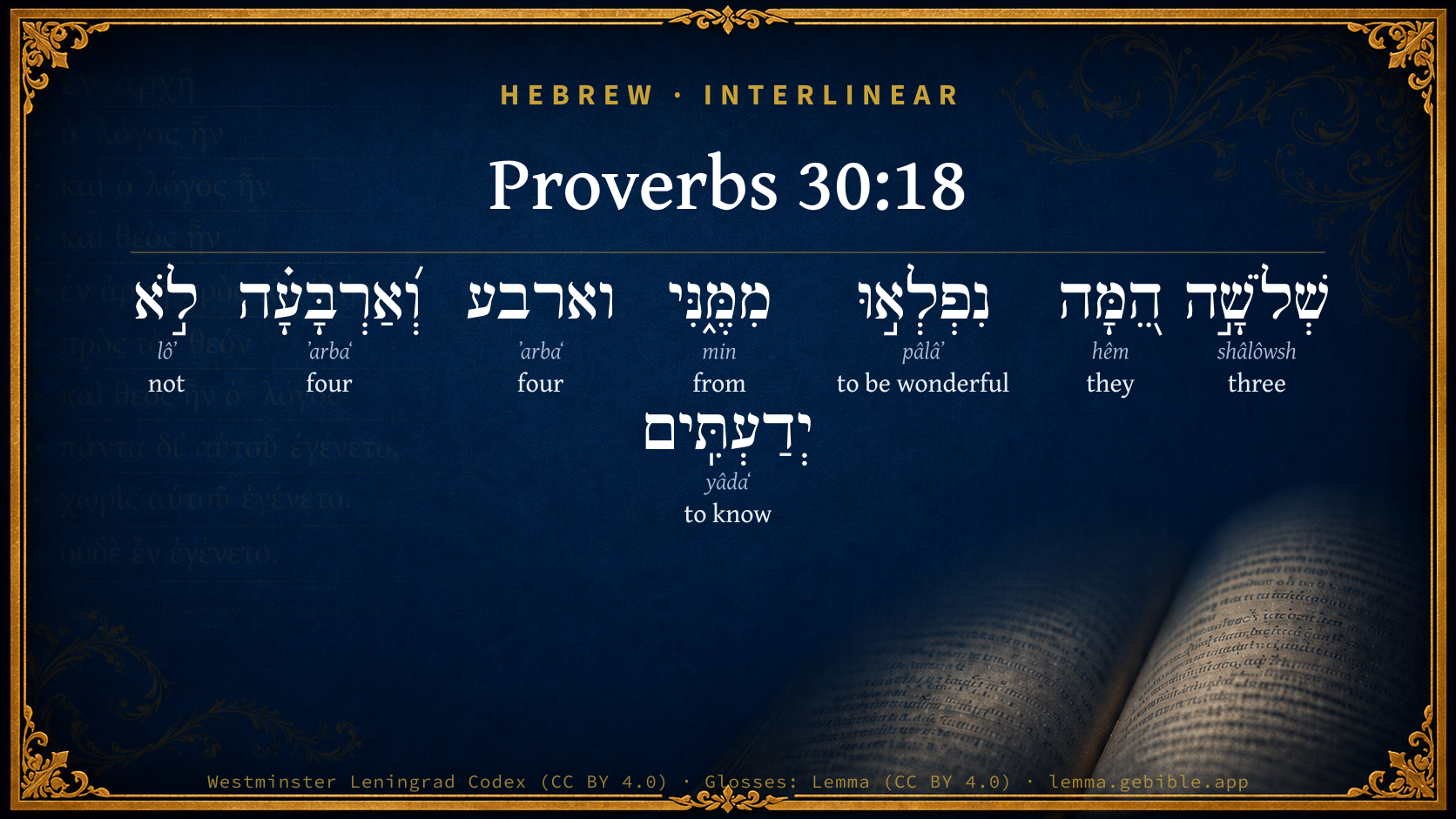
  1. שְׁלֹשָׁ֣ה shâlôwsh H7969 “three” Adjective, Cardinal number, Masculine, Singular, Absolute
  2. הֵ֭מָּה hêm H1992 “they” Pronoun, Personal, 3rd Person, Masculine, Plural
  3. מִמֶּ֑נִּי min H4480 “from · me” Preposition + Suffix, Personal, 1st Person, Common, Singular
  4. וארבע ʼarbaʻ H702 “and · four” Conjunction + Adjective, Cardinal number, Feminine, Singular, Absolute
  5. וְ֝אַרְבָּעָ֗ה ʼarbaʻ H702 “and · four” Conjunction + Adjective, Cardinal number, Masculine, Singular, Absolute
  6. לֹ֣א lôʼ H3808 “not” Particle, Negative
  7. יְדַעְתִּֽים yâdaʻ H3045 “to know · them” Verb, Qal, Perfect, 1st Person, Common, Singular + Suffix, Personal, 3rd Person, Masculine, Plural

About this verse

These counts appear in no published source. They are computed here, from the morphology-tagged text and Lemma’s own curated glosses. What Lemma adds →

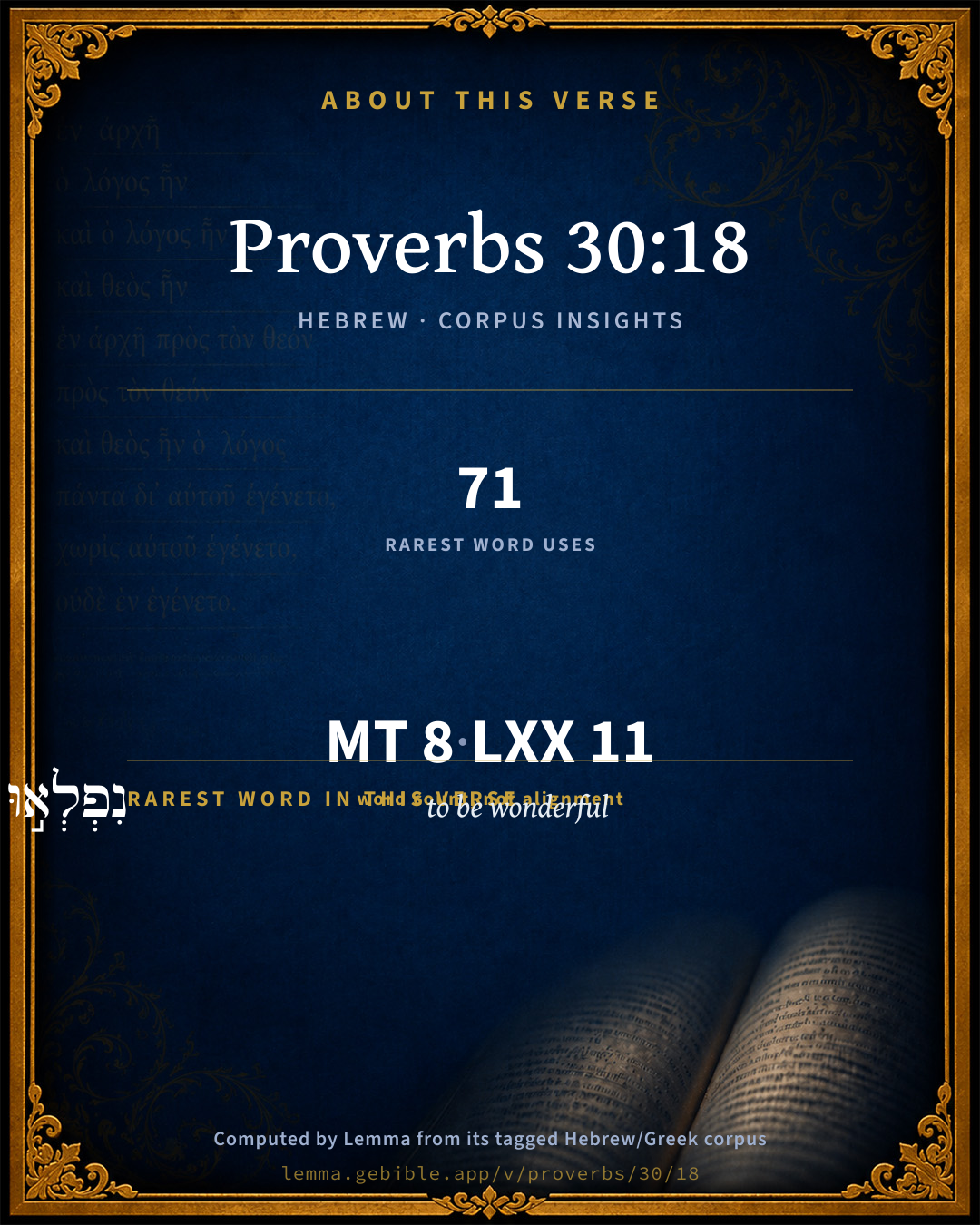
8
words
7
distinct lemmas
Wisdom
section

Grammatical profile

  • 2 verbs
  • 3 adjectives
  • 1 pronoun
  • 1 preposition
  • 1 particle

Verb forms

  • נִפְלְא֣וּ Niphal · Perfect
  • יְדַעְתִּֽים Qal · Perfect

Repetition

A word recurs within this verse — often emphatic in Hebrew:

  • וארבע four H702 ×2

Hebrew & Septuagint length

In English translation the verse runs 15 words from the Hebrew and 16 from the Septuagint (LXX English) — closely comparable.

A rough comparison of the two English renderings, which tokenize alike — not a word-level alignment.

Word counts can differ between the Hebrew and the Greek without any difference in meaning — e.g. the Hebrew direct-object marker אֵת has no separate Greek word, and Greek often adds the article ὁ.

In the original languages it is 8 Hebrew tokens and 11 Greek tokens — but the two are counted differently (Hebrew bundles its prefixes and suffixes into one token; the Greek is in lemma form), so that isn’t a like-for-like length.

Cross-references

2

Topical passages linked to Proverbs 30:18 in the Treasury of Scripture Knowledge — connected by theme and wording, ordered by reader-vote popularity; previews shown in the World English Bible.

  • Job 42:3 You asked, 'Who is this who hides counsel without knowledge?' Therefore I have uttered that which I did not understand, Things too wonderful for me, which I didn't know.
  • Psalms 139:6 This knowledge is beyond me. It's lofty. I can't attain it.

Cross-references courtesy of OpenBible.info (CC BY 4.0).

Hebrew and Greek witnesses Masoretic Hebrew ↔ Greek Septuagint

The same verse in the two great witnesses to the Old Testament, shown verse-for-verse.

These are two independent witnesses, not word-aligned to each other, and the Septuagint is shown in lemma (dictionary) form.

Hebrew Proverbs 30:18 Masoretic · Westminster Leningrad Codex

שְׁלֹשָׁ֣ה הֵ֭מָּה נִפְלְא֣וּ מִמֶּ֑נִּי וארבע וְ֝אַרְבָּעָ֗ה לֹ֣א יְדַעְתִּֽים

"There are three things which are too amazing for me, Four which I don't understand:

World English Bible · Public Domain

Greek LXX Proverbs 30:18 Septuagint · lemma form

τρεῖς δέ εἰμί ἀδύνατος ἐγώ νοέω καί ὁ τέταρτος οὐ ἐπιγιγνώσκω

Moreover there are three things impossible for me to comprehend, and the fourth I know not:

LXX2012 (modern English Septuagint) · Public Domain

On this verse, Whedon's Commentary on the Bible discusses the Septuagint’s reading. Read the note in Commentary ↓

Hebrew: Westminster Leningrad Codex (CC BY 4.0). Greek: Septuagint (public domain); English from LXX2012 (modern English Septuagint) (Public Domain). How the Septuagint differs from the Hebrew →

Commentary

Notes on Proverbs 30:18 from classic Christian and Jewish commentators (each source and its license shown beneath its notes). The classic Christian expositions comment on the surrounding passage and are grouped to its opening verse, so a note may address several verses; the Jewish commentaries on the Tanakh (Rashi and others) are per-verse, so they appear only where the commentator wrote on this verse.

Lemma curates 59 commentaries, every one of them public domain or Creative Commons licensed, each selected and text-cleaned for this edition rather than reprinted as found. About our sources →

Trapp's Complete Commentary

John Trapp

Pro 30:18 There be three [things which] are too wonderful for me, yea, four which I know not:

Ver. 18. There be three things which are too wonderful.] The wisest man that is cannot give a reason for all things; such as the ebbing and flowing of the sea, of the colours in the rainbow, of the strength of the nether chap, and of the heat in the stomach, which consumeth all other things, and yet not the parts about it. Agur here confesseth himself gravelled in four things at least, and benighted.

John Trapp, A Commentary or Exposition upon All the Books of the Old and New Testament (1647–1656) — public domain. Text from a community e-Sword module.

Joseph Benson's Commentary

Pro 30:18-19. There be three things too wonderful for me — The way whereof I cannot trace; the way of an eagle in the air — Either, 1st, The manner of her flight, which is exceedingly high, swift, and strong: or, rather, 2d, The way, or part of the air through which she passes, without leaving any print or sign in it. The way of a serpent upon a rock — Where it leaves no impression, nor slime, nor token which way it went. The way of a ship in the sea — In which, though at present it make a furrow, yet it is speedily closed again; and the way of a man with a maid — The various methods and artifices which young men sometimes use to slide into the hearts of young virgins, and win their love, that they may persuade them either to honourable marriage or to unlawful lust. “I would just observe upon this” last clause, says Dr. Dodd, “that some have understood it as a reference to the incarnation of the Word in the Virgin Mary.” The word עלמה, rendered maid, signifies a virgin, strictly speaking; and גבר, rendered a man, may signify the man, or great one, by way of eminence. But for more on this text the reader is referred to Schultens’s very accurate discussion of it. Houbigant thinks that the sacred writer here refers to the human conception; which is indeed truly miraculous and incomprehensible.

Joseph Benson's Commentary on the Old and New Testaments (1811–1818) — public domain. Text from a community e-Sword module.

The Preacher's Complete Homiletical Commentary

Joseph S. Exell (gen. ed.)

MAIN HOMILETICS OF THE PARAGRAPH.—Pro_30:18-20

DEPTHS OF WICKEDNESS

I. There are deeds of iniquity which leave no outward immediate trace. The path which the eagle opens by her wings when she soars aloft cannot be traced by the human eye. The air closes behind her as she moves, and she leaves nothing to show that she has passed that way. The vessel ploughs its way through the deep, and leaves a wake behind her for a short time. But the sea, like the air, soon resumes its former condition, and the keel leaves no lasting indication upon the water whereby the course of the mariner can be seen. So the serpent glides over the rock, and for a moment its shining scales are reflected in the sun, and then it is hidden from sight and the rock bears no footprint upon its surface. No human skill could, in any of these instances, find any evidence by which to establish the fact that either the thing without life or the living creatures had been there. So the sin to which all these comparisons are linked is one which may be concealed from the eyes of all except those concerned in it, not only at the time of its committal, but also in the immediate future. Those who come in contact with the guilty parties may see no more trace of the sin than they would do of an eagle’s course, or, to use the other metaphor, of bread that had been eaten by one who has wiped his mouth after the meal.

II. Sin is so in opposition to the voice of the human conscience that even those who love it most seek to hide it. The adulteress has sunk as low in the moral scale as it is possible for a human creature to sink, and yet she seeks to hide her shame. Men of evil deeds love darkness rather than light, and so give evidence that there is that within them that condemns their unholy deeds. The very denial of the crime is a condemnation of it. There are many crimes which are not amenable to human law which men, notwithstanding, try to hide from human eyes, and their efforts to do this are witnesses against them and in favour of the law which they have broken.

The Preacher's Complete Homiletical Commentary (gen. ed. Joseph S. Exell; Funk & Wagnalls, c. 1892) — public domain (pre-1929). A full-Bible homiletical/sermon-outline anthology covering 65 of 66 books (2 John is absent from the source module). Text from a community e-Sword module.

Tyndale Open Study Notes

Tyndale Open Resources

30:18-19 The writer stands amazed at how one thing moves on another.

Tyndale Open Study Notes — © Tyndale Open Resources, licensed CC BY-SA 4.0. Text via the HelloAO Bible API.

Matthew Henry's Commentary

Here is, I. An account of four things that are unsearchable, too wonderful to be fully known. And here,

1. The first three are natural things, and are only designed as comparisons for the illustration of the last. We cannot trace, (1.) An eagle in the air. Which way she has flown cannot be discovered either by the footstep or by the scent, as the way of a beast may upon ground; nor can we account for the wonderful swiftness of her flight, how soon she has gone beyond our ken. (2.) A serpent upon a rock. The way of a serpent in the sand we may find by the track, but not of a serpent upon the hard rock; nor can we describe how a serpent will, without feet, in a little time creep to the top of a rock. (3.) A ship in the midst of the sea. The leviathan indeed makes a path to shine after him, one would think the deep to be hoary (Job 41:32), but a ship leaves no mark behind it, and sometimes it is so tossed upon the waves that one would wonder how it lives at sea and gains its point. The kingdom of nature is full of wonders, marvellous things which the God of nature does, past finding out.

2. The fourth is a mystery of iniquity, more unaccountable than any of these; it belongs to the depths of Satan, that deceitfulness and that desperate wickedness of the heart which none can know, Jer 17:9. It is twofold: - (1.) The cursed arts which a vile adulterer has to debauch a maid, and to persuade her to yield to his wicked and abominable lust. This is what a wanton poet wrote a whole book of, long since, De arte amandi - On the art of love. By what pretensions and protestations of love, and all its powerful charms, promises of marriage, assurances of secresy and reward, is many an unwary virgin brought to sell her virtue, and honour, and peace, and soul, and all to a base traitor; for so all sinful lust is in the kingdom of love. The more artfully the temptation is managed the more watchful and resolute ought every pure heart to be against it. (2.) The cursed arts which a vile adulteress has to conceal her wickedness, especially from her husband, from whom she treacherously departs; so close are her intrigues with her lewd companions, and so craftily disguised, that it is as impossible to discover her as to track an eagle in the air. She eats the forbidden fruit, after the similitude of Adam's transgression, and then wipes her mouth, that it may not betray itself, and with a bold and impudent face says, I have done no wickedness. [1.] To the world she denies the fact, and is ready to swear it that she is as chaste and modest as any woman, and never did the wickedness she is suspected of. Those are the works of darkness which are industriously kept from coming to the light. [2.] To her own conscience (if she have any left) she denies the fault, and will not own that that great wickedness is any wickedness at all, but an innocent entertainment. See Hos 12:7, Hos 12:8. Thus multitudes ruin their souls by calling evil good and out-facing their convictions with a self-justification.

II. An account of four things that are intolerable, that is, four sorts of persons that are very troublesome to the places where they live and the relations and companies they are in; the earth is disquieted for them, and groans under them as a burden it cannot bear, and they are all much alike: - 1. A servant when he is advanced, and entrusted with power, who is, of all others, most insolent and imperious; witness Tobiah the servant, the Ammonite, Neh 2:10. 2. A fool, a silly, rude, boisterous, vicious man, who when he has grown rich, and is partaking of the pleasures of the table, will disturb all the company with his extravagant talk and the affronts he will put upon those about him. 3. An ill-natured, cross-grained, woman, when she gets a husband, one who, having made herself odious by her pride and sourness, so that one would not have thought any body would ever love her, yet, if at last she be married, that honourable estate makes her more intolerably scornful and spiteful than ever. It is a pity that that which should sweeten the disposition should have a contrary effect. A gracious woman, when she is married, will be yet more obliging. 4. An old maid-servant that has prevailed with her mistress, by humouring her, and, as we say, getting the length of her foot, to leave her what she has, or is as dear to her as if she was to be her heir, such a one likewise will be intolerably proud and malicious, and think all too little that her mistress gives her, and herself wronged if any thing be left from her. Let those therefore whom Providence has advanced to honour from mean beginnings carefully watch against that sin which will most easily beset them, pride and haughtiness, which will in them, of all others, be most insufferable and inexcusable; and let them humble themselves with the remembrance of the rock out of which they were hewn.

Matthew Henry's Commentary on the Whole Bible (1708–1710) — public domain (CC PDM 1.0). Text via the HelloAO Bible API.

Jamieson, Fausset & Brown

Robert Jamieson, A. R. Fausset & David Brown

Hypocrisy is illustrated by four examples of the concealment of all methods or traces of action, and a pertinent example of double dealing in actual vice is added, that is, the adulterous woman.

Jamieson, Fausset & Brown — Commentary Critical and Explanatory on the Whole Bible (1871) — public domain (CC PDM 1.0). Text via the HelloAO Bible API.

Ellicott's Commentary for English Readers

(18) Too wonderful for me.—The wonder in Agur’s eyes seems to be that none of the four leave any trace behind them. (Comp. Wis_5:10 sqq.) For a spiritual interpretation of these and other passages in this chapter, comp. Bishop Wordsworth’s Commentary.

A Bible Commentary for English Readers, edited by Charles John Ellicott (1878–1897) — public domain. Text from a community e-Sword module.

The Cambridge Bible for Schools and Colleges

gen. ed. J. J. S. Perowne

18. too wonderful] The wonder consists in these things leaving no trace behind them. Two of the four are used as illustrations of the transitoriness of a vicious life in Wis_5:10-11 (R.V.):

“As a ship passing through the billowy water,

Whereof, when it is gone by, there is no trace to be found,

Neither pathway of its keel in the billows:

Or as when a bird flieth through the air,

No token of her passage is found,

But the light wind, lashed with the stroke of her pinions,

And rent asunder with the violent rush of the moving wings, is passed through,

And afterwards no sign of her coming is found therein.”

18–20. Four things that are inscrutable.

The Cambridge Bible for Schools and Colleges (gen. ed. J. J. S. Perowne; Cambridge University Press, 1878–1918) — public domain. Text from a community e-Sword module.

John Gill's Exposition

There be three things which are too wonderful for me,.... Which were above his reach and comprehension; what he could not find out, nor account for, nor sufficiently admire;

yea, four things which I know not; the way of them; as follows.

John Gill's Exposition of the Whole Bible (1746–1763) — public domain (CC PDM 1.0). Text via the HelloAO Bible API.

Albert Barnes' Notes on the Bible

Another enigma. The four things of Pro 30:16 agreed in the common point of insatiableness; the four now mentioned agree in this, that they leave no trace behind them.

Pro 30:19

The way of a man with a maid - The act of sin leaves no outward mark upon the sinners.

Albert Barnes' Notes on the Bible (1834–1885) — public domain. Text from a community e-Sword/MySword module.

Matthew Poole's English Annotations

The way whereof I cannot trace or find out.

Matthew Poole's English Annotations on the Holy Bible (1683–1685) — public domain. Text from a community e-Sword/MySword module.

Whedon's Commentary on the Bible

Daniel D. Whedon

18, 19. Too wonderful — As we have in the preceding verses several illustrations of the insatiable, so we have in these examples of the mysterious. The mystery of these things (as commonly supposed) is not so much in themselves as in the discovery of them afterward — “the impossibility of tracing the way gone over.” — Stuart. There is a various reading in the last of the four particulars the correctness of which is maintained by very respectable critics. Instead of עלמה, (‘halmah,) a maid, a marriageable virgin, some manuscripts and versions read עלומיו, (‘halu-mayv,) his youth, “the way of a man in his youth.” So the Septuagint, Vulgate, Arabic, etc. Some illustrate this passage thus: In countries where young women are kept secluded there is little opportunity of personal acquaintance, and of what we call courtship. There are few chances by which a young man can personally engage the affections of a young woman. She is not at her own disposal, and can but acquiesce in the choice of her parents and friends. “I have often been surprised,” says a certain writer, “to see with what little regret a lover, proposed to a virgin, has been abandoned by her for another, perhaps not at all better. She transfers her connexion and person with so little difficulty to the latter’s proposal, that however she might have encouraged the first, and even have adopted him as her husband elect, he appears to have left no more trace on her mind than the eagle leaves in the air.” — TAYLOR’S Calmet, under Al-mah. All this may be so, but it seems to be the way of a maid with a man, rather than, as the text demands, the way of a man with a maid.

Conant’s note on “difficult things” is worthy of consideration. “It matters not that these things can be philosophically explained, and that we now understand how the eagle is sustained in the air by its reacting force, and moves upward or onward by the difference of forces. So can the ‘balancings of the clouds’ (Job_37:16) be now understood. The discovery that the air has weight, and is heavier than the pellicles of vapour, has explained the mystery. But there was a time when these were wonders, and to men as wise at least as we are in matters of greater concern than the truths of physical science. We all can remember when to us, too, they were wonders; and no illustrations of truth take stronger hold of the imagination and the heart than those drawn from our earliest impressions of nature. The Bible abounds in them, and in this is one secret of its hold on the human heart.”

Not less incomprehensible is the mysterious law of reproduction in the divinely appointed relation of the sexes. In purposed contrast with what follows, we have here the case of the bridegroom and bride, and their chaste intercourse, as a type of the sanctity and purity of that relation, for by “maid” is meant a young woman of marriageable age.

Daniel D. Whedon (gen. ed.), Commentary on the Old and New Testaments (1874–1909) — public domain. Text from a community e-Sword module.

The Pulpit Commentary

Vers. 18-20. A proverb concerning four inscrutable things, connected with the last by mention of the eagle.

There be three things which are too wonderful for me, yea, four which I know not. The great point is the fourth, to which the three previous things lead up, all of them being alike in this, that they leave no trace. The facts are marvellous; Agur feels like Job, "I have uttered that which I understood not, things too wonderful for me, which I knew not". (Job_42:3)

Vers. 18, 19. The mystery of love.

Agur sees four things that cannot be traced out.

1. "The way of an eagle in the air." No track is followed by the king of birds as it cleaves the invisible fluid and takes its own wild course from crag to crag.

2. "The way of a serpent upon a rock." Creeping out of a dark cranny, the reptile lies and basks on the hot stone, and then at the approach of an intruder darts into another cranny its course unknown.

3. "The way of a ship in the midst of the sea." We talk of the ocean highway, but there is no beaten track, no worn course. The ship cuts the surface for a moment, and then the waves roll over its path, and in a short time every trace of its passage is lost in the wash of the waters. So it is with the fourth mystery. The course of human love cannot be predicted or explained. It cannot be made to follow rule and precedent or to correspond to fond parental wishes. Love will go its own way free as the eagle in the air, unsuspected as the serpent on the rock, untracked as the ship in the sea. The three earlier wonders lead on to the fourth, and help to give colour and weight to it. The whole sentence thus gathers up its force into a climax. Nothing is so wonderful in the natural world as the great mystery of love. This may take three forms

I THE WILD FREEDOM OF THE EAGLE"S FLIGHT. Love can never be coerced. A forced marriage cannot be a love match. It is natural that man and maid should learn to love one another of their own accord, by the drawing of mutual sympathy. Friends may guide, warn, encourage, or hinder. But a matter which concerns the lifelong happiness of two souls cannot be well arranged by worldly contrivances. Nevertheless, love that is untamed and utterly uncontrolled may lead to frightful mistakes, to folly and sin and shame. The eagle is a wild and dangerous bird a terror to the helpless lamb. Love becomes a cursed thing, near to hatred, when it is no better than a wild, unfettered passion.

II THE SUBTLE SECRET OF THE SERPENT"S TRAIL. This is a very ugly picture, from which we start back shuddering and in horror. There is a snake-like cunning in selfish lust that wickedly usurps the sacred name of love, when it is really the very incarnation of hellish venom, seeking to allure its prey to destruction. All low, carnal lust is of the type of the serpent. The wild passion that follows the eagle"s flight may be dangerous, but the cold, loveless course of deliberate vice is deadly as that of a viper.

III THE UNCERTAIN VOYAGE OF THE SHIP. The ship is a home on the waters. She carries freight and passengers wealth and life. She sails from one port and she seeks another in a far-off land. But she cannot see her distant haven; she knows not what fierce tempests she may have to encounter; her way is uncertain and dangerous. Married life is a voyage over unknown waters. But where there is true love the vessel is well ballasted; she carries a cargo richer than untold ingots of gold; her crew work peacefully without fear of mutiny. Under such circumstances, though there is mystery, hearts that trust in God need fear no shipwreck of love and happiness.

Vers. 18-20. The mystery of actions.

I THERE ARE ACTIONS WHICH, LIKE THE FLIGHT OF THE EAGLE, OR THE PASSAGE OF THE SHIP, LEAVE NO VISIBLE TRACE BEHIND. What seems to strike the mind of the simple-hearted Agur is the fact that criminal deeds may be committed and, seemingly, leave as little trace behind.

II BUT THE MYSTERY AND SECRECY OF ALL ACTIONS ARE KNOWN TO GOD. We are naked and open to the eyes of him with whom we have to do. And God shall bring every secret work into judgment. Every act leaves its trace in the world of spirit. J.

The Pulpit Commentary (1880–1919), ed. H.D.M. Spence-Jones & Joseph S. Exell — public domain. Text from a community e-Sword module.

John Wesley's Explanatory Notes

Wonderful - The way whereof I cannot trace.

John Wesley, Explanatory Notes Upon the Whole Bible (1754–1765) — public domain. Text via the GEBible commentary corpus.

Keil & Delitzsch

C. F. Keil & F. Delitzsch

The following proverb, again a numerical proverb, begins with the eagle, mentioned in the last line of the foregoing:

18 Three things lie beyond me,

And four I understand not:

19 The way of the eagle in the heavens,

The way of a serpent over a rock,

The way of a ship on the high sea,

And the way of a man with a maid.

20 Thus is the way of the adulterous woman:

She eateth and wipeth her mouth, and saith:

I have done no iniquity.

נפלאוּ ממּנּי, as relative clause, like 15b (where Aquila, Symmachus, Theodotion rightly: τρία δέ ἐστιν ἃ οὐ πλησθήσεται), is joined to שׁלשׁה המּה. On the other hand, ארבע (τέσσαρα, for with the Kerı̂, conforming to 18a, ארבּעה, τέσσαρας) has to be interpreted as object. accus. The introduction of four things that are not known is in expressions like Job 42:3; cf. Psa 139:6. The turning-point lies in the fourth; to that point the other three expressions gravitate, which have not an object in themselves, but are only as folie to the fourth. The articles wanting after הנּשׁר: they would be only the marks of the gender, and are therefore unnecessary; cf. under Pro 29:2. And while בּשּׁמים, in the heavens, and בלב־ים, in the sea, are the expressions used, עלי צוּר is used for on the rock, because here "on" is not at the same time "in," "within," as the eagle cleaves the air and the ship the waves. For this same reason the expression, "the way of a man בּעלמה," is not to be understood of love unsought, suddenly taking possession of and captivating a man toward this or that maid, so that the principal thought of the proverb may be compared to the saying, "marriages are made in heaven;" but, as in Kidduschin 2b, with reference to this passage, is said coitus via appellatur. The ב refers to copula carnalis. But in what respect did his understanding not reach to this? "Wonderful," thus Hitzig explains as the best interpreter of this opinion elsewhere (cf. Psychol. p. 115) propounded, "appeared to him the flying, and that how a large and thus heavy bird could raise itself so high in the air (Job 39:27); then how, over the smooth rock, which offers no hold, the serpent pushes itself along; finally, how the ship in the trackless waves, which present nothing to the eye as a guide, nevertheless finds its way. These three things have at the same time this in common, that they leave no trace of their pathway behind them. But of the fourth way that cannot be said; for the trace is left on the substrat, which the man דּרך, and it becomes manifest, possibly as pregnancy, keeping out of view that the עלמה may yet be בתולה. That which is wonderful is consequently only the coition itself, its mystical act and its incomprehensible consequences." But does not this interpretation carry in itself its own refutation? To the three wonderful ways which leave no traces behind them, there cannot be compared a fourth, the consequences of which are not only not trackless, but, on the contrary, become manifest as proceeding from the act in an incomprehensible way. The point of comparison is either the wonderfulness of the event or the tracklessness of its consequences. But now "the way of a man בתולה" is altogether inappropriate to designate the wonderful event of the origin of a human being. How altogether differently the Chokma expresses itself on this matter is seen from Job 10:8-12; Ecc 11:5 (cf. Psychol. p. 210). That "way of a man with a maid" denotes only the act of coition, which physiologically differs in nothing from that of the lower animals, and which in itself, in the externality of its accomplishment, the poet cannot possibly call something transcendent. And why did he use the word בעלמה, and not rather בּנקבה [with a female] or בּאשּׁה [id.]? For this reason, because he meant the act of coition, not as a physiological event, but as a historical occurrence, as it takes place particularly in youth as the goal of love, not always reached in the divinely-appointed way. The point of comparison hence is not the secret of conception, but the tracelessness of the carnal intercourse. Now it is also clear why the way of the serpent עלי צור was in his eye: among grass, and still more in sand, the trace of the serpent's path would perhaps be visible, but not on a hard stone, over which it has glided. And it is clear why it is said of the ship בלב־ים [in the heart of the sea]: while the ship is still in sight from the land, one knows the track it follows; but who can in the heart of the sea, i.e., on the high sea, say that here or there a ship has ploughed the water, since the water-furrows have long ago disappeared? Looking to the heavens, one cannot say that an eagle has passed there; to the rock, that a serpent has wound its way over it; to the high sea, that a ship has been steered through it; to the maid, that a man has had carnal intercourse with her. That the fact might appear on nearer investigation, although this will not always guide to a certain conclusion, is not kept in view; only the outward appearance is spoken of, the intentional concealment (Rashi) being in this case added thereto. Sins against the sixth [= seventh] commandment remain concealed from human knowledge, and are distinguished from others by this, that they shun human cognition (as the proverb says: אין אפיטרופוס לעריות, there is for sins of the flesh no ἐπίτροπος) - unchastity can mask itself, the marks of chastity are deceitful, here only the All-seeing Eye (עין ראה כּל, Aboth ii. 1) perceives that which is done. Yet it is not maintained that "the way of a man with a maid" refers exclusively to external intercourse; but altogether on this side the proverb gains ethical significance. Regarding עלמה (from עלם, pubes esse et caeundi cupidus, not from עלם, to conceal, and not, as Schultens derives it, from עלם, signare, to seal) as distinguished from בּתוּלה, vid., under Isa 7:14. The mark of maidenhood belongs to עלמה not in the same way as to בתולה (cf. Gen 24:43 with 16), but only the marks of puberty and youth; the wife אשּׁה (viz., אושׁת אישׁ) cannot as such be called עלמה. Ralbag's gloss עלמה שׁהיא בעולה is incorrect, and in Arama's explanation (Akeda, Abschn. 9): the time is not to be determined when the sexual love of the husband to his wife flames out, ought to have been ודרך אישׁ בּאשׁתּו ne. One has therefore to suppose that Pro 30:20 explains what is meant by "the way of a man with a maid" by a strong example (for "the adulterous woman" can mean only an old adulteress), there not inclusive, for the tracklessness of sins of the flesh in their consequences.

This 20th verse does not appear to have been an original part of the numerical proverb, but is an appendix thereto (Hitzig). If we assume that כּן points forwards: thus as follows is it with the... (Fleischer), then we should hold this verse as an independent cognate proverb; but where is there a proverb (except Pro 11:19) that begins with כּן? כן, which may mean eodem modo (for one does not say כּן גּם) as well as eo modo, here points backwards in the former sense. Instead of וּמחתה פּיה (not פּיה; for the attraction of that which follows, brought about by the retrogression of the tone of the first word, requires dageshing, Thorath Emeth, p. 30) the lxx has merely ἀπονιψαμένη, i.e., as Immanuel explains: מקנּחה עצמה, abstergens semet ipsam, with Grotius, who to tergens os suum adds the remark: σεμνολογία (honesta elocutio). But eating is just a figure, like the "secret bread," Pro 9:17, and the wiping of the mouth belongs to this figure. This appendix, with its כן, confirms it, that the intention of the four ways refers to the tracklessness of the consequences.

Keil & Delitzsch — Biblical Commentary on the Old Testament (1861–1891) — public domain (CC PDM 1.0). Text via the HelloAO Bible API. (Old Testament only.)

Bridges on Proverbs

Charles Bridges

The kingdom of nature is full of wonder, and these wonders full of instruction. Where the philosopher cannot give a reason, the humble disciple may learn a lesson. The depths of nature are the figure of the depths of sin — of the unsearchable deceitful heart. (Jer 17:9 .) The eagle soars in the air with so lofty and rapid a flight, that the eye cannot follow her way. She leaves no scent nor footsteps, by which we might trace her, as the beast on the ground. (Job 39:27 .) The serpent on the sand would leave its mark. But the serpent on the rock leaves no slime like the worm, no feathers like the birds; who then can mark its way? The ship, like the great monster of the deep, "maketh a path to shine after her."†1 But while she ploughs in the midst (in the heart) of the sea, her furrows are quickly closed up, and her way is untraceable. Not less mysterious is the way of a man with a maid. Eminently practiced is the seducer in "the depths of Satan," and a thousand arts does he employ to allure the affections of his unwary victim. And it is often as difficult to penetrate his designs, and to escape his snares, as to trace the way of the eagle, the serpent, or the ship. Let this be a warning to young and inexperienced females, not to trust to their own purity, or to the strength of their own resolutions, or to place themselves in unprotected situations.†2

Equally unfathomable are the devices of the adulterous woman to entangle her prey, and to deceive her unsuspecting husband. Solomon has described the picture with striking and minute accuracy. (Pro 7:1-27 ; Pro 5:6 .) Such a course of abomination, wickedness, and hypocrisy, as is scarcely to be conceived; indulging her sin as the sweet morsel under her tongue; feasting greedily upon her "stolen waters and secret bread;"†3 yet keeping up the semblance of innocence and purity;†4 wiping her mouth, to prevent all suspicion, suffering no sign of the action to remain. A woman must be advanced very far in the way of sin, before she can present such unblushing a front. Yet every fresh indulgence of lust gives rise to new artifices, "hardening" the heart more fully in the "deceitfulness of sin." (Heb 3:13 .) Its fascinations blind it to its real character. Let then the first step be shunned, the most distant path, that may lead to temptation. Where shame ceases to accompany it, the ruin of the victim is accomplished. Abundant warning is given; solemn instruction — many beacons in the path — to show the certain end of this flowery road.†5

Footnotes:

†1 Job 41:32. Compare Psa 104:26 ; Psa 107:23-24 . This figure, and that of the eagle, as images of the rapid course of life, are finely illustrated - Wis 5:11-12 . Witsius admirably defends these figures as worthy of inspiration, against the sneers of neological critics - Misc. Sacra, Lib. i. c. xviii. 31-33.

†2 Ambrose has treated fully upon these four figures. Assuming the chapter to be written by Solomon, he explains his ignorance of them - ’not that he was not able to know them, but because it was not a time for him to know them.’ The way of the eagle he understands to be the ascension of Christ, flying back as an eagle to his Father, carrying man plucked from the jaws of the enemy as his prey with him! And though the ascension was visible, yet what understanding could grasp the apprehension of such Majesty retiring to heaven! The way of the serpent on the rock shadowed the assaults of Satan upon Christ - on whom, as on a rock (unlike the first man, who was earth and dust) he could leave no mark, no footsteps of his malice. The pious father seems to be in some doubt upon the third image. The way of the ship in the sea is the way of God’s church through the sea of persecution. This ship cannot miscarry, because Christ is lifted up in the mast of it - that is - on the cross. The Father sitteth as pilot at the stern of it. The Comforter preserved its prow! Or - Christ is the ship, into which the souls of all true believers do go up; which, that it may be carried more strongly in the midst of the waves, is made of wood, and fastened with iron: this is Christ in the flesh. And who can tell the way of this ship, either into the womb of the Virgin, or the heart of believers? The way of a man in his youth (LXX and some other versions) illustrates the ways of our Savior Christ in his youth upon the earth!’

Such puerile crudities are calculated to bring ridicule rather than reverence to the sacred book. Yet a combined and powerful effort is now made to palm the Fathers upon the church as the primary expositors of Scripture, and the standard of faith! Many patristic expositions of the Proverbs equally gross might have been produced. Apart from higher ground - Can we forbear surprise, that men of taste and learning should affix their imprimatur to such undisciplined folly of interpretation?

†3 Pro 9:17.

†4 Gen 39:13-19.

†5 Pro 5:3-5; Pro 7:24-27 ; Pro 9:18 .

Charles Bridges, An Exposition of the Book of Proverbs (1846) — public domain. Text from a community e-Sword module.

Kretzmann's Popular Commentary

Paul E. Kretzmann

Deducing Truths from Common Experience

v. 18. There be three things which are too wonderful for me, beyond the explanation of an ordinary mind, yea, four which I know not, cannot understand, which are incomprehensible:

v. 19. the way of an eagle in the air, both its manner and the fact that the air shows no trace of his having passed through; the way of a serpent upon a rock, which also leaves no marks; the way of a ship In the midst of the sea, whose wake is swiftly obliterated by the waves; and the way of a man with a maid, for such intercourse also leaves no traces which are immediately and directly apparent. Even so can hypocrisy conceal the real condition of the heart and mind, at least for a while.

v. 20. Such is the way of an adulterous woman, who eagerly makes use of such concealment; she eateth, enjoying the sinful act, and wipeth her mouth, boldly professing innocence, and saith, I have done no wickedness, feeling sure that she is safe against detection.

v. 21. For three things the earth is disquieted, trembling as under an unbearable burden, and for four which it cannot bear:

v. 22. for a servant, a man of the lowest condition and status in life, when he reigneth, when lie suddenly finds himself elevated to the position of ruler and then follows his caprice; and a fool when he is filled with meat, since lie, being surfeited, becomes insolent;

v. 23. for an odious woman when she is married, for an old maid, disagreeable in disposition, is apt to repay the contempt which she suffered from others in the same coin, and with full interest; and an handmaid, a house slave or nurse, that is heir to her mistress, such a piece of good fortune tending to make her insolent and presumptuous in her behavior.

v. 24. There be four things which are little upon the earth, inconspicuous and therefore ordinarily overlooked, but they are exceeding wise:

v. 25. The ants are a people not strong, not powerful in size, yet they prepare their meat in the summer, their diligence and thrift laying up a store for the time of need;

v. 26. the conies, the cliff-badgers of Palestine, are but a feeble folk, also lacking in strength, yet make they their houses in the rocks, thus exhibiting a shrewdness which is worthy of imitation;

v. 27. the locusts have no king, yet go they forth all of them by bands, their swarms migrating in perfect harmony and order;

v. 28. the spider, rather, the gecko, a poisonous spotted lizard, taketh hold with her hands, being able to cling to, and even move forward upon, the flat surfaces, and is in kings’ palaces, able to adapt herself to every situation. These virtues, as taught by the animals mentioned, are to be applied by men in their domestic, social, and political life.

v. 29. There be three things which go well, creatures that move with a stately bearing, yea, four are comely in going, showing dignity and power in every stride:

v. 30. a lion, which is strongest among beasts, commonly acknowledged as the king of wild beasts, and turneth not away for any, being a stranger to fear;

v. 31. a greyhound, slender in his loins and possessed of great and graceful speed; an he-goat also, known for strength and courage; and a king against whom there is no rising up, who exercises the authority of calling his men to battle and with becoming dignity marches at their head.

v. 32. If thou hast done foolishly in lifting up thyself, self-exaltation being evidence of unusual denseness, or if thou hast thought evil, in wicked plotting against a neighbor, lay thine hand upon thy mouth, refraining from further speech and thus from further sinning.

v. 33. Surely the churning of milk, the Oriental method being that of squeezing and wringing in a skin or bottle of leather, bringeth forth butter, and the wringing of the nose, if it is pressed too hard, bringeth forth blood; so the forcing of wrath, when one or both parties to a quarrel are highly irritated, bringeth forth strife, the proper course for a Christian therefore being that of refraining from anger and provocation and of living peaceably with all men, Rom 12:18.

Paul E. Kretzmann, Popular Commentary of the Bible (1921–1924) — public domain. Text from a community e-Sword module.

unfoldingWord translationNotes

Door43 World Missions Community

There are three things that are ... four that I do not understand:

The use of the numbers "three" and "four" here is likely a poetic device. AT: "There are some things that are too wonderful for me that I do not understand—four of them are:"

in the heart of the sea

The "heart" refers to the middle. AT: "in the middle of the sea" or "on the open sea" (See: Metaphor)

translationWords

eagle

heaven

unfoldingWord translationNotes — © Distant Shores Media and the Door43 World Missions Community, licensed CC BY-SA 4.0. Source: git.door43.org/Door43/en_tn.

Rashi

Rabbi Shlomo Yitzchaki (Rashi)

are concealed from me They are covered after they passed from my eyes, and I do not know where they went, because they hasten to hide from the eye.

Rashi on the Tanakh — English translations: “The Judaica Press complete Tanach with Rashi, translated by A. J. Rosenberg” (CC BY 4.0); “Pentateuch with Rashi's commentary by M. Rosenbaum and A.M. Silbermann, 1929-1934” (public domain); “The Metsudah Tanach series, Lakewood, N.J” (CC BY 4.0); and “The Book of Joshua, Metsudah Publications, 1997” (CC BY 4.0). Text via Sefaria.

Lesson kit

Teaching starters — assembled from the data on this page, not authored interpretation. Every prompt links to the verse data it draws on. Edit before teaching.

Proverbs, in the Wisdom, opens this verse with 8 words (7 distinct Hebrew lemmas). Its most distinctive word is pâlâʼ (“to be wonderful”). A historical commentator’s framing appears above. Read the whole chapter for the surrounding context.

Discussion questions

  1. The word pâlâʼ carries the sense “to be wonderful.” How does it shape the verse?
  2. How does Job 42:3, which shares this passage’s theme, read alongside this verse?
  3. What does the repetition of “four” (2× in this one verse) do in this verse?
  4. These translations render this verse differently. What is at stake in choosing one wording over another?
  5. «נִפְלְא֣וּ» is a Niphal Perfect verb. How does that grammatical form shape the action described?
  6. Compare how Trapp's Complete Commentary and Joseph Benson's Commentary read this verse. Where do they agree or differ?

Things to notice

Reading settings

Reading text

Shown beneath each verse's original-language words.

Old Testament
Old Testament edition

Read the OT as the Masoretic Hebrew (MT) or the Greek Septuagint (LXX).

English shown for the Greek Septuagint (in the Hebrew ↔ Greek comparison).

Comparing translations? Open the Compare panel on any verse page to stack up to four side by side.