
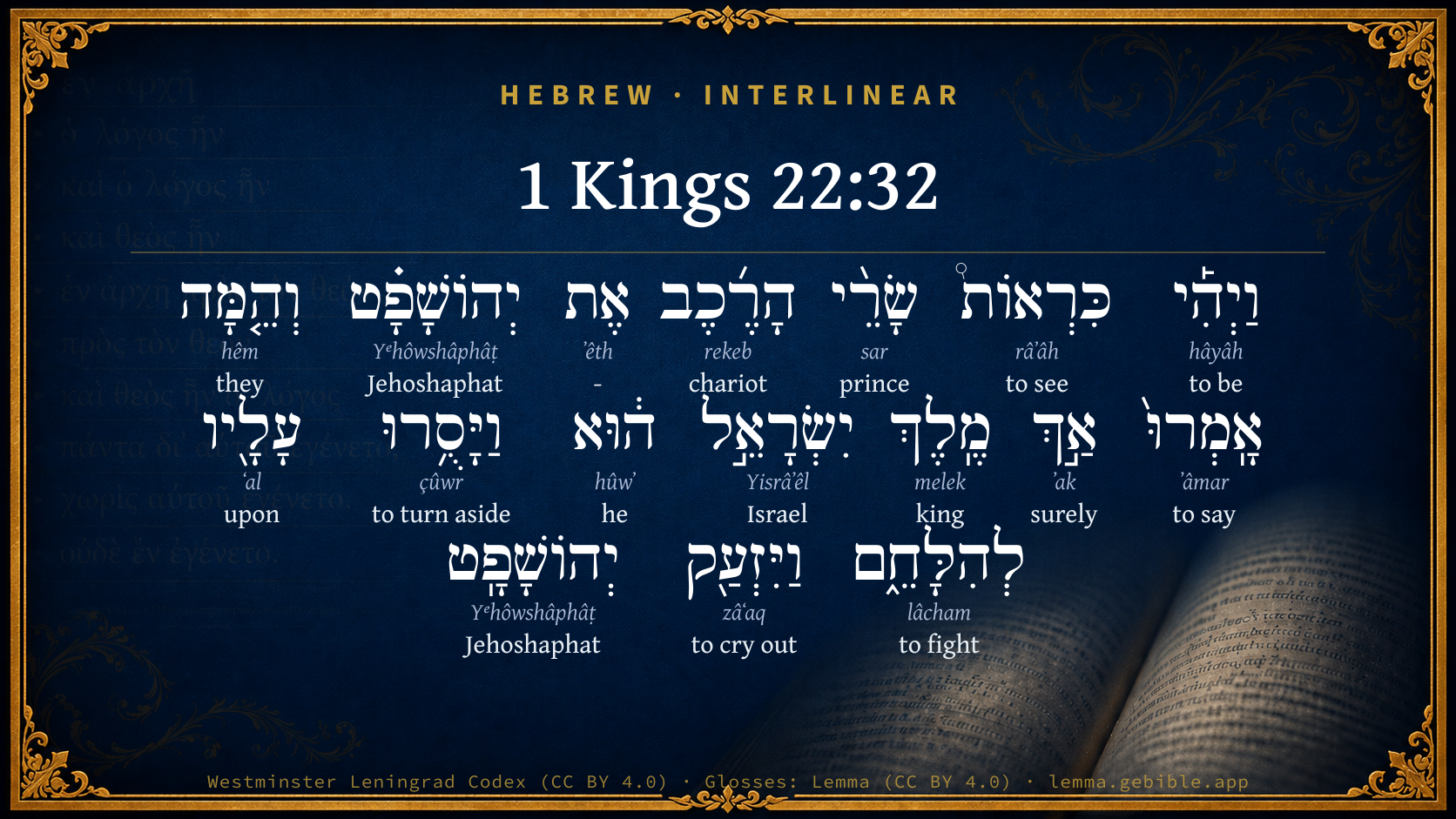
1 Kings 22:32

Hebrew (Westminster Leningrad Codex) 1 Kings 22:32 appears in the Hebrew Old Testament. The text above is from the Westminster Leningrad Codex. Each word links to its Strong’s number, a concise gloss, and parsing drawn from the Open Scriptures Hebrew Bible morphology. Click any word for its full Brown-Driver-Briggs (BDB) entry.
Download image
Cite this verse

1 Kings 22:32 (World English Bible). Public Domain. Lemma interlinear Bible study tool, https://lemma.gebible.app/v/1-kings/22/32.

Show BibTeX & RIS
BibTeX
RIS
English Translation
It happened, when the captains of the chariots saw Jehoshaphat, that they said, Surely it is the king of Israel; and they turned aside to fight against him: and Jehoshaphat cried out.
World English Bible · Public Domain
Download a study sheet

One document with this verse’s original text, its word-by-word gloss line, the meaning frame, cross-references with their text, attributed commentary, and full source and license credits — printable, and it pastes into notes with its structure intact.

This verse Autodidact and up

Study sheet (.html) Plain text (.txt)

A passage Seminary Student

Up to 50 verses in one chapter. A passage sheet keeps up to 6 commentary sources and 12 cross-references per verse, in the order this page ranks them, and says so on the sheet whenever that leaves anything out. Ask for a single verse and you get the Autodidact verse sheet above.

Everything on this page stays free to read, with no account — the sheet is a download of what is already on screen, not access to it.

Want to remove ads? Support Godless Engineer
Compare translations 3

The same verse in 3 English versions, stacked beneath the original-language interlinear above. Click any original word for its lexicon entry.

Each is an independent rendering of the whole verse — the interlinear is not word-aligned to these translations.

Highlighted words mark where these versions differ — a whole-verse word diff, not a word-by-word alignment.

  • World English Bible Public Domain
    It happened, when the captains of the chariots saw Jehoshaphat, that they said, Surely it is the king of Israel; and they turned aside to fight against him: and Jehoshaphat cried out.
  • King James Version Public Domain
    And it came to pass, when the captains of the chariots saw Jehoshaphat, that they said, Surely it is the king of Israel. And they turned aside to fight against him: and Jehoshaphat cried out.
  • unfoldingWord Literal Text CC BY-SA 4.0
    And it happened, when the commanders of the chariotry saw Jehoshaphat, that they, they said, “Surely he the king of Israel!” And they turned aside to fight against him, and Jehoshaphat cried out.

unfoldingWord Literal Text — © unfoldingWord, licensed CC BY-SA 4.0. Word-aligned USFM3 via Door43 (git.door43.org/unfoldingWord/en_ult).

Versions to compare (up to 4)

3 of 4 selected

Show all 18 translations

Every available English version of this verse, each an independent rendering of the whole verse.

  • World English Bible Public Domain
    It happened, when the captains of the chariots saw Jehoshaphat, that they said, Surely it is the king of Israel; and they turned aside to fight against him: and Jehoshaphat cried out.
  • Berean Standard Bible Public Domain
    When the chariot commanders saw Jehoshaphat, they said, “Surely this is the king of Israel!” So they turned to fight against him, but Jehoshaphat cried out.
  • Majority Standard Bible Public Domain
    When the chariot commanders saw Jehoshaphat, they said, “Surely this is the king of Israel!” So they turned to fight against him, but Jehoshaphat cried out.
  • King James Version Public Domain
    And it came to pass, when the captains of the chariots saw Jehoshaphat, that they said, Surely it is the king of Israel. And they turned aside to fight against him: and Jehoshaphat cried out.
  • American Standard Version (1901) Public Domain
    And it came to pass, when the captains of the chariots saw Jehoshaphat, that they said, Surely it is the king of Israel; and they turned aside to fight against him: and Jehoshaphat cried out.
  • Revised Version (1885) Public Domain
    And it came to pass, when the captains of the chariots saw Jehoshaphat, that they said, Surely it is the king of Israel; and they turned aside to fight against him: and Jehoshaphat cried out.
  • Geneva Bible (1599) Public Domain
    And when the captaines of the charets saw Iehoshaphat, they sayd, Surely it is the King of Israel, and they turned to fight against him: and Iehoshaphat cryed.
  • Douay-Rheims (1899) Public Domain
    So when the captains of the chariots saw Josaphat, they suspected that he was the king of Israel, and making a violent assault they fought against him: and Josaphat cried out.
  • Young's Literal Translation Public Domain
    And it cometh to pass, at the heads of the charioteers seeing Jehoshaphat, that they said, `He `is' only the king of Israel;' and they turn aside to him to fight, and Jehoshaphat crieth out,
  • Literal Standard Version CC BY-SA 4.0
    And it comes to pass, at the heads of the charioteers seeing Jehoshaphat, that they said, “He [is] surely the king of Israel!” And they turn aside to him to fight, and Jehoshaphat cries out,
  • Unlocked Literal Bible CC BY-SA 4.0
    It came about that when the captains of the chariots saw Jehoshaphat they said, “Surely that is the king of Israel.” They turned to attack him, so Jehoshaphat cried out.
  • unfoldingWord Literal Text CC BY-SA 4.0
    And it happened, when the commanders of the chariotry saw Jehoshaphat, that they, they said, “Surely he the king of Israel!” And they turned aside to fight against him, and Jehoshaphat cried out.
  • Darby Bible Public Domain
    And it came to pass when the captains of the chariots saw Jehoshaphat, that they said, Surely that is the king of Israel; and they turned against him to fight; and Jehoshaphat cried out.
  • World Messianic Bible Public Domain
    When the captains of the chariots saw Jehoshaphat, they said, “Surely that is the king of Israel!” and they came over to fight against him. Jehoshaphat cried out.
  • Webster's Bible Public Domain
    And it came to pass, when the captains of the chariots saw Jehoshaphat, that they said, Surely it is the king of Israel. And they turned aside to fight against him: and Jehoshaphat cried out.
  • Free Bible Version CC BY-SA 4.0
    So when the chariot commanders saw Jehoshaphat, they shouted, “This must be the king of Israel!” So they turned to attack him, but when Jehoshaphat called out for help,
  • Bible in Basic English Public Domain
    So when the captains of the war-carriages saw Jehoshaphat, they said, Truly, this is the king of Israel; and turning against him, they came round him, but Jehoshaphat gave a cry.
  • JPS Tanakh (1917) Public Domain
    And it came to pass, when the captains of the chariots saw Jehoshaphat, that they said: 'Surely it is the king of Israel'; and they turned aside to fight against him; and Jehoshaphat cried out.

Literal Standard Version (2020), Covenant Press — licensed CC BY-SA 4.0. Text via the HelloAO Bible API (eBible.org). Unlocked Literal Bible (unfoldingWord) — licensed CC BY-SA 4.0. Text via the HelloAO Bible API (eBible.org). unfoldingWord Literal Text — © unfoldingWord, licensed CC BY-SA 4.0. Word-aligned USFM3 via Door43 (git.door43.org/unfoldingWord/en_ult). Free Bible Version, Dr. Jonathan Gallagher — licensed CC BY-SA 4.0. Text via the HelloAO Bible API (eBible.org).

Word by word

More ways to search: Search by grammar → Find every occurrence → Compare this word →

Practice this passage: Drill this verse → Learn its vocabulary →

וַיִּזְעַ֖ק
zâʻaq
H2199
“and · to cry out”
Conjunction + Verb, Qal, Sequential Imperfect, 3rd Person, Masculine, Singular
Part of Speech
Conjunction + Verb
Stem
Qal
Form
Sequential Imperfect
Person
3rd Person
Gender
Masculine
Number
Singular
Full BDB Definition

Origin: a primitive root

TWOT: 570

to cry, cry out, call, call for help - (Qal) - to call (to one's aid) - to cry, cry out (in need) - (Niphal) to be assembled, be called together, be joined together - (Hiphil) - to call, call out, call together, summon - to make a crying, proclaim - to have a proclamation made - to call out to, call out at
  1. וַיְהִ֡י hâyâh H1961 “and · to be” Conjunction + Verb, Qal, Sequential Imperfect, 3rd Person, Masculine, Singular
  2. כִּרְאוֹת֩ râʼâh H7200 “like/as · to see” Preposition + Verb, Qal, Infinitive Construct
  3. שָׂרֵ֨י sar H8269 “princes of” Noun, Common, Masculine, Plural, Construct
  4. הָרֶ֜כֶב rekeb H7393 “the · chariot” Particle, Definite Article + Noun, Common, Masculine, Singular, Absolute
  5. אֶת ʼêth H853 “-” Particle, Direct Object
  6. יְהוֹשָׁפָ֗ט Yᵉhôwshâphâṭ H3092 “Jehoshaphat” Noun, Proper
  7. וְהֵ֤מָּה hêm H1992 “and · they” Conjunction + Pronoun, Personal, 3rd Person, Masculine, Plural
  8. אָֽמְרוּ֙ ʼâmar H559 “to say” Verb, Qal, Perfect, 3rd Person, Common, Plural
  9. אַ֣ךְ ʼak H389 “surely” Particle, Accusative
  10. מֶֽלֶךְ melek H4428 “king of” Noun, Common, Masculine, Singular, Construct
  11. יִשְׂרָאֵ֣ל Yisrâʼêl H3478 “Israel” Noun, Proper
  12. ה֔וּא hûwʼ H1931 “he” Pronoun, Personal, 3rd Person, Masculine, Singular
  13. וַיָּסֻ֥רוּ çûwr H5493 “and · to turn aside” Conjunction + Verb, Qal, Sequential Imperfect, 3rd Person, Masculine, Plural
  14. עָלָ֖יו ʻal H5921 “upon · him” Preposition + Suffix, Personal, 3rd Person, Masculine, Singular
  15. לְהִלָּחֵ֑ם lâcham H3898 “to fight” Preposition + Verb, Niphal, Infinitive Construct
  16. יְהוֹשָׁפָֽט Yᵉhôwshâphâṭ H3092 “Jehoshaphat” Noun, Proper

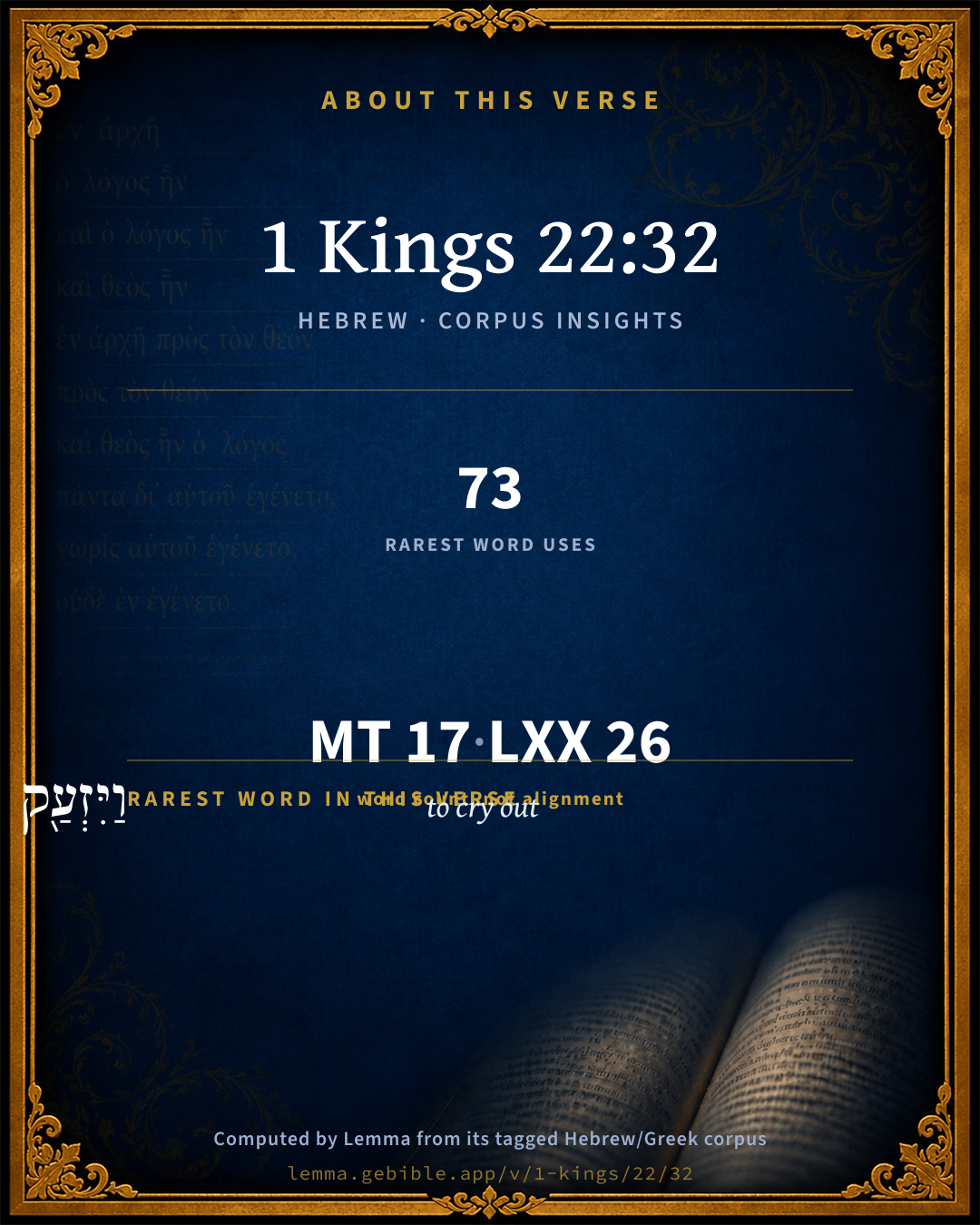
About this verse

These counts appear in no published source. They are computed here, from the morphology-tagged text and Lemma’s own curated glosses. What Lemma adds →

17
words
16
distinct lemmas
Historical
section

Grammatical profile

  • 6 verbs
  • 6 nouns
  • 2 pronouns
  • 1 preposition
  • 2 particles

Verb forms

  • וַיְהִ֡י Qal · Sequential Imperfect
  • כִּרְאוֹת֩ Qal · Infinitive Construct
  • אָֽמְרוּ֙ Qal · Perfect
  • וַיָּסֻ֥רוּ Qal · Sequential Imperfect
  • לְהִלָּחֵ֑ם Niphal · Infinitive Construct
  • וַיִּזְעַ֖ק Qal · Sequential Imperfect

Repetition

A word recurs within this verse — often emphatic in Hebrew:

  • יְהוֹשָׁפָ֗ט Jehoshaphat H3092 ×2

Hebrew & Septuagint length

In English translation the verse runs 32 words from the Hebrew and 40 from the Septuagint (LXX English) — closely comparable.

A rough comparison of the two English renderings, which tokenize alike — not a word-level alignment.

Word counts can differ between the Hebrew and the Greek without any difference in meaning — e.g. the Hebrew direct-object marker אֵת has no separate Greek word, and Greek often adds the article ὁ.

In the original languages it is 17 Hebrew tokens and 26 Greek tokens — but the two are counted differently (Hebrew bundles its prefixes and suffixes into one token; the Greek is in lemma form), so that isn’t a like-for-like length.

Cross-references

8

Topical passages linked to 1 Kings 22:32 in the Treasury of Scripture Knowledge — connected by theme and wording, ordered by reader-vote popularity; previews shown in the World English Bible.

  • Proverbs 13:20 One who walks with wise men grows wise, But a companion of fools suffers harm.
  • Jonah 2:1–2 Then Jonah prayed to Yahweh, his God, out of the fish's belly.
  • Exodus 14:10 When Pharaoh drew near, the children of Israel lifted up their eyes, and behold, the Egyptians were marching after them; and they were very afraid. The children of Israel cried out to Yahweh.
  • 2 Chronicles 18:31 It happened, when the captains of the chariots saw Jehoshaphat, that they said, It is the king of Israel. Therefore they turned about to fight against him: but Jehoshaphat cried out, and Yahweh helped him; and God moved them [to depart] from him.
  • Psalms 50:15 Call on me in the day of trouble. I will deliver you, and you will honor me."
  • Psalms 91:15 He will call on me, and I will answer him. I will be with him in trouble. I will deliver him, and honor him.
  • Psalms 116:1–2 I love Yahweh, because he listens to my voice, And my cries for mercy.
  • Psalms 130:1–4 Out of the depths I have cried to you, Yahweh.

Cross-references courtesy of OpenBible.info (CC BY 4.0).

Hebrew and Greek witnesses Masoretic Hebrew ↔ Greek Septuagint

The same verse in the two great witnesses to the Old Testament, shown verse-for-verse.

These are two independent witnesses, not word-aligned to each other, and the Septuagint is shown in lemma (dictionary) form.

Hebrew 1 Kings 22:32 Masoretic · Westminster Leningrad Codex

וַיְהִ֡י כִּרְאוֹת֩ שָׂרֵ֨י הָרֶ֜כֶב אֶת יְהוֹשָׁפָ֗ט וְהֵ֤מָּה אָֽמְרוּ֙ אַ֣ךְ מֶֽלֶךְ יִשְׂרָאֵ֣ל ה֔וּא וַיָּסֻ֥רוּ עָלָ֖יו לְהִלָּחֵ֑ם וַיִּזְעַ֖ק יְהוֹשָׁפָֽט

It happened, when the captains of the chariots saw Jehoshaphat, that they said, Surely it is the king of Israel; and they turned aside to fight against him: and Jehoshaphat cried out.

World English Bible · Public Domain

Greek LXX 1 Kings 22:32 Septuagint · lemma form

καί γίγνομαι ὡς ὁράω ὁ ἄρχων ὁ ἅρμα ὁ ιωσαφατ βασιλεύς ἰουδά καί αὐτός εἶπον φαίνω βασιλεύς ἰσραήλ οὗτος καί κυκλόω αὐτός πολεμέω καί ἀνακράζω ιωσαφατ

And it came to pass, when the captains of the chariots saw Josaphat king of Juda, that they said, this seems to be the king of Israel. And they compassed him about to fight against him; and Josaphat cried out.

LXX2012 (modern English Septuagint) · Public Domain

On this verse, The Cambridge Bible for Schools and Colleges discusses the Septuagint’s reading. Read the note in Commentary ↓

Hebrew: Westminster Leningrad Codex (CC BY 4.0). Greek: Septuagint (public domain); English from LXX2012 (modern English Septuagint) (Public Domain). How the Septuagint differs from the Hebrew →

Targum (Aramaic paraphrase)

1

The Targum is the ancient Jewish Aramaic paraphrase of the Hebrew Scriptures — an interpretive translation, not the Hebrew text itself. Onkelos (literal) and Pseudo-Jonathan (expansive) render the Torah, and Jonathan the Prophets. Coverage is partial: where no permissively-licensed English translation exists for a verse, only the Aramaic is shown. This is verse-level text, not a word-by-word alignment to the Hebrew.

  1. Targum Jonathan Prophets (Joshua–Malachi)
    וַהֲוָה כַּד חֲזוֹ רַבָּנֵי רְתִיכַיָא יַת יְהוֹשָׁפָט וְאִינוּן אֲמַרוּ בְּרַם מַלְכָּא דְיִשְׂרָאֵל הוּא וְזָרוּ עֲלוֹהִי לְאַגָחָא קְרָבָא בֵיהּ וּצְוַח יְהוֹשָׁפָט:

    (no public-domain English translation for this verse)

    Targum Jonathan — Aramaic: “Mikraot Gedolot” (public domain). English: “Sefaria Community Translation” (CC0 1.0 (public-domain dedication)); “London "Chaldee Paraphrase," 1871” (public domain). Text via Sefaria.

Commentary

Notes on 1 Kings 22:32 from classic Christian and Jewish commentators (each source and its license shown beneath its notes). The classic Christian expositions comment on the surrounding passage and are grouped to its opening verse, so a note may address several verses; the Jewish commentaries on the Tanakh (Rashi and others) are per-verse, so they appear only where the commentator wrote on this verse.

Lemma curates 59 commentaries, every one of them public domain or Creative Commons licensed, each selected and text-cleaned for this edition rather than reprinted as found. About our sources →

Trapp's Complete Commentary

John Trapp

1Ki 22:32 And it came to pass, when the captains of the chariots saw Jehoshaphat, that they said, Surely it [is] the king of Israel. And they turned aside to fight against him: and Jehoshaphat cried out.

Ver. 32. And Jehoshaphat cried out.] To God for help, {2Ch 18:31} but in addition in such a manner, as the Syrians perceived it was not Ahab, perhaps because he cried out to Jehovah alone, contemnens minutulos illos deos, modo Iovam sibi propitium haberet. And now Jehoshaphat seeth to his sorrow the great inconvenience of being in bad company: and that green wood also, if bound up with dry, doth easily take fire, and is burned together.

John Trapp, A Commentary or Exposition upon All the Books of the Old and New Testament (1647–1656) — public domain. Text from a community e-Sword module.

Joseph Benson's Commentary

1Ki 22:32-33. When the captains — saw Jehoshaphat, they said, Surely, &c. — They saw no other but him in a royal habit, and hence concluded he must be the king of Israel, whom they believed to be present in the battle, and to be the commander of the Israelitish army. They turned aside to fight against him — They drew their forces from their several quarters toward him. And Jehoshaphat cried out — By his danger God now let him know that he was displeased with him, for joining in confederacy with Ahab. They that associate with evil doers are in danger of sharing in their plagues. When the captains — perceived it was not the king of Israel — This they would easily perceive, either by the words which he spake, when he cried out, or by the difference of his form and countenance from those of Ahab, whom, probably, many of them had seen, and knew well. They turned back from pursuing him — Thus, by his deliverance, God showed him that, though he was displeased with him, he had not deserted him. To him he cried out, not in cowardice, but devotion, and from him his relief came. For God, who has the hearts of all men in his hand, moved them to depart from him, 2Ch 18:31. In the mean time Ahab, who brought him into this danger, seems to have been in no care to succour him. God is a friend who will not fail us when other friends do.

Joseph Benson's Commentary on the Old and New Testaments (1811–1818) — public domain. Text from a community e-Sword module.

Geneva Bible (1599)

Geneva Bible translators

That is, to the Lord for help.

Geneva Bible (1599) marginal notes — public domain. Text via Bolls.life.

Ellicott's Commentary for English Readers

(32) Cried out—i.e., to rally his people round him In 2Ch_18:31 it is added, “And the Lord helped him; and God moved them to depart from him.”

A Bible Commentary for English Readers, edited by Charles John Ellicott (1878–1897) — public domain. Text from a community e-Sword module.

The Cambridge Bible for Schools and Colleges

gen. ed. J. J. S. Perowne

32. when the captains of the chariots saw Jehoshaphat] They would recognise from a distance that this was a royal personage, and would naturally suppose that it could be none other than Ahab. On approaching nearer they would probably discern that he was not wearing the armour and insignia of Israel. The LXX. represents them as saying ‘This seems to be the king of Israel,’ as if they were guided by the robes and kingly array.

And they turned aside to fight against him] The LXX. has ‘and they compassed him about &c.’

and Jehoshaphat cried out] Perhaps to his own men to rally round him for defence. It can hardly have been a cry to his assailants to let them know he was not the man they sought. For he could not be acquainted with the orders they had received. We see from the expansion in 2Ch_18:31 ‘But Jehoshaphat cried out and the Lord helped him; and God moved them to depart from him’ that it was understood at that time that the cry was to Jehovah to save him from the danger. The Vulg. has ‘clamavit ad Dominum.’

The Cambridge Bible for Schools and Colleges (gen. ed. J. J. S. Perowne; Cambridge University Press, 1878–1918) — public domain. Text from a community e-Sword module.

John Gill's Exposition

And there went a proclamation throughout the host, about the going down of the sun,.... Much about the time that Ahab died; and this proclamation by an herald might be made by his order, as he was dying, or by Jehoshaphat, when he understood he was dead:

saying, every man to his city, and every man to his own country; the order was to cease fighting, and make the best of their way as fast as they could to their own homes, since their shepherd and master was dead, which fulfilled the vision of Micaiah, Kg1 22:17. It seems to have been a drawn battle, at least there is no account of the advantage on either side.

John Gill's Exposition of the Whole Bible (1746–1763) — public domain (CC PDM 1.0). Text via the HelloAO Bible API.

Albert Barnes' Notes on the Bible

Surely it is the king of Israel - This was a natural supposition, as Jehoshaphat alone wore royal robes.

And Jehoshaphat cried out - Jehoshaphat called to his men for help, using perhaps his own special battle-cry, which would be distinct from that of Ahab, and would probably be known to the Syrians.

Albert Barnes' Notes on the Bible (1834–1885) — public domain. Text from a community e-Sword/MySword module.

Haydock's Catholic Bible Commentary

Cried out. Paralipomenon add, to the Lord, and he helped him, and turned them away from him. The Jews (in Seder. Olam xvii.) acknowledge the same thing; and thus it was known that Josaphat was not the king of Israel, who would rather have invoked Baal. (Menochius) --- Perhaps he also declared the truth, and who he was, when he saw the Syrians surround him, crying, This is the king of Israel! (2 Paralipomenon xviii. 31.) (Tirinus)

George Leo Haydock (1774–1849), Haydock's Catholic Family Bible and Commentary, 1859 edition — public domain. Excludes Psalms (Douay-Rheims chapter numbering differs from Protestant) and Deuterocanonical books (Catholic canon only).

Matthew Poole's English Annotations

They turned aside; they drew their forces from their several quarters towards Jehoshaphat.

Jehoshaphat cried out to the Lord for help, 2Ch 18:31.

Matthew Poole's English Annotations on the Holy Bible (1683–1685) — public domain. Text from a community e-Sword/MySword module.

Whedon's Commentary on the Bible

Daniel D. Whedon

32. Jehoshaphat cried out — He called upon God to save him, and probably used in his prayer his own name, or title, or at least some expression by which those Syrian captains learned that he was not the king of Israel. By this means “the Lord helped him; and God moved them to depart from him.” 2Ch_18:31.

Daniel D. Whedon (gen. ed.), Commentary on the Old and New Testaments (1874–1909) — public domain. Text from a community e-Sword module.

The Pulpit Commentary

And it came to pass when the captains of the chariots saw Jehoshaphat, that they said, Surely not only (Bahr, Keil), but certainly; (cf. Gen_44:28; Jud_1:3:24; 2Ki_24:3) it Heb. he is the king of Israel. And they turned aside Cf.klwsen, 1Ki_20:39, same word. The Hebrew inserts wyl. The chronicler reads Wbsoy; they surrounded him, instead of Wrsuy; and the LXX has ejku in both places. But the Syrians can hardly have actually closed round the king, and the alteration might easily be made in the course of transcription to fight against him according to their instructions: and Jehoshaphat cried out. This cry has been very variously interpreted. According to some, it was his own name that he ejaculated, which is possible, if the command of ver. 31 was known in the allied army. According to others, it was the battle cry of Judah, which, it is said, would be familiar to the Syrians, and which would rally his own soldiers round him. The Vulgate, no doubt influenced by the words of 2Ch_18:31, "And the Lord helped him, and God moved them to depart from him," interprets, clamavit ad Dominum. That it was a cry for Divine help is the most probable, because it is almost an instinct, especially with a pious soul like Jehoshaphat, to cry to God in the moment of danger. That he had doubts as to whether the course he was pursuing was pleasing to God, would make him all the more ready to cry aloud for mercy the moment he found himself in peril. But it may have been merely a cry of terror. It must be carefully observed that the Scripture does not say that it was this cry led to his being recognized and spared.

The Pulpit Commentary (1880–1919), ed. H.D.M. Spence-Jones & Joseph S. Exell — public domain. Text from a community e-Sword module.

Rashi

Rabbi Shlomo Yitzchaki (Rashi)

And Yehoshofot cried out. To the Holy One Blessed Is He.

Rashi on the Tanakh — English translations: “The Judaica Press complete Tanach with Rashi, translated by A. J. Rosenberg” (CC BY 4.0); “Pentateuch with Rashi's commentary by M. Rosenbaum and A.M. Silbermann, 1929-1934” (public domain); “The Metsudah Tanach series, Lakewood, N.J” (CC BY 4.0); and “The Book of Joshua, Metsudah Publications, 1997” (CC BY 4.0). Text via Sefaria.

Lesson kit

Teaching starters — assembled from the data on this page, not authored interpretation. Every prompt links to the verse data it draws on. Edit before teaching.

1 Kings, in the Historical, opens this verse with 17 words (16 distinct Hebrew lemmas). Its most distinctive word is zâʻaq (“to cry out”). A historical commentator’s framing appears above. Read the whole chapter for the surrounding context.

Discussion questions

  1. The word zâʻaq carries the sense “to cry out.” How does it shape the verse?
  2. Proverbs 13:20 shares this passage’s theme. How do the two illuminate each other?
  3. “Jehoshaphat” occurs 2× in this one verse. What is the effect of the repetition?
  4. The translations on this page render this verse differently — a whole-verse word diff, not a word-by-word alignment. What might account for the different wordings?
  5. The verb «וַיְהִ֡י» is Qal Sequential Imperfect. How does its form color the action?
  6. Reading how Trapp's Complete Commentary and Joseph Benson's Commentary read this verse, where do the two commentators agree and where do they part?

Things to notice

Reading settings

Reading text

Shown beneath each verse's original-language words.

Old Testament
Old Testament edition

Read the OT as the Masoretic Hebrew (MT) or the Greek Septuagint (LXX).

English shown for the Greek Septuagint (in the Hebrew ↔ Greek comparison).

Comparing translations? Open the Compare panel on any verse page to stack up to four side by side.