
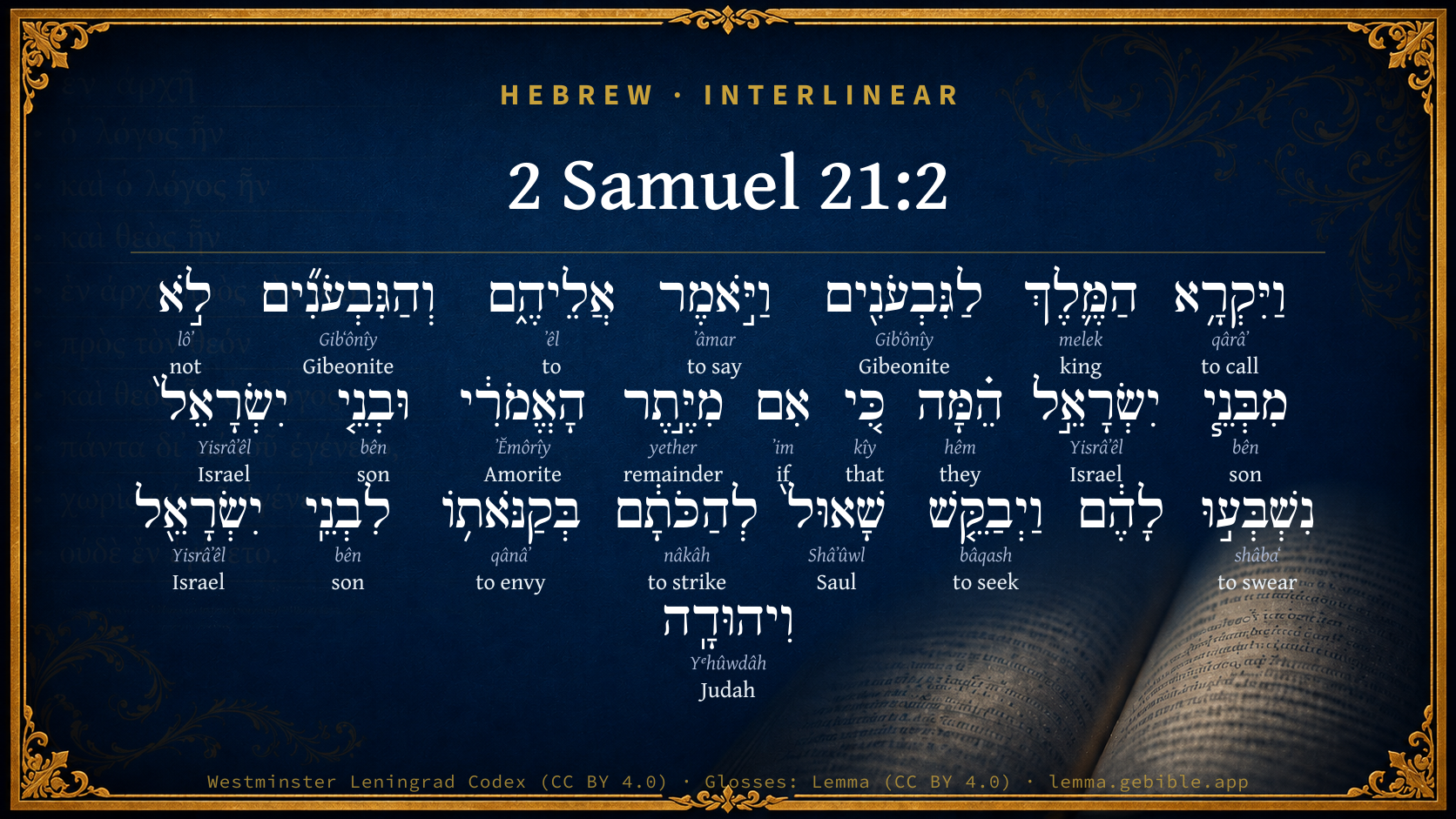
2 Samuel 21:2

Hebrew (Westminster Leningrad Codex) 2 Samuel 21:2 appears in the Hebrew Old Testament. The text above is from the Westminster Leningrad Codex. Each word links to its Strong’s number, a concise gloss, and parsing drawn from the Open Scriptures Hebrew Bible morphology. Click any word for its full Brown-Driver-Briggs (BDB) entry.
Download image
Cite this verse

2 Samuel 21:2 (World English Bible). Public Domain. Lemma interlinear Bible study tool, https://lemma.gebible.app/v/2-samuel/21/2.

Show BibTeX & RIS
BibTeX
RIS
English Translation
The king called the Gibeonites, and said to them (now the Gibeonites were not of the children of Israel, but of the remnant of the Amorites; and the children of Israel had sworn to them: and Saul sought to kill them in his zeal for the children of Israel and Judah);
World English Bible · Public Domain
Download a study sheet

One document with this verse’s original text, its word-by-word gloss line, the meaning frame, cross-references with their text, attributed commentary, and full source and license credits — printable, and it pastes into notes with its structure intact.

This verse Autodidact and up

Study sheet (.html) Plain text (.txt)

A passage Seminary Student

Up to 50 verses in one chapter. A passage sheet keeps up to 6 commentary sources and 12 cross-references per verse, in the order this page ranks them, and says so on the sheet whenever that leaves anything out. Ask for a single verse and you get the Autodidact verse sheet above.

Everything on this page stays free to read, with no account — the sheet is a download of what is already on screen, not access to it.

Want to remove ads? Support Godless Engineer
Compare translations 3

The same verse in 3 English versions, stacked beneath the original-language interlinear above. Click any original word for its lexicon entry.

Each is an independent rendering of the whole verse — the interlinear is not word-aligned to these translations.

Highlighted words mark where these versions differ — a whole-verse word diff, not a word-by-word alignment.

  • World English Bible Public Domain
    The king called the Gibeonites, and said to them (now the Gibeonites were not of the children of Israel, but of the remnant of the Amorites; and the children of Israel had sworn to them: and Saul sought to kill them in his zeal for the children of Israel and Judah);
  • King James Version Public Domain
    And the king called the Gibeonites, and said unto them; (now the Gibeonites were not of the children of Israel, but of the remnant of the Amorites; and the children of Israel had sworn unto them: and Saul sought to slay them in his zeal to the children of Israel and Judah.)
  • unfoldingWord Literal Text CC BY-SA 4.0
    And the king called to the Gibeonites, and he spoke to them. (Now the Gibeonites not from the sons of Israel. Rather, they from the remnant of the Amorite. And the sons of Israel had sworn to them, but Saul sought to strike them when he was jealous for the sons of Israel and Judah.)

unfoldingWord Literal Text — © unfoldingWord, licensed CC BY-SA 4.0. Word-aligned USFM3 via Door43 (git.door43.org/unfoldingWord/en_ult).

Versions to compare (up to 4)

3 of 4 selected

Show all 18 translations

Every available English version of this verse, each an independent rendering of the whole verse.

  • World English Bible Public Domain
    The king called the Gibeonites, and said to them (now the Gibeonites were not of the children of Israel, but of the remnant of the Amorites; and the children of Israel had sworn to them: and Saul sought to kill them in his zeal for the children of Israel and Judah);
  • Berean Standard Bible Public Domain
    At this, David summoned the Gibeonites and spoke to them. (Now the Gibeonites were not Israelites, but a remnant of the Amorites. The Israelites had taken an oath concerning them, but in his zeal for Israel and Judah, Saul had sought to kill them.)
  • Majority Standard Bible Public Domain
    At this, David summoned the Gibeonites and spoke to them. (Now the Gibeonites were not Israelites, but a remnant of the Amorites. The Israelites had taken an oath concerning them, but in his zeal for Israel and Judah, Saul had sought to kill them.)
  • King James Version Public Domain
    And the king called the Gibeonites, and said unto them; (now the Gibeonites were not of the children of Israel, but of the remnant of the Amorites; and the children of Israel had sworn unto them: and Saul sought to slay them in his zeal to the children of Israel and Judah.)
  • American Standard Version (1901) Public Domain
    And the king called the Gibeonites, and said unto them (now the Gibeonites were not of the children of Israel, but of the remnant of the Amorites; and the children of Israel had sworn unto them: and Saul sought to slay them in his zeal for the children of Israel and Judah);
  • Revised Version (1885) Public Domain
    And the king called the Gibeonites, and said unto them; (now the Gibeonites were not of the children of Israel, but of the remnant of the Amorites; and the children of Israel had sworn unto them: and Saul sought to slay them in his zeal for the children of Israel and Judah:)
  • Geneva Bible (1599) Public Domain
    Then ye King called the Gibeonites and said vnto them. (Now the Gibeonites were not of the children of Israel, but a remnant of the Amorites, vnto whom ye children of Israel had sworne: but Saul sought to slay them for his zeale toward the children of Israel and Iudah)
  • Douay-Rheims (1899) Public Domain
    Then the king, calling for the Gabaonites, said to them: (Now the Gabaonites were not of the children of Israel, but the remains of the Amorrhites: I and the children of Israel had sworn to them, and Saul sought to slay them out of zeal, as it were for the children of Israel and Juda:)
  • Young's Literal Translation Public Domain
    And the king calleth for the Gibeonites, and saith unto them -- as to the Gibeonites, they `are' not of the sons of Israel, but of the remnant of the Amorite, and the sons of Israel had sworn to them, and Saul seeketh to smite them in his zeal for the sons of Israel and Judah --
  • Literal Standard Version CC BY-SA 4.0
    And the king calls for the Gibeonites and says to them—as for the Gibeonites, they [are] not of the sons of Israel, but of the remnant of the Amorite, and the sons of Israel had sworn to them, and Saul seeks to strike them in his zeal for the sons of Israel and Judah—
  • Unlocked Literal Bible CC BY-SA 4.0
    Now the Gibeonites were not from the people of Israel; they were from what remained of the Amorites. The people of Israel had sworn not to kill them, but Saul tried to kill them all anyway in his zeal for the people of Israel and Judah.
  • unfoldingWord Literal Text CC BY-SA 4.0
    And the king called to the Gibeonites, and he spoke to them. (Now the Gibeonites not from the sons of Israel. Rather, they from the remnant of the Amorite. And the sons of Israel had sworn to them, but Saul sought to strike them when he was jealous for the sons of Israel and Judah.)
  • Darby Bible Public Domain
    And the king called the Gibeonites, and spoke to them. (Now the Gibeonites were not of the children of Israel, but of the remainder of the Amorites; and the children of Israel had sworn to them; and Saul sought to smite them in his zeal for the children of Israel and Judah.)
  • World Messianic Bible Public Domain
    The king called the Gibeonites and said to them (now the Gibeonites were not of the children of Israel, but of the remnant of the Amorites, and the children of Israel had sworn to them; and Saul sought to kill them in his zeal for the children of Israel and Judah);
  • Webster's Bible Public Domain
    And the king called the Gibeonites, and said to them; (now the Gibeonites were not of the children of Israel, but of the remnant of the Amorites; and the children of Israel had sworn to them: and Saul sought to slay them, in his zeal to the children of Israel and Judah.)
  • Free Bible Version CC BY-SA 4.0
    David summoned the Gibeonites and spoke with them. The Gibeonites were not Israelites, but what was left of the Amorites. The Israelites had sworn an oath to them, but in his nationalistic passion for the Israelites and Judah, Saul had tried to wipe them out.
  • Bible in Basic English Public Domain
    Then the king sent for the Gibeonites; (now the Gibeonites were not of the children of Israel, but were the last of the Amorites, to whom the children of Israel had given an oath; but Saul, in his passion for the children of Israel and Judah, had made an attempt on their lives:)
  • JPS Tanakh (1917) Public Domain
    And the king called the Gibeonites, and said unto them — now the Gibeonites were not of the children of Israel, but of the remnant of the Amorites; and the children of Israel had sworn unto them; and Saul sought to slay them in his zeal for the children of Israel and Judah —

Literal Standard Version (2020), Covenant Press — licensed CC BY-SA 4.0. Text via the HelloAO Bible API (eBible.org). Unlocked Literal Bible (unfoldingWord) — licensed CC BY-SA 4.0. Text via the HelloAO Bible API (eBible.org). unfoldingWord Literal Text — © unfoldingWord, licensed CC BY-SA 4.0. Word-aligned USFM3 via Door43 (git.door43.org/unfoldingWord/en_ult). Free Bible Version, Dr. Jonathan Gallagher — licensed CC BY-SA 4.0. Text via the HelloAO Bible API (eBible.org).

Word by word

More ways to search: Search by grammar → Find every occurrence → Compare this word →

Practice this passage: Drill this verse → Learn its vocabulary →

לַגִּבְעֹנִ֖ים
Gibʻônîy
H1393
“to/for the · Gibeonites”
Preposition, Determined + Noun, Gentilic, Masculine, Plural, Absolute
Part of Speech
Preposition + Noun
Type
Gentilic
Gender
Masculine
Number
Plural
State
Absolute
Full BDB Definition

Origin: patrial from H1391

TWOT: None

Gibeonite = "little hill: hilly" - an inhabitant of Gibeon
  1. וַיִּקְרָ֥א qârâʼ H7121 “and · to call” Conjunction + Verb, Qal, Sequential Imperfect, 3rd Person, Masculine, Singular
  2. הַמֶּ֛לֶךְ melek H4428 “the · king” Particle, Definite Article + Noun, Common, Masculine, Singular, Absolute
  3. וַיֹּ֣אמֶר ʼâmar H559 “and · to say” Conjunction + Verb, Qal, Sequential Imperfect, 3rd Person, Masculine, Singular
  4. אֲלֵיהֶ֑ם ʼêl H413 “to · them” Preposition + Suffix, Personal, 3rd Person, Masculine, Plural
  5. וְהַגִּבְעֹנִ֞ים Gibʻônîy H1393 “and · the · Gibeonites” Conjunction + Particle, Definite Article + Noun, Gentilic, Masculine, Plural, Absolute
  6. לֹ֣א lôʼ H3808 “not” Particle, Negative
  7. מִבְּנֵ֧י bên H1121 “from · sons of” Preposition + Noun, Common, Masculine, Plural, Construct
  8. יִשְׂרָאֵ֣ל Yisrâʼêl H3478 “Israel” Noun, Proper
  9. הֵ֗מָּה hêm H1992 “they” Pronoun, Personal, 3rd Person, Masculine, Plural
  10. כִּ֚י kîy H3588 “that” Conjunction
  11. אִם ʼim H518 “if” Conjunction
  12. מִיֶּ֣תֶר yether H3499 “from · remainder of” Preposition + Noun, Common, Masculine, Singular, Construct
  13. הָאֱמֹרִ֔י ʼĔmôrîy H567 “the · Amorite” Particle, Definite Article + Noun, Gentilic, Masculine, Singular, Absolute
  14. וּבְנֵ֤י bên H1121 “and · sons of” Conjunction + Noun, Common, Masculine, Plural, Construct
  15. יִשְׂרָאֵל֙ Yisrâʼêl H3478 “Israel” Noun, Proper
  16. נִשְׁבְּע֣וּ shâbaʻ H7650 “to swear” Verb, Niphal, Perfect, 3rd Person, Common, Plural
  17. וַיְבַקֵּ֤שׁ bâqash H1245 “and · to seek” Conjunction + Verb, Piel, Sequential Imperfect, 3rd Person, Masculine, Singular
  18. שָׁאוּל֙ Shâʼûwl H7586 “Saul” Noun, Proper
  19. לְהַכֹּתָ֔ם nâkâh H5221 “to strike · them” Preposition + Verb, Hiphil, Infinitive Construct + Suffix, Personal, 3rd Person, Masculine, Plural
  20. בְּקַנֹּאת֥וֹ qânâʼ H7065 “in/at · to envy · him” Preposition + Verb, Piel, Infinitive Construct + Suffix, Personal, 3rd Person, Masculine, Singular
  21. לִבְנֵֽי bên H1121 “to/for · sons of” Preposition + Noun, Common, Masculine, Plural, Construct
  22. יִשְׂרָאֵ֖ל Yisrâʼêl H3478 “Israel” Noun, Proper
  23. וִיהוּדָֽה Yᵉhûwdâh H3063 “and · Judah” Conjunction + Noun, Proper

About this verse

These counts appear in no published source. They are computed here, from the morphology-tagged text and Lemma’s own curated glosses. What Lemma adds →

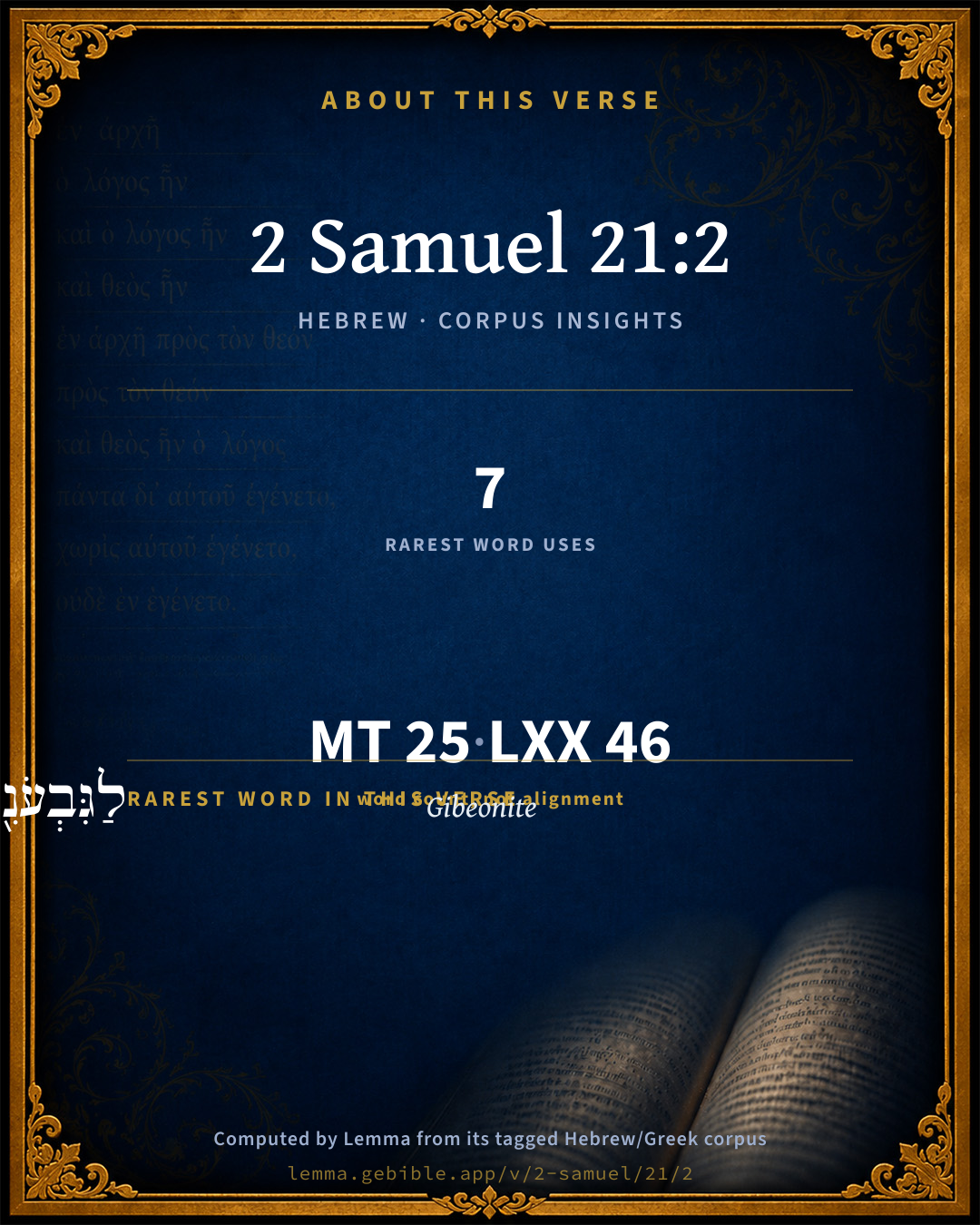
25
words
19
distinct lemmas
Historical
section

Notable vocabulary

The rarest word here is לַגִּבְעֹנִ֖ים Gibeonite H1393 — appearing just 7 times in the whole Hebrew Bible.

Shared distinctive vocabulary

לַגִּבְעֹנִ֖ים Gibeonite H1393 occurs in 6 verses of the Hebrew Bible. Also found in:

Grammatical profile

  • 6 verbs
  • 13 nouns
  • 1 pronoun
  • 2 prepositions
  • 2 conjunctions
  • 1 particle

Verb forms

  • וַיִּקְרָ֥א Qal · Sequential Imperfect
  • וַיֹּ֣אמֶר Qal · Sequential Imperfect
  • נִשְׁבְּע֣וּ Niphal · Perfect
  • וַיְבַקֵּ֤שׁ Piel · Sequential Imperfect
  • לְהַכֹּתָ֔ם Hiphil · Infinitive Construct
  • בְּקַנֹּאת֥וֹ Piel · Infinitive Construct

Repetition

Words recur within this verse — often emphatic in Hebrew:

  • מִבְּנֵ֧י son H1121 ×3
  • יִשְׂרָאֵ֣ל Israel H3478 ×3
  • לַגִּבְעֹנִ֖ים Gibeonite H1393 ×2

Hebrew & Septuagint length

In English translation the verse runs 51 words from the Hebrew and 52 from the Septuagint (LXX English) — closely comparable.

A rough comparison of the two English renderings, which tokenize alike — not a word-level alignment.

Word counts can differ between the Hebrew and the Greek without any difference in meaning — e.g. the Hebrew direct-object marker אֵת has no separate Greek word, and Greek often adds the article ὁ.

In the original languages it is 25 Hebrew tokens and 46 Greek tokens — but the two are counted differently (Hebrew bundles its prefixes and suffixes into one token; the Greek is in lemma form), so that isn’t a like-for-like length.

Cross-references

11

Topical passages linked to 2 Samuel 21:2 in the Treasury of Scripture Knowledge — connected by theme and wording, ordered by reader-vote popularity; previews shown in the World English Bible.

  • Joshua 9:3–21 But when the inhabitants of Gibeon heard what Joshua had done to Jericho and to Ai,
  • Genesis 15:16 In the fourth generation they will come here again, for the iniquity of the Amorite is not yet full."
  • Deuteronomy 7:16 You shall consume all the peoples who Yahweh your God shall deliver to you; your eye shall not pity them: neither shall you serve their gods; for that will be a snare to you.
  • 1 Samuel 14:44 Saul said, God do so and more also; for you shall surely die, Jonathan.
  • 1 Samuel 15:8–9 He took Agag the king of the Amalekites alive, and utterly destroyed all the people with the edge of the sword.
  • 2 Kings 10:16 He said, Come with me, and see my zeal for Yahweh. So they made him ride in his chariot.
  • 2 Kings 10:31 But Jehu took no heed to walk in the law of Yahweh, the God of Israel, with all his heart: he didn't depart from the sins of Jeroboam, with which he made Israel to sin.
  • Luke 9:54–55 When his disciples, James and John, saw this, they said, "Lord, do you want us to command fire to come down from the sky, and destroy them, just as Elijah did?"
  • Romans 10:2 For I testify about them that they have a zeal for God, but not according to knowledge.
  • John 16:2 They will put you out of the synagogues. Yes, the time comes that whoever kills you will think that he offers service to God.
  • Galatians 4:17 They zealously seek you in no good way. No, they desire to alienate you, that you may seek them.

Cross-references courtesy of OpenBible.info (CC BY 4.0).

Hebrew and Greek witnesses Masoretic Hebrew ↔ Greek Septuagint

The same verse in the two great witnesses to the Old Testament, shown verse-for-verse.

These are two independent witnesses, not word-aligned to each other, and the Septuagint is shown in lemma (dictionary) form.

Hebrew 2 Samuel 21:2 Masoretic · Westminster Leningrad Codex

וַיִּקְרָ֥א הַמֶּ֛לֶךְ לַגִּבְעֹנִ֖ים וַיֹּ֣אמֶר אֲלֵיהֶ֑ם וְהַגִּבְעֹנִ֞ים לֹ֣א מִבְּנֵ֧י יִשְׂרָאֵ֣ל הֵ֗מָּה כִּ֚י אִם מִיֶּ֣תֶר הָאֱמֹרִ֔י וּבְנֵ֤י יִשְׂרָאֵל֙ נִשְׁבְּע֣וּ לָהֶ֔ם וַיְבַקֵּ֤שׁ שָׁאוּל֙ לְהַכֹּתָ֔ם בְּקַנֹּאת֥וֹ לִבְנֵֽי יִשְׂרָאֵ֖ל וִיהוּדָֽה

The king called the Gibeonites, and said to them (now the Gibeonites were not of the children of Israel, but of the remnant of the Amorites; and the children of Israel had sworn to them: and Saul sought to kill them in his zeal for the children of Israel and Judah);

World English Bible · Public Domain

Greek LXX 2 Samuel 21:2 Septuagint · lemma form

καί καλέω ὁ βασιλεύς δαυίδ ὁ γαβαωνίτης καί εἶπον πρός αὐτός καί ὁ γαβαωνίτης οὐ υἱός ἰσραήλ εἰμί ὅτι ἀλλά ἤ ἐκ ὁ λεῖμμα ὁ ἀμορραῖος καί ὁ υἱός ἰσραήλ ὄμνυμι αὐτός καί ζητέω σαούλ πατάσσω αὐτός ἐν ὁ ζηλόω αὐτός ὁ υἱός ἰσραήλ καί ιουδα

And King David called the Gabaonites, and said to them; —(now the Gabaonites are not the children of Israel, but are of the remnant of the Amorite, and the children of Israel had sworn to them: but Saul sought to strike them in his zeal for the children of Israel and Juda.)

LXX2012 (modern English Septuagint) · Public Domain

Hebrew: Westminster Leningrad Codex (CC BY 4.0). Greek: Septuagint (public domain); English from LXX2012 (modern English Septuagint) (Public Domain). How the Septuagint differs from the Hebrew →

Targum (Aramaic paraphrase)

1

The Targum is the ancient Jewish Aramaic paraphrase of the Hebrew Scriptures — an interpretive translation, not the Hebrew text itself. Onkelos (literal) and Pseudo-Jonathan (expansive) render the Torah, and Jonathan the Prophets. Coverage is partial: where no permissively-licensed English translation exists for a verse, only the Aramaic is shown. This is verse-level text, not a word-by-word alignment to the Hebrew.

  1. Targum Jonathan Prophets (Joshua–Malachi)
    וּקְרָא מַלְכָּא לְגִבְעוֹנָאֵי וַאֲמַר לְהוֹן וְגִבְעוֹנָאֵי לָא מִבְּנֵי יִשְׂרָאֵל אִינוּן אֱלָהֵין מִשְׁאַר אֱמוֹרָאֵי וּבְנֵי יִשְׂרָאֵל קַיָמוּ לְהוֹן וּבְעָא שָׁאוּל לְקַטָלוּתְהוֹן בִּדְקָנִי לִבְנֵי יִשְׂרָאֵל וִיהוּדָה:

    (no public-domain English translation for this verse)

    Targum Jonathan — Aramaic: “Mikraot Gedolot” (public domain). English: “Sefaria Community Translation” (CC0 1.0 (public-domain dedication)); “London "Chaldee Paraphrase," 1871” (public domain). Text via Sefaria.

Commentary

Notes on 2 Samuel 21:2 from classic Christian and Jewish commentators (each source and its license shown beneath its notes). The classic Christian expositions comment on the surrounding passage and are grouped to its opening verse, so a note may address several verses; the Jewish commentaries on the Tanakh (Rashi and others) are per-verse, so they appear only where the commentator wrote on this verse.

Lemma curates 59 commentaries, every one of them public domain or Creative Commons licensed, each selected and text-cleaned for this edition rather than reprinted as found. About our sources →

Trapp's Complete Commentary

John Trapp

2Sa 21:2 And the king called the Gibeonites, and said unto them; (now the Gibeonites [were] not of the children of Israel, but of the remnant of the Amorites; and the children of Israel had sworn unto them: and Saul sought to slay them in his zeal to the children of Israel and Judah.)

Ver. 2. And Saul sought to slay them.] Taxing them with supposed faults, saith Diodate, aggravating their true faults, extending the particular ones into the general, depriving them of all commodity and favour, and raising great dissensions amongst them. Others think that when Saul expelled sorcerers and witches out of Israel, under that pretence he also sought to root out the Gibeonites, as being a remnant of the Canaanites, who were much addicted to those devilish studies.

In his zeal to the children of Israel.] Not to God - whose law, nevertheless, he might seem to have on his side, {Deu 7:16 Exo 23:32-33} and would be ready to say as those vainglorious hypocrites, {Isa 66:5} Let the Lord be glorified - but to the children of Israel and Judah, whose good he pretended, whose applause he sought. And yet he might also be moved to this by covetousness, to gain their lands and goods: as also by malice against all that any way appertained to the priests whom he slew, as did these Gibeonites, who were hewers of wood and drawers of water to the tabernacle. The hypocrite is fitly compared to the eagle, which soareth aloft, not for any love of heaven, for her eye is all the while upon the prey which, by this means, she spyeth sooner, and seizeth upon better.

John Trapp, A Commentary or Exposition upon All the Books of the Old and New Testament (1647–1656) — public domain. Text from a community e-Sword module.

Joseph Benson's Commentary

2Sa 21:2. In his zeal for the children of Israel and Judah — When Joshua and the princes made a league with the Gibeonites, the people were greatly offended with them, as appears, Joshua chap. 9. Whatever the pretences of this resentment might be, the true reason seems sufficiently apparent; they were, by this league, deprived of the lands and spoils of the Gibeonites. Did these reasons cease in the days of Saul? Or rather, did they not still subsist, and with more force, in proportion as the people of Israel and their wants increased, in a narrow land? But however this may be, why did Saul slay them? The text plainly saith, that he did it in his zeal for the children of Israel and Judah. But the question still returns: How could the destroying these poor people manifest his zeal for Israel and Judah? There is seemingly but one imaginable way how this could be done. The Gibeonites had one city in the tribe of Judah, and three in Benjamin; and when they were destroyed out of these cities, who could pretend any right to them but Israel (that is, Benjamin) and Judah? So that Saul destroyed the Gibeonites, as the most obliging thing he could do for his people. See Delaney.

Joseph Benson's Commentary on the Old and New Testaments (1811–1818) — public domain. Text from a community e-Sword module.

Tyndale Open Study Notes

Tyndale Open Resources

21:2 Though the Amorites were a specific people group (Gen 10:16), here it is a general term for the pre-Israelite inhabitants of Canaan. • When properly directed, zeal is commendable (e.g., Num 25:11; 1 Kgs 19:10). Saul’s misdirected zeal, however, involved blatant disregard for Israel’s covenant with the Gibeonites.

Tyndale Open Study Notes — © Tyndale Open Resources, licensed CC BY-SA 4.0. Text via the HelloAO Bible API.

Jamieson, Fausset & Brown

Robert Jamieson, A. R. Fausset & David Brown

in his zeal to the children of Israel and Judah--Under pretense of a rigorous and faithful execution of the divine law regarding the extermination of the Canaanites, he set himself to expel or destroy those whom Joshua had been deceived into sparing. His real object seems to have been, that the possessions of the Gibeonites, being forfeited to the crown, might be divided among his own people (compare Sa1 22:7). At all events, his proceeding against this people was in violation of a solemn oath, and involving national guilt. The famine was, in the wise and just retribution of Providence, made a national punishment, since the Hebrews either assisted in the massacre, or did not interpose to prevent it; since they neither endeavored to repair the wrong, nor expressed any horror of it; and since a general protracted chastisement might have been indispensable to inspire a proper respect and protection to the Gibeonite remnant that survived.

Jamieson, Fausset & Brown — Commentary Critical and Explanatory on the Whole Bible (1871) — public domain (CC PDM 1.0). Text via the HelloAO Bible API.

Adam Clarke's Commentary

Verse 2. The remnant of the Amorites] The Gibeonites were Hivites, not Amorites, as appears from Jos 11:19: but Amorites is a name often given to the Canaanites in general, Ge 15:16; Am 2:9, and elsewhere.

Adam Clarke's Commentary on the Bible (1810–1826) — public domain. Text from a community e-Sword/MySword module.

Ellicott's Commentary for English Readers

(2) For his bloody house.—Better, for the blood-guilty house. Saul’s family and descendants are regarded, according to the universal ideas of the times, as sharers in his guilt. The story of the Gibeonites and of Joshua’s league with them is told in Joshua 9, but Saul’s attempt to destroy them is mentioned only here. It is plain, from what is said of them in 2Sa_21:8, that they had never become incorporated with the Israelites by circumcision, but remained a distinct people. Saul’s sin consisted in the violation of the solemn oath, in the Lord’s name, by which the nation of Israel was bound to the Gibeonites. “His zeal” in that case was of the same ungodly character with many other acts of his reign, in which pride, arrogance, and self-will were cloaked under a zeal for God’s honour and His people’s welfare.

The Amorites.—More precisely, the Gibeonites were Hivites (Jos_9:7); but they are called Amorites (=mountaineers) as a frequent general name for the old people of Palestine.

Two questions are often asked in connection with this narrative: (1) Why the punishment of Saul’s sin should have been so long delayed? and (2) why it should at last have fallen upon David and his people, who had no share in the commission of the sin? The answer to both questions is in the fact that Israel both sinned and was punished as a nation. Saul slew the Gibeonites, not simply as the son of Kish, but as the king of Israel, and therefore involved all Israel with him in the violation of the national oath; and hence, until the evil should be put away by the execution of the immediate offender or his representatives, all Israel must suffer. The lesson of the continuity of the nation’s life, and of its continued responsibility from age to age, was greatly enhanced by the delay. Besides this, there were so many other grievous sins for which Saul was to be punished, that it was hardly possible to bring out during his lifetime the special Divine displeasure at this one.

A Bible Commentary for English Readers, edited by Charles John Ellicott (1878–1897) — public domain. Text from a community e-Sword module.

The Cambridge Bible for Schools and Colleges

gen. ed. J. J. S. Perowne

2. the Amorites] Amorites (= highlanders) is here and elsewhere used as a general designation for the ancient inhabitants of Palestine, particularly those who occupied the mountainous country. See note on 1Sa_7:14. The Gibeonites belonged to the tribe of the Hivites.

had sworn unto them] See Jos_9:3 ff. The oath though obtained by fraud was acknowledged to be binding (Jos_9:19-20), and its violation was a breach of the third commandment (Exo_20:7).

in his zeal] Probably in a fit of zeal to carry out the Law by cleansing the land from the remnant of the heathen (Exo_34:11-16; Deu_7:2) as he cleansed it from the soothsayers (1Sa_28:3). There is no allusion to the deed elsewhere.

wherewith shall I make the atonement] The cognate substantive—also rendered satisfaction (Num_35:31) and ransom (Exo_30:12)—means literally a covering. The “atonement” is a covering, which hides the offence from the eyes of the offended party, and withdraws the guilt from the gaze of an avenging God.

The Cambridge Bible for Schools and Colleges (gen. ed. J. J. S. Perowne; Cambridge University Press, 1878–1918) — public domain. Text from a community e-Sword module.

John Gill's Exposition

And the king called the Gibeonites,.... Sent messengers unto them, and summoned them to come to him:

and said unto them; what is expressed in Sa2 21:3; for what follows is in a parenthesis:

(now the Gibeonites were not of the children of Israel; originally, though they were proselyted to the Jewish religion, and were employed in the menial services of the sanctuary:

but of the remnant of the Amorites; they were the remains of the old Canaanites, who sometimes in general were called Amorites, otherwise the Gibeonites were called Hivites; see Jos 9:7,

and the children of Israel had sworn unto them; by their princes, as Joshua; yet:

and Saul, contrary to this oath, sought to slay them in his zeal to the children of Israel and Judah); pretending a great concern for them, for their honour and profit; that these men ought not to live in their cities, and take the bread out of their mouths, and be employed in the service of the sanctuary; but that they ought to be expelled, and even cut off, being the old inhabitants of the land, the Lord ordered to be destroyed; and that though the Israelites had given an oath to the contrary, they were drawn into it by guile and deceit, and therefore not binding upon them; hence he sought by all means to harass and oppress them, and slew many of them, and destroyed them out of their cities, that they might be possessed by Judah and Benjamin; see Sa2 4:2, compared with Jos 9:17.

John Gill's Exposition of the Whole Bible (1746–1763) — public domain (CC PDM 1.0). Text via the HelloAO Bible API.

Albert Barnes' Notes on the Bible

The way in which the writer here refers to the history of the league with the Gibeonites Josh. 9 shows that the Book of Joshua was not a part of the same work as the Books of Samuel.

Of the Amorites - The Gibeonites were Hivites Jos 9:7; Jos 11:19; and in many enumerations of the Canaanite nations the Hivites are distinguished from the Amorites. But “Amorite” is often used in a more comprehensive sense, equivalent to “Canaanite” (as Gen 15:16; Deu 1:27), and denoting especially that part of the Canaanite nation which dwelt in the hill country Num 13:29; Deu 1:7, Deu 1:20, Deu 1:24, and so includes the Hivites.

Albert Barnes' Notes on the Bible (1834–1885) — public domain. Text from a community e-Sword/MySword module.

Haydock's Catholic Bible Commentary

Amorrhites, by which name all the nations of Chanaan were frequently designated, Genesis xv. 16. (Menochius) --- They were properly Hevites. --- Juda. As if Josue, and all succeeding governors, had acted wrong, Exodus xxiii. 33., and Josue vi. 19. Saul ought, at least, to have consulted God. (Calmet)

George Leo Haydock (1774–1849), Haydock's Catholic Family Bible and Commentary, 1859 edition — public domain. Excludes Psalms (Douay-Rheims chapter numbering differs from Protestant) and Deuterocanonical books (Catholic canon only).

Matthew Poole's English Annotations

Saul sought to slay them, i. e. he sought occasions and pretences how he might cut them off with some colour of law or justice, diligently searching out and aggravating their faults, and punishing them worse than they deserved; oppressing them with excessive labours, and openly killing some of them, and intending by degrees to wear them out.

In his zeal to the children of Israel and Judah; conceiving, or rather pretending, that it was not for the honour, nor comfort, nor advantage of God’s people, to nourish any of that viperous broad in their bosoms; and that howsoever Joshua and the princes which then were, had by their fraud been drawn into an oath to preserve them, Jos 9:15, yet in truth that oath was contrary to God’s command, Exo 23:32; Deu 7:2, and therefore (as he thought) not to be observed. This was his pretence. But how little zeal he had for God, or for the public good of his people, is evident by the whole course of his life; and therefore it is more than probable he had some particular motive or design in the case; either because some of them had highly provoked him, for whose sake he would be revenged of the whole race; or because, they being cut off, their estates might be forfeited to the crown; or for some other reason now unknown.

Matthew Poole's English Annotations on the Holy Bible (1683–1685) — public domain. Text from a community e-Sword/MySword module.

Whedon's Commentary on the Bible

Daniel D. Whedon

2. Of the Amorites — They are called Hivites at Jos_9:7; but the name Amorites is more general and often used of all the Canaanitish tribes.

Gen_15:16; Amo_2:9.

Had sworn — See Jos_9:3-21.

Daniel D. Whedon (gen. ed.), Commentary on the Old and New Testaments (1874–1909) — public domain. Text from a community e-Sword module.

The Pulpit Commentary

Saul sought to slay them in his zeal. We gather from various incidental circumstances that Saul, in some part of his reign, manifested great zeal in an attempt to carry out literally the enactments of the Levitical Law; but he seems to have done so with the same ferocity as that which he displayed in slaughtering the priests at Nob with their wives and children. Thus he had put to death wizards and all who dealt with familiar spirits, (1Sa_28:9) in accordance with Exo_22:18 and Lev_20:6. In the same way he seems to have tried to exterminate the aboriginal inhabitants of Palestine, in accordance with Deu_7:2, and had especially massacred a large number of Gibeonites, in violation of the covenant made with them by Joshua and all Israel. (Jos_9:3, Jos_9:15-27) And as he would thus acquire "fields and vineyards" robbed from them to give to his captains, his conduct was probably popular, and the cause of a general system of wrong and oppression practised upon all the natives. It had thus become a national sin, and as such was punished by a national calamity. Amorites; that is highlanders, mountaineers. Strictly they were Hivites. (Jos_9:7)

Ver. 2. (GIBEON.)

Unrighteous zeal.

"And Saul sought to slay them in his zeal to the children of Israel and Judah." When his attempt was made is not certainly known; possibly soon after his sparing Amalek (and to make amends for it); or at the time of his massacre of the priests at Nob (where the Gibeonites then assisted the Levites, before the removal of the altar and tabernacle to Gibeon); more probably at the time of his expulsion of the necromancers and soothsayers; (1Sa_28:3) being "one of those acts of passionate zeal in which he tried to drown the remorse of his later years." His zeal (like that of others in later times) was:

1. Religious and patriotic in intention and profession; to purge the land ofthe remnant of the heathen, (Deu_7:2, Deu_7:24) to honour God, to benefit his people. Good intentions are not enough to constitute good actions.

2. Blind and wilful, "not according to knowledge" (Rom_10:2; Act_26:9)

3. Irreverent and ungodly; in violation of a solemn compact in the name ofGod, and against those who were consecrated to his service. His humblest ministers should be held in respect.

4. Unjust and ungrateful; for they bad done no wrong, but had performeduseful service.

5. Proud. and tyrannical; regarding them with contempt, and takingadvantage of their defenceless condition. (1Sa_22:6-19)

6. Cruel and murderous.

7. Selfish and covetous; to appropriate the spoil to his family andadherents.

8. Popular and acceptable. The people never forgave the crafty manner inwhich they had originally been induced to spare their lives, looked upon them with suspicion and dislike, and readily sympathized with Saul"s attack upon them (as they did not in the case of the priests at Nob), and consented to share the plunder.

9. Restrained and unsuccessful. Some survived. It is seldom thatpersecutors are able to do all they endeavour to do.

10. Infectious and disastrous, in its influence on his family and the nation. D.

The Pulpit Commentary (1880–1919), ed. H.D.M. Spence-Jones & Joseph S. Exell — public domain. Text from a community e-Sword module.

John Wesley's Explanatory Notes

Sought - That is, he sought how he might cut them off with some colour of justice, aggravating their faults, and punishing them worse than they deserved; oppressing them with excessive labours, and intending by degrees to wear them out.

John Wesley, Explanatory Notes Upon the Whole Bible (1754–1765) — public domain. Text via the GEBible commentary corpus.

unfoldingWord translationNotes

Door43 World Missions Community

Now

Here "Now" marks a break in the main story line. This gives background information about the Gibeonites. (See: Background Information)

What should I do for you? How can I make atonement ... promises?

These two sentences have similar meanings. AT: "What can I do to remove this sin, so that you may bless the people of Yahweh, who inherit his goodness and promises?" (See: Parallelism)

translationWords

Israel

Amorite

oath

zeal

Judah

king

call

atonement

bless

people of God

inherit

good

promise

unfoldingWord translationNotes — © Distant Shores Media and the Door43 World Missions Community, licensed CC BY-SA 4.0. Source: git.door43.org/Door43/en_tn.

Rashi

Rabbi Shlomo Yitzchaki (Rashi)

And spoke to them. Words of appeasement [asking them] to put aside their feelings [of anger] and forgive Shaul and his household.

The Givonim were not part of the Bnei Yisroel. This is to say that they displayed how cruel they are, because they are not descendants of our forefather Avrohom. They have proven themselves unworthy to join with Yisroel and hence Dovid decreed that they not be permitted to marry into the Jewish community. He [Dovid] said, This nation [of Yisroel] has three characteristics, the people are merciful, they possess shame and perform kindful deeds for others. Whoever has these three characteristics is worthy of joining it [Yisroel].

Sworn to them [that they would let them live]. During the days of Yehoshua when he made woodcutters and water drawers for the Altar.

In his zeal to avenge the Bnei Yisroel. Because he [Shaul] intended to clean and purify Yisroel and to take care of their [Yisroel's] needs, he wanted to kill them. This anger was for a good purpose as we find "Are you zealous for my sake?" And we also find "by the zeal for God's sake" as was said of Yeihuh. This is the simple explanation of our verse. [But] according to the Midrashic intepretation, he [Shaul] only ordered that the kohanim be killed. And the zeal described here was not for a good purpose but rather for a bad purpose because he [Shaul] knew that his kingdom would not continue further from the day that he did not heed God's commandment concerning Amoleik, and from that time on, he was angry [and persecuted] them.

Rashi on the Tanakh — English translations: “The Judaica Press complete Tanach with Rashi, translated by A. J. Rosenberg” (CC BY 4.0); “Pentateuch with Rashi's commentary by M. Rosenbaum and A.M. Silbermann, 1929-1934” (public domain); “The Metsudah Tanach series, Lakewood, N.J” (CC BY 4.0); and “The Book of Joshua, Metsudah Publications, 1997” (CC BY 4.0). Text via Sefaria.

Lesson kit

Teaching starters — assembled from the data on this page, not authored interpretation. Every prompt links to the verse data it draws on. Edit before teaching.

2 Samuel, in the Historical, opens this verse with 25 words (19 distinct Hebrew lemmas). Its most distinctive word is Gibʻônîy (“Gibeonite”). A historical commentator’s framing appears above. Read the whole chapter for the surrounding context.

Discussion questions

  1. The word Gibʻônîy carries the sense “Gibeonite.” How does it shape the verse?
  2. 2 Samuel 21:1 shares the word «Gibeonite» with this verse. How do the two illuminate each other?
  3. “son” occurs 3× in this one verse. What is the effect of the repetition?
  4. These translations render this verse differently. What is at stake in choosing one wording over another?
  5. The verb «וַיִּקְרָ֥א» is Qal Sequential Imperfect. How does its form color the action?
  6. Reading how Trapp's Complete Commentary and Joseph Benson's Commentary read this verse, where do the two commentators agree and where do they part?

Things to notice

Reading settings

Reading text

Shown beneath each verse's original-language words.

Old Testament
Old Testament edition

Read the OT as the Masoretic Hebrew (MT) or the Greek Septuagint (LXX).

English shown for the Greek Septuagint (in the Hebrew ↔ Greek comparison).

Comparing translations? Open the Compare panel on any verse page to stack up to four side by side.