
Joshua 9:4

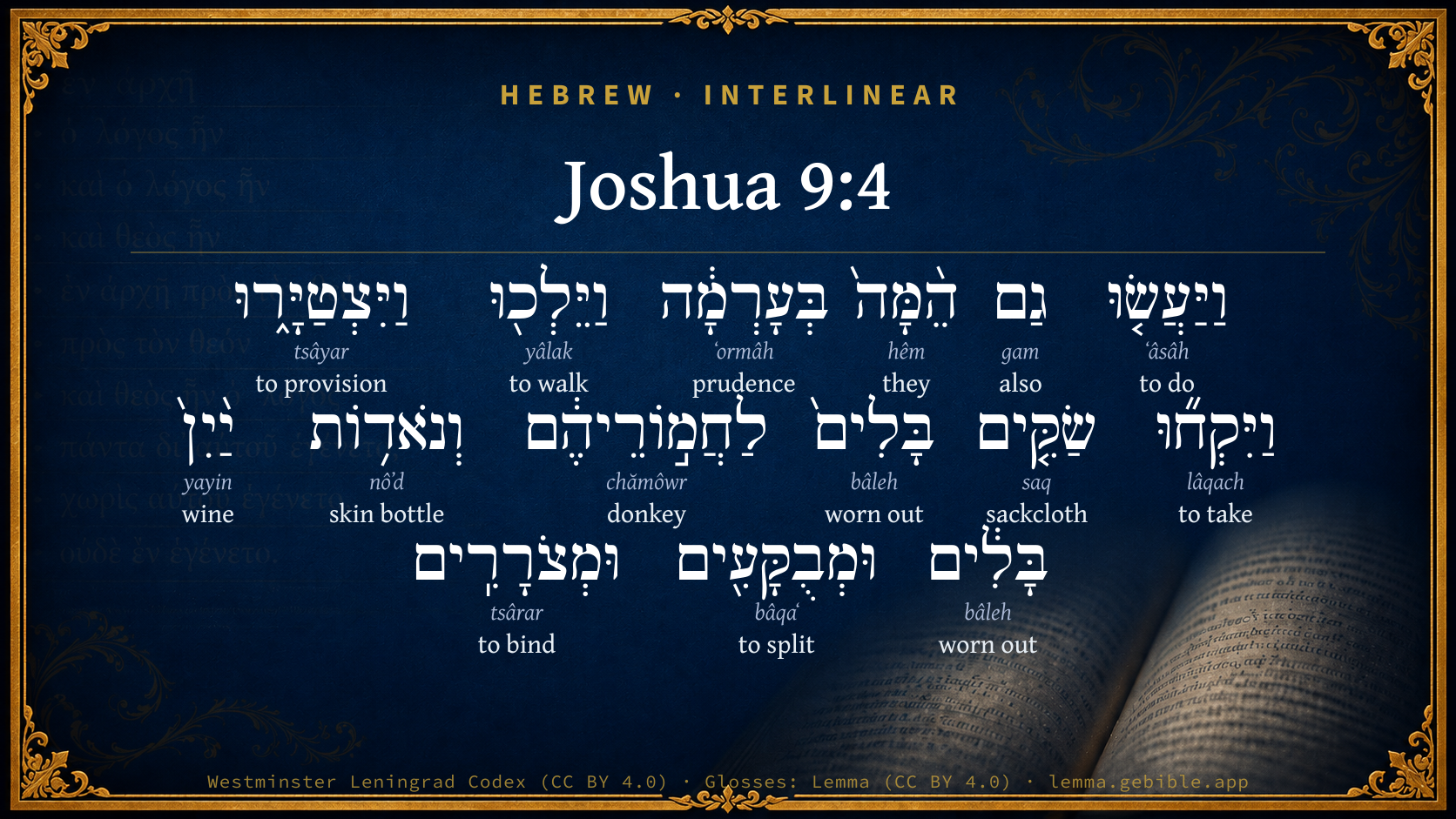
Hebrew (Westminster Leningrad Codex) Joshua 9:4 appears in the Hebrew Old Testament. The text above is from the Westminster Leningrad Codex. Each word links to its Strong’s number, a concise gloss, and parsing drawn from the Open Scriptures Hebrew Bible morphology. Click any word for its full Brown-Driver-Briggs (BDB) entry.
Download image
Cite this verse

Joshua 9:4 (World English Bible). Public Domain. Lemma interlinear Bible study tool, https://lemma.gebible.app/v/joshua/9/4.

Show BibTeX & RIS
BibTeX
RIS
English Translation
they also resorted to a ruse, and went and made as if they had been ambassadors, and took old sacks on their donkeys, and wine-skins, old and torn and bound up,
World English Bible · Public Domain
Highlights
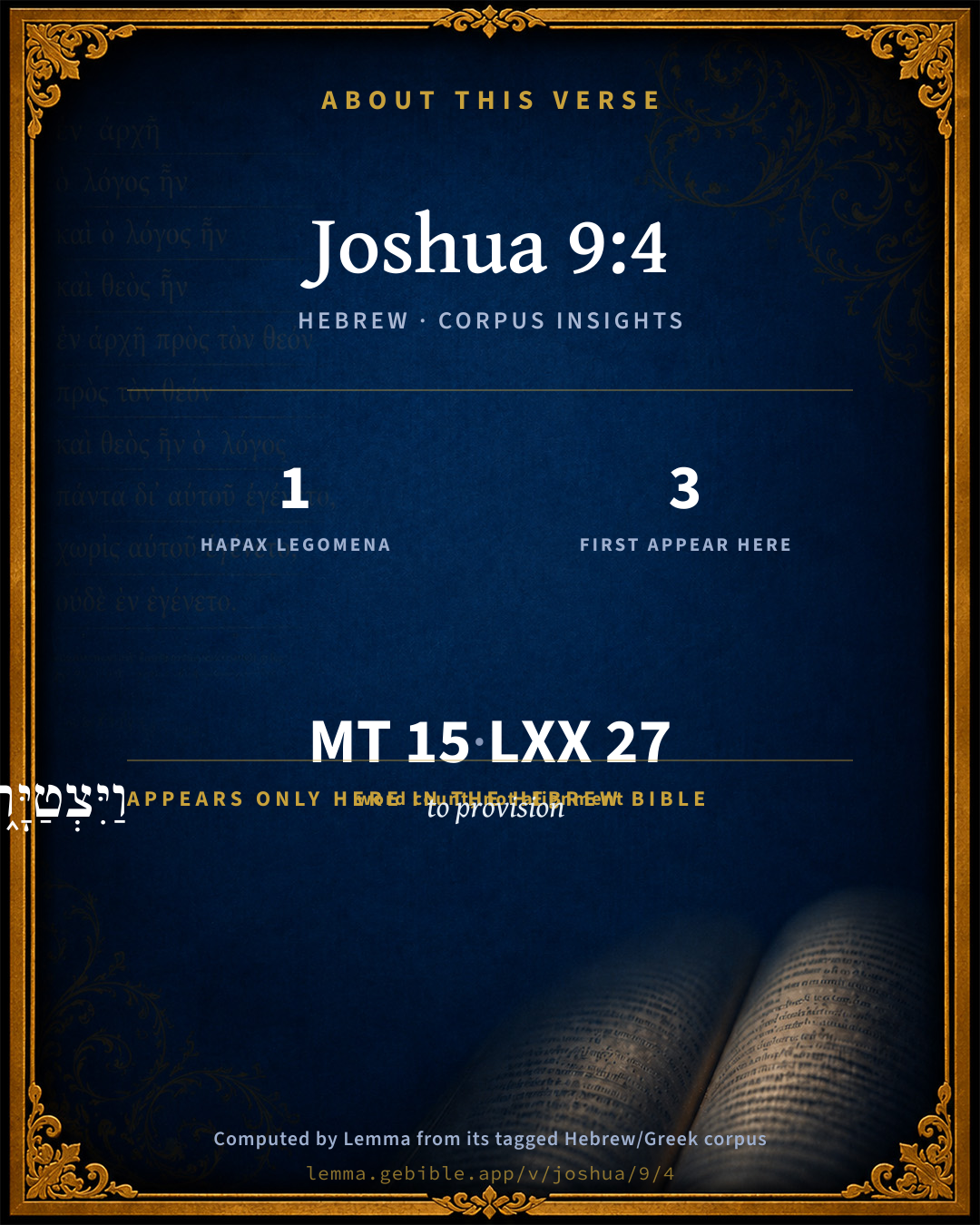
  • 1 hapax legomenon — only here in the Hebrew Bible
  • 3 first appearances in the Hebrew Bible
Full analysis ↓
Download a study sheet

One document with this verse’s original text, its word-by-word gloss line, the meaning frame, cross-references with their text, attributed commentary, and full source and license credits — printable, and it pastes into notes with its structure intact.

This verse Autodidact and up

Study sheet (.html) Plain text (.txt)

A passage Seminary Student

Up to 50 verses in one chapter. A passage sheet keeps up to 6 commentary sources and 12 cross-references per verse, in the order this page ranks them, and says so on the sheet whenever that leaves anything out. Ask for a single verse and you get the Autodidact verse sheet above.

Everything on this page stays free to read, with no account — the sheet is a download of what is already on screen, not access to it.

Want to remove ads? Support Godless Engineer
Compare translations 3

The same verse in 3 English versions, stacked beneath the original-language interlinear above. Click any original word for its lexicon entry.

Each is an independent rendering of the whole verse — the interlinear is not word-aligned to these translations.

Highlighted words mark where these versions differ — a whole-verse word diff, not a word-by-word alignment.

  • World English Bible Public Domain
    they also resorted to a ruse, and went and made as if they had been ambassadors, and took old sacks on their donkeys, and wine-skins, old and torn and bound up,
  • King James Version Public Domain
    They did work wilily, and went and made as if they had been ambassadors, and took old sacks upon their asses, and wine bottles, old, and rent, and bound up;
  • unfoldingWord Literal Text CC BY-SA 4.0
    And they acted, they also, with cunning. And they went and acted as envoys and took worn-out sacks for their donkeys and worn-out and torn and mended skins of wine,

unfoldingWord Literal Text — © unfoldingWord, licensed CC BY-SA 4.0. Word-aligned USFM3 via Door43 (git.door43.org/unfoldingWord/en_ult).

Versions to compare (up to 4)

3 of 4 selected

Show all 18 translations

Every available English version of this verse, each an independent rendering of the whole verse.

  • World English Bible Public Domain
    they also resorted to a ruse, and went and made as if they had been ambassadors, and took old sacks on their donkeys, and wine-skins, old and torn and bound up,
  • Berean Standard Bible Public Domain
    acted deceptively and set out as envoys, carrying on their donkeys worn-out sacks and old wineskins, cracked and mended.
  • Majority Standard Bible Public Domain
    acted deceptively and set out as envoys, carrying on their donkeys worn-out sacks and old wineskins, cracked and mended.
  • King James Version Public Domain
    They did work wilily, and went and made as if they had been ambassadors, and took old sacks upon their asses, and wine bottles, old, and rent, and bound up;
  • American Standard Version (1901) Public Domain
    they also did work wilily, and went and made as if they had been ambassadors, and took old sacks upon their asses, and wine-skins, old and rent and bound up,
  • Revised Version (1885) Public Domain
    they also did work wilily, and went and made as if they had been ambassadors, and took old sacks upon their asses, and wineskins, old and rent and bound up;
  • Geneva Bible (1599) Public Domain
    And therefore they wrought craftily: for they went, and fayned themselues ambassadours, and tooke olde sackes vpon their asses, and olde bottels for wine, both rent and bound vp,
  • Douay-Rheims (1899) Public Domain
    Cunningly devising took for themselves provisions, laying old sacks upon their asses, and wine bottles rent and sewed up again,
  • Young's Literal Translation Public Domain
    and they work, even they, with subtilty, and go, and feign to be ambassadors, and take old sacks for their asses, and wine-bottles, old, and rent, and bound up,
  • Literal Standard Version CC BY-SA 4.0
    and they work, even they, with subtlety, and go, and feign to be ambassadors, and take old sacks for their donkeys, and wine-bottles, old, and split, and bound up,
  • Unlocked Literal Bible CC BY-SA 4.0
    they acted with a cunning plan. They went as messengers. They took worn-out sacks and put them on their donkeys. They also took old wineskins that were worn, torn, and had been repaired.
  • unfoldingWord Literal Text CC BY-SA 4.0
    And they acted, they also, with cunning. And they went and acted as envoys and took worn-out sacks for their donkeys and worn-out and torn and mended skins of wine,
  • Darby Bible Public Domain
    then they also acted with craft, and they went prepared as on a journey, and took old sacks upon their asses, and wine-flasks, old and rent and tied up;
  • World Messianic Bible Public Domain
    they also resorted to a ruse, and went and made as if they had been ambassadors, and took old sacks on their donkeys, and old, torn-up and bound up wineskins,
  • Webster's Bible Public Domain
    They did work craftily, and went and made as if they had been embassadors, and took old sacks upon their asses, and wine-bottles, old, and rent, and bound up;
  • Free Bible Version CC BY-SA 4.0
    they decided on a cunning plan. They sent messengers to Joshua, their donkeys wearing worn-out saddles and carrying old wineskins that were torn and patched.
  • Bible in Basic English Public Domain
    Acting with deceit, got food together as if for a long journey; and took old food-bags for their asses, and old and cracked wine-skins kept together with cord;
  • JPS Tanakh (1917) Public Domain
    they also did work wilily, and went and made as if they had been ambassadors, and took old sacks upon their asses, and wine skins, worn and rent and patched up;

Literal Standard Version (2020), Covenant Press — licensed CC BY-SA 4.0. Text via the HelloAO Bible API (eBible.org). Unlocked Literal Bible (unfoldingWord) — licensed CC BY-SA 4.0. Text via the HelloAO Bible API (eBible.org). unfoldingWord Literal Text — © unfoldingWord, licensed CC BY-SA 4.0. Word-aligned USFM3 via Door43 (git.door43.org/unfoldingWord/en_ult). Free Bible Version, Dr. Jonathan Gallagher — licensed CC BY-SA 4.0. Text via the HelloAO Bible API (eBible.org).

Word by word

More ways to search: Search by grammar → Find every occurrence → Compare this word →

Practice this passage: Drill this verse → Learn its vocabulary →

וַיִּצְטַיָּ֑רוּ
tsâyar
H6737
“and · to provision”
Conjunction + Verb, Hithpael, Sequential Imperfect, 3rd Person, Masculine, Plural
Part of Speech
Conjunction + Verb
Stem
Hithpael
Form
Sequential Imperfect
Person
3rd Person
Gender
Masculine
Number
Plural
Full BDB Definition

Origin: a denominative from H6735 in the sense of ambassador

TWOT: None

(BDB) (Hithpael) to supply oneself with provisions, take as one's provision - (CLBL) to act as envoy
  1. וַיַּעֲשׂ֤וּ ʻâsâh H6213 “and · to do” Conjunction + Verb, Qal, Sequential Imperfect, 3rd Person, Masculine, Plural
  2. גַם gam H1571 “also” Adverb
  3. הֵ֨מָּה֙ hêm H1992 “they” Pronoun, Personal, 3rd Person, Masculine, Plural
  4. בְּעָרְמָ֔ה ʻormâh H6195 “in/at · prudence” Preposition + Noun, Common, Feminine, Singular, Absolute
  5. וַיֵּלְכ֖וּ yâlak H3212 “and · to walk” Conjunction + Verb, Qal, Sequential Imperfect, 3rd Person, Masculine, Plural
  6. וַיִּקְח֞וּ lâqach H3947 “and · to take” Conjunction + Verb, Qal, Sequential Imperfect, 3rd Person, Masculine, Plural
  7. שַׂקִּ֤ים saq H8242 “sacks” Noun, Common, Masculine, Plural, Absolute
  8. בָּלִים֙ bâleh H1087 “worn out” Adjective, Adjective, Masculine, Plural, Absolute
  9. לַחֲמ֣וֹרֵיהֶ֔ם chămôwr H2543 “to/for · donkeys · their” Preposition + Noun, Common, Both, Plural, Construct + Suffix, Personal, 3rd Person, Masculine, Plural
  10. וְנֹאד֥וֹת nôʼd H4997 “and · skin bottles of” Conjunction + Noun, Common, Masculine, Plural, Construct
  11. יַ֨יִן֙ yayin H3196 “wine” Noun, Common, Masculine, Singular, Absolute
  12. בָּלִ֔ים bâleh H1087 “worn out” Adjective, Adjective, Masculine, Plural, Absolute
  13. וּמְבֻקָּעִ֖ים bâqaʻ H1234 “and · split” Conjunction + Verb, Pual, Participle Passive, Masculine, Plural, Absolute
  14. וּמְצֹרָרִֽים tsârar H6887 “and · bound” Conjunction + Verb, Pual, Participle Passive, Masculine, Plural, Absolute

About this verse

These counts appear in no published source. They are computed here, from the morphology-tagged text and Lemma’s own curated glosses. What Lemma adds →

15
words
14
distinct lemmas
Historical
section

Notable vocabulary

1 hapax legomenon — a word that appears only here in the entire Hebrew Bible:

  • וַיִּצְטַיָּ֑רוּ to provision H6737

First appearance in Scripture

These words make their first canonical appearance in the Hebrew Bible here:

  • וַיִּצְטַיָּ֑רוּ to provision H6737
  • בָּלִים֙ worn out H1087
  • וְנֹאד֥וֹת skin bottle H4997

Shared distinctive vocabulary

בְּעָרְמָ֔ה prudence H6195 occurs in 5 verses of the Hebrew Bible. Also found in:

Grammatical profile

  • 6 verbs
  • 5 nouns
  • 2 adjectives
  • 1 pronoun
  • 1 adverb

Verb forms

  • וַיַּעֲשׂ֤וּ Qal · Sequential Imperfect
  • וַיֵּלְכ֖וּ Qal · Sequential Imperfect
  • וַיִּצְטַיָּ֑רוּ Hithpael · Sequential Imperfect
  • וַיִּקְח֞וּ Qal · Sequential Imperfect
  • וּמְבֻקָּעִ֖ים Pual · Participle Passive
  • וּמְצֹרָרִֽים Pual · Participle Passive

Repetition

A word recurs within this verse — often emphatic in Hebrew:

  • בָּלִים֙ worn out H1087 ×2

Hebrew & Septuagint length

In English translation the verse runs 31 words from the Hebrew and 31 from the Septuagint (LXX English) — the same length.

A rough comparison of the two English renderings, which tokenize alike — not a word-level alignment.

Word counts can differ between the Hebrew and the Greek without any difference in meaning — e.g. the Hebrew direct-object marker אֵת has no separate Greek word, and Greek often adds the article ὁ.

In the original languages it is 15 Hebrew tokens and 27 Greek tokens — but the two are counted differently (Hebrew bundles its prefixes and suffixes into one token; the Greek is in lemma form), so that isn’t a like-for-like length.

Cross-references

8

Topical passages linked to Joshua 9:4 in the Treasury of Scripture Knowledge — connected by theme and wording, ordered by reader-vote popularity; previews shown in the World English Bible.

  • Matthew 10:16 "Behold, I send you out as sheep in the midst of wolves. Therefore be wise as serpents, and harmless as doves.
  • Mark 2:22 No one puts new wine into old wineskins, or else the new wine will burst the skins, and the wine pours out, and the skins will be destroyed; but they put new wine into fresh wineskins."
  • Luke 5:37–38 No one puts new wine into old wineskins, or else the new wine will burst the skins, and it will be spilled, and the skins will be destroyed.
  • Luke 16:8 "His lord commended the dishonest manager because he had done wisely, for the children of this world are, in their own generation, wiser than the children of the light.
  • Genesis 34:13 The sons of Jacob answered Shechem and Hamor his father with deceit, and spoke, because he had defiled Dinah their sister,
  • 1 Kings 20:31–33 His servants said to him, See now, we have heard that the kings of the house of Israel are merciful kings: let us, we pray you, put sackcloth on our loins, and ropes on our heads, and go out to the king of Israel: peradventure he will save your life.
  • Psalms 119:83 For I have become like a wineskin in the smoke. I don't forget your statutes.
  • Matthew 9:17 Neither do people put new wine into old wineskins, or else the skins would burst, and the wine be spilled, and the skins ruined. No, they put new wine into fresh wineskins, and both are preserved."

Cross-references courtesy of OpenBible.info (CC BY 4.0).

Hebrew and Greek witnesses Masoretic Hebrew ↔ Greek Septuagint

The same verse in the two great witnesses to the Old Testament, shown verse-for-verse.

These are two independent witnesses, not word-aligned to each other, and the Septuagint is shown in lemma (dictionary) form.

Hebrew Joshua 9:4 Masoretic · Westminster Leningrad Codex

וַיַּעֲשׂ֤וּ גַם הֵ֨מָּה֙ בְּעָרְמָ֔ה וַיֵּלְכ֖וּ וַיִּצְטַיָּ֑רוּ וַיִּקְח֞וּ שַׂקִּ֤ים בָּלִים֙ לַחֲמ֣וֹרֵיהֶ֔ם וְנֹאד֥וֹת יַ֨יִן֙ בָּלִ֔ים וּמְבֻקָּעִ֖ים וּמְצֹרָרִֽים

they also resorted to a ruse, and went and made as if they had been ambassadors, and took old sacks on their donkeys, and wine-skins, old and torn and bound up,

World English Bible · Public Domain

Greek LXX Joshua 9:4 Septuagint · lemma form

καί ποιέω καί γέ αὐτός μετά πανουργία καί ἔρχομαι ἐπισιτίζω καί ἑτοιμάζω καί λαμβάνω σάκκος παλαιός ἐπί ὁ ὄνος αὐτός καί ἀσκός οἶνος παλαιός καί καταῥήγνυμι ἀποδέω

And they also wrought craftily, and they went and made provision and prepared themselves; and having taken old sacks on their shoulders, and old and torn and patched bottles of wine,

LXX2012 (modern English Septuagint) · Public Domain

On this verse, Ellicott's Commentary for English Readers discusses the Septuagint’s reading. Read the note in Commentary ↓

Hebrew: Westminster Leningrad Codex (CC BY 4.0). Greek: Septuagint (public domain); English from LXX2012 (modern English Septuagint) (Public Domain). How the Septuagint differs from the Hebrew →

Targum (Aramaic paraphrase)

1

The Targum is the ancient Jewish Aramaic paraphrase of the Hebrew Scriptures — an interpretive translation, not the Hebrew text itself. Onkelos (literal) and Pseudo-Jonathan (expansive) render the Torah, and Jonathan the Prophets. Coverage is partial: where no permissively-licensed English translation exists for a verse, only the Aramaic is shown. This is verse-level text, not a word-by-word alignment to the Hebrew.

  1. Targum Jonathan Prophets (Joshua–Malachi)
    וַעֲבַדוּ אַף אִינוּן בְּחוּכְמָא וְאִזְדַוָדוּ וּנְסִיבוּ שַׂקִין בָּלָן לַחֲמָרֵיהוֹן וְזִיקִין דַחֲמָר בָּלָן וּמְבַזְעִין וּמְצָרְרִין:

    (no public-domain English translation for this verse)

    Targum Jonathan — Aramaic: “Mikraot Gedolot” (public domain). English: “Sefaria Community Translation” (CC0 1.0 (public-domain dedication)); “London "Chaldee Paraphrase," 1871” (public domain). Text via Sefaria.

Commentary

Notes on Joshua 9:4 from classic Christian and Jewish commentators (each source and its license shown beneath its notes). The classic Christian expositions comment on the surrounding passage and are grouped to its opening verse, so a note may address several verses; the Jewish commentaries on the Tanakh (Rashi and others) are per-verse, so they appear only where the commentator wrote on this verse.

Lemma curates 59 commentaries, every one of them public domain or Creative Commons licensed, each selected and text-cleaned for this edition rather than reprinted as found. About our sources →

Trapp's Complete Commentary

John Trapp

Jos 9:4 They did work wilily, and went and made as if they had been ambassadors, and took old sacks upon their asses, and wine bottles, old, and rent, and bound up;

Ver. 4. They did work wilily.] They exercised a serpentine subtilty, and dealt fraudulently, as Gen 3:1; but where was their columbine simplicity? {Mat 10:16} They strain hard to save their lives. But a man should rather die than lie.

John Trapp, A Commentary or Exposition upon All the Books of the Old and New Testament (1647–1656) — public domain. Text from a community e-Sword module.

Tyndale Open Study Notes

Tyndale Open Resources

9:4-6 Long-distance travel was difficult, dirty, and dangerous in those days. If they were to carry off their deception, the Gibeonite supplies, clothes, and even food had to look the part.

Tyndale Open Study Notes — © Tyndale Open Resources, licensed CC BY-SA 4.0. Text via the HelloAO Bible API.

Geneva Bible (1599)

Geneva Bible translators

Because they were all worn.

Geneva Bible (1599) marginal notes — public domain. Text via Bolls.life.

Jamieson, Fausset & Brown

Robert Jamieson, A. R. Fausset & David Brown

They did work wilily--They acted with dexterous policy, seeking the means of self-preservation, not by force, which they were convinced would be unavailing, but by artful diplomacy.

took old sacks upon their asses--Travellers in the East transport their luggage on beasts of burden; the poorer sort stow all their necessaries, food, clothes, utensils together, in a woollen or hair-cloth sack, laid across the shoulders of the beast they ride upon.

wine bottles, old, and rent, and bound up--Goat-skins, which are better adapted for carrying liquor of any kind fresh and good, than either earthenware, which is porous, or metallic vessels, which are soon heated by the sun. These skin bottles are liable to be rent when old and much used; and there are various ways of mending them--by inserting a new piece of leather, or by gathering together the edges of the rent and sewing them in the form of a purse, or by putting a round flat splinter of wood into the hole.

Jamieson, Fausset & Brown — Commentary Critical and Explanatory on the Whole Bible (1871) — public domain (CC PDM 1.0). Text via the HelloAO Bible API.

Adam Clarke's Commentary

Verse 4. They did work wilily] Finesse of this kind is allowed by the conduct of all nations; and stratagems in war are all considered as legal. Nine tenths of the victories gained are attributable to stratagem; all sides practise them, and therefore none can condemn them. Much time and labour have been lost in the inquiry, "Did not the Gibeonites tell lies?" Certainly they did, and what is that to us? Does the word of God commend them for it? It does not. Are they held up to us as examples! Surely no. They did what any other nation would have done in their circumstances, and we have nothing to do with their example. Had they come to the Israelites, and simply submitted themselves without opposition and without fraud, they had certainly fared much better. Lying and hypocrisy always defeat their own purpose, and at best can succeed only for a short season. Truth and honesty never wear out.

Old sacks-and wine bottles, old, &c.] They pretended to have come from a very distant country, and that their sacks and the goat-skins that served them for carrying their wine and water in, were worn out by the length of the journey.

Adam Clarke's Commentary on the Bible (1810–1826) — public domain. Text from a community e-Sword/MySword module.

Ellicott's Commentary for English Readers

(4) They did work wilily.—Literally, and they also dealt with subtilty. The stratagem does not seem a very profound one, or one that would have been difficult to detect. But we may remember a fact of Israel’s experience which puts it in a somewhat different light. The Israelites themselves had come from a far country, but their raiment had not “waxed old upon them,” nor did “their feet swell,” these forty years. Of bread they had no need, when there was manna, and God gave them water for their thirst. Of worn garments and stale provisions they had no experience, and therefore, when the Gibeonites presented themselves in this extraordinary garb and guise, it is not unnatural that they were not detected by the eyes of Israel.

They . . . made as if they had been ambassadors.—The verb thus translated does not occur elsewhere in the Hebrew Bible. By the alteration of a letter, the Targum, LXX., and some other versions make it mean, “they gat them provision.”

A Bible Commentary for English Readers, edited by Charles John Ellicott (1878–1897) — public domain. Text from a community e-Sword module.

The Cambridge Bible for Schools and Colleges

gen. ed. J. J. S. Perowne

4. they did work wilily] Rather, they also did work wilily. They had heard what Joshua had done in the case of Jericho and Ai, and the stratagems he had employed, and now they also resolved to do something and to meet craft with craft. “Thei thouçten felli,” Wyclif.

made as if they had been] Or, as the Ancient Versions with the change of a single consonant, reading here as in Jos_9:12, render, provided themselves with victuals.

old sacks upon their asses] These were probably the same as “the large bags, usually of hair, in which the Orientals pack up, for convenient transport on the backs of animals, all the baggage and commodities required for the journey. Beds, boxes, provisions, pots, packages of goods, all are carried in such bags, slung over the back of the animal, one hanging at each side. Being a good deal knocked about and exposed to the weather, these saddle-bags, as one might call them but for their size, suffer in a long journey; and hence the Gibeonites took old bags, to convey the impression that a long journey had been made. Kitto’s Bible Illustrations, 11. p. 286.

wine bottles] i.e. skin bottles, of which classical antiquity has afforded many representations. In the East the wine was preserved not in casks but in earthen jars and leathern bottles, made of the skins of goats, oxen, and buffaloes, turned inside out, washed, and rubbed over with warm mineral tar or naphtha. The wine is drawn out at one of the feet, by opening or closing the cord with which it is tied. This explains how the bottles could be “old,” “rent,” and “bound up,” and also the caution of our Lord against pouring new wine into old bottles, lest they should be burst by the wine (Mar_2:22).

The Cambridge Bible for Schools and Colleges (gen. ed. J. J. S. Perowne; Cambridge University Press, 1878–1918) — public domain. Text from a community e-Sword module.

John Gill's Exposition

And they did work wilily,.... Acted craftily, dealt in much cunning and subtlety; our version leaves out a very emphatic word, "also"; they also, as well as other nations, acted a cunning part, but in a different way; they did not enter into consultations and alliances with others, how to defend themselves, but made use of a stratagem to make peace, and enter into a league with Israel; or also as the Israelites had done, either as Simeon and Levi had dealt craftily with the Shechemites, who were Hivites, Gen 34:2; so now the Gibeonites, who also were Hivites, Jos 9:7; wrought in a wily and crafty manner with them, so Jarchi; or as the Israelites had lately done in the affair of Ai:

and went and made as if they had been ambassadors: from some states in a foreign country, sent on an embassy to the people of Israel, to compliment them on their successes, and to enter into alliance with them, which they thought would be pleasing and acceptable to them; the Targum is,"they prepared food,''which they took with them for their journey; and so the Septuagint, Vulgate Latin, Syriac, and Arabic versions:

and took old sacks upon their asses: in which they put, their provisions:

and wine bottles, old, and rent, and bound up: not made of glass, as ours usually are, but of the skins of beasts, as the bottles in the eastern countries commonly were; which in time grew old, and were rent and burst, and they were obliged to mend them, and bind them up, that they might hold together, and retain the liquor put into them, see Mat 9:17.

John Gill's Exposition of the Whole Bible (1746–1763) — public domain (CC PDM 1.0). Text via the HelloAO Bible API.

Albert Barnes' Notes on the Bible

They did work wilily - literally, “they also,” or “they too, did work, etc.” The “also” serves, apparently, to connect the stratagem of the Gibeonites with that employed by the Israelites before Ai. It hints that the Gibeonites resolved to meet craft with craft.

Rent and bound up - i. e. the wine skins were torn and roughly repaired by tying up the edges of the tear. The more thorough and careful way, hardly feasible in a hasty journey, would have been to insert a patch.

Albert Barnes' Notes on the Bible (1834–1885) — public domain. Text from a community e-Sword/MySword module.

Haydock's Catholic Bible Commentary

Provisions. By the alteration of a single letter, Hebrew means, "they feigned themselves to be ambassadors." But the Chaldean, Syriac, and Septuagint agree with the Vulgate. (Calmet) --- The Gabaonites were Hevites, though they are called by the more general name of Amhorrites, 2 Kings xxi. 2. St. Jerome says that their city stood in the tribe of Benjamin; according to Josephus, 40 or 50 stadia north of Jerusalem. (Menochius) --- They alone had the prudence to submit, (Calmet) being terrified and converted by the miracles of God. (Haydock) --- Again. In the East, goat skins with the hair inwards, are used to carry wine.

George Leo Haydock (1774–1849), Haydock's Catholic Family Bible and Commentary, 1859 edition — public domain. Excludes Psalms (Douay-Rheims chapter numbering differs from Protestant) and Deuterocanonical books (Catholic canon only).

Matthew Poole's English Annotations

Ambassadors, sent from a far country, as they say, Jos 9:6.

Matthew Poole's English Annotations on the Holy Bible (1683–1685) — public domain. Text from a community e-Sword/MySword module.

Whedon's Commentary on the Bible

Daniel D. Whedon

4. [

They did work wilily — Literally, Then did also they by stratagem. The also seems to refer here most naturally to what Joshua had done to Ai. As he used cunning and strategy in the capture of that city, so did also they practice strategy in making a league with Israel. Others, we think less correctly, take also (גם) as an adversative here, expressing the contrast between the action of the Gibeonites and the other Canaanites.]

As if… ambassadors — Suing for peace. The more distant cities think only of war; the nearest, on whom the next blow must fall, seek for peace; perhaps their popular form of government also influenced them toward a pacific policy. [The Hebrew word translated, made as if they had been ambassadors, (Hithpael of ציר,) occurs nowhere else; but Keil and others defend this meaning, given in the English version. Others, however, with Gesenius, argue that “since no other trace of this form or signification exists in Hebrew or Aramaean, it is better to read, with six MSS., יֶצשׂירוthey provided themselves with food for the journey, as in Jos_9:12; which is also expressed by the ancient versions.”]

Old sacks — The traveller’s equipage in Syria, anciently and at the present day, comprises food and drink, kitchen utensils, tents, bedding, etc., all stowed away in sacks and transported on the backs of asses. Old sacks would give the impression of a long journey.

Wine bottles — These were goat-skins, nearly whole, cured in a peculiar manner. When worn through, a temporary expedient for mending them was to gather up the skin about the hole and tie it like the mouth of a bag. By this means the mending becomes very manifest.

Daniel D. Whedon (gen. ed.), Commentary on the Old and New Testaments (1874–1909) — public domain. Text from a community e-Sword module.

The Pulpit Commentary

They did work wilily. Rather, and they worked they also with craft. The reference, no doubt, is to the confederacy of the other kings. The Gibeonites also acted upon what they had heard, but they preferred an accommodation to war. So Calvin and Rosenmuller; also Drusius. And they felt that they could only effect their purpose by craft. Other explanations are given, such as that a reference is made to Joshua"s stratagem at Ai. Keil rejects both, and proposes an explanation of his own, which is unintelligible. Origen"s interpretation here is interesting as a specimen of the theology of the third century. He regards the Gibeonites as the type of men who, though they are enrolled in the Church as believers and have faith in God, and acquiesce in all the Divine precepts, and are ready enough to take part in all the external duties of religion, are yet involved in vices and foulnesses, like the Gibeonites in their old garments and clouted shoes. They display no signs of improvement or alteration, yet Jesus our Lord concedes to them salvation, even though that salvation does not escape a certain stigma of disgrace. That there may be some persons in a condition somewhat resembling this described by Origen may be admitted, but it is difficult to see how any one in a state of salvation can display no signs of improvement whatever. There are many who do not improve as they might, whom we should yet hesitate to pronounce altogether reprobate from God. But surely the entire absence of all improvement is a manifest sign of reprobation. This passage is one of many among the voluminous works of Origen in which that holy and learned man has not sufficiently weighed what he was saying (see below, ver. 23).

Made as if they had been ambassadors. "Sent an embassy" (Luther). If we take this reading, we must suppose, with Grotius and others, the word to be the Hithpahel of ryxi to go, to revolve. But the form is rare, and the word is elsewhere unknown, at least in Hebrew, though an Arabic form of it is found. It is therefore better to read WdYfxyo "they prepared themselves provisions." This is the reading of the LXX, the Vulgate, the Chaldee, the Syriac, and of most modern editors. It is rendered still more probable by the occurrence of the same word in ver. 12. Old sacks. Rather, worn out, and so throughout the passage. The usual mode of conveyance still in the East is in sackcloth bags on the backs of horses, mules, camels, and asses. Such bags are apt to meet with rough usage in a long journey. Wine bottles. Rather, wine skins, the wine then being kept in skins, not in vessels of glass. This explains how they could be burst open ( and tied up. These skins were hung up frequently in the smoke, (Psa_119:83) which gave them a shrivelled appearance. The first bottles were made of such skins, as Herodotus tells us. The Egyptian monuments confirm his statements, displaying as they do skins of animals so used, with the legs or the neck forming what we still term the "neck" of the bottle (cf. Homer, Iliad, 4:247, askw en aigeiw ). Similar bottles are depicted on the walls of Herculaneum and Pompeii, and the like may be seen still in Italian villages. They were pitched over at the seams to prevent leakage. (cf. Job_32:19 Mat_9:17 Mar_2:22 Luk_5:37, Luk_5:38. See also Kitto"s "Cyclopaedia of Biblical Literature Bound up. The usual mode of mending in the East, except when a patch is inserted, is to tie or sew up the hole.

The Pulpit Commentary (1880–1919), ed. H.D.M. Spence-Jones & Joseph S. Exell — public domain. Text from a community e-Sword module.

John Wesley's Explanatory Notes

Been ambassadors - Sent from a far country.

John Wesley, Explanatory Notes Upon the Whole Bible (1754–1765) — public domain. Text via the GEBible commentary corpus.

Rashi

Rabbi Shlomo Yitzchaki (Rashi)

And they too proceded with deception just as the sons of Yaakov dealt with trickery with Chamor, the father of Shechem, who was a Chivite. The people of Givon were descendents of the Chivites, as it is said in this context.

They presented themselves as envoys. They made themselves look like messengers. The word יִצְטַיָרוּ messenger, is from, צִיר “וְצִיר בַּגוֹיִם שְׁלַח” (Ovadiah 1:1) [and a messenger was sent among the nations.] Every word whose root begins with a “צ” (צַדִי ), when used as a reflexive either in the form of מִתְפַּעֵל or נִתְפַּעֵל, is constructed with a “ט” (טֶית) in the middle and separates the root letters of the word, like מַה נִצְטַדָק, (how can we justify ourselves). the root of נִצְטַדָק is צֶדֶק (justice) which he says as נִצְטַדָק. Similarly, וּמִטַל שְׁמַיָא גִשְׁמֵה יִצְטַבַע [His body was wet from the dew of Heaven) The root of יִצְטַבַע is צֶבַע.

Worn-out sacks. To give the appearance that they were coming from a distant land.

And tied together. מְצרָרִים is another expression of מְבוּקָעִים (split), which is an Aramaic expression, “The cleft of the wheat.” of the other, so that the water does not cover it on all sides and it will cause fermentation. “Which makes the wine-skin burst.”

Rashi on the Tanakh — English translations: “The Judaica Press complete Tanach with Rashi, translated by A. J. Rosenberg” (CC BY 4.0); “Pentateuch with Rashi's commentary by M. Rosenbaum and A.M. Silbermann, 1929-1934” (public domain); “The Metsudah Tanach series, Lakewood, N.J” (CC BY 4.0); and “The Book of Joshua, Metsudah Publications, 1997” (CC BY 4.0). Text via Sefaria.

Lesson kit

Teaching starters — assembled from the data on this page, not authored interpretation. Every prompt links to the verse data it draws on. Edit before teaching.

Joshua, in the Historical, opens this verse with 15 words (14 distinct Hebrew lemmas). Its most distinctive word is tsâyar (“to provision”). A historical commentator’s framing appears above. Read the whole chapter for the surrounding context.

Discussion questions

  1. How does “to provision” (tsâyar) shape what this verse is saying?
  2. 1 word here appears nowhere else in the Hebrew Bible. Why might the author reach for such rare wording?
  3. 3 words make their first appearance in Scripture here. What does this debut establish?
  4. How does Exodus 21:14, which shares the word «prudence», read alongside this verse?
  5. What does the repetition of “worn out” (2× in this one verse) do in this verse?
  6. The translations on this page render this verse differently — a whole-verse word diff, not a word-by-word alignment. What might account for the different wordings?
  7. «וַיַּעֲשׂ֤וּ» is a Qal Sequential Imperfect verb. How does that grammatical form shape the action described?
  8. Compare how Trapp's Complete Commentary and Tyndale Open Study Notes read this verse. Where do they agree or differ?

Things to notice

  • 1 word in this verse appears nowhere else in the Hebrew Bible.
  • 3 words make their first canonical appearance in Scripture here.
  • This verse counts 15 Hebrew ↔ 27 Greek words.
  • These translations choose different wording for 27 words in this verse.
  • “worn out” occurs 2× in this single verse.

Reading settings

Reading text

Shown beneath each verse's original-language words.

Old Testament
Old Testament edition

Read the OT as the Masoretic Hebrew (MT) or the Greek Septuagint (LXX).

English shown for the Greek Septuagint (in the Hebrew ↔ Greek comparison).

Comparing translations? Open the Compare panel on any verse page to stack up to four side by side.