
Leviticus 17:5

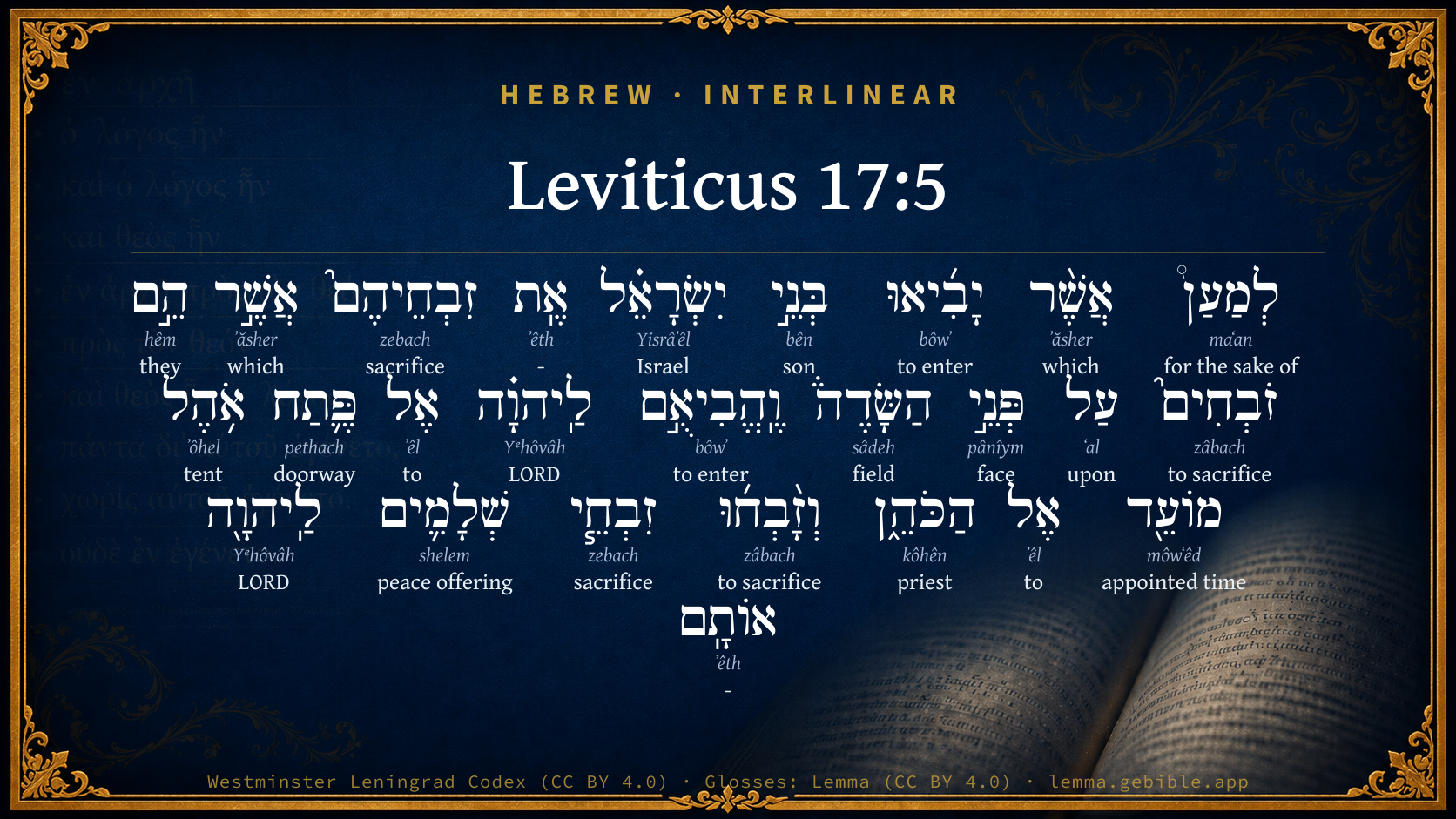
Hebrew (Westminster Leningrad Codex) Leviticus 17:5 appears in the Hebrew Old Testament. The text above is from the Westminster Leningrad Codex. Each word links to its Strong’s number, a concise gloss, and parsing drawn from the Open Scriptures Hebrew Bible morphology. Click any word for its full Brown-Driver-Briggs (BDB) entry.
Download image
Cite this verse

Leviticus 17:5 (World English Bible). Public Domain. Lemma interlinear Bible study tool, https://lemma.gebible.app/v/leviticus/17/5.

Show BibTeX & RIS
BibTeX
RIS
English Translation
This is to the end that the children of Israel may bring their sacrifices, which they sacrifice in the open field, that they may bring them to Yahweh, to the door of the Tent of Meeting, to the priest, and sacrifice them for sacrifices of peace offerings to Yahweh.
World English Bible · Public Domain
Download a study sheet

One document with this verse’s original text, its word-by-word gloss line, the meaning frame, cross-references with their text, attributed commentary, and full source and license credits — printable, and it pastes into notes with its structure intact.

This verse Autodidact and up

Study sheet (.html) Plain text (.txt)

A passage Seminary Student

Up to 50 verses in one chapter. A passage sheet keeps up to 6 commentary sources and 12 cross-references per verse, in the order this page ranks them, and says so on the sheet whenever that leaves anything out. Ask for a single verse and you get the Autodidact verse sheet above.

Everything on this page stays free to read, with no account — the sheet is a download of what is already on screen, not access to it.

Want to remove ads? Support Godless Engineer
Compare translations 3

The same verse in 3 English versions, stacked beneath the original-language interlinear above. Click any original word for its lexicon entry.

Each is an independent rendering of the whole verse — the interlinear is not word-aligned to these translations.

Highlighted words mark where these versions differ — a whole-verse word diff, not a word-by-word alignment.

  • World English Bible Public Domain
    This is to the end that the children of Israel may bring their sacrifices, which they sacrifice in the open field, that they may bring them to Yahweh, to the door of the Tent of Meeting, to the priest, and sacrifice them for sacrifices of peace offerings to Yahweh.
  • King James Version Public Domain
    To the end that the children of Israel may bring their sacrifices, which they offer in the open field, even that they may bring them unto the LORD, unto the door of the tabernacle of the congregation, unto the priest, and offer them for peace offerings unto the LORD.
  • unfoldingWord Literal Text CC BY-SA 4.0
    so that the sons of Israel will bring their sacrifices that they are sacrificing on the face of the field and bring them to Yahweh at the entrance of the tent of meeting, to the priest, and sacrifice them sacrifices of peace offerings to Yahweh.

unfoldingWord Literal Text — © unfoldingWord, licensed CC BY-SA 4.0. Word-aligned USFM3 via Door43 (git.door43.org/unfoldingWord/en_ult).

Versions to compare (up to 4)

3 of 4 selected

Show all 18 translations

Every available English version of this verse, each an independent rendering of the whole verse.

  • World English Bible Public Domain
    This is to the end that the children of Israel may bring their sacrifices, which they sacrifice in the open field, that they may bring them to Yahweh, to the door of the Tent of Meeting, to the priest, and sacrifice them for sacrifices of peace offerings to Yahweh.
  • Berean Standard Bible Public Domain
    For this reason the Israelites will bring to the LORD the sacrifices they have been offering in the open fields. They are to bring them to the priest at the entrance to the Tent of Meeting and offer them as sacrifices of peace to the LORD.
  • Majority Standard Bible Public Domain
    For this reason the Israelites will bring to the LORD the sacrifices they have been offering in the open fields. They are to bring them to the priest at the entrance to the Tent of Meeting and offer them as sacrifices of peace offerings to the LORD.
  • King James Version Public Domain
    To the end that the children of Israel may bring their sacrifices, which they offer in the open field, even that they may bring them unto the LORD, unto the door of the tabernacle of the congregation, unto the priest, and offer them for peace offerings unto the LORD.
  • American Standard Version (1901) Public Domain
    To the end that the children of Israel may bring their sacrifices, which they sacrifice in the open field, even that they may bring them unto Jehovah, unto the door of the tent of meeting, unto the priest, and sacrifice them for sacrifices of peace-offerings unto Jehovah.
  • Revised Version (1885) Public Domain
    To the end that the children of Israel may bring their sacrifices, which they sacrifice in the open field, even that they may bring them unto the LORD, unto the door of the tent of meeting, unto the priest, and sacrifice them for sacrifices of peace offerings unto the LORD.
  • Geneva Bible (1599) Public Domain
    Therefore the children of Israel shall bring their offrings, which they would offer abroad in the fielde, and present the vnto ye Lord at the doore of the Tabernacle of ye Congregation by ye Priest, and offer them for peace offrings vnto the Lord.
  • Douay-Rheims (1899) Public Domain
    Therefore the children of Israel shall bring to the priest their victims, which they kill in the field, that they may be sanctified to the Lord before the door of the tabernacle of the testimony, and they may sacrifice them for peace offerings to the Lord.
  • Young's Literal Translation Public Domain
    so that the sons of Israel do bring in their sacrifices which they are sacrificing on the face of the field, yea, they have brought them in to Jehovah, unto the opening of the tent of meeting, unto the priest, and they have sacrificed sacrifices of peace-offerings to Jehovah with them.
  • Literal Standard Version CC BY-SA 4.0
    so that the sons of Israel bring in their sacrifices which they are sacrificing on the face of the field, indeed, they have brought them to YHWH, to the opening of the Tent of Meeting, to the priest, and they have sacrificed sacrifices of peace-offerings to YHWH with them.
  • Unlocked Literal Bible CC BY-SA 4.0
    The purpose of this command is so that the people of Israel will bring their sacrifices to Yahweh at the entrance to the tent of meeting, to the priest to be sacrificed as fellowship offerings to Yahweh, instead of offering sacrifices in an open field.
  • unfoldingWord Literal Text CC BY-SA 4.0
    so that the sons of Israel will bring their sacrifices that they are sacrificing on the face of the field and bring them to Yahweh at the entrance of the tent of meeting, to the priest, and sacrifice them sacrifices of peace offerings to Yahweh.
  • Darby Bible Public Domain
    to the end that the children of Israel bring their sacrifices, which they sacrifice in the open field, that they bring them to Jehovah, unto the entrance of the tent of meeting, unto the priest, and sacrifice them as sacrifices of peace-offerings to Jehovah.
  • World Messianic Bible Public Domain
    This is to the end that the children of Israel may bring their sacrifices, which they sacrifice in the open field, that they may bring them to the LORD, to the door of the Tent of Meeting, to the priest, and sacrifice them for sacrifices of peace offerings to the LORD.
  • Webster's Bible Public Domain
    To the end that the children of Israel may bring their sacrifices which they offer in the open field, even that they may bring them to the LORD, to the door of the tabernacle of the congregation, to the priest, and offer them for peace-offerings to the LORD.
  • Free Bible Version CC BY-SA 4.0
    This is why the Israelites have to bring to the Lord the sacrifices they currently offer out in the fields. They must bring them to the priest at the entrance to the Tent of Meeting and offer them as peace offerings to the Lord.
  • Bible in Basic English Public Domain
    So that the children of Israel may take to the Lord, to the door of the Tent of meeting and to the priest, the offerings which they have put to death in the open country, and that they may make their peace-offerings to the Lord.
  • JPS Tanakh (1917) Public Domain
    To the end that the children of Israel may bring their sacrifices, which they sacrifice in the open field, even that they may bring them unto the LORD, unto the door of the tent of meeting, unto the priest, and sacrifice them for sacrifices of peace-offerings unto the LORD.

Literal Standard Version (2020), Covenant Press — licensed CC BY-SA 4.0. Text via the HelloAO Bible API (eBible.org). Unlocked Literal Bible (unfoldingWord) — licensed CC BY-SA 4.0. Text via the HelloAO Bible API (eBible.org). unfoldingWord Literal Text — © unfoldingWord, licensed CC BY-SA 4.0. Word-aligned USFM3 via Door43 (git.door43.org/unfoldingWord/en_ult). Free Bible Version, Dr. Jonathan Gallagher — licensed CC BY-SA 4.0. Text via the HelloAO Bible API (eBible.org).

Word by word

More ways to search: Search by grammar → Find every occurrence → Compare this word →

Practice this passage: Drill this verse → Learn its vocabulary →

שְׁלָמִ֛ים
shelem
H8002
“peace offerings”
Noun, Common, Masculine, Plural, Absolute
Part of Speech
Noun
Type
Common
Gender
Masculine
Number
Plural
State
Absolute
Full BDB Definition

Origin: from H7999

TWOT: 2401b

peace offering, requital, sacrifice for alliance or friendship - voluntary sacrifice of thanks
  1. לְמַעַן֩ maʻan H4616 “for the sake of” Preposition
  2. אֲשֶׁ֨ר ʼăsher H834 “which” Particle, Relative
  3. יָבִ֜יאוּ bôwʼ H935 “to enter” Verb, Hiphil, Imperfect, 3rd Person, Masculine, Plural
  4. בְּנֵ֣י bên H1121 “sons of” Noun, Common, Masculine, Plural, Construct
  5. יִשְׂרָאֵ֗ל Yisrâʼêl H3478 “Israel” Noun, Proper
  6. אֶֽת ʼêth H853 “-” Particle, Direct Object
  7. זִבְחֵיהֶם֮ zebach H2077 “sacrifices · their” Noun, Common, Masculine, Plural, Construct + Suffix, Personal, 3rd Person, Masculine, Plural
  8. אֲשֶׁ֣ר ʼăsher H834 “which” Particle, Relative
  9. הֵ֣ם hêm H1992 “they” Pronoun, Personal, 3rd Person, Masculine, Plural
  10. זֹבְחִים֮ zâbach H2076 “sacrificing” Verb, Qal, Participle Active, Masculine, Plural, Absolute
  11. עַל ʻal H5921 “upon” Preposition
  12. פְּנֵ֣י pânîym H6440 “face(s) of” Noun, Common, Both, Plural, Construct
  13. הַשָּׂדֶה֒ sâdeh H7704 “the · field” Particle, Definite Article + Noun, Common, Masculine, Singular, Absolute
  14. וֶֽהֱבִיאֻ֣ם bôwʼ H935 “and · to enter · them” Conjunction + Verb, Hiphil, Sequential Perfect, 3rd Person, Common, Plural + Suffix, Personal, 3rd Person, Masculine, Plural
  15. לַֽיהוָ֗ה Yᵉhôvâh H3068 “to/for · LORD” Preposition + Noun, Proper
  16. אֶל ʼêl H413 “to” Preposition
  17. פֶּ֛תַח pethach H6607 “doorway of” Noun, Common, Masculine, Singular, Construct
  18. אֹ֥הֶל ʼôhel H168 “tent of” Noun, Common, Masculine, Singular, Construct
  19. מוֹעֵ֖ד môwʻêd H4150 “appointed time” Noun, Common, Masculine, Singular, Absolute
  20. אֶל ʼêl H413 “to” Preposition
  21. הַכֹּהֵ֑ן kôhên H3548 “the · priest” Particle, Definite Article + Noun, Common, Masculine, Singular, Absolute
  22. וְזָ֨בְח֜וּ zâbach H2076 “and · to sacrifice” Conjunction + Verb, Qal, Sequential Perfect, 3rd Person, Common, Plural
  23. זִבְחֵ֧י zebach H2077 “sacrifices of” Noun, Common, Masculine, Plural, Construct
  24. לַֽיהוָ֖ה Yᵉhôvâh H3068 “to/for · LORD” Preposition + Noun, Proper
  25. אוֹתָֽם ʼêth H853 “- · them” Particle, Direct Object + Suffix, Personal, 3rd Person, Masculine, Plural

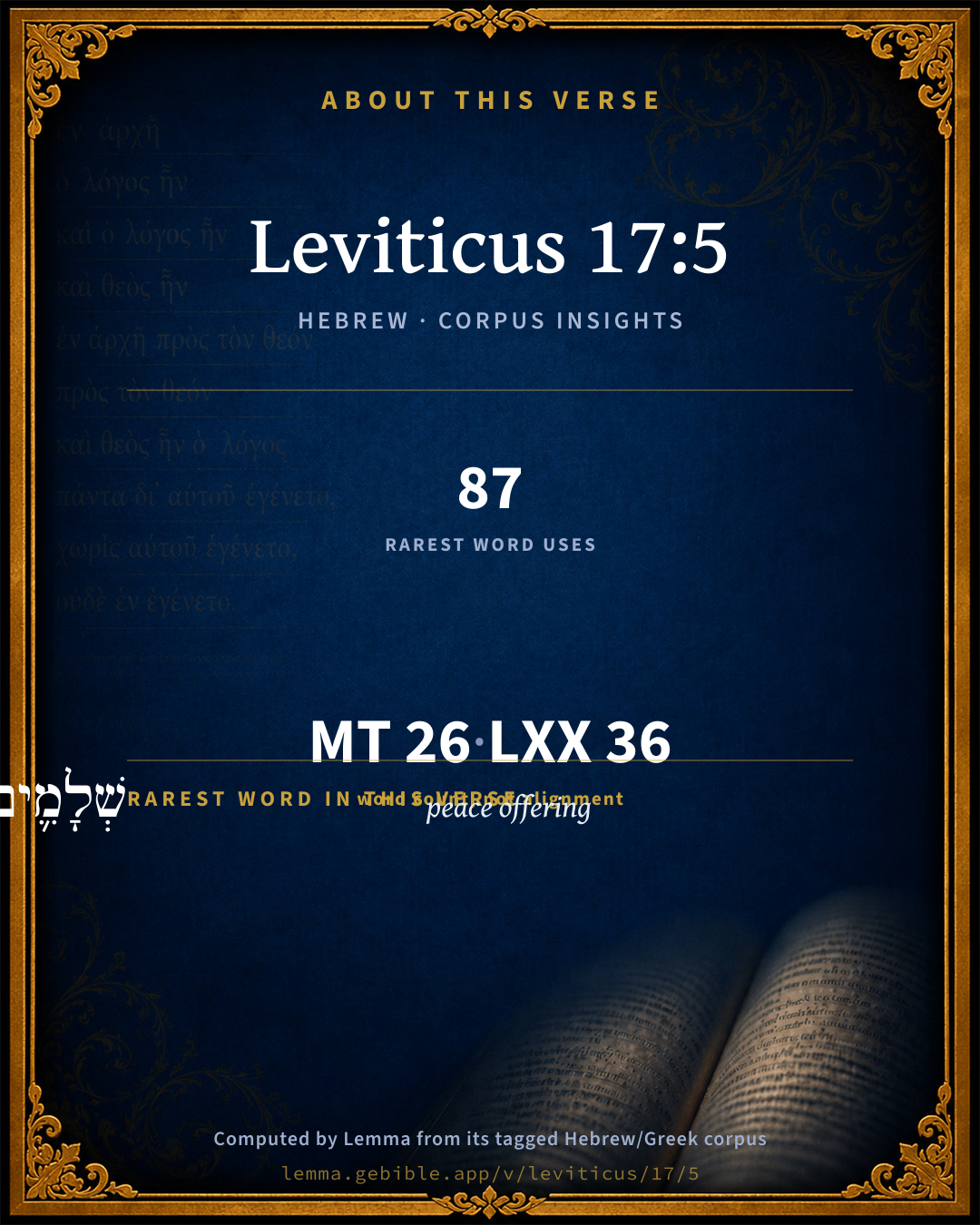
About this verse

These counts appear in no published source. They are computed here, from the morphology-tagged text and Lemma’s own curated glosses. What Lemma adds →

26
words
19
distinct lemmas
Pentateuch
section

Grammatical profile

  • 4 verbs
  • 13 nouns
  • 1 pronoun
  • 4 prepositions
  • 4 particles

Verb forms

  • יָבִ֜יאוּ Hiphil · Imperfect
  • זֹבְחִים֮ Qal · Participle Active
  • וֶֽהֱבִיאֻ֣ם Hiphil · Sequential Perfect
  • וְזָ֨בְח֜וּ Qal · Sequential Perfect

Repetition

Words recur within this verse — often emphatic in Hebrew:

  • יָבִ֜יאוּ to enter H935 ×2
  • זִבְחֵיהֶם֮ sacrifice H2077 ×2
  • זֹבְחִים֮ to sacrifice H2076 ×2
  • לַֽיהוָ֗ה LORD H3068 ×2
  • אֲשֶׁ֨ר which H834 ×2
  • אֶל to H413 ×2

Hebrew & Septuagint length

In English translation the verse runs 49 words from the Hebrew and 45 from the Septuagint (LXX English) — closely comparable.

A rough comparison of the two English renderings, which tokenize alike — not a word-level alignment.

Word counts can differ between the Hebrew and the Greek without any difference in meaning — e.g. the Hebrew direct-object marker אֵת has no separate Greek word, and Greek often adds the article ὁ.

In the original languages it is 26 Hebrew tokens and 36 Greek tokens — but the two are counted differently (Hebrew bundles its prefixes and suffixes into one token; the Greek is in lemma form), so that isn’t a like-for-like length.

Cross-references

14

Topical passages linked to Leviticus 17:5 in the Treasury of Scripture Knowledge — connected by theme and wording, ordered by reader-vote popularity; previews shown in the World English Bible.

  • Genesis 21:33 Abraham planted a tamarisk tree in Beersheba, and called there on the name of Yahweh, the Everlasting God.
  • Genesis 22:2 He said, "Now take your son, your only son, whom you love, even Isaac, and go into the land of Moriah. Offer him there for a burnt offering on one of the mountains which I will tell you of."
  • Genesis 22:13 Abraham lifted up his eyes, and looked, and saw that behind him was a ram caught in the thicket by his horns. Abraham went and took the ram, and offered him up for a burnt offering instead of his son.
  • Genesis 31:54 Jacob offered a sacrifice in the mountain, and called his relatives to eat bread. They ate bread, and stayed all night in the mountain.
  • Exodus 24:5 He sent young men of the children of Israel, who offered burnt offerings and sacrificed peace-offerings of oxen to Yahweh.
  • Leviticus 3:1–17 "'If his offering is a sacrifice of peace offerings; if he offers it from the herd, whether male or female, he shall offer it without blemish before Yahweh.
  • Leviticus 7:11–21 "'This is the law of the sacrifice of peace offerings, which one shall offer to Yahweh.
  • Deuteronomy 12:2 You shall surely destroy all the places in which the nations that you shall dispossess served their gods, on the high mountains, and on the hills, and under every green tree:
  • 1 Kings 14:23 For they also built them high places, and pillars, and Asherim, on every high hill, and under every green tree;
  • 2 Kings 16:4 He sacrificed and burnt incense in the high places, and on the hills, and under every green tree.
  • 2 Kings 17:10 and they set them up pillars and Asherim on every high hill, and under every green tree;
  • 2 Chronicles 28:4 He sacrificed and burnt incense in the high places, and on the hills, and under every green tree.
  • Ezekiel 20:28 For when I had brought them into the land, which I swore to give to them, then they saw every high hill, and every thick tree, and they offered there their sacrifices, and there they presented the provocation of their offering; there also they made their sweet savor, and they poured out there their drink-offerings.
  • Ezekiel 22:9 Slanderous men have been in you to shed blood; and in you they have eaten on the mountains: in the midst of you they have committed lewdness.

Cross-references courtesy of OpenBible.info (CC BY 4.0).

Hebrew and Greek witnesses Masoretic Hebrew ↔ Greek Septuagint

The same verse in the two great witnesses to the Old Testament, shown verse-for-verse.

These are two independent witnesses, not word-aligned to each other, and the Septuagint is shown in lemma (dictionary) form.

Hebrew Leviticus 17:5 Masoretic · Westminster Leningrad Codex

לְמַעַן֩ אֲשֶׁ֨ר יָבִ֜יאוּ בְּנֵ֣י יִשְׂרָאֵ֗ל אֶֽת זִבְחֵיהֶם֮ אֲשֶׁ֣ר הֵ֣ם זֹבְחִים֮ עַל פְּנֵ֣י הַשָּׂדֶה֒ וֶֽהֱבִיאֻ֣ם לַֽיהוָ֗ה אֶל פֶּ֛תַח אֹ֥הֶל מוֹעֵ֖ד אֶל הַכֹּהֵ֑ן וְזָ֨בְח֜וּ זִבְחֵ֧י שְׁלָמִ֛ים לַֽיהוָ֖ה אוֹתָֽם

This is to the end that the children of Israel may bring their sacrifices, which they sacrifice in the open field, that they may bring them to Yahweh, to the door of the Tent of Meeting, to the priest, and sacrifice them for sacrifices of peace offerings to Yahweh.

World English Bible · Public Domain

Greek LXX Leviticus 17:5 Septuagint · lemma form

ὅπως ἀναφέρω ὁ υἱός ἰσραήλ ὁ θυσία αὐτός ὅσος ἄν αὐτός σφάζω ἐν ὁ πεδίον καί φέρω ὁ κύριος ἐπί ὁ θύρα ὁ σκηνή ὁ μαρτύριον πρός ὁ ἱερεύς καί θύω θυσία σωτήριον ὁ κύριος αὐτός

That the children of Israel may offer their sacrifices, all that they shall kill in the fields, and bring them to the Lord to the doors of the tabernacle of witness to the priest, and they shall sacrifice them as a peace-offering to the Lord.

LXX2012 (modern English Septuagint) · Public Domain

Hebrew: Westminster Leningrad Codex (CC BY 4.0). Greek: Septuagint (public domain); English from LXX2012 (modern English Septuagint) (Public Domain). How the Septuagint differs from the Hebrew →

Targum (Aramaic paraphrase)

2

The Targum is the ancient Jewish Aramaic paraphrase of the Hebrew Scriptures — an interpretive translation, not the Hebrew text itself. Onkelos (literal) and Pseudo-Jonathan (expansive) render the Torah, and Jonathan the Prophets. Coverage is partial: where no permissively-licensed English translation exists for a verse, only the Aramaic is shown. This is verse-level text, not a word-by-word alignment to the Hebrew.

  1. Targum Onkelos Torah (Genesis–Deuteronomy)
    בְּדִיל דִי יַיְתוּן בְּנֵי יִשְׂרָאֵל יָת דִבְחֵיהוֹן דִי אִנוּן דָבְחִין עַל אַפֵּי חַקְלָא וְיַיְתוּנוּן לָקֳדָם יְיָ לִתְרַע מַשְׁכַּן זִמְנָא לְוָת כַּהֲנָא וְיִכְסוּן נִכְסַת קוּדְשִׁין קֳדָם יְיָ יָתְהוֹן

    (no public-domain English translation for this verse)

    Targum Onkelos — Aramaic: “Onkelos Genesis” (public domain); “Onkelos Exodus” (public domain); “Onkelos Leviticus” (public domain); “Onkelos Numbers” (public domain); “Onkelos Deuteronomy” (public domain). English: “Sefaria Community Translation” (CC0 1.0 (public-domain dedication)); “J.W. Etheridge. The Targums of Onkelos and Jonathan Ben Uzziel on the Pentateuch. London: Longmans, Green, 1862” (public domain). Text via Sefaria.

  2. Targum Pseudo-Jonathan Torah (Genesis–Deuteronomy)
    מִן בִּגְלַל דְיַיְתוּן בְּנֵי יִשְרָאֵל נִכְסַתְהוֹן דְהִינוּן דַבְחִין עַל אַנְפֵּי חַקְלָא וְיַיְתוּנוּן קֳדָם יְיָ לִתְרַע מַשְׁכַּן זִמְנָא לְוַת כַּהֲנָא וְיִכְסוּן נִכְסַת קוּדְשִׁין קֳדָם יְיָ יַתְהוֹן

    In order that the sons of Israel may bring their sacrifices which they have heretofore killed on the face of the field, they may henceforth bring them before the Lord, at the door of the tabernacle of ordinance, unto the priest, and sacrifice their consecrated victims before the Lord.

    Targum Pseudo-Jonathan — Aramaic: “Targum Jonathan on Genesis” (public domain); “Targum Jonathan on Exodus” (public domain); “Targum Jonathan on Leviticus” (public domain); “Targum Jonathan on Numbers” (public domain); “Targum Jonathan on Deuteronomy” (public domain). English: “The Targum of Jonathan ben Uzziel, trans. J. W. Etheridge, London, 1862” (public domain). Text via Sefaria.

Commentary

Notes on Leviticus 17:5 from classic Christian and Jewish commentators (each source and its license shown beneath its notes). The classic Christian expositions comment on the surrounding passage and are grouped to its opening verse, so a note may address several verses; the Jewish commentaries on the Tanakh (Rashi and others) are per-verse, so they appear only where the commentator wrote on this verse.

Lemma curates 59 commentaries, every one of them public domain or Creative Commons licensed, each selected and text-cleaned for this edition rather than reprinted as found. About our sources →

Trapp's Complete Commentary

John Trapp

Lev 17:5 To the end that the children of Israel may bring their sacrifices, which they offer in the open field, even that they may bring them unto the LORD, unto the door of the tabernacle of the congregation, unto the priest, and offer them [for] peace offerings unto the LORD.

Ver. 5. Unto the priest.] No man might offer his own sacrifice, though never so good, but must bring it to the priest; and the priest was to offer as well the poor man’s lamb, as the rich man’s ox.

John Trapp, A Commentary or Exposition upon All the Books of the Old and New Testament (1647–1656) — public domain. Text from a community e-Sword module.

Joseph Benson's Commentary

Lev 17:5. They offer — The Israelites, before the building of the tabernacle, did so, from which they are now restrained. Peace-offerings — He does not name these exclusively from others, as appears from the reason of the law, and from Lev 17:8-9, but because in these the temptation was more common in regard of their frequency, and more powerful, because part of these belonged to the offerers, and the pretence was more plausible, because their sanctity was of a lower degree than that of others, these being only called holy, and allowed in part to the people, whereas the others are called most holy, and were wholly appropriated either to God, or to the priests.

Joseph Benson's Commentary on the Old and New Testaments (1811–1818) — public domain. Text from a community e-Sword module.

Geneva Bible (1599)

Geneva Bible translators

Wheresoever they were moved with foolish devotion to offer it.

Geneva Bible (1599) marginal notes — public domain. Text via Bolls.life.

Jamieson, Fausset & Brown

Robert Jamieson, A. R. Fausset & David Brown

To the end that the children of Israel may bring their sacrifices, which they offer in the open field--"They" is supposed by some commentators to refer to the Egyptians, so that the verse will stand thus: "the children of Israel may bring their sacrifices which they (the Egyptians) offer in the open field." The law is thought to have been directed against those whose Egyptian habits led them to imitate this idolatrous practice.

Jamieson, Fausset & Brown — Commentary Critical and Explanatory on the Whole Bible (1871) — public domain (CC PDM 1.0). Text via the HelloAO Bible API.

Ellicott's Commentary for English Readers

(5) To the end that the children of Israel may bring.—The reason why these three kinds of animals, when intended for private food, are to be brought to the precincts of the sanctuary, and are there to be offered first as a peace offering to the Lord, is to prevent the Israelites sacrificing them to the demons in the open fields.

Which they offer in the open field.—The first part of this verse is better rendered, In order that the children of Israel may bring in [i.e., within the precincts of the sanctuary] their sacrifices which they are sacrificing on the face of the field; that is, which they have heretofore been in the habit of offering in the open fields to heathen deities, and which, in future, they might be inclined to do again. The phrase “open field “denotes the space outside the encampment, in contradistinction to the enclosed place where the Israelites sojourned. (See Lev_14:7; Lev_14:53, &c.)

Even that they may bring them . . . unto the door of the tabernacle of the congregation.—Better, and bring them . . . to the entrance of the tent of meeting.

A Bible Commentary for English Readers, edited by Charles John Ellicott (1878–1897) — public domain. Text from a community e-Sword module.

The Cambridge Bible for Schools and Colleges

gen. ed. J. J. S. Perowne

5. The whole v. appears to be an expansion on the part of Rp[62]. See p. 99.

[62] A Reviser, who, probably after that collection had been combined with the Priestly Code, introduced further elements from that Code.

the open field] In contrast to the city. For the expression cp. Lev_14:7; Lev_14:53.

The Cambridge Bible for Schools and Colleges (gen. ed. J. J. S. Perowne; Cambridge University Press, 1878–1918) — public domain. Text from a community e-Sword module.

John Gill's Exposition

To the end that the children of Israel may bring their sacrifices which they offer in the open field,.... Which, before the tabernacle was erected, they were used to offer there, as it was lawful for them to do, and on high places, but now unlawful; though sometimes this was dispensed with by the Lord, and was done by some of his prophets, as Samuel, David, and Elijah, though not by priests:

even that they may bring them unto the Lord, unto the door of the tabernacle of the congregation, unto the priest; by whom they were to be offered, and by him only, and which is a principal reason why they were ordered to be brought thither:

and offer them for peace offerings unto the Lord; which though only mentioned, include all others. These are only taken notice of because most frequent, and because most profitable to the people, having a part of them; wherefore if these were to be brought to the tabernacle, which came the nearest of any to their meals and feasts in their own houses, then much more burnt offerings, and sin offerings, in which the Lord, had so great a concern.

John Gill's Exposition of the Whole Bible (1746–1763) — public domain (CC PDM 1.0). Text via the HelloAO Bible API.

Haydock's Catholic Bible Commentary

They. The Egyptians and other nations, kill in the field, as the Hebrews had also done, till it was now prohibited. Some were, perhaps, still much inclined to adore, (Calmet) and to offer sacrifices privately to devils; (ver. 7,) and therefore God forbids any sacrifice, but such as was performed by his priests at the tabernacle. (Haydock)

George Leo Haydock (1774–1849), Haydock's Catholic Family Bible and Commentary, 1859 edition — public domain. Excludes Psalms (Douay-Rheims chapter numbering differs from Protestant) and Deuterocanonical books (Catholic canon only).

Matthew Poole's English Annotations

Which they offer; either,

1. The Egyptians and other idolatrous nations, which commonly sacrificed to idols or devils in fields or any places; who are not here named, but may be designed by the particle they, in way of contempt, as if they were not worthy to be named, as that particle is used, Luk 14:24; 19:27; Joh 7:11; 8:10. Or rather,

2. The Israelites now mentioned, and plainly understood in the following they, who, before the building of the tabernacle, took the same liberty herein which the Gentiles did, from which they are now restrained.

He nameth not peace-offerings exclusively to others, as appears from the reason of the law, and from Lev 17:8,9, but especially, because in these the temptation was more common in regard of their frequency, and more powerful, because part of these belonged to the offerer, and the pretence was more plausible, because their sanctity was something of a lower degree than others, these being only called holy, and allowed in part to the people, when the other are called most holy, and were wholly appropriated either to God or to the priests.

Matthew Poole's English Annotations on the Holy Bible (1683–1685) — public domain. Text from a community e-Sword/MySword module.

Whedon's Commentary on the Bible

Daniel D. Whedon

5. Sacrifices which they offer — Animals which Israel would have slain for food in the open field, that is, outside the enclosed space of the court of the tabernacle, are required to be slain as peace offerings, in the manner prescribed in Leviticus 3, and Lev_7:11-34, though the limitation of the time of eating was probably removed, nor is it certain that the priest’s portion, the heave offering, was demanded.

Daniel D. Whedon (gen. ed.), Commentary on the Old and New Testaments (1874–1909) — public domain. Text from a community e-Sword module.

The Pulpit Commentary

To the end that the children of Israel may bring their sacrifices. This passage tells us the purpose of the previous command: it is to prevent sacrifices being sacrificed (the word is twice used in the original) in the open field, or anywhere else than in the court of the tabernacle. It follows that the command refers to sacrifice, not to mere slaughtering. Clark, taking the opposite view of the command, is obliged to change the translation, sacrifices which they offer in the open field, into "beasts for slaughter which they now slaughter in the open field" ("Speaker"s Commentary"); but he has no authority for doing so. Zabach means always, in the Pentateuch, to slay in sacrifice. These field sacrifices, when offered to the Lord in the proper place and with the proper ceremonies, would become peace offerings unto the Lord.

The Pulpit Commentary (1880–1919), ed. H.D.M. Spence-Jones & Joseph S. Exell — public domain. Text from a community e-Sword module.

John Wesley's Explanatory Notes

They offer - The Israelites, before the building of the tabernacle, did so, from which they are now restrained. Peace- offerings - He nameth not these exclusively from others, as appears from the reason of the law, and from ver. 8, 9, but because in these the temptation was more common in regard of their frequency, and more powerful, because part of these belonged to the offerer, and the pretense was more plausible, because their sanctity was of a lower degree than others, these being only called holy, and allowed in part to the people, whereas the others are called most holy, and were wholly appropriated either to God, or to the priests.

John Wesley, Explanatory Notes Upon the Whole Bible (1754–1765) — public domain. Text via the GEBible commentary corpus.

unfoldingWord translationNotes

Door43 World Missions Community

to the priest to be sacrificed

This can be translated in active form. AT: "to the priest so he may sacrifice them" (See: Active or Passive)

translationWords

priest

fellowship offering

altar

unfoldingWord translationNotes — © Distant Shores Media and the Door43 World Missions Community, licensed CC BY-SA 4.0. Source: git.door43.org/Door43/en_tn.

Rashi

Rabbi Shlomo Yitzchaki (Rashi)

אשר הם זבחים [THAT THE CHILDREN OF ISRAEL MAY BRING THEIR SACRIFICES] WHICH THEY SACRIFICE [IN THE OPEN FIELD ….. UNTO THE LORD] — "which they sacrifice" means, which they are at present accustomed to sacrifice.

Rashi on the Tanakh — English translations: “The Judaica Press complete Tanach with Rashi, translated by A. J. Rosenberg” (CC BY 4.0); “Pentateuch with Rashi's commentary by M. Rosenbaum and A.M. Silbermann, 1929-1934” (public domain); “The Metsudah Tanach series, Lakewood, N.J” (CC BY 4.0); and “The Book of Joshua, Metsudah Publications, 1997” (CC BY 4.0). Text via Sefaria.

Lesson kit

Teaching starters — assembled from the data on this page, not authored interpretation. Every prompt links to the verse data it draws on. Edit before teaching.

Leviticus, in the Pentateuch, opens this verse with 26 words (19 distinct Hebrew lemmas). Its most distinctive word is shelem (“peace offering”). A historical commentator’s framing appears above. Read the whole chapter for the surrounding context.

Discussion questions

  1. What does “peace offering” (shelem) contribute to the verse as a whole?
  2. How does Genesis 21:33, which shares this passage’s theme, read alongside this verse?
  3. What does the repetition of “to enter” (2× in this one verse) do in this verse?
  4. These translations render this verse differently; the difference is in the English rendering, not the original. What questions does that raise?
  5. «יָבִ֜יאוּ» is a Hiphil Imperfect verb. How does that grammatical form shape the action described?
  6. Compare how Trapp's Complete Commentary and Joseph Benson's Commentary read this verse. Where do they agree or differ?

Things to notice

Reading settings

Reading text

Shown beneath each verse's original-language words.

Old Testament
Old Testament edition

Read the OT as the Masoretic Hebrew (MT) or the Greek Septuagint (LXX).

English shown for the Greek Septuagint (in the Hebrew ↔ Greek comparison).

Comparing translations? Open the Compare panel on any verse page to stack up to four side by side.