
Ezekiel 25:4

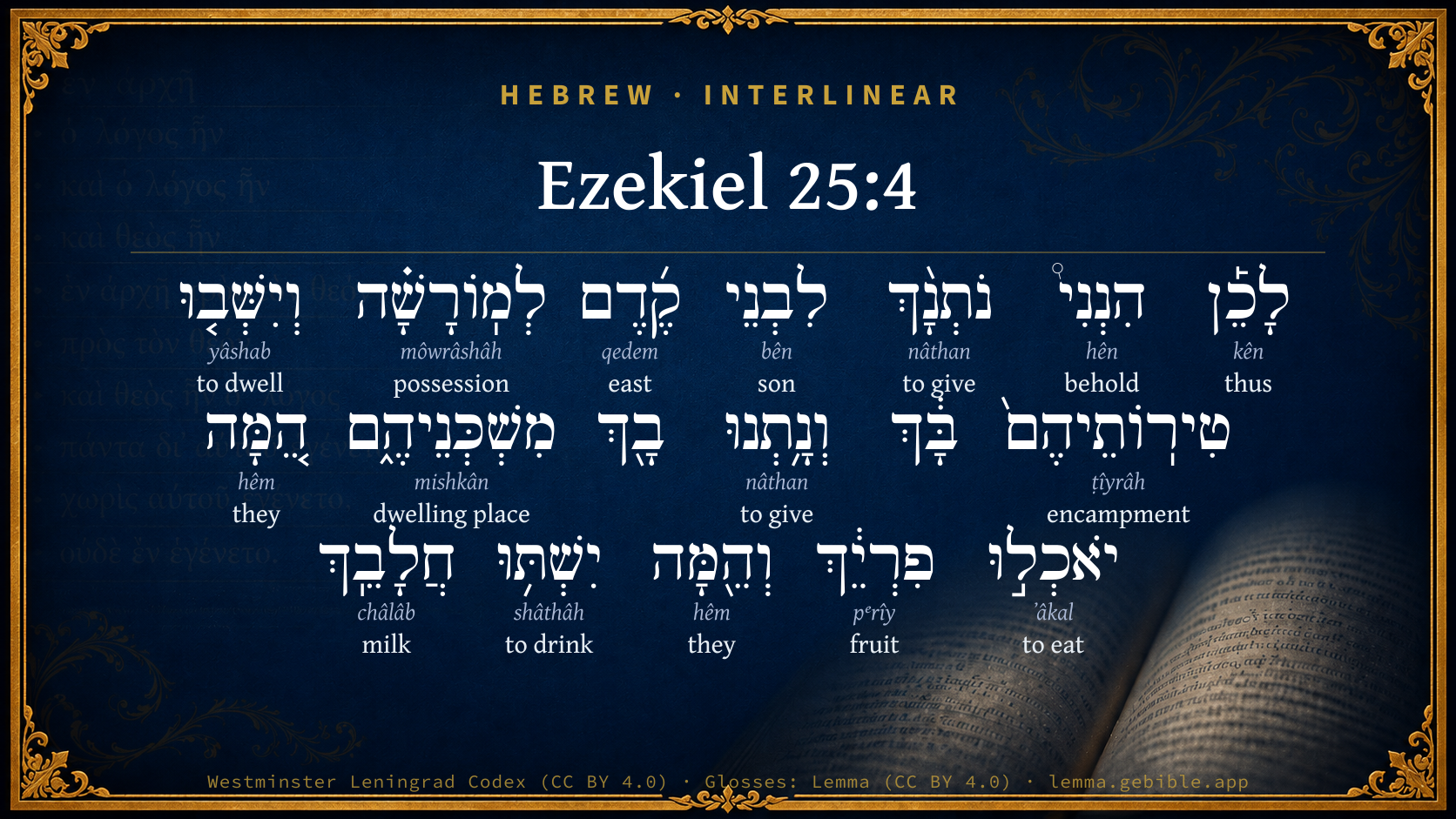
Hebrew (Westminster Leningrad Codex) Ezekiel 25:4 appears in the Hebrew Old Testament. The text above is from the Westminster Leningrad Codex. Each word links to its Strong’s number, a concise gloss, and parsing drawn from the Open Scriptures Hebrew Bible morphology. Click any word for its full Brown-Driver-Briggs (BDB) entry.
Download image
Cite this verse

Ezekiel 25:4 (World English Bible). Public Domain. Lemma interlinear Bible study tool, https://lemma.gebible.app/v/ezekiel/25/4.

Show BibTeX & RIS
BibTeX
RIS
English Translation
therefore, behold, I will deliver you to the children of the east for a possession, and they shall set their encampments in you, and make their dwellings in you; they shall eat your fruit, and they shall drink your milk.
World English Bible · Public Domain
Download a study sheet

One document with this verse’s original text, its word-by-word gloss line, the meaning frame, cross-references with their text, attributed commentary, and full source and license credits — printable, and it pastes into notes with its structure intact.

This verse Autodidact and up

Study sheet (.html) Plain text (.txt)

A passage Seminary Student

Up to 50 verses in one chapter. A passage sheet keeps up to 6 commentary sources and 12 cross-references per verse, in the order this page ranks them, and says so on the sheet whenever that leaves anything out. Ask for a single verse and you get the Autodidact verse sheet above.

Everything on this page stays free to read, with no account — the sheet is a download of what is already on screen, not access to it.

Want to remove ads? Support Godless Engineer
Compare translations 3

The same verse in 3 English versions, stacked beneath the original-language interlinear above. Click any original word for its lexicon entry.

Each is an independent rendering of the whole verse — the interlinear is not word-aligned to these translations.

Highlighted words mark where these versions differ — a whole-verse word diff, not a word-by-word alignment.

  • World English Bible Public Domain
    therefore, behold, I will deliver you to the children of the east for a possession, and they shall set their encampments in you, and make their dwellings in you; they shall eat your fruit, and they shall drink your milk.
  • King James Version Public Domain
    Behold, therefore I will deliver thee to the men of the east for a possession, and they shall set their palaces in thee, and make their dwellings in thee: they shall eat thy fruit, and they shall drink thy milk.
  • unfoldingWord Literal Text CC BY-SA 4.0
    therefore, behold, I am giving you to a people in the east as their possession. They will set up camp against you and set up their tents among you. They will eat your fruit and they will drink your milk.

unfoldingWord Literal Text — © unfoldingWord, licensed CC BY-SA 4.0. Word-aligned USFM3 via Door43 (git.door43.org/unfoldingWord/en_ult).

Versions to compare (up to 4)

3 of 4 selected

Show all 18 translations

Every available English version of this verse, each an independent rendering of the whole verse.

  • World English Bible Public Domain
    therefore, behold, I will deliver you to the children of the east for a possession, and they shall set their encampments in you, and make their dwellings in you; they shall eat your fruit, and they shall drink your milk.
  • Berean Standard Bible Public Domain
    therefore I will indeed give you as a possession to the people of the East. They will set up their camps and pitch their tents among you. They will eat your fruit and drink your milk.
  • Majority Standard Bible Public Domain
    therefore I will indeed give you as a possession to the people of the East. They will set up their camps and pitch their tents among you. They will eat your fruit and drink your milk.
  • King James Version Public Domain
    Behold, therefore I will deliver thee to the men of the east for a possession, and they shall set their palaces in thee, and make their dwellings in thee: they shall eat thy fruit, and they shall drink thy milk.
  • American Standard Version (1901) Public Domain
    therefore, behold, I will deliver thee to the children of the east for a possession, and they shall set their encampments in thee, and make their dwellings in thee; they shall eat thy fruit, and they shall drink thy milk.
  • Revised Version (1885) Public Domain
    therefore behold, I will deliver thee to the children of the east for a possession, and they shall set their encampments in thee, and make their dwellings in thee; they shall eat thy fruit, and they shall drink thy milk.
  • Geneva Bible (1599) Public Domain
    Beholde, therefore I will deliuer thee to the men of the East for a possession, and they shall set their palaces in thee, and make their dwellings in thee: they shall eate thy fruite, and they shall drinke thy milke.
  • Douay-Rheims (1899) Public Domain
    Therefore will I deliver thee to the men of the east for an inheritance, and they shall place their sheepcotes in thee, and shall set up their tents in thee: they shall eat thy fruits: and they shall drink thy milk.
  • Young's Literal Translation Public Domain
    Therefore, lo, I am giving thee to sons of the east for a possession, And they set their towers in thee, And have placed in thee their tabernacles. They eat thy fruit, and they drink thy milk,
  • Literal Standard Version CC BY-SA 4.0
    Therefore, behold, I am giving you to sons of the east for a possession, || And they set their towers in you, || And have placed their dwelling places in you. They eat your fruit, and they drink your milk,
  • Unlocked Literal Bible CC BY-SA 4.0
    therefore, behold, I am giving you to a people in the east as their possession. They will set up camp against you and set up their tents among you. They will eat your fruit and they will drink your milk.
  • unfoldingWord Literal Text CC BY-SA 4.0
    therefore, behold, I am giving you to a people in the east as their possession. They will set up camp against you and set up their tents among you. They will eat your fruit and they will drink your milk.
  • Darby Bible Public Domain
    therefore behold, I will give thee to the children of the east for a possession, and they shall set their encampments in thee, and make their dwellings in thee; they shall eat thy fruits, and they shall drink thy milk.
  • World Messianic Bible Public Domain
    therefore, behold, I will deliver you to the children of the east for a possession. They will set their encampments in you and make their dwellings in you. They will eat your fruit and they will drink your milk.
  • Webster's Bible Public Domain
    Behold, therefore I will deliver thee to the men of the east for a possession, and they shall set their palaces in thee, and make their dwellings in thee: they shall eat thy fruit, and they shall drink thy milk.
  • Free Bible Version CC BY-SA 4.0
    this is why I will make you subject to the people of the East. They will make camp and set up their tents right where you live. They will eat your fruit and drink your milk.
  • Bible in Basic English Public Domain
    For this cause I will give you up to the children of the east for their heritage, and they will put their tent-circles in you and make their houses in you; they will take your fruit for their food and your milk for their drink.
  • JPS Tanakh (1917) Public Domain
    therefore, behold, I will deliver thee to the children of the east for a possession, and they shall set their encampments in thee, and make their dwellings in thee; they shall eat thy fruit, and they shall drink thy milk.

Literal Standard Version (2020), Covenant Press — licensed CC BY-SA 4.0. Text via the HelloAO Bible API (eBible.org). Unlocked Literal Bible (unfoldingWord) — licensed CC BY-SA 4.0. Text via the HelloAO Bible API (eBible.org). unfoldingWord Literal Text — © unfoldingWord, licensed CC BY-SA 4.0. Word-aligned USFM3 via Door43 (git.door43.org/unfoldingWord/en_ult). Free Bible Version, Dr. Jonathan Gallagher — licensed CC BY-SA 4.0. Text via the HelloAO Bible API (eBible.org).

Word by word

More ways to search: Search by grammar → Find every occurrence → Compare this word →

Practice this passage: Drill this verse → Learn its vocabulary →

טִירֽוֹתֵיהֶם֙
ṭîyrâh
H2918
“encampments · their”
Noun, Common, Feminine, Plural, Construct + Suffix, Personal, 3rd Person, Masculine, Plural
Part of Speech
Noun
Type
Common
Gender
Feminine
Number
Plural
State
Construct
Full BDB Definition

Origin: from (an equivalent to) H2905

TWOT: 798b

encampment, battlement - encampment, tent camp - walled dwelling places, battlement (metaphorically) - row (of stones)
  1. לָכֵ֡ן kên H3651 “to/for · thus” Preposition + Adverb
  2. הִנְנִי֩ hên H2005 “behold · me” Particle, Demonstrative + Suffix, Personal, 1st Person, Common, Singular
  3. נֹתְנָ֨ךְ nâthan H5414 “giving · you” Verb, Qal, Participle Active, Masculine, Singular, Construct + Suffix, Personal, 2nd Person, Feminine, Singular
  4. לִבְנֵי bên H1121 “to/for · sons of” Preposition + Noun, Common, Masculine, Plural, Construct
  5. קֶ֜דֶם qedem H6924 “east” Noun, Common, Masculine, Singular, Absolute
  6. לְמֽוֹרָשָׁ֗ה môwrâshâh H4181 “to/for · possession” Preposition + Noun, Common, Feminine, Singular, Absolute
  7. וְיִשְּׁב֤וּ yâshab H3427 “and · to dwell” Conjunction + Verb, Piel, Sequential Perfect, 3rd Person, Common, Plural
  8. וְנָ֥תְנוּ nâthan H5414 “and · to give” Conjunction + Verb, Qal, Sequential Perfect, 3rd Person, Common, Plural
  9. מִשְׁכְּנֵיהֶ֑ם mishkân H4908 “dwelling places · their” Noun, Common, Masculine, Plural, Construct + Suffix, Personal, 3rd Person, Masculine, Plural
  10. הֵ֚מָּה hêm H1992 “they” Pronoun, Personal, 3rd Person, Masculine, Plural
  11. יֹאכְל֣וּ ʼâkal H398 “to eat” Verb, Qal, Imperfect, 3rd Person, Masculine, Plural
  12. פִרְיֵ֔ךְ pᵉrîy H6529 “fruit · your” Noun, Common, Masculine, Singular, Construct + Suffix, Personal, 2nd Person, Feminine, Singular
  13. וְהֵ֖מָּה hêm H1992 “and · they” Conjunction + Pronoun, Personal, 3rd Person, Masculine, Plural
  14. יִשְׁתּ֥וּ shâthâh H8354 “to drink” Verb, Qal, Imperfect, 3rd Person, Masculine, Plural
  15. חֲלָבֵֽךְ châlâb H2461 “milk · your” Noun, Common, Masculine, Singular, Construct + Suffix, Personal, 2nd Person, Feminine, Singular

About this verse

These counts appear in no published source. They are computed here, from the morphology-tagged text and Lemma’s own curated glosses. What Lemma adds →

18
words
14
distinct lemmas
Prophets
section

Notable vocabulary

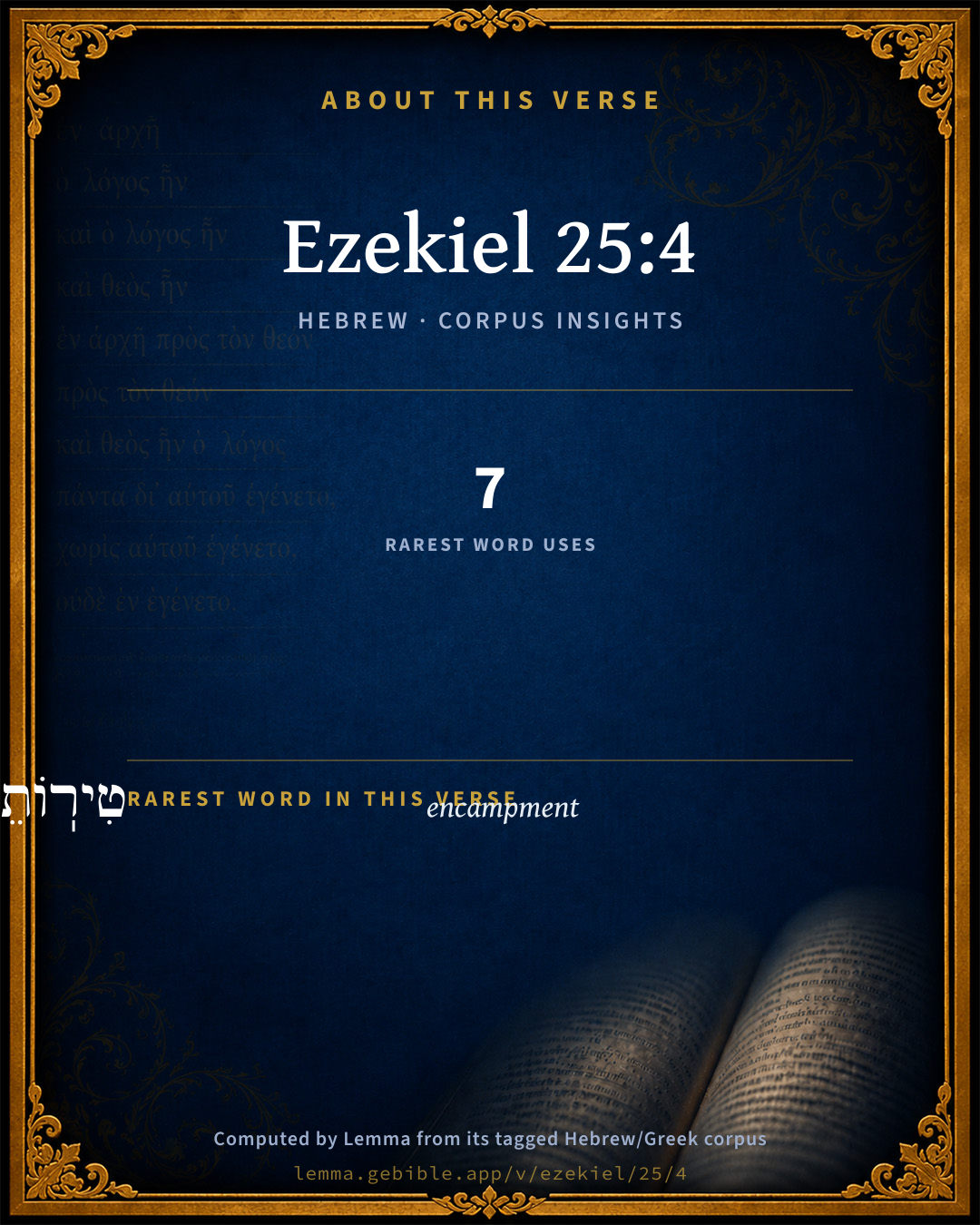
The rarest word here is טִירֽוֹתֵיהֶם֙ encampment H2918 — appearing just 7 times in the whole Hebrew Bible.

Shared distinctive vocabulary

טִירֽוֹתֵיהֶם֙ encampment H2918 occurs in 7 verses of the Hebrew Bible. Also found in:

Grammatical profile

  • 5 verbs
  • 7 nouns
  • 2 pronouns
  • 2 prepositions
  • 1 adverb
  • 1 particle

Verb forms

  • נֹתְנָ֨ךְ Qal · Participle Active
  • וְיִשְּׁב֤וּ Piel · Sequential Perfect
  • וְנָ֥תְנוּ Qal · Sequential Perfect
  • יֹאכְל֣וּ Qal · Imperfect
  • יִשְׁתּ֥וּ Qal · Imperfect

Repetition

Words recur within this verse — often emphatic in Hebrew:

  • נֹתְנָ֨ךְ to give H5414 ×2
  • הֵ֚מָּה they H1992 ×2

Hebrew & Septuagint length

In English translation the verse runs 40 words from the Hebrew and 42 from the Septuagint (LXX English) — closely comparable.

A rough comparison of the two English renderings, which tokenize alike — not a word-level alignment.

Word counts can differ between the Hebrew and the Greek without any difference in meaning — e.g. the Hebrew direct-object marker אֵת has no separate Greek word, and Greek often adds the article ὁ.

Cross-references

15

Topical passages linked to Ezekiel 25:4 in the Treasury of Scripture Knowledge — connected by theme and wording, ordered by reader-vote popularity; previews shown in the World English Bible.

  • Deuteronomy 28:33 The fruit of your ground, and all your labors, shall a nation which you don't know eat up; and you shall be only oppressed and crushed always;
  • Judges 6:33 Then all the Midianites and the Amalekites and the children of the east assembled themselves together; and they passed over, and encamped in the valley of Jezreel.
  • Deuteronomy 28:51 and shall eat the fruit of your cattle, and the fruit of your ground, until you are destroyed; that also shall not leave you grain, new wine, or oil, the increase of your cattle, or the young of your flock, until they have caused you to perish.
  • 1 Kings 4:30 Solomon's wisdom excelled the wisdom of all the children of the east, and all the wisdom of Egypt.
  • Isaiah 1:7 Your country is desolate. Your cities are burned with fire. Strangers devour your land in your presence, And it is desolate, As overthrown by strangers.
  • Genesis 29:1 Then Jacob went on his journey, and came to the land of the children of the east.
  • Leviticus 26:16 I also will do this to you: I will appoint terror over you, even consumption and fever, that shall consume the eyes, and make the soul to pine away; and you will sow your seed in vain, for your enemies will eat it.
  • Numbers 23:7 He took up his parable, and said, From Aram has Balak brought me, The king of Moab from the mountains of the East: Come, curse me Jacob, Come, defy Israel.
  • Judges 6:3–6 So it was, when Israel had sown, that the Midianites came up, and the Amalekites, and the children of the east; they came up against them;
  • Judges 7:12 The Midianites and the Amalekites and all the children of the east lay along in the valley like locusts for multitude; and their camels were without number, as the sand which is on the sea-shore for multitude.
  • Judges 8:10 Now Zebah and Zalmunna were in Karkor, and their hosts with them, about fifteen thousand men, all who were left of all the host of the children of the east; for there fell one hundred twenty thousand men who drew sword.
  • 2 Samuel 12:26 Now Joab fought against Rabbah of the children of Ammon, and took the royal city.
  • Isaiah 32:8–9 But the noble devises noble things; and in noble things shall he continue.
  • Isaiah 41:2 Who has raised up one from the east, whom he calls in righteousness to his foot? he gives nations before him, and makes him rule over kings; he gives them as the dust to his sword, as the driven stubble to his bow.
  • Isaiah 65:22 They shall not build, and another inhabit; they shall not plant, and another eat: for as the days of a tree shall be the days of my people, and my chosen shall long enjoy the work of their hands.

Cross-references courtesy of OpenBible.info (CC BY 4.0).

Hebrew and Greek witnesses Masoretic Hebrew ↔ Greek Septuagint

The same verse in the two great witnesses to the Old Testament, shown verse-for-verse.

These are two independent witnesses, not word-aligned to each other, and the Septuagint is shown in lemma (dictionary) form.

Hebrew Ezekiel 25:4 Masoretic · Westminster Leningrad Codex

לָכֵ֡ן הִנְנִי֩ נֹתְנָ֨ךְ לִבְנֵי קֶ֜דֶם לְמֽוֹרָשָׁ֗ה וְיִשְּׁב֤וּ טִירֽוֹתֵיהֶם֙ בָּ֔ךְ וְנָ֥תְנוּ בָ֖ךְ מִשְׁכְּנֵיהֶ֑ם הֵ֚מָּה יֹאכְל֣וּ פִרְיֵ֔ךְ וְהֵ֖מָּה יִשְׁתּ֥וּ חֲלָבֵֽךְ

therefore, behold, I will deliver you to the children of the east for a possession, and they shall set their encampments in you, and make their dwellings in you; they shall eat your fruit, and they shall drink your milk.

World English Bible · Public Domain

Greek LXX Ezekiel 25:4 Septuagint · lemma form

διά οὗτος ἰδού ἐγώ παραδίδωμι σύ ὁ υἱός κεδεμ εἰς κληρονομία καί κατασκηνόω ἐν ὁ ἀπαρτία αὐτός ἐν σύ καί δίδωμι ἐν σύ ὁ σκήνωμα αὐτός αὐτός ἐσθίω ὁ καρπός σύ καί αὐτός πίνω ὁ πιότης σύ

therefore, behold, I will deliver you to the children of Kedem for an inheritance, and they shall lodge in you with their stuff, and they shall pitch their tents in you: they shall eat your fruits, and they shall drink your milk.

LXX2012 (modern English Septuagint) · Public Domain

On this verse, Joseph Benson's Commentary discusses the Septuagint’s reading. Read the note in Commentary ↓

Hebrew: Westminster Leningrad Codex (CC BY 4.0). Greek: Septuagint (public domain); English from LXX2012 (modern English Septuagint) (Public Domain). How the Septuagint differs from the Hebrew →

Targum (Aramaic paraphrase)

1

The Targum is the ancient Jewish Aramaic paraphrase of the Hebrew Scriptures — an interpretive translation, not the Hebrew text itself. Onkelos (literal) and Pseudo-Jonathan (expansive) render the Torah, and Jonathan the Prophets. Coverage is partial: where no permissively-licensed English translation exists for a verse, only the Aramaic is shown. This is verse-level text, not a word-by-word alignment to the Hebrew.

  1. Targum Jonathan Prophets (Joshua–Malachi)
    בְּכֵן הָא אֲנָא מְסַר לִיךְ לִבְנֵי מַדִינְחָא לִירוּתָא וְיִתְבוּן בִּרְנְיָתֵיהוֹן בִּיךְ מַשְׁכְּנֵיהוֹן אִינוּן יֵיכְלוּן טוּב אַרְעִיךְ וְאִינוּן יִבְזוּן נִכְסָךְ:

    (no public-domain English translation for this verse)

    Targum Jonathan — Aramaic: “Mikraot Gedolot” (public domain). English: “Sefaria Community Translation” (CC0 1.0 (public-domain dedication)); “London "Chaldee Paraphrase," 1871” (public domain). Text via Sefaria.

Commentary

Notes on Ezekiel 25:4 from classic Christian and Jewish commentators (each source and its license shown beneath its notes). The classic Christian expositions comment on the surrounding passage and are grouped to its opening verse, so a note may address several verses; the Jewish commentaries on the Tanakh (Rashi and others) are per-verse, so they appear only where the commentator wrote on this verse.

Lemma curates 59 commentaries, every one of them public domain or Creative Commons licensed, each selected and text-cleaned for this edition rather than reprinted as found. About our sources →

Trapp's Complete Commentary

John Trapp

Eze 25:4 Behold, therefore I will deliver thee to the men of the east for a possession, and they shall set their palaces in thee, and make their dwellings in thee: they shall eat thy fruit, and they shall drink thy milk.

Ver. 4. I will deliver thee to the men of the east.] To the Arabians, Keturah’s posterity, who were shepherds and camel masters.

They shall eat thy fruit and drink thy milk.] Sept., πιοτητα, Thy fatness. Est enim adeps lac coagulatum. The Ammonites, as now the Flemmings, were γαλακτοφαγοι, butter boxes, as we say, and lived much upon dairy products; so do we. Let us use our plenty to God’s glory, lest we lose all.

John Trapp, A Commentary or Exposition upon All the Books of the Old and New Testament (1647–1656) — public domain. Text from a community e-Sword module.

Joseph Benson's Commentary

Eze 25:4-7. Behold, I will deliver thee to the men of the east — That is, to the Chaldeans, whose country lay east of the Ammonites. This people was accordingly conquered and subdued by the Chaldeans, about five years after the destruction of Jerusalem. And they shall drink thy milk — Milk was the principal sustenance of those people, whose riches consisted chiefly in their stocks of cattle. The Hebrew word חלב, however, here rendered milk, signifies also the fattest or choicest parts of any flesh or fruits. So it is used Gen 45:18, Ye shall eat the fat of the land; and Psa 81:16, where our translation reads, The finest of the wheat, in the Hebrew it is, The fat of the wheat. And this clause is rendered by the LXX., Και αυτοι πιονται τον πιοτητα σου, And they shall drink, or swallow down, thy fatness. And I will make Rabbah a stable for camels — Rabbah was the chief city of the Ammonites. What is said of it here, that it should be made a stable for camels, implies, that instead of being a city inhabited by men, it should be a place for cattle, and particularly for camels, to feed and lie down in, of which that and the neighbouring countries had great store. It is a proverbial expression for utter destruction, to say that grass grows where a town stood. Because thou hast clapped thy hands, &c. — Showed expressions of joy and satisfaction in the most insolent manner, with all thy despite against the land of Israel — With the utmost hatred and contempt of my people; I will stretch out my hand upon thee — Namely, my hand of wrath. And will deliver thee for a spoil to the heathen — Or, for meat, as the word in the Hebrew text, לבג, properly means, though the marginal reading of the Masorites is, לבז, for a prey. The greedy, covetous soldiers shall make thy wealth their prey; the hungry enemies shall eat thee up. And I will cut thee off from the people — Thou shalt no more be reckoned among the nations, but shalt cease from being a people. And thou shalt know that I am the Lord — In these words the threatenings, both in Eze 25:5 and in this verse, conclude. For thus, 1st, God would maintain his own honour, and make it appear that he was the God of Israel, though he suffered them for a time to be captives in Babylon. And, 2d, He would bring those that were strangers to him into an acquaintance with him, and it would be a blessed effect of their calamities. How much better is it to be poor and know God, than to be rich and ignorant of him!

Joseph Benson's Commentary on the Old and New Testaments (1811–1818) — public domain. Text from a community e-Sword module.

Geneva Bible (1599)

Geneva Bible translators

They shall chase thee away, and take thy gorgeous houses to dwell in.

That is, to the Babylonians.

Geneva Bible (1599) marginal notes — public domain. Text via Bolls.life.

Jamieson, Fausset & Brown

Robert Jamieson, A. R. Fausset & David Brown

men of . . . east--literally, "children of the East," the nomad tribes of Arabia-Deserta, east of the Jordan and the Dead Sea.

palaces--their nomadic encampments or folds, surrounded with mud walls, are so called in irony. Where thy "palaces" once stood, there shall their very different "palaces" stand. Fulfilled after the ravaging of their region by Nebuchadnezzar, shortly after the destruction of Jerusalem (compare Eze 21:22; Jer. 49:1-28).

Jamieson, Fausset & Brown — Commentary Critical and Explanatory on the Whole Bible (1871) — public domain (CC PDM 1.0). Text via the HelloAO Bible API.

Adam Clarke's Commentary

Verse 4. Will deliver thee to the men of the east] Probably the Scenite Arabs, Ishmaelites, and people of Kedar, who seized upon the provinces of the vanquished Ammonites, &c. The following description suits this people only, living on fruits, the milk of their flocks, using camels, &c. Some think the people of the east mean the Chaldeans.

Adam Clarke's Commentary on the Bible (1810–1826) — public domain. Text from a community e-Sword/MySword module.

Ellicott's Commentary for English Readers

(4) To the men of the east.—Literally, sons of the east, i.e., the various nomadic tribes inhabiting the Eastern deserts, who occupy the country to this day. They are described as its possessors, not its conquerors; the conquest was effected by Nebuchadnezzar. In Eze_21:20-23 he was represented as hesitating whether to attack first Judah or Ammon, and determined to the former by the Divine direction; in this attack some of the Ammonites joined his army, but he nevertheless afterwards carried out his purpose and desolated their country. (See Eze_21:28.)

Palaces.—The word properly means an enclosure for folding cattle. The same word is used in connection with tribes of the desert in Gen_25:16; Num_31:10, and in both is translated castles, a singularly inappropriate sense. It afterwards came to mean a dwelling-place of any kind. The Ammonites and Moabites appear to have practically constituted one nation, the latter being, for the most part, the settled, and the former the nomadic portion. After the conquest of Nebuchadnezzar the Ammonites gradually dwindled away, until lost from history. The Ptolemies founded the city Philadelphia on the site of Rabbah, and there are still extensive ruins there belonging to the period of the Roman occupation; but the Ammonites had no part in either of these successive cities. The place is now utterly without inhabitants, and the most recent traveller says, “Lonely desolation in a rich country was the striking characteristic.”

A Bible Commentary for English Readers, edited by Charles John Ellicott (1878–1897) — public domain. Text from a community e-Sword module.

The Cambridge Bible for Schools and Colleges

gen. ed. J. J. S. Perowne

4. men of the east] lit. children of the east, the nomad tribes of the Arabian desert, Jdg_6:3.

set their palaces] their encampments, Jdg_6:1-6.

drink thy milk] Ammon, lying toward the desert, was a pastoral country.

The Cambridge Bible for Schools and Colleges (gen. ed. J. J. S. Perowne; Cambridge University Press, 1878–1918) — public domain. Text from a community e-Sword module.

John Gill's Exposition

Behold, therefore, I will deliver thee to the men of the east for a possession,.... The Chaldeans and Syrians, which were on the east side, as Jarchi; or the Medes and Persians, as Kimchi, which lay more eastward; or it may be the Arabians, who are commonly called the men of the east; who were a part of Nebuchadnezzar's army, and whom he might reward with this country, when taken by him; for this prophecy, according to Josephus (q), was fulfilled five years after the destruction of Jerusalem:

and they shall set their palaces in thee, and make their dwellings in thee; or, "their camps and their tents" (r); and so the Syriac version renders it, their armies and their tents; who should subdue them, and take possession of their cities and fields, and enjoy what they found there:

they shall eat thy fruit, and drink thy milk; the fruit of their land, their vineyards and fields, and the milk of their flocks and herds, which was commonly drank in those countries; these are put for the whole of their substance. So the Targum,

"they shall eat the good of thy land, and spoil thy substance.''

(q) Antiqu. l. 16. c. 9. sect. 7. (r) "arces suas", Junius & Tremellius, Piscator, Polanus, Coeccius. "tentoria sua", V. L. "tabernacala sus", Junius & Tremellius, Piscator, Polanus, Cocceius, Starckius.

John Gill's Exposition of the Whole Bible (1746–1763) — public domain (CC PDM 1.0). Text via the HelloAO Bible API.

Haydock's Catholic Bible Commentary

East; the Chaldeans, (Sanctius) who conquered them, (Haydock) though the Scenite Arabs, who occupied the country after the inhabitants were removed, or the Armenians and Agarens, are rather meant than the Chaldeans. (Worthington)

George Leo Haydock (1774–1849), Haydock's Catholic Family Bible and Commentary, 1859 edition — public domain. Excludes Psalms (Douay-Rheims chapter numbering differs from Protestant) and Deuterocanonical books (Catholic canon only).

Matthew Poole's English Annotations

I, the God whom thou hast despised, whose people thou hast reproached, whose worship thou hast vilified, I will avenge myself, and deliver time up.

To the men of the East; the Medes and Persians, say some; the Babylonians, say others, but this suits not well with geography; Arabians, say others, associates of Nehuchadnezzar, who, it is likely, recompensed their labour and service with giving them this country when it was conquered, as it was five years after the desolation of Jerusalem.

For a possession; they shall settle on it, as a very convenient country for their sheep and camels, and possess it, as their inheritance.

Set their palaces in thee: the word palaces seems little to agree with Arabians, who dwelt in tents, but this manner of dwelling many of them would be ready to change, where they might to so great advantage, as in that country, which was fruitful, as this was; besides, the word signifieth, what is fenced, as Isa 2:15, and is paraphrased by camp, and Arabians had their munitions and fortified camps, and these they shall set here while they stay. And I add this also, that the next words explain these.

Make their dwellings in thee; they shall set up their tents, as the word properly; their tents and habitations they would fortify in some manner or other, that in their camp they might be safe, if they did not build cities in the country.

Eat thy fruit; the fruit of that land was once thine, of the trees thou plantedst.

Drink thy milk; which in so fruitful land and rich pastures they had in abundance from the multitude of their kine, and it was a drink that well suited with those hot regions.

Matthew Poole's English Annotations on the Holy Bible (1683–1685) — public domain. Text from a community e-Sword/MySword module.

Whedon's Commentary on the Bible

Daniel D. Whedon

4. Men of the east — Hebrews, children of the east. The wandering tribes which were always near neighbors of Ammon and Israel (Jdg_6:3; Jdg_6:33; Jdg_7:12; Jdg_8:11; Job_1:3).

Palaces — R.V., “encampments.”

Daniel D. Whedon (gen. ed.), Commentary on the Old and New Testaments (1874–1909) — public domain. Text from a community e-Sword module.

The Pulpit Commentary

Vers. 4, 5The men of the east; Hebrew, children of the east. The name is applied in Gen_29:1; 1Ki_4:30; Job_1:3; Jud_1:6:3, 33 7:12 8:10, to the nomadic tribes, Midianites and others, which roamed to and fro in the wilderness east of Ammon and Moab, after the manner of the modem Bedouins, with their sheep and camels, and were looked upon as descendants of Ishmael. Palaces; better, with the Revised Version, encampments, or tent-villages. The word is found, in this sense, in Gen_25:16; Psa_69:25; Num_31:10. This was, probably, the immediate result of Nebuchadnezzar"s march. Rabbah was left undefended, and became a stable for the camels of the Midianites and other tribes. (Jud_1:6:5) The prediction has been slowly fulfilled. Under the Greece-Egyptian rule the city revived, was named after Ptolemy Philadel-phus, and was flourishing under the Roman Empire. Remains of temples, theatres, houses, are still found on its site, but its present desolate condition agrees with the picture drawn here by Ezekiel Jer_49:2. The language of Jer_49:6 impliescaptivity and a partial return from it.

The Pulpit Commentary (1880–1919), ed. H.D.M. Spence-Jones & Joseph S. Exell — public domain. Text from a community e-Sword module.

John Wesley's Explanatory Notes

The men of the east - The Arabians, associates of Nebuchadnezzar, who recompensed their service, with giving them this country when it was conquered, as it was five years after the desolation of Jerusalem.

John Wesley, Explanatory Notes Upon the Whole Bible (1754–1765) — public domain. Text via the GEBible commentary corpus.

Rashi

Rabbi Shlomo Yitzchaki (Rashi)

to the children of the East The Chaldeans and Aram are to the east.

Rashi on the Tanakh — English translations: “The Judaica Press complete Tanach with Rashi, translated by A. J. Rosenberg” (CC BY 4.0); “Pentateuch with Rashi's commentary by M. Rosenbaum and A.M. Silbermann, 1929-1934” (public domain); “The Metsudah Tanach series, Lakewood, N.J” (CC BY 4.0); and “The Book of Joshua, Metsudah Publications, 1997” (CC BY 4.0). Text via Sefaria.

Lesson kit

Teaching starters — assembled from the data on this page, not authored interpretation. Every prompt links to the verse data it draws on. Edit before teaching.

Ezekiel, in the Prophets, opens this verse with 18 words (14 distinct Hebrew lemmas). Its most distinctive word is ṭîyrâh (“encampment”). A historical commentator’s framing appears above. Read the whole chapter for the surrounding context.

Discussion questions

  1. What does “encampment” (ṭîyrâh) contribute to the verse as a whole?
  2. Genesis 25:16 shares the word «encampment» with this verse. How do the two illuminate each other?
  3. “to give” occurs 2× in this one verse. What is the effect of the repetition?
  4. The translations on this page render this verse differently — a whole-verse word diff, not a word-by-word alignment. What might account for the different wordings?
  5. The verb «נֹתְנָ֨ךְ» is Qal Participle Active. How does its form color the action?
  6. Reading how Trapp's Complete Commentary and Joseph Benson's Commentary read this verse, where do the two commentators agree and where do they part?

Things to notice

Reading settings

Reading text

Shown beneath each verse's original-language words.

Old Testament
Old Testament edition

Read the OT as the Masoretic Hebrew (MT) or the Greek Septuagint (LXX).

English shown for the Greek Septuagint (in the Hebrew ↔ Greek comparison).

Comparing translations? Open the Compare panel on any verse page to stack up to four side by side.