
Genesis 7:14

Hebrew (Westminster Leningrad Codex) Genesis 7:14 appears in the Hebrew Old Testament. The text above is from the Westminster Leningrad Codex. Each word links to its Strong’s number, a concise gloss, and parsing drawn from the Open Scriptures Hebrew Bible morphology. Click any word for its full Brown-Driver-Briggs (BDB) entry.
Download image
Cite this verse

Genesis 7:14 (World English Bible). Public Domain. Lemma interlinear Bible study tool, https://lemma.gebible.app/v/genesis/7/14.

Show BibTeX & RIS
BibTeX
RIS
English Translation
they, and every animal after its kind, all the cattle after their kind, every creeping thing that creeps on the earth after its kind, and every bird after its kind, every bird of every sort.
World English Bible · Public Domain
Highlights
  • 1 first appearance in the Hebrew Bible
Full analysis ↓
Download a study sheet

One document with this verse’s original text, its word-by-word gloss line, the meaning frame, cross-references with their text, attributed commentary, and full source and license credits — printable, and it pastes into notes with its structure intact.

This verse Autodidact and up

Study sheet (.html) Plain text (.txt)

A passage Seminary Student

Up to 50 verses in one chapter. A passage sheet keeps up to 6 commentary sources and 12 cross-references per verse, in the order this page ranks them, and says so on the sheet whenever that leaves anything out. Ask for a single verse and you get the Autodidact verse sheet above.

Everything on this page stays free to read, with no account — the sheet is a download of what is already on screen, not access to it.

Want to remove ads? Support Godless Engineer
Compare translations 3

The same verse in 3 English versions, stacked beneath the original-language interlinear above. Click any original word for its lexicon entry.

Each is an independent rendering of the whole verse — the interlinear is not word-aligned to these translations.

Highlighted words mark where these versions differ — a whole-verse word diff, not a word-by-word alignment.

  • World English Bible Public Domain
    they, and every animal after its kind, all the cattle after their kind, every creeping thing that creeps on the earth after its kind, and every bird after its kind, every bird of every sort.
  • King James Version Public Domain
    They, and every beast after his kind, and all the cattle after their kind, and every creeping thing that creepeth upon the earth after his kind, and every fowl after his kind, every bird of every sort.
  • unfoldingWord Literal Text CC BY-SA 4.0
    they and every living thing according to its kind, and every livestock according to its kind, and every moving creature moving on the earth according to its kind, and every bird according to its kind, every bird of every wing.

unfoldingWord Literal Text — © unfoldingWord, licensed CC BY-SA 4.0. Word-aligned USFM3 via Door43 (git.door43.org/unfoldingWord/en_ult).

Versions to compare (up to 4)

3 of 4 selected

Show all 18 translations

Every available English version of this verse, each an independent rendering of the whole verse.

  • World English Bible Public Domain
    they, and every animal after its kind, all the cattle after their kind, every creeping thing that creeps on the earth after its kind, and every bird after its kind, every bird of every sort.
  • Berean Standard Bible Public Domain
    they and every kind of wild animal, livestock, crawling creature, bird, and winged creature.
  • Majority Standard Bible Public Domain
    they and every kind of wild animal, livestock, crawling creature, bird, and winged creature.
  • King James Version Public Domain
    They, and every beast after his kind, and all the cattle after their kind, and every creeping thing that creepeth upon the earth after his kind, and every fowl after his kind, every bird of every sort.
  • American Standard Version (1901) Public Domain
    they, and every beast after its kind, and all the cattle after their kind, and every creeping thing that creepeth upon the earth after its kind, and every bird after its kind, every bird of every sort.
  • Revised Version (1885) Public Domain
    they, and every beast after its kind, and all the cattle after their kind, and every creeping thing that creepeth upon the earth after its kind, and every fowl after its kind, every bird of every sort.
  • Geneva Bible (1599) Public Domain
    They and euery beast after his kinde, and all cattell after their kinde, and euery thing that creepeth and moueth vpon the earth after his kinde, and euery foule after his kinde, euen euery bird of euery fether.
  • Douay-Rheims (1899) Public Domain
    They and every beast according to its kind, and all the cattle in their kind, and every thing that moveth upon the earth according to its kind, and every fowl according to its kind, and every fowl according to its kind, all birds, and all that fly.
  • Young's Literal Translation Public Domain
    they, and every living creature after its kind, and every beast after its kind, and every creeping thing that is creeping on the earth after its kind, and every fowl after its kind, every bird -- every wing.
  • Literal Standard Version CC BY-SA 4.0
    they, and every living creature after its kind, and every beast after its kind, and every creeping thing that is creeping on the earth after its kind, and every bird after its kind (every bird, every wing).
  • Unlocked Literal Bible CC BY-SA 4.0
    They entered along with each wild animal according to its kind, and each sort of livestock according to its kind, and each creeping thing that creeps upon the earth according to its kind, and every sort of bird according to its kind, each kind of creature with wings.
  • unfoldingWord Literal Text CC BY-SA 4.0
    they and every living thing according to its kind, and every livestock according to its kind, and every moving creature moving on the earth according to its kind, and every bird according to its kind, every bird of every wing.
  • Darby Bible Public Domain
    they, and every beast after its kind, and all the cattle after their kind, and every creeping thing that creeps on the earth after its kind, and all fowl after its kind -- every bird of every wing.
  • World Messianic Bible Public Domain
    they, and every animal after its kind, all the livestock after their kind, every creeping thing that creeps on the earth after its kind, and every bird after its kind, every bird of every sort.
  • Webster's Bible Public Domain
    They, and every beast after his kind, and all the cattle after their kind, and every creeping animal that creepeth upon the earth after his kind, and every fowl after his kind, every bird of every sort.
  • Free Bible Version CC BY-SA 4.0
    They had with them every kind of wild animals, livestock, creatures that run along the ground, and birds—everything with wings.
  • Bible in Basic English Public Domain
    And with them, every sort of beast and cattle, and every sort of thing which goes on the earth, and every sort of bird.
  • JPS Tanakh (1917) Public Domain
    they, and every beast after its kind, and all the cattle after their kind, and every creeping thing that creepeth upon the earth after its kind, and every fowl after its kind, every bird of every sort.

Literal Standard Version (2020), Covenant Press — licensed CC BY-SA 4.0. Text via the HelloAO Bible API (eBible.org). Unlocked Literal Bible (unfoldingWord) — licensed CC BY-SA 4.0. Text via the HelloAO Bible API (eBible.org). unfoldingWord Literal Text — © unfoldingWord, licensed CC BY-SA 4.0. Word-aligned USFM3 via Door43 (git.door43.org/unfoldingWord/en_ult). Free Bible Version, Dr. Jonathan Gallagher — licensed CC BY-SA 4.0. Text via the HelloAO Bible API (eBible.org).

Word by word

More ways to search: Search by grammar → Find every occurrence → Compare this word →

Practice this passage: Drill this verse → Learn its vocabulary →

הָרֶ֛מֶשׂ
remes
H7431
“the · creeping things”
Particle, Definite Article + Noun, Common, Masculine, Singular, Absolute
Part of Speech
Particle + Noun
Type
Common
Gender
Masculine
Number
Singular
State
Absolute
Full BDB Definition

Origin: from H7430

TWOT: 2177a

creeping things, moving things, creeping organism - creeping things - gliding things (of sea animals) - moving things (of all animals)
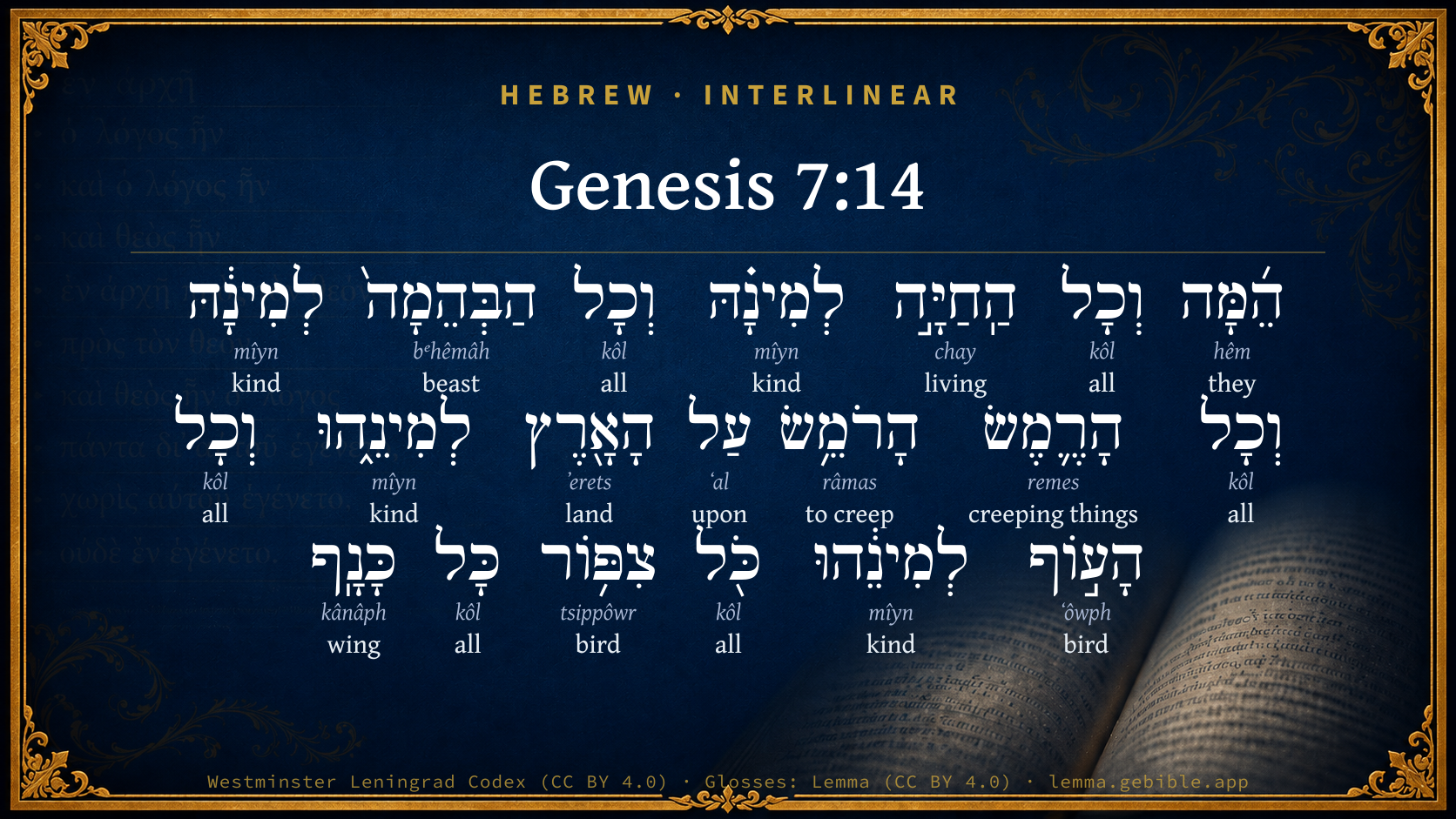
  1. הֵ֜מָּה hêm H1992 “they” Pronoun, Personal, 3rd Person, Masculine, Plural
  2. וְכָל kôl H3605 “and · all of” Conjunction + Noun, Common, Masculine, Singular, Construct
  3. הַֽחַיָּ֣ה chay H2416 “the · living” Particle, Definite Article + Noun, Common, Feminine, Singular, Absolute
  4. לְמִינָ֗הּ mîyn H4327 “to/for · kind · her” Preposition + Noun, Common, Masculine, Singular, Construct + Suffix, Personal, 3rd Person, Feminine, Singular
  5. וְכָל kôl H3605 “and · all of” Conjunction + Noun, Common, Masculine, Singular, Construct
  6. הַבְּהֵמָה֙ bᵉhêmâh H929 “the · beast” Particle, Definite Article + Noun, Common, Feminine, Singular, Absolute
  7. לְמִינָ֔הּ mîyn H4327 “to/for · kind · their” Preposition + Noun, Common, Masculine, Singular, Construct + Suffix, Personal, 3rd Person, Feminine, Plural
  8. וְכָל kôl H3605 “and · all of” Conjunction + Noun, Common, Masculine, Singular, Construct
  9. הָרֹמֵ֥שׂ râmas H7430 “the · creeping” Particle, Definite Article + Verb, Qal, Participle Active, Masculine, Singular, Absolute
  10. עַל ʻal H5921 “upon” Preposition
  11. הָאָ֖רֶץ ʼerets H776 “the · land” Particle, Definite Article + Noun, Common, Both, Singular, Absolute
  12. לְמִינֵ֑הוּ mîyn H4327 “to/for · kind · his” Preposition + Noun, Common, Masculine, Singular, Construct + Suffix, Personal, 3rd Person, Masculine, Singular
  13. וְכָל kôl H3605 “and · all of” Conjunction + Noun, Common, Masculine, Singular, Construct
  14. הָע֣וֹף ʻôwph H5775 “the · bird” Particle, Definite Article + Noun, Common, Masculine, Singular, Absolute
  15. לְמִינֵ֔הוּ mîyn H4327 “to/for · kind · his” Preposition + Noun, Common, Masculine, Singular, Construct + Suffix, Personal, 3rd Person, Masculine, Singular
  16. כֹּ֖ל kôl H3605 “all of” Noun, Common, Masculine, Singular, Construct
  17. צִפּ֥וֹר tsippôwr H6833 “bird of” Noun, Common, Both, Singular, Construct
  18. כָּל kôl H3605 “all of” Noun, Common, Masculine, Singular, Construct
  19. כָּנָֽף kânâph H3671 “wing” Noun, Common, Feminine, Singular, Absolute

About this verse

These counts appear in no published source. They are computed here, from the morphology-tagged text and Lemma’s own curated glosses. What Lemma adds →

20
words
12
distinct lemmas
Pentateuch
section

Notable vocabulary

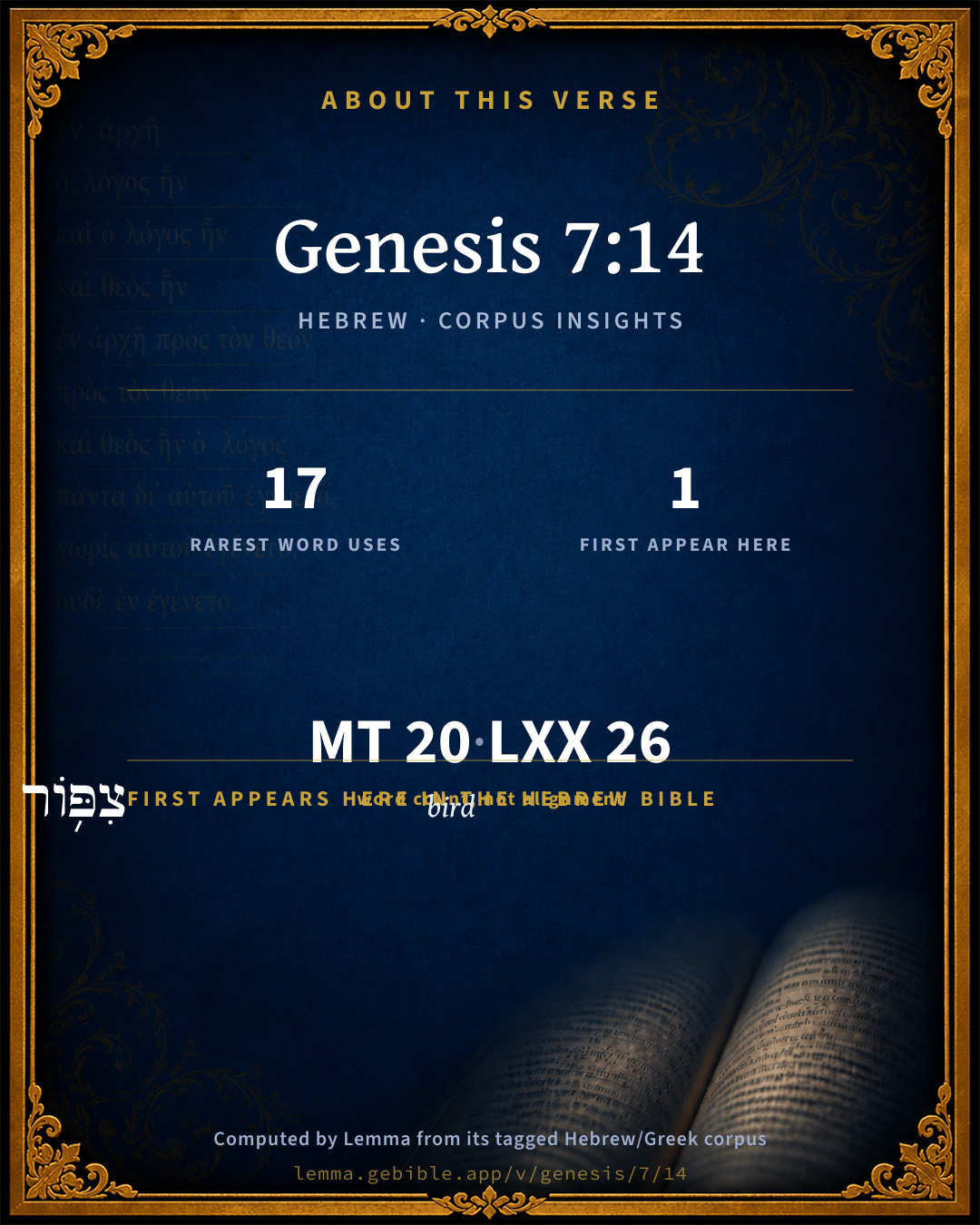
The rarest word here is הָרֶ֛מֶשׂ creeping things H7431 — appearing just 17 times in the whole Hebrew Bible.

First appearance in Scripture

This word makes its first canonical appearance in the Hebrew Bible here:

  • צִפּ֥וֹר bird H6833

Shared distinctive vocabulary

הָרֶ֛מֶשׂ creeping things H7431 occurs in 17 verses of the Hebrew Bible. Also found in:

Grammatical profile

  • 1 verb
  • 17 nouns
  • 1 pronoun
  • 1 preposition

Verb forms

  • הָרֹמֵ֥שׂ Qal · Participle Active

Repetition

Words recur within this verse — often emphatic in Hebrew:

  • וְכָל all H3605 ×6
  • לְמִינָ֗הּ kind H4327 ×4

Hebrew & Septuagint length

In English translation the verse runs 35 words from the Hebrew and 32 from the Septuagint (LXX English) — closely comparable.

A rough comparison of the two English renderings, which tokenize alike — not a word-level alignment.

Word counts can differ between the Hebrew and the Greek without any difference in meaning — e.g. the Hebrew direct-object marker אֵת has no separate Greek word, and Greek often adds the article ὁ.

In the original languages it is 20 Hebrew tokens and 26 Greek tokens — but the two are counted differently (Hebrew bundles its prefixes and suffixes into one token; the Greek is in lemma form), so that isn’t a like-for-like length.

Cross-references

2

Topical passages linked to Genesis 7:14 in the Treasury of Scripture Knowledge — connected by theme and wording, ordered by reader-vote popularity; previews shown in the World English Bible.

  • Genesis 7:2–3 You shall take seven pairs of every clean animal with you, the male and his female. Of the animals that are not clean, take two, the male and his female.
  • Genesis 7:8–9 Clean animals, animals that are not clean, birds, and everything that creeps on the ground

Cross-references courtesy of OpenBible.info (CC BY 4.0).

Hebrew and Greek witnesses Masoretic Hebrew ↔ Greek Septuagint

The same verse in the two great witnesses to the Old Testament, shown verse-for-verse.

These are two independent witnesses, not word-aligned to each other, and the Septuagint is shown in lemma (dictionary) form.

Hebrew Genesis 7:14 Masoretic · Westminster Leningrad Codex

הֵ֜מָּה וְכָל הַֽחַיָּ֣ה לְמִינָ֗הּ וְכָל הַבְּהֵמָה֙ לְמִינָ֔הּ וְכָל הָרֶ֛מֶשׂ הָרֹמֵ֥שׂ עַל הָאָ֖רֶץ לְמִינֵ֑הוּ וְכָל הָע֣וֹף לְמִינֵ֔הוּ כֹּ֖ל צִפּ֥וֹר כָּל כָּנָֽף

they, and every animal after its kind, all the cattle after their kind, every creeping thing that creeps on the earth after its kind, and every bird after its kind, every bird of every sort.

World English Bible · Public Domain

Greek LXX Genesis 7:14 Septuagint · lemma form

καί πᾶς ὁ θηρίον κατά γένος καί πᾶς ὁ κτῆνος κατά γένος καί πᾶς ἑρπετόν κινέω ἐπί ὁ γῆ κατά γένος καί πᾶς πετεινόν κατά γένος

And all the wild beasts after their kind, and all cattle after their kind, and every reptile moving itself on the earth after its kind, and every flying bird after its kind,

LXX2012 (modern English Septuagint) · Public Domain

On this verse, The Cambridge Bible for Schools and Colleges discusses the Septuagint’s reading. Read the note in Commentary ↓

Hebrew: Westminster Leningrad Codex (CC BY 4.0). Greek: Septuagint (public domain); English from LXX2012 (modern English Septuagint) (Public Domain). How the Septuagint differs from the Hebrew →

Targum (Aramaic paraphrase)

2

The Targum is the ancient Jewish Aramaic paraphrase of the Hebrew Scriptures — an interpretive translation, not the Hebrew text itself. Onkelos (literal) and Pseudo-Jonathan (expansive) render the Torah, and Jonathan the Prophets. Coverage is partial: where no permissively-licensed English translation exists for a verse, only the Aramaic is shown. This is verse-level text, not a word-by-word alignment to the Hebrew.

  1. Targum Onkelos Torah (Genesis–Deuteronomy)
    אִנּוּן וְכָל חַיְתָא לִזְנַהּ וְכָל בְּעִירָא לְזְנַהּ וְכָל רִחֲשָׁא דְּרָחֵשׁ עַל אַרְעָא לִזְנוֹהִי וְכָל עוֹפָא לִזְנוֹהִי כֹּל צִפַּר כָּל דְּפָרָח

    they, and every animal after his kind, and all cattle after its kind, and every, reptile which creepeth upon the earth after its kind, and every fowl after its kind, every bird, every one that flieth:

    Targum Onkelos — Aramaic: “Onkelos Genesis” (public domain); “Onkelos Exodus” (public domain); “Onkelos Leviticus” (public domain); “Onkelos Numbers” (public domain); “Onkelos Deuteronomy” (public domain). English: “Sefaria Community Translation” (CC0 1.0 (public-domain dedication)); “J.W. Etheridge. The Targums of Onkelos and Jonathan Ben Uzziel on the Pentateuch. London: Longmans, Green, 1862” (public domain). Text via Sefaria.

  2. Targum Pseudo-Jonathan Torah (Genesis–Deuteronomy)
    הִינוּן וְכָל חַיְיתָא לִזְנָהָא וְכָל בְּעִירָא לִזְנָהָא וְכָל רִיחֲשָׁא דִרְחִישׁ עַל אַרְעָא לִזְנֵיהּ כָּל עוֹפָא לִזְנֵיהּ כָּל צִפּוֹר כָּל דְפָרָח

    they, and every animal after his kind, and all cattle after their kind, and every reptile that creepeth upon the earth after his kind, and every fowl after its kind, every bird which flieth.

    Targum Pseudo-Jonathan — Aramaic: “Targum Jonathan on Genesis” (public domain); “Targum Jonathan on Exodus” (public domain); “Targum Jonathan on Leviticus” (public domain); “Targum Jonathan on Numbers” (public domain); “Targum Jonathan on Deuteronomy” (public domain). English: “The Targum of Jonathan ben Uzziel, trans. J. W. Etheridge, London, 1862” (public domain). Text via Sefaria.

Commentary

Notes on Genesis 7:14 from classic Christian and Jewish commentators (each source and its license shown beneath its notes). The classic Christian expositions comment on the surrounding passage and are grouped to its opening verse, so a note may address several verses; the Jewish commentaries on the Tanakh (Rashi and others) are per-verse, so they appear only where the commentator wrote on this verse.

Lemma curates 59 commentaries, every one of them public domain or Creative Commons licensed, each selected and text-cleaned for this edition rather than reprinted as found. About our sources →

Trapp's Complete Commentary

John Trapp

Gen 7:14 They, and every beast after his kind, and all the cattle after their kind, and every creeping thing that creepeth upon the earth after his kind, and every fowl after his kind, every bird of every sort.

Ver. 14. They, and every beast after his kind.] Laying aside all their antipathies, and hostilities, for self-preservation, in that common danger. Oh that men were thus wise! Some Roman generals did so; and some fathers of the Church: but few such now-a-days: Apparent rari ,& c.

John Trapp, A Commentary or Exposition upon All the Books of the Old and New Testament (1647–1656) — public domain. Text from a community e-Sword module.

Joseph Benson's Commentary

Gen 7:14. Every beast after his kind — According to the phrase used in the history of the creation, Gen 1:21, to intimate, that as many species as were created were now saved. Every fowl and every bird — The former word in the original signifies the larger, the latter, the less sort of birds; of every sort — The Hebrew is, of every kind of wing, whether feathered, as the wing is in most birds, or skinny, as in bats.

Joseph Benson's Commentary on the Old and New Testaments (1811–1818) — public domain. Text from a community e-Sword module.

Ellicott's Commentary for English Readers

(14) Every beast.—Heb., every living thing (as in Gen_8:1), but probably we are to supply “of the field,” and thus it would mean the wild animals.

The cattle—Behêmâh. (See Note on Gen_1:24.)

Creeping thing.—Not specially reptiles, but alt small animals (see ibid.). The last clause literally is, every fowl after its kind, every bird, every wing; whence some understand it as meaning three kinds of winged beings: birds generally, next singing-birds, and lastly, bats, insects, and other such creatures. It more probably means “birds of all sorts.”

A Bible Commentary for English Readers, edited by Charles John Ellicott (1878–1897) — public domain. Text from a community e-Sword module.

The Cambridge Bible for Schools and Colleges

gen. ed. J. J. S. Perowne

14. kind] See note on Gen_1:12 and Gen_6:20.

of every sort] Heb. wing. Literally, “every bird, every wing,” i.e. all sorts of birds. The clause is wanting in the LXX. Some scholars prefer the rendering, “every bird, every winged thing,” so that the phrase should include all winged animals, insects as well as birds.

Notice in this verse the comprehensive description of the animal world; “beast” = wild animals, “cattle” = domestic animals, “creeping things,” “fowls,” “winged things of all sorts,” as in Gen_1:21; Gen_1:24-26.

The Cambridge Bible for Schools and Colleges (gen. ed. J. J. S. Perowne; Cambridge University Press, 1878–1918) — public domain. Text from a community e-Sword module.

John Gill's Exposition

And they that went in, went in male and female of all flesh,.... These pairs were not two males or two females, but one male and one female; so they were coupled for the propagation of their species, which was the end of their entering into the ark, and being preserved:

as God had commanded him: Noah, who took care, as they entered, that there were so many of a sort as was enjoined, and these were male and female:

and the Lord shut him in; or shut the door after him (l), he being the last that entered; and which he could not so well shut himself, at least so close, as was done by the Lord, or by the angels; and this was done to keep out the waters, and all within in safety; and to shut out others, and preserve Noah from the rage of wicked men, as well as the violence of the waters: some (m) have thought that not so much the door of the ark is meant, as the way to it, the pensile bridge which was necessary for the creatures to enter the ark; which being carried away by the force of the waters near the ark, that not being joined to it, precluded all access of the scoffers, whose scoffs were soon turned to lamentation and howling.

(l) "post ipsum", Vatablus, Tigurine version, Cocceius, Schmidt. "Pone eum", Piscator. (m) Scheuchzer. Physica Sacra, vol. 1. p. 45.

John Gill's Exposition of the Whole Bible (1746–1763) — public domain (CC PDM 1.0). Text via the HelloAO Bible API.

Matthew Poole's English Annotations

Every bird. The first word signifies the greater, the second the less sort of birds, as appears from Gen 15:9-10; Lev 14:4; Psa 104:17.

Of every sort; Heb. Of every kind of wing, whether feathered, as it is in most birds, or skinny and gristly, as in bats.

Matthew Poole's English Annotations on the Holy Bible (1683–1685) — public domain. Text from a community e-Sword/MySword module.

John Wesley's Explanatory Notes

And every beast after his kind - According to the phrase used in the history of the creation, chap. i, 21, 24, 25, to intimate, that just as many species as were created at first were saved now, and no more.

John Wesley, Explanatory Notes Upon the Whole Bible (1754–1765) — public domain. Text via the GEBible commentary corpus.

Rashi

Rabbi Shlomo Yitzchaki (Rashi)

צפור כל כנף [EVERY] BIRD OF EVERY KIND — The word צפור is in the construct state, viz.. birds of every kind of wing, thus including locusts (Chullin 139b). The word כנף means “wingfeather”, as (Leviticus 1:17) “He shall rend it by the wings thereof”, for even its feathers were offered as a sacrifice. Also here, the meaning is, birds with any kind of semblance of wing.

Rashi on the Tanakh — English translations: “The Judaica Press complete Tanach with Rashi, translated by A. J. Rosenberg” (CC BY 4.0); “Pentateuch with Rashi's commentary by M. Rosenbaum and A.M. Silbermann, 1929-1934” (public domain); “The Metsudah Tanach series, Lakewood, N.J” (CC BY 4.0); and “The Book of Joshua, Metsudah Publications, 1997” (CC BY 4.0). Text via Sefaria.

Radak

Rabbi David Kimhi (Radak)

המה..כל צפור, כל כנף, when the Torah used the word עוף it referred to any creature that could fly, יעוף. Now the Torah became even more explicit, writing כל צפור, a generic term for all the larger birds. The expression צפור includes both the ritually pure birds as well as the ritually impure ones. כל כנף, the Torah adds more detail, writing that every creature that has wings was included in those entering the ark; alternatively, the word could be understood as an adjective, i.e. “every feathered creature.”

Radak on the Tanakh — English translations: “Sefaria Community Translation” (CC0 1.0 (public-domain dedication)); “Eliyahu Munk, HaChut Hameshulash” (CC BY 4.0); “Rabbi Mike Feuer, Jerusalem Anthology” (CC BY 4.0); and “R. David Kimhi on the first book of Psalms, Translated by R.G. Finch, London, 1919” (public domain). Text via Sefaria.

Lesson kit

Teaching starters — assembled from the data on this page, not authored interpretation. Every prompt links to the verse data it draws on. Edit before teaching.

Genesis, in the Pentateuch, opens this verse with 20 words (12 distinct Hebrew lemmas). Its most distinctive word is remes (“creeping things”). A historical commentator’s framing appears above. Read the whole chapter for the surrounding context.

Discussion questions

  1. The word remes carries the sense “creeping things.” How does it shape the verse?
  2. The word “bird” first appears here in Scripture. What is being introduced at this debut?
  3. Genesis 1:24 shares the word «creeping things» with this verse. How do the two illuminate each other?
  4. “all” occurs 6× in this one verse. What is the effect of the repetition?
  5. These translations render this verse differently; the difference is in the English rendering, not the original. What questions does that raise?
  6. The verb «הָרֹמֵ֥שׂ» is Qal Participle Active. How does its form color the action?
  7. Reading how Trapp's Complete Commentary and Joseph Benson's Commentary read this verse, where do the two commentators agree and where do they part?

Things to notice

Reading settings

Reading text

Shown beneath each verse's original-language words.

Old Testament
Old Testament edition

Read the OT as the Masoretic Hebrew (MT) or the Greek Septuagint (LXX).

English shown for the Greek Septuagint (in the Hebrew ↔ Greek comparison).

Comparing translations? Open the Compare panel on any verse page to stack up to four side by side.