
1 Kings 15:23

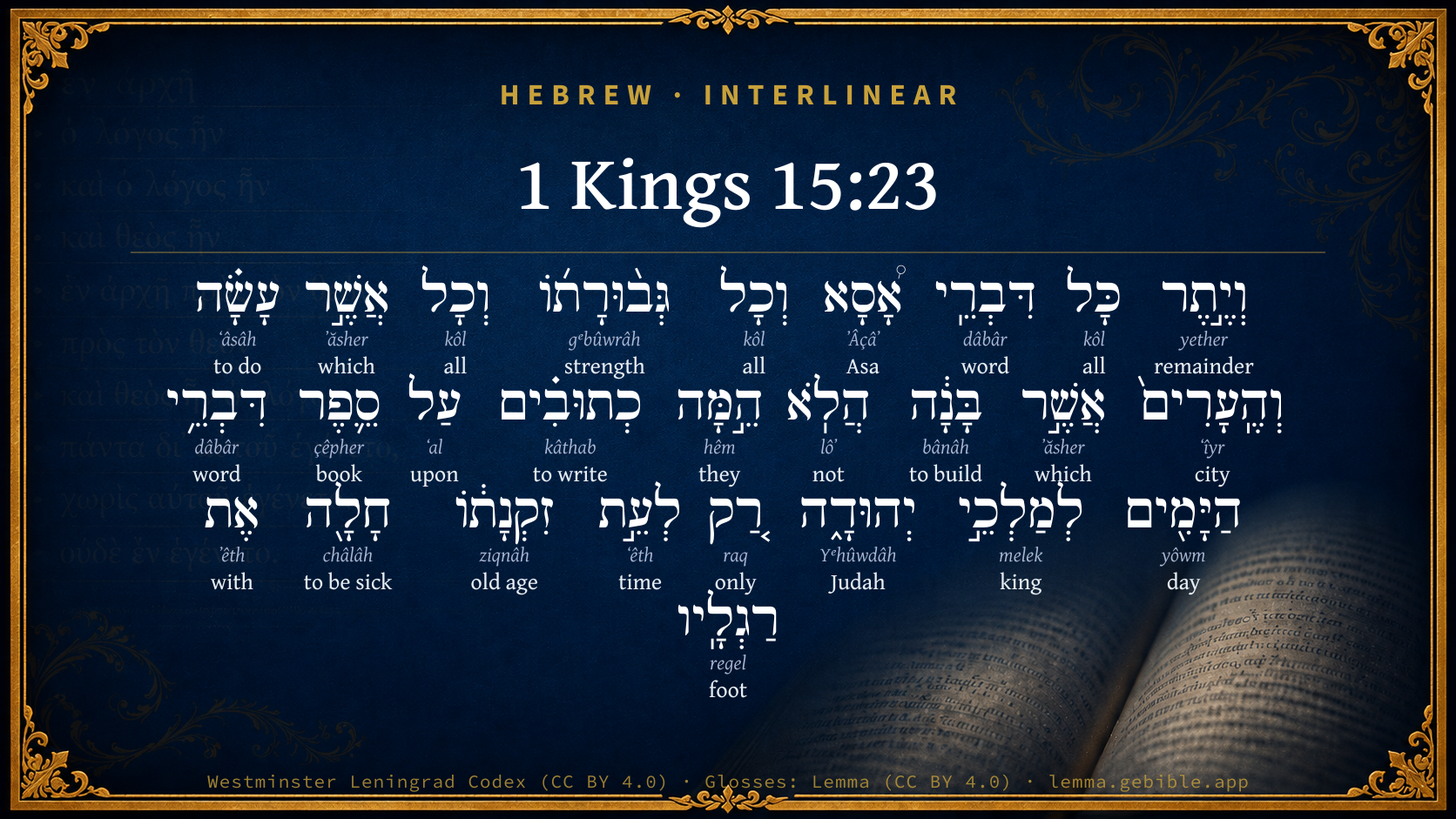
Hebrew (Westminster Leningrad Codex) 1 Kings 15:23 appears in the Hebrew Old Testament. The text above is from the Westminster Leningrad Codex. Each word links to its Strong’s number, a concise gloss, and parsing drawn from the Open Scriptures Hebrew Bible morphology. Click any word for its full Brown-Driver-Briggs (BDB) entry.
Download image
Cite this verse

1 Kings 15:23 (World English Bible). Public Domain. Lemma interlinear Bible study tool, https://lemma.gebible.app/v/1-kings/15/23.

Show BibTeX & RIS
BibTeX
RIS
English Translation
Now the rest of all the acts of Asa, and all his might, and all that he did, and the cities which he built, aren't they written in the book of the chronicles of the kings of Judah? But in the time of his old age he was diseased in his feet.
World English Bible · Public Domain
Download a study sheet

One document with this verse’s original text, its word-by-word gloss line, the meaning frame, cross-references with their text, attributed commentary, and full source and license credits — printable, and it pastes into notes with its structure intact.

This verse Autodidact and up

Study sheet (.html) Plain text (.txt)

A passage Seminary Student

Up to 50 verses in one chapter. A passage sheet keeps up to 6 commentary sources and 12 cross-references per verse, in the order this page ranks them, and says so on the sheet whenever that leaves anything out. Ask for a single verse and you get the Autodidact verse sheet above.

Everything on this page stays free to read, with no account — the sheet is a download of what is already on screen, not access to it.

Want to remove ads? Support Godless Engineer
Compare translations 3

The same verse in 3 English versions, stacked beneath the original-language interlinear above. Click any original word for its lexicon entry.

Each is an independent rendering of the whole verse — the interlinear is not word-aligned to these translations.

Highlighted words mark where these versions differ — a whole-verse word diff, not a word-by-word alignment.

  • World English Bible Public Domain
    Now the rest of all the acts of Asa, and all his might, and all that he did, and the cities which he built, aren't they written in the book of the chronicles of the kings of Judah? But in the time of his old age he was diseased in his feet.
  • King James Version Public Domain
    The rest of all the acts of Asa, and all his might, and all that he did, and the cities which he built, are they not written in the book of the chronicles of the kings of Judah? Nevertheless in the time of his old age he was diseased in his feet.
  • unfoldingWord Literal Text CC BY-SA 4.0
    Now the rest of all of the matters of Asa and all of his might and all that he did and the cities that he built, are they not written in the book of the matters of the days of the kings of Judah? (But in the time of his old age he became sick in his feet.)

unfoldingWord Literal Text — © unfoldingWord, licensed CC BY-SA 4.0. Word-aligned USFM3 via Door43 (git.door43.org/unfoldingWord/en_ult).

Versions to compare (up to 4)

3 of 4 selected

Show all 18 translations

Every available English version of this verse, each an independent rendering of the whole verse.

  • World English Bible Public Domain
    Now the rest of all the acts of Asa, and all his might, and all that he did, and the cities which he built, aren't they written in the book of the chronicles of the kings of Judah? But in the time of his old age he was diseased in his feet.
  • Berean Standard Bible Public Domain
    Now the rest of the acts of Asa, along with all his might, all his accomplishments, and the cities he built, are they not written in the Book of the Chronicles of the Kings of Judah? In his old age, however, he became diseased in his feet.
  • Majority Standard Bible Public Domain
    Now the rest of the acts of Asa, along with all his might, all his accomplishments, and the cities he built, are they not written in the Book of the Chronicles of the Kings of Judah? In his old age, however, he became diseased in his feet.
  • King James Version Public Domain
    The rest of all the acts of Asa, and all his might, and all that he did, and the cities which he built, are they not written in the book of the chronicles of the kings of Judah? Nevertheless in the time of his old age he was diseased in his feet.
  • American Standard Version (1901) Public Domain
    Now the rest of all the acts of Asa, and all his might, and all that he did, and the cities which he built, are they not written in the book of the chronicles of the kings of Judah? But in the time of his old age he was diseased in his feet.
  • Revised Version (1885) Public Domain
    Now the rest of all the acts of Asa, and all his might, and all that he did, and the cities which he built, are they not written in the book of the chronicles of the kings of Judah? But in the time of his old age he was diseased in his feet.
  • Geneva Bible (1599) Public Domain
    And the rest of all the actes of Asa, and all his might, and all that he did, and the cities which he buylt, are they not written in the booke of the Chronicles of the Kings of Iudah? but in his olde age he was diseased in his feete.
  • Douay-Rheims (1899) Public Domain
    But the rest of all the acts of Asa, and all his strength, and all that he did and the cities that he built, are they not written in the book of the words of the days of the kings of Juda? But in the time of his old age he was diseased in his feet.
  • Young's Literal Translation Public Domain
    And the rest of all the matters of Asa, and all his might, and all that he did, and the cities that he built, are they not written on the book of the Chronicles of the kings of Judah? Only, at the time of his old age he was diseased in his feet;
  • Literal Standard Version CC BY-SA 4.0
    And the rest of all the matters of Asa, and all his might, and all that he did, and the cities that he built, are they not written on the scroll of the Chronicles of the Kings of Judah? Only, at the time of his old age he was diseased in his feet;
  • Unlocked Literal Bible CC BY-SA 4.0
    As for the other matters of Asa, all his might, all that he did, and the cities he built, are they not written in the book of the events of the kings of Judah? But during his old age he was diseased in his feet.
  • unfoldingWord Literal Text CC BY-SA 4.0
    Now the rest of all of the matters of Asa and all of his might and all that he did and the cities that he built, are they not written in the book of the matters of the days of the kings of Judah? (But in the time of his old age he became sick in his feet.)
  • Darby Bible Public Domain
    And the rest of all the acts of Asa, and all his might, and all that he did, and the cities that he built, are they not written in the book of the chronicles of the kings of Judah? Only, in the time of his old age he was diseased in his feet.
  • World Messianic Bible Public Domain
    Now the rest of all the acts of Asa, and all his might, and all that he did, and the cities which he built, aren’t they written in the book of the chronicles of the kings of Judah? But in the time of his old age he was diseased in his feet.
  • Webster's Bible Public Domain
    The rest of all the acts of Asa, and all his might, and all that he did, and the cities which he built, are they not written in the book of the chronicles of the kings of Judah? Nevertheless in the time of his old age he was diseased in his feet.
  • Free Bible Version CC BY-SA 4.0
    The rest of what happened in Asa's reign, all his achievements, everything that he did, and the towns he built, are recorded in the Book of Chronicles of the Kings of Judah. But when he grew old he had disease in his feet.
  • Bible in Basic English Public Domain
    Now the rest of the acts of Asa, and his power, and all he did, and the towns of which he was the builder, are they not recorded in the book of the history of the kings of Judah? But when he was old he had a disease of the feet.
  • JPS Tanakh (1917) Public Domain
    Now the rest of all the acts of Asa, and all his might, and all that he did, and the cities which he built, are they not written in the book of the chronicles of the kings of Judah? But in the time of his old age he was diseased in his feet.

Literal Standard Version (2020), Covenant Press — licensed CC BY-SA 4.0. Text via the HelloAO Bible API (eBible.org). Unlocked Literal Bible (unfoldingWord) — licensed CC BY-SA 4.0. Text via the HelloAO Bible API (eBible.org). unfoldingWord Literal Text — © unfoldingWord, licensed CC BY-SA 4.0. Word-aligned USFM3 via Door43 (git.door43.org/unfoldingWord/en_ult). Free Bible Version, Dr. Jonathan Gallagher — licensed CC BY-SA 4.0. Text via the HelloAO Bible API (eBible.org).

Word by word

More ways to search: Search by grammar → Find every occurrence → Compare this word →

Practice this passage: Drill this verse → Learn its vocabulary →

זִקְנָת֔וֹ
ziqnâh
H2209
“old age · his”
Noun, Common, Feminine, Singular, Construct + Suffix, Personal, 3rd Person, Masculine, Singular
Part of Speech
Noun
Type
Common
Gender
Feminine
Number
Singular
State
Construct
Full BDB Definition

Origin: from H2205

TWOT: 574d

old age
  1. וְיֶ֣תֶר yether H3499 “and · remainder of” Conjunction + Noun, Common, Masculine, Singular, Construct
  2. כָּל kôl H3605 “all of” Noun, Common, Masculine, Singular, Construct
  3. דִּבְרֵֽי dâbâr H1697 “words of” Noun, Common, Masculine, Plural, Construct
  4. אָ֠סָא ʼÂçâʼ H609 “Asa” Noun, Proper
  5. וְכָל kôl H3605 “and · all of” Conjunction + Noun, Common, Masculine, Singular, Construct
  6. גְּב֨וּרָת֜וֹ gᵉbûwrâh H1369 “strength · his” Noun, Common, Feminine, Singular, Construct + Suffix, Personal, 3rd Person, Masculine, Singular
  7. וְכָל kôl H3605 “and · all of” Conjunction + Noun, Common, Masculine, Singular, Construct
  8. אֲשֶׁ֣ר ʼăsher H834 “which” Particle, Relative
  9. עָשָׂ֗ה ʻâsâh H6213 “to do” Verb, Qal, Perfect, 3rd Person, Masculine, Singular
  10. וְהֶֽעָרִים֙ ʻîyr H5892 “and · the · cities” Conjunction + Particle, Definite Article + Noun, Common, Feminine, Plural, Absolute
  11. אֲשֶׁ֣ר ʼăsher H834 “which” Particle, Relative
  12. בָּנָ֔ה bânâh H1129 “to build” Verb, Qal, Perfect, 3rd Person, Masculine, Singular
  13. הֲלֹֽא lôʼ H3808 “not” Particle, Interrogative + Particle, Negative
  14. הֵ֣מָּה hêm H1992 “they” Pronoun, Personal, 3rd Person, Masculine, Plural
  15. כְתוּבִ֗ים kâthab H3789 “written” Verb, Qal, Participle Passive, Masculine, Plural, Absolute
  16. עַל ʻal H5921 “upon” Preposition
  17. סֵ֛פֶר çêpher H5612 “book of” Noun, Common, Masculine, Singular, Construct
  18. דִּבְרֵ֥י dâbâr H1697 “words of” Noun, Common, Masculine, Plural, Construct
  19. הַיָּמִ֖ים yôwm H3117 “the · days” Particle, Definite Article + Noun, Common, Masculine, Plural, Absolute
  20. לְמַלְכֵ֣י melek H4428 “to/for · kings of” Preposition + Noun, Common, Masculine, Plural, Construct
  21. יְהוּדָ֑ה Yᵉhûwdâh H3063 “Judah” Noun, Proper
  22. רַ֚ק raq H7535 “only” Particle, Accusative
  23. לְעֵ֣ת ʻêth H6256 “to/for · time of” Preposition + Noun, Common, Both, Singular, Construct
  24. חָלָ֖ה châlâh H2470 “to be sick” Verb, Qal, Perfect, 3rd Person, Masculine, Singular
  25. אֶת ʼêth H854 “with” Preposition
  26. רַגְלָֽיו regel H7272 “feet · his” Noun, Common, Feminine, Dual, Construct + Suffix, Personal, 3rd Person, Masculine, Singular

About this verse

These counts appear in no published source. They are computed here, from the morphology-tagged text and Lemma’s own curated glosses. What Lemma adds →

27
words
23
distinct lemmas
Historical
section

Notable vocabulary

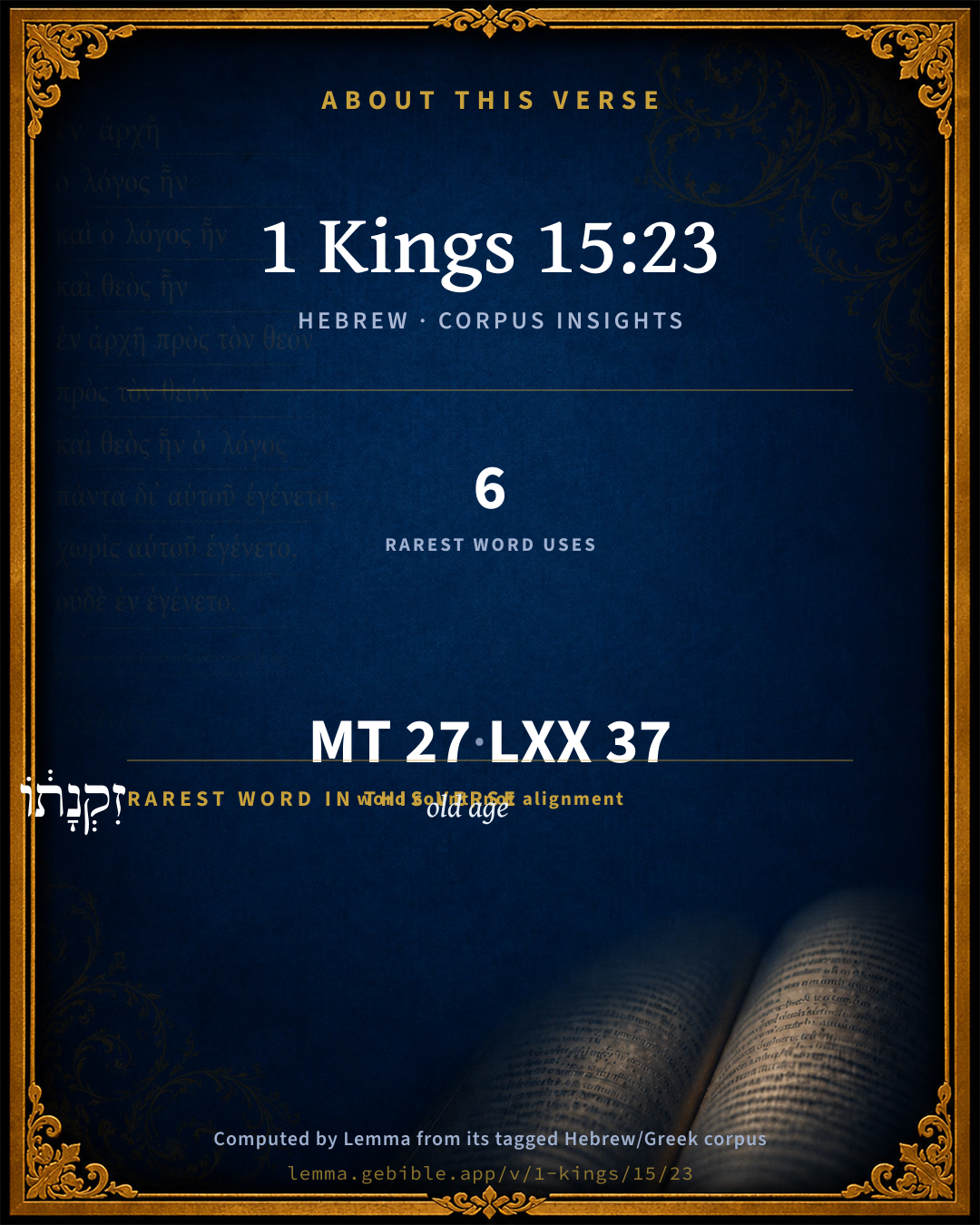
The rarest word here is זִקְנָת֔וֹ old age H2209 — appearing just 6 times in the whole Hebrew Bible.

Shared distinctive vocabulary

זִקְנָת֔וֹ old age H2209 occurs in 6 verses of the Hebrew Bible. Also found in:

Grammatical profile

  • 4 verbs
  • 16 nouns
  • 1 pronoun
  • 2 prepositions
  • 4 particles

Verb forms

  • עָשָׂ֗ה Qal · Perfect
  • בָּנָ֔ה Qal · Perfect
  • כְתוּבִ֗ים Qal · Participle Passive
  • חָלָ֖ה Qal · Perfect

Repetition

Words recur within this verse — often emphatic in Hebrew:

  • כָּל all H3605 ×3
  • דִּבְרֵֽי word H1697 ×2
  • אֲשֶׁ֣ר which H834 ×2

Hebrew & Septuagint length

In English translation the verse runs 52 words from the Hebrew and 52 from the Septuagint (LXX English) — the same length.

A rough comparison of the two English renderings, which tokenize alike — not a word-level alignment.

Word counts can differ between the Hebrew and the Greek without any difference in meaning — e.g. the Hebrew direct-object marker אֵת has no separate Greek word, and Greek often adds the article ὁ.

In the original languages it is 27 Hebrew tokens and 37 Greek tokens — but the two are counted differently (Hebrew bundles its prefixes and suffixes into one token; the Greek is in lemma form), so that isn’t a like-for-like length.

Cross-references

4

Topical passages linked to 1 Kings 15:23 in the Treasury of Scripture Knowledge — connected by theme and wording, ordered by reader-vote popularity; previews shown in the World English Bible.

  • 1 Kings 14:29–31 Now the rest of the acts of Rehoboam, and all that he did, aren't they written in the book of the chronicles of the kings of Judah?
  • 1 Kings 15:7–8 The rest of the acts of Abijam, and all that he did, aren't they written in the book of the chronicles of the kings of Judah? There was war between Abijam and Jeroboam.
  • 2 Chronicles 16:11–14 Behold, the acts of Asa, first and last, behold, they are written in the book of the kings of Judah and Israel.
  • Psalms 90:10 The days of our years are seventy, Or even by reason of strength eighty years; Yet their pride is but labor and sorrow, For it passes quickly, and we fly away.

Cross-references courtesy of OpenBible.info (CC BY 4.0).

Hebrew and Greek witnesses Masoretic Hebrew ↔ Greek Septuagint

The same verse in the two great witnesses to the Old Testament, shown verse-for-verse.

These are two independent witnesses, not word-aligned to each other, and the Septuagint is shown in lemma (dictionary) form.

Hebrew 1 Kings 15:23 Masoretic · Westminster Leningrad Codex

וְיֶ֣תֶר כָּל דִּבְרֵֽי אָ֠סָא וְכָל גְּב֨וּרָת֜וֹ וְכָל אֲשֶׁ֣ר עָשָׂ֗ה וְהֶֽעָרִים֙ אֲשֶׁ֣ר בָּנָ֔ה הֲלֹֽא הֵ֣מָּה כְתוּבִ֗ים עַל סֵ֛פֶר דִּבְרֵ֥י הַיָּמִ֖ים לְמַלְכֵ֣י יְהוּדָ֑ה רַ֚ק לְעֵ֣ת זִקְנָת֔וֹ חָלָ֖ה אֶת רַגְלָֽיו

Now the rest of all the acts of Asa, and all his might, and all that he did, and the cities which he built, aren't they written in the book of the chronicles of the kings of Judah? But in the time of his old age he was diseased in his feet.

World English Bible · Public Domain

Greek LXX 1 Kings 15:23 Septuagint · lemma form

καί ὁ λοιπός ὁ λόγος ασα καί πᾶς ὁ δυναστεία αὐτός ὅς ποιέω οὐ ἰδού οὗτος γράφω εἰμί ἐπί βιβλίον λόγος ὁ ἡμέρα ὁ βασιλεύς ιουδα πλήν ἐν ὁ καιρός ὁ γῆρας αὐτός πονέω ὁ πούς αὐτός

And the rest of the history of Asa, and all his mighty deeds which he wrought, and the cities which he built, behold, are not these written in the book of the chronicles of the kings of Juda? Nevertheless in the time of his old age he was diseased in his feet.

LXX2012 (modern English Septuagint) · Public Domain

On this verse, Haydock's Catholic Bible Commentary discusses the Septuagint’s reading. Read the note in Commentary ↓

Hebrew: Westminster Leningrad Codex (CC BY 4.0). Greek: Septuagint (public domain); English from LXX2012 (modern English Septuagint) (Public Domain). How the Septuagint differs from the Hebrew →

Targum (Aramaic paraphrase)

1

The Targum is the ancient Jewish Aramaic paraphrase of the Hebrew Scriptures — an interpretive translation, not the Hebrew text itself. Onkelos (literal) and Pseudo-Jonathan (expansive) render the Torah, and Jonathan the Prophets. Coverage is partial: where no permissively-licensed English translation exists for a verse, only the Aramaic is shown. This is verse-level text, not a word-by-word alignment to the Hebrew.

  1. Targum Jonathan Prophets (Joshua–Malachi)
    וּשְׁאַר כָּל פִּתְגָמֵי אָסָא וְכָל גְבוּרְתֵּיהּ וְכָל דִי עֲבַד וְקִירְוַיָא דִי בְנָא הֲלָא אִינוּן כְּתִיבִין עַל סְפַר פִּתְגָמֵי יוֹמַיָא לְמַלְכָּא דְבֵית יְהוּדָה לְחוֹד לְעִדַן סִיבְתֵיהּ אִתְמְרַע בְּרִגְלוֹהִי:

    (no public-domain English translation for this verse)

    Targum Jonathan — Aramaic: “Mikraot Gedolot” (public domain). English: “Sefaria Community Translation” (CC0 1.0 (public-domain dedication)); “London "Chaldee Paraphrase," 1871” (public domain). Text via Sefaria.

Commentary

Notes on 1 Kings 15:23 from classic Christian and Jewish commentators (each source and its license shown beneath its notes). The classic Christian expositions comment on the surrounding passage and are grouped to its opening verse, so a note may address several verses; the Jewish commentaries on the Tanakh (Rashi and others) are per-verse, so they appear only where the commentator wrote on this verse.

Lemma curates 59 commentaries, every one of them public domain or Creative Commons licensed, each selected and text-cleaned for this edition rather than reprinted as found. About our sources →

Trapp's Complete Commentary

John Trapp

1Ki 15:23 The rest of all the acts of Asa, and all his might, and all that he did, and the cities which he built, [are] they not written in the book of the chronicles of the kings of Judah? Nevertheless in the time of his old age he was diseased in his feet.

Ver. 23. He was diseased in his feet.] He that imprisoned the prophet is imprisoned in his bed; there being more pain in those fetters put by God upon Asa than in those put by Asa upon Hanani. This good man was the worse a while for whipping.

John Trapp, A Commentary or Exposition upon All the Books of the Old and New Testament (1647–1656) — public domain. Text from a community e-Sword module.

The Biblical Illustrator

Joseph S. Exell

1Ki_15:23

Nevertheless in the time of his old age he was diseased in his feet.

Asa; or, failure at the last

Few personages in Holy Scripture appear to have commenced their career with more decided promise of good, and more energetic measures against evil, than Asa, King of Judah. Asa was the third of those princes of the house of David, whom God, though for the sins of Solomon He had alienated ten tribes from their sway, permitted for His ancient servants sake to retain a throne and a name. Asa was preserved pure amid the corruptions of his age; and his acts immediately on ascending the throne, and for a large portion of his life, showed, not merely that his heart was not perverted to idols--that is, was in this sense perfect before the Lord--but that he leaned on Him, and found Him to be his Strength and his Redeemer. When ten years are over, we find that great change has passed upon Asa. Hostilities are threatened at the hands of Baasha, King of Israel. That prince is building a fortress on his very frontier. His purpose cannot be mistaken. It is to check the growing intercourse between Asas subjects and his own. Asa is naturally alarmed; but in his alarm he seeks not God--he seeks a human, a heathen ally. He bribes the King of Syria., with his own treasures and the treasures of the temple, to break an existing league with Baasha, and invade the north-eastern provinces of Israel. A diversion is thus effected; for Baasha is summoned from his scheme of offence by tidings that the whole of the coast of Gennesaret is being wasted by fire and sword. Asa improves his opportunity. He destroys the rising fortress, Ramah, and applies to the strengthening of two cities for himself the materials prepared by the enemy. Yes, he has repelled the danger, but he has incurred a greater danger. He has made God his enemy, for he has not trusted in Him as his friend. How strange, how very mournful, that he who for more than a quarter of a century had led men to God, should at length have himself turned from Him; that he who, by his life and reign, had preached to others, should himself be a castaway! And is it indeed so? Hanani the prophet has come to remonstrate with him; and his remonstrance, truly though severely kind, must surely move him. Alas! Asas heart is hardened. The voice of honesty grates harshly on him; he is wroth with the prophet; he even imprisons him. And the sacred historian adds, He oppressed some of the people at the same time; it may be, because they reminded him of the oath which they had sworn at his bidding, and in which he had bound himself, that God should be their God. A few more years pass on, of which we read nothing, but of which we must fear much. Asa is now stretched on his sick-bed; a lingering disease is wasting him; at length, it is exceeding great. Two or three years he lies in deep agony, yet he never thinks of God; he seeks not to the Lord, but to the physicians. Is no more said of him than this? Does no repentance for his evil deeds come upon him? No remembrance of his youthful faith, and of the way in which it was rewarded, flash upon him? Does no light illume the chamber of death? No fear of what is beyond death appal him? He had long ceased to live by faith, and he does not die in faith. To the words, he sought not to the Lord, but to the physicians, succeeds the simple announcement, and Asa slept with his fathers, and died in the one-and-fortieth year of his reign. He died. He died, and was buried in his own sepulchre, which he had provided for the body, however much he had neglected his soul. He was buried with great honour in the city of David. He was buried with an empires lamentation. But what was all this, unless we have reason to suppose that angels received his soul, and conveyed it into Abrahams bosom, there to abide till the resurrection? But what were the causes of his fall? Scripture is silent on this point; we may, however, discover two or three of them.

1. He was tried, in the first place, by great success. People are inclined to think that success is no trial. They are much mistaken. Nothing is more liable to produce self-confidence, and neglect of Him who bestoweth on the wise their wisdom, and on the strong their strength. Unless a man watches himself very narrowly, pride will insinuate itself even into the midst of his thanksgivings; complacent thoughts of his own foresight underlie his recognition of Gods providence; convictions of his own good desert qualify his confessions of sin. Idols had bowed at Asas word. Profligacy had shrunk abashed from his presence. The appointments of the temple had risen to fresh splendour on his opening the doors of his treasury. The ancient renown of his people had revived under his sway. The borders of his kingdom had been extended by his policy. He had spoken, and cities long dismantled had resumed their coronal of towers. He had led out his armies, and barbarians had fled before him. Whatever he had taken in hand, the Lord had made it to prosper. This was at length too much for him. He dwelt on his wisdom, it became foolishness--on his strength, and it turned to weakness; in a word, he forgot God, who, as He had raised him up, had power to cast him down.

2. But mark a second point in which Asa was tried, and having been tried was found wanting. He was placed in the perilous position of having to guide and instruct others--to provide for their spiritual welfare--to correct whatever tendencies he discovered towards vice or towards idolatry. Now, little as we are accustomed so to view it, this is a great snare to any one. The mother, who teaches her child to pray; the father, who watches over his sons moral progress; the master, who is a strict censor of the behaviour of his servants; the Scripture reader, the district visitor, the nurse of the sick, the almoner of the poor; yea, even the minister of God who has professionally to bring before his people the means of grace and the hopes of glory, the right use of the one, and the sober entertainment of the other; these persons are all of them in danger of neglecting themselves; of placing themselves, as it were, ab extra, to the duties which they have to inculcate; of losing their interest in them as things in which they have a deep personal concernment. Such persons are tempted then in the contemplation of their works, to forget themselves, to abate their self-discipline, and, when the novelty of their employment has passed away, to fall back upon other things; it may be, to end with languor, disgust, or carelessness, if not with utter faithlessness and sin. Gradually, indeed, and very slowly, such lethargy may creep over the soul; as gradually as the fumes of the chafing-dish overpower the senses of the sleeper, or as the deathlike chill of the mountain steals over the weary traveller, and lulls him into a slumber from which there is no awakening--but like these, it is subtle, silent, fatal. It is only sure-walking that is safe-walking. To be sure we must not be secure, we must be careful; carefulness is the earnest of safety; carefulness, whose maxim is, Let him that thinketh he standeth take heed lest he fall; carefulness, which, in the words of our Litany, petitions the Almighty for deliverance not merely in the time of tribulation, but in the time of wealth. (J. A. Heasey, D. C. L)

.

The Biblical Illustrator, edited by Joseph S. Exell (c. 1880s–1900s) — public domain. Text from a community e-Sword module.

Joseph Benson's Commentary

1Ki 15:23. Nevertheless he was diseased in his feet — Notwithstanding the great things which he had done, and the glory and prosperity which he had enjoyed, he felt the effects of human infirmity, and of his own sins. He probably had the gout, which made him less active than he had been before this disease seized him.

Joseph Benson's Commentary on the Old and New Testaments (1811–1818) — public domain. Text from a community e-Sword module.

Tyndale Open Study Notes

Tyndale Open Resources

15:23 feet became diseased: The nature of Asa’s malady is uncertain; the Talmud conjectures that it was gout. During his severe illness, Asa depended only on his physicians rather than seeking the Lord’s help (2 Chr 16:12).

Tyndale Open Study Notes — © Tyndale Open Resources, licensed CC BY-SA 4.0. Text via the HelloAO Bible API.

Geneva Bible (1599)

Geneva Bible translators

He had the gout and put his trust rather in Physicians than in the Lord, 2 Chron. 16:12.

Geneva Bible (1599) marginal notes — public domain. Text via Bolls.life.

Jamieson, Fausset & Brown

Robert Jamieson, A. R. Fausset & David Brown

in the time of his old age he was diseased in his feet--(See on Ch2 16:12, where an additional proof is given of his religious degeneracy.)

Jamieson, Fausset & Brown — Commentary Critical and Explanatory on the Whole Bible (1871) — public domain (CC PDM 1.0). Text via the HelloAO Bible API.

Adam Clarke's Commentary

Verse 23. And the cities which he built] Such as Geba and Mizpah, which he built out of the spoils of Ramah.

He was diseased in his feet.] Probably he had a strong rheumatic affection, or the gout. This took place in the thirty-ninth year of his reign, three years before his death; and it is said that he sought to physicians rather than to the Lord, 2Ch 16:12-13.

Adam Clarke's Commentary on the Bible (1810–1826) — public domain. Text from a community e-Sword/MySword module.

Ellicott's Commentary for English Readers

(23) All his might.—This phrase, not used of Rehoboam or Abijah, is significant, indicating the increased power of Judah under Asa.

The cities which he built.—Fortification of cities (see 2Ch_11:5-10; 2Ch_14:6) was naturally the traditional policy of the kingdom of Judah—small in extent, menaced by more powerful neighbours, but having an exceedingly strong country and central position.

Diseased in his feet.—In the Chronicles it is added significantly, “in his disease he sought not to the Lord, but to the physicians” (2Ch_16:7-12); and from the same records it appears that in his last days Asa ventured to defy the prophetic authority by the imprisonment of Hanani the seer. Prosperity, it is implied, had somewhat deteriorated his character, though he still continued faithful to the worship of God. Certainly, Jehoshaphat on his accession still found much to do for the religious condition of his people.

A Bible Commentary for English Readers, edited by Charles John Ellicott (1878–1897) — public domain. Text from a community e-Sword module.

The Cambridge Bible for Schools and Colleges

gen. ed. J. J. S. Perowne

23. The rest of all the acts of Asa] There is a conjunction at the opening of the verse in the original. Hence R.V. Now the rest &c.

The reign of Asa is dealt with more fully in the book of Chronicles. Beside what is told in Kings, we learn there that he built fenced cities in Judah, because the land had rest and no war. His army is described as consisting of 300,000 men of Judah and 280,000 of Benjamin. He defeated Zerah the Ethiopian, who came against him in battle, and with the help of God drove him back as far as Gerar. A prophecy of Azariah the son of Oded encouraged the king to put down idolatry with a strong hand, and he bound his people by a solemn oath to cleave unto the Lord, and those who would not do so he put to death. Asa, we are told, was rebuked by Hanani the prophet after the withdrawal of Baasha, because he had relied on the help of the king of Syria, and he was told that from henceforth he should have wars. In anger Asa imprisoned the unwelcome prophet, and oppressed some of his people at the same time. The long reign of this king was manifestly an active time, both in the religious and political life of Judah.

the cities which he built] No doubt these are ‘the fenced cities’ spoken of in 2Ch_14:6, as built during the days of peace.

Nevertheless] R.V. But. The A.V. would make it seem as though the successes described in the early part of the verse ought to have been enough to prevent the disease here mentioned.

diseased in his feet] In 2Ch_16:12 it is added ‘until his disease was exceeding great’, and then as another token of his weakened trust in God the chronicler continues ‘yet in his disease he sought not to the Lord, but to the physicians.’

The Cambridge Bible for Schools and Colleges (gen. ed. J. J. S. Perowne; Cambridge University Press, 1878–1918) — public domain. Text from a community e-Sword module.

John Gill's Exposition

Even in the third year of Asa king of Judah did Baasha slay him, and reigned in his stead. Which seems to be his only or chief view in slaying him, to get possession of his kingdom.

Even in the third year of Asa king of Judah did Baasha slay him, and reigned in his stead. Which seems to be his only or chief view in slaying him, to get possession of his kingdom.

1 Kings 15:29

kg1 15:29

kg1 15:29

kg1 15:29And it came to pass, when he reigned, that he smote all the house of Jeroboam,.... That he might have no rival, or any that could pretend any title to the crown:

he left not Jeroboam any that breathed, until he had destroyed him, according to the saying of the Lord, which he spake by his servant Ahijah the Shilonite; not that his intention in destroying Jeroboam's family was to fulfil that prophecy, but so it was eventually; see Kg1 14:10.

John Gill's Exposition of the Whole Bible (1746–1763) — public domain (CC PDM 1.0). Text via the HelloAO Bible API.

Albert Barnes' Notes on the Bible

The rest of all the acts of Asa - A few of these are preserved in 2Ch 15:9-15; 2Ch 16:7-12. From the whole narrative of Chronicles we gather that the character of Asa deteriorated as he grew old, and that, while he maintained the worship of Yahweh consistently from first to last, he failed to maintain the personal faith and piety which had been so conspicuous in his early youth.

The cities which he built - Asa, during the earlier part of his reign, before any serious attack had been made upon him, had the prudence to “build fenced cities in Judah,” with “walls and towers, gates and bars,” so strengthening himself against a possible evil day 2Ch 14:6-7.

In the time of his old age - See the marginal reference. If it has been rightly supposed that Rehoboam was a young man of 21 or 22 at his accession 1Ki 12:8, Asa’s age at this time must have been less than 50. It may seem strange to speak of “old age” in such a case; but Solomon was regarded as “old” at about 50 (1Ki 11:4 note).

Albert Barnes' Notes on the Bible (1834–1885) — public domain. Text from a community e-Sword/MySword module.

Haydock's Catholic Bible Commentary

Strength. Septuagint, "dynasty," or power, whether of his dominions or of his person. (Calmet) --- Feet, with the gout, (Menochius) three years before his death. He did not confide in the Lord sufficiently, 2 Paralipomenon xvi. 12. His body was embalmed or burnt, unless aromatic spices evaporated with it was laid on a bed of state, before it was consigned to the tomb, which Asa had prepared for himself in the city of David, 2 Paralipomenon xvi. 14.

George Leo Haydock (1774–1849), Haydock's Catholic Family Bible and Commentary, 1859 edition — public domain. Excludes Psalms (Douay-Rheims chapter numbering differs from Protestant) and Deuterocanonical books (Catholic canon only).

Matthew Poole's English Annotations

Nevertheless; notwithstanding the great things which he had done, and the glory and prosperity which he enjoyed, he felt the effects of human infirmity, and of his own sins; of which see 2Ch 16:12,13.

Matthew Poole's English Annotations on the Holy Bible (1683–1685) — public domain. Text from a community e-Sword/MySword module.

Whedon's Commentary on the Bible

Daniel D. Whedon

23.

Cities which he built — See 2Ch_14:6-7.

Diseased in his feet — The disease is supposed by most interpreters to have been the gout. 2Chronicles adds, (2Ch_16:12,) that “in his disease he sought not to the Lord, but to the physicians.” From the fact that the writer of Chronicles mentions the sins of Asa, which are passed over in silence by the writer of Kings, Wordsworth argues against the assumption of some, that the writer of Chronicles was partial to the house of David, and sought to cover up their faults. Chronicles makes no mention of Solomon’s apostasy, and Kings says nothing of Asa’s sins. Thus one of these sacred historians supplies the omissions of the other, and yet both together do not assume to give an exhaustive history of the subjects they take in hand. Large portions of their narrative are professedly excerpts from the public annals.

Daniel D. Whedon (gen. ed.), Commentary on the Old and New Testaments (1874–1909) — public domain. Text from a community e-Sword module.

The Pulpit Commentary

And the rest of all the acts of Asa, and all his might, (see 2Ch_14:15) and all that he did, and the cities which he built during the peace in the earlier part of his reign, (2Ch_14:5, 2Ch_14:6) are they not written in the book of the chronicles of the kings of Judah? Nevertheless Heb. only. There was one exception to his otherwise happy and prosperous reign in the time of his old age see notes on 1Ki_1:1 1Ki_11:4. "Old age" means here, as them, the end of life. Asa cannot well have been more than fifty. It was in the 39th year of his reign (2Ch_16:12) that this disease attacked him he was diseased in his feet. It is generally supposed that this disease was the gout. In the Chronicles (l.c. ) he is reproached for seeking "not to the Lord but to the physicians." We must remember what the art of medicine at that day was like (see Kitto, "Daily Bib. Illus.," 4:195 sqq.), and that the Jews regarded sickness and healing as alike the immediate acts of God.

The Pulpit Commentary (1880–1919), ed. H.D.M. Spence-Jones & Joseph S. Exell — public domain. Text from a community e-Sword module.

John Wesley's Explanatory Notes

Nevertheless - Notwithstanding the great things which he had done, and the glory and prosperity which he enjoyed, he felt the effects of human infirmity, and of his own sins.

John Wesley, Explanatory Notes Upon the Whole Bible (1754–1765) — public domain. Text via the GEBible commentary corpus.

unfoldingWord translationNotes

Door43 World Missions Community

are they not written in the book of the events of the kings of Judah?

This question is used to either inform or remind the readers that the information about Abijah is in this other book. See how you translated this in 1 Kings 14:29. This rhetorical question can be translated as a statement. AT: "they are written in the book of the events of the kings of Judah" (See: Rhetorical Question)

are they not written in the book of the events of the kings of Judah?

This can be stated in active form. AT: "someone has written about this in the book of the events of the kings of Judah." (See: Active or Passive)

Asa slept with his ancestors

Sleeping here is a euphemism which represents dying. AT: "Asa died as his ancestors had" (See: Metaphor and Euphemism)

was buried with them

This can be stated in active form. AT: "they buried him with his ancestors" (See: Active or Passive)

David his father

The word "father" here refers to an ancestor. AT: "King David, his ancestor"

translationWords

might

king

kingdom of Judah

asleep

bury

city of David

Jehoshaphat

unfoldingWord translationNotes — © Distant Shores Media and the Door43 World Missions Community, licensed CC BY-SA 4.0. Source: git.door43.org/Door43/en_tn.

Lesson kit

Teaching starters — assembled from the data on this page, not authored interpretation. Every prompt links to the verse data it draws on. Edit before teaching.

1 Kings, in the Historical, opens this verse with 27 words (23 distinct Hebrew lemmas). Its most distinctive word is ziqnâh (“old age”). A historical commentator’s framing appears above. Read the whole chapter for the surrounding context.

Discussion questions

  1. How does “old age” (ziqnâh) shape what this verse is saying?
  2. Genesis 24:36 shares the word «old age» with this verse. How do the two illuminate each other?
  3. “all” occurs 3× in this one verse. What is the effect of the repetition?
  4. These translations render this verse differently; the difference is in the English rendering, not the original. What questions does that raise?
  5. The verb «עָשָׂ֗ה» is Qal Perfect. How does its form color the action?
  6. Reading how Trapp's Complete Commentary and The Biblical Illustrator read this verse, where do the two commentators agree and where do they part?

Things to notice

Reading settings

Reading text

Shown beneath each verse's original-language words.

Old Testament
Old Testament edition

Read the OT as the Masoretic Hebrew (MT) or the Greek Septuagint (LXX).

English shown for the Greek Septuagint (in the Hebrew ↔ Greek comparison).

Comparing translations? Open the Compare panel on any verse page to stack up to four side by side.