
Exodus 30:4

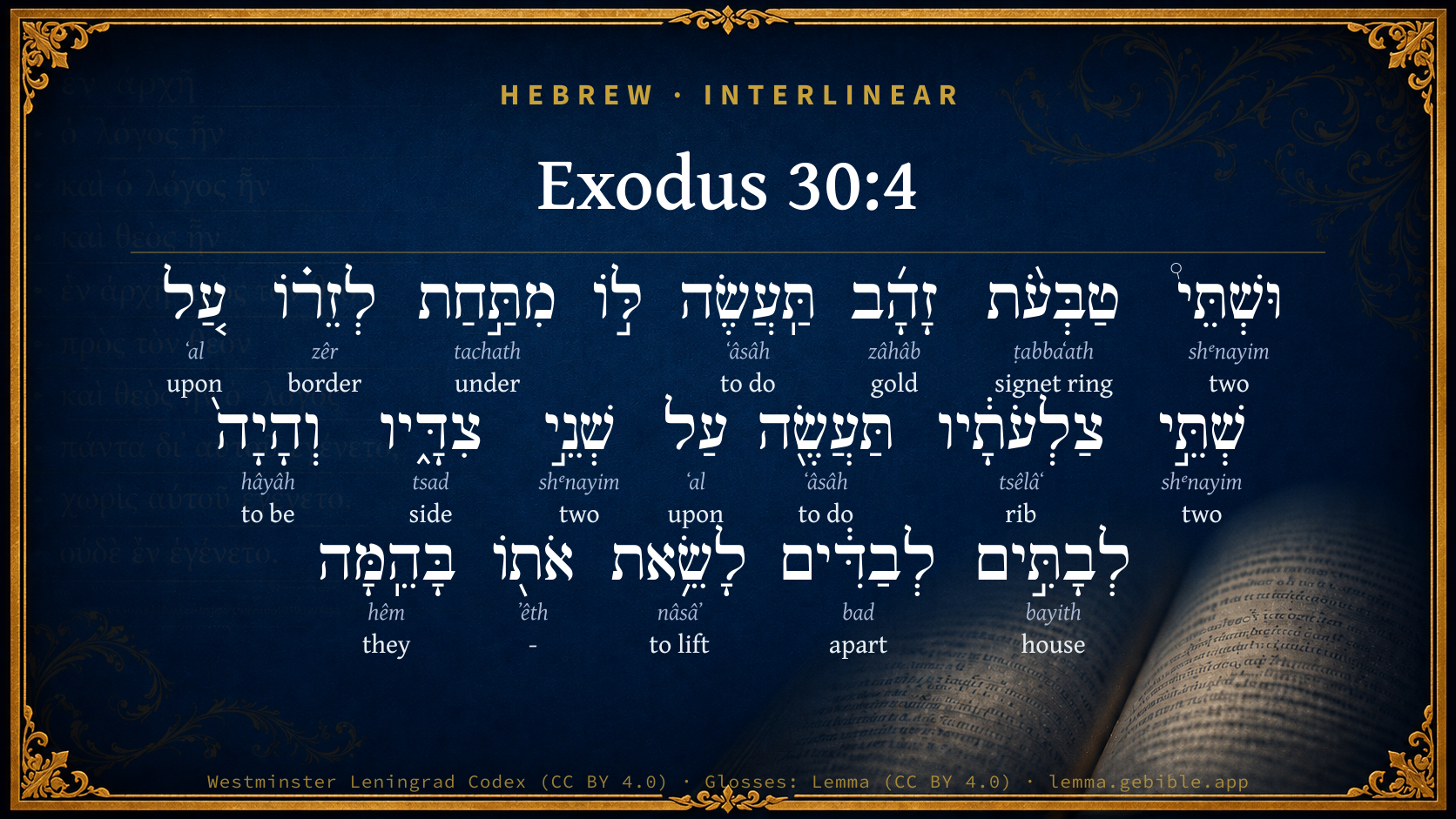
Hebrew (Westminster Leningrad Codex) Exodus 30:4 appears in the Hebrew Old Testament. The text above is from the Westminster Leningrad Codex. Each word links to its Strong’s number, a concise gloss, and parsing drawn from the Open Scriptures Hebrew Bible morphology. Click any word for its full Brown-Driver-Briggs (BDB) entry.
Download image
Cite this verse

Exodus 30:4 (World English Bible). Public Domain. Lemma interlinear Bible study tool, https://lemma.gebible.app/v/exodus/30/4.

Show BibTeX & RIS
BibTeX
RIS
English Translation
You shall make two golden rings for it under its molding; on its two ribs, on its two sides you shall make them; and they shall be for places for poles with which to bear it.
World English Bible · Public Domain
Download a study sheet

One document with this verse’s original text, its word-by-word gloss line, the meaning frame, cross-references with their text, attributed commentary, and full source and license credits — printable, and it pastes into notes with its structure intact.

This verse Autodidact and up

Study sheet (.html) Plain text (.txt)

A passage Seminary Student

Up to 50 verses in one chapter. A passage sheet keeps up to 6 commentary sources and 12 cross-references per verse, in the order this page ranks them, and says so on the sheet whenever that leaves anything out. Ask for a single verse and you get the Autodidact verse sheet above.

Everything on this page stays free to read, with no account — the sheet is a download of what is already on screen, not access to it.

Want to remove ads? Support Godless Engineer
Compare translations 3

The same verse in 3 English versions, stacked beneath the original-language interlinear above. Click any original word for its lexicon entry.

Each is an independent rendering of the whole verse — the interlinear is not word-aligned to these translations.

Highlighted words mark where these versions differ — a whole-verse word diff, not a word-by-word alignment.

  • World English Bible Public Domain
    You shall make two golden rings for it under its molding; on its two ribs, on its two sides you shall make them; and they shall be for places for poles with which to bear it.
  • King James Version Public Domain
    And two golden rings shalt thou make to it under the crown of it, by the two corners thereof, upon the two sides of it shalt thou make it; and they shall be for places for the staves to bear it withal.
  • unfoldingWord Literal Text CC BY-SA 4.0
    And you shall make two rings of gold for it under its border on its two sides. You shall make them on its two sides. They will be housings for the poles for carrying it with.

unfoldingWord Literal Text — © unfoldingWord, licensed CC BY-SA 4.0. Word-aligned USFM3 via Door43 (git.door43.org/unfoldingWord/en_ult).

Versions to compare (up to 4)

3 of 4 selected

Show all 18 translations

Every available English version of this verse, each an independent rendering of the whole verse.

  • World English Bible Public Domain
    You shall make two golden rings for it under its molding; on its two ribs, on its two sides you shall make them; and they shall be for places for poles with which to bear it.
  • Berean Standard Bible Public Domain
    And make two gold rings below the molding on opposite sides to hold the poles used to carry it.
  • Majority Standard Bible Public Domain
    And make two gold rings below the molding on opposite sides to hold the poles used to carry it.
  • King James Version Public Domain
    And two golden rings shalt thou make to it under the crown of it, by the two corners thereof, upon the two sides of it shalt thou make it; and they shall be for places for the staves to bear it withal.
  • American Standard Version (1901) Public Domain
    And two golden rings shalt thou make for it under the crown thereof; upon the two ribs thereof, upon the two sides of it shalt thou make them; and they shall be for places for staves wherewith to bear it.
  • Revised Version (1885) Public Domain
    And two golden rings shalt thou make for it under the crown thereof, upon the two ribs thereof, upon the two sides of it shalt thou make them; and they shall be for places for staves to bear it withal.
  • Geneva Bible (1599) Public Domain
    Besides this thou shalt make vnder this crowne two golden rings on either side: euen on euery side shalt thou make them, that they may be as places for the barres to beare it withall.
  • Douay-Rheims (1899) Public Domain
    And two golden rings under the crown on either side, that the bars may be put into them, and the altar be carried.
  • Young's Literal Translation Public Domain
    and two rings of gold thou dost make to it under its crown; on its two ribs thou dost make `them', on its two sides, and they have become places for staves, to bear it with them.
  • Literal Standard Version CC BY-SA 4.0
    and you make two rings of gold for it, under its crown on its two ribs; you make [them] on its two sides, and they have become places for poles to carry it with them.
  • Unlocked Literal Bible CC BY-SA 4.0
    You must make two golden rings to be attached to it under its border on its two opposite sides. The rings must be holders for poles to carry the altar.
  • unfoldingWord Literal Text CC BY-SA 4.0
    And you shall make two rings of gold for it under its border on its two sides. You shall make them on its two sides. They will be housings for the poles for carrying it with.
  • Darby Bible Public Domain
    And two rings of gold shalt thou make for it under its border; by its two corners shalt thou make [them], on the two sides thereof; and they shall be for receptacles for the staves, with which to carry it.
  • World Messianic Bible Public Domain
    You shall make two golden rings for it under its molding; on its two ribs, on its two sides you shall make them; and they shall be for places for poles with which to bear it.
  • Webster's Bible Public Domain
    And two golden rings shalt thou make to it under the crown of it, by its two corners, upon the two sides of it shalt thou make it; and they shall be for places for the staffs to bear it with.
  • Free Bible Version CC BY-SA 4.0
    On two of the altar's sides make two gold rings and attach them below the trim to hold the poles that carry it.
  • Bible in Basic English Public Domain
    Under the edge on the two opposite sides, you are to make two gold rings, to take the rods for lifting it.
  • JPS Tanakh (1917) Public Domain
    And two golden rings shalt thou make for it under the crown thereof, upon the two ribs thereof, upon the two sides of it shalt thou make them; and they shall be for places for staves wherewith to bear it.

Literal Standard Version (2020), Covenant Press — licensed CC BY-SA 4.0. Text via the HelloAO Bible API (eBible.org). Unlocked Literal Bible (unfoldingWord) — licensed CC BY-SA 4.0. Text via the HelloAO Bible API (eBible.org). unfoldingWord Literal Text — © unfoldingWord, licensed CC BY-SA 4.0. Word-aligned USFM3 via Door43 (git.door43.org/unfoldingWord/en_ult). Free Bible Version, Dr. Jonathan Gallagher — licensed CC BY-SA 4.0. Text via the HelloAO Bible API (eBible.org).

Word by word

More ways to search: Search by grammar → Find every occurrence → Compare this word →

Practice this passage: Drill this verse → Learn its vocabulary →

לְזֵר֗וֹ
zêr
H2213
“to/for · border · his”
Preposition + Noun, Common, Masculine, Singular, Construct + Suffix, Personal, 3rd Person, Masculine, Singular
Part of Speech
Preposition + Noun
Type
Common
Gender
Masculine
Number
Singular
State
Construct
Full BDB Definition

Origin: from H2237 (in the sense of scattering)

TWOT: 543a

border, moulding, circlet
  1. וּשְׁתֵּי֩ shᵉnayim H8147 “and · two” Conjunction + Adjective, Cardinal number, Feminine, Dual, Construct
  2. טַבְּעֹ֨ת ṭabbaʻath H2885 “signet rings of” Noun, Common, Feminine, Plural, Construct
  3. זָהָ֜ב zâhâb H2091 “gold” Noun, Common, Masculine, Singular, Absolute
  4. תַּֽעֲשֶׂה ʻâsâh H6213 “to do” Verb, Qal, Imperfect, 2nd Person, Masculine, Singular
  5. מִתַּ֣חַת tachath H8478 “from · under” Preposition + Preposition
  6. עַ֚ל ʻal H5921 “upon” Preposition
  7. שְׁתֵּ֣י shᵉnayim H8147 “two” Adjective, Cardinal number, Feminine, Dual, Construct
  8. צַלְעֹתָ֔יו tsêlâʻ H6763 “ribs · his” Noun, Common, Both, Plural, Construct + Suffix, Personal, 3rd Person, Masculine, Singular
  9. תַּעֲשֶׂ֖ה ʻâsâh H6213 “to do” Verb, Qal, Imperfect, 2nd Person, Masculine, Singular
  10. עַל ʻal H5921 “upon” Preposition
  11. שְׁנֵ֣י shᵉnayim H8147 “two” Adjective, Cardinal number, Masculine, Dual, Construct
  12. צִדָּ֑יו tsad H6654 “sides · his” Noun, Common, Masculine, Plural, Construct + Suffix, Personal, 3rd Person, Masculine, Singular
  13. וְהָיָה֙ hâyâh H1961 “and · to be” Conjunction + Verb, Qal, Sequential Perfect, 3rd Person, Masculine, Singular
  14. לְבָתִּ֣ים bayith H1004 “to/for · houses” Preposition + Noun, Common, Masculine, Plural, Absolute
  15. לְבַדִּ֔ים bad H905 “to/for · poles” Preposition + Noun, Common, Masculine, Plural, Absolute
  16. לָשֵׂ֥את nâsâʼ H5375 “to lift” Preposition + Verb, Qal, Infinitive Construct
  17. אֹת֖וֹ ʼêth H853 “- · him” Particle, Direct Object + Suffix, Personal, 3rd Person, Masculine, Singular
  18. בָּהֵֽמָּה hêm H1992 “in/at · they” Preposition + Pronoun, Personal, 3rd Person, Masculine, Plural

About this verse

These counts appear in no published source. They are computed here, from the morphology-tagged text and Lemma’s own curated glosses. What Lemma adds →

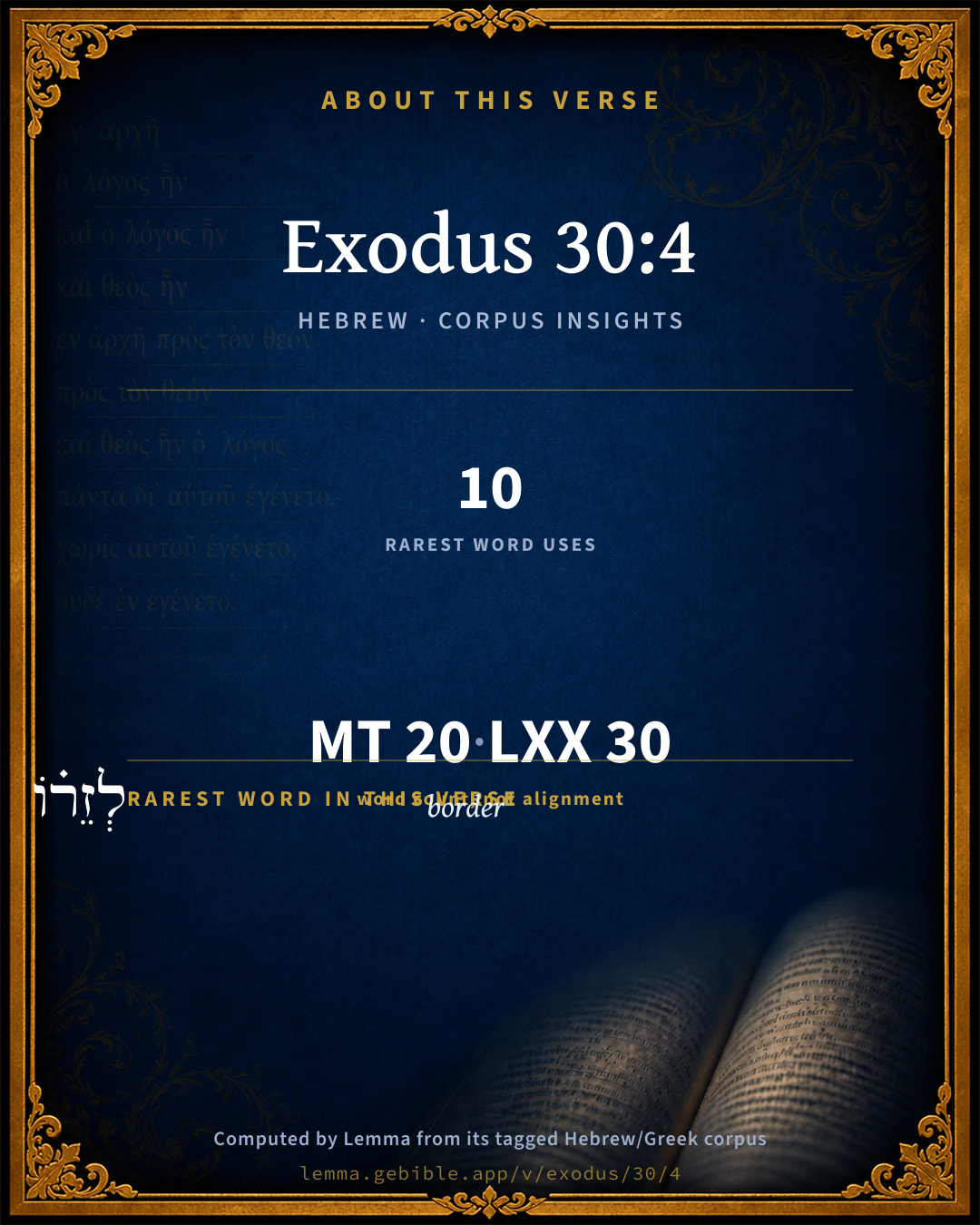
20
words
15
distinct lemmas
Pentateuch
section

Notable vocabulary

The rarest word here is לְזֵר֗וֹ border H2213 — appearing just 10 times in the whole Hebrew Bible.

Shared distinctive vocabulary

לְזֵר֗וֹ border H2213 occurs in 10 verses of the Hebrew Bible. Also found in:

Grammatical profile

  • 4 verbs
  • 7 nouns
  • 3 adjectives
  • 1 pronoun
  • 4 prepositions
  • 1 particle

Verb forms

  • תַּֽעֲשֶׂה Qal · Imperfect
  • תַּעֲשֶׂ֖ה Qal · Imperfect
  • וְהָיָה֙ Qal · Sequential Perfect
  • לָשֵׂ֥את Qal · Infinitive Construct

Repetition

Words recur within this verse — often emphatic in Hebrew:

  • וּשְׁתֵּי֩ two H8147 ×3
  • תַּֽעֲשֶׂה to do H6213 ×2
  • עַ֚ל upon H5921 ×2

Hebrew & Septuagint length

In English translation the verse runs 36 words from the Hebrew and 40 from the Septuagint (LXX English) — closely comparable.

A rough comparison of the two English renderings, which tokenize alike — not a word-level alignment.

Word counts can differ between the Hebrew and the Greek without any difference in meaning — e.g. the Hebrew direct-object marker אֵת has no separate Greek word, and Greek often adds the article ὁ.

In the original languages it is 20 Hebrew tokens and 30 Greek tokens — but the two are counted differently (Hebrew bundles its prefixes and suffixes into one token; the Greek is in lemma form), so that isn’t a like-for-like length.

Cross-references

6

Topical passages linked to Exodus 30:4 in the Treasury of Scripture Knowledge — connected by theme and wording, ordered by reader-vote popularity; previews shown in the World English Bible.

  • Exodus 25:27 the rings shall be close to the rim, for places for the poles to carry the table.
  • Exodus 25:12 You shall cast four rings of gold for it, and put them in its four feet. Two rings shall be on the one side of it, and two rings on the other side of it.
  • Exodus 25:14 You shall put the poles into the rings on the sides of the ark to carry the ark.
  • Exodus 26:29 You shall overlay the boards with gold, and make their rings of gold for places for the bars: and you shall overlay the bars with gold.
  • Exodus 27:4 You shall make a grating for it of network of brass: and on the net you shall make four brazen rings in its four corners.
  • Exodus 27:7 Its poles shall be put into the rings, and the poles shall be on the two sides of the altar, when carrying it.

Cross-references courtesy of OpenBible.info (CC BY 4.0).

Hebrew and Greek witnesses Masoretic Hebrew ↔ Greek Septuagint

The same verse in the two great witnesses to the Old Testament, shown verse-for-verse.

These are two independent witnesses, not word-aligned to each other, and the Septuagint is shown in lemma (dictionary) form.

Hebrew Exodus 30:4 Masoretic · Westminster Leningrad Codex

וּשְׁתֵּי֩ טַבְּעֹ֨ת זָהָ֜ב תַּֽעֲשֶׂה לּ֣וֹ מִתַּ֣חַת לְזֵר֗וֹ עַ֚ל שְׁתֵּ֣י צַלְעֹתָ֔יו תַּעֲשֶׂ֖ה עַל שְׁנֵ֣י צִדָּ֑יו וְהָיָה֙ לְבָתִּ֣ים לְבַדִּ֔ים לָשֵׂ֥את אֹת֖וֹ בָּהֵֽמָּה

You shall make two golden rings for it under its molding; on its two ribs, on its two sides you shall make them; and they shall be for places for poles with which to bear it.

World English Bible · Public Domain

Greek LXX Exodus 30:4 Septuagint · lemma form

καί δύο δακτύλιος χρυσοῦς καθαρός ποιέω ὑπό ὁ στρεπτός στεφάνη αὐτός εἰς ὁ δύο κλίτος ποιέω ἐν ὁ δύο πλευρόν καί εἰμί ψαλίς ὁ σκυτάλη ὥστε αἴρω αὐτός ἐν αὐτός

And you shall make under its wreathen border two rings of pure gold; you shall make it to the two corners on the two sides, and they shall be bearings for the staves, so as to bear it with them.

LXX2012 (modern English Septuagint) · Public Domain

Hebrew: Westminster Leningrad Codex (CC BY 4.0). Greek: Septuagint (public domain); English from LXX2012 (modern English Septuagint) (Public Domain). How the Septuagint differs from the Hebrew →

Targum (Aramaic paraphrase)

2

The Targum is the ancient Jewish Aramaic paraphrase of the Hebrew Scriptures — an interpretive translation, not the Hebrew text itself. Onkelos (literal) and Pseudo-Jonathan (expansive) render the Torah, and Jonathan the Prophets. Coverage is partial: where no permissively-licensed English translation exists for a verse, only the Aramaic is shown. This is verse-level text, not a word-by-word alignment to the Hebrew.

  1. Targum Onkelos Torah (Genesis–Deuteronomy)
    וְתַרְתֵּין עִזְקַן דִדְהַב תַּעְבֶּד לֵהּ מִלְרַע לְדֵירֵהּ עַל תַּרְתֵּין זִוְיָתֵהּ תַּעְבֵּד עַל תְּרֵין סִטְרוֹהִי וִיהֵי לְאַתְרָא לַאֲרִיחַיָא לְמִטַל יָתֵהּ בְּהוֹן:

    (no public-domain English translation for this verse)

    Targum Onkelos — Aramaic: “Onkelos Genesis” (public domain); “Onkelos Exodus” (public domain); “Onkelos Leviticus” (public domain); “Onkelos Numbers” (public domain); “Onkelos Deuteronomy” (public domain). English: “Sefaria Community Translation” (CC0 1.0 (public-domain dedication)); “J.W. Etheridge. The Targums of Onkelos and Jonathan Ben Uzziel on the Pentateuch. London: Longmans, Green, 1862” (public domain). Text via Sefaria.

  2. Targum Pseudo-Jonathan Torah (Genesis–Deuteronomy)
    וְתַרְתֵּין עִיזְקַן דִּדְהַב תַּעֲבֵיד לֵיהּ מִלְרַע לְזֵירֵיהּ עַל תְּרֵין זִיוְיָיתֵיהּ תַּעֲבֵיד עַל תְּרֵין צִיטְרוֹי וִיהֵי לְאַתְרָא לַאֲרִיחַיָא לְמֵיטַל יָתֵיהּ בְּהוֹם

    And two golden rings make thou for it beneath its border at the two corners, thou shalt make upon its two sides, to be the place for the staves by which it may be carried.

    Targum Pseudo-Jonathan — Aramaic: “Targum Jonathan on Genesis” (public domain); “Targum Jonathan on Exodus” (public domain); “Targum Jonathan on Leviticus” (public domain); “Targum Jonathan on Numbers” (public domain); “Targum Jonathan on Deuteronomy” (public domain). English: “The Targum of Jonathan ben Uzziel, trans. J. W. Etheridge, London, 1862” (public domain). Text via Sefaria.

Commentary

Notes on Exodus 30:4 from classic Christian and Jewish commentators (each source and its license shown beneath its notes). The classic Christian expositions comment on the surrounding passage and are grouped to its opening verse, so a note may address several verses; the Jewish commentaries on the Tanakh (Rashi and others) are per-verse, so they appear only where the commentator wrote on this verse.

Lemma curates 59 commentaries, every one of them public domain or Creative Commons licensed, each selected and text-cleaned for this edition rather than reprinted as found. About our sources →

Ellicott's Commentary for English Readers

(4) Two golden rings.—The golden altar was so much smaller and lighter than the brazen one that two rings only were required for carrying it, instead of the “four rings” needed by the brazen altar (Exo_27:4).

By the two corners thereof.—Rather, on the two sides thereof. The word used means, literally, “ribs,” and is explained in the clause which follows.

A Bible Commentary for English Readers, edited by Charles John Ellicott (1878–1897) — public domain. Text from a community e-Sword module.

The Cambridge Bible for Schools and Colleges

gen. ed. J. J. S. Perowne

4. upon the two ribs thereof] i.e. upon its flanks or sides, a common metaph. sense of ‘rib’ in Heb. (see on Exo_25:12). The words seem tautologous beside the following ‘upon the two sides of it’; either they have come in here by error, through a recollection of Exo_27:12, or (Di.) the expression denotes the extreme ends of the two sides, near the corners.

sides] not as v. 3, but the usual word for ‘side,’ Exo_26:13, &c.

4, 5. The rings and acacia-wood poles, for the transport of the altar, as in the case of the ark (Exo_25:12-15), the table of Presence bread (Exo_25:26-28), and the Bronze altar (Exo_27:4-7).

The Cambridge Bible for Schools and Colleges (gen. ed. J. J. S. Perowne; Cambridge University Press, 1878–1918) — public domain. Text from a community e-Sword module.

John Gill's Exposition

And two golden rings shalt thou make to it under the crown of it,.... The crown was on the top of the altar, at the edge of it all around; and just underneath it were two rings of gold, two on each side:

by the two corners thereof, upon the two sides of it shall thou make them; at each corner a ring, and at each side; the use of them follows:

and they shall be for places for the staves to bear it withal; these rings were for the staves to be put into when the altar was to be carried from place to place, as it was in the wilderness, during the travels of Israel there; and this signifies that Christ never leaves his people; when they are in the wilderness he is with them, interceding for them, providing all things necessary for their food, safety, and protection, Rev 12:14.

John Gill's Exposition of the Whole Bible (1746–1763) — public domain (CC PDM 1.0). Text via the HelloAO Bible API.

The Pulpit Commentary

By the two corners. Rather, "on its two sides." The ensuing clause is redundant. All that is meant is, that the altar should have two rings only not four one at each side, directly below the moulding. As it was so small, two rings were enough. For the staves. Rather, "for staves."

The Pulpit Commentary (1880–1919), ed. H.D.M. Spence-Jones & Joseph S. Exell — public domain. Text from a community e-Sword module.

Rashi

Rabbi Shlomo Yitzchaki (Rashi)

צלעתיו Here this word must signify “corners” (not “sides” as Rashi explains in Exodus 25:12), as it is translated in the Targum, since it is stated afterwards, על שני צדיו, “upon the two sides of it”, so that the phrases mean, “the two corners that are on its two sides”.

והיה (lit., “and it shall be”, not “they shall be”) — i. e. the making of these rings (this ring-work) shall be (shall serve) —

לבתים לבדים FOR PLACES FOR THE STAVES — i.e. the ring shall serve as a place for the stave (cf. Rashi on Exodus 25:27).

Rashi on the Tanakh — English translations: “The Judaica Press complete Tanach with Rashi, translated by A. J. Rosenberg” (CC BY 4.0); “Pentateuch with Rashi's commentary by M. Rosenbaum and A.M. Silbermann, 1929-1934” (public domain); “The Metsudah Tanach series, Lakewood, N.J” (CC BY 4.0); and “The Book of Joshua, Metsudah Publications, 1997” (CC BY 4.0). Text via Sefaria.

Lesson kit

Teaching starters — assembled from the data on this page, not authored interpretation. Every prompt links to the verse data it draws on. Edit before teaching.

Exodus, in the Pentateuch, opens this verse with 20 words (15 distinct Hebrew lemmas). Its most distinctive word is zêr (“border”). A historical commentator’s framing appears above. Read the whole chapter for the surrounding context.

Discussion questions

  1. The word zêr carries the sense “border.” How does it shape the verse?
  2. How does Exodus 25:11, which shares the word «border», read alongside this verse?
  3. What does the repetition of “two” (3× in this one verse) do in this verse?
  4. These translations render this verse differently. What is at stake in choosing one wording over another?
  5. «תַּֽעֲשֶׂה» is a Qal Imperfect verb. How does that grammatical form shape the action described?
  6. Compare how Ellicott's Commentary for English Readers and The Cambridge Bible for Schools and Colleges read this verse. Where do they agree or differ?

Things to notice

Reading settings

Reading text

Shown beneath each verse's original-language words.

Old Testament
Old Testament edition

Read the OT as the Masoretic Hebrew (MT) or the Greek Septuagint (LXX).

English shown for the Greek Septuagint (in the Hebrew ↔ Greek comparison).

Comparing translations? Open the Compare panel on any verse page to stack up to four side by side.