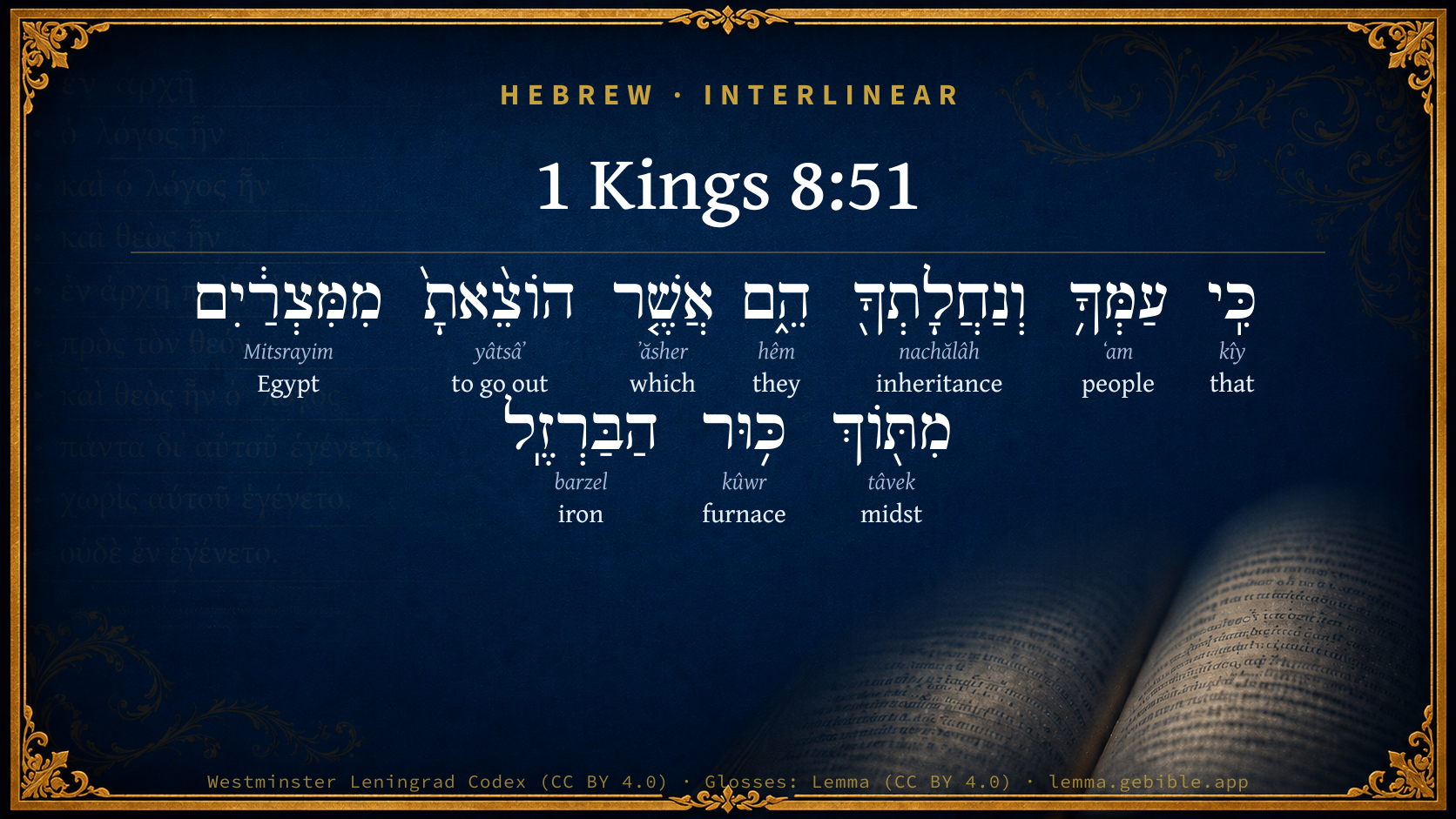
1 Kings 8:51

Hebrew (Westminster Leningrad Codex) 1 Kings 8:51 appears in the Hebrew Old Testament. The text above is from the Westminster Leningrad Codex. Each word links to its Strong’s number, a concise gloss, and parsing drawn from the Open Scriptures Hebrew Bible morphology. Click any word for its full Brown-Driver-Briggs (BDB) entry.
Download image
Cite this verse

1 Kings 8:51 (World English Bible). Public Domain. Lemma interlinear Bible study tool, https://lemma.gebible.app/v/1-kings/8/51.

Show BibTeX & RIS
BibTeX
RIS
English Translation
(for they are your people, and your inheritance, which you brought forth out of Egypt, from the midst of the furnace of iron);
World English Bible · Public Domain
Download a study sheet

One document with this verse’s original text, its word-by-word gloss line, the meaning frame, cross-references with their text, attributed commentary, and full source and license credits — printable, and it pastes into notes with its structure intact.

This verse Autodidact and up

Study sheet (.html) Plain text (.txt)

A passage Seminary Student

Up to 50 verses in one chapter. A passage sheet keeps up to 6 commentary sources and 12 cross-references per verse, in the order this page ranks them, and says so on the sheet whenever that leaves anything out. Ask for a single verse and you get the Autodidact verse sheet above.

Everything on this page stays free to read, with no account — the sheet is a download of what is already on screen, not access to it.

Want to remove ads? Support Godless Engineer
Compare translations 3

The same verse in 3 English versions, stacked beneath the original-language interlinear above. Click any original word for its lexicon entry.

Each is an independent rendering of the whole verse — the interlinear is not word-aligned to these translations.

Highlighted words mark where these versions differ — a whole-verse word diff, not a word-by-word alignment.

  • World English Bible Public Domain
    (for they are your people, and your inheritance, which you brought forth out of Egypt, from the midst of the furnace of iron);
  • King James Version Public Domain
    For they be thy people, and thine inheritance, which thou broughtest forth out of Egypt, from the midst of the furnace of iron:
  • unfoldingWord Literal Text CC BY-SA 4.0
    For they your people and your inheritance, whom you brought out from Egypt, from the midst of the furnace of iron,

unfoldingWord Literal Text — © unfoldingWord, licensed CC BY-SA 4.0. Word-aligned USFM3 via Door43 (git.door43.org/unfoldingWord/en_ult).

Versions to compare (up to 4)

3 of 4 selected

Show all 18 translations

Every available English version of this verse, each an independent rendering of the whole verse.

  • World English Bible Public Domain
    (for they are your people, and your inheritance, which you brought forth out of Egypt, from the midst of the furnace of iron);
  • Berean Standard Bible Public Domain
    For they are Your people and Your inheritance; You brought them out of Egypt, out of the furnace for iron.
  • Majority Standard Bible Public Domain
    For they are Your people and Your inheritance; You brought them out of Egypt, out of the furnace for iron.
  • King James Version Public Domain
    For they be thy people, and thine inheritance, which thou broughtest forth out of Egypt, from the midst of the furnace of iron:
  • American Standard Version (1901) Public Domain
    (for they are thy people, and thine inheritance, which thou broughtest forth out of Egypt, from the midst of the furnace of iron);
  • Revised Version (1885) Public Domain
    For they be thy people, and thine inheritance which thou broughtest forth out of Egypt, from the midst of the furnace of iron:
  • Geneva Bible (1599) Public Domain
    For they be thy people, and thine inheritance, which thou broughtest out of Egypt from the middes of the yron fornace.
  • Douay-Rheims (1899) Public Domain
    For they are thy people, and thy inheritance, whom thou hast brought out of the land of Egypt, from the midst of the furnace of iron.
  • Young's Literal Translation Public Domain
    (for Thy people and Thy inheritance `are' they, whom Thou didst bring out of Egypt, out of the midst of the furnace of iron) --
  • Literal Standard Version CC BY-SA 4.0
    for they [are] Your people and Your inheritance, whom You brought out of Egypt, out of the midst of the furnace of iron—
  • Unlocked Literal Bible CC BY-SA 4.0
    They are your people whom you have chosen, whom you rescued out of Egypt as if from the middle of a furnace where iron is forged.
  • unfoldingWord Literal Text CC BY-SA 4.0
    For they your people and your inheritance, whom you brought out from Egypt, from the midst of the furnace of iron,
  • Darby Bible Public Domain
    (for they are thy people, and thine inheritance, which thou broughtest forth out of Egypt, from the midst of the furnace of iron) --
  • World Messianic Bible Public Domain
    (for they are your people and your inheritance, which you brought out of Egypt, from the middle of the iron furnace);
  • Webster's Bible Public Domain
    For they are thy people, and thy inheritance, which thou broughtest out of Egypt, from the midst of the furnace of iron:
  • Free Bible Version CC BY-SA 4.0
    For they are your people—they belong to you! You led them out of Egypt, out of the middle of a furnace used for smelting iron.
  • Bible in Basic English Public Domain
    For they are your people and your heritage, which you took out of Egypt, out of the iron fireplace;
  • JPS Tanakh (1917) Public Domain
    for they are Thy people, and Thine inheritance, which Thou broughtest forth out of Egypt, from the midst of the furnace of iron;

Literal Standard Version (2020), Covenant Press — licensed CC BY-SA 4.0. Text via the HelloAO Bible API (eBible.org). Unlocked Literal Bible (unfoldingWord) — licensed CC BY-SA 4.0. Text via the HelloAO Bible API (eBible.org). unfoldingWord Literal Text — © unfoldingWord, licensed CC BY-SA 4.0. Word-aligned USFM3 via Door43 (git.door43.org/unfoldingWord/en_ult). Free Bible Version, Dr. Jonathan Gallagher — licensed CC BY-SA 4.0. Text via the HelloAO Bible API (eBible.org).

Word by word

More ways to search: Search by grammar → Find every occurrence → Compare this word →

Practice this passage: Drill this verse → Learn its vocabulary →

כּ֥וּר
kûwr
H3564
“furnace of”
Noun, Common, Masculine, Singular, Construct
Part of Speech
Noun
Type
Common
Gender
Masculine
Number
Singular
State
Construct
Full BDB Definition

Origin: from an unused root meaning properly, to dig through

TWOT: 967b , 968

furnace, forge, smelting furnace or pot (noun masculine) - (Qal) to bore, pierce, dig, hew (verb)
  1. כִּֽי kîy H3588 “that” Conjunction
  2. עַמְּךָ֥ ʻam H5971 “people · your” Noun, Common, Masculine, Singular, Construct + Suffix, Personal, 2nd Person, Masculine, Singular
  3. וְנַחֲלָתְךָ֖ nachălâh H5159 “and · inheritance · your” Conjunction + Noun, Common, Feminine, Singular, Construct + Suffix, Personal, 2nd Person, Masculine, Singular
  4. הֵ֑ם hêm H1992 “they” Pronoun, Personal, 3rd Person, Masculine, Plural
  5. אֲשֶׁ֤ר ʼăsher H834 “which” Particle, Relative
  6. הוֹצֵ֨אתָ֙ yâtsâʼ H3318 “to go out” Verb, Hiphil, Perfect, 2nd Person, Masculine, Singular
  7. מִמִּצְרַ֔יִם Mitsrayim H4714 “from · Egypt” Preposition + Noun, Proper
  8. מִתּ֖וֹךְ tâvek H8432 “from · midst of” Preposition + Noun, Common, Masculine, Singular, Construct
  9. הַבַּרְזֶֽל barzel H1270 “the · iron” Particle, Definite Article + Noun, Common, Masculine, Singular, Absolute

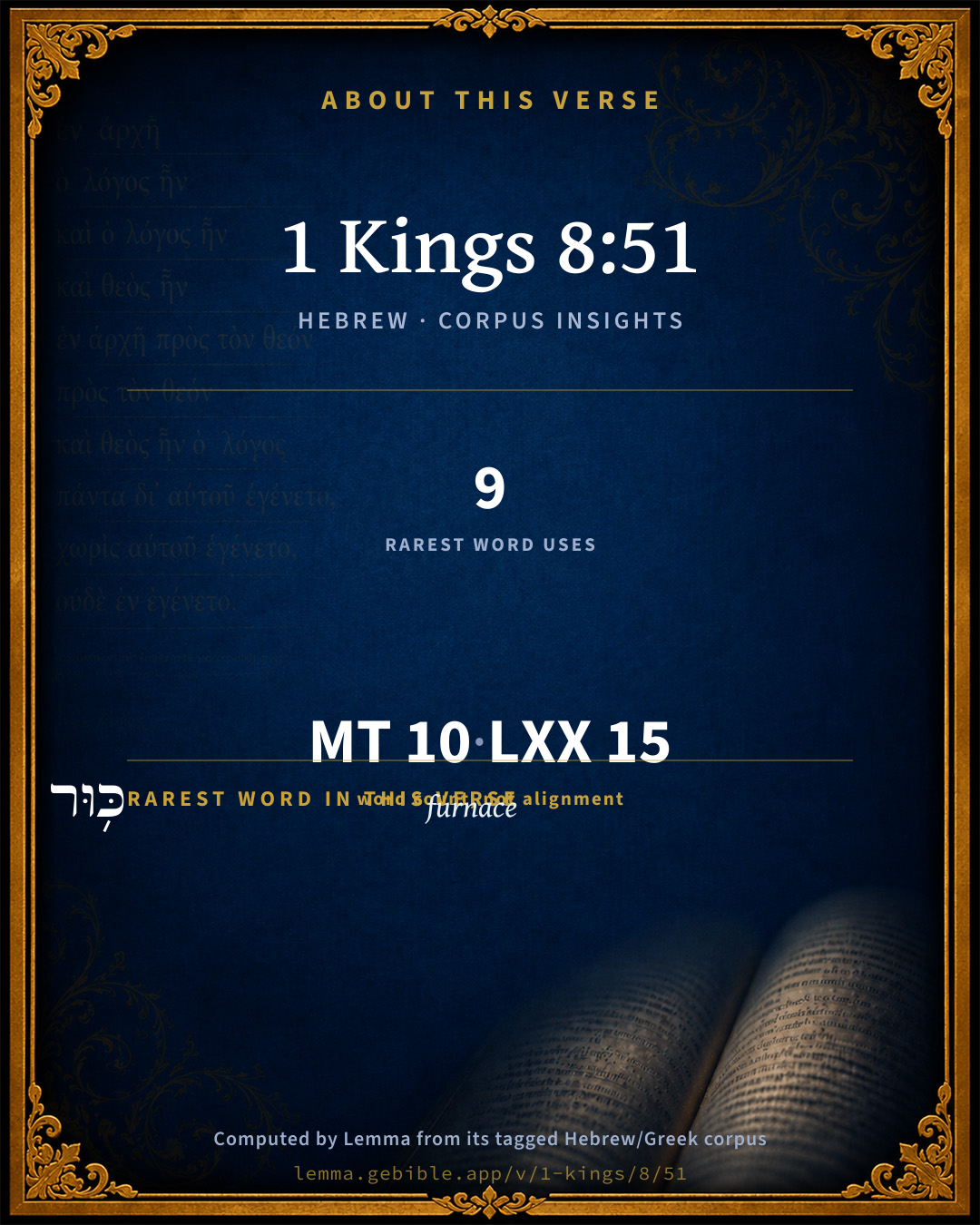
About this verse

These counts appear in no published source. They are computed here, from the morphology-tagged text and Lemma’s own curated glosses. What Lemma adds →

10
words
10
distinct lemmas
Historical
section

Notable vocabulary

The rarest word here is כּ֥וּר furnace H3564 — appearing just 9 times in the whole Hebrew Bible.

Shared distinctive vocabulary

כּ֥וּר furnace H3564 occurs in 9 verses of the Hebrew Bible. Also found in:

Grammatical profile

  • 1 verb
  • 6 nouns
  • 1 pronoun
  • 1 conjunction
  • 1 particle

Verb forms

  • הוֹצֵ֨אתָ֙ Hiphil · Perfect

Hebrew & Septuagint length

In English translation the verse runs 23 words from the Hebrew and 26 from the Septuagint (LXX English) — closely comparable.

A rough comparison of the two English renderings, which tokenize alike — not a word-level alignment.

Word counts can differ between the Hebrew and the Greek without any difference in meaning — e.g. the Hebrew direct-object marker אֵת has no separate Greek word, and Greek often adds the article ὁ.

In the original languages it is 10 Hebrew tokens and 15 Greek tokens — but the two are counted differently (Hebrew bundles its prefixes and suffixes into one token; the Greek is in lemma form), so that isn’t a like-for-like length.

Cross-references

11

Topical passages linked to 1 Kings 8:51 in the Treasury of Scripture Knowledge — connected by theme and wording, ordered by reader-vote popularity; previews shown in the World English Bible.

  • Deuteronomy 4:20 But Yahweh has taken you, and brought you forth out of the iron furnace, out of Egypt, to be to him a people of inheritance, as at this day.
  • Nehemiah 1:10 Now these are your servants and your people, whom you have redeemed by your great power, and by your strong hand.
  • Jeremiah 11:4 which I commanded your fathers in the day that I brought them forth out of the land of Egypt, out of the iron furnace, saying, Obey my voice, and do them, according to all which I command you: so shall you be my people, and I will be your God;
  • Exodus 32:11–12 Moses begged Yahweh his God, and said, "Yahweh, why does your wrath burn hot against your people, that you have brought forth out of the land of Egypt with great power and with a mighty hand?
  • Numbers 14:13–19 Moses said to Yahweh, Then the Egyptians will hear it; for you brought up this people in your might from among them;
  • Deuteronomy 9:26–29 I prayed to Yahweh, and said, Lord Yahweh, don't destroy your people and your inheritance, that you have redeemed through your greatness, that you have brought forth out of Egypt with a mighty hand.
  • Jeremiah 51:19 The portion of Jacob is not like these; for he is the former of all things; and [Israel] is the tribe of his inheritance: Yahweh of Hosts is his name.
  • 1 Kings 8:53 For you did separate them from among all the peoples of the earth, to be your inheritance, as you spoke by Moses your servant, when you brought our fathers out of Egypt, Lord Yahweh.
  • 2 Chronicles 6:39 then hear from heaven, even from your dwelling-place, their prayer and their petitions, and maintain their cause, and forgive your people who have sinned against you.
  • Isaiah 63:16–18 For you are our Father, though Abraham doesn't know us, and Israel does not acknowledge us: you, Yahweh, are our Father; our Redeemer from everlasting is your name.
  • Isaiah 64:9 Don't be angry very sore, Yahweh, neither remember iniquity forever: see, look, we beg you, we are all your people.

Cross-references courtesy of OpenBible.info (CC BY 4.0).

Hebrew and Greek witnesses Masoretic Hebrew ↔ Greek Septuagint

The same verse in the two great witnesses to the Old Testament, shown verse-for-verse.

These are two independent witnesses, not word-aligned to each other, and the Septuagint is shown in lemma (dictionary) form.

Hebrew 1 Kings 8:51 Masoretic · Westminster Leningrad Codex

כִּֽי עַמְּךָ֥ וְנַחֲלָתְךָ֖ הֵ֑ם אֲשֶׁ֤ר הוֹצֵ֨אתָ֙ מִמִּצְרַ֔יִם מִתּ֖וֹךְ כּ֥וּר הַבַּרְזֶֽל

(for they are your people, and your inheritance, which you brought forth out of Egypt, from the midst of the furnace of iron);

World English Bible · Public Domain

Greek LXX 1 Kings 8:51 Septuagint · lemma form

ὅτι λαός σύ καί κληρονομία σύ ὅς ἐκἄγω ἐκ γῆ αἴγυπτος ἐκ μέσος χωνευτηρίον σίδηρος

for they are your people and your inheritance, whom you brought out of the land of Egypt, out of the midst of the furnace of iron.

LXX2012 (modern English Septuagint) · Public Domain

Hebrew: Westminster Leningrad Codex (CC BY 4.0). Greek: Septuagint (public domain); English from LXX2012 (modern English Septuagint) (Public Domain). How the Septuagint differs from the Hebrew →

Targum (Aramaic paraphrase)

1

The Targum is the ancient Jewish Aramaic paraphrase of the Hebrew Scriptures — an interpretive translation, not the Hebrew text itself. Onkelos (literal) and Pseudo-Jonathan (expansive) render the Torah, and Jonathan the Prophets. Coverage is partial: where no permissively-licensed English translation exists for a verse, only the Aramaic is shown. This is verse-level text, not a word-by-word alignment to the Hebrew.

  1. Targum Jonathan Prophets (Joshua–Malachi)
    אֲרֵי עֲמָךְ וְאַחֲסַנְתָּךְ אִינוּן דְאַפֵּיקְתָּא מִצְרַיִם מִגוֹ כוּרָא דְבַרְזְלָא:

    (no public-domain English translation for this verse)

    Targum Jonathan — Aramaic: “Mikraot Gedolot” (public domain). English: “Sefaria Community Translation” (CC0 1.0 (public-domain dedication)); “London "Chaldee Paraphrase," 1871” (public domain). Text via Sefaria.

Commentary

Notes on 1 Kings 8:51 from classic Christian and Jewish commentators (each source and its license shown beneath its notes). The classic Christian expositions comment on the surrounding passage and are grouped to its opening verse, so a note may address several verses; the Jewish commentaries on the Tanakh (Rashi and others) are per-verse, so they appear only where the commentator wrote on this verse.

Lemma curates 59 commentaries, every one of them public domain or Creative Commons licensed, each selected and text-cleaned for this edition rather than reprinted as found. About our sources →

Trapp's Complete Commentary

John Trapp

1Ki 8:51 For they [be] thy people, and thine inheritance, which thou broughtest forth out of Egypt, from the midst of the furnace of iron:

Ver. 51. For they be thy people.] Culled and called out of the rest of the world. Thou hast avouched them for thine; and they have avouched thee for their God.

From the midst of the furnace of iron.] Where they were grievously afflicted, and by those afflictions melted and made more malleable.

John Trapp, A Commentary or Exposition upon All the Books of the Old and New Testament (1647–1656) — public domain. Text from a community e-Sword module.

Ellicott's Commentary for English Readers

(51-53) For they be thy people.—This pleading with God by His deliverance of the people from Egypt, and by His promise to Moses to make them His inheritance (see Exo_19:5; Deu_9:26; Deu_9:29; Deu_14:2), although especially suggested by the last petition for deliverance from captivity, may be held to apply to the whole of Solomon’s prayer. It implies the belief not only that the declared purpose of God cannot fail, but that, even for the manifestation of His glory to man, it must needs be visibly fulfilled before the eyes of the world. This same conviction breathes in many of the utterances of Moses for Israel (see Exo_32:12-13; Num_14:13-14); it is expressed in the “Help us, O Lord, and deliver us for Thy name’s sake,” of Psa_79:9-10, or the “Defer not for Thine own sake, O my God” of Dan_9:19 : it is declared on the part, of the Lord again and again in Eze_20:9; Eze_20:14; Eze_20:22, “I wrought for my name’s sake.” It may, indeed, seem to jar upon our fuller conception of the infinite majesty of God, incapable of being augmented or lessened, and of the infinite love which does all for the sake of His creatures. Yet it is not wholly unlike our Lord’s prayer (Joh_12:28), “Father, glorify thy name,” or the Apostolic declarations of the great purpose of redemption, as designed for “the praise of God’s glory” (Eph_1:6; Eph_1:12; Eph_1:14), and of all Christian life as commanded to “do all to the glory of God” (1Co_10:31). In some respects it is like the pleading with our Lord, in the Litanies of the Church in all ages, by all the various acts of His redemption, and the prayer of the old Latin hymn—

“ Redemisti crucem passus;

Tantus labor ne sit cassus.”

But, indeed, all that might seem to us strange or unworthy in such prayers vanishes at once, when we consider that the knowledge of God in His self-manifestation is the highest happiness of man; on which, indeed, depend all depth and harmony of human knowledge, and all dignity and purity of human life. Hence, in the Lord’s Prayer, the three petitions “for Gods glory,” preceding all special petitions for our own needs, are really prayers for the highest blessing of all mankind. God’s care for His glory is not for His own sake, but for ours.

A Bible Commentary for English Readers, edited by Charles John Ellicott (1878–1897) — public domain. Text from a community e-Sword module.

The Cambridge Bible for Schools and Colleges

gen. ed. J. J. S. Perowne

51. from the midst of the furnace of iron] The bondage of Egypt is so called, Deu_4:20. The idea is of the intense heat needed to melt iron in a furnace, and that with this the suffering of Israel might be compared. Cf. Isa_48:10; Jer_11:14.

The Cambridge Bible for Schools and Colleges (gen. ed. J. J. S. Perowne; Cambridge University Press, 1878–1918) — public domain. Text from a community e-Sword module.

John Gill's Exposition

That thine eyes may be open to the supplication of thy servant,.... That is, attentive to it, meaning himself and his present supplication; or any other he should hereafter put up in this place:

and unto the supplication of thy people Israel, to hearken unto them in all that they call unto thee: at any time, and upon any account; so far as may be agreeable to his will, make for his glory, and their good; see Deu 4:7.

John Gill's Exposition of the Whole Bible (1746–1763) — public domain (CC PDM 1.0). Text via the HelloAO Bible API.

Albert Barnes' Notes on the Bible

The furnace of iron - Egypt is so called as a place of severe trial and affliction.

Albert Barnes' Notes on the Bible (1834–1885) — public domain. Text from a community e-Sword/MySword module.

Haydock's Catholic Bible Commentary

CHAPTER VIII.

Iron. This expression is often used to denote the rigour of the Egyptian bondage, Deuteronomy iv. 20. Thus Homer says, that Mars was shut up for thirteen months in a barrel (or prison) of brass. (Iliad E.)

George Leo Haydock (1774–1849), Haydock's Catholic Family Bible and Commentary, 1859 edition — public domain. Excludes Psalms (Douay-Rheims chapter numbering differs from Protestant) and Deuterocanonical books (Catholic canon only).

Matthew Poole's English Annotations

They be thy people; for howsoever they may sin against thee, or suffer from men, yet still remember that they are thy peculiar people, and therefore do thou pity, and pardon, and save them.

The furnace of iron; so called, either from the metal melted in it; or rather, from the matter of which it consisted, an iron furnace being more hot and terrible than one of brick or stone. He understands hereby their cruel bondage and painful labours. See Poole "Deu 4:20".

Matthew Poole's English Annotations on the Holy Bible (1683–1685) — public domain. Text from a community e-Sword/MySword module.

Whedon's Commentary on the Bible

Daniel D. Whedon

51. Furnace of iron — Metaphorical description of the bitter bondage and inhuman persecutions of Egypt. Compare marginal references.

Daniel D. Whedon (gen. ed.), Commentary on the Old and New Testaments (1874–1909) — public domain. Text from a community e-Sword module.

The Pulpit Commentary

For they be thy people a citation or reminiscence of Deu_4:10, and thine inheritance, which thou broughtest forth out of Egypt cf. vers. 21, 53. There is a constant recurrence throughout the Old Testament to this great deliverance, and with good reason, for it was the real birthday of the nation, and was also a pledge of future help and favour. God who had "wrought such great things for them in Egypt "could not well forsake them. Solomon"s constant plea is that they are the elect and covenant race from the midst of the furnace of iron i.e., a furnace for iron, heated and fierce as for smelting. Same phrase, Deu_4:20.

The Pulpit Commentary (1880–1919), ed. H.D.M. Spence-Jones & Joseph S. Exell — public domain. Text from a community e-Sword module.

unfoldingWord translationNotes

Door43 World Missions Community

a furnace where iron is forged

This can be stated in active form. AT: "a furnace where people forge iron" (See: Active or Passive)

May your eyes be open

The eye is a synecdoche for the person. AT: "Please pay attention" (See: Synecdoche)

translationWords

Egypt

furnace

servant

people group

Israel

receive

promise

Moses

ancestor

Lord Yahweh

unfoldingWord translationNotes — © Distant Shores Media and the Door43 World Missions Community, licensed CC BY-SA 4.0. Source: git.door43.org/Door43/en_tn.

Rashi

Rabbi Shlomo Yitzchaki (Rashi)

The smelting pot of iron. The earthenware utensils used to purify gold of its impurities is called כור.

Rashi on the Tanakh — English translations: “The Judaica Press complete Tanach with Rashi, translated by A. J. Rosenberg” (CC BY 4.0); “Pentateuch with Rashi's commentary by M. Rosenbaum and A.M. Silbermann, 1929-1934” (public domain); “The Metsudah Tanach series, Lakewood, N.J” (CC BY 4.0); and “The Book of Joshua, Metsudah Publications, 1997” (CC BY 4.0). Text via Sefaria.

Lesson kit

Teaching starters — assembled from the data on this page, not authored interpretation. Every prompt links to the verse data it draws on. Edit before teaching.

1 Kings, in the Historical, opens this verse with 10 words (10 distinct Hebrew lemmas). Its most distinctive word is kûwr (“furnace”). A historical commentator’s framing appears above. Read the whole chapter for the surrounding context.

Discussion questions

  1. How does “furnace” (kûwr) shape what this verse is saying?
  2. How does Deuteronomy 4:20, which shares the word «furnace», read alongside this verse?
  3. These translations render this verse differently; the difference is in the English rendering, not the original. What questions does that raise?
  4. «הוֹצֵ֨אתָ֙» is a Hiphil Perfect verb. How does that grammatical form shape the action described?
  5. Compare how Trapp's Complete Commentary and Ellicott's Commentary for English Readers read this verse. Where do they agree or differ?

Things to notice

Reading settings

Reading text

Shown beneath each verse's original-language words.

Old Testament
Old Testament edition

Read the OT as the Masoretic Hebrew (MT) or the Greek Septuagint (LXX).

English shown for the Greek Septuagint (in the Hebrew ↔ Greek comparison).

Comparing translations? Open the Compare panel on any verse page to stack up to four side by side.