
Hosea 4:14

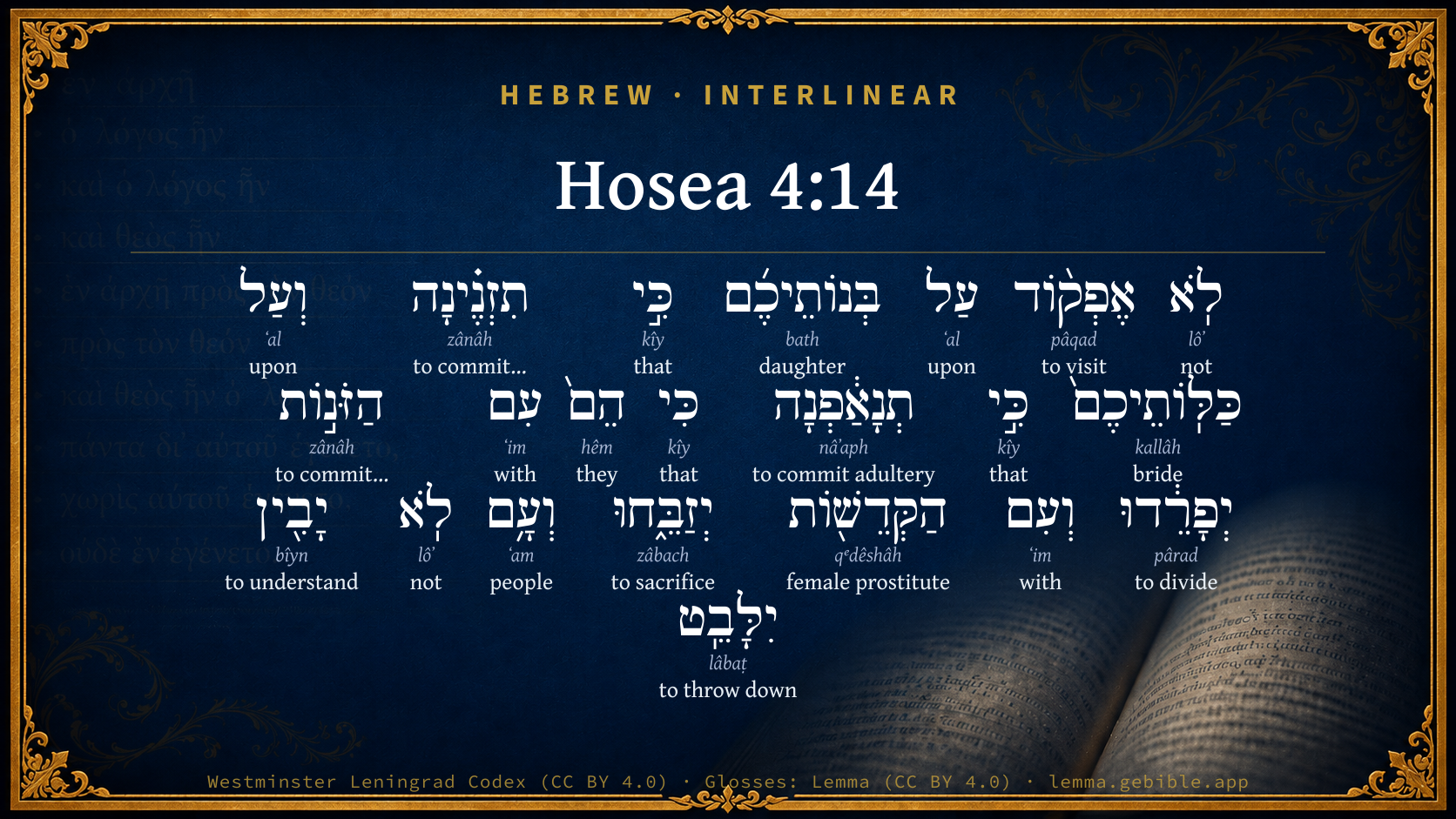
Hebrew (Westminster Leningrad Codex) Hosea 4:14 appears in the Hebrew Old Testament. The text above is from the Westminster Leningrad Codex. Each word links to its Strong’s number, a concise gloss, and parsing drawn from the Open Scriptures Hebrew Bible morphology. Click any word for its full Brown-Driver-Briggs (BDB) entry.
Download image
Cite this verse

Hosea 4:14 (World English Bible). Public Domain. Lemma interlinear Bible study tool, https://lemma.gebible.app/v/hosea/4/14.

Show BibTeX & RIS
BibTeX
RIS
English Translation
I will not punish your daughters when they play the prostitute, Nor your brides when they commit adultery; Because the men consort with prostitutes, And they sacrifice with the shrine prostitutes; And the people that does not understand will come to ruin.
World English Bible · Public Domain
Download a study sheet

One document with this verse’s original text, its word-by-word gloss line, the meaning frame, cross-references with their text, attributed commentary, and full source and license credits — printable, and it pastes into notes with its structure intact.

This verse Autodidact and up

Study sheet (.html) Plain text (.txt)

A passage Seminary Student

Up to 50 verses in one chapter. A passage sheet keeps up to 6 commentary sources and 12 cross-references per verse, in the order this page ranks them, and says so on the sheet whenever that leaves anything out. Ask for a single verse and you get the Autodidact verse sheet above.

Everything on this page stays free to read, with no account — the sheet is a download of what is already on screen, not access to it.

Want to remove ads? Support Godless Engineer
Compare translations 3

The same verse in 3 English versions, stacked beneath the original-language interlinear above. Click any original word for its lexicon entry.

Each is an independent rendering of the whole verse — the interlinear is not word-aligned to these translations.

Highlighted words mark where these versions differ — a whole-verse word diff, not a word-by-word alignment.

  • World English Bible Public Domain
    I will not punish your daughters when they play the prostitute, Nor your brides when they commit adultery; Because the men consort with prostitutes, And they sacrifice with the shrine prostitutes; And the people that does not understand will come to ruin.
  • King James Version Public Domain
    I will not punish your daughters when they commit whoredom, nor your spouses when they commit adultery: for themselves are separated with whores, and they sacrifice with harlots: therefore the people that doth not understand shall fall.
  • unfoldingWord Literal Text CC BY-SA 4.0
    I will not visit upon your daughters when they prostitute, and upon your daughters-in-law when they commit adultery, for the men, they go aside with the prostitutes, and they sacrifice with the temple prostitutes, and a people does not understand will be thrown down.

unfoldingWord Literal Text — © unfoldingWord, licensed CC BY-SA 4.0. Word-aligned USFM3 via Door43 (git.door43.org/unfoldingWord/en_ult).

Versions to compare (up to 4)

3 of 4 selected

Show all 18 translations

Every available English version of this verse, each an independent rendering of the whole verse.

  • World English Bible Public Domain
    I will not punish your daughters when they play the prostitute, Nor your brides when they commit adultery; Because the men consort with prostitutes, And they sacrifice with the shrine prostitutes; And the people that does not understand will come to ruin.
  • Berean Standard Bible Public Domain
    I will not punish your daughters when they prostitute themselves, nor your daughters-in-law when they commit adultery. For the men themselves go off with prostitutes and offer sacrifices with shrine prostitutes. So a people without understanding will come to ruin.
  • Majority Standard Bible Public Domain
    I will not punish your daughters when they prostitute themselves, nor your daughters-in-law when they commit adultery. For the men themselves go off with prostitutes and offer sacrifices with shrine prostitutes. So a people without understanding will come to ruin.
  • King James Version Public Domain
    I will not punish your daughters when they commit whoredom, nor your spouses when they commit adultery: for themselves are separated with whores, and they sacrifice with harlots: therefore the people that doth not understand shall fall.
  • American Standard Version (1901) Public Domain
    I will not punish your daughters when they play the harlot, nor your brides when they commit adultery; for `the men' themselves go apart with harlots, and they sacrifice with the prostitutes; and the people that doth not understand shall be overthrown.
  • Revised Version (1885) Public Domain
    I will not punish your daughters when they commit whoredom, nor your brides when they commit adultery; for they themselves go apart with whores, and they sacrifice with the harlots: and the people that doth not understand shall be overthrown.
  • Geneva Bible (1599) Public Domain
    I will not visite your daughters when they are harlots: nor your spouses when they are whores: for they themselues are separated with harlots, and sacrifice with whores: therefore the people that doeth not vnderstand, shall fall.
  • Douay-Rheims (1899) Public Domain
    I will not visit upon your daughters when they shell commit fornication, and upon your spouses when they shall commit adultery: because themselves conversed with harlots, and offered sacrifice with the effeminate, and the people that doth not understand shall be beaten.
  • Young's Literal Translation Public Domain
    Therefore commit whoredom do your daughters, And your spouses commit adultery, I do not see after your daughters when they commit whoredom, And after your spouses when they commit adultery, For they with the harlots are separated, And with the whores they do sacrifice, A people that doth not understand kicketh.
  • Literal Standard Version CC BY-SA 4.0
    Therefore your daughters commit whoredom, || And your spouses commit adultery, || I do not see after your daughters when they commit whoredom, || And after your spouses when they commit adultery, || For they with the harlots are separated, || And with the whores they sacrifice, || A people that does not understand kicks.
  • Unlocked Literal Bible CC BY-SA 4.0
    I will not punish your daughters when they choose to commit sexual immorality, nor your daughters-in-law when they commit adultery. For the men also give themselves to the prostitutes, and they offer sacrifices so they can commit immoral acts with sacred prostitutes. So this people who does not understand will be thrown down.
  • unfoldingWord Literal Text CC BY-SA 4.0
    I will not visit upon your daughters when they prostitute, and upon your daughters-in-law when they commit adultery, for the men, they go aside with the prostitutes, and they sacrifice with the temple prostitutes, and a people does not understand will be thrown down.
  • Darby Bible Public Domain
    I will not punish your daughters when they play the harlot, nor your daughters-in-law for their committing adultery; for they themselves go aside with harlots, and they sacrifice with prostitutes: and the people that doth not understand shall come to ruin.
  • World Messianic Bible Public Domain
    I will not punish your daughters when they play the prostitute, nor your brides when they commit adultery; because the men consort with prostitutes, and they sacrifice with the shrine prostitutes; so the people without understanding will come to ruin.
  • Webster's Bible Public Domain
    I will not punish your daughters when they are guilty of lewdness, nor your spouses when they commit adultery: for they themselves are separated with prostitutes, and they sacrifice with harlots: therefore the people that doth not understand shall fall.
  • Free Bible Version CC BY-SA 4.0
    I will not punish your daughters when they practice prostitution, nor your daughters-in-law when they commit adultery, because you men visit whores and sacrifice with temple prostitutes. A people who lack understanding end up in disaster.
  • Bible in Basic English Public Domain
    I will not give punishment to your daughters or your brides for their evil behaviour; for they make themselves separate with loose women, and make offerings with those who are used for sex purposes in the worship of the gods: the people who have no wisdom will be sent away.
  • JPS Tanakh (1917) Public Domain
    I will not punish your daughters when they commit harlotry, nor your daughters-in-law when they commit adultery; for they themselves consort with lewd women, and they sacrifice with harlots; and the people that is without understanding is distraught.

Literal Standard Version (2020), Covenant Press — licensed CC BY-SA 4.0. Text via the HelloAO Bible API (eBible.org). Unlocked Literal Bible (unfoldingWord) — licensed CC BY-SA 4.0. Text via the HelloAO Bible API (eBible.org). unfoldingWord Literal Text — © unfoldingWord, licensed CC BY-SA 4.0. Word-aligned USFM3 via Door43 (git.door43.org/unfoldingWord/en_ult). Free Bible Version, Dr. Jonathan Gallagher — licensed CC BY-SA 4.0. Text via the HelloAO Bible API (eBible.org).

Word by word

More ways to search: Search by grammar → Find every occurrence → Compare this word →

Practice this passage: Drill this verse → Learn its vocabulary →

יִלָּבֵֽט
lâbaṭ
H3832
“to throw down”
Verb, Niphal, Imperfect, 3rd Person, Masculine, Singular
Part of Speech
Verb
Stem
Niphal
Form
Imperfect
Person
3rd Person
Gender
Masculine
Number
Singular
Full BDB Definition

Origin: a primitive root

TWOT: 1072

to throw down, thrust down, thrust out, thrust away - (Niphal) to be thrust down, be thrust away, be thrown down, be cast aside
  1. לֹֽא lôʼ H3808 “not” Particle, Negative
  2. אֶפְק֨וֹד pâqad H6485 “to visit” Verb, Qal, Imperfect, 1st Person, Common, Singular
  3. עַל ʻal H5921 “upon” Preposition
  4. בְּנוֹתֵיכֶ֜ם bath H1323 “daughters · your” Noun, Common, Feminine, Plural, Construct + Suffix, Personal, 2nd Person, Masculine, Plural
  5. כִּ֣י kîy H3588 “that” Conjunction
  6. תִזְנֶ֗ינָה zânâh H2181 “to commit fornication” Verb, Qal, Imperfect, 3rd Person, Feminine, Plural
  7. וְעַל ʻal H5921 “and · upon” Conjunction + Preposition
  8. כַּלּֽוֹתֵיכֶם֙ kallâh H3618 “brides · your” Noun, Common, Feminine, Plural, Construct + Suffix, Personal, 2nd Person, Masculine, Plural
  9. כִּ֣י kîy H3588 “that” Conjunction
  10. תְנָאַ֔פְנָה nâʼaph H5003 “to commit adultery” Verb, Piel, Imperfect, 3rd Person, Feminine, Plural
  11. כִּי kîy H3588 “that” Conjunction
  12. הֵם֙ hêm H1992 “they” Pronoun, Personal, 3rd Person, Masculine, Plural
  13. עִם ʻim H5973 “with” Preposition
  14. הַזֹּנ֣וֹת zânâh H2181 “the · committing fornication” Particle, Definite Article + Verb, Qal, Participle Active, Feminine, Plural, Absolute
  15. יְפָרֵ֔דוּ pârad H6504 “to divide” Verb, Piel, Imperfect, 3rd Person, Masculine, Plural
  16. וְעִם ʻim H5973 “and · with” Conjunction + Preposition
  17. הַקְּדֵשׁ֖וֹת qᵉdêshâh H6948 “the · female prostitute” Particle, Definite Article + Adjective, Adjective, Feminine, Plural, Absolute
  18. יְזַבֵּ֑חוּ zâbach H2076 “to sacrifice” Verb, Piel, Imperfect, 3rd Person, Masculine, Plural
  19. וְעָ֥ם ʻam H5971 “and · people” Conjunction + Noun, Common, Masculine, Singular, Absolute
  20. לֹֽא lôʼ H3808 “not” Particle, Negative
  21. יָבִ֖ין bîyn H995 “to understand” Verb, Qal, Imperfect, 3rd Person, Masculine, Singular

About this verse

These counts appear in no published source. They are computed here, from the morphology-tagged text and Lemma’s own curated glosses. What Lemma adds →

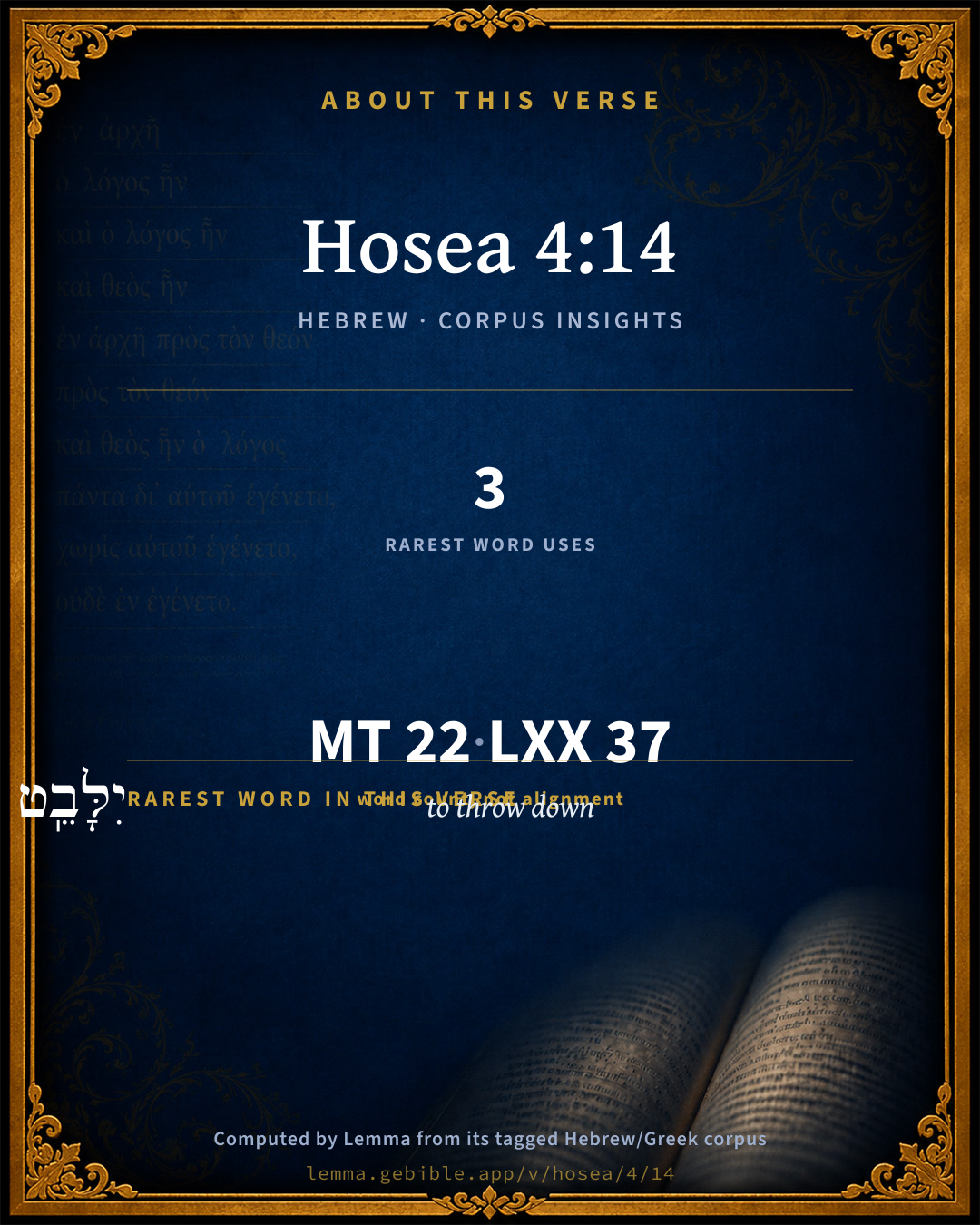
22
words
16
distinct lemmas
Prophets
section

Notable vocabulary

The rarest word here is יִלָּבֵֽט to throw down H3832 — appearing just 3 times in the whole Hebrew Bible.

Shared distinctive vocabulary

יִלָּבֵֽט to throw down H3832 occurs in 3 verses of the Hebrew Bible. Also found in:

Grammatical profile

  • 8 verbs
  • 3 nouns
  • 1 adjective
  • 1 pronoun
  • 4 prepositions
  • 3 conjunctions
  • 2 particles

Verb forms

  • אֶפְק֨וֹד Qal · Imperfect
  • תִזְנֶ֗ינָה Qal · Imperfect
  • תְנָאַ֔פְנָה Piel · Imperfect
  • הַזֹּנ֣וֹת Qal · Participle Active
  • יְפָרֵ֔דוּ Piel · Imperfect
  • יְזַבֵּ֑חוּ Piel · Imperfect
  • יָבִ֖ין Qal · Imperfect
  • יִלָּבֵֽט Niphal · Imperfect

Repetition

Words recur within this verse — often emphatic in Hebrew:

  • עַל upon H5921 ×2
  • תִזְנֶ֗ינָה to commit fornication H2181 ×2
  • כִּ֣י that H3588 ×3
  • לֹֽא not H3808 ×2
  • עִם with H5973 ×2

Hebrew & Septuagint length

In English translation the verse runs 42 words from the Hebrew and 44 from the Septuagint (LXX English) — closely comparable.

A rough comparison of the two English renderings, which tokenize alike — not a word-level alignment.

Word counts can differ between the Hebrew and the Greek without any difference in meaning — e.g. the Hebrew direct-object marker אֵת has no separate Greek word, and Greek often adds the article ὁ.

In the original languages it is 22 Hebrew tokens and 37 Greek tokens — but the two are counted differently (Hebrew bundles its prefixes and suffixes into one token; the Greek is in lemma form), so that isn’t a like-for-like length.

Cross-references

18

Topical passages linked to Hosea 4:14 in the Treasury of Scripture Knowledge — connected by theme and wording, ordered by reader-vote popularity; previews shown in the World English Bible.

  • Hosea 4:1 Hear the word of Yahweh, you children of Israel; For Yahweh has a charge against the inhabitants of the land: "Indeed there is no truth, Nor goodness, Nor knowledge of God in the land.
  • 1 Corinthians 6:16 Or don't you know that he who is joined to a prostitute is one body? For, "The two," says he, "will become one flesh."
  • Ephesians 4:18 being darkened in their understanding, alienated from the life of God, because of the ignorance that is in them, because of the hardening of their hearts;
  • Deuteronomy 23:17 There shall be no prostitute of the daughters of Israel, neither shall there be a sodomite of the sons of Israel.
  • 1 Kings 14:23–24 For they also built them high places, and pillars, and Asherim, on every high hill, and under every green tree;
  • 1 Kings 15:12 He put away the sodomites out of the land, and removed all the idols that his fathers had made.
  • 2 Kings 23:7 He broke down the houses of the sodomites, that were in the house of Yahweh, where the women wove hangings for the Asherah.
  • Proverbs 28:5 Evil men don't understand justice; But those who seek Yahweh understand it fully.
  • Isaiah 1:5 Why should you be beaten more, That you revolt more and more? The whole head is sick, And the whole heart faint.
  • Isaiah 44:18–20 They don't know, neither do they consider: for he has shut their eyes, that they can't see; and their hearts, that they can't understand.
  • Isaiah 56:11 Yes, the dogs are greedy, they can never have enough; and these are shepherds who can't understand: they have all turned to their own way, each one to his gain, from every quarter.
  • Daniel 12:10 Many shall purify themselves, and make themselves white, and be refined; but the wicked shall do wickedly; and none of the wicked shall understand; but those who are wise shall understand.
  • Hosea 4:5–6 You will stumble in the day, And the prophet will also stumble with you in the night; And I will destroy your mother.
  • Hosea 4:17 Ephraim is joined to idols. Leave him alone!
  • Hosea 14:9 Who is wise, that he may understand these things? Who is prudent, that he may know them? For the ways of Yahweh are right, And the righteous walk in them; But the rebellious stumble in them.
  • John 8:43 Why don't you understand my speech? Because you can't hear my word.
  • Romans 3:11 There is no one who understands. There is no one who seeks after God.
  • Hebrews 12:8 But if you are without discipline, of which all have been made partakers, then are you illegitimate, and not children.

Cross-references courtesy of OpenBible.info (CC BY 4.0).

Hebrew and Greek witnesses Masoretic Hebrew ↔ Greek Septuagint

The same verse in the two great witnesses to the Old Testament, shown verse-for-verse.

These are two independent witnesses, not word-aligned to each other, and the Septuagint is shown in lemma (dictionary) form.

Hebrew Hosea 4:14 Masoretic · Westminster Leningrad Codex

לֹֽא אֶפְק֨וֹד עַל בְּנוֹתֵיכֶ֜ם כִּ֣י תִזְנֶ֗ינָה וְעַל כַּלּֽוֹתֵיכֶם֙ כִּ֣י תְנָאַ֔פְנָה כִּי הֵם֙ עִם הַזֹּנ֣וֹת יְפָרֵ֔דוּ וְעִם הַקְּדֵשׁ֖וֹת יְזַבֵּ֑חוּ וְעָ֥ם לֹֽא יָבִ֖ין יִלָּבֵֽט

I will not punish your daughters when they play the prostitute, Nor your brides when they commit adultery; Because the men consort with prostitutes, And they sacrifice with the shrine prostitutes; And the people that does not understand will come to ruin.

World English Bible · Public Domain

Greek LXX Hosea 4:14 Septuagint · lemma form

καί οὐ μή ἐπισκέπτω ἐπί ὁ θυγάτηρ σύ ὅταν πορνεύω καί ἐπί ὁ νύμφη σύ ὅταν μοιχεύω διότι καί αὐτός μετά ὁ πόρνη συνφύρω καί μετά ὁ τελέω θύω καί ὁ λαός ὁ συνἵημι συνπλέκω μετά πόρνη

And I will not visit upon your daughters when they shall commit fornication, nor your daughters-in-law when they shall commit adultery: for they themselves mingled themselves with harlots, and sacrificed with polluted ones, and the people that understood not entangled itself with a harlot.

LXX2012 (modern English Septuagint) · Public Domain

On this verse, John Gill's Exposition discusses the Septuagint’s reading. Read the note in Commentary ↓

Hebrew: Westminster Leningrad Codex (CC BY 4.0). Greek: Septuagint (public domain); English from LXX2012 (modern English Septuagint) (Public Domain). How the Septuagint differs from the Hebrew →

Targum (Aramaic paraphrase)

1

The Targum is the ancient Jewish Aramaic paraphrase of the Hebrew Scriptures — an interpretive translation, not the Hebrew text itself. Onkelos (literal) and Pseudo-Jonathan (expansive) render the Torah, and Jonathan the Prophets. Coverage is partial: where no permissively-licensed English translation exists for a verse, only the Aramaic is shown. This is verse-level text, not a word-by-word alignment to the Hebrew.

  1. Targum Jonathan Prophets (Joshua–Malachi)
    לָא אַסְעַר עַל בְּנָתְכוֹן אֲרֵי מְזַנְיָן וְעַל כַּלָתְכוֹן אֲרֵי מְנַיְפָן אֲרֵי אִינוּן עִם זַנְיָתָא מִסְתַּיְעָן וְעִם נַפְקַת בָּרָא אָכְלִין וְשָׁתָן וְעִם דָרָא דְלָא אִסְתַּכַּל בְּאוֹרַיְתָא הֲלָא אִתְרַטָשׁ:

    (no public-domain English translation for this verse)

    Targum Jonathan — Aramaic: “Mikraot Gedolot” (public domain). English: “Sefaria Community Translation” (CC0 1.0 (public-domain dedication)); “London "Chaldee Paraphrase," 1871” (public domain). Text via Sefaria.

Commentary

Notes on Hosea 4:14 from classic Christian and Jewish commentators (each source and its license shown beneath its notes). The classic Christian expositions comment on the surrounding passage and are grouped to its opening verse, so a note may address several verses; the Jewish commentaries on the Tanakh (Rashi and others) are per-verse, so they appear only where the commentator wrote on this verse.

Lemma curates 59 commentaries, every one of them public domain or Creative Commons licensed, each selected and text-cleaned for this edition rather than reprinted as found. About our sources →

Trapp's Complete Commentary

John Trapp

Hos 4:14 I will not punish your daughters when they commit whoredom, nor your spouses when they commit adultery: for themselves are separated with whores, and they sacrifice with harlots: therefore the people [that] doth not understand shall fall.

Ver. 14. I will not punish your daughters when they commit whoredom] q.d. I will not once foul my fingers with them, or be at pains to correct them but they shall take their swing in sin for me &c. Origen in a certain homily, quoting this Scripture, saith, Vis indignantis Dei terribilem vocem audire, &c. (Hom. 8 in Exo 20:1-26): Will you hear the terrible voice of a provoked God; hear it here, I will not punish, &c. You shall be without chastisement, for an argument that you are bastards, and not sons. Never was Jerusalem’s condition so desperate as the time when God said unto her, "My fury shall depart from thee, I will be quiet and no more angry," Eze 16:42. Feri, Domine, feri, cried Luther, Strike, Lord, strike, and spare not.

“ Ferre minora volo, ne graviora feram. ”

There is not a greater plague can befall a man than to prosper in sinful practices. Bernard calleth it misericordiam omni indignatione crudeliorem, a killing courtesy. Eze 3:20, I will lay a stumbling block before him: that is, saith Vatablus, I will prosper him in all things, and not by affliction restrain him from sin. Job surely counts it for a great favour to sorry man, that God accounts him worth melting, though it be every morning; and trying, though it be every moment, Job 7:17-18. And Jeremiah calleth for correction as a thing that he could not well be without: "Correct me, O Lord," &c.

For themselves are separated with whores] God seemeth to speak this to others by change of person: Ac si puderet ipsum cum putidis hircis verba facere, as if he were ashamed to speak any longer to such stinking goats (Rivet). Separates they were, but of the worst sort. They separated themselves with harlots, they got into byways, far from company (especially of those that know them), that they might more freely act filthiness (Auson.). But what could the heathen say, Turpe quid acturus, Te sine teste time. Shameful what he will do, fear you without witness. Conscience is a thousand witnesses: and men must not think long to lie hidden; for God will be a "swift witness against the adulterers," Mal 3:5, {See Trapp on "Mal 3:5"} and, it may be, "bring them into all evil, in the midst of the congregation and assembly," Pro 5:14. {See Trapp on "Pro 5:14"} Some render it, they beget bastards, such as the mule is (which also hath his name pered, from this root, yithparedu). Or they shall be unfruitful as the mule. Wantonness is commonly punished with want of children. {See Trapp on "Hos 4:10"} Those children that they had took after them, it appeareth here, they were naught by kind, as being an adulterous generation, a seed of evildoers, a race of rebels; and therefore it was no matter how little they multiplied. Let those that have children, and others under their charge, keep home as much as may be; and not be separate from their families (with whores especially), lest their daughters meanwhile commit whoredom (counted but a trick of youth, a sin that that slippery age may easily slip into, and not easily be descried, Pro 30:19), and their spouses commit adultery, by occasion of their lewd absence, and to cry quittance with them at home. Let them also make Nebuchadnezzar’s law, that none under their roof say or do aught "against the God of heaven," Dan 3:29; and themselves be first in the practice of it, as so many living laws, walking statutes; so may they hope to keep their houses chaste and honest, and provide for the credit and comfort both of themselves and of theirs.

And they sacrifice with harlots] Heb. Holy harlots, sacrificing harlots, such as Solomon speaketh of, Pro 7:14, and as those wicked women that lay with Eli’s sons at the door of the tabernacle, 1Sa 2:22. Or as King Edward IV’s holy whore, as he used to call her, that came to him out of a nunnery, when he wished to send for her (Speed). His kinsman, Louis XI of France (knowing his disposition), invited him to the court, promising him his choice of beauties there, and adhibebimus tibi Cardinalem Burbonium, then shall Cardinal Bourbon impose penance on you, and absolve you of all your misdoings (Comin.) It is well enough known what foul work the heathens made at their sacra Eleusinia, Bacchanalia, Lupercalia, Priapdia (the same with the sacrificing to Baal Peor, as Jerome holds). And to these this text may seem to refer; and this people too have separated themselves to that shame.

Therefore the people that doth not understand shall fall] Heb. shall be beaten, as some render it, shall be perplexed, and troubled, so as they know not what to do, or how to help themselves, as Aben Ezra from the Arabic. The Chaldee interprets it collidetur, shall be dashed in pieces. Ignorance is much instanced and threatened in this chapter, three or four different times at least. Not because men sin only by ignorance, as the Platonists think, Omnis peccans est ignorans; but, 1. To aggravate the hatefulness of this: sin, which men use so to excuse and extenuate; 2. To taunt and abase the rebellious nature of man, who now is set in gross ignorance, and ready to pitch headlong into hell, as the just reward of his aspiring and reaching after forbidden knowledge; 3. Because ignorance (affected especially) is the source of many sins, and a main support of Satan’s kingdom. {See Trapp on "Hos 4:1"} {See Trapp on "Hos 4:6"} &c.

John Trapp, A Commentary or Exposition upon All the Books of the Old and New Testament (1647–1656) — public domain. Text from a community e-Sword module.

Joseph Benson's Commentary

Hos 4:14. I will not punish your daughters, &c. — I will suffer your daughters to go on in their iniquity, and to fall from one degree of wickedness to another. For themselves — That is, for yourselves; are separated with whores — That is, you go aside and retire with the women who prostitute themselves in the groves, or in the precincts of the idolatrous temples. And sacrifice with harlots — Hebrew, עם הקדשׁות, with women set apart, or consecrated to prostitution. The meaning is, that the people partook in those rites of idolatrous worship in which prostitution made a stated part of the religious festivity. Such lewd practices were frequent in the heathen temples dedicated to Venus and other impure deities. The expressions seem to allude to the practice mentioned Bar 6:43, and minutely described by Herodotus, lib. 1. cap. 199. Therefore the people that doth not understand shall fall — Hebrew, ילבשׂ, shall be thrown down, prostrated, dashed to the ground, or beaten, as the Vulgate renders it.

Joseph Benson's Commentary on the Old and New Testaments (1811–1818) — public domain. Text from a community e-Sword module.

Tyndale Open Study Notes

Tyndale Open Resources

4:14 God declared that he would not single out the young women for their prostitution. This declaration contrasts with double standards that were common in ancient cultures. • shrine prostitutes: The Hebrew word refers to female prostitutes who were dedicated to the service of Baal and Asherah in the temples of Baal (Deut 23:18).

Tyndale Open Study Notes — © Tyndale Open Resources, licensed CC BY-SA 4.0. Text via the HelloAO Bible API.

Geneva Bible (1599)

Geneva Bible translators

I will not correct your shame to bring you to amendment, but let you run headlong to your own damnation.

Geneva Bible (1599) marginal notes — public domain. Text via Bolls.life.

Jamieson, Fausset & Brown

Robert Jamieson, A. R. Fausset & David Brown

I will not punish . . . daughters--I will visit with the heaviest punishments "not" the unchaste "daughters and spouses," but the fathers and husbands; for it is these who "themselves" have set the bad example, so that as compared with the punishment of the latter, that of the former shall seem as nothing [MUNSTER].

separated with whores--withdrawn from the assembly of worshippers to some receptacle of impurity for carnal connection with whores.

sacrifice with harlots--They commit lewdness with women who devote their persons to be violated in honor of Astarte. (So the Hebrew for "harlots" means, as distinguished from "whores"). Compare Num 25:1-3; and the prohibition, Deu 23:18.

not understand-- (Isa 44:18; Isa 45:20).

shall fall--shall be cast down.

Jamieson, Fausset & Brown — Commentary Critical and Explanatory on the Whole Bible (1871) — public domain (CC PDM 1.0). Text via the HelloAO Bible API.

Adam Clarke's Commentary

Verse 14. I will not punish] Why should you be stricken any more; ye will revolt more and more. When God, in judgment, removes his judgments, the case of that people is desperate. While there is hope, there is correction.

Themselves are separated] There is a reference here to certain debaucheries which should not be described. The state of the people at this time must have been abominable beyond all precedent; animal, sensual, bestial, diabolical: women consecrating themselves to serve their idols by public prostitution; boys dismembered like the Galli or priests of Cybele, men and women acting unnaturally; and all conjoining to act diabolically.

Adam Clarke's Commentary on the Bible (1810–1826) — public domain. Text from a community e-Sword/MySword module.

John Calvin's Commentaries

He then who worships not God, shall have at home an adulterous wife, and filthy strumpets as his daughters, boldly playing the wanton, and he shall have also adulterous daughters-in-law: not that the Prophet speaks only of what would take place; but he shows that such would be the vengeance that God would take: ‘Your daughters therefore shall play the wanton, and your daughters-in-law shall be adulteresses;’ and I will not punish your daughters and your daughters-in-law; that is, “I will not correct them for their scandalous conduct; for I wish them to be exposed to infamy.” For this truth must ever stand firm,

‘Him who honors me, I will honor: and him who despises my name, I will make contemptible and ignominious,’ (1 Samuel 2:30.)

God then declares that he will not visit these crimes, because he designed in this way to punish the ungodly, by whom his own worship had been corrupted.

He says, Because they with strumpets separate themselves. Some explain this verb פדר, pered, as meaning, “They divide husbands from their wives:” but the Prophet, no doubt, means, that they separated themselves from God, in the same manner as a wife does, when she leaves her husband and gives herself up to an adulterer. The Prophet then uses the word allegorically, or at least metaphorically: and a reason is given, which they do not understand who take this passage as referring literally to adulteries; and their mistake is sufficiently proved to be so by the next clause, ‘and with strumpets they sacrifice.’ The separation then of which he speaks is this, that they sacrificed with strumpets; which they could not do without violating their faith pledged to God. We now apprehend the Prophet’s real meaning: ‘I will not punish,’ he says, ‘wantonness and adulteries in your families.’ Why? “Because I would have you to be made infamous, for ye have first played the wanton.”

But there is a change of person; and this ought to be observed: for he ought to have carried on his discourse throughout in the second person, and to have said, “Because ye have separated with strumpets, and accompany harlots;” this is the way in which he ought to have spoken: but through excess, as it were, of indignation, he makes a change in his address, ‘They,’ he says, ‘have played the wanton,’ as though he deemed them unworthy of being spoken to. They have then played the wanton with strumpets. By “strumpets”, he doubtless understands the corruptions by which God’s worship had been perverted, even through wantonness: “they sacrifice”, he says, “with strumpets”, that is, they forsake the true God, and resort to whatever pollutions they please; and this is to play the wanton, as when a husband, leaving his wife, or when a wife, leaving her husband, abandon themselves to filthy lust. But it is nothing strange or unwonted for sins to be punished by other sins. What Paul teaches ought especially to be borne in mind, that God, as the avenger of his own glory, gives men up to a reprobate mind, and suffers them to be covered with many most disgraceful things; for he cannot bear with them, when they turn his glory to shame and his truth to a lie.

He afterwards adds, And the people, not understanding, shall stumble. They who take the verb לבט, labeth, as meaning, “to be perverted,” understand it here in the sense of being “perplexed:” nor is this sense inappropriate. The people then shall not understand and be perplexed; that is, They shall not know the right way. But the word means also “to stumble,” and still oftener “to fall;” and since this is the more received sense, I am disposed to embrace it: The people then, not understanding, shall stumble

The Prophet here teaches, that the pretence of ignorance is of no weight before God, though hypocrites are wont to flee to this at last. When they find themselves without any excuse they run to this asylum, — “But I thought that I was doing right; I am deceived: but be it so, it is a pardonable mistake.” The Prophet here declares these excuses to be vain and fallacious; for the people, who understand not, shall stumble and that deservedly: for how came this ignorance to be in the people of Israel, but that they, as it has been before said, willfully closed their eyes against the light? When, therefore, men thus willfully determine to be blind, it is no wonder that the Lord delivers them up to final destruction. But if they now flatter themselves by pretending, as I have already said, a mistake, the Lord will shake off this false confidence, and does now shake it off by his word. What then ought we to do? To learn knowledge from his word; for this is our wisdom and our understanding, as Moses says, in the fourth chapter of Deuteronomy.

John Calvin's Commentaries (1540-1563) — public domain. Text from the Calvin Translation Society English edition (1840s-50s) via the Christian Classics Ethereal Library (ccel.org). Calvin's coverage is partial (roughly two-thirds of the Bible); uncommented books and verses are honest gaps, never fabricated. The 19th-century editor's footnotes and remarks are omitted so the notes are faithfully Calvin's own voice.

Ellicott's Commentary for English Readers

(14) Jehovah threatens to visit no punishment on the women for their licentiousness, because they are more sinned against than sinning.

Sacrifice with harlots.—Referring to the sensuality of the religious rites, as represented by the women (q’dçshôth) who dedicated themselves to these impurities.

A Bible Commentary for English Readers, edited by Charles John Ellicott (1878–1897) — public domain. Text from a community e-Sword module.

The Cambridge Bible for Schools and Colleges

gen. ed. J. J. S. Perowne

14. The precedence in guilt belongs to the elders who set so wicked an example.

themselves are separated with] Rather, they themselves go aside with. A change of person, instead of ‘ye yourselves.’

harlots] Rather, consecrated harlots, i.e. women who dedicate themselves, or are dedicated by others, to the service of Ashérah or of Ashtoreth, and give up their chastity in honour of the goddess. Mesha, king of Moab, says that, when he took Nebo from the Israelites, he slew the men, but spared the women in order to devote them to Ashtar-Chemosh (Moabite inscription, lines 16, 17).

sacrifice] Probably the reference is partly to the feast which followed the sacrifice (Exo_32:6).

shall fall] Rather, shall be dashed to the ground.

The Cambridge Bible for Schools and Colleges (gen. ed. J. J. S. Perowne; Cambridge University Press, 1878–1918) — public domain. Text from a community e-Sword module.

John Gill's Exposition

I will not punish your daughters when they commit whoredoms, nor your spouses when they commit adultery,.... Either not punish them at all, so that they shall go on in sin, and to a greater degree, to the disgrace and reproach of their parents and husbands; or not as yet, or not so severely in them, because it was by their example they were led into it. Jarchi's note is very impertinent, that God threatens them with the disuse of the bitter waters of jealousy. The words are by some rendered interrogatively, "shall I not punish your daughters?" &c. (r); verily I will; and not them only, but their parents and husbands too, who deserve more severe corrections:

for themselves are separated with whores, and sacrifice with harlots; they separated themselves to Baalpeor, that shameful idol, Hos 9:10, the Priapus of the Gentiles, in whose idolatrous worship many obscene rites were used; these men separated themselves from their wives, as well as from God and his worship, and from the company and conversation of men, and in private committed uncleanness with the women that attended, and with the female priests that officiated at the worship of idols; those "sanctified" ones, as the word may be rendered; and after that ate of things offered to idols with them. So the Targum,

"they associated themselves with whores, and ate and drank with harlots.''

Some versions understand the latter of catamites, or sodomitical persons, and of the wickedness practised by them in such places.

Therefore the people that doth not understand; the law, as the Targum; what is to be done, and what to be avoided; the difference between the true and false religion; have no knowledge of divine and spiritual things, at least are very wavering and unsettled in their minds about religion, having thought little, and know less, of the matter:

shall fall: into idolatry and adultery, led by such examples. So the Septuagint version, "is implicated with a whore"; or "embraces a whore", as the Syriac and Arabic versions; see Pro 7:22 or shall fall into calamities, ruin, and destruction; shall be dashed, as the Targum; so the Arabic interpreter of Mar 9:26, uses the word: though Aben Ezra and Kimchi say, that in the Arabic language it signifies to be perplexed and disturbed, so as not to know what to do (s). The first sense seems to be best, of being scandalized, offended, and stumbling and falling into sin; and which Abarbinel suggests, and it agrees with what follows concerning Judah.

(r) So Junius & Tremellius, Piscator, Schmidt. (s) Vid. R. Sol. Urbin, Ohel Moed, fol. 43. 2.

John Gill's Exposition of the Whole Bible (1746–1763) — public domain (CC PDM 1.0). Text via the HelloAO Bible API.

Albert Barnes' Notes on the Bible

I will not punish your daughters - God threatens, as the severest woe, that He will not punish their sins with the correction of a Father in this present life, but will leave the sinners, unheeded, to follow all iniquity. It is the last punishment of persevering stoners, that God leaves them to prosper in their sins and in those things which help them to sin. Hence, we are taught to pray, “O Lord, correct me, but in judgment, not in Thine anger” Jer 10:24. For since God chastiseth those whom He loveth, it follows, “if we be without chasetisement, whereof all are partakers, then are we bastards, and not sons” Heb 12:8. To be chastened severely for lesser sins, is a token of great love of God toward us; to sin on without punishment is a token of God’s extremest displeasure, and a sign of reprobation. : “Great is the offence, if, when thou hast sinned, thou art undeserving of the wrath of God.”

For themselves are separated with whores - God turns from them as unworthy to be spoken to anymore, and speaks of them, They “separate themselves,” from whom? and with whom? They separate themselves “from” God, and with the degraded ones and “with” devils. Yet so do all those who choose willful sin.

And they sacrifice - (continually, as before) with (the) harlots The unhappy women here spoken of were such as were “consecrated” (as their name imports) to their vile gods and goddesses, and to prostitution. This dreadful consecration, yea desecration, whereby they were taught to seek honor in their disgrace, was spread in different forms over Phoenicia, Syria, Phrygia, Assyria, Babylonia. Ashtaroth, (the Greek Astarte) was its chief object. This horrible worship prevailed in Midian, when Israel was entering the promised land, and it suggested the devilish device of Balaam Num. 25; Num 31:8, Num 31:16 to entangle Israel in sin whereby they might forfeit the favor of God. The like is said to subsist to this day in pagan India. The sin was both the cause and effect of the superstition. Man’s corrupt heart gave rise to the worship: and the worship in turn fostered the corruption. He first sanctioned the sin by aid of a degrading worship of nature, and then committed it under plea of that worship. He made his sin a law to him. Women, who never relapsed into the sin, sinned in obedience to the dreadful law . Blinded as they were, individual pagan had the excuse of their hereditary blindness; the Jews had imperfect grace. The sins of Christians are self sought, against light and grace.

Therefore the people that doth not understand shall fall - The word comprises both, “that doth not understand,” and, “that will not understand.” They might have understood, if they would. God had revealed Himself to them, and had given to them His law, and was still sending to them His prophets, so that they could not have known and understood God’s will, had they willed. Ignorance, which we might avoid or cure, if we would, is itself a sin. It cannot excuse sin. They shall, he says, fall, “or be cast headlong.” Those who blind their eyes, so as not to see or understand God’s will, bring themselves to sudden ruin, which hide from themselves, until they fall headlong in it.

Albert Barnes' Notes on the Bible (1834–1885) — public domain. Text from a community e-Sword/MySword module.

Haydock's Catholic Bible Commentary

Visit. This is the most dreadful of God’s judgments. He permits those who offend him to receive discontent from their own families. --- Effeminate, like the Galli, &c., (St. Jerome) and votaries of Priapus, 3 Kings xv. 11. Hebrew, "the consecrated women." Septuagint, "initiated," to honour a lewd idol by prostitution. (Calmet) --- Beaten. Septuagint, "adhere to a harlot. But thou, Israel, be not ignorant, and Juda go," &c. (Haydock)

George Leo Haydock (1774–1849), Haydock's Catholic Family Bible and Commentary, 1859 edition — public domain. Excludes Psalms (Douay-Rheims chapter numbering differs from Protestant) and Deuterocanonical books (Catholic canon only).

Matthew Poole's English Annotations

I will not punish, or visit upon,

your daughters; God will not any more lay on them such restraints, as remarkable punishments are usually to all that observe them. They are threatened thus to be thrown up to their own hearts’ and others’ lusts. You have rejected my law which directed the correction and punishment of such sins, and do you think I will by extraordinary courses restrain, where you cast off the ordinary? You shall have no bitter water of jealousy to discover, convict, and torment an adulterous wife, as Judah hath, Num 5:12, &c., nor will I by unusual strokes of my hand smite them. This impunity will in. crease your grief and shame, and so you shall be punished.

Themselves, the husbands and fathers, are examples to wives and daughters; those are

separated with the lewd women, which either they took to them upon putting away their lawful wife, which these men did to satisfy their lusts; or else separated, i.e. withdrawn from the company or their fellow idolaters, that in privacy they might commit whoredom with the women they choose to themselves for that end.

They sacrifice with harlots; perform the rites of sacrifices, both in offering first and in feasting next, in which feasts wine and women would prove great and prevalent temptations to whoredom among those men.

Therefore the people that doth not understand: by all this it is evident this people is a sottish, ignorant people, that know not God, as Hos 4:1,6,11.

Shall fall; be utterly ruined, broken into pieces, and scattered; broken at home first by intestine wars, next by foreign invasions, and carried away at last by conquering enemies.

Matthew Poole's English Annotations on the Holy Bible (1683–1685) — public domain. Text from a community e-Sword/MySword module.

Whedon's Commentary on the Bible

Daniel D. Whedon

14. Their shameful acts cannot be justified, but Jehovah knows that the chief fault is not with them; therefore the heaviest punishment will not fall upon the daughters and wives, but upon those leading them astray by their wicked example. Themselves [“they”] — The fathers and husbands. Harlots [“prostitutes”] — Literally, the consecrated ones (Deu_23:17-18); that is, women who are consecrated or consecrate themselves to a life of shame in honor of the deity. (See article “Harlot” in Hastings’s Dictionary of the Bible.) On the solemn occasion of sacrifice licentiousness is permitted to have full sway. The rest of the verse is, according to the English translations, an announcement of judgment; because of their corrupt condition the unthinking people shall be overthrown. It is preferable, however, to regard the words as expressing the result of the wickedness of the fathers and husbands, who would be looked upon as leaders; “And so the people that does not consider goes to its ruin.”

That doth not understand — Those who do not think for themselves. Daughters are apt to imitate the fathers, wives the husbands.

Shall fall — Or, go to ruin. Not through a judgment to come; their present immoralities are their ruin.

Daniel D. Whedon (gen. ed.), Commentary on the Old and New Testaments (1874–1909) — public domain. Text from a community e-Sword module.

The Pulpit Commentary

I will not punish your daughters when they commit whoredom, nor your spouses when they commit adultery. The spiritual adultery of parents and husbands would be punished by the carnal adultery of daughters and wives; sin would thus be punished by sin. Their own dishonor and disgrace, through the unfaithfulness of persons so near to them, would impress them with a sense of the dishonor done to God, the spiritual Husband of his people; their feeling of pain and shame in consequence would convey to them a clearer notion of the abhorrence which their offences had occasioned to God. But their punishment would become more severe, and their pain intensified by the Divine refusal to avenge them by punishing the lewdness that caused such dishonor. While punishment would prevent the sin and consequent reproach, impunity, or the postponement of punishment, would leave the offenders to go on in their course of sin and shame. Aben Ezra comments on this fourteenth verse as follows: "The sense is It is not to be wondered at if the daughters commit whoredom; for they themselves, when they go up to the tops of the mountains to burn in-cerise, eat and drink with harlots and commit whoredom all of them. And, behold, the sense is, not that he shall not punish them at all, but he speaks in regard to, i.e. in comparison with, the fathers; for they teach them to commit whoredom doing according to their works. Perhaps the daughters are still little, therefore I shall not punish." Rashi thinks that this threatening refers to the disuse of the bitter waters of jealousy, so that suspected guilt could not be detected. But there is nothing to intimate such a reference; nor would it be in keeping with the scope of the passage. Again, some, as in the margin of the Authorized Version, read the words, not indicatively, but interrogatively I not punish," etc.? This would require such a meaning to be read into the passage as the following: "Assuredly I shall punish them; and not the daughters and daughters-in-law only, but the parents and husbands still more severely, because of their greater criminality." Equally unsatisfactory is the explanation of Theodoret, who, taking dqp in a good sense, which it has with the accusative, understands it of God"s refusing any protection or preservation of their daughters and spouses from outrage at the hands of a hostile soldiery, so that such sins as they themselves had been guilty in private, would be committed with the females of their family in public. For they themselves are separated with whores, and they sacrifice with harlots. The change of person appears to imply that God turns away with inexpressible disgust from such vileness, and, turning aside to a third party, explains the grounds of his procedure. The Qedesheth were females who devoted themselves to licentiousness in the service of Ashtaroth, the Sidonian Venus. Persons of this description were attached to idol temples and idolatrous worship in heathen lands in ancient times, as in India at the present time. The "Speaker"s Commentary" calls them "devotee-harlots," and cites an allusion to the custom from the Moabite Stone, as follows: "I did not kill the women and maidens, for I devoted them to Ashtarkemosh." After stating the humiliating fact that fathers and husbands in Israel, instead of uniting with their wives in the worship of Jehovah, separated themselves, going aside with these female idolaters for the purpose of lewdness, and shared in their sacrificial feasts, the prophet, or rather God by the prophet, impatient of the recital of such shameless licentiousness, and indignant at such presumptuous sinning, closes abruptly with the declaration of the recklessness, and denunciation of the ruin of all such offenders, in the wordsthe people that doth not understand shall fall; margin, be punished; rather, dashed to the ground, or plunge into ruin (nilbat). Both Aben Ezra and Kimchi give from the Arabic, as an alternative sense of silbat, to fall into error.

The Pulpit Commentary (1880–1919), ed. H.D.M. Spence-Jones & Joseph S. Exell — public domain. Text from a community e-Sword module.

John Wesley's Explanatory Notes

Nor your spouses - I will give them up to their own hearts. For themselves - The husband and fathers are examples to their wives and daughters. Therefore the people - The sottish ignorant people, that know not God. Shall fall - Be utterly ruined.

John Wesley, Explanatory Notes Upon the Whole Bible (1754–1765) — public domain. Text via the GEBible commentary corpus.

Keil & Delitzsch

C. F. Keil & F. Delitzsch

"I will not visit it upon your daughters that they commit whoredom, nor upon your daughters-in-law that they commit adultery; for they themselves go aside with harlots, and with holy maidens do they sacrifice: and the nation that does not see is ruined." God would not punish the daughters and daughters-in-law for their whoredom, because the elder ones did still worse. "So great was the number of fornications, that all punishment ceased, in despair of any amendment" (Jerome). With כּי הם God turns away from the reckless nation, as unworthy of being further addressed or exhorted, in righteous indignation at such presumptuous sinning, and proceed to speak about it in the third person: for "they (the fathers and husbands, not 'the priest,' as Simson supposes, since there is no allusion to them here) go," etc. פּרד, piel in an intransitive sense, to separate one's self, to go aside for the purpose of being alone with the harlots. Sacrificing with the qedēshōth, i.e., with prostitutes, or Hetairai (see at Gen 38:14), may have taken its rise in the prevailing custom, viz., that fathers of families came with their wives to offer yearly sacrifices, and the wives shared in the sacrificial meals (Sa1 1:3.). Coming to the altar with Hetairai instead of their own wives, was the climax of shameless licentiousness. A nation that had sunk so low and had lost all perception must perish. לבט = Arab. lbṭ: to throw to the earth; or in the niphal, to cast headlong into destruction (Pro 10:8, Pro 10:10).

Keil & Delitzsch — Biblical Commentary on the Old Testament (1861–1891) — public domain (CC PDM 1.0). Text via the HelloAO Bible API. (Old Testament only.)

Rashi

Rabbi Shlomo Yitzchaki (Rashi)

I will not punish your daughters anymore, to test them with the ‘bitter waters’ should they commit adultery. Why? Because their husbands join with harlots; for once the man is not free of sin, the waters do not test his wife. [based on Sifrei Num. 5:82 and Sotah 47a]

join Heb. יִפָרֵדוּ. Jonathan translates מִסְתַייעָן from סִיעָה, ‘a company,’ that is, they join with them (the harlots) in drinking wine. Now Menahem [Machbereth Menahem p. 145] connects it with עָבְשוּ פְרוּדוֹת “the wine barrels decay” (of Joel 1:17) where they (פְרוּדוֹת) are wine barrels.

the people that does not understand shall be knocked about Because you do not set your heart to comprehend, therefore you shall be knocked about, struck with (divine) visitation: יִלָּבֵט is an expression of road weariness and toilsome burden, ‘dיlaser’ in old French.

Rashi on the Tanakh — English translations: “The Judaica Press complete Tanach with Rashi, translated by A. J. Rosenberg” (CC BY 4.0); “Pentateuch with Rashi's commentary by M. Rosenbaum and A.M. Silbermann, 1929-1934” (public domain); “The Metsudah Tanach series, Lakewood, N.J” (CC BY 4.0); and “The Book of Joshua, Metsudah Publications, 1997” (CC BY 4.0). Text via Sefaria.

Lesson kit

Teaching starters — assembled from the data on this page, not authored interpretation. Every prompt links to the verse data it draws on. Edit before teaching.

Hosea, in the Prophets, opens this verse with 22 words (16 distinct Hebrew lemmas). Its most distinctive word is lâbaṭ (“to throw down”). A historical commentator’s framing appears above. Read the whole chapter for the surrounding context.

Discussion questions

  1. How does “to throw down” (lâbaṭ) shape what this verse is saying?
  2. How does Proverbs 10:8, which shares the word «to throw down», read alongside this verse?
  3. What does the repetition of “upon” (2× in this one verse) do in this verse?
  4. The translations on this page render this verse differently — a whole-verse word diff, not a word-by-word alignment. What might account for the different wordings?
  5. «אֶפְק֨וֹד» is a Qal Imperfect verb. How does that grammatical form shape the action described?
  6. Compare how Trapp's Complete Commentary and Joseph Benson's Commentary read this verse. Where do they agree or differ?

Things to notice

Reading settings

Reading text

Shown beneath each verse's original-language words.

Old Testament
Old Testament edition

Read the OT as the Masoretic Hebrew (MT) or the Greek Septuagint (LXX).

English shown for the Greek Septuagint (in the Hebrew ↔ Greek comparison).

Comparing translations? Open the Compare panel on any verse page to stack up to four side by side.