
1 Samuel 19:20

Hebrew (Westminster Leningrad Codex) 1 Samuel 19:20 appears in the Hebrew Old Testament. The text above is from the Westminster Leningrad Codex. Each word links to its Strong’s number, a concise gloss, and parsing drawn from the Open Scriptures Hebrew Bible morphology. Click any word for its full Brown-Driver-Briggs (BDB) entry.
Download image
Cite this verse

1 Samuel 19:20 (World English Bible). Public Domain. Lemma interlinear Bible study tool, https://lemma.gebible.app/v/1-samuel/19/20.

Show BibTeX & RIS
BibTeX
RIS
English Translation
Saul sent messengers to take David: and when they saw the company of the prophets prophesying, and Samuel standing as head over them, the Spirit of God came on the messengers of Saul, and they also prophesied.
World English Bible · Public Domain
Highlights
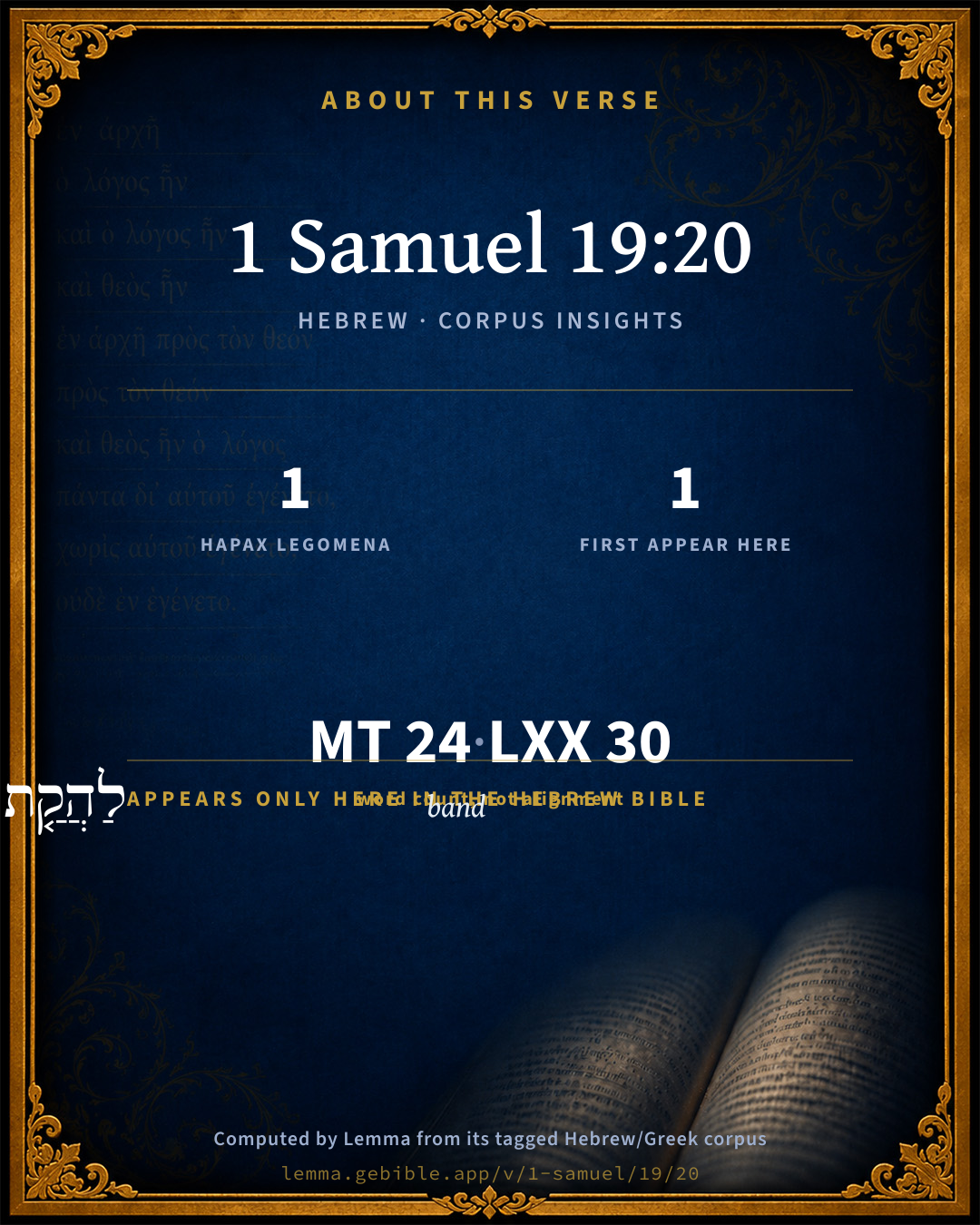
  • 1 hapax legomenon — only here in the Hebrew Bible
  • 1 first appearance in the Hebrew Bible
Full analysis ↓
Download a study sheet

One document with this verse’s original text, its word-by-word gloss line, the meaning frame, cross-references with their text, attributed commentary, and full source and license credits — printable, and it pastes into notes with its structure intact.

This verse Autodidact and up

Study sheet (.html) Plain text (.txt)

A passage Seminary Student

Up to 50 verses in one chapter. A passage sheet keeps up to 6 commentary sources and 12 cross-references per verse, in the order this page ranks them, and says so on the sheet whenever that leaves anything out. Ask for a single verse and you get the Autodidact verse sheet above.

Everything on this page stays free to read, with no account — the sheet is a download of what is already on screen, not access to it.

Want to remove ads? Support Godless Engineer
Compare translations 3

The same verse in 3 English versions, stacked beneath the original-language interlinear above. Click any original word for its lexicon entry.

Each is an independent rendering of the whole verse — the interlinear is not word-aligned to these translations.

Highlighted words mark where these versions differ — a whole-verse word diff, not a word-by-word alignment.

  • World English Bible Public Domain
    Saul sent messengers to take David: and when they saw the company of the prophets prophesying, and Samuel standing as head over them, the Spirit of God came on the messengers of Saul, and they also prophesied.
  • King James Version Public Domain
    And Saul sent messengers to take David: and when they saw the company of the prophets prophesying, and Samuel standing as appointed over them, the Spirit of God was upon the messengers of Saul, and they also prophesied.
  • unfoldingWord Literal Text CC BY-SA 4.0
    And Saul sent messengers to take David. And one saw a group of prophets prophesying, and Samuel was standing, having stationed himself over them. And the Spirit of God came upon the messengers of Saul, and they also prophesied.

unfoldingWord Literal Text — © unfoldingWord, licensed CC BY-SA 4.0. Word-aligned USFM3 via Door43 (git.door43.org/unfoldingWord/en_ult).

Versions to compare (up to 4)

3 of 4 selected

Show all 18 translations

Every available English version of this verse, each an independent rendering of the whole verse.

  • World English Bible Public Domain
    Saul sent messengers to take David: and when they saw the company of the prophets prophesying, and Samuel standing as head over them, the Spirit of God came on the messengers of Saul, and they also prophesied.
  • Berean Standard Bible Public Domain
    he sent messengers to capture him. But when they saw the group of prophets prophesying, with Samuel leading them, the Spirit of God came upon them, and Saul’s messengers also began to prophesy.
  • Majority Standard Bible Public Domain
    he sent messengers to seize him. But when they saw the group of prophets prophesying, with Samuel leading them, the Spirit of God came upon them, and Saul’s messengers also began to prophesy.
  • King James Version Public Domain
    And Saul sent messengers to take David: and when they saw the company of the prophets prophesying, and Samuel standing as appointed over them, the Spirit of God was upon the messengers of Saul, and they also prophesied.
  • American Standard Version (1901) Public Domain
    And Saul sent messengers to take David: and when they saw the company of the prophets prophesying, and Samuel standing as head over them, the Spirit of God came upon the messengers of Saul, and they also prophesied.
  • Revised Version (1885) Public Domain
    And Saul sent messengers to take David: and when they saw the company of the prophets prophesying, and Samuel standing as head over them, the spirit of God came upon the messengers of Saul, and they also prophesied;
  • Geneva Bible (1599) Public Domain
    And Saul sent messengers to take Dauid: and when they sawe a company of Prophets prophecying, and Samuel standing as appoynted ouer them, the Spirit of God fell vpon the messengers of Saul, and they also prophecied.
  • Douay-Rheims (1899) Public Domain
    So Saul sent officers to take David: and when they saw a company of prophets prophesying, and Samuel presiding over them, the spirit of the Lord came also upon them, and they likewise began to prophesy.
  • Young's Literal Translation Public Domain
    And Saul sendeth messengers to take David, and they see the assembly of the prophets prophesying, and Samuel standing, set over them, and the Spirit of God is on Saul's messengers, and they prophesy -- they also.
  • Literal Standard Version CC BY-SA 4.0
    And Saul sends messengers to take David, and they see the assembly of the prophets prophesying, and Samuel standing, set over them, and the Spirit of God is on Saul’s messengers, and they prophesy—they also.
  • Unlocked Literal Bible CC BY-SA 4.0
    Then Saul sent messengers to capture David. When they saw the company of the prophets prophesying, and Samuel standing as head over them, the Spirit of God came on the messengers of Saul, and they also prophesied.
  • unfoldingWord Literal Text CC BY-SA 4.0
    And Saul sent messengers to take David. And one saw a group of prophets prophesying, and Samuel was standing, having stationed himself over them. And the Spirit of God came upon the messengers of Saul, and they also prophesied.
  • Darby Bible Public Domain
    Then Saul sent messengers to take David; and they saw a company of prophets prophesying, and Samuel standing as president over them; and the Spirit of God came upon the messengers of Saul, and they also prophesied.
  • World Messianic Bible Public Domain
    Saul sent messengers to seize David; and when they saw the company of the prophets prophesying, and Samuel standing as head over them, God’s Spirit came on Saul’s messengers, and they also prophesied.
  • Webster's Bible Public Domain
    And Saul sent messengers to take David: and when they saw the company of the prophets prophesying, and Samuel standing as appointed over them, the Spirit of God was upon the messengers of Saul, and they also prophesied.
  • Free Bible Version CC BY-SA 4.0
    he sent messengers to arrest him. But when they saw a group of prophets prophesying with Samuel leading out, the Spirit of God came on Saul's messengers and they started prophesying too.
  • Bible in Basic English Public Domain
    And Saul sent men to take David; and when they saw the band of prophets at work, with Samuel in his place at their head, the spirit of God came on Saul's men, and they became like prophets.
  • JPS Tanakh (1917) Public Domain
    And Saul sent messengers to take David; and when they saw the company of the prophets prophesying, and Samuel standing as head over them, the spirit of God came upon the messengers of Saul, and they also prophesied.

Literal Standard Version (2020), Covenant Press — licensed CC BY-SA 4.0. Text via the HelloAO Bible API (eBible.org). Unlocked Literal Bible (unfoldingWord) — licensed CC BY-SA 4.0. Text via the HelloAO Bible API (eBible.org). unfoldingWord Literal Text — © unfoldingWord, licensed CC BY-SA 4.0. Word-aligned USFM3 via Door43 (git.door43.org/unfoldingWord/en_ult). Free Bible Version, Dr. Jonathan Gallagher — licensed CC BY-SA 4.0. Text via the HelloAO Bible API (eBible.org).

Word by word

More ways to search: Search by grammar → Find every occurrence → Compare this word →

Practice this passage: Drill this verse → Learn its vocabulary →

לַהֲקַ֤ת
lahăqâh
H3862
“band of”
Noun, Common, Feminine, Singular, Construct
Part of Speech
Noun
Type
Common
Gender
Feminine
Number
Singular
State
Construct
Full BDB Definition

Origin: probably from an unused root meaning to gather

TWOT: 1084

company, group, band
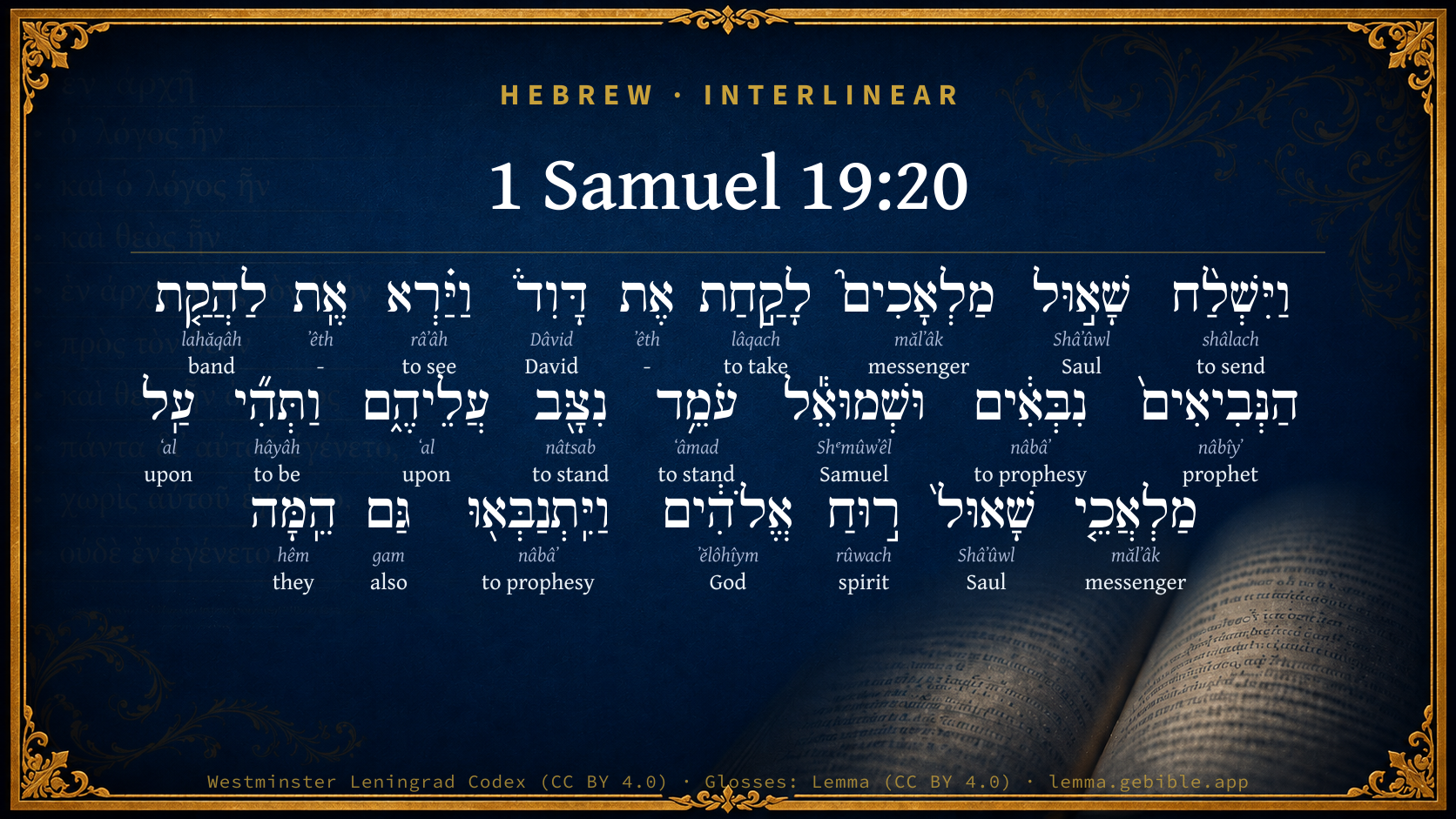
  1. וַיִּשְׁלַ֨ח shâlach H7971 “and · to send” Conjunction + Verb, Qal, Sequential Imperfect, 3rd Person, Masculine, Singular
  2. שָׁא֣וּל Shâʼûwl H7586 “Saul” Noun, Proper
  3. מַלְאָכִים֮ mălʼâk H4397 “messengers” Noun, Common, Masculine, Plural, Absolute
  4. לָקַ֣חַת lâqach H3947 “to take” Preposition + Verb, Qal, Infinitive Construct
  5. אֶת ʼêth H853 “-” Particle, Direct Object
  6. דָּוִד֒ Dâvid H1732 “David” Noun, Proper
  7. וַיַּ֗רְא râʼâh H7200 “and · to see” Conjunction + Verb, Qal, Sequential Imperfect, 3rd Person, Masculine, Singular
  8. אֶֽת ʼêth H853 “-” Particle, Direct Object
  9. הַנְּבִיאִים֙ nâbîyʼ H5030 “the · prophets” Particle, Definite Article + Noun, Common, Masculine, Plural, Absolute
  10. נִבְּאִ֔ים nâbâʼ H5012 “prophesying” Verb, Niphal, Participle Active, Masculine, Plural, Absolute
  11. וּשְׁמוּאֵ֕ל Shᵉmûwʼêl H8050 “and · Samuel” Conjunction + Noun, Proper
  12. עֹמֵ֥ד ʻâmad H5975 “standing” Verb, Qal, Participle Active, Masculine, Singular, Absolute
  13. נִצָּ֖ב nâtsab H5324 “standing” Verb, Niphal, Participle Active, Masculine, Singular, Absolute
  14. עֲלֵיהֶ֑ם ʻal H5921 “upon · them” Preposition + Suffix, Personal, 3rd Person, Masculine, Plural
  15. וַתְּהִ֞י hâyâh H1961 “and · to be” Conjunction + Verb, Qal, Sequential Imperfect, 3rd Person, Feminine, Singular
  16. עַֽל ʻal H5921 “upon” Preposition
  17. מַלְאֲכֵ֤י mălʼâk H4397 “messengers of” Noun, Common, Masculine, Plural, Construct
  18. שָׁאוּל֙ Shâʼûwl H7586 “Saul” Noun, Proper
  19. ר֣וּחַ rûwach H7307 “spirit of” Noun, Common, Both, Singular, Construct
  20. אֱלֹהִ֔ים ʼĕlôhîym H430 “God(s)” Noun, Common, Masculine, Plural, Absolute
  21. וַיִּֽתְנַבְּא֖וּ nâbâʼ H5012 “and · to prophesy” Conjunction + Verb, Hithpael, Sequential Imperfect, 3rd Person, Masculine, Plural
  22. גַּם gam H1571 “also” Particle, Accusative
  23. הֵֽמָּה hêm H1992 “they” Pronoun, Personal, 3rd Person, Masculine, Plural

About this verse

These counts appear in no published source. They are computed here, from the morphology-tagged text and Lemma’s own curated glosses. What Lemma adds →

24
words
19
distinct lemmas
Historical
section

Notable vocabulary

1 hapax legomenon — a word that appears only here in the entire Hebrew Bible:

  • לַהֲקַ֤ת band H3862

First appearance in Scripture

This word makes its first canonical appearance in the Hebrew Bible here:

  • לַהֲקַ֤ת band H3862

Grammatical profile

  • 8 verbs
  • 10 nouns
  • 1 pronoun
  • 2 prepositions
  • 3 particles

Verb forms

  • וַיִּשְׁלַ֨ח Qal · Sequential Imperfect
  • לָקַ֣חַת Qal · Infinitive Construct
  • וַיַּ֗רְא Qal · Sequential Imperfect
  • נִבְּאִ֔ים Niphal · Participle Active
  • עֹמֵ֥ד Qal · Participle Active
  • נִצָּ֖ב Niphal · Participle Active
  • וַתְּהִ֞י Qal · Sequential Imperfect
  • וַיִּֽתְנַבְּא֖וּ Hithpael · Sequential Imperfect

Repetition

Words recur within this verse — often emphatic in Hebrew:

  • שָׁא֣וּל Saul H7586 ×2
  • מַלְאָכִים֮ messenger H4397 ×2
  • נִבְּאִ֔ים to prophesy H5012 ×2
  • עֲלֵיהֶ֑ם upon H5921 ×2

Hebrew & Septuagint length

In English translation the verse runs 37 words from the Hebrew and 36 from the Septuagint (LXX English) — closely comparable.

A rough comparison of the two English renderings, which tokenize alike — not a word-level alignment.

Word counts can differ between the Hebrew and the Greek without any difference in meaning — e.g. the Hebrew direct-object marker אֵת has no separate Greek word, and Greek often adds the article ὁ.

In the original languages it is 24 Hebrew tokens and 30 Greek tokens — but the two are counted differently (Hebrew bundles its prefixes and suffixes into one token; the Greek is in lemma form), so that isn’t a like-for-like length.

Cross-references

10

Topical passages linked to 1 Samuel 19:20 in the Treasury of Scripture Knowledge — connected by theme and wording, ordered by reader-vote popularity; previews shown in the World English Bible.

  • Joel 2:28 "It will happen afterward, that I will pour out my Spirit on all flesh; And your sons and your daughters will prophesy. Your old men will dream dreams. Your young men will see visions.
  • 1 Samuel 10:5–6 After that you shall come to the hill of God, where is the garrison of the Philistines: and it shall happen, when you are come there to the city, that you shall meet a band of prophets coming down from the high place with a psaltery, and a tambourine, and a pipe, and a harp, before them; and they will be prophesying:
  • John 7:32 The Pharisees heard the multitude murmuring these things concerning him, and the chief priests and the Pharisees sent officers to arrest him.
  • 1 Samuel 10:10 When they came there to the hill, behold, a band of prophets met him; and the Spirit of God came mightily on him, and he prophesied among them.
  • 1 Corinthians 14:24–25 But if all prophesy, and someone unbelieving or unlearned comes in, he is reproved by all, and he is judged by all.
  • 1 Samuel 19:11 Saul sent messengers to David's house, to watch him, and to kill him in the morning: and Michal, David's wife, told him, saying, If you don't save your life tonight, tomorrow you will be slain.
  • 1 Samuel 19:14 When Saul sent messengers to take David, she said, He is sick.
  • 1 Corinthians 14:3 But he who prophesies speaks to men for their edification, exhortation, and consolation.
  • Numbers 11:25–26 Yahweh came down in the cloud, and spoke to him, and took of the Spirit that was on him, and put it on the seventy elders: and it happened that when the Spirit rested on them, they prophesied, but they did so no more.
  • John 7:45–52 The officers therefore came to the chief priests and Pharisees, and they said to them, "Why didn't you bring him?"

Cross-references courtesy of OpenBible.info (CC BY 4.0).

Hebrew and Greek witnesses Masoretic Hebrew ↔ Greek Septuagint

The same verse in the two great witnesses to the Old Testament, shown verse-for-verse.

These are two independent witnesses, not word-aligned to each other, and the Septuagint is shown in lemma (dictionary) form.

Hebrew 1 Samuel 19:20 Masoretic · Westminster Leningrad Codex

וַיִּשְׁלַ֨ח שָׁא֣וּל מַלְאָכִים֮ לָקַ֣חַת אֶת דָּוִד֒ וַיַּ֗רְא אֶֽת לַהֲקַ֤ת הַנְּבִיאִים֙ נִבְּאִ֔ים וּשְׁמוּאֵ֕ל עֹמֵ֥ד נִצָּ֖ב עֲלֵיהֶ֑ם וַתְּהִ֞י עַֽל מַלְאֲכֵ֤י שָׁאוּל֙ ר֣וּחַ אֱלֹהִ֔ים וַיִּֽתְנַבְּא֖וּ גַּם הֵֽמָּה

Saul sent messengers to take David: and when they saw the company of the prophets prophesying, and Samuel standing as head over them, the Spirit of God came on the messengers of Saul, and they also prophesied.

World English Bible · Public Domain

Greek LXX 1 Samuel 19:20 Septuagint · lemma form

καί ἀποστέλλω σαούλ ἄγγελος λαμβάνω ὁ δαυίδ καί ὁράω ὁ ἐκκλησία ὁ προφήτης καί σαμουηλ ἵστημι καταἵστημι ἐπί αὐτός καί γίγνομαι ἐπί ὁ ἄγγελος ὁ σαούλ πνεῦμα θεός καί προφητεύω

And Saul sent messengers to take David, and they saw the assembly of the prophets, and Samuel stood as appointed over them; and the Spirit of God came upon the messengers of Saul, and they prophesy.

LXX2012 (modern English Septuagint) · Public Domain

Hebrew: Westminster Leningrad Codex (CC BY 4.0). Greek: Septuagint (public domain); English from LXX2012 (modern English Septuagint) (Public Domain). How the Septuagint differs from the Hebrew →

Targum (Aramaic paraphrase)

1

The Targum is the ancient Jewish Aramaic paraphrase of the Hebrew Scriptures — an interpretive translation, not the Hebrew text itself. Onkelos (literal) and Pseudo-Jonathan (expansive) render the Torah, and Jonathan the Prophets. Coverage is partial: where no permissively-licensed English translation exists for a verse, only the Aramaic is shown. This is verse-level text, not a word-by-word alignment to the Hebrew.

  1. Targum Jonathan Prophets (Joshua–Malachi)
    וּשְׁלַח שָׁאוּל אִזְגַדִין לְמִדְבַּר יַת דָוִד וַחֲזוֹ יַת סִיעַת סַפְרַיָא מְשַׁבְּחִין וּשְׁמוּאֵל קָאֵים מַלִיף עִלַוֵיהוֹן וּשְׁרַת עַל אִזְגַדֵי שָׁאוּל רוּחַ נְבוּאָה מִן קֳדָם יְיָ וְשַׁבָּחוּ אַף אִנוּן:

    (no public-domain English translation for this verse)

    Targum Jonathan — Aramaic: “Mikraot Gedolot” (public domain). English: “Sefaria Community Translation” (CC0 1.0 (public-domain dedication)); “London "Chaldee Paraphrase," 1871” (public domain). Text via Sefaria.

Commentary

Notes on 1 Samuel 19:20 from classic Christian and Jewish commentators (each source and its license shown beneath its notes). The classic Christian expositions comment on the surrounding passage and are grouped to its opening verse, so a note may address several verses; the Jewish commentaries on the Tanakh (Rashi and others) are per-verse, so they appear only where the commentator wrote on this verse.

Lemma curates 59 commentaries, every one of them public domain or Creative Commons licensed, each selected and text-cleaned for this edition rather than reprinted as found. About our sources →

Trapp's Complete Commentary

John Trapp

1Sa 19:20 And Saul sent messengers to take David: and when they saw the company of the prophets prophesying, and Samuel standing [as] appointed over them, the Spirit of God was upon the messengers of Saul, and they also prophesied.

Ver. 20. And Saul sent messengers to take David.] Contra gentes, as they say, and whosoever should say nay to it: not sparing the prophets, but if they opposed, putting them all to the sword, as he afterwards did the priests of Nob. All malice is bloody and barbarous so far as it dare show itself.

And when they saw the company of the prophets prophesying.] That is, Praising God, praying, and preaching, to the no small comfort of distressed David, who might well say, "In the multitude of my perplexed thoughts within me, thy comforts have refreshed my soul." {Psa 94:19}

And Samuel standing as appointed over them.] As their president. For though Samuel had given over the public government of the commonwealth, yet he would not live to himself, as did Sulla after that he had resigned the dictatorship: but as Cato - after that he had ridden in triumph, and so had a writ of case given him - exercised himself still for the good of the public, -

“ Ut qui toti genitum se credidit orbi. ”

So Samuel hated to be idle or unprofitable: and therefore exercised himself in his prophetical office still. So Moses when he may not in Egypt, will be doing justice in Midian: in Egypt he delivered the oppressed Israelite, in Midian the wronged daughters of Jethro. I had rather be sick in my bed than idle, saith Seneca.

And they also prophesied.] They put off their military clothes, and acted the prophets in habit and gesture, forgetting the business they came about. Disce hic quantum valeat bonorum societas, saith A. Lapide. See here the efficacy of good company: surely as the loadstone draweth iron, so spiritual exercises are able to affect the hearts and affections of others.

John Trapp, A Commentary or Exposition upon All the Books of the Old and New Testament (1647–1656) — public domain. Text from a community e-Sword module.

The Biblical Illustrator

Joseph S. Exell

1Sa_19:20

The Spirit of God was upon the messengers of Saul, and they also prophesied.

The contagious influence of faithful prophesying

The prophet of former days was, in all substantial point, identical with the preacher of these. The commission both of prophet and preacher is to set forth the Divine Oracles; to speak to their fellow sinners the word which proceedeth out of the mouth of the Lord. It is only an accidental, not an essential difference between the two, that in the case of the prophet this word is derived from immediate inspiration, while in that of the preacher it is gathered by prayerful study out of the pages of a written record. Nor, so long as the testimony borne by both is a testimony of Gods Word, does it constitute an essential difference, that in the prophets case the testimony should oftentimes be a warning of future and impending events, in the preachers an admonition of present privileges and present duties.

I. A spiritual influence exerted upon certain persons. Both the messengers of Saul and Saul himself were constrained by a strange and irresistible impulse to prophesy before Samuel. In this seizure and ecstasy of minds, previously bent on the prosecution of a hostile purpose, there was, no doubt, something miraculous, or rather, something that must not be confounded with the ordinary operations of the Holy Spirit. But yet there were circumstances in the former which may usefully remind us of the latter. Saul stripping off his royal apparel, and lying down in the very dust before Samuel--what a picture does this present to us of the sinners self-abasement, when the convicting and converting influences of the Holy Spirit first pour in upon his heart! How does he prostrate himself, in deepest humiliation of spirit, at the foot of that cross which has now become his only hope? A blessed and happy influence this, which has been exerted upon his spirit; and one, haply, no less marvellous than the impression made upon Saul of old. Of the latter, men said, Is Saul also among the prophets? The spiritual character sat strangely and unwontedly upon this furious and worldly prince. So marvellous in mens eyes was the transformation, that Saul among the prophets passed into a proverb of marvellousness. And is not the result of the Holy Spirits ordinary operations as much a marvel, in the strict and true sense of that word, as His bestowal of extraordinary gifts?

II. The instrumentality employed in making this impression upon Saul himself and his messengers. In the case of the latter, we are distinctly informed that it was not until they saw the company of the prophets prophesying and Samuel standing as appointed over them, that they also prophesied. What sight is so infectious, if we may be allowed to use the term, as that of a congregation of persons solemnly assembled for Divine worship, and joining, as with one heart and one tongue, in the sacred exercises of prayer and praise? Can such a sight fail--even if it make no permanent impression upon the spectator--of absorbing his mind for a season into the current of devotion? Over and above the associations of the place (which of themselves lend wings to devotion) there is a sympathy abroad--a sympathy recognised by the spiritual faculty within us--which lifts up the soul, as by an instinct, into unison with the song of praise and thanksgiving. When we see the company of the prophets prophesying, and Samuel standing as appointed over them, the Spirit of God is upon us, and we also prophesy. Such is, we believe, the experience of every devout mind; such the Christians realisation of the blessing annexed by charter to Public Worship, Where two or three are gathered together in My name, there am I in the midst of them. (E. M. Goulburn, D. D.)

The Biblical Illustrator, edited by Joseph S. Exell (c. 1880s–1900s) — public domain. Text from a community e-Sword module.

Joseph Benson's Commentary

1Sa 19:20. Saul sent messengers to take David — His implacable hatred had abolished all respect and reverence for Samuel, (under whose protection David now was,) and for the college of the prophets, which was a kind of sanctuary to those that fled to it. Samuel standing as appointed over them — To instruct and direct them in their holy exercises. For though they prophesied by divine inspiration, yet they were both to prepare themselves for it beforehand, and to make good improvement of it afterward, in both which they needed Samuel’s counsel and assistance. And whereas some might falsely pretend to those raptures, or the devil might transform himself into an angel of light, Samuel’s presence and judgment were necessary to prevent and to detect such impostures. Besides, Samuel would, by his present conjunction with them in those holy exercises, encourage them, and stir up others to the coveting of those gifts, and to the performance of such religious duties. The Spirit of God was upon the messengers of Saul — That, being rapt up into an ecstasy, and no longer masters of themselves, their minds might be wholly taken off from their design of seizing David. They prophesied — Praised God in hymns, by a sudden impulse, which they could not resist.

Joseph Benson's Commentary on the Old and New Testaments (1811–1818) — public domain. Text from a community e-Sword module.

The Preacher's Complete Homiletical Commentary

Joseph S. Exell (gen. ed.)

CRITICAL AND EXPOSITORY NOTES—

1Sa_19:20. “Prophets.” “It is to be noted that we have here prophets who in inspired discourse give forth their inner life, filled with the Holy Ghost, not sons of the prophets as in 2Ki_4:38, etc., who as scholars and learners sit at the feet of their master and teacher. The prophetic community here, therefore, under Samuel as head, is not yet a prophetic school to educate young men for the prophetic calling, but is a prophetic seminary in which, under Samuel’s guidance, in an externally strictly ordered, yet internally free association, the prophetic powers are practised and strengthened, mutually incite, nourish, and further one another, and the prophetic charisma finds ever new nourishment and new growth by this common holy discipline.” (Erdmann.) See also notes on Chap. 10 “They also prophesied.” “The condition of Saul’s messengers is that of ecstatic ravishment, into which they were brought by the overpowering might of the inspired song, or word of the prophets.” (Erdmann.)

1Sa_19:22. “A great well,” etc. Rather, “The great cistern,” some well-known spot in a locality now unknown.

1Sa_19:23. “Prophesied until he came,” etc. “The difference between Saul and his messengers was simply that the inspiration came on him as he was approaching the residence of the prophet, and that it attained a higher grade, and lasted longer, completely suppressing his self-consciousness.” (Erdmann.)

1Sa_19:24. “Lay naked,” i.e., divested of his robe or upper garment. “The throwing off of the clothing was the effect of the heat of the body produced by internal excitement.” (Erdmann.)

MAIN HOMILETICS OF THE PARAGRAPH.—1Sa_19:20-24

SAUL AMONG THE PROPHETS

I. Institutions for the study of the oracles of God are the outcome of human need. Each individual man is a creature of manifold needs. Being a compound of matter and mind, possessing a material and a spiritual nature, he has many wants—bodily wants, intellectual wants, and moral wants. There is a wide field open, therefore, to those who devote their lives to ministering to his wants. They may make it their business to feed or clothe his body, and in doing so their special object is to supply that material which shall be best adapted for the purpose; or they may make bodily health the object of their aim, and spend their lives in studying how to promote or restore it. Others study man’s intellectual needs, and endeavour to find out how best to develop his mental powers, or to satisfy his mental appetites. But man is more than body and intellect, he is also conscience, and unless he finds satisfaction for this moral part of his being, he goes through life with his deepest need unsatisfied. It is only natural therefore that some men should feel called upon to devote their lives and energies to endeavouring to show their fellow creatures how this deepest and most pressing of all their many needs can be met. And as there are institutions whose object it is to fit men to be useful to others in respect of their bodily and intellectual wants, it seems fit and proper that there should be similar institutions calculated to render men more fit to deal with the moral wants of their fellows. If there are schools for the training of bodily healers, and for those who are to educate the intellectual part of man, there ought surely to be schools for those who desire to be instrumental in healing and in training his moral nature. Such institutions seem to be the natural outcome of human need. The one object of study in such communities is, of course, the only book which can meet man’s spiritual wants—that book which contains a revelation of the Divine will and purpose concerning him. Other things are studied, but all tending to the one end, that of throwing light upon the Divine oracles. As the schools of the prophets found in Israel were born of the human needs of that earlier day, so our modern religious training institutions are the outcome of a felt present need. And although they differ greatly in many respects they agree in having for their aim the study of the Word of God, and the diffusion of its truths among mankind, so that the needs of each soul may be met.

II. Such institutions ought to be places in which the operation of the Spirit of God is very manifest. Men who have to deal with this greatest need of fallen humanity have to encounter obstacles which are not met with by those who seek to supply the needs of man’s lower nature. Men are willing and eager to satisfy their bodily appetites, and to be healed of their bodily diseases, and many are glad to obtain food and training for their minds, but the majority of men are indifferent as to their spiritual needs and turn with aversion from any effort made to heal their moral diseases. Hence those who essay to labour for this end must be aided by a power which is more than human, even by that power of the spirit of God which is mighty in convincing of sin and in healing the sinner. Every prophet of God, in whatever age he lives, must be able, in some degree, to adopt the words of the greatest and the Divine Prophet when He said, “The Spirit of the Lord is upon me because He hath anointed me to preach the gospel to the poor, He hath sent me to heal the broken-hearted, to preach deliverance to the captives, and recovering of sight to the blind, to set at liberty them that are bruised, to preach the acceptable year of the Lord” (Luk_4:18-19). Without this mighty reinforcement he will not prevail against the natural opposition of the human heart to God and goodness. This mighty spirit evidently rested in a special and remarkable manner upon the school of the prophets over which Samuel presided, it worked in and through the first New Testament prophets in a similar manner, and without the influence of that same Divine Person no man, however richly he may be endowed in other respects, can be instrumental in communicating spiritual life to others. While, therefore, all godly men in all ages need and possess the help of the spirit of God, the sons of the prophets need His help in a special manner, and there is every reason for them to expect to receive it if the conditions for its reception be fulfilled.

III. Men may be wrought upon by the Spirit of God without becoming morally better. This was not the first time that Saul had been found among the prophets, and had been the subject of that supernatural influence which was present with them. On the first occasion it seems likely that he was a willing subject of this Divine influence, and that he gladly yielded himself to its power. That first endowment was probably an earnest of what might have been bestowed on him had he continued willing to be guided by the Holy Ghost. He would then have been from time to time favoured with these special manifestations of the Divine presence in such a way as would have enlightened his spiritual understanding, and altogether exalted his moral nature and made him more and more fit to be the representative of God to the people of Israel. But such had not been the case, and this last exercise of the Spirit of God upon him seems to have been at least without the consent of his will and possibly against it. It has rather the aspect of a visitation of Divine judgment than of Divine favour, and is a solemn illustration of the truth that even this great gift of the Father of Lights may be bestowed in a certain form and degree, without its receiver becoming a renewed man. “Many will say to me in that day, Lord, Lord, have we not prophesied in Thy name? and in Thy name cast out devils? and in Thy name done many wonderful works? And then will I profess unto them, I never knew you: depart from me, ye that work iniquity” (Mat_7:22-23).

OUTLINES AND SUGGESTIVE COMMENTS

1Sa_19:20-21. By these “prophesyings” we are not to understand, as we are already aware, a foretelling of future things, but a pouring forth of the heart under the impulse of the Holy Spirit, in lively songs of praise of God, and of His wonderful works. With anointed lips, and with an animated oratory, they praised the mighty deeds through which Jehovah had from of old made Himself glorious to His people. In responsive chorus they sang—with the harmonious accompaniment of harps, flutes, cymbals, and trumpets—sacred songs to the honour of God, and called down in earnest prayers upon themselves and all the people the blessings of the Almighty, and the fire-streams of His Spirit. From time to time it pleased God, in the days of the Old Covenant, to bring into prominence the exalted life of His own children in contrast with the children of this world, abandoned by the Spirit, and unable to rise above the earth, in so unmistakable and overpowering a manner, that in view of it even the most blinded among the people might gain some apprehension of the depth to which they had fallen from the elevated height of their former calling. At the same time, from these inspired ones there went forth among the people a light to show in what sense the Lord, by the coming of the Messiah—for whom they were then waiting—would create a “new thing in the earth,” and what was meant by the regeneration and purifying of the world, which would be brought about by the advent of the Messiah.… Even among the roughest and wildest spirits in Israel, the religious feeling was in only a few instances so completely dead that it could not be kindled up out of its ashes, although only temporarily, when touched by the right spark. There are even at the present day, in our own fatherland, districts of the Church where almost a similar thing may be said of those who belong to it. In times of great spiritual awakening, or even of only solemn Church festivals, one sees persons who, on account of their spiritual dulness and their thorough worldliness of character, were believed to be incapable of being lifted up into the kingdom of God, suddenly glow with devotion and with zeal for the service of God when brought into fellowship with believers. This sudden religious elevation to which they are thus drawn along with them, shows itself, as a rule, to be by no means steadfast and enduring. But they also “prophesy” a while with the congregation of the saints, and perhaps even rise higher than many of them, in the heat and enthusiasm of their religious profession. It not seldom happens even that they who are only passing travellers, when they breathe the air of such a district, feel themselves, before they are aware of it, deeply interested in religious and ecclesiastical matters. Moreover, the religious elevation of mind on the part of the royal messengers at Naioth may be attributed partly to the appearance of the aged Samuel, the man of God, known and highly venerated throughout the whole land. It is enough that at that time they could not venture on any account to rush with violence into the midst of of the solemn scenes to which they had come. How could they by any possibility lay hands on him whom Saul hated in so unrighteous a manner, and who was so visibly under the protecting care of God,—the young hero by the side of Samuel?—Krummacher.

1Sa_19:24. Mark here, how men who are themselves godless observe and criticise the characters of those who join themselves with the people of God. “Is Saul also among the prophets?” said the wits of Israel, when they heard of what occurred at Naioth. Now this might have been as honourable to Saul, as it came to be dishonourable to him, if only he had in his after history proved himself sincerely resolved to do the will of God. Thus, when we say of another Saul, “Is Paul also among the apostles?” we mean no reproach to the man of Tarsus, but only desire thereby to magnify the riches of divine grace, which transformed him from a persecutor of the Church into a preacher of the Gospel; and had this occasion been the turning-point in the history of the King of Israel, as the prostration at Damascus was the crisis in the life of the Christian apostle, the proverb before us would have been one of honour, and not of disgrace. Unhappily, however, by his after conduct Saul gave occasion to men to speak of his insincerity and wickedness, and so, “Saul among the prophets” is, even yet, jeeringly said by us, when we mean to indicate that a godless, Christless man has found his way into the membership or ministry of the Church. Now this proverb, thus understood, is two-edged. It speaks to those who are as yet outside of the Church, and says to them, “If you are not really and truly Christ’s; if you do not love the Lord and desire to serve him, then do not seek to enter the Church.” But it speaks also to those who are within, and says to them, “If in your hearts you are conscious that you are none of Christ’s, and if in your conduct you are dishonouring his name, then go out from the Church. It is not for such as you; and your continuance in it will only make men say, ‘Is Saul among the prophets?’ They who have named the name of Christ should depart from iniquity.”—Dr. W. M. Taylor.

In reviewing the narrative over which we have come, we are impressed with the proof, which is here furnished, of the diversified resources which Jehovah has at command for the protection of His people. Again and again Saul attempts to take David’s life, but always without success; and each time the means by which David was delivered are different. At first he is defended by God’s blessing on his own valour against the Philistines; then he is indebted for his safety to the mediation of Jonathan; then to the agency of Michal; and finally to the miraculous work of God’s own Holy Spirit. In the subsequent portion of the history, we shall find that the same principle holds, and that in each new peril he is preserved by some new instrumentality. When God purposes to protect a man, He is at no loss for the means of carrying out His design. He may find them in what seems to us mortals the most unexpected places, and they may work in what appears to us to be a very strange—it may be, also, a very sinful manner; yet the purpose is accomplished, while yet the liberty of the different agents is not infringed.—Dr. W. M. Taylor.

1Sa_19:24. In connection with chap 1Sa_10:11. There has been some moment, some one fleeting moment, in the life of every man, even the most thoughtless, when he has had dreams of better things, when he has heard the voices of the prophets coming with their harp and their tabret down the hill, when he has joined their company and caught their strains. There may have been a time when it has been said of him, “What! is he too among the prophets?” Has he found that life is real.… That hour, that moment, was the hour, the moment of thy life, friend and brother. To that God would raise, assimilate the whole of it. Oh! do not let the sluggish turbid current of your ordinary days seem to you that which truly represent to you what you are, what you are able to be.… but if you should have succeeded in quenching that voice of love which you once heard speaking in your heart, and now can hear nothing but hoarse and dissonant voices of evil omen,—oh yet be sure that the spirit of God does not desert the work of His own hands, that He is still hovering about the habitation in which He desires to dwell. And if, when you meet with old friends from whom you have been long estranged, there should come back something of the youthful impulse, some of those heart yearnings and songs of hope you poured forth then, though mixed with turbulence and confusion, and hardly to be distinguished from madness, yet the question may be asked again, “Is he too among the prophets?” and it is a God will answer the question as it was not answered before, if you desire not the power of the prophets, but their obedience, not that you may speak inspired words, but that you may have the humble and contrite heart which He does not despise.—Maurice.

The Preacher's Complete Homiletical Commentary (gen. ed. Joseph S. Exell; Funk & Wagnalls, c. 1892) — public domain (pre-1929). A full-Bible homiletical/sermon-outline anthology covering 65 of 66 books (2 John is absent from the source module). Text from a community e-Sword module.

Tyndale Open Study Notes

Tyndale Open Resources

19:20 Prophets often assembled in groups under a single leader (see 2 Kgs 2:15; 4:38; 6:1-7). • The Spirit of God came upon Saul’s men to allow David to escape (1 Sam 20:1).

Tyndale Open Study Notes — © Tyndale Open Resources, licensed CC BY-SA 4.0. Text via the HelloAO Bible API.

Geneva Bible (1599)

Geneva Bible translators

Being their chief instructor.

Changed their minds and praised God.

Geneva Bible (1599) marginal notes — public domain. Text via Bolls.life.

Adam Clarke's Commentary

Verse 20. The company of the prophets prophesying] Employed in religious exercises.

Samuel - appointed over them] Being head or president of the school at this place.

The Spirit of God was upon the messengers] They partook of the same influence, and joined in the same exercise; and thus were prevented from seizing David.

Adam Clarke's Commentary on the Bible (1810–1826) — public domain. Text from a community e-Sword/MySword module.

Ellicott's Commentary for English Readers

(20) The company of the prophets.—(On the general question of this company of prophets see Excursus H, at the end of this Book.) The Hebrew word rendered “company” occurs only in this place, but the ancient versions agree in rendering it “company,” or “assembly.” The Chaldee paraphrases here “they saw the company of the scribes praising, and Samuel standing over them teaching.”

And they also prophesied.—Like so much that happened among the chosen people during their eventful trial period, the circumstance here related does not belong to ordinary natural experience. The words which immediately precede suggest the only possible explanation of the strange occurrence: “The Spirit of God was upon these messengers of Saul.” Ewald thus graphically paraphrases the Biblical record of this scene:—“It is related of those who started with the most hostile intentions against the prophets and their pupils, that as they approached they suddenly stood still, spell-bound by the music and solemn dance of the devotees; then, more and more powerfully drawn by the same Spirit into the charmed circle, they broke forth into similar words and gestures; and then, flinging away their upper garments, they joined in the dance and the music, and sinking down into ecstatic quivering, utterly forgot the hostile spirit in which they had come. . . . The same thing befell fresh messengers a second, nay, a third time. Then Saul himself, enraged, rushed to Ramah, . . . and as he looked down from the hill upon the school, and heard the loud pealing songs rising from it, he was seized by the Divine Spirit; and when he at last reached the spot he sank into the same condition of enthusiasm still more deeply than all the messengers whom he had previously despatched.”

A Bible Commentary for English Readers, edited by Charles John Ellicott (1878–1897) — public domain. Text from a community e-Sword module.

The Cambridge Bible for Schools and Colleges

gen. ed. J. J. S. Perowne

20. prophets prophesying] Some common religious exercise conducted by Samuel, who is described as standing as president over the prophets, is meant by “prophesying.” See on 1Sa_10:5. The Targum paraphrases: “They saw the company of scribes praising, and Samuel standing as instructor over them.”

The Cambridge Bible for Schools and Colleges (gen. ed. J. J. S. Perowne; Cambridge University Press, 1878–1918) — public domain. Text from a community e-Sword module.

John Gill's Exposition

And Saul sent messengers to take David,.... Notwithstanding the sacred place he was in, so bent was he upon his destruction:

and when they saw the company of the prophets prophesying; or praising, as the Targum; singing hymns and songs of praise to God, under the inspiration and influence of the Spirit of God, who endited these songs for them, and excited them to sing them; these prophets belonged to the school or college of prophets at Naioth, whom the messengers saw when they came thither, and found them thus employed; or "when he saw" (m), for the word is singular, that is, the chief of the messengers, or everyone of them, so Kimchi:

and Samuel standing as appointed over them; he was president of the college, and he stood to instruct and teach them in the knowledge of divine things: so the Targum,"standing, teaching over them or by them,''and to direct and assist them in singing their songs of praise:

the Spirit of the Lord was upon the messengers of Saul, and they also prophesied: or praised, as the Targum; sung hymns and songs of praise as the prophets did, and were so taken up with these religious exercises, that they forgot, or were inattentive to the business they were sent to do. Ben Gersom thinks they foretold things to come, and so Abarbinel; and particularly that they prophesied that David should rule over all Israel, and that God would not suffer Saul to slay him; and so were indifferent to, and negligent of doing the errand they were sent on, yea, purposely avoided it.

(m) "et vidit", Montanus, Vatablus, Tigurine version; "et vidit quisque vel unusquisque illorum", Junius & Tremellius, Piscator.

John Gill's Exposition of the Whole Bible (1746–1763) — public domain (CC PDM 1.0). Text via the HelloAO Bible API.

Albert Barnes' Notes on the Bible

Samuel standing as appointed - Rather, “as Overseer, or leader.”

Albert Barnes' Notes on the Bible (1834–1885) — public domain. Text from a community e-Sword/MySword module.

Haydock's Catholic Bible Commentary

Prophesying. That is, singing praises to God by a divine impulse. God was pleased on this occasion that both Saul’s messengers and himself should experience the like impulse, that he might understand, by this instance of the divine power, how vain are the designs of man against him whom God protects. (Challoner) --- The messengers did not return. (Menochius) --- They were seized by the spirit only when they arrived at Najoth. But Saul felt the impression even at Socho, threw aside his garments, and began to act and to speak as one inspired. (Calmet)

George Leo Haydock (1774–1849), Haydock's Catholic Family Bible and Commentary, 1859 edition — public domain. Excludes Psalms (Douay-Rheims chapter numbering differs from Protestant) and Deuterocanonical books (Catholic canon only).

Matthew Poole's English Annotations

Saul sent messengers to take David: thus Saul’s wickedness and fury increased; and he that at first used only secret practices against David, now breaks forth into open and impudent hostilities; plainly declaring that he neither feared God nor reverenced man. He would have punished Samuel, as afterwards he did Abimelech, for giving David entertainment, but that he feared the people, who had so great and unanimous a veneration for him.

Prophesying, i.e. speaking of God, or of the things of God, by Divine inspiration; either praising God, or instructing men. Compare Num 11:25; 1Sa 10:5.

Appointed over them, to instruct, moderate, and direct them in those holy exercises. For though they prophesied by Divine inspiration, which Samuel could not govern; yet they were both to prepare and dispose themselves for it beforehand, and to make good improvement of it afterwards, in both which they needed Samuel’s counsel and assistance. And whereas some might falsely pretend to those raptures, or the devil might transform himself into an angel of light, and convey some evil or false suggestions into some of their minds, Samuel’s presence and judgment was necessary to prevent and to detect such impostures. Besides, Samuel would by his present conjunction with them in those holy exercises encourage them, and stir up others to the coveting of those gifts, and the performance of such religious duties.

They also prophesied; being inspired by God to do so, as wicked Balaam also was; that, being rapt up into such an ecstasy, their minds might be wholly taken up with those matters, and quite taken off from their design of seizing David.

Matthew Poole's English Annotations on the Holy Bible (1683–1685) — public domain. Text from a community e-Sword/MySword module.

Whedon's Commentary on the Bible

Daniel D. Whedon

20. The company of the prophets prophesying — See note on 1Sa_10:5.

Samuel standing as appointed over them — Or, standing chief over them. He was their president and leader. The scene presented by the aged prophet standing as leader in the assembly of prophets, and all together engaged in worship according to some impressive ceremonial, was in itself awe-inspiring. When they saw the impressive spectacle, and heard the thrilling strains of song and prayer, the messengers were overwhelmed with awe, forgot their mission, and fell helpless before the power of prophecy.

Daniel D. Whedon (gen. ed.), Commentary on the Old and New Testaments (1874–1909) — public domain. Text from a community e-Sword module.

The Pulpit Commentary

Ver. 20. (RAMAH.)

Samuel the president.

Of Samuel one more glimpse is afforded before his life closes. After his separation from Saul he appears to have devoted himself to the training of a body of younger men to carry on his prophetic work. The flight of David to him shows that an intimate relationship had previously subsisted between them. He went to him for counsel and sanctuary, and the intercourse of the young hero with the old prophet is full of suggestion. Samuel might have advised him to make armed resistance against the godless tyranny of Saul; in which, with his great popularity, he might have succeeded, but only at the cost of a long and ruinous civil war. As at the rejection of Saul he avoided violent measures m support of the theocracy, so now he counselled the same course, and took David with him from his own house to Naioth (dwellings), or the common residence of "the company of the prophets", (1Sa_10:10) in the neighbourhood of Ramah. It was the chief home of order, light, and religion; the centre of spiritual influence. "He found there only temporary safety, indeed, from Saul"s persecution, but abiding consolation and strength in the inspired prophetic word, in the blessings of the fraternal community, and in the consoling and elevating power of the holy poetic art, whereby he doubtless stood in peculiarly intimate connection with the community" (Erdmann). "God intended to make David not a warrior and a king only, but a prophet too. As the field fitted him for the first and the court for the second, so Naioth shall fit him for the third (Hall). How long he continued is not stated; but, on hearing of his refuge, Saul sent three times to take him by force, and ultimately went himself for the purpose. The messengers found an assembly (lahak, used here only, probably by a transposition of letters, i.q. kahal Gesenius) of prophets engaged in religious exercises under the presidency of Samuel. It is not necessary to suppose that the service, which may have had a special character, was conducted in a large hall, though there may have been such; it was probably in the open air, and capable of being seen and heard from a distance (ver. 22). With respect more particularly to Samuel, notice

I HIS HONOURED POSITION as appointed over them," or as leader; not probably appointed by any official act of theirs, but generally recognised and honoured, and directing their holy exercises. The honour in which he was held was due to

1. The pre-eminent authority he possessed as a prophet of the Lord. (1Sa_3:19)

2. The high character he had so long sustained in that office, and the course of labour he had pursued.

3. The special work he had accomplished in gathering around him such young men as seemed to be qualified by their gifts and piety to act as prophets in Israel, and forming them into a school or college of prophets. He was the venerable founder of their order, and reaped the reward of his labours in their reverence and affection, and still more in their devotion to Jehovah and their zeal for his honour.

II HIS PROPHETIC ASSOCIATES. They were not "sons" or disciples "of the prophets", (2Ki_2:3) who seem to have occupied in later times a more dependent and inferior position. They were a union or free association of men "endowed with the Spirit of God for the purpose of carrying on their work, the feeble powers of junior members being directed and strengthened by those of a higher class" (Kitto, "Cyc. of Bib. Lit."). Among them probably were Gad (1Sa_22:5; 2Sa_24:11) Nathan, (2Sa_7:2 2Sa_12:1) and Heman, the grandson of Samuel. (1Ch_6:33 1Ch_25:5; "the king"s seer," etc.)

1. They had been under his instruction in the knowledge of God and his law, and, as subservient to this, in reading and writing, poetry, music, and singing. "Education is not a panacea for all human ills, but it is an indispensable condition both of individual and of national progress" ("Expositor," 3:344).

1. They were in sympathy with his purposes concerning the true welfare of the people of Israel, and strove to carry them into effect. They formed "a compact phalanx to stand against the corruption which had penetrated so

2. deeply into the nation, and to bring back the rebellious to the law and the testimony" (Keil).

3. They were endowed, like Samuel himself, with a peculiar measure of the Divine Spirit for the accomplishment of their work. By his influence they were drawn together, variously gifted, and sometimes impelled to ecstatic utterances.

III HIS DEVOUT OCCUPATION. He presided over the prophets, and took part with them in "prophesying," or uttering with a loud voice the praises of God. His last recorded act was one of worship, and under his influence David"s intense love for public worship was probably acquired. The service was

1. Accompanied with music. (as in 1Sa_10:10) "A principal part of their occupation consisted under the guidance of some prophet of superior authority, and more peculiarly under the Divine influence, as moderator and preceptor in celebrating the praises of Almighty God, in hymns and poetry, with choral chaunts, accompanied by stringed instruments and pipes" (Lowth).

2. Edifying. Whilst their utterance expressed their inward feeling, it was also the means of teaching and exhorting one another, and of "awakening holy susceptibilities and emotions in the soul, and of lifting up the spirit to God, and so preparing it for the reception of Divine revelations.

3. United. which tends by the power of sympathy to intensify feeling, strengthen faith, enlarge desire, and perfect those dispositions in connection with which worship is acceptable to God.

IV HIS POWERFUL INFLUENCE. "The Spirit of God came upon the messengers," etc. The immediate effect was to transform these men, to protect David from their power, and to afford a sign of the opposition of God to the designs of Saul. More generally, the influence of Samuel was put forth in and through the "company of prophets" for

1. The maintenance of the principle of the theocracy, which was imperilled by the conduct of Saul. The prophets were its true representatives and upholders in every subsequent age.

1. The elevation of the people in wisdom and righteousness. Their work was to teach, reprove, and exhort those with whom they came into contact; and "through such a diffusion of prophetic training the higher truths of

2. prophecy must have been most rapidly diffused among the people, and a new and higher life formed in the nation" (Ewald).

3. The preparation of men for a better time the advent of Christ, the outpouring of the Spirit, and the proclamation of the gospel. The prophets, not the priests, were the true forerunners of the gospel ministry. D.

The Pulpit Commentary (1880–1919), ed. H.D.M. Spence-Jones & Joseph S. Exell — public domain. Text from a community e-Sword module.

John Wesley's Explanatory Notes

Over them - To instruct and direct them in those holy exercises. For though they prophesied by Divine inspiration, yet they were both to prepare themselves for it before hand, and to make good improvement of it afterwards, in both which they needed Samuel's counsel and assistance. And whereas some might falsely pretend to those raptures; or the devil might transform himself into an angel of light, Samuel's presence and judgment was necessary to prevent and to detect such impostures. Besides, Samuel would by his present conjunction with them in those holy exercises, encourage them, and stir up others to the coveting of those gifts, and to the performance of such religious duties. Prophesied - Being inspired by God as Balaam was; that being wrapt up into such an extasy, their minds might be wholly taken off from their design of seizing David.

John Wesley, Explanatory Notes Upon the Whole Bible (1754–1765) — public domain. Text via the GEBible commentary corpus.

Rashi

Rabbi Shlomo Yitzchaki (Rashi)

A group of. A company.

Rashi on the Tanakh — English translations: “The Judaica Press complete Tanach with Rashi, translated by A. J. Rosenberg” (CC BY 4.0); “Pentateuch with Rashi's commentary by M. Rosenbaum and A.M. Silbermann, 1929-1934” (public domain); “The Metsudah Tanach series, Lakewood, N.J” (CC BY 4.0); and “The Book of Joshua, Metsudah Publications, 1997” (CC BY 4.0). Text via Sefaria.

Lesson kit

Teaching starters — assembled from the data on this page, not authored interpretation. Every prompt links to the verse data it draws on. Edit before teaching.

1 Samuel, in the Historical, opens this verse with 24 words (19 distinct Hebrew lemmas). Its most distinctive word is lahăqâh (“band”). A historical commentator’s framing appears above. Read the whole chapter for the surrounding context.

Discussion questions

  1. What does “band” (lahăqâh) contribute to the verse as a whole?
  2. This verse holds 1 word here found nowhere else in the Hebrew Bible. What might the rare word draw attention to?
  3. The word “band” first appears here in Scripture. What is being introduced at this debut?
  4. Joel 2:28 shares this passage’s theme. How do the two illuminate each other?
  5. “Saul” occurs 2× in this one verse. What is the effect of the repetition?
  6. The translations on this page render this verse differently — a whole-verse word diff, not a word-by-word alignment. What might account for the different wordings?
  7. The verb «וַיִּשְׁלַ֨ח» is Qal Sequential Imperfect. How does its form color the action?
  8. Reading how Trapp's Complete Commentary and The Biblical Illustrator read this verse, where do the two commentators agree and where do they part?

Things to notice

  • 1 word in this verse appears nowhere else in the Hebrew Bible.
  • 1 word makes its first canonical appearance in Scripture here.
  • This verse counts 24 Hebrew ↔ 30 Greek words.
  • These translations choose different wording for 11 words in this verse.
  • “Saul” occurs 2× in this single verse.

Reading settings

Reading text

Shown beneath each verse's original-language words.

Old Testament
Old Testament edition

Read the OT as the Masoretic Hebrew (MT) or the Greek Septuagint (LXX).

English shown for the Greek Septuagint (in the Hebrew ↔ Greek comparison).

Comparing translations? Open the Compare panel on any verse page to stack up to four side by side.