
1 Kings 22:39

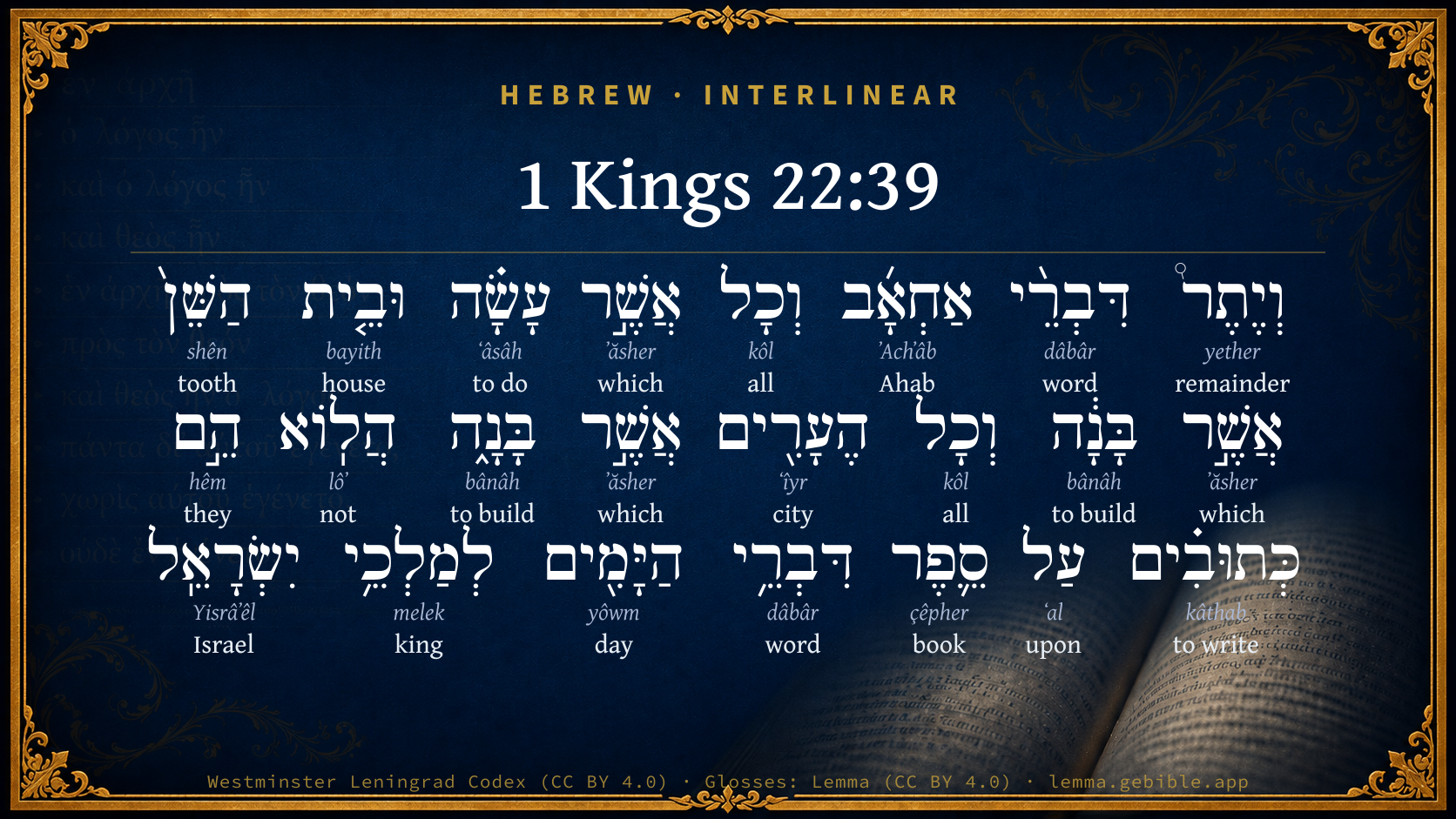
Hebrew (Westminster Leningrad Codex) 1 Kings 22:39 appears in the Hebrew Old Testament. The text above is from the Westminster Leningrad Codex. Each word links to its Strong’s number, a concise gloss, and parsing drawn from the Open Scriptures Hebrew Bible morphology. Click any word for its full Brown-Driver-Briggs (BDB) entry.
Download image
Cite this verse

1 Kings 22:39 (World English Bible). Public Domain. Lemma interlinear Bible study tool, https://lemma.gebible.app/v/1-kings/22/39.

Show BibTeX & RIS
BibTeX
RIS
English Translation
Now the rest of the acts of Ahab, and all that he did, and the ivory house which he built, and all the cities that he built, aren't they written in the book of the chronicles of the kings of Israel?
World English Bible · Public Domain
Download a study sheet

One document with this verse’s original text, its word-by-word gloss line, the meaning frame, cross-references with their text, attributed commentary, and full source and license credits — printable, and it pastes into notes with its structure intact.

This verse Autodidact and up

Study sheet (.html) Plain text (.txt)

A passage Seminary Student

Up to 50 verses in one chapter. A passage sheet keeps up to 6 commentary sources and 12 cross-references per verse, in the order this page ranks them, and says so on the sheet whenever that leaves anything out. Ask for a single verse and you get the Autodidact verse sheet above.

Everything on this page stays free to read, with no account — the sheet is a download of what is already on screen, not access to it.

Want to remove ads? Support Godless Engineer
Compare translations 3

The same verse in 3 English versions, stacked beneath the original-language interlinear above. Click any original word for its lexicon entry.

Each is an independent rendering of the whole verse — the interlinear is not word-aligned to these translations.

Highlighted words mark where these versions differ — a whole-verse word diff, not a word-by-word alignment.

  • World English Bible Public Domain
    Now the rest of the acts of Ahab, and all that he did, and the ivory house which he built, and all the cities that he built, aren't they written in the book of the chronicles of the kings of Israel?
  • King James Version Public Domain
    Now the rest of the acts of Ahab, and all that he did, and the ivory house which he made, and all the cities that he built, are they not written in the book of the chronicles of the kings of Israel?
  • unfoldingWord Literal Text CC BY-SA 4.0
    Now the rest of the matters of Ahab and all that he did, and the house of ivory that he built, and all of the cities that he built, are they not written in the book of the matters of the days of the kings of Israel?

unfoldingWord Literal Text — © unfoldingWord, licensed CC BY-SA 4.0. Word-aligned USFM3 via Door43 (git.door43.org/unfoldingWord/en_ult).

Versions to compare (up to 4)

3 of 4 selected

Show all 18 translations

Every available English version of this verse, each an independent rendering of the whole verse.

  • World English Bible Public Domain
    Now the rest of the acts of Ahab, and all that he did, and the ivory house which he built, and all the cities that he built, aren't they written in the book of the chronicles of the kings of Israel?
  • Berean Standard Bible Public Domain
    As for the rest of the acts of Ahab, along with all his accomplishments and the ivory palace and all the cities he built, are they not written in the Book of the Chronicles of the Kings of Israel?
  • Majority Standard Bible Public Domain
    As for the rest of the acts of Ahab, along with all his accomplishments and the ivory palace and all the cities he built, are they not written in the Book of the Chronicles of the Kings of Israel?
  • King James Version Public Domain
    Now the rest of the acts of Ahab, and all that he did, and the ivory house which he made, and all the cities that he built, are they not written in the book of the chronicles of the kings of Israel?
  • American Standard Version (1901) Public Domain
    Now the rest of the acts of Ahab, and all that he did, and the ivory house which he built, and all the cities that he built, are they not written in the book of the chronicles of the kings of Israel?
  • Revised Version (1885) Public Domain
    Now the rest of the acts of Ahab, and all that he did, and the ivory house which he built, and all the cities that he built, are they not written in the book of the chronicles of the kings of Israel?
  • Geneva Bible (1599) Public Domain
    Concerning the rest of the actes of Ahab and all that he did, and the yuorie house which he built, and all the cities that he built, are they not written in the booke of the Chronicles of the Kings of Israel?
  • Douay-Rheims (1899) Public Domain
    But the rest of the acts of Achab, and all that he did, and the house of ivory that he made, and all the cities that he built, are they not written in the book of the words of the days of the kings of Israel?
  • Young's Literal Translation Public Domain
    And the rest of the matters of Ahab, and all that he did, and the house of ivory that he built, and all the cities that he built, are they not written on the book of the Chronicles of the kings of Israel?
  • Literal Standard Version CC BY-SA 4.0
    And the rest of the matters of Ahab, and all that he did, and the house of ivory that he built, and all the cities that he built, are they not written on the scroll of the Chronicles of the Kings of Israel?
  • Unlocked Literal Bible CC BY-SA 4.0
    As for the other matters concerning Ahab, all that he did, the ivory house that he built, and all the cities that he built, are they not written in the book of the events of the kings of Israel?
  • unfoldingWord Literal Text CC BY-SA 4.0
    Now the rest of the matters of Ahab and all that he did, and the house of ivory that he built, and all of the cities that he built, are they not written in the book of the matters of the days of the kings of Israel?
  • Darby Bible Public Domain
    And the rest of the acts of Ahab, and all that he did, and the ivory house that he built, and all the cities that he built, are they not written in the book of the chronicles of the kings of Israel?
  • World Messianic Bible Public Domain
    Now the rest of the acts of Ahab, and all that he did, and the ivory house which he built, and all the cities that he built, aren’t they written in the book of the chronicles of the kings of Israel?
  • Webster's Bible Public Domain
    Now the rest of the acts of Ahab, and all that he did, and the ivory house which he made, and all the cities that he built, are they not written in the book of the chronicles of the kings of Israel?
  • Free Bible Version CC BY-SA 4.0
    The rest of what happened in Ahab's reign, all that he did, the ivory palace he constructed and all the cities he built are recorded in the Book of Chronicles of the Kings of Israel.
  • Bible in Basic English Public Domain
    Now the rest of the acts of Ahab, and all he did, and his ivory house, and all the towns of which he was the builder, are they not recorded in the book of the history of the kings of Israel?
  • JPS Tanakh (1917) Public Domain
    Now the rest of the acts of Ahab, and all that he did, and the ivory house which he built, and all the cities that he built, are they not written in the book of the chronicles of the kings of Israel?

Literal Standard Version (2020), Covenant Press — licensed CC BY-SA 4.0. Text via the HelloAO Bible API (eBible.org). Unlocked Literal Bible (unfoldingWord) — licensed CC BY-SA 4.0. Text via the HelloAO Bible API (eBible.org). unfoldingWord Literal Text — © unfoldingWord, licensed CC BY-SA 4.0. Word-aligned USFM3 via Door43 (git.door43.org/unfoldingWord/en_ult). Free Bible Version, Dr. Jonathan Gallagher — licensed CC BY-SA 4.0. Text via the HelloAO Bible API (eBible.org).

Word by word

More ways to search: Search by grammar → Find every occurrence → Compare this word →

Practice this passage: Drill this verse → Learn its vocabulary →

הַשֵּׁן֙
shên
H8127
“the · tooth”
Particle, Definite Article + Noun, Common, Both, Singular, Absolute
Part of Speech
Particle + Noun
Type
Common
Gender
Both
Number
Singular
State
Absolute
Full BDB Definition

Origin: from H8150

TWOT: 2422a

tooth, ivory - tooth - of man, lex talionis, beast - tooth, tine (of fork) - ivory - as material - of commerce - sharp pointed rock
  1. וְיֶתֶר֩ yether H3499 “and · remainder of” Conjunction + Noun, Common, Masculine, Singular, Construct
  2. דִּבְרֵ֨י dâbâr H1697 “words of” Noun, Common, Masculine, Plural, Construct
  3. אַחְאָ֜ב ʼAchʼâb H256 “Ahab” Noun, Proper
  4. וְכָל kôl H3605 “and · all of” Conjunction + Noun, Common, Masculine, Singular, Construct
  5. אֲשֶׁ֣ר ʼăsher H834 “which” Particle, Relative
  6. עָשָׂ֗ה ʻâsâh H6213 “to do” Verb, Qal, Perfect, 3rd Person, Masculine, Singular
  7. וּבֵ֤ית bayith H1004 “and · house of” Conjunction + Noun, Common, Masculine, Singular, Construct
  8. אֲשֶׁ֣ר ʼăsher H834 “which” Particle, Relative
  9. בָּנָ֔ה bânâh H1129 “to build” Verb, Qal, Perfect, 3rd Person, Masculine, Singular
  10. וְכָל kôl H3605 “and · all of” Conjunction + Noun, Common, Masculine, Singular, Construct
  11. הֶעָרִ֖ים ʻîyr H5892 “the · cities” Particle, Definite Article + Noun, Common, Feminine, Plural, Absolute
  12. אֲשֶׁ֣ר ʼăsher H834 “which” Particle, Relative
  13. בָּנָ֑ה bânâh H1129 “to build” Verb, Qal, Perfect, 3rd Person, Masculine, Singular
  14. הֲלֽוֹא lôʼ H3808 “not” Particle, Interrogative + Particle, Negative
  15. הֵ֣ם hêm H1992 “they” Pronoun, Personal, 3rd Person, Masculine, Plural
  16. כְּתוּבִ֗ים kâthab H3789 “written” Verb, Qal, Participle Passive, Masculine, Plural, Absolute
  17. עַל ʻal H5921 “upon” Preposition
  18. סֵ֛פֶר çêpher H5612 “book of” Noun, Common, Masculine, Singular, Construct
  19. דִּבְרֵ֥י dâbâr H1697 “words of” Noun, Common, Masculine, Plural, Construct
  20. הַיָּמִ֖ים yôwm H3117 “the · days” Particle, Definite Article + Noun, Common, Masculine, Plural, Absolute
  21. לְמַלְכֵ֥י melek H4428 “to/for · kings of” Preposition + Noun, Common, Masculine, Plural, Construct
  22. יִשְׂרָאֵֽל Yisrâʼêl H3478 “Israel” Noun, Proper

About this verse

These counts appear in no published source. They are computed here, from the morphology-tagged text and Lemma’s own curated glosses. What Lemma adds →

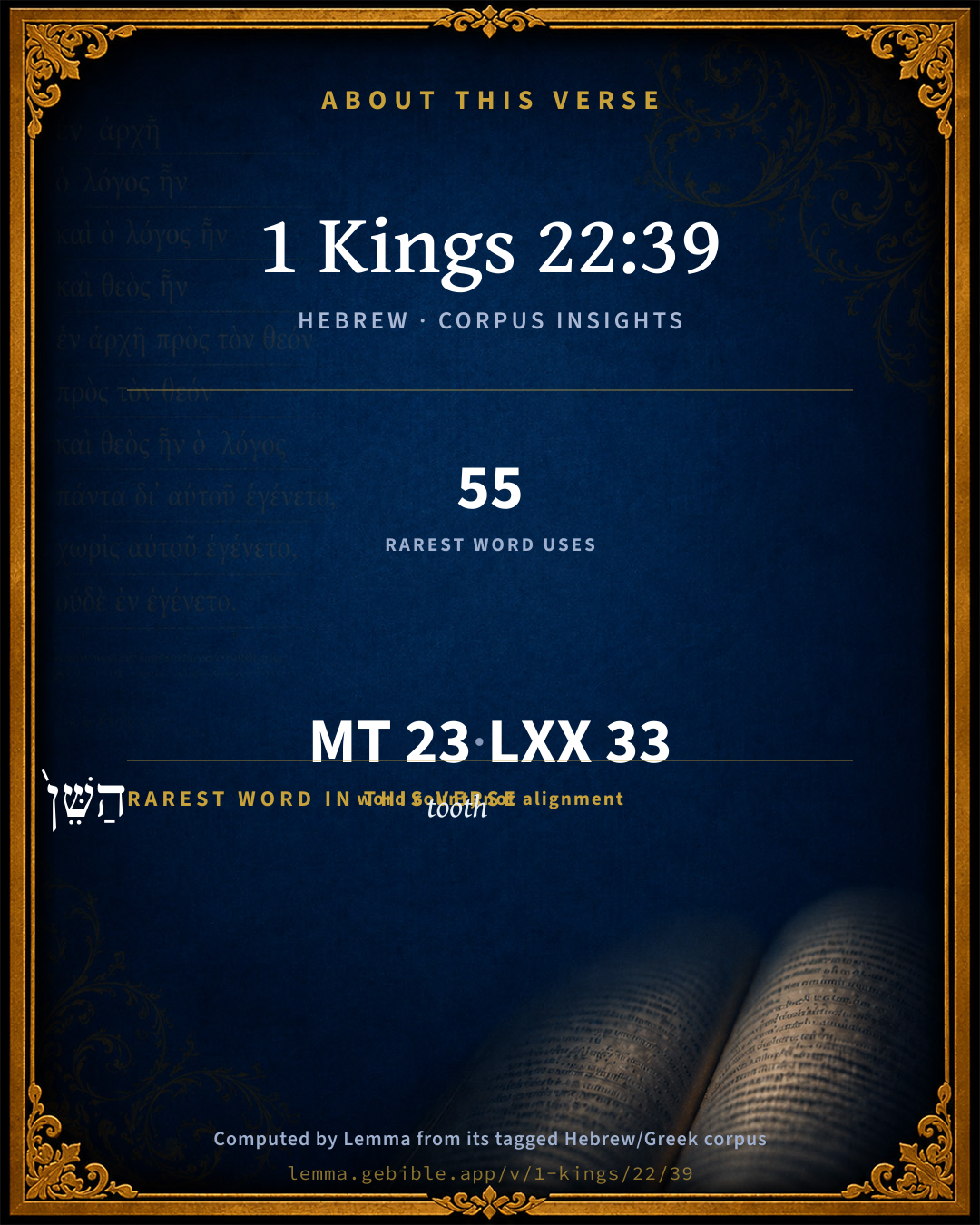
23
words
18
distinct lemmas
Historical
section

Shared distinctive vocabulary

הַשֵּׁן֙ tooth H8127 occurs in 48 verses of the Hebrew Bible. Also found in:

Grammatical profile

  • 4 verbs
  • 13 nouns
  • 1 pronoun
  • 1 preposition
  • 4 particles

Verb forms

  • עָשָׂ֗ה Qal · Perfect
  • בָּנָ֔ה Qal · Perfect
  • בָּנָ֑ה Qal · Perfect
  • כְּתוּבִ֗ים Qal · Participle Passive

Repetition

Words recur within this verse — often emphatic in Hebrew:

  • דִּבְרֵ֨י word H1697 ×2
  • וְכָל all H3605 ×2
  • בָּנָ֔ה to build H1129 ×2
  • אֲשֶׁ֣ר which H834 ×3

Hebrew & Septuagint length

In English translation the verse runs 41 words from the Hebrew and 44 from the Septuagint (LXX English) — closely comparable.

A rough comparison of the two English renderings, which tokenize alike — not a word-level alignment.

Word counts can differ between the Hebrew and the Greek without any difference in meaning — e.g. the Hebrew direct-object marker אֵת has no separate Greek word, and Greek often adds the article ὁ.

In the original languages it is 23 Hebrew tokens and 33 Greek tokens — but the two are counted differently (Hebrew bundles its prefixes and suffixes into one token; the Greek is in lemma form), so that isn’t a like-for-like length.

Cross-references

13

Topical passages linked to 1 Kings 22:39 in the Treasury of Scripture Knowledge — connected by theme and wording, ordered by reader-vote popularity; previews shown in the World English Bible.

  • Amos 3:15 I will strike the winter house with the summer house; And the houses of ivory will perish, And the great houses will have an end," says Yahweh.
  • 1 Kings 10:18 Moreover the king made a great throne of ivory, and overlaid it with the finest gold.
  • 1 Kings 10:22 For the king had at sea a navy of Tarshish with the navy of Hiram: once every three years came the navy of Tarshish, bringing gold, and silver, ivory, and apes, and peacocks.
  • 1 Kings 14:19 The rest of the acts of Jeroboam, how he warred, and how he reigned, behold, they are written in the book of the chronicles of the kings of Israel.
  • 1 Kings 15:23 Now the rest of all the acts of Asa, and all his might, and all that he did, and the cities which he built, aren't they written in the book of the chronicles of the kings of Judah? But in the time of his old age he was diseased in his feet.
  • 1 Kings 15:31 Now the rest of the acts of Nadab, and all that he did, aren't they written in the book of the chronicles of the kings of Israel?
  • 1 Kings 16:5 Now the rest of the acts of Baasha, and what he did, and his might, aren't they written in the book of the chronicles of the kings of Israel?
  • 1 Kings 16:20 Now the rest of the acts of Zimri, and his treason that he did, aren't they written in the book of the chronicles of the kings of Israel?
  • 1 Kings 16:27 Now the rest of the acts of Omri which he did, and his might that he shown, aren't they written in the book of the chronicles of the kings of Israel?
  • Psalms 45:8 All your garments smell like myrrh, aloes, and cassia. Out of ivory palaces stringed instruments have made you glad.
  • Ezekiel 27:6 Of the oaks of Bashan have they made your oars; they have made your benches of ivory inlaid in boxwood, from the isles of Kittim.
  • Ezekiel 27:15 The men of Dedan were your traffickers; many isles were the market of your hand: they brought you in exchange horns of ivory and ebony.
  • Amos 6:4 Who lie on beds of ivory, And stretch themselves on their couches, And eat the lambs out of the flock, And the calves out of the midst of the stall;

Cross-references courtesy of OpenBible.info (CC BY 4.0).

Hebrew and Greek witnesses Masoretic Hebrew ↔ Greek Septuagint

The same verse in the two great witnesses to the Old Testament, shown verse-for-verse.

These are two independent witnesses, not word-aligned to each other, and the Septuagint is shown in lemma (dictionary) form.

Hebrew 1 Kings 22:39 Masoretic · Westminster Leningrad Codex

וְיֶתֶר֩ דִּבְרֵ֨י אַחְאָ֜ב וְכָל אֲשֶׁ֣ר עָשָׂ֗ה וּבֵ֤ית הַשֵּׁן֙ אֲשֶׁ֣ר בָּנָ֔ה וְכָל הֶעָרִ֖ים אֲשֶׁ֣ר בָּנָ֑ה הֲלֽוֹא הֵ֣ם כְּתוּבִ֗ים עַל סֵ֛פֶר דִּבְרֵ֥י הַיָּמִ֖ים לְמַלְכֵ֥י יִשְׂרָאֵֽל

Now the rest of the acts of Ahab, and all that he did, and the ivory house which he built, and all the cities that he built, aren't they written in the book of the chronicles of the kings of Israel?

World English Bible · Public Domain

Greek LXX 1 Kings 22:39 Septuagint · lemma form

καί ὁ λοιπός ὁ λόγος αχααβ καί πᾶς ὅς ποιέω καί οἶκος ἐλεφάντινος ὅς οἰκοδομέω καί πᾶς ὁ πόλις ὅς ποιέω οὐ ἰδού οὗτος γράφω ἐν βιβλίον λόγος ὁ ἡμέρα ὁ βασιλεύς ἰσραήλ

And the rest of the acts of Achaab, and all that he did, and the ivory house which he built, and all the cities which he built, behold, are not these things written in the book of the chronicles of the kings of Israel?

LXX2012 (modern English Septuagint) · Public Domain

Hebrew: Westminster Leningrad Codex (CC BY 4.0). Greek: Septuagint (public domain); English from LXX2012 (modern English Septuagint) (Public Domain). How the Septuagint differs from the Hebrew →

Targum (Aramaic paraphrase)

1

The Targum is the ancient Jewish Aramaic paraphrase of the Hebrew Scriptures — an interpretive translation, not the Hebrew text itself. Onkelos (literal) and Pseudo-Jonathan (expansive) render the Torah, and Jonathan the Prophets. Coverage is partial: where no permissively-licensed English translation exists for a verse, only the Aramaic is shown. This is verse-level text, not a word-by-word alignment to the Hebrew.

  1. Targum Jonathan Prophets (Joshua–Malachi)
    וּשְׁאָר פִּתְגָמֵי אַחְאָב וְכָל דַעֲבַד וּבֵית שִׁנָא דְפִיל דִי בְנָא וְכָל קִרְוַיָא דִבְנָא הֲלָא אִינוּן כְּתִיבִין עַל סְפַר פִּתְגָמֵי יוֹמַיָא לְמַלְכֵי יִשְׂרָאֵל:

    (no public-domain English translation for this verse)

    Targum Jonathan — Aramaic: “Mikraot Gedolot” (public domain). English: “Sefaria Community Translation” (CC0 1.0 (public-domain dedication)); “London "Chaldee Paraphrase," 1871” (public domain). Text via Sefaria.

Commentary

Notes on 1 Kings 22:39 from classic Christian and Jewish commentators (each source and its license shown beneath its notes). The classic Christian expositions comment on the surrounding passage and are grouped to its opening verse, so a note may address several verses; the Jewish commentaries on the Tanakh (Rashi and others) are per-verse, so they appear only where the commentator wrote on this verse.

Lemma curates 59 commentaries, every one of them public domain or Creative Commons licensed, each selected and text-cleaned for this edition rather than reprinted as found. About our sources →

Trapp's Complete Commentary

John Trapp

1Ki 22:39 Now the rest of the acts of Ahab, and all that he did, and the ivory house which he made, and all the cities that he built, [are] they not written in the book of the chronicles of the kings of Israel?

Ver. 39. And the ivory house which he had made.] For pomp and pleasure: as the emperors of Constantinople had a room made of porphyry, wherein their empresses were delivered, and their children were there hence called Porphyrogeniti.

John Trapp, A Commentary or Exposition upon All the Books of the Old and New Testament (1647–1656) — public domain. Text from a community e-Sword module.

Joseph Benson's Commentary

1Ki 22:39. The ivory house which he made — Not that it was wholly made of solid ivory, but the other materials used in building it were covered, or intermixed, or adorned with ivory. It appears by this short history that Ahab would have had some noble qualities in him, if he had not been incurably addicted to idolatry, and other sins and vices.

Joseph Benson's Commentary on the Old and New Testaments (1811–1818) — public domain. Text from a community e-Sword module.

Tyndale Open Study Notes

Tyndale Open Resources

22:39-40 Excavations at Samaria have disclosed Ahab’s palace and a nearby pool. The description of the palace as ivory may arise from the ivory-covered furnishings and wall panels. Gleaming white limestone covering the outside of the building also added to the palace’s ivory-like luster.

Tyndale Open Study Notes — © Tyndale Open Resources, licensed CC BY-SA 4.0. Text via the HelloAO Bible API.

Adam Clarke's Commentary

Verse 39. Ivory house] A royal palace which he built in Samaria, decorated with ivory, and hence called the ivory house. Amos the prophet speaks against this luxury, Am 3:15.

Adam Clarke's Commentary on the Bible (1810–1826) — public domain. Text from a community e-Sword/MySword module.

Ellicott's Commentary for English Readers

(39) The ivory house.—See Amo_3:15. We note that now, for the first time since the days of Solomon (1Ki_10:18-20), the use of ivory—in this case for inlaying the walls of houses—so characteristic of Zidonian art, is mentioned. The “undesigned coincidence,” in relation to the renewed intercourse with Zidon, is remarkable.

All the cities . . .—Possibly the cities ceded by Ben-hadad, and rebuilt as strongholds. The description shows that Ahab’s reign was externally one of power and prosperity, as yet unimpaired even by his death and disaster at Ramoth-gilead. The fruits of spiritual corruption had not yet ripened.

A Bible Commentary for English Readers, edited by Charles John Ellicott (1878–1897) — public domain. Text from a community e-Sword module.

The Cambridge Bible for Schools and Colleges

gen. ed. J. J. S. Perowne

39. the ivory house that he made [R.V. built] The verb is the same as in the next clause. The house was of course not of ivory, but largely adorned with it. That such adornment prevailed in Oriental lands, see Amo_3:15. The family of Ahab were great builders. It was the father of this king who in his short reign built Samaria, and Ahab apparently built several cities, i.e. perhaps restored and beautified them. Omri’s building of Samaria, however, was the founding of a new capital.

The Cambridge Bible for Schools and Colleges (gen. ed. J. J. S. Perowne; Cambridge University Press, 1878–1918) — public domain. Text from a community e-Sword module.

John Gill's Exposition

And Jehoshaphat made peace with the king of Israel. First with Ahab, with whom he contracted an affinity, and joined with him in his expedition to Ramothgilead, and with Ahaziah his successor.

And Jehoshaphat made peace with the king of Israel. First with Ahab, with whom he contracted an affinity, and joined with him in his expedition to Ramothgilead, and with Ahaziah his successor.

1 Kings 22:45

kg1 22:45

kg1 22:45

kg1 22:45And all the rest of the acts of Jehoshaphat, and all his might that he showed, and all his wars, are they not written in the book of the Chronicles of the kings of Israel? Many of them are recorded in the canonical book of Scripture, which bears the name of Chronicles; and more might be in this referred to, out of which might be taken what God has thought fit to transmit to future times; see Ch2 17:1.

John Gill's Exposition of the Whole Bible (1746–1763) — public domain (CC PDM 1.0). Text via the HelloAO Bible API.

Albert Barnes' Notes on the Bible

The ivory house - So called from the character of its ornamentation. Ivory was largely used in the ancient world as a covering of wood-work, and seems to have been applied, not only to furniture, but to the doors and walls of houses.

Nothing is known of the cities built by Ahab; but the fact is important as indicating the general prosperity of the country in his time, and his own activity as a ruler. Prosperity, it is plain, may for a while co-exist with causes - such as, the decay of religions - which are sapping the vital power of a nation, and leading it surely, if slowly, to destruction.

The book of the chronicles ... - See above, 1Ki 14:19; 1Ki 15:31; 1Ki 16:5, 1Ki 16:14, 1Ki 16:20, 1Ki 16:27.

Albert Barnes' Notes on the Bible (1834–1885) — public domain. Text from a community e-Sword/MySword module.

Haydock's Catholic Bible Commentary

Of ivory. The palace was greatly adorned with it, (see Amos iii. 15., and Psalm xliv. 9.; Calmet) like the palace of Solomon, chap. x. 18. Pliny (xvi. 43.) speaks of bedsteads and vehicles of ivory, in the same sense. (Tirinus)

George Leo Haydock (1774–1849), Haydock's Catholic Family Bible and Commentary, 1859 edition — public domain. Excludes Psalms (Douay-Rheims chapter numbering differs from Protestant) and Deuterocanonical books (Catholic canon only).

Matthew Poole's English Annotations

The ivory house, Heb. the house of the tooth or teeth, to wit, of elephants: see 1Ki 10:18. Not that it was made wholly of solid ivory, but because the other materials were covered, or intermixed, or adorned with ivory. Compare Amo 3:15.

Matthew Poole's English Annotations on the Holy Bible (1683–1685) — public domain. Text from a community e-Sword/MySword module.

Whedon's Commentary on the Bible

Daniel D. Whedon

39. The ivory house — Probably his royal palace at Samaria was so ornamented and inwrought with ivory as to be called the ivory house. Of his works no other record now remains.

Daniel D. Whedon (gen. ed.), Commentary on the Old and New Testaments (1874–1909) — public domain. Text from a community e-Sword module.

The Pulpit Commentary

Now the rest of the acts of Ahab, and all that he did, and the ivory house which he made So called because it was adorned with ivory. See on ch. 11.; and cf. Amo_3:15; Psa_45:8; Son_7:5. Rawlinson cites several passages from Greek and Latin authors to prove that ivory was anciently applied, not only to furniture, but to the doors and walls of houses, and the cities that he built Probably Jezreel was one, but we have no information concerning them. The fact that he did build cities, however, is one proof of Ahab"s enterprize. He was not weak in all particulars, are they not written in the book of the chronicles of the kings of Israel?

Vers. 39, 40, 51-53.

Survival.

After the account of Ahab"s death and burial, and of the manner in which the dogs of Samaria fulfilled the prophecy of Elijah, the earlier verses of our text follow. In the first of these the reader is referred to the archives of the nation for an account of the "rest of the acts" and works of this monarch, viz., those to which inspiration was not here specially directed. In the second, the succession of Ahaziah is mentioned. With these verses, because of the unity of the subject, we associate the three verses referring to the reign of Ahaziah, with which the chapter closes. Taking the latter first in order, we see

I THAT AHAB SURVIVED IN AHAZIAH.

1. This was legally true.

(1) "So Ahab slept with his fathers; and Ahaziah his son reigned in his stead." In law, a man is said to "live in his heirs." He is never legally dead while he has an heir. There is a good reason for this. Ahaziah would never have mounted the throne of Israel unless his father had been there before him. He reigned in the posthumous influence of Ahab. His representative.

(2) When a man is what is called "the architect of his own fortune," he is said to have had "no father." But in this language the fact is ignored that, under Providence, this "architect" is indebted to his ancestry for his existence, for his faculties, and for the circumstances which he may have seized and moulded into this "fortune.

2. It was also morally true.

(1) In Ahaziah the vices of Ahab were reproduced. "He did evil in the sight of the Lord, and walked in the way of his father." The bad example of his father wrought its influence into his character, and thus Ahab survived in Ahaziah.

(2) The record descends to particulars. "He walked in the way of his father, and in the way of his mother." Here not only is Jezebel reproduced in Ahaziah, but Ahab"s sin in marrying Jezebel also survives. "And in the way of Jeroboam the son of Nebat, who made Israel to sin." Here is not only the posthumous influence of Jeroboam, but also of the sin of Ahab in perpetuating it. "For he served Baal, and worshipped him." The establishment of this Canaanitish abomination was due to Ahab and Jezebel, and they infamously survive in its perpetuation.

(3) Note

(a) A Church is not the more true for being established. Here were two State Churches which were, in the Biblical sense, atheistic.

(b) For concurrent endowment, whatever may be said for its expediency, there can be no moral defence.

3. But there was no necessity for this.

(1) Legal representation is an accident over which we have no control. It is a notable truth that men have influences in spite of themselves, and that these also are posthumous.

(2) But moral representation is in a different category. Ahaziah might have reigned in Ahab"s stead without imitating his vices. "Jehoram the son of Ahab," e.g., "wrought evil in the sight of the Lord; but not like his father, and like his mother; for he put away the image of Baal that his father had. (2Ki_3:2)

(3) Ahaziah should have been admonished by the history of the judgments of God upon the house of Jeroboam. He should have taken the warning given in the judgments of God on the sins of his father. His guilt, therefore, was upon his own head, and he suffered accordingly. He reigned two years. God makes short work with some sinners. His death was provoked by his perversity. (see 2Ki_1:3, 2Ki_1:4) We see further

II THAT AHAB SURVIVES IN HISTORY.

1. He survived in secular history. His acts and works were written in the chronicles of his nation.

(1) Amongst these were mentioned "all the cities that he built." Perhaps this building of cities simply meant the construction of fortifications for their defence. Whether they reflected credit or discredit upon his memory we cannot pronounce. A man may do a great deal of work to very little profit.

(2) The chronicles mentioned "the ivory house which he made." This palace had its description probably from the quantity of that valuable substance used in its ornamentation. But this does not seem to have been to his honour. A kingdom impoverished through famines, wars, and idolatries was in no position to bear the cost of such a piece of luxurious and selfish vanity. Amos accordingly denounces this work of pride. (Amo_3:15)

(3) The survival of Ahab in secular history was a consequence of his social position. The masons and carpenters, whose skill brought the works of Ahab to perfection, had no mention there. Social status is a talent from God, for the right use of which men are accountable.

2. He survives in sacred history.

(1) The sacred history consists of selections from the secular under the guiding influence of Divine inspiration, with a view to illustrating the principles of the providence, truth, and grace of God. To illustrate such principles is the noblest end of writing. So of reading. What quantities of trash, in which the claims of God are ignored, is both written and read!

(2) In these selections the notices of the wicked are generally brief. Perhaps no wicked man has a larger share of the sacred writings occupied with his acts than Ahab. Such acts are not agreeable to the Spirit of God. But in the hands of inspiration they are made an influence for good. They are recorded, apparently, because of their relation to the actions of prophets and good men. They are made to serve as a dark background to show up to admiration virtuous qualities, and to be made themselves odious in the contrast. The principles of the wicked should only be studied to be shunned. So God brings good out of evil.

(3) The sacred records have survived the secular. "The book of the chronicles of the kings of Israel" has long since perished. The sacred records have come down to our times. In these, after a lapse of nearly thirty centuries, Ahab survives. But for these his name would not be known. Note

(a) the Providence which has preserved the Scriptures evinces their Divine authenticity.

(b) Things are permanent as they stand related to the everlasting God.

(c) The posthumous influence points to the immortality of man. J.A.M.

The Pulpit Commentary (1880–1919), ed. H.D.M. Spence-Jones & Joseph S. Exell — public domain. Text from a community e-Sword module.

John Wesley's Explanatory Notes

Ivory house - Not that it was made of solid ivory, but because the other materials were covered, or inlaid with ivory.

John Wesley, Explanatory Notes Upon the Whole Bible (1754–1765) — public domain. Text via the GEBible commentary corpus.

unfoldingWord translationNotes

Door43 World Missions Community

are they not written in the book of the events of the kings of Israel?

This can be expressed in active form and assumes that the answer is positive. The question is rhetorical and is used for emphasis. See how you translated this in 1 Kings 15:31. AT: "they are written in the book of the events of the kings of Israel." or "you can read them in the book of the events of the kings of Israel." (See: Active or Passive and Rhetorical Question)

slept with his ancestors

Ahab dying is spoken of as if he had fallen asleep. See how you translated this in 1 Kings 2:10. AT: "died" (See: Metaphor and Euphemism)

translationWords

written

asleep

Ahaziah

unfoldingWord translationNotes — © Distant Shores Media and the Door43 World Missions Community, licensed CC BY-SA 4.0. Source: git.door43.org/Door43/en_tn.

Rashi

Rabbi Shlomo Yitzchaki (Rashi)

The ivory palace. [Made of] elephant tooth [i.e., ivory].

Rashi on the Tanakh — English translations: “The Judaica Press complete Tanach with Rashi, translated by A. J. Rosenberg” (CC BY 4.0); “Pentateuch with Rashi's commentary by M. Rosenbaum and A.M. Silbermann, 1929-1934” (public domain); “The Metsudah Tanach series, Lakewood, N.J” (CC BY 4.0); and “The Book of Joshua, Metsudah Publications, 1997” (CC BY 4.0). Text via Sefaria.

Lesson kit

Teaching starters — assembled from the data on this page, not authored interpretation. Every prompt links to the verse data it draws on. Edit before teaching.

1 Kings, in the Historical, opens this verse with 23 words (18 distinct Hebrew lemmas). Its most distinctive word is shên (“tooth”). A historical commentator’s framing appears above. Read the whole chapter for the surrounding context.

Discussion questions

  1. How does “tooth” (shên) shape what this verse is saying?
  2. How does Genesis 49:12, which shares the word «tooth», read alongside this verse?
  3. What does the repetition of “word” (2× in this one verse) do in this verse?
  4. The translations on this page render this verse differently — a whole-verse word diff, not a word-by-word alignment. What might account for the different wordings?
  5. «עָשָׂ֗ה» is a Qal Perfect verb. How does that grammatical form shape the action described?
  6. Compare how Trapp's Complete Commentary and Joseph Benson's Commentary read this verse. Where do they agree or differ?

Things to notice

Reading settings

Reading text

Shown beneath each verse's original-language words.

Old Testament
Old Testament edition

Read the OT as the Masoretic Hebrew (MT) or the Greek Septuagint (LXX).

English shown for the Greek Septuagint (in the Hebrew ↔ Greek comparison).

Comparing translations? Open the Compare panel on any verse page to stack up to four side by side.