Numbers 20:13

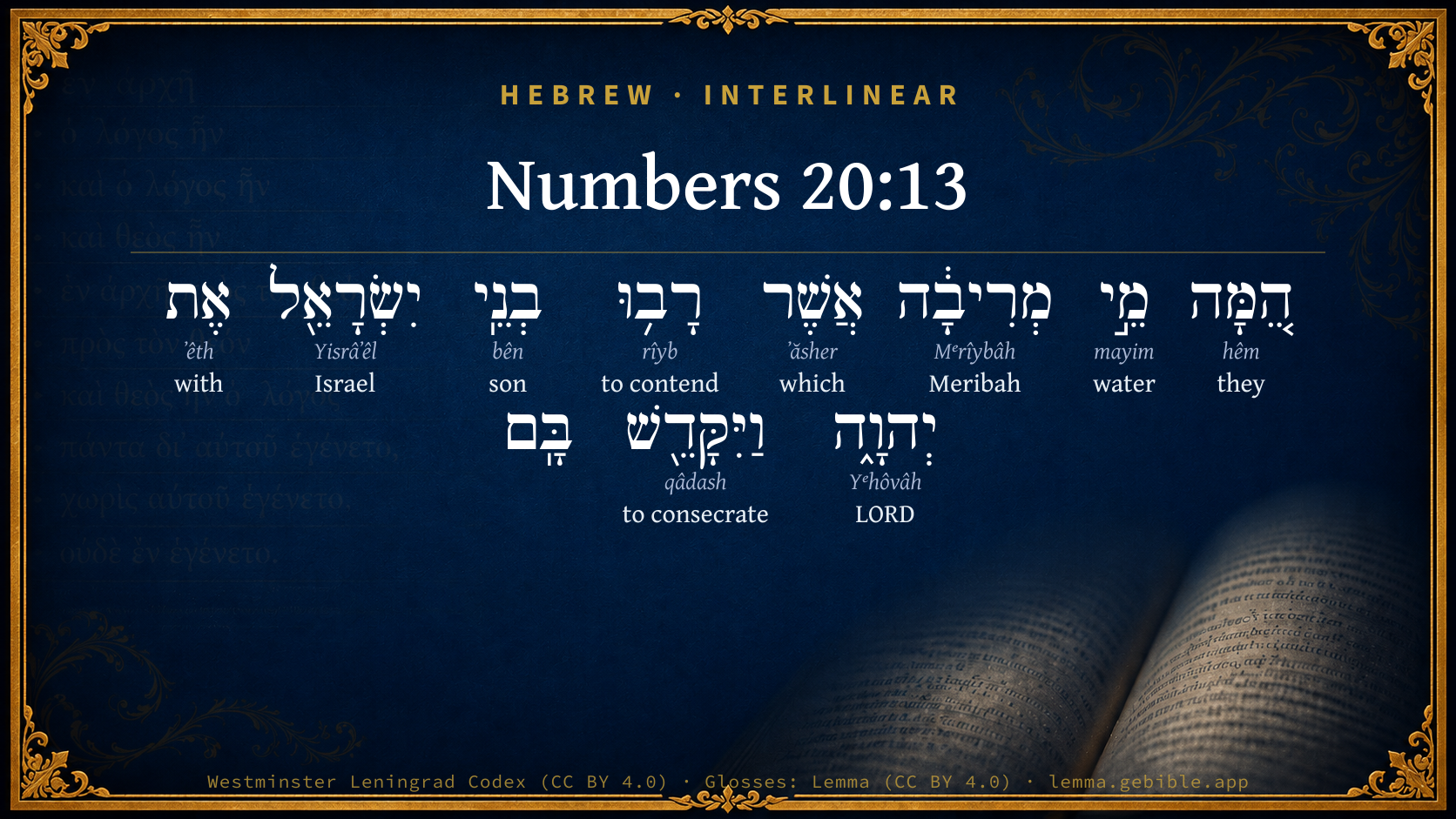
Hebrew (Westminster Leningrad Codex) Numbers 20:13 appears in the Hebrew Old Testament. The text above is from the Westminster Leningrad Codex. Each word links to its Strong’s number, a concise gloss, and parsing drawn from the Open Scriptures Hebrew Bible morphology. Click any word for its full Brown-Driver-Briggs (BDB) entry.
Download image
Cite this verse

Numbers 20:13 (World English Bible). Public Domain. Lemma interlinear Bible study tool, https://lemma.gebible.app/v/numbers/20/13.

Show BibTeX & RIS
BibTeX
RIS
English Translation
These are the waters of Meribah; because the children of Israel strove with Yahweh, and he was sanctified in them.
World English Bible · Public Domain
Download a study sheet

One document with this verse’s original text, its word-by-word gloss line, the meaning frame, cross-references with their text, attributed commentary, and full source and license credits — printable, and it pastes into notes with its structure intact.

This verse Autodidact and up

Study sheet (.html) Plain text (.txt)

A passage Seminary Student

Up to 50 verses in one chapter. A passage sheet keeps up to 6 commentary sources and 12 cross-references per verse, in the order this page ranks them, and says so on the sheet whenever that leaves anything out. Ask for a single verse and you get the Autodidact verse sheet above.

Everything on this page stays free to read, with no account — the sheet is a download of what is already on screen, not access to it.

Want to remove ads? Support Godless Engineer
Compare translations 3

The same verse in 3 English versions, stacked beneath the original-language interlinear above. Click any original word for its lexicon entry.

Each is an independent rendering of the whole verse — the interlinear is not word-aligned to these translations.

Highlighted words mark where these versions differ — a whole-verse word diff, not a word-by-word alignment.

  • World English Bible Public Domain
    These are the waters of Meribah; because the children of Israel strove with Yahweh, and he was sanctified in them.
  • King James Version Public Domain
    This is the water of Meribah; because the children of Israel strove with the LORD, and he was sanctified in them.
  • unfoldingWord Literal Text CC BY-SA 4.0
    They the waters of Meribah, where the sons of Israel contended with Yahweh, and he showed himself to be holy in them.

unfoldingWord Literal Text — © unfoldingWord, licensed CC BY-SA 4.0. Word-aligned USFM3 via Door43 (git.door43.org/unfoldingWord/en_ult).

Versions to compare (up to 4)

3 of 4 selected

Show all 18 translations

Every available English version of this verse, each an independent rendering of the whole verse.

  • World English Bible Public Domain
    These are the waters of Meribah; because the children of Israel strove with Yahweh, and he was sanctified in them.
  • Berean Standard Bible Public Domain
    These were the waters of Meribah, where the Israelites quarreled with the LORD, and He showed His holiness among them.
  • Majority Standard Bible Public Domain
    These were the waters of Meribah, where the Israelites quarreled with the LORD, and He showed His holiness among them.
  • King James Version Public Domain
    This is the water of Meribah; because the children of Israel strove with the LORD, and he was sanctified in them.
  • American Standard Version (1901) Public Domain
    These are the waters of Meribah; because the children of Israel strove with Jehovah, and he was sanctified in them.
  • Revised Version (1885) Public Domain
    These are the waters of Meribah; because the children of Israel strove with the LORD, and he was sanctified in them.
  • Geneva Bible (1599) Public Domain
    This is the water of Meribah, because the children of Israel stroue with the Lord, and hee was sanctified in them.
  • Douay-Rheims (1899) Public Domain
    This is the Water of contradiction, where the children of Israel strove with words against the Lord, and he was sanctified in them.
  • Young's Literal Translation Public Domain
    These `are' waters of Meribah, because the sons of Israel have `striven' with Jehovah, and He is sanctified upon them.
  • Literal Standard Version CC BY-SA 4.0
    These [are] the waters of Meribah, because the sons of Israel have “striven” with YHWH, and He is sanctified among them.
  • Unlocked Literal Bible CC BY-SA 4.0
    This place was called the waters of Meribah because the people of Israel had quarreled with Yahweh there, and he showed himself to them as holy.
  • unfoldingWord Literal Text CC BY-SA 4.0
    They the waters of Meribah, where the sons of Israel contended with Yahweh, and he showed himself to be holy in them.
  • Darby Bible Public Domain
    These are the waters of Meribah, where the children of Israel contended with Jehovah, and he hallowed himself in them.
  • World Messianic Bible Public Domain
    These are the waters of Meribah; because the children of Israel strove with the LORD, and he was sanctified in them.
  • Webster's Bible Public Domain
    This is the water of Meribah; because the children of Israel strove with the LORD, and he was sanctified in them.
  • Free Bible Version CC BY-SA 4.0
    The place where the Israelites argued with the Lord was called the waters of Meribah, and was where he revealed his holiness to them.
  • Bible in Basic English Public Domain
    These are the waters of Meribah; because the children of Israel went against the Lord, and they saw that he was holy among them.
  • JPS Tanakh (1917) Public Domain
    These are the waters of Meribah, where the children of Israel strove with the LORD, and He was sanctified in them.

Literal Standard Version (2020), Covenant Press — licensed CC BY-SA 4.0. Text via the HelloAO Bible API (eBible.org). Unlocked Literal Bible (unfoldingWord) — licensed CC BY-SA 4.0. Text via the HelloAO Bible API (eBible.org). unfoldingWord Literal Text — © unfoldingWord, licensed CC BY-SA 4.0. Word-aligned USFM3 via Door43 (git.door43.org/unfoldingWord/en_ult). Free Bible Version, Dr. Jonathan Gallagher — licensed CC BY-SA 4.0. Text via the HelloAO Bible API (eBible.org).

Word by word

More ways to search: Search by grammar → Find every occurrence → Compare this word →

Practice this passage: Drill this verse → Learn its vocabulary →

מְרִיבָ֔ה
Mᵉrîybâh
H4809
“Meribah”
Noun, Proper
Part of Speech
Noun
Type
Proper
Full BDB Definition

Origin: the same as H4808

TWOT: None

Meribah = "strife" or " contention" - a fountain at Rephidim, in the desert of Sin; so called because the Israelites murmured against God - the name of the water supply at Kadesh on the southern border of the promised land; the people also murmured here against God
  1. הֵ֚מָּה hêm H1992 “they” Pronoun, Personal, 3rd Person, Masculine, Plural
  2. מֵ֣י mayim H4325 “water(s) of” Noun, Common, Masculine, Plural, Construct
  3. אֲשֶׁר ʼăsher H834 “which” Particle, Relative
  4. רָב֥וּ rîyb H7378 “to contend” Verb, Qal, Perfect, 3rd Person, Common, Plural
  5. בְנֵֽי bên H1121 “sons of” Noun, Common, Masculine, Plural, Construct
  6. יִשְׂרָאֵ֖ל Yisrâʼêl H3478 “Israel” Noun, Proper
  7. אֶת ʼêth H854 “with” Preposition
  8. יְהוָ֑ה Yᵉhôvâh H3068 “LORD” Noun, Proper
  9. וַיִּקָּדֵ֖שׁ qâdash H6942 “and · to consecrate” Conjunction + Verb, Niphal, Sequential Imperfect, 3rd Person, Masculine, Singular

About this verse

These counts appear in no published source. They are computed here, from the morphology-tagged text and Lemma’s own curated glosses. What Lemma adds →

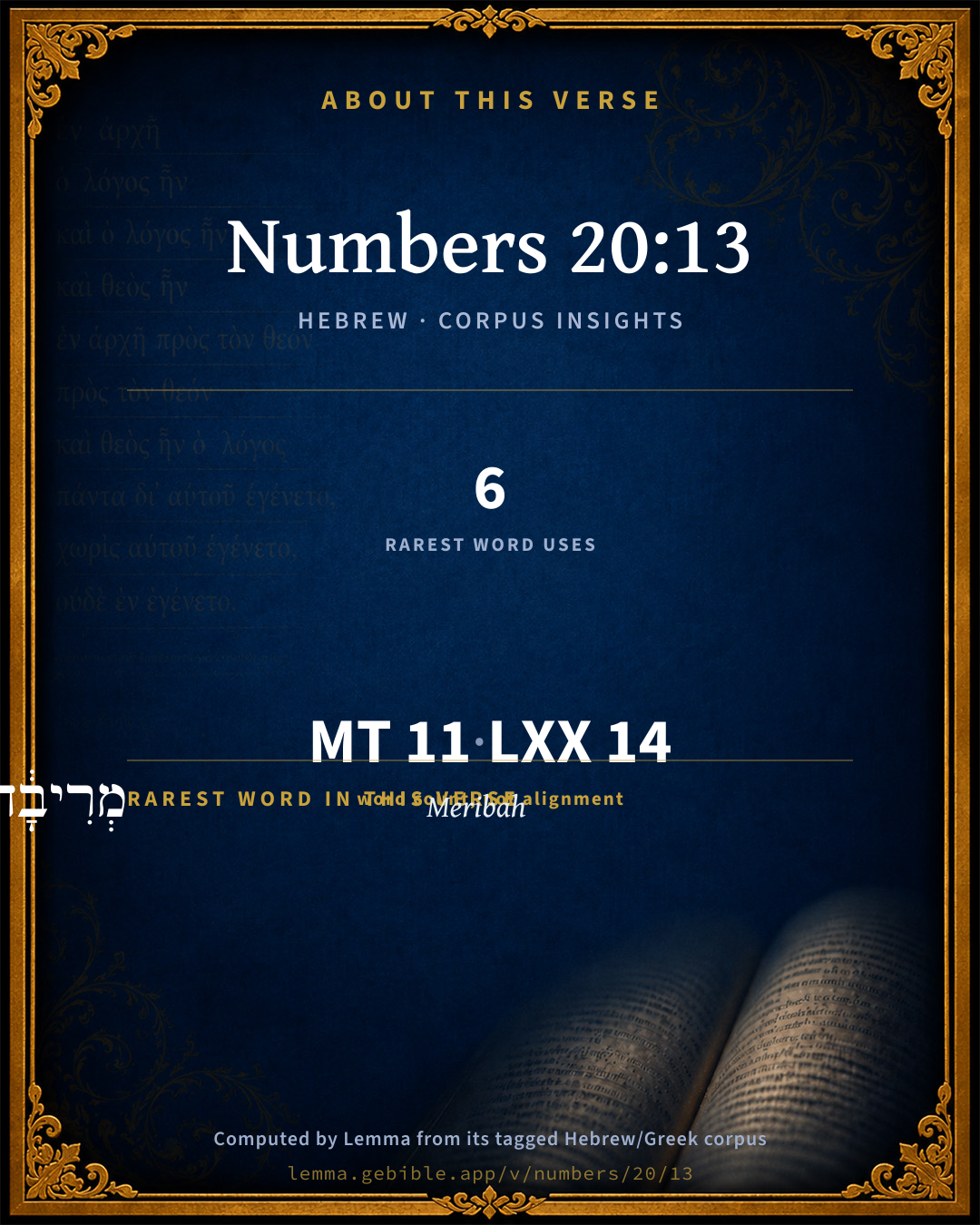
11
words
10
distinct lemmas
Pentateuch
section

Notable vocabulary

The rarest word here is מְרִיבָ֔ה Meribah H4809 — appearing just 6 times in the whole Hebrew Bible.

Shared distinctive vocabulary

מְרִיבָ֔ה Meribah H4809 occurs in 6 verses of the Hebrew Bible. Also found in:

Grammatical profile

  • 2 verbs
  • 5 nouns
  • 1 pronoun
  • 2 prepositions
  • 1 particle

Verb forms

  • רָב֥וּ Qal · Perfect
  • וַיִּקָּדֵ֖שׁ Niphal · Sequential Imperfect

Hebrew & Septuagint length

In English translation the verse runs 20 words from the Hebrew and 22 from the Septuagint (LXX English) — closely comparable.

A rough comparison of the two English renderings, which tokenize alike — not a word-level alignment.

Word counts can differ between the Hebrew and the Greek without any difference in meaning — e.g. the Hebrew direct-object marker אֵת has no separate Greek word, and Greek often adds the article ὁ.

In the original languages it is 11 Hebrew tokens and 14 Greek tokens — but the two are counted differently (Hebrew bundles its prefixes and suffixes into one token; the Greek is in lemma form), so that isn’t a like-for-like length.

Cross-references

9

Topical passages linked to Numbers 20:13 in the Treasury of Scripture Knowledge — connected by theme and wording, ordered by reader-vote popularity; previews shown in the World English Bible.

  • Exodus 17:7 He called the name of the place Massah, and Meribah, because the children of Israel quarreled, and because they tested Yahweh, saying, "Is Yahweh among us, or not?"
  • Psalms 95:8 Don't harden your heart, as at Meribah, As in the day of Massah in the wilderness,
  • Deuteronomy 33:8 Of Levi he said, Your Thummim and your Urim are with your godly one, Whom you did prove at Massah, With whom you did strive at the waters of Meribah;
  • Deuteronomy 32:51 because you trespassed against me in the midst of the children of Israel at the waters of Meribah of Kadesh, in the wilderness of Zin; because you didn't sanctify me in the midst of the children of Israel.
  • Psalms 106:32–48 They angered him also at the waters of Meribah, So that Moses was troubled for their sakes;
  • Isaiah 5:16 But Yahweh of Hosts is exalted in justice, And God the Holy One is sanctified in righteousness.
  • Ezekiel 20:41 As a sweet savor will I accept you, when I bring you out from the peoples, and gather you out of the countries in which you have been scattered; and I will be sanctified in you in the sight of the nations.
  • Ezekiel 36:23 I will sanctify my great name, which has been profaned among the nations, which you have profaned in the midst of them; and the nations shall know that I am Yahweh, says the Lord Yahweh, when I shall be sanctified in you before their eyes.
  • Ezekiel 38:16 and you shall come up against my people Israel, as a cloud to cover the land: it shall happen in the latter days, that I will bring you against my land, that the nations may know me, when I shall be sanctified in you, Gog, before their eyes.

Cross-references courtesy of OpenBible.info (CC BY 4.0).

Hebrew and Greek witnesses Masoretic Hebrew ↔ Greek Septuagint

The same verse in the two great witnesses to the Old Testament, shown verse-for-verse.

These are two independent witnesses, not word-aligned to each other, and the Septuagint is shown in lemma (dictionary) form.

Hebrew Numbers 20:13 Masoretic · Westminster Leningrad Codex

הֵ֚מָּה מֵ֣י מְרִיבָ֔ה אֲשֶׁר רָב֥וּ בְנֵֽי יִשְׂרָאֵ֖ל אֶת יְהוָ֑ה וַיִּקָּדֵ֖שׁ בָּֽם

These are the waters of Meribah; because the children of Israel strove with Yahweh, and he was sanctified in them.

World English Bible · Public Domain

Greek LXX Numbers 20:13 Septuagint · lemma form

οὗτος ὕδωρ ἀντιλογία ὅτι λοιδορέω ὁ υἱός ἰσραήλ ἔναντι κύριος καί ἁγιάζω ἐν αὐτός

This is the water of Strife, because the children of Israel spoke insolently before the Lord, and he was sanctified in them.

LXX2012 (modern English Septuagint) · Public Domain

On this verse, The Pulpit Commentary discusses the Septuagint’s reading. Read the note in Commentary ↓

Hebrew: Westminster Leningrad Codex (CC BY 4.0). Greek: Septuagint (public domain); English from LXX2012 (modern English Septuagint) (Public Domain). How the Septuagint differs from the Hebrew →

Targum (Aramaic paraphrase)

2

The Targum is the ancient Jewish Aramaic paraphrase of the Hebrew Scriptures — an interpretive translation, not the Hebrew text itself. Onkelos (literal) and Pseudo-Jonathan (expansive) render the Torah, and Jonathan the Prophets. Coverage is partial: where no permissively-licensed English translation exists for a verse, only the Aramaic is shown. This is verse-level text, not a word-by-word alignment to the Hebrew.

  1. Targum Onkelos Torah (Genesis–Deuteronomy)
    אִינוּן מֵי מַצוּתָא דִנְצוֹ בְנֵי יִשְׂרָאֵל קֳדָם יְיָ וְאִתְקַדַשׁ בְּהוֹן

    (no public-domain English translation for this verse)

    Targum Onkelos — Aramaic: “Onkelos Genesis” (public domain); “Onkelos Exodus” (public domain); “Onkelos Leviticus” (public domain); “Onkelos Numbers” (public domain); “Onkelos Deuteronomy” (public domain). English: “Sefaria Community Translation” (CC0 1.0 (public-domain dedication)); “J.W. Etheridge. The Targums of Onkelos and Jonathan Ben Uzziel on the Pentateuch. London: Longmans, Green, 1862” (public domain). Text via Sefaria.

  2. Targum Pseudo-Jonathan Torah (Genesis–Deuteronomy)
    הִינוּן מֵי מַצוּתָא דְנָצוּ בְּנֵי יִשְרָאֵל קֳדָם יְיָ עַל עֵיסַק בֵּירָא דְאִתְגְנִיזַת וְאִתְקְדַשׁ בְּהוֹן בְּמשֶׁה וְאַהֲרן כַּד אִתְיְהִיבַת לְהוֹן

    These are the Waters of Contention, where the sons of Israel contended before the Lord on account of the well that had been hidden; and He was sanctified in them, in Mosheh and Aharon, when (the waters) were given to them.

    Targum Pseudo-Jonathan — Aramaic: “Targum Jonathan on Genesis” (public domain); “Targum Jonathan on Exodus” (public domain); “Targum Jonathan on Leviticus” (public domain); “Targum Jonathan on Numbers” (public domain); “Targum Jonathan on Deuteronomy” (public domain). English: “The Targum of Jonathan ben Uzziel, trans. J. W. Etheridge, London, 1862” (public domain). Text via Sefaria.

Commentary

Notes on Numbers 20:13 from classic Christian and Jewish commentators (each source and its license shown beneath its notes). The classic Christian expositions comment on the surrounding passage and are grouped to its opening verse, so a note may address several verses; the Jewish commentaries on the Tanakh (Rashi and others) are per-verse, so they appear only where the commentator wrote on this verse.

Lemma curates 59 commentaries, every one of them public domain or Creative Commons licensed, each selected and text-cleaned for this edition rather than reprinted as found. About our sources →

Trapp's Complete Commentary

John Trapp

Num 20:13 This [is] the water of Meribah; because the children of Israel strove with the LORD, and he was sanctified in them.

Ver. 13. And he was sanctified in them.] By overcoming their evil with good; striking the rock for them, when he might justly have stricken them with utter destruction. Man’s badness interrupteth not the course of God’s goodness; "his unbelief maketh not the faith of God without effect." {Rom 3:3}

John Trapp, A Commentary or Exposition upon All the Books of the Old and New Testament (1647–1656) — public domain. Text from a community e-Sword module.

Joseph Benson's Commentary

Num 20:13. Meribah — That is, strife. In them — Or, among them, the children of Israel, by the demonstration of his omnipotency, veracity, and clemency toward the Israelites, and of his impartial holiness and severity against sin, even in his greatest friends and favourites.

Joseph Benson's Commentary on the Old and New Testaments (1811–1818) — public domain. Text from a community e-Sword module.

Tyndale Open Study Notes

Tyndale Open Resources

20:13 Meribah: As they had at Rephidim (Exod 17:1-7), the Israelites coined a name (“Arguing”) that referred more to the incident than to a geographical location. • God demonstrated his holiness through his judgment on Aaron and Moses’ sin.

Tyndale Open Study Notes — © Tyndale Open Resources, licensed CC BY-SA 4.0. Text via the HelloAO Bible API.

Geneva Bible (1599)

Geneva Bible translators

Or, strife and contention, Num. 27:14.

By showing himself almighty and maintaining his glory.

Geneva Bible (1599) marginal notes — public domain. Text via Bolls.life.

Jamieson, Fausset & Brown

Robert Jamieson, A. R. Fausset & David Brown

This is the water of Meribah--The word "Kadesh" is added to it [Deu 32:51] to distinguish it from another Meribah (Exo 17:7).

Jamieson, Fausset & Brown — Commentary Critical and Explanatory on the Whole Bible (1871) — public domain (CC PDM 1.0). Text via the HelloAO Bible API.

Ellicott's Commentary for English Readers

(13) This is the water of Meribah.—i.e., of strife. (See Exo_17:7, and Note; also Num_27:14, where the words “in Kadesh, in the wilderness of Zin,” are added to distinguish the latter from the earlier miracle.) In Deu_32:51 the waters are spoken of as those of “Meribah of Kadesh.”

And he was sanctified in them.—The reference in the words in them seems to be either to the word waters, which is plural in Hebrew, or, more probably, to the children of Israel, amongst whom Moses and Aaron were included. It has been supposed that the place derived its name of Kadesh (or, more fully, Kadesh-Barnea, Num_32:8) from the cognate verb, which is rendered sanctify in this and the preceding verse. It was in Kadesh that the sentence of exclusion had been pronounced upon the people generally (Num_14:22-23), and upon Moses and Aaron in particular, and it was thus that the Lord sanctified Himself in dealing with the transgressors. If the place derived its name, Kadesh, from these circumstances, it must have been called by that name proleptically in Gen_14:7—a supposition which is entirely consistent with the manner in which the place is mentioned in that verse (“Enmishpat, which is Kadesh.”)

A Bible Commentary for English Readers, edited by Charles John Ellicott (1878–1897) — public domain. Text from a community e-Sword module.

The Cambridge Bible for Schools and Colleges

gen. ed. J. J. S. Perowne

13. he was sanctified in them] The verb is from the same root as that of Kadesh (‘sacred’), and there is perhaps an intentional play on the name. The expression means ‘he proved, or vindicated, himself as holy,’ in spite of the sin of Moses and Aaron.

in them] Either in the waters, i.e. by his miracle in giving water, or, better, in the hearts of the people; cf. Eze_28:25.

The Cambridge Bible for Schools and Colleges (gen. ed. J. J. S. Perowne; Cambridge University Press, 1878–1918) — public domain. Text from a community e-Sword module.

John Gill's Exposition

And Moses sent messengers from Kadesh unto the king of Edom,.... This country was sometimes governed by kings, and sometimes by "dukes", see Gen 36:14. At the time of the passage of the Israelites through the Red sea, we read of the dukes of Edom, Exo 15:15, and here, thirty nine years after, of a king of Edom, but who he was is not certain. Bishop Usher takes him to be the same with Hadar, the last of the race of kings mentioned in Gen 36:39, to him Moses sent messengers with a request, which follows after a preamble to it; who were the messengers is not said; the place from whence they were sent is Kadesh, a city on the borders of the land of Edom; but not Kadeshbarnea, Aben Ezra says, though some are of opinion it is the same, see Num 20:1,

thus saith thy brother Israel; the Israelites and Edomites springing from two men, Jacob and Esau, who were twin brothers, and is observed to ingratiate themselves to the Edomites, and gain their request, pleading relation to them:

thou knowest all the travail that hath befallen us; what an uncomfortable condition they had been in for many years, which was well known to Edom, a neighbouring country, as is reasonable to suppose; since the fame of the children of Israel coming out of Egypt, passing through the Red sea, and being so long in the wilderness, was spread everywhere; this was said to move their pity.

John Gill's Exposition of the Whole Bible (1746–1763) — public domain (CC PDM 1.0). Text via the HelloAO Bible API.

Albert Barnes' Notes on the Bible

The water of Meribah - i. e. “Strife.” The place is called “Meribah in Kadesh” Num 27:14, and “Meribah-Kadesh” Deu 32:51. to distinguish it from the “Meribah” of Exo 17:2 ff.

And he was sanctified in them - An allusion doubtless to the name “Kadesh” (holy), which though not now bestowed, acquired a new significance from the fact that God here vindicated His own sanctity, punishing Moses and Aaron who had trespassed against it.

Albert Barnes' Notes on the Bible (1834–1885) — public domain. Text from a community e-Sword/MySword module.

Haydock's Catholic Bible Commentary

The water of contradiction or strife. Hebrew Meribah. (Challoner) --- Sanctified: he shewed the effects of his power and clemency towards the people, and he treated his ministers with a just severity. The Samaritan copy here inserts what we read in Deuteronomy, only it places the speech of Moses in an historical form. "The Moses said, Lord, &c. (Deuteronomy iii. 24-28.) Moreover, the Lord said to Moses, you shall pass by," &c. (Deuteronomy ii. 4-6.)

George Leo Haydock (1774–1849), Haydock's Catholic Family Bible and Commentary, 1859 edition — public domain. Excludes Psalms (Douay-Rheims chapter numbering differs from Protestant) and Deuterocanonical books (Catholic canon only).

Matthew Poole's English Annotations

Meribah, called Meribah Kadesh, to distinguish it from another Meribah, Exo 17:7. Sanctified in them, or, among them, to wit, the children of Israel last mentioned, by the demonstration of his omnipotency, veracity, and clemency towards the Israelites, and of his impartial holiness and severity against sin even in his greatest friends and favourites, as Moses was.

Matthew Poole's English Annotations on the Holy Bible (1683–1685) — public domain. Text from a community e-Sword/MySword module.

Whedon's Commentary on the Bible

Daniel D. Whedon

13. Meribah — That is, Strife. The two miracles of bringing water from the rock are thus distinguished: that at Rephidim, nearly forty years before, was called Massah, or Temptation; that in Kadesh is called Meribah. Deu_33:8. That the second is not a mythical repetition of the first is evident from the new features which it presents — the sin of Moses and his consequent exclusion from Canaan.

Strove with the Lord — In reproaching and vilifying his servants. Jesus Christ always identifies himself with his disciples: “He that receiveth you receiveth me.”

And he was sanctified in them — He showed himself holy (kadesh) on them, or in their case, putting to shame the unbelief of the people and punishing Moses and Aaron for their misconduct. Since the best men on earth had failed to reflect a perfect image of the holy God, he had vindicated and glorified himself among men by his signal rebuke of Moses and Aaron. God’s judgments do for him what his grace fails to prompt us to do, by reason of the abuse of our free agency. “God’s name,” says R. Solomon, “is much revered when he doth not spare even his holy ones.” His power was magnified by bringing water out of the rock, and “his holiness and impartial justice were exhibited in punishing his greatest friends for their unbelief.” — Bishop Patrick. For the practical lesson see Hebrews 3. Learned Jews advance three opinions: 1.) That he was sanctified in the waters; 2.) In the Israelites; 3.) In the punishment of Moses and Aaron. See Num_20:12, note, where the last opinion is maintained.

Daniel D. Whedon (gen. ed.), Commentary on the Old and New Testaments (1874–1909) — public domain. Text from a community e-Sword module.

The Pulpit Commentary

This is the water of Meribah, or "water of strife." Septuagint, udwr antilogiav . The word "Meribah" appears, however, to form part of a proper name in Deu_32:51. A similar use of the word is recorded in Exo_17:7. That the same name was more or less definitely attached to these two scenes is only another way of saying that there was a strong similarity between the two sets of associations. At the same time the differences are so marked in the narratives that they leave very distinct impressions upon the mind. And he was sanctified in them, i.e., he revealed there his holiness and power, and put to silence their evil murmurings against him. He was sanctified in them all the more abundantly because Moses and Aaron failed to sanctify him in the eyes of the people; but what they failed to do he brought to pass without their agency.

The Pulpit Commentary (1880–1919), ed. H.D.M. Spence-Jones & Joseph S. Exell — public domain. Text from a community e-Sword module.

John Wesley's Explanatory Notes

Meribah - That is, strife. In them - Or, among them, the children of Israel, by the demonstration of his omnipotency, veracity, and clemency towards the Israelites, and of his impartial holiness and severity against sin even in his greatest friends and favourites.

John Wesley, Explanatory Notes Upon the Whole Bible (1754–1765) — public domain. Text via the GEBible commentary corpus.

Keil & Delitzsch

C. F. Keil & F. Delitzsch

The account closes with the words, "This is the water of strife, about which the children of Israel strove with Jehovah, and He sanctified Himself on them." This does not imply that the scene of this occurrence received the name of "strife-water," but simply that the water which God brought out of the rock for the Israelites received that name. But God sanctified Himself on them, by the fact that, on the one hand, He put their unbelief to shame by the miraculous gift of water, and on the other hand punished Moses and Aaron for the weakness of their faith.

(Note: The assumption of neological critics, that this occurrence is identical with the similar one at Rephidim (Ex 17), and that this is only another saga based upon the same event, has no firm ground whatever. The want of water in the arid desert is a fact so constantly attested by travellers, that it would be a matter of great surprise if Israel had only experienced this want, and quarrelled with its God and its leaders, once in the course of forty years. As early as Exo 15:22. the people murmured because of the want of drinkable water, and the bitter water was turned into sweet; and immediately after the event before us, it gave utterance to the complaint again, "We have no bread and no water" (Num 21:4-5). But if the want remained the same, the relief of that want would necessarily be repeated in the same or a similar manner. Moreover, the occurrences at Rephidim (or Massah-Meribah) and at Kadesh are altogether different from each other. In Rephidim, God gave the people water out of the rock, and the murmuring of the people was stayed. In Kadesh, God no doubt relieved the distress in the same way; but the mediators of His mercy, Moses and Aaron, sinned at the time, so that God sanctified Himself upon them by a judgment, because they had not sanctified Him before the congregation. (See Hengstenberg, Dissertations, vol. ii.))

Keil & Delitzsch — Biblical Commentary on the Old Testament (1861–1891) — public domain (CC PDM 1.0). Text via the HelloAO Bible API. (Old Testament only.)

Rashi

Rabbi Shlomo Yitzchaki (Rashi)

המה מי מריבה THESE ARE THE WATERS OF MERIBAH — These are they that were alluded to, though unwittingly, on another occasion: these it was that Pharaoh’s astrologers foresaw, saying that Israel’s deliverer would be punished through water. On that account they decreed (Exodus 1:22) “Every son that is born shall ye cast into the river” (Sanhedrin 101b).

ויקדש בם AND HE WAS SANCTIFIED IN THEM — For Moses and Aaron died on account of them (cf. Targum Jonathan on). When the Holy One, blessed be He, executes judgement upon those who are holy to Him he is revered and sanctified by mankind. Similarly does it state, (Psalms 68:36) “Revered art Thou when Thou showest Thyself אלהים, Judge, in consequence of thy hallowed ones”; and similarly, too, does it state, (Leviticus 10:3) “Through those that draw near unto me shall I be sanctified” (see Rashi on that verse; Zevachim 115b).

Rashi on the Tanakh — English translations: “The Judaica Press complete Tanach with Rashi, translated by A. J. Rosenberg” (CC BY 4.0); “Pentateuch with Rashi's commentary by M. Rosenbaum and A.M. Silbermann, 1929-1934” (public domain); “The Metsudah Tanach series, Lakewood, N.J” (CC BY 4.0); and “The Book of Joshua, Metsudah Publications, 1997” (CC BY 4.0). Text via Sefaria.

Ramban (Nachmanides)

Rabbi Moshe ben Nachman (Ramban / Nachmanides)

AND HE WAS SANCTIFIED IN THEM — “in that Moses and Aaron died on account of them [i.e., the waters of Meribah]. When the Holy One, blessed be He, executes judgment upon those who are holy [i.e., near] to Him, He becomes revered and sanctified in people’s eyes, as it is said, In them that are nigh unto Me I will be sanctified, and similarly it is stated, Revered is G-d ‘mimikdashecha’ (out of Thy holy places).” (‘out of Thy holy places’) but mim’kudashecha [‘out of Thy sanctified ones’ — out of those who are holy to His Name, upon whom He executes judgment]” (Rashi, Leviticus 10:3). This is Rashi’s language, and it is also Rabbi Abraham ibn Ezra’s interpretation. But it does not appear to me to be correct, for Moses and Aaron had not yet died and it was not commonly known amongst people that they were to die on account of this sin, so that G-d would become revered as a result of it, as happened with Nadab and Abihu, and at Perez-uzzah. Besides, Scripture states, These are the waters of Meribah, where the children of Israel strove with the Eternal, and He was sanctified ‘by them,’ meaning to say that He was sanctified by those who did the striving [and not through the punishment of Moses and Aaron, as Rashi and Ibn Ezra said], this being related to the expression ‘In them’ that are nigh unto Me I will be sanctified. And according to their explanation [i.e., that of Rashi and Ibn Ezra], it should have said, [These are the waters of Meribah, where the children of Israel strove with the Eternal] “and He became honored in front of them” [the children of Israel].The correct interpretation appears to me to be that the incident with the first rock took place in the sight of the elders of Israel alone, as it is expressly stated there. But here [in Verse 10] it is said, And Moses and Aaron gathered the assembly together etc. Therefore Scripture states that these waters of Meribah [Strife] which brought about the Divine decree against Moses and Aaron [that they would not enter the Land], were the same waters of Meribah, where the children of Israel strove with the Eternal and He was sanctified in them in the presence of all of them, similar to that which is written, and I shall gather them out of their enemies’ lands, and will be sanctified in them in the sight of many nations. Know that at the first [incident with the rock] the people quarrelled with Moses — as it is said, And the people strove with Moses, and so also did Moses say, They are almost ready to stone me, Verse 4. — and they [also] tried G-d, saying, Is the Eternal among us, or not?, Verse 7. But here they strove with Him Who is on high, but they did riot test Him. Therefore [Scripture] says that these waters of Meribah [Strife] which were the cause of this decree [against Moses and Aaron] are the same waters of Meribah, where the children of Israel strove with the Eternal, and He was sanctified in them in their presence, and they were not the first [waters of the rock in Horeb], where they tried the Eternal, and He was sanctified only in the sight of the elders of Israel. And since there were two incidents with a rock, Scripture had to explain for which one [of these two events] these righteous men [Moses and Aaron] were punished.

Ramban (Nachmanides) on the Tanakh — English translation: “Commentary on the Torah by Ramban (Nachmanides). Translated and annotated by Charles B. Chavel. New York, Shilo Pub. House, 1971-1976” (CC BY 4.0). Text via Sefaria.

Lesson kit

Teaching starters — assembled from the data on this page, not authored interpretation. Every prompt links to the verse data it draws on. Edit before teaching.

Numbers, in the Pentateuch, opens this verse with 11 words (10 distinct Hebrew lemmas). Its most distinctive word is Mᵉrîybâh (“Meribah”). A historical commentator’s framing appears above. Read the whole chapter for the surrounding context.

Discussion questions

  1. The word Mᵉrîybâh carries the sense “Meribah.” How does it shape the verse?
  2. Exodus 17:7 shares the word «Meribah» with this verse. How do the two illuminate each other?
  3. The translations on this page render this verse differently — a whole-verse word diff, not a word-by-word alignment. What might account for the different wordings?
  4. The verb «רָב֥וּ» is Qal Perfect. How does its form color the action?
  5. Reading how Trapp's Complete Commentary and Joseph Benson's Commentary read this verse, where do the two commentators agree and where do they part?

Things to notice

Reading settings

Reading text

Shown beneath each verse's original-language words.

Old Testament
Old Testament edition

Read the OT as the Masoretic Hebrew (MT) or the Greek Septuagint (LXX).

English shown for the Greek Septuagint (in the Hebrew ↔ Greek comparison).

Comparing translations? Open the Compare panel on any verse page to stack up to four side by side.