Exodus 36:4

Hebrew (Westminster Leningrad Codex) Exodus 36:4 appears in the Hebrew Old Testament. The text above is from the Westminster Leningrad Codex. Each word links to its Strong’s number, a concise gloss, and parsing drawn from the Open Scriptures Hebrew Bible morphology. Click any word for its full Brown-Driver-Briggs (BDB) entry.
Download image
Cite this verse

Exodus 36:4 (World English Bible). Public Domain. Lemma interlinear Bible study tool, https://lemma.gebible.app/v/exodus/36/4.

Show BibTeX & RIS
BibTeX
RIS
English Translation
All the wise men, who performed all the work of the sanctuary, each came from his work which they did.
World English Bible · Public Domain
Download a study sheet

One document with this verse’s original text, its word-by-word gloss line, the meaning frame, cross-references with their text, attributed commentary, and full source and license credits — printable, and it pastes into notes with its structure intact.

This verse Autodidact and up

Study sheet (.html) Plain text (.txt)

A passage Seminary Student

Up to 50 verses in one chapter. A passage sheet keeps up to 6 commentary sources and 12 cross-references per verse, in the order this page ranks them, and says so on the sheet whenever that leaves anything out. Ask for a single verse and you get the Autodidact verse sheet above.

Everything on this page stays free to read, with no account — the sheet is a download of what is already on screen, not access to it.

Want to remove ads? Support Godless Engineer
Compare translations 3

The same verse in 3 English versions, stacked beneath the original-language interlinear above. Click any original word for its lexicon entry.

Each is an independent rendering of the whole verse — the interlinear is not word-aligned to these translations.

Highlighted words mark where these versions differ — a whole-verse word diff, not a word-by-word alignment.

  • World English Bible Public Domain
    All the wise men, who performed all the work of the sanctuary, each came from his work which they did.
  • King James Version Public Domain
    And all the wise men, that wrought all the work of the sanctuary, came every man from his work which they made;
  • unfoldingWord Literal Text CC BY-SA 4.0
    So all the skilled doing all the work of the Holy Place came, every single man from the work that they were doing,

unfoldingWord Literal Text — © unfoldingWord, licensed CC BY-SA 4.0. Word-aligned USFM3 via Door43 (git.door43.org/unfoldingWord/en_ult).

Versions to compare (up to 4)

3 of 4 selected

Show all 18 translations

Every available English version of this verse, each an independent rendering of the whole verse.

  • World English Bible Public Domain
    All the wise men, who performed all the work of the sanctuary, each came from his work which they did.
  • Berean Standard Bible Public Domain
    so that all the skilled craftsmen who were doing all the work on the sanctuary left their work
  • Majority Standard Bible Public Domain
    so that all the skilled craftsmen who were doing all the work on the sanctuary left their work
  • King James Version Public Domain
    And all the wise men, that wrought all the work of the sanctuary, came every man from his work which they made;
  • American Standard Version (1901) Public Domain
    And all the wise men, that wrought all the work of the sanctuary, came every man from his work which they wrought.
  • Revised Version (1885) Public Domain
    And all the wise men, that wrought all the work of the sanctuary, came every man from his work which they wrought;
  • Geneva Bible (1599) Public Domain
    So all the wise men, that wrought all the holy worke, came euery man from his worke which they wrought,
  • Douay-Rheims (1899) Public Domain
    Whereupon the workmen being constrained to come,
  • Young's Literal Translation Public Domain
    And all the wise men, who are doing all the work of the sanctuary, come each from his work which they are doing,
  • Literal Standard Version CC BY-SA 4.0
    And all the wise men, who are doing all the work of the holy place, each come from his work which they are doing,
  • Unlocked Literal Bible CC BY-SA 4.0
    So all the skilled people working on the holy place came from the work that they had been doing.
  • unfoldingWord Literal Text CC BY-SA 4.0
    So all the skilled doing all the work of the Holy Place came, every single man from the work that they were doing,
  • Darby Bible Public Domain
    And all the wise men that wrought all the work of the sanctuary came, every man from his work which they wrought,
  • World Messianic Bible Public Domain
    All the wise men, who performed all the work of the sanctuary, each came from his work which he did.
  • Webster's Bible Public Domain
    And all the wise men, that wrought all the work of the sanctuary, came every man from his work which they made.
  • Free Bible Version CC BY-SA 4.0
    so much so that all the craftsmen who were working on the sanctuary stopped what they were doing
  • Bible in Basic English Public Domain
    Then the wise men, who were doing all the work of the holy place, came from their work;
  • JPS Tanakh (1917) Public Domain
    And all the wise men, that wrought all the work of the sanctuary, came every man from his work which they wrought.

Literal Standard Version (2020), Covenant Press — licensed CC BY-SA 4.0. Text via the HelloAO Bible API (eBible.org). Unlocked Literal Bible (unfoldingWord) — licensed CC BY-SA 4.0. Text via the HelloAO Bible API (eBible.org). unfoldingWord Literal Text — © unfoldingWord, licensed CC BY-SA 4.0. Word-aligned USFM3 via Door43 (git.door43.org/unfoldingWord/en_ult). Free Bible Version, Dr. Jonathan Gallagher — licensed CC BY-SA 4.0. Text via the HelloAO Bible API (eBible.org).

Word by word

More ways to search: Search by grammar → Find every occurrence → Compare this word →

Practice this passage: Drill this verse → Learn its vocabulary →

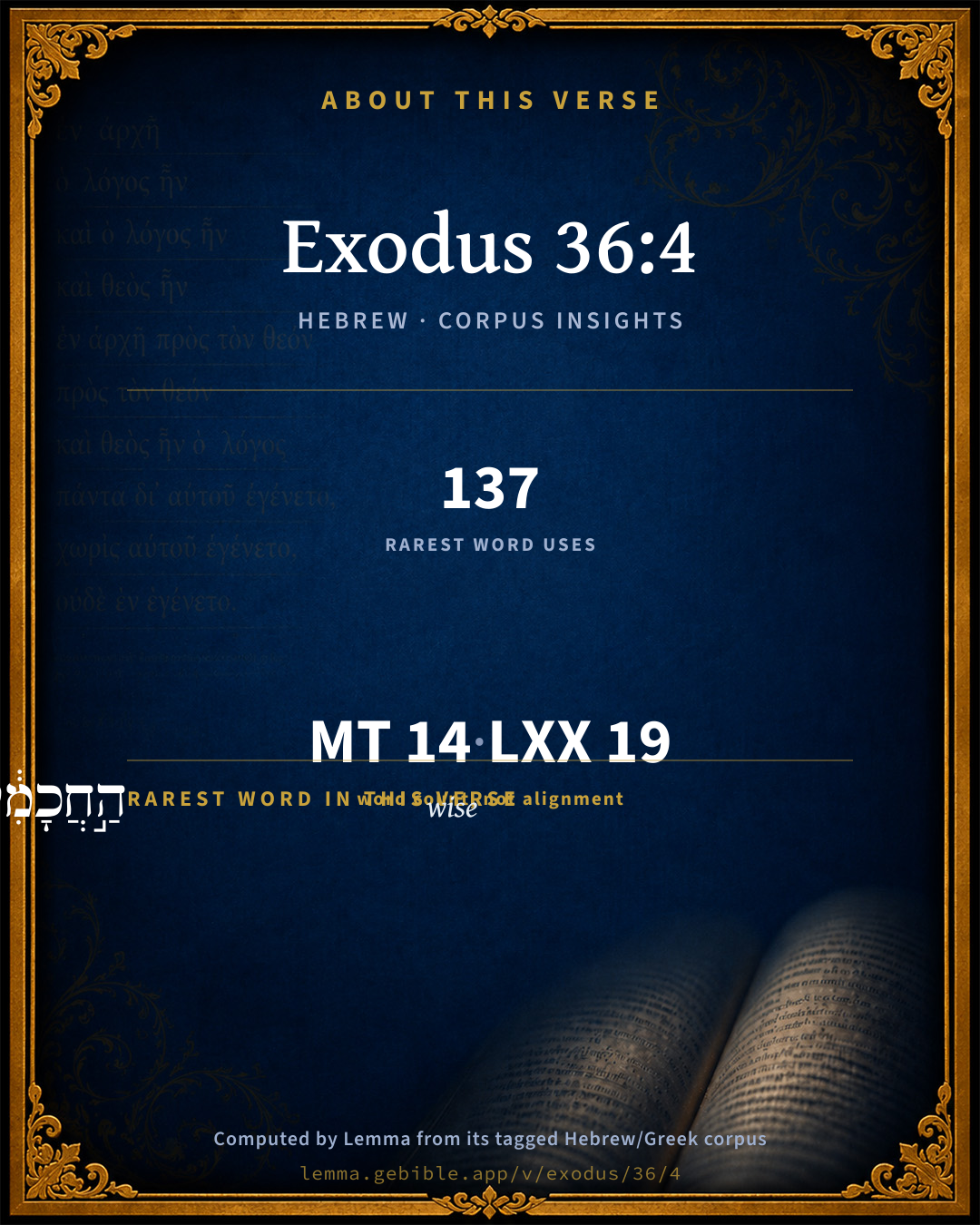
הַ֣חֲכָמִ֔ים
châkâm
H2450
“the · wise”
Particle, Definite Article + Adjective, Adjective, Masculine, Plural, Absolute
Part of Speech
Particle + Adjective
Type
Adjective
Gender
Masculine
Number
Plural
State
Absolute
Full BDB Definition

Origin: from H2449

TWOT: 647b

wise, wise (man) - skilful (in technical work) - wise (in administration) - shrewd, crafty, cunning, wily, subtle - learned, shrewd (class of men) - prudent - wise (ethically and religiously)
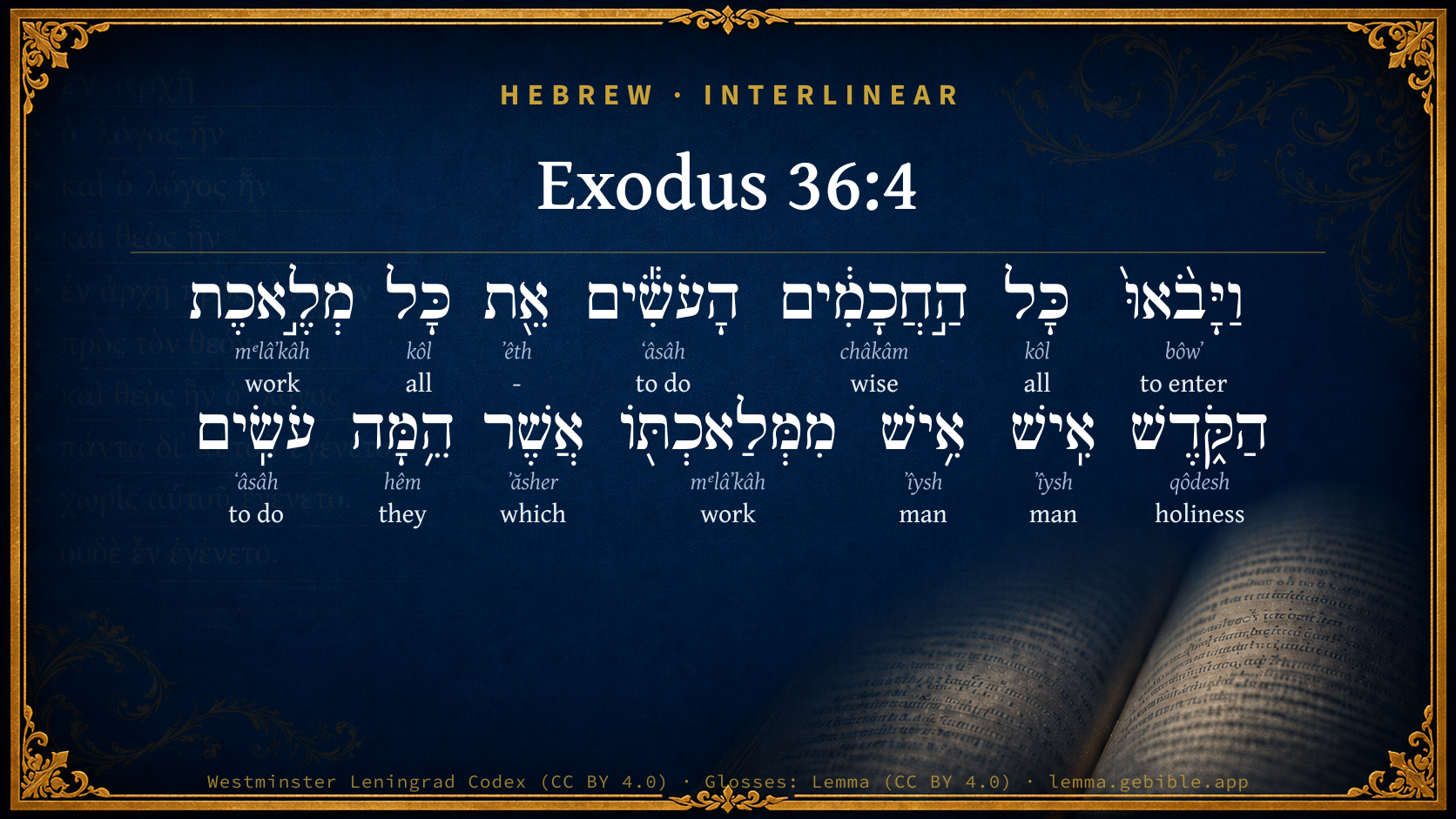
  1. וַיָּבֹ֨אוּ֙ bôwʼ H935 “and · to enter” Conjunction + Verb, Qal, Sequential Imperfect, 3rd Person, Masculine, Plural
  2. כָּל kôl H3605 “all of” Noun, Common, Masculine, Singular, Construct
  3. הָעֹשִׂ֕ים ʻâsâh H6213 “the · doing” Particle, Definite Article + Verb, Qal, Participle Active, Masculine, Plural, Absolute
  4. אֵ֖ת ʼêth H853 “-” Particle, Direct Object
  5. כָּל kôl H3605 “all of” Noun, Common, Masculine, Singular, Construct
  6. מְלֶ֣אכֶת mᵉlâʼkâh H4399 “work of” Noun, Common, Feminine, Singular, Construct
  7. הַקֹּ֑דֶשׁ qôdesh H6944 “the · holiness” Particle, Definite Article + Noun, Common, Masculine, Singular, Absolute
  8. אִֽישׁ ʼîysh H376 “man” Noun, Common, Masculine, Singular, Absolute
  9. אִ֥ישׁ ʼîysh H376 “man” Noun, Common, Masculine, Singular, Absolute
  10. מִמְּלַאכְתּ֖וֹ mᵉlâʼkâh H4399 “from · work · his” Preposition + Noun, Common, Feminine, Singular, Construct + Suffix, Personal, 3rd Person, Masculine, Singular
  11. אֲשֶׁר ʼăsher H834 “which” Particle, Relative
  12. הֵ֥מָּה hêm H1992 “they” Pronoun, Personal, 3rd Person, Masculine, Plural
  13. עֹשִֽׂים ʻâsâh H6213 “doing” Verb, Qal, Participle Active, Masculine, Plural, Absolute

About this verse

These counts appear in no published source. They are computed here, from the morphology-tagged text and Lemma’s own curated glosses. What Lemma adds →

14
words
10
distinct lemmas
Pentateuch
section

Grammatical profile

  • 3 verbs
  • 7 nouns
  • 1 adjective
  • 1 pronoun
  • 2 particles

Verb forms

  • וַיָּבֹ֨אוּ֙ Qal · Sequential Imperfect
  • הָעֹשִׂ֕ים Qal · Participle Active
  • עֹשִֽׂים Qal · Participle Active

Repetition

Words recur within this verse — often emphatic in Hebrew:

  • כָּל all H3605 ×2
  • הָעֹשִׂ֕ים to do H6213 ×2
  • מְלֶ֣אכֶת work H4399 ×2
  • אִֽישׁ man H376 ×2

Hebrew & Septuagint length

In English translation the verse runs 20 words from the Hebrew and 23 from the Septuagint (LXX English) — closely comparable.

A rough comparison of the two English renderings, which tokenize alike — not a word-level alignment.

Word counts can differ between the Hebrew and the Greek without any difference in meaning — e.g. the Hebrew direct-object marker אֵת has no separate Greek word, and Greek often adds the article ὁ.

In the original languages it is 14 Hebrew tokens and 19 Greek tokens — but the two are counted differently (Hebrew bundles its prefixes and suffixes into one token; the Greek is in lemma form), so that isn’t a like-for-like length.

Cross-references

4

Topical passages linked to Exodus 36:4 in the Treasury of Scripture Knowledge — connected by theme and wording, ordered by reader-vote popularity; previews shown in the World English Bible.

  • Luke 12:42 The Lord said, "Who then is the faithful and wise steward, whom his lord will set over his household, to give them their portion of food at the right times?
  • 1 Corinthians 3:10 According to the grace of God which was given to me, as a wise master builder I laid a foundation, and another builds on it. But let each man be careful how he builds on it.
  • 2 Chronicles 24:13 So the workmen worked, and the work of repairing went forward in their hands, and they set up the house of God in its state, and strengthened it.
  • Matthew 24:45 "Who then is the faithful and wise servant, whom his lord has set over his household, to give them their food in due season?

Cross-references courtesy of OpenBible.info (CC BY 4.0).

Hebrew and Greek witnesses Masoretic Hebrew ↔ Greek Septuagint

The same verse in the two great witnesses to the Old Testament, shown verse-for-verse.

These are two independent witnesses, not word-aligned to each other, and the Septuagint is shown in lemma (dictionary) form.

Hebrew Exodus 36:4 Masoretic · Westminster Leningrad Codex

וַיָּבֹ֨אוּ֙ כָּל הַ֣חֲכָמִ֔ים הָעֹשִׂ֕ים אֵ֖ת כָּל מְלֶ֣אכֶת הַקֹּ֑דֶשׁ אִֽישׁ אִ֥ישׁ מִמְּלַאכְתּ֖וֹ אֲשֶׁר הֵ֥מָּה עֹשִֽׂים

All the wise men, who performed all the work of the sanctuary, each came from his work which they did.

World English Bible · Public Domain

Greek LXX Exodus 36:4 Septuagint · lemma form

καί παραγίγνομαι πᾶς ὁ σοφός ὁ ποιέω ὁ ἔργον ὁ ἅγιος ἕκαστος κατά ὁ αὐτός ἔργον ὅς αὐτός ἐργάζομαι

And there came all the wise men who wrought the works of the sanctuary, each according to his own work, which they wrought.

LXX2012 (modern English Septuagint) · Public Domain

Hebrew: Westminster Leningrad Codex (CC BY 4.0). Greek: Septuagint (public domain); English from LXX2012 (modern English Septuagint) (Public Domain). How the Septuagint differs from the Hebrew →

Targum (Aramaic paraphrase)

2

The Targum is the ancient Jewish Aramaic paraphrase of the Hebrew Scriptures — an interpretive translation, not the Hebrew text itself. Onkelos (literal) and Pseudo-Jonathan (expansive) render the Torah, and Jonathan the Prophets. Coverage is partial: where no permissively-licensed English translation exists for a verse, only the Aramaic is shown. This is verse-level text, not a word-by-word alignment to the Hebrew.

  1. Targum Onkelos Torah (Genesis–Deuteronomy)
    וַאֲתוֹ כָּל חַכִּימַיָא דְעָבְדִין יָת כָּל עִבִידַת קוּדְשָׁא גְבַר גְבַר מֵעִבִדְתֵּהּ דְאִנוּן עָבְדִין:

    (no public-domain English translation for this verse)

    Targum Onkelos — Aramaic: “Onkelos Genesis” (public domain); “Onkelos Exodus” (public domain); “Onkelos Leviticus” (public domain); “Onkelos Numbers” (public domain); “Onkelos Deuteronomy” (public domain). English: “Sefaria Community Translation” (CC0 1.0 (public-domain dedication)); “J.W. Etheridge. The Targums of Onkelos and Jonathan Ben Uzziel on the Pentateuch. London: Longmans, Green, 1862” (public domain). Text via Sefaria.

  2. Targum Pseudo-Jonathan Torah (Genesis–Deuteronomy)
    וְאָתוּ כָּל חַכִּימַיָא דְעָבְדִין יַת כָּל עִיבִידַת קוּדְשָׁא גְּבַר גְּבַר מֵעִבִידְתֵּיהּ דְּהִינוּן עָבְדִין

    And all the wise men who did all the work of the sanctuary came, each man from the work which he had done;

    Targum Pseudo-Jonathan — Aramaic: “Targum Jonathan on Genesis” (public domain); “Targum Jonathan on Exodus” (public domain); “Targum Jonathan on Leviticus” (public domain); “Targum Jonathan on Numbers” (public domain); “Targum Jonathan on Deuteronomy” (public domain). English: “The Targum of Jonathan ben Uzziel, trans. J. W. Etheridge, London, 1862” (public domain). Text via Sefaria.

Commentary

Notes on Exodus 36:4 from classic Christian and Jewish commentators (each source and its license shown beneath its notes). The classic Christian expositions comment on the surrounding passage and are grouped to its opening verse, so a note may address several verses; the Jewish commentaries on the Tanakh (Rashi and others) are per-verse, so they appear only where the commentator wrote on this verse.

Lemma curates 59 commentaries, every one of them public domain or Creative Commons licensed, each selected and text-cleaned for this edition rather than reprinted as found. About our sources →

The Cambridge Bible for Schools and Colleges

gen. ed. J. J. S. Perowne

4. wrought] were working.

The Cambridge Bible for Schools and Colleges (gen. ed. J. J. S. Perowne; Cambridge University Press, 1878–1918) — public domain. Text from a community e-Sword module.

John Gill's Exposition

And all the wise men that wrought all the work of the sanctuary,.... The ingenious artificers who were employed, some in one thing, and some in another, either on the tabernacle itself, or the vessels of it, and things appertaining to it:

came every man from his work which they made; left off their work by mutual consent and agreement, and came in a body to Moses.

John Gill's Exposition of the Whole Bible (1746–1763) — public domain (CC PDM 1.0). Text via the HelloAO Bible API.

The Pulpit Commentary

Vers. 4, 5. At last, remonstrance had to be made. The workmen were cumbered with an overplus of material an embarras de richesses and came in a body to Moses, to make complaint. All the wise men came, every man from his work, with the cry The people bring much more than enough we are hampered in our work by the too great abundance let an end be put to it."

The Pulpit Commentary (1880–1919), ed. H.D.M. Spence-Jones & Joseph S. Exell — public domain. Text from a community e-Sword module.

Keil & Delitzsch

C. F. Keil & F. Delitzsch

Then the wise workmen came, every one from his work that they were making, and said to Moses, "Much make the people to bring, more than suffices for the labour (the finishing, as in Exo 27:19) of the work," i.e., they are bringing more than will be wanted for carrying out the work (the מן in מדּי is comparative); whereupon Moses let the cry go through the camp, i.e., had proclamation made, "No one is to make any more property (מלאכה as in Exo 22:7, Exo 22:10, cf. Gen 33:14) for a holy heave-offering," i.e., to prepare anything more from his own property to offer for the building of the sanctuary; and with this he put a stop to any further offerings.

Keil & Delitzsch — Biblical Commentary on the Old Testament (1861–1891) — public domain (CC PDM 1.0). Text via the HelloAO Bible API. (Old Testament only.)

Lesson kit

Teaching starters — assembled from the data on this page, not authored interpretation. Every prompt links to the verse data it draws on. Edit before teaching.

Exodus, in the Pentateuch, opens this verse with 14 words (10 distinct Hebrew lemmas). Its most distinctive word is châkâm (“wise”). A historical commentator’s framing appears above. Read the whole chapter for the surrounding context.

Discussion questions

  1. What does “wise” (châkâm) contribute to the verse as a whole?
  2. How does Luke 12:42, which shares this passage’s theme, read alongside this verse?
  3. What does the repetition of “all” (2× in this one verse) do in this verse?
  4. The translations on this page render this verse differently — a whole-verse word diff, not a word-by-word alignment. What might account for the different wordings?
  5. «וַיָּבֹ֨אוּ֙» is a Qal Sequential Imperfect verb. How does that grammatical form shape the action described?
  6. Compare how The Cambridge Bible for Schools and Colleges and John Gill's Exposition read this verse. Where do they agree or differ?

Things to notice

Reading settings

Reading text

Shown beneath each verse's original-language words.

Old Testament
Old Testament edition

Read the OT as the Masoretic Hebrew (MT) or the Greek Septuagint (LXX).

English shown for the Greek Septuagint (in the Hebrew ↔ Greek comparison).

Comparing translations? Open the Compare panel on any verse page to stack up to four side by side.