1 Kings 13:20

Hebrew (Westminster Leningrad Codex) 1 Kings 13:20 appears in the Hebrew Old Testament. The text above is from the Westminster Leningrad Codex. Each word links to its Strong’s number, a concise gloss, and parsing drawn from the Open Scriptures Hebrew Bible morphology. Click any word for its full Brown-Driver-Briggs (BDB) entry.
Download image
Cite this verse

1 Kings 13:20 (World English Bible). Public Domain. Lemma interlinear Bible study tool, https://lemma.gebible.app/v/1-kings/13/20.

Show BibTeX & RIS
BibTeX
RIS
English Translation
It happened, as they sat at the table, that the word of Yahweh came to the prophet who brought him back;
World English Bible · Public Domain
Download a study sheet

One document with this verse’s original text, its word-by-word gloss line, the meaning frame, cross-references with their text, attributed commentary, and full source and license credits — printable, and it pastes into notes with its structure intact.

This verse Autodidact and up

Study sheet (.html) Plain text (.txt)

A passage Seminary Student

Up to 50 verses in one chapter. A passage sheet keeps up to 6 commentary sources and 12 cross-references per verse, in the order this page ranks them, and says so on the sheet whenever that leaves anything out. Ask for a single verse and you get the Autodidact verse sheet above.

Everything on this page stays free to read, with no account — the sheet is a download of what is already on screen, not access to it.

Want to remove ads? Support Godless Engineer
Compare translations 3

The same verse in 3 English versions, stacked beneath the original-language interlinear above. Click any original word for its lexicon entry.

Each is an independent rendering of the whole verse — the interlinear is not word-aligned to these translations.

Highlighted words mark where these versions differ — a whole-verse word diff, not a word-by-word alignment.

  • World English Bible Public Domain
    It happened, as they sat at the table, that the word of Yahweh came to the prophet who brought him back;
  • King James Version Public Domain
    And it came to pass, as they sat at the table, that the word of the LORD came unto the prophet that brought him back:
  • unfoldingWord Literal Text CC BY-SA 4.0
    And it happened, they were sitting at the table, that the word of Yahweh to the prophet who had brought him back.

unfoldingWord Literal Text — © unfoldingWord, licensed CC BY-SA 4.0. Word-aligned USFM3 via Door43 (git.door43.org/unfoldingWord/en_ult).

Versions to compare (up to 4)

3 of 4 selected

Show all 18 translations

Every available English version of this verse, each an independent rendering of the whole verse.

  • World English Bible Public Domain
    It happened, as they sat at the table, that the word of Yahweh came to the prophet who brought him back;
  • Berean Standard Bible Public Domain
    While they were sitting at the table, the word of the LORD came to the prophet who had brought him back,
  • Majority Standard Bible Public Domain
    While they were sitting at the table, the word of the LORD came to the prophet who had brought him back,
  • King James Version Public Domain
    And it came to pass, as they sat at the table, that the word of the LORD came unto the prophet that brought him back:
  • American Standard Version (1901) Public Domain
    And it came to pass, as they sat at the table, that the word of Jehovah came unto the prophet that brought him back;
  • Revised Version (1885) Public Domain
    And it came to pass, as they sat at the table, that the word of the LORD came unto the prophet that brought him back:
  • Geneva Bible (1599) Public Domain
    And as they sate at the table, the worde of the Lord came vnto the Prophet, that brought him againe.
  • Douay-Rheims (1899) Public Domain
    And as they sat at table, the word of the Lord came to the prophet that brought him back:
  • Young's Literal Translation Public Domain
    And it cometh to pass -- they are sitting at the table -- and a word of Jehovah is unto the prophet who brought him back,
  • Literal Standard Version CC BY-SA 4.0
    And it comes to pass—they are sitting at the table—and [there] is a word of YHWH to the prophet who brought him back,
  • Unlocked Literal Bible CC BY-SA 4.0
    As they sat at the table, the word of Yahweh came to the prophet who had brought him back,
  • unfoldingWord Literal Text CC BY-SA 4.0
    And it happened, they were sitting at the table, that the word of Yahweh to the prophet who had brought him back.
  • Darby Bible Public Domain
    And it came to pass as they sat at the table, that the word of Jehovah came to the prophet that brought him back;
  • World Messianic Bible Public Domain
    As they sat at the table, the LORD’s word came to the prophet who brought him back;
  • Webster's Bible Public Domain
    And it came to pass, as they sat at the table, that the word of the LORD came to the prophet that brought him back:
  • Free Bible Version CC BY-SA 4.0
    As they were sitting at the table, a message from the Lord came to the prophet who had brought him back.
  • Bible in Basic English Public Domain
    But while they were seated at the table, the word of the Lord came to the prophet who had taken him back;
  • JPS Tanakh (1917) Public Domain
    And it came to pass, as they sat at the table, that the word of the LORD came unto the prophet that brought him back.

Literal Standard Version (2020), Covenant Press — licensed CC BY-SA 4.0. Text via the HelloAO Bible API (eBible.org). Unlocked Literal Bible (unfoldingWord) — licensed CC BY-SA 4.0. Text via the HelloAO Bible API (eBible.org). unfoldingWord Literal Text — © unfoldingWord, licensed CC BY-SA 4.0. Word-aligned USFM3 via Door43 (git.door43.org/unfoldingWord/en_ult). Free Bible Version, Dr. Jonathan Gallagher — licensed CC BY-SA 4.0. Text via the HelloAO Bible API (eBible.org).

Word by word

More ways to search: Search by grammar → Find every occurrence → Compare this word →

Practice this passage: Drill this verse → Learn its vocabulary →

הַשֻּׁלְחָ֑ן
shulchân
H7979
“the · table”
Particle, Definite Article + Noun, Common, Masculine, Singular, Absolute
Part of Speech
Particle + Noun
Type
Common
Gender
Masculine
Number
Singular
State
Absolute
Full BDB Definition

Origin: from H7971

TWOT: 2395a

table - table - of king's table, private use, sacred uses
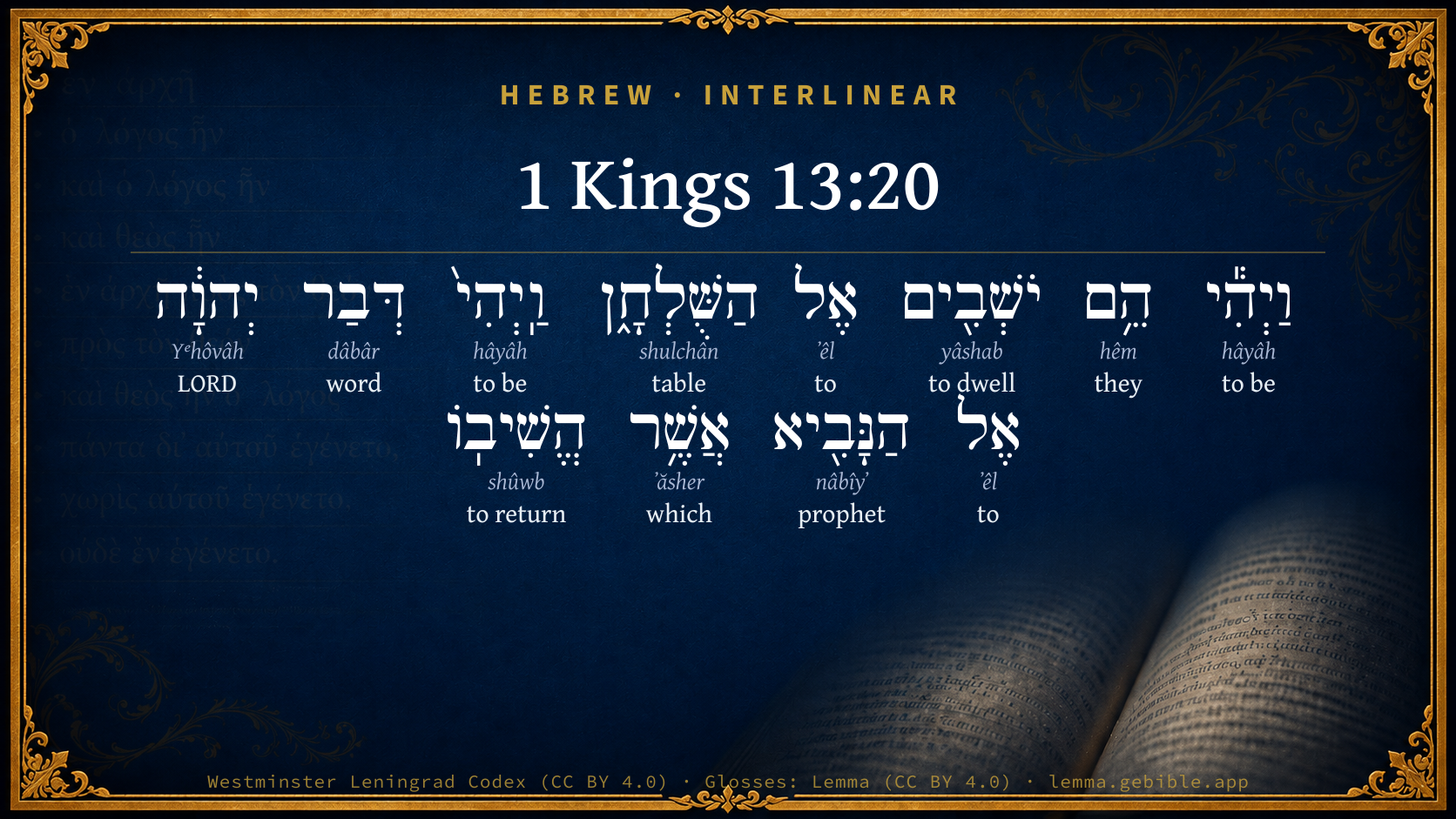
  1. וַיְהִ֕י hâyâh H1961 “and · to be” Conjunction + Verb, Qal, Sequential Imperfect, 3rd Person, Masculine, Singular
  2. הֵ֥ם hêm H1992 “they” Pronoun, Personal, 3rd Person, Masculine, Plural
  3. יֹשְׁבִ֖ים yâshab H3427 “dwelling” Verb, Qal, Participle Active, Masculine, Plural, Absolute
  4. אֶל ʼêl H413 “to” Preposition
  5. וַֽיְהִי֙ hâyâh H1961 “and · to be” Conjunction + Verb, Qal, Sequential Imperfect, 3rd Person, Masculine, Singular
  6. דְּבַר dâbâr H1697 “word of” Noun, Common, Masculine, Singular, Construct
  7. יְהוָ֔ה Yᵉhôvâh H3068 “LORD” Noun, Proper
  8. אֶל ʼêl H413 “to” Preposition
  9. הַנָּבִ֖יא nâbîyʼ H5030 “the · prophet” Particle, Definite Article + Noun, Common, Masculine, Singular, Absolute
  10. אֲשֶׁ֥ר ʼăsher H834 “which” Particle, Relative
  11. הֱשִׁיבֽוֹ shûwb H7725 “to return · him” Verb, Hiphil, Perfect, 3rd Person, Masculine, Singular + Suffix, Personal, 3rd Person, Masculine, Singular

About this verse

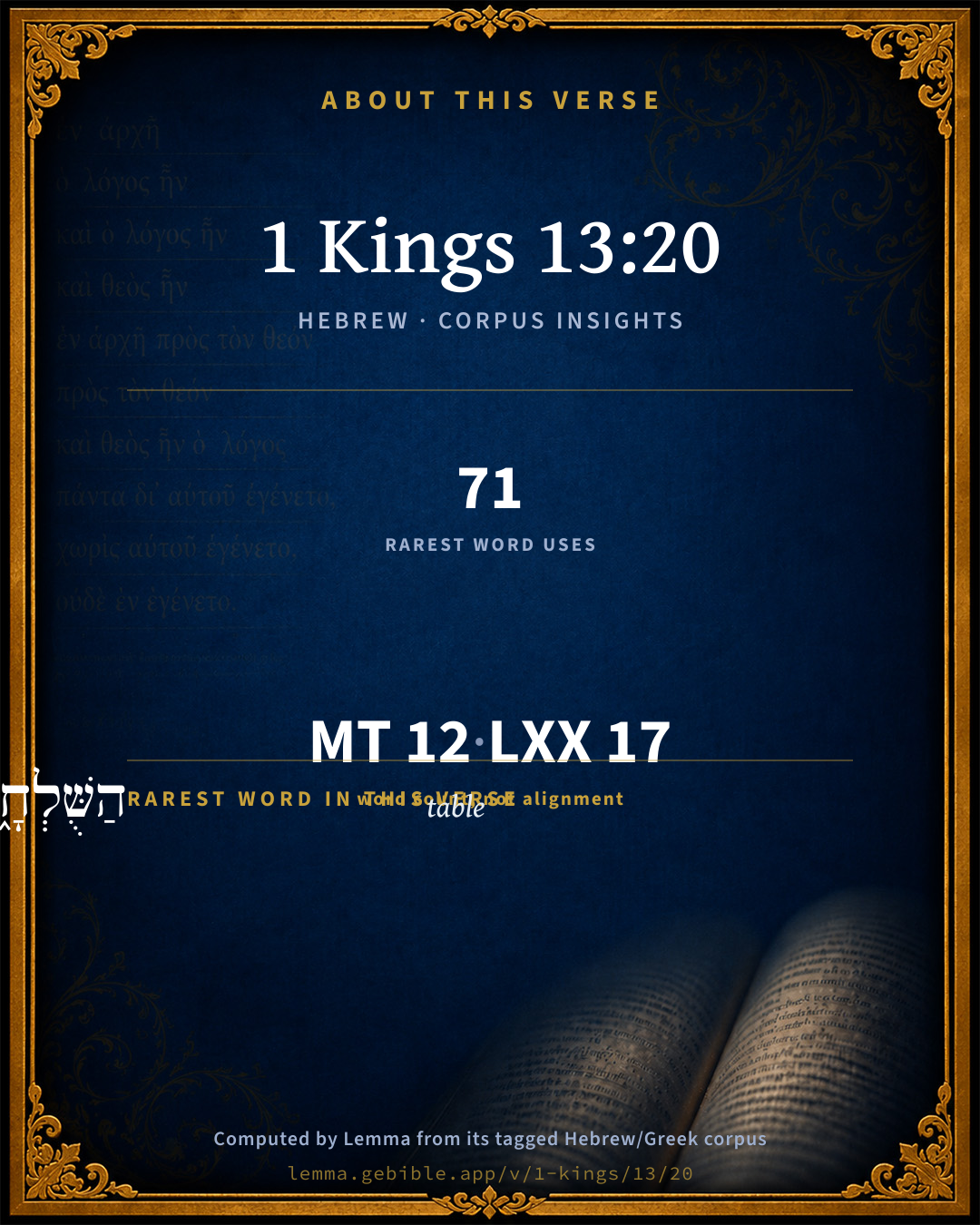
These counts appear in no published source. They are computed here, from the morphology-tagged text and Lemma’s own curated glosses. What Lemma adds →

12
words
10
distinct lemmas
Historical
section

Grammatical profile

  • 4 verbs
  • 4 nouns
  • 1 pronoun
  • 2 prepositions
  • 1 particle

Verb forms

  • וַיְהִ֕י Qal · Sequential Imperfect
  • יֹשְׁבִ֖ים Qal · Participle Active
  • וַֽיְהִי֙ Qal · Sequential Imperfect
  • הֱשִׁיבֽוֹ Hiphil · Perfect

Repetition

Words recur within this verse — often emphatic in Hebrew:

  • וַיְהִ֕י to be H1961 ×2
  • אֶל to H413 ×2

Hebrew & Septuagint length

In English translation the verse runs 21 words from the Hebrew and 26 from the Septuagint (LXX English) — closely comparable.

A rough comparison of the two English renderings, which tokenize alike — not a word-level alignment.

Word counts can differ between the Hebrew and the Greek without any difference in meaning — e.g. the Hebrew direct-object marker אֵת has no separate Greek word, and Greek often adds the article ὁ.

In the original languages it is 12 Hebrew tokens and 17 Greek tokens — but the two are counted differently (Hebrew bundles its prefixes and suffixes into one token; the Greek is in lemma form), so that isn’t a like-for-like length.

Cross-references

7

Topical passages linked to 1 Kings 13:20 in the Treasury of Scripture Knowledge — connected by theme and wording, ordered by reader-vote popularity; previews shown in the World English Bible.

  • Numbers 23:5 Yahweh put a word in Balaam's mouth, and said, Return to Balak, and thus you shall speak.
  • Numbers 23:16 Yahweh met Balaam, and put a word in his mouth, and said, Return to Balak, and thus shall you speak.
  • Numbers 24:4 He says, who hears the words of God, Who sees the vision of the Almighty, Falling down, and having his eyes open:
  • Numbers 24:16–24 He says, who hears the words of God, Knows the knowledge of the Most High, Who sees the vision of the Almighty, Falling down, and having his eyes open:
  • Matthew 7:22 Many will tell me in that day, 'Lord, Lord, didn't we prophesy in your name, in your name cast out demons, and in your name do many mighty works?'
  • John 11:51 Now he didn't say this of himself, but being high priest that year, he prophesied that Jesus would die for the nation,
  • 1 Corinthians 13:2 If I have the gift of prophecy, and know all mysteries and all knowledge; and if I have all faith, so as to remove mountains, but don't have love, I am nothing.

Cross-references courtesy of OpenBible.info (CC BY 4.0).

Hebrew and Greek witnesses Masoretic Hebrew ↔ Greek Septuagint

The same verse in the two great witnesses to the Old Testament, shown verse-for-verse.

These are two independent witnesses, not word-aligned to each other, and the Septuagint is shown in lemma (dictionary) form.

Hebrew 1 Kings 13:20 Masoretic · Westminster Leningrad Codex

וַיְהִ֕י הֵ֥ם יֹשְׁבִ֖ים אֶל הַשֻּׁלְחָ֑ן וַֽיְהִי֙ דְּבַר יְהוָ֔ה אֶל הַנָּבִ֖יא אֲשֶׁ֥ר הֱשִׁיבֽוֹ

It happened, as they sat at the table, that the word of Yahweh came to the prophet who brought him back;

World English Bible · Public Domain

Greek LXX 1 Kings 13:20 Septuagint · lemma form

καί γίγνομαι αὐτός καταἧμαι ἐπί ὁ τράπεζα καί γίγνομαι λόγος κύριος πρός ὁ προφήτης ὁ ἐπιστρέφω αὐτός

And it came to pass while they were sitting at the table, that the word of the Lord came to the prophet that brought him back;

LXX2012 (modern English Septuagint) · Public Domain

Hebrew: Westminster Leningrad Codex (CC BY 4.0). Greek: Septuagint (public domain); English from LXX2012 (modern English Septuagint) (Public Domain). How the Septuagint differs from the Hebrew →

Targum (Aramaic paraphrase)

1

The Targum is the ancient Jewish Aramaic paraphrase of the Hebrew Scriptures — an interpretive translation, not the Hebrew text itself. Onkelos (literal) and Pseudo-Jonathan (expansive) render the Torah, and Jonathan the Prophets. Coverage is partial: where no permissively-licensed English translation exists for a verse, only the Aramaic is shown. This is verse-level text, not a word-by-word alignment to the Hebrew.

  1. Targum Jonathan Prophets (Joshua–Malachi)
    וַהֲוָה עַד דְאִינוּן מְסַחֲרִין עַל פָּתוֹרָא וַהֲוָה פִתְגָם נְבוּאָה מִן קֳדָם יְיָ לִנְבִיָא דַאֲתָבֵיהּ:

    (no public-domain English translation for this verse)

    Targum Jonathan — Aramaic: “Mikraot Gedolot” (public domain). English: “Sefaria Community Translation” (CC0 1.0 (public-domain dedication)); “London "Chaldee Paraphrase," 1871” (public domain). Text via Sefaria.

Commentary

Notes on 1 Kings 13:20 from classic Christian and Jewish commentators (each source and its license shown beneath its notes). The classic Christian expositions comment on the surrounding passage and are grouped to its opening verse, so a note may address several verses; the Jewish commentaries on the Tanakh (Rashi and others) are per-verse, so they appear only where the commentator wrote on this verse.

Lemma curates 59 commentaries, every one of them public domain or Creative Commons licensed, each selected and text-cleaned for this edition rather than reprinted as found. About our sources →

Trapp's Complete Commentary

John Trapp

1Ki 13:20 And it came to pass, as they sat at the table, that the word of the LORD came unto the prophet that brought him back:

Ver. 20. And it came to pass, as they sat at the table.] Where this prophet was eating and drinking against God’s express charge, there doth he hear his doom denounced by the same mouth that had seduced him; Ut inde poenam veraciter sumeret unde culpam negligenter admisit, saith Gregory, that the punishment might answer to the sin.

That the word of the Lord came,] sc., By some internal inspiration, or prophetic ecstasy.

John Trapp, A Commentary or Exposition upon All the Books of the Old and New Testament (1647–1656) — public domain. Text from a community e-Sword module.

The Biblical Illustrator

Joseph S. Exell

1Ki_13:20-22

And it came to pass as they sat at the table.

The two erring prophets

1. If the word of God has spoken, the vision or the interpretation which essentially contradicts it cannot be followed without destruction. Nothing short of a real, well-attested revelation could have furnished a better excuse for departing from the word of the Lord; and yet for departing he was slain. Here a lesson Is written as it were on the arch of heaven, and hung out for a warning to all generations, not to depart, on any pretence, from the plain word of God. Whatever He has said we must believe and obey, and an angel from heaven must not be allowed to contradict it. We may compare Scripture with Scripture to ascertain what He has actually spoken; but that being determined, we must suffer neither our own reasoning, nor the authority or reasoning or ridicule or glosses of others to weaken our confidence in any revealed truth. Men act over again the part so strongly condemned in the history before us. They leave the plain revelation of God for another guide more congenial with their feelings. At the suggestion of others who set up pretensions to superior knowledge, or at the sole instance of their own depraved hearts, they depart from truth and duty in defiance of the plain prescriptions of Gods word. Let them beware. These paths lead down to death, and these steps take hold on hell. The Almighty God will rend them like a lion, and there shall be none to deliver. All this becomes more credible when we see, as we do in the account before us:

2. That it is some selfish and sinful bias which leads men to forsake the wool of God for fables. In the present ease it is most plain by what influence and by what process of mind the man of God came to believe the fatal lie. It was under the spur of an appetite awakened by long abstinence. Pressed with hunger and fainting with thirst, in a sultry climate in the heat of the day, no sooner was the sound in his ear that God had released him from the burdensome restraint, than he rushed to the conclusion that so it was. He opened his ear to hear the refreshing tidings, as he would his parched lips to receive the cooling draught. Any one can almost see the operations of his mind, who has ever studied his own. That selfish desire of personal gratification,--that impatience under the restriction of a burdensome command,--predisposed him to fall in with the suggestion, and to believe (for he doubtless did believe) that God had released him from the prohibition. How easily do men believe what they wish should be true. No man ever went over from the revelation of God to believe a lie, without being led by a selfish and sinful bias.

3. We perceive in this history how men, and even prophets, will lie to draw others from the pathway of the Lord. The Jewish priests and Roman soldiers equally conspired to cheat the world, by a deliberate lie, out of that infinitely important fact on which the whole Gospel rests. Every revival of religion brings out confessions of this sort. The religion of these several classes is a religion supported, not by their reason, but by their passions. So it was with the religion of Jeroboam.

4. It may be our duty so to bear testimony against errors and vices, as to refuse to eat or drink or associate with those on whom they are found. And when the evil is so great as to call for this marked condemnation, no feelings of courtesy ought to turn us aside from the course of duty; nor ought such a withdrawment to be stigmatised as uncharitableness or bigotry. All this is fully supported by the history before us.

5. We learn from the history before us that strong resistance of temptation will not screen us from death if we are overcome at last. This man of God made a noble stand against the temptation by which he fell. When men have long resisted temptation and are overcome at last, they are prone to raise some excuse from the resistance they have made. But there is no excuse. The virtue of their past resistance is annihilated. They have sinned, and the sentence is out that they must die.

6. Seducers are often made the instruments of punishing their own victims. The old prophet, after decoying the man of God to his house and table, is made the organ of the terrible denunciation against him. The tempter becomes the instrument of punishment. In sin and sinful things is found the punishment of sin. If you touch what is polluted, it will thrust you through with a dart.

7. From this illuminated section of Divine providence we learn that good men, when they transgress, are often more severely punished in this life than the wicked. Instead of being protected by the sanctity of their profession, their nearness to God, the dignity of their office, or any services they may have rendered, they frequently receive a double portion of the cup of trembling. But there is another reason why, under certain circumstances, God punishes His children in this life more than others. When their sins are public, it behoves Him to wipe off the aspersion thus cast upon Himself.

8. This piece of history affords a specimen of the complexness of Gods providence, and particularly the extensive effects which are sometimes connected with the punishment of His people, beyond the immediate ends of the chastisement. In the case under consideration, the immediate ends in view were to disown the communion which the prophet had held with idolaters, and to show those idolaters Gods abhorrence of sin, and His unalterable deter-ruination to punish it on whomsoever found. But besides these ends, the miraculous death of the prophet for disobeying what he had publicly declared to be a part of his instructions, furnished irresistible proof of his Divine mission, and of the truth of the prediction which he had hurled against the altar of idols. By his death also his body was left at Bethel, where his sepulchre, with a broad and legible inscription, hard by the temple of idols, daily delivered anew the same denunciations of heaven, and proved a standing testimony against the idolaters.

9. God corrects His children in measure, and does not let loose all His wrath, but in the midst of wrath remembers mercy. Thus always does He break the stroke by which He chastises His children; and when the end of the infliction is answered, He opens to them a Fathers heart. And at last, when for sin He has sunk them in death, He will set himself down to guard their dust until the last morning bids it rise. (E. D. Griffiths, D. D.)

The Biblical Illustrator, edited by Joseph S. Exell (c. 1880s–1900s) — public domain. Text from a community e-Sword module.

Joseph Benson's Commentary

1Ki 13:20-22. The word of the Lord came, &c. — God obliged the prophet, who had caused him to sin, to denounce a punishment against him for it, that it might the more affect him; nothing being more piercing than to be reflected on by those who have caused us to err. And he cried unto the man of God — With a loud voice, the effect of his passion, both for his own guilt and shame, and for the prophet’s approaching misery. Forasmuch as thou hast disobeyed the mouth of the Lord — That is, the word of command coming out of his mouth; thy carcass shall not come into the sepulchre of thy fathers — Thou shalt not die a natural, but a violent death, and that in this journey, before thou returnest to thy own habitation.

Joseph Benson's Commentary on the Old and New Testaments (1811–1818) — public domain. Text from a community e-Sword module.

Tyndale Open Study Notes

Tyndale Open Resources

13:20-22 Although the old prophet had lied, God communicated through him. The severe pronouncement against the man of God was that because of his disobedience, he would be denied burial in his ancestral tomb. This death sentence was quickly carried out. Disobedience to the clear command of God is a serious offense (Num 14:21-23; Deut 11:26-28).

Tyndale Open Study Notes — © Tyndale Open Resources, licensed CC BY-SA 4.0. Text via the HelloAO Bible API.

Adam Clarke's Commentary

Verse 20. The word of the Lord came unto the prophet that brought him back] "A great clamour," says Dr. Kennicott, "has been raised against this part of the history, on account of God's denouncing sentence on the true prophet by the mouth of the false prophet: but if we examine with attention the original words here, they will be found to signify either he who brought him back; or, whom he had brought back; for the very same words, אשר השיבו asher heshibo, occur again in 1Kg 13:23, where they are now translated, whom he had brought back; and where they cannot be translated otherwise. This being the case, we are at liberty to consider the word of the Lord as delivered to the true prophet thus brought back; and then the sentence is pronounced by GOD himself, calling to him out of heaven, as in Ge 22:11. And that this doom was thus pronounced by God, not by the false prophet, we are assured in 1Kg 13:26: 'The Lord hath delivered him unto the lion, according to the word of the Lord which HE spake unto him.' Josephus expressly asserts that the sentence was declared by God to the true prophet." The Arabic asserts the same.

Adam Clarke's Commentary on the Bible (1810–1826) — public domain. Text from a community e-Sword/MySword module.

Ellicott's Commentary for English Readers

(20) The word of the Lord came.—It is, perhaps, the most terrible feature in the history that the Divine sentence is spoken—no doubt, as in the case of Balaam, unwillingly—through the very lips which by falsehood had lured the prophet of Judah from the right path, and at the very table of treacherous hospitality. Josephus, with his perverse tendency to explain away all that seems startling, misses this point entirely, and assigns the revelation to the prophet of Judah himself. Striking as this incident is, it is perhaps a symbol of a general law constantly exemplifying itself, that the voice of worldly wisdom first beguiles the servants of God to disobedience by false glosses on their duty to Him, and then proclaims unsparingly their sin and its just punishment.

A Bible Commentary for English Readers, edited by Charles John Ellicott (1878–1897) — public domain. Text from a community e-Sword module.

The Cambridge Bible for Schools and Colleges

gen. ed. J. J. S. Perowne

20. as they sat at the table] They were having a proper meal. The expression ‘to eat bread and to drink water’ signifies ‘to take food and drink’ and must not be understood literally. The idea meant to be conveyed by the prohibition is that nothing of any sort was to be taken.

The Cambridge Bible for Schools and Colleges (gen. ed. J. J. S. Perowne; Cambridge University Press, 1878–1918) — public domain. Text from a community e-Sword module.

John Gill's Exposition

But camest back, and hast eaten bread and drunk water in the place, of the which the Lord did say to thee, eat no bread, nor drink no water,.... Which command he observed when first there, though invited by the king; and yet, after he had got out of the place, was prevailed upon to return and transgress the command:

thy carcass shall not come unto the sepulchre of thy fathers; signifying that he should die before he came to the land of Judah, and he should be buried in another place, and which was verified.

John Gill's Exposition of the Whole Bible (1746–1763) — public domain (CC PDM 1.0). Text via the HelloAO Bible API.

Haydock's Catholic Bible Commentary

Table. After this the Masorets place a piska, or circle, to denote some omission, which the Syriac version alone supplies; "and did eat." (Kennicott) --- Back. Some translate, "whom he had brought back." (Junius; Syriac, &c.) --- This would destroy the principal proof of those who esteem the man of Bethel to have been a true prophet. (Calmet) --- Protestants agree with us; and the context seems to assert, that God addressed his servant by another’s mouth. (Haydock)

George Leo Haydock (1774–1849), Haydock's Catholic Family Bible and Commentary, 1859 edition — public domain. Excludes Psalms (Douay-Rheims chapter numbering differs from Protestant) and Deuterocanonical books (Catholic canon only).

Matthew Poole's English Annotations

As they sat at the table; there the prophet meets with a severe judgment, where he was pleasing himself with this seasonable refreshment.

The word of the Lord came by secret instinct into his mind, as sometimes God spake to Moses and other prophets when they were in company with others.

Unto the prophet that brought him back; so he makes this prophet publicly to call himself liar, and to pronounce a terrible sentence against him, to whom he professed so much kindness. Indeed the Hebrew words are ambiguous, and by others rendered thus, to the prophet whom he had brought back which agrees very well with the Hebrew phrase, and may seem to be the best translation, by comparing 1Ki 13:23, where the very same phrase is so rendered; and 1Ki 13:26, where this message is said to be spoken to him. But these arguments are not cogent; not that from 1Ki 13:23, because it is a common thing for the same phrase in divers verses, and sometimes in one and the same verse, to be diversely used; nor that from 1Ki 13:27, for that may be rendered concerning him. And therefore our translation is better, as is manifest from 1Ki 13:21.

Matthew Poole's English Annotations on the Holy Bible (1683–1685) — public domain. Text from a community e-Sword/MySword module.

Whedon's Commentary on the Bible

Daniel D. Whedon

20. The word of the Lord came unto the prophet that brought him back — So God may often speak through a wicked prophet. So he did through Balaam, uttering the sublimest oracles of blessing, though that soothsayer would fain have cursed Israel. He made even the dumb ass speak with man’s voice, and rebuke the madness of the prophet. The attempt of Dr. Kennicott, to make the latter part of this verse mean the prophet whom he had brought back, is uncalled for, and precluded by the unmistakable meaning of the same words in 1Ki_13:26. On the faulty translation of the words in 1Ki_13:23 see note there.

Daniel D. Whedon (gen. ed.), Commentary on the Old and New Testaments (1874–1909) — public domain. Text from a community e-Sword module.

The Pulpit Commentary

And it came to pass, as they sat at the table cf. Psa_78:30. He is taken in the act, "even in the blossoms of his sin", that the word of the Lord came unto the prophet that brought him back.

Vers. 20-22.

The Voice of Reproof.

No man of God will deliberately sin against God (Joh_8:44; 1Jn_3:9 1Jn_5:18) But the good are liable to be surprised or deceived into transgression (Jam 1:18-15; 1Jn_2:1, 1Jn_2:2) We must be ever on our guard against the "wiles" and "depths" of Satan. For lack of vigilance this man of God fell into the snare, and we see here how he was reproved.

I HE SINNED AGAINST THE WORD OF JEHOVAH.

1. This is evident upon the face of the narrative.

(1) He came out of Judah "by the word of Jehovah." Cried against the altar at Bethel "in the word of Jehovah." Gave the sign upon the altar "by the word of Jehovah" (vers. 1, 2, 5).

(2) He professed that.his instructions not to eat in Mount Ephraim, but to return to Judah by another road, were by the same word. Professed to the king (ver. 9); to the old prophet (ver. 17).

2. But could not God revoke or modify His word?

(1) Certainly. He did so to Abraham. (see Gen_22:11, Gen_22:12) What had been might be.

(2) Upon the recognition of this principle the old prophet proceeded, and so far was the man of God from disputing it that he was taken in the snare (vers. 18, 19).

3. Wherein, then, was his fault? The revocation here came not with the evidence of the command. The command was immediately from "the mouth of the Lord" (per. 21). The revocation came immediately from the mouth of the old prophet. Note: We are responsible for the proper use of reason in religion.

(2) Faith in the word of the Lord must be implicit. The Bible is that word. The evidence that it is such is conclusive external, internal, collateral.

(3) Other voices must not be allowed to replace this. The voice of "nature," of "reason," of the "Church." We listen implicitly to these at our peril.

II BY THE WORD OF JEHOVAH HE WAS REPROVED.

1. This came to the man of God himself.

(1) The reading of the text would lead us to conclude that it came to the old prophet. The words wby r here rendered, "who brought him back," are in verse 23 construed, "whom he had brought back," and might be so construed here. Josephus asserts that the word of the Lord here came to the man of God; and so does the Arabic. In the 26th verse we are assured by the old prophet that this word of the Lord came to the man of God.

(2) According to this view it was "Jehovah" who "cried unto the man of God," viz., from heaven as He called to Abraham. (Gen_22:11) So, coming to himself, as the command did in the first instance, he had not to weigh contradictory testimonies from the old prophet, but was left without a doubt. God brings home sin with demonstration.

2. It came to him in the ripeness of his transgression.

(1) "As they sat at table." Conscience reproves the sinner in the very act of sin. This is the voice of God in the soul. But here was an external voice to which the internal voice responded. Conscience responds to the word or law of God.

(2) It came to all who were at the table. To the old prophet as well as to the man of God. His conscience, too, would respond to the voice of God. To the sons of the old prophet, if present, there would also be a voice. What will our emotions be when in the day of judgment all the mischief to which we have been accessories will be discovered?

3. It was terribly severe.

(1) He is doomed to dis. "Sin, when it is finished, bringeth forth death." We all die in consequence of sin entailed. But here is an actual "sin unto death". (1Jn_5:16)

(2) He is doomed to die abroad. The mention of his carcase not coming to the sepulchre of his fathers implied a violent death away from home. Possibly the manner of his death may have been made known to him (compare ver. 26; 1Ki_20:36) The word of God is not violated with impunity. What will be the case of those who seldom take pains to consult it? J.A.M.

HOMILIES BY J. WAITE Vers. 20-22.

The Disobedient Prophet.

The "old prophet," though here employed as the medium of a Divine message, had acted falsely towards his "brother" ("he lied unto him," ver. 18). The fact that he was content to remain in the land under the rule of Jeroboam was against him. As the Levites had been supplanted by a base priesthood, so the prophets in Israel would seem to be a degenerate race. It must have aggravated the bitterness of the remorse the "man of God" felt, that the prophet who had dealt so treacherously with him should be commissioned to pronounce the Divine sentence on his transgression. His case seems altogether a hard one. How shall we explain it? What lessons does it teach?

I THE INFLEXIBILITY OF A DIVINE COMMAND. The command had been given clearly and positively (ver. 9), and He who gave it had in no way revoked it. The reasons for it remained as they were. The man of God greatly erred in giving more weight to the report of an angelic message delivered to another than to the clear voice of "the word of the Lord" in his own soul. "God is not a man, that he should lie; nor the son of man, that he should repent", (Num_23:19) and His commands can be abrogated only by others that are equally explicit and authoritative.

II THE DANGER OF PARLEYING WITH THE TEMPTER. The integrity of the man of God was imperilled as soon as he began to listen to the persuasion that would lead him astray. The first deliverances of conscience are generally right, and we run great moral risk when we begin to question them. He who had resisted the allurements of the king yields to those of the seeming prophet. Moral evil is always most fascinating when it assumes a sacred disguise, and the false "prophet" is the most plausible and dangerous of all tempters.

III THE GUILT OF DISOBEDIENCE. "To obey is better than sacrifice," etc.. (1Sa_15:22, 1Sa_15:23) The spirit of disobedience is the root of all practical iniquity. "By one man"s disobedience many were made sinners". (Rom_5:19) A seemingly trifling offence may thus, especially under certain circumstances, have an important meaning, and entail fatal consequences out of all proportion to its outward form. It is on this principle, that every act of wilful wrong is a violation of the spirit of obedience, that St. James says, "Whosoever shall keep the whole law, and yet offend in one point, he is guilty of all". (Jam_2:10)

IV THE TEMPORAL PENALTIES THAT FOLLOW THE SIN EVEN OF GOOD MEN. The "man of God" may have been at heart a true prophet, and may have received in another world the eternal reward of the true prophet; but his transgression involved him in a violent death, and he was denied the privilege, so much desired by every Hebrew, of having his body laid in the "sepulchre of his fathers." Sin may be pardoned and yet punished. The temporal penalty may be inflicted though Divine mercy cancels the eternal. David"s sin is forgiven, but his child must die. (2Sa_12:13, 2Sa_12:14) Christ is "the propitiation for our sins," and His blood "cleanseth us from all sin," but He promises us no immunity from the ill effects, the shame and loss and pain and sorrow in which our sin may in this world involve us. W.

The Pulpit Commentary (1880–1919), ed. H.D.M. Spence-Jones & Joseph S. Exell — public domain. Text from a community e-Sword module.

Keil & Delitzsch

C. F. Keil & F. Delitzsch

As they were sitting at table the word of the Lord came to the old prophet, so that he cried out to the man of God from Judah: "Because thou hast been rebellious against the command of the Lord, and hast not kept the commandment, ... thou wilt not come to the grave of thy fathers," i.e., thou wilt meet with a violent death by the way. This utterance was soon fulfilled.

Keil & Delitzsch — Biblical Commentary on the Old Testament (1861–1891) — public domain (CC PDM 1.0). Text via the HelloAO Bible API. (Old Testament only.)

unfoldingWord translationNotes

Door43 World Missions Community

As they sat at the table

The implied information is that they were still eating and drinking at the table. AT: "As they were eating and drinking at the table" (See: Assumed Knowledge and Implicit Information)

the word of Yahweh came to the prophet ... came from Judah, saying, "Yahweh

The idiom "the word of Yahweh came to" is used to introduce a special message from God. See how you translated a similar phrase in 1 Kings 6:11. AT: "Yahweh gave a message to the prophet ... came from Judah. He said, 'Yahweh" or "Yahweh spoke this message to the prophet ... came from Judah: 'Yahweh" (See: Idiom)

the word of Yahweh came

This idiom is used to introduce a special message from God. AT: "Yahweh gave a message" or "Yahweh spoke" (See: Idiom)

brought him back

Here the word "him" refers to the man of God.

he cried to the man of God

"the prophet spoke loudly to the man of God"

Because you have been disobedient to the word of Yahweh

"Because you have not obeyed the word of Yahweh"

translationWords

prophet

kingdom of Judah

Yahweh

disobey

command

bury

grave

ancestor

unfoldingWord translationNotes — © Distant Shores Media and the Door43 World Missions Community, licensed CC BY-SA 4.0. Source: git.door43.org/Door43/en_tn.

Rashi

Rabbi Shlomo Yitzchaki (Rashi)

To the prophet. The false prophet.

That caused him to return. To the man of God. From here they [the Rabbis] deduced that [offering] refreshment is a great thing, for it causes the Divine Presence to rest on the prophets of the Baal.

Rashi on the Tanakh — English translations: “The Judaica Press complete Tanach with Rashi, translated by A. J. Rosenberg” (CC BY 4.0); “Pentateuch with Rashi's commentary by M. Rosenbaum and A.M. Silbermann, 1929-1934” (public domain); “The Metsudah Tanach series, Lakewood, N.J” (CC BY 4.0); and “The Book of Joshua, Metsudah Publications, 1997” (CC BY 4.0). Text via Sefaria.

Lesson kit

Teaching starters — assembled from the data on this page, not authored interpretation. Every prompt links to the verse data it draws on. Edit before teaching.

1 Kings, in the Historical, opens this verse with 12 words (10 distinct Hebrew lemmas). Its most distinctive word is shulchân (“table”). A historical commentator’s framing appears above. Read the whole chapter for the surrounding context.

Discussion questions

  1. What does “table” (shulchân) contribute to the verse as a whole?
  2. How does Numbers 23:5, which shares this passage’s theme, read alongside this verse?
  3. What does the repetition of “to be” (2× in this one verse) do in this verse?
  4. These translations render this verse differently. What is at stake in choosing one wording over another?
  5. «וַיְהִ֕י» is a Qal Sequential Imperfect verb. How does that grammatical form shape the action described?
  6. Compare how Trapp's Complete Commentary and The Biblical Illustrator read this verse. Where do they agree or differ?

Things to notice

Reading settings

Reading text

Shown beneath each verse's original-language words.

Old Testament
Old Testament edition

Read the OT as the Masoretic Hebrew (MT) or the Greek Septuagint (LXX).

English shown for the Greek Septuagint (in the Hebrew ↔ Greek comparison).

Comparing translations? Open the Compare panel on any verse page to stack up to four side by side.