
Judges 20:28

Hebrew (Westminster Leningrad Codex) Judges 20:28 appears in the Hebrew Old Testament. The text above is from the Westminster Leningrad Codex. Each word links to its Strong’s number, a concise gloss, and parsing drawn from the Open Scriptures Hebrew Bible morphology. Click any word for its full Brown-Driver-Briggs (BDB) entry.
Download image
Cite this verse

Judges 20:28 (World English Bible). Public Domain. Lemma interlinear Bible study tool, https://lemma.gebible.app/v/judges/20/28.

Show BibTeX & RIS
BibTeX
RIS
English Translation
and Phinehas, the son of Eleazar, the son of Aaron, stood before it in those days), saying, Shall I yet again go out to battle against the children of Benjamin my brother, or shall I cease? Yahweh said, Go up; for tomorrow I will deliver him into your hand.
World English Bible · Public Domain
Download a study sheet

One document with this verse’s original text, its word-by-word gloss line, the meaning frame, cross-references with their text, attributed commentary, and full source and license credits — printable, and it pastes into notes with its structure intact.

This verse Autodidact and up

Study sheet (.html) Plain text (.txt)

A passage Seminary Student

Up to 50 verses in one chapter. A passage sheet keeps up to 6 commentary sources and 12 cross-references per verse, in the order this page ranks them, and says so on the sheet whenever that leaves anything out. Ask for a single verse and you get the Autodidact verse sheet above.

Everything on this page stays free to read, with no account — the sheet is a download of what is already on screen, not access to it.

Want to remove ads? Support Godless Engineer
Compare translations 3

The same verse in 3 English versions, stacked beneath the original-language interlinear above. Click any original word for its lexicon entry.

Each is an independent rendering of the whole verse — the interlinear is not word-aligned to these translations.

Highlighted words mark where these versions differ — a whole-verse word diff, not a word-by-word alignment.

  • World English Bible Public Domain
    and Phinehas, the son of Eleazar, the son of Aaron, stood before it in those days), saying, Shall I yet again go out to battle against the children of Benjamin my brother, or shall I cease? Yahweh said, Go up; for tomorrow I will deliver him into your hand.
  • King James Version Public Domain
    And Phinehas, the son of Eleazar, the son of Aaron, stood before it in those days,) saying, Shall I yet again go out to battle against the children of Benjamin my brother, or shall I cease? And the LORD said, Go up; for to morrow I will deliver them into thine hand.
  • unfoldingWord Literal Text CC BY-SA 4.0
    (and Phinehas, the son of Eleazar, the son of Aaron, standing to the face of it in those days), saying, “Shall I resume again to go out to battle with the sons of Benjamin, my brother, or shall I stop?” And Yahweh said, “Go up, for tomorrow I will give him into your hand.”

unfoldingWord Literal Text — © unfoldingWord, licensed CC BY-SA 4.0. Word-aligned USFM3 via Door43 (git.door43.org/unfoldingWord/en_ult).

Versions to compare (up to 4)

3 of 4 selected

Show all 18 translations

Every available English version of this verse, each an independent rendering of the whole verse.

  • World English Bible Public Domain
    and Phinehas, the son of Eleazar, the son of Aaron, stood before it in those days), saying, Shall I yet again go out to battle against the children of Benjamin my brother, or shall I cease? Yahweh said, Go up; for tomorrow I will deliver him into your hand.
  • Berean Standard Bible Public Domain
    and Phinehas son of Eleazar, the son of Aaron, served before it.) The Israelites asked, “Should we again go out to battle against our brothers the Benjamites, or should we stop?” The LORD answered, “Fight, for tomorrow I will deliver them into your hand.”
  • Majority Standard Bible Public Domain
    and Phinehas son of Eleazar, the son of Aaron, served before it.) The Israelites asked, “Should we again go out to battle against our brothers the Benjamites, or should we stop?” The LORD answered, “Fight, for tomorrow I will deliver them into your hand.”
  • King James Version Public Domain
    And Phinehas, the son of Eleazar, the son of Aaron, stood before it in those days,) saying, Shall I yet again go out to battle against the children of Benjamin my brother, or shall I cease? And the LORD said, Go up; for to morrow I will deliver them into thine hand.
  • American Standard Version (1901) Public Domain
    and Phinehas, the son of Eleazar, the son of Aaron, stood before it in those days), saying, Shall I yet again go out to battle against the children of Benjamin my brother, or shall I cease? And Jehovah said, Go up; for to-morrow I will deliver him into thy hand.
  • Revised Version (1885) Public Domain
    and Phinehas, the son of Eleazar, the son of Aaron, stood before it in those days,) saying, Shall I yet again go out to battle against the children of Benjamin my brother, or shall I cease? And the LORD said, Go up; for tomorrow I will deliver him into thine hand.
  • Geneva Bible (1599) Public Domain
    And Phinehas the sonne of Eleazar, the sonne of Aaron stoode before it at that time) saying, Shall I yet goe anie more to battel against the children of Beniamin my brethren, or shall I cease? And the Lord said, Go vp: for to morowe I will deliuer them into your hand.
  • Douay-Rheims (1899) Public Domain
    And Phinees the son of Eleazar the son of Aaron was over the house. So they consulted the Lord and said: Shall we go out any more to fight against the children of Benjamin our brethren, or shall we cease? And the Lord said to them: Go up, for to morrow I will deliver them into your hands.
  • Young's Literal Translation Public Domain
    and Phinehas son of Eleazar, son of Aaron, is standing before it in those days -- saying, `Do I add again to go out to battle with the sons of Benjamin, my brother, or do I cease?' And Jehovah saith, `Go up, for to-morrow I give him into thy hand.'
  • Literal Standard Version CC BY-SA 4.0
    and Phinehas son of Eleazar, son of Aaron, is standing before it in those days, saying, “Do I add to go out to battle again with the sons of my brother Benjamin, or do I cease?” And YHWH says, “Go up, for tomorrow I give him into your hand.”
  • Unlocked Literal Bible CC BY-SA 4.0
    and Phinehas, son of Eleazar son of Aaron, was serving before the ark in those days—”Should we go out to battle once more against the people of Benjamin, our brothers, or stop?” Yahweh said, “Attack, for tomorrow I will help you defeat them.”
  • unfoldingWord Literal Text CC BY-SA 4.0
    (and Phinehas, the son of Eleazar, the son of Aaron, standing to the face of it in those days), saying, “Shall I resume again to go out to battle with the sons of Benjamin, my brother, or shall I stop?” And Yahweh said, “Go up, for tomorrow I will give him into your hand.”
  • Darby Bible Public Domain
    and Phin'ehas the son of Elea'zar, son of Aaron, ministered before it in those days), saying, "Shall we yet again go out to battle against our brethren the Benjaminites, or shall we cease?" And the LORD said, "Go up; for tomorrow I will give them into your hand."
  • World Messianic Bible Public Domain
    and Phinehas, the son of Eleazar, the son of Aaron, stood before it in those days), saying, “Shall I yet again go out to battle against the children of Benjamin my brother, or shall I cease?” The LORD said, “Go up; for tomorrow I will deliver him into your hand.”
  • Webster's Bible Public Domain
    And Phinehas, the son of Eleazar, the son of Aaron, stood before it in those days,) saying, Shall I yet again go out to battle against the children of Benjamin my brother, or shall I cease? And the LORD said, Go up; for to-morrow I will deliver them into thy hand.
  • Free Bible Version CC BY-SA 4.0
    Phinehas, son of Eleazar and grandson of Aaron, was the priest. The Israelites asked the Lord, “Should we go and fight against our relatives from Benjamin again, or not?” “Yes, go! Tomorrow I will hand them over to you,” the Lord replied.
  • Bible in Basic English Public Domain
    And Phinehas, the son of Eleazar, the son of Aaron, was in his place before it,) and said, Am I still to go on with the fight against the children of Benjamin my brother, or am I to give it up? And the Lord said, Go on; for tomorrow I will give him into your hands.
  • JPS Tanakh (1917) Public Domain
    and Phinehas, the son of Eleazar, the son of Aaron, stood before it in those days — saying: 'Shall I yet again go out to battle against the children of Benjamin my brother, or shall I cease?' And the LORD said: 'Go up; for to-morrow I will deliver him into thy hand.'

Literal Standard Version (2020), Covenant Press — licensed CC BY-SA 4.0. Text via the HelloAO Bible API (eBible.org). Unlocked Literal Bible (unfoldingWord) — licensed CC BY-SA 4.0. Text via the HelloAO Bible API (eBible.org). unfoldingWord Literal Text — © unfoldingWord, licensed CC BY-SA 4.0. Word-aligned USFM3 via Door43 (git.door43.org/unfoldingWord/en_ult). Free Bible Version, Dr. Jonathan Gallagher — licensed CC BY-SA 4.0. Text via the HelloAO Bible API (eBible.org).

Word by word

More ways to search: Search by grammar → Find every occurrence → Compare this word →

Practice this passage: Drill this verse → Learn its vocabulary →

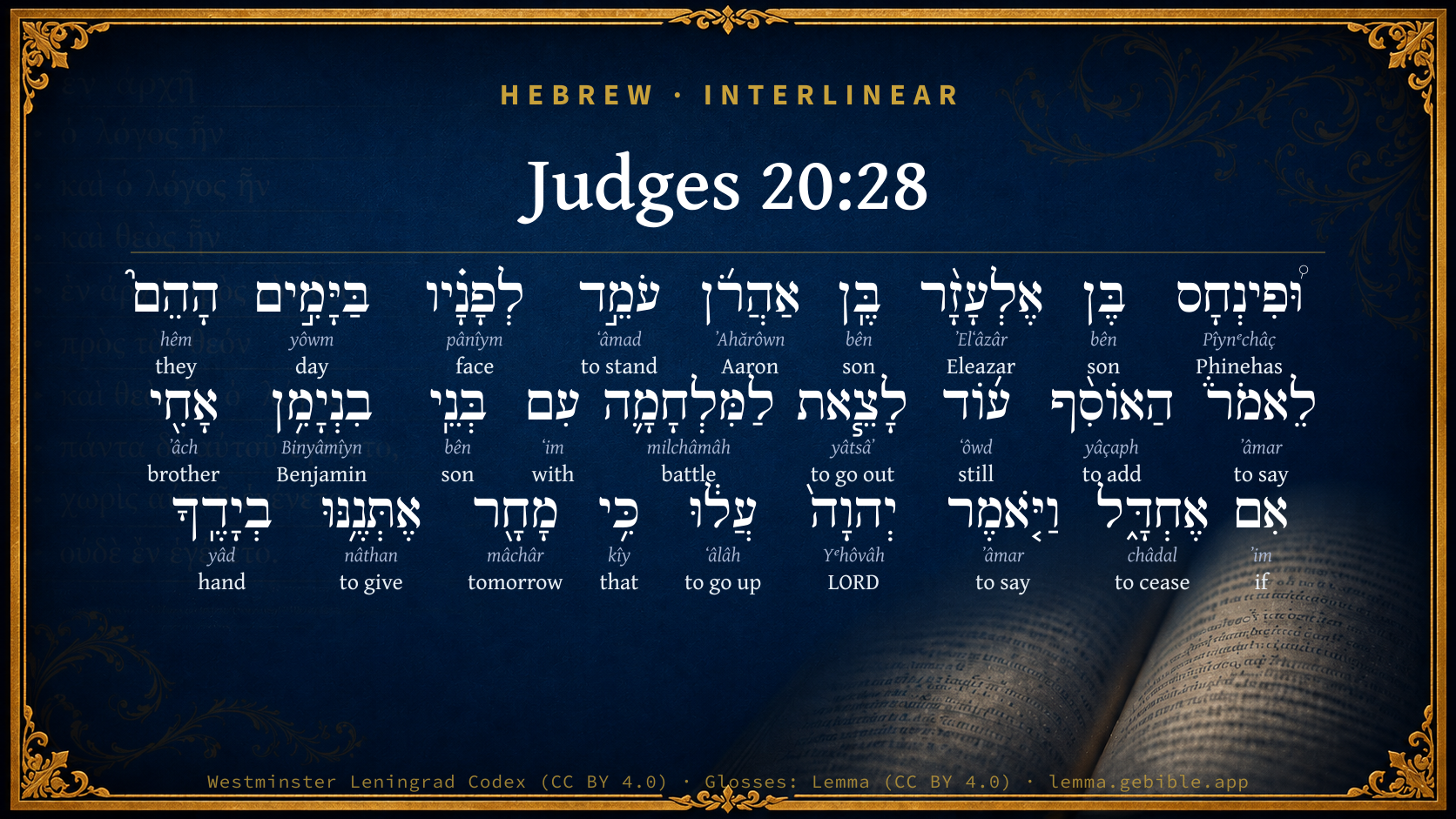
וּ֠פִינְחָס
Pîynᵉchâç
H6372
“and · Phinehas”
Conjunction + Noun, Proper
Part of Speech
Conjunction + Noun
Type
Proper
Full BDB Definition

Origin: apparently from H6310 and a variation of H5175

TWOT: None

Phinehas = "mouth of brass" - son of Eleazar and grandson of Aaron; his zealousness for the Lord averted a plague on Israel and gained him the promise of the Lord of an everlasting priesthood in his family - a priest and the son of the priest Eli - the father of a helper of Ezra
  1. בֶּן bên H1121 “son of” Noun, Common, Masculine, Singular, Construct
  2. אֶלְעָזָ֨ר ʼElʻâzâr H499 “Eleazar” Noun, Proper
  3. בֶּֽן bên H1121 “son of” Noun, Common, Masculine, Singular, Construct
  4. אַהֲרֹ֜ן ʼAhărôwn H175 “Aaron” Noun, Proper
  5. עֹמֵ֣ד ʻâmad H5975 “standing” Verb, Qal, Participle Active, Masculine, Singular, Absolute
  6. לְפָנָ֗יו pânîym H6440 “to/for · face(s) · his” Preposition + Noun, Common, Both, Plural, Construct + Suffix, Personal, 3rd Person, Masculine, Singular
  7. בַּיָּמִ֣ים yôwm H3117 “in/at the · days” Preposition, Determined + Noun, Common, Masculine, Plural, Absolute
  8. הָהֵם֮ hêm H1992 “the · they” Particle, Definite Article + Pronoun, Personal, 3rd Person, Masculine, Plural
  9. לֵאמֹר֒ ʼâmar H559 “to say” Preposition + Verb, Qal, Infinitive Construct
  10. הַאוֹסִ֨ף yâçaph H3254 “to add” Particle, Interrogative + Verb, Hiphil, Imperfect, 1st Person, Common, Singular
  11. ע֜וֹד ʻôwd H5750 “still” Adverb
  12. לָצֵ֧את yâtsâʼ H3318 “to go out” Preposition + Verb, Qal, Infinitive Construct
  13. לַמִּלְחָמָ֛ה milchâmâh H4421 “to/for the · battle” Preposition, Determined + Noun, Common, Feminine, Singular, Absolute
  14. עִם ʻim H5973 “with” Preposition
  15. בְּנֵֽי bên H1121 “sons of” Noun, Common, Masculine, Plural, Construct
  16. בִנְיָמִ֥ן Binyâmîyn H1144 “Benjamin” Noun, Proper
  17. אָחִ֖י ʼâch H251 “brother · my” Noun, Common, Masculine, Singular, Construct + Suffix, Personal, 1st Person, Common, Singular
  18. אִם ʼim H518 “if” Conjunction
  19. אֶחְדָּ֑ל châdal H2308 “to cease” Verb, Qal, Imperfect, 1st Person, Common, Singular
  20. וַיֹּ֤אמֶר ʼâmar H559 “and · to say” Conjunction + Verb, Qal, Sequential Imperfect, 3rd Person, Masculine, Singular
  21. יְהוָה֙ Yᵉhôvâh H3068 “LORD” Noun, Proper
  22. עֲל֔וּ ʻâlâh H5927 “go up” Verb, Qal, Imperative, 2nd Person, Masculine, Plural
  23. כִּ֥י kîy H3588 “that” Conjunction
  24. מָחָ֖ר mâchâr H4279 “tomorrow” Noun, Common, Masculine, Singular, Absolute
  25. אֶתְּנֶ֥נּוּ nâthan H5414 “to give · him” Verb, Qal, Imperfect, 1st Person, Common, Singular + Suffix, Personal, 3rd Person, Masculine, Singular
  26. בְיָדֶֽךָ yâd H3027 “in/at · hand · your” Preposition + Noun, Common, Both, Singular, Construct + Suffix, Personal, 2nd Person, Masculine, Singular

About this verse

These counts appear in no published source. They are computed here, from the morphology-tagged text and Lemma’s own curated glosses. What Lemma adds →

27
words
24
distinct lemmas
Historical
section

Notable vocabulary

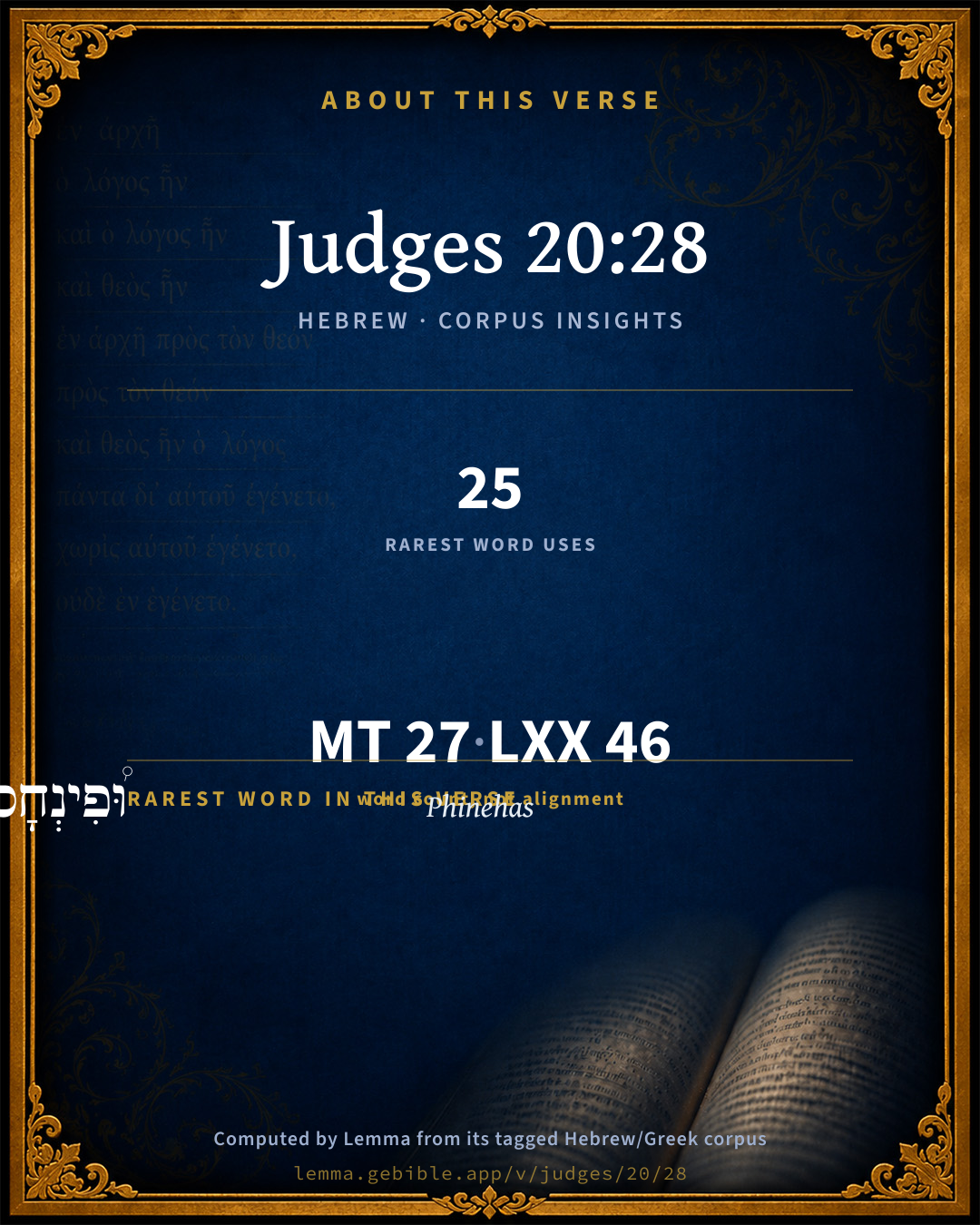
The rarest word here is וּ֠פִינְחָס Phinehas H6372 — appearing just 25 times in the whole Hebrew Bible.

Shared distinctive vocabulary

וּ֠פִינְחָס Phinehas H6372 occurs in 24 verses of the Hebrew Bible. Also found in:

Grammatical profile

  • 8 verbs
  • 14 nouns
  • 1 pronoun
  • 1 preposition
  • 2 conjunctions
  • 1 adverb

Verb forms

  • עֹמֵ֣ד Qal · Participle Active
  • לֵאמֹר֒ Qal · Infinitive Construct
  • הַאוֹסִ֨ף Hiphil · Imperfect
  • לָצֵ֧את Qal · Infinitive Construct
  • אֶחְדָּ֑ל Qal · Imperfect
  • וַיֹּ֤אמֶר Qal · Sequential Imperfect
  • עֲל֔וּ Qal · Imperative
  • אֶתְּנֶ֥נּוּ Qal · Imperfect

Repetition

Words recur within this verse — often emphatic in Hebrew:

  • בֶּן son H1121 ×3
  • לֵאמֹר֒ to say H559 ×2

Hebrew & Septuagint length

In English translation the verse runs 49 words from the Hebrew and 55 from the Septuagint (LXX English) — closely comparable.

A rough comparison of the two English renderings, which tokenize alike — not a word-level alignment.

Word counts can differ between the Hebrew and the Greek without any difference in meaning — e.g. the Hebrew direct-object marker אֵת has no separate Greek word, and Greek often adds the article ὁ.

In the original languages it is 27 Hebrew tokens and 46 Greek tokens — but the two are counted differently (Hebrew bundles its prefixes and suffixes into one token; the Greek is in lemma form), so that isn’t a like-for-like length.

Cross-references

18

Topical passages linked to Judges 20:28 in the Treasury of Scripture Knowledge — connected by theme and wording, ordered by reader-vote popularity; previews shown in the World English Bible.

  • Judges 7:9 It happened the same night, that Yahweh said to him, Arise, get you down into the camp; for I have delivered it into your hand.
  • Deuteronomy 18:5 For Yahweh your God has chosen him out of all your tribes, to stand to minister in the name of Yahweh, him and his sons for ever.
  • Joshua 24:33 Eleazar the son of Aaron died; and they buried him in the hill of Phinehas his son, which was given him in the hill-country of Ephraim.
  • Deuteronomy 10:8 At that time Yahweh set apart the tribe of Levi, to bear the ark of the covenant of Yahweh, to stand before Yahweh to minister to him, and to bless in his name, to this day.
  • Numbers 25:7–13 When Phinehas, the son of Eleazar, the son of Aaron the priest, saw it, he rose up from the midst of the congregation, and took a spear in his hand;
  • Joshua 7:7 Joshua said, Alas, Lord Yahweh, why have you at all brought this people over the Jordan, to deliver us into the hand of the Amorites, to cause us to perish? would that we had been content and lived beyond the Jordan!
  • Joshua 22:13 The children of Israel sent to the children of Reuben, and to the children of Gad, and to the half-tribe of Manasseh, into the land of Gilead, Phinehas the son of Eleazar the priest,
  • Joshua 22:30–32 When Phinehas the priest, and the princes of the congregation, even the heads of the thousands of Israel that were with him, heard the words that the children of Reuben and the children of Gad and the children of Manasseh spoke, it pleased them well.
  • Judges 1:2 Yahweh said, Judah shall go up: behold, I have delivered the land into his hand.
  • 1 Samuel 14:37 Saul asked counsel of God, Shall I go down after the Philistines? will you deliver them into the hand of Israel? But he didn't answer him that day.
  • 1 Samuel 23:4–12 Then David inquired of Yahweh yet again. Yahweh answered him, and said, Arise, go down to Keilah; for I will deliver the Philistines into your hand.
  • 1 Samuel 30:8 David inquired of Yahweh, saying, If I pursue after this troop, shall I overtake them? He answered him, Pursue; for you shall surely overtake [them], and shall without fail recover [all].
  • 2 Samuel 5:19–24 David inquired of Yahweh, saying, Shall I go up against the Philistines? will you deliver them into my hand? Yahweh said to David, Go up; for I will certainly deliver the Philistines into your hand.
  • 2 Samuel 6:3 They set the ark of God on a new cart, and brought it out of the house of Abinadab that was in the hill: and Uzzah and Ahio, the sons of Abinadab, drove the new cart.
  • 2 Samuel 6:7–12 The anger of Yahweh was kindled against Uzzah; and God struck him there for his error; and there he died by the ark of God.
  • 2 Chronicles 20:17 You shall not need to fight in this [battle]: set yourselves, stand you still, and see the salvation of Yahweh with you, O Judah and Jerusalem; don't be afraid, nor be dismayed: tomorrow go out against them: for Yahweh is with you.
  • Proverbs 3:5–6 Trust in Yahweh with all your heart, And don't lean on your own understanding.
  • Jeremiah 10:23 Yahweh, I know that the way of man is not in himself: it is not in man who walks to direct his steps.

Cross-references courtesy of OpenBible.info (CC BY 4.0).

Hebrew and Greek witnesses Masoretic Hebrew ↔ Greek Septuagint

The same verse in the two great witnesses to the Old Testament, shown verse-for-verse.

These are two independent witnesses, not word-aligned to each other, and the Septuagint is shown in lemma (dictionary) form.

Hebrew Judges 20:28 Masoretic · Westminster Leningrad Codex

וּ֠פִינְחָס בֶּן אֶלְעָזָ֨ר בֶּֽן אַהֲרֹ֜ן עֹמֵ֣ד לְפָנָ֗יו בַּיָּמִ֣ים הָהֵם֮ לֵאמֹר֒ הַאוֹסִ֨ף ע֜וֹד לָצֵ֧את לַמִּלְחָמָ֛ה עִם בְּנֵֽי בִנְיָמִ֥ן אָחִ֖י אִם אֶחְדָּ֑ל וַיֹּ֤אמֶר יְהוָה֙ עֲל֔וּ כִּ֥י מָחָ֖ר אֶתְּנֶ֥נּוּ בְיָדֶֽךָ

and Phinehas, the son of Eleazar, the son of Aaron, stood before it in those days), saying, Shall I yet again go out to battle against the children of Benjamin my brother, or shall I cease? Yahweh said, Go up; for tomorrow I will deliver him into your hand.

World English Bible · Public Domain

Greek LXX Judges 20:28 Septuagint · lemma form

καί φινεες υἱός ελεαζαρ υἱός ἀαρών παραἵστημι ἐνώπιον αὐτός ἐν ὁ ἡμέρα ἐκεῖνος καί ἐπιἐρωτάω ὁ υἱός ἰσραήλ ἐν κύριος λέγω εἰ προςτίθημι ἔτι ἐκἔρχομαι εἰς παράταξις πρός υἱός βενιαμίν ἀδελφός ἐγώ ἤ ἐπιἔχω καί εἶπον κύριος ἀναβαίνω ὅτι αὔριον δίδωμι αὐτός εἰς ὁ χείρ σύ

and Phinees the son of Eleazar the son of Aaron stood before it in those days; and the children of Israel enquired of the Lord, saying, Shall we yet again go forth to fight with our brethren the sons of Benjamin? and the Lord said, Go up, to-morrow I will give them into your hands.

LXX2012 (modern English Septuagint) · Public Domain

Hebrew: Westminster Leningrad Codex (CC BY 4.0). Greek: Septuagint (public domain); English from LXX2012 (modern English Septuagint) (Public Domain). How the Septuagint differs from the Hebrew →

Targum (Aramaic paraphrase)

1

The Targum is the ancient Jewish Aramaic paraphrase of the Hebrew Scriptures — an interpretive translation, not the Hebrew text itself. Onkelos (literal) and Pseudo-Jonathan (expansive) render the Torah, and Jonathan the Prophets. Coverage is partial: where no permissively-licensed English translation exists for a verse, only the Aramaic is shown. This is verse-level text, not a word-by-word alignment to the Hebrew.

  1. Targum Jonathan Prophets (Joshua–Malachi)
    וּפִינְחָס בַּר אֶלְעָזָר בַּר אַהֲרֹן קָאִים קֳדָמוֹהִי בְּיוֹמַיָא הָאִנוּן לְמֵימָר הַאוֹסֵף עוֹד לְמִפַּק לְאַגָחָא קְרָבָא עִם בְּנֵי בִּנְיָמִין אָחִי אִם אִתְמְנַע וַאֲמַר יְיָ סַקוּ אֲרֵי מְחָר אֶמְסָרִינוּן בִּידָךְ:

    (no public-domain English translation for this verse)

    Targum Jonathan — Aramaic: “Mikraot Gedolot” (public domain). English: “Sefaria Community Translation” (CC0 1.0 (public-domain dedication)); “London "Chaldee Paraphrase," 1871” (public domain). Text via Sefaria.

Commentary

Notes on Judges 20:28 from classic Christian and Jewish commentators (each source and its license shown beneath its notes). The classic Christian expositions comment on the surrounding passage and are grouped to its opening verse, so a note may address several verses; the Jewish commentaries on the Tanakh (Rashi and others) are per-verse, so they appear only where the commentator wrote on this verse.

Lemma curates 59 commentaries, every one of them public domain or Creative Commons licensed, each selected and text-cleaned for this edition rather than reprinted as found. About our sources →

Trapp's Complete Commentary

John Trapp

Jdg 20:28 And Phinehas, the son of Eleazar, the son of Aaron, stood before it in those days,) saying, Shall I yet again go out to battle against the children of Benjamin my brother, or shall I cease? And the LORD said, Go up; for to morrow I will deliver them into thine hand.

Ver. 28. Go up; for tomorrow I will deliver them.] Now they have a promise, which before they had none. Josephus saith {a} that when they inquired of God by Urim and Thummim, as here they did, the splendour and brightness of the high priest’s breastplate foreshowed victory. Certain it is that this promise did so.

{a} Antiq., lib. iii. cap. 3.

John Trapp, A Commentary or Exposition upon All the Books of the Old and New Testament (1647–1656) — public domain. Text from a community e-Sword module.

Joseph Benson's Commentary

Jdg 20:28. Phinehas the son of Eleazar — This is added to give us light respecting the time of this history, and to show, that this war did not take place in the order in which it is here recorded, after the death of Samson, but long before; probably not long after the death of Joshua. Stood before it — Namely, the ark: that is, ministered as high-priest. Against the children of Benjamin my brother — This is a more humble inquiry than either of the former. At first they only asked what tribe should first go up, presuming that the war ought to be made; and the second time, only whether God would have them renew the fight. But now they ask whether they should proceed in the war or desist altogether. That is, they leave the matter wholly to God’s will and pleasure, desiring to take no further step, if he did not see fit to accompany them with his blessing. Accordingly, as they now sought God after the due order, truly humbled themselves for their sins, and resigned themselves and the whole business up to his direction and disposal, he condescended to give them a gracious answer, assuring them of a speedy victory.

Joseph Benson's Commentary on the Old and New Testaments (1811–1818) — public domain. Text from a community e-Sword module.

Geneva Bible (1599)

Geneva Bible translators

Or, served in the Priest’s office at those days: for the Jews write, that he lived three hundred years.

Geneva Bible (1599) marginal notes — public domain. Text via Bolls.life.

Adam Clarke's Commentary

Verse 28. Phinehas, the son of Eleazar] This was the same Phinehas who is mentioned Nu 25:7, and consequently these transactions must have taken place shortly after the death of Joshua.

Adam Clarke's Commentary on the Bible (1810–1826) — public domain. Text from a community e-Sword/MySword module.

Ellicott's Commentary for English Readers

(28) Phinehas.—The fact that the high priest is. still the grandson of Aaron, who had shown such noble zeal in the desert (Num_25:8; Psa_106:30), is. an important note of time, and proves decisively that this narrative, like the last, is anterior to much that has been recorded in the earlier chapters. It is remarkable that the chief personages in these two wild scenes are the grandson of Moses and the grandson of Aaron, and it is a strange illustration of the disorder of the times that while the latter fulfils the supreme functions of the high priest, the former, who has sunk to the condition of a poor wandering Levite, does not go to his powerful cousin, but serves an unknown and schismatic image for a most paltry pittance.

Tomorrow.—Comp. Jdg_4:14; Jos_8:1. This is the first promise of success. The people needed to be taught that even in a religious war they could by no means rely on their own strength. How often has history laughed to scorn the cynical remark of Napoleon that “Providence usually favours the strongest battalion !”

A Bible Commentary for English Readers, edited by Charles John Ellicott (1878–1897) — public domain. Text from a community e-Sword module.

John Gill's Exposition

And Israel set liers in wait round about Gibeah. For though they were assured of success and victory, yet they thought proper to make use of means: and though their numbers were very great, they had recourse to art and stratagem, and set an ambush in divers places, much in like manner as Israel did for the men of Ai; the two cases being pretty much similar; this ambush was set in the night, as Josephus says (s),

(s) Ut supra, (Antiqu. l. 5. c. 2.) sect. 11.

John Gill's Exposition of the Whole Bible (1746–1763) — public domain (CC PDM 1.0). Text via the HelloAO Bible API.

Albert Barnes' Notes on the Bible

Phinehas, the son of Eleazar ... - A most important chronological statement, which makes it probable that these events occurred within twenty years of the death of Joshua.

To-morrow - The two former answers only bade them go up against Benjamin; now, for the first time, the promise is added, “Tomorrow,” etc. (compare Jos 8:1).

Albert Barnes' Notes on the Bible (1834–1885) — public domain. Text from a community e-Sword/MySword module.

Haydock's Catholic Bible Commentary

Was over. Hebrew, "stood before it at that time," (Haydock) in the camp, (Calmet) or perhaps at Silo, which was not so remote; but some, if not the whole army, might go thither to weep, and to consult the Lord. Phinees had formerly displayed his zeal against the impiety of Beelphegor, Numbers xxv. 7. He was contemporary with Jonathan, the priest of Michas. (Kennicott) --- Hence it appears that this took place not long after the death of Eleazar, Josue xxiv. (Worthington)

George Leo Haydock (1774–1849), Haydock's Catholic Family Bible and Commentary, 1859 edition — public domain. Excludes Psalms (Douay-Rheims chapter numbering differs from Protestant) and Deuterocanonical books (Catholic canon only).

Matthew Poole's English Annotations

Phinehas the son of Eleazar: this is added to give us some light about the time of this history, and to show it was not done in the order in which it is here placed, after Samson’s death, but long before.

Stood, i.e. ministered, as the word stand oft signifies, as Deu 10:8; 18:7; Pro 22:29; Jer 52:12, compared with 2Ki 25:8, because standing is the usual posture of servants.

Before it, i.e. before the ark; or, before his, i.e. the Lord’s face, or presence; which shows that he was the high priest, for none else might appear there.

Or shall I cease? which, if thou requirest, we are willing to do, notwithstanding the provocation they have given us, and our own inclination to revenge.

Tomorrow I will deliver them into thine hand: now, when they had sought God after the due order, and truly humbled themselves for their sins, he gives them a full and satisfactory answer to their desires.

Matthew Poole's English Annotations on the Holy Bible (1683–1685) — public domain. Text from a community e-Sword/MySword module.

Whedon's Commentary on the Bible

Daniel D. Whedon

28. Phinehas — This mention of the grandson of Aaron, like that of Moses’ grandson in Jdg_18:30, (where see note,) shows that the events of this chapter, like those recorded in chaps. 17 and 18, must have occurred early in the period of the Judges, and not many years after the death of Joshua.

Daniel D. Whedon (gen. ed.), Commentary on the Old and New Testaments (1874–1909) — public domain. Text from a community e-Sword module.

John Wesley's Explanatory Notes

Phinehas - This is added to give us light about the time of this history, and to shew it was not done in the order in which it is here placed, after Samson's death, but long before. Stood - That is ministered as high-priest. The Lord said - When they sought God after the due order, and truly humbled themselves for their sins, he gives them a satisfactory answer.

John Wesley, Explanatory Notes Upon the Whole Bible (1754–1765) — public domain. Text via the GEBible commentary corpus.

Lesson kit

Teaching starters — assembled from the data on this page, not authored interpretation. Every prompt links to the verse data it draws on. Edit before teaching.

Judges, in the Historical, opens this verse with 27 words (24 distinct Hebrew lemmas). Its most distinctive word is Pîynᵉchâç (“Phinehas”). A historical commentator’s framing appears above. Read the whole chapter for the surrounding context.

Discussion questions

  1. The word Pîynᵉchâç carries the sense “Phinehas.” How does it shape the verse?
  2. Exodus 6:25 shares the word «Phinehas» with this verse. How do the two illuminate each other?
  3. “son” occurs 3× in this one verse. What is the effect of the repetition?
  4. These translations render this verse differently. What is at stake in choosing one wording over another?
  5. The verb «עֹמֵ֣ד» is Qal Participle Active. How does its form color the action?
  6. Reading how Trapp's Complete Commentary and Joseph Benson's Commentary read this verse, where do the two commentators agree and where do they part?

Things to notice

Reading settings

Reading text

Shown beneath each verse's original-language words.

Old Testament
Old Testament edition

Read the OT as the Masoretic Hebrew (MT) or the Greek Septuagint (LXX).

English shown for the Greek Septuagint (in the Hebrew ↔ Greek comparison).

Comparing translations? Open the Compare panel on any verse page to stack up to four side by side.