
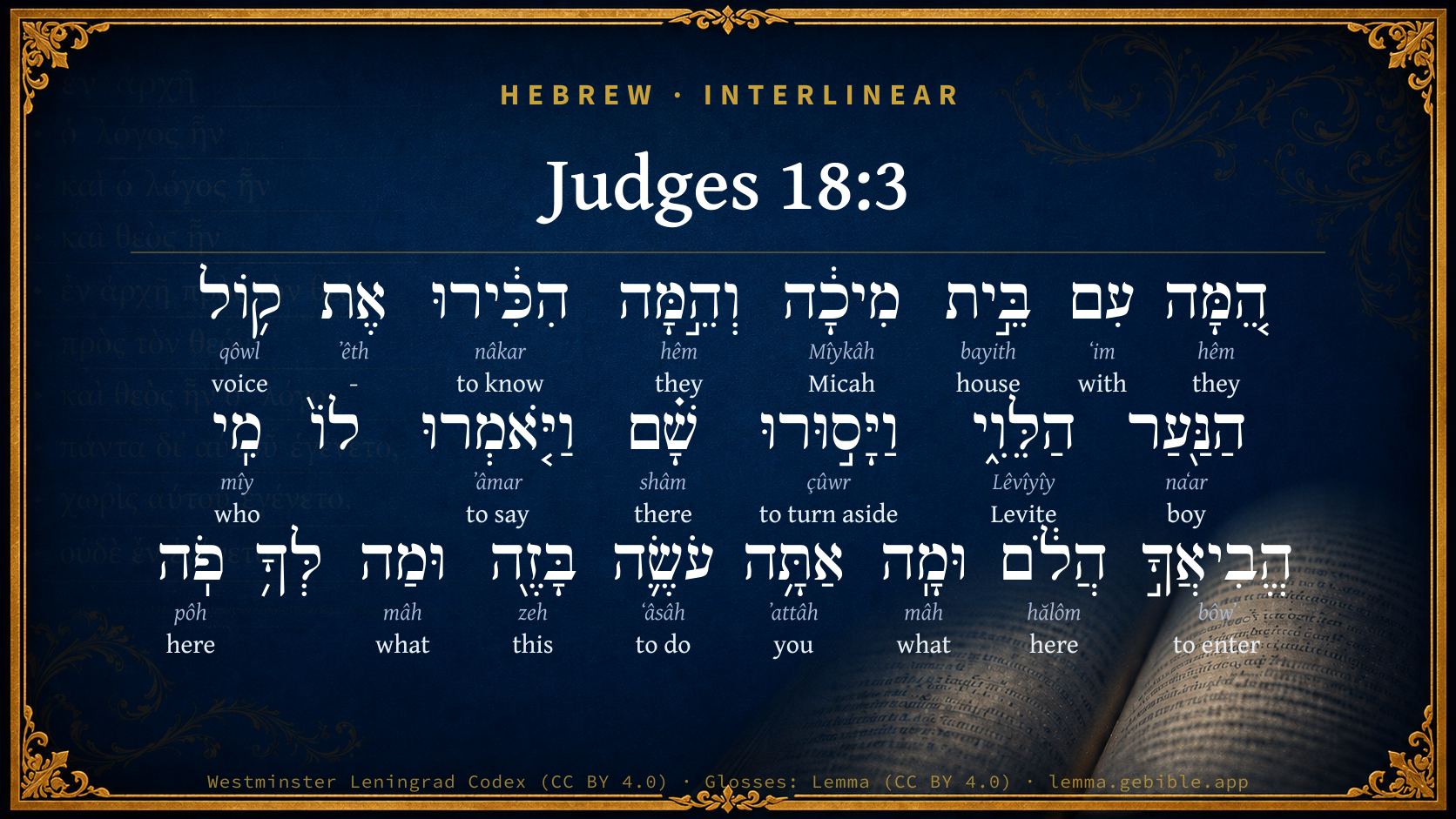
Judges 18:3

Hebrew (Westminster Leningrad Codex) Judges 18:3 appears in the Hebrew Old Testament. The text above is from the Westminster Leningrad Codex. Each word links to its Strong’s number, a concise gloss, and parsing drawn from the Open Scriptures Hebrew Bible morphology. Click any word for its full Brown-Driver-Briggs (BDB) entry.
Download image
Cite this verse

Judges 18:3 (World English Bible). Public Domain. Lemma interlinear Bible study tool, https://lemma.gebible.app/v/judges/18/3.

Show BibTeX & RIS
BibTeX
RIS
English Translation
When they were by the house of Micah, they knew the voice of the young man the Levite; and they turned aside there, and said to him, Who brought you here? and what do you in this place? and what have you here?
World English Bible · Public Domain
Download a study sheet

One document with this verse’s original text, its word-by-word gloss line, the meaning frame, cross-references with their text, attributed commentary, and full source and license credits — printable, and it pastes into notes with its structure intact.

This verse Autodidact and up

Study sheet (.html) Plain text (.txt)

A passage Seminary Student

Up to 50 verses in one chapter. A passage sheet keeps up to 6 commentary sources and 12 cross-references per verse, in the order this page ranks them, and says so on the sheet whenever that leaves anything out. Ask for a single verse and you get the Autodidact verse sheet above.

Everything on this page stays free to read, with no account — the sheet is a download of what is already on screen, not access to it.

Want to remove ads? Support Godless Engineer
Compare translations 3

The same verse in 3 English versions, stacked beneath the original-language interlinear above. Click any original word for its lexicon entry.

Each is an independent rendering of the whole verse — the interlinear is not word-aligned to these translations.

Highlighted words mark where these versions differ — a whole-verse word diff, not a word-by-word alignment.

  • World English Bible Public Domain
    When they were by the house of Micah, they knew the voice of the young man the Levite; and they turned aside there, and said to him, Who brought you here? and what do you in this place? and what have you here?
  • King James Version Public Domain
    When they were by the house of Micah, they knew the voice of the young man the Levite: and they turned in thither, and said unto him, Who brought thee hither? and what makest thou in this place? and what hast thou here?
  • unfoldingWord Literal Text CC BY-SA 4.0
    They near the house of Micah, and they recognized the voice of the young man, the Levite. So they turned aside there and said to him, “Who brought you here? And what you doing in this? And what to you here?”

unfoldingWord Literal Text — © unfoldingWord, licensed CC BY-SA 4.0. Word-aligned USFM3 via Door43 (git.door43.org/unfoldingWord/en_ult).

Versions to compare (up to 4)

3 of 4 selected

Show all 18 translations

Every available English version of this verse, each an independent rendering of the whole verse.

  • World English Bible Public Domain
    When they were by the house of Micah, they knew the voice of the young man the Levite; and they turned aside there, and said to him, Who brought you here? and what do you in this place? and what have you here?
  • Berean Standard Bible Public Domain
    And while they were near Micah’s house, they recognized the voice of the young Levite; so they went over and asked him, “Who brought you here? What are you doing in this place? Why are you here?”
  • Majority Standard Bible Public Domain
    And while they were near Micah’s house, they recognized the voice of the young Levite; so they went over and asked him, “Who brought you here? What are you doing in this place? Why are you here?”
  • King James Version Public Domain
    When they were by the house of Micah, they knew the voice of the young man the Levite: and they turned in thither, and said unto him, Who brought thee hither? and what makest thou in this place? and what hast thou here?
  • American Standard Version (1901) Public Domain
    When they were by the house of Micah, they knew the voice of the young man the Levite; and they turned aside thither, and said unto him, Who brought thee hither? and what doest thou in this place? and what hast thou here?
  • Revised Version (1885) Public Domain
    When they were by the house of Micah, they knew the voice of the young man the Levite: and they turned aside thither, and said unto him, Who brought thee hither? and what doest thou in this place? and what hast thou here?
  • Geneva Bible (1599) Public Domain
    When they were in the house of Michah, they knewe the voyce of the yong man the Leuite: and being turned in thither, they saide vnto him, Who brought thee hither? or what makest thou in this place? and what hast thou to doe here?
  • Douay-Rheims (1899) Public Domain
    And knowing the voice of the young man the Levite, and lodging with him, they said to him: Who brought thee hither? what dost thou here? why wouldst thou come hither?
  • Young's Literal Translation Public Domain
    They `are' with the household of Micah, and they have discerned the voice of the young man, the Levite, and turn aside there, and say to him, `Who hath brought thee hither? and what art thou doing in this `place?' and what to thee here?'
  • Literal Standard Version CC BY-SA 4.0
    They [are] with the household of Micah, and they have discerned the voice of the young man, the Levite, and turn aside there, and say to him, “Who has brought you here? And what are you doing in this [place]? And why are you here?”
  • Unlocked Literal Bible CC BY-SA 4.0
    When they were near Micah's house, they recognized the speech of the young Levite. So they stopped and asked him, “Who brought you here? What are you doing in this place? Why are you here?”
  • unfoldingWord Literal Text CC BY-SA 4.0
    They near the house of Micah, and they recognized the voice of the young man, the Levite. So they turned aside there and said to him, “Who brought you here? And what you doing in this? And what to you here?”
  • Darby Bible Public Domain
    When they were by the house of Micah, they recognized the voice of the young Levite; and they turned aside and said to him, "Who brought you here? What are you doing in this place? What is your business here?"
  • World Messianic Bible Public Domain
    When they were by the house of Micah, they knew the voice of the young man the Levite; so they went over there and said to him, “Who brought you here? What do you do in this place? What do you have here?”
  • Webster's Bible Public Domain
    When they were by the house of Micah, they knew the voice of the young man the Levite: and they turned in thither, and said to him, Who brought thee hither? and what makest thou in this place? and what hast thou here?
  • Free Bible Version CC BY-SA 4.0
    While they were there, they recognized the young Levite's accent, so they went to him and asked him, “So who brought you here, and what are you doing in this place? Why are you here?”
  • Bible in Basic English Public Domain
    When they were near the house of Micah, hearing a voice which was not strange to them, that of the young Levite, they went out of their road to his place, and said to him, How did you come here? and what are you doing in this place? and why are you here?
  • JPS Tanakh (1917) Public Domain
    When they were by the house of Micah, they knew the voice of the young man the Levite; and they turned aside thither, and said unto him: 'Who brought thee hither? and what doest thou in this place? and what hast thou here?'

Literal Standard Version (2020), Covenant Press — licensed CC BY-SA 4.0. Text via the HelloAO Bible API (eBible.org). Unlocked Literal Bible (unfoldingWord) — licensed CC BY-SA 4.0. Text via the HelloAO Bible API (eBible.org). unfoldingWord Literal Text — © unfoldingWord, licensed CC BY-SA 4.0. Word-aligned USFM3 via Door43 (git.door43.org/unfoldingWord/en_ult). Free Bible Version, Dr. Jonathan Gallagher — licensed CC BY-SA 4.0. Text via the HelloAO Bible API (eBible.org).

Word by word

More ways to search: Search by grammar → Find every occurrence → Compare this word →

Practice this passage: Drill this verse → Learn its vocabulary →

הֲלֹ֔ם
hălôm
H1988
“here”
Adverb
Part of Speech
Adverb
Full BDB Definition

Origin: from the article [see H1973 ]

TWOT: 503

here, hither
  1. הֵ֚מָּה hêm H1992 “they” Pronoun, Personal, 3rd Person, Masculine, Plural
  2. עִם ʻim H5973 “with” Preposition
  3. בֵּ֣ית bayith H1004 “house of” Noun, Common, Masculine, Singular, Construct
  4. מִיכָ֔ה Mîykâh H4318 “Micah” Noun, Proper
  5. וְהֵ֣מָּה hêm H1992 “and · they” Conjunction + Pronoun, Personal, 3rd Person, Masculine, Plural
  6. הִכִּ֔ירוּ nâkar H5234 “to know” Verb, Hiphil, Perfect, 3rd Person, Common, Plural
  7. אֶת ʼêth H853 “-” Particle, Direct Object
  8. ק֥וֹל qôwl H6963 “voice of” Noun, Common, Masculine, Singular, Construct
  9. הַנַּ֖עַר naʻar H5288 “the · boy” Particle, Definite Article + Noun, Common, Masculine, Singular, Absolute
  10. הַלֵּוִ֑י Lêvîyîy H3881 “the · Levite” Particle, Definite Article + Noun, Gentilic, Masculine, Singular, Absolute
  11. וַיָּס֣וּרוּ çûwr H5493 “and · to turn aside” Conjunction + Verb, Qal, Sequential Imperfect, 3rd Person, Masculine, Plural
  12. שָׁ֗ם shâm H8033 “there” Adverb
  13. וַיֹּ֤אמְרוּ ʼâmar H559 “and · to say” Conjunction + Verb, Qal, Sequential Imperfect, 3rd Person, Masculine, Plural
  14. מִֽי mîy H4310 “who” Particle, Interrogative
  15. הֱבִיאֲךָ֣ bôwʼ H935 “to enter · you” Verb, Hiphil, Perfect, 3rd Person, Masculine, Singular + Suffix, Personal, 2nd Person, Masculine, Singular
  16. וּמָֽה mâh H4100 “and · what” Conjunction + Particle, Interrogative
  17. אַתָּ֥ה ʼattâh H859 “you” Pronoun, Personal, 2nd Person, Masculine, Singular
  18. עֹשֶׂ֛ה ʻâsâh H6213 “doing” Verb, Qal, Participle Active, Masculine, Singular, Absolute
  19. בָּזֶ֖ה zeh H2088 “in/at · this” Preposition + Pronoun, Demonstrative, Masculine, Singular
  20. וּמַה mâh H4100 “and · what” Conjunction + Particle, Interrogative
  21. פֹֽה pôh H6311 “here” Adverb

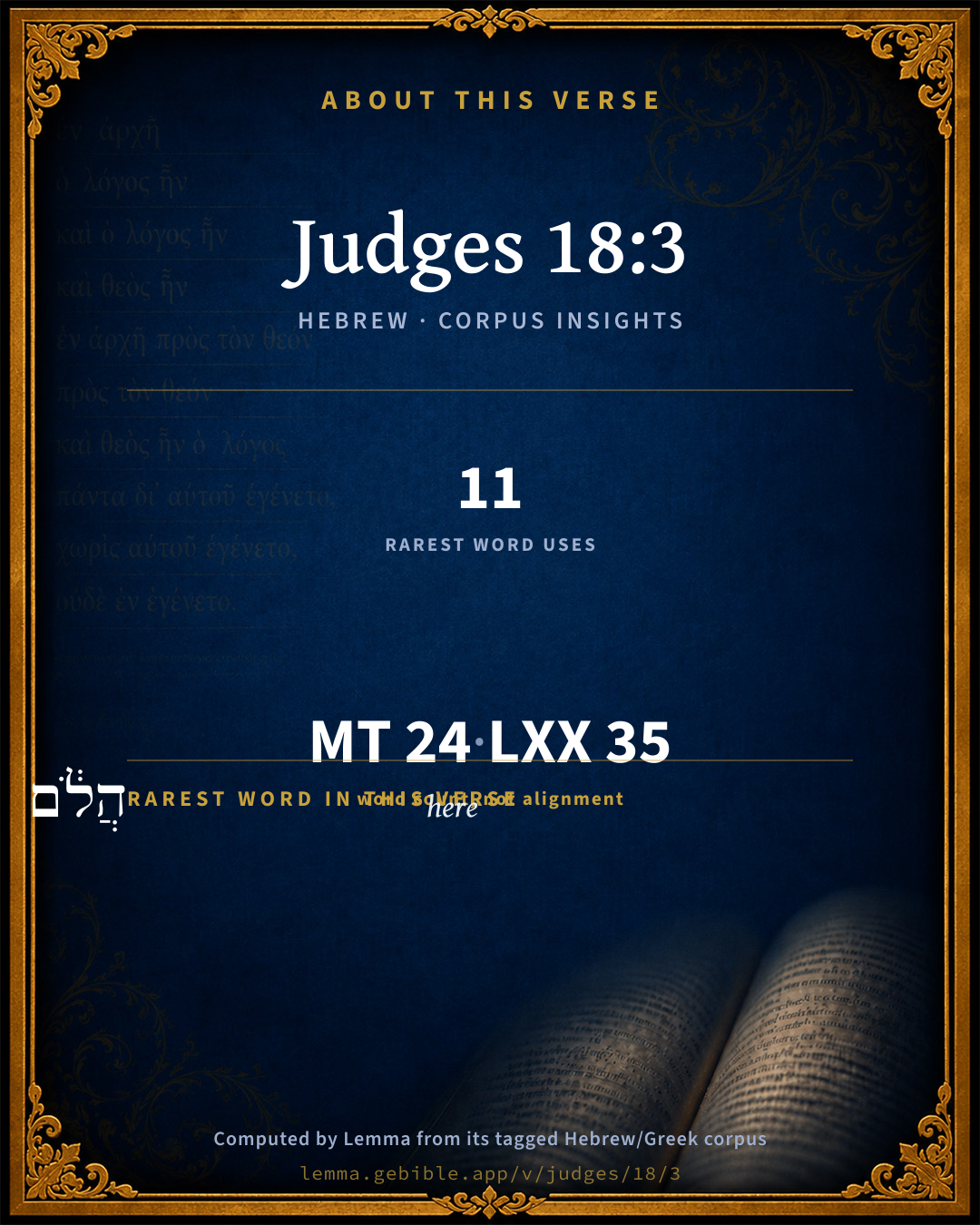
About this verse

These counts appear in no published source. They are computed here, from the morphology-tagged text and Lemma’s own curated glosses. What Lemma adds →

24
words
20
distinct lemmas
Historical
section

Notable vocabulary

The rarest word here is הֲלֹ֔ם here H1988 — appearing just 11 times in the whole Hebrew Bible.

Shared distinctive vocabulary

הֲלֹ֔ם here H1988 occurs in 11 verses of the Hebrew Bible. Also found in:

Grammatical profile

  • 5 verbs
  • 5 nouns
  • 4 pronouns
  • 3 prepositions
  • 3 adverbs
  • 4 particles

Verb forms

  • הִכִּ֔ירוּ Hiphil · Perfect
  • וַיָּס֣וּרוּ Qal · Sequential Imperfect
  • וַיֹּ֤אמְרוּ Qal · Sequential Imperfect
  • הֱבִיאֲךָ֣ Hiphil · Perfect
  • עֹשֶׂ֛ה Qal · Participle Active

Repetition

Words recur within this verse — often emphatic in Hebrew:

  • הֵ֚מָּה they H1992 ×2
  • וּמָֽה what H4100 ×2

Hebrew & Septuagint length

In English translation the verse runs 43 words from the Hebrew and 41 from the Septuagint (LXX English) — closely comparable.

A rough comparison of the two English renderings, which tokenize alike — not a word-level alignment.

Word counts can differ between the Hebrew and the Greek without any difference in meaning — e.g. the Hebrew direct-object marker אֵת has no separate Greek word, and Greek often adds the article ὁ.

In the original languages it is 24 Hebrew tokens and 35 Greek tokens — but the two are counted differently (Hebrew bundles its prefixes and suffixes into one token; the Greek is in lemma form), so that isn’t a like-for-like length.

Cross-references

4

Topical passages linked to Judges 18:3 in the Treasury of Scripture Knowledge — connected by theme and wording, ordered by reader-vote popularity; previews shown in the World English Bible.

  • Genesis 27:22 Jacob went near to Isaac his father. He felt him, and said, "The voice is Jacob's voice, but the hands are the hands of Esau."
  • Matthew 26:73 After a little while those who stood by came and said to Peter, "Surely you are also one of them, for your speech makes you known."
  • Judges 12:6 then said they to him, Say now Shibboleth; and he said Sibboleth; for he couldn't manage to pronounce it right: then they laid hold on him, and killed him at the fords of the Jordan. There fell at that time of Ephraim forty-two thousand.
  • Isaiah 22:16 "What are you doing here? and who has you here, that you have hewed out a tomb here? Cutting him out a tomb on high, chiseling a habitation for himself in the rock!"

Cross-references courtesy of OpenBible.info (CC BY 4.0).

Hebrew and Greek witnesses Masoretic Hebrew ↔ Greek Septuagint

The same verse in the two great witnesses to the Old Testament, shown verse-for-verse.

These are two independent witnesses, not word-aligned to each other, and the Septuagint is shown in lemma (dictionary) form.

Hebrew Judges 18:3 Masoretic · Westminster Leningrad Codex

הֵ֚מָּה עִם בֵּ֣ית מִיכָ֔ה וְהֵ֣מָּה הִכִּ֔ירוּ אֶת ק֥וֹל הַנַּ֖עַר הַלֵּוִ֑י וַיָּס֣וּרוּ שָׁ֗ם וַיֹּ֤אמְרוּ לוֹ֙ מִֽי הֱבִיאֲךָ֣ הֲלֹ֔ם וּמָֽה אַתָּ֥ה עֹשֶׂ֛ה בָּזֶ֖ה וּמַה לְּךָ֥ פֹֽה

When they were by the house of Micah, they knew the voice of the young man the Levite; and they turned aside there, and said to him, Who brought you here? and what do you in this place? and what have you here?

World English Bible · Public Domain

Greek LXX Judges 18:3 Septuagint · lemma form

αὐτός ἐν οἶκος μιχαιας καί αὐτός ἐπιγιγνώσκω ὁ φωνή ὁ νεανίσκος ὁ λευίτης καί ἐκκλίνω ἐκεῖ καί εἶπον αὐτός τίς φέρω σύ ὧδε καί τίς σύ ποιέω ἐν ὁ τόπος οὗτος καί τίς σύ ὧδε

in the house of Michaias, and they recognized the voice of the young man the Levite, and turned in there; and said to him, Who brought you in hither? and what do you in this place? and what have you here?

LXX2012 (modern English Septuagint) · Public Domain

Hebrew: Westminster Leningrad Codex (CC BY 4.0). Greek: Septuagint (public domain); English from LXX2012 (modern English Septuagint) (Public Domain). How the Septuagint differs from the Hebrew →

Targum (Aramaic paraphrase)

1

The Targum is the ancient Jewish Aramaic paraphrase of the Hebrew Scriptures — an interpretive translation, not the Hebrew text itself. Onkelos (literal) and Pseudo-Jonathan (expansive) render the Torah, and Jonathan the Prophets. Coverage is partial: where no permissively-licensed English translation exists for a verse, only the Aramaic is shown. This is verse-level text, not a word-by-word alignment to the Hebrew.

  1. Targum Jonathan Prophets (Joshua–Malachi)
    אִינוּן עִם בִּיתָא דְמִיכָה וִאִינוּן אִשְׁתְּמוֹדָעוּ יַת קַל עוּלֵימָא לִיוָאָה וְזַרוּ לְתַמָן וַאֲמַרוּ לֵיהּ מַן אַיְתָךְ הַלִכָא וּמָא אַתְּ עָבֵיד הָכָא וּמַה לָךְ כְּדֵין:

    (no public-domain English translation for this verse)

    Targum Jonathan — Aramaic: “Mikraot Gedolot” (public domain). English: “Sefaria Community Translation” (CC0 1.0 (public-domain dedication)); “London "Chaldee Paraphrase," 1871” (public domain). Text via Sefaria.

Commentary

Notes on Judges 18:3 from classic Christian and Jewish commentators (each source and its license shown beneath its notes). The classic Christian expositions comment on the surrounding passage and are grouped to its opening verse, so a note may address several verses; the Jewish commentaries on the Tanakh (Rashi and others) are per-verse, so they appear only where the commentator wrote on this verse.

Lemma curates 59 commentaries, every one of them public domain or Creative Commons licensed, each selected and text-cleaned for this edition rather than reprinted as found. About our sources →

Trapp's Complete Commentary

John Trapp

Jdg 18:3 When they [were] by the house of Micah, they knew the voice of the young man the Levite: and they turned in thither, and said unto him, Who brought thee hither? and what makest thou in this [place]? and what hast thou here?

Ver. 3. When they were by the house of Micah,] sc., In or near unto the Levite’s lodging, which was adjoining to the chapel of those idols made by Micah. {Jdg 18:14}

They knew the voice of the young man.] Either out of some former acquaintance with this roving leap-land Levite, or by his tone, as Jdg 12:6 Mar 14:70.

John Trapp, A Commentary or Exposition upon All the Books of the Old and New Testament (1647–1656) — public domain. Text from a community e-Sword module.

Geneva Bible (1599)

Geneva Bible translators

They knew him by his speech that he was a stranger there.

Geneva Bible (1599) marginal notes — public domain. Text via Bolls.life.

Adam Clarke's Commentary

Verse 3. They knew the voice of the young man] They knew, by his dialect or mode of pronunciation, that he was not an Ephraimite. We have already seen (Jdg 12:6) that the Ephraimites could not pronounce certain letters. See the note there.

Adam Clarke's Commentary on the Bible (1810–1826) — public domain. Text from a community e-Sword/MySword module.

Ellicott's Commentary for English Readers

(3) By the house of Micah.—Literally, with—i.e., lodging in it, as in Gen_27:43.

They knew the voice of the young man the Levite.—Again the narrative is too much compressed to enable us to fill up its details with any certainty. The youthful Jonathan had lived in Bethlehem. The grandson of Moses could not be wholly unknown. and at this time there was close intercourse between the tribes of Dan and Judah. Possibly, therefore they were personally acquainted with him; nor do they ask (as Micah had done), “Whence cometh thou? They recognised his voice, possibly by some dialectic peculiarity, but more probably by hearing him performing in the upper room his service before the pesel. Cassel renders “voice” by “sound,” and refers it to the bells on the priestly dress, as in Exo_28:35. We notice that Micah had been reticent about the ephod, &c., perhaps out of suspicion as to their intentions.

Turned in thither.—Not necessarily into the house, but into the room—the oratory (aedicula), or Beth-Elohim (Jdg_17:5). It seems to have been a kind of spurious Shiloh.

What makest thou in this place?—The accent of extreme surprise in their queries shows that they knew Jonathan, and did not expect to find a Judæan Levite in Ephraim.

A Bible Commentary for English Readers, edited by Charles John Ellicott (1878–1897) — public domain. Text from a community e-Sword module.

The Cambridge Bible for Schools and Colleges

gen. ed. J. J. S. Perowne

3. When they were by the house of Micah] repeats what has just been said in Jdg_18:2; this verse must belong to the narrative of the young man the Levite Jdg_17:7; Jdg_17:11 b, 12a. Before he made his home with Micah, the young Levite lived, if not at Beth-lehem (his connexion with Beth-lehem Jdg_17:7 is questioned by Moore), then in the neighbourhood of the Danite villages; hence the spies were acquainted with him. Transl. They were by the house of M., when they recognized: cf. 1Sa_9:11, 1Ki_14:17 b in Hebr.

The Cambridge Bible for Schools and Colleges (gen. ed. J. J. S. Perowne; Cambridge University Press, 1878–1918) — public domain. Text from a community e-Sword module.

John Gill's Exposition

When they were by the house of Micah,.... At their inn, which might be next to it, or as they were passing by it:

they knew the voice of the young man the Levite; who had been in their country, and they had been in his company and conversation, and they knew the tone of his voice when they heard it; a particular brogue he might have. Abarbinel conjectures, that he was singing to Micah's idol, or multiplying his prayers before him:

and they turned in thither; into Micah's house, and into the apartment where the young man was:

and said unto him, who brought thee hither? they knew he was of Bethlehemjudah; they inquire therefore how he came there, who sent for him, and by what means he was brought to that place:

and what makest thou in this place? they knew he was a Levite, and that such an one had no business to minister but at the tabernacle, and therefore they inquire what was his employment here: and what hast thou here? to support himself with, what he had for his maintenance, or how he lived.

John Gill's Exposition of the Whole Bible (1746–1763) — public domain (CC PDM 1.0). Text via the HelloAO Bible API.

Albert Barnes' Notes on the Bible

It does not follow that they had known him before, and recognized his voice, though it may be so. But the Hebrew equally bears the sense that they heard the voice of the Levite; and, attracted by it, went into the chapel Jdg 18:18 where Jonathan was. They were probably just starting on their journey, but were still within the court or precincts of Micah’s house. Micah had evidently not told them of his house of God, and his Levite. Their questions indicate surprise.

Albert Barnes' Notes on the Bible (1834–1885) — public domain. Text from a community e-Sword/MySword module.

Matthew Poole's English Annotations

They knew the voice of the young man; either,

1. By his manner of pronunciation, which was differing and distinguishable in several tribes, as appears from Jdg 12:6; Mar 14:70. Or,

2. By the celebration of some part of his office, which they, then lodging in the neighbourhood, might be invited to. Or rather,

3. By some acquaintance which some of them formerly had with him which they might have upon many occasions.

What makest thou in this place; this being not thy usual place, nor proper for thy employment?

Matthew Poole's English Annotations on the Holy Bible (1683–1685) — public domain. Text from a community e-Sword/MySword module.

Whedon's Commentary on the Bible

Daniel D. Whedon

3. They knew the voice of the young man — They overheard his conversation, and, looking upon him, they at once recognised him as an old acquaintance. Most commentators understand that the Danites knew by his dialect or mode of pronunciation that he was not an Ephraimite, but the words they knew the voice are not adapted to convey such an idea, and the questions, Who brought thee hither? etc., are the natural language of old acquaintances that have unexpectedly met. And if this Levite was a grandson or great grandson of Moses, the lawgiver of Israel, as appears from Jdg_18:30, it is not strange at all that he was personally known to these Danites.

Daniel D. Whedon (gen. ed.), Commentary on the Old and New Testaments (1874–1909) — public domain. Text from a community e-Sword module.

The Pulpit Commentary

When. Rather, while. By the house. Rather, in or at the house. They knew the voice, having, as some think, known him before he left Bethlehem, or perceiving a southern accent. But it may merely mean that they discerned his voice as he was singing or reciting prayers in the house of God. Micah"s house seems to have been a collection of houses (vers. 14, 22), approached by one gateway (ver. 16), in one of which the Levite dwelt. They turned in thither. This seems to have been next morning, when they were starting on their journey. Hearing the Levite"s voice, they turned aside into his house. What makest thou, etc. Rather, What doest thou in this place? and what is thy business here?

The Pulpit Commentary (1880–1919), ed. H.D.M. Spence-Jones & Joseph S. Exell — public domain. Text from a community e-Sword module.

John Wesley's Explanatory Notes

Knew - By the acquaintance which some of them formerly had with him.

John Wesley, Explanatory Notes Upon the Whole Bible (1754–1765) — public domain. Text via the GEBible commentary corpus.

Keil & Delitzsch

C. F. Keil & F. Delitzsch

When they were at Micah's house and recognised the voice of the young Levite, i.e., heard his voice, and perceived form his dialect that he was not a native of these mountains, they turned aside there, sc., from the road into the house, near to which they rested, and asked him, "Who brought thee hither, and what doest thou at this place? what hast thou to do here?" When he told them his history ("thus and thus," lit. according to this and that; cf. Sa2 11:25; Kg1 14:5), they said to him, "Ask God, we pray thee, that we may learn whether our way will be prosperous." בּאלהים שׁאל, used for asking the will of God, as in Jdg 1:1, except that here the inquiry was made through the medium of the imitation of the ephod and the worship of an image. And he said to them, sc., after making inquiry of the divine oracle, "Go in peace; straight before Jehovah is your way," i.e., it is known and well-pleasing to Him (vid., Pro 5:21; Jer 17:16).

Keil & Delitzsch — Biblical Commentary on the Old Testament (1861–1891) — public domain (CC PDM 1.0). Text via the HelloAO Bible API. (Old Testament only.)

unfoldingWord translationNotes

Door43 World Missions Community

they recognized the speech of the young Levite

They recognized the man by the sound of his voice. Here "speech" refers to his "voice." AT: "they heard the young Levite talking, and they recognized his voice" (See: Metonymy)

translationWords

Levi

priest

unfoldingWord translationNotes — © Distant Shores Media and the Door43 World Missions Community, licensed CC BY-SA 4.0. Source: git.door43.org/Door43/en_tn.

Rashi

Rabbi Shlomo Yitzchaki (Rashi)

Who brought you here. There are numerous questions here. Are you not descended from our teacher Moshe, to whom it was said, "Do not come close here," "Who provided mankind with the mouth?" and "What is this in your hand?"

Rashi on the Tanakh — English translations: “The Judaica Press complete Tanach with Rashi, translated by A. J. Rosenberg” (CC BY 4.0); “Pentateuch with Rashi's commentary by M. Rosenbaum and A.M. Silbermann, 1929-1934” (public domain); “The Metsudah Tanach series, Lakewood, N.J” (CC BY 4.0); and “The Book of Joshua, Metsudah Publications, 1997” (CC BY 4.0). Text via Sefaria.

Lesson kit

Teaching starters — assembled from the data on this page, not authored interpretation. Every prompt links to the verse data it draws on. Edit before teaching.

Judges, in the Historical, opens this verse with 24 words (20 distinct Hebrew lemmas). Its most distinctive word is hălôm (“here”). A historical commentator’s framing appears above. Read the whole chapter for the surrounding context.

Discussion questions

  1. The word hălôm carries the sense “here.” How does it shape the verse?
  2. Genesis 16:13 shares the word «here» with this verse. How do the two illuminate each other?
  3. “they” occurs 2× in this one verse. What is the effect of the repetition?
  4. These translations render this verse differently. What is at stake in choosing one wording over another?
  5. The verb «הִכִּ֔ירוּ» is Hiphil Perfect. How does its form color the action?
  6. Reading how Trapp's Complete Commentary and Geneva Bible (1599) read this verse, where do the two commentators agree and where do they part?

Things to notice

Reading settings

Reading text

Shown beneath each verse's original-language words.

Old Testament
Old Testament edition

Read the OT as the Masoretic Hebrew (MT) or the Greek Septuagint (LXX).

English shown for the Greek Septuagint (in the Hebrew ↔ Greek comparison).

Comparing translations? Open the Compare panel on any verse page to stack up to four side by side.