
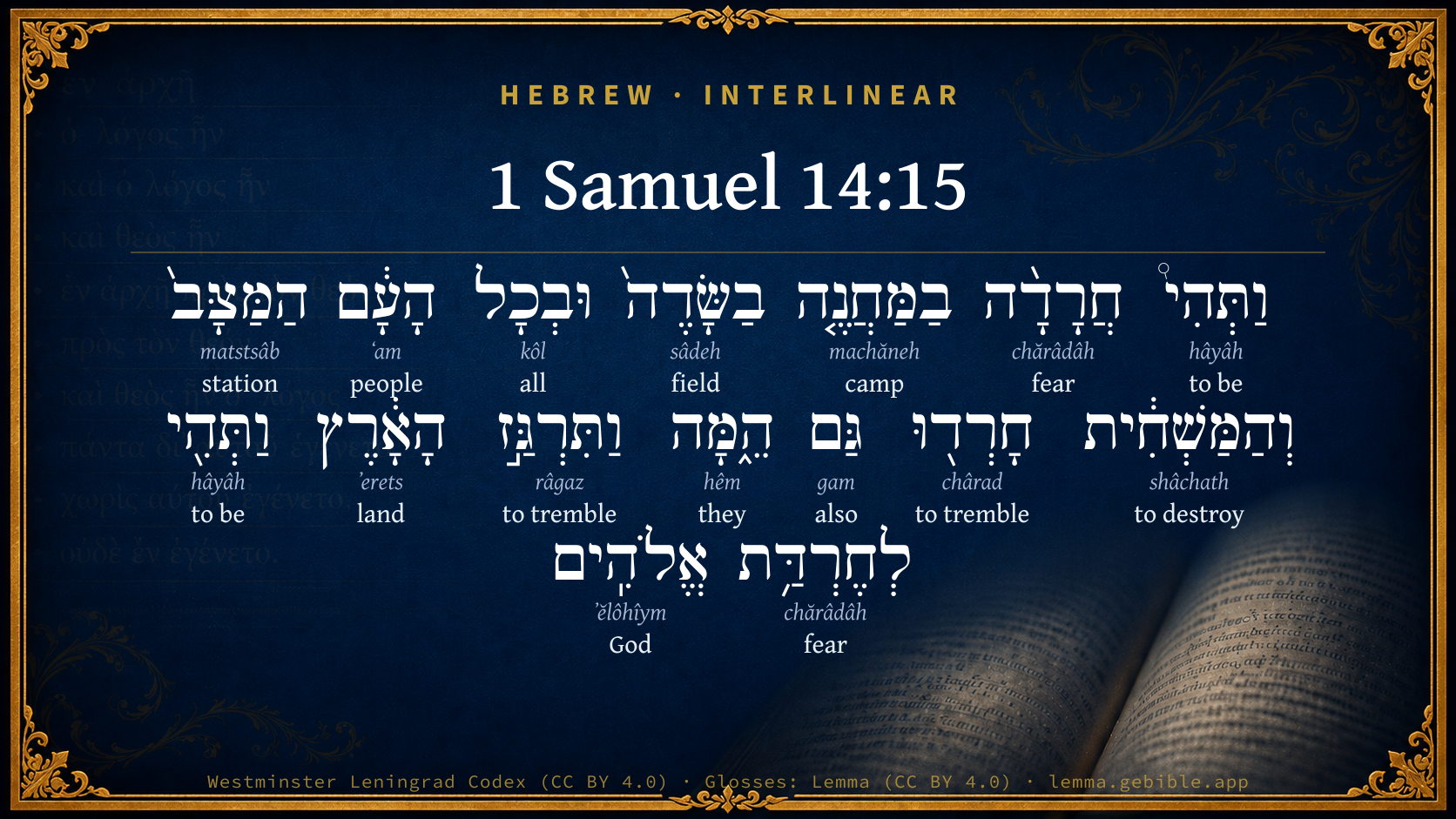
1 Samuel 14:15

Hebrew (Westminster Leningrad Codex) 1 Samuel 14:15 appears in the Hebrew Old Testament. The text above is from the Westminster Leningrad Codex. Each word links to its Strong’s number, a concise gloss, and parsing drawn from the Open Scriptures Hebrew Bible morphology. Click any word for its full Brown-Driver-Briggs (BDB) entry.
Download image
Cite this verse

1 Samuel 14:15 (World English Bible). Public Domain. Lemma interlinear Bible study tool, https://lemma.gebible.app/v/1-samuel/14/15.

Show BibTeX & RIS
BibTeX
RIS
English Translation
There was a trembling in the camp, in the field, and among all the people; the garrison, and the spoilers, they also trembled; and the earth quaked: so there was an exceeding great trembling.
World English Bible · Public Domain
Download a study sheet

One document with this verse’s original text, its word-by-word gloss line, the meaning frame, cross-references with their text, attributed commentary, and full source and license credits — printable, and it pastes into notes with its structure intact.

This verse Autodidact and up

Study sheet (.html) Plain text (.txt)

A passage Seminary Student

Up to 50 verses in one chapter. A passage sheet keeps up to 6 commentary sources and 12 cross-references per verse, in the order this page ranks them, and says so on the sheet whenever that leaves anything out. Ask for a single verse and you get the Autodidact verse sheet above.

Everything on this page stays free to read, with no account — the sheet is a download of what is already on screen, not access to it.

Want to remove ads? Support Godless Engineer
Compare translations 3

The same verse in 3 English versions, stacked beneath the original-language interlinear above. Click any original word for its lexicon entry.

Each is an independent rendering of the whole verse — the interlinear is not word-aligned to these translations.

Highlighted words mark where these versions differ — a whole-verse word diff, not a word-by-word alignment.

  • World English Bible Public Domain
    There was a trembling in the camp, in the field, and among all the people; the garrison, and the spoilers, they also trembled; and the earth quaked: so there was an exceeding great trembling.
  • King James Version Public Domain
    And there was trembling in the host, in the field, and among all the people: the garrison, and the spoilers, they also trembled, and the earth quaked: so it was a very great trembling.
  • unfoldingWord Literal Text CC BY-SA 4.0
    And was trembling in the camp in the field and among all of the people. The garrison and the destroyer, even they trembled. And the earth quaked, and it became a trembling of God.

unfoldingWord Literal Text — © unfoldingWord, licensed CC BY-SA 4.0. Word-aligned USFM3 via Door43 (git.door43.org/unfoldingWord/en_ult).

Versions to compare (up to 4)

3 of 4 selected

Show all 18 translations

Every available English version of this verse, each an independent rendering of the whole verse.

  • World English Bible Public Domain
    There was a trembling in the camp, in the field, and among all the people; the garrison, and the spoilers, they also trembled; and the earth quaked: so there was an exceeding great trembling.
  • Berean Standard Bible Public Domain
    Then terror struck the Philistines in the camp, in the field, and among all the people. Even those in the outposts and raiding parties trembled. Indeed, the earth quaked and panic spread from God.
  • Majority Standard Bible Public Domain
    Then panic struck the Philistines in the camp, in the field, and among all the people. Even those in the outposts and raiding parties trembled. Indeed, the earth quaked, and panic spread from God.
  • King James Version Public Domain
    And there was trembling in the host, in the field, and among all the people: the garrison, and the spoilers, they also trembled, and the earth quaked: so it was a very great trembling.
  • American Standard Version (1901) Public Domain
    And there was a trembling in the camp, in the field, and among all the people; the garrison, and the spoilers, they also trembled; and the earth quaked: so there was an exceeding great trembling.
  • Revised Version (1885) Public Domain
    And there was a trembling in the camp, in the field, and among all the people; the garrison, and the spoilers, they also trembled: and the earth quaked; so there was an exceeding great trembling.
  • Geneva Bible (1599) Public Domain
    And there was a feare in the hoste, and in the field, and among all the people: the garison also, and they that went out to spoyle, were afraid themselues: and the earth trembled: for it was striken with feare by God.
  • Douay-Rheims (1899) Public Domain
    And there was a miracle in the camp, through the fields: yea and all the people of their garrison, who had gone out to plunder, were amazed, and the earth trembled: and it happened as a miracle from God.
  • Young's Literal Translation Public Domain
    and there is a trembling in the camp, in the field, and among all the people, the station and the destroyers have trembled -- even they, and the earth shaketh, and it becometh a trembling of God.
  • Literal Standard Version CC BY-SA 4.0
    and there is a trembling in the camp, in the field, and among all the people, the station and the destroyers have trembled—even they, and the earth shakes, and it becomes a trembling of God.
  • Unlocked Literal Bible CC BY-SA 4.0
    There was a panic in the camp, in the field, and among the people. Even the garrison and the raiders panicked. The earth quaked, and there was a great panic.
  • unfoldingWord Literal Text CC BY-SA 4.0
    And was trembling in the camp in the field and among all of the people. The garrison and the destroyer, even they trembled. And the earth quaked, and it became a trembling of God.
  • Darby Bible Public Domain
    And there was trembling in the camp, in the field, and among all the people; the garrison, and the ravagers, they also trembled, and the earth quaked; for it was a trembling [from] God.
  • World Messianic Bible Public Domain
    There was a trembling in the camp, in the field, and among all the people; the garrison and the raiders also trembled; and the earth quaked, so there was an exceedingly great trembling.
  • Webster's Bible Public Domain
    And there was trembling in the host, in the field, and among all the people: the garrison, and the spoilers, they also trembled, and the earth quaked: so it was a very great trembling.
  • Free Bible Version CC BY-SA 4.0
    Then the Philistines went into a panic, in the camp, in the field, and throughout their army. Even those in the outposts and the groups of raiders became terrified. The earth shook—this was a panic sent from God.
  • Bible in Basic English Public Domain
    And there was great fear in the tents and in the field and among all the men of the armed force, and the attackers were shaking with fear; even the earth was moved with a great shaking and there was a fear as from God.
  • JPS Tanakh (1917) Public Domain
    And there was a trembling in the camp in the field, and among all the people; the garrison, and the spoilers, they also trembled; and the earth quaked; so it grew into a terror from God.

Literal Standard Version (2020), Covenant Press — licensed CC BY-SA 4.0. Text via the HelloAO Bible API (eBible.org). Unlocked Literal Bible (unfoldingWord) — licensed CC BY-SA 4.0. Text via the HelloAO Bible API (eBible.org). unfoldingWord Literal Text — © unfoldingWord, licensed CC BY-SA 4.0. Word-aligned USFM3 via Door43 (git.door43.org/unfoldingWord/en_ult). Free Bible Version, Dr. Jonathan Gallagher — licensed CC BY-SA 4.0. Text via the HelloAO Bible API (eBible.org).

Word by word

More ways to search: Search by grammar → Find every occurrence → Compare this word →

Practice this passage: Drill this verse → Learn its vocabulary →

חֲרָדָ֨ה
chărâdâh
H2731
“fear”
Noun, Common, Feminine, Singular, Absolute
Part of Speech
Noun
Type
Common
Gender
Feminine
Number
Singular
State
Absolute
Full BDB Definition

Origin: from H2730

TWOT: 735b

fear, anxiety, quaking, trembling, (extreme) anxiety, anxious care - trembling, quaking - anxious care
  1. וַתְּהִי֩ hâyâh H1961 “and · to be” Conjunction + Verb, Qal, Sequential Imperfect, 3rd Person, Feminine, Singular
  2. בַמַּחֲנֶ֤ה machăneh H4264 “in/at the · camp” Preposition, Determined + Noun, Common, Both, Singular, Absolute
  3. בַשָּׂדֶה֙ sâdeh H7704 “in/at the · field” Preposition, Determined + Noun, Common, Masculine, Singular, Absolute
  4. וּבְכָל kôl H3605 “and · in/at · all of” Conjunction + Preposition + Noun, Common, Masculine, Singular, Construct
  5. הָעָ֔ם ʻam H5971 “the · people” Particle, Definite Article + Noun, Common, Masculine, Singular, Absolute
  6. הַמַּצָּב֙ matstsâb H4673 “the · station” Particle, Definite Article + Noun, Common, Masculine, Singular, Absolute
  7. וְהַמַּשְׁחִ֔ית shâchath H7843 “and · the · destroyer” Conjunction + Particle, Definite Article + Noun, Common, Masculine, Singular, Absolute
  8. חָרְד֖וּ chârad H2729 “to tremble” Verb, Qal, Perfect, 3rd Person, Common, Plural
  9. גַּם gam H1571 “also” Particle, Accusative
  10. הֵ֑מָּה hêm H1992 “they” Pronoun, Personal, 3rd Person, Masculine, Plural
  11. וַתִּרְגַּ֣ז râgaz H7264 “and · to tremble” Conjunction + Verb, Qal, Sequential Imperfect, 3rd Person, Feminine, Singular
  12. הָאָ֔רֶץ ʼerets H776 “the · land” Particle, Definite Article + Noun, Common, Both, Singular, Absolute
  13. וַתְּהִ֖י hâyâh H1961 “and · to be” Conjunction + Verb, Qal, Sequential Imperfect, 3rd Person, Feminine, Singular
  14. לְחֶרְדַּ֥ת chărâdâh H2731 “to/for · fear of” Preposition + Noun, Common, Feminine, Singular, Construct
  15. אֱלֹהִֽים ʼĕlôhîym H430 “God(s)” Noun, Common, Masculine, Plural, Absolute

About this verse

These counts appear in no published source. They are computed here, from the morphology-tagged text and Lemma’s own curated glosses. What Lemma adds →

16
words
14
distinct lemmas
Historical
section

Notable vocabulary

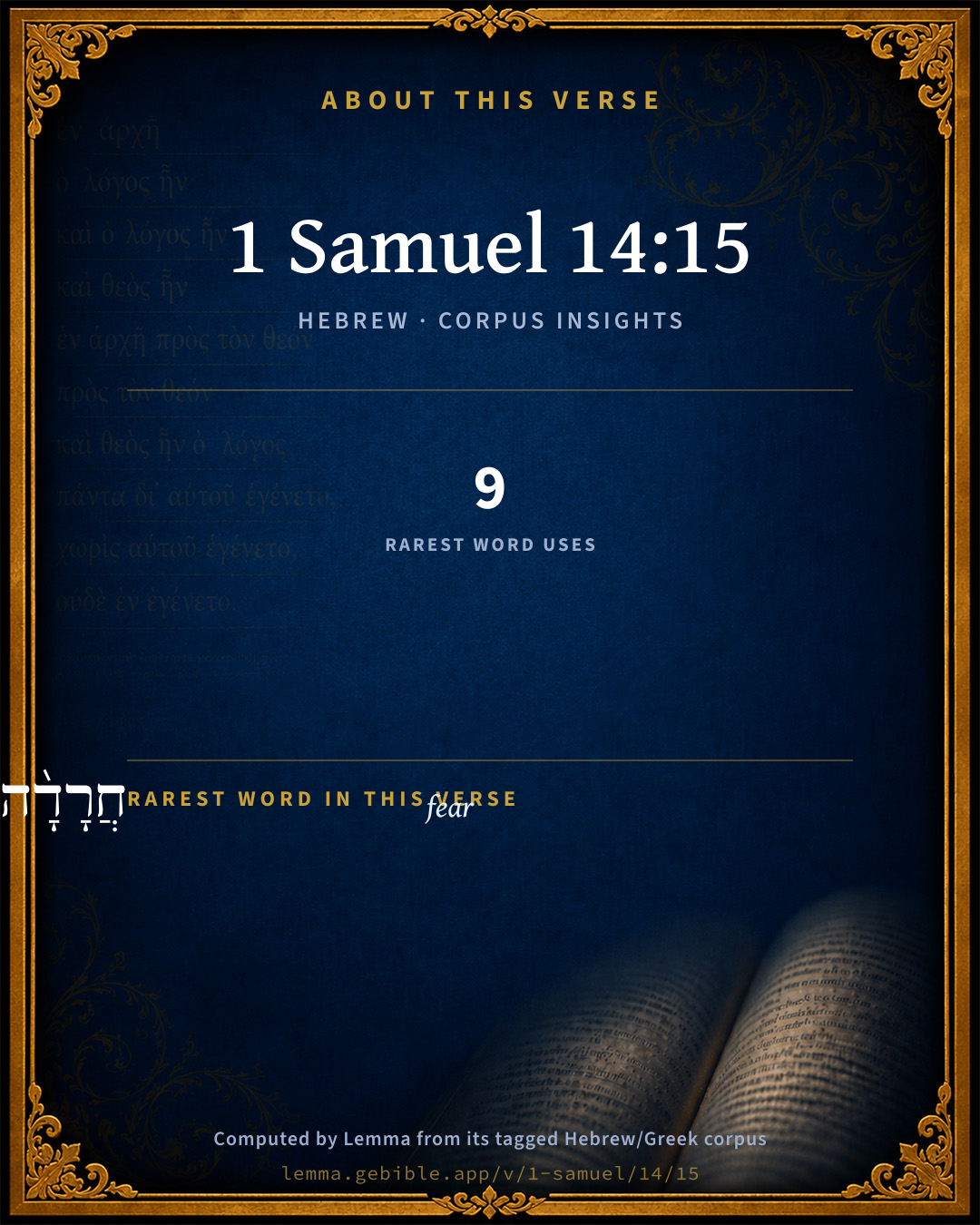
The rarest word here is חֲרָדָ֨ה fear H2731 — appearing just 9 times in the whole Hebrew Bible.

Shared distinctive vocabulary

חֲרָדָ֨ה fear H2731 occurs in 8 verses of the Hebrew Bible. Also found in:

Grammatical profile

  • 4 verbs
  • 10 nouns
  • 1 pronoun
  • 1 particle

Verb forms

  • וַתְּהִי֩ Qal · Sequential Imperfect
  • חָרְד֖וּ Qal · Perfect
  • וַתִּרְגַּ֣ז Qal · Sequential Imperfect
  • וַתְּהִ֖י Qal · Sequential Imperfect

Repetition

Words recur within this verse — often emphatic in Hebrew:

  • וַתְּהִי֩ to be H1961 ×2
  • חֲרָדָ֨ה fear H2731 ×2

Hebrew & Septuagint length

In English translation the verse runs 34 words from the Hebrew and 39 from the Septuagint (LXX English) — closely comparable.

A rough comparison of the two English renderings, which tokenize alike — not a word-level alignment.

Word counts can differ between the Hebrew and the Greek without any difference in meaning — e.g. the Hebrew direct-object marker אֵת has no separate Greek word, and Greek often adds the article ὁ.

Cross-references

14

Topical passages linked to 1 Samuel 14:15 in the Treasury of Scripture Knowledge — connected by theme and wording, ordered by reader-vote popularity; previews shown in the World English Bible.

  • 1 Samuel 13:17 The spoilers came out of the camp of the Philistines in three companies: one company turned to the way that leads to Ophrah, to the land of Shual;
  • Genesis 35:5 They traveled: and a terror of God was on the cities that were round about them, and they didn't pursue the sons of Jacob.
  • Exodus 19:18 Mount Sinai, the whole of it, smoked, because Yahweh descended on it in fire; and its smoke ascended like the smoke of a furnace, and the whole mountain quaked greatly.
  • 2 Samuel 5:24 It shall be, when you hear the sound of marching in the tops of the mulberry trees, that then you shall bestir yourself; for then is Yahweh gone out before you to strike the host of the Philistines.
  • 2 Kings 7:6–7 For the Lord had made the host of the Syrians to hear a noise of chariots, and a noise of horses, even the noise of a great host: and they said one to another, Behold, the king of Israel has hired against us the kings of the Hittites, and the kings of the Egyptians, to come on us.
  • Leviticus 26:36–37 "'As for those of you who are left, I will send a faintness into their hearts in the lands of their enemies: and the sound of a driven leaf will put them to flight; and they shall flee, as one flees from the sword; and they will fall when no one pursues.
  • Joshua 2:9 and she said to the men, I know that Yahweh has given you the land, and that the fear of you is fallen on us, and that all the inhabitants of the land melt away before you.
  • Judges 7:21 They stood every man in his place round about the camp; and all the host ran; and they shouted, and put [them] to flight.
  • 1 Samuel 13:23 The garrison of the Philistines went out to the pass of Michmash.
  • Job 18:11 Terrors shall make him afraid on every side, And shall chase him at his heels.
  • Psalms 14:5 There they were in great fear, For God is in the generation of the righteous.
  • Daniel 5:6 Then the king's face was changed in him, and his thoughts troubled him; and the joints of his loins were loosened, and his knees struck one against another.
  • Matthew 24:6 You will hear of wars and rumors of wars. See that you aren't troubled, for all this must happen, but the end is not yet.
  • Matthew 27:50–51 Jesus cried again with a loud voice, and yielded up his spirit.

Cross-references courtesy of OpenBible.info (CC BY 4.0).

Hebrew and Greek witnesses Masoretic Hebrew ↔ Greek Septuagint

The same verse in the two great witnesses to the Old Testament, shown verse-for-verse.

These are two independent witnesses, not word-aligned to each other, and the Septuagint is shown in lemma (dictionary) form.

Hebrew 1 Samuel 14:15 Masoretic · Westminster Leningrad Codex

וַתְּהִי֩ חֲרָדָ֨ה בַמַּחֲנֶ֤ה בַשָּׂדֶה֙ וּבְכָל הָעָ֔ם הַמַּצָּב֙ וְהַמַּשְׁחִ֔ית חָרְד֖וּ גַּם הֵ֑מָּה וַתִּרְגַּ֣ז הָאָ֔רֶץ וַתְּהִ֖י לְחֶרְדַּ֥ת אֱלֹהִֽים

There was a trembling in the camp, in the field, and among all the people; the garrison, and the spoilers, they also trembled; and the earth quaked: so there was an exceeding great trembling.

World English Bible · Public Domain

Greek LXX 1 Samuel 14:15 Septuagint · lemma form

καί γίγνομαι ἔκστασις ἐν ὁ παρεμβολή καί ἐν ἀγρός καί πᾶς ὁ λαός ὁ ἐν μεσσαβ καί ὁ διαφθείρω ἐκἵστημι καί αὐτός οὐ θέλω ποιέω καί θαμβέω ὁ γῆ καί γίγνομαι ἔκστασις παρά κύριος

And there was dismay in the camp, and in the field; and all the people in Messab, and the spoilers were amazed; and they would not act, and the land was terror-struck, and there was dismay from the lord.

LXX2012 (modern English Septuagint) · Public Domain

Hebrew: Westminster Leningrad Codex (CC BY 4.0). Greek: Septuagint (public domain); English from LXX2012 (modern English Septuagint) (Public Domain). How the Septuagint differs from the Hebrew →

Targum (Aramaic paraphrase)

1

The Targum is the ancient Jewish Aramaic paraphrase of the Hebrew Scriptures — an interpretive translation, not the Hebrew text itself. Onkelos (literal) and Pseudo-Jonathan (expansive) render the Torah, and Jonathan the Prophets. Coverage is partial: where no permissively-licensed English translation exists for a verse, only the Aramaic is shown. This is verse-level text, not a word-by-word alignment to the Hebrew.

  1. Targum Jonathan Prophets (Joshua–Malachi)
    וַהֲוַת זִיעָא בְּמַשְׁרִיתָא בְּחַקְלָא וּבְכָל עַמָא אִסְטַרְטִיגָא וּמְחַבְּלָא זָעוּ אַף אִינוּן וְזָעַת אַרְעָא וַהֲוַת לְזִיעַ מִן קֳדָם יְיָ:

    (no public-domain English translation for this verse)

    Targum Jonathan — Aramaic: “Mikraot Gedolot” (public domain). English: “Sefaria Community Translation” (CC0 1.0 (public-domain dedication)); “London "Chaldee Paraphrase," 1871” (public domain). Text via Sefaria.

Commentary

Notes on 1 Samuel 14:15 from classic Christian and Jewish commentators (each source and its license shown beneath its notes). The classic Christian expositions comment on the surrounding passage and are grouped to its opening verse, so a note may address several verses; the Jewish commentaries on the Tanakh (Rashi and others) are per-verse, so they appear only where the commentator wrote on this verse.

Lemma curates 59 commentaries, every one of them public domain or Creative Commons licensed, each selected and text-cleaned for this edition rather than reprinted as found. About our sources →

Trapp's Complete Commentary

John Trapp

1Sa 14:15 And there was trembling in the host, in the field, and among all the people: the garrison, and the spoilers, they also trembled, and the earth quaked: so it was a very great trembling.

Ver. 15. And there was trembling in the host.] The Lord smote them with a panic terror; and hence they fell so fast before Jonathan and his armour bearer: hence also they fell so foul one upon another, and fled so fast before the host of Israel. The like befell the Germans in their war against the Hussites of Bohemia: and the Spaniards at Zutphen in the low countries, A.D. 1586, when and where the Earl of Leicester, General of the English forces, took the fort by the valour of Edward Stanley; who catching hold on a Spaniard’s pike, wherewith he charged him, held it so fast, that by the same he was drawn up into the sconce: wherewith the Spaniards being terrified, as the Philistines were here at the sight of Jonathan, fearfully withdrew themselves, &c. {a}

And the earth quaked.] This added much to their amazement.

So it was a very great trembling.] Heb., A trembling of God: that is, of God’s own sending. Himself was a terror to them; an evil that Jeremiah so much deprecated, {Jer 17:17} as the greatest of all other.

{a} Camden’s Elisab., fol. 205.

John Trapp, A Commentary or Exposition upon All the Books of the Old and New Testament (1647–1656) — public domain. Text from a community e-Sword module.

Tyndale Open Study Notes

Tyndale Open Resources

14:15 panic broke out: This parallel with the Gideon story depicts Jonathan as a judge-like figure (cp. Judg 7:19-22). God had not anointed or expressly gifted Jonathan to be leader, yet God used him to rescue his people. • raiding parties: See study note on 1 Sam 13:17-18.

Tyndale Open Study Notes — © Tyndale Open Resources, licensed CC BY-SA 4.0. Text via the HelloAO Bible API.

Geneva Bible (1599)

Geneva Bible translators

In that the insensible creatures tremble for fear of God’s judgment, it declareth how terrible his vengeance shall be against his enemies.

Geneva Bible (1599) marginal notes — public domain. Text via Bolls.life.

Adam Clarke's Commentary

Verse 15. There was trembling in the host] They were terrified and panic-struck; the people in general round about, those in the garrison, the spoilers, and the whole country, were struck with terror; the commotion was universal and most extraordinary. The trembling of the earth is probably not to be taken literally, but as a metaphor for a great commotion in the country, though God might have interposed in an extraordinary manner, and produced a real earthquake; but their being panic-struck was sufficient to produce all the requisite confusion and dismay.

Adam Clarke's Commentary on the Bible (1810–1826) — public domain. Text from a community e-Sword/MySword module.

Ellicott's Commentary for English Readers

(15) And there was trembling in the host.—The rest of the outpost garrison, panic-stricken, escaped to the other camp of the main body of the host, spreading dismay as they fled.

And the earth quaked . . .—To add to the dire confusion, an earthquake was felt, which completed the discomfiture of the Philistines; they perceived that some Divine power was fighting against them, and all the stories of the unseen Helper of the Hebrews would flash across their minds. Some would explain the earthquake as a poetical description of the extreme terror and confusion which prevailed far and near, but the literal meaning is far the best. The Eternal fought for Jonathan and Israel that day, and the powers of nature were summoned to the young hero’s aid, as they had been before, when Pharaoh pursued the people at the Red Sea (Exo_14:26-27), as when Joshua fought the Canaanites at Beth-horon (Jos_10:11), and as when Barak smote Sisera at Kishon (Jdg_5:21).

A Bible Commentary for English Readers, edited by Charles John Ellicott (1878–1897) — public domain. Text from a community e-Sword module.

The Cambridge Bible for Schools and Colleges

gen. ed. J. J. S. Perowne

15. in the host, in the field] In the camp in the field, the main army as distinguished from the outpost which Jonathan had attacked.

the earth quaked] Perhaps this only describes the tumult and confusion of the Philistine host (cp. 1Sa_4:5), but possibly an earthquake augmented the general panic, as at the Exodus (Psa_77:18). Cp. the storm at Ebenezer (ch. 1Sa_7:10).

so it was a very great trembling] Lit. “And it became a trembling of God,” i.e. a supernatural panic inspired by God. Cp. 2Ki_7:6.

The Cambridge Bible for Schools and Colleges (gen. ed. J. J. S. Perowne; Cambridge University Press, 1878–1918) — public domain. Text from a community e-Sword module.

John Gill's Exposition

And there was trembling in the host in the field,.... Belonging to Michmash, where the army lay encamped:

and among all the people; the inhabitants of Michmash, or that attended the army, and furnished them with provisions, trafficking with them; the common people, as distinguished from the soldiers:

the garrison; those that were in it, who did not sally out, but perceiving a great slaughter made of their outer scouts, were seized with a panic:

and the spoilers they also trembled; who had been about the country, ravaging and plundering it, and were returned with their booty; see Sa1 13:17.

and the earth quaked; the inhabitants of it thereabout, or the earth itself literally; a real earthquake was caused at the same time, which increased the terror:

so that it was a very great trembling; both with respect to the numbers that were affected with it throughout the camp and garrison, and the causes of it; the terrible apprehension they had of a large army just ready to rush upon them; the earth quaking and opening in various places, threatening to swallow them up; and perhaps suspicions of treachery among themselves, they consisting of various nations, and some among them Hebrews; hence they fell upon and slew one another, Sa1 14:20, or "a trembling of God" (u); either in the same sense to which we translate it, as cedars of God, flame of God, &c. that is, large and great ones; or which came from God; it was he that sent this trembling among them, struck their minds with fear and dread, so that they were in the utmost consternation, and knew not what to do, nor which way to take, and had no heart to oppose the enemy, and defend themselves.

(u) "in trepidationem Dei", Montanus, Drusius, Vatablus.

John Gill's Exposition of the Whole Bible (1746–1763) — public domain (CC PDM 1.0). Text via the HelloAO Bible API.

Albert Barnes' Notes on the Bible

The earth quaked - This naturally increased the panic to the utmost. Compare 1Sa 7:10; Jos 10:11; Psa 114:4.

Albert Barnes' Notes on the Bible (1834–1885) — public domain. Text from a community e-Sword/MySword module.

Haydock's Catholic Bible Commentary

Miracle. Hebrew charada, "consternation or trembling," a panic fear, as the Philistines imagined that all the army of Israel had got into the camp. "In the terrors sent by demons, (or superior beings) even the sons of the gods flee away." (Pindar. Nem.) The earth quaked (Calmet) to increase the enemies’ apprehensions, so that those who had gone out to plunder, hearing of the disaster, which report had greatly magnified, and all the people feeling this unusual and alarming motion of the earth, perceiving that God was fighting against them, and trembled. (Haydock)

George Leo Haydock (1774–1849), Haydock's Catholic Family Bible and Commentary, 1859 edition — public domain. Excludes Psalms (Douay-Rheims chapter numbering differs from Protestant) and Deuterocanonical books (Catholic canon only).

Matthew Poole's English Annotations

Trembling; a great consternation; partly from this unexpected and prodigious slaughter, which made them suspect there was more than man in the case, and that the Lord (of whose infinite power they had had former experience) was come forth to fight against them; and partly from the Lord, who took away their spirits and strength, and struck them with fear and amazement.

In the field, i.e. in the whole host, which as there in the field.

Among all the people, i.e. among all the rest of their forces, as well those in the garrison (as it is here explained in the following words) at Michmash, as the spoilers, mentioned 1Sa 13:17; the report of this prodigy, and with it the terror of God, speedily passing from one to another.

The earth quaked; either,

1. Metaphorically and hyperbolically, the whole land, i.e. the inhabitants of the land, to wit, of the Philistines, trembled. Or rather,

2. Properly, God sent an earthquake among them, which probably overthrew their tents and chariots, and destroyed many of their persons, and scattered the whole host, making them to flee away for their lives.

Matthew Poole's English Annotations on the Holy Bible (1683–1685) — public domain. Text from a community e-Sword/MySword module.

Whedon's Commentary on the Bible

Daniel D. Whedon

15. Trembling — Fear, consternation, and horror.

The earth quaked — Because of the vast multitude rushing to and fro, and beating one another down. Perhaps, also, an earthquake.

A very great trembling — Rather, as the margin, a trembling of God; a supernatural terror infused by God into the hearts of the Philistines.

Daniel D. Whedon (gen. ed.), Commentary on the Old and New Testaments (1874–1909) — public domain. Text from a community e-Sword module.

The Pulpit Commentary

Trembling. Ie. "terror," "fright." In the host. Hebrew, "in the camp," i.e. the main camp at Michmash, contrasted with the field, i.e. the open country, in which the soldiers were foraging for supplies. The people. Ie. the camp followers, as opposed to the soldiers. All these were terrified by the garrison rushing down the pass, with tidings of the attack magnified by their fears, and who communicated the alarm to the spoilers, who, having now for a fortnight met with no resistance, had probably discontinued all measures of precaution. The earth quaked. This may be taken literally, but is more probably a poetical description of the widespread terror and confusion which prevailed far and near. So it was a very great trembling. Literally, "and it became a terror of God;" but the name of the deity (Elohim, not Jehovah) is constantly used in Hebrew to express vastness.

The Pulpit Commentary (1880–1919), ed. H.D.M. Spence-Jones & Joseph S. Exell — public domain. Text from a community e-Sword module.

John Wesley's Explanatory Notes

Field - That is, in the whole host which was in the field. All - That is, among all the rest of their forces, as well as those in the garrison at Michmash, as the spoilers, mentioned chap. xiii, 17, the report of this prodigy, and with it the terror of God speedily passing from one to another. Trembling - The Hebrew is, a trembling of God, signifying not only a very great trembling, but such as was supernatural, and came immediately from the hand of God. He that made the heart knows how to make it tremble. To complete their confusion, even the earth quaked; it shook under them, and made them fear it was just going to swallow them up. Those who will not fear the eternal God, he can make afraid of a shadow.

John Wesley, Explanatory Notes Upon the Whole Bible (1754–1765) — public domain. Text via the GEBible commentary corpus.

unfoldingWord translationNotes

Door43 World Missions Community

There was a panic in the camp, in the field, and among the people

The abstract noun "panic" can be translated as a verb or as an adjective. AT: "The Philistine soldiers in the camp and in the field, and all the people with them, panicked" or "The Philistine soldiers in the camp and in the field, and all the people with them, became very afraid" (See: Abstract Nouns)

the raiders

the Philistines who were raiding Israelite cities

The earth quaked

It may be helpful to state the cause. AT: "God caused the ground to shake" (See: Assumed Knowledge and Implicit Information)

translationWords

people group

unfoldingWord translationNotes — © Distant Shores Media and the Door43 World Missions Community, licensed CC BY-SA 4.0. Source: git.door43.org/Door43/en_tn.

Lesson kit

Teaching starters — assembled from the data on this page, not authored interpretation. Every prompt links to the verse data it draws on. Edit before teaching.

1 Samuel, in the Historical, opens this verse with 16 words (14 distinct Hebrew lemmas). Its most distinctive word is chărâdâh (“fear”). A historical commentator’s framing appears above. Read the whole chapter for the surrounding context.

Discussion questions

  1. What does “fear” (chărâdâh) contribute to the verse as a whole?
  2. How does Genesis 27:33, which shares the word «fear», read alongside this verse?
  3. What does the repetition of “to be” (2× in this one verse) do in this verse?
  4. These translations render this verse differently; the difference is in the English rendering, not the original. What questions does that raise?
  5. «וַתְּהִי֩» is a Qal Sequential Imperfect verb. How does that grammatical form shape the action described?
  6. Compare how Trapp's Complete Commentary and Tyndale Open Study Notes read this verse. Where do they agree or differ?

Things to notice

Reading settings

Reading text

Shown beneath each verse's original-language words.

Old Testament
Old Testament edition

Read the OT as the Masoretic Hebrew (MT) or the Greek Septuagint (LXX).

English shown for the Greek Septuagint (in the Hebrew ↔ Greek comparison).

Comparing translations? Open the Compare panel on any verse page to stack up to four side by side.