1 Samuel 12:21

Hebrew (Westminster Leningrad Codex) 1 Samuel 12:21 appears in the Hebrew Old Testament. The text above is from the Westminster Leningrad Codex. Each word links to its Strong’s number, a concise gloss, and parsing drawn from the Open Scriptures Hebrew Bible morphology. Click any word for its full Brown-Driver-Briggs (BDB) entry.
Download image
Cite this verse

1 Samuel 12:21 (World English Bible). Public Domain. Lemma interlinear Bible study tool, https://lemma.gebible.app/v/1-samuel/12/21.

Show BibTeX & RIS
BibTeX
RIS
English Translation
and don't turn aside; for [then would you go] after vain things which can't profit nor deliver, for they are vain.
World English Bible · Public Domain
Highlights
  • 1 first appearance in the Hebrew Bible
Full analysis ↓
Download a study sheet

One document with this verse’s original text, its word-by-word gloss line, the meaning frame, cross-references with their text, attributed commentary, and full source and license credits — printable, and it pastes into notes with its structure intact.

This verse Autodidact and up

Study sheet (.html) Plain text (.txt)

A passage Seminary Student

Up to 50 verses in one chapter. A passage sheet keeps up to 6 commentary sources and 12 cross-references per verse, in the order this page ranks them, and says so on the sheet whenever that leaves anything out. Ask for a single verse and you get the Autodidact verse sheet above.

Everything on this page stays free to read, with no account — the sheet is a download of what is already on screen, not access to it.

Want to remove ads? Support Godless Engineer
Compare translations 3

The same verse in 3 English versions, stacked beneath the original-language interlinear above. Click any original word for its lexicon entry.

Each is an independent rendering of the whole verse — the interlinear is not word-aligned to these translations.

Highlighted words mark where these versions differ — a whole-verse word diff, not a word-by-word alignment.

  • World English Bible Public Domain
    and don't turn aside; for [then would you go] after vain things which can't profit nor deliver, for they are vain.
  • King James Version Public Domain
    And turn ye not aside: for then should ye go after vain things, which cannot profit nor deliver; for they are vain.
  • unfoldingWord Literal Text CC BY-SA 4.0
    And do not turn aside, for after the nothingness that does not profit and does not deliver, for they nothingness.

unfoldingWord Literal Text — © unfoldingWord, licensed CC BY-SA 4.0. Word-aligned USFM3 via Door43 (git.door43.org/unfoldingWord/en_ult).

Versions to compare (up to 4)

3 of 4 selected

Show all 18 translations

Every available English version of this verse, each an independent rendering of the whole verse.

  • World English Bible Public Domain
    and don't turn aside; for [then would you go] after vain things which can't profit nor deliver, for they are vain.
  • Berean Standard Bible Public Domain
    Do not turn aside after worthless things that cannot profit you or deliver you, for they are empty.
  • Majority Standard Bible Public Domain
    Do not turn aside after worthless things that cannot profit you or deliver you, for they are empty.
  • King James Version Public Domain
    And turn ye not aside: for then should ye go after vain things, which cannot profit nor deliver; for they are vain.
  • American Standard Version (1901) Public Domain
    and turn ye not aside; for `then would ye go' after vain things which cannot profit nor deliver, for they are vain.
  • Revised Version (1885) Public Domain
    and turn ye not aside: for then should ye go after vain things which cannot profit nor deliver, for they are vain.
  • Geneva Bible (1599) Public Domain
    Neither turne yee backe: for that shoulde be after vaine things which cannot profite you, nor deliuer you, for they are but vanitie)
  • Douay-Rheims (1899) Public Domain
    And turn not aside after vain things which shall never profit you, nor deliver you, because they are vain.
  • Young's Literal Translation Public Domain
    and ye do not turn aside after the vain things which do not profit nor deliver, for they `are' vain,
  • Literal Standard Version CC BY-SA 4.0
    and you do not turn aside after the vain things which do not profit nor deliver, for they [are] vain,
  • Unlocked Literal Bible CC BY-SA 4.0
    Do not turn away after empty things that cannot profit or rescue you, because they are useless.
  • unfoldingWord Literal Text CC BY-SA 4.0
    And do not turn aside, for after the nothingness that does not profit and does not deliver, for they nothingness.
  • Darby Bible Public Domain
    and turn ye not aside; for [it would be] after vain things which cannot profit nor deliver; for they are vain.
  • World Messianic Bible Public Domain
    Don’t turn away to go after vain things which can’t profit or deliver, for they are vain.
  • Webster's Bible Public Domain
    And turn ye not aside: for then would ye go after vain things, which cannot profit nor deliver; for they are vain.
  • Free Bible Version CC BY-SA 4.0
    Don't worship worthless idols that can't help you or save you, for they are nothing.
  • Bible in Basic English Public Domain
    And do not go from the right way turning to those false gods in which there is no profit and no salvation, for they are false.
  • JPS Tanakh (1917) Public Domain
    and turn ye not aside; for then should ye go after vain things which cannot profit nor deliver, for they are vain.

Literal Standard Version (2020), Covenant Press — licensed CC BY-SA 4.0. Text via the HelloAO Bible API (eBible.org). Unlocked Literal Bible (unfoldingWord) — licensed CC BY-SA 4.0. Text via the HelloAO Bible API (eBible.org). unfoldingWord Literal Text — © unfoldingWord, licensed CC BY-SA 4.0. Word-aligned USFM3 via Door43 (git.door43.org/unfoldingWord/en_ult). Free Bible Version, Dr. Jonathan Gallagher — licensed CC BY-SA 4.0. Text via the HelloAO Bible API (eBible.org).

Word by word

More ways to search: Search by grammar → Find every occurrence → Compare this word →

Practice this passage: Drill this verse → Learn its vocabulary →

הַתֹּ֗הוּ
tôhûw
H8414
“the · chaos”
Particle, Definite Article + Noun, Common, Masculine, Singular, Absolute
Part of Speech
Particle + Noun
Type
Common
Gender
Masculine
Number
Singular
State
Absolute
Full BDB Definition

Origin: from an unused root meaning to lie waste

TWOT: 2494a

formlessness, confusion, unreality, emptiness - formlessness (of primeval earth) - nothingness, empty space - that which is empty or unreal (of idols) (figuratively) - wasteland, wilderness (of solitary places) - place of chaos - vanity
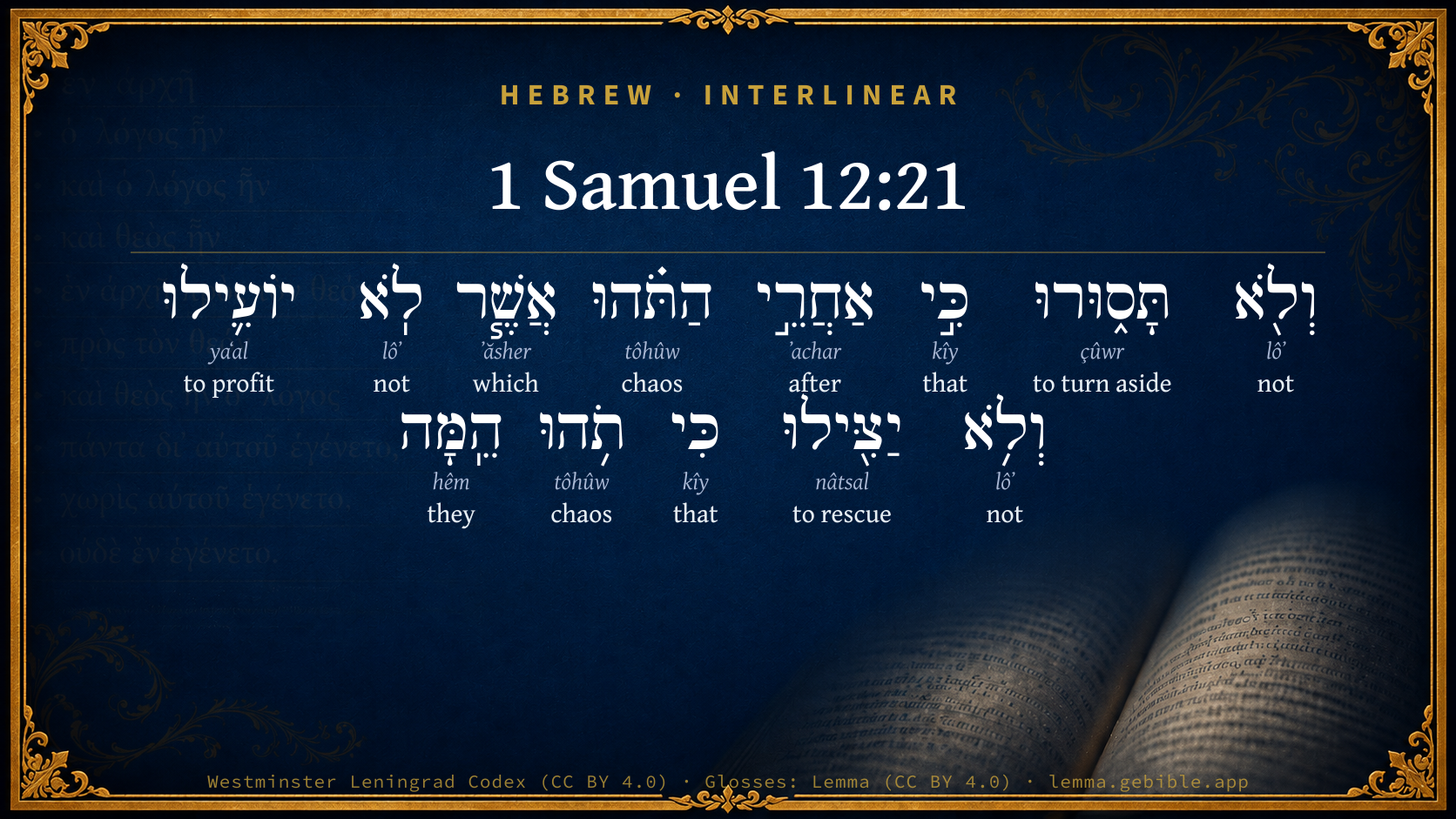
  1. וְלֹ֖א lôʼ H3808 “and · not” Conjunction + Particle, Negative
  2. תָּס֑וּרוּ çûwr H5493 “to turn aside” Verb, Qal, Imperfect, 2nd Person, Masculine, Plural
  3. כִּ֣י kîy H3588 “that” Conjunction
  4. אַחֲרֵ֣י ʼachar H310 “after” Preposition
  5. אֲשֶׁ֧ר ʼăsher H834 “which” Particle, Relative
  6. לֹֽא lôʼ H3808 “not” Particle, Negative
  7. יוֹעִ֛ילוּ yaʻal H3276 “to profit” Verb, Hiphil, Imperfect, 3rd Person, Masculine, Plural
  8. וְלֹ֥א lôʼ H3808 “and · not” Conjunction + Particle, Negative
  9. יַצִּ֖ילוּ nâtsal H5337 “to rescue” Verb, Hiphil, Imperfect, 3rd Person, Masculine, Plural
  10. כִּי kîy H3588 “that” Conjunction
  11. תֹ֥הוּ tôhûw H8414 “chaos” Noun, Common, Masculine, Singular, Absolute
  12. הֵֽמָּה hêm H1992 “they” Pronoun, Personal, 3rd Person, Masculine, Plural

About this verse

These counts appear in no published source. They are computed here, from the morphology-tagged text and Lemma’s own curated glosses. What Lemma adds →

13
words
9
distinct lemmas
Historical
section

Notable vocabulary

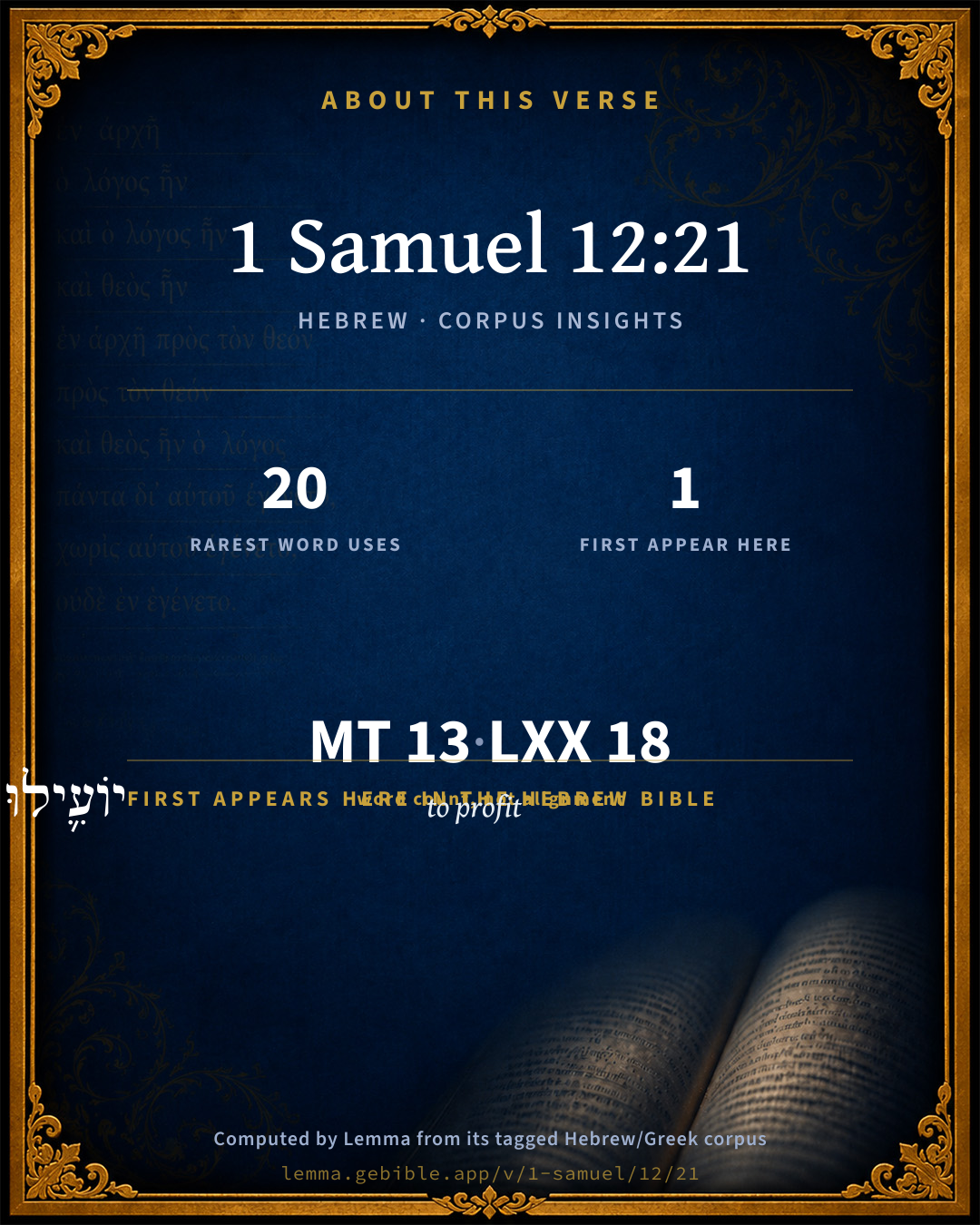
The rarest word here is הַתֹּ֗הוּ chaos H8414 — appearing just 20 times in the whole Hebrew Bible.

First appearance in Scripture

This word makes its first canonical appearance in the Hebrew Bible here:

  • יוֹעִ֛ילוּ to profit H3276

Shared distinctive vocabulary

הַתֹּ֗הוּ chaos H8414 occurs in 19 verses of the Hebrew Bible. Also found in:

Grammatical profile

  • 3 verbs
  • 2 nouns
  • 1 pronoun
  • 1 preposition
  • 2 conjunctions
  • 4 particles

Verb forms

  • תָּס֑וּרוּ Qal · Imperfect
  • יוֹעִ֛ילוּ Hiphil · Imperfect
  • יַצִּ֖ילוּ Hiphil · Imperfect

Repetition

Words recur within this verse — often emphatic in Hebrew:

  • הַתֹּ֗הוּ chaos H8414 ×2
  • וְלֹ֖א not H3808 ×3
  • כִּ֣י that H3588 ×2

Hebrew & Septuagint length

In English translation the verse runs 21 words from the Hebrew and 23 from the Septuagint (LXX English) — closely comparable.

A rough comparison of the two English renderings, which tokenize alike — not a word-level alignment.

Word counts can differ between the Hebrew and the Greek without any difference in meaning — e.g. the Hebrew direct-object marker אֵת has no separate Greek word, and Greek often adds the article ὁ.

In the original languages it is 13 Hebrew tokens and 18 Greek tokens — but the two are counted differently (Hebrew bundles its prefixes and suffixes into one token; the Greek is in lemma form), so that isn’t a like-for-like length.

Cross-references

17

Topical passages linked to 1 Samuel 12:21 in the Treasury of Scripture Knowledge — connected by theme and wording, ordered by reader-vote popularity; previews shown in the World English Bible.

  • Habakkuk 2:18 "What value does the engraved image have, that its maker has engraved it; the molten image, even the teacher of lies, that he who fashions its form trusts in it, to make mute idols?
  • Jeremiah 10:15 They are vanity, a work of delusion: in the time of their visitation they shall perish.
  • Jeremiah 16:19 Yahweh, my strength, and my stronghold, and my refuge in the day of affliction, to you shall the nations come from the ends of the earth, and shall say, Our fathers have inherited nothing but lies, [even] vanity and things in which there is no profit.
  • Deuteronomy 11:16 Take heed to yourselves, lest your heart be deceived, and you turn aside, and serve other gods, and worship them;
  • Jeremiah 14:22 Are there any among the vanities of the nations that can cause rain? or can the sky give showers? Aren't you he, Yahweh our God? therefore we will wait for you; for you have made all these things.
  • Isaiah 44:9–10 Those who fashion an engraved image are all of them vanity; and the things that they delight in shall not profit; and their own witnesses don't see, nor know: that they may be disappointed.
  • Isaiah 45:20 Assemble yourselves and come; draw near together, you who have escaped from the nations: they have no knowledge who carry the wood of their engraved image, and pray to a god that can't save.
  • Isaiah 46:7 They bear it on the shoulder, they carry it, and set it in its place, and it stands, from its place it shall not move: yes, one may cry to it, yet it can not answer, nor save him out of his trouble.
  • Jeremiah 2:13 For my people have committed two evils: they have forsaken me, the spring of living waters, and hewed them out cisterns, broken cisterns, that can hold no water.
  • Jonah 2:8 Those who regard lying vanities forsake their own mercy.
  • 1 Corinthians 8:4 Therefore concerning the eating of things sacrificed to idols, we know that no idol is anything in the world, and that there is no other God but one.
  • Deuteronomy 32:21 They have moved me to jealousy with that which is not God; They have provoked me to anger with their vanities: I will move them to jealousy with those who are not a people; I will provoke them to anger with a foolish nation.
  • Psalms 115:4–8 Their idols are silver and gold, The work of men's hands.
  • Isaiah 41:23–24 Declare the things that are to come hereafter, that we may know that you are gods: yes, do good, or do evil, that we may be dismayed, and see it together.
  • Isaiah 41:29 Behold, all of them, their works are vanity [and] nothing; their molten images are wind and confusion.
  • Jeremiah 2:5 thus says Yahweh, What unrighteousness have your fathers found in me, that they have gone far from me, and have walked after vanity, and are become vain?
  • Jeremiah 10:8 But they are together brutish and foolish: the instruction of idols! it is but a stock.

Cross-references courtesy of OpenBible.info (CC BY 4.0).

Hebrew and Greek witnesses Masoretic Hebrew ↔ Greek Septuagint

The same verse in the two great witnesses to the Old Testament, shown verse-for-verse.

These are two independent witnesses, not word-aligned to each other, and the Septuagint is shown in lemma (dictionary) form.

Hebrew 1 Samuel 12:21 Masoretic · Westminster Leningrad Codex

וְלֹ֖א תָּס֑וּרוּ כִּ֣י אַחֲרֵ֣י הַתֹּ֗הוּ אֲשֶׁ֧ר לֹֽא יוֹעִ֛ילוּ וְלֹ֥א יַצִּ֖ילוּ כִּי תֹ֥הוּ הֵֽמָּה

and don't turn aside; for [then would you go] after vain things which can't profit nor deliver, for they are vain.

World English Bible · Public Domain

Greek LXX 1 Samuel 12:21 Septuagint · lemma form

καί μή παραβαίνω ὀπίσω ὁ μηδείς εἰμί ὅς οὐ περαίνω οὐδείς καί ὅς οὐ ἐκαἱρέω ὅτι οὐδείς εἰμί

And turn not aside after the gods that are nothing, who will do nothing, and will not deliver you, because they are nothing.

LXX2012 (modern English Septuagint) · Public Domain

Hebrew: Westminster Leningrad Codex (CC BY 4.0). Greek: Septuagint (public domain); English from LXX2012 (modern English Septuagint) (Public Domain). How the Septuagint differs from the Hebrew →

Targum (Aramaic paraphrase)

1

The Targum is the ancient Jewish Aramaic paraphrase of the Hebrew Scriptures — an interpretive translation, not the Hebrew text itself. Onkelos (literal) and Pseudo-Jonathan (expansive) render the Torah, and Jonathan the Prophets. Coverage is partial: where no permissively-licensed English translation exists for a verse, only the Aramaic is shown. This is verse-level text, not a word-by-word alignment to the Hebrew.

  1. Targum Jonathan Prophets (Joshua–Malachi)
    וְלָא תִסְטוּן מִבָּתַר פּוּלְחָנֵיהּ וְלָא תִפְלְחוּן לְטַעֲוָתָא דְאִינוּן לְמָא וְלֵית בְּהוֹן הֲנָאָה וְלָא מְשֵׁיזְבִין אֲרֵי לְמָא אִינוּן:

    (no public-domain English translation for this verse)

    Targum Jonathan — Aramaic: “Mikraot Gedolot” (public domain). English: “Sefaria Community Translation” (CC0 1.0 (public-domain dedication)); “London "Chaldee Paraphrase," 1871” (public domain). Text via Sefaria.

Commentary

Notes on 1 Samuel 12:21 from classic Christian and Jewish commentators (each source and its license shown beneath its notes). The classic Christian expositions comment on the surrounding passage and are grouped to its opening verse, so a note may address several verses; the Jewish commentaries on the Tanakh (Rashi and others) are per-verse, so they appear only where the commentator wrote on this verse.

Lemma curates 59 commentaries, every one of them public domain or Creative Commons licensed, each selected and text-cleaned for this edition rather than reprinted as found. About our sources →

Trapp's Complete Commentary

John Trapp

1Sa 12:21 And turn ye not aside: for [then should ye go] after vain [things], which cannot profit nor deliver; for they [are] vain.

Ver. 21. And turn ye not aside.] To idols, or other of the devil’s anodynes, as music, merry company, multiplicity of worldly business, or the like. This is but to imitate the wounded deer, which frisketh about, but hath the deadly arrow sticking in his side.

John Trapp, A Commentary or Exposition upon All the Books of the Old and New Testament (1647–1656) — public domain. Text from a community e-Sword module.

The Biblical Illustrator

Joseph S. Exell

1Sa_12:21

Turn ye not aside.

Points of departure

Samuel assumes that the true path was clear before Israel; it knew its calling and destiny. To love God alone and to serve Him was the simple royal pathway. And Samuel here reminds the people that the imminent danger was not that they would execute a right-about and go back to Egypt, but that they should turn aside. So the grand path of life is clearly discovered to us. And our great danger is not that we should suddenly wheel about, but that we should deflect little by little. Let us note these points of departure from a higher to a lower life--from faith to unbelief, spirituality to worldliness, purity to laxity and immorality.

I. These points of departure are numerous. Men begin to live afresh, to live a better and still better life, prompted by most diverse occasions. On the other side, from all kinds of happenings men begin to gravitate. Beginning school awakes in one child a higher sense, whilst for another it is the loss of innocence and the beginning of evil, proving, as Michelet writes, that the real fall is the day when a boy leaves him me, her. Leaving school initiates one youth into a more serious, manly life, whilst another takes advantage of the change to relax discipline and begins to play a baser part. A change of residence or situation leads one to greater devotion and circumspection, whilst another from that time forward is distinctly poorer in character, the change destroying old habits of good. Marriage proves a truly golden day in the life of some--the beginning of higher thought, love, and purpose; for others the same event is altogether disastrous to their moral and religious life. After Methuselah was born, Enoch his father walked with God. Events are always happening which are occasions of the rising or falling of souls, and herein lies the real seriousness of life. The danger comes from opposite directions. Thou shalt not go aside . . . to the right hand, or to the left. Directly opposite phases of experience and circumstance prove equally fatal.

II. These points of departure are slight. We do not go off at an acute angle, or down a steep incline, leading right away from the Christian course; we simply get a little wrong, and this may end with ruin. The first departure from God is of really tremendous significance, and yet it may appear absolutely trifling. The descent into error is rarely violent. We speak of men falling into error, but more commonly they slide into it. There are half-way houses to superstition. There is a literature which deftly saps solemn convictions, and which, like the thief in the night, despoils men of a faith infinitely more precious than gold. The down grade in belief is a masterpiece of engineering, and many who follow it are all the time unconscious of any declination. The lapse into worldliness is usually a process of fine shadings off. The little rift in the lute slowly widening stills the music; but that rift is never more subtle and slow than it is in the lute which makes musical the hearts and lives of righteous men. The descent into wickedness is equally gentle. The beginning of sin is always obscure. Insidious are the beginnings of evil. The agents of darkness, as our poet says,

Win us with honest trifles, to betray us

In deepest consequence.

The slow and subtle way in which practical iniquity takes shape is one of the tragedies of life. M. Joly has recorded the experience of the police concerning the thefts that take place at the great Parisian shops. This is the beginning. From a gallery one sees a woman--rich or well-to-do--who buys a certain number of objects and pays for them, but without asking permission she takes some little, almost insignificant, object--a little ribbon to fasten a parcel, more commodious paper bag. No one will say she is stealing; no one will think of speaking to her or disturbing her. But she is observed, and even watched; for one expects to see her again some time after taking, as she walks along, say, a flower worth twenty-five centimes. A little later she will appropriate an article of greater value, and henceforth she will take for the pleasure of taking. Amid the glaciers of the Alps an explosion is sometimes heard announcing the birth of a crevasse. At first the young fissure is almost too slight to be seen, and at no place is it wide enough to admit a knife blade. But the almost imperceptible fracture eventually becomes a gaping, impassable chasm. So it is when we break with good; the great gulf fixed between the lost and paradise began in a flaw hardly to be discerned.

III. These points of departure are specious. It seems in the hour of temptation as if we should secure a great advantage by departing from a strict, literal fidelity to the path of duty. When Israel first dabbled with idolatry, they had no thought of renouncing God. They imagined that certain advantages were to be gained by intercourse with idolatrous nations, and that such advantages might be secured without losing in any measure the blessing of Jehovah. They became worse than the heathen. Very specious still are many of the things which draw us from God. The point of departure to worldliness is often similarly specious. Care for his family--this is the reason why Demos abates his religious enthusiasm and applies himself to business. James Hinton said, Wishing to tempt an Englishman, the devil generally appears in the shape of the mans wife and family. And how plausible he is in this shape! How much is to be said for prudence and diligence! Oh, very rational, promising, enticing seem those openings which lead to a lower life! This is what Shakespeare meant when he wrote:

But tis strange:

And oftentimes, to win us to our harm,

The instruments of darkness tell us truths.

At Bypath meadow Christian said to Hopeful, If this meadow lieth along by our wayside, lets go over into it. Then he went to the stile to see, and behold a path lay along by the way on the other side of the fence. Here is the easiest going, said he; let us go over. Many paths on the other side of the fence seem to run parallel with Christian principle and doctrine, and yet they lead to death. The fence may be very narrow. Andrew Bonar writes: Often I have wondered that I did not feel the temptations of Satan more frequently and plainly. But now I discover his plan. In short, he succeeds in reversing in my case, Seek first the kingdom of God.

IV. These points of departure are always serious. Even if they do not lead us altogether astray or far astray, turnings aside are great evils. A tree grows so grandly because without vagary it develops itself according to its nature; the flower is so glorious because it concentrates itself on bud and blossom; the bee is so rich in honey because it follows the shortest line: and if we are to attain wealth and glory of character we must avoid lapses, eccentricities, obliquities, waste of time and power by diversions and repentances. These branchings off from the Kings highway may lead to utter ruin. All wanderings of heart or life begin in a lack of faith either in the prize or in the path. Let us keep alive, then, an ardent faith in the grand prize of life. Life is not like a suddenly twisted kaleidoscope which at every turn discloses startling scenery, events, and experiences; still there will not be a day without its stepping stones to higher things, and there will be critical, privileged days, bringing memorable chances and inspiration. (W. L. Watkinson.)

Backsliding arrested

I. The first point of instruction addressed to such is, that they should not proceed another step in their backsliding.

II. The second point of instruction which the prophet addressed to these trembling backsliders was, that they should have a filial confidence in God, in order that they might not depart from Him. Fear not, ye have done all this wickedness; yet turn not aside from following the Lord with all your heart.

III. This leads us to the third point of instruction addressed by the Prophet to the people, namely, the ground upon which their confidence was to rest. Turn ye not aside; for then should ye go after vain things, which cannot profit nor deliver, for they are vain. For the Lord will not forsake his people.

IV. The reason why the Lord thus delights to be gracious. For the Lord will not forsake his people, for His great names sake: because it has pleased the Lord to make you his people. (B. Noel.)

The folly of turning aside from the Lord

The text is a defiance held out to men in their attempts to mend their condition by departing from the Lord. In which there is,

1. A case supposed, which is, That they should turn aside from the Lord; and having done so, they have the wide world to choose upon, let them take to the right hand, or to the left, choose the best they can pitch on, some or all, that what is wanting in one, may be made up in another. This is the utmost extent to which it can be carried. There is,

2. The determination in this case, which is expressed in the text with all confidence. Ye shall not, ye cannot for your hearts, turn aside, but after vain things; I defy you to find out a substantial good for yourselves in the whole creation, separate from God. Doctrine, That no man shall mend his condition, but will ruin it, by turning aside from the Lord, let him turn to what hand soever he will. For illustrating this doctrine, I shall--

I. To offer some things for explaining the point. Here I observe,

1. That no man, by turning aside from the Lord, shall mend his condition, but ruin it, in point of rest to his heart, and satisfaction to the desires of it (Isa_57:19-20).

2. That no man, by turning aside from the Lord, shall mend his condition, but ruin it, in point of comfort and ease to his conscience.

3. That no man, by turning aside from the Lord, shall mend his condition, but ruin it, in point of his interest and advantage (Jer_2:13).

4. That no man, by turning aside from the Lord, will better his condition, but ruin it, in point of security from evil (Pro_28:18), Whoso walketh uprightly, shall be saved; but he that is perverse in his ways, shall fall at once.

II. To evince the truth of this weighty point. That no man shall mend his condition, but will ruin it, by turning aside from the Lord, let him turn to what hand soever he will.

1. We are to evince the truth of this weighty point, by considering to what a person turns aside when he turns from God. It is but vanity, which cannot proof or deliverse There are but two things to which a person can turn aside, though the particulars are numberless. The character agrees either,

(1) To sin, that is, to sinful ways, courses, or practices. And while there is a God in heaven to avenge the affront, no man shall mend his condition in this way.

2. To the creature, to which, when men are turning aside from God, they turn to seek happiness. This comprehends all created comforts whatsoeverse Of them we have two things to say. They are all uncertain, a person can never get a sure hold of them: (Pro_23:5), Wilt thou set thine eyes upon that which is not? for riches certainly make themselves wings, they flee away as an eagle towards heaven. They are utterly insufficient. It is not in them to answer the cravings of the human heart, of an immortal soul (Isa_55:2). There is no suitableness in them to the soul They have no Divine appointment for that end.

2. For evincing the truth of this weighty point, consider what a person turns aside from, when turning aside from God He turns from an upmaking portion; (Psa_73:25), Whom have I in heaven but thee? and there is none upon earth that I desire besides thee. Cleave to the Lord, turn not aside from him: for,

(1) Thou art enriched for time: (1Ti_4:8), Godliness is profitable unto all things, having the promise of the life that now is, and of that which is to come (Psa_37:3).

(2) Cleave unto the Lord, turn not aside from Him, and thus thou art enriched for eternity (1Ti_4:8), quoted above. Come death when it will, what then? thou shalt be carried where thy happiness shall be completed: (Joh_14:2). The law cannot debar thee from this happiness, it is satisfied; justice has nothing to say against thee, for the debt is paid: God is thy God; and the tongue of men, nor of angels, cannot fully express this privilege.

3. The truth of this weighty point in the text will farther appear, by inspecting the pretended gain which is acquired by turning aside from the Lord. It may all be summed up in these two particulars.

(1) It is nothing (Pro_23:5). All the gain is but childrens gain, which they have won off their fellows, of which grown persons make no account. It is a poor trade where a person is not gaining for his soul; and no person will gain for this by turning aside from God.

(2) It is worse than nothing. Whatsoever thou thinkest thou gainest by turning aside from the Lord, a thousand times more is going to destruction in the meantime. Count what thou givest out, as well at what thou gettest in, and thou wilt soon see the gain worse than nothing (Mat_16:26). From all which it is evident, that no man shall better his condition, but ruin it, by turning aside from the Lord; let him turn to what hand soever he will. I now proceed,

III. To make some improvement of this subject, in an use of information.

1. You who have never yet turned to the Lord, but have been going aside from him all your days, know, that ye are yet in a ruinous condition; there is nothing you can call yours, but what is vanity, and cannot, profit or deliver.

2. Backsliders, be all of you convinced of the foolish choice ye have made, repent, and turn again unto the Lord. What have you gained by your departure from him?

3. Ye who have got near God in this ordinance, ye may see that it is your duty and interest, by a holy tender walk, a living by faith, to hold where you are.

4. Disappointed communicants may hence be satisfied, that if you love your own souls, it is not for your profit to go aside to another door, to get your loss at the door of Gods house made up another way. Be peremptory in your resolutions that you will wait upon the Lord, and not give over, how long soever ye be without sensible success (Gen_32:26).

5. Ye carnal ones, who are weary of waiting about the Lords hand, and are longing to be back to the world as your element, saying in your heart, When will the Sabbath be over? Ye may see the propriety of checking these carnal notions: stir up yourselves to seek the Lord. (T. Boston, D. D.)

How steadfastness is secured

Loose things on the deck of a ship will be blown or washed overboard when the storm comes. There is only one way to keep them firm, and that is to lash them to something that is fixed. It is not the bit of rope that gives them security, but it is the stable thing to which they are lashed. Lash yourselves to Christ by faith, and whatever storm or tempest comes you will be safe, and stand firm and immovable. (A. Maclaren, D. D.)

The Biblical Illustrator, edited by Joseph S. Exell (c. 1880s–1900s) — public domain. Text from a community e-Sword module.

Tyndale Open Study Notes

Tyndale Open Resources

12:21 worthless . . . totally useless: Israel was slow to learn this lesson (e.g., Isa 40:18-26; 44:9-20).

Tyndale Open Study Notes — © Tyndale Open Resources, licensed CC BY-SA 4.0. Text via the HelloAO Bible API.

Adam Clarke's Commentary

Verse 21. After vain things] That is, idols; which he calls here התהו hattohu, the same expression found Ge 1:2. The earth was תהו tohu; it was waste, empty, and formless: so idols; they are confusion, and things of naught, for an idol is nothing in the world-it is not the representative of any intelligent being.

Adam Clarke's Commentary on the Bible (1810–1826) — public domain. Text from a community e-Sword/MySword module.

Ellicott's Commentary for English Readers

(21) For then should ye go after vain things.—The passage is more forcible without the “for” and the words in italics supplied in the English translation. The verse without it would run thus: “Turn ye not aside after vain things which cannot profit,” &c. Singularly enough, not one of the ancient versions translate the Hebrew ki, “for”: they all omit it. It is therefore clear that this “for” has, through some copyist’s error, got into the text since the versions were made.

A Bible Commentary for English Readers, edited by Charles John Ellicott (1878–1897) — public domain. Text from a community e-Sword module.

The Cambridge Bible for Schools and Colleges

gen. ed. J. J. S. Perowne

21. for then should ye go after vain things] The word “for” necessitates the insertion of a verb to complete the sentence. But it is expressed in none of the ancient versions, and the sense gains by its omission. Translate: “And ye shall not turn aside after vain things which cannot profit nor deliver.” “Vain things” are false gods and idols, Heb. tôhû, literally emptiness. The same word is applied to them in Isa_41:29 (E. V. confusion), and to idol-makers in Isa_44:9. Cp. 1Co_8:4.

The Cambridge Bible for Schools and Colleges (gen. ed. J. J. S. Perowne; Cambridge University Press, 1878–1918) — public domain. Text from a community e-Sword module.

John Gill's Exposition

And turn ye not aside,.... From his worship: for then; if they turned aside from that:

should ye go after vain things; idols, which are vanity, and less than vanity:

which cannot profit nor deliver; neither bestow good things on their votaries, nor deliver them from evils, or from the hands of their enemies

for they are vain; empty, useless, and unprofitable; an idol is nothing in the world, Co1 8:4.

John Gill's Exposition of the Whole Bible (1746–1763) — public domain (CC PDM 1.0). Text via the HelloAO Bible API.

Haydock's Catholic Bible Commentary

Vain and wicked idols. Hebrew thohu, full of "confusion" and disorder.

George Leo Haydock (1774–1849), Haydock's Catholic Family Bible and Commentary, 1859 edition — public domain. Excludes Psalms (Douay-Rheims chapter numbering differs from Protestant) and Deuterocanonical books (Catholic canon only).

Matthew Poole's English Annotations

Turn ye not aside, to wit, after idols; as they had often done before; and, notwithstanding this warning, did afterwards.

Should ye go, or, should ye turn aside; which words are easily to be understood out of the foregoing branch, such ellipses being most frequent in Scripture, as Deu 1:4; 1Ki 14:14; 2Ki 9:27.

Vain things; so idols are called, Deu 32:21; Jer 2:5, and so they are, being mere nothings, 1Co 8:4, having no divinity nor power in them; no influence upon us, nor use or benefit to us.

Which cannot profit nor deliver, i.e. which will not only be unprofitable, but highly pernicious to you; the contrary affirmative being understood under the negative, as Exo 20:7; Num 21:23; Deu 2:30.

Matthew Poole's English Annotations on the Holy Bible (1683–1685) — public domain. Text from a community e-Sword/MySword module.

The Pulpit Commentary

For then should ye go after vain things. The word for is omitted in all the ancient versions, and the sense is complete without it: "And turn ye not aside after tohu, the word used in Gen_1:1, and there translated "without form." It means anything empty, void, and so is often used, as here, for "an idol," because, as St. Paul says, "an idol is nothing in the world". (1Co_8:4) So Isaiah (Isa_44:9) calls the makers of idols vanity, Hebrew, tohu, i.e. empty people, with no sense in them. The word is used again at the end of the versewhich idols cannot profit nor deliver; for they are tohu, emptiness.

The Pulpit Commentary (1880–1919), ed. H.D.M. Spence-Jones & Joseph S. Exell — public domain. Text from a community e-Sword module.

John Wesley's Explanatory Notes

Turn aside-After idols; as they had often done before; and, notwithstanding this warning, did afterwards. Vain things - So idols are called, Deut. xxxii, 21 Jer. ii, 5, and so they are, being mere nothings, having no power in them; no influence upon us, nor use or benefit to us.

John Wesley, Explanatory Notes Upon the Whole Bible (1754–1765) — public domain. Text via the GEBible commentary corpus.

Lesson kit

Teaching starters — assembled from the data on this page, not authored interpretation. Every prompt links to the verse data it draws on. Edit before teaching.

1 Samuel, in the Historical, opens this verse with 13 words (9 distinct Hebrew lemmas). Its most distinctive word is tôhûw (“chaos”). A historical commentator’s framing appears above. Read the whole chapter for the surrounding context.

Discussion questions

  1. What does “chaos” (tôhûw) contribute to the verse as a whole?
  2. The word “to profit” first appears here in Scripture. What is being introduced at this debut?
  3. Genesis 1:2 shares the word «chaos» with this verse. How do the two illuminate each other?
  4. “chaos” occurs 2× in this one verse. What is the effect of the repetition?
  5. These translations render this verse differently; the difference is in the English rendering, not the original. What questions does that raise?
  6. The verb «תָּס֑וּרוּ» is Qal Imperfect. How does its form color the action?
  7. Reading how Trapp's Complete Commentary and The Biblical Illustrator read this verse, where do the two commentators agree and where do they part?

Things to notice

Reading settings

Reading text

Shown beneath each verse's original-language words.

Old Testament
Old Testament edition

Read the OT as the Masoretic Hebrew (MT) or the Greek Septuagint (LXX).

English shown for the Greek Septuagint (in the Hebrew ↔ Greek comparison).

Comparing translations? Open the Compare panel on any verse page to stack up to four side by side.