
Ezekiel 32:29

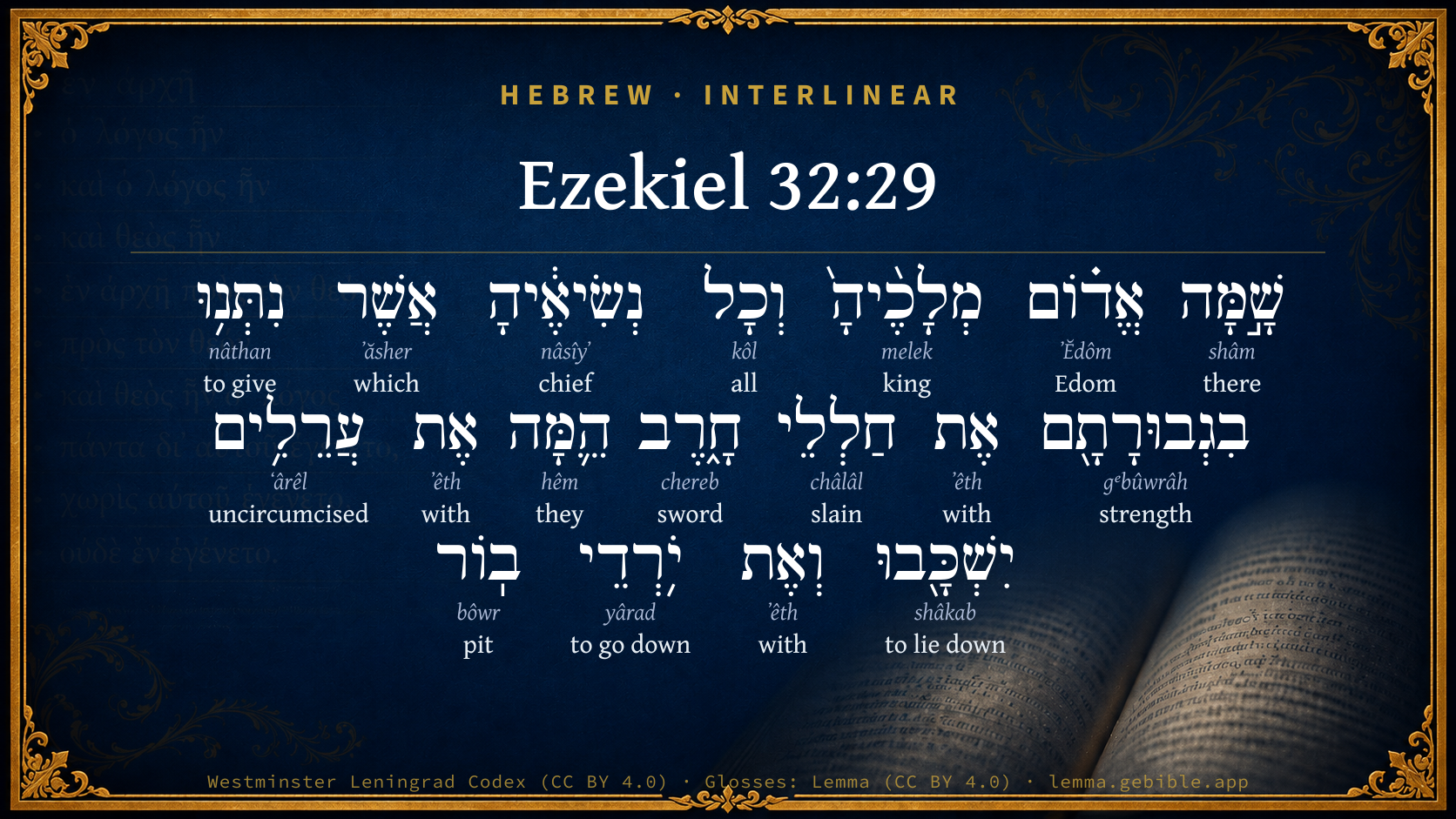
Hebrew (Westminster Leningrad Codex) Ezekiel 32:29 appears in the Hebrew Old Testament. The text above is from the Westminster Leningrad Codex. Each word links to its Strong’s number, a concise gloss, and parsing drawn from the Open Scriptures Hebrew Bible morphology. Click any word for its full Brown-Driver-Briggs (BDB) entry.
Download image
Cite this verse

Ezekiel 32:29 (World English Bible). Public Domain. Lemma interlinear Bible study tool, https://lemma.gebible.app/v/ezekiel/32/29.

Show BibTeX & RIS
BibTeX
RIS
English Translation
There is Edom, her kings and all her princes, who in their might are laid with those who are slain by the sword: they shall lie with the uncircumcised, and with those who go down to the pit.
World English Bible · Public Domain
Download a study sheet

One document with this verse’s original text, its word-by-word gloss line, the meaning frame, cross-references with their text, attributed commentary, and full source and license credits — printable, and it pastes into notes with its structure intact.

This verse Autodidact and up

Study sheet (.html) Plain text (.txt)

A passage Seminary Student

Up to 50 verses in one chapter. A passage sheet keeps up to 6 commentary sources and 12 cross-references per verse, in the order this page ranks them, and says so on the sheet whenever that leaves anything out. Ask for a single verse and you get the Autodidact verse sheet above.

Everything on this page stays free to read, with no account — the sheet is a download of what is already on screen, not access to it.

Want to remove ads? Support Godless Engineer
Compare translations 3

The same verse in 3 English versions, stacked beneath the original-language interlinear above. Click any original word for its lexicon entry.

Each is an independent rendering of the whole verse — the interlinear is not word-aligned to these translations.

Highlighted words mark where these versions differ — a whole-verse word diff, not a word-by-word alignment.

  • World English Bible Public Domain
    There is Edom, her kings and all her princes, who in their might are laid with those who are slain by the sword: they shall lie with the uncircumcised, and with those who go down to the pit.
  • King James Version Public Domain
    There is Edom, her kings, and all her princes, which with their might are laid by them that were slain by the sword: they shall lie with the uncircumcised, and with them that go down to the pit.
  • unfoldingWord Literal Text CC BY-SA 4.0
    Edom is there with her kings and all her leaders. They have been placed in their strength with those killed by the sword. With the uncircumcised they lie, with those who have gone down to the pit.

unfoldingWord Literal Text — © unfoldingWord, licensed CC BY-SA 4.0. Word-aligned USFM3 via Door43 (git.door43.org/unfoldingWord/en_ult).

Versions to compare (up to 4)

3 of 4 selected

Show all 18 translations

Every available English version of this verse, each an independent rendering of the whole verse.

  • World English Bible Public Domain
    There is Edom, her kings and all her princes, who in their might are laid with those who are slain by the sword: they shall lie with the uncircumcised, and with those who go down to the pit.
  • Berean Standard Bible Public Domain
    Edom is there, and all her kings and princes, who despite their might are laid among those slain by the sword. They lie down with the uncircumcised, with those who descend to the Pit.
  • Majority Standard Bible Public Domain
    Edom is there, and all her kings and princes, who despite their might are laid among those slain by the sword. They lie down with the uncircumcised, with those who descend to the Pit.
  • King James Version Public Domain
    There is Edom, her kings, and all her princes, which with their might are laid by them that were slain by the sword: they shall lie with the uncircumcised, and with them that go down to the pit.
  • American Standard Version (1901) Public Domain
    There is Edom, her kings and all her princes, who in their might are laid with them that are slain by the sword: they shall lie with the uncircumcised, and with them that go down to the pit.
  • Revised Version (1885) Public Domain
    There is Edom, her kings and all her princes, which in their might are laid with them that are slain by the sword: they shall lie with the uncircumcised, and with them that go down to the pit.
  • Geneva Bible (1599) Public Domain
    There is Edom, his Kings, and all his princes, which with their strength are laied by them that were slaine by the sworde: they shall sleepe with the vncircumcised, and with them that goe downe to the pit.
  • Douay-Rheims (1899) Public Domain
    There is Edom, and her kings, and all her princes, who with their army are joined with them that are slain by the sword: and have slept with the uncircumcised, and with them that go down into the pit.
  • Young's Literal Translation Public Domain
    There `is' Edom, her kings, and all her princes, Who have been given up in their might, With the pierced of the sword, They with the uncircumcised do lie, And with those going down to the pit.
  • Literal Standard Version CC BY-SA 4.0
    There [is] Edom, her kings, and all her princes, || Who have been given up in their might, || With the pierced of the sword, || They lie with the uncircumcised, || And with those going down to the pit.
  • Unlocked Literal Bible CC BY-SA 4.0
    Edom is there with her kings and all her leaders. They have been placed in their strength with those killed by the sword. With the uncircumcised they lie, with those who have gone down to the pit.
  • unfoldingWord Literal Text CC BY-SA 4.0
    Edom is there with her kings and all her leaders. They have been placed in their strength with those killed by the sword. With the uncircumcised they lie, with those who have gone down to the pit.
  • Darby Bible Public Domain
    There is Edom, her kings, and all her princes, who in their might are laid with them that are slain by the sword: they lie with the uncircumcised, and with them that go down to the pit.
  • World Messianic Bible Public Domain
    “There is Edom, her kings, and all her princes, who in their might are laid with those who are slain by the sword. They will lie with the uncircumcised, and with those who go down to the pit.
  • Webster's Bible Public Domain
    There is Edom, her kings, and all her princes, who with their might are laid by them that were slain by the sword: they shall lie with the uncircumcised, and with them that go down to the pit.
  • Free Bible Version CC BY-SA 4.0
    Edom is there with all its kings and princes. Once they were powerful, but now they too are laid to rest with those killed by the sword. They lie with the heathen, with those who go down into the grave.
  • Bible in Basic English Public Domain
    There is Edom, her kings and all her princes, who have been given a resting-place with those who were put to the sword: they will be resting among those without circumcision, even with those who go down to the underworld.
  • JPS Tanakh (1917) Public Domain
    There is Edom, her kings and all her princes, who for all their might are laid with them that are slain by the sword; they shall lie with the uncircumcised, and with them that go down to the pit.

Literal Standard Version (2020), Covenant Press — licensed CC BY-SA 4.0. Text via the HelloAO Bible API (eBible.org). Unlocked Literal Bible (unfoldingWord) — licensed CC BY-SA 4.0. Text via the HelloAO Bible API (eBible.org). unfoldingWord Literal Text — © unfoldingWord, licensed CC BY-SA 4.0. Word-aligned USFM3 via Door43 (git.door43.org/unfoldingWord/en_ult). Free Bible Version, Dr. Jonathan Gallagher — licensed CC BY-SA 4.0. Text via the HelloAO Bible API (eBible.org).

Word by word

More ways to search: Search by grammar → Find every occurrence → Compare this word →

Practice this passage: Drill this verse → Learn its vocabulary →

עֲרֵלִ֥ים
ʻârêl
H6189
“uncircumcised”
Adjective, Adjective, Masculine, Plural, Absolute
Part of Speech
Adjective
Type
Adjective
Gender
Masculine
Number
Plural
State
Absolute
Full BDB Definition

Origin: from H6188

TWOT: 1695b

uncircumcised, having foreskin
  1. שָׁ֣מָּה shâm H8033 “there · toward” Adverb + Suffix, Demonstrative
  2. אֱד֗וֹם ʼĔdôm H123 “Edom” Noun, Proper
  3. מְלָכֶ֨יהָ֙ melek H4428 “kings · her” Noun, Common, Masculine, Plural, Construct + Suffix, Personal, 3rd Person, Feminine, Singular
  4. וְכָל kôl H3605 “and · all of” Conjunction + Noun, Common, Masculine, Singular, Construct
  5. נְשִׂיאֶ֔יהָ nâsîyʼ H5387 “chiefs · her” Noun, Common, Masculine, Plural, Construct + Suffix, Personal, 3rd Person, Feminine, Singular
  6. אֲשֶׁר ʼăsher H834 “which” Particle, Relative
  7. נִתְּנ֥וּ nâthan H5414 “to give” Verb, Niphal, Perfect, 3rd Person, Common, Plural
  8. בִגְבוּרָתָ֖ם gᵉbûwrâh H1369 “in/at · strength · their” Preposition + Noun, Common, Feminine, Singular, Construct + Suffix, Personal, 3rd Person, Masculine, Plural
  9. אֶת ʼêth H854 “with” Preposition
  10. חַלְלֵי châlâl H2491 “slain of” Adjective, Adjective, Masculine, Plural, Construct
  11. חָ֑רֶב chereb H2719 “sword” Noun, Common, Feminine, Singular, Absolute
  12. הֵ֛מָּה hêm H1992 “they” Pronoun, Personal, 3rd Person, Masculine, Plural
  13. אֶת ʼêth H854 “with” Preposition
  14. יִשְׁכָּ֖בוּ shâkab H7901 “to lie down” Verb, Qal, Imperfect, 3rd Person, Masculine, Plural
  15. וְאֶת ʼêth H854 “and · with” Conjunction + Preposition
  16. יֹ֥רְדֵי yârad H3381 “going down” Verb, Qal, Participle Active, Masculine, Plural, Construct
  17. בֽוֹר bôwr H953 “pit” Noun, Common, Masculine, Singular, Absolute

About this verse

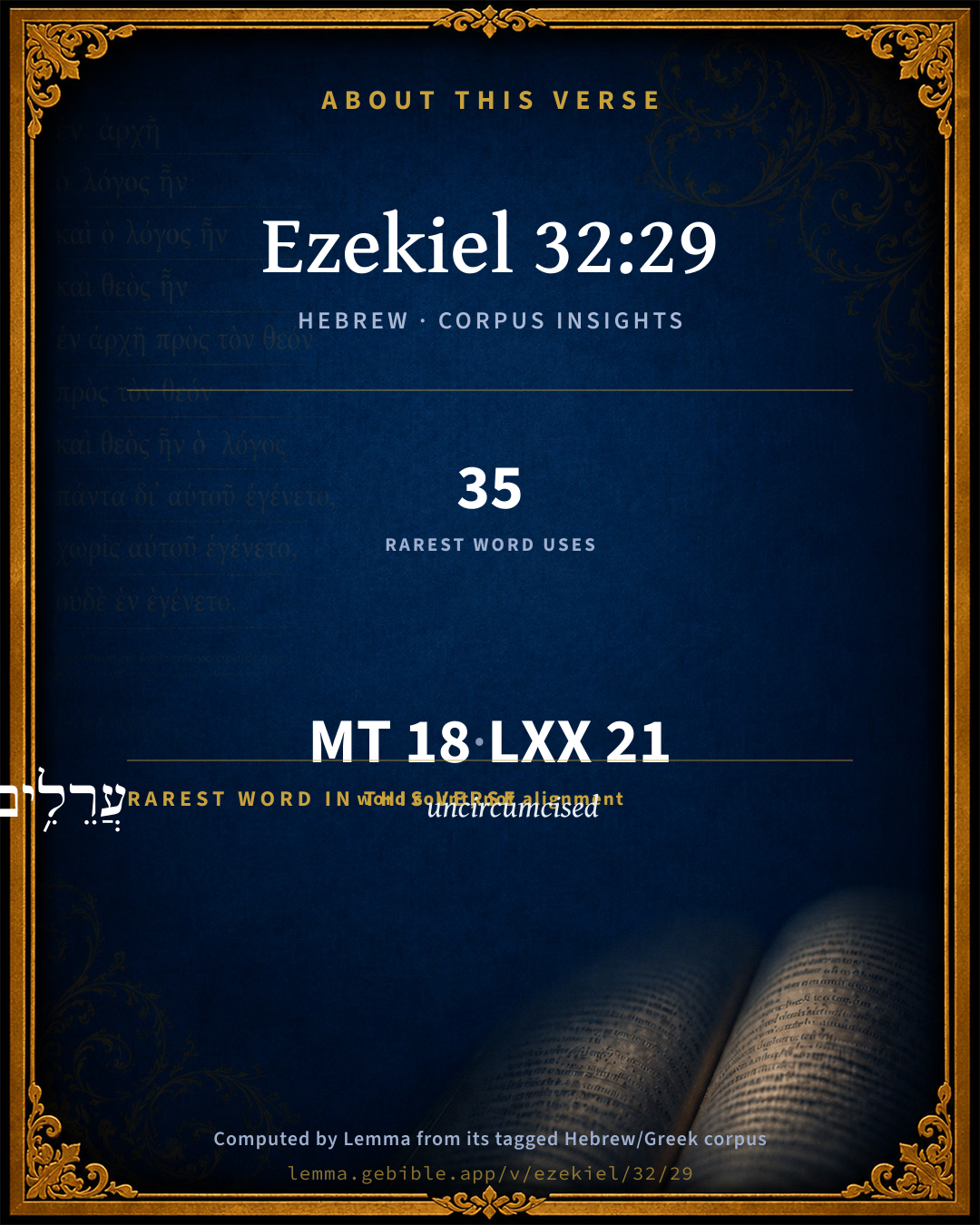
These counts appear in no published source. They are computed here, from the morphology-tagged text and Lemma’s own curated glosses. What Lemma adds →

18
words
16
distinct lemmas
Prophets
section

Shared distinctive vocabulary

עֲרֵלִ֥ים uncircumcised H6189 occurs in 32 verses of the Hebrew Bible. Also found in:

Grammatical profile

  • 3 verbs
  • 7 nouns
  • 2 adjectives
  • 1 pronoun
  • 3 prepositions
  • 1 adverb
  • 1 particle

Verb forms

  • נִתְּנ֥וּ Niphal · Perfect
  • יִשְׁכָּ֖בוּ Qal · Imperfect
  • יֹ֥רְדֵי Qal · Participle Active

Repetition

A word recurs within this verse — often emphatic in Hebrew:

  • אֶת with H854 ×3

Hebrew & Septuagint length

In English translation the verse runs 38 words from the Hebrew and 31 from the Septuagint (LXX English) — closely comparable.

A rough comparison of the two English renderings, which tokenize alike — not a word-level alignment.

Word counts can differ between the Hebrew and the Greek without any difference in meaning — e.g. the Hebrew direct-object marker אֵת has no separate Greek word, and Greek often adds the article ὁ.

In the original languages it is 18 Hebrew tokens and 21 Greek tokens — but the two are counted differently (Hebrew bundles its prefixes and suffixes into one token; the Greek is in lemma form), so that isn’t a like-for-like length.

Cross-references

10

Topical passages linked to Ezekiel 32:29 in the Treasury of Scripture Knowledge — connected by theme and wording, ordered by reader-vote popularity; previews shown in the World English Bible.

  • Jeremiah 49:7–22 Of Edom. Thus says Yahweh of Hosts: Is wisdom no more in Teman? is counsel perished from the prudent? is their wisdom vanished?
  • Genesis 25:30 Esau said to Jacob, "Please feed me with that same red stew, for I am famished." Therefore his name was called Edom.
  • Genesis 36:1–19 Now this is the history of the generations of Esau (the same is Edom).
  • Isaiah 34:1–17 Come near, you nations, to hear; and listen, you peoples: let the earth hear, and the fullness of it; the world, and all things that come forth from it.
  • Isaiah 63:1–6 Who is this who comes from Edom, with dyed garments from Bozrah? this who is glorious in his clothing, marching in the greatness of his strength? I who speak in righteousness, mighty to save.
  • Ezekiel 25:1–17 The word of Yahweh came to me, saying,
  • Ezekiel 35:1–15 Moreover the word of Yahweh came to me, saying,
  • Amos 1:11–12 Thus says Yahweh: "For three transgressions of Edom, yes, for four, I will not turn away its punishment; Because he pursued his brother with the sword, And cast off all pity, And his anger raged continually, And he kept his wrath forever;
  • Obadiah 1:1–9 The vision of Obadiah. This is what the Lord Yahweh says about Edom. We have heard news from Yahweh, and an ambassador is sent among the nations, saying, "Arise, and let's rise up against her in battle.
  • Malachi 1:3–4 but Esau I hated, and made his mountains a desolation, and gave his heritage to the jackals of the wilderness."

Cross-references courtesy of OpenBible.info (CC BY 4.0).

Hebrew and Greek witnesses Masoretic Hebrew ↔ Greek Septuagint

The same verse in the two great witnesses to the Old Testament, shown verse-for-verse.

These are two independent witnesses, not word-aligned to each other, and the Septuagint is shown in lemma (dictionary) form.

Hebrew Ezekiel 32:29 Masoretic · Westminster Leningrad Codex

שָׁ֣מָּה אֱד֗וֹם מְלָכֶ֨יהָ֙ וְכָל נְשִׂיאֶ֔יהָ אֲשֶׁר נִתְּנ֥וּ בִגְבוּרָתָ֖ם אֶת חַלְלֵי חָ֑רֶב הֵ֛מָּה אֶת עֲרֵלִ֥ים יִשְׁכָּ֖בוּ וְאֶת יֹ֥רְדֵי בֽוֹר

There is Edom, her kings and all her princes, who in their might are laid with those who are slain by the sword: they shall lie with the uncircumcised, and with those who go down to the pit.

World English Bible · Public Domain

Greek LXX Ezekiel 32:29 Septuagint · lemma form

ἐκεῖ δίδωμι ὁ ἄρχων ασσουρ ὁ δίδωμι ὁ ἰσχύς αὐτός εἰς τραῦμα μάχαιρα οὗτος μετά τραυματίας κοιμάω μετά καταβαίνω εἰς βόθρος

There are laid the princes of Assur, who yielded their strength to a wound of the sword: these are laid with the slain, with them that go down to the pit.

LXX2012 (modern English Septuagint) · Public Domain

On this verse, Haydock's Catholic Bible Commentary discusses the Septuagint’s reading. Read the note in Commentary ↓

Hebrew: Westminster Leningrad Codex (CC BY 4.0). Greek: Septuagint (public domain); English from LXX2012 (modern English Septuagint) (Public Domain). How the Septuagint differs from the Hebrew →

Targum (Aramaic paraphrase)

1

The Targum is the ancient Jewish Aramaic paraphrase of the Hebrew Scriptures — an interpretive translation, not the Hebrew text itself. Onkelos (literal) and Pseudo-Jonathan (expansive) render the Torah, and Jonathan the Prophets. Coverage is partial: where no permissively-licensed English translation exists for a verse, only the Aramaic is shown. This is verse-level text, not a word-by-word alignment to the Hebrew.

  1. Targum Jonathan Prophets (Joshua–Malachi)
    תַּמָן אֱדוֹם מַלְכָהָא וְכָל רַבְרְבָהָא דְאִתְמְסִירוּ בִּגְבוּרָתְהוֹן עִם קְטִילֵי חַרְבָּא אִינוּן עִם חַיָבַיָא יִשְׁכְּבוּן וְעִם נַחֲתֵי גוּב בֵּית אַבְדָנָא:

    (no public-domain English translation for this verse)

    Targum Jonathan — Aramaic: “Mikraot Gedolot” (public domain). English: “Sefaria Community Translation” (CC0 1.0 (public-domain dedication)); “London "Chaldee Paraphrase," 1871” (public domain). Text via Sefaria.

Commentary

Notes on Ezekiel 32:29 from classic Christian and Jewish commentators (each source and its license shown beneath its notes). The classic Christian expositions comment on the surrounding passage and are grouped to its opening verse, so a note may address several verses; the Jewish commentaries on the Tanakh (Rashi and others) are per-verse, so they appear only where the commentator wrote on this verse.

Lemma curates 59 commentaries, every one of them public domain or Creative Commons licensed, each selected and text-cleaned for this edition rather than reprinted as found. About our sources →

Trapp's Complete Commentary

John Trapp

Eze 32:29 There [is] Edom, her kings, and all her princes, which with their might are laid by [them that were] slain by the sword: they shall lie with the uncircumcised, and with them that go down to the pit.

Ver. 29. They shall lie with the uncircumcised.] Though they were circumcised, as now the Turks are, yet that shall not profit them. Faciunt et vespae favos, et

“ Simia quam similis turpissima bestia nobis! ”

John Trapp, A Commentary or Exposition upon All the Books of the Old and New Testament (1647–1656) — public domain. Text from a community e-Sword module.

Joseph Benson's Commentary

Eze 32:29-32. There is Edom, her kings, &c. — Of whose destruction Ezekiel prophesied, Eze 25:12; laid by them that were slain by the sword — Laid among the conquered. With them that go down to the pit — Among those of no renown, who are thrown into one common grave without any honour or distinction paid to them. There be the princes of the north — By these, it seems, are meant the Tyrians, who lay north of Judea, and were overcome in many battles by the Chaldeans. Pharaoh shall see them, and shall be comforted, &c. — Here, by a poetical figure, sense is given to Pharaoh among the dead, and he feels a consolation in that state to see so many other kings and nations brought into the same condition as himself and his people were in. Even Pharaoh and all his army slain by the sword — Herodotus affirms, that Apries, or Pharaoh-hophra, was strangled: οι δε μιν απεπνιξαν, 50. 2. p. 154. But the enemies of Apries may have used the sword against him before he expired. For I have caused my terror in the land of the living — In the Hebrew text it is, חתיתו, his terror, that is, I have permitted the king of Egypt to be a vexation and terror to many while he was alive in the world. And he shall be laid in the midst of the uncircumcised — That is, with the basest sort, or those of no distinction. Or, if we read with the Masorites, whom our translators follow, my terror, the meaning of the verse may be, As these kings and nations have been a terror to the world while they were in it, Eze 32:24, &c, so will I be now a terror to them, and especially to Pharaoh and his people, in making them a remarkable example of my vengeance. Observe, reader, the calamitous state of human life! See what a dying world this is! The strong die, the mighty die; Asshur, Elam, Meshech, Tubal, Edom, the princes of the north, the Zidonians, Pharaoh, and all his multitude! But here is likewise an allusion to the final and everlasting death of impenitent sinners. Those that are uncircumcised in heart are slain by the sword of divine justice. Their iniquity is upon them, and they bear their shame for ever!

Joseph Benson's Commentary on the Old and New Testaments (1811–1818) — public domain. Text from a community e-Sword module.

Jamieson, Fausset & Brown

Robert Jamieson, A. R. Fausset & David Brown

princes--Edom was not only governed by kings, but by subordinate "princes" ox "dukes" (Gen 36:40).

with their might--notwithstanding their might, they shall be brought down (Isa 34:5, Isa 34:10-17; Jer 49:7, Jer 49:13-18).

lie with the uncircumcised--Though Edom was circumcised, being descended from Isaac, he shall lie with the uncircumcised; much more shall Egypt, who had no hereditary right to circumcision.

Jamieson, Fausset & Brown — Commentary Critical and Explanatory on the Whole Bible (1871) — public domain (CC PDM 1.0). Text via the HelloAO Bible API.

Adam Clarke's Commentary

Verse 29. There is Edom] All the glory and pomp of the Idumean kings, who also helped to oppress the Israelites, are gone down into the grave. Their kings, princes, and all their mighty men lie mingled with the uncircumcised, not distinguished from the common dead:

"Where they an equal honour share,

Who buried or unburied are.

Where Agamemnon knows no more

Than Irus, he condemned before.

Where fair Achilles and Thersites lie,

Equally naked, poor, and dry."

Adam Clarke's Commentary on the Bible (1810–1826) — public domain. Text from a community e-Sword/MySword module.

Ellicott's Commentary for English Readers

(29) There is Edom.—Edom had been long since conquered and almost destroyed by Israel, but had again revived to mock at her calamity (Eze_25:12-14). It was soon, like its neighbours, to be swept away by the armies of Nebuchadnezzar.

A Bible Commentary for English Readers, edited by Charles John Ellicott (1878–1897) — public domain. Text from a community e-Sword module.

The Cambridge Bible for Schools and Colleges

gen. ed. J. J. S. Perowne

29. Edom. Cf. Eze_25:12.

with their might] Possibly, because of—the words might and mighty being used in a bad sense. Otherwise the words might signify: notwithstanding their might.

are laid by them] i.e. with, or, beside them. The term “laid,” lit. given, means rather put, consigned.

them that go down] that are gone down.

The Cambridge Bible for Schools and Colleges (gen. ed. J. J. S. Perowne; Cambridge University Press, 1878–1918) — public domain. Text from a community e-Sword module.

John Gill's Exposition

There is Edom, her kings, and all her princes,.... In the next place, near the graves of the above mentioned, and in the same ruinous and desolate condition, lie the famous kingdom of Idumea, and the several kings and dukes of it, from the first setting of it up, to its last destruction prophesied of, Eze 25:12, of many of which mention is made, Gen 36:15,

which with their might are laid by them that are slain with the sword; who, notwithstanding their powerful armies, and prowess and skill in war, yet are conquered, and destroyed, and laid in graves in like manner as all others slain by the, sword of the enemy are:

they shall lie with the uncircumcised; for though they themselves were circumcised, being the descendants of Esau the son of Isaac, the son of Abraham, on whose seed circumcision was enjoined; yet this did not secure them from a violent death, and an ignominious burial; they being uncircumcised in heart, wicked and ungodly men, and so should be joined in their death and burial with such:

and with them that go down to the pit; the common receptacle of the slain.

John Gill's Exposition of the Whole Bible (1746–1763) — public domain (CC PDM 1.0). Text via the HelloAO Bible API.

Haydock's Catholic Bible Commentary

Edom. Septuagint add, "and all the Assyrian princes." Some copies omit Edom. (Haydock) --- This nation had laid aside circumcision, which Hircan forced them to resume. They had been present at the siege of Jerusalem, chap. xxxv. (Calmet)

George Leo Haydock (1774–1849), Haydock's Catholic Family Bible and Commentary, 1859 edition — public domain. Excludes Psalms (Douay-Rheims chapter numbering differs from Protestant) and Deuterocanonical books (Catholic canon only).

Matthew Poole's English Annotations

Edom; the posterity of Esau, the name of the country too in which they dwelt.

Her kings; which had been many, and some great warriors.

Her princes, or dukes, as Gen 36:20,21.

With their might; showed in the assistance they gave the Assyrians.

Are laid by them; are slain, and laid aside to be buried, as commanders are usually after their death regarded, and their bodies kept for a funeral.

With the uncircumcised; yet, as the uncircumcised, so these must to the pit, though no mention is made of their being a terror to the nations.

Matthew Poole's English Annotations on the Holy Bible (1683–1685) — public domain. Text from a community e-Sword/MySword module.

The Pulpit Commentary

There is Edom, her kings and her princes. (For the political relations of Edom at this time, see Eze_25:12-14) Whatever shadow of power might yet remain to it, Ezekiel, from his standpoint, could yet declare that her greatness had departed. The exultation which the Edomites had shown over the fall of Jerusalem (Psa_137:7) would naturally tend to accentuate the prophet"s language. The "princes" of Edom are probably identical with the "dukes" of Gen_36:15-43 and 1Ch_1:51, where the word means literally the heads or captains of thousands, i.e. of tribes, as in Jud_1:6:15. (comp. Zec_9:7 Zec_12:5)

The Pulpit Commentary (1880–1919), ed. H.D.M. Spence-Jones & Joseph S. Exell — public domain. Text from a community e-Sword module.

John Wesley's Explanatory Notes

With the uncircumcised - The Edomites retained circumcision, being of the seed of Abraham. But that shall stand them in no stead: they shall lie with the uncircumcised.

John Wesley, Explanatory Notes Upon the Whole Bible (1754–1765) — public domain. Text via the GEBible commentary corpus.

Lesson kit

Teaching starters — assembled from the data on this page, not authored interpretation. Every prompt links to the verse data it draws on. Edit before teaching.

Ezekiel, in the Prophets, opens this verse with 18 words (16 distinct Hebrew lemmas). Its most distinctive word is ʻârêl (“uncircumcised”). A historical commentator’s framing appears above. Read the whole chapter for the surrounding context.

Discussion questions

  1. The word ʻârêl carries the sense “uncircumcised.” How does it shape the verse?
  2. How does Genesis 17:14, which shares the word «uncircumcised», read alongside this verse?
  3. What does the repetition of “with” (3× in this one verse) do in this verse?
  4. These translations render this verse differently. What is at stake in choosing one wording over another?
  5. «נִתְּנ֥וּ» is a Niphal Perfect verb. How does that grammatical form shape the action described?
  6. Compare how Trapp's Complete Commentary and Joseph Benson's Commentary read this verse. Where do they agree or differ?

Things to notice

Reading settings

Reading text

Shown beneath each verse's original-language words.

Old Testament
Old Testament edition

Read the OT as the Masoretic Hebrew (MT) or the Greek Septuagint (LXX).

English shown for the Greek Septuagint (in the Hebrew ↔ Greek comparison).

Comparing translations? Open the Compare panel on any verse page to stack up to four side by side.