
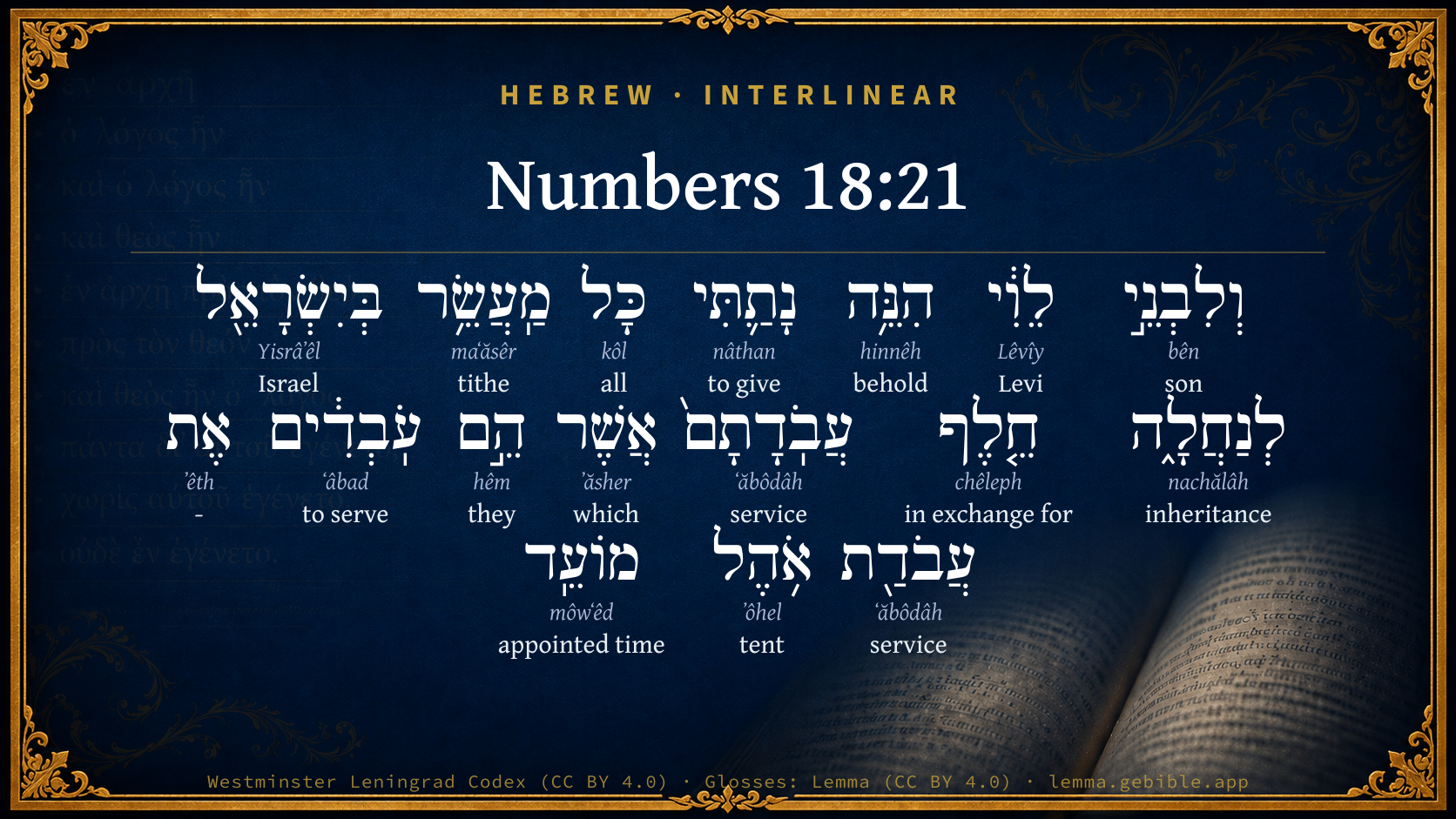
Numbers 18:21

Hebrew (Westminster Leningrad Codex) Numbers 18:21 appears in the Hebrew Old Testament. The text above is from the Westminster Leningrad Codex. Each word links to its Strong’s number, a concise gloss, and parsing drawn from the Open Scriptures Hebrew Bible morphology. Click any word for its full Brown-Driver-Briggs (BDB) entry.
Download image
Cite this verse

Numbers 18:21 (World English Bible). Public Domain. Lemma interlinear Bible study tool, https://lemma.gebible.app/v/numbers/18/21.

Show BibTeX & RIS
BibTeX
RIS
English Translation
To the children of Levi, behold, I have given all the tithe in Israel for an inheritance, in return for their service which they serve, even the service of the tent of meeting.
World English Bible · Public Domain
Highlights
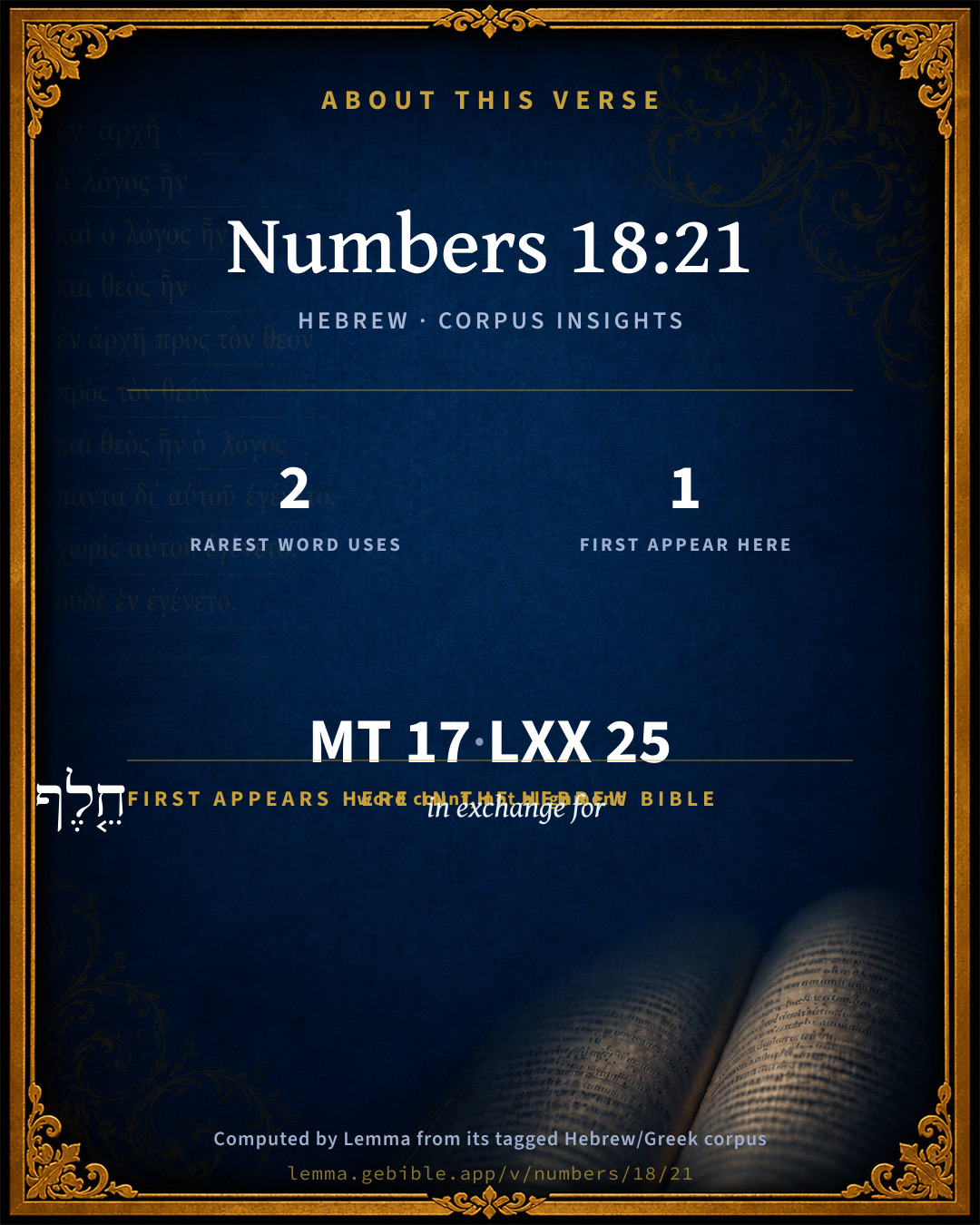
  • 1 first appearance in the Hebrew Bible
Full analysis ↓
Download a study sheet

One document with this verse’s original text, its word-by-word gloss line, the meaning frame, cross-references with their text, attributed commentary, and full source and license credits — printable, and it pastes into notes with its structure intact.

This verse Autodidact and up

Study sheet (.html) Plain text (.txt)

A passage Seminary Student

Up to 50 verses in one chapter. A passage sheet keeps up to 6 commentary sources and 12 cross-references per verse, in the order this page ranks them, and says so on the sheet whenever that leaves anything out. Ask for a single verse and you get the Autodidact verse sheet above.

Everything on this page stays free to read, with no account — the sheet is a download of what is already on screen, not access to it.

Want to remove ads? Support Godless Engineer
Compare translations 3

The same verse in 3 English versions, stacked beneath the original-language interlinear above. Click any original word for its lexicon entry.

Each is an independent rendering of the whole verse — the interlinear is not word-aligned to these translations.

Highlighted words mark where these versions differ — a whole-verse word diff, not a word-by-word alignment.

  • World English Bible Public Domain
    To the children of Levi, behold, I have given all the tithe in Israel for an inheritance, in return for their service which they serve, even the service of the tent of meeting.
  • King James Version Public Domain
    And, behold, I have given the children of Levi all the tenth in Israel for an inheritance, for their service which they serve, even the service of the tabernacle of the congregation.
  • unfoldingWord Literal Text CC BY-SA 4.0
    And to the sons of Levi, behold, I have given every tithe in Israel for an inheritance, in exchange for their service which they are serving, the service of the tent of meeting.

unfoldingWord Literal Text — © unfoldingWord, licensed CC BY-SA 4.0. Word-aligned USFM3 via Door43 (git.door43.org/unfoldingWord/en_ult).

Versions to compare (up to 4)

3 of 4 selected

Show all 18 translations

Every available English version of this verse, each an independent rendering of the whole verse.

  • World English Bible Public Domain
    To the children of Levi, behold, I have given all the tithe in Israel for an inheritance, in return for their service which they serve, even the service of the tent of meeting.
  • Berean Standard Bible Public Domain
    Behold, I have given to the Levites all the tithes in Israel as an inheritance in return for the work they do, the service of the Tent of Meeting.
  • Majority Standard Bible Public Domain
    Behold, I have given to the Levites all the tithes in Israel as an inheritance in return for the work they do, the service of the Tent of Meeting.
  • King James Version Public Domain
    And, behold, I have given the children of Levi all the tenth in Israel for an inheritance, for their service which they serve, even the service of the tabernacle of the congregation.
  • American Standard Version (1901) Public Domain
    And unto the children of Levi, behold, I have given all the tithe in Israel for an inheritance, in return for their service which they serve, even the service of the tent of meeting.
  • Revised Version (1885) Public Domain
    And unto the children of Levi, behold, I have given all the tithe in Israel for an inheritance, in return for their service which they serve, even the service of the tent of meeting.
  • Geneva Bible (1599) Public Domain
    For beholde, I haue giuen the children of Leui all the tenth in Israel for an inheritance, for their seruice which they serue in the Tabernacle of the Congregation.
  • Douay-Rheims (1899) Public Domain
    And I have given to the sons of Levi all the tithes of Israel for a possession for the ministry wherewith they serve me in the tabernacle of the covenant:
  • Young's Literal Translation Public Domain
    and to the sons of Levi, lo, I have given all the tenth in Israel for inheritance in exchange for their service which they are serving -- the service of the tent of meeting.
  • Literal Standard Version CC BY-SA 4.0
    and to the sons of Levi, behold, have given all the tenth in Israel for inheritance in exchange for their service which they are serving—the service of the Tent of Meeting.
  • Unlocked Literal Bible CC BY-SA 4.0
    To the descendants of Levi, look, I have given all the tithes in Israel as their inheritance in return for the service that they provide in working at the tent of meeting.
  • unfoldingWord Literal Text CC BY-SA 4.0
    And to the sons of Levi, behold, I have given every tithe in Israel for an inheritance, in exchange for their service which they are serving, the service of the tent of meeting.
  • Darby Bible Public Domain
    And to the children of Levi, behold, I have given all the tithes in Israel for an inheritance, for their service which they perform, the service of the tent of meeting.
  • World Messianic Bible Public Domain
    “To the children of Levi, behold, I have given all the tithe in Israel for an inheritance, in return for their service which they serve, even the service of the Tent of Meeting.
  • Webster's Bible Public Domain
    And behold, I have given the children of Levi all the tenth in Israel for an inheritance, for their service which they serve, even the service of the tabernacle of the congregation.
  • Free Bible Version CC BY-SA 4.0
    Instead I have given the Levites all the tithes in Israel as compensation for the service they provide in doing the work in the Tent of Meeting.
  • Bible in Basic English Public Domain
    And to the children of Levi I have given as their heritage all the tenths offered in Israel, as payment for the work they do, the work of the Tent of meeting.
  • JPS Tanakh (1917) Public Domain
    And unto the children of Levi, behold, I have given all the tithe in Israel for an inheritance, in return for their service which they serve, even the service of the tent of meeting.

Literal Standard Version (2020), Covenant Press — licensed CC BY-SA 4.0. Text via the HelloAO Bible API (eBible.org). Unlocked Literal Bible (unfoldingWord) — licensed CC BY-SA 4.0. Text via the HelloAO Bible API (eBible.org). unfoldingWord Literal Text — © unfoldingWord, licensed CC BY-SA 4.0. Word-aligned USFM3 via Door43 (git.door43.org/unfoldingWord/en_ult). Free Bible Version, Dr. Jonathan Gallagher — licensed CC BY-SA 4.0. Text via the HelloAO Bible API (eBible.org).

Word by word

More ways to search: Search by grammar → Find every occurrence → Compare this word →

Practice this passage: Drill this verse → Learn its vocabulary →

חֵ֤לֶף
chêleph
H2500
“in exchange for”
Preposition
Part of Speech
Preposition
Full BDB Definition

Origin: from H2498

TWOT: 666a

in exchange for (only construct) (noun masculine) - in return for (preposition)
  1. וְלִבְנֵ֣י bên H1121 “and · to/for · sons of” Conjunction + Preposition + Noun, Common, Masculine, Plural, Construct
  2. לֵוִ֔י Lêvîy H3878 “Levi” Noun, Proper
  3. הִנֵּ֥ה hinnêh H2009 “behold” Particle, Demonstrative
  4. נָתַ֛תִּי nâthan H5414 “to give” Verb, Qal, Perfect, 1st Person, Common, Singular
  5. כָּל kôl H3605 “all of” Noun, Common, Masculine, Singular, Construct
  6. מַֽעֲשֵׂ֥ר maʻăsêr H4643 “tithe” Noun, Common, Masculine, Singular, Absolute
  7. בְּיִשְׂרָאֵ֖ל Yisrâʼêl H3478 “in/at · Israel” Preposition + Noun, Proper
  8. לְנַחֲלָ֑ה nachălâh H5159 “to/for · inheritance” Preposition + Noun, Common, Feminine, Singular, Absolute
  9. עֲבֹֽדָתָם֙ ʻăbôdâh H5656 “service · their” Noun, Common, Feminine, Singular, Construct + Suffix, Personal, 3rd Person, Masculine, Plural
  10. אֲשֶׁר ʼăsher H834 “which” Particle, Relative
  11. הֵ֣ם hêm H1992 “they” Pronoun, Personal, 3rd Person, Masculine, Plural
  12. עֹֽבְדִ֔ים ʻâbad H5647 “serving” Verb, Qal, Participle Active, Masculine, Plural, Absolute
  13. אֶת ʼêth H853 “-” Particle, Direct Object
  14. עֲבֹדַ֖ת ʻăbôdâh H5656 “service of” Noun, Common, Feminine, Singular, Construct
  15. אֹ֥הֶל ʼôhel H168 “tent of” Noun, Common, Masculine, Singular, Construct
  16. מוֹעֵֽד môwʻêd H4150 “appointed time” Noun, Common, Masculine, Singular, Absolute

About this verse

These counts appear in no published source. They are computed here, from the morphology-tagged text and Lemma’s own curated glosses. What Lemma adds →

17
words
16
distinct lemmas
Pentateuch
section

Notable vocabulary

The rarest word here is חֵ֤לֶף in exchange for H2500 — appearing just 2 times in the whole Hebrew Bible.

First appearance in Scripture

This word makes its first canonical appearance in the Hebrew Bible here:

  • חֵ֤לֶף in exchange for H2500

Shared distinctive vocabulary

חֵ֤לֶף in exchange for H2500 occurs in 2 verses of the Hebrew Bible. Also found in:

Grammatical profile

  • 2 verbs
  • 10 nouns
  • 1 pronoun
  • 1 preposition
  • 3 particles

Verb forms

  • נָתַ֛תִּי Qal · Perfect
  • עֹֽבְדִ֔ים Qal · Participle Active

Repetition

A word recurs within this verse — often emphatic in Hebrew:

  • עֲבֹֽדָתָם֙ service H5656 ×2

Hebrew & Septuagint length

In English translation the verse runs 33 words from the Hebrew and 29 from the Septuagint (LXX English) — closely comparable.

A rough comparison of the two English renderings, which tokenize alike — not a word-level alignment.

Word counts can differ between the Hebrew and the Greek without any difference in meaning — e.g. the Hebrew direct-object marker אֵת has no separate Greek word, and Greek often adds the article ὁ.

In the original languages it is 17 Hebrew tokens and 25 Greek tokens — but the two are counted differently (Hebrew bundles its prefixes and suffixes into one token; the Greek is in lemma form), so that isn’t a like-for-like length.

Cross-references

16

Topical passages linked to Numbers 18:21 in the Treasury of Scripture Knowledge — connected by theme and wording, ordered by reader-vote popularity; previews shown in the World English Bible.

  • Deuteronomy 14:22–29 You shall surely tithe all the increase of your seed, that which comes forth from the field year by year.
  • Nehemiah 10:37 and that we should bring the first fruits of our dough, and our heave-offerings, and the fruit of all manner of trees, the new wine and the oil, to the priests, to the chambers of the house of our God; and the tithes of our ground to the Levites; for they, the Levites, take the tithes in all the cities of our tillage.
  • Nehemiah 12:44 On that day were men appointed over the chambers for the treasures, for the heave-offerings, for the first fruits, and for the tithes, to gather into them, according to the fields of the cities, the portions appointed by the law for the priests and Levites: for Judah rejoiced for the priests and for the Levites who waited.
  • Numbers 18:6 I, behold, I have taken your brothers the Levites from among the children of Israel: to you they are a gift, given to Yahweh, to do the service of the tent of meeting.
  • 2 Chronicles 31:12 They brought in the offerings and the tithes and the dedicated things faithfully: and over them Conaniah the Levite was ruler, and Shimei his brother was second.
  • Nehemiah 10:29 They joined with their brothers, their nobles, and entered into a curse, and into an oath, to walk in God's law, which was given by Moses the servant of God, and to observe and do all the commandments of Yahweh our Lord, and his ordinances and his statutes;
  • Nehemiah 13:12 Then brought all Judah the tithe of the grain and the new wine and the oil to the treasuries.
  • Hebrews 7:5 They indeed of the sons of Levi who receive the priest's office have a commandment to take tithes of the people according to the law, that is, of their brothers, though these have come out of the loins of Abraham,
  • Genesis 14:20 and blessed be God Most High, who has delivered your enemies into your hand." Abram gave him a tenth of all.
  • Leviticus 27:30–33 "'All the tithe of the land, whether of the seed of the land or of the fruit of the trees, is Yahweh's. It is holy to Yahweh.
  • Numbers 3:7–8 They shall keep his charge, and the charge of the whole congregation before the Tent of Meeting, to do the service of the tabernacle.
  • Numbers 18:24–26 For the tithe of the children of Israel, which they offer as a heave-offering to Yahweh, I have given to the Levites for an inheritance: therefore I have said to them, Among the children of Israel they shall have no inheritance.
  • Deuteronomy 12:17–19 You may not eat within your gates the tithe of your grain, or of your new wine, or of your oil, or the firstborn of your herd or of your flock, nor any of your vows which you vow, nor your freewill-offerings, nor the heave-offering of your hand;
  • 2 Chronicles 31:5–6 As soon as the commandment came abroad, the children of Israel gave in abundance the first fruits of grain, new wine, and oil, and honey, and of all the increase of the field; and the tithe of all things brought they in abundantly.
  • 1 Corinthians 9:13–14 Don't you know that those who serve around sacred things eat from the things of the temple, and those who wait on the altar have their portion with the altar?
  • Galatians 6:6 But let him who is taught in the word share all good things with him who teaches.

Cross-references courtesy of OpenBible.info (CC BY 4.0).

Hebrew and Greek witnesses Masoretic Hebrew ↔ Greek Septuagint

The same verse in the two great witnesses to the Old Testament, shown verse-for-verse.

These are two independent witnesses, not word-aligned to each other, and the Septuagint is shown in lemma (dictionary) form.

Hebrew Numbers 18:21 Masoretic · Westminster Leningrad Codex

וְלִבְנֵ֣י לֵוִ֔י הִנֵּ֥ה נָתַ֛תִּי כָּל מַֽעֲשֵׂ֥ר בְּיִשְׂרָאֵ֖ל לְנַחֲלָ֑ה חֵ֤לֶף עֲבֹֽדָתָם֙ אֲשֶׁר הֵ֣ם עֹֽבְדִ֔ים אֶת עֲבֹדַ֖ת אֹ֥הֶל מוֹעֵֽד

To the children of Levi, behold, I have given all the tithe in Israel for an inheritance, in return for their service which they serve, even the service of the tent of meeting.

World English Bible · Public Domain

Greek LXX Numbers 18:21 Septuagint · lemma form

καί ὁ υἱός λευί ἰδού δίδωμι πᾶς ἐπιδέκατος ἐν ἰσραήλ ἐν κλῆρος ἀντί ὁ λειτουργία αὐτός ὅσος αὐτός λειτουργέω λειτουργία ἐν ὁ σκηνή ὁ μαρτύριον

And, behold, I have given to the sons of Levi every tithe in Israel for an inheritance for their services, whenever they perform ministry in the tabernacle of witness.

LXX2012 (modern English Septuagint) · Public Domain

Hebrew: Westminster Leningrad Codex (CC BY 4.0). Greek: Septuagint (public domain); English from LXX2012 (modern English Septuagint) (Public Domain). How the Septuagint differs from the Hebrew →

Targum (Aramaic paraphrase)

2

The Targum is the ancient Jewish Aramaic paraphrase of the Hebrew Scriptures — an interpretive translation, not the Hebrew text itself. Onkelos (literal) and Pseudo-Jonathan (expansive) render the Torah, and Jonathan the Prophets. Coverage is partial: where no permissively-licensed English translation exists for a verse, only the Aramaic is shown. This is verse-level text, not a word-by-word alignment to the Hebrew.

  1. Targum Onkelos Torah (Genesis–Deuteronomy)
    וְלִבְנֵי לֵוִי הָא יְהָבִית כָּל מַעַשְׂרָא בְּיִשְׂרָאֵל לְאַחֲסָנָא חֲלַף פּוּלְחַנְהוֹן דִי אִינוּן פָּלְחִין יָת פּוּלְחַן מַשְׁכַּן זִמְנָא

    (no public-domain English translation for this verse)

    Targum Onkelos — Aramaic: “Onkelos Genesis” (public domain); “Onkelos Exodus” (public domain); “Onkelos Leviticus” (public domain); “Onkelos Numbers” (public domain); “Onkelos Deuteronomy” (public domain). English: “Sefaria Community Translation” (CC0 1.0 (public-domain dedication)); “J.W. Etheridge. The Targums of Onkelos and Jonathan Ben Uzziel on the Pentateuch. London: Longmans, Green, 1862” (public domain). Text via Sefaria.

  2. Targum Pseudo-Jonathan Torah (Genesis–Deuteronomy)
    וְלִבְנוֹי דְלֵוִי הָא יְהָבִית יַת כָּל מַעַשְרָא בְּיִשְרָאֵל בְּאַחְסָנָא חוֹלַף פּוּלְחַנְהוֹן דְהִינוּן פַּלְחִין יַת פּוּלְחַן מַשְׁכְּנָא זִמְנָא

    And, behold, I have given to the sons of Levi all the tenths in Israel for a possession, on account of their service with which they serve in the work of the tabernacle of ordinance.

    Targum Pseudo-Jonathan — Aramaic: “Targum Jonathan on Genesis” (public domain); “Targum Jonathan on Exodus” (public domain); “Targum Jonathan on Leviticus” (public domain); “Targum Jonathan on Numbers” (public domain); “Targum Jonathan on Deuteronomy” (public domain). English: “The Targum of Jonathan ben Uzziel, trans. J. W. Etheridge, London, 1862” (public domain). Text via Sefaria.

Commentary

Notes on Numbers 18:21 from classic Christian and Jewish commentators (each source and its license shown beneath its notes). The classic Christian expositions comment on the surrounding passage and are grouped to its opening verse, so a note may address several verses; the Jewish commentaries on the Tanakh (Rashi and others) are per-verse, so they appear only where the commentator wrote on this verse.

Lemma curates 59 commentaries, every one of them public domain or Creative Commons licensed, each selected and text-cleaned for this edition rather than reprinted as found. About our sources →

Jamieson, Fausset & Brown

Robert Jamieson, A. R. Fausset & David Brown

THE LEVITES' PORTION. (Num 18:21-32)

I have given the children of Levi all the tenth in Israel for an inheritance, for their service which they serve--Neither the priests nor the Levites were to possess any allotments of land but to depend entirely upon Him who liberally provided for them out of His own portion; and this law was subservient to many important purposes--such as that, being exempted from the cares and labors of worldly business, they might be exclusively devoted to His service; that a bond of mutual love and attachment might be formed between the people and the Levites, who, as performing religious services for the people, derived their subsistence from them; and further, that being the more easily dispersed among the different tribes, they might be more useful in instructing and directing the people.

Jamieson, Fausset & Brown — Commentary Critical and Explanatory on the Whole Bible (1871) — public domain (CC PDM 1.0). Text via the HelloAO Bible API.

Trapp's Complete Commentary

John Trapp

Num 18:21 And, behold, I have given the children of Levi all the tenth in Israel for an inheritance, for their service which they serve, [even] the service of the tabernacle of the congregation.

Ver. 21. For their service which they serve.] No man did so much as shut the doors of God’s sanctuary, or kindle a fire on his altar for nought. {Mal 1:10}

John Trapp, A Commentary or Exposition upon All the Books of the Old and New Testament (1647–1656) — public domain. Text from a community e-Sword module.

Joseph Benson's Commentary

Num 18:21-22. The tenth — For the tithes were all given to the Levites, and out of their tithes the tenth was given to the priests. Come nigh the tabernacle — So nigh as to do any proper act to the priests or Levites.

Joseph Benson's Commentary on the Old and New Testaments (1811–1818) — public domain. Text from a community e-Sword module.

Whedon's Commentary on the Bible

Daniel D. Whedon

THE REVENUES OF THE LEVITES, Num_18:21-24.

In order that the tribe of Levi might be withdrawn from the common calling of life, which in the theocratic state was agricultural, and might give itself completely to its sacred vocation, no inheritance as a tribe was assigned to it.

21. All the tenth in Israel — A tenth of all the earnings of twelve tribes — a revenue greater than the average of each — was an ample maintenance for the tribe set apart for sub-priestly service. “Yet this was not a splendid endowment. Even when the tithe was conscientiously handed over, it was no certain income. Moreover, if the people showed themselves averse to this tax, the tribe of Levi was subjected to unavoidable poverty. Deu_12:19; Deu_14:27; Deu_14:29.” — Oehler.

Daniel D. Whedon (gen. ed.), Commentary on the Old and New Testaments (1874–1909) — public domain. Text from a community e-Sword module.

Adam Clarke's Commentary

Verse 21. Behold, I have given the children of Levi all the tenth]

First, the Levites had the tenth of all the productions of the land.

2. They had forty-eight cities, each forming a square of 4,000 cubits.

3. They had 2,000 cubits of ground round each city.

Total of the land they possessed, 53,000 acres.

4. They had the first-fruits and certain parts of all the animals killed in the land.

Canaan contained about 11,264,000 acres; therefore the portion possessed by the Levites was rather less than as one to two hundred and twelve; for 11,264,000 divided by 53,000, quotes only 212 28/53. - See Lowman, Dodd, c. But though this was a very small proportion for a whole tribe that had consented to annihilate its political existence, that it might wait upon the service of God, and labour for the people's souls yet let it be considered that what they possessed was the best of the land: and while it was a slender remuneration for their services, yet their portion was such as rendered them independent, and kept them comfortable; so that they could wait on the Lord's work without distraction. This is a proper pattern for the maintenance of the ministers of God: let them have a sufficiency for themselves and families, that there may be no distracting cares; and let them not be encumbered with riches or worldly possessions, that they may not be prevented from taking care of souls.

Adam Clarke's Commentary on the Bible (1810–1826) — public domain. Text from a community e-Sword/MySword module.

Ellicott's Commentary for English Readers

(21) All the tenth in Israel.—The reference here is to the first tithe, or tenth of the whole of the produce of the land.

A Bible Commentary for English Readers, edited by Charles John Ellicott (1878–1897) — public domain. Text from a community e-Sword module.

The Cambridge Bible for Schools and Colleges

gen. ed. J. J. S. Perowne

21–24. The Levites’ dues. These consisted in tithe levied on agricultural produce only (cf. Num_18:27; Num_18:30).

This was similarly assigned to the Levitical priests in the earlier law contained in Deu_14:22-29; Deu_26:12-15. But the present regulation is in advance of that in Dt. in that it assigns the tithe to the Levites absolutely. According to Dt. the Levite shared it, in two years out of three, with the offerer and his household, and in the third year with the poor—‘sojourners, widows, and orphans.’ This variety led in post-Biblical times to the imposition of two tithes (cf. Tob_1:7 ff.). In Lev_27:30-33, 2Ch_31:6 (which are probably later than the present passage) mention is made of a fresh demand, viz. a tithe on cattle, which is found nowhere else in the O.T. In early days the ‘clergy’ were poor and humble persons who needed support from the charity of the rich. The contributions paid to them were at first small, and probably variable; the officials at the important sanctuaries, for example, would receive larger dues than those in country villages. But when, after the Exile, the priests and Levites advanced to a high position in the community, their demands gradually increased, until they became the grasping and avaricious rulers that we see in the Ḥasmoneans and the Sadducees.

In Heb_7:5 the payment of tithes by Israel is part of the argument that the Aaronic priesthood is inferior to that of Christ.

The Cambridge Bible for Schools and Colleges (gen. ed. J. J. S. Perowne; Cambridge University Press, 1878–1918) — public domain. Text from a community e-Sword module.

John Gill's Exposition

Neither must the children of Israel henceforth come nigh the tabernacle of the congregation,.... To do any part of the priest's office, as to burn incense, as Korah and his company had done; or to do any part of the work of the Levites, by watching in the tabernacle, by taking it down and setting it up, and bearing the vessels of it; otherwise they might come to it, to bring their sacrifices, to pay their vows, and for their purification when necessary, and such like things:

lest they bear sin and die; lest sin be charged upon them, and punishment be inflicted, even the punishment of death; for it was death to intrude into the priest's office.

John Gill's Exposition of the Whole Bible (1746–1763) — public domain (CC PDM 1.0). Text via the HelloAO Bible API.

Albert Barnes' Notes on the Bible

Abraham paid tithes to Melchizedek: Jacob had promised the tithe of all wherewith God blessed him if he should return in peace to his father’s house. But now first the Lord’s tithes are assigned to the Levites for their support (compare Lev 27:30). The payment of tithes to them is recognized in Neh 10:37; Neh 12:44; Tobit 1:7.

Albert Barnes' Notes on the Bible (1834–1885) — public domain. Text from a community e-Sword/MySword module.

Matthew Poole's English Annotations

For the tithes were all given to the Levites, and out of their tithes the tenth was given to the priests, here Num 18:26, & C, and Neh 10:37,38.

Matthew Poole's English Annotations on the Holy Bible (1683–1685) — public domain. Text from a community e-Sword/MySword module.

The Pulpit Commentary

All the tenth. The tithe of all fruits and flocks had been already claimed absolutely by the Lord. (Lev_27:30, Lev_27:32) It is probable indeed that the giving of tithes had been more or less a matter of obligation from time immemorial. Abraham had paid them on one memorable occasion, (Gen_14:20) and Jacob had vowed them on another. (Gen_28:22) From this time forth, however, the tithes were formally assigned to the maintenance of the Levites, in return for their service.

The Pulpit Commentary (1880–1919), ed. H.D.M. Spence-Jones & Joseph S. Exell — public domain. Text from a community e-Sword module.

John Wesley's Explanatory Notes

The tenth - For the tithes were all given to the Levites, and out of their tithes the tenth was given to the priests.

John Wesley, Explanatory Notes Upon the Whole Bible (1754–1765) — public domain. Text via the GEBible commentary corpus.

Keil & Delitzsch

C. F. Keil & F. Delitzsch

Revenues of the Levites. - For (חלף, instead of, for) their service at the tabernacle God assigns them "every tenth in Israel as an inheritance." On the tenth, see at Lev 27:30-33. The institution and description of their service in Num 18:22 and Num 18:23 is the same as that in Num 1:53 and Num 8:19. "Lest they bear sin:" see at Lev 19:17.

Keil & Delitzsch — Biblical Commentary on the Old Testament (1861–1891) — public domain (CC PDM 1.0). Text via the HelloAO Bible API. (Old Testament only.)

unfoldingWord translationNotes

Door43 World Missions Community

Connecting Statement:

God continues speaking to Aaron.

look, I have given

The word "look" here adds emphasis to what follows. AT: "indeed, I have given"

as their inheritance

God speaks of what Aaron and his descendants will receive as if they will inherit it. AT: "as their portion of what I give to all Israel" (See: Metaphor)

translationWords

Levi

tenth

servant

tent of meeting

sin

die

unfoldingWord translationNotes — © Distant Shores Media and the Door43 World Missions Community, licensed CC BY-SA 4.0. Source: git.door43.org/Door43/en_tn.

Lesson kit

Teaching starters — assembled from the data on this page, not authored interpretation. Every prompt links to the verse data it draws on. Edit before teaching.

Numbers, in the Pentateuch, opens this verse with 17 words (16 distinct Hebrew lemmas). Its most distinctive word is chêleph (“in exchange for”). A historical commentator’s framing appears above. Read the whole chapter for the surrounding context.

Discussion questions

  1. The word chêleph carries the sense “in exchange for.” How does it shape the verse?
  2. The word “in exchange for” first appears here in Scripture. What is being introduced at this debut?
  3. Numbers 18:31 shares the word «in exchange for» with this verse. How do the two illuminate each other?
  4. “service” occurs 2× in this one verse. What is the effect of the repetition?
  5. The translations on this page render this verse differently — a whole-verse word diff, not a word-by-word alignment. What might account for the different wordings?
  6. The verb «נָתַ֛תִּי» is Qal Perfect. How does its form color the action?
  7. Reading how Jamieson, Fausset & Brown and Trapp's Complete Commentary read this verse, where do the two commentators agree and where do they part?

Things to notice

Reading settings

Reading text

Shown beneath each verse's original-language words.

Old Testament
Old Testament edition

Read the OT as the Masoretic Hebrew (MT) or the Greek Septuagint (LXX).

English shown for the Greek Septuagint (in the Hebrew ↔ Greek comparison).

Comparing translations? Open the Compare panel on any verse page to stack up to four side by side.