
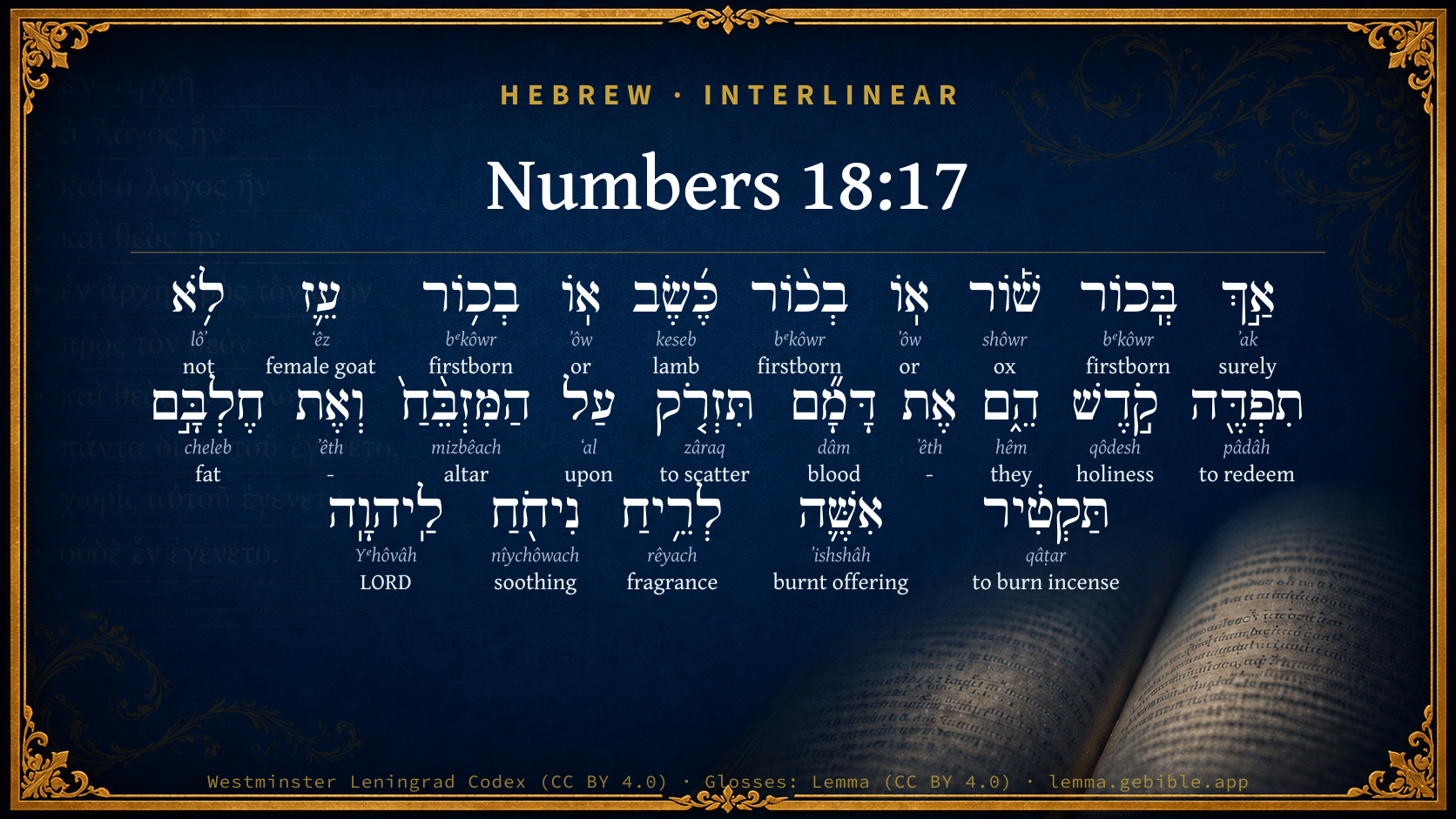
Numbers 18:17

Hebrew (Westminster Leningrad Codex) Numbers 18:17 appears in the Hebrew Old Testament. The text above is from the Westminster Leningrad Codex. Each word links to its Strong’s number, a concise gloss, and parsing drawn from the Open Scriptures Hebrew Bible morphology. Click any word for its full Brown-Driver-Briggs (BDB) entry.
Download image
Cite this verse

Numbers 18:17 (World English Bible). Public Domain. Lemma interlinear Bible study tool, https://lemma.gebible.app/v/numbers/18/17.

Show BibTeX & RIS
BibTeX
RIS
English Translation
But the firstborn of a cow, or the firstborn of a sheep, or the firstborn of a goat, you shall not redeem; they are holy: you shall sprinkle their blood on the altar, and shall burn their fat for an offering made by fire, for a sweet savor to Yahweh.
World English Bible · Public Domain
Download a study sheet

One document with this verse’s original text, its word-by-word gloss line, the meaning frame, cross-references with their text, attributed commentary, and full source and license credits — printable, and it pastes into notes with its structure intact.

This verse Autodidact and up

Study sheet (.html) Plain text (.txt)

A passage Seminary Student

Up to 50 verses in one chapter. A passage sheet keeps up to 6 commentary sources and 12 cross-references per verse, in the order this page ranks them, and says so on the sheet whenever that leaves anything out. Ask for a single verse and you get the Autodidact verse sheet above.

Everything on this page stays free to read, with no account — the sheet is a download of what is already on screen, not access to it.

Want to remove ads? Support Godless Engineer
Compare translations 3

The same verse in 3 English versions, stacked beneath the original-language interlinear above. Click any original word for its lexicon entry.

Each is an independent rendering of the whole verse — the interlinear is not word-aligned to these translations.

Highlighted words mark where these versions differ — a whole-verse word diff, not a word-by-word alignment.

  • World English Bible Public Domain
    But the firstborn of a cow, or the firstborn of a sheep, or the firstborn of a goat, you shall not redeem; they are holy: you shall sprinkle their blood on the altar, and shall burn their fat for an offering made by fire, for a sweet savor to Yahweh.
  • King James Version Public Domain
    But the firstling of a cow, or the firstling of a sheep, or the firstling of a goat, thou shalt not redeem; they are holy: thou shalt sprinkle their blood upon the altar, and shalt burn their fat for an offering made by fire, for a sweet savor unto the LORD.
  • unfoldingWord Literal Text CC BY-SA 4.0
    Only a firstborn of an ox or a firstborn of a sheep or a firstborn of a goat you shall not redeem; they holy. You shall splash their blood on the altar, and you shall cause their fat to become smoke, a gift for a scent of pleasing to Yahweh.

unfoldingWord Literal Text — © unfoldingWord, licensed CC BY-SA 4.0. Word-aligned USFM3 via Door43 (git.door43.org/unfoldingWord/en_ult).

Versions to compare (up to 4)

3 of 4 selected

Show all 18 translations

Every available English version of this verse, each an independent rendering of the whole verse.

  • World English Bible Public Domain
    But the firstborn of a cow, or the firstborn of a sheep, or the firstborn of a goat, you shall not redeem; they are holy: you shall sprinkle their blood on the altar, and shall burn their fat for an offering made by fire, for a sweet savor to Yahweh.
  • Berean Standard Bible Public Domain
    But you must not redeem the firstborn of an ox, a sheep, or a goat; they are holy. You are to sprinkle their blood on the altar and burn their fat as an offering made by fire, a pleasing aroma to the LORD.
  • Majority Standard Bible Public Domain
    But you must not redeem the firstborn of an ox, a sheep, or a goat; they are holy. You are to splatter their blood on the altar and burn their fat as a food offering, a pleasing aroma to the LORD.
  • King James Version Public Domain
    But the firstling of a cow, or the firstling of a sheep, or the firstling of a goat, thou shalt not redeem; they are holy: thou shalt sprinkle their blood upon the altar, and shalt burn their fat for an offering made by fire, for a sweet savor unto the LORD.
  • American Standard Version (1901) Public Domain
    But the firstling of a cow, or the firstling of a sheep, or the firstling of a goat, thou shalt not redeem; they are holy: thou shalt sprinkle their blood upon the altar, and shalt burn their fat for an offering made by fire, for a sweet savor unto Jehovah.
  • Revised Version (1885) Public Domain
    But the firstling of an ox, or the firstling of a sheep, or the firstling of a goat, thou shalt not redeem; they are holy: thou shalt sprinkle their blood upon the altar, and shalt burn their fat for an offering made by fire, for a sweet savour unto the LORD.
  • Geneva Bible (1599) Public Domain
    But the first borne of a kow, or the first borne of a sheepe, or the first borne of a goate shalt thou not redeeme: for they are holy: thou shalt sprinkle their blood at the altar, and thou shalt burne their fat: it is a sacrifice made by fire for a sweete sauour vnto the Lord.
  • Douay-Rheims (1899) Public Domain
    But the firstling of a cow and of a sheep and of a goat thou shalt not cause to be redeemed, because they are sanctified to the Lord. Their blood only thou shalt pour upon the altar, and their fat thou shalt burn for a most sweet odour to the Lord.
  • Young's Literal Translation Public Domain
    `Only, the firstling of a cow, or the firstling of a sheep, or the firstling of a goat, thou dost not ransom, holy they `are': their blood thou dost sprinkle on the altar, and of their fat thou makest perfume, a fire-offering of sweet fragrance to Jehovah,
  • Literal Standard Version CC BY-SA 4.0
    Only, the firstling of a cow, or the firstling of a sheep, or the firstling of a goat, you do not ransom, they [are] holy: you sprinkle their blood on the altar, and you make incense of their fat [as] a fire-offering of refreshing fragrance to YHWH;
  • Unlocked Literal Bible CC BY-SA 4.0
    But the firstborn of a cow, or the firstborn of a sheep, or the firstborn of a goat—you must not buy back these animals; they are set apart to me. You must sprinkle their blood on the altar and burn their fat as an offering made by fire, an aroma pleasing to Yahweh.
  • unfoldingWord Literal Text CC BY-SA 4.0
    Only a firstborn of an ox or a firstborn of a sheep or a firstborn of a goat you shall not redeem; they holy. You shall splash their blood on the altar, and you shall cause their fat to become smoke, a gift for a scent of pleasing to Yahweh.
  • Darby Bible Public Domain
    But the firstborn of a cow, or the firstborn of a sheep, or the firstborn of a goat, thou shalt not ransom: they are holy. Thou shalt sprinkle their blood on the altar, and their fat shalt thou burn as an offering by fire for a sweet odour to Jehovah.
  • World Messianic Bible Public Domain
    “But you shall not redeem the firstborn of a cow, or the firstborn of a sheep, or the firstborn of a goat. They are holy. You shall sprinkle their blood on the altar, and shall burn their fat for an offering made by fire, for a pleasant aroma to the LORD.
  • Webster's Bible Public Domain
    But the firstling of a cow, or the firstling of a sheep, or the firstling of a goat, thou shalt not redeem; they are holy: thou shalt sprinkle their blood upon the altar, and shalt burn their fat for an offering made by fire, for a sweet savor to the LORD.
  • Free Bible Version CC BY-SA 4.0
    But you are not allowed to redeem the firstborn of an ox, a sheep, or a goat because they are holy. You shall sprinkle their blood on the altar, and burn their fat as a burnt offering accepted by the Lord.
  • Bible in Basic English Public Domain
    But no such payment may be made for the first birth of an ox or a sheep or a goat; these are holy: their blood is to be dropped on the altar, and their fat burned for an offering made by fire, a sweet smell to the Lord.
  • JPS Tanakh (1917) Public Domain
    But the firstling of an ox, or the firstling of a sheep, or the firstling of a goat, thou shalt not redeem; they are holy: thou shalt dash their blood against the altar, and shalt make their fat smoke for an offering made by fire, for a sweet savour unto the LORD.

Literal Standard Version (2020), Covenant Press — licensed CC BY-SA 4.0. Text via the HelloAO Bible API (eBible.org). Unlocked Literal Bible (unfoldingWord) — licensed CC BY-SA 4.0. Text via the HelloAO Bible API (eBible.org). unfoldingWord Literal Text — © unfoldingWord, licensed CC BY-SA 4.0. Word-aligned USFM3 via Door43 (git.door43.org/unfoldingWord/en_ult). Free Bible Version, Dr. Jonathan Gallagher — licensed CC BY-SA 4.0. Text via the HelloAO Bible API (eBible.org).

Word by word

More ways to search: Search by grammar → Find every occurrence → Compare this word →

Practice this passage: Drill this verse → Learn its vocabulary →

כֶּ֜שֶׂב
keseb
H3775
“lamb”
Noun, Common, Masculine, Singular, Absolute
Part of Speech
Noun
Type
Common
Gender
Masculine
Number
Singular
State
Absolute
Full BDB Definition

Origin: apparently by transposition for H3532

TWOT: 949

lamb, young ram, sheep
  1. אַ֣ךְ ʼak H389 “surely” Particle, Accusative
  2. בְּֽכוֹר bᵉkôwr H1060 “firstborn of” Noun, Common, Masculine, Singular, Construct
  3. שׁ֡וֹר shôwr H7794 “ox” Noun, Common, Masculine, Singular, Absolute
  4. אֽוֹ ʼôw H176 “or” Conjunction
  5. בְכ֨וֹר bᵉkôwr H1060 “firstborn of” Noun, Common, Masculine, Singular, Construct
  6. אֽוֹ ʼôw H176 “or” Conjunction
  7. בְכ֥וֹר bᵉkôwr H1060 “firstborn of” Noun, Common, Masculine, Singular, Construct
  8. עֵ֛ז ʻêz H5795 “female goat” Noun, Common, Feminine, Singular, Absolute
  9. לֹ֥א lôʼ H3808 “not” Particle, Negative
  10. תִפְדֶּ֖ה pâdâh H6299 “to redeem” Verb, Qal, Imperfect, 2nd Person, Masculine, Singular
  11. קֹ֣דֶשׁ qôdesh H6944 “holiness” Noun, Common, Masculine, Singular, Absolute
  12. הֵ֑ם hêm H1992 “they” Pronoun, Personal, 3rd Person, Masculine, Plural
  13. אֶת ʼêth H853 “-” Particle, Direct Object
  14. דָּמָ֞ם dâm H1818 “blood · their” Noun, Common, Masculine, Singular, Construct + Suffix, Personal, 3rd Person, Masculine, Plural
  15. תִּזְרֹ֤ק zâraq H2236 “to scatter” Verb, Qal, Imperfect, 2nd Person, Masculine, Singular
  16. עַל ʻal H5921 “upon” Preposition
  17. הַמִּזְבֵּ֨חַ֙ mizbêach H4196 “the · altar” Particle, Definite Article + Noun, Common, Masculine, Singular, Absolute
  18. וְאֶת ʼêth H853 “and · -” Conjunction + Particle, Direct Object
  19. חֶלְבָּ֣ם cheleb H2459 “fat · their” Noun, Common, Masculine, Singular, Construct + Suffix, Personal, 3rd Person, Masculine, Plural
  20. תַּקְטִ֔יר qâṭar H6999 “to burn incense” Verb, Hiphil, Imperfect, 2nd Person, Masculine, Singular
  21. אִשֶּׁ֛ה ʼishshâh H801 “burnt offering” Noun, Common, Masculine, Singular, Absolute
  22. לְרֵ֥יחַ rêyach H7381 “to/for · fragrance of” Preposition + Noun, Common, Masculine, Singular, Construct
  23. נִיחֹ֖חַ nîychôwach H5207 “soothing” Noun, Common, Masculine, Singular, Absolute
  24. לַֽיהוָֽה Yᵉhôvâh H3068 “to/for · LORD” Preposition + Noun, Proper

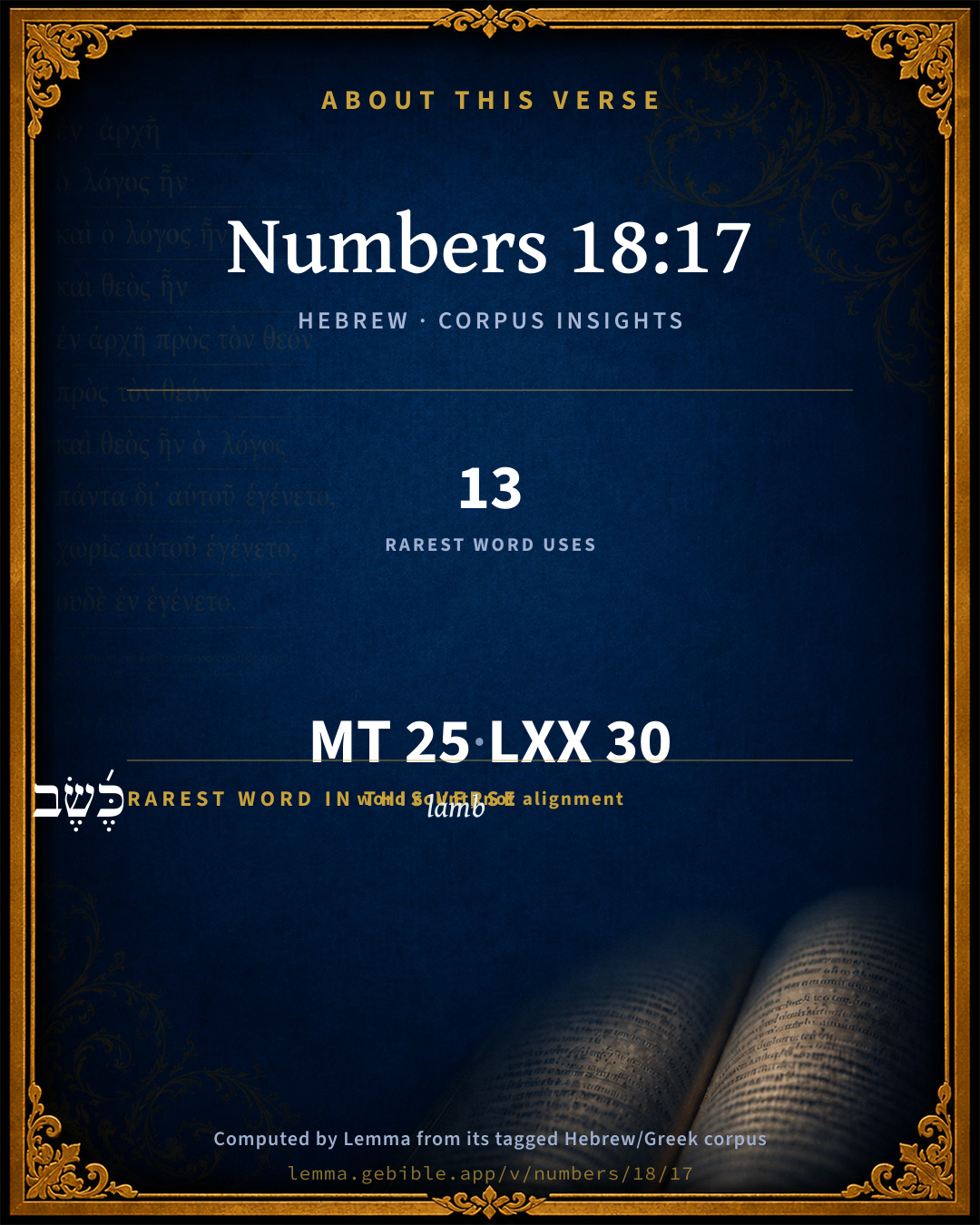
About this verse

These counts appear in no published source. They are computed here, from the morphology-tagged text and Lemma’s own curated glosses. What Lemma adds →

25
words
21
distinct lemmas
Pentateuch
section

Notable vocabulary

The rarest word here is כֶּ֜שֶׂב lamb H3775 — appearing just 13 times in the whole Hebrew Bible.

Shared distinctive vocabulary

כֶּ֜שֶׂב lamb H3775 occurs in 13 verses of the Hebrew Bible. Also found in:

Grammatical profile

  • 3 verbs
  • 14 nouns
  • 1 pronoun
  • 1 preposition
  • 2 conjunctions
  • 4 particles

Verb forms

  • תִפְדֶּ֖ה Qal · Imperfect
  • תִּזְרֹ֤ק Qal · Imperfect
  • תַּקְטִ֔יר Hiphil · Imperfect

Repetition

Words recur within this verse — often emphatic in Hebrew:

  • בְּֽכוֹר firstborn H1060 ×3
  • אֽוֹ or H176 ×2

Hebrew & Septuagint length

In English translation the verse runs 50 words from the Hebrew and 50 from the Septuagint (LXX English) — the same length.

A rough comparison of the two English renderings, which tokenize alike — not a word-level alignment.

Word counts can differ between the Hebrew and the Greek without any difference in meaning — e.g. the Hebrew direct-object marker אֵת has no separate Greek word, and Greek often adds the article ὁ.

In the original languages it is 25 Hebrew tokens and 30 Greek tokens — but the two are counted differently (Hebrew bundles its prefixes and suffixes into one token; the Greek is in lemma form), so that isn’t a like-for-like length.

Cross-references

3

Topical passages linked to Numbers 18:17 in the Treasury of Scripture Knowledge — connected by theme and wording, ordered by reader-vote popularity; previews shown in the World English Bible.

  • Exodus 29:16 You shall kill the ram, and you shall take its blood, and sprinkle it around on the altar.
  • Leviticus 3:2–5 He shall lay his hand on the head of his offering, and kill it at the door of the tent of meeting: and Aaron's sons the priests shall sprinkle the blood on the altar round about.
  • Deuteronomy 15:19–22 All the firstborn males that are born of your herd and of your flock you shall sanctify to Yahweh your God: you shall do no work with the firstborn of your herd, nor shear the firstborn of your flock.

Cross-references courtesy of OpenBible.info (CC BY 4.0).

Hebrew and Greek witnesses Masoretic Hebrew ↔ Greek Septuagint

The same verse in the two great witnesses to the Old Testament, shown verse-for-verse.

These are two independent witnesses, not word-aligned to each other, and the Septuagint is shown in lemma (dictionary) form.

Hebrew Numbers 18:17 Masoretic · Westminster Leningrad Codex

אַ֣ךְ בְּֽכוֹר שׁ֡וֹר אֽוֹ בְכ֨וֹר כֶּ֜שֶׂב אֽוֹ בְכ֥וֹר עֵ֛ז לֹ֥א תִפְדֶּ֖ה קֹ֣דֶשׁ הֵ֑ם אֶת דָּמָ֞ם תִּזְרֹ֤ק עַל הַמִּזְבֵּ֨חַ֙ וְאֶת חֶלְבָּ֣ם תַּקְטִ֔יר אִשֶּׁ֛ה לְרֵ֥יחַ נִיחֹ֖חַ לַֽיהוָֽה

But the firstborn of a cow, or the firstborn of a sheep, or the firstborn of a goat, you shall not redeem; they are holy: you shall sprinkle their blood on the altar, and shall burn their fat for an offering made by fire, for a sweet savor to Yahweh.

World English Bible · Public Domain

Greek LXX Numbers 18:17 Septuagint · lemma form

πλήν πρωτότοκος μόσχος καί πρωτότοκος πρόβατον καί πρωτότοκος αἴξ οὐ λυτρόω ἅγιος εἰμί καί ὁ αἷμα αὐτός προςχέω πρός ὁ θυσιαστήριον καί ὁ στέαρ ἀναφέρω κάρπωμα εἰς ὀσμή εὐωδία κύριος

But you shall not redeem the firstborn of calves and the firstborn of sheep and the firstborn of goats; they are holy: and you shall pour their blood upon the altar, and you shall offer the fat as a burnt offering for a smell of sweet savor to the Lord.

LXX2012 (modern English Septuagint) · Public Domain

Hebrew: Westminster Leningrad Codex (CC BY 4.0). Greek: Septuagint (public domain); English from LXX2012 (modern English Septuagint) (Public Domain). How the Septuagint differs from the Hebrew →

Targum (Aramaic paraphrase)

2

The Targum is the ancient Jewish Aramaic paraphrase of the Hebrew Scriptures — an interpretive translation, not the Hebrew text itself. Onkelos (literal) and Pseudo-Jonathan (expansive) render the Torah, and Jonathan the Prophets. Coverage is partial: where no permissively-licensed English translation exists for a verse, only the Aramaic is shown. This is verse-level text, not a word-by-word alignment to the Hebrew.

  1. Targum Onkelos Torah (Genesis–Deuteronomy)
    בְּרַם בּוּכְרָא דְתוֹרָא אוֹ בּוּכְרָא דְאִמְרָא אוֹ בּוּכְרָא דְעִזָא לָא תִפְרוֹק קוּדְשָׁא אִינוּן יָת דִמְהוֹן תִּזְרוֹק עַל מַדְבְּחָא וְיָת תַּרְבְּהוֹן תַּסֵיק קוּרְבַּן לְאִתְקַבָּלָא בְּרַעֲוָא קֳדָם יְיָ

    (no public-domain English translation for this verse)

    Targum Onkelos — Aramaic: “Onkelos Genesis” (public domain); “Onkelos Exodus” (public domain); “Onkelos Leviticus” (public domain); “Onkelos Numbers” (public domain); “Onkelos Deuteronomy” (public domain). English: “Sefaria Community Translation” (CC0 1.0 (public-domain dedication)); “J.W. Etheridge. The Targums of Onkelos and Jonathan Ben Uzziel on the Pentateuch. London: Longmans, Green, 1862” (public domain). Text via Sefaria.

  2. Targum Pseudo-Jonathan Torah (Genesis–Deuteronomy)
    בְּרַם בּוּכְרָא דְתוֹרֵי אוֹ בוּכְרָא דְאִימְרֵי אוֹ בוּכְרָא דְעִזֵי לָא תִפְרוֹק מְטוֹל דְקוּדְשָׁא הִינוּן וְיַת אַדְמַתְהוֹן תִּדְרוֹק עַל מַדְבְּחָא וְיַת תַּרְבֵּיהוֹן תַּסִיק קוּרְבַּן דְמִתְקַבֵּל בְּרַעֲוָא קֳדָם יְיָ

    But the firstlings of oxen, of sheep, or of goats thou mayest not redeem, for they are sacred; but thou shalt sprinkle their blood upon the altar, and burn their fat for an oblation to be accepted before, the Lord.

    Targum Pseudo-Jonathan — Aramaic: “Targum Jonathan on Genesis” (public domain); “Targum Jonathan on Exodus” (public domain); “Targum Jonathan on Leviticus” (public domain); “Targum Jonathan on Numbers” (public domain); “Targum Jonathan on Deuteronomy” (public domain). English: “The Targum of Jonathan ben Uzziel, trans. J. W. Etheridge, London, 1862” (public domain). Text via Sefaria.

Commentary

Notes on Numbers 18:17 from classic Christian and Jewish commentators (each source and its license shown beneath its notes). The classic Christian expositions comment on the surrounding passage and are grouped to its opening verse, so a note may address several verses; the Jewish commentaries on the Tanakh (Rashi and others) are per-verse, so they appear only where the commentator wrote on this verse.

Lemma curates 59 commentaries, every one of them public domain or Creative Commons licensed, each selected and text-cleaned for this edition rather than reprinted as found. About our sources →

Joseph Benson's Commentary

Num 18:17-18. They are holy — Namely, in a peculiar manner, consecrated to a holy use, even to be sacrificed to God, Deu 15:19. The flesh — All the flesh of them, and not only some parts, as in other sacrifices.

Joseph Benson's Commentary on the Old and New Testaments (1811–1818) — public domain. Text from a community e-Sword module.

Geneva Bible (1599)

Geneva Bible translators

Because they are appointed for sacrifice.

Geneva Bible (1599) marginal notes — public domain. Text via Bolls.life.

John Gill's Exposition

And the flesh of them shall be thine,.... For him and his family to eat of, whether blemished or perfect the Jews say (l):

as the wave breast and as the right shoulder are thine: which were his part of the peace offerings, for him and his sons to eat of, Lev 7:34; and the Jews observe (m), that as the wave breast and heave shoulder of the peace offerings might be eaten in two days and one night, so might those of the firstlings.

(l) Maimon. & Bartenora in Misn. Becorot, c. 4. sect. 2. & 5. 2. (m) Maimon. & Bartenora in Misn. Zebachim, c. 5. sect. 8.

John Gill's Exposition of the Whole Bible (1746–1763) — public domain (CC PDM 1.0). Text via the HelloAO Bible API.

Matthew Poole's English Annotations

They are holy, to wit, in a peculiar manner, and higher degree than other beasts, consecrated to a holy use, even to be sacrificed unto God, and not to be redeemed nor alienated to any other use. Compare Deu 15:19.

Matthew Poole's English Annotations on the Holy Bible (1683–1685) — public domain. Text from a community e-Sword/MySword module.

Whedon's Commentary on the Bible

Daniel D. Whedon

17. Thou shalt not redeem, nor give as a substitute, (Lev_27:10,) nor use for thy own profit by deriving labour from the bullock or the fleece from the sheep. Deu_15:19.

Sprinkle their blood — See Lev_3:2, note.

Their fat — See Lev_3:3; Lev_3:17, notes.

A sweet savour — See Lev_1:9, note.

Daniel D. Whedon (gen. ed.), Commentary on the Old and New Testaments (1874–1909) — public domain. Text from a community e-Sword module.

The Pulpit Commentary

But the firstling of a cow, &c. Only those things which were not available for sacrifice could be redeemed; the rest must be offered to him that claimed them. The first-born of men belonged partially to both classes: on the one hand, they could not be sacrificed, and therefore were redeemed with money; on the other hand, they could be dedicated (being clean), and therefore had been exchanged for the Levites.

The Pulpit Commentary (1880–1919), ed. H.D.M. Spence-Jones & Joseph S. Exell — public domain. Text from a community e-Sword module.

John Wesley's Explanatory Notes

Holy - Namely, in a peculiar manner, consecrated to an holy use, even to be sacrificed to God. Deut. xv, 19.

John Wesley, Explanatory Notes Upon the Whole Bible (1754–1765) — public domain. Text via the GEBible commentary corpus.

unfoldingWord translationNotes

Door43 World Missions Community

Connecting Statement:

God continues speaking to Aaron.

You must sprinkle their blood

That he must kill the animals first can be stated clearly. AT: "You must kill them and sprinkle their blood" (See: Assumed Knowledge and Implicit Information)

made by fire

This can be stated in active form. AT: "that you make by fire" or "that you burn with fire on the altar" (See: Active or Passive)

an aroma pleasing to Yahweh

The Lord's pleasure with the aroma represents his pleasure with the person who burns the offering. AT: "and Yahweh will be pleased with you" (See: Metaphor)

the raised breast and the right thigh

This can be stated in active form. AT: "the breast and the right thigh that you lift up as a gift to me" (See: Active or Passive)

translationWords

cow

ewe

goat

set apart

blood

altar

sacrifice

fire

unfoldingWord translationNotes — © Distant Shores Media and the Door43 World Missions Community, licensed CC BY-SA 4.0. Source: git.door43.org/Door43/en_tn.

Lesson kit

Teaching starters — assembled from the data on this page, not authored interpretation. Every prompt links to the verse data it draws on. Edit before teaching.

Numbers, in the Pentateuch, opens this verse with 25 words (21 distinct Hebrew lemmas). Its most distinctive word is keseb (“lamb”). A historical commentator’s framing appears above. Read the whole chapter for the surrounding context.

Discussion questions

  1. How does “lamb” (keseb) shape what this verse is saying?
  2. How does Genesis 30:32, which shares the word «lamb», read alongside this verse?
  3. What does the repetition of “firstborn” (3× in this one verse) do in this verse?
  4. These translations render this verse differently. What is at stake in choosing one wording over another?
  5. «תִפְדֶּ֖ה» is a Qal Imperfect verb. How does that grammatical form shape the action described?
  6. Compare how Joseph Benson's Commentary and Geneva Bible (1599) read this verse. Where do they agree or differ?

Things to notice

Reading settings

Reading text

Shown beneath each verse's original-language words.

Old Testament
Old Testament edition

Read the OT as the Masoretic Hebrew (MT) or the Greek Septuagint (LXX).

English shown for the Greek Septuagint (in the Hebrew ↔ Greek comparison).

Comparing translations? Open the Compare panel on any verse page to stack up to four side by side.