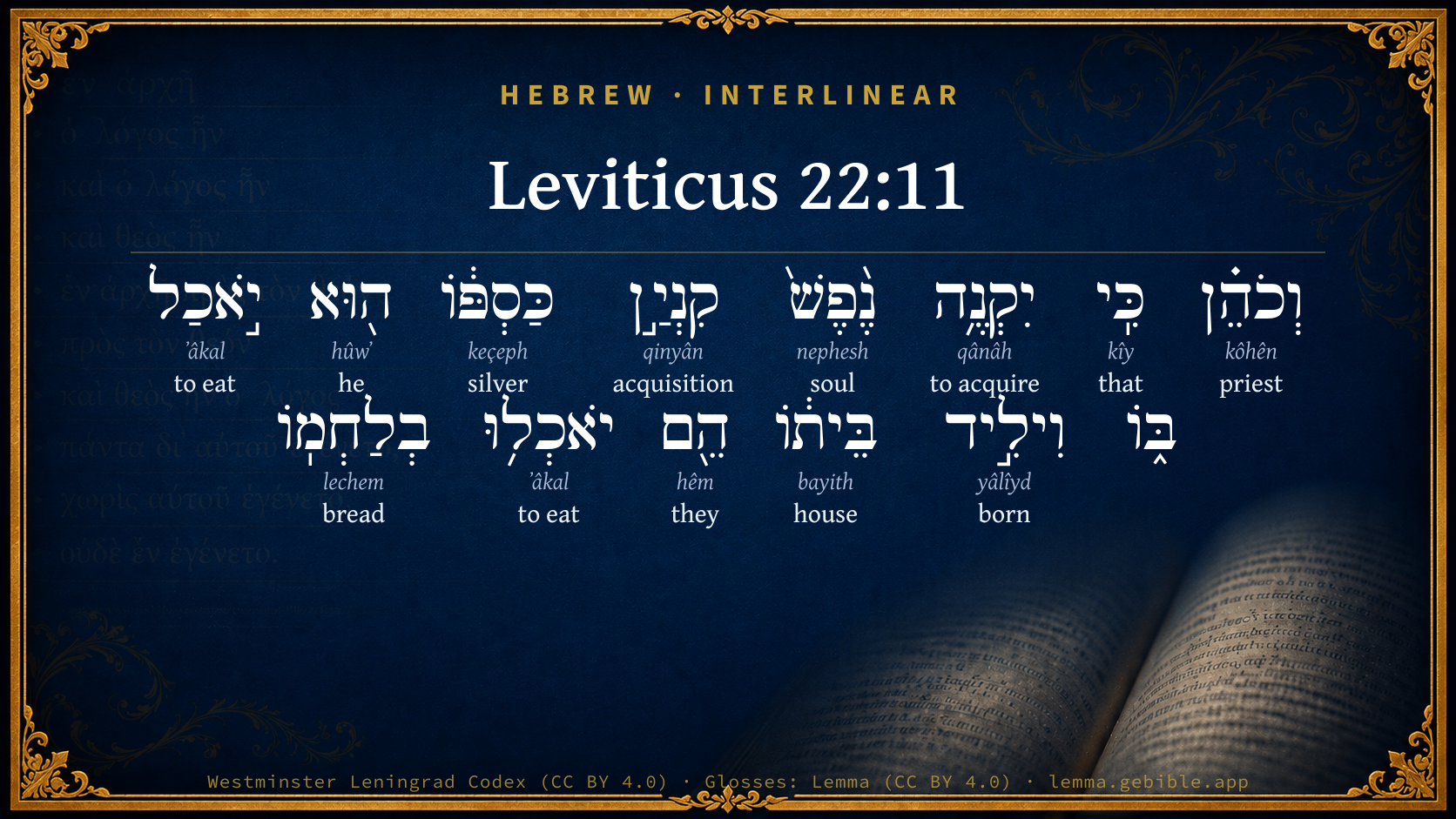
Leviticus 22:11

Hebrew (Westminster Leningrad Codex) Leviticus 22:11 appears in the Hebrew Old Testament. The text above is from the Westminster Leningrad Codex. Each word links to its Strong’s number, a concise gloss, and parsing drawn from the Open Scriptures Hebrew Bible morphology. Click any word for its full Brown-Driver-Briggs (BDB) entry.
Download image
Cite this verse

Leviticus 22:11 (World English Bible). Public Domain. Lemma interlinear Bible study tool, https://lemma.gebible.app/v/leviticus/22/11.

Show BibTeX & RIS
BibTeX
RIS
English Translation
But if a priest buys a slave, purchased by his money, he shall eat of it; and such as are born in his house, they shall eat of his bread.
World English Bible · Public Domain
Download a study sheet

One document with this verse’s original text, its word-by-word gloss line, the meaning frame, cross-references with their text, attributed commentary, and full source and license credits — printable, and it pastes into notes with its structure intact.

This verse Autodidact and up

Study sheet (.html) Plain text (.txt)

A passage Seminary Student

Up to 50 verses in one chapter. A passage sheet keeps up to 6 commentary sources and 12 cross-references per verse, in the order this page ranks them, and says so on the sheet whenever that leaves anything out. Ask for a single verse and you get the Autodidact verse sheet above.

Everything on this page stays free to read, with no account — the sheet is a download of what is already on screen, not access to it.

Want to remove ads? Support Godless Engineer
Compare translations 3

The same verse in 3 English versions, stacked beneath the original-language interlinear above. Click any original word for its lexicon entry.

Each is an independent rendering of the whole verse — the interlinear is not word-aligned to these translations.

Highlighted words mark where these versions differ — a whole-verse word diff, not a word-by-word alignment.

  • World English Bible Public Domain
    But if a priest buys a slave, purchased by his money, he shall eat of it; and such as are born in his house, they shall eat of his bread.
  • King James Version Public Domain
    But if the priest buy any soul with his money, he shall eat of it, and he that is born in his house: they shall eat of his meat.
  • unfoldingWord Literal Text CC BY-SA 4.0
    But a priest, when he buys a person, the property of his silver, he himself may eat it. And one born of his house, they themselves may eat his bread.

unfoldingWord Literal Text — © unfoldingWord, licensed CC BY-SA 4.0. Word-aligned USFM3 via Door43 (git.door43.org/unfoldingWord/en_ult).

Versions to compare (up to 4)

3 of 4 selected

Show all 18 translations

Every available English version of this verse, each an independent rendering of the whole verse.

  • World English Bible Public Domain
    But if a priest buys a slave, purchased by his money, he shall eat of it; and such as are born in his house, they shall eat of his bread.
  • Berean Standard Bible Public Domain
    But if a priest buys a slave with his own money, or if a slave is born in his household, that slave may eat his food.
  • Majority Standard Bible Public Domain
    But if a priest buys a slave with his own money, or if a slave is born in his household, that slave may eat his food.
  • King James Version Public Domain
    But if the priest buy any soul with his money, he shall eat of it, and he that is born in his house: they shall eat of his meat.
  • American Standard Version (1901) Public Domain
    But if a priest buy any soul, the purchase of his money, he shall eat of it; and such as are born in his house, they shall eat of his bread.
  • Revised Version (1885) Public Domain
    But if a priest buy any soul, the purchase of his money, he shall eat of it; and such as are born in his house, they shall eat of his bread.
  • Geneva Bible (1599) Public Domain
    But if the Priest bye any with money, he shall eate of it, also he that is borne in his house: they shall eate of his meate.
  • Douay-Rheims (1899) Public Domain
    But he whom the priest hath bought, and he that is his servant, born in his house, these shall eat of them.
  • Young's Literal Translation Public Domain
    and when a priest buyeth a person, the purchase of his money, he doth eat of it, also one born in his house; they do eat of his bread.
  • Literal Standard Version CC BY-SA 4.0
    but when a priest buys a person, the purchase of his money, he eats of it, also one born in his house; they eat of his bread.
  • Unlocked Literal Bible CC BY-SA 4.0
    But if a priest buys any slave with his own money, that slave may eat from the things set apart to Yahweh. The priest's family members and slaves born in his house, they also may eat with him from those things.
  • unfoldingWord Literal Text CC BY-SA 4.0
    But a priest, when he buys a person, the property of his silver, he himself may eat it. And one born of his house, they themselves may eat his bread.
  • Darby Bible Public Domain
    But if a priest buy any one for money, he may eat of it, and he that is born in his house: they may eat of his food.
  • World Messianic Bible Public Domain
    But if a priest buys a slave, purchased by his money, he shall eat of it; and those who are born in his house shall eat of his bread.
  • Webster's Bible Public Domain
    But if the priest shall buy any soul with his money, he shall eat of it, and he that is born in his house: they shall eat of his meat.
  • Free Bible Version CC BY-SA 4.0
    However, if a priest uses his own money to buy a slave, or if a slave is born in the priest's household, then that slave is allowed to eat his food.
  • Bible in Basic English Public Domain
    But any person for whom the priest has given money, to make him his, may take of it with him; and those who come to birth in his house may take of his bread.
  • JPS Tanakh (1917) Public Domain
    But if a priest buy any soul, the purchase of his money, he may eat of it; and such as are born in his house, they may eat of his bread.

Literal Standard Version (2020), Covenant Press — licensed CC BY-SA 4.0. Text via the HelloAO Bible API (eBible.org). Unlocked Literal Bible (unfoldingWord) — licensed CC BY-SA 4.0. Text via the HelloAO Bible API (eBible.org). unfoldingWord Literal Text — © unfoldingWord, licensed CC BY-SA 4.0. Word-aligned USFM3 via Door43 (git.door43.org/unfoldingWord/en_ult). Free Bible Version, Dr. Jonathan Gallagher — licensed CC BY-SA 4.0. Text via the HelloAO Bible API (eBible.org).

Word by word

More ways to search: Search by grammar → Find every occurrence → Compare this word →

Practice this passage: Drill this verse → Learn its vocabulary →

קִנְיַ֣ן
qinyân
H7075
“acquisition of”
Noun, Common, Masculine, Singular, Construct
Part of Speech
Noun
Type
Common
Gender
Masculine
Number
Singular
State
Construct
Full BDB Definition

Origin: from H7069

TWOT: 2039a

thing acquired, acquisition, possession, purchased property, wealth - thing acquired (by purchase) - creatures (more general)
  1. וְכֹהֵ֗ן kôhên H3548 “and · priest” Conjunction + Noun, Common, Masculine, Singular, Absolute
  2. כִּֽי kîy H3588 “that” Conjunction
  3. יִקְנֶ֥ה qânâh H7069 “to acquire” Verb, Qal, Imperfect, 3rd Person, Masculine, Singular
  4. נֶ֨פֶשׁ֙ nephesh H5315 “soul” Noun, Common, Both, Singular, Absolute
  5. כַּסְפּ֔וֹ keçeph H3701 “silver · his” Noun, Common, Masculine, Singular, Construct + Suffix, Personal, 3rd Person, Masculine, Singular
  6. ה֖וּא hûwʼ H1931 “he” Pronoun, Personal, 3rd Person, Masculine, Singular
  7. יֹ֣אכַל ʼâkal H398 “to eat” Verb, Qal, Imperfect, 3rd Person, Masculine, Singular
  8. וִילִ֣יד yâlîyd H3211 “and · born of” Conjunction + Noun, Common, Masculine, Singular, Construct
  9. בֵּית֔וֹ bayith H1004 “house · his” Noun, Common, Masculine, Singular, Construct + Suffix, Personal, 3rd Person, Masculine, Singular
  10. הֵ֖ם hêm H1992 “they” Pronoun, Personal, 3rd Person, Masculine, Plural
  11. יֹאכְל֥וּ ʼâkal H398 “to eat” Verb, Qal, Imperfect, 3rd Person, Masculine, Plural
  12. בְלַחְמֽוֹ lechem H3899 “in/at · bread · his” Preposition + Noun, Common, Both, Singular, Construct + Suffix, Personal, 3rd Person, Masculine, Singular

About this verse

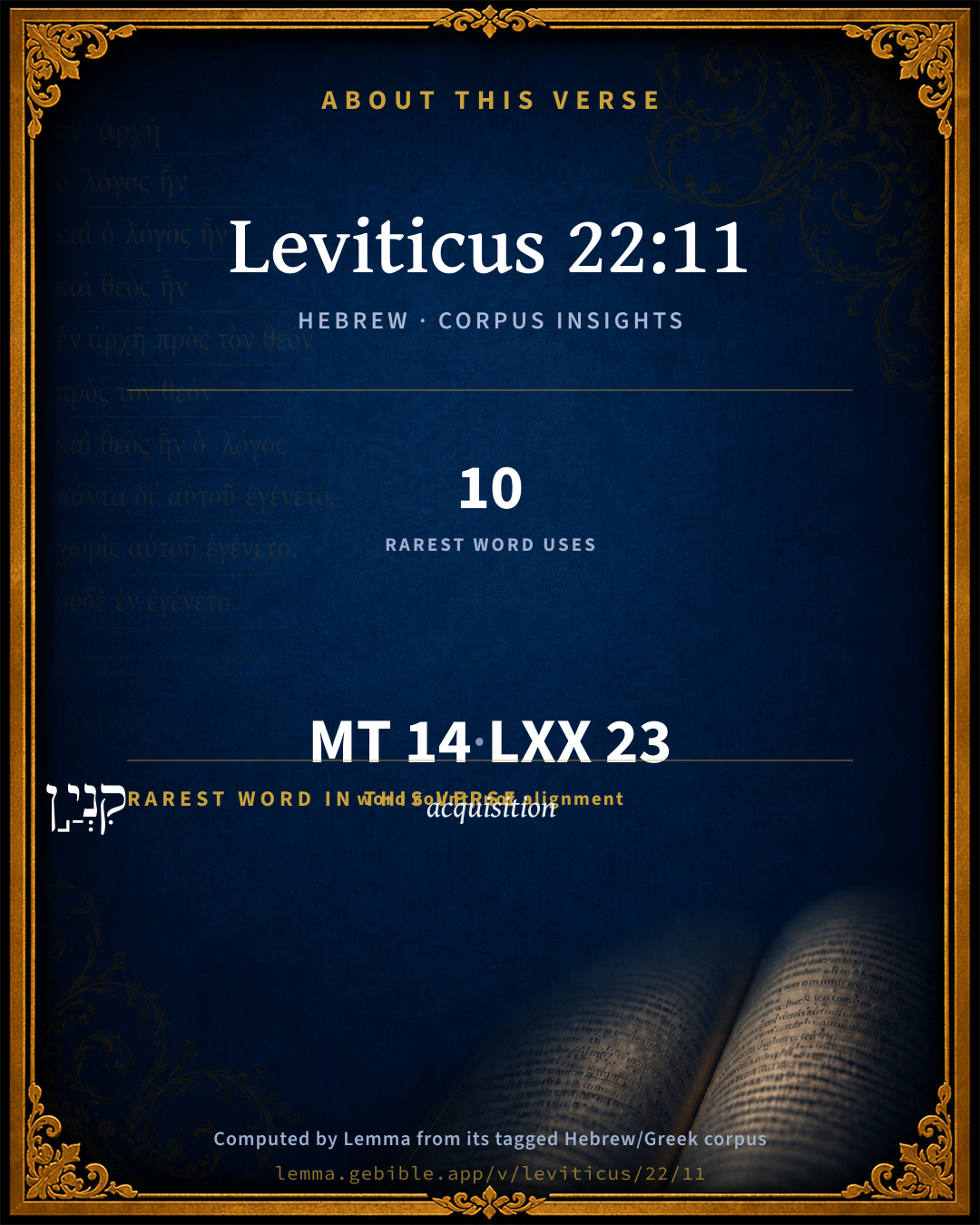
These counts appear in no published source. They are computed here, from the morphology-tagged text and Lemma’s own curated glosses. What Lemma adds →

14
words
12
distinct lemmas
Pentateuch
section

Notable vocabulary

The rarest word here is קִנְיַ֣ן acquisition H7075 — appearing just 10 times in the whole Hebrew Bible.

Shared distinctive vocabulary

קִנְיַ֣ן acquisition H7075 occurs in 10 verses of the Hebrew Bible. Also found in:

Grammatical profile

  • 3 verbs
  • 7 nouns
  • 2 pronouns
  • 1 preposition
  • 1 conjunction

Verb forms

  • יִקְנֶ֥ה Qal · Imperfect
  • יֹ֣אכַל Qal · Imperfect
  • יֹאכְל֥וּ Qal · Imperfect

Repetition

A word recurs within this verse — often emphatic in Hebrew:

  • יֹ֣אכַל to eat H398 ×2

Hebrew & Septuagint length

In English translation the verse runs 30 words from the Hebrew and 32 from the Septuagint (LXX English) — closely comparable.

A rough comparison of the two English renderings, which tokenize alike — not a word-level alignment.

Word counts can differ between the Hebrew and the Greek without any difference in meaning — e.g. the Hebrew direct-object marker אֵת has no separate Greek word, and Greek often adds the article ὁ.

In the original languages it is 14 Hebrew tokens and 23 Greek tokens — but the two are counted differently (Hebrew bundles its prefixes and suffixes into one token; the Greek is in lemma form), so that isn’t a like-for-like length.

Cross-references

3

Topical passages linked to Leviticus 22:11 in the Treasury of Scripture Knowledge — connected by theme and wording, ordered by reader-vote popularity; previews shown in the World English Bible.

  • Genesis 17:13 He who is born in your house, and he who is bought with your money, must be circumcised. My covenant will be in your flesh for an everlasting covenant.
  • Exodus 12:44 but every man's servant who is bought for money, when you have circumcised him, then shall he eat of it.
  • Numbers 18:11–13 This is your: the heave-offering of their gift, even all the wave-offerings of the children of Israel; I have given them to you, and to your sons and to your daughters with you, as a portion forever; everyone who is clean in your house shall eat of it.

Cross-references courtesy of OpenBible.info (CC BY 4.0).

Hebrew and Greek witnesses Masoretic Hebrew ↔ Greek Septuagint

The same verse in the two great witnesses to the Old Testament, shown verse-for-verse.

These are two independent witnesses, not word-aligned to each other, and the Septuagint is shown in lemma (dictionary) form.

Hebrew Leviticus 22:11 Masoretic · Westminster Leningrad Codex

וְכֹהֵ֗ן כִּֽי יִקְנֶ֥ה נֶ֨פֶשׁ֙ קִנְיַ֣ן כַּסְפּ֔וֹ ה֖וּא יֹ֣אכַל בּ֑וֹ וִילִ֣יד בֵּית֔וֹ הֵ֖ם יֹאכְל֥וּ בְלַחְמֽוֹ

But if a priest buys a slave, purchased by his money, he shall eat of it; and such as are born in his house, they shall eat of his bread.

World English Bible · Public Domain

Greek LXX Leviticus 22:11 Septuagint · lemma form

ἐάν δέ ἱερεύς κτάομαι ψυχή ἔγκτητος ἀργύριον οὗτος ἐσθίω ἐκ ὁ ἄρτος αὐτός καί ὁ οἰκογενής αὐτός καί οὗτος ἐσθίω ὁ ἄρτος αὐτός

But if a priest should have a soul purchased for money, he shall eat of his bread; and they that are born in his house, they also shall eat of his bread.

LXX2012 (modern English Septuagint) · Public Domain

Hebrew: Westminster Leningrad Codex (CC BY 4.0). Greek: Septuagint (public domain); English from LXX2012 (modern English Septuagint) (Public Domain). How the Septuagint differs from the Hebrew →

Targum (Aramaic paraphrase)

2

The Targum is the ancient Jewish Aramaic paraphrase of the Hebrew Scriptures — an interpretive translation, not the Hebrew text itself. Onkelos (literal) and Pseudo-Jonathan (expansive) render the Torah, and Jonathan the Prophets. Coverage is partial: where no permissively-licensed English translation exists for a verse, only the Aramaic is shown. This is verse-level text, not a word-by-word alignment to the Hebrew.

  1. Targum Onkelos Torah (Genesis–Deuteronomy)
    וְכָהֵן אֲרֵי יִקְנֵי נְפַשׁ קִנְיַן כַּסְפֵּהּ הוּא יֵיכוּל בֵּהּ וִילִיד בֵּיתֵהּ אִנוּן יֵיכְלוּן בְּלַחְמֵהּ

    (no public-domain English translation for this verse)

    Targum Onkelos — Aramaic: “Onkelos Genesis” (public domain); “Onkelos Exodus” (public domain); “Onkelos Leviticus” (public domain); “Onkelos Numbers” (public domain); “Onkelos Deuteronomy” (public domain). English: “Sefaria Community Translation” (CC0 1.0 (public-domain dedication)); “J.W. Etheridge. The Targums of Onkelos and Jonathan Ben Uzziel on the Pentateuch. London: Longmans, Green, 1862” (public domain). Text via Sefaria.

  2. Targum Pseudo-Jonathan Torah (Genesis–Deuteronomy)
    וְכַהֲנָא אֲרוּם יִקְנֵי בַּר נַשׁ נוּכְרָאָה קִנְיַן כַּסְפֵּיהּ הוּא יֵיכוֹל בֵּיהּ וּמַרְבְּיָינֵי בַיְיתֵיהּ הִינוּן יֵיכְלוּן בְּלַחֲמֵיהּ

    But if the priest buy a man a stranger with the price of his money, he may eat of it, and such as have grown up in his house may eat of his bread.

    Targum Pseudo-Jonathan — Aramaic: “Targum Jonathan on Genesis” (public domain); “Targum Jonathan on Exodus” (public domain); “Targum Jonathan on Leviticus” (public domain); “Targum Jonathan on Numbers” (public domain); “Targum Jonathan on Deuteronomy” (public domain). English: “The Targum of Jonathan ben Uzziel, trans. J. W. Etheridge, London, 1862” (public domain). Text via Sefaria.

Commentary

Notes on Leviticus 22:11 from classic Christian and Jewish commentators (each source and its license shown beneath its notes). The classic Christian expositions comment on the surrounding passage and are grouped to its opening verse, so a note may address several verses; the Jewish commentaries on the Tanakh (Rashi and others) are per-verse, so they appear only where the commentator wrote on this verse.

Lemma curates 59 commentaries, every one of them public domain or Creative Commons licensed, each selected and text-cleaned for this edition rather than reprinted as found. About our sources →

Trapp's Complete Commentary

John Trapp

Lev 22:11 But if the priest buy [any] soul with his money, he shall eat of it, and he that is born in his house: they shall eat of his meat.

Ver. 11. He shall eat.] As being a menial servant to the priest.

John Trapp, A Commentary or Exposition upon All the Books of the Old and New Testament (1647–1656) — public domain. Text from a community e-Sword module.

The Biblical Illustrator

Joseph S. Exell

Lev_22:11

If the priest buy any soul . . . and he that is born.

Bought, or born

Strangers, sojourners, and servants upon hire were not to eat of holy things. It is so in spiritual matters still. But two classes were free at the sacred table--those who were bought with the priests money, and those who were born into the priests house.

I. Bought. Our great High Priest has bought with a price all those who put their trust in Him. They are His absolute property. Not for what they are in themselves, but for their Owners sake they are admitted into the same privileges which He Himself enjoys, and they shall eat of His meat. He has meat to eat which worldlings know not of. Because ye belong to Christ, therefore shall ye share with your Lord.

II. Born. This is an equally sure way to privilege; if born in the Priests house we take our place with the rest of the family. Regeneration makes us fellow-heirs, and of the same body; and, therefore, the peace, the joy, the glory, which the Father has given to Christ, Christ has given to us. (C. H. Spurgeon.)

The Biblical Illustrator, edited by Joseph S. Exell (c. 1880s–1900s) — public domain. Text from a community e-Sword module.

Joseph Benson's Commentary

Lev 22:11. If the priest buy any soul — Either one of the Jewish nation, obliged, through poverty, to sell himself, (Lev 25:39,) or of another nation, (v. 44, 45,) who being proselyted to the Jewish religion, became part of the priest’s family, and so was permitted to eat of his consecrated meat.

Joseph Benson's Commentary on the Old and New Testaments (1811–1818) — public domain. Text from a community e-Sword module.

Tyndale Open Study Notes

Tyndale Open Resources

22:11 The only male outside the priest’s family who could eat the priest’s share was the priest’s slave. He would have no other food if this provision were denied him.

Tyndale Open Study Notes — © Tyndale Open Resources, licensed CC BY-SA 4.0. Text via the HelloAO Bible API.

Ellicott's Commentary for English Readers

(11) But if the priest buy any soul.—The case, however, was different with heathen slaves whom the priest purchased. These were admitted into the Jewish community by the rite of circumcision, they were allowed to partake of the paschal lamb, and of every privilege of the Israelites. Hence they became incorporated in the priestly family, and were allowed to eat of the holy things. During the second Temple this privilege was extended to that kind of domestic whom the priest did not actually acquire by his own purchase-money, but whom the wife brought with her as part of her dowry, as well as to those whom the slaves of the priestly family purchased.

Born in his house.—That is, the house-born servant or the child of the slave. (See Gen_17:12-13.) Even when the priest himself could not eat of the holy things by reason of his having contracted some legal defilement, his wife, children, and slaves were permitted to partake of the sacrificial repast.

A Bible Commentary for English Readers, edited by Charles John Ellicott (1878–1897) — public domain. Text from a community e-Sword module.

John Gill's Exposition

But if the priest buy any soul with his money, he shall eat of it,.... Whether any of his own nation, who sometimes, when become poor, were obliged to sell themselves; or a stranger, as the Targum of Jonathan; one of another nation, a Canaanitish servant, as Jarchi. Now these being his own purchase, and always to abide with him, became part of his family, and so might eat of the provisions of it; and it is from hence the Jews gather, as Jarchi and Gersom, that his wife might eat of the holy things, because bought with his money; but there is a better reason to be given for that, for of whatever family she was before, whether of the priests or not, by marriage she became a part, yea, a principal of his family, being one flesh with him, bearing the same name, and entitled to all the privileges of his house. This is extended by some Jewish writers (l) to cattle, for by any soul they understood also the soul of a beast, which being bought by the priest's money, might eat of the offerings of the tithes:

and he that is born in his house; they shall eat of his meat; whether male or female, as Aben Ezra; these are children of handmaids, as Jarchi, that were bought with his money; and these children being born of them, became his property, and part of his family, and so had a right to the provisions of his house. All this may teach us, that the holy ordinances of the Gospel are not to be administered to strangers, persons destitute of the grace of God, nor to such as are not of the family or church of God, but to such as are bought and redeemed with the blood of Christ, the high priest, and are born again of his Spirit and grace.

(l) Misn. Trumot, c. 11. sect. 9. & Maimon. & Bartenora in ib. Hilchot Trumot, c. 6. sect. 1.

John Gill's Exposition of the Whole Bible (1746–1763) — public domain (CC PDM 1.0). Text via the HelloAO Bible API.

Albert Barnes' Notes on the Bible

This shows how completely a purchased bondsman was incorporated into the household. See Exo 21:2, note; Exo 21:20-21, note.

Albert Barnes' Notes on the Bible (1834–1885) — public domain. Text from a community e-Sword/MySword module.

Matthew Poole's English Annotations

Because they were wholly his, and as such they were circumcised, Ge 17; Exo 12.

Matthew Poole's English Annotations on the Holy Bible (1683–1685) — public domain. Text from a community e-Sword/MySword module.

Whedon's Commentary on the Bible

Daniel D. Whedon

11. If the priest buy any soul — That is, person. A mild form of servitude was allowed as a mitigation of the usages of war in those times. Otherwise the Hebrews would have slain all their captives taken in war.

They shall eat of his meat — Since these constitute a permanent part of his family, they are permitted to eat the sacred things, but not the most holy. This partially relieves the difficulty of Colenso respecting the capacity of the priests to eat all the sacrifices assigned to them. See chap. vi, concluding notes.

Daniel D. Whedon (gen. ed.), Commentary on the Old and New Testaments (1874–1909) — public domain. Text from a community e-Sword module.

Rashi

Rabbi Shlomo Yitzchaki (Rashi)

וכהן כי יקנה נפש BUT IF THE PRIEST BUY ANY SOUL… [HE MAY EAT OF IT] — This refers to a Canaanitish servant who has been acquired even in respect to his body (not only as regards his work).

ויליד ביתו AND THEY THAT ARE BORN IN HIS HOUSE — This refers to the children of his maid-servants. A priest's wife may eat תרומה as may be derived from this verse, for she, too, is “an acquisition obtained by his money” (Ketuvot 57b; cf. Mishna Kiddushin 1:1… ‎'האשה נקנית בכסף וכו‎‎‎, one of the ways in which a marriage may be contracted is by the passing of money or its equivalent from the man to the woman. A wife is therefore a קנין כסף). But it may also be derived from another verse (Numbers 18:11) "[the heave-offering…] everyone that is clean in thy house may eat of it”. Thus is it expounded in Sifrei Bamidbar 117 2.

Rashi on the Tanakh — English translations: “The Judaica Press complete Tanach with Rashi, translated by A. J. Rosenberg” (CC BY 4.0); “Pentateuch with Rashi's commentary by M. Rosenbaum and A.M. Silbermann, 1929-1934” (public domain); “The Metsudah Tanach series, Lakewood, N.J” (CC BY 4.0); and “The Book of Joshua, Metsudah Publications, 1997” (CC BY 4.0). Text via Sefaria.

Lesson kit

Teaching starters — assembled from the data on this page, not authored interpretation. Every prompt links to the verse data it draws on. Edit before teaching.

Leviticus, in the Pentateuch, opens this verse with 14 words (12 distinct Hebrew lemmas). Its most distinctive word is qinyân (“acquisition”). A historical commentator’s framing appears above. Read the whole chapter for the surrounding context.

Discussion questions

  1. The word qinyân carries the sense “acquisition.” How does it shape the verse?
  2. Genesis 31:18 shares the word «acquisition» with this verse. How do the two illuminate each other?
  3. “to eat” occurs 2× in this one verse. What is the effect of the repetition?
  4. These translations render this verse differently; the difference is in the English rendering, not the original. What questions does that raise?
  5. The verb «יִקְנֶ֥ה» is Qal Imperfect. How does its form color the action?
  6. Reading how Trapp's Complete Commentary and The Biblical Illustrator read this verse, where do the two commentators agree and where do they part?

Things to notice

Reading settings

Reading text

Shown beneath each verse's original-language words.

Old Testament
Old Testament edition

Read the OT as the Masoretic Hebrew (MT) or the Greek Septuagint (LXX).

English shown for the Greek Septuagint (in the Hebrew ↔ Greek comparison).

Comparing translations? Open the Compare panel on any verse page to stack up to four side by side.