
Deuteronomy 11:30

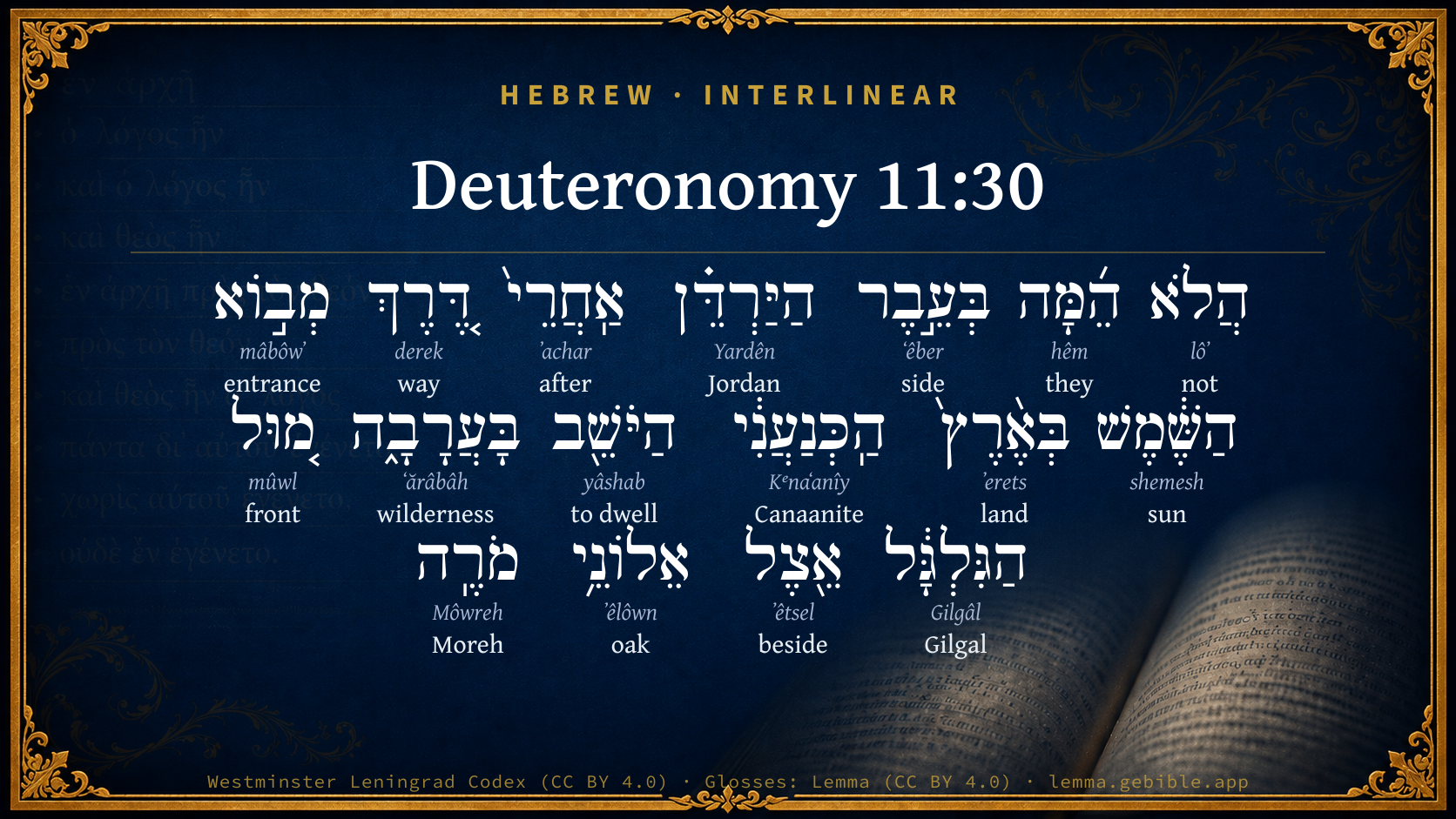
Hebrew (Westminster Leningrad Codex) Deuteronomy 11:30 appears in the Hebrew Old Testament. The text above is from the Westminster Leningrad Codex. Each word links to its Strong’s number, a concise gloss, and parsing drawn from the Open Scriptures Hebrew Bible morphology. Click any word for its full Brown-Driver-Briggs (BDB) entry.
Download image
Cite this verse

Deuteronomy 11:30 (World English Bible). Public Domain. Lemma interlinear Bible study tool, https://lemma.gebible.app/v/deuteronomy/11/30.

Show BibTeX & RIS
BibTeX
RIS
English Translation
Aren't they beyond the Jordan, behind the way of the going down of the sun, in the land of the Canaanites who dwell in the Arabah, over against Gilgal, beside the oaks of Moreh?
World English Bible · Public Domain
Highlights Full analysis ↓
Download a study sheet

One document with this verse’s original text, its word-by-word gloss line, the meaning frame, cross-references with their text, attributed commentary, and full source and license credits — printable, and it pastes into notes with its structure intact.

This verse Autodidact and up

Study sheet (.html) Plain text (.txt)

A passage Seminary Student

Up to 50 verses in one chapter. A passage sheet keeps up to 6 commentary sources and 12 cross-references per verse, in the order this page ranks them, and says so on the sheet whenever that leaves anything out. Ask for a single verse and you get the Autodidact verse sheet above.

Everything on this page stays free to read, with no account — the sheet is a download of what is already on screen, not access to it.

Want to remove ads? Support Godless Engineer
Compare translations 3

The same verse in 3 English versions, stacked beneath the original-language interlinear above. Click any original word for its lexicon entry.

Each is an independent rendering of the whole verse — the interlinear is not word-aligned to these translations.

Highlighted words mark where these versions differ — a whole-verse word diff, not a word-by-word alignment.

  • World English Bible Public Domain
    Aren't they beyond the Jordan, behind the way of the going down of the sun, in the land of the Canaanites who dwell in the Arabah, over against Gilgal, beside the oaks of Moreh?
  • King James Version Public Domain
    Are they not on the other side Jordan, by the way where the sun goeth down, in the land of the Canaanites, which dwell in the champaign over against Gilgal, beside the plains of Moreh?
  • unfoldingWord Literal Text CC BY-SA 4.0
    they not across the Jordan, following the road of the sun setting, in the land of the Canaanites who live in the Arabah, opposite Gilgal, beside the oaks of Moreh?

unfoldingWord Literal Text — © unfoldingWord, licensed CC BY-SA 4.0. Word-aligned USFM3 via Door43 (git.door43.org/unfoldingWord/en_ult).

Versions to compare (up to 4)

3 of 4 selected

Show all 18 translations

Every available English version of this verse, each an independent rendering of the whole verse.

  • World English Bible Public Domain
    Aren't they beyond the Jordan, behind the way of the going down of the sun, in the land of the Canaanites who dwell in the Arabah, over against Gilgal, beside the oaks of Moreh?
  • Berean Standard Bible Public Domain
    Are not these mountains across the Jordan, west of the road toward the sunset, in the land of the Canaanites who live in the Arabah opposite Gilgal near the Oak of Moreh?
  • Majority Standard Bible Public Domain
    Are not these mountains across the Jordan, west of the road toward the sunset, in the land of the Canaanites who live in the Arabah opposite Gilgal near the Oak of Moreh?
  • King James Version Public Domain
    Are they not on the other side Jordan, by the way where the sun goeth down, in the land of the Canaanites, which dwell in the champaign over against Gilgal, beside the plains of Moreh?
  • American Standard Version (1901) Public Domain
    Are they not beyond the Jordan, behind the way of the going down of the sun, in the land of the Canaanites that dwell in the Arabah, over against Gilgal, beside the oaks of Moreh?
  • Revised Version (1885) Public Domain
    Are they not beyond Jordan, behind the way of the going down of the sun, in the land of the Canaanites which dwell in the Arabah, over against Gilgal, beside the oaks of Moreh?
  • Geneva Bible (1599) Public Domain
    Are they not beyond Iorden on that part, where the sunne goeth downe in the land of the Canaanites, which dwel in the plaine ouer against Gilgal, beside the groue of Moreh?
  • Douay-Rheims (1899) Public Domain
    And when the Lord thy God shall have brought thee into the land, whither thou goest to dwell, thou shalt put the blessing upon mount Garizim, the curse upon mount Hebal:
  • Young's Literal Translation Public Domain
    are they not beyond the Jordan, behind the way of the going in of the sun, in the land of the Canaanite, who is dwelling in the plain over-against Gilgal, near the oaks of Moreh?
  • Literal Standard Version CC BY-SA 4.0
    are they not beyond the Jordan, behind the way of the going in of the sun, in the land of the Canaanite who is dwelling in the plain opposite Gilgal, near the oaks of Moreh?
  • Unlocked Literal Bible CC BY-SA 4.0
    Are they not beyond the Jordan, west of the western road, in the land of the Canaanites who live in the Arabah, over against Gilgal, beside the oaks of Moreh?
  • unfoldingWord Literal Text CC BY-SA 4.0
    they not across the Jordan, following the road of the sun setting, in the land of the Canaanites who live in the Arabah, opposite Gilgal, beside the oaks of Moreh?
  • Darby Bible Public Domain
    Are they not on the other side of the Jordan, beyond the way toward the going down of the sun, in the land of the Canaanites that dwell on the plain opposite to Gilgal, beside the oaks of Moreh?
  • World Messianic Bible Public Domain
    Aren’t they beyond the Jordan, behind the way of the going down of the sun, in the land of the Canaanites who dwell in the Arabah near Gilgal, beside the oaks of Moreh?
  • Webster's Bible Public Domain
    Are they not on the other side of Jordan, by the way where the sun goeth down in the land of the Canaanites, who dwell in the plain over against Gilgal, beside the plains of Moreh?
  • Free Bible Version CC BY-SA 4.0
    (These mountains are to the west of the Jordan, in the country of the Canaanites who live in the Arabah near Gilgal, beside the oaks of Moreh.)
  • Bible in Basic English Public Domain
    Are they not on the other side of Jordan, looking west, in the land of the Canaanites living in the Arabah, opposite Gilgal, by the holy tree of Moreh?
  • JPS Tanakh (1917) Public Domain
    Are they not beyond the Jordan, behind the way of the going down of the sun, in the land of the Canaanites that dwell in the Arabah, over against Gilgal, beside the terebinths of Moreh?

Literal Standard Version (2020), Covenant Press — licensed CC BY-SA 4.0. Text via the HelloAO Bible API (eBible.org). Unlocked Literal Bible (unfoldingWord) — licensed CC BY-SA 4.0. Text via the HelloAO Bible API (eBible.org). unfoldingWord Literal Text — © unfoldingWord, licensed CC BY-SA 4.0. Word-aligned USFM3 via Door43 (git.door43.org/unfoldingWord/en_ult). Free Bible Version, Dr. Jonathan Gallagher — licensed CC BY-SA 4.0. Text via the HelloAO Bible API (eBible.org).

Word by word

More ways to search: Search by grammar → Find every occurrence → Compare this word →

Practice this passage: Drill this verse → Learn its vocabulary →

מֹרֶֽה
Môwreh
H4176
“Moreh”
Noun, Proper
Part of Speech
Noun
Type
Proper
Full BDB Definition

Origin: the same as H4175

TWOT: None

Moreh = "teacher" - the oak tree at Shechem where Abram stopped when he first entered Canaan; close to the mountains of Ebal and Gerizim - the hill in the valley of Jezreel at which the Midianites were camped when Gideon attacked them
  1. הֲלֹא lôʼ H3808 “not” Particle, Interrogative + Particle, Negative
  2. הֵ֜מָּה hêm H1992 “they” Pronoun, Personal, 3rd Person, Masculine, Plural
  3. בְּעֵ֣בֶר ʻêber H5676 “in/at · side of” Preposition + Noun, Common, Masculine, Singular, Construct
  4. הַיַּרְדֵּ֗ן Yardên H3383 “the · Jordan” Particle, Definite Article + Noun, Proper
  5. אַֽחֲרֵי֙ ʼachar H310 “after” Preposition
  6. דֶּ֚רֶךְ derek H1870 “way of” Noun, Common, Both, Singular, Construct
  7. מְב֣וֹא mâbôwʼ H3996 “entrance of” Noun, Common, Masculine, Singular, Construct
  8. הַשֶּׁ֔מֶשׁ shemesh H8121 “the · sun” Particle, Definite Article + Noun, Common, Both, Singular, Absolute
  9. בְּאֶ֨רֶץ֙ ʼerets H776 “in/at · land of” Preposition + Noun, Common, Both, Singular, Construct
  10. הַֽכְּנַעֲנִ֔י Kᵉnaʻanîy H3669 “the · Canaanite” Particle, Definite Article + Noun, Gentilic, Masculine, Singular, Absolute
  11. הַיֹּשֵׁ֖ב yâshab H3427 “the · dwelling” Particle, Definite Article + Verb, Qal, Participle Active, Masculine, Singular, Absolute
  12. בָּעֲרָבָ֑ה ʻărâbâh H6160 “in/at the · wilderness” Preposition, Determined + Noun, Common, Feminine, Singular, Absolute
  13. מ֚וּל mûwl H4136 “front” Preposition
  14. הַגִּלְגָּ֔ל Gilgâl H1537 “the · Gilgal” Particle, Definite Article + Noun, Proper
  15. אֵ֖צֶל ʼêtsel H681 “beside” Preposition
  16. אֵלוֹנֵ֥י ʼêlôwn H436 “oaks of” Noun, Common, Masculine, Plural, Construct

About this verse

These counts appear in no published source. They are computed here, from the morphology-tagged text and Lemma’s own curated glosses. What Lemma adds →

17
words
17
distinct lemmas
Pentateuch
section

Notable vocabulary

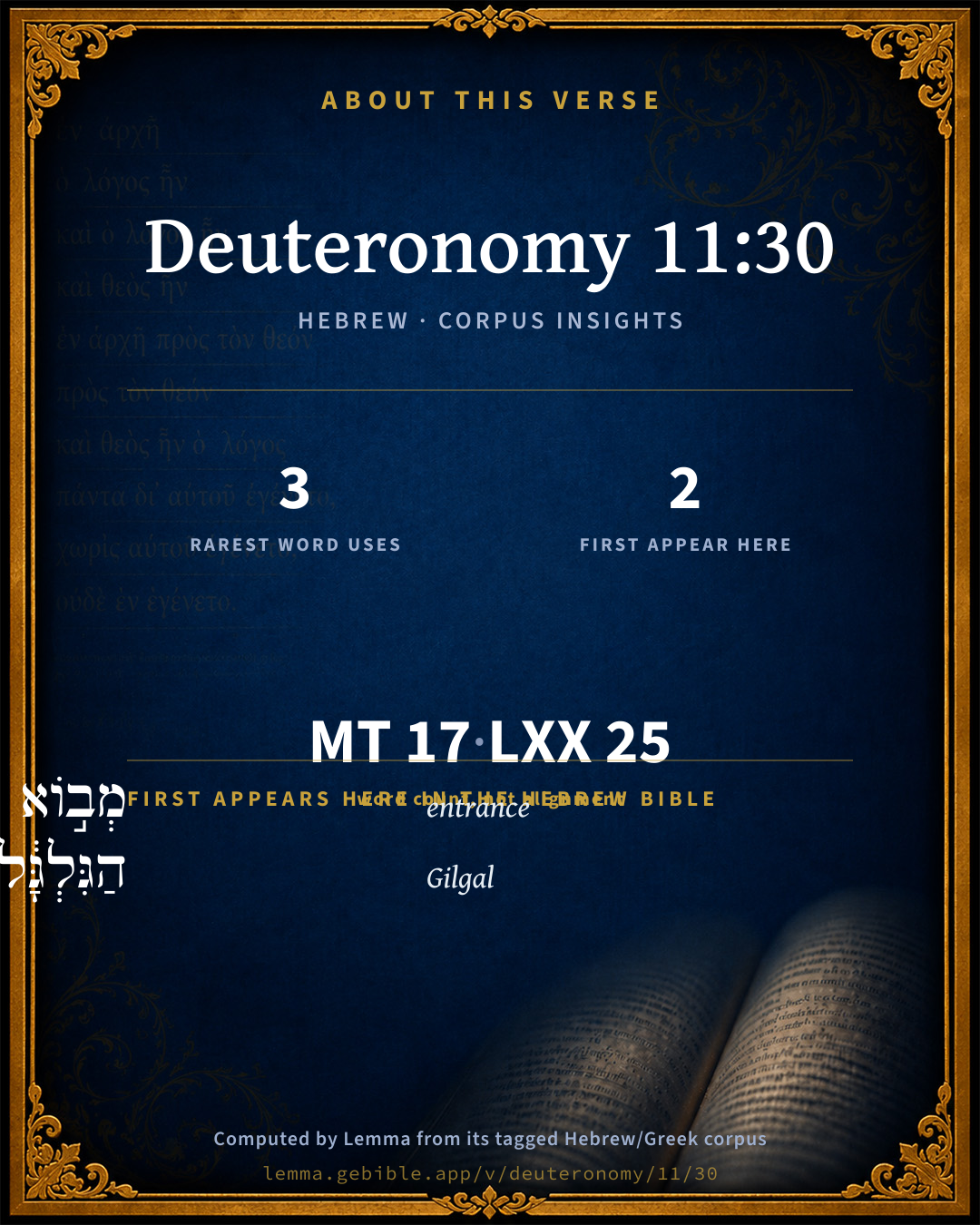
The rarest word here is מֹרֶֽה Moreh H4176 — appearing just 3 times in the whole Hebrew Bible.

First appearance in Scripture

These words make their first canonical appearance in the Hebrew Bible here:

  • מְב֣וֹא entrance H3996
  • הַגִּלְגָּ֔ל Gilgal H1537

Shared distinctive vocabulary

מֹרֶֽה Moreh H4176 occurs in 3 verses of the Hebrew Bible. Also found in:

Grammatical profile

  • 1 verb
  • 11 nouns
  • 1 pronoun
  • 3 prepositions
  • 1 particle

Verb forms

  • הַיֹּשֵׁ֖ב Qal · Participle Active

Hebrew & Septuagint length

In English translation the verse runs 34 words from the Hebrew and 22 from the Septuagint (LXX English) — the Septuagint runs noticeably shorter here. See the side-by-side →

A rough comparison of the two English renderings, which tokenize alike — not a word-level alignment.

Word counts can differ between the Hebrew and the Greek without any difference in meaning — e.g. the Hebrew direct-object marker אֵת has no separate Greek word, and Greek often adds the article ὁ.

In the original languages it is 17 Hebrew tokens and 25 Greek tokens — but the two are counted differently (Hebrew bundles its prefixes and suffixes into one token; the Greek is in lemma form), so that isn’t a like-for-like length.

Cross-references

4

Topical passages linked to Deuteronomy 11:30 in the Treasury of Scripture Knowledge — connected by theme and wording, ordered by reader-vote popularity; previews shown in the World English Bible.

  • Genesis 12:6 Abram passed through the land to the place of Shechem, to the oak of Moreh. The Canaanite was then in the land.
  • Judges 7:1 Then Jerubbaal, who is Gideon, and all the people who were with him, rose up early, and encamped beside the spring of Harod: and the camp of Midian was on the north side of them, by the hill of Moreh, in the valley.
  • Joshua 4:19 The people came up out of the Jordan on the tenth day of the first month, and encamped in Gilgal, on the east border of Jericho.
  • Joshua 5:9 Yahweh said to Joshua, This day have I rolled away the reproach of Egypt from off you. Therefore the name of that place was called Gilgal, to this day.

Cross-references courtesy of OpenBible.info (CC BY 4.0).

Hebrew and Greek witnesses Masoretic Hebrew ↔ Greek Septuagint

The same verse in the two great witnesses to the Old Testament, shown verse-for-verse.

Here the Septuagint runs noticeably shorter than the Hebrew — LXX2012 (modern English Septuagint) 22 words vs World English Bible 34. A rough length comparison of the two English translations, not a word-level alignment — read both below.

These are two independent witnesses, not word-aligned to each other, and the Septuagint is shown in lemma (dictionary) form.

Hebrew Deuteronomy 11:30 Masoretic · Westminster Leningrad Codex

הֲלֹא הֵ֜מָּה בְּעֵ֣בֶר הַיַּרְדֵּ֗ן אַֽחֲרֵי֙ דֶּ֚רֶךְ מְב֣וֹא הַשֶּׁ֔מֶשׁ בְּאֶ֨רֶץ֙ הַֽכְּנַעֲנִ֔י הַיֹּשֵׁ֖ב בָּעֲרָבָ֑ה מ֚וּל הַגִּלְגָּ֔ל אֵ֖צֶל אֵלוֹנֵ֥י מֹרֶֽה

Aren't they beyond the Jordan, behind the way of the going down of the sun, in the land of the Canaanites who dwell in the Arabah, over against Gilgal, beside the oaks of Moreh?

World English Bible · Public Domain

Greek LXX Deuteronomy 11:30 Septuagint · lemma form

οὐ ἰδού οὗτος πέραν ὁ ἰορδάνης ὀπίσω ὁδός δυσμή ἥλιος ἐν γῆ χανααν ὁ καταοἰκέω ἐπί δυσμή ἔχω ὁ γολγολ πλησίον ὁ δρῦς ὁ ὑψηλός

Behold! are not these beyond Jordan, behind, westward in the land of Chanaan, which lies westward near Golgol, by the high oak?

LXX2012 (modern English Septuagint) · Public Domain

Hebrew: Westminster Leningrad Codex (CC BY 4.0). Greek: Septuagint (public domain); English from LXX2012 (modern English Septuagint) (Public Domain). How the Septuagint differs from the Hebrew →

Targum (Aramaic paraphrase)

2

The Targum is the ancient Jewish Aramaic paraphrase of the Hebrew Scriptures — an interpretive translation, not the Hebrew text itself. Onkelos (literal) and Pseudo-Jonathan (expansive) render the Torah, and Jonathan the Prophets. Coverage is partial: where no permissively-licensed English translation exists for a verse, only the Aramaic is shown. This is verse-level text, not a word-by-word alignment to the Hebrew.

  1. Targum Onkelos Torah (Genesis–Deuteronomy)
    הֲלָא אִנוּן בְּעִבְרָא דְיַרְדְנָא אֲחוֹרֵי אֹרַח מַעֲלָנֵי שִׁמְשָׁא בְּאַרְעָא כְּנַעְנָאָה דְיָתֵב בְּמֵישְׁרָא לָקֳבֵל גִלְגְלָא בִּסְטַר מֵישְׁרֵי מֹרֶה

    (no public-domain English translation for this verse)

    Targum Onkelos — Aramaic: “Onkelos Genesis” (public domain); “Onkelos Exodus” (public domain); “Onkelos Leviticus” (public domain); “Onkelos Numbers” (public domain); “Onkelos Deuteronomy” (public domain). English: “Sefaria Community Translation” (CC0 1.0 (public-domain dedication)); “J.W. Etheridge. The Targums of Onkelos and Jonathan Ben Uzziel on the Pentateuch. London: Longmans, Green, 1862” (public domain). Text via Sefaria.

  2. Targum Pseudo-Jonathan Torah (Genesis–Deuteronomy)
    הֲלָא אִינוּן יְהִיבִין מִלְהָלָא לְיוֹרְדְּנָא אֲחוֹרֵי אוֹרַח מַטְמְעָא דְשִׁמְשָׁא בְּאַרַע כְּנַעֲנָאָה דְשָׁרֵי בְּמֵישְׁרָא כֻּלּוֹ קֳבֵיל גֻּלְגְּלָא בְּסִטְרֵי חֶזְוֵי מַמְרֵא

    Are they not situated beyond Jordan by the way of the sunset, in the land of the Kenaanah, who dwell in the plain over against Gilgela by the side (of the place) of the vision of Mamre?

    Targum Pseudo-Jonathan — Aramaic: “Targum Jonathan on Genesis” (public domain); “Targum Jonathan on Exodus” (public domain); “Targum Jonathan on Leviticus” (public domain); “Targum Jonathan on Numbers” (public domain); “Targum Jonathan on Deuteronomy” (public domain). English: “The Targum of Jonathan ben Uzziel, trans. J. W. Etheridge, London, 1862” (public domain). Text via Sefaria.

Commentary

Notes on Deuteronomy 11:30 from classic Christian and Jewish commentators (each source and its license shown beneath its notes). The classic Christian expositions comment on the surrounding passage and are grouped to its opening verse, so a note may address several verses; the Jewish commentaries on the Tanakh (Rashi and others) are per-verse, so they appear only where the commentator wrote on this verse.

Lemma curates 59 commentaries, every one of them public domain or Creative Commons licensed, each selected and text-cleaned for this edition rather than reprinted as found. About our sources →

Tyndale Open Study Notes

Tyndale Open Resources

11:30 Gilgal was the site of the first camp the Israelites would make in Canaan after crossing the Jordan (Josh 4:19). It was about two miles northeast of Jericho, although its exact location is no longer certain. A line from Jericho to Shechem would pass near Gilgal. • The oaks of Moreh were near Shechem; they were where Abram had set up his first camp in Canaan (Gen 12:6) and where Jacob had later buried Laban’s idols (Gen 35:4).

Tyndale Open Study Notes — © Tyndale Open Resources, licensed CC BY-SA 4.0. Text via the HelloAO Bible API.

Geneva Bible (1599)

Geneva Bible translators

Or, plain.

Meaning, in Samaria.

Geneva Bible (1599) marginal notes — public domain. Text via Bolls.life.

Ellicott's Commentary for English Readers

(30) Where the sun goeth down.—A memorable passage, as attesting the true position of the speaker, east of Jordan, over against Jericho. The sun has been seen by travellers from that very spot going down exactly in the remarkable gap between Ebal and Gerizim.

The plains of Moren.—Rather, the oaks or terebinths of Moreh. (See Gen_12:6.)

A Bible Commentary for English Readers, edited by Charles John Ellicott (1878–1897) — public domain. Text from a community e-Sword module.

Haydock's Catholic Bible Commentary

Far. Hebrew, "over against Galgal, beside the plains of More, or Aluni More." Samaritan reads, "the plain of More, near Sichem," as Exodus xx. 17. (Haydock) --- This is styled the noble vale, Genesis xii. 6. (Calmet) --- The road from Jericho to the Mediterranean Sea, left these mountains on the north. The Chanaanite inhabited all that region, from Galgal to Sichem. How far these places were distant from each other, is not here specified; though Eusebius seems to have inferred from this text, that Garizim was near Jericho. But the plain might be very extensive or noble, and reach from Sichem as far as Galgala.

George Leo Haydock (1774–1849), Haydock's Catholic Family Bible and Commentary, 1859 edition — public domain. Excludes Psalms (Douay-Rheims chapter numbering differs from Protestant) and Deuterocanonical books (Catholic canon only).

Matthew Poole's English Annotations

Over against Gilgal; looking towards Gilgal, though at some considerable distance from it, as this particle is sometimes used.

Matthew Poole's English Annotations on the Holy Bible (1683–1685) — public domain. Text from a community e-Sword/MySword module.

Whedon's Commentary on the Bible

Daniel D. Whedon

30. By the way where the sun goeth down — Referring to the great highway for travel from Syria to Egypt, which runs through the land on the west side of the Jordan. There was another main road on the east side of the river.

Which dwell in the champaign — In the Arabah. This term was applied to the whole valley, extending from the sources of the Jordan to the gulf of Akabah. As the Israelites are now encamped on the east side of the Jordan, the Arabah would be right before them as they looked toward the west. Knobel thinks the region in which Nablus is situated to be meant.

Over against Gilgal — Not Gilgal on the west side of the Jordan near Jericho, but probably the Gilgal mentioned in 2Ki_2:1. In the narrative it is said that Elijah and Elisha came down from Gilgal to Bethel, and from Beth-el, going by Jericho, they pass on to the Jordan. This Gilgal was higher than Beth-el, and evidently more remote from Jordan. A place bearing the name Jiljilieh is thought to be the site of this Gilgal. The critics have made this one of the points of attack on the authenticity of the book. “It must seem strange that Moses, who had never been in the land of Canaan, should know all these places and be able to describe them so accurately. But it is still more strange that he should know the name Gilgal, which, according to the book of Joshua, was not given to the place till after the people had entered the land of Canaan. It is plain the text was written at a later age, when these names and places were familiarly known.” — Pentateuch Examined, ii, p. 200. Now it would be strange indeed if Moses were not familiar with the geography of the land. The monuments of Egypt show acquaintance with Syria. The great roads for commerce and war led through Canaan. Forty years spent in Egypt, forty years in Midian, and forty years on the very borders of the land would certainly give opportunity for familiar knowledge of the physical features of the land. As there were several places that bore the name Gilgal, one at least may have had that name before the conquest.

The plains of Moreh — Rather, the terebinths of Moreh, hallowed in the minds of the Israelites as the place of the divine manifestation to Abraham. Gen_12:6-7.

Daniel D. Whedon (gen. ed.), Commentary on the Old and New Testaments (1874–1909) — public domain. Text from a community e-Sword module.

John Wesley's Explanatory Notes

Over against - Looking toward Gilgal, tho' at some considerable distance from it. Beside the plains of Moreh - This was one of the first places that Abram came to in Canaan. So that in sending them thither to hear the blessing and the curse, they were minded of the promise made to Abram in that very place, Gen. xii, 6, 7.

John Wesley, Explanatory Notes Upon the Whole Bible (1754–1765) — public domain. Text via the GEBible commentary corpus.

Rashi

Rabbi Shlomo Yitzchaki (Rashi)

הלא המה ARE THEY NOT [AT THE PASSAGE OF THE JORDAN … ]? — He gave geographical indications regarding them (the mountains).

אחרי [AT THE PASSAGE OF THE JORDAN,] AFTER — This means: behind the passage of the Jordan much further on in a distance, for that is the force of the expression אחרי, because wherever the term אחרי (in contradistinction to אחר; cf. Rashi on Genesis 15:1) is used it signifies “greatly separated” (Genesis Rabbah 44:5; cf. Sifrei Devarim 56:1; Sotah 33b).

דרך מבוא השמש [AT THE PASSAGE OF THE JORDAN, FAR DISTANT FROM IT] ON THE WAY OF THE SETTING OF THE SUN — i.e. beyond the Jordan towards the West. The accents in the verse prove that they (the word אחרי and the phrase דרך מבוא השמש) are two unconnected phrases since they bear two separate accents of a different character, viz., the word אחרי is marked by a Pashta (a disjunctive accent), and the word דרך is marked by a משפל (our Yetib), and also has a Dagesh. If, however, אחרי דרך formed one phrase, the word אחרי should be marked by a conjunctive accent, a שופר הפוך (our Mahpach) and דרך by a Pashta, while the ד of דרך would be ‘‘weak” (i.e. have no Dagesh; cf. Rashi on Joshua 7:15).

מול הגלגל means, distant from Gilgal (not near Gilgal).

אלוני מורה [BESIDE] THE TEREBINTHS OF MOREH — This is Shechem, for it states, (Genesis 12:6): “unto the place of Shechem, unto the terebinth of Moreh” (Sifrei Devarim 56:1; Sotah 33b; cf. Rashi on that verse).

Rashi on the Tanakh — English translations: “The Judaica Press complete Tanach with Rashi, translated by A. J. Rosenberg” (CC BY 4.0); “Pentateuch with Rashi's commentary by M. Rosenbaum and A.M. Silbermann, 1929-1934” (public domain); “The Metsudah Tanach series, Lakewood, N.J” (CC BY 4.0); and “The Book of Joshua, Metsudah Publications, 1997” (CC BY 4.0). Text via Sefaria.

Lesson kit

Teaching starters — assembled from the data on this page, not authored interpretation. Every prompt links to the verse data it draws on. Edit before teaching.

Deuteronomy, in the Pentateuch, opens this verse with 17 words (17 distinct Hebrew lemmas). Its most distinctive word is Môwreh (“Moreh”). The Greek Septuagint runs shorter here. A historical commentator’s framing appears above. Read the whole chapter for the surrounding context.

Discussion questions

  1. How does “Moreh” (Môwreh) shape what this verse is saying?
  2. 2 words here appear for the first time in Scripture. What is being introduced at this debut?
  3. Genesis 12:6 shares the word «Moreh» with this verse. How do the two illuminate each other?
  4. Compared with the Hebrew, the Septuagint runs shorter here. What questions does that raise?
  5. These translations render this verse differently. What is at stake in choosing one wording over another?
  6. The verb «הַיֹּשֵׁ֖ב» is Qal Participle Active. How does its form color the action?
  7. Reading how Tyndale Open Study Notes and Geneva Bible (1599) read this verse, where do the two commentators agree and where do they part?

Things to notice

Reading settings

Reading text

Shown beneath each verse's original-language words.

Old Testament
Old Testament edition

Read the OT as the Masoretic Hebrew (MT) or the Greek Septuagint (LXX).

English shown for the Greek Septuagint (in the Hebrew ↔ Greek comparison).

Comparing translations? Open the Compare panel on any verse page to stack up to four side by side.