
Judges 18:22

Hebrew (Westminster Leningrad Codex) Judges 18:22 appears in the Hebrew Old Testament. The text above is from the Westminster Leningrad Codex. Each word links to its Strong’s number, a concise gloss, and parsing drawn from the Open Scriptures Hebrew Bible morphology. Click any word for its full Brown-Driver-Briggs (BDB) entry.
Download image
Cite this verse

Judges 18:22 (World English Bible). Public Domain. Lemma interlinear Bible study tool, https://lemma.gebible.app/v/judges/18/22.

Show BibTeX & RIS
BibTeX
RIS
English Translation
When they were a good way from the house of Micah, the men who were in the houses near to Micah's house were gathered together, and overtook the children of Dan.
World English Bible · Public Domain
Download a study sheet

One document with this verse’s original text, its word-by-word gloss line, the meaning frame, cross-references with their text, attributed commentary, and full source and license credits — printable, and it pastes into notes with its structure intact.

This verse Autodidact and up

Study sheet (.html) Plain text (.txt)

A passage Seminary Student

Up to 50 verses in one chapter. A passage sheet keeps up to 6 commentary sources and 12 cross-references per verse, in the order this page ranks them, and says so on the sheet whenever that leaves anything out. Ask for a single verse and you get the Autodidact verse sheet above.

Everything on this page stays free to read, with no account — the sheet is a download of what is already on screen, not access to it.

Want to remove ads? Support Godless Engineer
Compare translations 3

The same verse in 3 English versions, stacked beneath the original-language interlinear above. Click any original word for its lexicon entry.

Each is an independent rendering of the whole verse — the interlinear is not word-aligned to these translations.

Highlighted words mark where these versions differ — a whole-verse word diff, not a word-by-word alignment.

  • World English Bible Public Domain
    When they were a good way from the house of Micah, the men who were in the houses near to Micah's house were gathered together, and overtook the children of Dan.
  • King James Version Public Domain
    And when they were a good way from the house of Micah, the men that were in the houses near to Micah's house were gathered together, and overtook the children of Dan.
  • unfoldingWord Literal Text CC BY-SA 4.0
    They themselves had gone far from the house of Micah, and the men who in the houses that were near the house of Micah assembled themselves, and they overtook the sons of Dan.

unfoldingWord Literal Text — © unfoldingWord, licensed CC BY-SA 4.0. Word-aligned USFM3 via Door43 (git.door43.org/unfoldingWord/en_ult).

Versions to compare (up to 4)

3 of 4 selected

Show all 18 translations

Every available English version of this verse, each an independent rendering of the whole verse.

  • World English Bible Public Domain
    When they were a good way from the house of Micah, the men who were in the houses near to Micah's house were gathered together, and overtook the children of Dan.
  • Berean Standard Bible Public Domain
    After they were some distance from Micah’s house, the men in the houses near Micah’s house mobilized and overtook the Danites.
  • Majority Standard Bible Public Domain
    After they were some distance from Micah’s house, the men in the houses near Micah’s house mobilized and overtook the Danites.
  • King James Version Public Domain
    And when they were a good way from the house of Micah, the men that were in the houses near to Micah's house were gathered together, and overtook the children of Dan.
  • American Standard Version (1901) Public Domain
    When they were a good way from the house of Micah, the men that were in the houses near to Micah's house were gathered together, and overtook the children of Dan.
  • Revised Version (1885) Public Domain
    When they were a good way from the house of Micah, the men that were in the houses near to Micah’s house were gathered together, and overtook the children of Dan.
  • Geneva Bible (1599) Public Domain
    When they were farre off from the house of Michah, the men that were in the houses neere to Michahs house, gathered together, and pursued after the children of Dan,
  • Douay-Rheims (1899) Public Domain
    And were now at a distance from the house of Michas, the men that dwelt in the houses of Michas gathering together followed them,
  • Young's Literal Translation Public Domain
    They have been far off from the house of Micah -- and the men who `are' in the houses which `are' near the house of Micah have been called together, and overtake the sons of Dan,
  • Literal Standard Version CC BY-SA 4.0
    They have been far off from the house of Micah—and the men who [are] in the houses which [are] near the house of Micah have been called together, and overtake the sons of Dan,
  • Unlocked Literal Bible CC BY-SA 4.0
    When they were a good distance from the house of Micah, the men who were in the houses near Micah's house were called together, and they caught up with the Danites.
  • unfoldingWord Literal Text CC BY-SA 4.0
    They themselves had gone far from the house of Micah, and the men who in the houses that were near the house of Micah assembled themselves, and they overtook the sons of Dan.
  • Darby Bible Public Domain
    When they were a good way from the home of Micah, the men who were in the houses near Micah's house were called out, and they overtook the Danites.
  • World Messianic Bible Public Domain
    When they were a good way from the house of Micah, the men who were in the houses near Micah’s house gathered together and overtook the children of Dan.
  • Webster's Bible Public Domain
    And when they were a good way from the house of Micah, the men that were in the houses near to Micah's house were collected, and overtook the children of Dan.
  • Free Bible Version CC BY-SA 4.0
    The Danites were already quite a way from Micah's home when men from Micah's village caught up with them,
  • Bible in Basic English Public Domain
    When they had gone some way from the house of Micah, the men from the houses near Micah's house came together and overtook the children of Dan,
  • JPS Tanakh (1917) Public Domain
    When they were a good way from the house of Micah, the men that were in the houses near to Micah's house were gathered together, and overtook the children of Dan.

Literal Standard Version (2020), Covenant Press — licensed CC BY-SA 4.0. Text via the HelloAO Bible API (eBible.org). Unlocked Literal Bible (unfoldingWord) — licensed CC BY-SA 4.0. Text via the HelloAO Bible API (eBible.org). unfoldingWord Literal Text — © unfoldingWord, licensed CC BY-SA 4.0. Word-aligned USFM3 via Door43 (git.door43.org/unfoldingWord/en_ult). Free Bible Version, Dr. Jonathan Gallagher — licensed CC BY-SA 4.0. Text via the HelloAO Bible API (eBible.org).

Word by word

More ways to search: Search by grammar → Find every occurrence → Compare this word →

Practice this passage: Drill this verse → Learn its vocabulary →

מִיכָ֑ה
Mîykâh
H4318
“Micah”
Noun, Proper
Part of Speech
Noun
Type
Proper
Full BDB Definition

Origin: an abbrev. of H4320

TWOT: None

Micah or Micaiah or Michah = "who is like God" - the 6th in order of the minor prophets; a native of Moresheth, he prophesied during the reigns of Jotham, Ahaz, and Hezekiah of Judah, and was contemporary with the prophets Hosea, Amos, and Isaiah - an Ephraimite during the period of the judges - a descendant of Joel the Reubenite - son of Meribbaal and grandson of Jonathan - a Kohathite Levite, the eldest son of Uzziel the brother of Amram - father of Abdon, a man of high station in the reign of Josiah - son of Imlah and a prophet of Samaria who predicted the defeat and death of king Ahab of Israel
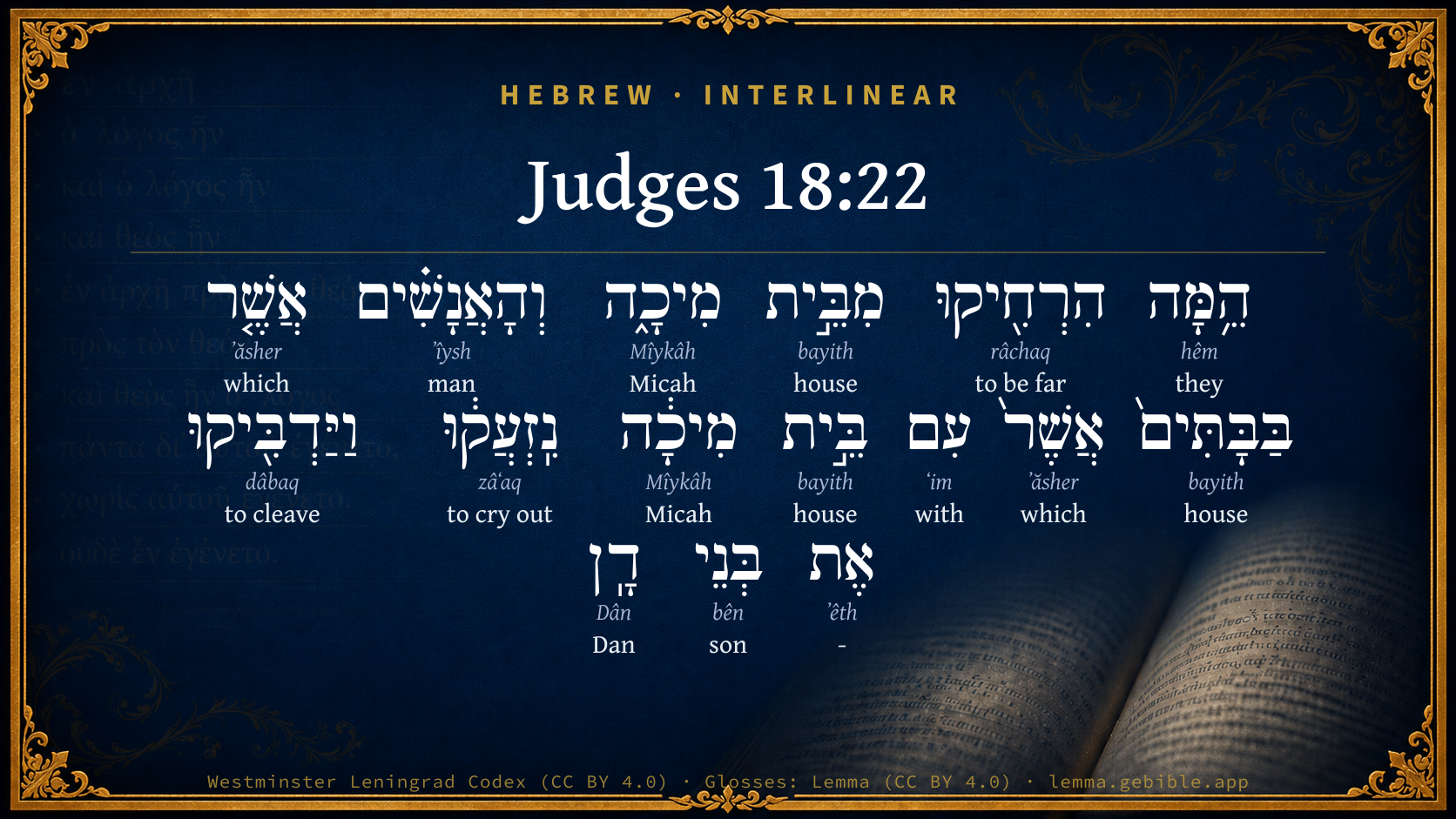
  1. הֵ֥מָּה hêm H1992 “they” Pronoun, Personal, 3rd Person, Masculine, Plural
  2. הִרְחִ֖יקוּ râchaq H7368 “to be far” Verb, Hiphil, Perfect, 3rd Person, Common, Plural
  3. מִבֵּ֣ית bayith H1004 “from · house of” Preposition + Noun, Common, Masculine, Singular, Construct
  4. וְהָאֲנָשִׁ֗ים ʼîysh H376 “and · the · men” Conjunction + Particle, Definite Article + Noun, Common, Masculine, Plural, Absolute
  5. אֲשֶׁ֤ר ʼăsher H834 “which” Particle, Relative
  6. בַּבָּתִּים֙ bayith H1004 “in/at the · houses” Preposition, Determined + Noun, Common, Masculine, Plural, Absolute
  7. אֲשֶׁר֙ ʼăsher H834 “which” Particle, Relative
  8. עִם ʻim H5973 “with” Preposition
  9. בֵּ֣ית bayith H1004 “house of” Noun, Common, Masculine, Singular, Construct
  10. מִיכָ֔ה Mîykâh H4318 “Micah” Noun, Proper
  11. נִֽזְעֲק֔וּ zâʻaq H2199 “to cry out” Verb, Niphal, Perfect, 3rd Person, Common, Plural
  12. וַיַּדְבִּ֖יקוּ dâbaq H1692 “and · to cleave” Conjunction + Verb, Hiphil, Sequential Imperfect, 3rd Person, Masculine, Plural
  13. אֶת ʼêth H853 “-” Particle, Direct Object
  14. בְּנֵי bên H1121 “sons of” Noun, Common, Masculine, Plural, Construct
  15. דָֽן Dân H1835 “Dan” Noun, Proper

About this verse

These counts appear in no published source. They are computed here, from the morphology-tagged text and Lemma’s own curated glosses. What Lemma adds →

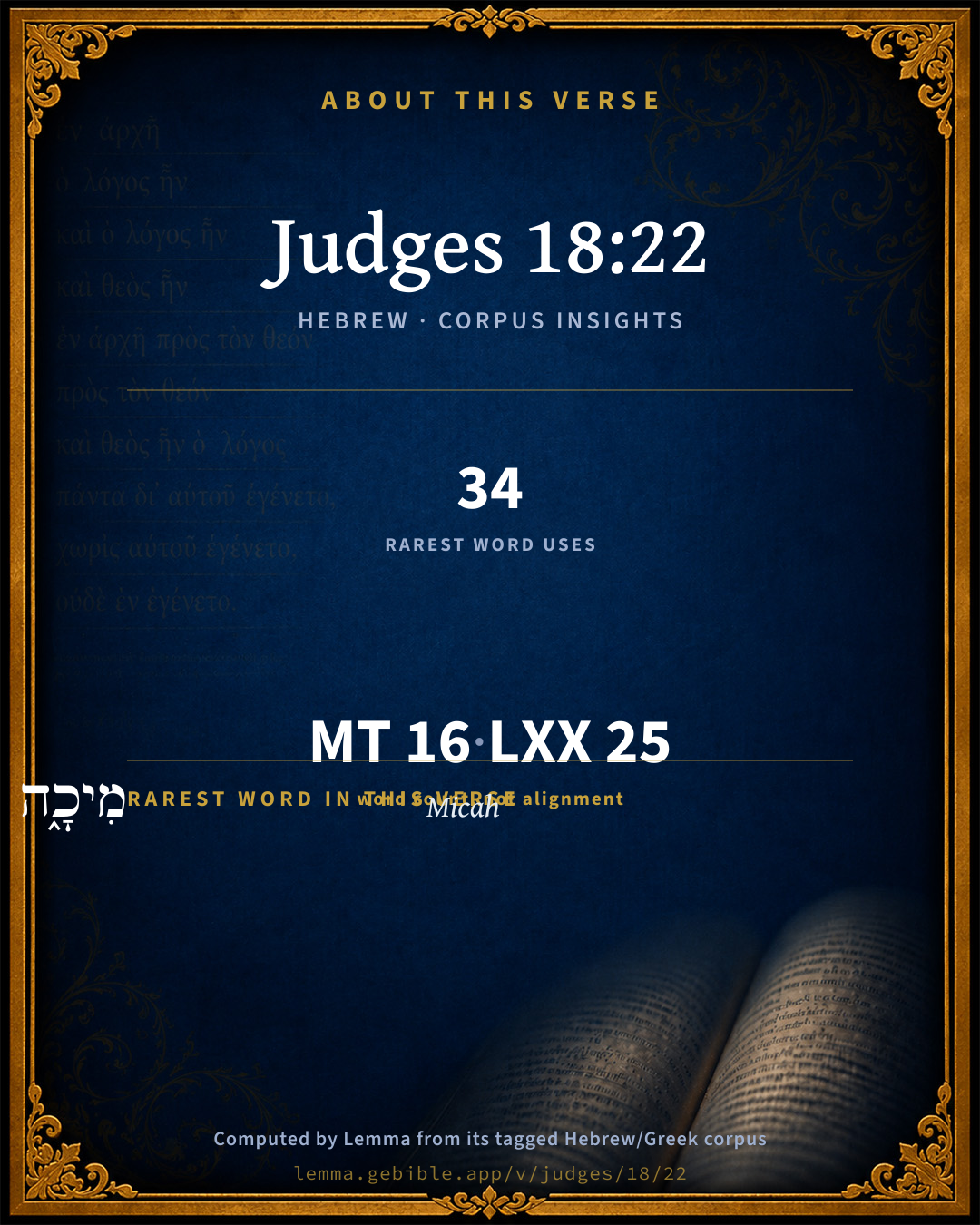
16
words
12
distinct lemmas
Historical
section

Shared distinctive vocabulary

מִיכָ֑ה Micah H4318 occurs in 31 verses of the Hebrew Bible. Also found in:

Grammatical profile

  • 3 verbs
  • 8 nouns
  • 1 pronoun
  • 1 preposition
  • 3 particles

Verb forms

  • הִרְחִ֖יקוּ Hiphil · Perfect
  • נִֽזְעֲק֔וּ Niphal · Perfect
  • וַיַּדְבִּ֖יקוּ Hiphil · Sequential Imperfect

Repetition

Words recur within this verse — often emphatic in Hebrew:

  • מִבֵּ֣ית house H1004 ×3
  • מִיכָ֑ה Micah H4318 ×2
  • אֲשֶׁ֤ר which H834 ×2

Hebrew & Septuagint length

In English translation the verse runs 31 words from the Hebrew and 29 from the Septuagint (LXX English) — closely comparable.

A rough comparison of the two English renderings, which tokenize alike — not a word-level alignment.

Word counts can differ between the Hebrew and the Greek without any difference in meaning — e.g. the Hebrew direct-object marker אֵת has no separate Greek word, and Greek often adds the article ὁ.

In the original languages it is 16 Hebrew tokens and 25 Greek tokens — but the two are counted differently (Hebrew bundles its prefixes and suffixes into one token; the Greek is in lemma form), so that isn’t a like-for-like length.

Hebrew and Greek witnesses Masoretic Hebrew ↔ Greek Septuagint

The same verse in the two great witnesses to the Old Testament, shown verse-for-verse.

These are two independent witnesses, not word-aligned to each other, and the Septuagint is shown in lemma (dictionary) form.

Hebrew Judges 18:22 Masoretic · Westminster Leningrad Codex

הֵ֥מָּה הִרְחִ֖יקוּ מִבֵּ֣ית מִיכָ֑ה וְהָאֲנָשִׁ֗ים אֲשֶׁ֤ר בַּבָּתִּים֙ אֲשֶׁר֙ עִם בֵּ֣ית מִיכָ֔ה נִֽזְעֲק֔וּ וַיַּדְבִּ֖יקוּ אֶת בְּנֵי דָֽן

When they were a good way from the house of Micah, the men who were in the houses near to Micah's house were gathered together, and overtook the children of Dan.

World English Bible · Public Domain

Greek LXX Judges 18:22 Septuagint · lemma form

αὐτός ἐμάκρυναν ἀπό οἶκος μιχαιας καί ἰδού μιχαιας καί ὁ ἀνήρ ὁ ἐν ὁ οἰκία ὁ μετά οἶκος μιχαιας βοάω καί καταλαμβάνω ὁ υἱός δαν

They went some distance from the house of Michaias, and, behold, Michaias and the men in the houses near Michaias' house, cried out, and overtook the children of Dan.

LXX2012 (modern English Septuagint) · Public Domain

On this verse, The Cambridge Bible for Schools and Colleges discusses the Septuagint’s reading. Read the note in Commentary ↓

Hebrew: Westminster Leningrad Codex (CC BY 4.0). Greek: Septuagint (public domain); English from LXX2012 (modern English Septuagint) (Public Domain). How the Septuagint differs from the Hebrew →

Targum (Aramaic paraphrase)

1

The Targum is the ancient Jewish Aramaic paraphrase of the Hebrew Scriptures — an interpretive translation, not the Hebrew text itself. Onkelos (literal) and Pseudo-Jonathan (expansive) render the Torah, and Jonathan the Prophets. Coverage is partial: where no permissively-licensed English translation exists for a verse, only the Aramaic is shown. This is verse-level text, not a word-by-word alignment to the Hebrew.

  1. Targum Jonathan Prophets (Joshua–Malachi)
    אִינוּן אַרְחִיקוּ מִבֵּית מִיכָה וְגַבְרַיָא דִבְבָתַּיָא דְעִם בֵּית מִיכָה אִתְכְּנִישׁוּ וְאַדְבִּיקוּ יַת בְּנֵי דָן:

    (no public-domain English translation for this verse)

    Targum Jonathan — Aramaic: “Mikraot Gedolot” (public domain). English: “Sefaria Community Translation” (CC0 1.0 (public-domain dedication)); “London "Chaldee Paraphrase," 1871” (public domain). Text via Sefaria.

Commentary

Notes on Judges 18:22 from classic Christian and Jewish commentators (each source and its license shown beneath its notes). The classic Christian expositions comment on the surrounding passage and are grouped to its opening verse, so a note may address several verses; the Jewish commentaries on the Tanakh (Rashi and others) are per-verse, so they appear only where the commentator wrote on this verse.

Lemma curates 59 commentaries, every one of them public domain or Creative Commons licensed, each selected and text-cleaned for this edition rather than reprinted as found. About our sources →

Trapp's Complete Commentary

John Trapp

Jdg 18:22 [And] when they were a good way from the house of Micah, the men that [were] in the houses near to Micah’s house were gathered together, and overtook the children of Dan.

Ver. 22. The men that were in the houses near to Micah’s.] The whole neighbourhood; and those were not a few, by reason of the idol temple there causing great resort, as now at Loretto and Sichem.

And overtook the children of Dan.] Heb., Clave unto them, Conglutinati sunt cum filiis Dan, were even at the heels of them; Amor addidit alas.

John Trapp, A Commentary or Exposition upon All the Books of the Old and New Testament (1647–1656) — public domain. Text from a community e-Sword module.

Keil & Delitzsch

C. F. Keil & F. Delitzsch

The two clauses of Jdg 18:22 are circumstantial clauses: "When they (the 600) had got to some distance from Micah's house, and the men who were in the houses by Micah's house were called together, and had overtaken the Danites, they (i.e., Micah and his people, whom he had called together from the neighbourhood to pursue the emigrants) called to the Danites; and they turned their faces, and said to Micah, What is to thee (what is the matter), that thou hast gathered together?"

Keil & Delitzsch — Biblical Commentary on the Old Testament (1861–1891) — public domain (CC PDM 1.0). Text via the HelloAO Bible API. (Old Testament only.)

Jamieson, Fausset & Brown

Robert Jamieson, A. R. Fausset & David Brown

the men that were in the houses near to Micah's house were gathered together--The robbers of the chapel being soon detected, a hot pursuit was forthwith commenced by Micah, at the head of a considerable body of followers. The readiness with which they joined in the attempt to recover the stolen articles affords a presumption that the advantages of the chapel had been open to all in the neighborhood; and the importance which Micah, like Laban, attached to his teraphim, is seen by the urgency with which he pursued the thieves, and the risk of his life in attempting to procure their restoration. Finding his party, however, not a match for the Danites, he thought it prudent to desist, well knowing the rule which was then prevalent in the land, that

"They should take who had the power,

And they should keep who could."

Jamieson, Fausset & Brown — Commentary Critical and Explanatory on the Whole Bible (1871) — public domain (CC PDM 1.0). Text via the HelloAO Bible API.

Ellicott's Commentary for English Readers

(22) A good way from the house of Micah.—It took some time to raise the alarm and collect a sufficient force. The Beth-Micah was probably strong enough to resist any ordinary robbers, but no one could have expected a raid of 600 men. Yet they would easily overtake the Danites, because their march was delayed and encumbered with women, children, and cattle.

Were gathered together.—See Jdg_6:34.

A Bible Commentary for English Readers, edited by Charles John Ellicott (1878–1897) — public domain. Text from a community e-Sword module.

The Cambridge Bible for Schools and Colleges

gen. ed. J. J. S. Perowne

22. the men that were in the houses] The sense is much improved by following the LXX behold Micaiah and the men that were etc. We need some mention of Micah joining the pursuit (Jdg_18:23).

The Cambridge Bible for Schools and Colleges (gen. ed. J. J. S. Perowne; Cambridge University Press, 1878–1918) — public domain. Text from a community e-Sword module.

John Gill's Exposition

And when they were a good way from the house of Micah,.... For it might be some time before Micah knew that his gods were stolen, and his priest was decoyed from him; and it must take up more time still to get his servants and neighbours together to pursue after those that injured him:

the men that were in the houses near to Micah's house were gathered together; no doubt at the request of Micah, who informed them of what had happened to him: and they being not only his neighbours, but deeply involved in the same superstition and idolatry, and closely addicted to it, and to whom it might in some respects be advantageous at it brought people from various parts to worship, or to consult the oracle: these being got together in a body, pursued

and overtook the children of Dan; who were obliged to move but slowly, because of their wives, little ones, and heavy substance they carried with them.

John Gill's Exposition of the Whole Bible (1746–1763) — public domain (CC PDM 1.0). Text via the HelloAO Bible API.

Albert Barnes' Notes on the Bible

Were gathered together - literally, “were called together.” The men, who were all Micah’s workmen, were probably in the fields with their master at the time of the robbery. When the women saw what was done they gave the alarm, and Micah called the men together as quickly as possible, and pursued the Danites and overtook them.

Albert Barnes' Notes on the Bible (1834–1885) — public domain. Text from a community e-Sword/MySword module.

Haydock's Catholic Bible Commentary

Houses. Hebrew, "near the house of Michas." The poor fellow called his neighbours, and pursued the Danites, (Haydock) despising as it were all his other effects, in comparison with his god. (Menochius)

George Leo Haydock (1774–1849), Haydock's Catholic Family Bible and Commentary, 1859 edition — public domain. Excludes Psalms (Douay-Rheims chapter numbering differs from Protestant) and Deuterocanonical books (Catholic canon only).

Whedon's Commentary on the Bible

Daniel D. Whedon

22. The men that were in… houses near to Micah’s house — These neighbours of Micah probably had an interest in his sanctuary and priest, and felt it no small blessing to have a Levitical minister and worship so near them. Hence their readiness to go with Micah to recover his gods and priest.

Daniel D. Whedon (gen. ed.), Commentary on the Old and New Testaments (1874–1909) — public domain. Text from a community e-Sword module.

The Pulpit Commentary

The houses near to Micah"s house. See ver. 14, note. Year to, the same Hebrew word as is rendered by in ver. 3, where see note.

The Pulpit Commentary (1880–1919), ed. H.D.M. Spence-Jones & Joseph S. Exell — public domain. Text from a community e-Sword module.

Lesson kit

Teaching starters — assembled from the data on this page, not authored interpretation. Every prompt links to the verse data it draws on. Edit before teaching.

Judges, in the Historical, opens this verse with 16 words (12 distinct Hebrew lemmas). Its most distinctive word is Mîykâh (“Micah”). A historical commentator’s framing appears above. Read the whole chapter for the surrounding context.

Discussion questions

  1. What does “Micah” (Mîykâh) contribute to the verse as a whole?
  2. How does Judges 17:5, which shares the word «Micah», read alongside this verse?
  3. What does the repetition of “house” (3× in this one verse) do in this verse?
  4. These translations render this verse differently. What is at stake in choosing one wording over another?
  5. «הִרְחִ֖יקוּ» is a Hiphil Perfect verb. How does that grammatical form shape the action described?
  6. Compare how Trapp's Complete Commentary and Keil & Delitzsch read this verse. Where do they agree or differ?

Things to notice

Reading settings

Reading text

Shown beneath each verse's original-language words.

Old Testament
Old Testament edition

Read the OT as the Masoretic Hebrew (MT) or the Greek Septuagint (LXX).

English shown for the Greek Septuagint (in the Hebrew ↔ Greek comparison).

Comparing translations? Open the Compare panel on any verse page to stack up to four side by side.