Ezekiel 34:30

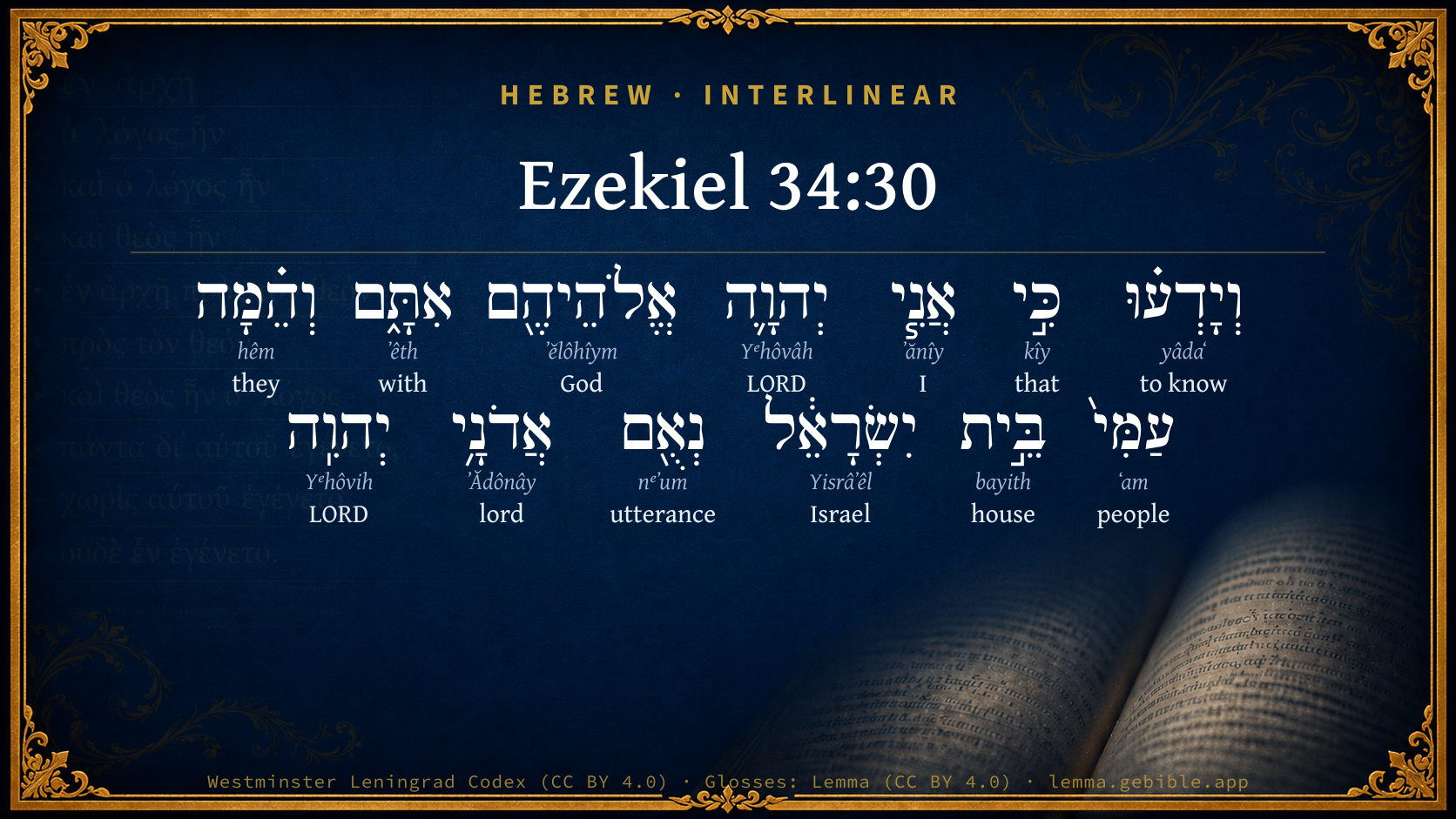
Hebrew (Westminster Leningrad Codex) Ezekiel 34:30 appears in the Hebrew Old Testament. The text above is from the Westminster Leningrad Codex. Each word links to its Strong’s number, a concise gloss, and parsing drawn from the Open Scriptures Hebrew Bible morphology. Click any word for its full Brown-Driver-Briggs (BDB) entry.
Download image
Cite this verse

Ezekiel 34:30 (World English Bible). Public Domain. Lemma interlinear Bible study tool, https://lemma.gebible.app/v/ezekiel/34/30.

Show BibTeX & RIS
BibTeX
RIS
English Translation
They shall know that I, Yahweh, their God am with them, and that they, the house of Israel, are my people, says the Lord Yahweh.
World English Bible · Public Domain
Download a study sheet

One document with this verse’s original text, its word-by-word gloss line, the meaning frame, cross-references with their text, attributed commentary, and full source and license credits — printable, and it pastes into notes with its structure intact.

This verse Autodidact and up

Study sheet (.html) Plain text (.txt)

A passage Seminary Student

Up to 50 verses in one chapter. A passage sheet keeps up to 6 commentary sources and 12 cross-references per verse, in the order this page ranks them, and says so on the sheet whenever that leaves anything out. Ask for a single verse and you get the Autodidact verse sheet above.

Everything on this page stays free to read, with no account — the sheet is a download of what is already on screen, not access to it.

Want to remove ads? Support Godless Engineer
Compare translations 3

The same verse in 3 English versions, stacked beneath the original-language interlinear above. Click any original word for its lexicon entry.

Each is an independent rendering of the whole verse — the interlinear is not word-aligned to these translations.

Highlighted words mark where these versions differ — a whole-verse word diff, not a word-by-word alignment.

  • World English Bible Public Domain
    They shall know that I, Yahweh, their God am with them, and that they, the house of Israel, are my people, says the Lord Yahweh.
  • King James Version Public Domain
    Thus shall they know that I the LORD their God am with them, and that they, even the house of Israel, are my people, saith the Lord GOD.
  • unfoldingWord Literal Text CC BY-SA 4.0
    Then they will know that I, Yahweh their God, am with them. They are my people, the house of Israel—this is the Lord Yahweh’s declaration.

unfoldingWord Literal Text — © unfoldingWord, licensed CC BY-SA 4.0. Word-aligned USFM3 via Door43 (git.door43.org/unfoldingWord/en_ult).

Versions to compare (up to 4)

3 of 4 selected

Show all 18 translations

Every available English version of this verse, each an independent rendering of the whole verse.

  • World English Bible Public Domain
    They shall know that I, Yahweh, their God am with them, and that they, the house of Israel, are my people, says the Lord Yahweh.
  • Berean Standard Bible Public Domain
    Then they will know that I, the LORD their God, am with them, and that they, the house of Israel, are My people,’ declares the Lord GOD.
  • Majority Standard Bible Public Domain
    Then they will know that I, the LORD their God, am with them, and that they, the house of Israel, are My people,’ declares the Lord GOD.
  • King James Version Public Domain
    Thus shall they know that I the LORD their God am with them, and that they, even the house of Israel, are my people, saith the Lord GOD.
  • American Standard Version (1901) Public Domain
    And they shall know that I, Jehovah, their God am with them, and that they, the house of Israel, are my people, saith the Lord Jehovah.
  • Revised Version (1885) Public Domain
    And they shall know that I the LORD their God am with them, and that they, the house of Israel, are my people, saith the Lord GOD.
  • Geneva Bible (1599) Public Domain
    Thus shall they vnderstande, that I the Lord their God am with them, and that they, euen the house of Israel, are my people, sayth the Lord God.
  • Douay-Rheims (1899) Public Domain
    And they shall know that I the Lord their God am with them, and that they are my people the house of Israel: saith the Lord God.
  • Young's Literal Translation Public Domain
    And they have known that I, Jehovah, their God, `am' with them, And they -- the house of Israel -- My people, An affirmation of the Lord Jehovah.
  • Literal Standard Version CC BY-SA 4.0
    And they have known that I, YHWH, their God, [am] with them, || And they—the house of Israel—My people, || A declaration of Lord YHWH.
  • Unlocked Literal Bible CC BY-SA 4.0
    Then they will know that I, Yahweh their God, am with them. They are my people, the house of Israel—this is the Lord Yahweh's declaration.
  • unfoldingWord Literal Text CC BY-SA 4.0
    Then they will know that I, Yahweh their God, am with them. They are my people, the house of Israel—this is the Lord Yahweh’s declaration.
  • Darby Bible Public Domain
    And they shall know that I Jehovah their God [am] with them, and that they, the house of Israel, are my people, saith the Lord Jehovah.
  • World Messianic Bible Public Domain
    They will know that I, the LORD, their God am with them, and that they, the house of Israel, are my people, says the Lord GOD.
  • Webster's Bible Public Domain
    Thus shall they know that I the LORD their God am with them, and that they, even the house of Israel, are my people, saith the Lord GOD.
  • Free Bible Version CC BY-SA 4.0
    Then they will know that I am with them as the Lord their God, and that the people of Israel belong to me, declares the Lord God.
  • Bible in Basic English Public Domain
    And they will be certain that I the Lord their God am with them, and that they, the children of Israel, are my people, says the Lord.
  • JPS Tanakh (1917) Public Domain
    And they shall know that I the LORD their God am with them, and that they, the house of Israel, are My people, saith the Lord GOD.

Literal Standard Version (2020), Covenant Press — licensed CC BY-SA 4.0. Text via the HelloAO Bible API (eBible.org). Unlocked Literal Bible (unfoldingWord) — licensed CC BY-SA 4.0. Text via the HelloAO Bible API (eBible.org). unfoldingWord Literal Text — © unfoldingWord, licensed CC BY-SA 4.0. Word-aligned USFM3 via Door43 (git.door43.org/unfoldingWord/en_ult). Free Bible Version, Dr. Jonathan Gallagher — licensed CC BY-SA 4.0. Text via the HelloAO Bible API (eBible.org).

Word by word

More ways to search: Search by grammar → Find every occurrence → Compare this word →

Practice this passage: Drill this verse → Learn its vocabulary →

יְהוִֽה
Yᵉhôvih
H3069
“LORD”
Noun, Proper
Part of Speech
Noun
Type
Proper
Full BDB Definition

Origin: a variation of ( H3068 ) [used after ( H136 ), and pronounced by Jews as H430 , in order to prevent the repetition of the same sound, since they elsewhere pronounce 03068 as 0136]

TWOT: None

Jehovah - used primarily in the combination 'Lord Jehovah'
  1. וְיָדְע֗וּ yâdaʻ H3045 “and · to know” Conjunction + Verb, Qal, Sequential Perfect, 3rd Person, Common, Plural
  2. כִּ֣י kîy H3588 “that” Conjunction
  3. אֲנִ֧י ʼănîy H589 “I” Pronoun, Personal, 1st Person, Common, Singular
  4. יְהוָ֛ה Yᵉhôvâh H3068 “LORD” Noun, Proper
  5. אֱלֹהֵיהֶ֖ם ʼĕlôhîym H430 “God(s) · their” Noun, Common, Masculine, Plural, Construct + Suffix, Personal, 3rd Person, Masculine, Plural
  6. אִתָּ֑ם ʼêth H854 “with · them” Preposition + Suffix, Personal, 3rd Person, Masculine, Plural
  7. וְהֵ֗מָּה hêm H1992 “and · they” Conjunction + Pronoun, Personal, 3rd Person, Masculine, Plural
  8. עַמִּי֙ ʻam H5971 “people · my” Noun, Common, Masculine, Singular, Construct + Suffix, Personal, 1st Person, Common, Singular
  9. בֵּ֣ית bayith H1004 “house of” Noun, Common, Masculine, Singular, Construct
  10. יִשְׂרָאֵ֔ל Yisrâʼêl H3478 “Israel” Noun, Proper
  11. נְאֻ֖ם nᵉʼum H5002 “utterance of” Noun, Common, Masculine, Singular, Construct
  12. אֲדֹנָ֥י ʼĂdônây H136 “Lord · my” Noun, Common, Masculine, Plural, Construct + Suffix, Personal, 1st Person, Common, Singular

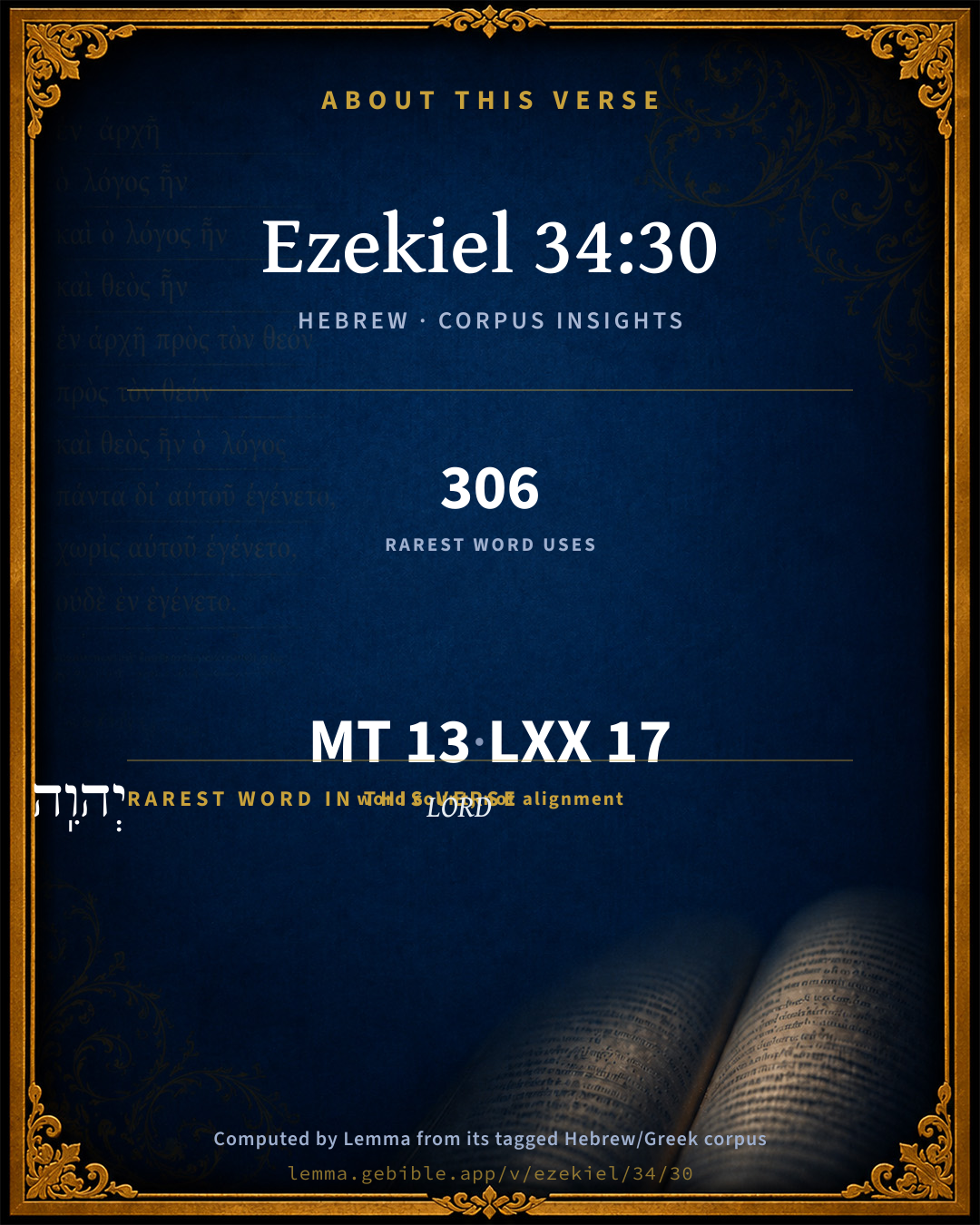
About this verse

These counts appear in no published source. They are computed here, from the morphology-tagged text and Lemma’s own curated glosses. What Lemma adds →

13
words
13
distinct lemmas
Prophets
section

Grammatical profile

  • 1 verb
  • 8 nouns
  • 2 pronouns
  • 1 preposition
  • 1 conjunction

Verb forms

  • וְיָדְע֗וּ Qal · Sequential Perfect

Hebrew & Septuagint length

In English translation the verse runs 25 words from the Hebrew and 23 from the Septuagint (LXX English) — closely comparable.

A rough comparison of the two English renderings, which tokenize alike — not a word-level alignment.

Word counts can differ between the Hebrew and the Greek without any difference in meaning — e.g. the Hebrew direct-object marker אֵת has no separate Greek word, and Greek often adds the article ὁ.

In the original languages it is 13 Hebrew tokens and 17 Greek tokens — but the two are counted differently (Hebrew bundles its prefixes and suffixes into one token; the Greek is in lemma form), so that isn’t a like-for-like length.

Cross-references

9

Topical passages linked to Ezekiel 34:30 in the Treasury of Scripture Knowledge — connected by theme and wording, ordered by reader-vote popularity; previews shown in the World English Bible.

  • Ezekiel 34:24 I, Yahweh, will be their God, and my servant David prince among them; I, Yahweh, have spoken it.
  • Ezekiel 37:27 My tent also shall be with them; and I will be their God, and they shall be my people.
  • Psalms 46:7 Yahweh of Hosts is with us. The God of Jacob is our refuge. Selah.
  • Psalms 46:11 Yahweh of Hosts is with us. The God of Jacob is our refuge. Selah.
  • Ezekiel 14:11 that the house of Israel may go no more astray from me, neither defile themselves any more with all their transgressions; but that they may be my people, and I may be their God, says the Lord Yahweh.
  • Isaiah 8:9–10 Make an uproar, O you peoples, and be broken in pieces! And give ear, all you of far countries: gird yourselves, and be broken in pieces! Gird yourselves, and be broken in pieces!
  • Ezekiel 16:62 I will establish my covenant with you; and you shall know that I am Yahweh;
  • Matthew 1:23 "Behold, the virgin shall be with child, And shall bring forth a son. They shall call his name Immanuel;" Which is, being interpreted, "God with us."
  • Matthew 28:20 teaching them to observe all things that I commanded you. Behold, I am with you always, even to the end of the age." Amen.

Cross-references courtesy of OpenBible.info (CC BY 4.0).

Hebrew and Greek witnesses Masoretic Hebrew ↔ Greek Septuagint

The same verse in the two great witnesses to the Old Testament, shown verse-for-verse.

These are two independent witnesses, not word-aligned to each other, and the Septuagint is shown in lemma (dictionary) form.

Hebrew Ezekiel 34:30 Masoretic · Westminster Leningrad Codex

וְיָדְע֗וּ כִּ֣י אֲנִ֧י יְהוָ֛ה אֱלֹהֵיהֶ֖ם אִתָּ֑ם וְהֵ֗מָּה עַמִּי֙ בֵּ֣ית יִשְׂרָאֵ֔ל נְאֻ֖ם אֲדֹנָ֥י יְהוִֽה

They shall know that I, Yahweh, their God am with them, and that they, the house of Israel, are my people, says the Lord Yahweh.

World English Bible · Public Domain

Greek LXX Ezekiel 34:30 Septuagint · lemma form

καί γιγνώσκω ὅτι ἐγώ εἰμί κύριος ὁ θεός αὐτός καί αὐτός λαός ἐγώ οἶκος ἰσραήλ λέγω κύριος

And they shall know that I am the Lord their God, and they my people. O house of Israel, says the Lord God,

LXX2012 (modern English Septuagint) · Public Domain

On this verse, The Cambridge Bible for Schools and Colleges discusses the Septuagint’s reading. Read the note in Commentary ↓

Hebrew: Westminster Leningrad Codex (CC BY 4.0). Greek: Septuagint (public domain); English from LXX2012 (modern English Septuagint) (Public Domain). How the Septuagint differs from the Hebrew →

Targum (Aramaic paraphrase)

1

The Targum is the ancient Jewish Aramaic paraphrase of the Hebrew Scriptures — an interpretive translation, not the Hebrew text itself. Onkelos (literal) and Pseudo-Jonathan (expansive) render the Torah, and Jonathan the Prophets. Coverage is partial: where no permissively-licensed English translation exists for a verse, only the Aramaic is shown. This is verse-level text, not a word-by-word alignment to the Hebrew.

  1. Targum Jonathan Prophets (Joshua–Malachi)
    וְיֵדְעוּן אֲרֵי אֲנָא יְיָ אֱלָהָהוֹן מֵימְרִי בְּסַעֲדְהוֹן וְאִינוּן עַמִי בֵּית יִשְׂרָאֵל אֲמַר יְיָ אֱלֹהִים:

    (no public-domain English translation for this verse)

    Targum Jonathan — Aramaic: “Mikraot Gedolot” (public domain). English: “Sefaria Community Translation” (CC0 1.0 (public-domain dedication)); “London "Chaldee Paraphrase," 1871” (public domain). Text via Sefaria.

Commentary

Notes on Ezekiel 34:30 from classic Christian and Jewish commentators (each source and its license shown beneath its notes). The classic Christian expositions comment on the surrounding passage and are grouped to its opening verse, so a note may address several verses; the Jewish commentaries on the Tanakh (Rashi and others) are per-verse, so they appear only where the commentator wrote on this verse.

Lemma curates 59 commentaries, every one of them public domain or Creative Commons licensed, each selected and text-cleaned for this edition rather than reprinted as found. About our sources →

Trapp's Complete Commentary

John Trapp

Eze 34:30 Thus shall they know that I the LORD their God [am] with them, and [that] they, [even] the house of Israel, [are] my people, saith the Lord GOD.

Ver. 30. Thus shall they know that I the Lord their God am with them.] They shall understand the lovingkindness of the Lord; {Psa 107:43} they shall know the salvation of their God; {Psa 50:23} they shall have a plerophory of faith. {as Rom 8:38}

John Trapp, A Commentary or Exposition upon All the Books of the Old and New Testament (1647–1656) — public domain. Text from a community e-Sword module.

The Biblical Illustrator

Joseph S. Exell

Eze_34:30

They, even the house of Israel, are My people.

Israels privileges

I. The distinctive appellation here given to the persons addressed--the house of Israel.

1. They were a people closely connected with each other. They belonged to the same house, or family. As the descendants from the same progenitor, they were, in a peculiar sense, brethren. The same is the case, though in a different sense, with those to whom the promises in the text are now made, in regard to their spiritual import. These persons, as genuine believers, are of the same house, or what the Apostle calls--the household of faith. They are brethren; and God Himself is their Father.

2. As the house of Israel, the persons to whom the promises in the text were originally addressed were a people highly privileged. But the people of God, under the present dispensation, are more highly favoured still. They too have been chosen by Him to be His peculiar people. They have a fuller and a far more glorious revelation of His will, and, both as it respects their present position and their future prospects, they have indeed a goodly heritage

3. As the house of Israel, they were bound to the discharge of peculiar and very important duties. More still has been given to us; and therefore are our obligations to duty, if possible, more imperative. The Israelites were bound to love, to worship, and, in every other view, to serve the Lord; and so unquestionably are we.

4. Notwithstanding all this, the house of Israel had, previously to the time here referred to, departed grievously from the Lord, and wrought great abominations. Alas! the parallel here in regard to ourselves holds in a way that may and ought to fill us with shame and confusion of face. But where sin abounded, grace is often made much more to abound.

II. The import of these promises as made to the persons so characterised.

1. There is here a promise of the continued presence of the Lord to be with them as their God.

2. It is here promised that the Lord will recognise the people addressed as being in reality His own people. The people of God are His peculiar property in consequence of the price paid for their purchase (1Pe_1:18-19). They are further Gods people, in consequence of being closely, vitally, and immutably united to the person of His Son (Joh_17:21). They are His people, besides, in consequence of having been subdued and won to Him by the powerful and gracious operations of His Holy Spirit (Psa_110:3). But, on the other hand, they are characterised and treated as the people of God in consequence of their own voluntary choice and covenant engagement to be for Him, and not for another. They are accordingly blessed with all needful blessings as the people of God (Eph_1:3).

3. It is here promised, that they shall have a pleasing conviction of their peculiar blessedness in enjoying the presence of the Lord, and being recognised by Him as His people.

4. The accomplishment of this promise, implying, as it does, such honour and blessedness, is as certain as the truth of God can make it.

Application--

1. Inquire to what description of people we belong.

2. Well may the saints of God be joyful in glory.

3. All must be wretched and miserable who are not the people of God (Isa_57:20-21).

4. Those who are not now the people of God may yet have that honour (Hos_1:10). (A. Thompson, D. D.)

The Biblical Illustrator, edited by Joseph S. Exell (c. 1880s–1900s) — public domain. Text from a community e-Sword module.

The Cambridge Bible for Schools and Colleges

gen. ed. J. J. S. Perowne

30. am with them] LXX. omits with them, reading: that I the Lord am their God, and they … my people—the usual antithesis. The people’s consciousness of salvation shall be, so to speak, a double one, that Jehovah is their God and that they are his people. The two things might seem identical, but the second suggests a feeling regarding themselves which belongs to the perfect enjoyment of salvation.

The Cambridge Bible for Schools and Colleges (gen. ed. J. J. S. Perowne; Cambridge University Press, 1878–1918) — public domain. Text from a community e-Sword module.

John Gill's Exposition

And ye my flock, the flock of my pasture, are men,.... This is observed, to show that all that had been said in this chapter concerning sheep, and a flock of sheep, was to be understood, not in a literal sense, but in a figurative one, of such as were rational and spiritual persons; a set of men whom the Lord had chosen, and separated from others, as his peculiar flock; and whom he took a special care of, and led them to, and fed them in, green pastures of his own providing; they are the souls of men that Christ is the Shepherd and Bishop of, Pe1 2:25. The Talmudists (u) frequently make use of this text, to prove that Israelites are only called men, and not the Gentiles; see Mat 15:26.

and I am your God, saith the Lord God; which is often repeated for the certainty of it, because a blessing of the greatest importance, and which includes all others in it; see Eze 34:24.

(u) T. Bab. Yebamot, fol. 61. 1. Bava Metzia, fol. 114. 2. & Ceritot, fol. 6. 2.

Next: Ezekiel Chapter 35

John Gill's Exposition of the Whole Bible (1746–1763) — public domain (CC PDM 1.0). Text via the HelloAO Bible API.

Matthew Poole's English Annotations

Thus, by these many and great blessings I give them,

shall they know, the very heathen shall be convinced.

The Lord, who can do what I promise and my people expect.

Their God, by covenant from their forefathers.

With them; present with them, and reconciled to them, and do bless them.

That they, whom they despised and injured, and ere while did make slaves, and used so.

My people; my peculiar people above all people in the world; and that though he seemed to have cast him off, and they feared it, and the enemies boasted he had, yet he owns them for his, and will not break his covenant.

Matthew Poole's English Annotations on the Holy Bible (1683–1685) — public domain. Text from a community e-Sword/MySword module.

The Pulpit Commentary

The presence of God.

I GOD IS PECULIARLY PRESENT WITH HIS PEOPLE. We know that he is everywhere on the desolate sea and the fair earth, in the high heavens and the dark regions of death. (Ps 139) Therefore if any would desire to escape from his presence, this is impossible. How, then, can God be said to be in an especial manner present with his people? Spiritual presence is spiritual manifestation. God is more fully present where he more completely manifests his power and grace.

1. He is present in the hearts of his people. He dwells in the contrite and humble spirit. (Isa_57:15) The Christian"s body is a "temple of theHoly Ghost". (1Co_6:19) God comes into especially close contact with those who are reconciled to him, and who open their hearts to receive his Spirit.

2. He is present in the lives of his people. He shapes their lives with his providential guidance, and watches over them with tender care, warding off danger and supplying wants. Even when they forget him in the slumbers of the night and during the busy distractions of the day, he neither sleeps nor neglects his people. Ever with them to guide and help and save, as he was with Israel in the pillar of cloud by day and the pillar of fire by night, God overshadows and surrounds his people with his fostering presence.

II GOD"S PEOPLE MAY RECOGNIZE HIS PRESENCE. The verse which suggests these reflections is somewhat like a frequent expression in the prophecies of Ezekiel. After denunciations of wrath and judgment against the heathen nations, the conclusion repeatedly arrived at is, "And they shall know that I am the Lord". (e.g. Eze_30:25) In these cases the awful action of God in his wrath is to bring home to the heathen the fact of his existence and supremacy; but it is not said that they will know that God is with them. To Israel, however, this new thing is asserted. Israel will not merely know that God is the eternal Lord; she will know that God is present. This further knowledge belongs to Christians. They are not merely theists, who believe in the existence of God; they know his actual, living presence. It is not suggested that this knowledge is to be obtained by direct, mystical intuition; it is rather suggested that it is gathered from the experience of God"s goodness. Hagar recognized the presence of God when the angel addressed her. (Gen_16:13) Jacob perceived it on awakening from his dream. (Gen_28:16) The later Jews were to see it in their restoration from the Captivity. We are to acknowledge it in the experience of the Christian redemption. In this Christ will manifest himself to us as he does not unto the world. (Joh_14:21, Joh_14:22)

III THE RECOGNITION OF GOD"S PRESENCE IS ACCOMPANIED BY THAT OF HIS OWNERSHIP OF HIS PEOPLE. "And that they, even the house of Israel, are my people." God is present with his people as their Owner. He comes to them to claim them. He visits his inheritance to take possession of it. When we perceive that God is with us we have to go further and acknowledge his relationship to us. It is much to acknowledge that we do not belong to ourselves, that we are God"s possession, bought with a great price, and valued by him as precious property is valued by its owner.

The Pulpit Commentary (1880–1919), ed. H.D.M. Spence-Jones & Joseph S. Exell — public domain. Text from a community e-Sword module.

John Wesley's Explanatory Notes

Their God - By covenant, from their forefathers. Am with them - Present with them, and reconciled to them.

John Wesley, Explanatory Notes Upon the Whole Bible (1754–1765) — public domain. Text via the GEBible commentary corpus.

unfoldingWord translationNotes

Door43 World Missions Community

I, Yahweh their God, am with them

Here "I ... am with them" is an idiom that means Yahweh helps them. AT: "I, Yahweh their God, am helping them" (See: Idiom)

with them. They are my people

This can be stated as one sentence. AT: "with them, and that they are my people"

the house of Israel

Here "house" represents people. AT: "the people of Israel" (See: Metonymy)

For you are my sheep, the flock of my pasture

This speaks of the people of Israel as if they were a flock of sheep and Yahweh is their shepherd. (See: Metaphor)

translationWords

people of God

house

Israel

Lord Yahweh

declare

unfoldingWord translationNotes — © Distant Shores Media and the Door43 World Missions Community, licensed CC BY-SA 4.0. Source: git.door43.org/Door43/en_tn.

Lesson kit

Teaching starters — assembled from the data on this page, not authored interpretation. Every prompt links to the verse data it draws on. Edit before teaching.

Ezekiel, in the Prophets, opens this verse with 13 words (13 distinct Hebrew lemmas). Its most distinctive word is Yᵉhôvih (“LORD”). A historical commentator’s framing appears above. Read the whole chapter for the surrounding context.

Discussion questions

  1. What does “LORD” (Yᵉhôvih) contribute to the verse as a whole?
  2. How does Ezekiel 34:24, which shares this passage’s theme, read alongside this verse?
  3. The translations on this page render this verse differently — a whole-verse word diff, not a word-by-word alignment. What might account for the different wordings?
  4. «וְיָדְע֗וּ» is a Qal Sequential Perfect verb. How does that grammatical form shape the action described?
  5. Compare how Trapp's Complete Commentary and The Biblical Illustrator read this verse. Where do they agree or differ?

Things to notice

Reading settings

Reading text

Shown beneath each verse's original-language words.

Old Testament
Old Testament edition

Read the OT as the Masoretic Hebrew (MT) or the Greek Septuagint (LXX).

English shown for the Greek Septuagint (in the Hebrew ↔ Greek comparison).

Comparing translations? Open the Compare panel on any verse page to stack up to four side by side.