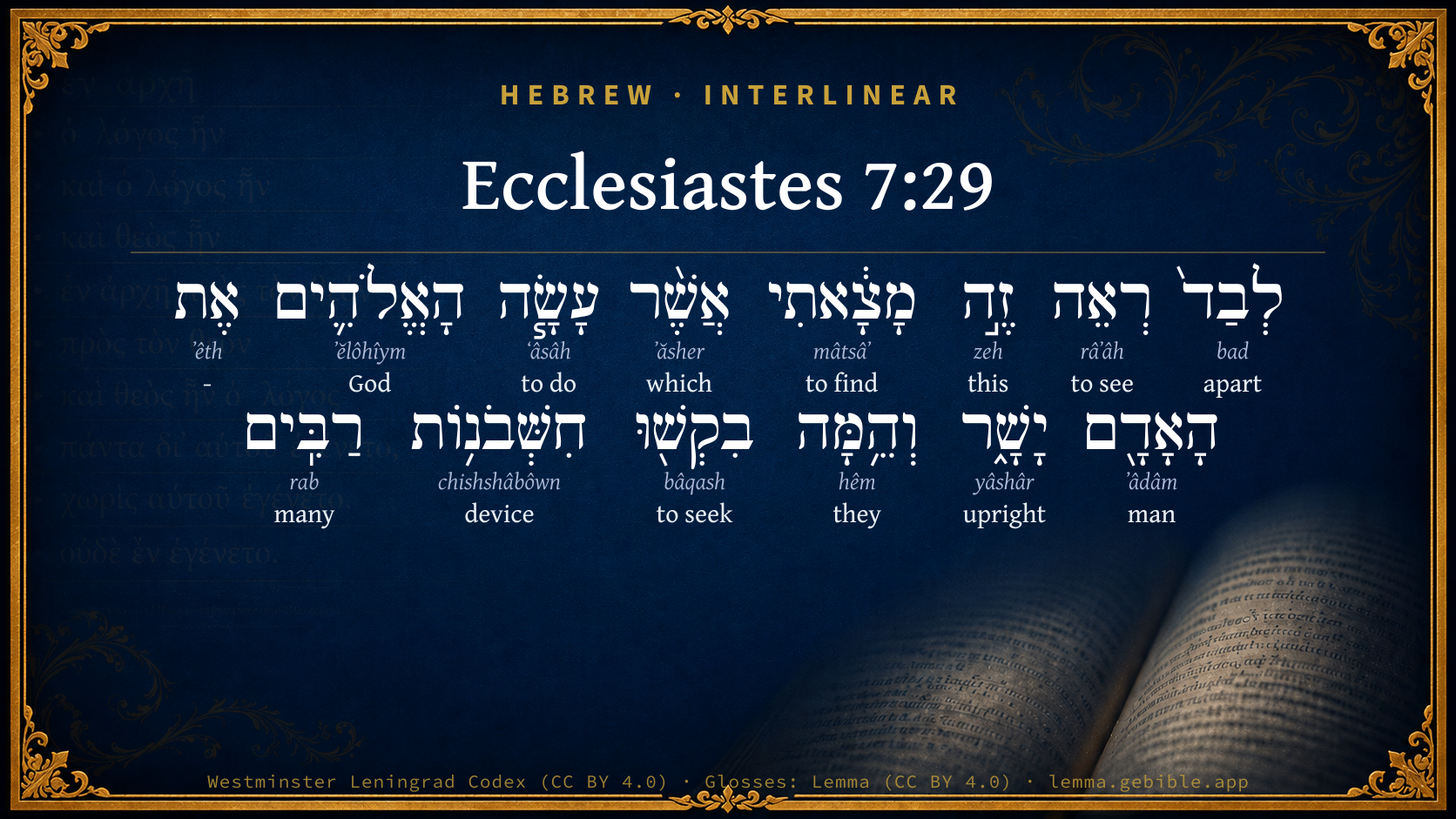
Ecclesiastes 7:29

Hebrew (Westminster Leningrad Codex) Ecclesiastes 7:29 appears in the Hebrew Old Testament. The text above is from the Westminster Leningrad Codex. Each word links to its Strong’s number, a concise gloss, and parsing drawn from the Open Scriptures Hebrew Bible morphology. Click any word for its full Brown-Driver-Briggs (BDB) entry.
Download image
Cite this verse

Ecclesiastes 7:29 (World English Bible). Public Domain. Lemma interlinear Bible study tool, https://lemma.gebible.app/v/ecclesiastes/7/29.

Show BibTeX & RIS
BibTeX
RIS
English Translation
Behold, this only have I found: that God made man upright; but they search for many schemes.
World English Bible · Public Domain
Download a study sheet

One document with this verse’s original text, its word-by-word gloss line, the meaning frame, cross-references with their text, attributed commentary, and full source and license credits — printable, and it pastes into notes with its structure intact.

This verse Autodidact and up

Study sheet (.html) Plain text (.txt)

A passage Seminary Student

Up to 50 verses in one chapter. A passage sheet keeps up to 6 commentary sources and 12 cross-references per verse, in the order this page ranks them, and says so on the sheet whenever that leaves anything out. Ask for a single verse and you get the Autodidact verse sheet above.

Everything on this page stays free to read, with no account — the sheet is a download of what is already on screen, not access to it.

Want to remove ads? Support Godless Engineer
Compare translations 3

The same verse in 3 English versions, stacked beneath the original-language interlinear above. Click any original word for its lexicon entry.

Each is an independent rendering of the whole verse — the interlinear is not word-aligned to these translations.

Highlighted words mark where these versions differ — a whole-verse word diff, not a word-by-word alignment.

  • World English Bible Public Domain
    Behold, this only have I found: that God made man upright; but they search for many schemes.
  • King James Version Public Domain
    Lo, this only have I found, that God hath made man upright; but they have sought out many inventions.
  • unfoldingWord Literal Text CC BY-SA 4.0
    Only see this I have found: That the God made humanity upright, but they, they have sought out many schemes.”

unfoldingWord Literal Text — © unfoldingWord, licensed CC BY-SA 4.0. Word-aligned USFM3 via Door43 (git.door43.org/unfoldingWord/en_ult).

Versions to compare (up to 4)

3 of 4 selected

Show all 18 translations

Every available English version of this verse, each an independent rendering of the whole verse.

  • World English Bible Public Domain
    Behold, this only have I found: that God made man upright; but they search for many schemes.
  • Berean Standard Bible Public Domain
    Only this have I found: I have discovered that God made men upright, but they have sought out many schemes.”
  • Majority Standard Bible Public Domain
    Only this have I found: I have discovered that God made mankind upright, but they have sought out many schemes.”
  • King James Version Public Domain
    Lo, this only have I found, that God hath made man upright; but they have sought out many inventions.
  • American Standard Version (1901) Public Domain
    Behold, this only have I found: that God made man upright; but they have sought out many inventions.
  • Revised Version (1885) Public Domain
    Behold, this only have I found, that God made man upright; but they have sought out many inventions.
  • Geneva Bible (1599) Public Domain
    Beholde, sayth the Preacher, this haue I found, seeking one by one to finde the count:
  • Douay-Rheims (1899) Public Domain
    Which yet my soul seeketh, and I have not found it. One man among a thousand I have found, a woman among them all I have not found.
  • Young's Literal Translation Public Domain
    See, this alone I have found, that God made man upright, and they -- they have sought out many devices.
  • Literal Standard Version CC BY-SA 4.0
    See, this alone I have found, that God made man upright, and they have sought out many inventions.
  • Unlocked Literal Bible CC BY-SA 4.0
    I have discovered only this: That God created humanity upright, but they have gone away looking for many difficulties.”
  • unfoldingWord Literal Text CC BY-SA 4.0
    Only see this I have found: That the God made humanity upright, but they, they have sought out many schemes.”
  • Darby Bible Public Domain
    Only see this which I have found: that God made man upright, but they have sought out many devices.
  • World Messianic Bible Public Domain
    Behold, I have only found this: that God made mankind upright; but they search for many inventions.”
  • Webster's Bible Public Domain
    Lo, this only have I found, that God hath made man upright; but they have sought out many inventions.
  • Free Bible Version CC BY-SA 4.0
    But I did find this one thing: God made people to do what's right, but they have followed their own ideas.
  • Bible in Basic English Public Domain
    This only have I seen, that God made men upright, but they have been searching out all sorts of inventions.
  • JPS Tanakh (1917) Public Domain
    Behold, this only have I found, that God made man upright; but they have sought out many inventions.

Literal Standard Version (2020), Covenant Press — licensed CC BY-SA 4.0. Text via the HelloAO Bible API (eBible.org). Unlocked Literal Bible (unfoldingWord) — licensed CC BY-SA 4.0. Text via the HelloAO Bible API (eBible.org). unfoldingWord Literal Text — © unfoldingWord, licensed CC BY-SA 4.0. Word-aligned USFM3 via Door43 (git.door43.org/unfoldingWord/en_ult). Free Bible Version, Dr. Jonathan Gallagher — licensed CC BY-SA 4.0. Text via the HelloAO Bible API (eBible.org).

Word by word

More ways to search: Search by grammar → Find every occurrence → Compare this word →

Practice this passage: Drill this verse → Learn its vocabulary →

חִשְּׁבֹנ֥וֹת
chishshâbôwn
H2810
“devices”
Noun, Common, Masculine, Plural, Absolute
Part of Speech
Noun
Type
Common
Gender
Masculine
Number
Plural
State
Absolute
Full BDB Definition

Origin: from H2803

TWOT: 767c

device, invention
  1. לְבַד֙ bad H905 “to/for · apart” Preposition + Noun, Common, Masculine, Singular, Absolute
  2. רְאֵה râʼâh H7200 “see” Verb, Qal, Imperative, 2nd Person, Masculine, Singular
  3. זֶ֣ה zeh H2088 “this” Pronoun, Demonstrative, Masculine, Singular
  4. מָצָ֔אתִי mâtsâʼ H4672 “to find” Verb, Qal, Perfect, 1st Person, Common, Singular
  5. אֲשֶׁ֨ר ʼăsher H834 “which” Particle, Relative
  6. עָשָׂ֧ה ʻâsâh H6213 “to do” Verb, Qal, Perfect, 3rd Person, Masculine, Singular
  7. הָאֱלֹהִ֛ים ʼĕlôhîym H430 “the · God(s)” Particle, Definite Article + Noun, Common, Masculine, Plural, Absolute
  8. אֶת ʼêth H853 “-” Particle, Direct Object
  9. הָאָדָ֖ם ʼâdâm H120 “the · man” Particle, Definite Article + Noun, Common, Masculine, Singular, Absolute
  10. יָשָׁ֑ר yâshâr H3477 “upright” Adjective, Adjective, Masculine, Singular, Absolute
  11. וְהֵ֥מָּה hêm H1992 “and · they” Conjunction + Pronoun, Personal, 3rd Person, Masculine, Plural
  12. בִקְשׁ֖וּ bâqash H1245 “to seek” Verb, Piel, Perfect, 3rd Person, Common, Plural
  13. רַבִּֽים rab H7227 “many” Adjective, Adjective, Masculine, Plural, Absolute

About this verse

These counts appear in no published source. They are computed here, from the morphology-tagged text and Lemma’s own curated glosses. What Lemma adds →

14
words
14
distinct lemmas
Wisdom
section

Notable vocabulary

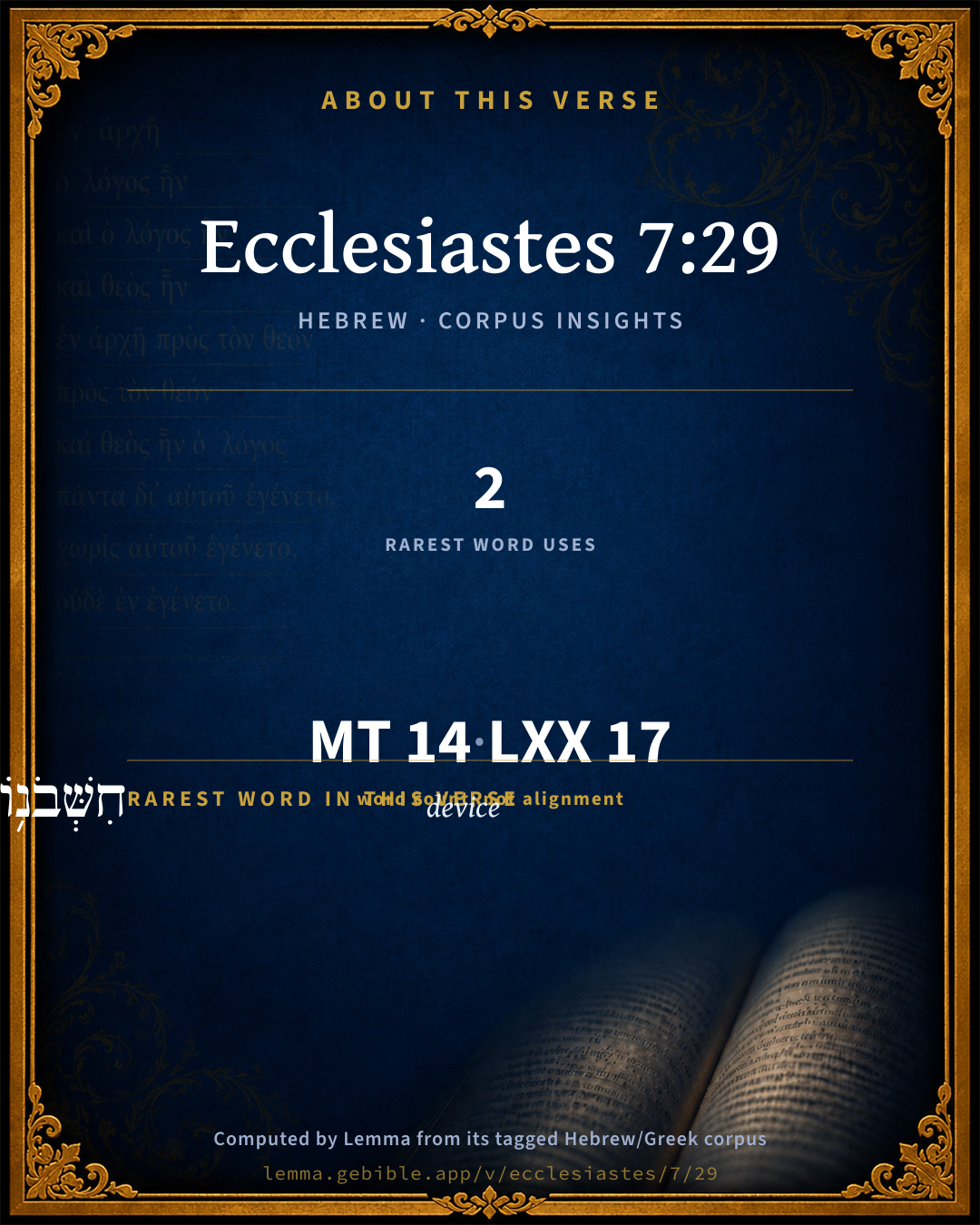
The rarest word here is חִשְּׁבֹנ֥וֹת device H2810 — appearing just 2 times in the whole Hebrew Bible.

Shared distinctive vocabulary

חִשְּׁבֹנ֥וֹת device H2810 occurs in 2 verses of the Hebrew Bible. Also found in:

Grammatical profile

  • 4 verbs
  • 4 nouns
  • 2 adjectives
  • 2 pronouns
  • 2 particles

Verb forms

  • רְאֵה Qal · Imperative
  • מָצָ֔אתִי Qal · Perfect
  • עָשָׂ֧ה Qal · Perfect
  • בִקְשׁ֖וּ Piel · Perfect

Hebrew & Septuagint length

In English translation the verse runs 17 words from the Hebrew and 28 from the Septuagint (LXX English) — the Septuagint runs noticeably longer here. See the side-by-side →

A rough comparison of the two English renderings, which tokenize alike — not a word-level alignment.

Word counts can differ between the Hebrew and the Greek without any difference in meaning — e.g. the Hebrew direct-object marker אֵת has no separate Greek word, and Greek often adds the article ὁ.

In the original languages it is 14 Hebrew tokens and 17 Greek tokens — but the two are counted differently (Hebrew bundles its prefixes and suffixes into one token; the Greek is in lemma form), so that isn’t a like-for-like length.

Cross-references

18

Topical passages linked to Ecclesiastes 7:29 in the Treasury of Scripture Knowledge — connected by theme and wording, ordered by reader-vote popularity; previews shown in the World English Bible.

  • Jeremiah 4:22 For my people are foolish, they don't know me; they are foolish children, and they have no understanding; they are wise to do evil, but to do good they have no knowledge.
  • Genesis 6:11–12 The earth was corrupt before God, and the earth was filled with violence.
  • Mark 7:8–9 "For you set aside the commandment of God, and hold tightly to the tradition of men--the washing of pitchers and cups, and you do many other such things."
  • Genesis 5:1 This is the book of the generations of Adam. In the day that God created man, he made him in God's likeness.
  • Titus 3:3 For we were also once foolish, disobedient, deceived, serving various lusts and pleasures, living in malice and envy, hateful, and hating one another.
  • Genesis 1:26–27 God said, "Let us make man in our image, after our likeness: and let them have dominion over the fish of the sea, and over the birds of the sky, and over the cattle, and over all the earth, and over every creeping thing that creeps on the earth."
  • Genesis 3:6–7 When the woman saw that the tree was good for food, and that it was a delight to the eyes, and that the tree was to be desired to make one wise, she took of the fruit of it, and ate; and she gave some to her husband with her, and he ate.
  • Genesis 6:5–6 Yahweh saw that the wickedness of man was great in the earth, and that every imagination of the thoughts of his heart was only evil continually.
  • Psalms 99:8 You answered them, Yahweh our God. You are a God who forgave them, Although you took vengeance for their doings.
  • Psalms 106:39 Thus were they defiled with their works, And prostituted themselves in their deeds.
  • Jeremiah 2:12–13 Be astonished, you heavens, at this, and be horribly afraid, be you very desolate, says Yahweh.
  • Ephesians 2:2–3 in which you once walked according to the course of this world, according to the prince of the powers of the air, the spirit who now works in the children of disobedience;
  • Genesis 11:4–6 They said, "Come, let's build us a city, and a tower, whose top reaches to the sky, and let's make us a name; lest we be scattered abroad on the surface of the whole earth."
  • Psalms 106:29 Thus they provoked him to anger with their deeds. The plague broke in on them.
  • Romans 3:9–19 What then? Are we better than they? No, in no way. For we previously charged both Jews and Greeks, that they are all under sin.
  • Ezekiel 22:6–13 Behold, the princes of Israel, everyone according to his power, have been in you to shed blood.
  • Acts 7:40–43 saying to Aaron, 'Make us gods that will go before us, for as for this Moses, who led us out of the land of Egypt, we don't know what has become of him.'
  • Romans 1:21–32 Because, knowing God, they didn't glorify him as God, neither gave thanks, but became vain in their reasoning, and their senseless heart was darkened.

Cross-references courtesy of OpenBible.info (CC BY 4.0).

Hebrew and Greek witnesses Masoretic Hebrew ↔ Greek Septuagint

The same verse in the two great witnesses to the Old Testament, shown verse-for-verse.

Here the Septuagint runs noticeably longer than the Hebrew — LXX2012 (modern English Septuagint) 28 words vs World English Bible 17. A rough length comparison of the two English translations, not a word-level alignment — read both below.

These are two independent witnesses, not word-aligned to each other, and the Septuagint is shown in lemma (dictionary) form.

Hebrew Ecclesiastes 7:29 Masoretic · Westminster Leningrad Codex

לְבַד֙ רְאֵה זֶ֣ה מָצָ֔אתִי אֲשֶׁ֨ר עָשָׂ֧ה הָאֱלֹהִ֛ים אֶת הָאָדָ֖ם יָשָׁ֑ר וְהֵ֥מָּה בִקְשׁ֖וּ חִשְּׁבֹנ֥וֹת רַבִּֽים

Behold, this only have I found: that God made man upright; but they search for many schemes.

World English Bible · Public Domain

Greek LXX Ecclesiastes 7:29 Septuagint · lemma form

πλήν ὁράω οὗτος εὑρίσκω ὅς ποιέω ὁ θεός σύν ὁ ἄνθρωπος εὐθής καί αὐτός ζητέω λογισμός πολύς

which my soul sought after, but I found not: for I have found one man of a thousand; but a woman in all these I have not found.

LXX2012 (modern English Septuagint) · Public Domain

On this verse, Adam Clarke's Commentary discusses the Septuagint’s reading. Read the note in Commentary ↓

Hebrew: Westminster Leningrad Codex (CC BY 4.0). Greek: Septuagint (public domain); English from LXX2012 (modern English Septuagint) (Public Domain). How the Septuagint differs from the Hebrew →

Commentary

Notes on Ecclesiastes 7:29 from classic Christian and Jewish commentators (each source and its license shown beneath its notes). The classic Christian expositions comment on the surrounding passage and are grouped to its opening verse, so a note may address several verses; the Jewish commentaries on the Tanakh (Rashi and others) are per-verse, so they appear only where the commentator wrote on this verse.

Lemma curates 59 commentaries, every one of them public domain or Creative Commons licensed, each selected and text-cleaned for this edition rather than reprinted as found. About our sources →

Trapp's Complete Commentary

John Trapp

Ecc 7:29 Lo, this only have I found, that God hath made man upright; but they have sought out many inventions.

Ver. 29. That God hath made man upright,] viz., In his own image - i.e., " knowledge" in his understanding part, "rightness" in his will, and "holiness" in his affections: {Col 3:10} his heart was a lump of love, &c., when he came first out of God’s mint, he shone most glorious, clad with the royal robe of righteousness, created with the imperial crown. {Psa 8:5} But the devil soon stripped him of it; he cheated and robbed him of the crown, as we use to do children, with the apple, or whatsoever fruit it was that he tendered to Eve: Porrexit pomum et surripuit paradisum. {a} He also set his limbs in the place of God’s image, so that now, Is qui factus est homo differt ab eo quem Deus fecit, as Philo saith, man is now of another make than God made him. Totus homo est inversus decalogus, Whole evil is in man, and whole man in evil. Neither can he cast the blame upon God, but must fault himself, and flee to the second Adam for repair.

But they have sought out many inventions.] New tricks and devices, like those poetic fictions and fabulous relations, whereof there is neither proof nor profit. The Vulgate Latin hath it, Et ipse se infinitis miscuit quaestionibus; And he hath entangled himself with numberless questions and fruitless speculations. See 1Ti 1:4; 1Ti 6:4, "doting about questions," or question sick. Bernard reads it thus, Ipse autem se implicuit doloribus multis, but he hath involved himself in many troubles, the fruit of his inventions, shifts, and shirking tricks. {see Jer 6:19}

{a} Bernard, lib. i. Legis Allegor.

John Trapp, A Commentary or Exposition upon All the Books of the Old and New Testament (1647–1656) — public domain. Text from a community e-Sword module.

The Biblical Illustrator

Joseph S. Exell

Ecc_7:29

God hath made man upright; but they have sought out many inventions.

Man in his original and in his lapsed stage

I. God made man upright. Our text, then, teaches us that man was made in a state of perfect conformity to some rule. If it is asked, what rule? I answer, the law of God, for this is the only perfect, immutable and eternal rule to which God requires His creatures to be conformed, and in conformity to which rectitude or uprightness consists.

1. A state of perfect conformity to the Divine law implies the possession of an understanding perfectly acquainted with that law.

2. A state of perfect uprightness, or conformity to the Divine law, implies a memory which faithfully retains all its precept.

3. A state of perfect conformity to the Divine law implies a conscience which always faithfully applies it.

4. A state of perfect conformity to the Divine law implies a heart which perfectly loves that law.

5. A state of perfect conformity to the law of God implies a will perfectly obedient and submissive to that law; or, in other words, to the Divine government and authority.

6. There still remains one faculty possessed by man, which it is necessary to consider--that which is usually called the imagination. When man left the forming hand of his Maker, this faculty, like the others which we have mentioned, was entirely free from moral imperfection. Instead of filling the mind, as it now does, with vain thoughts, waking dreams, and worthless or sinful fancies, it presented nothing but holy images of spiritual and heavenly objects.

II. Though God made man thus upright, they have sought out many inventions.

1. Men have sought out or invented many new ways in which to walk, forsaking the good old way in which God originally placed them.

2. Men have forsaken the one living and true God, in whom they live, and move, and are, and sought out or invented innumerable false gods and created idols, to which they give that homage and attention which are due to Him alone.

3. Men have ceased to be conformed to the Divine law, and have sought out many other rules--rules more agreeable to their present sinful inclinations--by which to regulate and try their conduct. Some adopt for this purpose the laws of their country; others the opinion of some human teacher; while a third and more numerous class govern themselves by the maxims which pass currently in the society of which they happen to be members. Thus, in various ways, men measure themselves by themselves, and compare themselves among themselves, and therefore are net wise; for while they follow these rules of human invention, they have lost all that uprightness, that conformity to the Divine law, which has been described.

4. Notice, among the inventions of sinful man the innumerable excuses, pleas and apologies which he has sought out to justify his conduct, and to make himself appear unfortunate, rather than criminal. (E. Payson, D. D.)

The original state of man, and the covenant of works

I. The natural form or constitution of man, as man. The primitive bodies of our first parents were not subject to the deformities and infirmities, the fatigues of labour, and the injuries of climates, or seasons, nor to distempers, violence and death which we are now exposed to; and no doubt but they were built with various beauties of due proportions, colour and form vastly superior to all that now appear in the ruins of human nature. But the chief glory of the natural form of man lies in his soul, which is an incorporeal, invisible and immortal, intelligent, free and active being, and so bears the natural image of God, as He is a Spirit. The bands of union between soul and body, and the way of their influencing and impressing one ,another, lie among the unsearchable mysteries of nature of which we have no ideas. But this we know, that by their union with each other to constitute a human person, the glories of the upper and lower worlds are in a sort epitomized and shadowed out in man.

II. His moral state or condition as an upright man.

1. With respect to his rectitude.

(1) His understanding was full of light.

(2) His will was perfectly holy and free.

(3) His affections and appetites were all pure and regular.

2. With respect to his happiness.

(1) He was a happy creature in the very constitution of his being as an innocent, upright man.

(2) He was a happy creature in his communion with God and sense of His favour.

(3) He was a happy creature in the pleasure of his situation, with the free use and government of all the creatures round about him.

III. The tenure by which or the terms upon which he was to hold this moral state. It was not entailed upon him by any absolute promise that he should continue in it; nor was it put upon a mere act of Divine sovereignty whether he should hold or lose it; the first would have left no room for a trial of his obedience, and the last would have taken away a grand article of his encouragement to that obedience and of his pleasure in it. But he was to hold it by a covenant of works, upon condition of perfect obedience to the end of that state of probation in which it became the wisdom of God to place him.

IV. The concern that all mankind had therein. He whom God created after His own image is to be considered as a public person, who was to hold or lose that happy state, not only for himself, but for all his natural offspring. Had he creed, we had all been blessed and confirmed in blessedness with him, as upon his fall, Scripture and experience assure us, we lost it with him. Use:--

1. This shows what dreadful work sin has made in the world.

2. This shows that all good is from God, and all evil from ourselves.

3. Let us be deeply affected with the present state of human nature.

4. Let us turn our eyes to the better covenant and the better Head which God has provided for our recovery. (J. Guyse, D. D.)

The state of innocence

I. The righteousness of this state wherein man was created. God made him upright.

1. This supposes a law to which he was conformed in his creation; as when anything is made regular, or according to rule, of necessity the rule itself is presupposed. Whence we may gather that this law was no other than the eternal, indispensable law of righteousness observed in all points by the second Adam, opposed by the carnal mind, and some notions of which remain yet among the Pagans, who, having not the law, are a law unto themselves (Rom_2:14).

(1) Mans understanding was a lamp of light. He had perfect knowledge of the lay, and of his duty accordingly: he was made after Gods image, and consequently could not want knowledge, which is a part thereof (Col_3:10).

(2) His will in all things was agreeable with the will of God (Eph_4:24).

(3) His affections were orderly, pure and holy.

2. From what has been said it may be gathered that the original righteousness explained was universal and natural, yet mutable.

(1) It was universal, both with respect to the subject of it, the whole man, and the object of it, the whole law. There was nothing in the law but what was agreeable to his reason and will, as God made him, though sin hath now set him at odds with it; his soul was shapen out in length and breadth to the commandment, though exceeding broad; so that his original righteousness was not only perfect in its parts, but in degrees.

(2) As it was universal, so it was natural to him, and not supernatural in that state. Not that it was essential to man, as man, for then he could not have lost it without the loss of his very being, but it was natural to him; he was created with it, and it was necessary to the perfection of man, as he came out of the hand of God, necessary to his being placed in a state of integrity.

3. It was mutable; it was a righteousness that might he lost, as is manifested by the doleful event. Let no man quarrel with Gods works in this; for if Adam had been unchangeably righteous, he must have been so either by nature or by free gift: by nature he could not be so, for that is proper to God, and incommunicable to any creature; if by free gift, then no wrong was done to him in withholding what he could not crave.

II. Some of those things which accompanied or flowed from the righteousness of mans primitive state. Happiness is the result of holiness; and as this was a holy, so it was a happy state.

1. Man was then a very glorious creature. There was no impurity to be seen without; no squint look in the eyes, after any unclean thing; the tongue spoke nothing but the language of heaven; and, in a word, the Kings son was all-glorious within, and his clothing of wrought gold.

2. He was the favourite of Heaven. While he was alone in the world he was not alone, for God was with him. His communion and fellowship were with his Creator, and that immediately; for as yet there was nothing to turn away the face of God from the work of His own hands, seeing sin had not as yet entered, which alone could make the breach.

3. God made him lord of the world, prince of the inferior creatures, universal lord and emperor of the whole earth. The Lord dealt most liberally and bountifully with him--put all things under his feet: only He kept one thing, one tree in the garden, out of his hands, even the tree of knowledge of good and evil. But you may say, and did He grudge him this? I answer, Nay; but when He had made him thus holy and happy, He graciously gave him this restriction, which was in its own nature a prop and stay to keep him from falling. And this I say upon these three grounds:--

(1) As it was most proper for the honour of God, who had made man lord of the lower world, to assert His sovereign dominion over all, by some particular visible sign, so it was proper for mans safety.

(2) This was a memorial of his mutable state given to him from heaven, to be laid up by him for his greater caution.

(3) God made man upright, directed towards God as his chief end. This fair tree, of which he was forbidden to eat, taught him that his happiness lay not in enjoyment of the creatures, for there was a want even in paradise: so that the forbidden tree was, in effect, the hand of all the creatures pointing man away from themselves to God for happiness. It was a sign of emptiness hung before the door of the creation, with the inscription, This is not your rest.

4. As he had a perfect tranquillity within his own breast, so he had a perfect calm without. His heart had nothing to reproach him with; conscience, then, had nothing to do but to direct, approve, and feast him; and, without, there was nothing to annoy him.

5. Man had a life of pure delight and unalloyed pleasure in this state. God placed him, not in a common place of the earth; but in Eden, a place eminent for pleasantness, as the name of it imports; nay, not only in Eden, but in the Garden of Eden; the mast pleasant spot of that pleasant place; a garden planted by God Himself, to be the mansion-house of this His favourite.

6. tie was immortal. He would never have died if he had not sinned; it was in case of sin that death was threatened (Gen_2:17), which shows it to be the consequence of sin, and not of the sinless human nature.

III. The doctrine of the state of innocence applied.

1. For information.

(1) Not God, but man himself was the cause of his ruin.

(2) God may most justly require of men perfect obedience to His law, and condemn them for their not obeying it perfectly, though now they have no ability to keep it. In so doing, He gathers but where He has sown.

(3) Behold here the infinite obligation we lie under to Jesus Christ the second Adam, who, with His own precious blood has bought our freedom, and freely makes offer of it again to us (Hos_13:9), and that with the advantage of everlasting security, and that it can never be altogether lost any more (Joh_10:28-29). Free grace will fix those whom free will shook down into the gulf of misery.

2. This conveys a reproof to three sorts of persons.

(1) To those who hate religion in the power of it, wherever it appears; and can take pleasure in nothing but in the world and in their lusts.

(2) It reproves those who put religion to shame, and those who are ashamed of religion, before a graceless world.

(3) It reproves the proud, self-conceited professor, who admires himself in a garment of rags which he has patched together.

3. Of lamentation. Here was a stately building; man carved like a fair palace, but now lying in ashes: let us stand and look on the ruins, and drop a tear. Ah, may we not now say, 0 that we were as in months past! when there was no stain in our nature, no cloud on our minds, no pollution in our hearts! Had we never been in better case, the matter had been less; but they that were brought up in scarlet do now embrace dunghills. Where is our primitive glory now? (T. Boston, D. D.)

Mans creation in a holy, but mutable, state

I. God endued the nature of man, in his creation, with a perfect and universal rectitude.

1. All created rectitude consists in conformity to some rule or law.

2. The highest rule of all created rectitude is the will of God, considered as including most intrinsically an eternal and immutable reason, justice and goodness.

3. Any sufficient signification of this will, touching the reasonable creatures duty, is a law, indispensably obliging such a creature.

4. The law given to Adam at his creation was partly natural, given by way of internal impression upon his soul; partly positive, given (as is probable) by some more external discovery or revelation.

5. Adam was endued in his creation with a sufficient ability and habitude to conform to this whole law, both natural and positive; in which ability and habitude his original rectitude did consist.

II. Mans defection from his primitive state was merely voluntary, and from the unconstrained choice of his own mutable and self-determining will.

1. The nature of man is now become universally depraved and sinful. This Scripture is full of (1Ki_8:46; Psa_14:1; Rom_3:10-19; Rom_3:23; Rom_5:12-13; Rom_5:17-19; 1Jn_5:19, etc.), and experience and common observation put it beyond dispute.

2. The pure and holy nature of God could never be the original of mans sin. This is evident in itself. God disclaims it; nor can any affirm it of Him without denying His very being (Deu_32:4; Psa_5:4; 3Jn_1:11).

3. It is blasphemous and absurd to talk of two principles (as the Manichees of old); the one good, and the cause of all good; the other evil, and the cause of all evil.

(1) This would suppose two Gods, two independent beings.

(2) It would suppose an evil God.

4. It was not possible that either external objects, or the temptation of the devil, should necessitate the will of man to sin.

5. The whole nature of sin consisting only in a defect, no other cause need be assigned of it than a defective; that is, an understanding, will, and inferior powers, however originally good, yet mutably and defectively so.

6. Man, being created mutable as to his holiness, must needs be so as to his happiness too. And that both upon a legal account (for the law had determined that if he did sin he must die), and also upon a natural; for it was not possible that, his soul being once depraved by sin, the powers of it vitiated, their order each to other and toward their objects broken and interrupted, there should remain a disposition and aptitude to converse with the Highest Good. (John Howe, M. A.)

Mans fall

I. Mans primitive innocence.

II. Mans acquired sin.

1. It is striking to observe that many inventions is in the plural. Righteousness is spoken of as oneness, singleness of heart. But the ways of sin are many.

2. These ways are of mans seeking--sought out. All men have followed the example of Adam, seeking ways of happiness beyond what God has prescribed for them. True happiness is only to be found in His service, and if man seeks it elsewhere he will be disappointed.

III. Lessons.

1. The folly of palliating our condition, or assuming a character we do not possess. A mans character may possess much that is lovely, but the best are fallen creatures.

2. The folly of casting the blame of our sinfulness on God. God originally made man upright.

3. The folly of supposing that we can recover ourselves from the fall.

4. The blessedness of comparing our own folly with the wisdom of God, and our present wretched condition with that which He has provided. He can restore and recover us through the sacrifice of Christ, and His vicarious atonement on our behalf. (Homilist.)

The fall

At first sight it would seem almost incredible that a being endowed and circumstanced as was Adam, probably informed that not only his own happiness, but that of an unnumbered posterity, depended on his obedience to a single command, should have signally failed in his probation, and provoked a curse which the least steadfastness might have averted. Our only business now, however, in examining this matter, is with the truth that God made man upright, and that in making him upright He had done enough for His creature. You may, indeed, say that God might have so constituted Adam that he should have been incapable of falling, and you may ask, Why was he not thus constituted? If you mean that human nature might have been such that to sin would have been impossible, we believe you to assert what is altogether incorrect. An incapacity of sinning is the property of no finite nature. The archangel, sublime in his prowess, is nevertheless finite--and what is finite may be measured and matched by temptation; add you must pass from the created to the uncreated, and bow down before Him who is every way infinite, ere you can find a being of whom to declare that he cannot sin because by nature inaccessible to evil. But then you will say, If not by nature, undoubtedly by grace, our first parents might have been prevented from yielding; grace in sufficient measure to maintain them in their obedience had been granted to many angels, and might, if God had seen fit, have been granted to man. Yes, it might; but grace, from its very nature, must be altogether free; God may give it or withhold it, according to His pleasure; and if there was no flaw in the original constitution of Adam, his powers having all that perfectness which consisted with creatureship, it could not have been at variance with any attribute of God to withhold that grace which should have kept him from falling. That God should have placed His creature in a share of probation, the trial being quite within the strength, and the reward of obedience unspeakably magnificent, you can imagine nothing more equitable, nothing more worthy every way of Deity; but there can be no probation where there is that prevention which you think might have been extended to Adam; if you allow it worthy of God to place His creature on trial, you make it indispensable that He should suffer him to fall. But if there still lurk a feeling in your minds--a feeling not to be met by argu-ment-that it was unlike a merciful God to permit His creature to work out for himself a heritage of woe and of shame, why, then, we call upon you to remember that, whilst allowing the evil, God had determined the antidote. I doubt not the glory of an unfallen man, I question not the splendour and loveliness of an unblighted paradise; very noble must Adam have been, and beautiful amidst the surrounding creation, when God conversed familiarly with man, and earth was as the shrine of its Maker; and sublime, indeed, would have been the spectacle, and majestic our inheritance, had each of us been born in the image of God, and secured against losing the resemblance; but I would not exchange what I am, if linked by faith with the Mediator Christ, for what I should have been bad Adam never transgressed. I know not what place would then have belonged to our nature amongst the orders of creation, but this I know, that now it is associated with the Divine, and imagination itself fails to measure its dignity. I know that by occupying my place, suffering and obeying in my stead, the Son of God has done vastly more than reinstate me in my forfeited possession: He has set me far above principalities and powers: He has opened to me happiness which is not to be reached by aught else created; He has brought me into a relationship with Deity, which could not have resulted from creation. Oh! then, to murmur because Adam was allowed to destroy us by his apostasy is to forget or deny that Christ redeemed us by His agony; to make it matter of complaint that we were suffered to fall is to repine at being placed unspeakably higher than we originally stood. It was not through any fault in his original constitution that Adam fell away. That constitution was, indeed, mutable, because Adam was a creature, and no created nature, not the very highest, can in itself be immutable. But there was no defect in Adam, unless you choose to reckon it a defect that he was finite. The understanding could immediately distinguish truth from error; the will was prompt to follow the verdict of the understanding; and the passions were all held in thorough subordination; so that, comparing the circumstances and the endowments of Adam, you may see that he possessed sufficient power for passing successfully through his probation, and that, having been created, he might, had he chosen, have continued in uprightness. Just, then, and true, and merciful was God in His dealings with the father of our race, for man could not have fallen had he not of his own will sought out inventions. This brief description has been applicable from the first. It was that they might be as gods, that they might know good and evil, that they might advance themselves in the scale of intelligence, for this it was that Adam and Eve partook of the forbidden fruit and set at nought the positive command. They tried the experiment, and, with all the consequences of failure, bequeathed to their children the fatal wish to invent good for themselves rather than seek it in God. The many inventions which we seek out; the schemes, even where there is the light of revelation, for being ourselves the authors, either in whole or in part, of our own deliverance, these are continued evidences that we are the children of those who even in paradise planned their own exaltation and thought to be wiser than God. We imitate our forefather, resolving to be ourselves the architects of our greatness, and therefore building on the quicksand; neglecting, as he did, the simple declarations of revelation, we take our own way of acquiring knowledge and learn it by being lost. Oh! for the spirit of St. Paul--I determined not to know anything among you save Jesus Christ and Him crucified. I read the history of human transgression and ruin. I read it in the pages of Scripture; I read it in the throes and the convulsions of a disorganized world. I then turn to the record of redemption. I find that God has graciously taken into His own hands the work of my salvation. I learn that, though fallen, He is ready to exalt me; though corrupted, He is willing to purify, though worthy of condemnation, He offers me forgiveness and pardon. (H. Melvill, B. D.)

.

The Biblical Illustrator, edited by Joseph S. Exell (c. 1880s–1900s) — public domain. Text from a community e-Sword module.

Joseph Benson's Commentary

Ecc 7:29. Lo, this only have I found — Though I could not find out all the streams of wickedness, and their infinite windings and turnings, yet I have discovered the fountain of it, original sin, and the corruption of nature, which is both in men and women; that God made our first parents, Adam and Eve, upright — Hebrew, right: without any imperfection or corruption, conformable to his nature and will, after his own likeness: but they — Our first parents, and after them their posterity; have sought out many inventions — Were not contented with their present state, but studied new ways of making themselves more wise and happy than God had made them. And we, their wretched children, are still prone to forsake the certain rule of God’s word, and the true way to happiness, and to seek new methods of attaining it.

Joseph Benson's Commentary on the Old and New Testaments (1811–1818) — public domain. Text from a community e-Sword module.

Tyndale Open Study Notes

Tyndale Open Resources

7:29 After much searching, the Teacher did find that humanity’s downward path from God’s created order (Gen 1:27-28; 2:23-25; 3:1-19) was repeated by Adam and Eve’s descendants (cp. Rom 3:10-18, 23).

Tyndale Open Study Notes — © Tyndale Open Resources, licensed CC BY-SA 4.0. Text via the HelloAO Bible API.

Geneva Bible (1599)

Geneva Bible translators

That is, to come to a conclusion.

Geneva Bible (1599) marginal notes — public domain. Text via Bolls.life.

Jamieson, Fausset & Brown

Robert Jamieson, A. R. Fausset & David Brown

The "only" way of accounting for the scarcity of even comparatively upright men and women is that, whereas God made man upright, they (men) have, &c. The only account to be "found" of the origin of evil, the great mystery of theology, is that given in Holy Writ (Gen. 2:1-3:24). Among man's "inventions" was the one especially referred to in Ecc 7:26, the bitter fruits of which Solomon experienced, the breaking of God's primeval marriage law, joining one man to "one" woman (Mat 19:4-6). "Man" is singular, namely, Adam; "they," plural, Adam, Eve, and their posterity.

Next: Ecclesiastes Chapter 8

Jamieson, Fausset & Brown — Commentary Critical and Explanatory on the Whole Bible (1871) — public domain (CC PDM 1.0). Text via the HelloAO Bible API.

Adam Clarke's Commentary

Verse 29. Lo, this only have I found, that God hath made man upright] Whatever evil may be now found among men and women, it is not of God; for God made them all upright. This is a singular verse, and has been most variously translated: עשה האלהים את האדם ישר והמה בקשו חשבנות רבים asah haelohim eth haadam yashar vehemhah bikkeshu chishbonoth rabbim.

"Elohim has made mankind upright, and they have sought many computations."

"He hath meddled with endless questions." - VULGATE.

"Many reasonings." - SEPTUAGINT, SYRIAC, and ARABIC.

"They seek dyverse sotylties."COVERDALE.

And he himself mengide with questions without eend. - Old MS. Bible.

The Targum considers the text as speaking of Adam and Eve.

"This have I found out, that the Lord made the first man upright before him, and innocent: but the serpent and Eve seduced him to eat of the fruit of the tree, which gave the power to those who ate of it to discern between good and evil; and was the cause that death came upon him, and all the inhabitants of the earth; and they sought that they might find out many stratagems to bring this evil upon all the inhabitants of the world."

I doubt much whether the word חשבנות chishbonoth should be taken in a bad sense. It may signify the whole of human devices, imaginations, inventions, artifice, with all their products; arts, sciences, schemes, plans, and all that they have found out for the destruction or melioration of life. God has given man wondrous faculties; and of them he has made strange uses, and sovereign abuses: and they have been, in consequence, at one time his help, and at another his bane. This is the fair way of understanding this question.

Adam Clarke's Commentary on the Bible (1810–1826) — public domain. Text from a community e-Sword/MySword module.

The Cambridge Bible for Schools and Colleges

gen. ed. J. J. S. Perowne

29. They have sought out many inventions] The Hebrew word implies an ingenuity exercised mainly for evil but takes within its range, as in 2Ch_26:15, the varied acts of life which are in themselves neither good nor evil. This inventive faculty, non-moral at the best, often absolutely immoral, was what struck the thinker as characterising mankind at large.

In this thought again we have an unmistakable echo of the language of Greek thinkers. Of this the most memorable example is, perhaps, the well-known chorus in the Antigone 332–5

πολλὰ τὰ δεινὰ κοὐδὲν ἀνθρώπου δεινοτέρον πέλει.

σοφόν τι τὸ μηχανόεν τέχνας ὑπὲρ ἐλπίδʼ ἔχων,

ποτὲ μὲν κακόν, ἀλλοτʼ ἐπʼ ἐσθλὸν ἕρπει.

“Many the things that strange and wondrous are,

None stranger and more wonderful than man.

And lo, with all this skill,

Wise and inventive still

Beyond hope’s dream,

He now to good inclines

And now to ill.”

Looking to the relation in which the poem of Lucretius stands to the system of Epicurus it is probable that the history of human inventions in the De Rerum Natura, v. 1281–1435 had its fore-runner in some of the Greek writings with which the author of Ecclesiastes appears to have been acquainted. The student will find another parallel in the narrative of the progress of mankind in the Prometheus Bound of Æschylus (450–514). Both these passages are somewhat too long to quote.

The Cambridge Bible for Schools and Colleges (gen. ed. J. J. S. Perowne; Cambridge University Press, 1878–1918) — public domain. Text from a community e-Sword module.

John Gill's Exposition

Lo, this only have I found, that God hath made man upright,.... The first man Adam, as the Targum and Jarchi interpret it; and not Adam only, but Eve also with him; for these were both made by the Lord, and on the same day, and in the same image, and had the same common name of Adam given them, Gen 1:27; And they were both made "upright"; which is to be understood, not of the erectness of their bodies, but of the disposition of their minds; they were

"right and innocent before him,''

or in the sight of God, as the Targum; which is best explained by their being made in the image and likeness of God, Gen 1:26; and which, according to the apostle, lay in knowledge, righteousness, and holiness, Eph 4:24; agreeably to which Plato (o) make likeness to God to be righteous and holy, with prudence: for this likeness of Adam and Eve to God; lay not in the shape of their bodies, for God is a spirit, and not a corporeal being, as the Anthropomorphites imagined, and so fancied men to be made like unto him in this respect; but in their souls, and it consisted of knowledge; of the knowledge of the creatures, their nature, use, and ends for which they were made, and put under their government; and of God, and his perfections, as made known in the creatures; and of his mind and will, and manner of worshipping him, he revealed unto them; and they might know the trinity of Persons in the Godhead, who were concerned in the making of them, though they seem not to have known Christ, as Mediator and Saviour, which was not necessary previous to their fall; nor evangelical truths suited to a fallen state: also this image lay in righteousness and true holiness, which was original, natural, and created with them; it was with them as soon as they were; not acquired, but infused; not a habit obtained, but a quality given; and this not supernatural, but natural; it was perfect in its kind, and entirely agreeable to the holy, just, and good law of God; it had no defects in it, yet was but the righteousness of a creature, and loseable, as the event showed; and so very different from the righteousness of Christ, man is justified by. Likewise, this uprightness is no other than the rectitude of human nature, of all the powers and faculties of the soul of man, as they were when he was created; his understanding clear of all errors and mistakes, either about divine or human things; his affections regular and ordinate, no unruly passion in him, no sinful affection, lust, and desire; he loved God with all his heart and soul, and delighted in him, and communion with him; the bias of his will was to that which is good; the law of God was written on his heart, and he had both power and will to keep it; and, during his state of integrity, was pure and sinless; yet he was not impeccable, as the confirmed angels and glorified saints are; nor immutable, as God only is; but being a creature, and changeable, he was liable to temptation, and subject to fall, as he did. Now Solomon, with all his diligent search and scrutiny, could not find out the infinity of sin, the boundless extent of it among mankind, the exceeding sinfulness of it, which he sought after, Ecc 7:25; yet this he "found" out, and this "only", the fountain of all sin, the origin of moral evil; namely, the corruption of human nature through the fall of Adam: this he found by reading the Scriptures, the three first chapters of Genesis; and by consulting human nature he found some remains of the image of God, and of the law that was in man's heart; whereby he perceived that man was once another man than he is now; and that this corruption is not owing to God, who is not the author of any thing sinful, he made man upright; but to himself, his own sin and folly: and this he found confirmed by sad experience; in himself and others, and by observing the history of all ages, from the times of the first man; and as this was notorious, it was worth knowing and observing, and therefore he calls upon others to take notice of it; lo, behold, consider it, as well as what follows;

but they have sought out many inventions; that is, Adam and Eve, not content with their present knowledge and happiness, they sought out new ways and means of being wiser and happier than God made them, or it was his will they should be. "They sought out the inventions of the many", or "great things", or "of the mighty and great ones" (p), as it may be rendered, the eternal Three in One; they sought to be as wise as God himself; or, however, as the great and mighty ones, the angels, who excelled them, as in strength, so in knowledge; see Gen 3:5; or they sought out thoughts of sin, as Jarchi says it is interpreted in the Midrash. Sins are the inventions of men, and these are many and numerous; they sought to gratify their senses, on which followed innumerable evils; and then they sought for shifts and evasions to excuse themselves; the man shifting it from himself, and throwing the blame upon the woman, and the woman upon the serpent: and so sinning, they lost the knowledge they had; their righteousness and holiness, the rectitude of their nature; the moral freedom of their will to that which is good, and their power to perform it; and they lost the presence of God, and communion with him: and so their posterity are not only inventors of evil things, of sins, but of new ways of happiness; some placing it in riches; others in honours; others in pleasures; and some in natural wisdom and knowledge; and some in their own works of righteousness; the vanity of all which Solomon has before exposed.

(o) Theaeteto, p. 129. (p) "cogitationes magnatum", De Dieu; "ratiocina multarum, magnarumque rerum", so some in Rambachius; see Luke x. 41, 42.

Next: Ecclesiastes Chapter 8

John Gill's Exposition of the Whole Bible (1746–1763) — public domain (CC PDM 1.0). Text via the HelloAO Bible API.

Albert Barnes' Notes on the Bible

God hath made - Rather, God made. A definite allusion to the original state of man: in which he was exempt from vanity.

Albert Barnes' Notes on the Bible (1834–1885) — public domain. Text from a community e-Sword/MySword module.

Haydock's Catholic Bible Commentary

Man. The superior part of the soul rarely thinks of good; but the sensual part always inclines to evil. (Worthington) --- Solomon found danger from all women, (St. Jerome) and there is none who may not prove fatal to those who are off their guard. (Calmet) --- Yet some are doubtless innocent, like the bless Virgin [Mary]. (Haydock)

George Leo Haydock (1774–1849), Haydock's Catholic Family Bible and Commentary, 1859 edition — public domain. Excludes Psalms (Douay-Rheims chapter numbering differs from Protestant) and Deuterocanonical books (Catholic canon only).

Matthew Poole's English Annotations

This only have I found; though I could not find out all the streams of wickedness, and their infinite windings and turnings in the world, yet I have discovered the fountain of it, to wit, original sin, and the corruption of nature, which is both in men and women.

God hath made man, God made our first parents, Adam and Eve, upright, Heb. right, without any imperfection or corruption, conformable to his nature and will, which is the rule of right, after his own likeness, understanding, and holy, and every way good.

They, our first parents, and after them their posterity treading in their steps,

have sought out many inventions; were not contented with their present state, but aimed at higher things, and studied new ways of making themselves more wise and happy than God had made them, and readily hearkened to the suggestions of the devil to that end. And we their sinful and wretched children, after their example, are still prone to forsake the certain rule of God’s word, and the true way to happiness, and to seek new methods and inventions of attaining to it, even such as Solomon hath discoursed of in this book.

Matthew Poole's English Annotations on the Holy Bible (1683–1685) — public domain. Text from a community e-Sword/MySword module.

Whedon's Commentary on the Bible

Daniel D. Whedon

29. Man… many inventions — The one abiding and ever-true result of Koheleth’s search is this — that the “inventions,” devices of man’s own heart, are enough to account for all the appalling wickedness of the race. No necessity to sin is framed into our original constitution, or laid upon us by the order of providence.

Daniel D. Whedon (gen. ed.), Commentary on the Old and New Testaments (1874–1909) — public domain. Text from a community e-Sword module.

The Pulpit Commentary

Lo, this only (or, only see! this) have I found. Universal corruption was that which met his wide investigations, but of one thing he was sure, which he proceeds to specify he has learned to trace the degradation to its source, not in God"s agency, but in man"s perverse will.

That God hath made man upright. Koheleth believes that man"s original constitution was yasbar, "straight," "right," "morally good," and possessed of ability to choose and follow what was just and right. (Gen_1:26, etc.) Thus in the Book of Wisdom (2:23) we read, "God created man to be immortal, and made him an imago of his own nature (ijiothtov). Nevertheless, through envy of the devil, came death into the world, and they that are his portion tempt it." But they (men) have sought out many inventions (chishshebonoth); 2Ch_26:15, where the term implies works of invention, and is translated "engines," i.e. devices, ways of going astray and deviating from original righteousness. Man has thus abased his free-will, and employed the inventive faculty with which he was endowed in excoriating evil. (Gen_6:5) How this state of things came about, how the originally good man became thus wicked, the writer does not tell. He knows from revelation that God made him upright; he knows from experience that he is now evil; and he leaves the matter there. Plumptre quotes, as illustrating our text, a passage from the "Antigone" of Sophocles, vers. 332, 365, 366, which he renders

Many the things that strange and wondrous are, None stranger and mere wonderful than man.... And lo, with all this skill, Wise and inventive still, Beyond hope"s dream, He now to good inclines, And now to ill.

We may add Aeschylus, "Choeph.," vers. 585, etc.

Pollan ga trefei deinatwn ach ajll uJpertolmon ajndronhma tiv legoi;

Many fearful plagues Earth nourishes But man"s audacious spirit Who can tell?

Horace, "Carm.," 1:3. 25

Audax omnia perpeti Gens humans ruit per vetitum nefas." "The race of man, bold all things to endure, Hurries undaunted to forbidden crime.

Vulgate, Et ipse se infinitis miscuerit quaestionibus, "And he entangled himself in multitudinous questions." This refers to unhallowed curiosity and speculation; but, as we have seen, the passage is concerned with man"s moral declension, declaring how his "devices" lead him away from "uprightness."

The Pulpit Commentary (1880–1919), ed. H.D.M. Spence-Jones & Joseph S. Exell — public domain. Text from a community e-Sword module.

John Wesley's Explanatory Notes

Lo, this - Though I could not find out all the streams of wickedness, and their infinite windings and turnings, yet I have discovered the fountain of it, Original sin, and the corruption of nature, which is both in men and women. That - God made our first parents, Adam and Eve. Upright - Hebrew. right: without any imperfection or corruption, conformable to his nature and will, after his own likeness. They - Our first parents, and after them their posterity. Sought out - Were not contented with their present state, but studied new ways of making themselves more wise and happy, than God had made them. And we, their wretched children, are still prone to forsake the certain rule of God's word, and the true way to happiness, and to seek new methods of attaining it.

John Wesley, Explanatory Notes Upon the Whole Bible (1754–1765) — public domain. Text via the GEBible commentary corpus.

Keil & Delitzsch

C. F. Keil & F. Delitzsch

"Lo, this only have I found, that God created man upright; but they seek many arts." Also here the order of the words is inverted, since זה, belonging as obj. to מץ (have I found), which is restricted by לבד, is amalgamated with ראה (Lo! see!). The author means to say: Only this (solummodo hocce) have I found, that ...; the ראה is an interjected nota bene. The expression: God has made man ישׁר, is dogmatically significant. Man, as he came from the Creator's hand, was not placed in the state of moral decision, nor yet in the state of absolute indifference between good and evil; he was not neither good nor bad, but he was טוב, or, which is the same thing, ישׁר; i.e., in every respect normal, so that he could normally develope himself from this positively good foundation. But by the expression ישׁר `שׁ, Koheleth has certainly not exclusively his origin in view, but at the same time his relative continuation in the propagation of himself, not without the concurrence of the Creator; also of man after the fall the words are true, ישׁר עשׂה, in so far as man still possesses the moral ability not to indulge sinful affections within him, nor suffer them to become sinful actions. But the sinful affections in the inborn nature of weak sinful man have derived so strong a support from his freedom, that the power of the will over against this power of nature is for the most part as weakness; the dominance of sin, where it is not counteracted by the grace of God, has always shown itself so powerful, that Koheleth has to complain of men of all times and in all circles of life: they seek many arts (as Luther well renders it), or properly, calculations, inventions, devices (hhishshevonoth,

(Note: If we derive this word from hhěshbon, the Dagesh in the שׁ is the so-called Dag. dirimens.)

as at Ch2 26:15, from hhishshevon, which is as little distinguished from the formation hhěshbon, as hhizzayon from hhězyon), viz., of means and ways, by which they go astray from the normal natural development into abnormities. In other words: inventive refined degeneracy has come into the place of moral simplicity, ἁπλότης (Ch2 11:3). As to the opinion that caricatures of true human nature, contrasts between the actual and that which ought to be (the ideal), are common, particularly among the female sex, the author has testimonies in support of it from all nations. It is confirmed by the primitive history itself, in which the woman appears as the first that was led astray, and as the seducer (cf. Psychol. pp. 103-106). With reference to this an old proverb says: "Women carry in themselves a frivolous mind," Kiddushin 80b.

(Note: Cf. Tendlau's Sprichw. (1860), No. 733.)

And because a woman, when she has fallen into evil, surpasses a man in fiendish superiority therein, the Midrash reckons under this passage before us fifteen things of which the one is worse than the other; the thirteenth is death, and the fourteenth a bad woman.

(Note: Duke's Rabb. Blumenl. (1844), No. 32.)

Hitzig supposes that the author has before him as his model Agathoclea, the mistress of the fourth Ptolemy Philopator. But also the history of the Persian Court affords dreadful examples of the truth of the proverb: "Woe to the age whose leader is a woman;"

(Note: Ibid. No. 118.)

and generally the harem is a den of female wickedness.

Keil & Delitzsch — Biblical Commentary on the Old Testament (1861–1891) — public domain (CC PDM 1.0). Text via the HelloAO Bible API. (Old Testament only.)

unfoldingWord translationNotes

Door43 World Missions Community

they have gone away looking for many difficulties

Possible meanings are 1) "they have made many sinful plans" or 2) "they have made their own lives difficult."

they have gone away

Here the word "they" refers to "humanity." This speaks of humanity changing from being upright to not being upright as if they were going from one place to another. (See: Metaphor)

translationWords

create

righteous

unfoldingWord translationNotes — © Distant Shores Media and the Door43 World Missions Community, licensed CC BY-SA 4.0. Source: git.door43.org/Door43/en_tn.

Rashi

Rabbi Shlomo Yitzchaki (Rashi)

See, only this one have I found for a stumbling block came into being through her.

that...made The Holy One, blessed be He [made] the first man straight.

but they when his wife Eve was paired up with him, and they became two and were called “they.”

sought many intrigues plans and designs of sin. So is it explained in the Midrash (Ecc. Rabbah).

Rashi on the Tanakh — English translations: “The Judaica Press complete Tanach with Rashi, translated by A. J. Rosenberg” (CC BY 4.0); “Pentateuch with Rashi's commentary by M. Rosenbaum and A.M. Silbermann, 1929-1934” (public domain); “The Metsudah Tanach series, Lakewood, N.J” (CC BY 4.0); and “The Book of Joshua, Metsudah Publications, 1997” (CC BY 4.0). Text via Sefaria.

Lesson kit

Teaching starters — assembled from the data on this page, not authored interpretation. Every prompt links to the verse data it draws on. Edit before teaching.

Ecclesiastes, in the Wisdom, opens this verse with 14 words (14 distinct Hebrew lemmas). Its most distinctive word is chishshâbôwn (“device”). The Greek Septuagint runs longer here. A historical commentator’s framing appears above. Read the whole chapter for the surrounding context.

Discussion questions

  1. The word chishshâbôwn carries the sense “device.” How does it shape the verse?
  2. 2 Chronicles 26:15 shares the word «device» with this verse. How do the two illuminate each other?
  3. Compared with the Hebrew, the Septuagint runs longer here. What questions does that raise?
  4. These translations render this verse differently; the difference is in the English rendering, not the original. What questions does that raise?
  5. The verb «רְאֵה» is Qal Imperative. How does its form color the action?
  6. Reading how Trapp's Complete Commentary and The Biblical Illustrator read this verse, where do the two commentators agree and where do they part?

Things to notice

Reading settings

Reading text

Shown beneath each verse's original-language words.

Old Testament
Old Testament edition

Read the OT as the Masoretic Hebrew (MT) or the Greek Septuagint (LXX).

English shown for the Greek Septuagint (in the Hebrew ↔ Greek comparison).

Comparing translations? Open the Compare panel on any verse page to stack up to four side by side.