
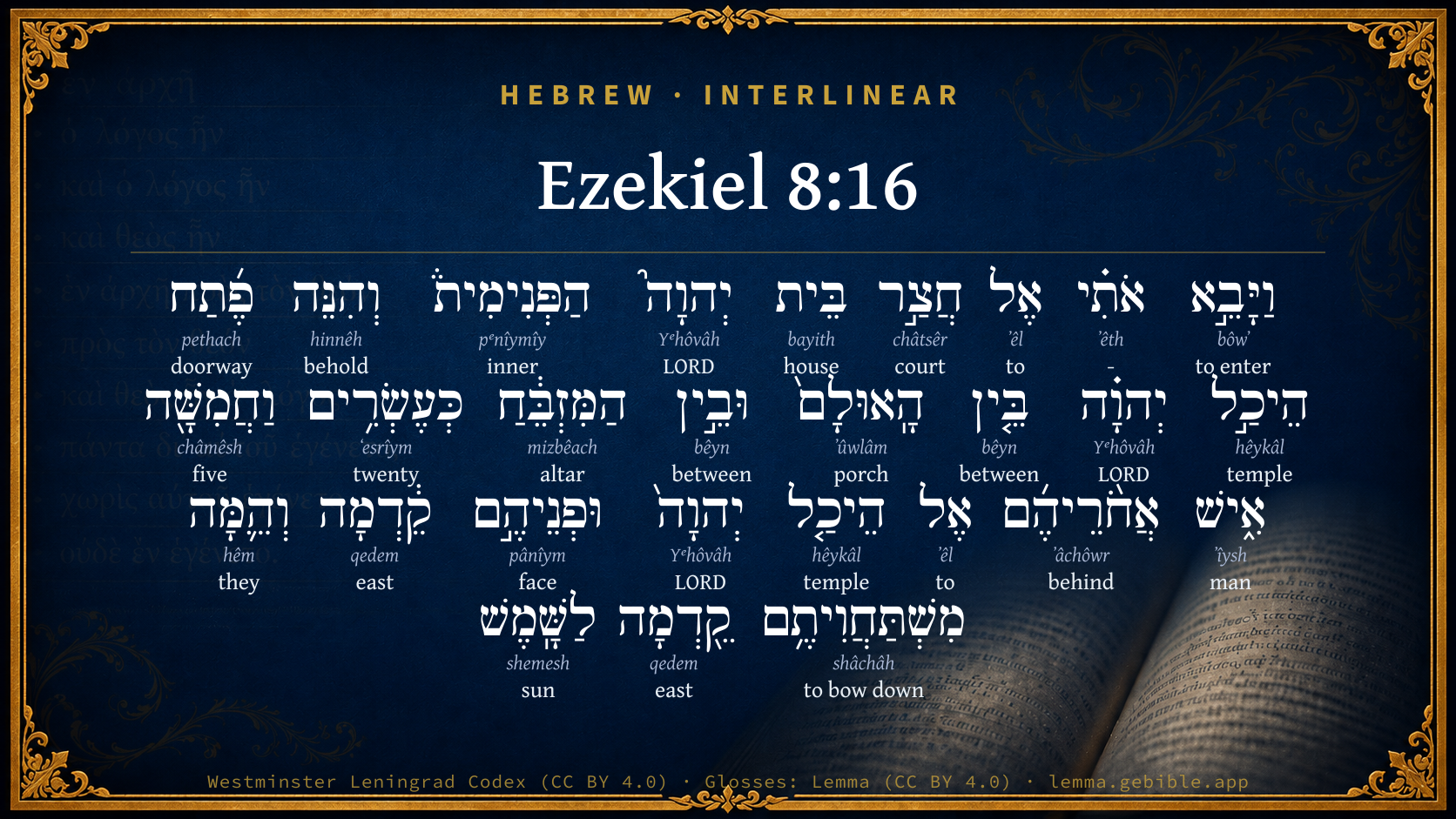
Ezekiel 8:16

Hebrew (Westminster Leningrad Codex) Ezekiel 8:16 appears in the Hebrew Old Testament. The text above is from the Westminster Leningrad Codex. Each word links to its Strong’s number, a concise gloss, and parsing drawn from the Open Scriptures Hebrew Bible morphology. Click any word for its full Brown-Driver-Briggs (BDB) entry.
Download image
Cite this verse

Ezekiel 8:16 (World English Bible). Public Domain. Lemma interlinear Bible study tool, https://lemma.gebible.app/v/ezekiel/8/16.

Show BibTeX & RIS
BibTeX
RIS
English Translation
He brought me into the inner court of Yahweh's house; and see, at the door of the temple of Yahweh, between the porch and the altar, were about twenty-five men, with their backs toward the temple of Yahweh, and their faces toward the east; and they were worshipping the sun toward the east.
World English Bible · Public Domain
Download a study sheet

One document with this verse’s original text, its word-by-word gloss line, the meaning frame, cross-references with their text, attributed commentary, and full source and license credits — printable, and it pastes into notes with its structure intact.

This verse Autodidact and up

Study sheet (.html) Plain text (.txt)

A passage Seminary Student

Up to 50 verses in one chapter. A passage sheet keeps up to 6 commentary sources and 12 cross-references per verse, in the order this page ranks them, and says so on the sheet whenever that leaves anything out. Ask for a single verse and you get the Autodidact verse sheet above.

Everything on this page stays free to read, with no account — the sheet is a download of what is already on screen, not access to it.

Want to remove ads? Support Godless Engineer
Compare translations 3

The same verse in 3 English versions, stacked beneath the original-language interlinear above. Click any original word for its lexicon entry.

Each is an independent rendering of the whole verse — the interlinear is not word-aligned to these translations.

Highlighted words mark where these versions differ — a whole-verse word diff, not a word-by-word alignment.

  • World English Bible Public Domain
    He brought me into the inner court of Yahweh's house; and see, at the door of the temple of Yahweh, between the porch and the altar, were about twenty-five men, with their backs toward the temple of Yahweh, and their faces toward the east; and they were worshipping the sun toward the east.
  • King James Version Public Domain
    And he brought me into the inner court of the LORD's house, and, behold, at the door of the temple of the LORD, between the porch and the altar, were about five and twenty men, with their backs toward the temple of the LORD, and their faces toward the east; and they worshipped the sun toward the east.
  • unfoldingWord Literal Text CC BY-SA 4.0
    He brought me into the inner courtyard of Yahweh’s house, and behold! At the entrance of the temple of Yahweh between the portico and the altar, there were about twenty-five men with their backs toward the temple of Yahweh and their faces toward the east, and they were worshiping the sun.

unfoldingWord Literal Text — © unfoldingWord, licensed CC BY-SA 4.0. Word-aligned USFM3 via Door43 (git.door43.org/unfoldingWord/en_ult).

Versions to compare (up to 4)

3 of 4 selected

Show all 18 translations

Every available English version of this verse, each an independent rendering of the whole verse.

  • World English Bible Public Domain
    He brought me into the inner court of Yahweh's house; and see, at the door of the temple of Yahweh, between the porch and the altar, were about twenty-five men, with their backs toward the temple of Yahweh, and their faces toward the east; and they were worshipping the sun toward the east.
  • Berean Standard Bible Public Domain
    So He brought me to the inner court of the house of the LORD, and there at the entrance to the temple of the LORD, between the portico and the altar, were about twenty-five men with their backs to the temple of the LORD and their faces toward the east; and they were bowing to the east in worship of the sun.
  • Majority Standard Bible Public Domain
    So He brought me to the inner court of the house of the LORD, and there at the entrance to the temple of the LORD, between the portico and the altar, were about twenty-five men with their backs to the temple of the LORD and their faces toward the east; and they were bowing to the east in worship of the sun.
  • King James Version Public Domain
    And he brought me into the inner court of the LORD's house, and, behold, at the door of the temple of the LORD, between the porch and the altar, were about five and twenty men, with their backs toward the temple of the LORD, and their faces toward the east; and they worshipped the sun toward the east.
  • American Standard Version (1901) Public Domain
    And he brought me into the inner court of Jehovah's house; and behold, at the door of the temple of Jehovah, between the porch and the altar, were about five and twenty men, with their backs toward the temple of Jehovah, and their faces toward the east; and they were worshipping the sun toward the east.
  • Revised Version (1885) Public Domain
    And he brought me into the inner court of the LORD’S house, and behold, at the door of the temple of the LORD, between the porch and the altar, were about five and twenty men, with their backs toward the temple of the LORD, and their faces toward the east; and they worshipped the sun toward the east.
  • Geneva Bible (1599) Public Domain
    And he caused me to enter into the inner court of the Lordes house, and beholde, at the doore of the Temple of the Lord, betweene the porche and the altar were about fiue and twentie men with their backs toward the Temple of the Lord, and their faces towarde the East, and they worshipped the sunne, towarde the East.
  • Douay-Rheims (1899) Public Domain
    And he brought me into the inner court of the house of the Lord: and behold at the door of the temple of the Lord, between the porch and the altar, were about five and twenty men having their backs towards the temple of the Lord, and their faces to the east: and they adored towards the rising of the sun.
  • Young's Literal Translation Public Domain
    And He bringeth me in unto the inner court of the house of Jehovah, and lo, at the opening of the temple of Jehovah, between the porch and the altar, about twenty-five men, their backs toward the temple of Jehovah, and their faces eastward, and they are bowing themselves eastward to the sun.
  • Literal Standard Version CC BY-SA 4.0
    And He brings me into the inner court of the house of YHWH, and behold, at the opening of the temple of YHWH, between the porch and the altar, about twenty-five men, their backs toward the temple of YHWH, and their faces eastward, and they are bowing themselves eastward to the sun.
  • Unlocked Literal Bible CC BY-SA 4.0
    He brought me into the inner courtyard of Yahweh's house, and behold! at the entrance of the temple of Yahweh between the portico and the altar, there were about twenty-five men with their backs toward the temple of Yahweh and their faces toward the east, and they were worshiping the sun.
  • unfoldingWord Literal Text CC BY-SA 4.0
    He brought me into the inner courtyard of Yahweh’s house, and behold! At the entrance of the temple of Yahweh between the portico and the altar, there were about twenty-five men with their backs toward the temple of Yahweh and their faces toward the east, and they were worshiping the sun.
  • Darby Bible Public Domain
    And he brought me into the inner court of Jehovah's house, and behold, at the entry of the temple of Jehovah, between the porch and the altar, were about five and twenty men, with their backs toward the temple of Jehovah and their faces toward the east; and they worshipped the sun toward the east.
  • World Messianic Bible Public Domain
    He brought me into the inner court of the LORD’s house; and I saw at the door of the LORD’s temple, between the porch and the altar, there were about twenty-five men with their backs toward the LORD’s temple and their faces toward the east. They were worshiping the sun toward the east.
  • Webster's Bible Public Domain
    And he brought me into the inner court of the LORD'S house, and behold, at the door of the temple of the LORD, between the porch and the altar, were about five and twenty men, with their backs towards the temple of the LORD, and their faces towards the east; and they worshiped the sun towards the east.
  • Free Bible Version CC BY-SA 4.0
    He took me to the inner courtyard of the Lord's Temple and right there at the entrance to the Temple, between the porch and the altar, were around twenty-five men. They had their backs to the Temple, and were facing towards the east. They were bowing in worship of the sun rising in the east.
  • Bible in Basic English Public Domain
    And he took me into the inner square of the Lord's house, and at the door of the Temple of the Lord, between the covered way and the altar, there were about twenty-five men with their backs turned to the Temple of the Lord and their faces turned to the east; and they were worshipping the sun, turning to the east.
  • JPS Tanakh (1917) Public Domain
    And He brought me into the inner court of the LORD'S house, and, behold, at the door of the temple of the LORD, between the porch and the altar, were about five and twenty men, with their backs toward the temple of the LORD, and their faces toward the east; and they worshipped the sun toward the east.

Literal Standard Version (2020), Covenant Press — licensed CC BY-SA 4.0. Text via the HelloAO Bible API (eBible.org). Unlocked Literal Bible (unfoldingWord) — licensed CC BY-SA 4.0. Text via the HelloAO Bible API (eBible.org). unfoldingWord Literal Text — © unfoldingWord, licensed CC BY-SA 4.0. Word-aligned USFM3 via Door43 (git.door43.org/unfoldingWord/en_ult). Free Bible Version, Dr. Jonathan Gallagher — licensed CC BY-SA 4.0. Text via the HelloAO Bible API (eBible.org).

Word by word

More ways to search: Search by grammar → Find every occurrence → Compare this word →

Practice this passage: Drill this verse → Learn its vocabulary →

הַפְּנִימִית֒
pᵉnîymîy
H6442
“the · inner”
Particle, Definite Article + Adjective, Adjective, Feminine, Singular, Absolute
Part of Speech
Particle + Adjective
Type
Adjective
Gender
Feminine
Number
Singular
State
Absolute
Full BDB Definition

Origin: from H6440

TWOT: 1782d

inner
  1. וַיָּבֵ֣א bôwʼ H935 “and · to enter” Conjunction + Verb, Hiphil, Sequential Imperfect, 3rd Person, Masculine, Singular
  2. אֹתִ֗י ʼêth H853 “- · me” Particle, Direct Object + Suffix, Personal, 1st Person, Common, Singular
  3. אֶל ʼêl H413 “to” Preposition
  4. חֲצַ֣ר châtsêr H2691 “court of” Noun, Common, Both, Singular, Construct
  5. בֵּית bayith H1004 “house of” Noun, Common, Masculine, Singular, Construct
  6. יְהוָה֮ Yᵉhôvâh H3068 “LORD” Noun, Proper
  7. וְהִנֵּה hinnêh H2009 “and · behold” Conjunction + Particle, Demonstrative
  8. פֶ֜תַח pethach H6607 “doorway of” Noun, Common, Masculine, Singular, Construct
  9. הֵיכַ֣ל hêykâl H1964 “temple of” Noun, Common, Masculine, Singular, Construct
  10. יְהוָ֗ה Yᵉhôvâh H3068 “LORD” Noun, Proper
  11. בֵּ֤ין bêyn H996 “between” Preposition
  12. הָֽאוּלָם֙ ʼûwlâm H197 “the · porch” Particle, Definite Article + Noun, Common, Masculine, Singular, Absolute
  13. וּבֵ֣ין bêyn H996 “and · between” Conjunction + Preposition
  14. הַמִּזְבֵּ֔חַ mizbêach H4196 “the · altar” Particle, Definite Article + Noun, Common, Masculine, Singular, Absolute
  15. כְּעֶשְׂרִ֥ים ʻesrîym H6242 “like/as · twenty” Preposition + Adjective, Cardinal number, Both, Plural, Absolute
  16. וַחֲמִשָּׁ֖ה châmêsh H2568 “and · five” Conjunction + Adjective, Cardinal number, Masculine, Singular, Absolute
  17. אִ֑ישׁ ʼîysh H376 “man” Noun, Common, Masculine, Singular, Absolute
  18. אֲחֹ֨רֵיהֶ֜ם ʼâchôwr H268 “back parts · their” Noun, Common, Masculine, Plural, Construct + Suffix, Personal, 3rd Person, Masculine, Plural
  19. אֶל ʼêl H413 “to” Preposition
  20. הֵיכַ֤ל hêykâl H1964 “temple of” Noun, Common, Masculine, Singular, Construct
  21. יְהוָה֙ Yᵉhôvâh H3068 “LORD” Noun, Proper
  22. וּפְנֵיהֶ֣ם pânîym H6440 “and · face(s) · their” Conjunction + Noun, Common, Both, Plural, Construct + Suffix, Personal, 3rd Person, Masculine, Plural
  23. קֵ֔דְמָה qedem H6924 “east · toward” Noun, Common, Masculine, Singular, Absolute + Suffix, Demonstrative
  24. וְהֵ֛מָּה hêm H1992 “and · they” Conjunction + Pronoun, Personal, 3rd Person, Masculine, Plural
  25. מִשְׁתַּחֲוִיתֶ֥ם shâchâh H7812 “bowing down” Verb, Hishtaphel, Participle Active, Masculine, Plural, Absolute
  26. קֵ֖דְמָה qedem H6924 “east · toward” Noun, Common, Masculine, Singular, Absolute + Suffix, Demonstrative
  27. לַשָּֽׁמֶשׁ shemesh H8121 “to/for the · sun” Preposition, Determined + Noun, Common, Both, Singular, Absolute

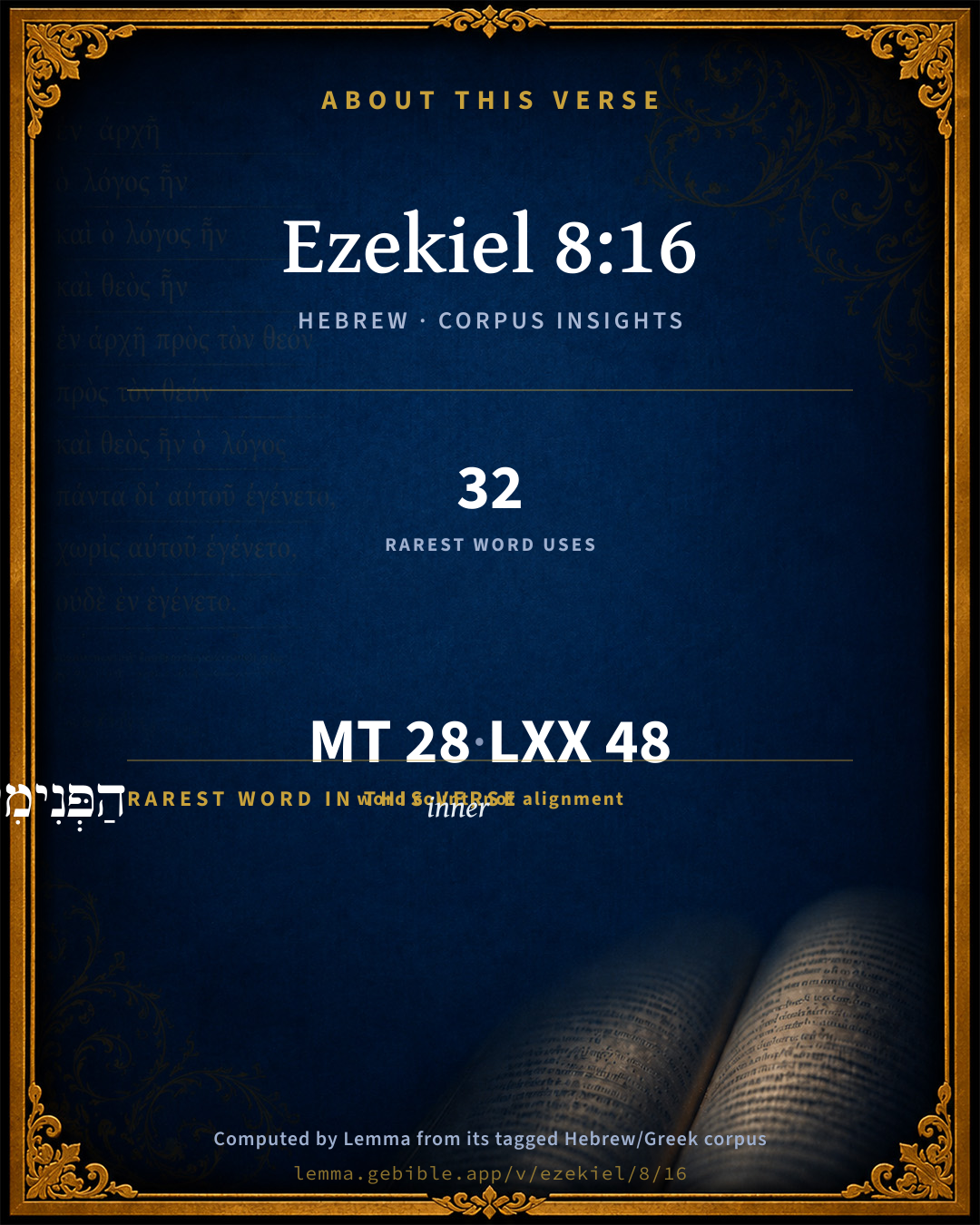
About this verse

These counts appear in no published source. They are computed here, from the morphology-tagged text and Lemma’s own curated glosses. What Lemma adds →

28
words
22
distinct lemmas
Prophets
section

Shared distinctive vocabulary

הַפְּנִימִית֒ inner H6442 occurs in 29 verses of the Hebrew Bible. Also found in:

Grammatical profile

  • 2 verbs
  • 16 nouns
  • 3 adjectives
  • 1 pronoun
  • 4 prepositions
  • 2 particles

Verb forms

  • וַיָּבֵ֣א Hiphil · Sequential Imperfect
  • מִשְׁתַּחֲוִיתֶ֥ם Hishtaphel · Participle Active

Repetition

Words recur within this verse — often emphatic in Hebrew:

  • יְהוָה֮ LORD H3068 ×3
  • הֵיכַ֣ל temple H1964 ×2
  • בֵּ֤ין between H996 ×2
  • קֵ֔דְמָה east H6924 ×2
  • אֶל to H413 ×2

Hebrew & Septuagint length

In English translation the verse runs 53 words from the Hebrew and 57 from the Septuagint (LXX English) — closely comparable.

A rough comparison of the two English renderings, which tokenize alike — not a word-level alignment.

Word counts can differ between the Hebrew and the Greek without any difference in meaning — e.g. the Hebrew direct-object marker אֵת has no separate Greek word, and Greek often adds the article ὁ.

In the original languages it is 28 Hebrew tokens and 48 Greek tokens — but the two are counted differently (Hebrew bundles its prefixes and suffixes into one token; the Greek is in lemma form), so that isn’t a like-for-like length.

Cross-references

20

Topical passages linked to Ezekiel 8:16 in the Treasury of Scripture Knowledge — connected by theme and wording, ordered by reader-vote popularity; previews shown in the World English Bible.

  • Deuteronomy 4:19 and lest you lift up your eyes to the sky, and when you see the sun and the moon and the stars, even all the host of the sky, you are drawn away and worship them, and serve them, which Yahweh your God has allotted to all the peoples under the whole sky.
  • Deuteronomy 17:3 and has gone and served other gods, and worshiped them, or the sun, or the moon, or any of the host of the sky, which I have not commanded;
  • Jeremiah 32:33 They have turned to me the back, and not the face: and though I taught them, rising up early and teaching them, yet they have not listened to receive instruction.
  • Jeremiah 2:27 who tell a stock, You are my father; and to a stone, You have brought me forth: for they have turned their back to me, and not their face; but in the time of their trouble they will say, Arise, and save us.
  • Ezekiel 11:1 Moreover the Spirit lifted me up, and brought me to the east gate of Yahweh's house, which looks eastward: and see, at the door of the gate twenty-five men; and I saw in the midst of them Jaazaniah the son of Azzur, and Pelatiah the son of Benaiah, princes of the people.
  • Job 31:26–28 If I have seen the sun when it shined, Or the moon moving in splendor,
  • Ezekiel 43:5 The Spirit took me up, and brought me into the inner court; and, behold, the glory of Yahweh filled the house.
  • Joel 2:17 Let the priests, the ministers of Yahweh, weep between the porch and the altar, And let them say, "Spare your people, Yahweh, And don't give your heritage to reproach, That the nations should rule over them. Why should they say among the peoples, 'Where is their God?'"
  • Jeremiah 44:17 But we will certainly perform every word that is gone forth out of our mouth, to burn incense to the queen of the sky, and to pour out drink-offerings to her, as we have done, we and our fathers, our kings and our princes, in the cities of Judah, and in the streets of Jerusalem; for then had we plenty of food, and were well, and saw no evil.
  • Acts 7:42–43 But God turned, and gave them up to serve the host of the sky, as it is written in the book of the prophets, 'Did you offer to me slain animals and sacrifices Forty years in the wilderness, O house of Israel?
  • 1 Kings 8:29 that your eyes may be open toward this house night and day, even toward the place of which you have said, My name shall be there; to listen to the prayer which your servant shall pray toward this place.
  • 2 Kings 16:14 The brazen altar, which was before Yahweh, he brought from the forefront of the house, from between his altar and the house of Yahweh, and put it on the north side of his altar.
  • 2 Kings 23:5 He put down the idolatrous priests, whom the kings of Judah had ordained to burn incense in the high places in the cities of Judah, and in the places round about Jerusalem; those also who burned incense to Baal, to the sun, and to the moon, and to the planets, and to all the host of the sky.
  • 2 Kings 23:11 He took away the horses that the kings of Judah had given to the sun, at the entrance of the house of Yahweh, by the chamber of Nathan-melech the chamberlain, which was in the precincts; and he burned the chariots of the sun with fire.
  • 2 Chronicles 29:6 For our fathers have trespassed, and done that which was evil in the sight of Yahweh our God, and have forsaken him, and have turned away their faces from the habitation of Yahweh, and turned their backs.
  • Ezekiel 10:3 Now the cherubim stood on the right side of the house, when the man went in; and the cloud filled the inner court.
  • Ezekiel 23:35 Therefore thus says the Lord Yahweh: Because you have forgotten me, and cast me behind your back, therefore bear you also your lewdness and your prostitution.
  • Ezekiel 40:28 Then he brought me to the inner court by the south gate: and he measured the south gate according to these measures;
  • Ezekiel 45:19 The priest shall take of the blood of the sin-offering, and put it on the door-posts of the house, and on the four corners of the ledge of the altar, and on the posts of the gate of the inner court.
  • 2 Chronicles 7:7 Moreover Solomon made the middle of the court holy that was before the house of Yahweh; for there he offered the burnt offerings, and the fat of the peace-offerings, because the brazen altar which Solomon had made was not able to receive the burnt offering, and the meal-offering, and the fat.

Cross-references courtesy of OpenBible.info (CC BY 4.0).

Hebrew and Greek witnesses Masoretic Hebrew ↔ Greek Septuagint

The same verse in the two great witnesses to the Old Testament, shown verse-for-verse.

These are two independent witnesses, not word-aligned to each other, and the Septuagint is shown in lemma (dictionary) form.

Hebrew Ezekiel 8:16 Masoretic · Westminster Leningrad Codex

וַיָּבֵ֣א אֹתִ֗י אֶל חֲצַ֣ר בֵּית יְהוָה֮ הַפְּנִימִית֒ וְהִנֵּה פֶ֜תַח הֵיכַ֣ל יְהוָ֗ה בֵּ֤ין הָֽאוּלָם֙ וּבֵ֣ין הַמִּזְבֵּ֔חַ כְּעֶשְׂרִ֥ים וַחֲמִשָּׁ֖ה אִ֑ישׁ אֲחֹ֨רֵיהֶ֜ם אֶל הֵיכַ֤ל יְהוָה֙ וּפְנֵיהֶ֣ם קֵ֔דְמָה וְהֵ֛מָּה מִשְׁתַּחֲוִיתֶ֥ם קֵ֖דְמָה לַשָּֽׁמֶשׁ

He brought me into the inner court of Yahweh's house; and see, at the door of the temple of Yahweh, between the porch and the altar, were about twenty-five men, with their backs toward the temple of Yahweh, and their faces toward the east; and they were worshipping the sun toward the east.

World English Bible · Public Domain

Greek LXX Ezekiel 8:16 Septuagint · lemma form

καί εἰςἄγω ἐγώ εἰς ὁ αὐλή οἶκος κύριος ὁ ἐσώτερος καί ἰδού ἐπί ὁ πρόθυρον ὁ ναός κύριος ἀνά μέσος ὁ αιλαμ καί ἀνά μέσος ὁ θυσιαστήριον ὡς εἴκοσι ἀνήρ ὁ ὀπίσθιος αὐτός πρός ὁ ναός ὁ κύριος καί ὁ πρόσωπον αὐτός ἀπέναντι καί οὗτος προςκυνέω ὁ ἥλιος

And he brought me into the inner court of the house of the Lord, and at the entrance of the temple of the Lord, between the porch and the altar, were about twenty men, with their back parts toward the temple of the Lord, and their faces turned the opposite way; and these were worshipping the sun.

LXX2012 (modern English Septuagint) · Public Domain

On this verse, The Cambridge Bible for Schools and Colleges discusses the Septuagint’s reading. Read the note in Commentary ↓

Hebrew: Westminster Leningrad Codex (CC BY 4.0). Greek: Septuagint (public domain); English from LXX2012 (modern English Septuagint) (Public Domain). How the Septuagint differs from the Hebrew →

Targum (Aramaic paraphrase)

1

The Targum is the ancient Jewish Aramaic paraphrase of the Hebrew Scriptures — an interpretive translation, not the Hebrew text itself. Onkelos (literal) and Pseudo-Jonathan (expansive) render the Torah, and Jonathan the Prophets. Coverage is partial: where no permissively-licensed English translation exists for a verse, only the Aramaic is shown. This is verse-level text, not a word-by-word alignment to the Hebrew.

  1. Targum Jonathan Prophets (Joshua–Malachi)
    וְאָעֵיל יָתִי לְדָרַת בֵּית מַקְדְשָׁא דַייָ גְוִיָתָא וְהָא תְרַע הֵיכְלָא דַייָ בֵּין אוּלָמָא וּבֵין מַדְבְּחָא כְּעַשְׂרִין וְחַמְשָׁא גַבְרָא אֲחוֹרֵיהוֹן לְהֵיכְלָא דַייָ וְאַפֵּיהוֹן לְמַדִינְחָא וְהָא אִינוּן מִתְחַבְּלִין וְסָגְדִין לְמַדִינְחָא לְשִׁמְשָׁא:

    (no public-domain English translation for this verse)

    Targum Jonathan — Aramaic: “Mikraot Gedolot” (public domain). English: “Sefaria Community Translation” (CC0 1.0 (public-domain dedication)); “London "Chaldee Paraphrase," 1871” (public domain). Text via Sefaria.

Commentary

Notes on Ezekiel 8:16 from classic Christian and Jewish commentators (each source and its license shown beneath its notes). The classic Christian expositions comment on the surrounding passage and are grouped to its opening verse, so a note may address several verses; the Jewish commentaries on the Tanakh (Rashi and others) are per-verse, so they appear only where the commentator wrote on this verse.

Lemma curates 59 commentaries, every one of them public domain or Creative Commons licensed, each selected and text-cleaned for this edition rather than reprinted as found. About our sources →

Trapp's Complete Commentary

John Trapp

Eze 8:16 And he brought me into the inner court of the LORD’S house, and, behold, at the door of the temple of the LORD, between the porch and the altar, [were] about five and twenty men, with their backs toward the temple of the LORD, and their faces toward the east; and they worshipped the sun toward the east.

Ver. 16. Were about five and twenty men.] These, say some, were the king and his council See Eze 11:1.

With their backs toward the temple.] And yet in a part of it. Hoc fuit signum nimiae improbitatis. Veluti Dominum in certamen provocantes. Here to turn their posteriors upon God’s house and ark, which they were commanded to look towards as a type of Christ, was to bid open defiance to him, and to renounce his service, cum ingenti contumelia sanctitatis Domini! Oh, the unspeakable patience of God!

And they worshipped the sun.] So did the Persians, under the name of Mithra; the Assyrians, of Osiris; the Egyptians, of Orus son of Isis, &c. Heathens thought that Christians did so too, because anciently they prayed with their faces eastward. {a}

{a} Tertul. Apol.

John Trapp, A Commentary or Exposition upon All the Books of the Old and New Testament (1647–1656) — public domain. Text from a community e-Sword module.

Matthew Poole's English Annotations

The inner court; the inmost, that which was next to the temple, called here the Lord’s house.

At the door of the temple: before he saw abominations in the gates of the courts, now he is come to the very house itself.

The porch; that stately, large porch, beautified with the high, curious, and mighty brass pillars, Jachin and Boaz, of which see 1Ki 6:3; 7:15,21.

The altar; the brazen altar for burnt-offerings, which was placed in the court before the front of the temple, and is here represented in its proper place, 2Ki 16:14. This is not contradictory to Eze 8:5, which speaks of the place where Ahaz had wickedly placed the altar, but this, Eze 8:16, speaks of the same altar, as supposing it to be where it ought, as God commanded it should be, and Solomon placed it, 2Ch 8:12.

About five and twenty; an indefinite and undetermined number.

Five and twenty men; either some principal men, or else some priests. If these, the greater sin in them to turn idolaters; if the other, the idolatry committed by them in a place they should not have entered appears presumptuous and greatly wicked.

With their backs toward the temple; in contempt of God, with an open and designed abrenunciation of God and his worship.

Worshipped the sun: though God had prohibited this, Deu 17:3, with Deu 4:17-19; yet, in imitation of’ the Chaldees, Persians, Egyptians, Phoenicians, and the Eastern idolaters, these Jews turn their back on God, who created the sun, and worship the creature in contempt of the Creator.

Matthew Poole's English Annotations on the Holy Bible (1683–1685) — public domain. Text from a community e-Sword/MySword module.

Keil & Delitzsch

C. F. Keil & F. Delitzsch

Fourth Abomination: Worship of the Sun by the Priests

Eze 8:16. And He took me into the inner court of the house of Jehovah, and behold, at the entrance into the temple of Jehovah, between the porch and the altar, as it were five and twenty men,with their backs towards the temple of Jehovah and their faces towards the east; they were worshipping the sun towards the east. Eze 8:17. And He said to me, Seest thou this, son of Man? Is it too little for the house of Judah to perform the abominations which they are performing here, that they also fill the land with violence, and provoke me to anger again and again? For behold they stretch out the vine-branch to their nose. Eze 8:18. But I also will act in fury; my eye shall not look compassionately, and I will not spare; and if they cry with a loud voice in my ears, I will not hear them. - After Ezekiel has seen the idolatrous abominations in the outer court, or place for the people, he is taken back into the inner court, or court of the priests, to see still greater abominations there. Between the porch of the temple and the altar of burnt-offering, the most sacred spot therefore in the inner court, which the priests alone were permitted to tread (Joe 2:17), he sees as if twenty-five men, with their backs toward the temple, were worshipping the sun in the east. כּ before עשׂרים is not a preposition, circa, about, but a particle of comparison (an appearance): as if twenty-five men; after the analogy of כּ before an accusative (vid., Ewald, 282d). For the number here is not an approximative one; but twenty-five is the exact number, namely, the twenty-four leaders of the classes of priests (Ch1 24:5.; Ch2 36:14; Ezr 10:5), with the high priest at the head (see Lightfoot's Chronol. of O.T., Opp. I. 124). As the whole nation was seen in the seventy elders, so is the entire priesthood represented here in the twenty-five leaders as deeply sunk in disgraceful idolatry. Their apostasy from the Lord is shown in the fact that they turn their back upon the temple, and therefore upon Jehovah, who was enthroned in the temple, and worship the sun, with their faces turned towards the east. The worship of the sun does not refer to the worship of Adonis, as Hvernick supposes, although Adonis was a sun-god; but generally to the worship of the heavenly bodies, against which Moses had warned the people (Deu 4:19; Deu 17:3), and which found its way in the time of Manasseh into the courts of the temple, whence it was afterwards expelled by Josiah (Kg2 23:5, Kg2 23:11). The form משׁתתּויתם must be a copyist's error for משׁתּחוים; as the supposition that it is an unusual form, with a play upon השׁחית,

(Note: "An extraordinary form, invented for the purpose of more effectually expressing their extraordinary abomination." - Lightfoot.)

is precluded by the fact that it would in that case be a 2nd per. plur. perf., and such a construction is rendered impossible by the המּה which immediately precedes it (cf. Ewald, 118a).

To these idolatrous abominations Judah has added other sins, as if these abominations were not bad enough in themselves. This is the meaning of the question in Eze 8:17, 'הנּקל וגו: is it too little for the house of Judah, etc.? נקל with מן, as in Isa 49:6. To indicate the fulness of the measure of guilt, reference is again briefly made to the moral corruption of Judah. חמס embraces all the injuries inflicted upon men; תּועבות, impiety towards God, i.e., idolatry. By violent deeds they provoke God repeatedly to anger (שׁוּב, followed by an infinitive, expresses the repetition of an action). The last clause of Eze 8:17 ('והנּם שׁלחים וגו) is very obscure. The usual explanation, which has been adopted by J. D. Michaelis and Gesenius: "they hold the twig to their nose," namely, the sacred twig Barsom, which the Parsees held in their hands when praying (vid., Hyde, de relig. vet. Pars. p. 350, ed. 2; and Kleuker, Zend-Avesta, III. p. 204), suits neither the context nor the words. According to the position of the clause in the context, we do not expect an allusion to a new idolatrous rite, but an explanation of the way in which Judah had excited the wrath of God by its violent deeds. Moreover, זמורה is not a suitable word to apply to the Barsom - Zemōrâh is a shoot or tendril of the vine (cf. Eze 15:2; Isa 17:10; Num 13:23). The Barsom, on the other hand, consisted of bunches of twigs of the tree Gez or Hom, or of branches of the pomegranate, the tamarisk, or the date (cf. Kleuker l.c., and Strabo, XV. 733), and was not held to the nose, but kept in front of the mouth as a magical mode of driving demons away (vid., Hyde, l.c.). Lastly, שׁלח אל does not mean to hold anything, but to stretch out towards, to prepare to strike, to use violence. Of the other explanations given, only two deserve any consideration - namely, first, the supposition that it is a proverbial expression, "to apply the twig to anger," in the sense of adding fuel to the fire, which Doederlein (ad Grotii adnott.) applies in this way, "by these things they supply food, as it were, to my wrath, which burns against themselves," i.e., they bring fuel to the fire of my wrath. Lightfoot gives a similar explanation in his Hor. hebr. ad Joh 15:6. The second is that of Hitzig: "they apply the sickle to their nose," i.e., by seeking to injure me, they injure themselves. In this case זמורה must be taken in the sense of מזמּרה, a sickle or pruning-knife, and pointed זמורה. The saying does appear to be a proverbial one, but the origin and meaning of the proverb have not yet been satisfactorily explained. - Eze 8:18. Therefore will the Lord punish unsparingly (cf. Eze 7:4, Eze 7:9; Eze 5:11). This judgment he shows to the prophet in the two following chapters.

Keil & Delitzsch — Biblical Commentary on the Old Testament (1861–1891) — public domain (CC PDM 1.0). Text via the HelloAO Bible API. (Old Testament only.)

Tyndale Open Study Notes

Tyndale Open Resources

8:16 The fourth and crowning act of idolatry took place in the very heart of the Temple complex, in the inner courtyard of the Lord’s Temple, as close as anyone could approach to the Temple building without actually entering it. • The twenty-five men . . . worshiping the sun were possibly priests, as none but priests should have had access to this area, though they might have been non-priests flaunting the rules of access. Though physically closer to the Lord’s presence than anyone else, they had turned their backs to the sanctuary of their Creator. Instead of worshiping him, they worshiped what he had created (cp. Rom 1:25).

Tyndale Open Study Notes — © Tyndale Open Resources, licensed CC BY-SA 4.0. Text via the HelloAO Bible API.

Jamieson, Fausset & Brown

Robert Jamieson, A. R. Fausset & David Brown

worshipped--In the Hebrew a corrupt form is used to express Ezekiel's sense of the foul corruption of such worship.

Jamieson, Fausset & Brown — Commentary Critical and Explanatory on the Whole Bible (1871) — public domain (CC PDM 1.0). Text via the HelloAO Bible API.

Adam Clarke's Commentary

Verse 16. Five and twenty men] These most probably represented the twenty-four courses of the priests, with the high priest for the twenty-fifth. This was the Persian worship, as their turning their faces to the east plainly shows they were worshipping the rising sun.

Adam Clarke's Commentary on the Bible (1810–1826) — public domain. Text from a community e-Sword/MySword module.

Ellicott's Commentary for English Readers

(16) Between the porch and the altar.—Ezekiel now returns to the court of the priests, and there sees—not about, but as it were (referring to the nature of the vision)—“twenty-five men.” These are probably the high priest and the heads of the twenty-four courses, representing the whole body of the priests, as the elders represented the whole body of the people. They were standing between the altar and the Temple, therefore in the most sacred part of the court, and there, turning their backs upon the Temple of the Lord, worshipped the sun. The adoration of the sun, probably the earliest form of false religion, was the especial worship of Persia, but had been long since practised by the kings and people of Judah (2Ki_23:5; 2Ki_23:11). Thus all classes of the nation are seen to be involved in common sin; and the priests particularly, the especial guardians of true religion, are found practising this sin under circumstances of peculiar insult to God. That the “chief priests” did pollute the sanctuary at this time is expressly asserted in the history at 2Ch_36:14.

A Bible Commentary for English Readers, edited by Charles John Ellicott (1878–1897) — public domain. Text from a community e-Sword module.

The Cambridge Bible for Schools and Colleges

gen. ed. J. J. S. Perowne

16. The sun-worshippers in the inner court

16. about five and twenty] LXX., about twenty. These men were seen adoring the sun with their faces to the east, and their backs to the temple house. Their position between the temple and the altar seems to imply that they were priests (Joe_2:17), and it is not decisive against this view that they are called “elders” in ch. Eze_9:6, for Jer_19:1 refers to “the elders of the priests.” They may be supposed representatives of the priesthood.

worshipped the sun] The worship of the sun, the queen of heaven, and the host of heaven, was adopted by Israel from their eastern conquerors: cf. 2Ki_23:5; 2Ki_23:11; Jer_44:17; Job_31:26; Deu_4:19. (The Heb. is to be read mishtaḥavim.)

The Cambridge Bible for Schools and Colleges (gen. ed. J. J. S. Perowne; Cambridge University Press, 1878–1918) — public domain. Text from a community e-Sword module.

John Gill's Exposition

And he brought me into the inner court of the Lord's house,.... The court of the priests, where they offered sacrifice, and into which none might come but themselves:

and, behold, at the door of the temple of the Lord, between the porch and the altar; the porch that led into the temple, and the brasen altar, the altar of burnt offerings, which was a very sacred place, and reckoned more holy than the court of the priests (g).

were about five and twenty men; the number, more or less, not being exactly known; who they were, whether the priests or princes of the people, is not certain; probably some of both:

with their backs towards the temple of the Lord; that is, the most holy place, which they were obliged to, in order to do what is afterwards affirmed of them; for the sanctuary was built to the west, that in their worship the Jews might not look to the east, as the Gentiles did; wherefore these men, that they might imitate the Gentiles in their idolatry, turned their backs to the most holy place; which is an aggravation of their impiety; casting the utmost contempt on God, his worship, and the place of it:

and their faces towards the east: when the sun rises:

and they worshipped the sun towards the east; as many nations did, though forbidden the Jews by an express law of God, Deu 4:19; yet this they fell into, and had horses and chariots devoted to this idolatry; see Kg2 21:3. The word rendered "worshipped" is compounded of two words; one signifying to "corrupt", the other to "worship": showing that, by worshipping the sun, they corrupted themselves, and the house of God; and so the Targum renders it,

"and, lo, they corrupted themselves, worshipping in the east the sun;''

and so it is explained in the Jerusalem Talmud,

"they corrupted the temple, and worshipped the sun;''

but Kimchi thinks the word (h) consists of the verb in the past tense, and of the participle; and that the sense is, when the prophet saw the men worshipping the sun to the east, as amazed at it, put this question to those that went in, "do ye worship also?" (i) so Ben Melech.

(g) Bemidbar Rabba, sect. 7. fol. 184. 4. (h) (i) Vid. Hottinger. Smegma Orientale, l. 3. par. 1. c. 24. p. 154. who rather is of opinion that the word is compounded of the participle and the particle or the pronoun

John Gill's Exposition of the Whole Bible (1746–1763) — public domain (CC PDM 1.0). Text via the HelloAO Bible API.

Albert Barnes' Notes on the Bible

The inner court - The court of the priests.

About five and twenty men - Rather, as it were five etc. This was the number of the heads of the 24 courses (shifts) with the high priest presiding over them. These then were the representatives of the priests, as the seventy were of the people. In the temple the seat of the Divine Majesty was at the west, perhaps appointed for this very purpose, to guard against the idolatrous adoration of the rising sun. Therefore the idolatrous priests must in worshipping the false sun-god turn their backs upon the True. The worship of the heavenly bodies was one of the earliest forms of idolatry Job 31:26-27 and was expressly forbidden in the Law Deu 17:3. In its earliest form, it was conducted without the intervention of images, the adoration being addressed to the heavenly bodies themselves: this form, continued among the Persians, seems to have been introduced afresh into Jerusalem at the time of Ezekiel. Compare, also, 2Ki 23:11-12. The images (compare Eze 6:4, Eze 6:6) were probably columns set up in honor of the sun, not images in human form. This simpler mode of sunworship was soon changed. The sun, or the god supposed to preside over it, was represented as a person, whose image was set up and adored.

Albert Barnes' Notes on the Bible (1834–1885) — public domain. Text from a community e-Sword/MySword module.

Haydock's Catholic Bible Commentary

Men. Twelve priests and as many Levites officiated daily. The high priest made the twenty fifth, 1 Paralipomenon xxiv. --- Sun. They prayed to God, turning their faces to the west: but here they despised him, and adored the sun, Job xxxi. 26. (Calmet) --- This posture was common. Illi ad surgentem conversi lumina solum. (Virgil, Æneid xii.) (Serv.) --- Christians did the like, though the reason is not ascertained. (Calmet) --- It might be because Christ is the orient, and not to resemble the Jews. There was no danger of their being taken for idolaters. (Haydock)

George Leo Haydock (1774–1849), Haydock's Catholic Family Bible and Commentary, 1859 edition — public domain. Excludes Psalms (Douay-Rheims chapter numbering differs from Protestant) and Deuterocanonical books (Catholic canon only).

Whedon's Commentary on the Bible

Daniel D. Whedon

16. With their backs toward the temple — “The very act was symbolical of their apostasy (2Ch_29:6; Isa_1:4; Jer_7:24). And they did this in order that they might look to the east and worship the rising sun. That, and not the temple (Dan_6:10), was the Kiblah of their adoration.” — Plumptre.

They worshiped the sun — No worship was so widespread as this in the ancient world. Almost every god of Egypt, Babylon, and Canaan can be traced back to some primitive sun deity. The five and twenty men mentioned here were engaged in the worship of the sun at its rising, which was at this time perhaps the most popular form of heathen worship with the educated classes, and which continued in Palestine far down in the Christian era. Since Manasseh the temple of Jehovah had been a place of worship for the constellations of heaven, which were adored by their political lord at Nineveh. It would seem at this time to have become part of the state worship at Jerusalem. The “queen of heaven” (Jer_7:18; Jer_44:17) was the popular name for Astarte, the morning and evening star (Zeits. fur die alt. Wiss., 1890, p. 130). This worship took place in the court of the priests, and there need be no doubt that these twenty-four men, led by some foreign hierophant or the Jewish high priest, are intended to symbolize the entire priesthood, or at least a representative from each priestly course (1Ch_24:4-18; 2Ch_36:14; Ezr_10:15). The mention that these priests “put the branch to their nose” while they adored the sun, perhaps shows one particular in which their worship was more abominable than the last. The flower or branch in many ancient rituals is the symbol of life and fructification, and suggests all the orgies of the spring festivals. (See notes Eze_8:14-15.)

Daniel D. Whedon (gen. ed.), Commentary on the Old and New Testaments (1874–1909) — public domain. Text from a community e-Sword module.

The Pulpit Commentary

He brought me into the inner court. The last and the worst form of desecration follows. It was the "inner court" (Joe_2:17) which, after the exile, was entered only by the priests. During the monarchy, however, it seems to have been accessible to kings and other persons of importance, as in the case of Solomon (1Ki_8:22 1Ki_9:25) in the revolution against Athaliah, (2Ki_11:4-15) and Hezekiah, (2Ki_19:14) and Josiah. (2Ki_23:2) Ezekiel does not say that the men whom he saw were priests, though the number twenty-five suggests that they were taking the place of the high priest and the heads of the twenty-four courses of the priesthood, (1Ch_24:4-19) and so symbolized the whole order of the priesthood as the seventy elders represented the laity in 2Ch_36:14 the chief of the priests is spoken of as having been prominent in "polluting the house of the Lord." They were seen turning their backs to the temple of Jehovah, i.e. the sanctuary. The very act was symbolical of their apostasy (Isa_1:4; Jer_7:24) And they did this in order that they might look to the east and worship the rising sun. That, and not the temple, (Dan_6:10) was the Kiblah of their adoration. The sun worship here appears to have had a Persian character, as being offered to the sun itself, and not to Baal, as a solar god. Of such a worship we have traces in Deu_4:19 Deu_17:3; Job_31:26; 2Ki_23:5, 2Ki_23:11.

Sun worship.

When Ezekiel, in his visionary visit to the temple, came upon the last scene of horror, and beheld the greatest of all the abominations therein committed, he saw twenty-five men performing rites of worship before the rising sun.

I SUN WORSHIP IS MOST FASCINATING. This was the most common, and perhaps also the most primitive, heathen cult. It was very prominent in the ancient Egyptian religion the rising, the midday, and the setting sun being honoured with separate names and rites; it was the essential idea of the Canaanite Baal worship, as well as of the Babylonian religion; and it lies at the heart of the Aryan mythology in Sanscrit, Greek, and Teutonic forms. If any material object should be selected for worship, it is natural that the earth"s great source of light, power, and life should be the universal favourite. Our modern idolatries do not reach this material form, but they contain the same ideas.

1. The worship of light. This takes two forms.

(1) AEstheticism. Grace of form and tone are set up as supreme objects of admiration, to the neglect of moral goodness.

(2) Science. This is put on a pinnacle as lord of all thought and life. Now, knowledge is good, and all truth, which is the subject of science, is in itself pure, and should be pursued by men. But the exclusive cult of science is idolatry, because it is placing knowledge above obedience.

1. The worship of power. The sun is the great motive power of the universe. Latent sun heat in coal drives our steam engines. Direct sun heat lifts the water from the sea, that afterwards descends in avalanches and mountain torrents. We do not prostrate ourselves before the sun, the source of all this force, but we do magnify the virtue of the power itself. Yet material resources are not the highest good.

2. The worship of life. The sun is the great fertilizing influence of nature. The return of its warm rays awakens nature from the death of winter, and creates the new life of spring; its great heat makes the tropics to teem with swift growing vegetable and insect life. The most modern idolatry is the deification of the vital powers the idea that, as all natural instinct is pure, the indulgence of naturalism is commendable. This is just the old Canaanite abomination.

3. The worship of the future. The sun worshipper turned to the east and hailed the sunrise. There is something fascinating and exhilarating in this anticipation of the morning. Christianity consecrates hope. But it is a mistake to believe in the future as in a fate of coming good. The future can only be good because God is in it, and blesses it.

II SUN WORSHIP IS MOST ABOMINABLE. It includes many evil things.

1. Departure from God. The sun worshippers stood with their backs turned towards the temple. Their attitude was most significant. All idolatry must be practised with the back turned towards the truly Divine. We cannot serve the false and the true at one and the same time.

2. The degradation of Gods greatest works. The more beautiful and powerful and fruitful the sun is seen to be, the more shameful is it that men should degrade their thought of it into idolatry. When we abuse God"s best gifts by idolizing them, we turn what should occasion our deepest gratitude and admiration for God"s goodness into an occasion for departing from him.

3. The consecration of sin. Sun worship began in adoration of the lord of day. But it descended into gross licentiousness, through the selection of the fertilizing power of sun heat as a special object of adoration. Thus sun worship became the worship of lust. This will be the inevitable effect of naturalism regarded as a religion. The worship of nature powers pure and simple involves the consecration of the lowest of those powers, so that what should be kept down as a slave claims to rule as a master, with obscene effrontery.

CONCLUSION. The rescue from nature worship modern as well as ancient is to be found in the revelation of One infinitely greater than nature. No wonder men who had no vision of the spiritual God selected the sun so powerful in his southern splendour as the greatest object of adoration. But we have "the Sun of Righteousness," before whose glory all physical brightness grows pale and fades away.

Sun worshippers in Jerusalem.

Although the worship of Baal and other similar deities was no doubt a corruption due to the personification of the great orb of day, it does not seem that, in this passage, the prophet intends to denounce that form of idolatry. It appears that actual sun worship, which we know to have been practised among the Persians, obtained in the time of Ezekiel at Jerusalem, though it is scarcely credible that it took place literally in the circumstances depicted in the context.

I THE SUN WORSHIP ITSELF. Of this it is enough to say that it is creature worship, and is therefore dishonouring to the Creator who kindled the sun in the firmament, and who is himself the eternal, uncreated Light.

II THE SUN WORSHIPPERS.

1. They included the priesthood; for the five and twenty here mentionedwere doubtless the heads of the twenty-four courses, with the high priest presiding over them.

2. Their attitude was indicative of profanity and defection; they aredepicted as turning their backs towards the temple of Jehovah that they might face the sun as he rose in the east.

III THE EFFECTS OF SUN WORSHIP.

1. This superstition estranged the minds of those who practised it from the God who is Light, and in whom is no darkness at all; it rendered them indifferent to the Divine Law, and inattentive to the Divine service and worship.

2. It was the means of filling the land with abominations and violence, andthis was especially the case when conjoined with the worship of the Phoenician sun god.

3. It thus became one of the many occasions for the arousing of the angerof God, and led to the retributions and chastenings which speedily came upon the ungrateful, unspiritual, and apostate people. T.

The Pulpit Commentary (1880–1919), ed. H.D.M. Spence-Jones & Joseph S. Exell — public domain. Text from a community e-Sword module.

John Wesley's Explanatory Notes

Inner court - The innermost, that which was next the temple, called here the Lord's house. At the door - Before he saw abominations in the gates of the courts, now he is come to the very house itself. The porch - That stately porch, beautified with the curious and mighty brass pillars, Jachin and Boaz. Altar - The brazen altar for burnt-offerings, which was placed in the court before the front of the temple, and is here represented in its proper place. Their backs - In contempt of God, and his worship. The sun - In imitation of the Persians, Egyptians, and other eastern idolaters; these Jews turn their back on God who created the sun, and worship the creature in contempt of the Creator.

John Wesley, Explanatory Notes Upon the Whole Bible (1754–1765) — public domain. Text via the GEBible commentary corpus.

unfoldingWord translationNotes

Door43 World Missions Community

behold!

This word shows that Ezekiel was surprised by what he saw.

portico

covering in front of an entrance with columns or posts for support

their faces toward the east

"they were looking toward the east"

translationWords

court

house of God

temple

altar

face

worship

unfoldingWord translationNotes — © Distant Shores Media and the Door43 World Missions Community, licensed CC BY-SA 4.0. Source: git.door43.org/Door43/en_tn.

Rashi

Rabbi Shlomo Yitzchaki (Rashi)

And He brought me to the inner court of the house of the Lord This is the Temple court, for the Temple Mount is called the outer court, and until now that is where he [already] had been standing, except that he had entered the northern gate when He showed him the image of the Tammuz in the chamber of the knives. Then He brought him to the east, [to stand] before the Temple and the altar.

and their faces toward the east From the implication of the statement, “and their faces toward the east,” I [already] know that “their backs were toward the Temple,” but [Scripture] tells us that their posteriors were exposed, for they would uncover themselves and excrete downward.

and they were prostrating themselves Heb. מִשְּׁתַּחֲוִיתֶם. This serves as two words, an expression of destruction (הַשְּׁחָתָה) and an expression of prostrating oneself (הִשְּׁתַּחֲוָיָה). So it is in Yerushalmi (Suc. 5:5, see Korban Ha’edah): “They were destroying the Temple and bowing to the sun.” Jonathan, too, rendered in that manner: and they were destroying and bowing.” Menachem (p. 171) classified it as an expression of bending down, like (Isa. 51:23): “Bend down (שְּׁחִי) and let us cross.”

Rashi on the Tanakh — English translations: “The Judaica Press complete Tanach with Rashi, translated by A. J. Rosenberg” (CC BY 4.0); “Pentateuch with Rashi's commentary by M. Rosenbaum and A.M. Silbermann, 1929-1934” (public domain); “The Metsudah Tanach series, Lakewood, N.J” (CC BY 4.0); and “The Book of Joshua, Metsudah Publications, 1997” (CC BY 4.0). Text via Sefaria.

Lesson kit

Teaching starters — assembled from the data on this page, not authored interpretation. Every prompt links to the verse data it draws on. Edit before teaching.

Ezekiel, in the Prophets, opens this verse with 28 words (22 distinct Hebrew lemmas). Its most distinctive word is pᵉnîymîy (“inner”). A historical commentator’s framing appears above. Read the whole chapter for the surrounding context.

Discussion questions

  1. The word pᵉnîymîy carries the sense “inner.” How does it shape the verse?
  2. 1 Kings 6:27 shares the word «inner» with this verse. How do the two illuminate each other?
  3. “LORD” occurs 3× in this one verse. What is the effect of the repetition?
  4. These translations render this verse differently. What is at stake in choosing one wording over another?
  5. The verb «וַיָּבֵ֣א» is Hiphil Sequential Imperfect. How does its form color the action?
  6. Reading how Trapp's Complete Commentary and Matthew Poole's English Annotations read this verse, where do the two commentators agree and where do they part?

Things to notice

Reading settings

Reading text

Shown beneath each verse's original-language words.

Old Testament
Old Testament edition

Read the OT as the Masoretic Hebrew (MT) or the Greek Septuagint (LXX).

English shown for the Greek Septuagint (in the Hebrew ↔ Greek comparison).

Comparing translations? Open the Compare panel on any verse page to stack up to four side by side.