
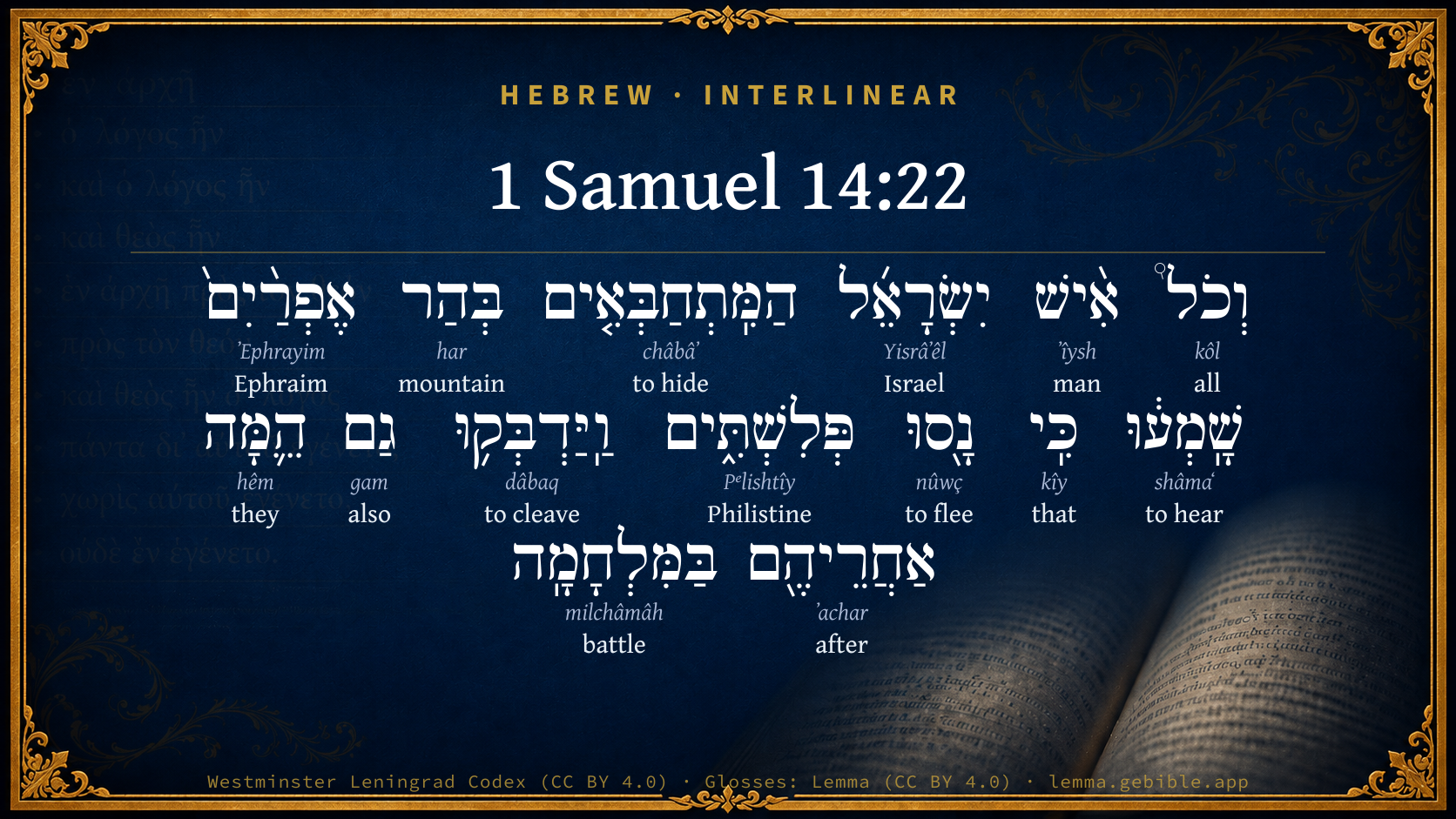
1 Samuel 14:22

Hebrew (Westminster Leningrad Codex) 1 Samuel 14:22 appears in the Hebrew Old Testament. The text above is from the Westminster Leningrad Codex. Each word links to its Strong’s number, a concise gloss, and parsing drawn from the Open Scriptures Hebrew Bible morphology. Click any word for its full Brown-Driver-Briggs (BDB) entry.
Download image
Cite this verse

1 Samuel 14:22 (World English Bible). Public Domain. Lemma interlinear Bible study tool, https://lemma.gebible.app/v/1-samuel/14/22.

Show BibTeX & RIS
BibTeX
RIS
English Translation
Likewise all the men of Israel who had hid themselves in the hill-country of Ephraim, when they heard that the Philistines fled, even they also followed hard after them in the battle.
World English Bible · Public Domain
Download a study sheet

One document with this verse’s original text, its word-by-word gloss line, the meaning frame, cross-references with their text, attributed commentary, and full source and license credits — printable, and it pastes into notes with its structure intact.

This verse Autodidact and up

Study sheet (.html) Plain text (.txt)

A passage Seminary Student

Up to 50 verses in one chapter. A passage sheet keeps up to 6 commentary sources and 12 cross-references per verse, in the order this page ranks them, and says so on the sheet whenever that leaves anything out. Ask for a single verse and you get the Autodidact verse sheet above.

Everything on this page stays free to read, with no account — the sheet is a download of what is already on screen, not access to it.

Want to remove ads? Support Godless Engineer
Compare translations 3

The same verse in 3 English versions, stacked beneath the original-language interlinear above. Click any original word for its lexicon entry.

Each is an independent rendering of the whole verse — the interlinear is not word-aligned to these translations.

Highlighted words mark where these versions differ — a whole-verse word diff, not a word-by-word alignment.

  • World English Bible Public Domain
    Likewise all the men of Israel who had hid themselves in the hill-country of Ephraim, when they heard that the Philistines fled, even they also followed hard after them in the battle.
  • King James Version Public Domain
    Likewise all the men of Israel which had hid themselves in mount Ephraim, when they heard that the Philistines fled, even they also followed hard after them in the battle.
  • unfoldingWord Literal Text CC BY-SA 4.0
    And all of the men of Israel having hidden themselves in the hill country of Ephraim heard that the Philistines had fled, and they pursued after them, they too, in the battle.

unfoldingWord Literal Text — © unfoldingWord, licensed CC BY-SA 4.0. Word-aligned USFM3 via Door43 (git.door43.org/unfoldingWord/en_ult).

Versions to compare (up to 4)

3 of 4 selected

Show all 18 translations

Every available English version of this verse, each an independent rendering of the whole verse.

  • World English Bible Public Domain
    Likewise all the men of Israel who had hid themselves in the hill-country of Ephraim, when they heard that the Philistines fled, even they also followed hard after them in the battle.
  • Berean Standard Bible Public Domain
    When all the Israelites who had been hiding in the hill country of Ephraim heard that the Philistines were fleeing, they also joined Saul and Jonathan in the battle.
  • Majority Standard Bible Public Domain
    When all the Israelites who had been hiding in the hill country of Ephraim heard that the Philistines were fleeing, they also joined the battle in close pursuit.
  • King James Version Public Domain
    Likewise all the men of Israel which had hid themselves in mount Ephraim, when they heard that the Philistines fled, even they also followed hard after them in the battle.
  • American Standard Version (1901) Public Domain
    Likewise all the men of Israel that had hid themselves in the hill-country of Ephraim, when they heard that the Philistines fled, even they also followed hard after them in the battle.
  • Revised Version (1885) Public Domain
    Likewise all the men of Israel which had hid themselves in the hill country of Ephraim, when they heard that the Philistines fled, even they also followed hard after them in the battle.
  • Geneva Bible (1599) Public Domain
    Also all the men of Israel which had hid themselues in mount Ephraim, when they heard, that the Philistims were fled, they followed after them in the battell.
  • Douay-Rheims (1899) Public Domain
    And all the Israelites that had hid themselves in mount Ephraim, hearing that the Philistines fled, joined themselves with their countrymen in the fight. And there were with Saul about ten thousand men.
  • Young's Literal Translation Public Domain
    and all the men of Israel, who are hiding themselves in the hill-country of Ephraim, have heard that the Philistines have fled, and they pursue -- even they -- after them in battle.
  • Literal Standard Version CC BY-SA 4.0
    and all the men of Israel, who are hiding themselves in the hill-country of Ephraim, have heard that the Philistines have fled, and they pursue—even they—after them in battle.
  • Unlocked Literal Bible CC BY-SA 4.0
    When all the men of Israel who had hidden themselves in the hills near Ephraim heard that the Philistines were fleeing, even they chased after them in battle.
  • unfoldingWord Literal Text CC BY-SA 4.0
    And all of the men of Israel having hidden themselves in the hill country of Ephraim heard that the Philistines had fled, and they pursued after them, they too, in the battle.
  • Darby Bible Public Domain
    And all the men of Israel who had hid themselves in mount Ephraim heard that the Philistines fled, and they also followed hard after them in the battle.
  • World Messianic Bible Public Domain
    Likewise all the men of Israel who had hidden themselves in the hill country of Ephraim, when they heard that the Philistines fled, even they also followed hard after them in the battle.
  • Webster's Bible Public Domain
    Likewise all the men of Israel who had hid themselves in mount Ephraim, when they heard that the Philistines fled, even they also followed hard after them in the battle.
  • Free Bible Version CC BY-SA 4.0
    When all the Israelites who had been hiding in the hill country of Ephraim heard that the Philistines were running away, they also joined in chasing after the Philistines to attack them.
  • Bible in Basic English Public Domain
    And all the men of Israel who had taken cover in the hill-country of Ephraim, hearing that the Philistines had been put to flight, went after them, attacking them.
  • JPS Tanakh (1917) Public Domain
    Likewise all the men of Israel that had hid themselves in the hill-country of Ephraim, when they heard that the Philistines fled, even they also followed hard after them in the battle.

Literal Standard Version (2020), Covenant Press — licensed CC BY-SA 4.0. Text via the HelloAO Bible API (eBible.org). Unlocked Literal Bible (unfoldingWord) — licensed CC BY-SA 4.0. Text via the HelloAO Bible API (eBible.org). unfoldingWord Literal Text — © unfoldingWord, licensed CC BY-SA 4.0. Word-aligned USFM3 via Door43 (git.door43.org/unfoldingWord/en_ult). Free Bible Version, Dr. Jonathan Gallagher — licensed CC BY-SA 4.0. Text via the HelloAO Bible API (eBible.org).

Word by word

More ways to search: Search by grammar → Find every occurrence → Compare this word →

Practice this passage: Drill this verse → Learn its vocabulary →

הַמִּֽתְחַבְּאִ֤ים
châbâʼ
H2244
“the · hiding”
Particle, Definite Article + Verb, Hithpael, Participle Active, Masculine, Plural, Absolute
Part of Speech
Particle + Verb
Stem
Hithpael
Form
Participle Active
Gender
Masculine
Number
Plural
State
Absolute
Full BDB Definition

Origin: a primitive root [compare H2245 ]

TWOT: 588

to withdraw, hide - (Niphal) to hide oneself - (Pual) to be forced into hiding - (Hiphil) to hide - (Hophal) to be hidden - (Hithpael) - to hide oneself, draw back - to draw together, thicken, harden
  1. וְכֹל֩ kôl H3605 “and · all of” Conjunction + Noun, Common, Masculine, Singular, Construct
  2. אִ֨ישׁ ʼîysh H376 “man of” Noun, Common, Masculine, Singular, Construct
  3. יִשְׂרָאֵ֜ל Yisrâʼêl H3478 “Israel” Noun, Proper
  4. בְּהַר har H2022 “in/at · mountain of” Preposition + Noun, Common, Masculine, Singular, Construct
  5. אֶפְרַ֨יִם֙ ʼEphrayim H669 “Ephraim” Noun, Proper
  6. שָֽׁמְע֔וּ shâmaʻ H8085 “to hear” Verb, Qal, Perfect, 3rd Person, Common, Plural
  7. כִּֽי kîy H3588 “that” Conjunction
  8. נָ֖סוּ nûwç H5127 “to flee” Verb, Qal, Perfect, 3rd Person, Common, Plural
  9. פְּלִשְׁתִּ֑ים Pᵉlishtîy H6430 “Philistines” Noun, Gentilic, Masculine, Plural, Absolute
  10. וַֽיַּדְבְּק֥וּ dâbaq H1692 “and · to cleave” Conjunction + Verb, Hiphil, Sequential Imperfect, 3rd Person, Masculine, Plural
  11. גַם gam H1571 “also” Adverb
  12. הֵ֛מָּה hêm H1992 “they” Pronoun, Personal, 3rd Person, Masculine, Plural
  13. אַחֲרֵיהֶ֖ם ʼachar H310 “after · them” Preposition + Suffix, Personal, 3rd Person, Masculine, Plural
  14. בַּמִּלְחָמָֽה milchâmâh H4421 “in/at the · battle” Preposition, Determined + Noun, Common, Feminine, Singular, Absolute

About this verse

These counts appear in no published source. They are computed here, from the morphology-tagged text and Lemma’s own curated glosses. What Lemma adds →

15
words
15
distinct lemmas
Historical
section

Shared distinctive vocabulary

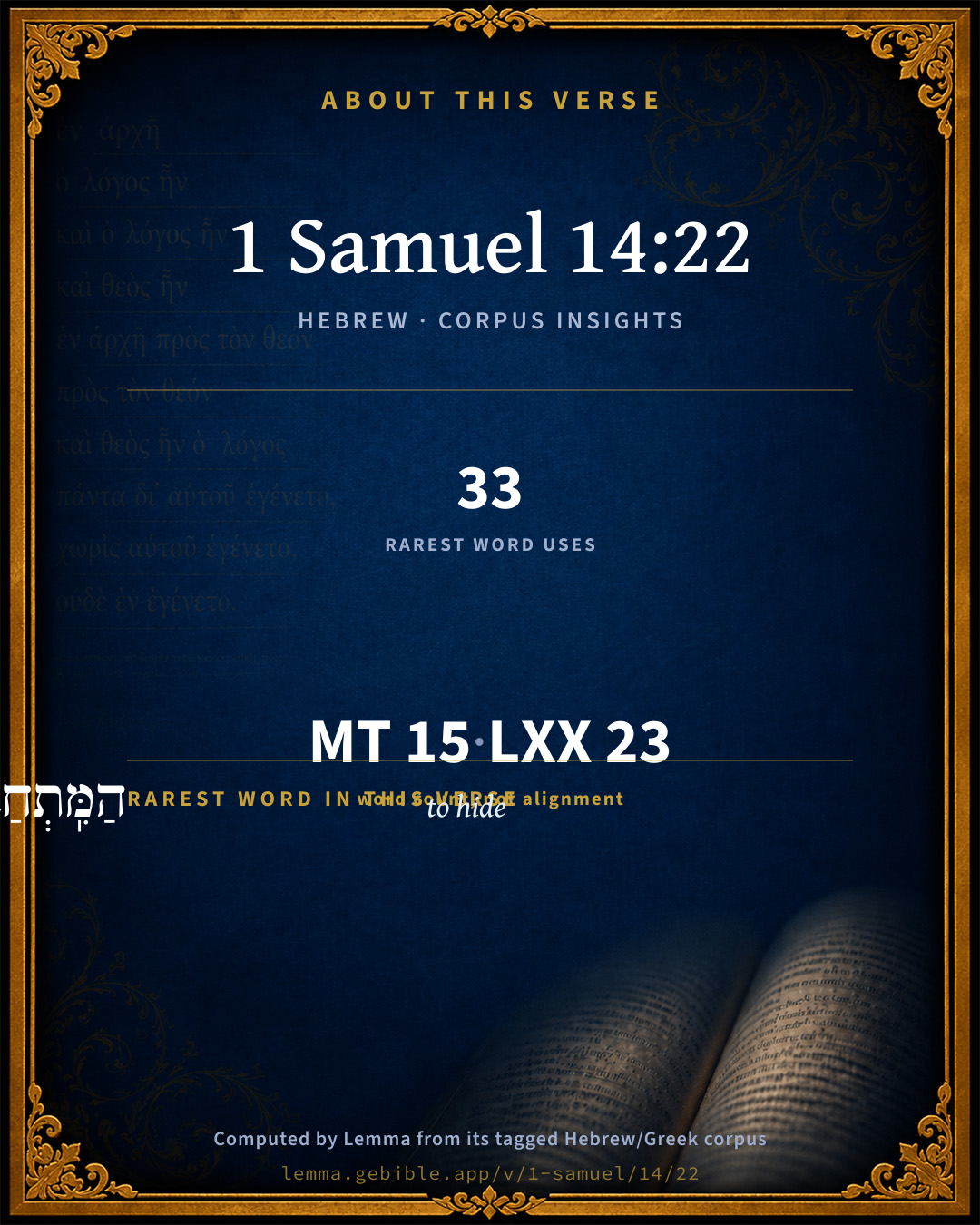
הַמִּֽתְחַבְּאִ֤ים to hide H2244 occurs in 33 verses of the Hebrew Bible. Also found in:

Grammatical profile

  • 4 verbs
  • 7 nouns
  • 1 pronoun
  • 1 preposition
  • 1 conjunction
  • 1 adverb

Verb forms

  • הַמִּֽתְחַבְּאִ֤ים Hithpael · Participle Active
  • שָֽׁמְע֔וּ Qal · Perfect
  • נָ֖סוּ Qal · Perfect
  • וַֽיַּדְבְּק֥וּ Hiphil · Sequential Imperfect

Hebrew & Septuagint length

In English translation the verse runs 32 words from the Hebrew and 50 from the Septuagint (LXX English) — the Septuagint runs noticeably longer here. See the side-by-side →

A rough comparison of the two English renderings, which tokenize alike — not a word-level alignment.

Word counts can differ between the Hebrew and the Greek without any difference in meaning — e.g. the Hebrew direct-object marker אֵת has no separate Greek word, and Greek often adds the article ὁ.

In the original languages it is 15 Hebrew tokens and 23 Greek tokens — but the two are counted differently (Hebrew bundles its prefixes and suffixes into one token; the Greek is in lemma form), so that isn’t a like-for-like length.

Cross-references

2

Topical passages linked to 1 Samuel 14:22 in the Treasury of Scripture Knowledge — connected by theme and wording, ordered by reader-vote popularity; previews shown in the World English Bible.

  • 1 Samuel 13:6 When the men of Israel saw that they were in a strait (for the people were distressed), then the people did hide themselves in caves, and in thickets, and in rocks, and in coverts, and in pits.
  • 1 Samuel 31:7 When the men of Israel who were on the other side of the valley, and those who were beyond the Jordan, saw that the men of Israel fled, and that Saul and his sons were dead, they forsook the cities, and fled; and the Philistines came and lived in them.

Cross-references courtesy of OpenBible.info (CC BY 4.0).

Hebrew and Greek witnesses Masoretic Hebrew ↔ Greek Septuagint

The same verse in the two great witnesses to the Old Testament, shown verse-for-verse.

Here the Septuagint runs noticeably longer than the Hebrew — LXX2012 (modern English Septuagint) 50 words vs World English Bible 32. A rough length comparison of the two English translations, not a word-level alignment — read both below.

These are two independent witnesses, not word-aligned to each other, and the Septuagint is shown in lemma (dictionary) form.

Hebrew 1 Samuel 14:22 Masoretic · Westminster Leningrad Codex

וְכֹל֩ אִ֨ישׁ יִשְׂרָאֵ֜ל הַמִּֽתְחַבְּאִ֤ים בְּהַר אֶפְרַ֨יִם֙ שָֽׁמְע֔וּ כִּֽי נָ֖סוּ פְּלִשְׁתִּ֑ים וַֽיַּדְבְּק֥וּ גַם הֵ֛מָּה אַחֲרֵיהֶ֖ם בַּמִּלְחָמָֽה

Likewise all the men of Israel who had hid themselves in the hill-country of Ephraim, when they heard that the Philistines fled, even they also followed hard after them in the battle.

World English Bible · Public Domain

Greek LXX 1 Samuel 14:22 Septuagint · lemma form

καί πᾶς ἰσραήλ ὁ κρύπτω ἐν ὁ ὄρος ἐφράιμ καί ἀκούω ὅτι φεύγω ὁ ἀλλόφυλος καί συνἅπτω καί αὐτός ὀπίσω αὐτός εἰς πόλεμος

And all the Israelites who were hidden in mount Ephraim heard also that the Philistines fled; and they also gather themselves after them to battle: and the Lord saved Israel in that day; and the war passed through Bamoth; and all the people with Saul were about ten thousand men.

LXX2012 (modern English Septuagint) · Public Domain

On this verse, Adam Clarke's Commentary discusses the Septuagint’s reading. Read the note in Commentary ↓

Hebrew: Westminster Leningrad Codex (CC BY 4.0). Greek: Septuagint (public domain); English from LXX2012 (modern English Septuagint) (Public Domain). How the Septuagint differs from the Hebrew →

Targum (Aramaic paraphrase)

1

The Targum is the ancient Jewish Aramaic paraphrase of the Hebrew Scriptures — an interpretive translation, not the Hebrew text itself. Onkelos (literal) and Pseudo-Jonathan (expansive) render the Torah, and Jonathan the Prophets. Coverage is partial: where no permissively-licensed English translation exists for a verse, only the Aramaic is shown. This is verse-level text, not a word-by-word alignment to the Hebrew.

  1. Targum Jonathan Prophets (Joshua–Malachi)
    וְכָל אֱנַשׁ יִשְׂרָאֵל דְאִטְמָרוּ בְּטוּרָא דְבֵית אֶפְרַיִם שְׁמָעוּ אֲרִי אַפִיכוּ פְלִשְׁתָּאֵי וְאַדְבִּיקוּ אַף אִינוּן בַּתְרֵיהוֹן בִּקְרָבָא:

    (no public-domain English translation for this verse)

    Targum Jonathan — Aramaic: “Mikraot Gedolot” (public domain). English: “Sefaria Community Translation” (CC0 1.0 (public-domain dedication)); “London "Chaldee Paraphrase," 1871” (public domain). Text via Sefaria.

Commentary

Notes on 1 Samuel 14:22 from classic Christian and Jewish commentators (each source and its license shown beneath its notes). The classic Christian expositions comment on the surrounding passage and are grouped to its opening verse, so a note may address several verses; the Jewish commentaries on the Tanakh (Rashi and others) are per-verse, so they appear only where the commentator wrote on this verse.

Lemma curates 59 commentaries, every one of them public domain or Creative Commons licensed, each selected and text-cleaned for this edition rather than reprinted as found. About our sources →

Trapp's Complete Commentary

John Trapp

1Sa 14:22 Likewise all the men of Israel which had hid themselves in mount Ephraim, [when] they heard that the Philistines fled, even they also followed hard after them in the battle.

Ver. 22. Even they also followed hard after them.] The Greeks have a proverb, When a tree is falling, every passenger will be pulling at it. {a} Leoni mortuo vel mus insultat.

{a} Dρυος πεσουσης πας ανηπ ξυλευεται.

John Trapp, A Commentary or Exposition upon All the Books of the Old and New Testament (1647–1656) — public domain. Text from a community e-Sword module.

Adam Clarke's Commentary

Verse 22. The men - which had hid themselves] See 1Sa 13:6.

The Vulgate and the Septuagint add here, And there were with Saul about ten thousand men; but this is supported by no other authority.

Adam Clarke's Commentary on the Bible (1810–1826) — public domain. Text from a community e-Sword/MySword module.

John Gill's Exposition

Likewise all the men of Israel which had hid themselves in Mount Ephraim,.... In the caves and rocks, thickets and pits there, see Sa1 13:6 when

they heard that the Philistines fled; now being delivered from their fears, and thinking themselves safe, ventured out of their lurking places:

even they also followed hard after them in the battle; they joined the pursuers who came their way, and stuck to them, and closely pursued the flying army of the Philistines. According to Josephus (p), the army of Saul was now increased to 10,000.

(p) Antiqu. l. 6. c. 6. sect. 3.

John Gill's Exposition of the Whole Bible (1746–1763) — public domain (CC PDM 1.0). Text via the HelloAO Bible API.

Haydock's Catholic Bible Commentary

And there, &c. This is not found in Hebrew, &c., nor in many Latin copies. The Septuagint specify the number, (ver. 24) where it is not in the original. (Calmet)

George Leo Haydock (1774–1849), Haydock's Catholic Family Bible and Commentary, 1859 edition — public domain. Excludes Psalms (Douay-Rheims chapter numbering differs from Protestant) and Deuterocanonical books (Catholic canon only).

unfoldingWord translationNotes

Door43 World Missions Community

the men of Israel who had hidden themselves in the hills

This does not refer to an ambush. These soldiers were hiding because they were afraid of the Philistines. This can be stated explicitly. AT: "the Israelite soldiers who were afraid and had hidden themselves in the hills" (See: Assumed Knowledge and Implicit Information)

Beth Aven

This is a place in Israel. See how you translated this in 1 Samuel 13:05. (See: How to Translate Names)

translationWords

Ephraim

Yahweh

unfoldingWord translationNotes — © Distant Shores Media and the Door43 World Missions Community, licensed CC BY-SA 4.0. Source: git.door43.org/Door43/en_tn.

Lesson kit

Teaching starters — assembled from the data on this page, not authored interpretation. Every prompt links to the verse data it draws on. Edit before teaching.

1 Samuel, in the Historical, opens this verse with 15 words (15 distinct Hebrew lemmas). Its most distinctive word is châbâʼ (“to hide”). The Greek Septuagint runs longer here. A historical commentator’s framing appears above. Read the whole chapter for the surrounding context.

Discussion questions

  1. What does “to hide” (châbâʼ) contribute to the verse as a whole?
  2. How does Genesis 3:8, which shares the word «to hide», read alongside this verse?
  3. The Septuagint runs longer here than the Hebrew. What might account for the difference?
  4. These translations render this verse differently; the difference is in the English rendering, not the original. What questions does that raise?
  5. «הַמִּֽתְחַבְּאִ֤ים» is a Hithpael Participle Active verb. How does that grammatical form shape the action described?
  6. Compare how Trapp's Complete Commentary and Adam Clarke's Commentary read this verse. Where do they agree or differ?

Things to notice

Reading settings

Reading text

Shown beneath each verse's original-language words.

Old Testament
Old Testament edition

Read the OT as the Masoretic Hebrew (MT) or the Greek Septuagint (LXX).

English shown for the Greek Septuagint (in the Hebrew ↔ Greek comparison).

Comparing translations? Open the Compare panel on any verse page to stack up to four side by side.