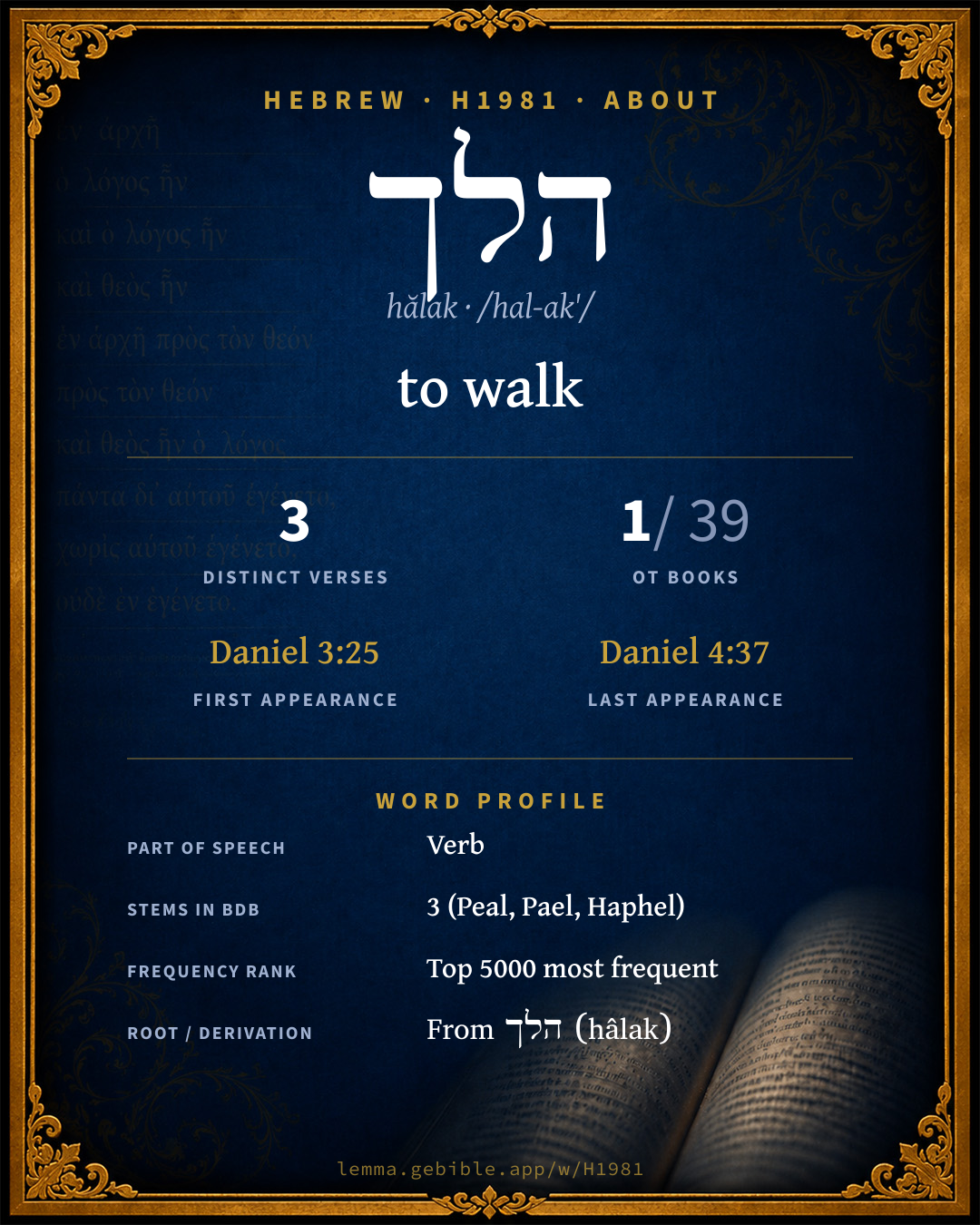
הֲלַךְ
to walk
‘to walk’ is one of 3 main senses fuller range ↓
Full lexicon entry — Brown-Driver-Briggs (BDB)
From Brown-Driver-Briggs (BDB)
Where this word appears
Grammar key — what these labels mean
Part of speech
- Verb
- An action or state-of-being word.
Stem
- Piel
- An intensive or resultative active stem.
Form
- Participle Active
- A verbal adjective expressing ongoing or characteristic action (“writing / one who writes”).
State
- Absolute
- The independent form of a noun, not bound to a following word.
Gender
- Masculine
- Grammatically masculine.
Number
- Plural
- More than one (in Hebrew, generally three or more).
- Singular
- One.
Grammatical forms
- Verb, a, Participle Active, Masculine, Plural, Absolute 2 times (67%)
- Verb, Piel, Participle Active, Masculine, Singular, Absolute 1 time (33%)
Parsed forms decoded from the imported morphology (morphhb / Westminster Leningrad Codex — WLC text public domain, morphhb tagging CC BY 4.0), counted across 3 parsed occurrences — not distinct verses.
Every verse where H1981 appears — 3 distinct verses across 1 book. Click any verse to open its interlinear word-by-word view. Verse text shown in the World English Bible for context — . Each verse’s Hebrew form is shown with its reference; the English is not keyword-highlighted, since the data carries no word-level English alignment. Use “Compare translations” on any verse to read it across multiple English versions. This concordance covers the Hebrew Bible; Septuagint (Greek Old Testament) occurrences are not indexed here.
Daniel 3 verses
- Daniel 3:25 מַהְלְכִ֣ין a ptcp.act mp He answered, Look, I see four men loose, walking in the midst of the fire, and they have no hurt; and the aspect of the fourth is like a son of the gods.
- Daniel 4:29 מְהַלֵּ֥ךְ Piel ptcp.act ms At the end of twelve months he was walking in the royal palace of Babylon.
- Daniel 4:37 מַהְלְכִ֣ין a ptcp.act mp Now I, Nebuchadnezzar, praise and extol and honor the King of heaven; for all his works are truth, and his ways justice; and those who walk in pride he is able to abase.
About this entry
At a glance — auto-summarized from this page’s data, not written by a person. Every figure links to its source below. This summary describes the numbers; it doesn’t interpret them.
“to walk” is the headline sense of the Hebrew verb הלך (hălak). With only 3 verses it sits in the long tail of Hebrew Bible vocabulary. It clusters heavily in Daniel, which alone accounts for 100% of its uses. First canonically at Daniel 3:25, it enters the text early. Across 3 stems, its meaning turns on the binyan (Peal, Pael). The sections below give every sense, occurrence, and version rendering.
Gloss history
Strong's 1890 vs modern scholarship
About this word
Strong's H1981 catalogs a Hebrew word from the Hebrew Old Testament.
These counts are not copied from any lexicon or concordance. They are computed here, from the morphology-tagged Hebrew Old Testament. What Lemma adds →
- 3
- distinct verses
- The word appears in 3 distinct verses.
- 1 / 39
- OT books
- The word appears in 1 of 39 Old Testament books.
- #4,179
- by frequency
- Top 5000 most frequent Hebrew words (rank 4,179 of 8,640 Hebrew words by occurrence).
View all 3 occurrences in the concordance →
Most concentrated in
- Daniel 3 verses 100%
By section of the Old Testament
By traditional corpus
Conventional, traditional groupings — biblical authorship is debated, so this is a traditional corpus grouping, not an authorship claim. Each share is this word’s portion of its verses in that division of the Hebrew canon. Each figure is a share of the word’s 3 distinct verses.
- Writings (Ketuvim) 3 verses · 100%
How translations render this word
Counts come from each version’s own published word-to-Strong’s tagging or interlinear alignment — an approximate guide to how each version renders this word, not a word-level alignment the data otherwise carries. Because each total is that version’s own tagged count, the per-version totals vary from one another and need not match the appearance or distinct-verse counts above. These counts may also differ from a printed concordance because Lemma counts each distinctly tagged rendering and does not collapse phrase taggings into a single head-word total. This is a fixed set of word-tagged versions (KJV, ASV, BSB, ULT) and does not change with the reading translation you choose elsewhere. Each version’s license is shown beside its name below (and on Sources).
- King James Version: Walk 1×, Walking 1×
- American Standard Version: Walk 1×, Walking 1×
- Berean Standard Bible: Walk 1×, Walking 1×, Walking around 1×
- unfoldingWord Literal Text: Walking 2×
King James Version Public Domain
Renders H1981 across 2 tagged occurrences — most commonly:
Not rendered by a distinct English word in 1 further occurrence.
American Standard Version Public Domain
Renders H1981 across 2 tagged occurrences — most commonly:
Berean Standard Bible Public Domain
Renders H1981 across 3 tagged occurrences — most commonly:
unfoldingWord Literal Text CC BY-SA 4.0
Renders H1981 across 3 tagged occurrences — most commonly:
Plus 1 rendering that appears only once — usually multi-word phrases or single function words the recovered tagging swept in, not distinct renderings.
Senses in the full BDB
Hebrew verbs can shift meaning by stem (binyan): Qal is the basic action, Niphal is often passive or reflexive, Piel often intensifies or makes it factitive, and Hiphil is typically causative. The senses below are grouped under the stem BDB assigns to each. This entry also uses Peal (the basic Aramaic stem, parallel to Qal), Pael (the intensive Aramaic stem, parallel to Piel), and Haphel (the causative Aramaic stem, parallel to Hiphil).
What do BDB’s symbols mean?
BDB uses these scholarly abbreviations:
| Symbol | Meaning |
|---|---|
| 𝔊 | the Septuagint (the ancient Greek translation, LXX) |
| 𝔙 | the Vulgate (the Latin translation) |
| 𝔖 | the Syriac version (the Peshitta) |
| 𝔗 | the Targum (the Aramaic translation) |
| ψ | the Psalms |
| √ | root (the underlying root or stem) |
| ‖ | parallel passage (a synonymous or contrasted parallel) |
| † | the dagger: every passage where the word occurs is cited |
The 3 senses and sub-senses the full Brown-Driver-Briggs lexicon distinguishes for this word, in lexicon order (not ranked by frequency), with BDB’s own verbatim wording and sub-sense lettering. Shown in Hebrew script with BDB’s own scholarly abbreviations. The condensed entry is in the Lexicon Entry tab. See also the Forms in the corpus table below.
Peal
- . syncop. go
Pael
- . walking about
Haphel
- . walk in pride
Senses from the full Brown-Driver-Briggs lexicon (Brown, Driver, Briggs; Oxford 1906 — public domain), digitized via Sefaria, supplemented by the OpenScriptures HebrewLexicon (CC BY 4.0). Full attribution on Sources.
Word origin
Derived from הלך (hâlak) (H1980) — to walk.
Jastrow Dictionary
A second Hebrew/Aramaic lexicon for comparison, covering Aramaic and post-biblical (Talmudic, Targumic, Midrashic) usage that the biblical-Hebrew BDB does not. Matched by lemma rather than by Strong’s number, so a lemma may carry more than one Jastrow headword (shown separately below), and the entries cover usage well beyond the Bible.
הֵילֵךְ
- = אֵילֵךְ. Y. Yeb. X, end, 11ᶜ.—Zab. III, 2 ה׳ … ה׳ this way …, the other way; a. fr.
הֵלֵךְ
- , v. הֵילֵךְ
הָלַךְ
- (b. h.) to go, go away; to walk. Yeb. 84ᵃ כשהָלַכְתִּי וכ׳ when I left home to study with &c. Macc. 10ᵇ, a. e. בדרך שאדם רוצה לֵילֵךְ בה מוֹלִיכִין אותו whatever way one desires to go, one is led; a. v. fr.—הוֹלְכֵי מדברות travellers through the desert. Taan. 27ᵇ; a. e.—Y. Kidd. I, 61ᵈ כהולכים בתורת ד׳ (not בה׳) as though they did walk in the law &c.—Imper. לֵךְ, לְכָה, v. כָּלָה Pi., a. כַּלֵּךְ.
- 1. same, same, to walk, tread upon. Ḥull. IX, 2 (122ᵃ) או שהי׳ בהן (Mish. ed. שהלך) or trod upon them for tanning purposes. Erub. 100ᵇ שיְהַלֵּךְ ע"ג וכ׳ to tread upon plants. Gen. R. s. 39 מְהַלֵּךְ בארם וכ׳ travelling through Aram &c.—Keth. 60ᵃ; Ker. 22ᵃ מְהַלְּכֵי שתים walking on two legs (human beings); a. fr.
- 2. to cause opening of the bowels. Y. Kil. I, 27ᵃ top מְהַלֶּכֶת את בני מיעים; cmp. הִילּוּךְ. [Y. Keth. XII, 35ᵇ top מהלך לפניהן אל הארץ, v. חָלַד.]
- 1. to lead; to carry. Macc. 10ᵇ, v. supra. Gitt. 4ᵃ המוֹלִיךְ וכ׳ he who carries abroad a letter of divorce, contrad. to המביא he who brings a letter from abroad. Ab. Zar. III, 9 יוֹלִיךְ הנאה וכ׳ let him cast the profit (one loaf’s value) into the Sea. Gitt. VI, 1 הוֹלֵךְ גט וכ׳ carry this letter of divorce (as a messenger). Ib. 63ᵃ sq. (distinction between הילך, here is the letter of divorce, i.e. take possession of it in behalf of my wife, and הולך carry it, i.e. be my messenger). Ib. 64ᵃ, a. e. הולך כזכי דמי ‘carry’ (the letter of divorce) is equal to ‘take possession’ (in behalf of her who authorized thee); a. fr.
- to go away, withdraw. Cant. R. to V, 1; Gen. R. s. 19 (ref. to Gen. III, 8) מְהַלֵּךְ … אלא מִתְהַלֵּךְ וכ׳ it does not say m’hallekh (walking) but mith-hallekh, He hastened and went upward. Ib. מתהלך לו (ed. מת הלך, corr. acc., v. Matt. K.) is he (Adam) going away (from God)?, v. אתמהא. e.g. Genesis 3:8
הֲלַךְ
- , to walk. Targ. Ps. CXXVI, 6 (Ms. Pa.). Targ. Y. II, Gen. XXII, 8 הֲלִיכוּ (some ed. הַלִ׳). Contr. יְהָךְ, מְהָךְ, v. הך.
- same. Targ. O. Gen. V, 22. Targ. I Sam. XXX, 31; a. fr.
- same. Targ. Ps. CI, 2. Ib. CXVI, 9.
הֲלָךְ
- (Ezra IV, 13) name of atax, prob. sustenance of marching troops. B. Bath. 8ᵃ; Ned. 62ᵇ expl. as אַרְנוֹנָא. Gen. R. s. 64, a. e., v. אַנְגַּרְיָא. e.g. Ezra 4:13
הֵלֶךְ
- traveller. Succ. 52ᵇ (ref. to II Sam. XII, 4) מתחלה קראו ה׳ וכ׳ at first he calls him (the tempting sin) a traveller &c. e.g. 2 Samuel 12:4
A Dictionary of the Targumim, the Talmud Babli and Yerushalmi, and the Midrashic Literature (Marcus Jastrow; London, Luzac, 1903) — Public Domain. Digitized via Sefaria. Digitized via Sefaria. Full attribution on Sources.
Forms in the corpus
The 2 distinct written forms H1981 takes in the Hebrew Bible, most frequent first — each parse links to that stem’s occurrences in the concordance. Hebrew forms include their vowel points and cantillation, so a single lemma takes many written forms.
| Form | Parsing | Example | Uses |
|---|---|---|---|
| מַהְלְכִ֣ין | Verb, a, Participle Active, Masculine, Plural, Absolute | Daniel 3:25 | 2 |
| מְהַלֵּ֥ךְ | Verb, Piel, Participle Active, Masculine, Singular, Absolute | Daniel 4:29 | 1 |
Same root — word family
Other BDB entries built from the same root as H1981, grouped by Strong’s listed origin. These share a root / origin per the lexicon — not necessarily a shared meaning. Each links to that word’s own entry.
Derives from
Shares the same root
- הליך hâlîyk H1978 step
- הלך hêlek H1982 traveller
- ילך yâlak H3212 to walk
- מהלך mahlêk H4108 walk
- מהלך mahălâk H4109 walk
- תהלכה tahălukâh H8418 procession
Derived from this word
Compare all same-root words → Showing 4 of 11 — not the complete family. They share a root, not necessarily a meaning.
Septuagint verse parallels
This word appears in 2 verses that also exist in the Greek Old Testament (Septuagint), out of the 3 Hebrew verses it occurs in. You can read those verses in Greek by switching the Old Testament edition to the Septuagint.
Read these verses in the Septuagint
This is a verse-level parallel only — the same verses exist in both the Hebrew and Greek Old Testaments. No word-level Hebrew↔Greek correspondence is claimed: the data carries no such alignment, so no Greek word is shown as this Hebrew word’s translation. Coverage is not total — the Septuagint omits the deuterocanon and renumbers the Psalms, so some Hebrew verses have no direct Greek parallel.