
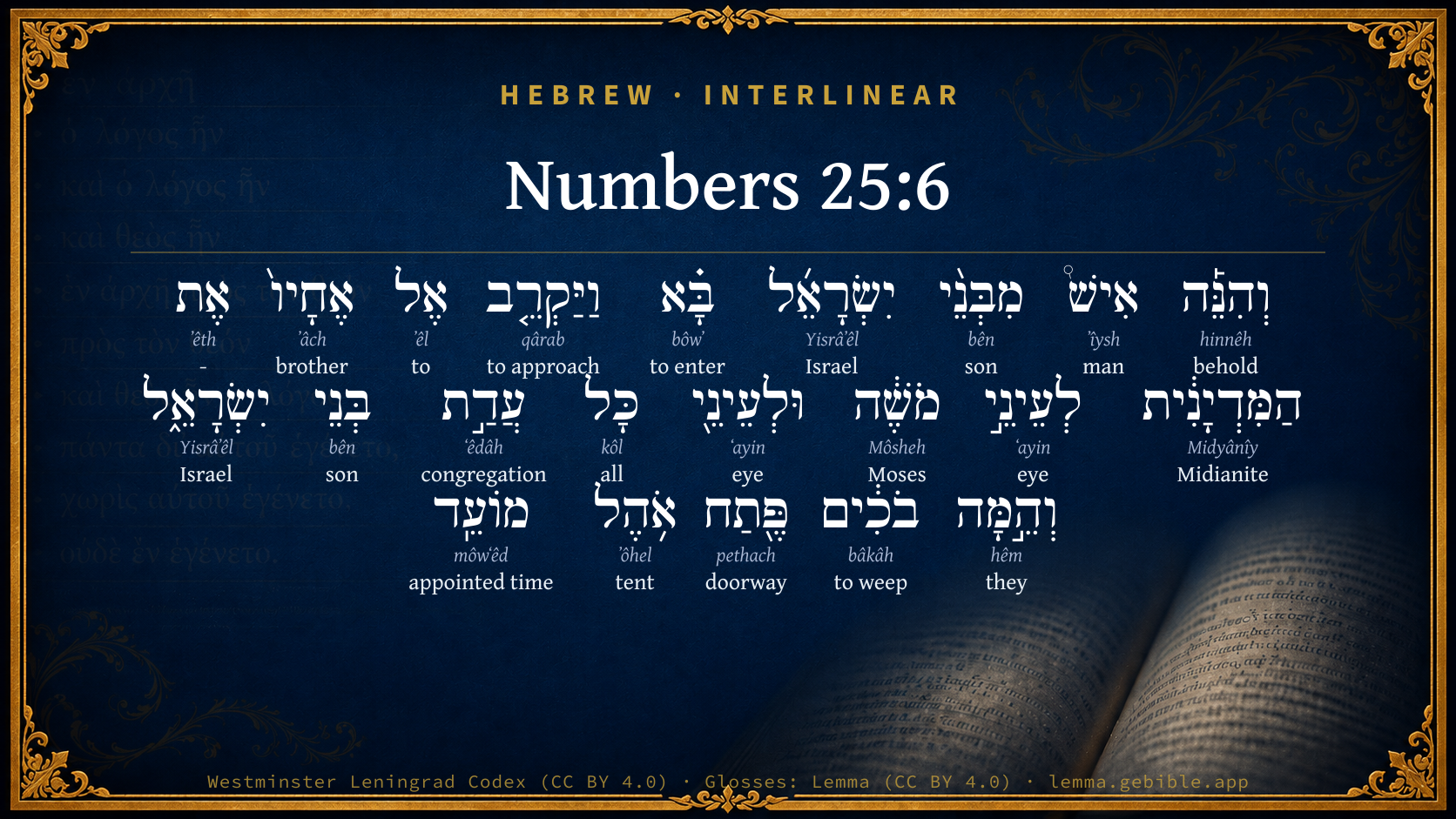
Numbers 25:6

Hebrew (Westminster Leningrad Codex) Numbers 25:6 appears in the Hebrew Old Testament. The text above is from the Westminster Leningrad Codex. Each word links to its Strong’s number, a concise gloss, and parsing drawn from the Open Scriptures Hebrew Bible morphology. Click any word for its full Brown-Driver-Briggs (BDB) entry.
Download image
Cite this verse

Numbers 25:6 (World English Bible). Public Domain. Lemma interlinear Bible study tool, https://lemma.gebible.app/v/numbers/25/6.

Show BibTeX & RIS
BibTeX
RIS
English Translation
Behold, one of the children of Israel came and brought to his brothers a Midianite woman in the sight of Moses, and in the sight of all the congregation of the children of Israel, while they were weeping at the door of the tent of meeting.
World English Bible · Public Domain
Download a study sheet

One document with this verse’s original text, its word-by-word gloss line, the meaning frame, cross-references with their text, attributed commentary, and full source and license credits — printable, and it pastes into notes with its structure intact.

This verse Autodidact and up

Study sheet (.html) Plain text (.txt)

A passage Seminary Student

Up to 50 verses in one chapter. A passage sheet keeps up to 6 commentary sources and 12 cross-references per verse, in the order this page ranks them, and says so on the sheet whenever that leaves anything out. Ask for a single verse and you get the Autodidact verse sheet above.

Everything on this page stays free to read, with no account — the sheet is a download of what is already on screen, not access to it.

Want to remove ads? Support Godless Engineer
Compare translations 3

The same verse in 3 English versions, stacked beneath the original-language interlinear above. Click any original word for its lexicon entry.

Each is an independent rendering of the whole verse — the interlinear is not word-aligned to these translations.

Highlighted words mark where these versions differ — a whole-verse word diff, not a word-by-word alignment.

  • World English Bible Public Domain
    Behold, one of the children of Israel came and brought to his brothers a Midianite woman in the sight of Moses, and in the sight of all the congregation of the children of Israel, while they were weeping at the door of the tent of meeting.
  • King James Version Public Domain
    And, behold, one of the children of Israel came and brought unto his brethren a Midianitish woman in the sight of Moses, and in the sight of all the congregation of the children of Israel, who were weeping before the door of the tabernacle of the congregation.
  • unfoldingWord Literal Text CC BY-SA 4.0
    And behold, a man from the sons of Israel came and brought near to his brothers the Midianite woman, before the eyes of Moses and before the eyes of all the congregation of the sons of Israel. And they were weeping at the opening of the tent of meeting.

unfoldingWord Literal Text — © unfoldingWord, licensed CC BY-SA 4.0. Word-aligned USFM3 via Door43 (git.door43.org/unfoldingWord/en_ult).

Versions to compare (up to 4)

3 of 4 selected

Show all 18 translations

Every available English version of this verse, each an independent rendering of the whole verse.

  • World English Bible Public Domain
    Behold, one of the children of Israel came and brought to his brothers a Midianite woman in the sight of Moses, and in the sight of all the congregation of the children of Israel, while they were weeping at the door of the tent of meeting.
  • Berean Standard Bible Public Domain
    Just then an Israelite man brought to his family a Midianite woman in the sight of Moses and the whole congregation of Israel while they were weeping at the entrance to the Tent of Meeting.
  • Majority Standard Bible Public Domain
    Just then an Israelite man brought to his family a Midianite woman in the sight of Moses and the whole congregation of Israel while they were weeping at the entrance to the Tent of Meeting.
  • King James Version Public Domain
    And, behold, one of the children of Israel came and brought unto his brethren a Midianitish woman in the sight of Moses, and in the sight of all the congregation of the children of Israel, who were weeping before the door of the tabernacle of the congregation.
  • American Standard Version (1901) Public Domain
    And, behold, one of the children of Israel came and brought unto his brethren a Midianitish woman in the sight of Moses, and in the sight of all the congregation of the children of Israel, while they were weeping at the door of the tent of meeting.
  • Revised Version (1885) Public Domain
    And, behold, one of the children of Israel came and brought unto his brethren a Midianitish woman in the sight of Moses, and in the sight of all the congregation of the children of Israel, while they were weeping at the door of the tent of meeting.
  • Geneva Bible (1599) Public Domain
    And behold, one of the children of Israel came and brought vnto his brethren a Midianitish woman in the sight of Moses, and in the sight of all the Congregation of the children of Israel, who wept before the doore of the Tabernacle of the Congregation.
  • Douay-Rheims (1899) Public Domain
    And behold one of the children of Israel went in before his brethren to a harlot of Madian, in the sight of Moses, and of all the children of Israel, who were weeping before the door of the tabernacle.
  • Young's Literal Translation Public Domain
    And lo, a man of the sons of Israel hath come, and bringeth in unto his brethren the Midianitess, before the eyes of Moses, and before the eyes of all the company of the sons of Israel, who are weeping at the opening of the tent of meeting;
  • Literal Standard Version CC BY-SA 4.0
    And behold, a man of the sons of Israel has come, and brings a Midianitess to his brothers before the eyes of Moses and before the eyes of all the congregation of the sons of Israel, who are weeping at the opening of the Tent of Meeting;
  • Unlocked Literal Bible CC BY-SA 4.0
    Then one of the men of Israel came and brought among his family members a Midianite woman. This happened in the sight of Moses and all the community of the people of Israel, while they were weeping at the entrance to the tent of meeting.
  • unfoldingWord Literal Text CC BY-SA 4.0
    And behold, a man from the sons of Israel came and brought near to his brothers the Midianite woman, before the eyes of Moses and before the eyes of all the congregation of the sons of Israel. And they were weeping at the opening of the tent of meeting.
  • Darby Bible Public Domain
    And behold, a man of the children of Israel came and brought a Midianitish woman to his brethren, in the sight of Moses, and in the sight of the whole assembly of the children of Israel, who were weeping before the entrance of the tent of meeting.
  • World Messianic Bible Public Domain
    Behold, one of the children of Israel came and brought to his brothers a Midianite woman in the sight of Moses, and in the sight of all the congregation of the children of Israel, while they were weeping at the door of the Tent of Meeting.
  • Webster's Bible Public Domain
    And, behold, one of the children of Israel came and brought to his brethren a Midianitish woman in the sight of Moses, and in the sight of all the congregation of the children of Israel, who were weeping before the door of the tabernacle of the congregation.
  • Free Bible Version CC BY-SA 4.0
    Right then an Israelite man brought a Midianite woman to his family tent in full view of Moses and all the Israelites as they were crying at the entrance to the Tent of Meeting.
  • Bible in Basic English Public Domain
    Then one of the children of Israel came to his brothers, taking with him a woman of Midian, before the eyes of Moses and all the meeting of the people, while they were weeping at the door of the Tent of meeting.
  • JPS Tanakh (1917) Public Domain
    And, behold, one of the children of Israel came and brought unto his brethren a Midianitish woman in the sight of Moses, and in the sight of all the congregation of the children of Israel, while they were weeping at the door of the tent of meeting.

Literal Standard Version (2020), Covenant Press — licensed CC BY-SA 4.0. Text via the HelloAO Bible API (eBible.org). Unlocked Literal Bible (unfoldingWord) — licensed CC BY-SA 4.0. Text via the HelloAO Bible API (eBible.org). unfoldingWord Literal Text — © unfoldingWord, licensed CC BY-SA 4.0. Word-aligned USFM3 via Door43 (git.door43.org/unfoldingWord/en_ult). Free Bible Version, Dr. Jonathan Gallagher — licensed CC BY-SA 4.0. Text via the HelloAO Bible API (eBible.org).

Word by word

More ways to search: Search by grammar → Find every occurrence → Compare this word →

Practice this passage: Drill this verse → Learn its vocabulary →

הַמִּדְיָנִ֔ית
Midyânîy
H4084
“the · Midianite”
Particle, Definite Article + Adjective, Adjective, Feminine, Singular, Absolute
Part of Speech
Particle + Adjective
Type
Adjective
Gender
Feminine
Number
Singular
State
Absolute
Full BDB Definition

Origin: patronymical or patrial from H4080

TWOT: None

Midianite = see Midian " strife" - a member of the tribe of Midian - an inhabitant of the land of Midian
  1. וְהִנֵּ֡ה hinnêh H2009 “and · behold” Conjunction + Particle, Demonstrative
  2. אִישׁ֩ ʼîysh H376 “man” Noun, Common, Masculine, Singular, Absolute
  3. מִבְּנֵ֨י bên H1121 “from · sons of” Preposition + Noun, Common, Masculine, Plural, Construct
  4. יִשְׂרָאֵ֜ל Yisrâʼêl H3478 “Israel” Noun, Proper
  5. בָּ֗א bôwʼ H935 “to enter” Verb, Qal, Perfect, 3rd Person, Masculine, Singular
  6. וַיַּקְרֵ֤ב qârab H7126 “and · to approach” Conjunction + Verb, Hiphil, Sequential Imperfect, 3rd Person, Masculine, Singular
  7. אֶל ʼêl H413 “to” Preposition
  8. אֶחָיו֙ ʼâch H251 “brothers · his” Noun, Common, Masculine, Plural, Construct + Suffix, Personal, 3rd Person, Masculine, Singular
  9. אֶת ʼêth H853 “-” Particle, Direct Object
  10. לְעֵינֵ֣י ʻayin H5869 “to/for · eyes of” Preposition + Noun, Common, Both, Dual, Construct
  11. מֹשֶׁ֔ה Môsheh H4872 “Moses” Noun, Proper
  12. וּלְעֵינֵ֖י ʻayin H5869 “and · to/for · eyes of” Conjunction + Preposition + Noun, Common, Both, Dual, Construct
  13. כָּל kôl H3605 “all of” Noun, Common, Masculine, Singular, Construct
  14. עֲדַ֣ת ʻêdâh H5712 “congregation of” Noun, Common, Feminine, Singular, Construct
  15. בְּנֵי bên H1121 “sons of” Noun, Common, Masculine, Plural, Construct
  16. יִשְׂרָאֵ֑ל Yisrâʼêl H3478 “Israel” Noun, Proper
  17. וְהֵ֣מָּה hêm H1992 “and · they” Conjunction + Pronoun, Personal, 3rd Person, Masculine, Plural
  18. בֹכִ֔ים bâkâh H1058 “weeping” Verb, Qal, Participle Active, Masculine, Plural, Absolute
  19. פֶּ֖תַח pethach H6607 “doorway of” Noun, Common, Masculine, Singular, Construct
  20. אֹ֥הֶל ʼôhel H168 “tent of” Noun, Common, Masculine, Singular, Construct
  21. מוֹעֵֽד môwʻêd H4150 “appointed time” Noun, Common, Masculine, Singular, Absolute

About this verse

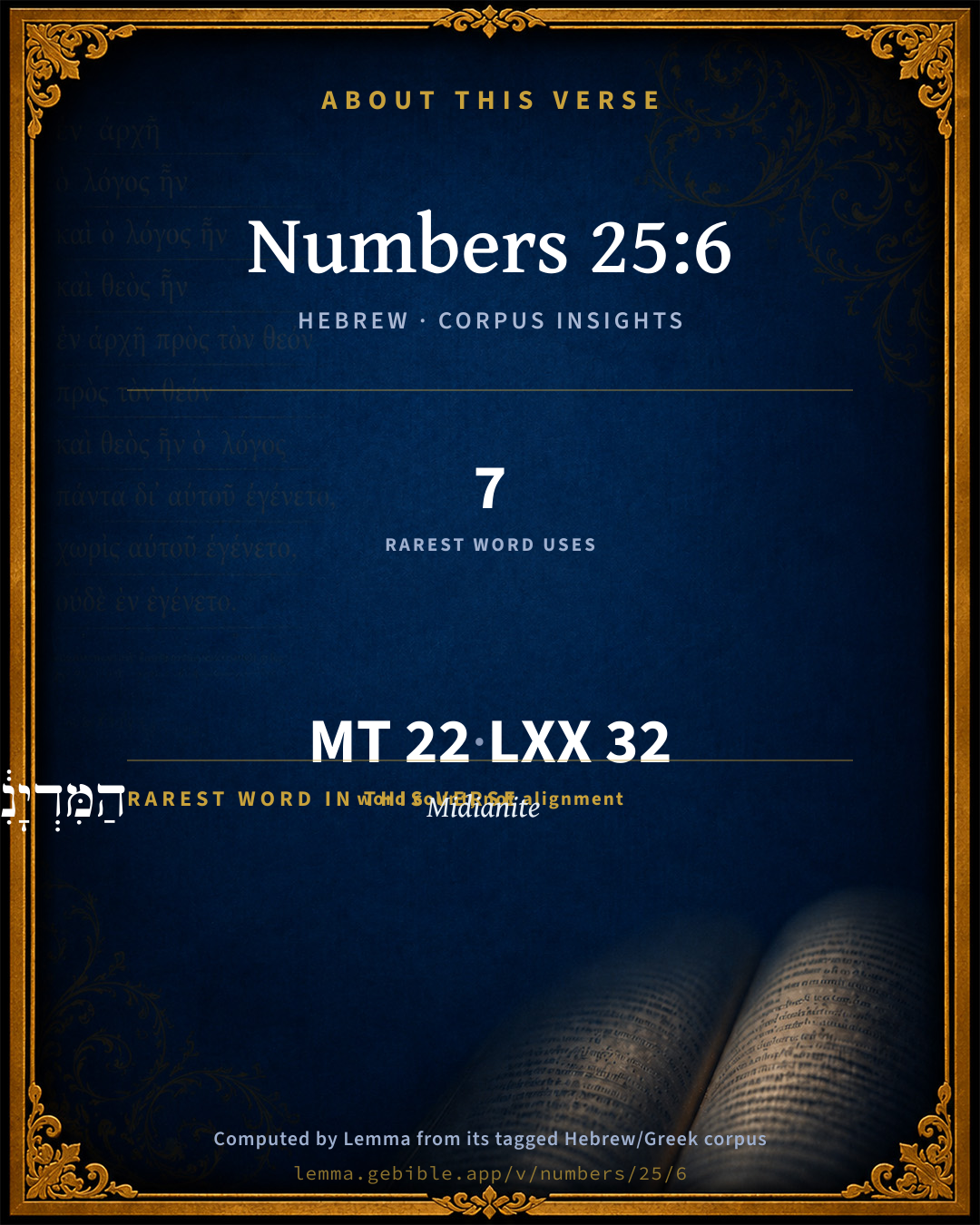
These counts appear in no published source. They are computed here, from the morphology-tagged text and Lemma’s own curated glosses. What Lemma adds →

22
words
19
distinct lemmas
Pentateuch
section

Notable vocabulary

The rarest word here is הַמִּדְיָנִ֔ית Midianite H4084 — appearing just 7 times in the whole Hebrew Bible.

Shared distinctive vocabulary

הַמִּדְיָנִ֔ית Midianite H4084 occurs in 7 verses of the Hebrew Bible. Also found in:

Grammatical profile

  • 3 verbs
  • 14 nouns
  • 1 adjective
  • 1 pronoun
  • 1 preposition
  • 2 particles

Verb forms

  • בָּ֗א Qal · Perfect
  • וַיַּקְרֵ֤ב Hiphil · Sequential Imperfect
  • בֹכִ֔ים Qal · Participle Active

Repetition

Words recur within this verse — often emphatic in Hebrew:

  • מִבְּנֵ֨י son H1121 ×2
  • יִשְׂרָאֵ֜ל Israel H3478 ×2
  • לְעֵינֵ֣י eye H5869 ×2

Hebrew & Septuagint length

In English translation the verse runs 46 words from the Hebrew and 42 from the Septuagint (LXX English) — closely comparable.

A rough comparison of the two English renderings, which tokenize alike — not a word-level alignment.

Word counts can differ between the Hebrew and the Greek without any difference in meaning — e.g. the Hebrew direct-object marker אֵת has no separate Greek word, and Greek often adds the article ὁ.

In the original languages it is 22 Hebrew tokens and 32 Greek tokens — but the two are counted differently (Hebrew bundles its prefixes and suffixes into one token; the Greek is in lemma form), so that isn’t a like-for-like length.

Cross-references

20

Topical passages linked to Numbers 25:6 in the Treasury of Scripture Knowledge — connected by theme and wording, ordered by reader-vote popularity; previews shown in the World English Bible.

  • Joel 2:17 Let the priests, the ministers of Yahweh, weep between the porch and the altar, And let them say, "Spare your people, Yahweh, And don't give your heritage to reproach, That the nations should rule over them. Why should they say among the peoples, 'Where is their God?'"
  • Numbers 22:4 Moab said to the elders of Midian, Now will this multitude lick up all that is round about us, as the ox licks up the grass of the field. Balak the son of Zippor was king of Moab at that time.
  • Numbers 15:30–31 But the soul who does anything with a high hand, whether he is home-born or a foreigner, the same blasphemes Yahweh; and that soul shall be cut off from among his people.
  • Numbers 25:14–15 Now the name of the man of Israel that was slain, who was slain with the Midianite woman, was Zimri, the son of Salu, a prince of a fathers' house among the Simeonites.
  • Numbers 31:2 Avenge the children of Israel of the Midianites: afterward you shall be gathered to your people.
  • Numbers 31:9–16 The children of Israel took captive the women of Midian and their little ones; and all their cattle, and all their flocks, and all their goods, they took for a prey.
  • Deuteronomy 29:19–21 and it happen, when he hears the words of this curse, that he bless himself in his heart, saying, I shall have peace, though I walk in the stubbornness of my heart, to destroy the moist with the dry.
  • Judges 2:4 It happened, when the angel of Yahweh spoke these words to all the children of Israel, that the people lifted up their voice, and wept.
  • Ezra 9:1–4 Now when these things were done, the princes drew near to me, saying, The people of Israel, and the priests and the Levites, have not separated themselves from the peoples of the lands, [doing] according to their abominations, even of the Canaanites, the Hittites, the Perizzites, the Jebusites, the Ammonites, the Moabites, the Egyptians, and the Amorites.
  • Ezra 10:6–9 Then Ezra rose up from before the house of God, and went into the chamber of Jehohanan the son of Eliashib: and [when] he came there, he ate no bread, nor drink water; for he mourned because of the trespass of them of the captivity.
  • Isaiah 22:12 In that day did the Lord, Yahweh of Hosts, call to weeping, and to mourning, and to baldness, and to girding with sackcloth:
  • Jeremiah 3:3 Therefore the showers have been withheld, and there has been no latter rain; yet you have a prostitute's forehead, you refused to be ashamed.
  • Jeremiah 8:12 Were they ashamed when they had committed abomination? nay, they were not at all ashamed, neither could they blush: therefore shall they fall among those who fall; in the time of their visitation they shall be cast down, says Yahweh.
  • Jeremiah 36:23 It happened, when Jehudi had read three or four leaves, that [the king] cut it with the penknife, and cast it into the fire that was in the brazier, until all the scroll was consumed in the fire that was in the brazier.
  • Jeremiah 42:15–18 now therefore hear you the word of Yahweh, O remnant of Judah: Thus says Yahweh of Hosts, the God of Israel, If you indeed set your faces to enter into Egypt, and go to sojourn there;
  • Jeremiah 43:4–7 So Johanan the son of Kareah, and all the captains of the forces, and all the people, didn't obey the voice of Yahweh, to dwell in the land of Judah.
  • Jeremiah 44:16–17 As for the word that you have spoken to us in the name of Yahweh, we will not listen to you.
  • Ezekiel 9:4–6 Yahweh said to him, Go through the midst of the city, through the midst of Jerusalem, and set a mark on the foreheads of the men that sigh and that cry over all the abominations that are done in the midst of it.
  • 2 Peter 2:13–15 receiving the wages of unrighteousness; people who count it pleasure to revel in the day-time, spots and blemishes, reveling in their deceit while they feast with you;
  • Jude 1:13 wild waves of the sea, foaming out their own shame; wandering stars, for whom the blackness of darkness has been reserved forever.

Cross-references courtesy of OpenBible.info (CC BY 4.0).

Hebrew and Greek witnesses Masoretic Hebrew ↔ Greek Septuagint

The same verse in the two great witnesses to the Old Testament, shown verse-for-verse.

These are two independent witnesses, not word-aligned to each other, and the Septuagint is shown in lemma (dictionary) form.

Hebrew Numbers 25:6 Masoretic · Westminster Leningrad Codex

וְהִנֵּ֡ה אִישׁ֩ מִבְּנֵ֨י יִשְׂרָאֵ֜ל בָּ֗א וַיַּקְרֵ֤ב אֶל אֶחָיו֙ אֶת הַמִּדְיָנִ֔ית לְעֵינֵ֣י מֹשֶׁ֔ה וּלְעֵינֵ֖י כָּל עֲדַ֣ת בְּנֵי יִשְׂרָאֵ֑ל וְהֵ֣מָּה בֹכִ֔ים פֶּ֖תַח אֹ֥הֶל מוֹעֵֽד

Behold, one of the children of Israel came and brought to his brothers a Midianite woman in the sight of Moses, and in the sight of all the congregation of the children of Israel, while they were weeping at the door of the tent of meeting.

World English Bible · Public Domain

Greek LXX Numbers 25:6 Septuagint · lemma form

καί ἰδού ἄνθρωπος ὁ υἱός ἰσραήλ ἔρχομαι προςἄγω ὁ ἀδελφός αὐτός πρός ὁ μαδιανῖτις ἐναντίον μωυσῆς καί ἔναντι πᾶς συναγωγή υἱός ἰσραήλ αὐτός δέ κλαίω παρά ὁ θύρα ὁ σκηνή ὁ μαρτύριον

And, behold, a man of the children of Israel came and brought his brother to a Madianitish woman before Moses, and before all the congregation of the children of Israel; and they were weeping at the door of the tabernacle of witness.

LXX2012 (modern English Septuagint) · Public Domain

On this verse, Haydock's Catholic Bible Commentary discusses the Septuagint’s reading. Read the note in Commentary ↓

Hebrew: Westminster Leningrad Codex (CC BY 4.0). Greek: Septuagint (public domain); English from LXX2012 (modern English Septuagint) (Public Domain). How the Septuagint differs from the Hebrew →

Targum (Aramaic paraphrase)

2

The Targum is the ancient Jewish Aramaic paraphrase of the Hebrew Scriptures — an interpretive translation, not the Hebrew text itself. Onkelos (literal) and Pseudo-Jonathan (expansive) render the Torah, and Jonathan the Prophets. Coverage is partial: where no permissively-licensed English translation exists for a verse, only the Aramaic is shown. This is verse-level text, not a word-by-word alignment to the Hebrew.

  1. Targum Onkelos Torah (Genesis–Deuteronomy)
    וְהָא גַבְרָא מִבְּנֵי יִשְׂרָאֵל אֲתָא וְקָרֵב לְוָת אֲחוֹהִי יָת מִדְיָנֵיתָא לְעֵינֵי משֶׁה וּלְעֵינֵי כָּל כְּנִשְׁתָּא דִבְנֵי יִשְׂרָאֵל וְאִינוּן בָּכָן בִּתְרַע מַשְׁכַּן זִמְנָא

    (no public-domain English translation for this verse)

    Targum Onkelos — Aramaic: “Onkelos Genesis” (public domain); “Onkelos Exodus” (public domain); “Onkelos Leviticus” (public domain); “Onkelos Numbers” (public domain); “Onkelos Deuteronomy” (public domain). English: “Sefaria Community Translation” (CC0 1.0 (public-domain dedication)); “J.W. Etheridge. The Targums of Onkelos and Jonathan Ben Uzziel on the Pentateuch. London: Longmans, Green, 1862” (public domain). Text via Sefaria.

  2. Targum Pseudo-Jonathan Torah (Genesis–Deuteronomy)
    וְהָא גְבַר מִבְּנֵי יִשְרָאֵל אָתָא וְאָחַד בְּבֵלוּרִיתָא דְמִדְיָנֵיתָא וְקָרֵיב יָתָהּ לְוַת אָחוֹהִי לְמֶחֱמֵי משֶׁה וּלְמֶחֱמֵי כָּל כְּנִשְׁתָּא דִבְנֵי יִשְרָאֵל עָנֵי וְכֵן אָמַר לְמשֶׁה מַה דָא לְמִקְרַב לְגַבָּהּ וְאִין אָמַר אַנְתְּ דַאֲסִירָא הִיא הֲלָא אַנְתָּ נְסֵיבַת יַת מִדְיָינֵיתָא בְּרַת יִתְרוֹ וְכַדִי שָׁמַע משֶׁה רָתַח וְאִשְׁתְּלֵי וְאִינוּן בַּכְיַין וְקַרְיַין שְׁמַע וְקַיְמִין בִּתְרַע מַשְׁכַּן זִמְנָא

    And behold, a man of the sons of Israel came, holding a Midianitess, and brought her to his brethren, in the sight of Mosheh and all the congregation of the children of Israel. He answered and said to Mosheh, What is it (that is wrong) to have company with her? If thou sayest, It is forbidden, didst thou not thyseIf take a Midianitess, the daughter of Jethro? When Mosheh heard, he trembled and swooned. But they wept, and cried, Listen! And they stood at the door of the tabernacle of ordinance.

    Targum Pseudo-Jonathan — Aramaic: “Targum Jonathan on Genesis” (public domain); “Targum Jonathan on Exodus” (public domain); “Targum Jonathan on Leviticus” (public domain); “Targum Jonathan on Numbers” (public domain); “Targum Jonathan on Deuteronomy” (public domain). English: “The Targum of Jonathan ben Uzziel, trans. J. W. Etheridge, London, 1862” (public domain). Text via Sefaria.

Commentary

Notes on Numbers 25:6 from classic Christian and Jewish commentators (each source and its license shown beneath its notes). The classic Christian expositions comment on the surrounding passage and are grouped to its opening verse, so a note may address several verses; the Jewish commentaries on the Tanakh (Rashi and others) are per-verse, so they appear only where the commentator wrote on this verse.

Lemma curates 59 commentaries, every one of them public domain or Creative Commons licensed, each selected and text-cleaned for this edition rather than reprinted as found. About our sources →

The Cambridge Bible for Schools and Colleges

gen. ed. J. J. S. Perowne

6. while they were weeping] The reason for their weeping is not found till Num_25:8 f.; a plague had been sent. The beginning of the narrative stating the reason for the plague has been lost. But it was probably a punishment for the general immorality of which Num_25:6 relates one instance.

It has been conjectured that the lost portion of the story related that Balaam persuaded the Midianites to seduce the Israelites into intermarriage with them in order to provoke Jehovah’s anger. In this case Balaam lived (according to P ) not in Mesopotamia or Ammon (see on Num_22:5) but in Midian. The conjecture receives support from Num_31:8; Num_31:16.

6–15. The zeal of Phinehas, and its reward. The passage belongs to the period after the exile, when those only were recognised as priests who could trace their ancestry through Phinehas, and Eleazar his father, to Aaron.

The Cambridge Bible for Schools and Colleges (gen. ed. J. J. S. Perowne; Cambridge University Press, 1878–1918) — public domain. Text from a community e-Sword module.

Trapp's Complete Commentary

John Trapp

Num 25:6 And, behold, one of the children of Israel came and brought unto his brethren a Midianitish woman in the sight of Moses, and in the sight of all the congregation of the children of Israel, who [were] weeping [before] the door of the tabernacle of the congregation.

Ver. 6. In the sight of Moses.] This man’s face was hatched over with detestable impudence; he thought, it may be, that being so great a man, none durst meddle with him. Pliny {a} reports of Proculus Caesar, that by him, viginti virgines intra dies quindecim faetum conceperunt. Louis II of France inviting our Edward IV to the French court, Recte erit cognate, saith he, iucundi vivemus et suaviter, teque oblectabis cum lectissimis faeminis, &c. - he should have added, "But know, that for all these things thou must come to judgment": {Ecc 11:9} that would have haply allayed his lust, cooled his courage, and not have come in with his - Adhibebo tibi Cardinalem Borbonium; is, quicquid peccaris, pro ea quam habet potestate, facile expiabit. Thou shalt take thy full pleasure, and then my cardinal shall give thee full pardon. {b}

{a} Plin, lib. vii.

{b} Comineus, lib. vi.

John Trapp, A Commentary or Exposition upon All the Books of the Old and New Testament (1647–1656) — public domain. Text from a community e-Sword module.

Joseph Benson's Commentary

Num 25:6. Behold one came — This was done when Moses had given the charge to the judges, and, as it may seem, before the execution of it; otherwise it is probable he would not have been so foolish as to have run upon certain ruin, when the examples were frequent before his eyes. To his brethren — Into the camp of the Israelites. In the sight of Moses — An argument of intolerable impudence and contempt of God and of Moses. Weeping — Bewailing the wickedness of the people, and the dreadful judgments of God, and imploring God’s mercy and favour.

Joseph Benson's Commentary on the Old and New Testaments (1811–1818) — public domain. Text from a community e-Sword module.

Tyndale Open Study Notes

Tyndale Open Resources

25:6 Here another Israelite defiled himself with a foreign woman; apparently both Moabite and Midianite women had been involved in the scandal (25:1-3, 16-18; 31:1-2). The man’s sin was particularly brazen, as he apparently disregarded the judgment and mourning around him. • Some suggest that his tent was an unauthorized shrine associated with the worship of Yahweh, and not just Zimri’s dwelling.

Tyndale Open Study Notes — © Tyndale Open Resources, licensed CC BY-SA 4.0. Text via the HelloAO Bible API.

Geneva Bible (1599)

Geneva Bible translators

Repenting that they had offended God.

Geneva Bible (1599) marginal notes — public domain. Text via Bolls.life.

Matthew Henry's Commentary

Here is a remarkable contest between wickedness and righteousness, which shall be most bold and resolute; and righteousness carries the day, as no doubt it will at last.

I. Never was vice more daring than it was in Zimri, a prince of a chief house in the tribe of Simeon. Such a degree of impudence in wickedness had he arrived at that he publicly appeared leading a Midianitish harlot (and a harlot of quality too like himself, a daughter of a chief house in Midian) in the sight of Moses, and all the good people of Israel. He did not think it enough to go out with his harlot to worship the gods of Moab, but, when he had done that, he brought her with him to dishonour the God of Israel. He not only owned her publicly as his friend, and higher in his favour then any of the daughters of Israel, but openly went with her into the tent, Num 25:8. The word signifies such a booth or place of retirement as was designed and fitted up for lewdness. Thus he declared his sin as Sodom, as was so far from blushing for it that he rather prided himself in it, and gloried in his shame. All the circumstances concurred to make it exceedingly sinful, exceedingly shameful. 1. It was an affront to the justice of the nation, and bade defiance to that. The judges were ordered to put the criminals to death, but he thought himself too great for them to meddle with, and, in effect, bade them touch him if they durst. He had certainly cast off all fear of God who stood in no awe of the powers which he had ordained to be a terror to evil-doers. 2. It was an affront to the religion of the nation, and put a contempt upon that. Moses, and the main body of the congregation, who kept their integrity, were weeping at the door of the tabernacle, lamenting the sin committed and deprecating the plague begun; they were sanctifying a fast in a solemn assembly, weeping between the porch and the altar, to turn away the wrath of God from the congregation. Then comes Zimri among them, with his harlot in his hand, to banter them, and, in effect, to tell them that he was resolved to fill the measure of sin as fast as they emptied it.

II. Never was virtue more daring than it was in Phinehas. Being aware of the insolence of Zimri, which it is probable, all the congregation took notice of, in a holy indignation at the offenders he rises up from his prayers, takes his sword or half-pike, follows those impudent sinners into their tent, and stabs them both, Num 25:7, Num 25:8. It is not at all difficult to justify Phinehas in what he did; for, being now heir-apparent to the high-priesthood, no doubt he was one of those judges of Israel whom Moses had ordered, by the divine appointment, to slay all those whom they knew to have joined themselves to Baal-peor, so that this gives no countenance at all to private persons, under pretence of zeal against sin, to put offenders to death, who ought to be prosecuted by due course of law. The civil magistrate is the avenger, to execute wrath upon him that doeth evil, and no private person may take his work out of his hand. Two ways God testified his acceptance of the pious zeal of Phinehas: - 1. He immediately put a stop to the plague, Num 25:8. Their weeping and praying prevailed not till this piece of necessary justice was done. If magistrates do not take care to punish sin, God will; but their justice will be the best prevention of his judgment, as in the case of Achan, Jos 7:13. 2. He put an honour upon Phinehas. Though he did no more than it was his duty to do as a judge, yet because he did it with extraordinary zeal against sin, and for the honour of God and Israel, and did it when the other judges, out of respect to Zimri's character as a prince, were afraid, and declined doing it, therefore God showed himself particularly well pleased with him, and it was counted to him for righteousness, Psa 106:31. There is nothing lost by venturing for God. If Zimri's relations bore him a grudge for it, and his friends might censure him as indiscreet in this violent and hasty execution, what needed he care, while God accepted him? In a good thing we should be zealously affected. (1.) Phinehas, upon this occasion, though a young man, is pronounced his country's patriot and best friend, Num 25:11. He has turned away my wrath from the children of Israel. So much does God delight in showing mercy that he is well pleased with those that are instrumental in turning away his wrath. This is the best service we can do to our people; and we may contribute something towards it by our prayers, and by our endeavours in our places to bring the wickedness of the wicked to an end. (2.) The priesthood is entailed by covenant upon his family. It was designed him before, but now it was confirmed to him, and, which added much to the comfort and honour of it, it was made the recompence of his pious zeal, Num 25:12, Num 25:13. It is here called an everlasting priesthood, because it should continue to the period of the Old Testament dispensation, and should then have its perfection and perpetuity in the unchangeable priesthood of Christ, who is consecrated for evermore. By the covenant of peace given him, some understand in general a promise of long life and prosperity, and all good; it seems rather to be meant particularly of the covenant of priesthood, for that is called the covenant of life and peace (Mal 2:5), and was made for the preservation of peace between God and his people. Observe how the reward answered the service. By executing justice he had made an atonement for the children of Israel (Num 25:13), and therefore he and his shall henceforward be employed in making atonement by sacrifice. He was zealous for his God, and therefore he shall have the covenant of an everlasting priesthood. Note, It is requisite that ministers should be not only for God, but zealous for God. It is required of them that they do more than others for the support and advancement of the interests of God's kingdom among men.

Matthew Henry's Commentary on the Whole Bible (1708–1710) — public domain (CC PDM 1.0). Text via the HelloAO Bible API.

Jamieson, Fausset & Brown

Robert Jamieson, A. R. Fausset & David Brown

behold, one of the children of Israel . . . brought . . . a Midianitish woman--This flagitious act most probably occurred about the time when the order was given and before its execution.

who were weeping before the door of the tabernacle--Some of the rulers and well-disposed persons were deploring the dreadful wickedness of the people and supplicating the mercy of God to avert impending judgments.

Jamieson, Fausset & Brown — Commentary Critical and Explanatory on the Whole Bible (1871) — public domain (CC PDM 1.0). Text via the HelloAO Bible API.

Adam Clarke's Commentary

Verse 6. One of the children of Israel] Zimri, the son of Salu, a prince of a chief family in the tribe of Simeon, Nu 25:14, brought a Midianitish woman, Cozbi, daughter of Zur, head over a people of one of the chief families in Midian, Nu 25:15. The condition of these two persons plainly proves it to have been a matrimonial alliance, the one was a prince, the other a princess; therefore I must conclude that fornication or whoredom, in the common sense of the word, was not practised on this occasion. The matter was bad enough, as the marriage was in flat opposition to the law of God; and we need not make it worse by representing the woman as a common prostitute, as the Vulgate and several others have done. In such a case this is absolutely inadmissible. Josephus positively says that Zimri had married Cozbi, Antiq., 1. iv., cap. 6; and if he had not said so, still the thing is nearly self-evident. See Clarke on Nu 24:25.

The children of Israel, who were weeping] This aggravated the crime, because the people were then in a state of great humiliation, because of the late impure and illegal transactions.

Adam Clarke's Commentary on the Bible (1810–1826) — public domain. Text from a community e-Sword/MySword module.

John Gill's Exposition

And, behold, one of the children of Israel came,.... From one of the cities of Moab or Midian, the latter rather, by what follows; where he had been, very probably, to an idolatrous feast, and had eaten of the sacrifices, and worshipped idols, and committed fornication with the daughters of the land; and not content with indulging himself with those impurities at a distance and where he was less known:

brought unto his brethren a Midianitish woman; into his father's family, into a tent where his brethren dwelt:

in the sight of Moses, and in the sight of all the congregation of the children of Israel; in the most open and undisguised manner, into the midst of the camp, passing by Moses, and a great number of the people, who were gathered together on this solemn occasion, to seek the Lord, and humble themselves before him:

who were weeping before the door of the tabernacle of the congregation; the place where the people used to assemble together for religious exercises; here they were weeping and mourning for the sins and abominations that were committed among them, and on account of the punishment inflicted on many of them, by the hand of the civil magistrate, and because of the plague that was broke out upon them, from an angry God; by which it appears, that though there were many who had fallen into those foul sins, yet there were a great number which were not defiled with them, and sighed and cried for the abominations in the midst of them: and because the fact here recorded was such an amazing piece of impudence, the word "behold" is prefixed to the account of it, it being done in such a public, bold, and audacious manner, and at such a time, when so many had been hanged up for it, and the plague of God was broke out among the people on account of it, and good men were bewailing the sin, and the punishment of it; and if this was on a sabbath day, as the Samaritan Chronicle (x) relates, it was a further aggravation of it.

(x) Apud Hottinger. Smegma Oriental. l. 1. c. 8. p. 448.

John Gill's Exposition of the Whole Bible (1746–1763) — public domain (CC PDM 1.0). Text via the HelloAO Bible API.

Albert Barnes' Notes on the Bible

A Midianite woman - literally, “the Midianite woman,” the particular one by whom he had been enticed (compare Num 25:15 and Num 31:18). Her high rank proves that Zimri had not fallen in with her by mere chance, but had been deliberately singled out by the Midianites as one whom they must at any price lead astray.

Weeping before the door of the tabernacle - The plague Num 25:9 had already broken out among the people: and the more God-fearing had assembled at the door of the tabernacle of God (compare the marginal reference.) to intercede for mercy, when Zimri committed the fresh and public outrage just described.

Albert Barnes' Notes on the Bible (1834–1885) — public domain. Text from a community e-Sword/MySword module.

Haydock's Catholic Bible Commentary

One, Zambri, ver. 14. (Menochius) --- Went in. Hebrew, "brought unto his brethren, or came....with a woman of Madian." Septuagint, "introduced one of his brethren to a Madianite woman." But the Samaritan copy agrees with the Vulgate; and the ancient edition of the Septuagint must have done so too, since the Fathers explain it in the same sense. (Philo, de vita Mos.; Origen; &c.) Josephus ([Antiquities?] iv. 6,) pretends that Zambri had married the most noble Cozbi, and that Moses finding fault with such infractions of this laws, this prince of the house of Simeon, arraigned him publicly of cruel tyranny and imposture in thus imposing his own laws upon a free people, adn that for his part, he would retain his wife and ingratiate himself with many gods, that he might discover the truth. Phinees heard this with just indignation, and following him to his tent, transfixed him with Cozbi, his wife, while those young men who were desirous of imitating his zeal, treated similar offenders in like manner. "God destroyed the rest by the plague, so that not less than 14,000 perished," as Epiphanius translates, omitting dis, or ten thousand, though many copies have only 23,000, which agrees with the number specified by St. Paul, if indeed he allude to this transaction, 1 Corinthians x. 7. Philo observes, that Phinees slew the Israelite who had sacrificed to the idols, and was in the company of the harlot; and , "that 24,000 perished in one day." (Haydock) --- Perhaps 1000 of the heads might be gibbeted, and 23,000 of the common people slain. (Du Hamel)

George Leo Haydock (1774–1849), Haydock's Catholic Family Bible and Commentary, 1859 edition — public domain. Excludes Psalms (Douay-Rheims chapter numbering differs from Protestant) and Deuterocanonical books (Catholic canon only).

Matthew Poole's English Annotations

This was done, either,

1. Before God’s command to Moses, and by him to the judges, Num 25:4,5, such transpositions and disorders being not unusual in sacred story. Or rather,

2. In the order it is related, to wit, when Moses had given the charge to the judges, and, as it may seem, before the execution of it, otherwise it is probable he would not have been so bold and foolish to have run upon present and certain ruin, when the examples were fresh and frequent before his eyes.

Unto his brethren, i.e. into the camp of the Israelites, or to his friends and relations in his tent, whither he carried her; Num 25:8, for his or their fleshly satisfaction.

In the sight of Moses; an argument of intolerable impudence and contempt of God and of Moses.

All the congregation, i.e. the rulers of the congregation with divers of the people.

Weeping; bewailing the abominable wickedness of the people, and the dreadful judgments of God, and imploring God’s mercy and favour.

Matthew Poole's English Annotations on the Holy Bible (1683–1685) — public domain. Text from a community e-Sword/MySword module.

Whedon's Commentary on the Bible

Daniel D. Whedon

6-9. One brought a Midianitish woman — From Num_25:14-15, we learn that the man was Zimri, a prince of the Simeonites, and the woman Cozbi, the daughter of a chief of Midian.

In the sight of all the congregation — This bold affront unveils the depth of the corruption which pervaded some in the camp, and fired the heart of Phinehas, the son of Eleazar, with the vehemence of a zealot. Seizing a javelin he rushed into the tent of the adulterer, and with one thrust transfixed both the man and the woman. Hebrew law ever recognised what is called the zealots’ right to correct a flagrant abuse which was overstepping the law and defying the ordinary courts of justice. Jesus, simply as a Hebrew citizen, purged the temple by this right.

So the plague was stayed — The stroke of the divine vengeance, which was falling like burning thunderbolts upon the camp, was arrested by this extraordinary immolation of these guilty parties.

Twenty and four thousand — St. Paul says that twenty-three thousand fell in “one day.” This Ewald, Alford, and Meyer regard as a slip of memory on the apostle’s part. A better explanation is, that Paul refers only to those cut off by the plague, and that an additional thousand were executed by sentence of the courts. Note, Num_25:5; see note, 1Co_10:8.

Daniel D. Whedon (gen. ed.), Commentary on the Old and New Testaments (1874–1909) — public domain. Text from a community e-Sword module.

The Pulpit Commentary

A Midianitish woman. Rather, "the Midianitish woman." tyniydMihAta. Septuagint, ththn . The writer deals with an incident only too notorious, and which by the peculiar aggravation of its circumstances had fixed itself deeply in the popular memory. This is the first mention of the Midianites in connection with this affair, and it prepares us to learn without surprise that they were in reality the authors of this mischief. All the congregation,... who were weeping. According to the loose sense in which this expression is used throughout the Pentateuch, it evidently means that those who truly represented the nation, not only as a political, but also as a religions community, were gathered in this distress before the presence of their invisible King. They wept on account of the wrath of God provoked; probably also on account of the wrath of God already gone forth in the form of a pestilence.

Vers. 6-15. Zeal for God: the result and reward of it.

I ZEAL FOR GOD.

1. The occasion on which it was shown. The people were passing through great suffering, as is evident from the mention of the weeping crowd before the tabernacle, and the great number who perished in the plague (verse 9) a number much exceeding that in the great visitation of wrath after therebellion of Korah. God himself had sentenced the leaders of the people to a peculiar and shameful death. The people had sinned, it would seem, even beyond their usual transgressions, and now they are being smitten in a way utterly to terrify and abase them. Yet Zimri, a man of high rank in Israel, and Cozbi, a woman of corresponding rank among her own people, choose this moment to commit a most audacious and shameless act in the presence of weeping Israel.

2. The person who showed this zeal. Phinehas, son of Eleazar the priest, and the man who in due time would become priest himself. He might have said, "Is it laid on me more than on any one else to become executioner of Heaven"s wrath on this daring couple?" or, "Doubtless the Lord will signify his will concerning them." But holy indignation becomes his guide, and he rightly judges that this is an instance of presumptuous sin deserving immediate and terrible retribution. He shows here the true spirit of the servant of God in an office such as that for which he was in training. Those who had to do with the tabernacle as closely as the Aaronic family thereby professed to be nearer God than others. And if their service was anything more than a hollow form, then when the honour of Jehovah was peculiarly in question it was to be expected that his true servants would be correspondingly indignant. What would be thought of an ambassador who should listen cool, unmoved, and unresenting to the greatest insults upon the nation from which he had come? The act of Phinehas was not that of a common Israelite; there was not merely indignation because of Zimri"s callous indifference to the sufferings and sorrows of his brethren; he was zealous for the Lord. It was daring, shameless sin which provoked his wrath; it was as if he looked to heaven in going forth and said, "Against thee, thee only have they sinned." To be easily tolerant in the presence of great sins shows a heart far from right towards God. Mere cynical observations on the frailties and eccentricities of fallen human nature do not fall with good grace from the lips of the Christian, however much they may consist with the conduct of a man of the world.

3. The way in which the zeal was shown. A violent and extreme measure certainly, but we are not allowed to judge it. God has taken judgment out of our hands by unmistakably indicating his approval. We must. distinguish between the spirit of the act and the outward mode of its commission. If the spirit and essence of the act be right, then the mode is a secondary matter. The mode largely depends on the times. Criminals were punished in England only a few centuries ago in ways which would not be tolerated now. What is wanted is that we should emulate the zeal of Phinehas without imitating the expression of it. One might almost say, better run a javelin through sinners than have that easy-going toleration for sins which some show who call themselves godly. If God is worth serving at all, he is worth serving with zeal. Zeal according to knowledge must be as free from mock-charity and humility on the one hand as from bigotry on the other. The more men there are in the Church of the stamp of Phinehas the better. There are even harder things to be done now-a-days than to thrust javelins through shameless fornicators. It needs a pure and fervent zeal to take one s stand with the few, or even alone, against all sorts of worldly principles and practices prevailing in what ought to be God"s kingdom through Christ Jesus. When Paul withstood Peter to the face because he was to be blamed, he did something quite as hard as if he had run a javelin through him.

II THE RESULT. The plague was stayed. A strange difference in method, is it not, from that adopted on the occasion when Moses commanded Aaron to take the censer and stand in the midst of the congregation, making atonement for them? (Num_16:46) Why was not something of this sort done now? Did Moses feel that it would be of no use, or was his tongue mysteriously stayed from the command? It is plain that Jehovah felt his honour was seriously in question. The people had actually bowed before idols. The chosen race is disintegrating within sight of the promised land. The patriotism of the theocracy is dead. The shout of a king (Num_23:21) is not met by the answering shout of confiding and grateful subjects. They have utterly forgotten that God is a jealous God. (Exo_20:5) Stay I there is one man at least, and he, be it marked, in the priestly succession, who does show an adequate jealousy against these idols, so suddenly and ungratefully exalted over against Jehovah. It is the act of only one man; but the act of one man rightly moved, full of holy indignation, energy, and heroism, is enough to stem Jehovah"s wrath. Mark, it is not said that Phinehas did this in order to stop the plague. The narrative is evidently intended to convey the impression that what he did was in holy indignation at the slight put upon Jehovah. But a righteous action is never wanting in good results. The zeal of Phinehas for Jehovah stood as an atonement for the monstrous disobedience of Israel.

III THE REWARD. The result was in itself a reward. To a man of the stamp of Phinehas it must surely have been no small joy to see the plague stayed. May we not presume that even the leaders escaped their doom, as in a most comprehensive amnesty? But there is a specified reward beside. Phinehas has shown his fitness to wear Aaron"s robes; nay, in a sense he has worn them, seeing he has made atonement. The real reward for every one faithful to his present opportunity is to enlarge his opportunity and give him more and higher service. He who has the joy of faithfulness in present and perhaps humble duties cannot have a greater joy than that of faithfulness in all of larger and more conspicuous service that may come before him. Our Lord himself, being zealous for his Father on earth (which the formal and professed custodians of the Divine honour were not), cleansing his Father"s house from profane and even unrighteous uses, was advanced to still higher service in the glorious opportunities belonging to a place at God"s right hand. Among men there is lamentable waste, humiliating and ridiculous failure, because men are so seldom proportioned to the offices they fill. The fit man in the great multitude of instances does not seem to get his chance. But in God"s service every one really gets his chance. Phinehas got his chance here. Everything depended on himself. The act was the outcome of his honest, fiery, devoted, godly heart. He had not to go to his father or to Moses, saying, "Think you I should do this thing?" If there is zeal in us, occasion will not be lacking. Phinehas had been required to show the zeal of the destroyer, and it proved to be also the zeal of the preserver. We have to be zealous for a God who is not only righteous and holy, and jealous of rivalry from any other god whatsoever, but also loving, and who desires not the death of a sinner. The zeal that can do nothing but protest, denounce, and destroy, God will never approve or reward. The becoming, fruitful, and praiseworthy zeal under the gospel is that which, following in the train of Paul, is all things to all men in order to save some. Y.

The Pulpit Commentary (1880–1919), ed. H.D.M. Spence-Jones & Joseph S. Exell — public domain. Text from a community e-Sword module.

John Wesley's Explanatory Notes

One came - This was done, when Moses had given the charge to the Judges, and, as it may seem, before the execution of it; otherwise it is probable he would not have been so foolish to have run upon certain ruin, when the examples were frequent before his eyes. To his brethren -- into the camp of the Israelites. In the sight of Moses - An argument of intolerable impudence and contempt of God and of Moses. Weeping - Bewailing the wickedness of the people, and the dreadful judgments of God, and imploring God's mercy and favour.

John Wesley, Explanatory Notes Upon the Whole Bible (1754–1765) — public domain. Text via the GEBible commentary corpus.

Keil & Delitzsch

C. F. Keil & F. Delitzsch

Whilst the heads of the people were deliberating on the subject, and the whole congregation was assembled before the tabernacle, weeping on account of the divine wrath, there came an Israelite, a prince of the tribe of Simeon, who brought a Midianitish woman, the daughter of a Midianitish chief (Num 25:14), to his brethren, i.e., into the camp of the Israelites, before the eyes of Moses and all the congregation, to commit adultery with her in his tent. This shameless wickedness, in which the depth of the corruption that had penetrated into the congregation came to light, inflamed the zeal of Phinehas, the son of Eleazar the high priest, to such an extent, that he seized a spear, and rushing into the tent of the adulterer, pierced both of them through in the very act. הקּבּה, lit., the arched, or arch, is applied here to the inner or hinder division of the tent, the sleeping-room and women's room in the larger tents of the upper classes.

Keil & Delitzsch — Biblical Commentary on the Old Testament (1861–1891) — public domain (CC PDM 1.0). Text via the HelloAO Bible API. (Old Testament only.)

Kretzmann's Popular Commentary

Paul E. Kretzmann

The Zeal of Phinehas. —

v. 6. And, behold, one of the children of Israel came, even while this execution was in progress, and brought unto his brethren, into the camp of the Israelites, a Midianitish woman in the sight of Moses and in the sight of all the congregation of the children of Israel, who were weeping before the door of the Tabernacle of the Congregation, full of terror at the manifestation of God’s anger upon their nation.

v. 7. And when Phinehas, the son of Eleazar, the son of Aaron, the priest, and the next in order of succession for the office of high priest, saw it, namely, this brazen, challenging shamelessness, he rose up from among the congregation and took a javelin in his hand;

v. 8. and he went after the man of Israel into the tent, into the sleeping apartment, and thrust both of them through, the man of Israel, and the woman through her belly. So the plague, which the Lord had sent, was stayed from the children of Israel. The example of punishment which Phinehas carried out was an act of intercession, through which he appeased the wrath of God and saved the people from total annihilation. So it was counted unto him for righteousness forevermore, Psa 106:31.

v. 9. And those that died in the plague were twenty and four thousand, including the heads and those that were put to death by the judges, 1Co 10:8.

v. 10. And the Lord spake unto Moses, saying,

v. 11. Phinehas, the son of Eleazar, the son of Aaron, the priest, hath turned My wrath away from the children of Israel while he was zealous for My sake among them, that I consumed not the children of Israel in My jealousy; for all these acts of whoredom, in the nature of the case, were also idolatrous acts and took away the honor of the Lord, and Phinehas, in his official position and with the express knowledge and consent of Moses, defended the rights of Jehovah in the midst of His people.

v. 12. Wherefore say, Behold, I give unto him My covenant of peace, and he should be assured that everything which the covenant implied would be granted;

v. 13. and he shall have it, and his seed after him, even the covenant of an everlasting priesthood, to last as long as the Levitical priesthood endured; because he was zealous for his God and made an atonement for the children of Israel. It was the zeal of Jehovah which had filled Phinehas and impelled him to put the daring sinners to death.

v. 14. Now the name of the Israelite that was slain, even that was slain with the Midianitish woman, was Zimri, the son of Salu, a prince of a chief house, the house of a father, among the Simeonites. The elementary group among the Israelites was the family; the aggregation of families formed "the house of the father"; the aggregation of houses made the tribe; the aggregation of tribes constituted the commonwealth.

v. 15. And the name of the Midianitish woman that was slain was Cozbi, the daughter of Zur; he was head over a people and of a chief house in Midian. He is afterwards called king and numbered with the five kings of Midian who were slain by the Israelites, Num 31:8. All sins of the flesh are an abomination before the Lord and provoke Him to anger. It is therefore His earnest will that such evils be put away from the midst of the Christian congregation. If Christians neglect this duty, they become guilty of the sins which are going on in their midst unchecked.

Paul E. Kretzmann, Popular Commentary of the Bible (1921–1924) — public domain. Text from a community e-Sword module.

unfoldingWord translationNotes

Door43 World Missions Community

brought among his family members a Midianite woman

It is implied that he brought her among his camp to have sex with her. The full meaning of this statement can be made clear. AT: "brought a Midianite woman to the Israelite camp to sleep with her" (See: Assumed Knowledge and Implicit Information)

in the sight of Moses and all the community of the people of Israel

Here "in the sight of" is an idiom that means they heard about it, or found out about it. (See: Idiom)

Eleazar

This is the name of Aaron's son. See how you translated it in Numbers 3:2.

translationWords

family

Midian

tent of meeting

Phinehas

Aaron

priest

raise

spear

unfoldingWord translationNotes — © Distant Shores Media and the Door43 World Missions Community, licensed CC BY-SA 4.0. Source: git.door43.org/Door43/en_tn.

Rashi

Rabbi Shlomo Yitzchaki (Rashi)

והנה איש וגו׳ AND BEHOLD, ONE [OF THE CHILDREN OF ISRAEL CAME] The tribe of Simeon gathered to Zimri who was their prince, saying to him. “We are sentenced to death and you remain quiet!?”, — as it is related in the chapter beginning אלו הן הנשרפין (Sanhedrin 82a).

את המדינית THE MIDIANITISH WOMAN — Kozbi the daughter of Zur.

לעיני משה BEFORE THE EYES OF MOSES — They said to him: “Moses, is this Midianite woman forbidden or permissible as a wife. If you say she is forbidden, then who made Jethro’s daughter, a Midianite woman, permissible to you, etc.” as is related there (Sanhedrin 82a).

והמה בכים AND THEY WERE WEEPING — the law (decision on this matter) escaped him and therefore they all burst out into weeping (Sanhedrin 82a). — In the case of the golden calf Moses successfully resisted six hundred thousand men, as it is said, (Exodus 32:20) “And he ground it to powder [and he made the children of Israel drink of it]”, and here his hands were weak (he did not know what to do)?! But this was intentionally caused by God in order that Phineas might come and receive that which was meant for him (Midrash Tanchuma, Balak 20).

Rashi on the Tanakh — English translations: “The Judaica Press complete Tanach with Rashi, translated by A. J. Rosenberg” (CC BY 4.0); “Pentateuch with Rashi's commentary by M. Rosenbaum and A.M. Silbermann, 1929-1934” (public domain); “The Metsudah Tanach series, Lakewood, N.J” (CC BY 4.0); and “The Book of Joshua, Metsudah Publications, 1997” (CC BY 4.0). Text via Sefaria.

Lesson kit

Teaching starters — assembled from the data on this page, not authored interpretation. Every prompt links to the verse data it draws on. Edit before teaching.

Numbers, in the Pentateuch, opens this verse with 22 words (19 distinct Hebrew lemmas). Its most distinctive word is Midyânîy (“Midianite”). A historical commentator’s framing appears above. Read the whole chapter for the surrounding context.

Discussion questions

  1. What does “Midianite” (Midyânîy) contribute to the verse as a whole?
  2. How does Genesis 37:28, which shares the word «Midianite», read alongside this verse?
  3. What does the repetition of “son” (2× in this one verse) do in this verse?
  4. These translations render this verse differently. What is at stake in choosing one wording over another?
  5. «בָּ֗א» is a Qal Perfect verb. How does that grammatical form shape the action described?
  6. Compare how The Cambridge Bible for Schools and Colleges and Trapp's Complete Commentary read this verse. Where do they agree or differ?

Things to notice

Reading settings

Reading text

Shown beneath each verse's original-language words.

Old Testament
Old Testament edition

Read the OT as the Masoretic Hebrew (MT) or the Greek Septuagint (LXX).

English shown for the Greek Septuagint (in the Hebrew ↔ Greek comparison).

Comparing translations? Open the Compare panel on any verse page to stack up to four side by side.