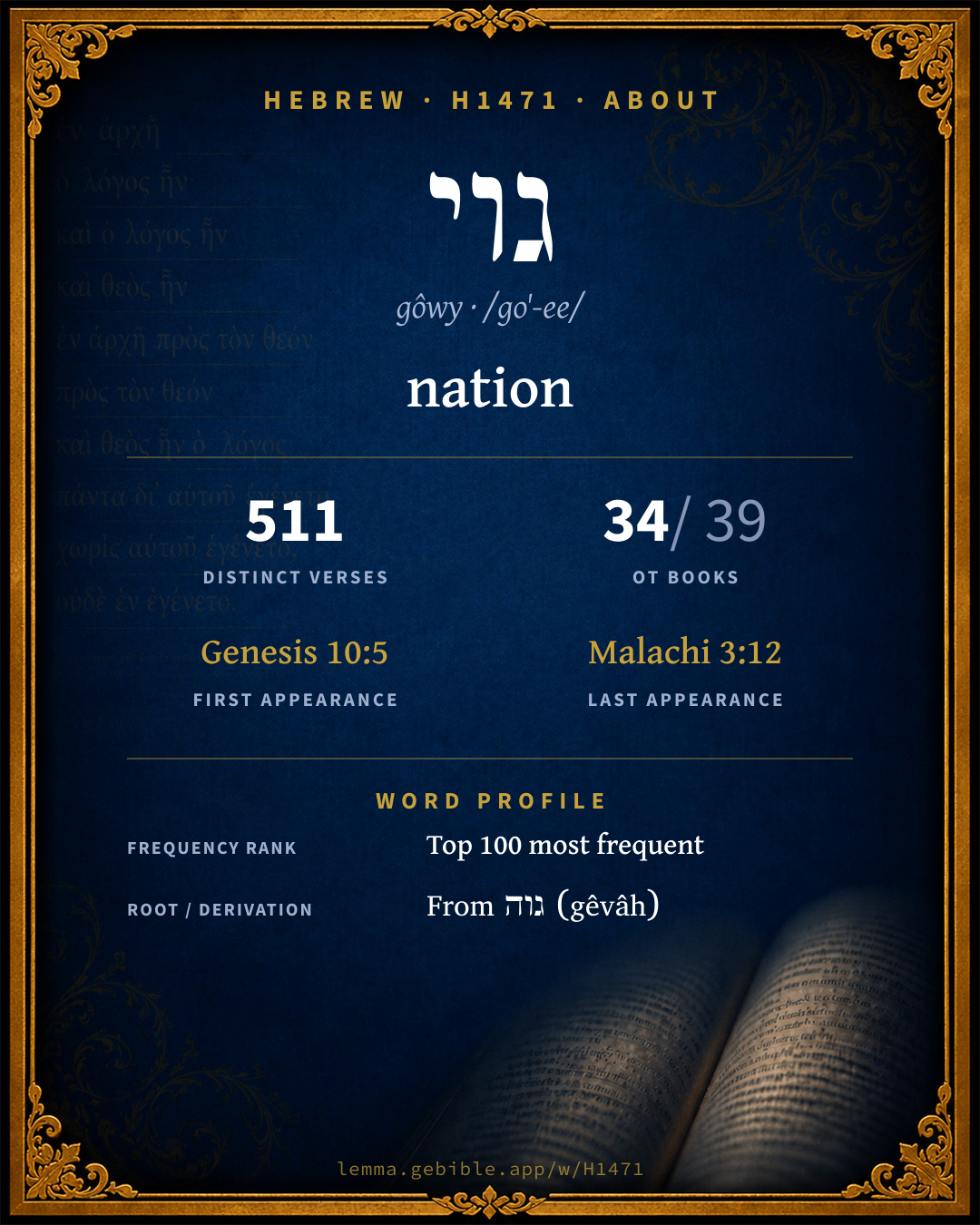
גּוֹי
nation
‘nation’ is one of 4 main senses fuller range ↓
Full lexicon entry — Brown-Driver-Briggs (BDB)
From Brown-Driver-Briggs (BDB)
Where this word appears
See every Absolute-state word in the Hebrew Bible →
Grammar key — what these labels mean
Part of speech
- Noun
- A naming word — a person, place, thing, or idea.
Noun type
- Common
- A common noun — a general class of person, place, or thing (“king,” “city,” “water”), not a specific name.
- Proper
- A name of a specific person, place, or people (e.g. Abraham, Zion, Israel).
State
- Absolute
- The independent form of a noun, not bound to a following word.
- Construct
- A noun bound to a following noun in a possessive / “of” relationship (the construct chain).
Gender
- Masculine
- Grammatically masculine.
Number
- Plural
- More than one (in Hebrew, generally three or more).
- Singular
- One.
Grammatical forms
- Noun, Common, Masculine, Plural, Absolute 416 times (73%)
- Noun, Common, Masculine, Singular, Absolute 121 times (21%)
- Noun, Common, Masculine, Plural, Construct 18 times (3%)
- Noun, Common, Masculine, Singular, Construct 7 times (1%)
- Noun, Proper 5 times (1%)
Parsed forms decoded from the imported morphology (morphhb / Westminster Leningrad Codex — WLC text public domain, morphhb tagging CC BY 4.0), counted across 567 parsed occurrences — not distinct verses.
Page 1 of 3 — showing verses 1–200 of 511 distinct verses where H1471 appears, across 34 books. Click any verse to open its interlinear word-by-word view. Verse text shown in the World English Bible for context — . Each verse’s Hebrew form is shown with its reference; the English is not keyword-highlighted, since the data carries no word-level English alignment. Use “Compare translations” on any verse to read it across multiple English versions. This concordance covers the Hebrew Bible; Septuagint (Greek Old Testament) occurrences are not indexed here.
Genesis 23 verses
- Genesis 10:5 הַ/גּוֹיִם֙ בְּ/גוֹיֵ/הֶֽם ptcl def.art + n c mp prep + n c mp cs + sfx pers 3mp Of these were the isles of the nations divided in their lands, everyone after his language, after their families, in their nations.
- Genesis 10:20 בְּ/גוֹיֵ/הֶֽם prep + n c mp cs + sfx pers 3mp These are the sons of Ham, after their families, after their languages, in their lands, in their nations.
- Genesis 10:31 לְ/גוֹיֵ/הֶֽם prep + n c mp cs + sfx pers 3mp These are the sons of Shem, after their families, after their languages, in their lands, after their nations.
- Genesis 10:32 בְּ/גוֹיֵ/הֶ֑ם הַ/גּוֹיִ֛ם prep + n c mp cs + sfx pers 3mp ptcl def.art + n c mp These are the families of the sons of Noah, after their generations, in their nations. Of these were the nations divided in the earth after the flood.
- Genesis 12:2 לְ/ג֣וֹי prep + n c ms I will make of you a great nation. I will bless you, and make your name great. You will be a blessing.
- Genesis 14:1 גּוֹיִֽם n Proper It happened in the days of Amraphel, king of Shinar, Arioch, king of Ellasar, Chedorlaomer, king of Elam, and Tidal, king of Goiim,
- Genesis 14:9 גּוֹיִ֔ם n Proper against Chedorlaomer king of Elam, and Tidal king of Goiim, and Amraphel king of Shinar, and Arioch king of Ellasar; four kings against the five.
- Genesis 15:14 הַ/גּ֛וֹי ptcl def.art + n c ms I will also judge that nation, whom they will serve. Afterward they will come out with great substance.
- Genesis 17:4 גּוֹיִֽם n c mp "As for me, behold, my covenant is with you. You will be the father of a multitude of nations.
- Genesis 17:5 גּוֹיִ֖ם n c mp Neither will your name any more be called Abram, but your name will be Abraham; for the father of a multitude of nations have I made you.
- Genesis 17:6 לְ/גוֹיִ֑ם prep + n c mp I will make you exceeding fruitful, and I will make nations of you. Kings will come out of you.
- Genesis 17:16 לְ/גוֹיִ֔ם prep + n c mp I will bless her, and moreover I will give you a son by her. Yes, I will bless her, and she will be a mother of nations. Kings of peoples will come from her."
- Genesis 17:20 לְ/ג֥וֹי prep + n c ms As for Ishmael, I have heard you. Behold, I have blessed him, and will make him fruitful, and will multiply him exceedingly. He will become the father of twelve princes, and I will make him a great nation.
- Genesis 18:18 לְ/ג֥וֹי גּוֹיֵ֥י prep + n c ms n c mp cs seeing that Abraham has surely become a great and mighty nation, and all the nations of the earth will be blessed in him?
- Genesis 20:4 הֲ/ג֥וֹי ptcl inter + n c ms Now Abimelech had not come near her. He said, "Lord, will you kill even a righteous nation?
- Genesis 21:13 לְ/ג֣וֹי prep + n c ms Also of the son of the handmaid will I make a nation, because he is your seed."
- Genesis 21:18 לְ/ג֥וֹי prep + n c ms Get up, lift up the boy, and hold him in your hand. For I will make him a great nation."
- Genesis 22:18 גּוֹיֵ֣י n c mp cs In your seed will all the nations of the earth be blessed, because you have obeyed my voice."
- Genesis 25:23 גיים גוֹיִם֙ n c mp n c mp Yahweh said to her, Two nations are in your womb, Two peoples will be separated from your body. The one people will be stronger than the other people. The elder will serve the younger.
- Genesis 26:4 גּוֹיֵ֥י n c mp cs I will multiply your seed as the stars of the sky, and will give to your seed all these lands. In your seed will all the nations of the earth be blessed,
- Genesis 35:11 גּ֛וֹי גּוֹיִ֖ם n c ms n c mp God said to him, "I am God Almighty. Be fruitful and multiply. A nation and a company of nations will be from you, and kings will come out of your loins.
- Genesis 46:3 לְ/ג֥וֹי prep + n c ms He said, "I am God, the God of your father. Don't be afraid to go down into Egypt; for there I will make of you a great nation.
- Genesis 48:19 הַ/גּוֹיִֽם ptcl def.art + n c mp His father refused, and said, "I know, my son, I know. He also will become a people, and he also will be great. However, his younger brother will be greater than he, and his seed will become a multitude of nations."
Exodus 6 verses
- Exodus 9:24 לְ/גֽוֹי prep + n c ms So there was very severe hail, and lightning mixed with the hail, such as had not been in all the land of Egypt since it became a nation.
- Exodus 19:6 וְ/ג֣וֹי conj + n c ms and you shall be to me a kingdom of priests, and a holy nation.' These are the words which you shall speak to the children of Israel."
- Exodus 32:10 לְ/ג֥וֹי prep + n c ms Now therefore leave me alone, that my wrath may burn hot against them, and that I may consume them; and I will make of you a great nation."
- Exodus 33:13 הַ/גּ֥וֹי ptcl def.art + n c ms Now therefore, if I have found favor in your sight, please show me now your ways, that I may know you, so that I may find favor in your sight: and consider that this nation is your people."
- Exodus 34:10 הַ/גּוֹיִ֑ם ptcl def.art + n c mp He said, "Behold, I make a covenant: before all your people I will do marvels, such as have not been worked in all the earth, nor in any nation; and all the people among which you are shall see the work of Yahweh; for it is an awesome thing that I do with you.
- Exodus 34:24 גּוֹיִם֙ n c mp For I will drive out nations before you and enlarge your borders; neither shall any man desire your land when you go up to appear before Yahweh, your God, three times in the year.
Leviticus 7 verses
- Leviticus 18:24 הַ/גּוֹיִ֔ם ptcl def.art + n c mp "'Don't defile yourselves in any of these things: for in all these the nations which I am casting out before you were defiled.
- Leviticus 18:28 הַ/גּ֖וֹי ptcl def.art + n c ms that the land not vomit you out also, when you defile it, as it vomited out the nation that was before you.
- Leviticus 20:23 הַ/גּ֔וֹי ptcl def.art + n c ms You shall not walk in the customs of the nation, which I am casting out before you: for they did all these things, and therefore I abhorred them.
- Leviticus 25:44 הַ/גּוֹיִ֗ם ptcl def.art + n c mp "'As for your male and your female slaves, whom you may have; of the nations that are around you, from them you may buy male and female slaves.
- Leviticus 26:33 בַ/גּוֹיִ֔ם prep det + n c mp I will scatter you among the nations, and I will draw out the sword after you: and your land will be a desolation, and your cities shall be a waste.
- Leviticus 26:38 בַּ/גּוֹיִ֑ם prep det + n c mp You will perish among the nations, and the land of your enemies will eat you up.
- Leviticus 26:45 הַ/גּוֹיִ֗ם ptcl def.art + n c mp but I will for their sake remember the covenant of their ancestors, whom I brought forth out of the land of Egypt in the sight of the nations, that I might be their God. I am Yahweh.'"
Numbers 5 verses
- Numbers 14:12 לְ/גוֹי prep + n c ms I will strike them with the pestilence, and disinherit them, and will make of you a nation greater and mightier than they.
- Numbers 14:15 הַ/גּוֹיִ֔ם ptcl def.art + n c mp Now if you shall kill this people as one man, then the nations which have heard the fame of you will speak, saying,
- Numbers 23:9 וּ/בַ/גּוֹיִ֖ם conj + prep det + n c mp For from the top of the rocks I see him, From the hills I see him: behold, it is a people that dwells alone, And shall not be reckoned among the nations.
- Numbers 24:8 גּוֹיִ֣ם n c mp God brings him forth out of Egypt; He has as it were the strength of the wild-ox: He shall eat up the nations his adversaries, Shall break their bones in pieces, Smite [them] through with his arrows.
- Numbers 24:20 גּוֹיִם֙ n c mp He looked at Amalek, and took up his parable, and said, Amalek was the first of the nations; But his latter end shall come to destruction.
Deuteronomy 41 verses
- Deuteronomy 4:6 הַ/גּ֥וֹי ptcl def.art + n c ms Keep therefore and do them; for this is your wisdom and your understanding in the sight of the peoples, who shall hear all these statutes, and say, Surely this great nation is a wise and understanding people.
- Deuteronomy 4:7 ג֣וֹי n c ms For what great nation is there, that has a god so near to them, as Yahweh our God is whenever we call on him?
- Deuteronomy 4:8 גּ֣וֹי n c ms What great nation is there, that has statutes and ordinances so righteous as all this law, which I set before you this day?
- Deuteronomy 4:27 בַּ/גּוֹיִ֕ם prep det + n c mp Yahweh will scatter you among the peoples, and you shall be left few in number among the nations, where Yahweh shall lead you away.
- Deuteronomy 4:34 גוֹי֮ גּוֹי֒ n c ms n c ms Or has God tried to go and take him a nation from the midst of [another] nation, by trials, by signs, and by wonders, and by war, and by a mighty hand, and by an outstretched arm, and by great terrors, according to all that Yahweh your God did for you in Egypt before your eyes?
- Deuteronomy 4:38 גּוֹיִ֛ם n c mp to drive out nations from before you greater and mightier than you, to bring you in, to give you their land for an inheritance, as at this day.
- Deuteronomy 7:1 גּֽוֹיִם גוֹיִ֔ם n c mp n c mp When Yahweh your God shall bring you into the land where you go to possess it, and shall cast out many nations before you, the Hittite, and the Girgashite, and the Amorite, and the Canaanite, and the Perizzite, and the Hivite, and the Jebusite, seven nations greater and mightier than you;
- Deuteronomy 7:17 הַ/גּוֹיִ֥ם ptcl def.art + n c mp If you shall say in your heart, These nations are more than I; how can I dispossess them?
- Deuteronomy 7:22 הַ/גּוֹיִ֥ם ptcl def.art + n c mp Yahweh your God will cast out those nations before you by little and little: you may not consume them at once, lest the animals of the field increase on you.
- Deuteronomy 8:20 כַּ/גּוֹיִ֗ם prep det + n c mp As the nations that Yahweh makes to perish before you, so shall you perish; because you wouldn't listen to the voice of Yahweh your God.
- Deuteronomy 9:1 גּוֹיִ֔ם n c mp Hear, Israel: you are to pass over the Jordan this day, to go in to dispossess nations greater and mightier than yourself, cities great and fortified up to the sky,
- Deuteronomy 9:4 הַ/גּוֹיִ֣ם ptcl def.art + n c mp Don't speak in your heart, after that Yahweh your God has thrust them out from before you, saying, For my righteousness Yahweh has brought me in to possess this land; whereas for the wickedness of these nations Yahweh does drive them out from before you.
- Deuteronomy 9:5 הַ/גּוֹיִ֣ם ptcl def.art + n c mp Not for your righteousness, or for the uprightness of your heart, do you go in to possess their land; but for the wickedness of these nations Yahweh your God does drive them out from before you, and that he may establish the word which Yahweh swore to your fathers, to Abraham, to Isaac, and to Jacob.
- Deuteronomy 9:14 לְ/גוֹי prep + n c ms let me alone, that I may destroy them, and blot out their name from under the sky; and I will make of you a nation mightier and greater than they.
- Deuteronomy 11:23 הַ/גּוֹיִ֥ם גּוֹיִ֔ם ptcl def.art + n c mp n c mp then will Yahweh drive out all these nations from before you, and you shall dispossess nations greater and mightier than yourselves.
- Deuteronomy 12:2 הַ/גּוֹיִ֗ם ptcl def.art + n c mp You shall surely destroy all the places in which the nations that you shall dispossess served their gods, on the high mountains, and on the hills, and under every green tree:
- Deuteronomy 12:29 הַ/גּוֹיִ֗ם ptcl def.art + n c mp When Yahweh your God shall cut off the nations from before you, where you go in to dispossess them, and you dispossess them, and dwell in their land;
- Deuteronomy 12:30 הַ/גּוֹיִ֤ם ptcl def.art + n c mp take heed to yourself that you not be ensnared to follow them, after that they are destroyed from before you; and that you not inquire after their gods, saying, How do these nations serve their gods? even so will I do likewise.
- Deuteronomy 15:6 גּוֹיִ֣ם בְּ/גוֹיִ֣ם n c mp prep + n c mp For Yahweh your God will bless you, as he promised you: and you shall lend to many nations, but you shall not borrow; and you shall rule over many nations, but they shall not rule over you.
- Deuteronomy 17:14 הַ/גּוֹיִ֖ם ptcl def.art + n c mp When you are come to the land which Yahweh your God gives you, and shall possess it, and shall dwell therein, and shall say, I will set a king over me, like all the nations that are round about me;
- Deuteronomy 18:9 הַ/גּוֹיִ֥ם ptcl def.art + n c mp When you are come into the land which Yahweh your God gives you, you shall not learn to do after the abominations of those nations.
- Deuteronomy 18:14 הַ/גּוֹיִ֣ם ptcl def.art + n c mp For these nations, that you shall dispossess, listen to those who practice sorcery, and to diviners; but as for you, Yahweh your God has not allowed you so to do.
- Deuteronomy 19:1 הַ/גּוֹיִ֔ם ptcl def.art + n c mp When Yahweh your God shall cut off the nations, whose land Yahweh your God gives you, and you succeed them, and dwell in their cities, and in their houses;
- Deuteronomy 20:15 הַ/גּֽוֹיִם ptcl def.art + n c mp Thus shall you do to all the cities which are very far off from you, which are not of the cities of these nations.
- Deuteronomy 26:5 לְ/ג֥וֹי prep + n c ms You shall answer and say before Yahweh your God, A Syrian ready to perish was my father; and he went down into Egypt, and sojourned there, few in number; and he became there a nation, great, mighty, and populous.
- Deuteronomy 26:19 הַ/גּוֹיִם֙ ptcl def.art + n c mp and to make you high above all nations that he has made, in praise, and in name, and in honor; and that you may be a holy people to Yahweh your God, as he has spoken.
- Deuteronomy 28:1 גּוֹיֵ֥י n c mp cs It shall happen, if you shall listen diligently to the voice of Yahweh your God, to observe to do all his commandments which I command you this day, who Yahweh your God will set you on high above all the nations of the earth:
- Deuteronomy 28:12 גּוֹיִ֣ם n c mp Yahweh will open to you his good treasure in the sky, to give the rain of your land in its season, and to bless all the work of your hand: and you shall lend to many nations, and you shall not borrow.
- Deuteronomy 28:36 גּ֕וֹי n c ms Yahweh will bring you, and your king whom you shall set over you, to a nation that you have not known, you nor your fathers; and there shall you serve other gods, wood and stone.
- Deuteronomy 28:49 גּ֤וֹי גּ֕וֹי n c ms n c ms Yahweh will bring a nation against you from far, from the end of the earth, as the eagle flies; a nation whose language you shall not understand;
- Deuteronomy 28:50 גּ֖וֹי n c ms a nation of fierce facial expressions, that shall not regard the person of the old, nor show favor to the young,
- Deuteronomy 28:65 וּ/בַ/גּוֹיִ֤ם conj + prep det + n c mp Among these nations shall you find no ease, and there shall be no rest for the sole of your foot: but Yahweh will give you there a trembling heart, and failing of eyes, and pining of soul;
- Deuteronomy 29:16 הַ/גּוֹיִ֖ם ptcl def.art + n c mp (for you know how we lived in the land of Egypt, and how we came through the midst of the nations through which you passed;
- Deuteronomy 29:18 הַ/גּוֹיִ֣ם ptcl def.art + n c mp lest there should be among you man, or woman, or family, or tribe, whose heart turns away this day from Yahweh our God, to go to serve the gods of those nations; lest there should be among you a root that bears gall and wormwood;
- Deuteronomy 29:24 הַ/גּוֹיִ֔ם ptcl def.art + n c mp even all the nations shall say, Why has Yahweh done thus to this land? what means the heat of this great anger?
- Deuteronomy 30:1 הַ/גּוֹיִ֔ם ptcl def.art + n c mp It shall happen, when all these things are come on you, the blessing and the curse, which I have set before you, and you shall call them to mind among all the nations, where Yahweh your God has driven you,
- Deuteronomy 31:3 הַ/גּוֹיִ֥ם ptcl def.art + n c mp Yahweh your God, he will go over before you; he will destroy these nations from before you, and you shall dispossess them: [and] Joshua, he shall go over before you, as Yahweh has spoken.
- Deuteronomy 32:8 גּוֹיִ֔ם n c mp When the Most High gave to the nations their inheritance, When he separated the children of men, He set the bounds of the peoples According to the number of the children of Israel.
- Deuteronomy 32:21 בְּ/ג֥וֹי prep + n c ms They have moved me to jealousy with that which is not God; They have provoked me to anger with their vanities: I will move them to jealousy with those who are not a people; I will provoke them to anger with a foolish nation.
- Deuteronomy 32:28 ג֛וֹי n c ms For they are a nation void of counsel, There is no understanding in them.
- Deuteronomy 32:43 גוֹיִם֙ n c mp Rejoice, you nations, [with] his people: For he will avenge the blood of his servants, Will render vengeance to his adversaries, Will make expiation for his land, for his people.
Joshua 12 verses
- Joshua 3:17 הַ/גּ֔וֹי ptcl def.art + n c ms The priests who bore the ark of the covenant of Yahweh stood firm on dry ground in the midst of the Jordan; and all Israel passed over on dry ground, until all the nation were passed clean over the Jordan.
- Joshua 4:1 הַ/גּ֔וֹי ptcl def.art + n c ms It happened, when all the nation were clean passed over the Jordan, that Yahweh spoke to Joshua, saying,
- Joshua 5:6 הַ/גּ֜וֹי ptcl def.art + n c ms For the children of Israel walked forty years in the wilderness, until all the nation, even the men of war who came forth out of Egypt, were consumed, because they didn't listen to the voice of Yahweh: to whom Yahweh swore that he wouldn't let them see the land which Yahweh swore to their fathers that he would give us, a land flowing with milk and honey.
- Joshua 5:8 הַ/גּ֖וֹי ptcl def.art + n c ms It happened, when they had done circumcising all the nation, that they abode in their places in the camp, until they were whole.
- Joshua 10:13 גּוֹי֙ n c ms The sun stood still, and the moon stayed, Until the nation had avenged themselves of their enemies. Isn't this written in the book of Jashar? The sun stayed in the midst of the sky, and didn't hurry to go down about a whole day.
- Joshua 12:23 גּוֹיִ֥ם n c mp the king of Dor in the height of Dor, one; the king of Goiim in Gilgal, one;
- Joshua 23:3 הַ/גּוֹיִ֥ם ptcl def.art + n c mp and you have seen all that Yahweh your God has done to all these nations because of you; for Yahweh your God, he it is that has fought for you.
- Joshua 23:4 הַ֠/גּוֹיִם הַ/גּוֹיִם֙ ptcl def.art + n c mp ptcl def.art + n c mp Behold, I have allotted to you these nations that remain, to be an inheritance for your tribes, from the Jordan, with all the nations that I have cut off, even to the great sea toward the going down of the sun.
- Joshua 23:7 בַּ/גּוֹיִ֣ם prep det + n c mp that you not come among these nations, these that remain among you; neither make mention of the name of their gods, nor cause to swear [by them], neither serve them, nor bow down yourselves to them;
- Joshua 23:9 גּוֹיִ֖ם n c mp For Yahweh has driven out from before you great nations and strong: but as for you, no man has stood before you to this day.
- Joshua 23:12 הַ/גּוֹיִ֣ם ptcl def.art + n c mp Else if you do at all go back, and cleave to the remnant of these nations, even these who remain among you, and make marriages with them, and go in to them, and they to you;
- Joshua 23:13 הַ/גּוֹיִ֥ם ptcl def.art + n c mp know for a certainty that Yahweh your God will no more drive these nations from out of your sight; but they shall be a snare and a trap to you, and a scourge in your sides, and thorns in your eyes, until you perish from off this good land which Yahweh your God has given you.
Judges 7 verses
- Judges 2:20 הַ/גּ֣וֹי ptcl def.art + n c ms The anger of Yahweh was kindled against Israel; and he said, Because this nation have transgressed my covenant which I commanded their fathers, and have not listened to my voice;
- Judges 2:21 הַ/גּוֹיִ֛ם ptcl def.art + n c mp I also will not henceforth drive out any from before them of the nations that Joshua left when he died;
- Judges 2:23 הַ/גּוֹיִ֣ם ptcl def.art + n c mp So Yahweh left those nations, without driving them out hastily; neither delivered he them into the hand of Joshua.
- Judges 3:1 הַ/גּוֹיִם֙ ptcl def.art + n c mp Now these are the nations which Yahweh left, to prove Israel by them, even as many [of Israel] as had not known all the wars of Canaan;
- Judges 4:2 הַגּוֹיִֽם n Proper Yahweh sold them into the hand of Jabin king of Canaan, who reigned in Hazor; the captain of whose host was Sisera, who lived in Harosheth of the Gentiles.
- Judges 4:13 הַגּוֹיִ֖ם n Proper Sisera gathered together all his chariots, even nine hundred chariots of iron, and all the people who were with him, from Harosheth of the Gentiles, to the river Kishon.
- Judges 4:16 הַגּוֹיִ֑ם n Proper But Barak pursued after the chariots, and after the host, to Harosheth of the Gentiles: and all the host of Sisera fell by the edge of the sword; there was not a man left.
1 Samuel 2 verses
- 1 Samuel 8:5 הַ/גּוֹיִֽם ptcl def.art + n c mp and they said to him, Behold, you are old, and your sons don't walk in your ways: now make us a king to judge us like all the nations.
- 1 Samuel 8:20 הַ/גּוֹיִ֑ם ptcl def.art + n c mp that we also may be like all the nations, and that our king may judge us, and go out before us, and fight our battles.
2 Samuel 4 verses
- 2 Samuel 7:23 גּ֥וֹי גּוֹיִ֖ם n c ms n c mp What one nation in the earth is like your people, even like Israel, whom God went to redeem to himself for a people, and to make him a name, and to do great things for you, and awesome things for your land, before your people, whom you redeem to you out of Egypt, [from] the nations and their gods?
- 2 Samuel 8:11 הַ/גּוֹיִ֖ם ptcl def.art + n c mp These also did king David dedicate to Yahweh, with the silver and gold that he dedicated of all the nations which he subdued;
- 2 Samuel 22:44 גּוֹיִ֔ם n c mp You also have delivered me from the strivings of my people; You have kept me to be the head of the nations: A people whom I have not known shall serve me.
- 2 Samuel 22:50 בַּ/גּוֹיִ֑ם prep det + n c mp Therefore I will give thanks to you, Yahweh, among the nations, Will sing praises to your name.
1 Kings 4 verses
- 1 Kings 4:31 הַ/גּוֹיִ֖ם ptcl def.art + n c mp For he was wiser than all men; than Ethan the Ezrahite, and Heman, and Calcol, and Darda, the sons of Mahol: and his fame was in all the nations round about.
- 1 Kings 11:2 הַ/גּוֹיִ֗ם ptcl def.art + n c mp of the nations concerning which Yahweh said to the children of Israel, You shall not go among them, neither shall they come among you; for surely they will turn away your heart after their gods: Solomon joined to these in love.
- 1 Kings 14:24 הַ/גּוֹיִ֔ם ptcl def.art + n c mp and there were also sodomites in the land: they did according to all the abominations of the nations which Yahweh drove out before the children of Israel.
- 1 Kings 18:10 גּ֤וֹי הַ/גּ֔וֹי n c ms ptcl def.art + n c ms As Yahweh your God lives, there is no nation or kingdom, where my lord has not sent to seek you: and when they said, He is not here, he took an oath of the kingdom and nation, that they didn't find you.
2 Kings 14 verses
- 2 Kings 6:18 הַ/גּוֹי ptcl def.art + n c ms When they came down to him, Elisha prayed to Yahweh, and said, Please smite this people with blindness. He struck them with blindness according to the word of Elisha.
- 2 Kings 16:3 הַ/גּוֹיִ֔ם ptcl def.art + n c mp But he walked in the way of the kings of Israel, yes, and made his son to pass through the fire, according to the abominations of the nations, whom Yahweh cast out from before the children of Israel.
- 2 Kings 17:8 הַ/גּוֹיִ֔ם ptcl def.art + n c mp and walked in the statutes of the nations, whom Yahweh cast out from before the children of Israel, and of the kings of Israel, which they made.
- 2 Kings 17:11 כַּ/גּוֹיִ֕ם prep det + n c mp and there they burnt incense in all the high places, as did the nations whom Yahweh carried away before them; and they worked wicked things to provoke Yahweh to anger;
- 2 Kings 17:15 הַ/גּוֹיִם֙ ptcl def.art + n c mp They rejected his statutes, and his covenant that he made with their fathers, and his testimonies which he testified to them; and they followed vanity, and became vain, and [went] after the nations that were round about them, concerning whom Yahweh had charged those who they should not do like them.
- 2 Kings 17:26 הַ/גּוֹיִ֗ם ptcl def.art + n c mp Therefore they spoke to the king of Assyria, saying, The nations which you have carried away, and placed in the cities of Samaria, don't know the law of the god of the land: therefore he has sent lions among them, and, behold, they kill them, because they don't know the law of the god of the land.
- 2 Kings 17:29 גּ֥וֹי גּ֖וֹי גּ֥וֹי גּוֹי֙ n c ms n c ms n c ms n c ms However every nation made gods of their own, and put them in the houses of the high places which the Samaritans had made, every nation in their cities in which they lived.
- 2 Kings 17:33 הַ/גּוֹיִ֔ם ptcl def.art + n c mp They feared Yahweh, and served their own gods, after the manner of the nations from among whom they had been carried away.
- 2 Kings 17:41 הַ/גּוֹיִ֣ם ptcl def.art + n c mp So these nations feared Yahweh, and served their engraved images; their children likewise, and their children's children, as did their fathers, so do they to this day.
- 2 Kings 18:33 הַ/גּוֹיִ֖ם ptcl def.art + n c mp Has any of the gods of the nations ever delivered his land out of the hand of the king of Assyria?
- 2 Kings 19:12 הַ/גּוֹיִם֙ ptcl def.art + n c mp Have the gods of the nations delivered them, which my fathers have destroyed, Gozan, and Haran, and Rezeph, and the children of Eden that were in Telassar?
- 2 Kings 19:17 הַ/גּוֹיִ֖ם ptcl def.art + n c mp Of a truth, Yahweh, the kings of Assyria have laid waste the nations and their lands,
- 2 Kings 21:2 הַ/גּוֹיִ֔ם ptcl def.art + n c mp He did that which was evil in the sight of Yahweh, after the abominations of the nations whom Yahweh cast out before the children of Israel.
- 2 Kings 21:9 הַ֨/גּוֹיִ֔ם ptcl def.art + n c mp But they didn't listen: and Manasseh seduced them to do that which is evil more than did the nations whom Yahweh destroyed before the children of Israel.
1 Chronicles 7 verses
- 1 Chronicles 14:17 הַ/גּוֹיִֽם ptcl def.art + n c mp The fame of David went out into all lands; and Yahweh brought the fear of him on all nations.
- 1 Chronicles 16:20 מִ/גּ֣וֹי גּ֔וֹי prep + n c ms n c ms They went about from nation to nation, From one kingdom to another people.
- 1 Chronicles 16:24 בַ/גּוֹיִם֙ prep det + n c mp Declare his glory among the nations, His marvelous works among all the peoples.
- 1 Chronicles 16:31 בַ/גּוֹיִ֖ם prep det + n c mp Let the heavens be glad, and let the earth rejoice; Let them say among the nations, Yahweh reigns.
- 1 Chronicles 16:35 הַ/גּוֹיִ֑ם ptcl def.art + n c mp Say you, Save us, God of our salvation, Gather us together and deliver us from the nations, To give thanks to your holy name, To triumph in your praise.
- 1 Chronicles 17:21 גּ֥וֹי גּוֹיִֽם n c ms n c mp What one nation in the earth is like your people Israel, whom God went to redeem to himself for a people, to make you a name by great and awesome things, in driving out nations from before your people, whom you redeem out of Egypt?
- 1 Chronicles 18:11 הַ/גּוֹיִ֑ם ptcl def.art + n c mp These also did king David dedicate to Yahweh, with the silver and the gold that he carried away from all the nations; from Edom, and from Moab, and from the children of Ammon, and from the Philistines, and from Amalek.
2 Chronicles 11 verses
- 2 Chronicles 15:6 גוֹי בְּ/ג֖וֹי n c ms prep + n c ms They were broken in pieces, nation against nation, and city against city; for God did vex them with all adversity.
- 2 Chronicles 20:6 הַ/גּוֹיִ֑ם ptcl def.art + n c mp and he said, Yahweh, the God of our fathers, aren't you God in heaven? and aren't you ruler over all the kingdoms of the nations? and in your hand is power and might, so that none is able to withstand you.
- 2 Chronicles 28:3 הַ/גּוֹיִ֔ם ptcl def.art + n c mp Moreover he burnt incense in the valley of the son of Hinnom, and burnt his children in the fire, according to the abominations of the nations whom Yahweh cast out before the children of Israel.
- 2 Chronicles 32:13 גּוֹיֵ֣ n c mp cs Don't you know what I and my fathers have done to all the peoples of the lands? Were the gods of the nations of the lands in any wise able to deliver their land out of my hand?
- 2 Chronicles 32:14 הַ/גּוֹיִ֤ם ptcl def.art + n c mp Who was there among all the gods of those nations which my fathers utterly destroyed, that could deliver his people out of my hand, that your God should be able to deliver you out of my hand?
- 2 Chronicles 32:15 גּ֣וֹי n c ms Now therefore don't let Hezekiah deceive you, nor persuade you after this manner, neither believe you him; for no god of any nation or kingdom was able to deliver his people out of my hand, and out of the hand of my fathers: how much less shall your God deliver you out of my hand?
- 2 Chronicles 32:17 גּוֹיֵ֤ n c mp cs He wrote also letters, to rail on Yahweh, the God of Israel, and to speak against him, saying, As the gods of the nations of the lands, which have not delivered their people out of my hand, so shall the God of Hezekiah not deliver his people out of my hand.
- 2 Chronicles 32:23 הַ/גּוֹיִ֖ם ptcl def.art + n c mp Many brought gifts to Yahweh to Jerusalem, and precious things to Hezekiah king of Judah; so that he was exalted in the sight of all nations from thenceforth.
- 2 Chronicles 33:2 הַ/גּוֹיִ֔ם ptcl def.art + n c mp He did that which was evil in the sight of Yahweh, after the abominations of the nations whom Yahweh cast out before the children of Israel.
- 2 Chronicles 33:9 הַ֨/גּוֹיִ֔ם ptcl def.art + n c mp Manasseh seduced Judah and the inhabitants of Jerusalem, so that they did evil more than did the nations whom Yahweh destroyed before the children of Israel.
- 2 Chronicles 36:14 הַ/גּוֹיִ֑ם ptcl def.art + n c mp Moreover all the chiefs of the priests, and the people, trespassed very greatly after all the abominations of the nations; and they polluted the house of Yahweh which he had made holy in Jerusalem.
Ezra 1 verse
Nehemiah 6 verses
- Nehemiah 5:8 לַ/גּוֹיִם֙ prep det + n c mp I said to them, We after our ability have redeemed our brothers the Jews, that were sold to the nations; and would you even sell your brothers, and should they be sold to us? Then held they their peace, and found never a word.
- Nehemiah 5:9 הַ/גּוֹיִ֥ם ptcl def.art + n c mp Also I said, The thing that you do is not good: ought you not to walk in the fear of our God, because of the reproach of the nations our enemies?
- Nehemiah 5:17 הַ/גּוֹיִ֥ם ptcl def.art + n c mp Moreover there were at my table, of the Jews and the rulers, one hundred fifty men, besides those who came to us from among the nations that were round about us.
- Nehemiah 6:6 בַּ/גּוֹיִ֤ם prep det + n c mp in which was written, It is reported among the nations, and Gashmu says it, that you and the Jews think to rebel; for which cause you are building the wall: and you would be their king, according to these words.
- Nehemiah 6:16 הַ/גּוֹיִם֙ ptcl def.art + n c mp It happened, when all our enemies heard [of it], that all the nations that were about us feared, and were much cast down in their own eyes; for they perceived that this work was worked of our God.
- Nehemiah 13:26 וּ/בַ/גּוֹיִ֣ם conj + prep det + n c mp Did not Solomon king of Israel sin by these things? yet among many nations was there no king like him, and he was beloved of his God, and God made him king over all Israel: nevertheless even him did foreign women cause to sin.
Job 2 verses
- Job 12:23 לַ֭/גּוֹיִם לַ֝/גּוֹיִ֗ם prep det + n c mp prep det + n c mp He increases the nations, and he destroys them. He enlarges the nations, and he leads them captive.
- Job 34:29 גּ֖וֹי n c ms When he gives quietness, who then can condemn? When he hides his face, who then can see him? Alike whether to a nation, or to a man:
Psalms 58 verses
- Psalms 2:1 גוֹיִ֑ם n c mp Why do the nations rage, And the peoples plot a vain thing?
- Psalms 2:8 ג֭וֹיִם n c mp Ask of me, and I will give the nations for your inheritance, The uttermost parts of the earth for your possession.
- Psalms 9:5 ג֭וֹיִם n c mp You have rebuked the nations. You have destroyed the wicked. You have blotted out their name forever and ever.
- Psalms 9:15 ג֭וֹיִם n c mp The nations have sunk down in the pit that they made; In the net which they hid, their own foot is taken.
- Psalms 9:17 גּ֝וֹיִ֗ם n c mp The wicked shall be turned back to Sheol, Even all the nations that forget God.
- Psalms 9:19 ג֝וֹיִ֗ם n c mp Arise, Yahweh! Don't let man prevail. Let the nations be judged in your sight.
- Psalms 9:20 גוֹיִ֑ם n c mp Put them in fear, Yahweh. Let the nations know that they are only men. Selah.
- Psalms 10:16 ג֝וֹיִ֗ם n c mp Yahweh is King forever and ever! The nations will perish out of his land.
- Psalms 18:43 גּוֹיִ֑ם n c mp You have delivered me from the strivings of the people. You have made me the head of the nations. A people whom I have not known shall serve me.
- Psalms 18:49 בַ/גּוֹיִ֥ם prep det + n c mp Therefore I will give thanks to you, Yahweh, among the nations, And will sing praises to your name.
- Psalms 22:27 גּוֹיִֽם n c mp All the ends of the earth shall remember and turn to Yahweh. All the relatives of the nations shall worship before you.
- Psalms 22:28 בַּ/גּוֹיִֽם prep det + n c mp For the kingdom is Yahweh's. He is the ruler over the nations.
- Psalms 33:10 גּוֹיִ֑ם n c mp Yahweh brings the counsel of the nations to nothing. He makes the thoughts of the peoples to be of no effect.
- Psalms 33:12 הַ֭/גּוֹי ptcl def.art + n c ms Blessed is the nation whose God is Yahweh, The people whom he has chosen for his own inheritance.
- Psalms 43:1 מִ/גּ֥וֹי prep + n c ms Vindicate me, God, and plead my cause against an ungodly nation. Oh, deliver me from deceitful and wicked men.
- Psalms 44:2 גּוֹיִ֣ם n c mp You drove out the nations with your hand, But you planted them. You afflicted the peoples, But you spread them abroad.
- Psalms 44:11 וּ֝/בַ/גּוֹיִ֗ם conj + prep det + n c mp You have made us like sheep for food, And have scattered us among the nations.
- Psalms 44:14 בַּ/גּוֹיִ֑ם prep det + n c mp You make us a byword among the nations, A shaking of the head among the peoples.
- Psalms 46:6 ג֭וֹיִם n c mp The nations raged. The kingdoms were moved. He lifted his voice, and the earth melted.
- Psalms 46:10 בַּ֝/גּוֹיִ֗ם prep det + n c mp "Be still, and know that I am God. I will be exalted among the nations. I will be exalted in the earth."
- Psalms 47:8 גּוֹיִ֑ם n c mp God reigns over the nations. God sits on his holy throne.
- Psalms 59:5 הַ/גּוֹיִ֑ם ptcl def.art + n c mp You, Yahweh God of hosts, the God of Israel, Rouse yourself to punish the nations. Show no mercy to the wicked traitors. Selah.
- Psalms 59:8 גּוֹיִֽם n c mp But you, Yahweh, laugh at them. You scoff at all the nations.
- Psalms 66:7 בַּ/גּוֹיִ֣ם prep det + n c mp He rules by his might forever. His eyes watch the nations. Don't let the rebellious rise up against him. Selah.
- Psalms 67:2 גּ֝וֹיִ֗ם n c mp That your way may be known on earth, And your salvation among all nations,
- Psalms 72:11 גּוֹיִ֥ם n c mp Yes, all kings shall fall down before him. All nations shall serve him.
- Psalms 72:17 גּוֹיִ֥ם n c mp His name endures forever. His name continues as long as the sun. Men shall be blessed by him. All nations will call him blessed.
- Psalms 78:55 גּוֹיִ֗ם n c mp He also drove out the nations before them, Allotted them for an inheritance by line, And made the tribes of Israel to dwell in their tents.
- Psalms 79:1 גוֹיִ֨ם n c mp God, the nations have come into your inheritance. They have defiled your holy temple. They have laid Jerusalem in heaps.
- Psalms 79:6 הַ/גּוֹיִם֮ ptcl def.art + n c mp Pour out your wrath on the nations that don't know you; On the kingdoms that don't call on your name;
- Psalms 79:10 הַ/גּוֹיִם֮ ב/גיים בַּ/גּוֹיִ֣ם ptcl def.art + n c mp prep det + n c mp prep det + n c mp Why should the nations say, "Where is their God?" Let it be known among the nations, before our eyes, That vengeance for your servants' blood is being poured out.
- Psalms 80:8 גּ֝וֹיִ֗ם n c mp You brought a vine out of Egypt. You drove out the nations, and planted it.
- Psalms 82:8 הַ/גּוֹיִֽם ptcl def.art + n c mp Arise, God, judge the earth, For you inherit all of the nations.
- Psalms 83:4 מִ/גּ֑וֹי prep + n c ms "Come," they say, "and let's destroy them as a nation, That the name of Israel may be remembered no more."
- Psalms 86:9 גּוֹיִ֤ם n c mp All nations you have made will come and worship before you, Lord. They shall glorify your name.
- Psalms 94:10 גּ֭וֹיִם n c mp He who disciplines the nations, won't he punish? He who teaches man knows.
- Psalms 96:3 בַ/גּוֹיִ֣ם prep det + n c mp Declare his glory among the nations, His marvelous works among all the peoples.
- Psalms 96:10 בַ/גּוֹיִ֨ם prep det + n c mp Say among the nations, "Yahweh reigns." The world is also established. It can't be moved. He will judge the peoples with equity.
- Psalms 98:2 הַ֝/גּוֹיִ֗ם ptcl def.art + n c mp Yahweh has made known his salvation. He has openly shown his righteousness in the sight of the nations.
- Psalms 102:15 ג֭וֹיִם n c mp So the nations will fear the name of Yahweh; All the kings of the earth your glory.
- Psalms 105:13 מִ/גּ֣וֹי גּ֑וֹי prep + n c ms n c ms They went about from nation to nation, From one kingdom to another people.
- Psalms 105:44 גּוֹיִ֑ם n c mp He gave them the lands of the nations. They took the labor of the peoples in possession,
- Psalms 106:5 גּוֹיֶ֑/ךָ n c ms cs + sfx pers 2ms That I may see the prosperity of your chosen, That I may rejoice in the gladness of your nation, That I may glory with your inheritance.
- Psalms 106:27 בַּ/גּוֹיִ֑ם prep det + n c mp That he would overthrow their seed among the nations, And scatter them in the lands.
- Psalms 106:35 בַ/גּוֹיִ֑ם prep det + n c mp But mixed themselves with the nations, And learned their works.
- Psalms 106:41 גּוֹיִ֑ם n c mp He gave them into the hand of the nations. Those who hated them ruled over them.
- Psalms 106:47 הַ/גּ֫וֹיִ֥ם ptcl def.art + n c mp Save us, Yahweh, our God, Gather us from among the nations, To give thanks to your holy name, To triumph in your praise!
- Psalms 110:6 בַּ֭/גּוֹיִם prep det + n c mp He will judge among the nations. He will heap up dead bodies. He will crush the ruler of the whole earth.
About this entry
At a glance — auto-summarized from this page’s data, not written by a person. Every figure links to its source below. This summary describes the numbers; it doesn’t interpret them.
“nation” is the headline sense of the Hebrew word גוי (gôwy). One archaism survives in the King James Version — “heathen” — where modern Bibles read “nations”; see the renderings breakdown. It turns up in 511 verses across 34 books, one of the most common footprint. Its earliest occurrence is Genesis 10:5. Its meaning spans more than one sense — see its full sense range. See the sense tree, 511-verse concordance, and the renderings breakdown below.
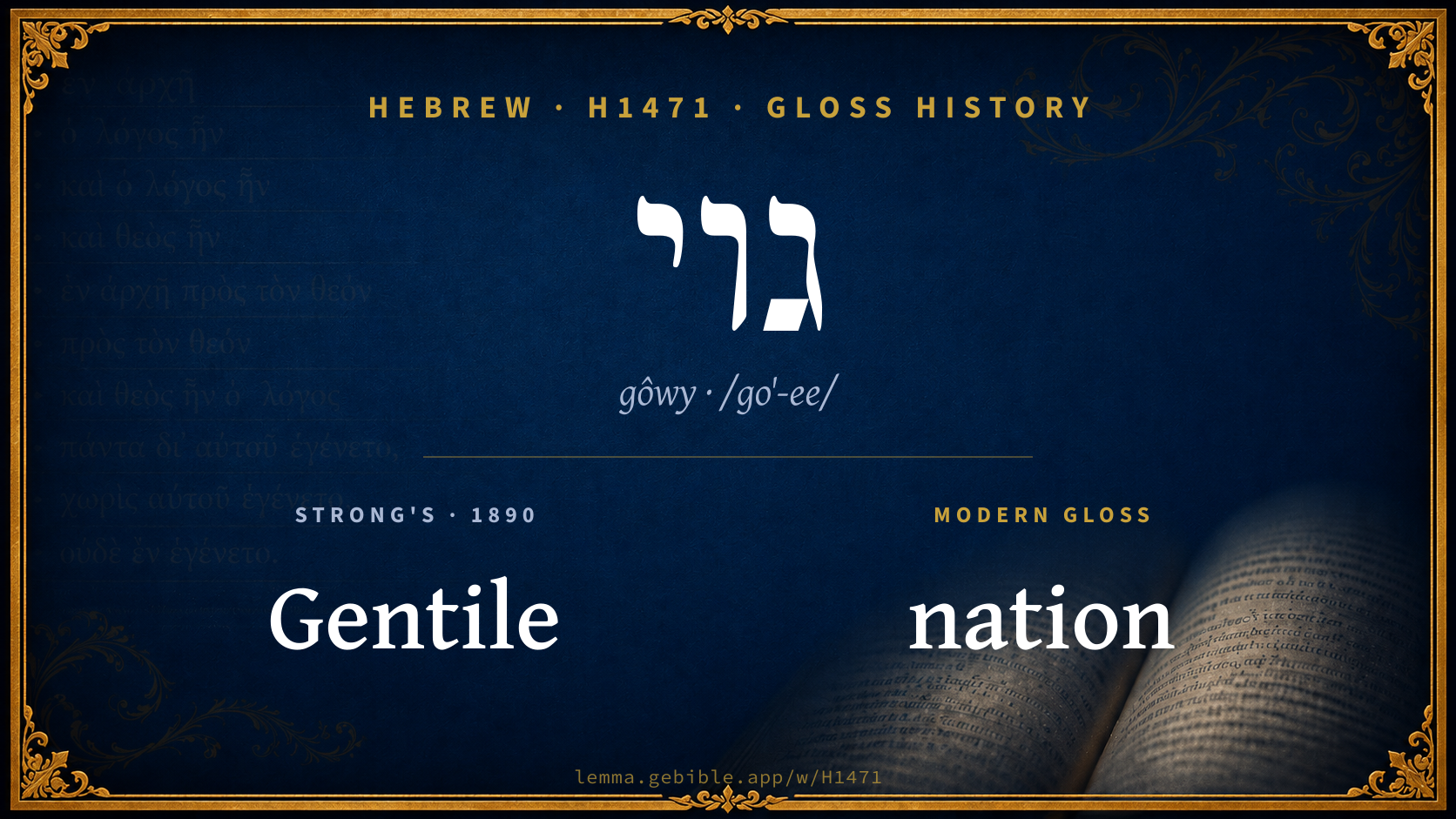
Gloss history
Strong's 1890 vs modern scholarship
About this word
Strong's H1471 catalogs a Hebrew word from the Hebrew Old Testament.
These counts are not copied from any lexicon or concordance. They are computed here, from the morphology-tagged Hebrew Old Testament. What Lemma adds →
- 511
- distinct verses
- The word appears in 511 distinct verses.
- 34 / 39
- OT books
- The word appears in 34 of 39 Old Testament books.
- #87
- by frequency
- Top 100 most frequent Hebrew words (rank 87 of 8,640 Hebrew words by occurrence).
View all 511 occurrences in the concordance →
By section of the Old Testament
By traditional corpus
Conventional, traditional groupings — biblical authorship is debated, so this is a traditional corpus grouping, not an authorship claim. Each share is this word’s portion of its verses in that division of the Hebrew canon. Each figure is a share of the word’s 511 distinct verses.
- Prophets (Nevi'im) 333 verses · 65%
- Writings (Ketuvim) 96 verses · 19%
- Torah (Pentateuch) 82 verses · 16%
How translations render this word
Counts come from each version’s own published word-to-Strong’s tagging or interlinear alignment — an approximate guide to how each version renders this word, not a word-level alignment the data otherwise carries. Because each total is that version’s own tagged count, the per-version totals vary from one another and need not match the appearance or distinct-verse counts above. These counts may also differ from a printed concordance because Lemma counts each distinctly tagged rendering and does not collapse phrase taggings into a single head-word total. This is a fixed set of word-tagged versions (KJV, ASV, BSB, ULT) and does not change with the reading translation you choose elsewhere. Each version’s license is shown beside its name below (and on Sources).
BDB lists this Strong’s number as 3 distinct words (homographs). Each count above pools all of them and is not split by sense — see the Senses section below. A low-frequency rendering may belong to a different one of those words, not the primary meaning.
- King James Version†: Nations 145×, Heathen 77×, Nation 76×
- American Standard Version†: Nations 212×, Nation 68×, Among the nations 54×
- Berean Standard Bible†: Nations 330×, Nation 107×, Among the nations 63×
- unfoldingWord Literal Text†: Nations 311×, Nation 108×, Among the nations 51×
King James Version Public Domain
Renders H1471 across 558† tagged occurrences — most commonly:
Plus other, less common renderings. Plus 88 renderings that appear only once — usually multi-word phrases or single function words the recovered tagging swept in, not distinct renderings.
American Standard Version Public Domain
Renders H1471 across 559† tagged occurrences — most commonly:
Plus other, less common renderings. Plus 115 renderings that appear only once — usually multi-word phrases or single function words the recovered tagging swept in, not distinct renderings.
Berean Standard Bible Public Domain
Renders H1471 across 553† tagged occurrences — most commonly:
Plus 28 renderings that appear only once — usually multi-word phrases or single function words the recovered tagging swept in, not distinct renderings. Not rendered by a distinct English word in 8 further occurrences.
unfoldingWord Literal Text CC BY-SA 4.0
Renders H1471 across 563† tagged occurrences — most commonly:
Plus other, less common renderings. Plus 42 renderings that appear only once — usually multi-word phrases or single function words the recovered tagging swept in, not distinct renderings.
Senses in the full BDB
What do BDB’s symbols mean?
BDB uses these scholarly abbreviations:
| Symbol | Meaning |
|---|---|
| 𝔊 | the Septuagint (the ancient Greek translation, LXX) |
| 𝔙 | the Vulgate (the Latin translation) |
| 𝔖 | the Syriac version (the Peshitta) |
| 𝔗 | the Targum (the Aramaic translation) |
| ψ | the Psalms |
| √ | root (the underlying root or stem) |
| ‖ | parallel passage (a synonymous or contrasted parallel) |
| † | the dagger: every passage where the word occurs is cited |
The 6 senses and sub-senses the full Brown-Driver-Briggs lexicon distinguishes for this word, in lexicon order (not ranked by frequency), with BDB’s own verbatim wording and sub-sense lettering. Shown in Hebrew script with BDB’s own scholarly abbreviations. The condensed entry is in the Lexicon Entry tab. See also the Forms in the corpus table below.
- 1. nation, people Gn 10:5(×2), 20, 31, 32(×2) (all P) +; Is 2:2, 4(×2) = Mi 4:2, 3(×2); †Jb 12:23(×2); 34:29†; Pr 14:34; כֹּל גּוֹיֵי הָאָרֶץ Gn 18:18; 22:18; 26:4 (all J) Dt 28:1. e.g. Genesis 10:5
- a. specif. of descendants of Abraham, גּוֹי גָּדוֹל Gn 12:2 cf. 18:18 (both J), גּוֹיִם 17:6, הֲמוֹן גּוֹיִם 17:4, 5 (all P); of Sarah גּוֹיִם 17:16 (P); of Ishmael גּוֹי 21:13, גּוֹי גָּדוֹל v 18 (both E), גּוֹי גָּדוֹל 17:20 (P); of Jacob גּוֹי וּקְהַל גּוֹיִם Gn 35:11 (P), גּוֹי גָּדוֹל 46:3 (E); of Ephraim מְלֹא הַגּ׳ 48:19 (J); of Moses גּוֹי גָּדוֹל Ex 32:10 (J) cf. Nu 14:12 (J) Dt 9:14; of Jacob and Esau as two nations Gn 25:23 (J). e.g. Genesis 12:2
- b. definitely of Israel Ex 19:6 (גּ׳ קָדוֹשׁ) 33:13 (both JE), Dt 4:6 (הַגּוֹי הַגָּדוֹל הַזֶּה, said by heathen cf. v 7, 8) v. also v 34, 26:5 cf. ψ 33:12, ψ 83:5 (said by enemies) Je 31:36; 33:24 Ez 27:22; in narrative Jos 3:17; 4:1; 5:8 (JE), v 6 (D), 10:13 (poet., no art.); of Israel and Judah as two nations Ez 35:10 (said by heathen) 37:22; of Judah Is 26:2, 15(×2) cf. 58:2; 60:22 Mi 4:7; once my people Zp 2:9 (‖ עַם); thy people ψ 106:5 (i.e. of י׳), cf. also Ez 36:13, 14 (read Kt); especially of Israel and (or) Judah as sinful, rebellious Dt 32:28 Ju 2:20 Is 1:4; 10:6 Je 5:9, 29; 7:28; 9:8; 12:17 Ez 2:3 (del. 𝔊 Co) Hg 2:14 Mal 3:9.—Note. This definite ref. to Israel and (or) Judah is comparatively rare; in Hex not P (yet v. Gn 17:4, 5, 6, 16; 35:11 P); seldom in exile & post-exile proph.; not Chr.— e.g. Exodus 19:6
- c. usually of non-Heb. peoples Ex 9:24; 34:10 (JE) Lv 25:44 (H) Nu 14:15 (J) Dt 15:6(×2) 1 K 5:11 1 Ch 14:17; 16:20 Is 11:10, 12 + often; opp. Israel as עם י׳ 2 S 7:23 1 Ch 17:21(×2) ect., v. עם, cf. also Nu 23:9; note especially גְּלִיל הַגּוֹיִם Is 8:23 circle or district of the nations (v. גָּלִיל); also חֲרֹשֶׁת הַגּ׳ Ju 4:2, 13, 16 Charosheth of the nations, & מֶלֶךְ גּוֹיִם לְגִלְגָּ֖ל Jos 12:23 king of nations (peoples, tribes) belonging to Gilgal (𝔊 Di to the district, i.e. ‘Galilee’); especially of these peoples as heathen: idolatrous Lv 8:24, 28 (P) 20:23 (H) 1 K 14:24 2 K 17:8, 11, 15, 26, 29(×2) 2 Ch 28:3; 32:13 +, Ezr 6:21 Ez 5:6 +; hostile Gn 15:14 (J) Lv 26:33; 38, 45 (H) Dt 4:27; 9:4, 5; 18:9 1 Ch 16:35 Je 5:15 Ez 4:13 + often Je Ez, etc.; in simile Ez 20:32; 25:8; sometimes ‖ עַם ψ 33:10, 12 Is 11:10 Je 6:18, v. also Is 2:2, 4 comp. with Mi 4:1, 3. e.g. Exodus 9:24
- 2. fig. of swarm of locusts Jo 1:6; of all species of beasts Zp 2:14. e.g. Joel 1:6
- 3. גּוֹיִם Gn 14:1, 9 prob. mutilated n.pr. v. infr. e.g. Genesis 14:1
Senses from the full Brown-Driver-Briggs lexicon (Brown, Driver, Briggs; Oxford 1906 — public domain), digitized via Sefaria, supplemented by the OpenScriptures HebrewLexicon (CC BY 4.0). Full attribution on Sources.
Word origin
I. n.m. Gn 12:2 nation, people (NH id. Gentiles, Ph. גו community, ܓܰܘܳܐ, Sab. גו id., DHMZMG 1883, 348)—ג׳ Gn 12:2 + 121 times; sf. i s. גּוֹיִ Zp 2:9, גּוֹיֶ֑ךָ ψ 106:5, גּוֹיֵךְ Kt Ez 36:13, 14, 15 (Qr wrongly גּוֹיַיִךְ cf. Co, who del. v 15); pl. גּוֹיִם Gn 10:5 + 410 times + Qr Gn 25:23 ψ 79:10 (Kt גיים) + 6 times Ez (var. emend. Co); cstr. גּוֹיֵי Gn 18:18 + 8 times, גּוֹיֵ 2 Ch 32:13 Ezr 6:21 (cf. Baer’s notes); sf. גּוֹיֵהֶם Gn 10:5, 20, 31, 32;—
I. n.pr.gent. Gn 14:1, 9, in phr. תִּדְעָל מֶלֶךְ גּוֹיִם Tidʿal king of Goim; prob. a Babylonian (Elamitic, etc.) name corrupted; H. Rawlinson proposes Gutî, a people NE. of Babylonia, COT on Gn 14:1; also KGF 258 al.; cf. also DlPa 233 f.
— Brown-Driver-Briggs (Oxford 1906, public domain), digitized via Sefaria, supplemented by the OpenScriptures HebrewLexicon (CC BY 4.0). See Sources.
Derived from גוה (gêvâh) (H1465) — back.
Jastrow Dictionary
A second Hebrew/Aramaic lexicon for comparison, covering Aramaic and post-biblical (Talmudic, Targumic, Midrashic) usage that the biblical-Hebrew BDB does not. Matched by lemma rather than by Strong’s number, so a lemma may carry more than one Jastrow headword (shown separately below), and the entries cover usage well beyond the Bible.
גּוֹי
- crowd, people, nation; pl. גּוֹיִם gentiles, fr. which גּוֹי = נָכְרִי or עכו"ם, gentile, idolator. Tosef. Ab. Zar. III, 4 sq.; Y. ib. IV, 41ᵃ top contrad. to כותי (Bab. ib. 29ᵃ נכרי); a. v. fr.—Pl. גּוֹיִים, גּוֹיִם. Ab. Zar. I, 1 sq. in Y. ed. ג׳ (Bab. ed. נכרים, עכו"ם, Mish. עכומ"ז, נכרים indiscriminately); a. v. fr.—Fem. גּוֹיָה gentile woman. Y. Yeb. II, 4ᵃ top ואין בנך מן הג׳ וכ׳ thy son from a gentile is not called thy son but her son (Bab. ib. 23ᵃ נכרית); a. fr.—Pl. גּוֹיוֹת. Y. ib. IV, 6ᵃ bot. [Y. Gitt. I, 43ᵇ top, a. e. גויים לוקין, v. גַּיּוּס.]
A Dictionary of the Targumim, the Talmud Babli and Yerushalmi, and the Midrashic Literature (Marcus Jastrow; London, Luzac, 1903) — Public Domain. Digitized via Sefaria. Digitized via Sefaria. Full attribution on Sources.
Forms in the corpus
The 166 distinct written forms H1471 takes in the Hebrew Bible, most frequent first — each parse links to that state’s occurrences in the concordance. Hebrew forms include their vowel points and cantillation, so a single lemma takes many written forms.
The 60 most common forms are shown; 106 rarer forms follow in the full concordance.
Same root — word family
Other BDB entries built from the same root as H1471, grouped by Strong’s listed origin. These share a root / origin per the lexicon — not necessarily a shared meaning. Each links to that word’s own entry.
Derives from
Shares the same root
Compare all same-root words → They share a root, not necessarily a meaning.
Septuagint verse parallels
This word appears in 472 verses that also exist in the Greek Old Testament (Septuagint), out of the 511 Hebrew verses it occurs in. You can read those verses in Greek by switching the Old Testament edition to the Septuagint.
Read these verses in the Septuagint
- Genesis 10:5
- Exodus 9:24
- Leviticus 18:24
- Numbers 14:12
- Deuteronomy 4:6
- Joshua 3:17
- Judges 2:20
- 1 Samuel 8:5
- 2 Samuel 7:23
- 1 Kings 11:2
- 2 Kings 6:18
- 1 Chronicles 14:17
This is a verse-level parallel only — the same verses exist in both the Hebrew and Greek Old Testaments. No word-level Hebrew↔Greek correspondence is claimed: the data carries no such alignment, so no Greek word is shown as this Hebrew word’s translation. Coverage is not total — the Septuagint omits the deuterocanon and renumbers the Psalms, so some Hebrew verses have no direct Greek parallel.