
2 Kings 16:3

Hebrew (Westminster Leningrad Codex) 2 Kings 16:3 appears in the Hebrew Old Testament. The text above is from the Westminster Leningrad Codex. Each word links to its Strong’s number, a concise gloss, and parsing drawn from the Open Scriptures Hebrew Bible morphology. Click any word for its full Brown-Driver-Briggs (BDB) entry.
Download image
Cite this verse

2 Kings 16:3 (World English Bible). Public Domain. Lemma interlinear Bible study tool, https://lemma.gebible.app/v/2-kings/16/3.

Show BibTeX & RIS
BibTeX
RIS
English Translation
But he walked in the way of the kings of Israel, yes, and made his son to pass through the fire, according to the abominations of the nations, whom Yahweh cast out from before the children of Israel.
World English Bible · Public Domain
Download a study sheet

One document with this verse’s original text, its word-by-word gloss line, the meaning frame, cross-references with their text, attributed commentary, and full source and license credits — printable, and it pastes into notes with its structure intact.

This verse Autodidact and up

Study sheet (.html) Plain text (.txt)

A passage Seminary Student

Up to 50 verses in one chapter. A passage sheet keeps up to 6 commentary sources and 12 cross-references per verse, in the order this page ranks them, and says so on the sheet whenever that leaves anything out. Ask for a single verse and you get the Autodidact verse sheet above.

Everything on this page stays free to read, with no account — the sheet is a download of what is already on screen, not access to it.

Want to remove ads? Support Godless Engineer
Compare translations 3

The same verse in 3 English versions, stacked beneath the original-language interlinear above. Click any original word for its lexicon entry.

Each is an independent rendering of the whole verse — the interlinear is not word-aligned to these translations.

Highlighted words mark where these versions differ — a whole-verse word diff, not a word-by-word alignment.

  • World English Bible Public Domain
    But he walked in the way of the kings of Israel, yes, and made his son to pass through the fire, according to the abominations of the nations, whom Yahweh cast out from before the children of Israel.
  • King James Version Public Domain
    But he walked in the way of the kings of Israel, yea, and made his son to pass through the fire, according to the abominations of the heathen, whom the LORD cast out from before the children of Israel.
  • unfoldingWord Literal Text CC BY-SA 4.0
    And he walked in the way of the kings of Israel. And he even made his son pass through the fire, like the abominations of the nations that Yahweh had driven them out from the face of the sons of Israel.

unfoldingWord Literal Text — © unfoldingWord, licensed CC BY-SA 4.0. Word-aligned USFM3 via Door43 (git.door43.org/unfoldingWord/en_ult).

Versions to compare (up to 4)

3 of 4 selected

Show all 18 translations

Every available English version of this verse, each an independent rendering of the whole verse.

  • World English Bible Public Domain
    But he walked in the way of the kings of Israel, yes, and made his son to pass through the fire, according to the abominations of the nations, whom Yahweh cast out from before the children of Israel.
  • Berean Standard Bible Public Domain
    Instead, he walked in the ways of the kings of Israel and even sacrificed his son in the fire, according to the abominations of the nations that the LORD had driven out before the Israelites.
  • Majority Standard Bible Public Domain
    Instead, he walked in the ways of the kings of Israel and even sacrificed his son in the fire, according to the abominations of the nations that the LORD had driven out before the Israelites.
  • King James Version Public Domain
    But he walked in the way of the kings of Israel, yea, and made his son to pass through the fire, according to the abominations of the heathen, whom the LORD cast out from before the children of Israel.
  • American Standard Version (1901) Public Domain
    But he walked in the way of the kings of Israel, yea, and made his son to pass through the fire, according to the abominations of the nations, whom Jehovah cast out from before the children of Israel.
  • Revised Version (1885) Public Domain
    But he walked in the way of the kings of Israel, yea, and made his son to pass through the fire, according to the abominations of the heathen, whom the LORD cast out from before the children of Israel.
  • Geneva Bible (1599) Public Domain
    But walked in the way of ye kings of Israel, yea, and made his sonne to go through the fire, after the abominations of the heathen, whom the Lord had cast out before the children of Israel.
  • Douay-Rheims (1899) Public Domain
    But he walked in the way of the kings of Israel: moreover he consecrated also his son, making him pass through the fire according to the idols of the nations: which the Lord destroyed before the children of Israel.
  • Young's Literal Translation Public Domain
    and he walketh in the way of the kings of Israel, and also his son he hath caused to pass over into fire, according to the abominations of the nations that Jehovah dispossessed from the presence of the sons of Israel,
  • Literal Standard Version CC BY-SA 4.0
    and he walks in the way of the kings of Israel, and he has also caused his son to pass over into fire, according to the abominations of the nations that YHWH dispossessed from the presence of the sons of Israel,
  • Unlocked Literal Bible CC BY-SA 4.0
    Instead, he walked in the way of the kings of Israel; indeed, he made his son pass through the fire, following the detestable practices of the nations, which Yahweh had driven out before the people of Israel.
  • unfoldingWord Literal Text CC BY-SA 4.0
    And he walked in the way of the kings of Israel. And he even made his son pass through the fire, like the abominations of the nations that Yahweh had driven them out from the face of the sons of Israel.
  • Darby Bible Public Domain
    but walked in the way of the kings of Israel, and even caused his son to pass through the fire, according to the abominations of the nations that Jehovah had dispossessed from before the children of Israel.
  • World Messianic Bible Public Domain
    But he walked in the way of the kings of Israel, and even made his son to pass through the fire, according to the abominations of the nations whom the LORD cast out from before the children of Israel.
  • Webster's Bible Public Domain
    But he walked in the way of the kings of Israel, and even made his son to pass through the fire, according to the abominations of the heathen, whom the LORD cast out from before the children of Israel.
  • Free Bible Version CC BY-SA 4.0
    He followed the ways of the kings of Israel, and he even sacrificed his son in the fire, participating in the disgusting practices of the nations the Lord had driven out before the Israelites.
  • Bible in Basic English Public Domain
    But he went in the ways of the kings of Israel, and even made his son go through the fire, copying the disgusting ways of the nations whom the Lord had sent out of the land before the children of Israel.
  • JPS Tanakh (1917) Public Domain
    But he walked in the way of the kings of Israel, yea, and made his son to pass through the fire, according to the abominations of the heathen, whom the LORD cast out from before the children of Israel.

Literal Standard Version (2020), Covenant Press — licensed CC BY-SA 4.0. Text via the HelloAO Bible API (eBible.org). Unlocked Literal Bible (unfoldingWord) — licensed CC BY-SA 4.0. Text via the HelloAO Bible API (eBible.org). unfoldingWord Literal Text — © unfoldingWord, licensed CC BY-SA 4.0. Word-aligned USFM3 via Door43 (git.door43.org/unfoldingWord/en_ult). Free Bible Version, Dr. Jonathan Gallagher — licensed CC BY-SA 4.0. Text via the HelloAO Bible API (eBible.org).

Word by word

More ways to search: Search by grammar → Find every occurrence → Compare this word →

Practice this passage: Drill this verse → Learn its vocabulary →

כְּתֹֽעֲבוֹת֙
tôwʻêbah
H8441
“like/as · abominations of”
Preposition + Noun, Common, Feminine, Plural, Construct
Part of Speech
Preposition + Noun
Type
Common
Gender
Feminine
Number
Plural
State
Construct
Full BDB Definition

Origin: act part of H8581

TWOT: 2530a

a disgusting thing, abomination, abominable - in ritual sense (of unclean food, idols, mixed marriages) - in ethical sense (of wickedness etc)
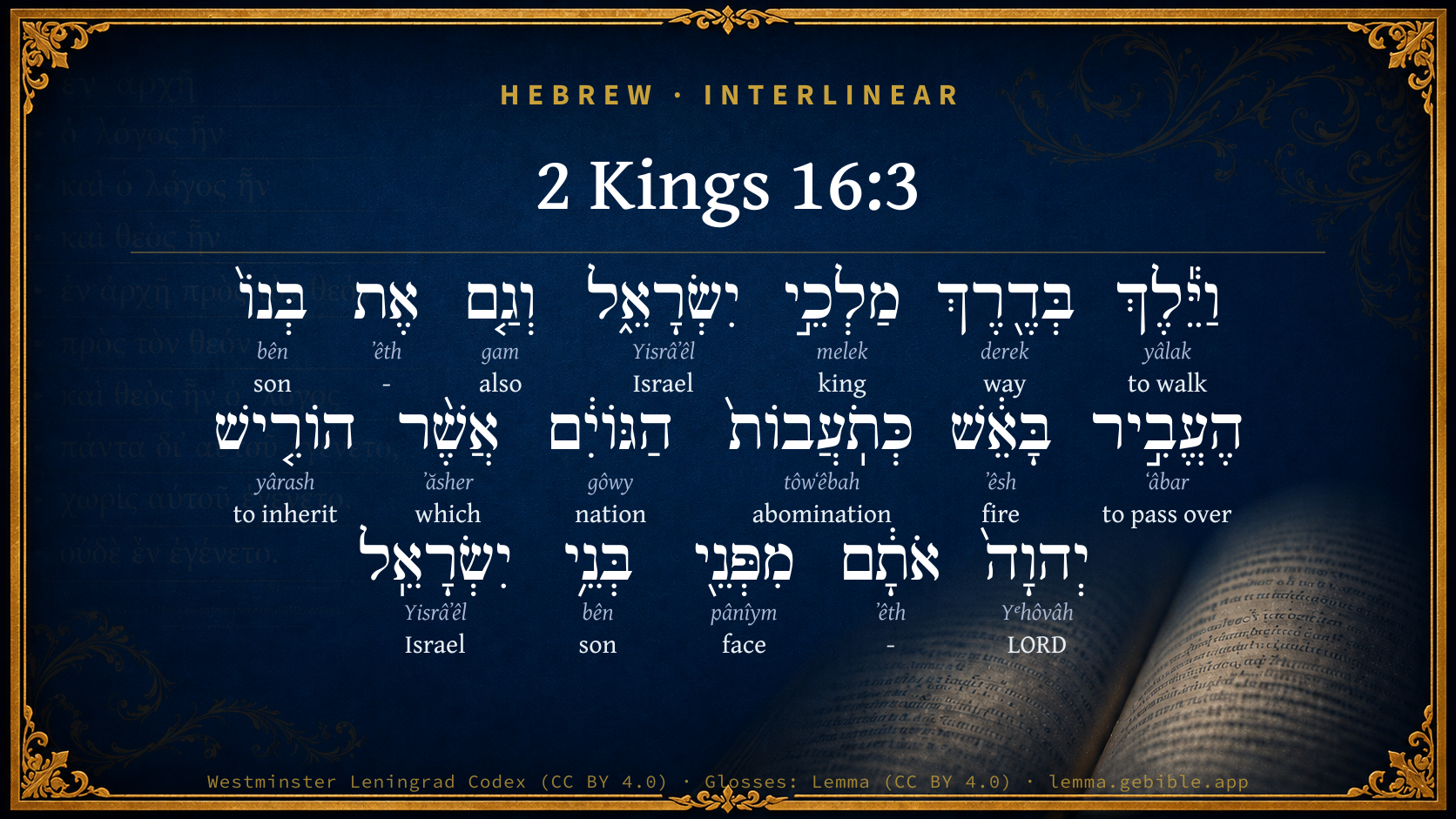
  1. וַיֵּ֕לֶךְ yâlak H3212 “and · to walk” Conjunction + Verb, Qal, Sequential Imperfect, 3rd Person, Masculine, Singular
  2. בְּדֶ֖רֶךְ derek H1870 “in/at · way of” Preposition + Noun, Common, Both, Singular, Construct
  3. מַלְכֵ֣י melek H4428 “kings of” Noun, Common, Masculine, Plural, Construct
  4. יִשְׂרָאֵ֑ל Yisrâʼêl H3478 “Israel” Noun, Proper
  5. וְגַ֤ם gam H1571 “and · also” Conjunction + Particle, Accusative
  6. אֶת ʼêth H853 “-” Particle, Direct Object
  7. בְּנוֹ֙ bên H1121 “son · his” Noun, Common, Masculine, Singular, Construct + Suffix, Personal, 3rd Person, Masculine, Singular
  8. הֶעֱבִ֣יר ʻâbar H5674 “to pass over” Verb, Hiphil, Perfect, 3rd Person, Masculine, Singular
  9. בָּאֵ֔שׁ ʼêsh H784 “in/at the · fire” Preposition, Determined + Noun, Common, Both, Singular, Absolute
  10. הַגּוֹיִ֔ם gôwy H1471 “the · nations” Particle, Definite Article + Noun, Common, Masculine, Plural, Absolute
  11. אֲשֶׁ֨ר ʼăsher H834 “which” Particle, Relative
  12. הוֹרִ֤ישׁ yârash H3423 “to inherit” Verb, Hiphil, Perfect, 3rd Person, Masculine, Singular
  13. יְהוָה֙ Yᵉhôvâh H3068 “LORD” Noun, Proper
  14. אֹתָ֔ם ʼêth H853 “- · them” Particle, Direct Object + Suffix, Personal, 3rd Person, Masculine, Plural
  15. מִפְּנֵ֖י pânîym H6440 “from · face(s) of” Preposition + Noun, Common, Both, Plural, Construct
  16. בְּנֵ֥י bên H1121 “sons of” Noun, Common, Masculine, Plural, Construct
  17. יִשְׂרָאֵֽל Yisrâʼêl H3478 “Israel” Noun, Proper

About this verse

These counts appear in no published source. They are computed here, from the morphology-tagged text and Lemma’s own curated glosses. What Lemma adds →

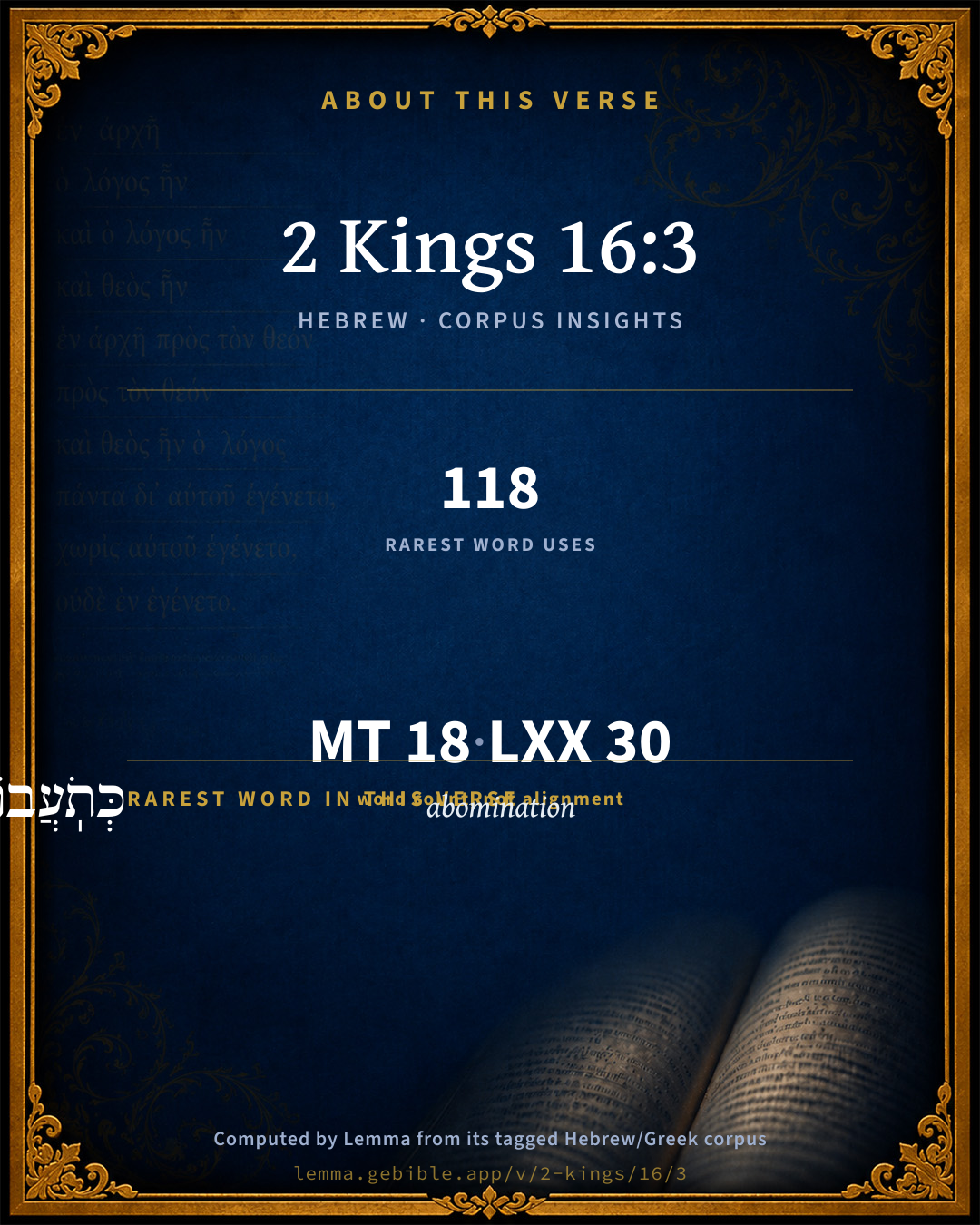
18
words
15
distinct lemmas
Historical
section

Grammatical profile

  • 3 verbs
  • 11 nouns
  • 4 particles

Verb forms

  • וַיֵּ֕לֶךְ Qal · Sequential Imperfect
  • הֶעֱבִ֣יר Hiphil · Perfect
  • הוֹרִ֤ישׁ Hiphil · Perfect

Repetition

Words recur within this verse — often emphatic in Hebrew:

  • יִשְׂרָאֵ֑ל Israel H3478 ×2
  • בְּנוֹ֙ son H1121 ×2

Hebrew & Septuagint length

In English translation the verse runs 38 words from the Hebrew and 39 from the Septuagint (LXX English) — closely comparable.

A rough comparison of the two English renderings, which tokenize alike — not a word-level alignment.

Word counts can differ between the Hebrew and the Greek without any difference in meaning — e.g. the Hebrew direct-object marker אֵת has no separate Greek word, and Greek often adds the article ὁ.

In the original languages it is 18 Hebrew tokens and 30 Greek tokens — but the two are counted differently (Hebrew bundles its prefixes and suffixes into one token; the Greek is in lemma form), so that isn’t a like-for-like length.

Cross-references

26

Topical passages linked to 2 Kings 16:3 in the Treasury of Scripture Knowledge — connected by theme and wording, ordered by reader-vote popularity; previews shown in the World English Bible.

  • Deuteronomy 12:31 You shall not do so to Yahweh your God: for every abomination to Yahweh, which he hates, have they done to their gods; for even their sons and their daughters do they burn in the fire to their gods.
  • Leviticus 18:21 "'You shall not give any of your children to sacrifice to Molech; neither shall you profane the name of your God: I am Yahweh.
  • 2 Kings 21:2 He did that which was evil in the sight of Yahweh, after the abominations of the nations whom Yahweh cast out before the children of Israel.
  • 2 Kings 17:17 They caused their sons and their daughters to pass through the fire, and used divination and enchantments, and sold themselves to do that which was evil in the sight of Yahweh, to provoke him to anger.
  • 2 Kings 21:11 Because Manasseh king of Judah has done these abominations, and has done wickedly above all that the Amorites did, who were before him, and has made Judah also to sin with his idols;
  • Psalms 106:37–38 Yes, they sacrificed their sons and their daughters to demons.
  • Leviticus 20:2 "Moreover, you shall tell the children of Israel, 'Anyone of the children of Israel, or of the strangers who live as foreigners in Israel, who gives any of his seed to Molech; he shall surely be put to death. The people of the land shall stone him with stones.
  • Deuteronomy 18:10 There shall not be found with you anyone who makes his son or his daughter to pass through the fire, one who uses divination, one who practices sorcery, or an enchanter, or a sorcerer,
  • 1 Kings 12:28–30 Whereupon the king took counsel, and made two calves of gold; and he said to them, It is too much for you to go up to Jerusalem: see your gods, Israel, which brought you up out of the land of Egypt.
  • 1 Kings 14:24 and there were also sodomites in the land: they did according to all the abominations of the nations which Yahweh drove out before the children of Israel.
  • 1 Kings 16:31–33 It happened, as if it had been a light thing for him to walk in the sins of Jeroboam the son of Nebat, that he took as wife Jezebel the daughter of Ethbaal king of the Sidonians, and went and served Baal, and worshiped him.
  • 1 Kings 21:25–26 (But there was none like Ahab, who did sell himself to do that which was evil in the sight of Yahweh, whom Jezebel his wife stirred up.
  • 1 Kings 22:52–53 He did that which was evil in the sight of Yahweh, and walked in the way of his father, and in the way of his mother, and in the way of Jeroboam the son of Nebat, in which he made Israel to sin.
  • 2 Kings 8:18 He walked in the way of the kings of Israel, as did the house of Ahab: for he had the daughter of Ahab as wife; and he did that which was evil in the sight of Yahweh.
  • 2 Kings 21:6 He made his son to pass through the fire, and practiced sorcery, and used enchantments, and dealt with those who had familiar spirits, and with wizards: he worked much evil in the sight of Yahweh, to provoke him to anger.
  • 2 Kings 23:10 He defiled Topheth, which is in the valley of the children of Hinnom, that no man might make his son or his daughter to pass through the fire to Molech.
  • 2 Chronicles 22:3 He also walked in the ways of the house of Ahab; for his mother was his counselor to do wickedly.
  • 2 Chronicles 28:2–4 but he walked in the ways of the kings of Israel, and made also molten images for the Baals.
  • 2 Chronicles 33:2 He did that which was evil in the sight of Yahweh, after the abominations of the nations whom Yahweh cast out before the children of Israel.
  • 2 Chronicles 33:6 He also made his children to pass through the fire in the valley of the son of Hinnom; and he practiced sorcery, and used enchantments, and practiced sorcery, and dealt with those who had familiar spirits, and with wizards: he worked much evil in the sight of Yahweh, to provoke him to anger.
  • Psalms 106:35 But mixed themselves with the nations, And learned their works.
  • Jeremiah 32:35 They built the high places of Baal, which are in the valley of the son of Hinnom, to cause their sons and their daughters to pass through [the fire] to Molech; which I didn't command them, neither did it come into my mind, that they should do this abomination, to cause Judah to sin.
  • Ezekiel 16:21 that you have slain my children, and delivered them up, in causing them to pass through [the fire] to them?
  • Ezekiel 16:47 Yet have you not walked in their ways, nor done after their abominations; but, as [if that were] a very little [thing], you were more corrupt than they in all your ways.
  • Ezekiel 20:26 and I polluted them in their own gifts, in that they caused to pass through [the fire] all that opens the womb, that I might make them desolate, to the end that they might know that I am Yahweh.
  • Ezekiel 20:31 and when you offer your gifts, when you make your sons to pass through the fire, do you pollute yourselves with all your idols to this day? and shall I be inquired of by you, house of Israel? As I live, says the Lord Yahweh, I will not be inquired of by you;

Cross-references courtesy of OpenBible.info (CC BY 4.0).

Hebrew and Greek witnesses Masoretic Hebrew ↔ Greek Septuagint

The same verse in the two great witnesses to the Old Testament, shown verse-for-verse.

These are two independent witnesses, not word-aligned to each other, and the Septuagint is shown in lemma (dictionary) form.

Hebrew 2 Kings 16:3 Masoretic · Westminster Leningrad Codex

וַיֵּ֕לֶךְ בְּדֶ֖רֶךְ מַלְכֵ֣י יִשְׂרָאֵ֑ל וְגַ֤ם אֶת בְּנוֹ֙ הֶעֱבִ֣יר בָּאֵ֔שׁ כְּתֹֽעֲבוֹת֙ הַגּוֹיִ֔ם אֲשֶׁ֨ר הוֹרִ֤ישׁ יְהוָה֙ אֹתָ֔ם מִפְּנֵ֖י בְּנֵ֥י יִשְׂרָאֵֽל

But he walked in the way of the kings of Israel, yes, and made his son to pass through the fire, according to the abominations of the nations, whom Yahweh cast out from before the children of Israel.

World English Bible · Public Domain

Greek LXX 2 Kings 16:3 Septuagint · lemma form

καί πορεύομαι ἐν ὁδός ιεροβοαμ υἱός ναβατ βασιλεύς ἰσραήλ καί γέ ὁ υἱός αὐτός διαἄγω ἐν πῦρ κατά ὁ βδέλυγμα ὁ ἔθνος ὅς ἐκαἴρω κύριος ἀπό πρόσωπον ὁ υἱός ἰσραήλ

And he walked in the way of the kings of Israel, yes, he made his son to pass through the fire, according to the abominations of the heathen whom the Lord cast out from before the children of Israel.

LXX2012 (modern English Septuagint) · Public Domain

Hebrew: Westminster Leningrad Codex (CC BY 4.0). Greek: Septuagint (public domain); English from LXX2012 (modern English Septuagint) (Public Domain). How the Septuagint differs from the Hebrew →

Targum (Aramaic paraphrase)

1

The Targum is the ancient Jewish Aramaic paraphrase of the Hebrew Scriptures — an interpretive translation, not the Hebrew text itself. Onkelos (literal) and Pseudo-Jonathan (expansive) render the Torah, and Jonathan the Prophets. Coverage is partial: where no permissively-licensed English translation exists for a verse, only the Aramaic is shown. This is verse-level text, not a word-by-word alignment to the Hebrew.

  1. Targum Jonathan Prophets (Joshua–Malachi)
    וַאֲזַל בְּאוֹרַח מַלְכֵי יִשְׂרָאֵל וְאַף יַת בְּרֵיהּ אַעֲבַר בְּנוּרָא כְּתוֹעֲבַת עַמְמַיָא דְתָרִיךְ יְיָ יַתְהוֹן מִן קֳדָם בְּנֵי יִשְׂרָאֵל:

    (no public-domain English translation for this verse)

    Targum Jonathan — Aramaic: “Mikraot Gedolot” (public domain). English: “Sefaria Community Translation” (CC0 1.0 (public-domain dedication)); “London "Chaldee Paraphrase," 1871” (public domain). Text via Sefaria.

Commentary

Notes on 2 Kings 16:3 from classic Christian and Jewish commentators (each source and its license shown beneath its notes). The classic Christian expositions comment on the surrounding passage and are grouped to its opening verse, so a note may address several verses; the Jewish commentaries on the Tanakh (Rashi and others) are per-verse, so they appear only where the commentator wrote on this verse.

Lemma curates 59 commentaries, every one of them public domain or Creative Commons licensed, each selected and text-cleaned for this edition rather than reprinted as found. About our sources →

Trapp's Complete Commentary

John Trapp

2Ki 16:3 But he walked in the way of the kings of Israel, yea, and made his son to pass through the fire, according to the abominations of the heathen, whom the LORD cast out from before the children of Israel.

Ver. 3. But he walked in the way, &c.] He "did wickedly as he could," as if he had been "delivered to do all these abominations," as Jer 7:10.

According to the abominations of the heathen.] Who offered their own flesh and blood in an idol’s fire. How gladly then should we offer to God our souls and bodies, which we may enjoy so much the more when they are his!

John Trapp, A Commentary or Exposition upon All the Books of the Old and New Testament (1647–1656) — public domain. Text from a community e-Sword module.

Joseph Benson's Commentary

2Ki 16:3. He walked in the way of the kings of Israel — Who all worshipped the calves, and were therefore idolaters. He was not joined in any affinity with them, as Jehoram and Ahaziah were with the house of Ahab, but of his own accord and voluntary motion, and, without any instigation, he walked in their way. The kings of Israel pleaded policy and reasons of state for their idolatry; but Ahaz had no such pretence: in him it was the most unreasonable and impolitic conduct that could be. They were his enemies, and had manifested that they were enemies to themselves too by their idolatry; yet he walked in their way. And made his son to pass through the fire — By way of oblation, so as to be consumed for a burnt- offering, which was the practice of heathen, and of some Israelites in imitation of them. Thus 2Ch 28:3, it is said, He burned his children in the fire, that is, some of them, first one, as is here mentioned, and afterward others, as is there observed. See on Lev 18:21, and Deu 18:10. According to the abominations of the heathen, whom the Lord cast out — It was an instance of his great folly that, in his religion, he would be guided by and imitate those whom he saw fallen into the ditch before his eyes; and of his great impiety, that he would conform to those usages which God had declared to be abominable to him.

Joseph Benson's Commentary on the Old and New Testaments (1811–1818) — public domain. Text from a community e-Sword module.

Geneva Bible (1599)

Geneva Bible translators

That is, offered him to Molech, or made him to pass between two fires, as the manner of the Gentiles was, Lev. 18:21; Deut. 18:10.

Geneva Bible (1599) marginal notes — public domain. Text via Bolls.life.

Jamieson, Fausset & Brown

Robert Jamieson, A. R. Fausset & David Brown

walked in the way of the kings of Israel--This is descriptive of the early part of his reign, when, like the kings of Israel, he patronized the symbolic worship of God by images but he gradually went farther into gross idolatry (Ch2 28:2).

made his son to pass through the fire-- (Kg2 23:10). The hands of the idol Moloch being red hot, the children were passed through between them, which was considered a form of lustration. There is reason to believe that, in certain circumstances, the children were burnt to death (Psa 106:37). This was strongly prohibited in the law (Lev 18:21; Lev 20:2-5; Deu 18:10), although there is no evidence that it was practised in Israel till the time of Ahaz.

Jamieson, Fausset & Brown — Commentary Critical and Explanatory on the Whole Bible (1871) — public domain (CC PDM 1.0). Text via the HelloAO Bible API.

Adam Clarke's Commentary

Verse 3. Made his son to pass through the fire] On this passage I beg leave to refer the reader to my notes on Le 18:21; Le 20:2; Le 20:14, where the subject is considered at large.

Adam Clarke's Commentary on the Bible (1810–1826) — public domain. Text from a community e-Sword/MySword module.

Ellicott's Commentary for English Readers

(3) But he walked in the way.—See Notes on 2Ch_28:2.

Made his son to pass through the fire.—The chronicler rightly explains this as a sacrifice by fire. That such an appalling rite is really intended may be seen by reference to 2Ki_17:31; Jer_19:5; Eze_16:20; Eze_23:37; Jer_32:35. The expression, “To make-to pass through the fire to Moloch” (Lev_18:21) may have originated, as Movers suggests, in the idea that the burning was a kind of passage to union with the deity, after the dross of the flesh had been purged away; or it may be a mere euphemism. Ahaz appears to have been the first Israelite king who offered such a sacrifice. He, no doubt, regarded it as a last desperate resource against the oppression of his northern enemies. It is absurd to suppose that the king intended it in love to his child, as Thenius suggests. (See Jdg_11:31.) Such dreadful sacrifices were only made in cases of dire extremity. (Comp. 2Ki_3:27.)

The heathen.—More particularly the Ammonites, who made such sacrifices to Molech or Milcom.

A Bible Commentary for English Readers, edited by Charles John Ellicott (1878–1897) — public domain. Text from a community e-Sword module.

The Cambridge Bible for Schools and Colleges

gen. ed. J. J. S. Perowne

3. he walked in the way of the kings of Israel] This is more fully explained by the Chronicler, and means that he followed after all kinds of heathen idolatry, not that he introduced the worship of the calves from Israel into Judah. ‘He made molten images for the Baalim, and burnt incense in the valley of the son of Hinnom.’ ‘It is hard not to be infected with a contagious neighbourhood. Whoever read that the kingdom of Israel was seasoned with the vicinity of the true religion of Judah? Goodness, such as our nature is, is not so apt to spread. A tainted air doth more easily affect a sound body, than a wholesome air can clear the sick’. (Bp. Hall.)

yea, and made his son to pass through the fire] i.e. To Moloch. Thus introducing into Judah once more, as in Solomon’s days (1Ki_11:7) the worship of ‘the abomination of the children of Ammon’. The words of this verse might be made to refer only to a passing through flame, as a ceremony significant of purification. But the words of the Chronicler are stronger: ‘he burnt his children in the fire.’ From which it would appear that not one son only was offered. That the children offered in such sacrifices were actually burnt is seen from 2Ki_17:31; Eze_16:21; and many other passages. But from the words of Ezekiel it may perhaps be inferred that the victims were first slain and then burnt. ‘Thou hast taken thy sons and thy daughters whom thou hast borne unto me and these hast thou sacrificed unto them to be devoured … thou hast slain my children and delivered them up in causing them to pass through the fire unto them.’

according to the abominations of the heathen] The word ‘abomination’ is constantly employed of idols and their worship, their rites being often of the foulest character. The heathen practices of Tyre and Sidon, of the Ammonites, and of the Syrians of Damascus all now found place and worshippers in Jerusalem.

The Cambridge Bible for Schools and Colleges (gen. ed. J. J. S. Perowne; Cambridge University Press, 1878–1918) — public domain. Text from a community e-Sword module.

John Gill's Exposition

And he sacrificed and burnt incense in the high places, and on the hills,.... Which none of the kings of Judah before him ever did; for though they connived at this practice in the people, they never encouraged it by their own example; and very probably he offered sacrifices there to idols, see Ch2 28:25 whereas the people sacrificed to the true God, though at a wrong place:

and under every green tree; and which is never said of the people, and seems to confirm it, that Ahaz sacrificed to other gods, since the Heathens used to place idols under green trees, and worship them, whom the Jews imitated, Jer 2:2.

John Gill's Exposition of the Whole Bible (1746–1763) — public domain (CC PDM 1.0). Text via the HelloAO Bible API.

Albert Barnes' Notes on the Bible

Ahaz was the worst of all the kings of Judah. He imitated the worst of the Israelite kings - Ahab and Ahaziah - by a re-introduction of the Baal worship, which had been rooted out of Israel by Jehu and out of Judah by Jehoiada.

And made Iris son to pass through the fire - i. e. Ahaz adopted the Moloch worship of the Ammonites and Moabites 2Ki 3:27; Mic 6:7, and sacrificed at least one son, probably his firstborn, according to the horrid rites of those nations, and the Canaanite tribes Deu 12:31; Psa 106:37-38. Hereto, apparently, the Jews had been guiltless of this abomination. They had been warned against it by Moses (marginal reference; Deu 18:10); and if (as some think) they had practiced it in the wilderness Eze 20:26; Amo 5:26, the sin must have been rare and exceptional; from the date of their entrance into the promised land they had wholly put it away. Now, however, it became so frequent (compare 2Ki 17:17; 2Ki 21:6) as to meet with the strongest protest from Jeremiah and Ezekiel (Jer 7:31-32; Jer 19:2-6; Jer 32:35; Eze 16:20; Eze 20:26; Eze 23:37, etc.).

Albert Barnes' Notes on the Bible (1834–1885) — public domain. Text from a community e-Sword/MySword module.

Haydock's Catholic Bible Commentary

Fire, to purify him (or them, Paralipomenon filios, all were treated thus. Haydock) according to the superstitions of the pagans: omnia purgat edax ignis. (Ovid, Fast.) (Theodoret, q. 16.) (Menochius) --- Others believe that the child was burnt to death in honour of Moloch, and in imitation of the Chanaanites, Psalm cv. 37., and Deuteronomy xviii. 10. The Carthaginians were required by Gelon, king of Syracuse, to lay aside this most barbarous custom. (Phil. apoph.) Yet, "infants were publicly immolated to Saturn, in Africa, till the proconsulate of Tiberius, who ordered the priests to be exposed on those same trees which shaded their crimes, as on votive crosses. This the soldiers, my countrymen, who executed the proconsul’s orders, can testify; and still the sacred crime is perpetrated in secret." (Tertullian, Apol. viii.) --- How tenacious are people of old errors! (Haydock)

George Leo Haydock (1774–1849), Haydock's Catholic Family Bible and Commentary, 1859 edition — public domain. Excludes Psalms (Douay-Rheims chapter numbering differs from Protestant) and Deuterocanonical books (Catholic canon only).

Matthew Poole's English Annotations

Made his son to pass through the fire; either,

1. By way of lustration, to pass hastily through it, so as to be scorched, and, as it were, baptized with it. Or,

2. By way of oblation, so as to be utterly consumed, and offered for a burntoffering, which was the practice of heathens, and of some Israelites, in imitation of them; of which see 2Ki 21:6; Psa 105:35; Jer 7:31; which seems best to agree with 2Ch 28:3, where it is said he burnt his children, i.e., some of them; first one, as is here noted; and afterwards others of them, as is there observed. Of these practices, see more on Lev 18:21; Deu 18:10.

Matthew Poole's English Annotations on the Holy Bible (1683–1685) — public domain. Text from a community e-Sword/MySword module.

Whedon's Commentary on the Bible

Daniel D. Whedon

3. Walked in the way of the kings of Israel — By running into all sorts of idolatry, and forming leagues with the heathen. His reign was a period of enormous wickedness, and to Judah one of numerous disasters.

Made his son to pass through the fire — This expression, more fully written in 2Ki_23:10, to pass through the fire to Molech, is interpreted by the rabbies to mean merely the passing between two burning pyres as a purificatory rite. But this is refuted by the parallel passage in 2Ch_28:3 : He burnt his children in the fire, and also by the unequivocal statements of the following texts: Psa_106:37-38; Jer_7:31; Jer_19:4-5; Eze_16:20-21; Eze_23:37. A comparison of all these passages will show that the victims were slain before they were burned. The laws of Moses warned the Israelites against this very abomination, Compare Lev_18:21; Lev_20:2-4; Deu_18:10. The rabbinical theory evidently sprung from a desire to escape the charge of the atrocious idolatries of the ancient Jews.

Abominations of the heathen — Several of the Canaanitish nations, as well as the Ammonites and Moabites, appear to have practised this horrible rite. According to Movers, “the burning of the children was regarded as a passing through, by which they attained to purification with the deity after the dissolution of the earthly, impure dross of the body.”

Daniel D. Whedon (gen. ed.), Commentary on the Old and New Testaments (1874–1909) — public domain. Text from a community e-Sword module.

The Pulpit Commentary

But he walked in the way of the kings of Israel. Not, of course, by establishing a worship of calves, but by following the worst practices of the worst Israelite kings, e.g. Ahab and Ahaziah, and reintroducing into Judah the Phoenician idolatry, which Joash and the high priest Jehoiada had cast out. (2Ki_11:17, 2Ki_11:18) As the writer of Chronicles says, (2Ch_28:2) "He walked in the ways of the kings of Israel, and made also molten images for Baalim." Baalim is either a plural of dignity, or a word denoting the different forms under which Baal was worshipped, as Melkarth, Adonis, Rimmon, etc. Yea, and made his son to pass through the fire. In Chronicles (2Ch_28:3) we are told that "he burnt incense in the valley of Hinnom, and burnt his children in the fire," as if he had sacrificed more than one son. The practice of offering children in sacrifice was not a feature of the Assyro-Babylonian religion, as some suppose, but an intrinsic part of the worship of the Phoenicians, common to them with the Moabites, Ammonites, and others. It was based upon the principle of a man"s offering to God that which was dearest and most precious to himself, whence the crowning sacrifice of the kind was a man"s offering of his firstborn son (see 2Ki_3:27; Mic_6:7) Some hare supposed that the rite was a mere dedication or lustration, the children passing between two fires, and being thenceforward employed only in God"s service. But the expressions used by the sacred writer and others, and still more the descriptions that have come down to us from heathen and patristic authors, make it absolutely certain that the "passing through the fire" was no such innocent ceremony as this, but involved the death of the children. The author of Chronicles says, "Ahaz burnt his children in the fire;" Jer_19:5, "They have built also the high places of Baal, to burn their sons with fire for burnt offerings unto Eze_16:21, "Thou hast slain my children, and delivered them to cause them to pass through the fire." Josephus declares of Ahaz that he "made his own son a whole burnt offering (idion wjlokautwse paida)." Diodorus Sicalus describes the ceremony as it took place at Carthage, the Phoenician colony. There was in the great temple there, he says, an image of Saturn (Moloch), which was a human figure with a bull"s head and outstretched arms. This image of metal was made glowing hot by a fire kindled within it; and the children, laid in its arms, rolled from thence into the fiery lap below. If the children cried, the parents stopped their noise by fondling and kissing them; for the victim ought not to weep, and the sound of complaint was drowned in the din of flutes and kettle-drums (Died. Sic., 20:14). "Mothers," says Plutarch ("De Superstitione," "stood by without tears or sobs; if they wept or sobbed, they lost the honor of the act, and the children were sacrificed notwithstanding." The only doubtful point is whether the children were placed alive in the glowing arms of the image, or whether they were first killed and afterwards burnt in sacrifice; but the description of Diodorus seems to imply the more cruel of the two proceedings. According to the abominations of the heathen, whom the Lord east out from before the children of Israel. (On the practice of this terrible rite by the Canaanitish nations at the time of the Israelite invasion, (Lev_18:21; Deu_12:31 Deu_18:9, Deu_18:10; Psa_106:37, Psa_106:38)

The Pulpit Commentary (1880–1919), ed. H.D.M. Spence-Jones & Joseph S. Exell — public domain. Text from a community e-Sword module.

John Wesley's Explanatory Notes

Pass - By way of oblation, so as to be consumed for a burnt- offering, which was the practice of Heathens, and of some Israelites, in imitation of them.

John Wesley, Explanatory Notes Upon the Whole Bible (1754–1765) — public domain. Text via the GEBible commentary corpus.

unfoldingWord translationNotes

Door43 World Missions Community

he walked in the way of the kings of Israel

Walking represents behavior and actions. AT: "King Ahaz acted the same way that the kings of Israel had acted" or "he did the things that the kings of Israel had done" (See: Metaphor)

following the detestable practices of the nations

Here "following" represents doing what others do. AT: "copying the disgusting things that the other nations did, the nations" (See: Metaphor)

the nations

The word "nations" represents the people of other nations. Here it refers to the people of the nations who had lived in that land. AT: "the people of other nations" (See: Metonymy)

which Yahweh had driven out

"Drive out" means "force out." AT: "which Yahweh had forced to leave"

before the people of Israel

The people of those nations fled as the people of Israel moved into the land. The full meaning of this statement can be made explicit. AT: "before the people of Israel who moved into the land" or "as the people of Israel moved into the land" (See: Assumed Knowledge and Implicit Information)

the high places, on the hilltops, and under every green tree

These are places where the people of the other nations worshiped their false gods.

under every green tree

God wanted his people to offer sacrifices to him in Jerusalem. The word "every" here is an exaggeration to show how determined King Ahaz was to disobey God by offering sacrifices in many other places instead. AT: "under many green trees" or "under many green trees around the country" (See: Hyperbole and Generalization)

translationWords

walk

kingdom of Israel

fire

burnt offering

nation

sacrifice

incense

high place

unfoldingWord translationNotes — © Distant Shores Media and the Door43 World Missions Community, licensed CC BY-SA 4.0. Source: git.door43.org/Door43/en_tn.

Lesson kit

Teaching starters — assembled from the data on this page, not authored interpretation. Every prompt links to the verse data it draws on. Edit before teaching.

2 Kings, in the Historical, opens this verse with 18 words (15 distinct Hebrew lemmas). Its most distinctive word is tôwʻêbah (“abomination”). A historical commentator’s framing appears above. Read the whole chapter for the surrounding context.

Discussion questions

  1. What does “abomination” (tôwʻêbah) contribute to the verse as a whole?
  2. Deuteronomy 12:31 shares this passage’s theme. How do the two illuminate each other?
  3. “Israel” occurs 2× in this one verse. What is the effect of the repetition?
  4. These translations render this verse differently; the difference is in the English rendering, not the original. What questions does that raise?
  5. The verb «וַיֵּ֕לֶךְ» is Qal Sequential Imperfect. How does its form color the action?
  6. Reading how Trapp's Complete Commentary and Joseph Benson's Commentary read this verse, where do the two commentators agree and where do they part?

Things to notice

Reading settings

Reading text

Shown beneath each verse's original-language words.

Old Testament
Old Testament edition

Read the OT as the Masoretic Hebrew (MT) or the Greek Septuagint (LXX).

English shown for the Greek Septuagint (in the Hebrew ↔ Greek comparison).

Comparing translations? Open the Compare panel on any verse page to stack up to four side by side.