
Amos 6:14

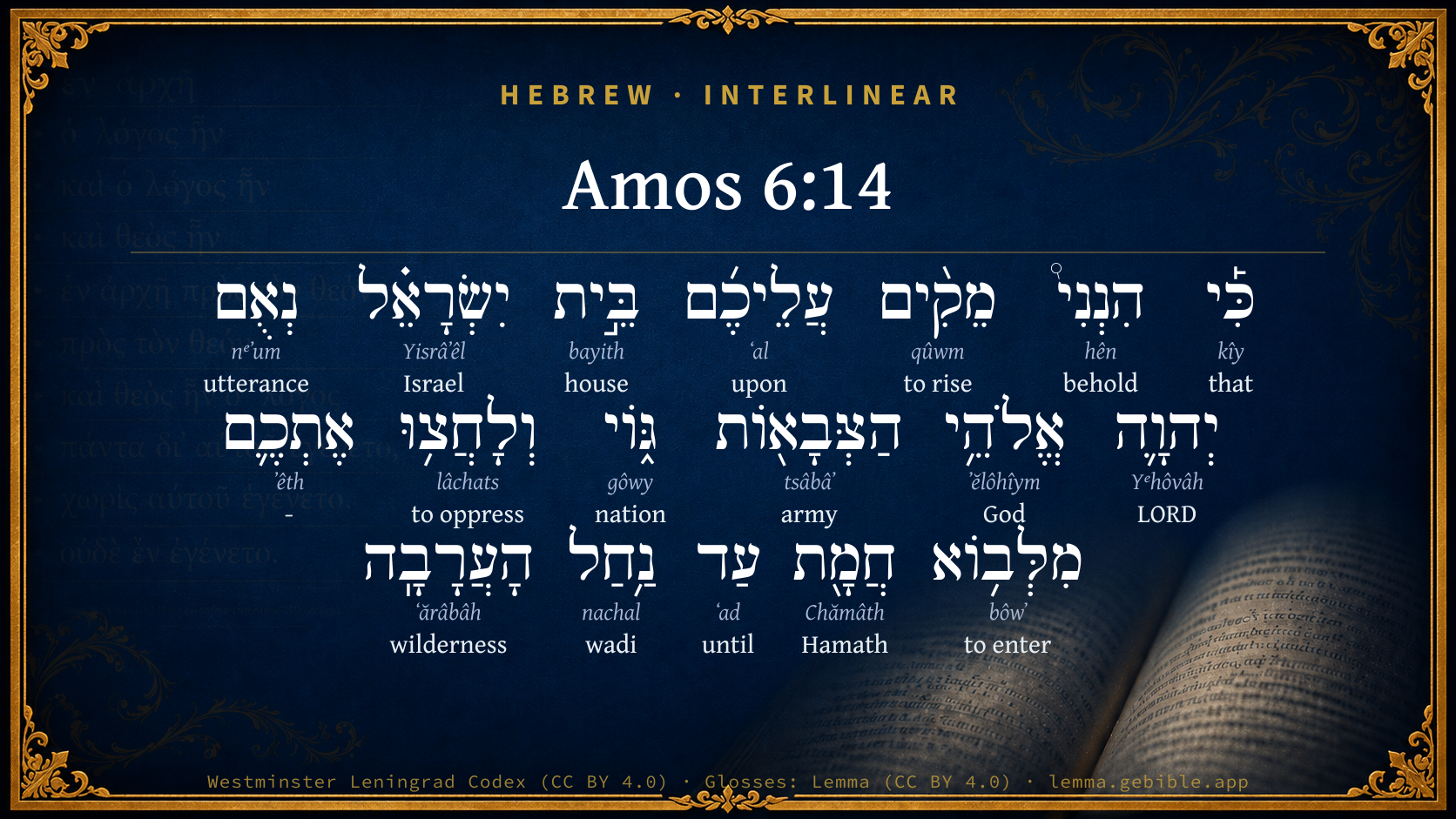
Hebrew (Westminster Leningrad Codex) Amos 6:14 appears in the Hebrew Old Testament. The text above is from the Westminster Leningrad Codex. Each word links to its Strong’s number, a concise gloss, and parsing drawn from the Open Scriptures Hebrew Bible morphology. Click any word for its full Brown-Driver-Briggs (BDB) entry.
Download image
Cite this verse

Amos 6:14 (World English Bible). Public Domain. Lemma interlinear Bible study tool, https://lemma.gebible.app/v/amos/6/14.

Show BibTeX & RIS
BibTeX
RIS
English Translation
For, behold, I will raise up against you a nation, house of Israel," Says Yahweh, the God of hosts; "And they will afflict you from the entrance of Hamath to the brook of the Arabah."
World English Bible · Public Domain
Download a study sheet

One document with this verse’s original text, its word-by-word gloss line, the meaning frame, cross-references with their text, attributed commentary, and full source and license credits — printable, and it pastes into notes with its structure intact.

This verse Autodidact and up

Study sheet (.html) Plain text (.txt)

A passage Seminary Student

Up to 50 verses in one chapter. A passage sheet keeps up to 6 commentary sources and 12 cross-references per verse, in the order this page ranks them, and says so on the sheet whenever that leaves anything out. Ask for a single verse and you get the Autodidact verse sheet above.

Everything on this page stays free to read, with no account — the sheet is a download of what is already on screen, not access to it.

Want to remove ads? Support Godless Engineer
Compare translations 3

The same verse in 3 English versions, stacked beneath the original-language interlinear above. Click any original word for its lexicon entry.

Each is an independent rendering of the whole verse — the interlinear is not word-aligned to these translations.

Highlighted words mark where these versions differ — a whole-verse word diff, not a word-by-word alignment.

  • World English Bible Public Domain
    For, behold, I will raise up against you a nation, house of Israel," Says Yahweh, the God of hosts; "And they will afflict you from the entrance of Hamath to the brook of the Arabah."
  • King James Version Public Domain
    But, behold, I will raise up against you a nation, O house of Israel, saith the LORD the God of hosts; and they shall afflict you from the entering in of Hemath unto the river of the wilderness.
  • unfoldingWord Literal Text CC BY-SA 4.0
    “Therefore, behold, I will raise up against you a nation, house of Israel”—this is the declaration of Yahweh, the God of hosts—“They will afflict you from Lebo Hamath to the brook of the Arabah.”

unfoldingWord Literal Text — © unfoldingWord, licensed CC BY-SA 4.0. Word-aligned USFM3 via Door43 (git.door43.org/unfoldingWord/en_ult).

Versions to compare (up to 4)

3 of 4 selected

Show all 18 translations

Every available English version of this verse, each an independent rendering of the whole verse.

  • World English Bible Public Domain
    For, behold, I will raise up against you a nation, house of Israel," Says Yahweh, the God of hosts; "And they will afflict you from the entrance of Hamath to the brook of the Arabah."
  • Berean Standard Bible Public Domain
    For behold, I will raise up a nation against you, O house of Israel,” declares the LORD, the God of Hosts, “and they will oppress you from Lebo-hamath to the Brook of the Arabah.”
  • Majority Standard Bible Public Domain
    For behold, I will raise up a nation against you, O house of Israel,” declares the LORD, the God of Hosts, “and they will oppress you from Lebo-hamath to the Brook of the Arabah.”
  • King James Version Public Domain
    But, behold, I will raise up against you a nation, O house of Israel, saith the LORD the God of hosts; and they shall afflict you from the entering in of Hemath unto the river of the wilderness.
  • American Standard Version (1901) Public Domain
    For, behold, I will raise up against you a nation, O house of Israel, saith Jehovah, the God of hosts; and they shall afflict you from the entrance of Hamath unto the brook of the Arabah.
  • Revised Version (1885) Public Domain
    For, behold, I will raise up against you a nation, O house of Israel, saith the LORD, the God of hosts; and they shall afflict you from the entering in of Hamath unto the brook of the Arabah.
  • Geneva Bible (1599) Public Domain
    But behold, I wil raise vp against you a nation, O house of Israel, sayeth the Lord God of hostes: and they shall afflict you, from the entring in of Hamath vnto the riuer of the wildernes.
  • Douay-Rheims (1899) Public Domain
    You that rejoice in a thing of nought: you that say: Have we not taken unto us horns by our own strength?
  • Young's Literal Translation Public Domain
    Surely, lo, I am raising against you a nation, O house of Israel, An affirmation of Jehovah, God of Hosts, And they have oppressed you from the coming in to Hamath, Unto the stream of the desert.
  • Literal Standard Version CC BY-SA 4.0
    “Surely, behold, I am raising a nation against you, O house of Israel,” || A declaration of YHWH, God of Hosts, || “And they have oppressed you from the coming in to Hamath, || To the stream of the desert.”
  • Unlocked Literal Bible CC BY-SA 4.0
    “But look, I will raise up against you a nation, house of Israel—this is the declaration of the Lord Yahweh, the God of hosts. They will afflict you from Lebo Hamath to the brook of the Arabah.”
  • unfoldingWord Literal Text CC BY-SA 4.0
    “Therefore, behold, I will raise up against you a nation, house of Israel”—this is the declaration of Yahweh, the God of hosts—“They will afflict you from Lebo Hamath to the brook of the Arabah.”
  • Darby Bible Public Domain
    For behold, O house of Israel, saith Jehovah the God of hosts, I will raise up against you a nation; and they shall afflict you from the entering in of Hamath unto the torrent of the Arabah.
  • World Messianic Bible Public Domain
    For, behold, I will raise up against you a nation, house of Israel,” says the LORD, the God of Hosts; “and they will afflict you from the entrance of Hamath to the brook of the Arabah.”
  • Webster's Bible Public Domain
    But behold, I will raise up against you a nation, O house of Israel, saith the LORD the God of hosts; and they shall afflict you from the entrance of Hamath to the river of the wilderness.
  • Free Bible Version CC BY-SA 4.0
    Watch out, people of Israel! I am going to send an enemy nation to attack you, says the Lord God of power, and they will oppress you from the Pass of Hamath to the Arabah Valley.
  • Bible in Basic English Public Domain
    For see, I will send against you a nation, O Israel, says the Lord, the God of armies, ruling you cruelly from the way into Hamath as far as the stream of the Arabah.
  • JPS Tanakh (1917) Public Domain
    For, behold, I will raise up against you a nation, O house of Israel, saith the LORD, the God of hosts; and they shall afflict you from the entrance of Hamath unto the Brook of the Arabah.

Literal Standard Version (2020), Covenant Press — licensed CC BY-SA 4.0. Text via the HelloAO Bible API (eBible.org). Unlocked Literal Bible (unfoldingWord) — licensed CC BY-SA 4.0. Text via the HelloAO Bible API (eBible.org). unfoldingWord Literal Text — © unfoldingWord, licensed CC BY-SA 4.0. Word-aligned USFM3 via Door43 (git.door43.org/unfoldingWord/en_ult). Free Bible Version, Dr. Jonathan Gallagher — licensed CC BY-SA 4.0. Text via the HelloAO Bible API (eBible.org).

Word by word

More ways to search: Search by grammar → Find every occurrence → Compare this word →

Practice this passage: Drill this verse → Learn its vocabulary →

וְלָחֲצ֥וּ
lâchats
H3905
“and · to oppress”
Conjunction + Verb, Qal, Sequential Perfect, 3rd Person, Common, Plural
Part of Speech
Conjunction + Verb
Stem
Qal
Form
Sequential Perfect
Person
3rd Person
Gender
Common
Number
Plural
Full BDB Definition

Origin: a primitive root

TWOT: 1106

to squeeze, press, oppress - (Qal) - to squeeze, press - to oppress - (Niphal) to squeeze oneself
  1. כִּ֡י kîy H3588 “that” Conjunction
  2. הִנְנִי֩ hên H2005 “behold · me” Particle, Demonstrative + Suffix, Personal, 1st Person, Common, Singular
  3. מֵקִ֨ים qûwm H6965 “rising” Verb, Hiphil, Participle Active, Masculine, Singular, Absolute
  4. עֲלֵיכֶ֜ם ʻal H5921 “upon · you” Preposition + Suffix, Personal, 2nd Person, Masculine, Plural
  5. בֵּ֣ית bayith H1004 “house of” Noun, Common, Masculine, Singular, Construct
  6. יִשְׂרָאֵ֗ל Yisrâʼêl H3478 “Israel” Noun, Proper
  7. נְאֻם nᵉʼum H5002 “utterance of” Noun, Common, Masculine, Singular, Construct
  8. יְהוָ֛ה Yᵉhôvâh H3068 “LORD” Noun, Proper
  9. אֱלֹהֵ֥י ʼĕlôhîym H430 “God(s) of” Noun, Common, Masculine, Plural, Construct
  10. הַצְּבָא֖וֹת tsâbâʼ H6635 “the · armies” Particle, Definite Article + Noun, Common, Both, Plural, Absolute
  11. גּ֑וֹי gôwy H1471 “nation” Noun, Common, Masculine, Singular, Absolute
  12. אֶתְכֶ֛ם ʼêth H853 “- · you” Particle, Direct Object + Suffix, Personal, 2nd Person, Masculine, Plural
  13. מִלְּב֥וֹא bôwʼ H935 “from · to/for · to enter” Preposition + Noun, Proper
  14. חֲמָ֖ת Chămâth H2574 “Hamath” Noun, Proper
  15. עַד ʻad H5704 “until” Preposition
  16. נַ֥חַל nachal H5158 “wadi of” Noun, Common, Masculine, Singular, Construct
  17. הָעֲרָבָֽה ʻărâbâh H6160 “the · wilderness” Particle, Definite Article + Noun, Common, Feminine, Singular, Absolute

About this verse

These counts appear in no published source. They are computed here, from the morphology-tagged text and Lemma’s own curated glosses. What Lemma adds →

18
words
18
distinct lemmas
Prophets
section

Notable vocabulary

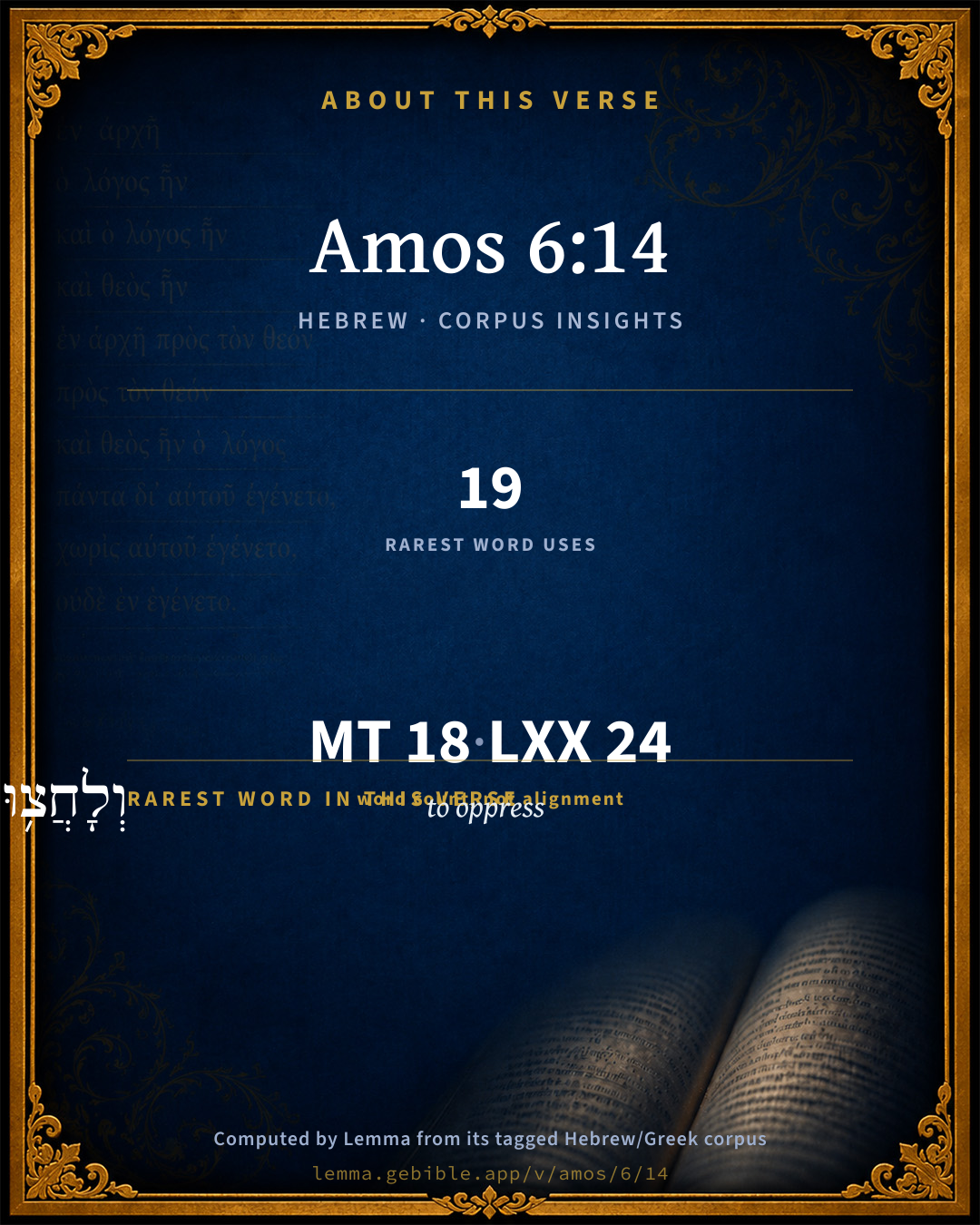
The rarest word here is וְלָחֲצ֥וּ to oppress H3905 — appearing just 19 times in the whole Hebrew Bible.

Shared distinctive vocabulary

וְלָחֲצ֥וּ to oppress H3905 occurs in 18 verses of the Hebrew Bible. Also found in:

Grammatical profile

  • 2 verbs
  • 11 nouns
  • 2 prepositions
  • 1 conjunction
  • 2 particles

Verb forms

  • מֵקִ֨ים Hiphil · Participle Active
  • וְלָחֲצ֥וּ Qal · Sequential Perfect

Hebrew & Septuagint length

In English translation the verse runs 35 words from the Hebrew and 16 from the Septuagint (LXX English) — the Septuagint runs noticeably shorter here. See the side-by-side →

A rough comparison of the two English renderings, which tokenize alike — not a word-level alignment.

Word counts can differ between the Hebrew and the Greek without any difference in meaning — e.g. the Hebrew direct-object marker אֵת has no separate Greek word, and Greek often adds the article ὁ.

In the original languages it is 18 Hebrew tokens and 24 Greek tokens — but the two are counted differently (Hebrew bundles its prefixes and suffixes into one token; the Greek is in lemma form), so that isn’t a like-for-like length.

Cross-references

11

Topical passages linked to Amos 6:14 in the Treasury of Scripture Knowledge — connected by theme and wording, ordered by reader-vote popularity; previews shown in the World English Bible.

  • 1 Kings 8:65 So Solomon held the feast at that time, and all Israel with him, a great assembly, from the entrance of Hamath to the brook of Egypt, before Yahweh our God, seven days and seven days, even fourteen days.
  • 2 Kings 14:25 He restored the border of Israel from the entrance of Hamath to the sea of the Arabah, according to the word of Yahweh, the God of Israel, which he spoke by his servant Jonah the son of Amittai, the prophet, who was of Gath Hepher.
  • Jeremiah 5:15–17 Behold, I will bring a nation on you from far, house of Israel, says Yahweh: it is a mighty nation, it is an ancient nation, a nation whose language you don't know, neither understand what they say.
  • Numbers 34:7–8 This shall be your north border: from the great sea you shall mark out for you Mount Hor;
  • 2 Kings 15:29 In the days of Pekah king of Israel came Tiglath Pileser king of Assyria, and took Ijon, and Abel Beth Maacah, and Janoah, and Kedesh, and Hazor, and Gilead, and Galilee, all the land of Naphtali; and he carried them captive to Assyria.
  • 2 Kings 17:6 In the ninth year of Hoshea the king of Assyria took Samaria, and carried Israel away to Assyria, and placed them in Halah, and on the Habor, the river of Gozan, and in the cities of the Medes.
  • Isaiah 7:20 In that day the Lord will shave with a razor that is hired in the parts beyond the River, even with the king of Assyria, the head and the hair of the feet; and it shall also consume the beard.
  • Isaiah 8:4–8 For before the child shall have knowledge to cry, My father, and, My mother, the riches of Damascus and the spoil of Samaria shall be carried away before the king of Assyria.
  • Ezekiel 47:15–17 This shall be the border of the land: On the north side, from the great sea, by the way of Hethlon, to the entrance of Zedad;
  • Hosea 10:5 The inhabitants of Samaria will be in terror for the calves of Beth Aven; For its people will mourn over it, Along with its priests who rejoiced over it, For its glory, because it has departed from it.
  • Isaiah 10:5–6 Ho Assyrian, the rod of my anger, the staff in whose hand is my indignation!

Cross-references courtesy of OpenBible.info (CC BY 4.0).

Hebrew and Greek witnesses Masoretic Hebrew ↔ Greek Septuagint

The same verse in the two great witnesses to the Old Testament, shown verse-for-verse.

Here the Septuagint runs noticeably shorter than the Hebrew — LXX2012 (modern English Septuagint) 16 words vs World English Bible 35. A rough length comparison of the two English translations, not a word-level alignment — read both below.

These are two independent witnesses, not word-aligned to each other, and the Septuagint is shown in lemma (dictionary) form.

Hebrew Amos 6:14 Masoretic · Westminster Leningrad Codex

כִּ֡י הִנְנִי֩ מֵקִ֨ים עֲלֵיכֶ֜ם בֵּ֣ית יִשְׂרָאֵ֗ל נְאֻם יְהוָ֛ה אֱלֹהֵ֥י הַצְּבָא֖וֹת גּ֑וֹי וְלָחֲצ֥וּ אֶתְכֶ֛ם מִלְּב֥וֹא חֲמָ֖ת עַד נַ֥חַל הָעֲרָבָֽה

For, behold, I will raise up against you a nation, house of Israel," Says Yahweh, the God of hosts; "And they will afflict you from the entrance of Hamath to the brook of the Arabah."

World English Bible · Public Domain

Greek LXX Amos 6:14 Septuagint · lemma form

διότι ἰδού ἐγώ ἐπιἐγείρω ἐπί σύ οἶκος ὁ ἰσραήλ ἔθνος καί ἐκθλίβω σύ ὁ μή εἰςἔρχομαι εἰς εμαθ καί ἕως ὁ χειμάρρους ὁ δυσμή

you⌃ who rejoice at vanity, who say, Have we not possessed horns by our own strength?

LXX2012 (modern English Septuagint) · Public Domain

On this verse, John Gill's Exposition discusses the Septuagint’s reading. Read the note in Commentary ↓

Hebrew: Westminster Leningrad Codex (CC BY 4.0). Greek: Septuagint (public domain); English from LXX2012 (modern English Septuagint) (Public Domain). How the Septuagint differs from the Hebrew →

Targum (Aramaic paraphrase)

1

The Targum is the ancient Jewish Aramaic paraphrase of the Hebrew Scriptures — an interpretive translation, not the Hebrew text itself. Onkelos (literal) and Pseudo-Jonathan (expansive) render the Torah, and Jonathan the Prophets. Coverage is partial: where no permissively-licensed English translation exists for a verse, only the Aramaic is shown. This is verse-level text, not a word-by-word alignment to the Hebrew.

  1. Targum Jonathan Prophets (Joshua–Malachi)
    אֲרֵי הָא אֲנָא מֵקִים עֲלֵיכוֹן בֵּית יִשְׂרָאֵל אֲמַר יְיָ אֱלֹהִים צְבָאוֹת עַם וְיִדְחֲקוּן יַתְכוֹן מִמַעֲלָנָא דַחֲמָת עַד נַחְלָא דְמֵישְׁרָא:

    (no public-domain English translation for this verse)

    Targum Jonathan — Aramaic: “Mikraot Gedolot” (public domain). English: “Sefaria Community Translation” (CC0 1.0 (public-domain dedication)); “London "Chaldee Paraphrase," 1871” (public domain). Text via Sefaria.

Commentary

Notes on Amos 6:14 from classic Christian and Jewish commentators (each source and its license shown beneath its notes). The classic Christian expositions comment on the surrounding passage and are grouped to its opening verse, so a note may address several verses; the Jewish commentaries on the Tanakh (Rashi and others) are per-verse, so they appear only where the commentator wrote on this verse.

Lemma curates 59 commentaries, every one of them public domain or Creative Commons licensed, each selected and text-cleaned for this edition rather than reprinted as found. About our sources →

John Gill's Exposition

But, behold, I will raise up against you a nation, O house of Israel, saith the Lord, the God of hosts,.... The Assyrian nation, under its king, Shalmaneser; who invaded Israel, came up to Samaria, and after a three years' siege took it, and carried Israel captive into foreign lands, Kg2 17:5;

and they shall afflict you; by battles, sieges, forages, plunders, and burning of cities and towns, and putting the inhabitants to the sword:

from the entering in of Hamath unto the river of the wilderness; from Hamath the less, said by Josephus (q) and Jerom (r) to be called Epiphania, in their times, from Antiochus Epiphanes; it was at the entrance on the land of Israel, and at the northern border of it; so that "the river of the wilderness", whatever is meant by it, lay to the south; by which it appears that this affliction and distress would be very general, from one end of it to the other. Some, by this river, understand the river of Egypt, at the entrance of Egypt in the wilderness of Ethan; Sihor or Nile; which, Jarchi says, lay southwest of Israel, as Hamath lay northwest of it. And a late traveller (s) observes, that the south and southwest border of the tribe of Judah, containing within it the whole or the greatest part of what was called the "way of the spies", Num 21:1; and afterwards Idumea, extended itself from the Elenitic gulf of the Red sea, along by that of Hieropolis, quite to the Nile westward; the Nile consequently, in this view and situation, either with regard to the barrenness of the Philistines, or to the position of it with respect to the land of promise, or to the river Euphrates, may, with propriety enough, be called "the river of the wilderness", Amo 6:14; as this district, which lies beyond the eastern or Asiatic banks of the Nile, from the parallel of Memphis, even to Pelusium, (the land of Goshen only excepted,) is all of it dry, barren, and inhospitable; or if the situation be more regarded, it may be called, as it is rendered by the Septuagint, the western torrent or river. Though some (t) take this to be the river Bosor or Bezor, that parts the tribes, of Judah and Simeon, and discharges itself into the Mediterranean between Gaza, or rather Majuma, and Anthedon. Though Kimchi takes this river to be the sea of the plain, the same with the Salt or Dead sea, Deu 3:17; which may seem likely, since Jeroboam the son of Joash, king of Israel, under whom Amos prophesied, had restored the coast of Israel, from the entering of Hamath unto the sea of the plain, Kg2 14:25; with which they were elevated, and of which they boasted; but now they should have affliction and distress in the same places, and which should extend as far.

(q) Antiqu. l. 1. c. 6. sect. 2. (r) Comment in Isa. x. fol. 20. G. & in Zech. ix. fol. 116. L. De locis Heb. fol. 88. E. & Quaest. in Gen. fol. 67. B. (s) Dr. Shaw's Travels, p. 287, 288. Ed. 2. (t) See the Universal History, vol. 2. p. 427, 428.

Next: Amos Chapter 7

John Gill's Exposition of the Whole Bible (1746–1763) — public domain (CC PDM 1.0). Text via the HelloAO Bible API.

Trapp's Complete Commentary

John Trapp

Amo 6:14 But, behold, I will raise up against you a nation, O house of Israel, saith the LORD the God of hosts; and they shall afflict you from the entering in of Hemath unto the river of the wilderness.

Ver. 14. But, behold, I will raise up against you a nation, &c.] Which shall be a cooler to your courage, a rebater to your swelth, a means to take you a link lower, and to stain the glory of your pride. I tell you not what a nation it is, that you may imagine the worst; but you will find their quiver is an open sepulchre, they are all mighty men, and no less merciless, Jer 5:16-17.

And they shall afflict you (or crush you) from the entering in of Hamath unto the river of the wilderness] From one end of your land to the other; that as ye have filled it from corner to corner with your uncleannesses, Ezr 9:11, so there may pass over it an overflowing scourge to wash the foul face of it, as once the old world. Hamath was before noted to be Antiochia, which was one of the bounds of the land of Israel to the north-east.

The river of the wilderness] Is elsewhere called the river of Egypt, as some will have it: see Num 34:5; Num 34:8 Deu 3:17 Jos 13:3; Jos 15:47, where the wilderness was, Joe 1:20. I cannot but concur with Kimchi, who by the river of the valleys here understandeth the Dead Sea, comparing this text with 2Ki 14:25 Deu 3:17, it being common in Scripture to call lakes and great rivers by the name of seas, Luk 5:1 cf. Num 34:11. The Dead Sea also is in human authors called the lake Asphaltites, the lake of Palestina, of Sodom, &c. It lieth to the south-west; and is elsewhere made the bound of the promised land, Num 34:3 Jos 15:2.

John Trapp, A Commentary or Exposition upon All the Books of the Old and New Testament (1647–1656) — public domain. Text from a community e-Sword module.

Tyndale Open Study Notes

Tyndale Open Resources

6:14 Lebo-hamath marked the northern border of Solomon’s influence (1 Kgs 8:65) and of the land recovered by Jeroboam II. The Dead Sea (called the sea of the Arabah; see footnote on 2 Kgs 14:25) marked the southern border of Jeroboam’s recovered territory. The irony was clear: All of this recovered land would be oppressed by the enemy nation (Assyria).

Tyndale Open Study Notes — © Tyndale Open Resources, licensed CC BY-SA 4.0. Text via the HelloAO Bible API.

Geneva Bible (1599)

Geneva Bible translators

From one corner of the country to another.

Geneva Bible (1599) marginal notes — public domain. Text via Bolls.life.

Jamieson, Fausset & Brown

Robert Jamieson, A. R. Fausset & David Brown

from the entering in of Hamath--the point of entrance for an invading army (as Assyria) into Israel from the north; specified here, as Hamath had been just before subjugated by Jeroboam II (Amo 6:2). Do not glory in your recently acquired city, for it shall be the starting-point for the foe to afflict you. How sad the contrast to the feast of Solomon attended by a congregation from this same Hamath, the most northern boundary of Israel, to the Nile, the river of Egypt, the most southern boundary!

unto the river of the wilderness--that is, to Kedron, which empties itself into the north bay of the Dead Sea below Jericho (Ch2 28:15), the southern boundary of the ten tribes (Kg2 14:25, "from the entering of Hamath unto the sea of the plain") [MAURER]. To the river Nile, which skirts the Arabian wilderness and separates Egypt from Canaan [GROTIUS]. If this verse includes Judah, as well as Israel (compare Amo 6:1, "Zion" and "Samaria"), GROTIUS' view is correct; and it agrees with Kg1 8:65.

The seventh, eighth, and ninth chapters contain VISIONS, WITH THEIR EXPLANATIONS. The seventh chapter consists of two parts. First (Amo 7:1-9): PROPHECIES ILLUSTRATED BY THREE SYMBOLS: (1) A vision of grasshoppers or young locusts, which devour the grass, but are removed at Amos' entreaty; (2) Fire drying up even the deep, and withering part of the land, but removed at Amos' entreaty; (3) A plumb-line to mark the buildings for destruction. Secondly (Amo 7:10-17): NARRATIVE OF AMAZIAH'S INTERRUPTION OF AMOS IN CONSEQUENCE OF THE FOREGOING PROPHECIES, AND PREDICTION OF HIS DOOM.

Next: Amos Chapter 7

Jamieson, Fausset & Brown — Commentary Critical and Explanatory on the Whole Bible (1871) — public domain (CC PDM 1.0). Text via the HelloAO Bible API.

Adam Clarke's Commentary

Verse 14. I will raise up against you a nation] The Assyrians under Pul, Tiglath-pileser, and Shalmaneser, who subdued the Israelites at various times, and at last carried them away captive in the days of Hosea, the last king of Israel in Samaria.

From the entering in of Hamath (on the north) unto the river of the wilderness.] Besor, which empties itself into the sea, not far from Gaza, and was in the southern part of the tribe of Simeon.

Adam Clarke's Commentary on the Bible (1810–1826) — public domain. Text from a community e-Sword/MySword module.

John Calvin's Commentaries

At last follows a denunciation, and this is the close of the chapter. God then after having seriously exposed the vices which prevailed among the people of Israel, again declares that vengeance of which he had shortly before reminded then; but with this difference only — that God now points out the kind of punishment which he would inflict on the Israelites. He had said before, ‘Behold God commands;’ and then he had spoken of calamity, but expressed not whence that calamity would come: but he now points it out in a special manner, Behold he says I am raising up against you, O house of Israel, a nation, who will straiten you from the entrance into Hemath to the river, etc. The Prophet no doubt speaks here of the Assyrians, and expresses in strong terms how dreadful the war with the Assyrians would be, which was now nigh at hand; for though large was their land and country, (and being large and spacious it had many outlets,) yet the Prophet shows that there would be everywhere straits, when the Lord would raise up on high that nation I am then stirring up a nation against you.

He again calls the Lord, the God of hosts, for the same reason as before, — that they might understand that all the Assyrians were at God’s disposal, and that they would stir up war whenever he gave them a signal. The Lord then will raise up a nation, who will straiten you In what place? He speaks not here of strait places, but of a spacious country, which, as it has been stated, had many outlets. But after the Lord had armed against them the Assyrians, all the most spacious places were made strait to them, “Ye shall be everywhere confined, so that there will be open no escape from death.”

John Calvin's Commentaries (1540-1563) — public domain. Text from the Calvin Translation Society English edition (1840s-50s) via the Christian Classics Ethereal Library (ccel.org). Calvin's coverage is partial (roughly two-thirds of the Bible); uncommented books and verses are honest gaps, never fabricated. The 19th-century editor's footnotes and remarks are omitted so the notes are faithfully Calvin's own voice.

Ellicott's Commentary for English Readers

(14) From . . . unto.—The entire limits of the kingdom of Israel after the victories of Jeroboam II. were, according to 2Ki_14:25, identical with the region which is here threatened with invasion, i.e., extending from the mouth of the Orontes valley (comp. Num_34:8; Jos_13:5) to the Wady el Ahsa, the southern boundary of Moab. (Comp. Isa_15:7, where the Hebrew name appears under a slightly different form, implying “torrent of the poplars.”)

A Bible Commentary for English Readers, edited by Charles John Ellicott (1878–1897) — public domain. Text from a community e-Sword module.

The Cambridge Bible for Schools and Colleges

gen. ed. J. J. S. Perowne

14. But] For,—justifying the low estimate of their power, expressed in Amo_6:13.

raise up] not absolutely, as Amo_2:11 (for the Assyrians had long existed as a nation), but against you, i.e. as your adversaries. As in Hab_1:6 (of the Chaldaeans) the term is used of the unconscious instruments of Providence: cf. 1Ki_11:14; 1Ki_11:23; also Isa_10:5. (The Hebrew words in Exo_9:16, and in Isa_41:2; Isa_41:25; Isa_45:13 are both different: in Ex. made thee to stand, i. e. to endure; in Is. stirred up, i.e. impelled into activity, as Isa_13:17.) Properly, am raising up: cf. Amo_7:8; and on Joe_2:19.

God of hosts] the title designates Jehovah appropriately, as one able to wield the powers of the world: cf. Amo_5:27, and p. 232.

afflict] or oppress,—often used of oppression by a foreign power (Exo_3:9; Jdg_4:3; Jdg_6:9 &c.). Lit. to crush (Num_22:25).

from the entering in of Hamath unto the wâdy of the ‘Arâbâh] i.e. over the whole extent of territory which had been recently recovered from Israel by Jeroboam II., who (2Ki_14:25) “restored the border of Israel from the entering in of Hamath unto the sea of the ‘Arábah.” The “entering in of Hamath,” as was observed on Amo_6:2, marks the furthest limit of Israelitish territory on the north. The ‘Arábah (comp. Deu_1:1 R.V. marg.) is the deep depression, varying from 2 to 14 miles across, through which the Jordan flows, and in which the Dead Sea lies (hence one of its Biblical names, the “sea of the ‘Arábah,” Deu_3:17; Deu_4:49, Jos_3:16; Jos_12:3), and which is prolonged southwards to the Gulf of ‘Aḳabah. At present, the northern part of this valley is called el-Ghôr, i.e. the Hollow, or Depression, the ancient name being limited to the part between the S. end of the Dead Sea, and the Gulf of ‘Aḳabah, the “Wâdy el-‘Arãbah.” See further the writer’s Commentary on Deut., p. 3, with the references. The “Wâdy” (see on Amo_5:24) of the ‘Arábah intended, can be identified only by conjecture; but it must, it seems, have been some fairly well-known Wâdy, and one also that might naturally be adopted as a boundary; hence it is generally supposed, with much plausibility, to have been the Wâdy el-Aḥsâ, which, flowing down from the south-east, enters the ‘Arábah about 3 miles S. of the Dead Sea, and then, turning northwards, runs straight into the lower end of the Dead Sea. The stream, which is a considerable one, divides now the district of Kerak from that of Jebal (Gebal, Psa_83:7, the ancient Gebalene), which would correspond, respectively, to the ancient Moab, and the N. part of Edom.

The Cambridge Bible for Schools and Colleges (gen. ed. J. J. S. Perowne; Cambridge University Press, 1878–1918) — public domain. Text from a community e-Sword module.

Albert Barnes' Notes on the Bible

But - (For,) - it was a non-thing, a nonexistent thing, a phantom, whereat they rejoiced; “for behold I raise up a nation.” God is said to “raise up,” when, by His Providence or His grace, He calls forth those who had not been called before, for the office for which He designs them. Thus, He raised up judges Jdg 2:16-18, delivers Jdg 3:9-15, prophets , Nazarites Amo 2:11, priests 1Sa 2:35, kings 2Sa 7:8, calling each separately to perform what He gave them in charge. So He is said to “raise up” even the evil ministers of His good Will, whom, in the course of His Providence, He allows to raise themselves up aloft to that eminence, so often as, in fulfilling their own bad will, they bring about, or are examples of, His righteous judgment. Thus God “raised up Hadad” as “an adversary” 1Ki 11:14 to Solomon, and again Rezon 1Ki 11:23; and the Chaldees Hab 1:6.

So again God says to Pharaoh, “For this have I raised thee up Exo 9:16, to show in thee My power.” So here He says, “I will raise up against you a nation, and they shall afflict you from the entering in of Hamath.” Israel, under Jeroboam II, had recovered a wider extent of territory, than had, in her northern portion, belonged to her since the better days of Solomon. Jeroboam “recovered Damascus and Hamath” 2Ki 14:28, 2Ki 14:25, which belonged to “Judah, unto Israel. He restored,” as God promised him by Jonah, “the coast of Israel from the entering of Hamath unto the sea of the plain. The entering of Hamath” expresses the utmost northern boundary promised to Israel Num 34:8. But this does not in itself express whether Hamath itself was included. Hamath however, and even Damascus itself, were incorporated in the bounds of Israel. The then great scourge of Israel had become part of its strength. Southward, Ammon and even Moab, had been taken into its borders. All the country on the other side of Jordan was theirs from Hamath and Damascus to the south of the Dead Sea, a space including four degrees of Latitude, as much as from Portsmouth to Durham. Amos describes the extension of the kingdom of Israel in the self-same terms as the Book of Kings; only he names as the southern extremity, “the river of the wilderness,” instead of “the sea of the wilderness.” The sea of the wilderness, that is, the Dead Sea, might in itself be either its northern or its southern extremity. The word used by Amos, defines it to be the southern. For his use of the name, “river of the wilderness,” implies:

(1) That it was a well-known boundary, a boundary as well-known to Israel on the south , “as the entering in of Hamath” was on the north.

(2) As a boundary-river, it must have been a river on the east of the Jordan, since Benjamin formed their boundary on the west of Jordan, and mountain passes, not rivers, separated them from it.

(3) From its name, ‘river of the wilderness, or the Arabah,” it must, in some important part of its course, have flowed in the ‘Arabah.

The ‘Arabah, (it is now well known,) is no other than that deep and remarkable depression, now called the Ghor, which extends from the lake of Gennesareth to the Red Sea . The Dead Sea itself is called by Moses too “the sea of the Arabah” Deu 3:17; Deu 4:49, lying, as it does, in the middle of that depression, and dividing it into two, the valley of the Jordan above the Dead Sea, and the southern portion which extends uninterrupted from the Dead to the Red Sea; and which also (although Scripture has less occasion to speak of it) Moses calls the ‘Arabah . A river, which fell from Moab into the Dead Sea without passing through the Arabah, would not be called “a river of the Arabah,” but, at the most “a river of the sea of the Arabah.” Now, besides the improbability that the name, “the river of the Arabah,” should have been substituted for the familiar names, the Arnon or the Jabbok, the Arnon does not flow into the Arabah at all, the Jabbok is no way connected with the Dead Sea, the corresponding boundary in the Book of Kings. These were both boundary-rivers, the Jabbok having keen the northern limit of what Moab and Ammon lost to the Amorite; the Arnon being the northern border of Moab. But there is a third boundary-river which answers all the conditions.

Moab was bounded on the south by a river, which Isaiah calls “the brook of the willows,” ערבים נחל nachal ‛ârâbı̂ym Isa 15:7, across which he foretells that they should transport for safety all which they had of value. A river, now called in its upper part the Wadi-el-Ahsa, and then the Wadi-es-Safieh, which now too “has more water than any south of the Yerka” (Jabbok), “divides the district of Kerek from that of Jebal, the ancient Gebalene” (that is, Moab from Idumaea). This river, after flowing from east to west and so forming a southern boundary to Moab, turns to the north in the Ghor or Arabah, and flows into the south extremity of the Dead Sea . This river then, answering to all the conditions, is doubtless that of which Amos spoke, and the boundary, which Jeroboam restored, included Moab also, (as in the most prosperous times of Israel,) since Moab’s southern border was now his border.

Israel, then, had no enemy, west of the Euphrates. Their strength had also, of late, been increasing steadily. Jehoash had, at the promise of Elisha, thrice defeated the Syrians, and recovered cities which had been lost, probably on the west also of Jordan, in the heart of the kingdom of Israel. What Jehoash had begun, Jeroboam II, during a reign of 41 years, continued. prophets had foretold and defined the successes of both kings, and so had marked them out the more to be the gift of God. Israel ascribed it to himself; and now that the enemies, whom Israel had feared, were subdued, God says, “I will raise up an enemy, and they shall afflict thee from the entering in of Hamath unto the river of the wilderness.” The whole scene of their triumphs should be one scene of affliction and woe. This was fulfilled after some 45 years, at the invasion of Tiglath-pileser.

Albert Barnes' Notes on the Bible (1834–1885) — public domain. Text from a community e-Sword/MySword module.

Haydock's Catholic Bible Commentary

Naught: in your idols, which are nothing, (1 Corinthians viii. 4.) or in your own strength, fortifications, or allies. --- Horns: glory and power. (Calmet) --- Pa rata tollo cornua. (Horace, epod. 6.)

George Leo Haydock (1774–1849), Haydock's Catholic Family Bible and Commentary, 1859 edition — public domain. Excludes Psalms (Douay-Rheims chapter numbering differs from Protestant) and Deuterocanonical books (Catholic canon only).

Matthew Poole's English Annotations

But; notwithstanding all your boasts and carnal confidences.

Behold; observe and weigh well what is said. ir will raise up; awaken, call together, strengthen, succeed, and prosper in the attempt against you.

A nation; Pul hath, and Tiglath-pileser hath, or now doth, afflict and break you, but Shalmaneser shall utterly destroy you; if his strength were not enough of itself, mine arm should strengthen him to bring all your hopes to nought.

O house of Israel; kingdom of the ten tribes.

Saith the Lord the God of hosts; who doth what he saith, who commands and it is done, whom none can resist.

They, the Assyrians and their confederates, shall afflict you; distress you and press you hard on all sides, it shall be a great and a universal oppression of you.

From the entering in of Hemath, a city of Syria bordering on the land of Israel north-east, and was an inlet into Syria from the north of Canaan,

unto the river of the wilderness, which is Sichor, in the most south-west parts of Canaan towards Egypt. So all your country, Judah and all, shall be oppressed by that nation which I will raise and strengthen against you.

Matthew Poole's English Annotations on the Holy Bible (1683–1685) — public domain. Text from a community e-Sword/MySword module.

Whedon's Commentary on the Bible

Daniel D. Whedon

14. But — Better, R.V., “For.”

Behold, I will — See on Amo_2:13.

Raise up — As an agent to execute judgment (Hab_1:6).

A nation — See at the close of comment on Amo_2:16.

Jehovah the God of hosts — The solemn address, the introduction of Jehovah as speaker, the divine title, all combine to add weight to the threat.

Afflict — Literally, crush. Used frequently of foreign oppression (Exo_3:9; Jdg_4:3).

Entering in of Hemath — R.V., “the entrance of Hamath.” On Hamath see Amo_6:2. The entrance of Hamath is a very indefinite geographical term, but it is generally identified with the mouth of the pass between the Lebanon and Anti-Lebanon, which was considered the starting point of the road to Hamath. This was the northern limit of the territory promised to Israel (Num_34:8), and to this point Jeroboam II extended his borders (2Ki_14:25 f.).

River of the wilderness — Better, R.V., “brook of the Arabah.” The Arabah (see Hastings’s Dictionary of the Bible, article “Arabah”) is, in a wider sense, the entire depression through which flows the Jordan and in which are located the Sea of Galilee and the Dead Sea, and which extends to the Gulf of Akabah, the eastern arm of the Red Sea. In a narrower sense the term applies only to the part of the declension between the Dead Sea and the Gulf of Akabah. Opinions differ concerning the identification of the brook of the Arabah. Evidently it marks the southern limit of Israel (not Judah), and is practically equivalent to sea of the Arabah in 2Ki_14:25. The latter is undoubtedly identical with the Dead Sea (Deu_3:17), but by no stretch of the imagination can the Dead Sea be called a brook. The brook must be one flowing into the Dead Sea, but where? It has been identified with the Arnon, flowing into the Dead Sea about halfway down its eastern shore. Most commonly it has been identified with the wady el Ahsa, flowing into the Arabah from the southeast about three miles south of the Dead Sea, then turning northward and emptying into the latter. To this identification G.A. Smith objects, not without reason, on the ground that the wady was outside the territory of Israel; it marked the boundary line between Moab and Edom, not between Israel and another country. It could mark the southern border of Israel only if Jeroboam had conquered Moab, but evidence of such conquest is lacking. It seems more natural to look for the brook of the Arabah near the northern boundary of Moab. The Arnon meets this condition (Num_21:13). Some commentators believe the brook to be one of the streams flowing into the Dead Sea in its northeastern part, while they understand 2Ki_14:25, to mean that Jeroboam extended the territory “as far as the Dead Sea.” In any case, Amos means to say that the entire territory, from its northern to its southern limits, will be wasted by an invader.

With this announcement of utter ruin closes the main part of the Book of Amos. The prophet endeavored to lead the people to repentance, but apparently all his efforts have failed. The leaders show no sign of contrition, and the people continue rebellious.

Daniel D. Whedon (gen. ed.), Commentary on the Old and New Testaments (1874–1909) — public domain. Text from a community e-Sword module.

The Pulpit Commentary

I will raise up. (comp. 1Ki_11:14, 1Ki_11:23; Hab_1:6, where see note) A nation. The Assyrians. From the entering in of Hamath. A district in the upper part of Coele-Syria, hod. El-Bukaa, the northern boundary of the kingdom of Israel. (Num_34:8; see on ver. 2) The river of the wilderness; rather, the torrent of the Arabah, which is the curious depression in which the Jordan flows, and which continues. though now on a higher level, south of the Dead Sea, towards the Gulf of Akaba. The torrent is probably the Wady es Safieh, just south of the Dead Sea. The limits named define the territory which Jeroboam recovered. (2Ki_14:25) The LXX gives, tou ceimarjrJou twn dusmwn, "the torrent of the west.

The hand of God seen in national retribution.

Coming when it did, this prophecy was an unmistakable proof of Divine foresight. Samaria was rejoicing and boasting because of a temporary victory obtained by her arms. The kingdom of Israel had taken horns, and by its own strength had pushed back the foe from the borders. This was the moment appointed for Amos to utter the faithful warning contained in this verse. Subsequent events proved the predictive authority from which this language proceeded. The advance of Assyria soon reminded the unbelieving and impenitent of the warning to which they had been indifferent. But we are chiefly concerned to trace the truths and to draw the lessons regarding Divine government upon earth, which this prediction so strikingly unfolds.

I THE FACT THAT A NATION IS CHOSEN BY GOD FOR A SPECIAL PURPOSE DOES NOT EXEMPT THAT NATION FROM THE OPERATION OF THE LAWS OF THE DIVINE GOVERNMENT. It is sometimes represented that the descendants of Abraham, Isaac, and Jacob were treated by the Ruler of all with an especial favouritism. But such a view cannot be justified from the sacred records. Undoubtedly, this nation was selected for high purposes, and appointed to occupy a position of enlightenment and eminence; but this was in order that the Jews might fulfil the purposes of God"s wisdom, might in the fulness of the time produce the Messiah, and might become a blessing to all the nations of the earth. But never was a nation subjected to more stringent discipline than the Hebrew theocracy endured. No transgression was unnoticed or unchastised. Such afflictions have indeed seldom been endured as Israel has known, both in ancient and in modern times.

II GOD, WHO IS NOT CONFINED TO ANY SPECIAL AGENCIES, HAS OFTEN EMPLOYED ONE NATION AS THE SCOURGE BY WHICH ANOTHER NATION HAS BEEN CHASTISED. It may be asked why Assyria, an idolatrous nation, should be employed to punish the transgressions of Israel. To such a question we can give no answer; but we may point out that the moral qualities of the chastising instrument have no bearing upon the purposes of punishment. God raiseth up one and setteth down another. History is full of examples of this principle. Amidst very much that is mysterious, there is not a little that is plain. Only in the most general way is it permitted us to interpret the methods of the Divine government. But the authoritative language of this and other passages of Scripture assure us that he who doeth according to his will among the inhabitants of the earth is impressing his own great lessons and fulfilling his own great designs by the changes which occur among the nations. Even wars, conquests, and captivities are the means by which God"s Law is vindicated and God"s kingdom is advanced.

III NATIONAL TRIBULATION MAY BE THE MEANS OF NATIONAL PURIFICATION AND PROGRESS. Punishment is not an end in itself; however deserved and just, it is inflicted with a view to the good of the community or individual punished, or the good of human society at large. We can to some extent trace, in the subsequent history of the Hebrew people, the beneficial results of the conquest and captivity here foretold. Idolatry, at all events, came to an end; more spiritual views of religion became general; the nation, or that portion of it which returned to the land of promise, was prepared for giving birth to the Messiah, and for furnishing the elements which were to constitute the primitive Church. Thus God brought the light of morning out of the darkness, and a spiritual spring from the long winter of affliction. T.

God chastising nations by nations.

behold, I will raise up against you a nation, O house of Israel, saith the Lord the God of hosts; and they shall afflict you from the entering in of Hamath unto the river of the wilderness." What "nation" is here referred to as about to be raised up by God against Israel? Undoubtedly, Assyria. This Assyrian nation is here represented as overspreading the country "from the entering in of Hamath unto the river of the wilderness." Hamath was a point of entrance for an invading army into Israel from the north, which had just been subjugated by Jeroboam II The boundaries are virtually the same as those mentioned (2Ki_14:25) as restored to Israel by Jeroboam II, "from the entering of Hamath unto the sea of the plain," i.e. the Dead Sea, into which the river of the wilderness here mentioned flows. Do not glory in your recently acquired city, for it shall be the starting point for the foe to afflict you. How sad the contrast to the feast of Solomon, attended by a congregation from the same Hamath, the most northern boundary of Israel, to the Nile, the river of Egypt, the most southern boundary! "Unto the river of the wilderness," i.e. to Kedron, or that part of it which empties itself into the northern bay of the Dead Sea below Jericho, (2Ch_28:15) which city was at the southern boundary of the ten tribes (Maurer). To the river Nile, which skirts the Arabian wilderness and separates Egypt from Canaan (Grotius). If this verse includes Judah as well as Israel, Grotius"s view is correct, and it agrees with 1Ki_8:65, "Solomon held a feast, and all Israel from the entering in of Hamath unto the river of Egypt" (Fausset) The subject suggested by the words is thisGod chastising nations by nations. He now threatens to chastise the kingdoms of Judah and Israel by the Assyrian people. This is how the Almighty has acted from the beginning. He has chastised nations by nations. The history of the world is little else than a history of civil wars. Let us for a moment notice the how and the why of this.

I THE HOW. How does the Almighty bring about wars?

1. Not by his inspiration. The God of peace does not breathe into any people greed, ambition, revenge. These principles, from which all war emanates, are repugnant to his nature. He denounces them. His grand aim in the world is to annihilate them, and in their place propagate disinterestedness, humility, and magnanimous love.

2. Not by his authority. All war is directly against his command; whilst everywhere he prohibits covetousness, pride, and revenge, he inculcates, in almost every page of inspiration and every form of utterance, love to our neighbours. The God of peace works everywhere in the world through peace, works by the peaceful influences of nature and the love of the gospel to produce "peace on earth, and good will towards men." How, then, can he be said to raise a nation to war? Simply by permission. He allows human nature freedom to work out the evil principles that are operating in it. The power of free action with which he endowed men at first he does not crush, he does not restrict; he treats it with respect, and leaves men free to do evil as well as good. He who permits the river at times to overflow its boundaries, and the subterranean fires to break forth, permits the passions of men to issue in war and bloodshed. Permission is not authorship.

II THE WHY. Why does the Almighty chastise nations by nations? Why not employ the elements of nature or angelic intelligences? or why not do it by his own direct volition, without any instrumentality whatever? He may, for aught we know, chastise men in all these ways; but we can see reasons for his employing nations to chastise nations by wars. In acting thus:

1. Man has revealed to him in the most impressive way the wickedness of the human heart. It has been well said that war is the effect, the embodiment, and manifestation of every conceivable sin. In every war hell is revealed; its fires flash, its thunders roll, its fiends revel and shriek. For man to get rid of sin, he must be impressed with its enormity; and does not war make that impression? Does not every crimson chapter in its history reveal to the human heart the stupendous enormity of sin?

2. Man has revealed to him the utter folly of putting confidence his fellow man. War reveals falsehood, treachery, cunning, fraud, cruelty; and who can trust these? Does not war say to every man, "Cursed is the man that trusteth in man, and maketh flesh his arm"? To day a man may fondle you as a friend, tomorrow foam at you as a fiend. "Put not your trust in princes, nor in the son of man, in whom there is no hope.

3. Man has revealed to him the supreme importance of cultivating the true friendship of his fellow men. What thoughtful men have not groaned and wept over the utter failure of all means to produce the results for which they were ostensibly commenced to vindicate national honour, to establish peace? Such ends are never realized. What, then, is the lesson? Cultivate friendship with your fellow men, the friendship of man with man, family with family, tribe with tribe, nation with nation. Wars are God"s moral lessons to man in tragedy. D.T.

The Pulpit Commentary (1880–1919), ed. H.D.M. Spence-Jones & Joseph S. Exell — public domain. Text from a community e-Sword module.

John Wesley's Explanatory Notes

Hemath - A city of Syria, bordering on Israel, northeast. The wilderness - Which is the southwest parts of Canaan. So all your country shall be destroyed.

John Wesley, Explanatory Notes Upon the Whole Bible (1754–1765) — public domain. Text via the GEBible commentary corpus.

unfoldingWord translationNotes

Door43 World Missions Community

look

"listen" or "pay attention"

house of Israel

Here "house" represents people. AT: "people of Israel" (See: Metonymy)

this is the declaration of the Lord Yahweh, the God of hosts

Yahweh speaks of himself by name to express the certainty of what he is declaring. See how you translated this in Amos 3:13. AT: "this is what the Lord Yahweh, the God of hosts, has declared" or "this is what I, the Lord Yahweh, the God of hosts, have declared" (See: First, Second, or Third Person)

from Lebo Hamath to the brook of the Arabah

Here "Lebo Hamath" represents the northern border of Israel, and "brook of the Arabah" represents the southern border. AT: "from the northern border of your nation to the southern border" (See: Metonymy)

brook

a small river that flows only during the wet season

translationWords

raise

nation

house

Israel

declare

Lord Yahweh

Yahweh of hosts

afflicted

Hamath

Arabah

unfoldingWord translationNotes — © Distant Shores Media and the Door43 World Missions Community, licensed CC BY-SA 4.0. Source: git.door43.org/Door43/en_tn.

Rashi

Rabbi Shlomo Yitzchaki (Rashi)

from the approach to Hamath—which is in the northwestern corner of Eretz Israel.

until the brook of the Arabah—The brook of Egypt, which is in the southwestern corner.

Rashi on the Tanakh — English translations: “The Judaica Press complete Tanach with Rashi, translated by A. J. Rosenberg” (CC BY 4.0); “Pentateuch with Rashi's commentary by M. Rosenbaum and A.M. Silbermann, 1929-1934” (public domain); “The Metsudah Tanach series, Lakewood, N.J” (CC BY 4.0); and “The Book of Joshua, Metsudah Publications, 1997” (CC BY 4.0). Text via Sefaria.

Lesson kit

Teaching starters — assembled from the data on this page, not authored interpretation. Every prompt links to the verse data it draws on. Edit before teaching.

Amos, in the Prophets, opens this verse with 18 words (18 distinct Hebrew lemmas). Its most distinctive word is lâchats (“to oppress”). The Greek Septuagint runs shorter here. A historical commentator’s framing appears above. Read the whole chapter for the surrounding context.

Discussion questions

  1. What does “to oppress” (lâchats) contribute to the verse as a whole?
  2. How does Exodus 3:9, which shares the word «to oppress», read alongside this verse?
  3. The Septuagint runs shorter here than the Hebrew. What might account for the difference?
  4. These translations render this verse differently; the difference is in the English rendering, not the original. What questions does that raise?
  5. «מֵקִ֨ים» is a Hiphil Participle Active verb. How does that grammatical form shape the action described?
  6. Compare how John Gill's Exposition and Trapp's Complete Commentary read this verse. Where do they agree or differ?

Things to notice

Reading settings

Reading text

Shown beneath each verse's original-language words.

Old Testament
Old Testament edition

Read the OT as the Masoretic Hebrew (MT) or the Greek Septuagint (LXX).

English shown for the Greek Septuagint (in the Hebrew ↔ Greek comparison).

Comparing translations? Open the Compare panel on any verse page to stack up to four side by side.