Psalms 59:5

Hebrew (Westminster Leningrad Codex) Psalms 59:5 appears in the Hebrew Old Testament. The text above is from the Westminster Leningrad Codex. Each word links to its Strong’s number, a concise gloss, and parsing drawn from the Open Scriptures Hebrew Bible morphology. Click any word for its full Brown-Driver-Briggs (BDB) entry.
Download image
Cite this verse

Psalms 59:5 (World English Bible). Public Domain. Lemma interlinear Bible study tool, https://lemma.gebible.app/v/psalms/59/5.

Show BibTeX & RIS
BibTeX
RIS
English Translation
You, Yahweh God of hosts, the God of Israel, Rouse yourself to punish the nations. Show no mercy to the wicked traitors. Selah.
World English Bible · Public Domain
Download a study sheet

One document with this verse’s original text, its word-by-word gloss line, the meaning frame, cross-references with their text, attributed commentary, and full source and license credits — printable, and it pastes into notes with its structure intact.

This verse Autodidact and up

Study sheet (.html) Plain text (.txt)

A passage Seminary Student

Up to 50 verses in one chapter. A passage sheet keeps up to 6 commentary sources and 12 cross-references per verse, in the order this page ranks them, and says so on the sheet whenever that leaves anything out. Ask for a single verse and you get the Autodidact verse sheet above.

Everything on this page stays free to read, with no account — the sheet is a download of what is already on screen, not access to it.

Want to remove ads? Support Godless Engineer
Compare translations 3

The same verse in 3 English versions, stacked beneath the original-language interlinear above. Click any original word for its lexicon entry.

Each is an independent rendering of the whole verse — the interlinear is not word-aligned to these translations.

Highlighted words mark where these versions differ — a whole-verse word diff, not a word-by-word alignment.

  • World English Bible Public Domain
    You, Yahweh God of hosts, the God of Israel, Rouse yourself to punish the nations. Show no mercy to the wicked traitors. Selah.
  • King James Version Public Domain
    Thou therefore, O LORD God of hosts, the God of Israel, awake to visit all the heathen: be not merciful to any wicked transgressors. Selah.
  • unfoldingWord Literal Text CC BY-SA 4.0
    So you, Yahweh, God of armies, the God of Israel, wake up to punish all of the nations! Do not be gracious any treacherous workers of iniquity. Selah

unfoldingWord Literal Text — © unfoldingWord, licensed CC BY-SA 4.0. Word-aligned USFM3 via Door43 (git.door43.org/unfoldingWord/en_ult).

Versions to compare (up to 4)

3 of 4 selected

Show all 18 translations

Every available English version of this verse, each an independent rendering of the whole verse.

  • World English Bible Public Domain
    You, Yahweh God of hosts, the God of Israel, Rouse yourself to punish the nations. Show no mercy to the wicked traitors. Selah.
  • Berean Standard Bible Public Domain
    O LORD God of Hosts, the God of Israel, rouse Yourself to punish all the nations; show no mercy to the wicked traitors. Selah
  • Majority Standard Bible Public Domain
    O LORD God of Hosts, the God of Israel, rouse Yourself to punish all the nations; show no mercy to the wicked traitors. Selah
  • King James Version Public Domain
    Thou therefore, O LORD God of hosts, the God of Israel, awake to visit all the heathen: be not merciful to any wicked transgressors. Selah.
  • American Standard Version (1901) Public Domain
    Even thou, O Jehovah God of hosts, the God of Israel, Arise to visit all the nations: Be not merciful to any wicked transgressors. Selah
  • Revised Version (1885) Public Domain
    Even thou, O LORD God of hosts, the God of Israel, arise to visit all the heathen: be not merciful to any wicked transgressors. Selah
  • Geneva Bible (1599) Public Domain
    Euen thou, O Lord God of hostes, O God of Israel awake to visit all the heathen, and be not merciful vnto all that transgresse maliciously. Selah.
  • Douay-Rheims (1899) Public Domain
    Neither is it my iniquity, nor my sin, O Lord: without iniquity have I run, and directed my steps.
  • Young's Literal Translation Public Domain
    And Thou, Jehovah, God of Hosts, God of Israel, Awake to inspect all the nations. Favour not any treacherous dealers of iniquity. Selah.
  • Literal Standard Version CC BY-SA 4.0
    And You, YHWH, God of Hosts, God of Israel, || Awake to inspect all the nations. Do not favor any treacherous dealers of iniquity. Selah.
  • Unlocked Literal Bible CC BY-SA 4.0
    You, Yahweh God of hosts, the God of Israel, arise and punish all the nations; do not be merciful to any wicked transgressors. Selah
  • unfoldingWord Literal Text CC BY-SA 4.0
    So you, Yahweh, God of armies, the God of Israel, wake up to punish all of the nations! Do not be gracious any treacherous workers of iniquity. Selah
  • Darby Bible Public Domain
    Yea, do thou, Jehovah, the God of hosts, the God of Israel, arise to visit all the nations: be not gracious to any plotters of iniquity. Selah.
  • World Messianic Bible Public Domain
    You, LORD God of Hosts, the God of Israel, rouse yourself to punish the nations. Show no mercy to the wicked traitors. Selah.
  • Webster's Bible Public Domain
    \\59:4\\They run and prepare themselves without my fault: awake to help me, and behold.
  • Free Bible Version CC BY-SA 4.0
    You are God, the Lord Almighty, God of Israel. Stand up, and punish all the nations. Don't have any mercy on these evil traitors. Selah.
  • Bible in Basic English Public Domain
    You, O Lord God of armies, are the God of Israel; come now and give punishment to the nations; have no mercy on any workers of deceit. (Selah.)
  • JPS Tanakh (1917) Public Domain
    (59-6) Thou therefore, O LORD God of hosts, the God of Israel, arouse Thyself to punish all the nations; show no mercy to any iniquitous traitors. Selah

Literal Standard Version (2020), Covenant Press — licensed CC BY-SA 4.0. Text via the HelloAO Bible API (eBible.org). Unlocked Literal Bible (unfoldingWord) — licensed CC BY-SA 4.0. Text via the HelloAO Bible API (eBible.org). unfoldingWord Literal Text — © unfoldingWord, licensed CC BY-SA 4.0. Word-aligned USFM3 via Door43 (git.door43.org/unfoldingWord/en_ult). Free Bible Version, Dr. Jonathan Gallagher — licensed CC BY-SA 4.0. Text via the HelloAO Bible API (eBible.org).

Word by word

More ways to search: Search by grammar → Find every occurrence → Compare this word →

Practice this passage: Drill this verse → Learn its vocabulary →

הָקִ֗יצָה
qûwts
H6974
“awake”
Verb, Hiphil, Imperative, 2nd Person, Masculine, Singular + Suffix, h
Part of Speech
Verb
Stem
Hiphil
Form
Imperative
Person
2nd Person
Gender
Masculine
Number
Singular
Full BDB Definition

Origin: a primitive root [identical with H6972 through the idea of abruptness in starting up from sleep (compare H3364 )]

TWOT: 904a , 2019

to awake, wake up - (Hiphil) to awaken, arouse, show signs of waking, awake
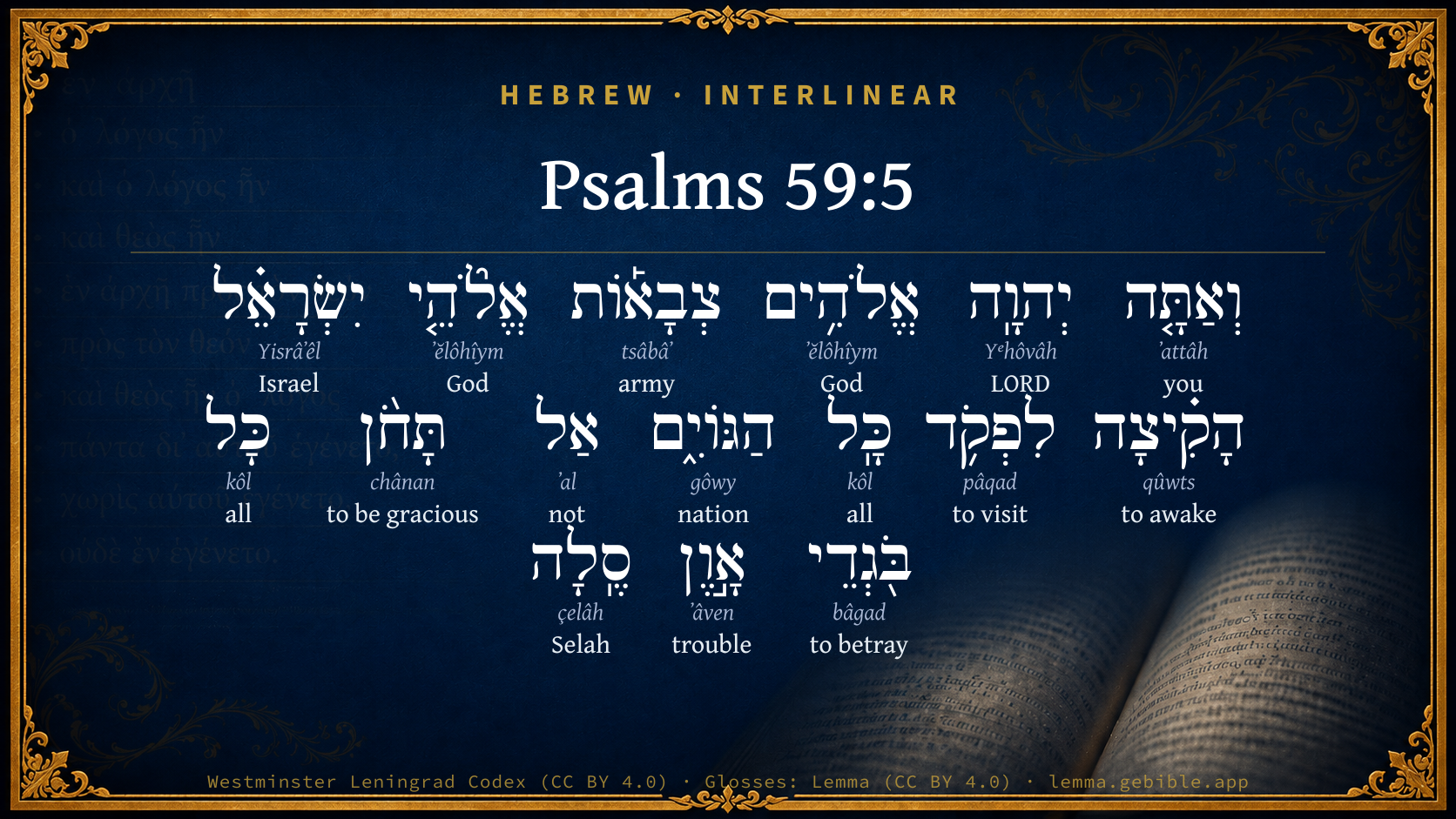
  1. וְאַתָּ֤ה ʼattâh H859 “and · you” Conjunction + Pronoun, Personal, 2nd Person, Masculine, Singular
  2. יְהוָֽה Yᵉhôvâh H3068 “LORD” Noun, Proper
  3. אֱלֹהִ֥ים ʼĕlôhîym H430 “God(s)” Noun, Common, Masculine, Plural, Absolute
  4. צְבָא֡וֹת tsâbâʼ H6635 “armies” Noun, Common, Both, Plural, Absolute
  5. אֱלֹ֘הֵ֤י ʼĕlôhîym H430 “God(s) of” Noun, Common, Masculine, Plural, Construct
  6. יִשְׂרָאֵ֗ל Yisrâʼêl H3478 “Israel” Noun, Proper
  7. לִפְקֹ֥ד pâqad H6485 “to visit” Preposition + Verb, Qal, Infinitive Construct
  8. כָּֽל kôl H3605 “all of” Noun, Common, Masculine, Singular, Construct
  9. הַגּוֹיִ֑ם gôwy H1471 “the · nations” Particle, Definite Article + Noun, Common, Masculine, Plural, Absolute
  10. אַל ʼal H408 “not” Particle, Negative
  11. תָּחֹ֨ן chânan H2603 “to be gracious” Verb, Qal, Jussive, 2nd Person, Masculine, Singular
  12. כָּל kôl H3605 “all of” Noun, Common, Masculine, Singular, Construct
  13. בֹּ֖גְדֵי bâgad H898 “betraying” Verb, Qal, Participle Active, Masculine, Plural, Construct
  14. אָ֣וֶן ʼâven H205 “trouble” Noun, Common, Masculine, Singular, Absolute
  15. סֶֽלָה çelâh H5542 “Selah” Particle, Interjection

About this verse

These counts appear in no published source. They are computed here, from the morphology-tagged text and Lemma’s own curated glosses. What Lemma adds →

16
words
14
distinct lemmas
Wisdom
section

Notable vocabulary

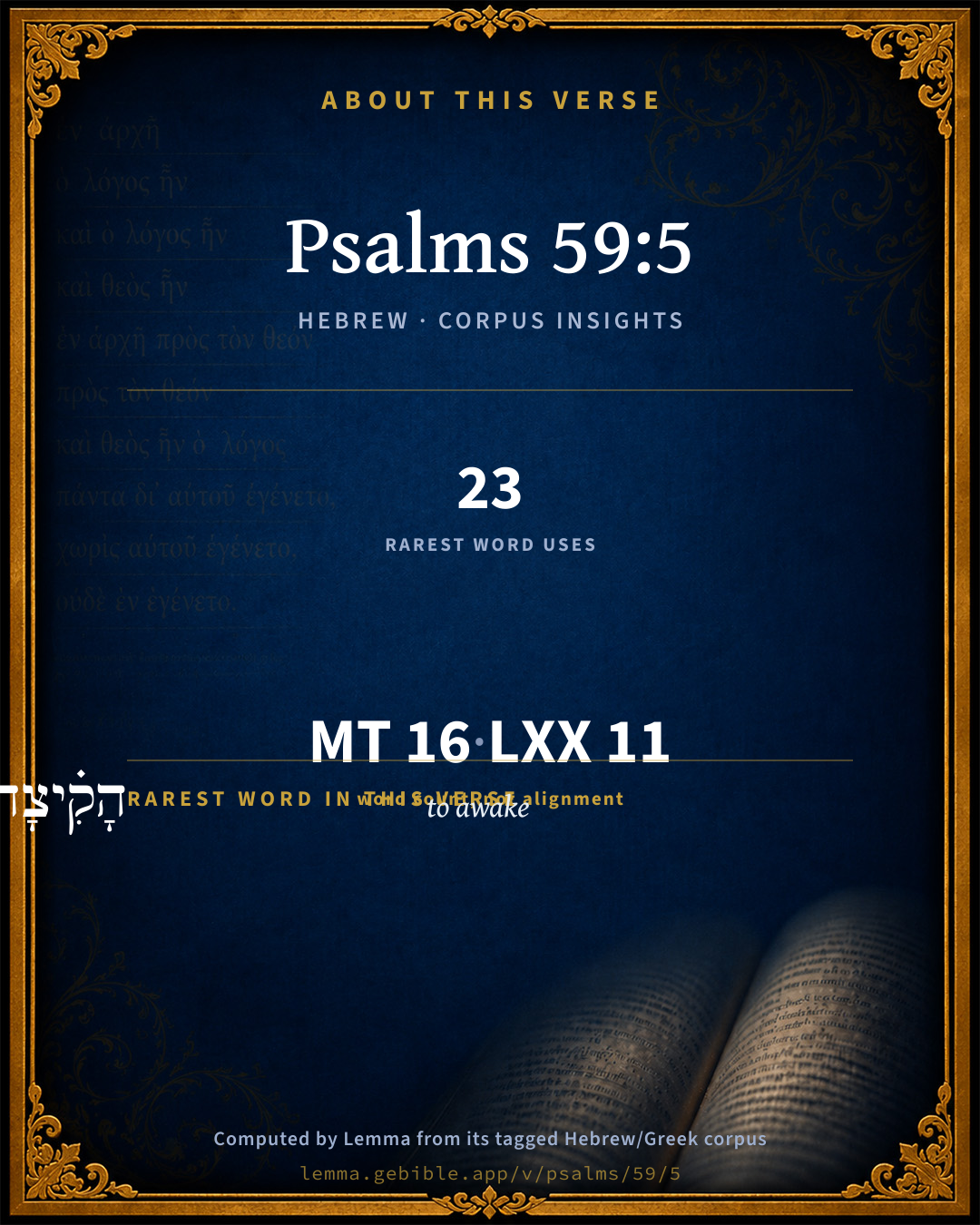
The rarest word here is הָקִ֗יצָה to awake H6974 — appearing just 23 times in the whole Hebrew Bible.

Shared distinctive vocabulary

הָקִ֗יצָה to awake H6974 occurs in 22 verses of the Hebrew Bible. Also found in:

Grammatical profile

  • 4 verbs
  • 9 nouns
  • 1 pronoun
  • 2 particles

Verb forms

  • הָקִ֗יצָה Hiphil · Imperative
  • לִפְקֹ֥ד Qal · Infinitive Construct
  • תָּחֹ֨ן Qal · Jussive
  • בֹּ֖גְדֵי Qal · Participle Active

Repetition

Words recur within this verse — often emphatic in Hebrew:

  • אֱלֹהִ֥ים God H430 ×2
  • כָּֽל all H3605 ×2

Hebrew & Septuagint length

In English translation the verse runs 23 words from the Hebrew and 24 from the Septuagint (LXX English) — closely comparable.

A rough comparison of the two English renderings, which tokenize alike — not a word-level alignment.

Word counts can differ between the Hebrew and the Greek without any difference in meaning — e.g. the Hebrew direct-object marker אֵת has no separate Greek word, and Greek often adds the article ὁ.

In the original languages it is 16 Hebrew tokens and 11 Greek tokens — but the two are counted differently (Hebrew bundles its prefixes and suffixes into one token; the Greek is in lemma form), so that isn’t a like-for-like length.

Cross-references

17

Topical passages linked to Psalms 59:5 in the Treasury of Scripture Knowledge — connected by theme and wording, ordered by reader-vote popularity; previews shown in the World English Bible.

  • Psalms 9:15 The nations have sunk down in the pit that they made; In the net which they hid, their own foot is taken.
  • Psalms 55:15 Let death come suddenly on them. Let them go down alive into Sheol. For wickedness is in their dwelling, in the midst of them.
  • Psalms 84:8 Yahweh, God of hosts, hear my prayer. Listen, God of Jacob. Selah.
  • Genesis 33:20 He erected an altar there, and called it El Elohe Israel.
  • Exodus 3:15 God said moreover to Moses, "You shall tell the children of Israel this, 'Yahweh, the God of your fathers, the God of Abraham, the God of Isaac, and the God of Jacob, has sent me to you.' This is my name forever, and this is my memorial to all generations.
  • Exodus 20:5 you shall not bow yourself down to them, nor serve them, for I, Yahweh your God, am a jealous God, visiting the iniquity of the fathers on the children, on the third and on the fourth generation of those who hate me,
  • Psalms 7:12–13 If a man doesn't relent, he will sharpen his sword; He has bent and strung his bow.
  • Psalms 54:3 For strangers have risen up against me. Violent men have sought after my soul. They haven't set God before them. Selah.
  • Psalms 80:4 Yahweh God of hosts, How long will you be angry against the prayer of your people?
  • Isaiah 1:10 Hear the word of Yahweh, you rulers of Sodom! Listen to the law of our God, you people of Gomorrah!
  • Isaiah 27:11 When the boughs of it are withered, they shall be broken off; the women shall come, and set them on fire; for it is a people of no understanding: therefore he who made them will not have compassion on them, and he who formed them will show them no favor.
  • Jeremiah 18:23 Yet, Yahweh, you know all their counsel against me to kill me; don't forgive their iniquity, neither blot out their sin from your sight; but let them be overthrown before you; deal you with them in the time of your anger.
  • Ezekiel 18:27–28 Again, when the wicked man turns away from his wickedness that he has committed, and does that which is lawful and right, he shall save his soul alive.
  • Amos 9:7 Are you not like the children of the Ethiopians to me, children of Israel?" says Yahweh. "Haven't I brought up Israel out of the land of Egypt, and the Philistines from Caphtor, and the Syrians from Kir?
  • Romans 2:28–29 For he is not a Jew who is one outwardly, neither is that circumcision which is outward in the flesh;
  • Romans 9:6 But it is not as though the word of God has come to nothing. For they are not all Israel, that are of Israel.
  • James 2:13 For judgment is without mercy to him who has shown no mercy. Mercy triumphs over judgment.

Cross-references courtesy of OpenBible.info (CC BY 4.0).

Hebrew and Greek witnesses Masoretic Hebrew ↔ Greek Septuagint

The same verse in the two great witnesses to the Old Testament, shown verse-for-verse.

You’re reading Greek Psalm 58 (Hebrew Psalm 59). The Septuagint counts the superscription, so verse numbers can differ from the Hebrew — chapter-level alignment, not verse-by-verse. Numbering follows Rahlfs.

These are two independent witnesses, not word-aligned to each other, and the Septuagint is shown in lemma (dictionary) form.

Hebrew Psalms 59:5 Masoretic · Westminster Leningrad Codex

וְאַתָּ֤ה יְהוָֽה אֱלֹהִ֥ים צְבָא֡וֹת אֱלֹ֘הֵ֤י יִשְׂרָאֵ֗ל הָקִ֗יצָה לִפְקֹ֥ד כָּֽל הַגּוֹיִ֑ם אַל תָּחֹ֨ן כָּל בֹּ֖גְדֵי אָ֣וֶן סֶֽלָה

You, Yahweh God of hosts, the God of Israel, Rouse yourself to punish the nations. Show no mercy to the wicked traitors. Selah.

World English Bible · Public Domain

Greek LXX Greek Psalm 58:5 Septuagint · lemma form

ἄνευ ἀνομία τρέχω καί καταεὐθύνω ἐκἐγείρω εἰς συνάντησις ἐγώ καί ὁράω

And you, Lord God of hosts, the God of Israel, draw near to visit all the heathen; pity not any that work iniquity. Pause.

LXX2012 (modern English Septuagint) · Public Domain

Hebrew: Westminster Leningrad Codex (CC BY 4.0). Greek: Septuagint (public domain); English from LXX2012 (modern English Septuagint) (Public Domain). How the Septuagint differs from the Hebrew →

Commentary

Notes on Psalms 59:5 from classic Christian and Jewish commentators (each source and its license shown beneath its notes). The classic Christian expositions comment on the surrounding passage and are grouped to its opening verse, so a note may address several verses; the Jewish commentaries on the Tanakh (Rashi and others) are per-verse, so they appear only where the commentator wrote on this verse.

Lemma curates 59 commentaries, every one of them public domain or Creative Commons licensed, each selected and text-cleaned for this edition rather than reprinted as found. About our sources →

Trapp's Complete Commentary

John Trapp

Psa 59:5 Thou therefore, O LORD God of hosts, the God of Israel, awake to visit all the heathen: be not merciful to any wicked transgressors. Selah.

Ver. 5. Awake to visit all the heathen] These pagan Israelites, who might have some heathens also among them, Saul’s slaughtermen, men fleshed in blood.

Be not merciful to any wicked transgressors] Heb. that treacherously work iniquity, that do it consulto et data opera, desperadoes, reprobates, destined to eternal destruction.

John Trapp, A Commentary or Exposition upon All the Books of the Old and New Testament (1647–1656) — public domain. Text from a community e-Sword module.

Joseph Benson's Commentary

Psa 59:5. O Lord, &c., the God of Israel — In covenant with all true Israelites, whom thou promisest to protect and bless. Awake to visit all the heathen — Or, these heathen, who, though they are Israelites by birth, yet in truth, and in their dispositions and manners, are mere heathen. Be not merciful — Hebrew, אל תחן, al tachon, Thou wilt not be merciful, that is, Thou canst not with honour, nor according to thy word, be merciful, to any wicked transgressors — Hebrew, כל בגדי און, cal bogedee aven, perfidious transgressors, or, more literally, prevaricators of wickedness; that is, such as are guilty of great treachery and perfidiousness, meaning such as, with pretences of friendship, persecuted him and other good men, out of malice, and against their own consciences. But neither can God, in consistency with the perfections of his nature, and the truths of his word, show mercy to any incorrigible offenders.

Joseph Benson's Commentary on the Old and New Testaments (1811–1818) — public domain. Text from a community e-Sword module.

J. A. Alexander on Psalms

Joseph Addison Alexander

6. (Psa 59:5). And thou, Jehovah, God, (Lord of) Hosts, God of Israel, awake to, visit all the nations; spare not all traitors of iniquity. Selah. The accumulation of divine names is not unmeaning, but suggestive of reasons why the prayer should be answered, to wit, because He to whom it was addressed was not only the Eternal, Self-existent God, the Sovereign of the Universe, but the God of Israel, and therefore bound by covenant to save his people. All the nations, i.e. such as are the enemies of God and of his people; and if whole nations are thus dealt with, how much more may Jehovah be expected to destroy his individual enemies? Traitors of iniquity, wicked traitors. The depth of the feeling here expressed is further

Joseph Addison Alexander, The Psalms Translated and Explained (1850) — public domain. Text from a community e-Sword module.

Geneva Bible (1599)

Geneva Bible translators

Seeing it appertaineth to God’s judgments to punish the wicked, he desiresth God to execute his vengeance on the reprobate, who maliciously persecute his Church.

Geneva Bible (1599) marginal notes — public domain. Text via Bolls.life.

Adam Clarke's Commentary

Verse 5. O Lord God of hosts] This was a proper view to take of God. when Israel, a handful of poor distressed captives were surrounded and oppressed by the heathen chiefs above mentioned, and their several tribes. But Jehovah, God of hosts, was the God of Israel; and hence Israel had little to fear.

Be not merciful to any wicked transgressors.] Do not favour the cause of these wicked men. They are בגדי און bogedey aven, "changers of iniquity:" they go through the whole round of evil; find out and exercise themselves in all the varieties of transgression. How exactly does this apply to Nehemiah's foes! They sought, by open attack, wiles, flattery, foul speeches, fair speeches, threats, and ambuscades, to take away his life. Do not show them favour, that they may not succeed in their wicked designs. The prayer here is exactly the same in sentiment with that of Nehemiah, Ne 4:4-5. Hear, our God, for we are despised; turn their reproach upon their own heads;-cover not their iniquity, "and let not their sin be blotted out."

Adam Clarke's Commentary on the Bible (1810–1826) — public domain. Text from a community e-Sword/MySword module.

Ellicott's Commentary for English Readers

(5) Therefore . . .—Better, Yea, even Thou . . . Not only is there an emphatic “thou,” but the passion of prayer cannot exhaust itself without piling up all the customary names of the Divine Being.

God of Israel.—This is added so emphatically because of the “heathen,” against whom aid is invoked.

All the heathen . . . wicked transgressors.—These two terms are not synonymous, but contrasted. There were not only foreign, but domestic foes, viz., the party who, pretending to be loyal Israelites, were yet intriguing with the foreigners. The literal “coverers of wickedness” implies concealment and treachery.

A Bible Commentary for English Readers, edited by Charles John Ellicott (1878–1897) — public domain. Text from a community e-Sword module.

The Cambridge Bible for Schools and Colleges

gen. ed. J. J. S. Perowne

5. Yea, do Thou, Jehovah, the God of hosts, the God of Israel,

Awake to visit all the nations:

Be not gracious to any treacherous workers of iniquity.

Thou is emphatic, and the address virtually means, ‘since Thou art God of hosts, and God of Israel.’ The first title implies that He has the power (Psa_46:7, note), the second that He is under the obligation, to interpose and ‘visit,’ hold inquisition concerning, the nations, to punish them for their offences. But who are meant by the ‘nations’ or ‘heathen’? Are they the enemies against whom the Psalmist is praying, and identical with the ‘treacherous workers of iniquity,’ mentioned in the next line? If so, the Psalmist’s enemies are foreigners, for usage does not justify the interpretation of gôyîm as ‘heathenishly minded men’; and if the Psalm is in its original form, it cannot have been written by David with reference to Saul and his myrmidons. But it is possible that, as in Psalms 7, the prayer for a judgement upon personal enemies is expanded into a prayer for a judgement upon all the enemies of Israel: and in that general judgement the treacherous Israelites who are iniquitously plotting against the Psalmist’s life will meet their due reward. Similarly in Psa_59:8, ‘them’ will refer to the Psalmist’s personal enemies, ‘the heathen’ or ‘nations’ to the enemies of Israel. It is also possible, as has been suggested above, that the Psalm has been altered for liturgical use.

The anomalous form of the combination Jehovah the God of hosts here and in Psa_80:4; Psa_80:19; Psa_84:8 (Jehovah Elôhîm Tsebâôth not Jehovah Elôhç Tsebâôth) makes it probable that the original reading was simply Jehovah of hosts, and that God is the substitution of the Elohistic editor for Jehovah, which however, has survived or has been restored along with it.

Be not gracious is the opposite to the Psalmist’s prayer for himself, Psa_56:1, Psa_57:1.

The Cambridge Bible for Schools and Colleges (gen. ed. J. J. S. Perowne; Cambridge University Press, 1878–1918) — public domain. Text from a community e-Sword module.

John Gill's Exposition

Thou therefore, O Lord God of hosts,.... Of the armies in heaven, the angels, and of all the inhabitants of the earth; who are all under him, and at his dispose, and can do among them and with them whatsoever he pleases;

the God of Israel; of the people of Israel, literally understood; and mystically of all the elect of God, Jews and Gentiles. The former epithet is expressive of his power, this of his grace and goodness in a covenant way; and both encouraged the psalmist to address him on the following account:

awake to visit all the Heathen: either the wicked Israelites that rose up against David, and sought to take away his life, who behaved like Heathens towards him, and were accounted as such by him; and the petition is, that God would arise and punish them, everyone of them, according to their deserts: or else the Gentiles, properly so called, whom he desires the Lord would visit, either in a way of grace, by sending the Gospel to them, and taking out of them a people for his name, as he did, Act 15:14; foreseeing, by a spirit of prophecy, that the Jews would be rejected for their ill usage of the Messiah; See Gill on Psa 59:1, title: or in a way of punishment for their idolatry and impiety; and particularly the antichristian states and powers, called the Heathen, and Gentiles, and nations of the earth, Psa 10:16; may be here meant; whom God will visit for their idolatry, blasphemy, and bloodshed;

be not merciful to any wicked transgressors; that are perfidiously and abominably wicked, as Judas Iscariot, the Romish antichrist. The Targum renders it, "princes of a lie"; that speak lies in hypocrisy, and are given up to believe a lie, as the followers of antichrist. God is merciful to wicked men and to transgressors, but not to wicked transgressors; apostates may be meant, such as deal perfidiously and treacherously, as the word (o) used signifies; who sin wilfully and knowingly, after they have received the knowledge of the truth; sin against light and evidence, and obstinately and wickedly persist therein: who sin the sin against the Holy Ghost, the sin unto death, which is not to be prayed for, Jo1 4:16; or otherwise this may seem to be contrary to the command and example of Christ, Mat 5:44.

Selah; on this word; see Gill on Psa 3:2.

(o) "perfide agentibus", Junius & Tremellius.

John Gill's Exposition of the Whole Bible (1746–1763) — public domain (CC PDM 1.0). Text via the HelloAO Bible API.

Albert Barnes' Notes on the Bible

Thou therefore, O Lord God of hosts - God of armies: commanding all the armies of heaven - the angels, and the stars and constellations drawn out in the form of armies; thou, thus endowed with all power, and able to subdue all people though arrayed and combined for purposes of evil - awake to my help. On the meaning of the phrase “God of hosts,” see the notes at Isa 1:9.

The God of Israel - The God of the Hebrew people - the descendants of Jacob or Israel - the Protector of thy people - awake to help me, one of those who, being of that covenant people, come under the promise of protection.

Awake to visit all the heathen - On the word here rendered “heathen” - גוים gôyim - see the notes at Psa 2:1. It is from the use of this word in this verse and in Psa 59:8, as remarked in the Introduction to the psalm, that DeWette infers that the psalm could not have been composed on the occasion referred to in the title, and argues, that this term could not be applied by David to Saul and his followers. This objection, however, will lose its force if the word is understood as denoting people who had the usual character of pagans, who were fierce, bloody, savage, cruel. In this sense the word might be employed with reference to those who were engaged in seeking the life of David. David, using the common word “heathen” or “nations,” as denoting those who are wicked, cruel, harsh, prays that God would awake to visit them; that is, to visit them for purposes of punishment, or so to visit them as to prevent their carrying out their designs.

Be not merciful to any tricked transgressors - That is, Arrest and punish them “as” transgressors, or “being” transgressors. This prayer is not inconsistent with a desire that such people might be converted, and “thus” obtain mercy; but it is a prayer that God would not suffer them, being wicked people, to go at large and accomplish the work of wickedness which they designed. See General Introduction Section 6. (5) (e).

Selah - A musical pause. See the notes at Psa 3:2.

Albert Barnes' Notes on the Bible (1834–1885) — public domain. Text from a community e-Sword/MySword module.

Matthew Poole's English Annotations

The God of Israel; a God in covenant with all true Israelites, whom thou hast promised to protect and bless. The heathen; or, these heathens, or Gentiles; who though they are called and accounted Israelites by their birth, yet in truth, and in their dispositions and manners, are mere heathens and barbarians; in which respect such men are elsewhere called strangers, Psa 54:3, men of Sodom and Gomorrah, Isa 1:10, and as Ethiopians, Amo 9:7; as among us ungodly Christians are oft called Jews, or Turks or heathens.

Be not merciful; for indeed thou canst not with thine honour, nor according to thy word, be merciful to any such incorrigible offenders.

Wicked transgressors; or, perfidious transgressors; such as persecute me, and other good men, out of malice, and against their own consciences, which tell them that I am innocent, and with pretences of friendship. He might well pray so vehemently against such, not only for his own preservation, but for the just and necessary vindication of God’s honour, and for the public good of mankind, whose common interest it was that such vile miscreants should be taken out of the way.

Matthew Poole's English Annotations on the Holy Bible (1683–1685) — public domain. Text from a community e-Sword/MySword module.

The Treasury of David

Charles H. Spurgeon

Ver. 5. Thou, thyself, work for me personally, for the case needs thine interposition.

Therefore, because I am unjustly assailed, and cannot help myself.

O Lord, ever living, God of Hosts, able to rescue me;

the God of Israel, pledged by covenant to redeem thine oppressed servant;

awake to visit all the heathen, arouse thy holy mind, bestow thy sacred energies, punish the heathen among thine Israel, the false hearted who say they are Jews and are not, but do lie. And when thou art about the business, let all the nations of thine enemies, and all the heathenish people at home and abroad know that thou art upon circuit, judging and punishing. It is the mark of a thoughtful prayer that the titles which are in it applied to God are appropriate, and are, as it were, congruous to the matter, and fitted to add force to the argument. Shall Jehovah endure to see his people oppressed? Shall the God of hosts permit his enemies to exult over his servant? Shall the faithful God of a chosen people leave his chosen to perish? The name of God is, even in a literal sense, a fortress and high tower for all his people. What a forceful petition is contained in the words, "awake to visit"! Actively punish, in wisdom judge, with force chastise.

Be not merciful to any wicked transgressors. Be merciful to them as men, but not as transgressors; if they continue hardened in their sin, do not wink at their oppression. To wink at sin in transgressors will be to leave the righteous under their power, therefore do not pass by their offences but deal out the due reward. The psalmist feels that the overthrow of oppression which was so needful for himself must be equally desirable for multitudes of the godly placed in like positions, and therefore he prays for the whole company of the faithful, and against the entire confraternity of traitors.

Selah. With such a subject before us we may well pause. Who would not sit still and consider, when vengeance is being meted out to all the enemies of God? How wrong is that state of mind which hates to hear of the punishment of the wicked!

Ver. 5. O Lord God of hosts, the God of Israel. In time of straits we should set our eyes most upon those styles of God which most serve to strengthen our faith, especially such as hold forth his power and goodwill to employ his power for us. David Dickson.

Ver. 5. Lord God of hosts. YAHVEH, Elohim, Tsebaoth; as in Ps 80:4, 19 84:8. Compare 2Sa 5:10 1Ki 19:10, 14 Ps 89:8. From "The Psalms translated from the Hebrew, with Notes chiefly exegetical." By William Kay, D.D., 1871.

Ver. 5. Lord God of hosts. Some have thought this equivalent to God of battles; the true force of the epithet, however, is, "Sovereign of the stars, material hosts of heaven, and of the angels their inhabitants." A. A. Hodge, in "Outlines of Theology, "1866.

Ver. 5.

1. God of hosts, and therefore able;

2. God of Israel, and therefore willing. Andrew A. Bonar.

Ver. 5. O Lord God of hosts, the God of Israel. This title furnishes an admirable topic.

Psalms 59:6*

Charles H. Spurgeon's The Treasury of David (1869–1885) — public domain. Psalms only. Text from a community e-Sword/MySword module.

Whedon's Commentary on the Bible

Daniel D. Whedon

5. O Lord God of hosts—Jehovah God of armies. A term denoting his boundless power.

God of Israel—A title denoting his covenant relation to his people, and his consequent special care of them, implying that David’s cause was the cause of Israel.

Awake to visit all the heathen—Awake to punish the nations, that is, the heathen or Gentile nations. From this it would appear the issue lay between the “God of Israel,” and the “heathen nations.” We know that Doeg, the Edomite, (1Sa_22:22,) was influential in Saul’s court, and instigated him to desperate measures, and it is not improbable that behind Doeg, an Edomitish policy, through the leading men of his nation, operated to make this venal man a political tool for the weakening and overthrow of the new kingly government of Israel. This intrigue brought Edom into direct conflict with Jehovah’s designs concerning David. See on Psa_59:8. In the same way, Haman the Agagite, a descendant of the royal family of Amalek, sought to revenge his nation upon the Jews. Esther 3

Daniel D. Whedon (gen. ed.), Commentary on the Old and New Testaments (1874–1909) — public domain. Text from a community e-Sword module.

The Pulpit Commentary

Thou therefore, O Lord God of hosts, the God of Israel. (comp. Psa_69:6, also "a psalm of David Awake to visit all the heathen. "All" is emphatic, and means not only those without the covenant, but also those within the wicked Israelites. It is noted that Saul"s instruments consisted of two classes actual heathen, such as Doeg the Edomite; and irreligious Israelites, as the Ziphites and others, who were no better than heathen. Be not merciful to any wicked transgressors. "The Hebrew words denote treachery and faithlessness" (Cook). They are scarcely applicable to open foreign enemies.

The Pulpit Commentary (1880–1919), ed. H.D.M. Spence-Jones & Joseph S. Exell — public domain. Text from a community e-Sword module.

John Wesley's Explanatory Notes

The God - A God in covenant with all true Israelites, whom thou hast promised to protect and bless. The heathen - Or, these heathens, who though they are Israelites by birth; yet in their dispositions they are mere Heathens. Be not - For indeed thou canst not according to thy word, be merciful to such incorrigible offenders.

John Wesley, Explanatory Notes Upon the Whole Bible (1754–1765) — public domain. Text via the GEBible commentary corpus.

unfoldingWord translationNotes

Door43 World Missions Community

arise

Deciding to do something and beginning to do it is spoken of as getting up. AT: "do something" or "take action" (See: Idiom)

all the nations

The word "nations" here represents the people of the nations that do not honor God. AT: "the people of all the nations" (See: Metonymy)

translationWords

Yahweh of hosts

Israel

raise

punish

nation

mercy

evil

transgress

selah

unfoldingWord translationNotes — © Distant Shores Media and the Door43 World Missions Community, licensed CC BY-SA 4.0. Source: git.door43.org/Door43/en_tn.

Rashi

Rabbi Shlomo Yitzchaki (Rashi)

Without iniquity I did not sin against them.

and prepare themselves Ready to kill.

Rashi on the Tanakh — English translations: “The Judaica Press complete Tanach with Rashi, translated by A. J. Rosenberg” (CC BY 4.0); “Pentateuch with Rashi's commentary by M. Rosenbaum and A.M. Silbermann, 1929-1934” (public domain); “The Metsudah Tanach series, Lakewood, N.J” (CC BY 4.0); and “The Book of Joshua, Metsudah Publications, 1997” (CC BY 4.0). Text via Sefaria.

Lesson kit

Teaching starters — assembled from the data on this page, not authored interpretation. Every prompt links to the verse data it draws on. Edit before teaching.

Psalms, in the Wisdom, opens this verse with 16 words (14 distinct Hebrew lemmas). Its most distinctive word is qûwts (“to awake”). A historical commentator’s framing appears above. Read the whole chapter for the surrounding context.

Discussion questions

  1. The word qûwts carries the sense “to awake.” How does it shape the verse?
  2. How does 1 Samuel 26:12, which shares the word «to awake», read alongside this verse?
  3. What does the repetition of “God” (2× in this one verse) do in this verse?
  4. The translations on this page render this verse differently — a whole-verse word diff, not a word-by-word alignment. What might account for the different wordings?
  5. «הָקִ֗יצָה» is a Hiphil Imperative verb. How does that grammatical form shape the action described?
  6. Compare how Trapp's Complete Commentary and Joseph Benson's Commentary read this verse. Where do they agree or differ?

Things to notice

Reading settings

Reading text

Shown beneath each verse's original-language words.

Old Testament
Old Testament edition

Read the OT as the Masoretic Hebrew (MT) or the Greek Septuagint (LXX).

English shown for the Greek Septuagint (in the Hebrew ↔ Greek comparison).

Comparing translations? Open the Compare panel on any verse page to stack up to four side by side.