
Psalms 9:17

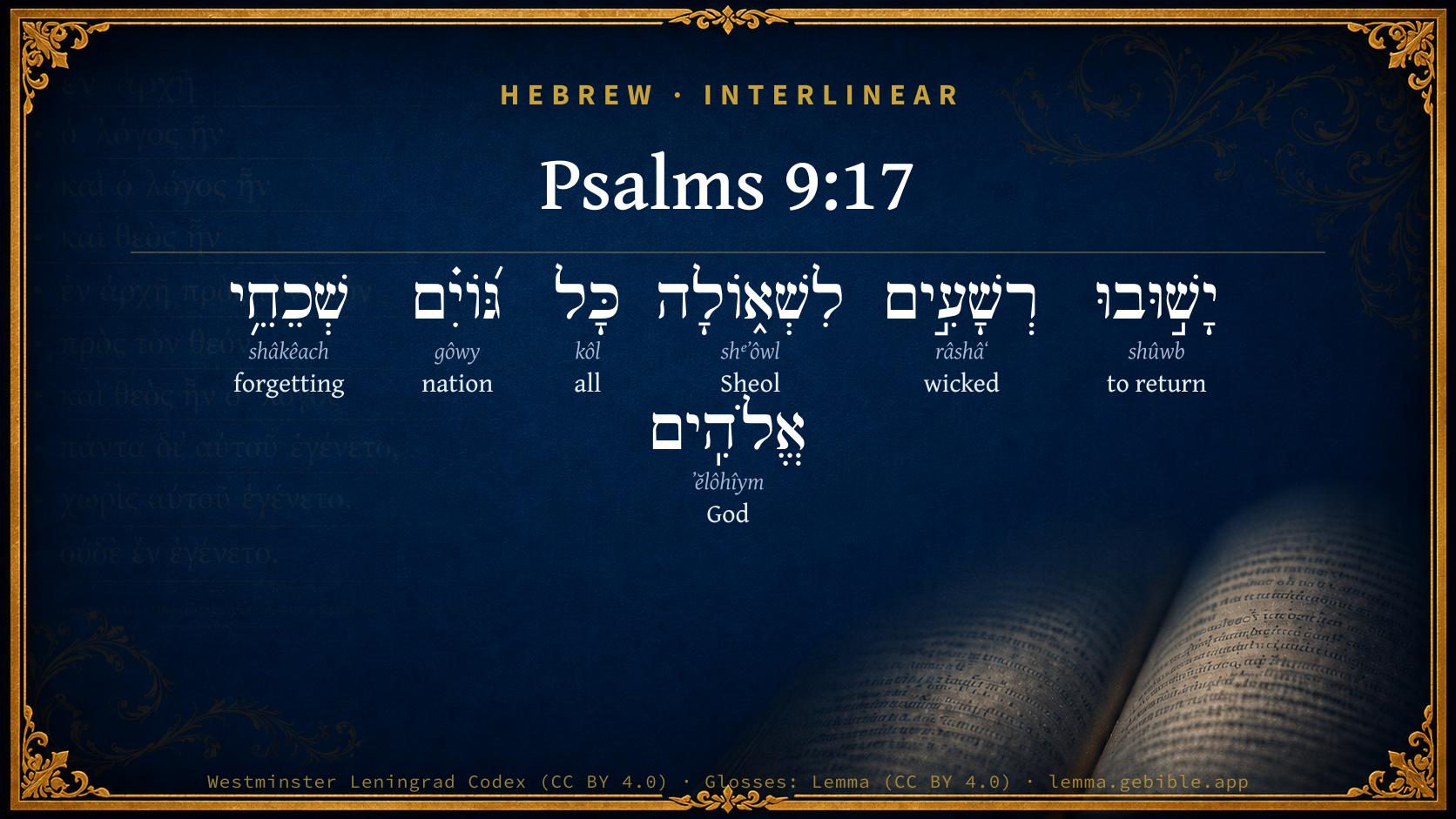
Hebrew (Westminster Leningrad Codex) Psalms 9:17 appears in the Hebrew Old Testament. The text above is from the Westminster Leningrad Codex. Each word links to its Strong’s number, a concise gloss, and parsing drawn from the Open Scriptures Hebrew Bible morphology. Click any word for its full Brown-Driver-Briggs (BDB) entry.
Download image
Cite this verse

Psalms 9:17 (World English Bible). Public Domain. Lemma interlinear Bible study tool, https://lemma.gebible.app/v/psalms/9/17.

Show BibTeX & RIS
BibTeX
RIS
English Translation
The wicked shall be turned back to Sheol, Even all the nations that forget God.
World English Bible · Public Domain
Highlights
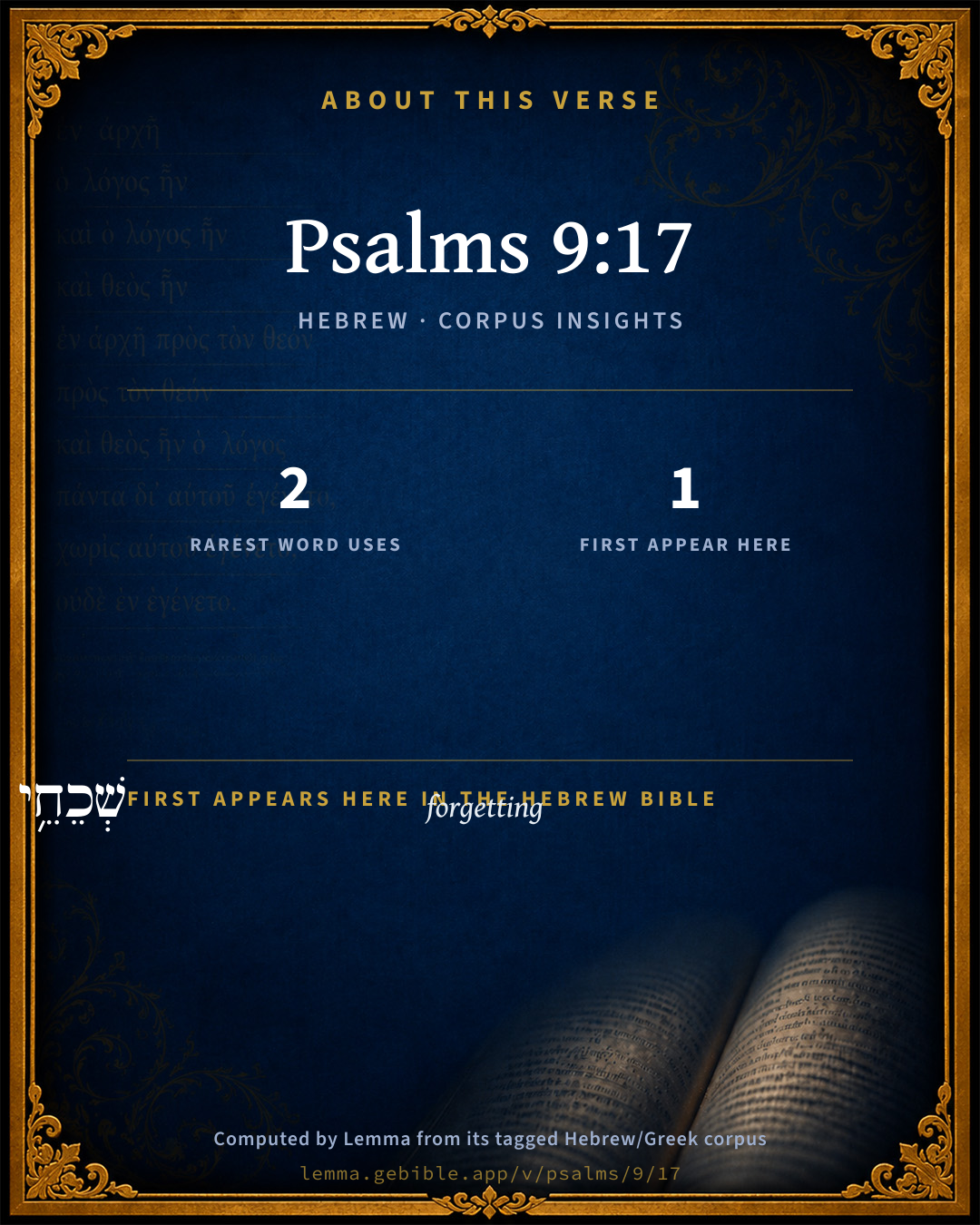
  • 1 first appearance in the Hebrew Bible
Full analysis ↓
Download a study sheet

One document with this verse’s original text, its word-by-word gloss line, the meaning frame, cross-references with their text, attributed commentary, and full source and license credits — printable, and it pastes into notes with its structure intact.

This verse Autodidact and up

Study sheet (.html) Plain text (.txt)

A passage Seminary Student

Up to 50 verses in one chapter. A passage sheet keeps up to 6 commentary sources and 12 cross-references per verse, in the order this page ranks them, and says so on the sheet whenever that leaves anything out. Ask for a single verse and you get the Autodidact verse sheet above.

Everything on this page stays free to read, with no account — the sheet is a download of what is already on screen, not access to it.

Want to remove ads? Support Godless Engineer
Compare translations 3

The same verse in 3 English versions, stacked beneath the original-language interlinear above. Click any original word for its lexicon entry.

Each is an independent rendering of the whole verse — the interlinear is not word-aligned to these translations.

Highlighted words mark where these versions differ — a whole-verse word diff, not a word-by-word alignment.

  • World English Bible Public Domain
    The wicked shall be turned back to Sheol, Even all the nations that forget God.
  • King James Version Public Domain
    The wicked shall be turned into hell, and all the nations that forget God.
  • unfoldingWord Literal Text CC BY-SA 4.0
    The wicked will turn back to Sheol; all nations are forgetful of God.

unfoldingWord Literal Text — © unfoldingWord, licensed CC BY-SA 4.0. Word-aligned USFM3 via Door43 (git.door43.org/unfoldingWord/en_ult).

Versions to compare (up to 4)

3 of 4 selected

Show all 18 translations

Every available English version of this verse, each an independent rendering of the whole verse.

  • World English Bible Public Domain
    The wicked shall be turned back to Sheol, Even all the nations that forget God.
  • Berean Standard Bible Public Domain
    The wicked will return to Sheol—all the nations who forget God.
  • Majority Standard Bible Public Domain
    The wicked will return to Sheol—all the nations who forget God.
  • King James Version Public Domain
    The wicked shall be turned into hell, and all the nations that forget God.
  • American Standard Version (1901) Public Domain
    The wicked shall be turned back unto Sheol, Even all the nations that forget God.
  • Revised Version (1885) Public Domain
    The wicked shall return to Sheol, even all the nations that forget God.
  • Geneva Bible (1599) Public Domain
    The wicked shall turne into hell, and all nations that forget God.
  • Douay-Rheims (1899) Public Domain
    The Lord shall be known when he executeth judgments: the sinner hath been caught in the works of his own hands.
  • Young's Literal Translation Public Domain
    The wicked do turn back to Sheol, All nations forgetting God.
  • Literal Standard Version CC BY-SA 4.0
    The wicked turn back to Sheol, || All nations forgetting God.
  • Unlocked Literal Bible CC BY-SA 4.0
    The wicked are turned back and sent to Sheol, all the nations that forget God.
  • unfoldingWord Literal Text CC BY-SA 4.0
    The wicked will turn back to Sheol; all nations are forgetful of God.
  • Darby Bible Public Domain
    The wicked shall be turned into Sheol, all the nations that forget God.
  • World Messianic Bible Public Domain
    The wicked shall be turned back to Sheol, even all the nations that forget God.
  • Webster's Bible Public Domain
    \\9:16\\The LORD is known by the judgment which he executeth: the wicked is snared in the work of his own hands. Higgaion. Selah.
  • Free Bible Version CC BY-SA 4.0
    The wicked depart, going to the grave—all nations who turn their backs on God.
  • Bible in Basic English Public Domain
    The sinners and all the nations who have no memory of God will be turned into the underworld.
  • JPS Tanakh (1917) Public Domain
    (9-18) The wicked shall return to the nether-world, even all the nations that forget God.

Literal Standard Version (2020), Covenant Press — licensed CC BY-SA 4.0. Text via the HelloAO Bible API (eBible.org). Unlocked Literal Bible (unfoldingWord) — licensed CC BY-SA 4.0. Text via the HelloAO Bible API (eBible.org). unfoldingWord Literal Text — © unfoldingWord, licensed CC BY-SA 4.0. Word-aligned USFM3 via Door43 (git.door43.org/unfoldingWord/en_ult). Free Bible Version, Dr. Jonathan Gallagher — licensed CC BY-SA 4.0. Text via the HelloAO Bible API (eBible.org).

Word by word

More ways to search: Search by grammar → Find every occurrence → Compare this word →

Practice this passage: Drill this verse → Learn its vocabulary →

About this verse

These counts appear in no published source. They are computed here, from the morphology-tagged text and Lemma’s own curated glosses. What Lemma adds →

7
words
7
distinct lemmas
Wisdom
section

Notable vocabulary

The rarest word here is שְׁכֵחֵ֥י forgetting H7913 — appearing just 2 times in the whole Hebrew Bible.

First appearance in Scripture

This word makes its first canonical appearance in the Hebrew Bible here:

  • שְׁכֵחֵ֥י forgetting H7913

Shared distinctive vocabulary

שְׁכֵחֵ֥י forgetting H7913 occurs in 2 verses of the Hebrew Bible. Also found in:

Grammatical profile

  • 1 verb
  • 4 nouns
  • 2 adjectives

Verb forms

  • יָשׁ֣וּבוּ Qal · Imperfect

Hebrew & Septuagint length

In English translation the verse runs 15 words from the Hebrew and 14 from the Septuagint (LXX English) — closely comparable.

A rough comparison of the two English renderings, which tokenize alike — not a word-level alignment.

Word counts can differ between the Hebrew and the Greek without any difference in meaning — e.g. the Hebrew direct-object marker אֵת has no separate Greek word, and Greek often adds the article ὁ.

Cross-references

19

Topical passages linked to Psalms 9:17 in the Treasury of Scripture Knowledge — connected by theme and wording, ordered by reader-vote popularity; previews shown in the World English Bible.

  • Psalms 50:22 "Now consider this, you who forget God, Lest I tear you into pieces, and there be none to deliver.
  • Revelation 21:8 But for the cowardly, unbelieving, sinners, abominable, murderers, sexually immoral, sorcerers, idolaters, and all liars, their part is in the lake that burns with fire and sulfur, which is the second death."
  • Job 8:13 So are the paths of all who forget God. The hope of the godless man shall perish,
  • Romans 2:8–9 but to those who are self-seeking, and don't obey the truth, but obey unrighteousness, will be wrath and indignation,
  • 2 Thessalonians 1:7–9 and to give relief to you that are afflicted with us, when the Lord Jesus is revealed from heaven with his mighty angels in flaming fire,
  • Isaiah 3:11 Woe to the wicked! Disaster is upon them; For the deeds of his hands will be paid back to him.
  • Jeremiah 2:32 Can a virgin forget her ornaments, or a bride her attire? yet my people have forgotten me days without number.
  • Jeremiah 13:25 This is your lot, the portion measured to you from me, says Yahweh; because you have forgotten me, and trusted in falsehood.
  • Jeremiah 18:15 For my people have forgotten me, they have burned incense to false [gods]; and they have been made to stumble in their ways, in the ancient paths, to walk in byways, in a way not built up;
  • Revelation 20:15 If anyone was not found written in the book of life, he was cast into the lake of fire.
  • Proverbs 14:32 The wicked is brought down in his calamity, But in death, the righteous has a refuge.
  • Isaiah 5:14 Therefore Sheol has enlarged its desire, And opened its mouth without measure; And their glory, their multitude, their pomp, and he who rejoices among them, descend into it.
  • Psalms 44:20 If we have forgotten the name of our God, Or spread forth our hands to a strange god;
  • Psalms 106:13 They soon forgot his works. They didn't wait for his counsel,
  • Matthew 25:41–46 Then he will say also to those on the left hand, 'Depart from me, you cursed, into the eternal fire which is prepared for the devil and his angels;
  • Psalms 44:17 All this has come on us, Yet have we not forgotten you, Neither have we been false to your covenant.
  • Psalms 49:14 They are appointed as a flock for Sheol. Death shall be their shepherd. The upright shall have dominion over them in the morning. Their beauty shall decay in Sheol, Far from their mansion.
  • Jeremiah 3:21 A voice is heard on the bare heights, the weeping [and] the petitions of the children of Israel; because they have perverted their way, they have forgotten Yahweh their God.
  • Hosea 2:13 I will visit on her the days of the Baals, To which she burned incense, When she decked herself with her earrings and her jewels, And went after her lovers, And forgot me," says Yahweh.

Cross-references courtesy of OpenBible.info (CC BY 4.0).

Hebrew and Greek witnesses Masoretic Hebrew ↔ Greek Septuagint

The same verse in the two great witnesses to the Old Testament, shown verse-for-verse.

You’re reading Greek Psalm 9 (Hebrew Psalm 9). The Septuagint counts the superscription, so verse numbers can differ from the Hebrew — chapter-level alignment, not verse-by-verse. Numbering follows Rahlfs.

These are two independent witnesses, not word-aligned to each other, and the Septuagint is shown in lemma (dictionary) form.

Hebrew Psalms 9:17 Masoretic · Westminster Leningrad Codex

יָשׁ֣וּבוּ רְשָׁעִ֣ים לִשְׁא֑וֹלָה כָּל גּ֝וֹיִ֗ם שְׁכֵחֵ֥י אֱלֹהִֽים

The wicked shall be turned back to Sheol, Even all the nations that forget God.

World English Bible · Public Domain

Greek LXX Greek Psalm 9:17 Septuagint · lemma form

γιγνώσκω κύριος κρίμα ποιέω ἐν ὁ ἔργον ὁ χείρ αὐτός συνλαμβάνω ὁ ἁμαρτωλός ᾠδή διάψαλμα

Let sinners be driven away into Hades, even all the nations that forget God.

LXX2012 (modern English Septuagint) · Public Domain

On this verse, Ellicott's Commentary for English Readers discusses the Septuagint’s reading. Read the note in Commentary ↓

Hebrew: Westminster Leningrad Codex (CC BY 4.0). Greek: Septuagint (public domain); English from LXX2012 (modern English Septuagint) (Public Domain). How the Septuagint differs from the Hebrew →

Commentary

Notes on Psalms 9:17 from classic Christian and Jewish commentators (each source and its license shown beneath its notes). The classic Christian expositions comment on the surrounding passage and are grouped to its opening verse, so a note may address several verses; the Jewish commentaries on the Tanakh (Rashi and others) are per-verse, so they appear only where the commentator wrote on this verse.

Lemma curates 59 commentaries, every one of them public domain or Creative Commons licensed, each selected and text-cleaned for this edition rather than reprinted as found. About our sources →

Trapp's Complete Commentary

John Trapp

Psa 9:17 The wicked shall be turned into hell, [and] all the nations that forget God.

Ver. 17. The wicked shall be turned into hell] Heb. into into hell (twice), that is, into the nethermost hell, the lowest dungeon of hell. The word lesheolah hath a vehement inforcement from ç local, as grammarians call it, and importeth that they shall be cast into outer darkness, In tenebras ex tenebris infeliciter exclusi, infelicius excludendi (August.). R. Solomon’s note here is, they shall be carried away from hell to judgment, and from judgment they shall be returned to the deepest pit of hell. This, if men did but believe, they durst not do as they do, as once Cato said to Caesar.

And all the nations] The wicked, be they never so many of them, they may not think to escape for their multitudes, as among mutineers in an army, the tenth man sometimes is punished, the rest go free.

John Trapp, A Commentary or Exposition upon All the Books of the Old and New Testament (1647–1656) — public domain. Text from a community e-Sword module.

The Biblical Illustrator

Joseph S. Exell

Psa_9:17

The wicked shall be turned into hell.

A description of the wicked

I. The characters specified.

1. All those who wilfully violate the plain and positive precepts of God. Drinkers. Profane persons. Those who dishonour Gods holy-day. The dishonest.

2. All the persecutors of the people of God.

3. All hypocrites and impostors in religion.

4. All must be denominated wicked who are unregenerate. Wickedness is not a superficial defect, but a profound radical principle, deeply rooted in the heart of man. The nations that forget God refers to heathen nations whose gods were idols. The wicked are described as they who forget God--in His character as Benefactor and as Sovereign. He forgets the all-prevailing presence of God, and he forgets the Word of God.

II. The affirmation made concerning Him. Turned into hell. Note, the place into which they shall he turned; the manner how it will be done; and the certainty of the affirmation. Hell describes--

1. A place of punishment;

2. The nature of the punishment;

3. The exquisite sense of punishment the wicked will feel;

4. The companions of their punishment;

5. The perpetuity of it. The wicked shall be turned into hell. This shall be done unexpectedly, suddenly, irresistibly. The certainty of the affirmation in the text may be inferred--

1. From the general consent of mankind;

2. From the justice of the moral governor of the universe;

3. From the moral unfitness of the wicked for any other situation;

4. And from the testimony of Holy Scripture. (Sketches of Four Hundred Sermons.)

Hell for the wicked

I. The place, or state, here mentioned. Sheol is often put for the grave. Not to be so understood in the text, because hell is here peculiar to the wicked, and the grave is common to good and bad. It signifies the place or state of the lost. It has two branches. The punishment of loss, and the punishment of sense. An eternal privation of the blessed and glorious presence of God, and all the joy, comfort, and happiness that is attending thereupon. The punishment of loss is further aggravated from a threefold consideration.

1. The possibility of preventing it, if there had been care taken about it.

2. The occasion of this loss, and the way of falling into it.

3. The beholding of others to enjoy that happiness which themselves are deprived of. The punishment of sense; which consists in the unspeakable torments inflicted upon soul and body forever and ever. Set forth by unquenchable fire, because fire being one of those things which is most grievous to corporal sense, is therefore fittest to express this condition to us.

II. The persons adjudged.

1. The comprehensive representation in the word wicked. A word of great latitude and extent, including all open and notorious sinners. All close and reserved hypocrites. All carnal and unregenerate persons whatsoever.

2. The emphatic representation. All the nations that forget God. The subjects of the punishment are all the nations, all that prove to be wicked. There is ground for this in Gods power and omnipotency. The importunity of sin and guilt makes for this likewise. The guilt fastened upon these subjects. That is, forgetting of God. Apply to the essence of God; the nature of God; the Word of God; the providence of God. Consider then, the doom and sentence passed upon all such persons as described; and use the passage as a caution and admonition. Look at our general state and condition in grace. Look to our particular life and conversation. (T. Horton, D. D.)

The history of ungodliness

I. Its germ. Forgetfulness of God. This is common. Nations. Contrary to mans true nature, obligations, and circumstances.

II. Its development. It leads to all kind of wickedness. Both Scripture and experience prove this. To forget God is to sin without restraint, without remorse, and without bounds.

III. Its consummation. It is Hell. This is inevitable and certain. There the wicked are abandoned by God, without excuse, without resource, without hope, forever. Consider this ye that forget God. (W. Forsyth, M. A.)

The sure hell

Heaven and hell are opposite states of being or conditions of humanity. Heaven is a present possession, not a mere future blessedness; a temper of mind and heart rather than a special locality. Hell is the opposite of heaven. Does heaven mean the service and consciousness of the love of God? Then hell will prove the selfishness and degradation of separation from God. If we say that heaven is inward happiness and peace, we must also say that hell is dissatisfaction and unrest. Character is the standard which determines whether a man is in heaven or in hell. Theories (concerning hell) once held by almost the entire Church of Christ are honeycombed with doubt and disbelief, and, to a large extent, the very idea of a future punishment of the wicked is regarded as but little more than a delusion of superstitious fancy. What has brought about such a revolution of sentiment? Probably the frightful and unworthy distortions of the doctrine, as proclaimed by the various creeds and churches. In Scripture we find no sure ground for any belief in a material hell, but a distinct and unmistakable enunciation of the fact of a natural hell of cause and effect. That wilful wrong-doing will inevitably be followed by its just punishment is the teaching of every Bible reference to the fact. Evil deserves, and calls for, punishment. And death does not change character. After death we shall be as we were before death, or the future can have no possible meaning for us. The irresistible laws of the moral world steadily bring the punishment. I make no absolute statement concerning the great problem of retribution; I formulate no theory; but it seems to me there is a truer and nobler satisfaction to Divine justice than the tortures of the damned. I believe evil will be followed by fearful penalty, for every principle of right and law of God demands that it should. Further I may not go; for justice there can be none, where mercy is not. What God is I know. He is wise, and sees the best. I can, I will trust Him. (George Bainton.)

Awful words

Yes, so awful that it seems almost presumption to preach on them. But woe is unto us if we do not warn the sinner. The words show that God doth regard (Psa_94:17).

I. The characters described.

1. The wicked. This means not all mankind, though all are wicked, but gross transgressors.

2. The nations that forget God. Practical atheists. How many do this?

II. The future portion decreed them. They shall be turned into hell. There will be--

1. Tormenting pains.

2. A sleepless conscience.

3. Mutual reproaches.

4. Unrestrained and full-grown passions.

5. The certainty of eternal despair. Then come this very hour to Jesus. (J. Jowett, M. A.)

The existence, punishment, and duration of hell

I. Let us meet some false opinions concerning hell and establish its real existence. The Bible maintains it. But consider--

1. The ancient belief is found both in sacred and profane writers. We read of it in the Old Testament. Moses tells of the anger of God burning unto the lowest hell. Homer speaks of Ajax sending men to hell. And other passages show that the ancients believed in hell.

2. Some deny the existence of any hell beyond the bounds of time, and assert that through Gods love all mankind shall be saved. But this contradicts Scripture, and confounds the distinctions between right and wrong.

3. Others say that hell is here in our present sufferings and that there is no other, but that beyond the grave mankind will be glorified. But then, why should Christ die? What pardon do we need if we suffer all the penalty of our sin here? And our sufferings would be the cause of our salvation.

4. Some assert that conscience is hell. But conscience was not designed to be either mans full reward or penalty, but only his guide. It is a witness, a judge, and to some extent an executioner.

5. Others, that the grave is the only hell the Bible speaks of, and that there is no future punishment. But only in 1Co_15:55 can hades be consistently translated grave. In all other places it means hell.

II. The duration of hell eternal. Some say that after a while the torments of the damned will be terminated, and the damned will then be saved. But this is to make hell the Saviour, and not Christ. And the word everlasting is the true rendering of Aionios. And how can a man be regenerated in hell; but unless he be born again he cannot enter the Kingdom of God? And for the protection of the righteous the wicked shall be shut off from them.

III. In what the punishment of hell consists.

1. The loss of all worldly good.

2. The society the lost will find there. Vile men and devils.

3. The lake of Fire. If this be figurative, then how awful must be the punishment which requires such a figure.

4. The loss of the glories of heaven.

5. And chief of all, of God Himself. (W. Barns.)

Hell Gods cemetery for the corrupt

Does it not seem cruel to put a loved form in the grave damn and cold? A wife for instance, who has been shielded from every breath one week, the next she is left here in the rain and exposure. So we queried, and the answer taught us a lesson. It is necessary to do so, for the good of the family and the community; it does seem cruel, and death, as it is the consequence of sin is always cruel, yet the putting away of the dead is kindness. Hell is Gods cemetery for dead and corrupt men; it is for souls what graveyards are for bodies. It may seem cruel of God to put souls away, but being dead it is necessary, indeed it is kindness to the living members of His family. (W. Luff.)

The end of the wicked

All wickedness came originally with the wicked one from hell; thither it will be again remitted, and they who hold on its side must accompany it on its return to that place of torment, there to be shut up forever. The true state, both of nations and the individuals of which they are composed, is to be estimated from one single circumstance, namely, whether in their doings they remember or forget God. Remembrance of Him is the well-spring of virtue; forgetfulness of Him, the fountain of vice. (George Horne, D. D.)

And all the nations that forget God.--

The hopeless state of the heathen

The time was when all the nations of the earth knew, and acknowledged, the only living and true God. This time, however, was of short duration. Soon after their separation from each other, they lost their religious traditions, grew vain in their imaginations, and degenerated into all kinds of idolatry. As the king of Gods peculiar people, David viewed all the heathen nations as his personal enemies; and as a prophet of the true Church, he viewed all the heathen nations as enemies to the true God and the true religion. Hence it is, that he so often blends his enemies with the enemies of God, and speaks of both as exposed to both temporal and eternal ruin. The text is a description of all the heathen world, who are destitute of Divine revelation. To make it appear that the heathen will be finally lost, observe--

1. That God, many years ago, gave them up to judicial blindness and hardness of heart. Paul, speaking of the heathen, says, God gave them up to a reprobate mind.

2. When God formed the seed of Abraham into a distinct national and visible Church, He shut the door against the heathen nations. The present heathen nations are as ignorant and wicked as the ancient heathen nations were.

3. When God sent Christ into the world to bring life and immortality to light, He directed Him to preach to the Jews, and not to the Gentiles.

4. When God sent the apostles to preach to heathens, He sent them to turn them from heathenism to Christianity.

5. God has told us that He intends to convert all the heathen nations, and that He intends to do it by the instrumentality of the Gospel. Improvement.

(1) If God will not save the heathen who are destitute of the Gospel, then we have no reason to think He will save the Jews, while they disbelieve the Gospel.

(2) If God will not save the heathen, then we have no reason to believe He will save atheists, deists, and those who deny the fundamental principles of Christianity.

(3) He will not save any, under the Gospel, on the ground of their external obedience, morality, or virtue. It appears, from what has been said, that the heathen are in a deplorable and perishing condition. (N. Emmons, D. D.)

What are our memories

That we forget is our commonest excuse for any omission, in great matters or in small. The excuse is put forward, not only as sufficient ground for pardon of our omission, but as one saving the credit of our intentions. In the text and elsewhere the people of God are warned that they will be held closely and severely responsible for forgetting God. There is no part of our minds powers which we reckon to be less under our control than our memories. It does not follow because we have not the command, that therefore we might not, and ought not, to have it. What are our memories? The recalling of things that have made an impression on us. The impression may be made at once by some striking circumstance, or it may be the result of frequent and diligent attention to some particular object. The ministering of our memory to our thoughts will depend, therefore, upon what the character of our interests has been in the different stages of our life, for according to this will be the character of our impressions. It must be one of the trials of these who have lived sinful lives, and after turned to God, that their memories will recall to their involuntary thoughts the scenes and works of other days, and contaminate with them their after endeavours after holier reflections. The memory must and will be occupied. What is the great conclusion? That if our memories depend on our impressions, and we have not remembered the Lord our God, then we have not been impressed by deep thought of Him. The utter confusion of such a sentence comes upon us if we consider it more piecemeal. It means this, that upon each opportunity of becoming deeply impressed by the thoughts of God, we have remained unimpressed, and, therefore, forgetful of His greatness. Time would fail us, if we were to attempt to show how the sinful nature of man resists the varied impressions he might receive through the innumerable manifestations of the attributes of our Almighty Father. Memory is a minister of good to the good, of evil to the evil, for it is our former selves waiting upon us. (Archdeacon Mildmay.)

Forgetfulness of God

Familiarity with the words of the Bible makes them lose their force to us. The Lords Prayer, the Liturgy generally. But this is no argument against a form of prayer. If we are to give up a form because of this danger, then we may give up reading the Bible for the same reason. But formalism is our fault, not that of the form we use. And this familiarity tells upon the truth taught in text.

I. Mens forgetfulness of God. And yet we ought to fear, for if in Davids day, when men were under the law, our text was true, how much more now in our state of greater privilege. See how we ward off the blow threatened by the idea that we are not of the number of those who forget God. This is true in a sense, for no one can quite forget God. Conscience will not let him. Not the infidel even, still less the profligate. The text, therefore, tells of something short of total forgetfulness. Who, then, are they who forget God?

1. Those who do not habitually remember Him. Such persons may be respectable before men.

2. Those who are afraid to do right because of the ridicule of the world.

3. Those who think that He will not punish sin.

II. This danger of forgetfulness presses on us all. And it is worse in us than in David, for we have the Holy Spirit given us in our baptism. If we call on Him He will help us to resist temptation. Pleading forgetfulness only adds to our fault if we fall. Therefore let us seek to remember God. (F. E. Paget, M. A.)

Tender words of terrible apprehension

Many ministers of Christ have been accused of taking pleasure in preaching upon this terrible subject of the wrath to come. It were strange, indeed, if it were so. To preach Christ is our delight, the joy of our heart; but while it is bard to preach the terrors of the law, it were harder still to bear the doom which must rest upon the silent minister, the unfaithful watchman who did not warn the sinner, and whose blood must therefore be required at the watchmans hands. None ever spoke as did Jesus on this terrible theme; no preacher ever used figures of such glaring horror as did He. Upon such a subject we cannot afford to trifle. Must the eternal and holy Son of God offer up His life for us, and is the world to come a thing about which men can idly sport or dream? But this forgetting of God.

I. Let me charge this sin upon you. Gross sinners will receive their doom. God will not treat them with leniency; He will not wink at their follies, the wicked shall be turned into hell. But observe their companions--those who forget God. Now I charge this sin upon many. Sinner, thou forgettest--

1. Gods infinite majesty;

2. His mercies;

3. His laws;

4. His presence;

5. His justice.

II. The reason of this forgetfulness.

1. It is because the thought of Him makes the sinner afraid. The guilty man always dreads the eye of the judge.

2. It is irksome to thee. Thy heart revolts. Thou sayest, Why should I think of God?

3. Such thinking and going on in sin are incompatible, and thou preferrest thy sins. Sin loved, God is abhorred.

III. Your excuses for it. You say--

1. A man is excusable if he has not had enough in early youth to impress God upon his memory. You, who have been trained by godly parents, cannot say that.

2. To think of God always is very hard. Have you ever made the attempt? How, then, do you know it is hard work? Your forgetting never caused you to weep. If it were not wilful and wicked forgetting you would repent of it. Everything around you reminds you of God, and what warnings many of you have had.

IV. I would persuade you to repentance. I would plead--relying on the Holy Ghost.

1. By the terrors of the law. In hell the thought of God shall be as a dagger in your soul. Son, remember, that was the word of Abraham to Dives in hell, and an awful word it was. But

2. By the mercies of God. He saith, As I live, I have no pleasure in the death of him that dieth, but had rather that he should turn unto Me and live. There is hope for thee in Christ Jesus. (C. H. Spurgeon.)

The Biblical Illustrator, edited by Joseph S. Exell (c. 1880s–1900s) — public domain. Text from a community e-Sword module.

The Treasury of David

Charles H. Spurgeon

Ver. 17. The justice which has punished the wicked, and preserved the righteous, remains the same, and therefore in days to come, retribution will surely be meted out. How solemn is Ps 9:17, especially in its warning to forgetters of God. The moral who are not devout, the honest who are not prayerful, the benevolent who are not believing, the amiable who are not converted, these must all have their own portion with the openly wicked in the hell which is prepared for the devil and his angels. There are whole nations of such; the forgetters of God are far more numerous than the profane or profligate, and according to the very forceful expression of the Hebrew, the nethermost hell will be the place into which all of them shall be hurled headlong. Forgetfulness seems a small sin, but it brings eternal wrath upon the man who lives and dies in it.

Ver. 17. The ungodly at death must undergo God's fury and indignation. The wicked shall be turned into hell. I have read of a lodestone in Ethiopia which hath two corners, with one it draws the iron to it, with the other it puts the iron from it: so God hath two hands, of mercy and justice; with the one he will draw the godly to heaven, with the other he will thrust the sinner to hell; and oh, how dreadful is that place! It is called a fiery lake (Re 20:15); a lake, to denote the plenty of torments in hell; a fiery lake, to show the fierceness of them: fire is the most torturing element. Strabo in his geography mentions a lake in Galilee of such a pestiferous nature that it scalds off the skin of whatsoever is cast into it; but, alas! that lake is cool compared with this fiery lake into which the damned are thrown. To demonstrate this fire terrible, there are two most pernicious qualities in it. 1. It is sulphurous, it is mixed with brimstone (Re 21:8), which is unsavoury and suffocating. 2. It is inextinguishable; though the wicked shall be choked in the flames, yet not consumed (Re 20:10); "And the devil was cast into the lake of fire and brimstone, where the beast and the false prophet are, and shall be tormented day and night forever and ever." Behold the deplorable condition of all ungodly ones in the other world, they shall have a life that always dies, and a death that always lives: may not this affright men out of their sins, and make them become godly? unless they are resolved to try how hot the hell fire is. Thomas Watson.

Ver. 17. The wicked shall be turned into hell, etc. By "the wicked" here we must understand unregenerate persons, whoever they are that are in a state of unregeneracy... That person is here spoken of as a "wicked" man that forgets God, who does not think of him frequently, and with affection, with fear and delight, and those affections that are suitable to serious thoughts of God... To forget God and to be a wicked person is all one. And these two things will abundantly evince the truth of this assertion: namely, that this forgetfulness of God excludes the prime and main essentials of religion, and also includes in it the highest and most heinous pieces of wickedness, and therefore must needs denominate the subject, a wicked person... Forgetfulness of God excludes the principal and essential parts of religion. It implies that a man doth neither esteem nor value the all sufficiency and holiness of God, as his happiness and portion, as his strength and support; nor doth he fear him, nor live in subjection to his laws and commands, as his rule; nor doth he aim at the glory of God as his end: therefore every one who thus forgets God, must certainly be a wicked person... To exclude God out of our thoughts and not to let him have a place there, not to mind, nor think upon God, is the greatest wickedness of the thoughts that can be. And, therefore, though you cannot say of such a one, he will be drunk, or he will swear, cozen, or oppress; yet if you can say he will forget God, or that he lives all his days never minding nor thinking upon God, you say enough to speak him under wrath, and to turn him into hell without remedy. John Howe, 1630-1705.

Ver. 17. The wicked shall be turned into hell. (hlwavl); Lisholah headlong into hell, down into hell. The original is very emphatic. Adam Clarke.

Ver. 17. All wickedness came originally with the wicked one from hell; thither it will again be remitted, and they who hold on its side must accompany it on its return to that place of torment, there to be shut up for ever. The true state of "nations, "and the individuals of which they are composed, is to be estimated from one single circumstance; namely, whether in their doings they remember, or "forget God." Remembrance of him is the well spring of virtue; forgetfulness of him, the fountain of vice. George Horne, D.D.

Ver. 17.

Hell, their fit habitation, fraught with fire Unquenchable, the house of woe and pain.

John Milton, 1608-1674.

Ver. 17.

Will without power, the element of hell, Abortive all its acts returning still Upon itself; ...Oh, anguish terrible! Meet guerdon of self love, its proper ill! Malice would scowl upon the foe he fears; And he with lip of scorn would seek to kill; But neither sees the other, neither hears For darkness each in his own dungeon bars, Lust pines for dearth, and grief drinks its own tears Each in its solitude apart. Hate wars Against himself, and feeds upon his chain, Whose iron penetrates the soul it scars, A dreadful solitude each mind insane, Each its own place, its prison all alone, And finds no sympathy to soften pain.

J. A. Heraud.

Ver. 17. A warning to forgetters of God.

Charles H. Spurgeon's The Treasury of David (1869–1885) — public domain. Psalms only. Text from a community e-Sword/MySword module.

Joseph Benson's Commentary

Psa 9:17. The wicked shall be turned into hell — Either, 1st, Into the grave, which is often called שׁאול, sheol, into which persons are said to be turned, or to return, because they were made of, or taken out of, the dust, Ecc 12:7; or, 2d, Into the place of eternal perdition, which also is sometimes called sheol, as Pro 15:24, and elsewhere. For he seems evidently to speak here of those punishments which are peculiar to the wicked, whereas the grave is common to the good and bad: and, as in Psa 9:8, he appears to speak of the last and general judgment of all the world, so this verse may be understood of the general punishment of all wicked persons and nations consequent upon that judgment; and, into this place men may be said to be turned back, or to return, because it is their own proper place, (Act 1:25,) to which they belong, and from which they have their wicked qualities, as being of their father the devil. For as “all wickedness,” says Dr. Horne, “came, originally, with the wicked one, from hell; thither it will be again remitted, and they who hold on its side must accompany it on its return to that place of torment, there to be shut up for ever.” And all the nations — Whom neither their great numbers nor power can protect from God’s wrath; that forget God — That do not consider nor regard him, nor his precepts, nor his threatenings and judgments; but go on securely and presumptuously in their wicked ways. Observe well, reader, forgetfulness of God is the primary cause of the wickedness of mankind, and there are whole nations, immense multitudes of persons, that forget him, though he is their Maker, Preserver, and Benefactor, and the Being on whom they are daily dependant for all things, and who live without him in the world; of all whom hell will at last be the portion, the pit of destruction in which they, and all their comforts, will be for ever lost and buried. Consider this well, and turn to the Lord with all thy heart.

Joseph Benson's Commentary on the Old and New Testaments (1811–1818) — public domain. Text from a community e-Sword module.

J. A. Alexander on Psalms

Joseph Addison Alexander

18. (Psa 9:17). The wicked shall turn back even to hell, to death, or to the grave, all nations forgetful, of God. The enemies of God and of his people shall be not only thwarted and repulsed, but driven to destruction; and that not merely individuals, but nations. For the meaning of Sheol see above, on Psa 6:6 (5). The figure of turning back, retreating, failing, is the same as in Psa 9:4 (3) above. The idea expressed is not that of being turned directly into hell, but that of turning back, first to one's original position, and then beyond it, to the grave or hell. In the last clause there is an allusion to the implied charge of forgetfulness on God's part in Psa 9:13 (12) above. He had not forgotten the "poor innocents," as they feared, and as their enemies believed; but these very enemies had forgotten him, and must now abide the consequences of their own forgetfulness. The future forms of this verse may have reference to the same things mentioned in the verse preceding as already past. It seems more natural, however, to explain them as a confident anticipation of results precisely similar to those which had already been produced by the same causes. As Jehovah had already caused the heathen to become their own destroyers, so he might be expected to renew the same judicial process in another case.

Joseph Addison Alexander, The Psalms Translated and Explained (1850) — public domain. Text from a community e-Sword module.

Jamieson, Fausset & Brown

Robert Jamieson, A. R. Fausset & David Brown

shall be turned--or, "shall turn," retreating under God's vengeance, and driven by Him to the extreme of destruction, even hell itself. Those who forget God are classed with the depraved and openly profane.

Jamieson, Fausset & Brown — Commentary Critical and Explanatory on the Whole Bible (1871) — public domain (CC PDM 1.0). Text via the HelloAO Bible API.

Adam Clarke's Commentary

Verse 17. The wicked shall be turned into hell] לשאולה lisholah, headlong into hell, down into hell. The original is very emphatic.

All the nations that forget God.] They will not live in his fear. There are both nations and individuals who, though they know God, forget him, that is, are unmindful of him, do not acknowledge him in their designs, ways, and works. These are all to be thrust down into hell. Reader, art thou forgetful of thy Maker, and of HIM who died for thee?

Adam Clarke's Commentary on the Bible (1810–1826) — public domain. Text from a community e-Sword/MySword module.

John Calvin's Commentaries

17. The wicked shall be turned into hell. Many translate the verb in the optative mood, Let the wicked be turned into hell, as if it were an imprecation. But, in my judgment, David here rather confirms himself and all the godly with respect to the future, declaring that whatever the wicked may attempt, it will have a termination disastrous to themselves. By the word turn he means that the issue will be far otherwise than what they imagine; for there is implied in it a tacit contrast between the height of their presumption and the depth of their fall. As they have no fear of God, they exalt themselves above the clouds; and then, as if they had “made a covenant with death,” according to the language of Isaiah, (Isaiah 28:15) they become so much the more arrogant and presumptuous. But when we see them raging without apprehension of danger, the prophet warns us that their madness carries them headlong, so that, at length, they fall into the grave, from which they thought themselves to be a great way off. Here, then, is described to us the sudden and unexpected change, by which God, when he pleases, restores to order things which were in confusion. When, therefore, we see the wicked flying aloft devoid of all fear, let us, by the eyes of faith, behold the grave which is prepared for them; and rest assured that the hand of God, although it is unseen, is very near, which can turn them back in the midst of their course in which they aim at reaching heaven, and make them tumble into hell in a moment. The meaning of the Hebrew word שאולה, sheolah, is doubtful, but I have not hesitated to translate it hell “Le mot Hebreu, pour lequel nous avons traduit Enfer signifie aussi Sepulchre; mais j’ay mieux aime retenir ceste signification. — Fr. “The Hebrew word which we have translated hell also signifies the grave; but I have preferred to retain the former meaning of the word.”

John Calvin's Commentaries (1540-1563) — public domain. Text from the Calvin Translation Society English edition (1840s-50s) via the Christian Classics Ethereal Library (ccel.org). Calvin's coverage is partial (roughly two-thirds of the Bible); uncommented books and verses are honest gaps, never fabricated. The 19th-century editor's footnotes and remarks are omitted so the notes are faithfully Calvin's own voice.

Ellicott's Commentary for English Readers

(17) The wicked.—This is a most unfortunate rendering. The true translation is, the wicked shall return, as in LXX. and Vulg. (not “be turned”) to the grave, i.e., to dust, according to the doom in Gen_3:19, or to the unseen world, as in Job_30:23; Psa_90:1-3; or the verbs may be imperative, as in LXX. and Vulg., let them return. The verse is closely connected with the previous one. The wicked are bringing about their own destruction, and so witnessing to the righteous judgment of Jehovah. There is an intensity about the original word, lisheôlah, with its double sign of direction, “right down to the world of death.” And all.—Better, the heathen all, forgetters of God.

A Bible Commentary for English Readers, edited by Charles John Ellicott (1878–1897) — public domain. Text from a community e-Sword module.

The Cambridge Bible for Schools and Colleges

gen. ed. J. J. S. Perowne

17. R.V. rightly:

The wicked shall return to Sheol,

Even all the nations that forget God.

Sheol is not hell as the place of torment. What is meant is that the career of the wicked in this world will be cut short by the judgement of God. Cp. Psa_55:15, Psa_63:9. But why ‘return?’ Man must ‘return’ unto the ground from which he was taken, to the dust of which he was made, to his elementary atoms (Gen_3:19; Psa_104:29; Psa_90:3). A still closer parallel is to be found in the words of Job (Job_30:23) ‘unto death wilt thou make me return.’ Cp. too Job_1:21. The shadowy existence in Sheol to which man passes at death is comparable to the state of non-existence out of which he was called at birth. “From the great deep to the great deep he goes.” There Job will have no more enjoyment of life, there ‘the wicked’ will have no more power for evil.

that forget God] Cp. Psa_50:22; Job_8:13, for the phrase, and Psa_10:4 for the thought. Observe that it is God, not Jehovah; the nations could not know Him in His character of the God of revelation, but even to them “he left not himself without witness” (Act_14:17), but manifested to them what they could know concerning Himself (Rom_1:18-23). Deliberate wickedness, especially as shewn in antagonism to God’s chosen people, implied a culpable forgetfulness of God.

17, 18. Stanza of Yod. Confident anticipation for the future, arising naturally out of the contemplation of Jehovah’s recent judgement.

The Cambridge Bible for Schools and Colleges (gen. ed. J. J. S. Perowne; Cambridge University Press, 1878–1918) — public domain. Text from a community e-Sword module.

John Gill's Exposition

For the needy shall not always be forgotten,.... The people of God are poor and needy for the most part; they are so in things temporal, and they are poor in spirit, or in things spiritual, of which they are sensible; their needs are many, and frequently return; but God has provided a throne of grace for them to come to for help in time of need, and he will supply all their wants out of the fulness of grace in Christ; nor is he unmindful of them, and of his covenant with them; strictly speaking, they are never forgotten by him, being engraven on his hands, and set as a seal on his heart; but they sometimes seem to be so both to themselves and others, Psa 42:3; and they may continue so long; God may seem for a long time to take no notice of them, but suffer them to lie under affliction and persecution; the holy city is trodden under foot forty two months, or one thousand two hundred and sixty days, that is, so many years; so long the witnesses prophesy in sackcloth, so long the church is in the wilderness, and so long will be the reign of antichrist, Rev 11:2; but as great Babylon will come up in remembrance before God, and he will remember her sins, and render her double; the set time to favour his poor and needy will come, and he will arise and have mercy on them, and bring them into a glorious and comfortable state and condition;

the expectation of the poor shall not perish for ever; the negative particle, though not in the original text, is rightly supplied from the preceding clause, as it is by the Targum, Jarchi, Aben Ezra, and Kimchi, and as the sense requires; and the expectation of Christ's poor ones is not only a supply of grace here and eternal happiness hereafter; but they expect a glorious state of the church on earth, and that Christ will descend in person from heaven, and his tabernacle will be among men; and that they shall be kings and priests, and possess the kingdom, and reign with Christ a thousand years; and though these things may seem to be deferred, and their expectation put off to a length of time, yet it shall not perish for ever; there will be a performance of the things promised and expected.

John Gill's Exposition of the Whole Bible (1746–1763) — public domain (CC PDM 1.0). Text via the HelloAO Bible API.

Albert Barnes' Notes on the Bible

The wicked - All the wicked; all who come properly under the denomination of wicked persons. Doubtless the writer had particularly in his eye the enemies with whom he was contending, and in reference to whom the psalm wits composed; and he meant to say that they would be certainly punished. But what was true in regard to them, was true of all others of similar character, and the statement is therefore made in a universal form - all the wicked.

Shall be turned - Shall turn back, or be turned from their present course. The idea is, that they were now pursuing a certain course, but that they would be turned back from that, or would fail and retreat; and instead of going on to victory, would be defeated, and would sink into hell. The idea is essentially the same as that which is expressed in Psa 9:3 above: “When mine enemies are turned back.”

Into hell - - לשׁאולה lishe'ôlâh - to Sheol, Hades, the grave, the world of departed spirits. This is the usual meaning of this word. See Luk 16:23, note; Isa 14:9, note; Job 10:21-22, note. Though the word, however, originally denoted the grave, the region of the dead, the world of departed spirits, yet it was also supposed that there was a distinction in the condition of the dead; and the word gradually came to denote the abode of the wicked portion of the dead, and hence, the place of future punishment. So it is undoubtedly used in Luk 16:23. It is clear

(a) that this cannot be understood here as referring to the grave in its ordinary sense, for the righteous will be as certainly consigned to the, grave, or will as certainly die, as the wicked;

(b) that it cannot refer to the invisible world, the abodes of the dead, in the ordinary sense of the term - for it is as true that the righteous will enter that world as that sinners will.

There must be some sense, in which the word is used here, different from that of the grave, or different merely from death as such. This sense can be only one of two - either:

(1) that the author means that they will be cut off by a sudden and violent death, considered as a calamity or as a punishment; or

(2) that he regarded the Sheol mentioned here as a place of punishment.

Calvin thinks it is not improbable that the former of these is intended; but it may be observed in regard to this,

(a) that this is not the language usually employed to denote that idea - the phrase, to be cut off, or cut down, being that which a writer intending to express that idea, would most naturally use - since the phrase, to be sent to Sheol, considered as the grave or the region of the dead, would express nothing special in regard to the wicked; and

(b) the spirit of the passage seems to demand the idea that the wicked referred to here would he consigned to a place of punishment, that they would be cut off as wicked persons, and treated accordingly.

This interpretation is strengthened by the other member of the parallelism, where it is said, “and all the nations that forget God;” since it is no more true that the nations “that forget God” will be “turned into the grave, or the world of departed spirits,” than it is that the nations that serve and obey him will. It seems to me, therefore, that this is one of the passages in which it is clear that the word Sheol had connected with it the idea of punishment beyond the grave - of a region where the wicked would be treated according to their deserts, and in a manner different from the treatment of the righteous; that although the general idea of that under-world was that it was a dark and gloomy place, yet that there was also the idea that the abode of the wicked there was far more gloomy than that of the righteous; and that it was regarded as a punishment to be consigned to that region. It is not necessary to suppose that they had the full idea attached to the word hell which we have, anymore than that they had the same full and clear idea of heaven that we have. Light has come into our world on all these subjects gradually, and there is nothing which requires us to suppose that the earlier sacred writers lind the same clear views which the later writers had, or that either of them knew all that is to be known. Compare 1Pe 1:10-11.

And all the nations that forget God - All who are strangers to him, or who are ignorant of the true God. See the notes at Rom 2:12. From the character and prospective doom of those to whom the psalmist particularly referred in this psalm, he is led to make this general remark about all who sustain the same character which they did. Under the administration of the same God those of the same character would share alike, for “there is no respect of persons with him;” and it is the perfection of an impartial government to treat all of the same character in the same manner. If we can, therefore, ascertain how, under his administration, one sinner will be treated in the future world, we can infer how all of the same character will be treated; if we can learn how God will deal with one people, we can infer how he will deal with all. The statement here is, that all the wicked, of whatever nation, will be consigned to punishment in the future world. The phrase used here, “that forqet God,” denotes those who are not disposed or inclined to remember and honor him. The idea seems to be that though they might have known him, they did not choose to retain him in their knowledge, but gave themselves up to a life of idolatry and sin. Compare Rom 1:19-21, notes; Rom 1:28, note.

Albert Barnes' Notes on the Bible (1834–1885) — public domain. Text from a community e-Sword/MySword module.

Matthew Poole's English Annotations

Into hell; either

1. Into the grave which is oft called sheol, into which they are said to be turned, or to return, because they were made of or taken out of the dust, Ecc 12:7. Or,

2. Into the place of eternal perdition; which also is sometimes called sheol, as Pro 15:24, and elsewhere. For he seems to speak here of those punishments which are peculiar to the wicked, whereas the grave is common to good and bad. And as, Psa 9:8, he seems to speak of the last and general judgment of all the world, so this verse may be understood of the general punishment of all persons and nations consequent upon it. And into this place wicked men may be said to be turned back, or to return; either,

1. Because it is their own proper place, Act 1:25, to which they belong, and from which they have their original and their wicked qualities, as being of their father the devil, Joh 8:44; in which respect the locusts (who are by all interpreters understood to be living men) are said to come out of the bottomless pit, Rev 9:2,3. Or,

2. Because they had set themselves as it were in battle array against God, and were beaten back and driven from his presence into their graves, and into hell itself.

All the nations; whom their great numbers and power cannot protect from God’s wrath.

That forget God; that do not consider nor regard God, nor his precepts, nor his threatenings and judgments, but go on securely and presumptuously in their oppressive and wicked courses.

Matthew Poole's English Annotations on the Holy Bible (1683–1685) — public domain. Text from a community e-Sword/MySword module.

Whedon's Commentary on the Bible

Daniel D. Whedon

17, 18. The point in the last strophe is, that God had made the devices of the wicked the instruments of their own defeat and punishment. David now proceeds to a further prediction of their overthrow, and the vindication of the oppressed righteous.

Hell—This is unquestionably one of the places where sheol signifies a place of future punishment, and will fully bear the translation here given. Nothing less could suit the sense. The righteous, no less than the wicked, will be turned into the grave, but not into hell. Compare, on sheol, Pro_5:5; Pro_9:18; Pro_23:14; Job_21:13; and notes on Psa_6:5; Psa_16:10.

Daniel D. Whedon (gen. ed.), Commentary on the Old and New Testaments (1874–1909) — public domain. Text from a community e-Sword module.

The Pulpit Commentary

The wicked shall be tamed into hell; literally, shall be turned backwards to Sheol, or Hades; i.e. shall be removed from earth to the place of departed spirits. There is no direct threat of retribution or punishment, beyond the peens damni, or loss of all that is pleasing and delightful in this life. And all the nations that forget God; rather, even all the people (Kay). "The wicked" and "the people that forget God" are identical.

The Pulpit Commentary (1880–1919), ed. H.D.M. Spence-Jones & Joseph S. Exell — public domain. Text from a community e-Sword module.

John Wesley's Explanatory Notes

Forget - That do not regard God, nor his precepts, nor his threatenings and judgments.

John Wesley, Explanatory Notes Upon the Whole Bible (1754–1765) — public domain. Text via the GEBible commentary corpus.

Keil & Delitzsch

C. F. Keil & F. Delitzsch

(Heb.: 9:18-19) Just as in Psa 9:8. the prospect of a final universal judgment was opened up by Jahve's act of judgment experienced in the present, so here the grateful retrospect of what has just happened passes over into a confident contemplation of the future, which is thereby guaranteed. The lxx translates ישׁוּבוּ by αποστραφήτωσαν, Jer. convertantur, a meaning which it may have (cf. e.g., Ch2 18:25); but why should it not be ἀναστραφήτωσαν, or rather: ἀναστραφήσονται, since Psa 9:19 shows that Psa 9:18 is not a wish but a prospect of that which is sure to come to pass? To be resolved into dust again, to sink away into nothing (redactio in pulverem, in nihilum) is man's return to his original condition, - man who was formed from the dust, who was called into being out of nothing. To die is to return to the dust, Psa 104:29, cf. Gen 3:19, and here it is called the return to Sheτl, as in Job 30:23 to death, and in Psa 90:3 to atoms, inasmuch as the state of shadowy existence in Hades, the condition of worn out life, the state of decay is to a certain extent the renewal (Repristination) of that which man was before he came into being. As to outward form לשׁאולה may be compared with לישׁעתה in Psa 80:3; the ל in both instances is that of the direction or aim, and might very well come before שׁאולה, because this form of the word may signify both ἐν ᾅδου and εἰς ᾅδου (cf. מבּבלה Jer 27:16). R. Abba ben Zabda, in Genesis Rabba cap. 50, explains the double sign of the direction as giving intensity to it: in imum ambitum orci. The heathen receive the epithet of שׁכחי אלהים (which is more neuter than שׁכחי, Psa 50:22); for God has not left them without a witness of Himself, that they could not know of Him, their alienation from God is a forgetfulness of Him, the guilt of which they have incurred themselves, and from which they are to turn to God (Isa 19:22). But because they do not do this, and even rise up in hostility against the nation and the God of the revelation that unfolds the plan of redemption, they will be obliged to return to the earth, and in fact to Hades, in order that the persecuted church may obtain its longed for peace and its promised dominion. Jahve will at last acknowledge this ecclesia pressa; and although its hope seems like to perish, inasmuch as it remains again and again unfulfilled, nevertheless it will not always continue thus. The strongly accented לא rules both members of Psa 9:19, as in Psa 35:19; Psa 38:2, and also frequently elsewhere (Ewald 351, a). אביון, from אבה to wish, is one eager to obtain anything = a needy person. The Arabic ‛bâ, which means the very opposite, and according to which it would mean "one who restrains himself," viz., because he is obliged to, must be left out of consideration.

Keil & Delitzsch — Biblical Commentary on the Old Testament (1861–1891) — public domain (CC PDM 1.0). Text via the HelloAO Bible API. (Old Testament only.)

unfoldingWord translationNotes

Door43 World Missions Community

turned back

"rejected"

all the nations that forget God

This refers to "the wicked."

For the needy will not always be forgotten

This can be stated in active form. AT: "God will not always forget the needy" or "God will remember the needy" (See: Active or Passive)

nor will the hope of the oppressed be forever dashed

Hopes are spoken of as if they were objects that could be broken or destroyed. Hopes being destroyed represents the things that people hope for never happening. AT: "and the oppressed will not hope forever without results" or "and someday what the oppressed hope for will happen" (See: Metaphor)

translationWords

Hades

destine

nation

God

hope

oppress

eternity

unfoldingWord translationNotes — © Distant Shores Media and the Door43 World Missions Community, licensed CC BY-SA 4.0. Source: git.door43.org/Door43/en_tn.

Rashi

Rabbi Shlomo Yitzchaki (Rashi)

The Lord is known All this is part of the praise: The Lord is known to the creatures; [it is known] that He governs and rules and wreaks vengeance upon His enemies, for He performs justice upon them, “justice” in French.

the wicked man stumbles Heb. נוקש, the wicked man stumbles. Let us meditate over this forever.

הגיון סלה, lit. a constant meditation. Let us meditate over this forever.

Rashi on the Tanakh — English translations: “The Judaica Press complete Tanach with Rashi, translated by A. J. Rosenberg” (CC BY 4.0); “Pentateuch with Rashi's commentary by M. Rosenbaum and A.M. Silbermann, 1929-1934” (public domain); “The Metsudah Tanach series, Lakewood, N.J” (CC BY 4.0); and “The Book of Joshua, Metsudah Publications, 1997” (CC BY 4.0). Text via Sefaria.

Radak

Rabbi David Kimhi (Radak)

The Lord hath made Himself known: – Now the Lord has made Himself known in this war, for Israel had conquered them with but little strength and power, compared with theirs; and they would not have been able to conquer them except the Lord had fought for Israel.

He hath executed judgment:on the Philistines.

The wicked is snared in the work of his own hands: This (wicked one) is Goliath, for with his own sword was he killed. And the word נוֹקֵשׁ (snared) is written (here) with sere equivalent to pathah, and is the niphal form with the same root-meaning as מוֹקְשִׁים, snares. It is possible also to explain the nun as radical, and then it is an intransitive verb, of which the meaning can be exemplified in the verse: “they that seek my life laid snares (וינקשו)” (Ps. 38:13). And נוקשׁ and יקשׁ have the same meaning.

Higgayon. Selah:This deliverance is the subject of our meditation (higgayon) and thanksgiving.

Radak on the Tanakh — English translations: “Sefaria Community Translation” (CC0 1.0 (public-domain dedication)); “Eliyahu Munk, HaChut Hameshulash” (CC BY 4.0); “Rabbi Mike Feuer, Jerusalem Anthology” (CC BY 4.0); and “R. David Kimhi on the first book of Psalms, Translated by R.G. Finch, London, 1919” (public domain). Text via Sefaria.

Lesson kit

Teaching starters — assembled from the data on this page, not authored interpretation. Every prompt links to the verse data it draws on. Edit before teaching.

Psalms, in the Wisdom, opens this verse with 7 words (7 distinct Hebrew lemmas). Its most distinctive word is shâkêach (“forgetting”). A historical commentator’s framing appears above. Read the whole chapter for the surrounding context.

Discussion questions

  1. How does “forgetting” (shâkêach) shape what this verse is saying?
  2. This is the first place “forgetting” appears in Scripture (first appears here). What does its debut here establish?
  3. How does Isaiah 65:11, which shares the word «forgetting», read alongside this verse?
  4. These translations render this verse differently. What is at stake in choosing one wording over another?
  5. «יָשׁ֣וּבוּ» is a Qal Imperfect verb. How does that grammatical form shape the action described?
  6. Compare how Trapp's Complete Commentary and The Biblical Illustrator read this verse. Where do they agree or differ?

Things to notice

Reading settings

Reading text

Shown beneath each verse's original-language words.

Old Testament
Old Testament edition

Read the OT as the Masoretic Hebrew (MT) or the Greek Septuagint (LXX).

English shown for the Greek Septuagint (in the Hebrew ↔ Greek comparison).

Comparing translations? Open the Compare panel on any verse page to stack up to four side by side.