
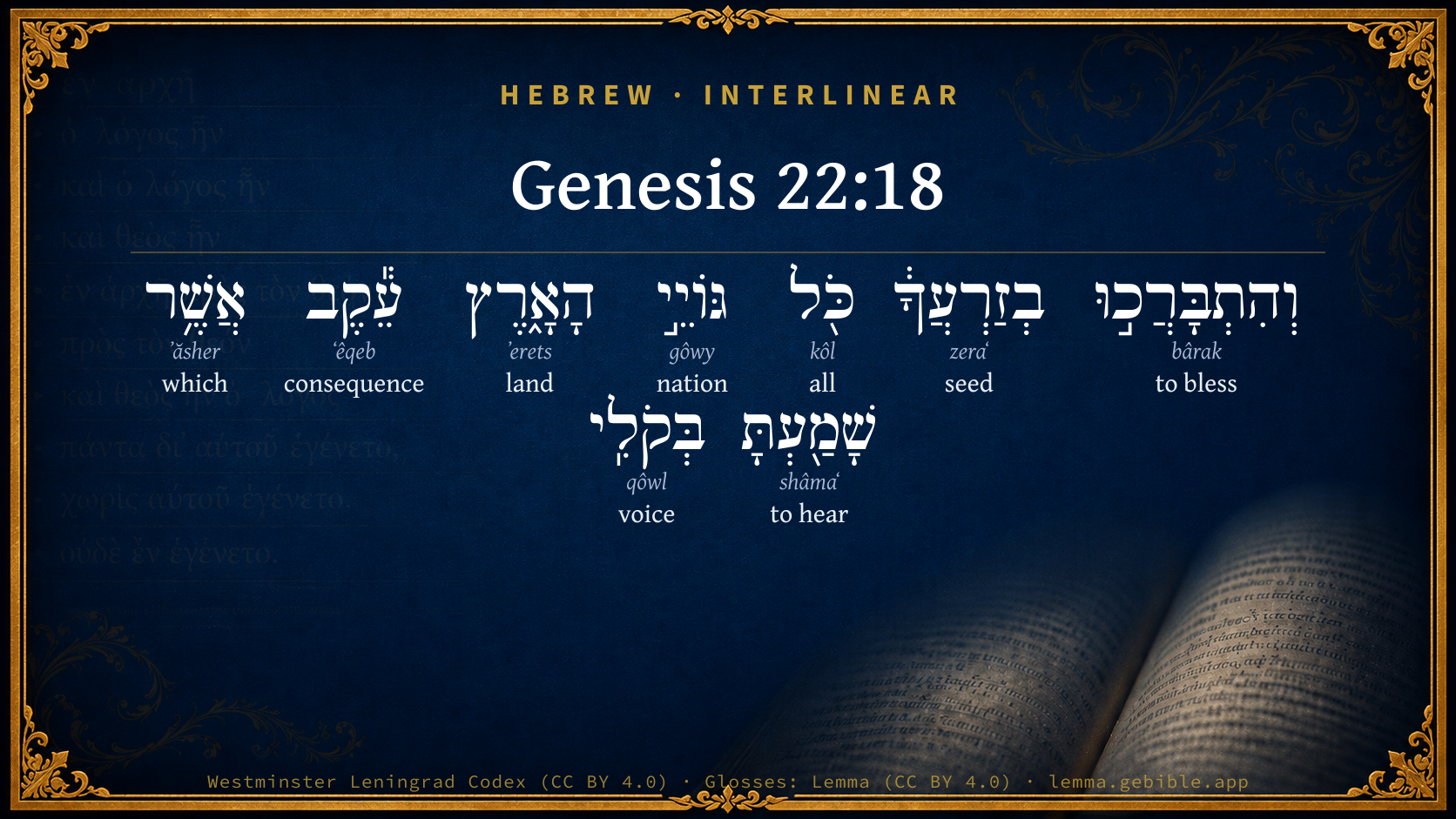
Genesis 22:18

Hebrew (Westminster Leningrad Codex) Genesis 22:18 appears in the Hebrew Old Testament. The text above is from the Westminster Leningrad Codex. Each word links to its Strong’s number, a concise gloss, and parsing drawn from the Open Scriptures Hebrew Bible morphology. Click any word for its full Brown-Driver-Briggs (BDB) entry.
Download image
Cite this verse

Genesis 22:18 (World English Bible). Public Domain. Lemma interlinear Bible study tool, https://lemma.gebible.app/v/genesis/22/18.

Show BibTeX & RIS
BibTeX
RIS
English Translation
In your seed will all the nations of the earth be blessed, because you have obeyed my voice."
World English Bible · Public Domain
Highlights Full analysis ↓
Download a study sheet

One document with this verse’s original text, its word-by-word gloss line, the meaning frame, cross-references with their text, attributed commentary, and full source and license credits — printable, and it pastes into notes with its structure intact.

This verse Autodidact and up

Study sheet (.html) Plain text (.txt)

A passage Seminary Student

Up to 50 verses in one chapter. A passage sheet keeps up to 6 commentary sources and 12 cross-references per verse, in the order this page ranks them, and says so on the sheet whenever that leaves anything out. Ask for a single verse and you get the Autodidact verse sheet above.

Everything on this page stays free to read, with no account — the sheet is a download of what is already on screen, not access to it.

Want to remove ads? Support Godless Engineer
Compare translations 3

The same verse in 3 English versions, stacked beneath the original-language interlinear above. Click any original word for its lexicon entry.

Each is an independent rendering of the whole verse — the interlinear is not word-aligned to these translations.

Highlighted words mark where these versions differ — a whole-verse word diff, not a word-by-word alignment.

  • World English Bible Public Domain
    In your seed will all the nations of the earth be blessed, because you have obeyed my voice."
  • King James Version Public Domain
    And in thy seed shall all the nations of the earth be blessed; because thou hast obeyed my voice.
  • unfoldingWord Literal Text CC BY-SA 4.0
    And in your offspring all the nations of the earth will be blessed, because you listened to my voice.”

unfoldingWord Literal Text — © unfoldingWord, licensed CC BY-SA 4.0. Word-aligned USFM3 via Door43 (git.door43.org/unfoldingWord/en_ult).

Versions to compare (up to 4)

3 of 4 selected

Show all 18 translations

Every available English version of this verse, each an independent rendering of the whole verse.

  • World English Bible Public Domain
    In your seed will all the nations of the earth be blessed, because you have obeyed my voice."
  • Berean Standard Bible Public Domain
    And through your offspring all nations of the earth will be blessed, because you have obeyed My voice.”
  • Majority Standard Bible Public Domain
    And through your offspring all nations of the earth will be blessed, because you have obeyed My voice.”
  • King James Version Public Domain
    And in thy seed shall all the nations of the earth be blessed; because thou hast obeyed my voice.
  • American Standard Version (1901) Public Domain
    And in thy seed shall all the nations of the earth be blessed. Because thou hast obeyed my voice.
  • Revised Version (1885) Public Domain
    and in thy seed shall all the nations of the earth be blessed; because thou hast obeyed my voice.
  • Geneva Bible (1599) Public Domain
    And in thy seede shall all the nations of the earth be blessed, because thou hast obeyed my voyce.
  • Douay-Rheims (1899) Public Domain
    And in thy seed shall all the nations of the earth be blessed, because thou hast obeyed my voice.
  • Young's Literal Translation Public Domain
    and blessed themselves in thy seed have all nations of the earth, because that thou hast hearkened to My voice.'
  • Literal Standard Version CC BY-SA 4.0
    and all nations of the earth have blessed themselves in your Seed, because you have listened to My voice.”
  • Unlocked Literal Bible CC BY-SA 4.0
    Through your offspring all the nations of the earth will be blessed, because you have obeyed my voice.”
  • unfoldingWord Literal Text CC BY-SA 4.0
    And in your offspring all the nations of the earth will be blessed, because you listened to my voice.”
  • Darby Bible Public Domain
    and in thy seed shall all the nations of the earth bless themselves, because thou hast hearkened to my voice.
  • World Messianic Bible Public Domain
    All the nations of the earth will be blessed by your offspring, because you have obeyed my voice.’”
  • Webster's Bible Public Domain
    And in thy seed shall all the nations of the earth be blessed: because thou hast obeyed my voice.
  • Free Bible Version CC BY-SA 4.0
    All the nations of the earth will be blessed by your descendants because you did what I told you.”
  • Bible in Basic English Public Domain
    And your seed will be a blessing to all the nations of the earth, because you have done what I gave you orders to do.
  • JPS Tanakh (1917) Public Domain
    and in thy seed shall all the nations of the earth be blessed; because thou hast hearkened to My voice.'

Literal Standard Version (2020), Covenant Press — licensed CC BY-SA 4.0. Text via the HelloAO Bible API (eBible.org). Unlocked Literal Bible (unfoldingWord) — licensed CC BY-SA 4.0. Text via the HelloAO Bible API (eBible.org). unfoldingWord Literal Text — © unfoldingWord, licensed CC BY-SA 4.0. Word-aligned USFM3 via Door43 (git.door43.org/unfoldingWord/en_ult). Free Bible Version, Dr. Jonathan Gallagher — licensed CC BY-SA 4.0. Text via the HelloAO Bible API (eBible.org).

Word by word

More ways to search: Search by grammar → Find every occurrence → Compare this word →

Practice this passage: Drill this verse → Learn its vocabulary →

עֵ֕קֶב
ʻêqeb
H6118
“consequence”
Noun, Common, Masculine, Singular, Absolute
Part of Speech
Noun
Type
Common
Gender
Masculine
Number
Singular
State
Absolute
Full BDB Definition

Origin: from H6117 in the sense of H6119

TWOT: 1676e

consequence (noun masculine) - consequence - consequence, gain, reward - end - as a consequence, because, consequently (adverb) - as a consequence of, that, because (conjunction)
  1. וְהִתְבָּרֲכ֣וּ bârak H1288 “and · to bless” Conjunction + Verb, Hithpael, Sequential Perfect, 3rd Person, Common, Plural
  2. בְזַרְעֲךָ֔ zeraʻ H2233 “in/at · seed · your” Preposition + Noun, Common, Masculine, Singular, Construct + Suffix, Personal, 2nd Person, Masculine, Singular
  3. כֹּ֖ל kôl H3605 “all of” Noun, Common, Masculine, Singular, Construct
  4. גּוֹיֵ֣י gôwy H1471 “nations of” Noun, Common, Masculine, Plural, Construct
  5. הָאָ֑רֶץ ʼerets H776 “the · land” Particle, Definite Article + Noun, Common, Both, Singular, Absolute
  6. אֲשֶׁ֥ר ʼăsher H834 “which” Particle, Relative
  7. שָׁמַ֖עְתָּ shâmaʻ H8085 “to hear” Verb, Qal, Perfect, 2nd Person, Masculine, Singular
  8. בְּקֹלִֽי qôwl H6963 “in/at · voice · my” Preposition + Noun, Common, Masculine, Singular, Construct + Suffix, Personal, 1st Person, Common, Singular

About this verse

These counts appear in no published source. They are computed here, from the morphology-tagged text and Lemma’s own curated glosses. What Lemma adds →

9
words
9
distinct lemmas
Pentateuch
section

Notable vocabulary

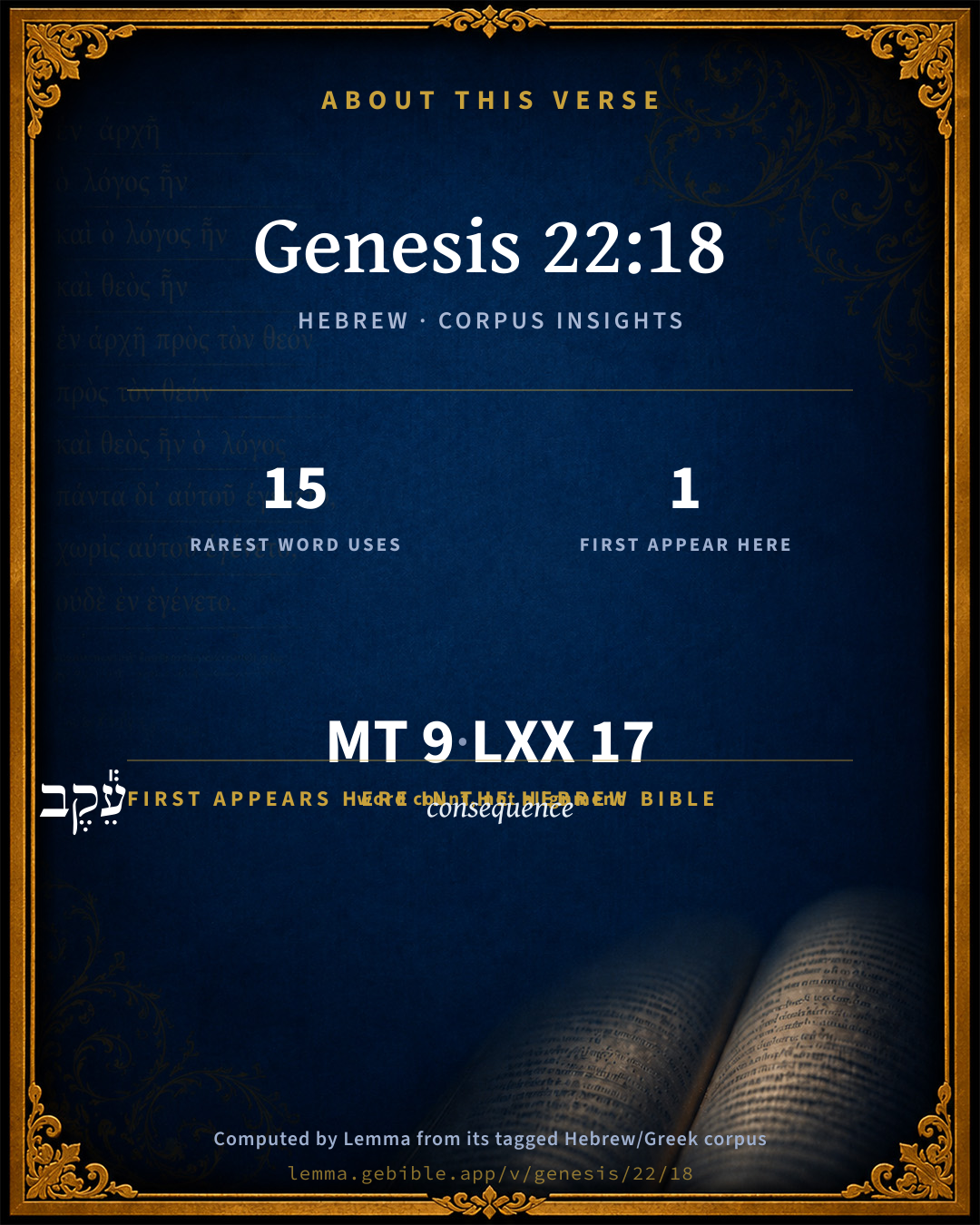
The rarest word here is עֵ֕קֶב consequence H6118 — appearing just 15 times in the whole Hebrew Bible.

First appearance in Scripture

This word makes its first canonical appearance in the Hebrew Bible here:

  • עֵ֕קֶב consequence H6118

Shared distinctive vocabulary

עֵ֕קֶב consequence H6118 occurs in 15 verses of the Hebrew Bible. Also found in:

Grammatical profile

  • 2 verbs
  • 6 nouns
  • 1 particle

Verb forms

  • וְהִתְבָּרֲכ֣וּ Hithpael · Sequential Perfect
  • שָׁמַ֖עְתָּ Qal · Perfect

Hebrew & Septuagint length

In English translation the verse runs 18 words from the Hebrew and 27 from the Septuagint (LXX English) — the Septuagint runs noticeably longer here. See the side-by-side →

A rough comparison of the two English renderings, which tokenize alike — not a word-level alignment.

Word counts can differ between the Hebrew and the Greek without any difference in meaning — e.g. the Hebrew direct-object marker אֵת has no separate Greek word, and Greek often adds the article ὁ.

In the original languages it is 9 Hebrew tokens and 17 Greek tokens — but the two are counted differently (Hebrew bundles its prefixes and suffixes into one token; the Greek is in lemma form), so that isn’t a like-for-like length.

Cross-references

16

Topical passages linked to Genesis 22:18 in the Treasury of Scripture Knowledge — connected by theme and wording, ordered by reader-vote popularity; previews shown in the World English Bible.

  • Acts 3:25 You are the children of the prophets, and of the covenant which God made with our fathers, saying to Abraham, 'In your seed will all the families of the earth be blessed.'
  • Genesis 12:3 I will bless those who bless you, and I will curse him who curses you. In you will all of the families of the earth be blessed."
  • Galatians 3:16 Now the promises were spoken to Abraham and to his seed. He doesn't say, "To seeds," as of many, but as of one, "To your seed," which is Christ.
  • Genesis 26:4–5 I will multiply your seed as the stars of the sky, and will give to your seed all these lands. In your seed will all the nations of the earth be blessed,
  • Genesis 18:18 seeing that Abraham has surely become a great and mighty nation, and all the nations of the earth will be blessed in him?
  • Galatians 3:8–9 The Scripture, foreseeing that God would justify the Gentiles by faith, preached the Gospel beforehand to Abraham, saying, "In you all the nations will be blessed."
  • Jeremiah 7:23 but this thing I commanded them, saying, Listen to my voice, and I will be your God, and you shall be my people; and walk you in all the way that I command you, that it may be well with you.
  • Psalms 72:17 His name endures forever. His name continues as long as the sun. Men shall be blessed by him. All nations will call him blessed.
  • Galatians 3:28–29 There is neither Jew nor Greek, there is neither slave nor free man, there is neither male nor female; for you are all one in Christ Jesus.
  • Ephesians 1:3 Blessed be the God and Father of our Lord Jesus Christ, who has blessed us with every spiritual blessing in the heavenly places in Christ;
  • Galatians 3:18 For if the inheritance is of the law, it is no more of promise; but God has granted it to Abraham by promise.
  • Romans 1:3 concerning his Son, who was born of the seed of David according to the flesh,
  • Hebrews 11:1–40 Now faith is assurance of things hoped for, proof of things not seen.
  • Genesis 22:3 Abraham rose early in the morning, and saddled his donkey, and took two of his young men with him, and Isaac his son. He split the wood for the burnt offering, and rose up, and went to the place of which God had told him.
  • Genesis 22:10 Abraham stretched forth his hand, and took the knife to kill his son.
  • 1 Samuel 2:30 Therefore Yahweh, the God of Israel, says, I said indeed that your house, and the house of your father, should walk before me forever: but now Yahweh says, Be it far from me; for those who honor me I will honor, and those who despise me shall be lightly esteemed.

Cross-references courtesy of OpenBible.info (CC BY 4.0).

Hebrew and Greek witnesses Masoretic Hebrew ↔ Greek Septuagint

The same verse in the two great witnesses to the Old Testament, shown verse-for-verse.

Here the Septuagint runs noticeably longer than the Hebrew — LXX2012 (modern English Septuagint) 27 words vs World English Bible 18. A rough length comparison of the two English translations, not a word-level alignment — read both below.

These are two independent witnesses, not word-aligned to each other, and the Septuagint is shown in lemma (dictionary) form.

Hebrew Genesis 22:18 Masoretic · Westminster Leningrad Codex

וְהִתְבָּרֲכ֣וּ בְזַרְעֲךָ֔ כֹּ֖ל גּוֹיֵ֣י הָאָ֑רֶץ עֵ֕קֶב אֲשֶׁ֥ר שָׁמַ֖עְתָּ בְּקֹלִֽי

In your seed will all the nations of the earth be blessed, because you have obeyed my voice."

World English Bible · Public Domain

Greek LXX Genesis 22:18 Septuagint · lemma form

καί ἐνεὐλογέω ἐν ὁ σπέρμα σύ πᾶς ὁ ἔθνος ὁ γῆ ἀντί ὅς ὑποἀκούω ὁ ἐμός φωνή

And Abraam returned to his servants, and they arose and went together to the well of the oath; and Abraam lived at the well of the oath.

LXX2012 (modern English Septuagint) · Public Domain

Hebrew: Westminster Leningrad Codex (CC BY 4.0). Greek: Septuagint (public domain); English from LXX2012 (modern English Septuagint) (Public Domain). How the Septuagint differs from the Hebrew →

Targum (Aramaic paraphrase)

2

The Targum is the ancient Jewish Aramaic paraphrase of the Hebrew Scriptures — an interpretive translation, not the Hebrew text itself. Onkelos (literal) and Pseudo-Jonathan (expansive) render the Torah, and Jonathan the Prophets. Coverage is partial: where no permissively-licensed English translation exists for a verse, only the Aramaic is shown. This is verse-level text, not a word-by-word alignment to the Hebrew.

  1. Targum Onkelos Torah (Genesis–Deuteronomy)
    וְיִתְבָּרְכוּן בְּדִיל בְּנָיךְ כֹּל עַמְמַיָּא דְאַרְעָא חֲלַף דִּי קַבֵּלְתָּא לְמֵימְרִי

    (no public-domain English translation for this verse)

    Targum Onkelos — Aramaic: “Onkelos Genesis” (public domain); “Onkelos Exodus” (public domain); “Onkelos Leviticus” (public domain); “Onkelos Numbers” (public domain); “Onkelos Deuteronomy” (public domain). English: “Sefaria Community Translation” (CC0 1.0 (public-domain dedication)); “J.W. Etheridge. The Targums of Onkelos and Jonathan Ben Uzziel on the Pentateuch. London: Longmans, Green, 1862” (public domain). Text via Sefaria.

  2. Targum Pseudo-Jonathan Torah (Genesis–Deuteronomy)
    וְיִתְבָּרְכוּן בְּגִין זַכְוַות בְּנָךְ כָּל עַמְמֵי אַרְעָא חוֹלַף דְקַבֵּלְתָּא בְּמֵימְרִי

    And all the peoples of the earth shall be blessed through the righteousness of thy son, because thou hast obeyed My word.

    Targum Pseudo-Jonathan — Aramaic: “Targum Jonathan on Genesis” (public domain); “Targum Jonathan on Exodus” (public domain); “Targum Jonathan on Leviticus” (public domain); “Targum Jonathan on Numbers” (public domain); “Targum Jonathan on Deuteronomy” (public domain). English: “The Targum of Jonathan ben Uzziel, trans. J. W. Etheridge, London, 1862” (public domain). Text via Sefaria.

Commentary

Notes on Genesis 22:18 from classic Christian and Jewish commentators (each source and its license shown beneath its notes). The classic Christian expositions comment on the surrounding passage and are grouped to its opening verse, so a note may address several verses; the Jewish commentaries on the Tanakh (Rashi and others) are per-verse, so they appear only where the commentator wrote on this verse.

Lemma curates 59 commentaries, every one of them public domain or Creative Commons licensed, each selected and text-cleaned for this edition rather than reprinted as found. About our sources →

Trapp's Complete Commentary

John Trapp

Gen 22:18 And in thy seed shall all the nations of the earth be blessed; because thou hast obeyed my voice.

Ver. 18. Because thou hast obeyed.] This "because" is not so much causal, as rational. Significat non causam meritoriam, sed subalternam, et sine qua non .

John Trapp, A Commentary or Exposition upon All the Books of the Old and New Testament (1647–1656) — public domain. Text from a community e-Sword module.

The Biblical Illustrator

Joseph S. Exell

Gen_22:18

In thy seed shall all the nations of the earth be blessed

Blessing in Abrahams seed

1.

There was to be a seed, a natural seed, including a spiritual seed, and this again including an individual seed.

2. The seed of Abraham is to have a relation to all the families of the earth. As Abraham was not a head of all mankind, like Adam or Noah, it was necessary to emphasize the universality of the blessing.

3. The benefit conveyed by the seed is here characterized by the word blessed. Blessing is like mercy in this: that it sums up in one word the whole salvation of which the Bible is the gospel. It involves redemption and regeneration, both of which are necessary to salvation. (Prof. J. G. Murphy)

A great promise

1. This promise

(1) narrows down previous Messianic anticipations, inasmuch as it points to the family instead of the race, as the source whence the Great Benefactor should arise;

(2) vastly widens them, inasmuch as it indicates that the beneficent work of that Benefactor will be universal.

2. We conclude that this is an anticipation of Christ, because

(1) it has proved to be an accurate description of Him;

(2) it is only true of Him;

(3) New Testament distinctly applies the Scripture to Him. This warranted, we look for the advent of Christ as for--

I. THE ADVENT OF A BENEFACTOR FROM AMONG THE JEWS. This suggests-

1. The proper interest we should take in the Jewish people.

2. The solemn warning that contact with what is most sacred does not ensure blessing.

II. THE ADVENT OF A BENEFACTOR FOR THE WORLD. We may adoringly notice--

1. The way in which Christ has already been a universal blessing.

2. The future that there yet must be for Christianity. (Homilist.)

All nations blessed in Abrahams seed

I. SOME OF THE REASONS FOR GIVING THIS DESCRIPTION OF THE MESSIAH: The seed of Abraham.

1. Christ is called the seed of Abraham because He was to assume human nature; to be truly man; a man like ourselves.

2. Christ was called the seed of Abraham, that additional evidence of His claims as Messiah might be given when He came into the world.

3. There is a third reason why He is called, why, in fact, He was made, the seed of Abraham. There is, after all, a peculiar relation between Christ and the Jews, as His brethren after the flesh.

II. Let us now consider THE IMPORT OF THE DECLARATION, In thy seed shall all the nations of the earth be blessed.

1. In the first place, there is its Divinely revealed truth.

2. The religion of Christ is calculated to produce human happiness, because it exhibits the Divinely-prescribed method by which the guilty may obtain pardon; in other words, that great doctrine of human hope and joy, that of justification by faith in the atonement and intercession of the Saviour.

3. In further examining this Divine system, to discover its adaptation to human happiness, we find the great, the singular, promise of the Holy Spirit.

4. Another adaptation to human happiness in Christianity is found in its explicit enforcement of those relative duties on which the welfare of society so much depends.

5. The last of these adaptations is, the kind and merciful spirit of the Gospel. (R. Watson.)

The Biblical Illustrator, edited by Joseph S. Exell (c. 1880s–1900s) — public domain. Text from a community e-Sword module.

Tyndale Open Study Notes

Tyndale Open Resources

22:18–25:11 Abraham passed the test of faith; from this point, his task was to pass the covenant blessings to Isaac. He purchased a burial plot (ch 23), acquired a wife for Isaac (ch 24), and distributed his property (25:1-11).

Tyndale Open Study Notes — © Tyndale Open Resources, licensed CC BY-SA 4.0. Text via the HelloAO Bible API.

Adam Clarke's Commentary

Verse 18. And in thy seed, c.] We have the authority of St. Paul, Ga 3:8 Ga 3:16; Ga 3:18, to restrain this to our blessed Lord, who was THE SEED through whom alone all God's blessings of providence, mercy, grace, and glory, should be conveyed to the nations of the earth.

Adam Clarke's Commentary on the Bible (1810–1826) — public domain. Text from a community e-Sword/MySword module.

The Cambridge Bible for Schools and Colleges

gen. ed. J. J. S. Perowne

18. in thy seed] See note on Gen_12:3. The words might be also rendered “by thy seed.”

be blessed] Better, as R.V. marg., bless themselves. See notes on Gen_12:3, Gen_18:18, Gen_26:4.

because thou hast obeyed] Lit. “because thou hast heard,” or “listened to.” God’s word may be a sound which is not heard; or it may be a sound which is heard, but not listened to; or it may be a sound which is heard, listened to, and obeyed.

The Cambridge Bible for Schools and Colleges (gen. ed. J. J. S. Perowne; Cambridge University Press, 1878–1918) — public domain. Text from a community e-Sword module.

John Gill's Exposition

So Abraham returned to his young men,.... He had left at a certain place with the ass, while he and Isaac went to the mount to worship; and who stayed there till he came to them, according to his order, Gen 22:5; no mention is made of Isaac, but there is no doubt that he returned with Abraham, since we hear of him afterwards in his house; for as to what the Targum of Jonathan says, it cannot be depended on, that the angels took Isaac and brought him to the school of Shem the great, and there he was three years:

and they rose up, and went together to Beersheba; that is, when Abraham and Isaac came to the place where the young men were, they got up and proceeded on in their journey along with them to Beersheba, from whence Abraham came, and where he had for some time lived:

and Abraham dwelt at Beersheba; there he continued for some time afterwards, and but for a time, for in the next chapter we hear of him at Hebron, Gen 23:2.

John Gill's Exposition of the Whole Bible (1746–1763) — public domain (CC PDM 1.0). Text via the HelloAO Bible API.

unfoldingWord translationNotes

Door43 World Missions Community

General Information:

The angel of Yahweh continues speaking to Abraham.

all the nations of the earth will be blessed

This can be stated in active form. AT: "I, the Lord, will bless all the people living everywhere" (See: Active or Passive)

nations of the earth

Here "nations" stands for the people of the nations. (See: Metonymy)

you have obeyed my voice

Here "voice" stands for what God said. AT: "you have obeyed what I said" or "you have obeyed me" (See: Metonymy)

Abraham returned

Only Abraham was named because he was the father, but it was implied that his son went with him. The full meaning of this statement can be made explicit. AT: "Abraham and his son went back" (See: Assumed Knowledge and Implicit Information)

young men

"servants"

they departed

"they left that place"

he lived at Beersheba

Only Abraham was mentioned because he was the leader of his family and servants, but it was implied that they were with him. The full meaning of this statement can be made explicit. AT: "Abraham and his people stayed in Beersheba" (See: Assumed Knowledge and Implicit Information)

translationWords

offspring

nation

bless

obey

voice

Abraham

Beersheba

unfoldingWord translationNotes — © Distant Shores Media and the Door43 World Missions Community, licensed CC BY-SA 4.0. Source: git.door43.org/Door43/en_tn.

Radak

Rabbi David Kimhi (Radak)

והתברכו, the meaning of this word is not identical with the wordונברכו in 12,3 which we explained at the time as meaning that wherever you would reside the people around you would benefit from you or your children’s proximity. In this verse the meaning of the word והתברכו is that the gentile nations, thanks to their prayers, will accumulate merits and therefore blessings for themselves. They will make the kind of blessings Avraham has experienced the focus of their own prayers. They will acknowledge Avraham’s G’d as the source of all blessings.

עקב, as a reward. It is an apt simile, seeing that he heel, עקב is the lower end of the body, so the reward is what one acquires at the conclusion of performing G’d’s commandments.

אשר שמעת בקולי, both in this instance as well as in all the other instructions I have issued to you

Radak on the Tanakh — English translations: “Sefaria Community Translation” (CC0 1.0 (public-domain dedication)); “Eliyahu Munk, HaChut Hameshulash” (CC BY 4.0); “Rabbi Mike Feuer, Jerusalem Anthology” (CC BY 4.0); and “R. David Kimhi on the first book of Psalms, Translated by R.G. Finch, London, 1919” (public domain). Text via Sefaria.

Lesson kit

Teaching starters — assembled from the data on this page, not authored interpretation. Every prompt links to the verse data it draws on. Edit before teaching.

Genesis, in the Pentateuch, opens this verse with 9 words (9 distinct Hebrew lemmas). Its most distinctive word is ʻêqeb (“consequence”). The Greek Septuagint runs longer here. A historical commentator’s framing appears above. Read the whole chapter for the surrounding context.

Discussion questions

  1. What does “consequence” (ʻêqeb) contribute to the verse as a whole?
  2. This is the first place “consequence” appears in Scripture (first appears here). What does its debut here establish?
  3. How does Genesis 26:5, which shares the word «consequence», read alongside this verse?
  4. The Septuagint runs longer here than the Hebrew. What might account for the difference?
  5. The translations on this page render this verse differently — a whole-verse word diff, not a word-by-word alignment. What might account for the different wordings?
  6. «וְהִתְבָּרֲכ֣וּ» is a Hithpael Sequential Perfect verb. How does that grammatical form shape the action described?
  7. Compare how Trapp's Complete Commentary and The Biblical Illustrator read this verse. Where do they agree or differ?

Things to notice

Reading settings

Reading text

Shown beneath each verse's original-language words.

Old Testament
Old Testament edition

Read the OT as the Masoretic Hebrew (MT) or the Greek Septuagint (LXX).

English shown for the Greek Septuagint (in the Hebrew ↔ Greek comparison).

Comparing translations? Open the Compare panel on any verse page to stack up to four side by side.