
Deuteronomy 9:5

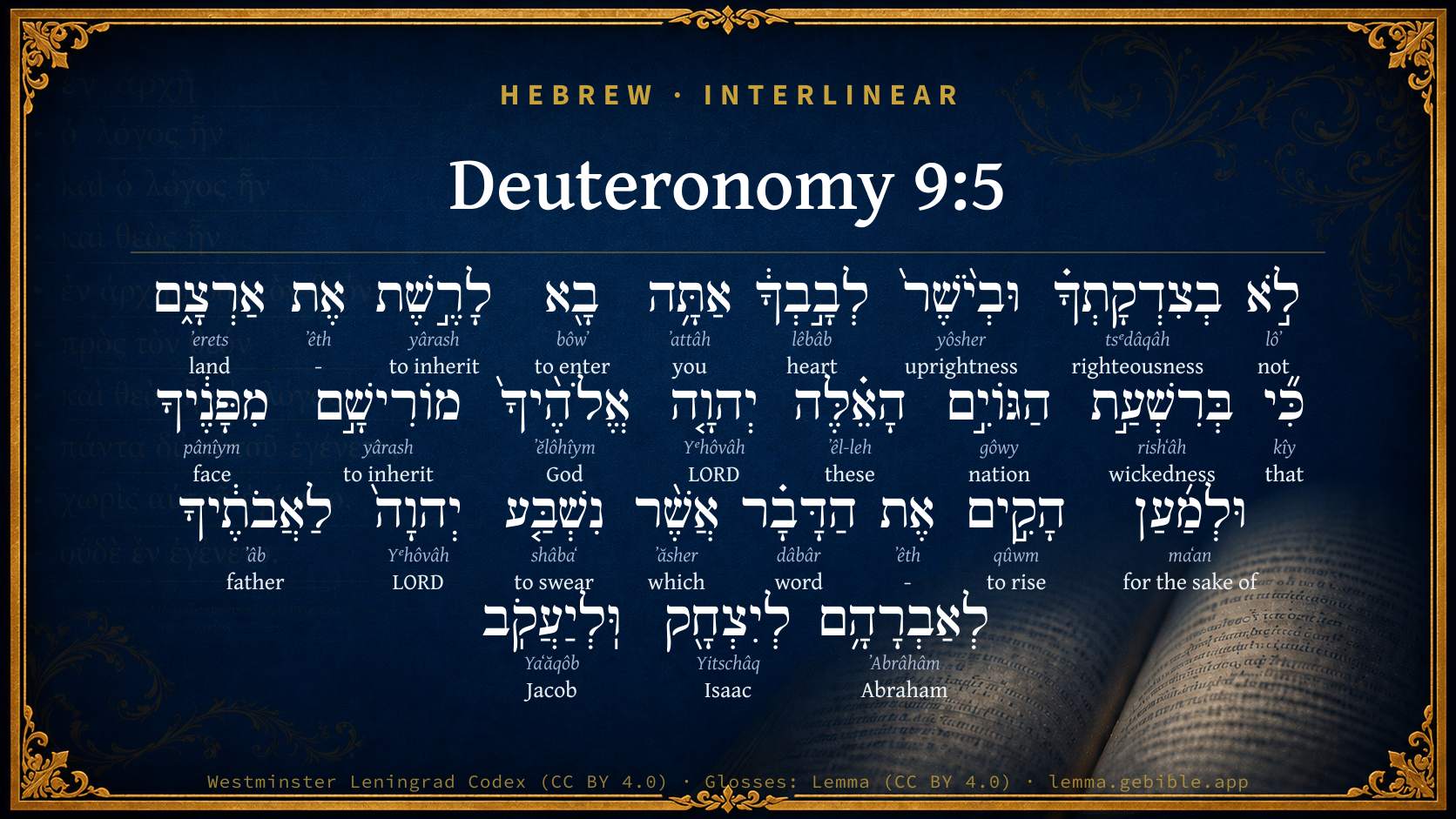
Hebrew (Westminster Leningrad Codex) Deuteronomy 9:5 appears in the Hebrew Old Testament. The text above is from the Westminster Leningrad Codex. Each word links to its Strong’s number, a concise gloss, and parsing drawn from the Open Scriptures Hebrew Bible morphology. Click any word for its full Brown-Driver-Briggs (BDB) entry.
Download image
Cite this verse

Deuteronomy 9:5 (World English Bible). Public Domain. Lemma interlinear Bible study tool, https://lemma.gebible.app/v/deuteronomy/9/5.

Show BibTeX & RIS
BibTeX
RIS
English Translation
Not for your righteousness, or for the uprightness of your heart, do you go in to possess their land; but for the wickedness of these nations Yahweh your God does drive them out from before you, and that he may establish the word which Yahweh swore to your fathers, to Abraham, to Isaac, and to Jacob.
World English Bible · Public Domain
Highlights
  • 1 first appearance in the Hebrew Bible
Full analysis ↓
Download a study sheet

One document with this verse’s original text, its word-by-word gloss line, the meaning frame, cross-references with their text, attributed commentary, and full source and license credits — printable, and it pastes into notes with its structure intact.

This verse Autodidact and up

Study sheet (.html) Plain text (.txt)

A passage Seminary Student

Up to 50 verses in one chapter. A passage sheet keeps up to 6 commentary sources and 12 cross-references per verse, in the order this page ranks them, and says so on the sheet whenever that leaves anything out. Ask for a single verse and you get the Autodidact verse sheet above.

Everything on this page stays free to read, with no account — the sheet is a download of what is already on screen, not access to it.

Want to remove ads? Support Godless Engineer
Compare translations 3

The same verse in 3 English versions, stacked beneath the original-language interlinear above. Click any original word for its lexicon entry.

Each is an independent rendering of the whole verse — the interlinear is not word-aligned to these translations.

Highlighted words mark where these versions differ — a whole-verse word diff, not a word-by-word alignment.

  • World English Bible Public Domain
    Not for your righteousness, or for the uprightness of your heart, do you go in to possess their land; but for the wickedness of these nations Yahweh your God does drive them out from before you, and that he may establish the word which Yahweh swore to your fathers, to Abraham, to Isaac, and to Jacob.
  • King James Version Public Domain
    Not for thy righteousness, or for the uprightness of thine heart, dost thou go to possess their land: but for the wickedness of these nations the LORD thy God doth drive them out from before thee, and that he may perform the word which the LORD sware unto thy fathers, Abraham, Isaac, and Jacob.
  • unfoldingWord Literal Text CC BY-SA 4.0
    Not in your righteousness or in the uprightness of your heart are you going in to possess their land, but in the wickedness of these nations, Yahweh your God is driving them out from your face, and so that Yahweh may establish the word that he swore to your fathers, to Abraham, to Isaac, and to Jacob.

unfoldingWord Literal Text — © unfoldingWord, licensed CC BY-SA 4.0. Word-aligned USFM3 via Door43 (git.door43.org/unfoldingWord/en_ult).

Versions to compare (up to 4)

3 of 4 selected

Show all 18 translations

Every available English version of this verse, each an independent rendering of the whole verse.

  • World English Bible Public Domain
    Not for your righteousness, or for the uprightness of your heart, do you go in to possess their land; but for the wickedness of these nations Yahweh your God does drive them out from before you, and that he may establish the word which Yahweh swore to your fathers, to Abraham, to Isaac, and to Jacob.
  • Berean Standard Bible Public Domain
    It is not because of your righteousness or uprightness of heart that you are going in to possess their land, but it is because of their wickedness that the LORD your God is driving out these nations before you, to keep the promise He swore to your fathers, to Abraham, Isaac, and Jacob.
  • Majority Standard Bible Public Domain
    It is not because of your righteousness or uprightness of heart that you are going in to possess their land, but it is because of their wickedness that the LORD your God is driving out these nations before you, to keep the promise He swore to your fathers, to Abraham, Isaac, and Jacob.
  • King James Version Public Domain
    Not for thy righteousness, or for the uprightness of thine heart, dost thou go to possess their land: but for the wickedness of these nations the LORD thy God doth drive them out from before thee, and that he may perform the word which the LORD sware unto thy fathers, Abraham, Isaac, and Jacob.
  • American Standard Version (1901) Public Domain
    Not for thy righteousness, or for the uprightness of thy heart, dost thou go in to possess their land; but for the wickedness of these nations Jehovah thy God doth drive them out from before thee, and that he may establish the word which Jehovah sware unto thy fathers, to Abraham, to Isaac, and to Jacob.
  • Revised Version (1885) Public Domain
    Not for thy righteousness, or for the uprightness of thine heart, dost thou go in to possess their land: but for the wickedness of these nations the LORD thy God doth drive them out from before thee, and that he may establish the word which the LORD sware unto thy fathers, to Abraham, to Isaac, and to Jacob.
  • Geneva Bible (1599) Public Domain
    For thou entrest not to inherite their lande for thy righteousnesse, or for thy vpright heart: but for the wickednesse of those nations, the Lord thy God doth cast them out before thee, and that he might performe the worde which the Lord thy God sware vnto thy fathers, Abraham, Izhak, and Iacob.
  • Douay-Rheims (1899) Public Domain
    For it is not for thy justices, and the uprightness of thy heart that thou shalt go in to possess their lands: but because they have done wickedly, they are destroyed at thy coming in: and that the Lord might accomplish his word, which he promised by oath to thy fathers Abraham, Isaac, and Jacob.
  • Young's Literal Translation Public Domain
    not for thy righteousness, and for the uprightness of thy heart, art thou going in to possess their land; but for the wickedness of these nations is Jehovah thy God dispossessing them from before thee; and in order to establish the word which Jehovah hath sworn to thy fathers, to Abraham, to Isaac, and to Jacob;
  • Literal Standard Version CC BY-SA 4.0
    [It is] not in your righteousness and in the uprightness of your heart [that] you are going in to possess their land, but in YHWH dispossessing these nations from your presence, [it is because of] their being wicked, and in order to establish the word which YHWH has sworn to your fathers, to Abraham, to Isaac, and to Jacob;
  • Unlocked Literal Bible CC BY-SA 4.0
    It is not because of your righteousness or the uprightness of your heart that you are going in to possess their land, but it is because of the wickedness of these nations that your God is driving them out from before you, and so that he may make come true the word that he swore to your ancestors, to Abraham, Isaac, and Jacob.
  • unfoldingWord Literal Text CC BY-SA 4.0
    Not in your righteousness or in the uprightness of your heart are you going in to possess their land, but in the wickedness of these nations, Yahweh your God is driving them out from your face, and so that Yahweh may establish the word that he swore to your fathers, to Abraham, to Isaac, and to Jacob.
  • Darby Bible Public Domain
    Not for thy righteousness, or for the uprightness of thy heart, dost thou enter in to possess their land, but for the wickedness of these nations doth Jehovah thy God dispossess them from before thee, and that he may perform the word which Jehovah swore unto thy fathers, to Abraham, to Isaac, and to Jacob.
  • World Messianic Bible Public Domain
    Not for your righteousness or for the uprightness of your heart do you go in to possess their land; but for the wickedness of these nations the LORD your God does drive them out from before you, and that he may establish the word which the LORD swore to your fathers, to Abraham, to Isaac, and to Jacob.
  • Webster's Bible Public Domain
    Not for thy righteousness, or for the uprightness of thy heart dost thou go to possess their land: but for the wickedness of these nations, the LORD thy God doth drive them out from before thee, and that he may perform the word which the LORD swore to thy fathers, Abraham, Isaac, and Jacob.
  • Free Bible Version CC BY-SA 4.0
    It's not because you're so good or moral that you're going to take over their land. No, it's because of their wickedness that the Lord your God is driving out these nations ahead of you, to keep the promise he made to your fathers—to Abraham, Isaac, and Jacob.
  • Bible in Basic English Public Domain
    Not for your righteousness or because your hearts are upright are you going in to take their land; but because of the evil-doing of these nations the Lord your God is driving them out from before you, and to give effect to his oath to your fathers, Abraham, Isaac, and Jacob.
  • JPS Tanakh (1917) Public Domain
    Not for thy righteousness, or for the uprightness of thy heart, dost thou go in to possess their land; but for the wickedness of these nations the LORD thy God doth drive them out from before thee, and that He may establish the word which the LORD swore unto thy fathers, to Abraham, to Isaac, and to Jacob.

Literal Standard Version (2020), Covenant Press — licensed CC BY-SA 4.0. Text via the HelloAO Bible API (eBible.org). Unlocked Literal Bible (unfoldingWord) — licensed CC BY-SA 4.0. Text via the HelloAO Bible API (eBible.org). unfoldingWord Literal Text — © unfoldingWord, licensed CC BY-SA 4.0. Word-aligned USFM3 via Door43 (git.door43.org/unfoldingWord/en_ult). Free Bible Version, Dr. Jonathan Gallagher — licensed CC BY-SA 4.0. Text via the HelloAO Bible API (eBible.org).

Word by word

More ways to search: Search by grammar → Find every occurrence → Compare this word →

Practice this passage: Drill this verse → Learn its vocabulary →

וּבְיֹ֨שֶׁר֙
yôsher
H3476
“and · in/at · uprightness of”
Conjunction + Preposition + Noun, Common, Masculine, Singular, Construct
Part of Speech
Conjunction + Preposition + Noun
Type
Common
Gender
Masculine
Number
Singular
State
Construct
Full BDB Definition

Origin: from H3474

TWOT: 930b

straightness, uprightness - straightness, evenness (moral implications) - rightness, uprightness - what is right, what is due
  1. לֹ֣א lôʼ H3808 “not” Particle, Negative
  2. בְצִדְקָתְךָ֗ tsᵉdâqâh H6666 “in/at · righteousness · your” Preposition + Noun, Common, Feminine, Singular, Construct + Suffix, Personal, 2nd Person, Masculine, Singular
  3. לְבָ֣בְךָ֔ lêbâb H3824 “heart · your” Noun, Common, Masculine, Singular, Construct + Suffix, Personal, 2nd Person, Masculine, Singular
  4. אַתָּ֥ה ʼattâh H859 “you” Pronoun, Personal, 2nd Person, Masculine, Singular
  5. בָ֖א bôwʼ H935 “entering” Verb, Qal, Participle Active, Masculine, Singular, Absolute
  6. לָרֶ֣שֶׁת yârash H3423 “to inherit” Preposition + Verb, Qal, Infinitive Construct
  7. אֶת ʼêth H853 “-” Particle, Direct Object
  8. אַרְצָ֑ם ʼerets H776 “land · their” Noun, Common, Both, Singular, Construct + Suffix, Personal, 3rd Person, Masculine, Plural
  9. כִּ֞י kîy H3588 “that” Conjunction
  10. בְּרִשְׁעַ֣ת rishʻâh H7564 “in/at · wickedness of” Preposition + Noun, Common, Feminine, Singular, Construct
  11. הַגּוֹיִ֣ם gôwy H1471 “the · nations” Particle, Definite Article + Noun, Common, Masculine, Plural, Absolute
  12. הָאֵ֗לֶּה ʼêl-leh H428 “the · these” Particle, Definite Article + Pronoun, Demonstrative, Common, Plural
  13. יְהוָ֤ה Yᵉhôvâh H3068 “LORD” Noun, Proper
  14. אֱלֹהֶ֨יךָ֙ ʼĕlôhîym H430 “God(s) · your” Noun, Common, Masculine, Plural, Construct + Suffix, Personal, 2nd Person, Masculine, Singular
  15. מוֹרִישָׁ֣ם yârash H3423 “inheriting · them” Verb, Hiphil, Participle Active, Masculine, Singular, Construct + Suffix, Personal, 3rd Person, Masculine, Plural
  16. מִפָּנֶ֔יךָ pânîym H6440 “from · face(s) · your” Preposition + Noun, Common, Both, Plural, Construct + Suffix, Personal, 2nd Person, Masculine, Singular
  17. וּלְמַ֜עַן maʻan H4616 “and · for the sake of” Conjunction + Preposition
  18. הָקִ֣ים qûwm H6965 “to rise” Verb, Hiphil, Infinitive Construct
  19. אֶת ʼêth H853 “-” Particle, Direct Object
  20. הַדָּבָ֗ר dâbâr H1697 “the · word” Particle, Definite Article + Noun, Common, Masculine, Singular, Absolute
  21. אֲשֶׁ֨ר ʼăsher H834 “which” Particle, Relative
  22. נִשְׁבַּ֤ע shâbaʻ H7650 “to swear” Verb, Niphal, Perfect, 3rd Person, Masculine, Singular
  23. יְהוָה֙ Yᵉhôvâh H3068 “LORD” Noun, Proper
  24. לַאֲבֹתֶ֔יךָ ʼâb H1 “to/for · fathers · your” Preposition + Noun, Common, Masculine, Plural, Construct + Suffix, Personal, 2nd Person, Masculine, Singular
  25. לְאַבְרָהָ֥ם ʼAbrâhâm H85 “to/for · Abraham” Preposition + Noun, Proper
  26. לְיִצְחָ֖ק Yitschâq H3327 “to/for · Isaac” Preposition + Noun, Proper
  27. וּֽלְיַעֲקֹֽב Yaʻăqôb H3290 “and · to/for · Jacob” Conjunction + Preposition + Noun, Proper

About this verse

These counts appear in no published source. They are computed here, from the morphology-tagged text and Lemma’s own curated glosses. What Lemma adds →

28
words
25
distinct lemmas
Pentateuch
section

Notable vocabulary

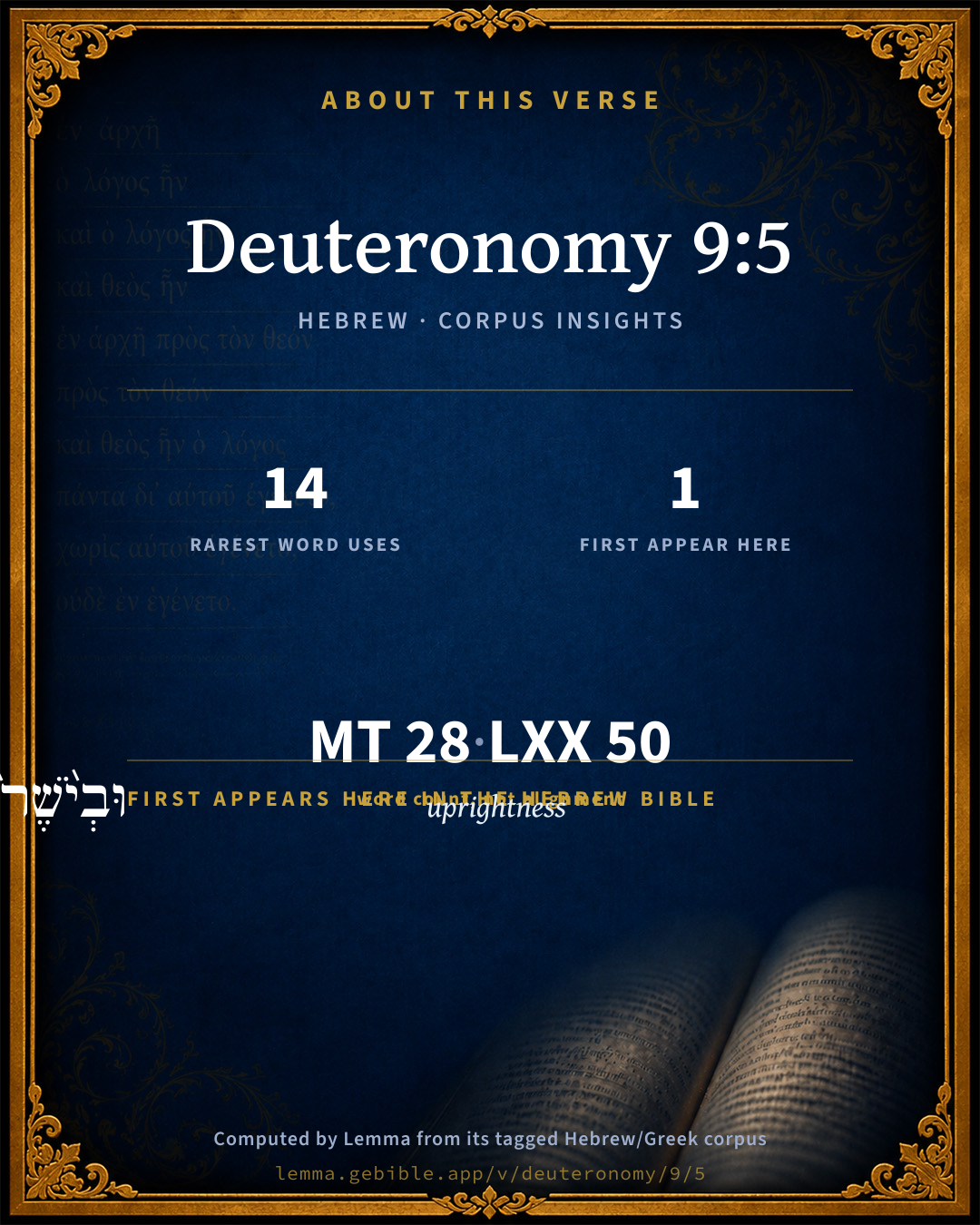
The rarest word here is וּבְיֹ֨שֶׁר֙ uprightness H3476 — appearing just 14 times in the whole Hebrew Bible.

First appearance in Scripture

This word makes its first canonical appearance in the Hebrew Bible here:

  • וּבְיֹ֨שֶׁר֙ uprightness H3476

Shared distinctive vocabulary

וּבְיֹ֨שֶׁר֙ uprightness H3476 occurs in 14 verses of the Hebrew Bible. Also found in:

Grammatical profile

  • 5 verbs
  • 15 nouns
  • 2 pronouns
  • 1 preposition
  • 1 conjunction
  • 4 particles

Verb forms

  • בָ֖א Qal · Participle Active
  • לָרֶ֣שֶׁת Qal · Infinitive Construct
  • מוֹרִישָׁ֣ם Hiphil · Participle Active
  • הָקִ֣ים Hiphil · Infinitive Construct
  • נִשְׁבַּ֤ע Niphal · Perfect

Repetition

Words recur within this verse — often emphatic in Hebrew:

  • לָרֶ֣שֶׁת to inherit H3423 ×2
  • יְהוָ֤ה LORD H3068 ×2

Hebrew & Septuagint length

In English translation the verse runs 56 words from the Hebrew and 57 from the Septuagint (LXX English) — closely comparable.

A rough comparison of the two English renderings, which tokenize alike — not a word-level alignment.

Word counts can differ between the Hebrew and the Greek without any difference in meaning — e.g. the Hebrew direct-object marker אֵת has no separate Greek word, and Greek often adds the article ὁ.

In the original languages it is 28 Hebrew tokens and 50 Greek tokens — but the two are counted differently (Hebrew bundles its prefixes and suffixes into one token; the Greek is in lemma form), so that isn’t a like-for-like length.

Cross-references

15

Topical passages linked to Deuteronomy 9:5 in the Treasury of Scripture Knowledge — connected by theme and wording, ordered by reader-vote popularity; previews shown in the World English Bible.

  • Titus 3:5 not by works of righteousness, which we did ourselves, but according to his mercy, he saved us, through the washing of regeneration and renewing by the Holy Spirit,
  • Genesis 17:8 I will give to you, and to your seed after you, the land where you are traveling, all the land of Canaan, for an everlasting possession. I will be their God."
  • Genesis 26:4 I will multiply your seed as the stars of the sky, and will give to your seed all these lands. In your seed will all the nations of the earth be blessed,
  • Genesis 12:7 Yahweh appeared to Abram, and said, "I will give this land to your seed." He built an altar there to Yahweh, who appeared to him.
  • Genesis 13:15 for all the land which you see, I will give to you, and to your offspring forever.
  • Genesis 15:7 He said to him, "I am Yahweh who brought you out of Ur of the Chaldees, to give you this land to inherit it."
  • Genesis 28:13 Behold, Yahweh stood above it, and said, "I am Yahweh, the God of Abraham your father, and the God of Isaac. The land whereon you lie, to you will I give it, and to your seed.
  • Ezekiel 20:14 But I worked for my name's sake, that it should not be profaned in the sight of the nations, in whose sight I brought them out.
  • Exodus 32:13 Remember Abraham, Isaac, and Israel, your servants, to whom you swore by your own self, and said to them, 'I will multiply your seed as the stars of the sky, and all this land that I have spoken of I will give to your seed, and they shall inherit it forever.'"
  • Micah 7:20 You will give truth to Jacob, and mercy to Abraham, As you have sworn to our fathers from the days of old.
  • Luke 1:54–55 He has given help to Israel, his servant, that he might remember mercy,
  • Acts 3:25 You are the children of the prophets, and of the covenant which God made with our fathers, saying to Abraham, 'In your seed will all the families of the earth be blessed.'
  • Acts 13:32–33 We bring you good news of the promise made to the fathers,
  • Romans 11:28 Concerning the Gospel, they are enemies for your sake. But concerning the election, they are beloved for the fathers' sake.
  • Romans 15:8 Now I say that Christ has been made a minister of the circumcision for the truth of God, that he might confirm the promises given to the fathers,

Cross-references courtesy of OpenBible.info (CC BY 4.0).

Hebrew and Greek witnesses Masoretic Hebrew ↔ Greek Septuagint

The same verse in the two great witnesses to the Old Testament, shown verse-for-verse.

These are two independent witnesses, not word-aligned to each other, and the Septuagint is shown in lemma (dictionary) form.

Hebrew Deuteronomy 9:5 Masoretic · Westminster Leningrad Codex

לֹ֣א בְצִדְקָתְךָ֗ וּבְיֹ֨שֶׁר֙ לְבָ֣בְךָ֔ אַתָּ֥ה בָ֖א לָרֶ֣שֶׁת אֶת אַרְצָ֑ם כִּ֞י בְּרִשְׁעַ֣ת הַגּוֹיִ֣ם הָאֵ֗לֶּה יְהוָ֤ה אֱלֹהֶ֨יךָ֙ מוֹרִישָׁ֣ם מִפָּנֶ֔יךָ וּלְמַ֜עַן הָקִ֣ים אֶת הַדָּבָ֗ר אֲשֶׁ֨ר נִשְׁבַּ֤ע יְהוָה֙ לַאֲבֹתֶ֔יךָ לְאַבְרָהָ֥ם לְיִצְחָ֖ק וּֽלְיַעֲקֹֽב

Not for your righteousness, or for the uprightness of your heart, do you go in to possess their land; but for the wickedness of these nations Yahweh your God does drive them out from before you, and that he may establish the word which Yahweh swore to your fathers, to Abraham, to Isaac, and to Jacob.

World English Bible · Public Domain

Greek LXX Deuteronomy 9:5 Septuagint · lemma form

οὐ διά ὁ δικαιοσύνη σύ οὐδέ διά ὁ ὁσιότης ὁ καρδία σύ σύ εἰςπορεύομαι κληρονομέω ὁ γῆ αὐτός ἀλλά διά ὁ ἀσέβεια ὁ ἔθνος οὗτος κύριος ἐκὀλεθρεύω αὐτός ἀπό πρόσωπον σύ καί ἵνα ἵστημι ὁ διαθήκη αὐτός ὅς ὄμνυμι ὁ πατήρ σύ ὁ ἀβραάμ καί ὁ ισαακ καί ὁ ἰακώβ

Not for your righteousness, nor for the holiness of your heart, do you go in to inherit their land, but because of the wickedness of these nations the Lord will destroy them from before you, and that he may establish the covenant, which the Lord swore to our fathers, to Abraam, and to Isaac, and to Jacob.

LXX2012 (modern English Septuagint) · Public Domain

On this verse, The Cambridge Bible for Schools and Colleges discusses the Septuagint’s reading. Read the note in Commentary ↓

Hebrew: Westminster Leningrad Codex (CC BY 4.0). Greek: Septuagint (public domain); English from LXX2012 (modern English Septuagint) (Public Domain). How the Septuagint differs from the Hebrew →

Targum (Aramaic paraphrase)

2

The Targum is the ancient Jewish Aramaic paraphrase of the Hebrew Scriptures — an interpretive translation, not the Hebrew text itself. Onkelos (literal) and Pseudo-Jonathan (expansive) render the Torah, and Jonathan the Prophets. Coverage is partial: where no permissively-licensed English translation exists for a verse, only the Aramaic is shown. This is verse-level text, not a word-by-word alignment to the Hebrew.

  1. Targum Onkelos Torah (Genesis–Deuteronomy)
    לָא בְזָכוּתָךְ וּבְקַשִׁיטּוּת לִבָּךְ אַתְּ עָלֵל לְמֵירַת יָת אַרְעֲהוֹן אֲרֵי בְּחוֹבֵי עַמְמַיָא הָאִלֵין יְיָ אֱלָהָךְ מתָרֶכְהוֹן מִקָדָמָךְ וּבְדִיל לַאֲקָמָא יָת פִּתְגָמָא דִי קַיִים יְיָ לַאֲבָהָתָךְ לְאַבְרָהָם לְיִצְחָק וּלְיַעֲקֹב

    (no public-domain English translation for this verse)

    Targum Onkelos — Aramaic: “Onkelos Genesis” (public domain); “Onkelos Exodus” (public domain); “Onkelos Leviticus” (public domain); “Onkelos Numbers” (public domain); “Onkelos Deuteronomy” (public domain). English: “Sefaria Community Translation” (CC0 1.0 (public-domain dedication)); “J.W. Etheridge. The Targums of Onkelos and Jonathan Ben Uzziel on the Pentateuch. London: Longmans, Green, 1862” (public domain). Text via Sefaria.

  2. Targum Pseudo-Jonathan Torah (Genesis–Deuteronomy)
    לָא מְטוּל זַכְוַותְכוֹן וּבַתְרִיצוּת לִבְּכוֹן אַתּוּן עַלְלִין לְמֵירוּת יַת אַרְעֲהוֹן אֲרוּם בְּחוֹבֵי עַמְמַיָא הָאִלֵּין יְיָ אֱלָהָכוֹן מְתָרֵךְ יַתְהוֹן מִן קֳדָמֵיכוֹן וּמִן בִּגְלַל לְקַיְימָא יַת פִּתְגָמָא דְקַיֵּים יְיָ לְאַבְהַתְכוֹן לְאַבְרָהָם לְיִצְחָק וּלְיַעֲקב

    Not for your righteousness, or the integrity of your heart, will you be brought in to possess their land, but for the sins of these people the Lord your God driveth them away before you; and that the Lord may establish the word which He sware to Abraham, Izhak, and Jakob, your fathers.

    Targum Pseudo-Jonathan — Aramaic: “Targum Jonathan on Genesis” (public domain); “Targum Jonathan on Exodus” (public domain); “Targum Jonathan on Leviticus” (public domain); “Targum Jonathan on Numbers” (public domain); “Targum Jonathan on Deuteronomy” (public domain). English: “The Targum of Jonathan ben Uzziel, trans. J. W. Etheridge, London, 1862” (public domain). Text via Sefaria.

Commentary

Notes on Deuteronomy 9:5 from classic Christian and Jewish commentators (each source and its license shown beneath its notes). The classic Christian expositions comment on the surrounding passage and are grouped to its opening verse, so a note may address several verses; the Jewish commentaries on the Tanakh (Rashi and others) are per-verse, so they appear only where the commentator wrote on this verse.

Lemma curates 59 commentaries, every one of them public domain or Creative Commons licensed, each selected and text-cleaned for this edition rather than reprinted as found. About our sources →

Joseph Benson's Commentary

Deu 9:5. Not for thy righteousness — Neither for thy upright heart nor holy life, the two things which God, above all others, regards. Here, therefore, all merit in them is excluded: and they are given to know that, although the Canaanites were expelled for their national wickedness, they were not settled in their room for their righteousness. And surely they, who did not deserve this earthly Canaan, could not merit the kingdom of glory. To perform the word — To show my faithfulness in accomplishing that promise which I graciously made and confirmed with my oath.

Joseph Benson's Commentary on the Old and New Testaments (1811–1818) — public domain. Text from a community e-Sword module.

Tyndale Open Study Notes

Tyndale Open Resources

9:5 to fulfill the oath: In the covenant promises made to the patriarchs, God swore that their descendants would inherit the land of Canaan (Gen 13:14-17; 15:18-21; see Deut 1:8; 8:18).

Tyndale Open Study Notes — © Tyndale Open Resources, licensed CC BY-SA 4.0. Text via the HelloAO Bible API.

Adam Clarke's Commentary

Verse 5. For the wickedness of these nations] So then it was not by any sovereign act of God that these people were cast out, but for their wickedness; they had transgressed the law of their Creator; they had resisted his Spirit, and could no longer be tolerated. The Israelites were to possess their land, not because they deserved it, but first, because they were less wicked than the others; and secondly, because God thus chose to begin the great work of his salvation among men. Thus then the Canaanites were cut off, and the Israelites were grafted in; and the Israelites, because of their wickedness, were afterwards cut off and the Gentiles grafted in. Let the latter not be high-minded, but fear; if God spared not the natural branches, take heed lest he spare not thee. But let it be remembered that this land was originally their own, and that the present possessors had no legal right to it.

Adam Clarke's Commentary on the Bible (1810–1826) — public domain. Text from a community e-Sword/MySword module.

Ellicott's Commentary for English Readers

(5) Not for thy righteousness . . . dost thou go.—The pronoun is emphatic. There is no reason why thou of all others shouldest be thus honoured.

A Bible Commentary for English Readers, edited by Charles John Ellicott (1878–1897) — public domain. Text from a community e-Sword module.

The Cambridge Bible for Schools and Colleges

gen. ed. J. J. S. Perowne

5. dost thou go in to possess] Characteristic of the Sg. passages.

the wickedness of these nations] wickedness the direct opposite of righteousness; in disputes as to justice the wicked is the man who is in the wrong (Deu_25:1; Exo_2:13 (J), Deu_23:1; Deu_23:7 (E), see note; Isa_5:23); so wickedness in Deu_25:2. Both adj. and noun are largely used especially in later writings of all in opposition to Jehovah and His people; but the terms also cover a wider ethical range, Eze_18:27; Eze_33:19, etc. Here, therefore, the wickedness of these, nations will primarily mean their refusal to acknowledge the true God, but implicitly the immorality and ethical uncleanness of their rites: to which recent excavations at Gezer and elsewhere bear testimony. See what is said on abomination Deu_7:25 : here it is clearer that more than ritual unrighteousness is intended.

thy God] Sam. and LXX B omit.

establish the word, etc.] See on Deu_8:18 : establish the covenant, etc. It is true that the people must fulfil their side of the covenant by obedience to its laws without which they shall not receive these material blessings in the land; but God made the covenant out of His own free will, Deu_7:7, and will keep it because of His faithfulness, Deu_7:9, and not because of any merit of the people.

which the Lord sware] Sam. and LXX B etc.: which he sware.

The Cambridge Bible for Schools and Colleges (gen. ed. J. J. S. Perowne; Cambridge University Press, 1878–1918) — public domain. Text from a community e-Sword module.

John Gill's Exposition

Not for thy righteousness, or for the uprightness of thine heart,.... Neither for their external righteousness before men, or their outward conformity to the law, nor for the inward sincerity of their hearts, and their upright intentions in doing good, in which they were defective:

dost thou go to possess their land; this is repeated, and enlarged on, and explained, that this notion might be entirely removed from them, and not entertained by them; similar to which is that of men, who fancy that their sincere obedience, though imperfect, will be accepted of God instead of a perfect one, on account of which they shall be justified and saved; but by the deeds of the law no flesh living can be justified in the sight of God, nor by any works of righteousness done by the best of men, and in the best manner they are capable of, will any be saved:

but for the wickedness of those nations the Lord thy God doth drive them out from before thee; which is repeated, that it might be taken notice of as the true reason of the Lord's dealing with them in such severity; and which because it would be now doing, when the Israelites passed over Jordan, and went in to possess the land, it is expressed in the present tense, "doth drive", the work being not yet finished; sin was the cause of their ejection out of their land, and another thing was the reason of the Israelites possessing it, and not their righteousness next expressed:

and that he may perform the word which the Lord sware unto thy fathers, Abraham, Isaac, and Jacob; it was to fulfil his covenant, and make good his word of promise to their fathers, and not on account of any righteousness of theirs; and the salvation of the Lord's people in a spiritual sense, and their enjoyment of the heavenly Canaan, are owing to the gracious purposes and promises of God, and to his covenant engagements, as well as to the undertakings, obedience, and righteousness of his Son, and not to any righteousness of theirs.

John Gill's Exposition of the Whole Bible (1746–1763) — public domain (CC PDM 1.0). Text via the HelloAO Bible API.

Matthew Poole's English Annotations

Neither for thy upright heart, nor holy life, which are the two things which God above all things regards, 1Ch 29:17; Psa 15:1,2; and consequently he excludes all merit. And surely they who did not deserve this earthly Canaan, could not merit the kingdom of glory. That he may perform the word which he sware; to show my faithfulness in accomplishing that promise which I graciously made and confirmed with my oath. By which words it is implied, that this land was not given to them for the righteousness of their fathers, though they were righteous and holy persons, and much less for their own righteousness, which they had not, as it follows.

Matthew Poole's English Annotations on the Holy Bible (1683–1685) — public domain. Text from a community e-Sword/MySword module.

John Wesley's Explanatory Notes

Not for thy righteousness - Neither for thy upright heart, nor holy life, which are the two things which God above all things regards. And consequently he excludes all merit. And surely they who did not deserve this earthly Canaan, could not merit the kingdom of glory. To perform the word - To shew my faithfulness in accomplishing that promise which I graciously made and confirmed with my oath.

John Wesley, Explanatory Notes Upon the Whole Bible (1754–1765) — public domain. Text via the GEBible commentary corpus.

unfoldingWord translationNotes

Door43 World Missions Community

General Information:

Moses continues to speak to the Israelites as if they are one person. (See: Forms of You)

the uprightness of your heart

This is an idiom. "because you always thought and desired the right things" (See: Idiom)

so that he may make come true the word

Here the metonym "the word" refers to what God has promised. AT: "so that he may fulfill the promise" (See: Metonymy)

your ancestors, to Abraham, Isaac, and Jacob

Abraham, Isaac, and Jacob are the "ancestors" of whom Moses is speaking.

translationWords

righteous

heart

possess

evil

nation

cast out

true

word

oath

Abraham

Isaac

Jacob

unfoldingWord translationNotes — © Distant Shores Media and the Door43 World Missions Community, licensed CC BY-SA 4.0. Source: git.door43.org/Door43/en_tn.

Rashi

Rabbi Shlomo Yitzchaki (Rashi)

לא בצדקתך אתה בא לרשת … כי ברשעת הגוים NOT FOR THY RIGHTEOUSNESS … DOST THOU GO TO POSSESS [THEIR LAND], but (כי) for the wickedness of these nations. — Here you have the word כי used in the sense of "but".

Rashi on the Tanakh — English translations: “The Judaica Press complete Tanach with Rashi, translated by A. J. Rosenberg” (CC BY 4.0); “Pentateuch with Rashi's commentary by M. Rosenbaum and A.M. Silbermann, 1929-1934” (public domain); “The Metsudah Tanach series, Lakewood, N.J” (CC BY 4.0); and “The Book of Joshua, Metsudah Publications, 1997” (CC BY 4.0). Text via Sefaria.

Ramban (Nachmanides)

Rabbi Moshe ben Nachman (Ramban / Nachmanides)

AND THAT HE MAY ESTABLISH THE WORD WHICH THE ETERNAL SWORE UNTO THY FATHERS. The purport thereof is that He had said and they shall serve them; and they shall afflict them four hundred years. And in the fourth generation they shall come back hither., Verse 16. Therefore it could not be postponed to a later generation.

Ramban (Nachmanides) on the Tanakh — English translation: “Commentary on the Torah by Ramban (Nachmanides). Translated and annotated by Charles B. Chavel. New York, Shilo Pub. House, 1971-1976” (CC BY 4.0). Text via Sefaria.

Lesson kit

Teaching starters — assembled from the data on this page, not authored interpretation. Every prompt links to the verse data it draws on. Edit before teaching.

Deuteronomy, in the Pentateuch, opens this verse with 28 words (25 distinct Hebrew lemmas). Its most distinctive word is yôsher (“uprightness”). A historical commentator’s framing appears above. Read the whole chapter for the surrounding context.

Discussion questions

  1. The word yôsher carries the sense “uprightness.” How does it shape the verse?
  2. This is the first place “uprightness” appears in Scripture (first appears here). What does its debut here establish?
  3. How does 1 Kings 9:4, which shares the word «uprightness», read alongside this verse?
  4. What does the repetition of “to inherit” (2× in this one verse) do in this verse?
  5. The translations on this page render this verse differently — a whole-verse word diff, not a word-by-word alignment. What might account for the different wordings?
  6. «בָ֖א» is a Qal Participle Active verb. How does that grammatical form shape the action described?
  7. Compare how Joseph Benson's Commentary and Tyndale Open Study Notes read this verse. Where do they agree or differ?

Things to notice

Reading settings

Reading text

Shown beneath each verse's original-language words.

Old Testament
Old Testament edition

Read the OT as the Masoretic Hebrew (MT) or the Greek Septuagint (LXX).

English shown for the Greek Septuagint (in the Hebrew ↔ Greek comparison).

Comparing translations? Open the Compare panel on any verse page to stack up to four side by side.