
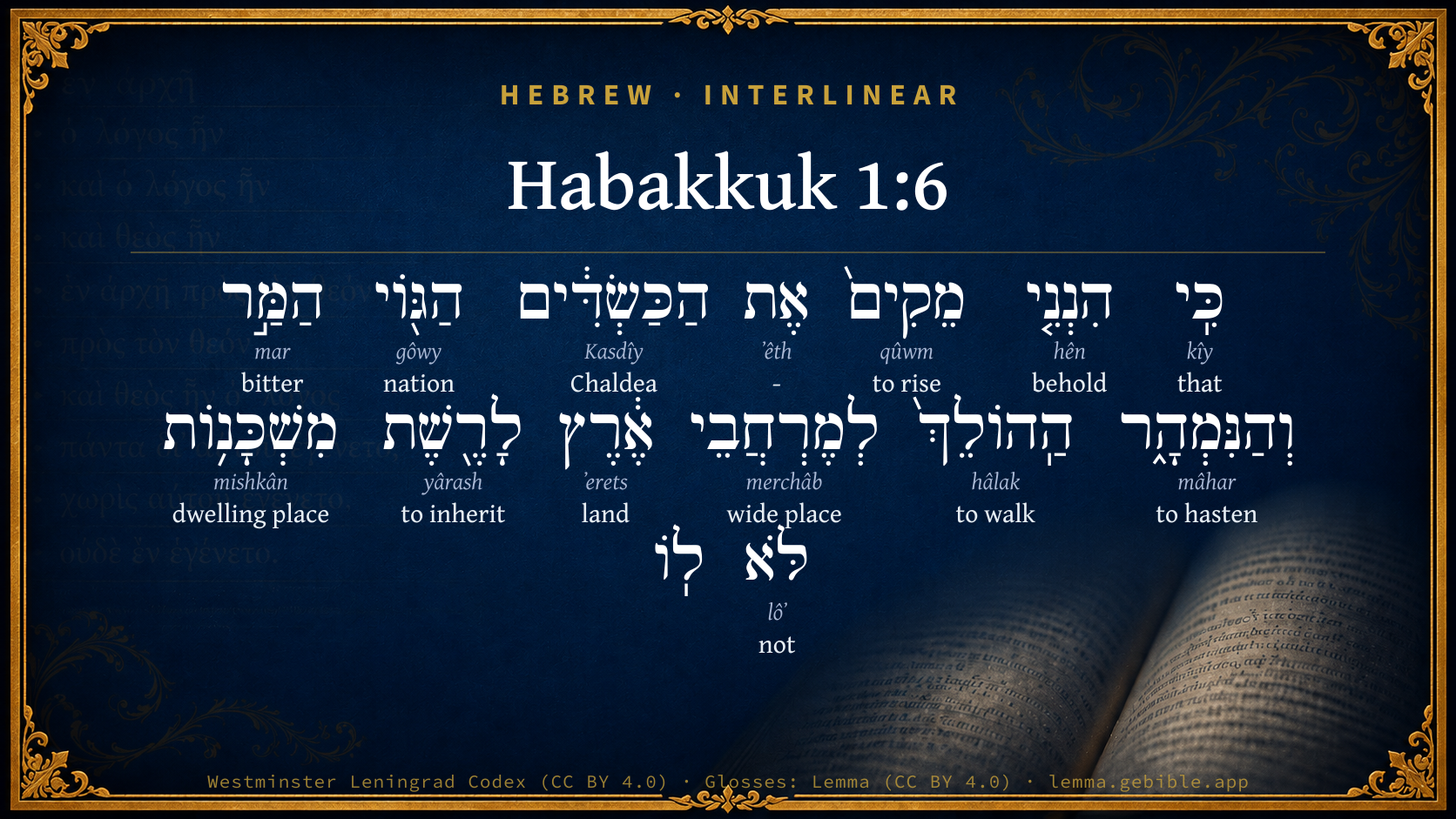
Habakkuk 1:6

Hebrew (Westminster Leningrad Codex) Habakkuk 1:6 appears in the Hebrew Old Testament. The text above is from the Westminster Leningrad Codex. Each word links to its Strong’s number, a concise gloss, and parsing drawn from the Open Scriptures Hebrew Bible morphology. Click any word for its full Brown-Driver-Briggs (BDB) entry.
Download image
Cite this verse

Habakkuk 1:6 (World English Bible). Public Domain. Lemma interlinear Bible study tool, https://lemma.gebible.app/v/habakkuk/1/6.

Show BibTeX & RIS
BibTeX
RIS
English Translation
For, behold, I raise up the Chaldeans, that bitter and hasty nation, that march through the breadth of the earth, to possess dwelling places that are not theirs.
World English Bible · Public Domain
Download a study sheet

One document with this verse’s original text, its word-by-word gloss line, the meaning frame, cross-references with their text, attributed commentary, and full source and license credits — printable, and it pastes into notes with its structure intact.

This verse Autodidact and up

Study sheet (.html) Plain text (.txt)

A passage Seminary Student

Up to 50 verses in one chapter. A passage sheet keeps up to 6 commentary sources and 12 cross-references per verse, in the order this page ranks them, and says so on the sheet whenever that leaves anything out. Ask for a single verse and you get the Autodidact verse sheet above.

Everything on this page stays free to read, with no account — the sheet is a download of what is already on screen, not access to it.

Want to remove ads? Support Godless Engineer
Compare translations 3

The same verse in 3 English versions, stacked beneath the original-language interlinear above. Click any original word for its lexicon entry.

Each is an independent rendering of the whole verse — the interlinear is not word-aligned to these translations.

Highlighted words mark where these versions differ — a whole-verse word diff, not a word-by-word alignment.

  • World English Bible Public Domain
    For, behold, I raise up the Chaldeans, that bitter and hasty nation, that march through the breadth of the earth, to possess dwelling places that are not theirs.
  • King James Version Public Domain
    For, lo, I raise up the Chaldeans, that bitter and hasty nation, which shall march through the breadth of the land, to possess the dwellingplaces that are not their's.
  • unfoldingWord Literal Text CC BY-SA 4.0
    For behold me, raising up the Chaldeans, the bitter and hastening nation, the one going through the breadths of the earth to seize dwellings not to him.

unfoldingWord Literal Text — © unfoldingWord, licensed CC BY-SA 4.0. Word-aligned USFM3 via Door43 (git.door43.org/unfoldingWord/en_ult).

Versions to compare (up to 4)

3 of 4 selected

Show all 18 translations

Every available English version of this verse, each an independent rendering of the whole verse.

  • World English Bible Public Domain
    For, behold, I raise up the Chaldeans, that bitter and hasty nation, that march through the breadth of the earth, to possess dwelling places that are not theirs.
  • Berean Standard Bible Public Domain
    For behold, I am raising up the Chaldeans—that ruthless and impetuous nation which marches through the breadth of the earth to seize dwellings not their own.
  • Majority Standard Bible Public Domain
    For behold, I am raising up the Chaldeans—that ruthless and impetuous nation which marches through the breadth of the earth to seize dwellings not their own.
  • King James Version Public Domain
    For, lo, I raise up the Chaldeans, that bitter and hasty nation, which shall march through the breadth of the land, to possess the dwellingplaces that are not their's.
  • American Standard Version (1901) Public Domain
    For, lo, I raise up the Chaldeans, that bitter and hasty nation, that march through the breadth of the earth, to possess dwelling-places that are not theirs.
  • Revised Version (1885) Public Domain
    For, lo, I raise up the Chaldeans, that bitter and hasty nation; which march through the breadth of the earth, to possess dwelling places that are not theirs.
  • Geneva Bible (1599) Public Domain
    For lo, I raise vp the Caldeans, that bitter and furious nation, which shall goe vpon the breadth of the lande to possesse the dwelling places, that are not theirs.
  • Douay-Rheims (1899) Public Domain
    For behold, I will raise up the Chaldeans, a bitter and swift nation, marching upon the breadth of the earth, to possess the dwelling places that are not their own.
  • Young's Literal Translation Public Domain
    For, lo, I am raising up the Chaldeans, The bitter and hasty nation, That is going to the broad places of earth, To occupy tabernacles not its own.
  • Literal Standard Version CC BY-SA 4.0
    For behold, I am raising up the Chaldeans, || The bitter and hasty nation, || That is going to the broad places of earth, || To occupy dwelling places not his own.
  • Unlocked Literal Bible CC BY-SA 4.0
    For look! I am about to raise up the Chaldeans—that fierce and impetuous nation— they are marching throughout the breadth of the land to seize homes that were not their own.
  • unfoldingWord Literal Text CC BY-SA 4.0
    For behold me, raising up the Chaldeans, the bitter and hastening nation, the one going through the breadths of the earth to seize dwellings not to him.
  • Darby Bible Public Domain
    For behold, I raise up the Chaldeans, that bitter and impetuous nation, which marcheth through the breadth of the earth, to possess dwelling-places that are not theirs.
  • World Messianic Bible Public Domain
    For, behold, I am raising up the Kasdim, that bitter and hasty nation who march through the width of the earth, to possess dwelling places that are not theirs.
  • Webster's Bible Public Domain
    For lo, I raise up the Chaldeans, that bitter and hasty nation, which shall march through the breadth of the land, to possess the dwelling-places that are not theirs.
  • Free Bible Version CC BY-SA 4.0
    Watch! I am raising up the Babylonians, a cruel and brutal people who will march across the world to seize other lands.
  • Bible in Basic English Public Domain
    For see, I am sending the Chaldaeans, that bitter and quick-moving nation; who go through the wide spaces of the earth to get for themselves living-places which are not theirs.
  • JPS Tanakh (1917) Public Domain
    For, lo, I raise up the Chaldeans, that bitter and impetuous nation, that march through the breadth of the earth, to possess dwelling-places that are not theirs.

Literal Standard Version (2020), Covenant Press — licensed CC BY-SA 4.0. Text via the HelloAO Bible API (eBible.org). Unlocked Literal Bible (unfoldingWord) — licensed CC BY-SA 4.0. Text via the HelloAO Bible API (eBible.org). unfoldingWord Literal Text — © unfoldingWord, licensed CC BY-SA 4.0. Word-aligned USFM3 via Door43 (git.door43.org/unfoldingWord/en_ult). Free Bible Version, Dr. Jonathan Gallagher — licensed CC BY-SA 4.0. Text via the HelloAO Bible API (eBible.org).

Word by word

More ways to search: Search by grammar → Find every occurrence → Compare this word →

Practice this passage: Drill this verse → Learn its vocabulary →

לְמֶרְחֲבֵי
merchâb
H4800
“to/for · wide places of”
Preposition + Noun, Common, Masculine, Plural, Construct
Part of Speech
Preposition + Noun
Type
Common
Gender
Masculine
Number
Plural
State
Construct
Full BDB Definition

Origin: from H7337

TWOT: 2143c

broad or roomy place, wide, expanses
  1. כִּֽי kîy H3588 “that” Conjunction
  2. הִנְנִ֤י hên H2005 “behold · me” Particle, Demonstrative + Suffix, Personal, 1st Person, Common, Singular
  3. מֵקִים֙ qûwm H6965 “rising” Verb, Hiphil, Participle Active, Masculine, Singular, Absolute
  4. אֶת ʼêth H853 “-” Particle, Direct Object
  5. הַכַּשְׂדִּ֔ים Kasdîy H3778 “the · Chaldea” Particle, Definite Article + Noun, Proper
  6. הַגּ֖וֹי gôwy H1471 “the · nation” Particle, Definite Article + Noun, Common, Masculine, Singular, Absolute
  7. הַמַּ֣ר mar H4751 “the · bitter” Particle, Definite Article + Adjective, Adjective, Masculine, Singular, Absolute
  8. וְהַנִּמְהָ֑ר mâhar H4116 “and · the · hastening” Conjunction + Particle, Definite Article + Verb, Niphal, Participle Active, Masculine, Singular, Absolute
  9. הַֽהוֹלֵךְ֙ hâlak H1980 “the · walking” Particle, Definite Article + Verb, Qal, Participle Active, Masculine, Singular, Absolute
  10. אֶ֔רֶץ ʼerets H776 “land” Noun, Common, Both, Singular, Absolute
  11. לָרֶ֖שֶׁת yârash H3423 “to inherit” Preposition + Verb, Qal, Infinitive Construct
  12. מִשְׁכָּנ֥וֹת mishkân H4908 “dwelling places” Noun, Common, Masculine, Plural, Absolute
  13. לֹּא lôʼ H3808 “not” Particle, Negative

About this verse

These counts appear in no published source. They are computed here, from the morphology-tagged text and Lemma’s own curated glosses. What Lemma adds →

15
words
14
distinct lemmas
Prophets
section

Notable vocabulary

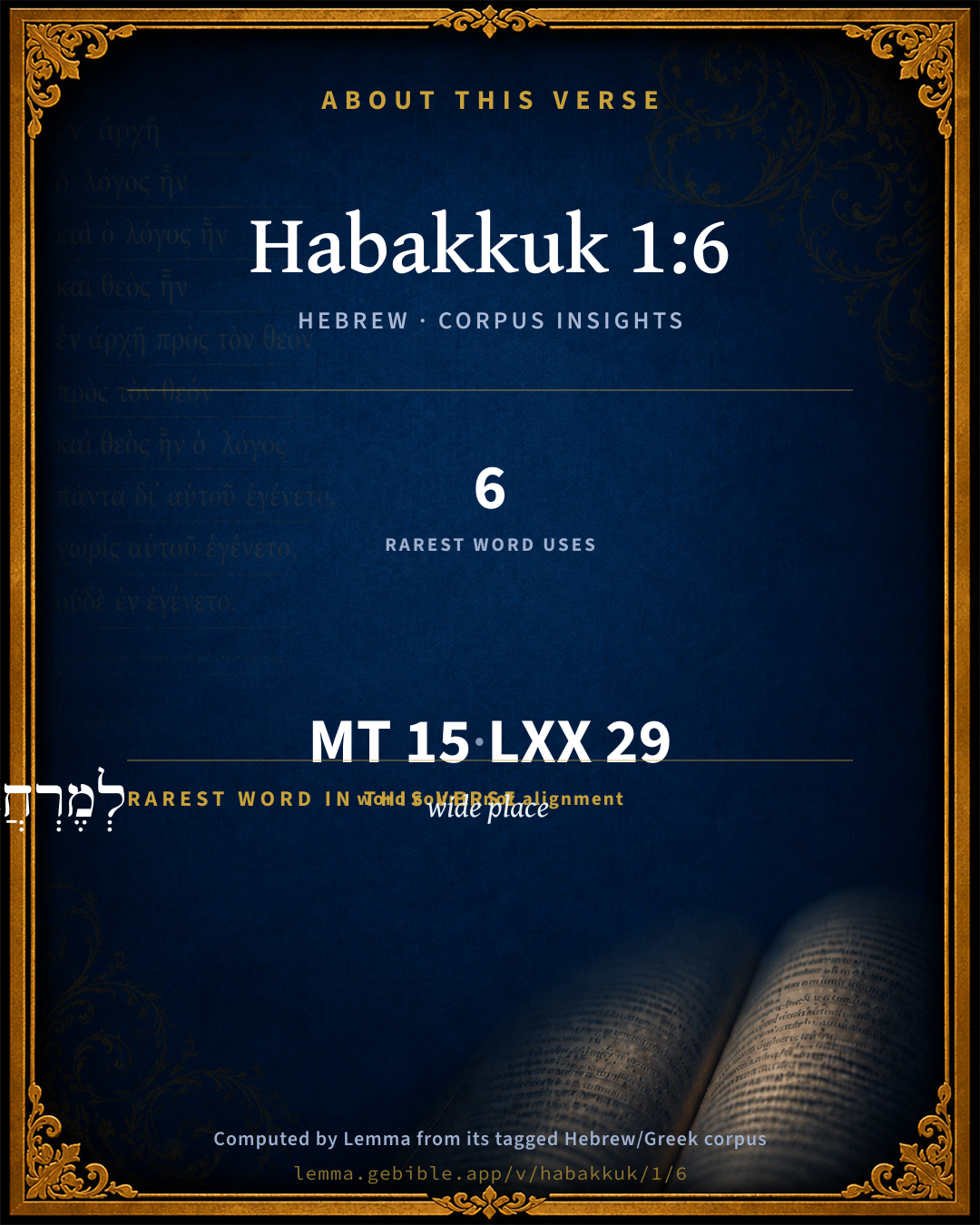
The rarest word here is לְמֶרְחֲבֵי wide place H4800 — appearing just 6 times in the whole Hebrew Bible.

Shared distinctive vocabulary

לְמֶרְחֲבֵי wide place H4800 occurs in 6 verses of the Hebrew Bible. Also found in:

Grammatical profile

  • 4 verbs
  • 5 nouns
  • 1 adjective
  • 1 preposition
  • 1 conjunction
  • 3 particles

Verb forms

  • מֵקִים֙ Hiphil · Participle Active
  • וְהַנִּמְהָ֑ר Niphal · Participle Active
  • הַֽהוֹלֵךְ֙ Qal · Participle Active
  • לָרֶ֖שֶׁת Qal · Infinitive Construct

Hebrew & Septuagint length

In English translation the verse runs 28 words from the Hebrew and 26 from the Septuagint (LXX English) — closely comparable.

A rough comparison of the two English renderings, which tokenize alike — not a word-level alignment.

Word counts can differ between the Hebrew and the Greek without any difference in meaning — e.g. the Hebrew direct-object marker אֵת has no separate Greek word, and Greek often adds the article ὁ.

In the original languages it is 15 Hebrew tokens and 29 Greek tokens — but the two are counted differently (Hebrew bundles its prefixes and suffixes into one token; the Greek is in lemma form), so that isn’t a like-for-like length.

Cross-references

13

Topical passages linked to Habakkuk 1:6 in the Treasury of Scripture Knowledge — connected by theme and wording, ordered by reader-vote popularity; previews shown in the World English Bible.

  • 2 Kings 24:2 Yahweh sent against him bands of the Chaldeans, and bands of the Syrians, and bands of the Moabites, and bands of the children of Ammon, and sent them against Judah to destroy it, according to the word of Yahweh, which he spoke by his servants the prophets.
  • 2 Chronicles 36:6 Against him came up Nebuchadnezzar king of Babylon, and bound him in fetters, to carry him to Babylon.
  • 2 Chronicles 36:17 Therefore he brought on them the king of the Chaldeans, who killed their young men with the sword in the house of their sanctuary, and had no compassion on young man or virgin, old man or gray-headed: he gave them all into his hand.
  • Jeremiah 5:15 Behold, I will bring a nation on you from far, house of Israel, says Yahweh: it is a mighty nation, it is an ancient nation, a nation whose language you don't know, neither understand what they say.
  • Deuteronomy 28:49–52 Yahweh will bring a nation against you from far, from the end of the earth, as the eagle flies; a nation whose language you shall not understand;
  • Isaiah 23:13 Behold, the land of the Chaldeans: this people was not; the Assyrian founded it for those who dwell in the wilderness; they set up their towers; they overthrew the palaces of it; they made it a ruin.
  • Jeremiah 4:6 Set up a standard toward Zion: flee for safety, don't stay; for I will bring evil from the north, and a great destruction.
  • Jeremiah 25:9 behold, I will send and take all the families of the north, says Yahweh, and [I will send] to Nebuchadrezzar the king of Babylon, my servant, and will bring them against this land, and against the inhabitants of it, and against all these nations round about; and I will utterly destroy them, and make them an astonishment, and a hissing, and perpetual desolations.
  • Isaiah 39:6–7 Behold, the days are coming, when all that is in your house, and that which your fathers have laid up in store until this day, shall be carried to Babylon: nothing shall be left, says Yahweh.
  • Jeremiah 1:15–16 For, behold, I will call all the families of the kingdoms of the north, says Yahweh; and they shall come, and they shall set everyone his throne at the entrance of the gates of Jerusalem, and against all the walls of it round about, and against all the cities of Judah.
  • Jeremiah 4:8 For this gird you with sackcloth, lament and wail; for the fierce anger of Yahweh hasn't turned back from us.
  • Jeremiah 6:22–23 Thus says Yahweh, Behold, a people comes from the north country; and a great nation shall be stirred up from the uttermost parts of the earth.
  • Jeremiah 21:4 Thus says Yahweh, the God of Israel, Behold, I will turn back the weapons of war that are in your hands, with which you fight against the king of Babylon, and against the Chaldeans who besiege you, without the walls; and I will gather them into the midst of this city.

Cross-references courtesy of OpenBible.info (CC BY 4.0).

Hebrew and Greek witnesses Masoretic Hebrew ↔ Greek Septuagint

The same verse in the two great witnesses to the Old Testament, shown verse-for-verse.

These are two independent witnesses, not word-aligned to each other, and the Septuagint is shown in lemma (dictionary) form.

Hebrew Habakkuk 1:6 Masoretic · Westminster Leningrad Codex

כִּֽי הִנְנִ֤י מֵקִים֙ אֶת הַכַּשְׂדִּ֔ים הַגּ֖וֹי הַמַּ֣ר וְהַנִּמְהָ֑ר הַֽהוֹלֵךְ֙ לְמֶרְחֲבֵי אֶ֔רֶץ לָרֶ֖שֶׁת מִשְׁכָּנ֥וֹת לֹּא לֽוֹ

For, behold, I raise up the Chaldeans, that bitter and hasty nation, that march through the breadth of the earth, to possess dwelling places that are not theirs.

World English Bible · Public Domain

Greek LXX Habakkuk 1:6 Septuagint · lemma form

διότι ἰδού ἐγώ ἐκἐγείρω ἐπί σύ ὁ χαλδαῖος ὁ μαχητής ὁ ἔθνος ὁ πικρός καί ὁ ταχινός ὁ πορεύομαι ἐπί ὁ πλάτος ὁ γῆ ὁ κατακληρονομέω σκήνωμα οὐ αὐτός

Therefore, behold, I stir up the Chaldeans, the bitter and hasty nation, that walks upon the breadth of the earth, to inherit tabernacles not his own.

LXX2012 (modern English Septuagint) · Public Domain

On this verse, Keil & Delitzsch discusses the Septuagint’s reading. Read the note in Commentary ↓

Hebrew: Westminster Leningrad Codex (CC BY 4.0). Greek: Septuagint (public domain); English from LXX2012 (modern English Septuagint) (Public Domain). How the Septuagint differs from the Hebrew →

Targum (Aramaic paraphrase)

1

The Targum is the ancient Jewish Aramaic paraphrase of the Hebrew Scriptures — an interpretive translation, not the Hebrew text itself. Onkelos (literal) and Pseudo-Jonathan (expansive) render the Torah, and Jonathan the Prophets. Coverage is partial: where no permissively-licensed English translation exists for a verse, only the Aramaic is shown. This is verse-level text, not a word-by-word alignment to the Hebrew.

  1. Targum Jonathan Prophets (Joshua–Malachi)
    אֲרֵי הָא אֲנָא מֵקִים יַת כַּסְדָאֵי עַמָא מוֹחֲיָא וְקַלִילָא דְאָזֵיל לִפְתָאֵי אַרְעָא לְאַחְסָנָא קִרְוִין דְלָא דִילֵיהּ:

    (no public-domain English translation for this verse)

    Targum Jonathan — Aramaic: “Mikraot Gedolot” (public domain). English: “Sefaria Community Translation” (CC0 1.0 (public-domain dedication)); “London "Chaldee Paraphrase," 1871” (public domain). Text via Sefaria.

Commentary

Notes on Habakkuk 1:6 from classic Christian and Jewish commentators (each source and its license shown beneath its notes). The classic Christian expositions comment on the surrounding passage and are grouped to its opening verse, so a note may address several verses; the Jewish commentaries on the Tanakh (Rashi and others) are per-verse, so they appear only where the commentator wrote on this verse.

Lemma curates 59 commentaries, every one of them public domain or Creative Commons licensed, each selected and text-cleaned for this edition rather than reprinted as found. About our sources →

Ellicott's Commentary for English Readers

(6) I raise up the Chaldeans—i.e., I am bringing up the Chaldæan or Babylonian armies into Judæa. The phrase implies that the Chaldæans were not yet in Judæa, but there is no occasion to find an allusion to the recent rise of the Chaldæan nation. We notice this point because an ethnological theory (now generally abandoned) has regarded the Chaldæans of the prophetic period as raised to national existence only a little time before the date of Habakkuk. It was supposed that they were a race distinct from the Chaldæans of earlier Scripture; being, in fact, an association of northern hordes who had but recently penetrated the lower Mesopotamian valley. Hab_1:6 and Isa_23:13 were therefore interpreted as illustrating the fact that these new nationalities “were on a sudden ‘raised up,’ elevated from their low estate of Assyrian colonists, to be the conquering people which they became under Nebuchadnezzar.” The confutation of this theory may be found in Rawlinson’s Ancient Monarchies, i. 57, 59. It appears that Babylon was peopled at this time, not, as was formerly supposed, with hordes of Armenians, Arabs, Kurds, and Sclaves, but with a mixed population, in which the old Chaldæan and Assyrian elements preponderated. The Chaldæans of the seventh century B.C. were, in fact, as legitimate descendants of the people of Nimrod’s empire as we are of the Saxons. Certainly, the rapidity with which Babylon rose from the position of an Assyrian colony to that of ruler of Asia was marvellous. But the work which is to make the Jews wonder is not God’s choice of an agent, but that agent’s proceeding; not the elevation of one Gentile power in the place of another, but the attack which that new power is to make upon the sacred city.

Bitter and hasty.—Better, fierce and impetuous. The association of these two epithets, mar and nimhâr, is the more forcible, because of their similarity in sound. With respect to the whole passage Hab_1:6-11, Kleinert well remarks, “The present passage is the locus classicus for the characteristics of this warlike people, just as Isa_5:26 seq. is for the characteristics of the Assyrians.”

A Bible Commentary for English Readers, edited by Charles John Ellicott (1878–1897) — public domain. Text from a community e-Sword module.

Trapp's Complete Commentary

John Trapp

Hab 1:6 For, lo, I raise up the Chaldeans, [that] bitter and hasty nation, which shall march through the breadth of the land, to possess the dwellingplaces [that are] not theirs.

Ver. 6. For lo, I raise up the Chaldeans, that bitter and hasty nation] The Chaldeans were anciently the philosophers of the Babylonians: Babylon was a province of the Assyrian empire; but not the same with Nineveh (only walled about by Semiramis, and by her called Babylon), as Suidas noteth. Nineveh was the metropolis, Babylon ruled by prefects. One of whom, viz. Merodach-Baladan, rebelling against Esarhaddon, King of Nineveh, translated the whole kingdom to the Babylonians, using the help and counsel of the Chaldeans, famous for their wisdom and authority; which yet was not done without the Lord, who then stirred them up, and now sent them against the Jews, to avenge the quarrel of his covenant. In like manner God hath in these last times raised up the Turks, "that bitter and hasty nation," bitter and bloody, hasty and headlong, υηδεν αναβαλλομενην, pursuing their victories and subduing in a short time many nations and kingdoms to their empire. Hence the Jews are in the former verse called upon to view among the heathen what havoc the Chaldeans had made; that is, should shortly make by overrunning Syria, the greater part of all Asia, and some part also of Africa. In the greatness of the Turkish empire is swallowed up at this day both the name and empire of the Saracens, the most glorious empire of the Greeks, the renowned kingdoms of Macedonia, Peloponnesus, Epirus, Bulgaria, Servia, Bosnia, Armenia, Cyprus, Syria, Egypt, Judaea, Tunis, Algiers, Media, Chaldea, with a great part of Hungary; as also of the Persian kingdom, and all the Churches and places so much spoken of in Scripture (the Roman only excepted, which yet he daily threateneth), and, in brief, so much in Christendom, as far exceedeth that which is thereof at this day left. In fine, no part of the world is left untouched by the Ottoman monarchy but America only; not more happy in her rich mines than in that she is so far from so great and dangerous an enemy. The King of Spain, of all other princes, Mahometan or Christian, that border upon the Turk, is best able to wage war with him. How far and with what bitterness and haste he hath carried on his Catholic monarchy is better known than that it need here to be related. Queen Elizabeth put a stop to him. Captain Drake and his soldiers, when they took Saint Domingo, A.D. 1585 (where his arms were to be seen in the townhall with this inscription, Non sufficit orbis The world is not enough), derided his avarice and ambition; but the poor Indies groan heavily under his cruelty: and Grynaeus commenting upon these words, "that bitter and hasty nation," Tribuuntur illis duo, saith he, Two things are here attributed to the Chaldees’ bitterness and swiftness in undertaking and despatching conquests: quibus dotibus Iberos nostra aetate praeditos, proh dolor, experimur, this by woeful experience we find today too much verified of the Spaniards.

John Trapp, A Commentary or Exposition upon All the Books of the Old and New Testament (1647–1656) — public domain. Text from a community e-Sword module.

Joseph Benson's Commentary

Hab 1:6. For lo, I raise up the Chaldeans — This is spoken of as a matter of great wonder and astonishment, because the Chaldeans, in the times of Hezekiah, Manasseh, and Josiah, were allies of the Jewish nation, and seemed linked to them in the greatest friendship; so that they had no fear on that side, but all their fear was from the Egyptians. Therefore the coming of the Chaldeans into the country is spoken of here as a thing entirely new, and as if that people had been called into existence for the very purpose of punishing the Jewish nation. There is a prophecy similar to this in Isaiah, with regard to the Assyrians, in whom the Jewish nation then placed their chief confidence, and thought of nothing less than of the evils which Isaiah threatened should be brought upon them by that nation: so weak and short-sighted often is human policy! see Isaiah 7. That bitter and hasty nation — That people cruel, in their disposition, quick in executing their purposes, and hasty in their marches, Isa 5:26-27; Jer 5:16-17. Which shall march through the breadth of the land, to possess, &c. — This is spoken of the Chaldeans extending their conquests to a vast distance from the original seat of their empire.

Joseph Benson's Commentary on the Old and New Testaments (1811–1818) — public domain. Text from a community e-Sword module.

Keil & Delitzsch

C. F. Keil & F. Delitzsch

Announcement of this work. - Hab 1:6. "For, behold, I cause the Chaldaeans to rise up, the fierce and vehement nation, which marches along the breadths of the earth, to take possession of dwelling-places that are not its own. Hab 1:7. It is alarming and fearful: its right and its eminence go forth from it. Hab 1:8. And its horses are swifter than leopards, and more sudden than evening wolves: and its horsemen spring along; and its horsemen, they come from afar; they fly hither, hastening like an eagle to devour. Hab 1:9. It comes all at once for wickedness; the endeavour of their faces is directed forwards, and it gathers prisoners together like sand. Hab 1:10. And it, kings it scoffs at, and princes are laughter to it; it laughs at every stronghold, and heaps up sand, and takes it. Hab 1:11. Then it passes along, a wind, and comes hither and offends: this its strength is its god." הנני מקים, ecce suscitaturus sum. הנּה before the participle always refers to the future. הקים, to cause to stand up or appear, does not apply to the elevation of the Chaldaeans into a nation or a conquering people, - for the picture which follows and is defined by the article הגּויו וגו presupposes that it already exists as a conquering people, - but to its being raised up against Judah, so that it is equivalent to מקים עליכם in Amo 6:14 (cf. Mic 5:4; Sa2 12:11, etc.). Hakkasdı̄m, the Chaldaeans, sprang, according to Gen 22:22, from Kesed the son of Nahor, the brother of Abraham; so that they were a Semitic race. They dwelt from time immemorial in Babylonia or Mesopotamia, and are called a primeval people, gōI mē‛ōlâm, in Jer 5:15. Abram migrated to Canaan from Ur of the Chaldees, from the other side of the river (Euphrates: Gen 11:28, Gen 11:31, compared with Jos 24:2); and the Kasdı̄m in Isaiah, Jeremiah, and Ezekiel are inhabitants of Babel or Babylonia (Isa 43:14; Isa 47:1; Isa 48:14, Isa 48:20; Jer 21:9; Jer 32:4, Jer 32:24, etc.; Eze 23:23). Babylonia is called 'erets Kasdı̄m (Jer 24:5; Jer 25:12; Eze 12:13), or simply Kasdı̄m (Jer 50:10; Jer 51:24, Jer 51:35; Ezekiel 26:29; Eze 23:16). The modern hypothesis, that the Chaldaeans were first of all transplanted by the Assyrians from the northern border mountains of Armenia, Media, and Assyria to Babylonia, and that having settled there, they afterwards grew into a cultivated people, and as a conquering nation exerted great influence in the history of the world, simply rests upon a most precarious interpretation of an obscure passage in Isaiah (Isa 23:18), and has no higher value than the opinion of the latest Assyriologists that the Chaldaeans are a people of Tatar origin, who mingled with the Shemites of the countries bordering upon the Euphrates and Tigris (see Delitzsch on Isa 23:13). Habakkuk describes this people as mar, bitter, or rough, and, when used to denote a disposition, fierce (mar nephesh, Jdg 18:25; Sa2 17:8); and nimhâr, heedless or rash (Isa 32:4), here violent, and as moving along the breadths of the earth (ἑπὶ τὰ πλάτη τῆς γῆς, lxx: cf. Rev 20:9), i.e., marching through the whole extent of the earth (Isa 8:8): terram quam late patet (Ros.). ל is not used here to denote the direction or the goal, but the space, as in Gen 13:17 (Hitzig, Delitzsch). To take possession of dwelling-laces that are not his own (לא־לו = אשׁר לא־לו), i.e., to take possession of foreign lands that do not belong to him. In Hab 1:7 the fierce disposition of this people is still further depicted, and in Hab 1:8 the violence with which it advances. אים, formidabilis, exciting terror; נורא, metuendus, creating alarm. ממּנּוּ וגו, from it, not from God (cf. Psa 17:2), does its right proceed, i.e., it determines right, and the rule of its conduct, according to its own standard; and שׂאתו, its eminence (Gen 49:3; Hos 13:1), "its δόξα (Co1 11:7) above all other nations" (Hitzig), making itself lord through the might of its arms. Its horses are lighter, i.e., swifter of foot, than panthers, which spring with the greatest rapidity upon their prey (for proofs of the swiftness of the panther, see Bochart, Hieroz. ii. p. 104, ed. Ros.), and חדּוּ, lit., sharper, i.e., shooting sharply upon it. As qâlal represents swiftness as a light rapid movement, which hardly touches the ground, so châda, ὀξὺν εἶναι, describes it as a hasty precipitate dash upon a certain object (Delitzsch). The first clause of this verse has been repeated by Jeremiah (Jer 4:13), with the alteration of one letter (viz., מנּשׁרים for מנּמרים). Wolves of the evening (cf. Zep 3:3) are wolves which go out in the evening in search of prey, after having fasted through the day, not "wolves of Arabia (ערב = ערב, lxx) or of the desert" (ערבה Kimchi).

Pâshū from pūsh, after the Arabic fâš, med. Ye, to strut proudly; when used of a horse and its rider, to spring along, to gallop; or of a calf, to hop or jump (Jer 50:11; Mal 4:2). The connection between this and pūsh (Nah 3:18), niphal to disperse or scatter one's self, is questionable. Delitzsch (on Job 35:15) derives pūsh in this verse and the passage cited from Arab. fâš, med. Vav, in the sense of swimming upon the top, and apparently traces pūsh in Nahum 3, as well as pash in Job 35:15, to Arab. fšš (when used of water: to overflow its dam); whilst Freytag (in the Lexicon) gives, as the meaning of Arab. fšš II, dissolvit, dissipavit. Pârâshı̄m are horsemen, not riding-horses. The repetition of פּרשׁיו does not warrant our erasing the words וּפשׁוּ פּרשׁיו as a gloss, as Hitzig proposes. It can be explained very simply from the fact, that in the second hemistich Habakkuk passes from the general description of the Chaldaeans to a picture of their invasion of Judah. מרחוק , from afar, i.e., from Babylonia (cf. Isa 39:3). Their coming from afar, and the comparison of the rushing along of the Chaldaean horsemen to the flight of an eagle, points to the threat in Deu 28:49, "Jehovah shall bring against thee a nation from far, from the end of the earth, as swift as the eagle flieth," which is now about to be fulfilled. Jeremiah frequently uses the same comparison when speaking of the Chaldaeans, viz., in Jer 4:13; Jer 48:40; Jer 49:22, and Lam 4:19 (cf. Sa2 1:23). The ἁπ. λεγ. מגמּה may mean a horde or crowd, after the Hebrew גם werbeH , and the Arabic jammah, or snorting, endeavouring, striving, after Arab. jmm and jâm, appetivit, in which case גמם would be connected with גמא, to swallow. But the first meaning does not suit פּניהם קדימה, whereas the second does. קדימה, not eastwards, but according to the primary meaning of קדם, to the front, forwards. Ewald renders it incorrectly: "the striving of their face is to storm, i.e., to mischief;" for qâdı̄m, the east wind, when used in the sense of storm, is a figurative expression for that which is vain and worthless (Hos 12:2; cf. Job 15:2), but not for mischief. For ויּאסף, compare Gen 41:49 and Zac 9:3; and for כּחול, like sand of the sea, Hos 2:1. In Hab 1:10 והוּא and הוּא are introduced, that the words בּמּלכים and לכל־מבצר, upon which the emphasis lies, may be placed first. It, the Chaldaean nation, scoffs at kings and princes, and every stronghold, i.e., it ridicules all the resistance that kings and princes offer to its advance, by putting forth their strength, as a perfectly fruitless attempt. Mischâq, the object of laughter. The words, it heaps up dust and takes it (the fortress), express the facility with which every fortress is conquered by it. To heap up dust: denoting the casting up an embankment for attack (Sa2 20:15, etc.). The feminine suffix attached to ילכּדהּ refers ad sensum to the idea of a city (עיר), implied in מבצר, the latter being equivalent to עיר מבצר in Sa1 6:18; Kg2 3:19, etc. Thus will the Chaldaean continue incessantly to overthrow kings and conquer kingdoms with tempestuous rapidity, till he offends, by deifying his own power. With this gentle hint at the termination of his tyranny, the announcement of the judgment closes in Hab 1:11. אז, there, i.e., in this appearance of his, as depicted in Hab 1:6-10 : not "then," in which case Hab 1:11 would affirm to what further enterprises the Chaldaeans would proceed after their rapidly and easily effected conquests. The perfects חלף and ויּעבור are used prophetically, representing the future as occurring already. חלף and עבר are used synonymously: to pass along and go further, used of the wind or tempest, as in Isa 21:1; here, as in Isa 8:8, of the hostile army overflowing the land; with this difference, however, that in Isaiah it is thought of as a stream of water, whereas here it is thought of as a tempest sweeping over the land. The subject to châlaph is not rūăch, but the Chaldaean (הוּא, Hab 1:10); and rūăch is used appositionally, to denote the manner in which it passes along, viz., "like a tempestuous wind" (rūăch as in Job 30:15; Isa 7:2). ואשׁם is not a participle, but a perfect with Vav rel., expressing the consequence, "and so he offends." In what way is stated in the last clause, in which זוּ does not answer to the relative אשׁר, in the sense of "he whose power," but is placed demonstratively before the noun כּחו, like זה in Exo 32:1; Jos 9:12-13, and Isa 23:13 (cf. Ewald, 293, b), pointing back to the strength of the Chaldaean, which has been previously depicted in its intensive and extensive greatness (Delitzsch). This its power is god to it, i.e., it makes it into its god (for the thought, compare Job 12:6, and the words of the Assyrian in Isa 10:13). The ordinary explanation of the first hemistich is, on the other hand, untenable (then its courage becomes young again, or grows), since רוּח cannot stand for רוּחו, and עבר without an object given in the context cannot mean to overstep, i.e., to go beyond the proper measure.

Keil & Delitzsch — Biblical Commentary on the Old Testament (1861–1891) — public domain (CC PDM 1.0). Text via the HelloAO Bible API. (Old Testament only.)

Jamieson, Fausset & Brown

Robert Jamieson, A. R. Fausset & David Brown

I raise up--not referring to God's having brought the Chaldeans from their original seats to Babylonia (see on Isa 23:13), for they had already been upwards of twenty years (since Nabopolassar's era) in political power there; but to His being about now to raise them up as the instruments of God's "work" of judgment on the Jews (Ch2 36:6). The Hebrew is future, "I will raise up."

bitter--that is, cruel (Jer 50:42; compare Jdg 18:25, Margin; Sa1 17:8).

hasty--not passionate, but "impetuous."

Jamieson, Fausset & Brown — Commentary Critical and Explanatory on the Whole Bible (1871) — public domain (CC PDM 1.0). Text via the HelloAO Bible API.

Adam Clarke's Commentary

Verse 6. That bitter and hasty nation] Cruel and oppressive in their disposition; and prompt and speedy in their assaults and conquests.

Adam Clarke's Commentary on the Bible (1810–1826) — public domain. Text from a community e-Sword/MySword module.

John Calvin's Commentaries

This verse is added by the Prophet as an explanation; for it was not enough to speak generally of God’s work, without reminding them that their destruction by the Chaldeans was nigh at hand. He does not indeed in this verse explain what would be the character of that judgement which he had mentioned in the last verse Habakkuk 1:5; but he will do this in what follows. Now the Prophets differ from Moses in this respect, for they show, as it were by the finger, what he threatened generally, and they declare the special judgements of God; as it is indeed evident from the demonstrative adverb, “Behold.” How necessary this was, we may gather from the perverseness of that people; for how distinctly soever the Prophets showed to them God’s judgements, so that they saw them with their eyes, yet so great was their insensibility, that they despised denunciations so apparent. What, then, would have been done, if the Prophets had only said in general, ‘God will not spare you!’ This, then, is the reason why the Prophet, having spoken of God’s terrible vengeance, now declares in express terms, that the Chaldeans were already armed by Him to execute His judgement. The rest we leave for tomorrow.

John Calvin's Commentaries (1540-1563) — public domain. Text from the Calvin Translation Society English edition (1840s-50s) via the Christian Classics Ethereal Library (ccel.org). Calvin's coverage is partial (roughly two-thirds of the Bible); uncommented books and verses are honest gaps, never fabricated. The 19th-century editor's footnotes and remarks are omitted so the notes are faithfully Calvin's own voice.

The Cambridge Bible for Schools and Colleges

gen. ed. J. J. S. Perowne

6. raise up the Chaldeans] The reference in “raise up” can hardly be to the first entrance of the Chaldeans upon the stage of history; it is rather to their advance against Israel. Some MSS. of Sept. add “against you.” On Chaldeans see after Hab_1:11.

bitter and hasty nation] Spoken of temper or disposition “bitter” is vehement and passionate, Jdg_18:25; 2Sa_17:8; and “hasty” is sudden in action, driven headlong by violent impulse.

shall march … the land] which marcheth through the breadth of the earth. His operations extend over the world, and his object is conquest, to seize for a possession the dwelling-places of other peoples. Job_18:21; Jer_9:19; Jer_30:18; Isa_32:18. The phrase “that are not his” again ch. Hab_2:6; cf. Deu_6:10-11.

The Cambridge Bible for Schools and Colleges (gen. ed. J. J. S. Perowne; Cambridge University Press, 1878–1918) — public domain. Text from a community e-Sword module.

John Gill's Exposition

For, lo, I raise up the Chaldeans,.... A people still of late mean and low, famous only for their soothsaying, divination, and judicial astrology; but now become a powerful and warlike people, rising up under the permission of Providence to universal monarchy, and who would quickly add Judea to the rest of their dominions:

that bitter and hasty nation; a cruel and merciless people in their temper and disposition: "bitter" against the people of God and true religion, and causing bitterness, calamities, and distress, wherever they came: "hasty" and precipitate in their determinations; swift and nimble in their motions; active and vigorous in the prosecution of their designs:

which shall march through the breadth of the land; or "breadths of the land" (t); through the whole world, as they were attempting to do, having subdued Syria, all Asia, and great part of Africa, through which they boldly marched, bearing down all opposition that was in their way; or through the breadth of the land of Judea, taking all the fenced cities as they went along, and Jerusalem the metropolis of it; see Isa 8:7,

to possess the dwellingplaces that are not theirs; the cities of Judea, and houses in them, as well as the palaces and dwellingplaces in Jerusalem, which they had no right unto, but what they got by the sword; what were the legal possessions and inheritances of others from father to son for ages past, these the Chaldeans would dispossess them of; and not only take them, and the spoil and plunder of them, for the present, but retain them in their possession, as an inheritance to be transmitted to their posterity. This may have some respect to the length of the captivity of the Jews, and their land being in the hands of their enemies for the space of seventy years.

(t) "latitudines terrae", Montanus, Junius & Tremellius, Piscator.

John Gill's Exposition of the Whole Bible (1746–1763) — public domain (CC PDM 1.0). Text via the HelloAO Bible API.

Albert Barnes' Notes on the Bible

For lo - So God announces a future, in which His Hand shall be greatly visible, whether more or less distant. In His sight it is present.

I raise up - God uses the free will and evil passions of people or devils to His own ends; and so He is said to “raise up” those whom He allows to be stirred up against His people, since the events which His Providence permits, favor their designs, and it rests with Him to withhold them. They lift themselves up for some end of covetousness or pride. But there is a higher order of things, in which God orders their actions to fulfill His righteousness by their iniquities.

The Chaldaeans, that bitter - מר. In Jdg 18:25; 2Sa 17:8, the less concise נפשׁ מר.

And hasty nation - נמהר as Isa 32:4. Jerome: “To its might and warlike boldness almost all the Greeks who have written histories of the barbarians, witness.”

Which shall march through the breadth of the land - rather, “the earth,” literally “to the breadths of the earth,” reaching to its whole length and breadth, all its dimensions as in the description of Gog and Magog Rev 20:8-9, “the number of whom is as the sand of the sea; and they went up on the breadth of the earth; unhindered, not pent up, but spreading abroad, where they will, over the whole earth.” All before it, is one wide even plain which it overspreads and covers, like a flood, and yet is not spent nor exhausted.

To possess the dwelling-places that are not theirs - As God’s people had done, so should it be done to them. Spoiling and violence within Hab 1:2-4 attract oppression from without. The overcharged atmosphere casts down the lightning upon them. They had expelled the weak from their dwelling Mic 2:9; others shall possess theirs. Yet this scourge too shall pass by, since, although the Chaldaean did God’s Will, He willed it not, but His own (See Isa 10:6-7). The words, “not theirs,” literally, “not to him” stand with a mysterious fullness of meaning. The dwelling places not being his by right, shall not remain his, although given to him, while God wills.

Albert Barnes' Notes on the Bible (1834–1885) — public domain. Text from a community e-Sword/MySword module.

Haydock's Catholic Bible Commentary

Chaldeans. Nabuchodonosor was the first of this nation who attacked Joakim, and having conquered all as far as the Nile, returned to succeed Nabopolassar. He afterwards came upon Jechonias and Sedecias, &c. The prophet might have all this in view, particularly the first invasion. (Calmet) --- Bitter; warlike, as all the Greek historians remark. (St. Jerome) --- The Chaldeans were not yet arrived at such greatness, and of course this is not the Habacuc specified [in] Daniel xiv. (Worthington) --- Yet the same prophet might foresee it. (Haydock)

George Leo Haydock (1774–1849), Haydock's Catholic Family Bible and Commentary, 1859 edition — public domain. Excludes Psalms (Douay-Rheims chapter numbering differs from Protestant) and Deuterocanonical books (Catholic canon only).

Matthew Poole's English Annotations

For lo: now the prophet declares particularly what it is that the Lord will work.

I raise up; awaken to action, animate them in it, and strengthen them to accomplish their design.

The Chaldeans, who had subdued other nations, and had already ruined the Assyrian monarchy.

Bitter; cruel, and without mercy, Jer 6:23; 21:7.

Hasty; speedy and quick in executing their merciless purposes, as Isa 5:26,27.

Which shall march, Heb.

walk without fear, and in order, as a conqueror doth in his conquests.

Through the breadth of the land; through all parts of the land, no corner shall escape his search or cruelty.

To possess; not to spoil and be gone, but to take and keep possession, as lord and proprietor in the right of conquest.

The dwelling-places; houses, towns, cities, Jerusalem itself, which they had no right to, till Jewish sins gave occasion for the dispossessing of the Jews, and the introducing of the Chaldeans.

Matthew Poole's English Annotations on the Holy Bible (1683–1685) — public domain. Text from a community e-Sword/MySword module.

The Pulpit Commentary

The executors of the Divine vengeance are now plainly announced. I raise up. God does it; he uses the power and passion of men to work out his designs (1Ki_11:14, 1Ki_11:23; Amo_6:14) The Chaldeans; Kasidim. By this appellation the prophets signify the soldiers or inhabitants of Babylon, which won its independence and commenced its wonderfully rapid career of conquest after the tall of Nineveh, between B.C. 626 and 608. At the time when Habakkuk wrote the Chaldeans had not appeared in Judaea, and no apprehension of danger from them was entertained. Bitter and hasty. The former epithet refers to their cruelty and ferocity. (comp. Isa_14:6; Jer_6:23 Jer_50:42) They are called "hasty," as being vehement and impetuous in attack and rapid in movement. Which shall march through the breadth of the land; which marcheth through the breadths of the earth. The statement explains the general character of the Chaldeans, and points to the foreign conquests of Nebuchadnezzar. LXX, Tomenon ejpi tath thv ghv. (comp. Rev_20:9)

The Pulpit Commentary (1880–1919), ed. H.D.M. Spence-Jones & Joseph S. Exell — public domain. Text from a community e-Sword module.

John Wesley's Explanatory Notes

Bitter - Cruel, and without mercy. Hasty - Speedy in executing their merciless purposes.

John Wesley, Explanatory Notes Upon the Whole Bible (1754–1765) — public domain. Text via the GEBible commentary corpus.

Lesson kit

Teaching starters — assembled from the data on this page, not authored interpretation. Every prompt links to the verse data it draws on. Edit before teaching.

Habakkuk, in the Prophets, opens this verse with 15 words (14 distinct Hebrew lemmas). Its most distinctive word is merchâb (“wide place”). A historical commentator’s framing appears above. Read the whole chapter for the surrounding context.

Discussion questions

  1. What does “wide place” (merchâb) contribute to the verse as a whole?
  2. How does 2 Samuel 22:20, which shares the word «wide place», read alongside this verse?
  3. These translations render this verse differently. What is at stake in choosing one wording over another?
  4. «מֵקִים֙» is a Hiphil Participle Active verb. How does that grammatical form shape the action described?
  5. Compare how Ellicott's Commentary for English Readers and Trapp's Complete Commentary read this verse. Where do they agree or differ?

Things to notice

Reading settings

Reading text

Shown beneath each verse's original-language words.

Old Testament
Old Testament edition

Read the OT as the Masoretic Hebrew (MT) or the Greek Septuagint (LXX).

English shown for the Greek Septuagint (in the Hebrew ↔ Greek comparison).

Comparing translations? Open the Compare panel on any verse page to stack up to four side by side.