
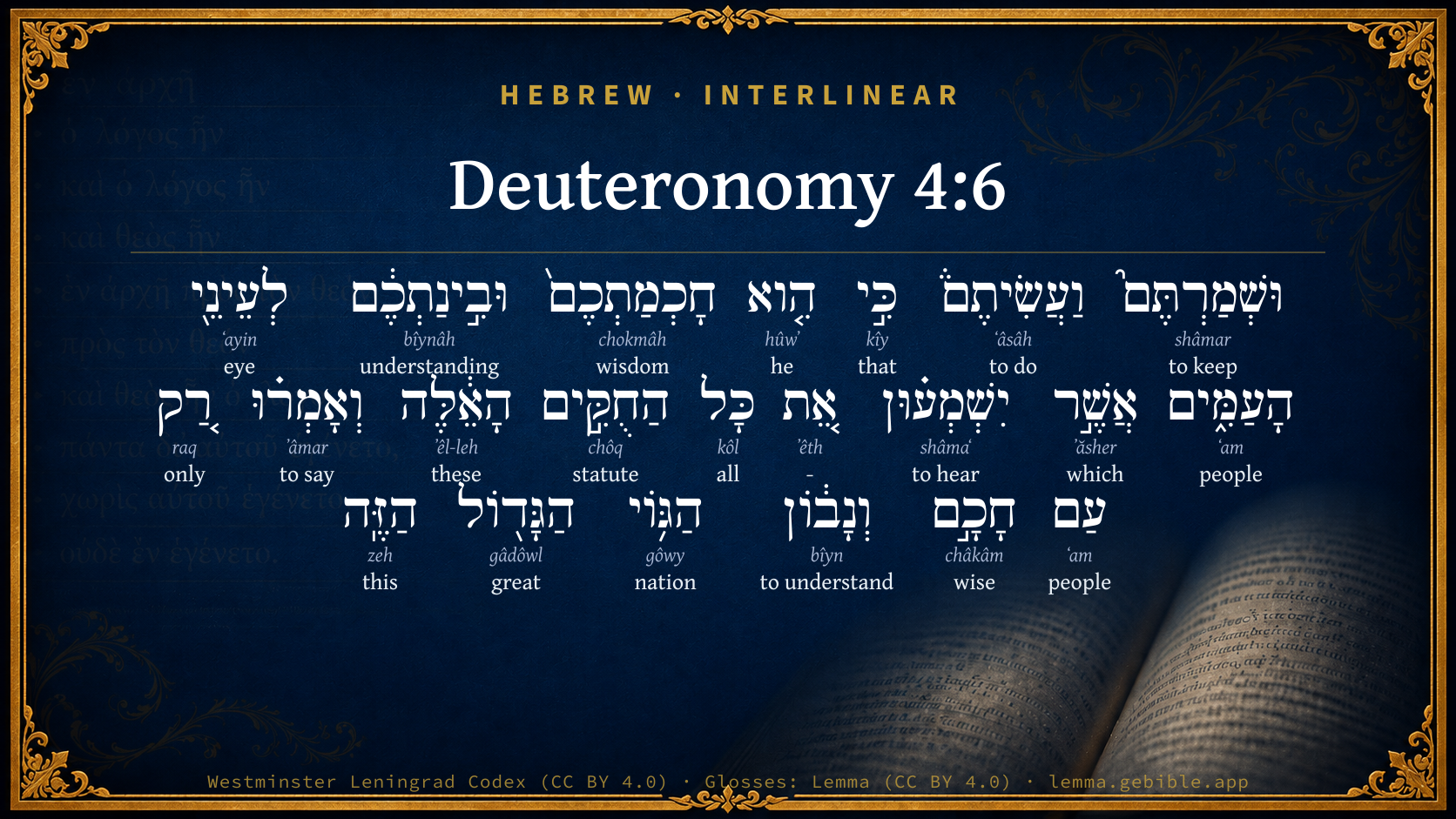
Deuteronomy 4:6

Hebrew (Westminster Leningrad Codex) Deuteronomy 4:6 appears in the Hebrew Old Testament. The text above is from the Westminster Leningrad Codex. Each word links to its Strong’s number, a concise gloss, and parsing drawn from the Open Scriptures Hebrew Bible morphology. Click any word for its full Brown-Driver-Briggs (BDB) entry.
Download image
Cite this verse

Deuteronomy 4:6 (World English Bible). Public Domain. Lemma interlinear Bible study tool, https://lemma.gebible.app/v/deuteronomy/4/6.

Show BibTeX & RIS
BibTeX
RIS
English Translation
Keep therefore and do them; for this is your wisdom and your understanding in the sight of the peoples, who shall hear all these statutes, and say, Surely this great nation is a wise and understanding people.
World English Bible · Public Domain
Highlights
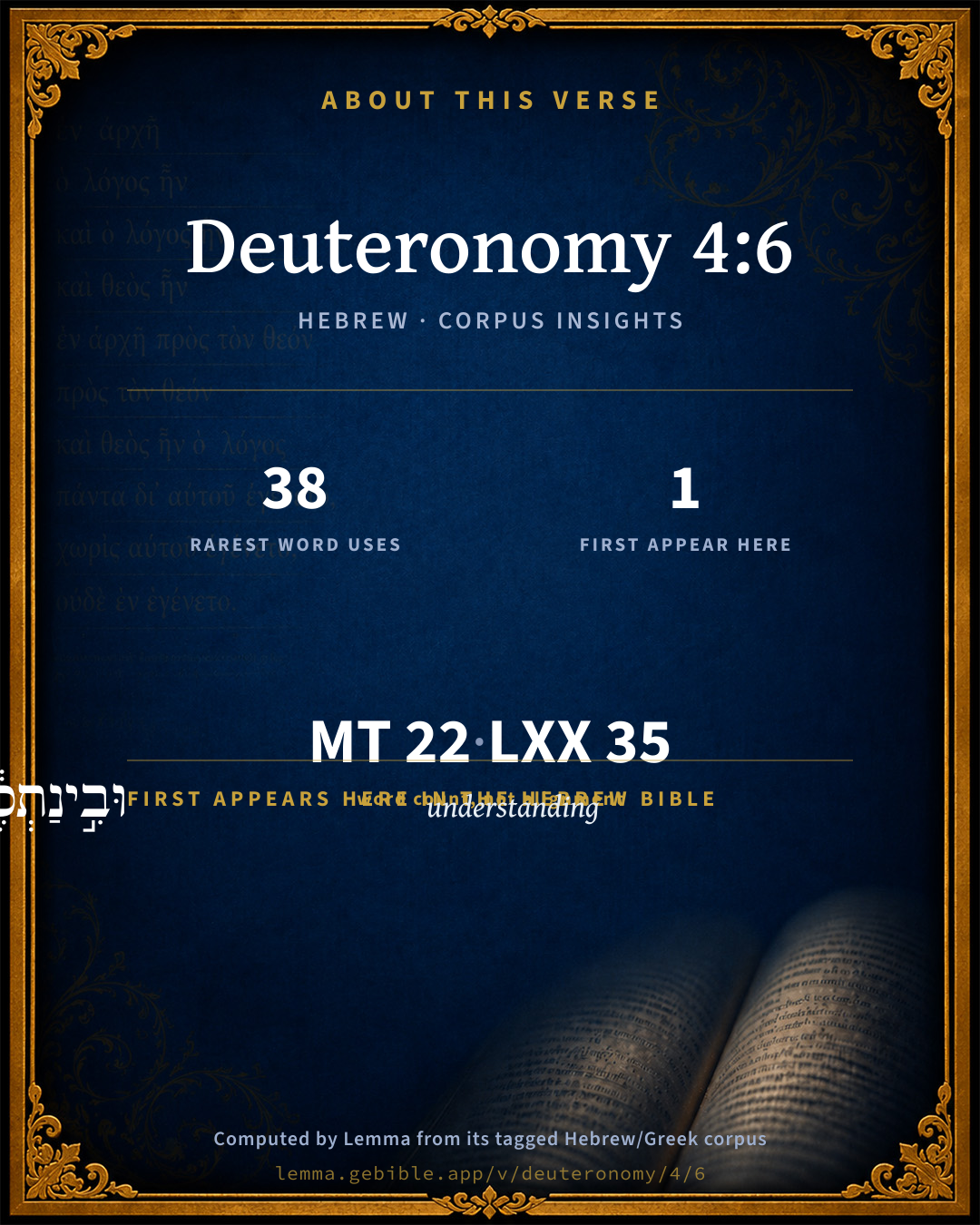
  • 1 first appearance in the Hebrew Bible
Full analysis ↓
Download a study sheet

One document with this verse’s original text, its word-by-word gloss line, the meaning frame, cross-references with their text, attributed commentary, and full source and license credits — printable, and it pastes into notes with its structure intact.

This verse Autodidact and up

Study sheet (.html) Plain text (.txt)

A passage Seminary Student

Up to 50 verses in one chapter. A passage sheet keeps up to 6 commentary sources and 12 cross-references per verse, in the order this page ranks them, and says so on the sheet whenever that leaves anything out. Ask for a single verse and you get the Autodidact verse sheet above.

Everything on this page stays free to read, with no account — the sheet is a download of what is already on screen, not access to it.

Want to remove ads? Support Godless Engineer
Compare translations 3

The same verse in 3 English versions, stacked beneath the original-language interlinear above. Click any original word for its lexicon entry.

Each is an independent rendering of the whole verse — the interlinear is not word-aligned to these translations.

Highlighted words mark where these versions differ — a whole-verse word diff, not a word-by-word alignment.

  • World English Bible Public Domain
    Keep therefore and do them; for this is your wisdom and your understanding in the sight of the peoples, who shall hear all these statutes, and say, Surely this great nation is a wise and understanding people.
  • King James Version Public Domain
    Keep therefore and do them; for this is your wisdom and your understanding in the sight of the nations, which shall hear all these statutes, and say, Surely this great nation is a wise and understanding people.
  • unfoldingWord Literal Text CC BY-SA 4.0
    And you shall keep and do, for it your wisdom and your understanding in the eyes of the peoples who will hear all these statutes and may say, ‘Surely this great nation a wise and understanding people.’

unfoldingWord Literal Text — © unfoldingWord, licensed CC BY-SA 4.0. Word-aligned USFM3 via Door43 (git.door43.org/unfoldingWord/en_ult).

Versions to compare (up to 4)

3 of 4 selected

Show all 18 translations

Every available English version of this verse, each an independent rendering of the whole verse.

  • World English Bible Public Domain
    Keep therefore and do them; for this is your wisdom and your understanding in the sight of the peoples, who shall hear all these statutes, and say, Surely this great nation is a wise and understanding people.
  • Berean Standard Bible Public Domain
    Observe them carefully, for this will show your wisdom and understanding in the sight of the peoples, who will hear of all these statutes and say, “Surely this great nation is a wise and understanding people.”
  • Majority Standard Bible Public Domain
    Observe them carefully, for this will show your wisdom and understanding in the sight of the peoples, who will hear of all these statutes and say, “Surely this great nation is a wise and understanding people.”
  • King James Version Public Domain
    Keep therefore and do them; for this is your wisdom and your understanding in the sight of the nations, which shall hear all these statutes, and say, Surely this great nation is a wise and understanding people.
  • American Standard Version (1901) Public Domain
    Keep therefore and do them; for this is your wisdom and your understanding in the sight of the peoples, that shall hear all these statutes, and say, Surely this great nation is a wise and understanding people.
  • Revised Version (1885) Public Domain
    Keep therefore and do them; for this is your wisdom and your understanding in the sight of the peoples, which shall hear all these statutes, and say, Surely this great nation is a wise and understanding people.
  • Geneva Bible (1599) Public Domain
    Keepe them therefore, and doe them; for that is your wisdome, and your vnderstanding in the sight of the people, which shall heare all these ordinances, and shall say, Onely this people is wise, and of vnderstanding, and a great nation.
  • Douay-Rheims (1899) Public Domain
    And you shall observe, and fulfil them in practice. For this is your wisdom, and understanding in the sight of nations, that hearing all these precepts, they may say: Behold a wise and understanding people, a great nation.
  • Young's Literal Translation Public Domain
    and ye have kept and done `them' (for it `is' your wisdom and your understanding) before the eyes of the peoples who hear all these statutes, and they have said, Only, a people wise and understanding `is' this great nation.
  • Literal Standard Version CC BY-SA 4.0
    and you have kept and done [them] (for it [is] your wisdom and your understanding) before the eyes of the peoples who hear all these statutes, and they have said, Surely a people wise and understanding [is] this great nation.
  • Unlocked Literal Bible CC BY-SA 4.0
    Therefore keep them and do them; for this is your wisdom and your understanding in the sight of the peoples who will hear about all these statutes and say, 'Surely this great nation is a wise and understanding people.'
  • unfoldingWord Literal Text CC BY-SA 4.0
    And you shall keep and do, for it your wisdom and your understanding in the eyes of the peoples who will hear all these statutes and may say, ‘Surely this great nation a wise and understanding people.’
  • Darby Bible Public Domain
    And ye shall keep and do them; for that will be your wisdom and your understanding before the eyes of the peoples that shall hear all these statutes, and say, Verily this great nation is a wise and understanding people.
  • World Messianic Bible Public Domain
    Keep therefore and do them; for this is your wisdom and your understanding in the sight of the peoples who shall hear all these statutes and say, “Surely this great nation is a wise and understanding people.”
  • Webster's Bible Public Domain
    Keep therefore and do them; for this is your wisdom and your understanding in the sight of the nations, which will hear all these statutes, and say, Surely this great nation is a wise and understanding people.
  • Free Bible Version CC BY-SA 4.0
    Be careful to observe them, because this will demonstrate your wisdom and insight to the other people living there who are watching. They will find out about all these rules and say, “The people of this great nation are very wise and have good insight.”
  • Bible in Basic English Public Domain
    So keep these laws and do them; for so will your wisdom and good sense be clear in the eyes of the peoples, who hearing all these laws will say, Truly, this great nation is a wise and far-seeing people.
  • JPS Tanakh (1917) Public Domain
    Observe therefore and do them; for this is your wisdom and your understanding in the sight of the peoples, that, when they hear all these statutes, shall say: 'Surely this great nation is a wise and understanding people.'

Literal Standard Version (2020), Covenant Press — licensed CC BY-SA 4.0. Text via the HelloAO Bible API (eBible.org). Unlocked Literal Bible (unfoldingWord) — licensed CC BY-SA 4.0. Text via the HelloAO Bible API (eBible.org). unfoldingWord Literal Text — © unfoldingWord, licensed CC BY-SA 4.0. Word-aligned USFM3 via Door43 (git.door43.org/unfoldingWord/en_ult). Free Bible Version, Dr. Jonathan Gallagher — licensed CC BY-SA 4.0. Text via the HelloAO Bible API (eBible.org).

Word by word

More ways to search: Search by grammar → Find every occurrence → Compare this word →

Practice this passage: Drill this verse → Learn its vocabulary →

וּבִ֣ינַתְכֶ֔ם
bîynâh
H998
“and · understanding · your”
Conjunction + Noun, Common, Feminine, Singular, Construct + Suffix, Personal, 2nd Person, Masculine, Plural
Part of Speech
Conjunction + Noun
Type
Common
Gender
Feminine
Number
Singular
State
Construct
Full BDB Definition

Origin: from H995

TWOT: 239b

understanding, discernment - act - faculty - object - personified
  1. וּשְׁמַרְתֶּם֮ shâmar H8104 “and · to keep” Conjunction + Verb, Qal, Sequential Perfect, 2nd Person, Masculine, Plural
  2. וַעֲשִׂיתֶם֒ ʻâsâh H6213 “and · to do” Conjunction + Verb, Qal, Sequential Perfect, 2nd Person, Masculine, Plural
  3. כִּ֣י kîy H3588 “that” Conjunction
  4. הִ֤וא hûwʼ H1931 “he” Pronoun, Personal, 3rd Person, Feminine, Singular
  5. חָכְמַתְכֶם֙ chokmâh H2451 “wisdom · your” Noun, Common, Feminine, Singular, Construct + Suffix, Personal, 2nd Person, Masculine, Plural
  6. לְעֵינֵ֖י ʻayin H5869 “to/for · eyes of” Preposition + Noun, Common, Both, Dual, Construct
  7. הָעַמִּ֑ים ʻam H5971 “the · peoples” Particle, Definite Article + Noun, Common, Masculine, Plural, Absolute
  8. אֲשֶׁ֣ר ʼăsher H834 “which” Particle, Relative
  9. יִשְׁמְע֗וּן shâmaʻ H8085 “to hear” Verb, Qal, Imperfect, 3rd Person, Masculine, Plural + Suffix, n
  10. אֵ֚ת ʼêth H853 “-” Particle, Direct Object
  11. כָּל kôl H3605 “all of” Noun, Common, Masculine, Singular, Construct
  12. הַחֻקִּ֣ים chôq H2706 “the · statutes” Particle, Definite Article + Noun, Common, Masculine, Plural, Absolute
  13. הָאֵ֔לֶּה ʼêl-leh H428 “the · these” Particle, Definite Article + Pronoun, Demonstrative, Common, Plural
  14. וְאָמְר֗וּ ʼâmar H559 “and · to say” Conjunction + Verb, Qal, Sequential Perfect, 3rd Person, Common, Plural
  15. רַ֚ק raq H7535 “only” Particle, Accusative
  16. עַם ʻam H5971 “people” Noun, Common, Masculine, Singular, Absolute
  17. חָכָ֣ם châkâm H2450 “wise” Adjective, Adjective, Masculine, Singular, Absolute
  18. וְנָב֔וֹן bîyn H995 “and · understanding” Conjunction + Verb, Niphal, Participle Active, Masculine, Singular, Absolute
  19. הַגּ֥וֹי gôwy H1471 “the · nation” Particle, Definite Article + Noun, Common, Masculine, Singular, Absolute
  20. הַגָּד֖וֹל gâdôwl H1419 “the · great” Particle, Definite Article + Adjective, Adjective, Masculine, Singular, Absolute
  21. הַזֶּֽה zeh H2088 “the · this” Particle, Definite Article + Pronoun, Demonstrative, Masculine, Singular

About this verse

These counts appear in no published source. They are computed here, from the morphology-tagged text and Lemma’s own curated glosses. What Lemma adds →

22
words
21
distinct lemmas
Pentateuch
section

First appearance in Scripture

This word makes its first canonical appearance in the Hebrew Bible here:

  • וּבִ֣ינַתְכֶ֔ם understanding H998

Shared distinctive vocabulary

וּבִ֣ינַתְכֶ֔ם understanding H998 occurs in 38 verses of the Hebrew Bible. Also found in:

Grammatical profile

  • 5 verbs
  • 8 nouns
  • 2 adjectives
  • 3 pronouns
  • 1 conjunction
  • 3 particles

Verb forms

  • וּשְׁמַרְתֶּם֮ Qal · Sequential Perfect
  • וַעֲשִׂיתֶם֒ Qal · Sequential Perfect
  • יִשְׁמְע֗וּן Qal · Imperfect
  • וְאָמְר֗וּ Qal · Sequential Perfect
  • וְנָב֔וֹן Niphal · Participle Active

Repetition

A word recurs within this verse — often emphatic in Hebrew:

  • הָעַמִּ֑ים people H5971 ×2

Hebrew & Septuagint length

In English translation the verse runs 37 words from the Hebrew and 39 from the Septuagint (LXX English) — closely comparable.

A rough comparison of the two English renderings, which tokenize alike — not a word-level alignment.

Word counts can differ between the Hebrew and the Greek without any difference in meaning — e.g. the Hebrew direct-object marker אֵת has no separate Greek word, and Greek often adds the article ὁ.

In the original languages it is 22 Hebrew tokens and 35 Greek tokens — but the two are counted differently (Hebrew bundles its prefixes and suffixes into one token; the Greek is in lemma form), so that isn’t a like-for-like length.

Cross-references

17

Topical passages linked to Deuteronomy 4:6 in the Treasury of Scripture Knowledge — connected by theme and wording, ordered by reader-vote popularity; previews shown in the World English Bible.

  • Job 28:28 To man he said, 'Behold, the fear of the Lord, that is wisdom. To depart from evil is understanding.'"
  • Psalms 111:10 The fear of Yahweh is the beginning of wisdom. All those who do his work have a good understanding. His praise endures forever!
  • 2 Timothy 3:15 From infancy, you have known the sacred writings which are able to make you wise for salvation through faith, which is in Christ Jesus.
  • 1 Kings 4:34 There came of all peoples to hear the wisdom of Solomon, from all kings of the earth, who had heard of his wisdom.
  • 1 Kings 10:6–9 She said to the king, It was a true report that I heard in my own land of your acts, and of your wisdom.
  • Psalms 19:7 Yahweh's law is perfect, restoring the soul. Yahweh's testimony is sure, making wise the simple.
  • Proverbs 1:7 The fear of Yahweh is the beginning of knowledge; But the foolish despise wisdom and instruction.
  • Jeremiah 8:9 The wise men are disappointed, they are dismayed and taken: behold, they have rejected the word of Yahweh; and what manner of wisdom is in them?
  • James 3:13 Who is wise and understanding among you? Let him show by his good conduct that his deeds are done in gentleness of wisdom.
  • Deuteronomy 30:19–20 I call heaven and earth to witness against you this day, that I have set before you life and death, the blessing and the curse: therefore choose life, that you may live, you and your seed;
  • Psalms 119:98–100 Your commandments make me wiser than my enemies, For your commandments are always with me.
  • Proverbs 14:8 The wisdom of the prudent is to think about his way, But the folly of fools is deceit.
  • Daniel 1:20 In every matter of wisdom and understanding, concerning which the king inquired of them, he found them ten times better than all the magicians and enchanters who were in all his realm.
  • Daniel 4:9 Belteshazzar, master of the magicians, because I know that the spirit of the holy gods is in you, and no secret troubles you, tell me the visions of my dream that I have seen, and the interpretation of it.
  • Daniel 5:11–16 There is a man in your kingdom, in whom is the spirit of the holy gods; and in the days of your father light and understanding and wisdom, like the wisdom of the gods, were found in him; and the king Nebuchadnezzar your father, the king, [I say], your father, made him master of the magicians, enchanters, Chaldeans, and soothsayers;
  • Zechariah 8:20–23 Thus says Yahweh of Hosts: "Many peoples, and the inhabitants of many cities will yet come;
  • Malachi 3:12 "All nations shall call you blessed, for you will be a delightful land," says Yahweh of Hosts.

Cross-references courtesy of OpenBible.info (CC BY 4.0).

Hebrew and Greek witnesses Masoretic Hebrew ↔ Greek Septuagint

The same verse in the two great witnesses to the Old Testament, shown verse-for-verse.

These are two independent witnesses, not word-aligned to each other, and the Septuagint is shown in lemma (dictionary) form.

Hebrew Deuteronomy 4:6 Masoretic · Westminster Leningrad Codex

וּשְׁמַרְתֶּם֮ וַעֲשִׂיתֶם֒ כִּ֣י הִ֤וא חָכְמַתְכֶם֙ וּבִ֣ינַתְכֶ֔ם לְעֵינֵ֖י הָעַמִּ֑ים אֲשֶׁ֣ר יִשְׁמְע֗וּן אֵ֚ת כָּל הַחֻקִּ֣ים הָאֵ֔לֶּה וְאָמְר֗וּ רַ֚ק עַם חָכָ֣ם וְנָב֔וֹן הַגּ֥וֹי הַגָּד֖וֹל הַזֶּֽה

Keep therefore and do them; for this is your wisdom and your understanding in the sight of the peoples, who shall hear all these statutes, and say, Surely this great nation is a wise and understanding people.

World English Bible · Public Domain

Greek LXX Deuteronomy 4:6 Septuagint · lemma form

καί φυλάσσω καί ποιέω ὅτι οὗτος ὁ σοφία σύ καί ὁ σύνεσις ἐναντίον πᾶς ὁ ἔθνος ὅσος ἐάν ἀκούω πᾶς ὁ δικαίωμα οὗτος καί εἶπον ἰδού λαός σοφός καί ἐπιστήμων ὁ ἔθνος ὁ μέγας οὗτος

And you⌃ shall keep and do them: for this is your wisdom and understanding before all nations, as many as shall hear all these ordinances; and they shall say, Behold, this great nation is a wise and understanding people.

LXX2012 (modern English Septuagint) · Public Domain

Hebrew: Westminster Leningrad Codex (CC BY 4.0). Greek: Septuagint (public domain); English from LXX2012 (modern English Septuagint) (Public Domain). How the Septuagint differs from the Hebrew →

Targum (Aramaic paraphrase)

2

The Targum is the ancient Jewish Aramaic paraphrase of the Hebrew Scriptures — an interpretive translation, not the Hebrew text itself. Onkelos (literal) and Pseudo-Jonathan (expansive) render the Torah, and Jonathan the Prophets. Coverage is partial: where no permissively-licensed English translation exists for a verse, only the Aramaic is shown. This is verse-level text, not a word-by-word alignment to the Hebrew.

  1. Targum Onkelos Torah (Genesis–Deuteronomy)
    וְתִטְרוּן וְתַעְבְּדוּן אֲרֵי הִיא חָכְמַתְכוֹן וְסוּכְלְתָנוּתְכוֹן לְעֵינֵי עַמְמַיָא דִי יִשְׁמְעוּן יָת כָּל קְיָמַיָא הָאִלֵין וְיֵימְרוּן לְחוֹד עַם חַכִּים וְסוּכְלְתָן עַמָא רַבָּא הָדֵין

    (no public-domain English translation for this verse)

    Targum Onkelos — Aramaic: “Onkelos Genesis” (public domain); “Onkelos Exodus” (public domain); “Onkelos Leviticus” (public domain); “Onkelos Numbers” (public domain); “Onkelos Deuteronomy” (public domain). English: “Sefaria Community Translation” (CC0 1.0 (public-domain dedication)); “J.W. Etheridge. The Targums of Onkelos and Jonathan Ben Uzziel on the Pentateuch. London: Longmans, Green, 1862” (public domain). Text via Sefaria.

  2. Targum Pseudo-Jonathan Torah (Genesis–Deuteronomy)
    וְתִנְטְרוּן וְתַעַבְדוּן יַת אוֹרַיְיתָא אֲרוּם הִוא חָכְמַתְכוֹן וְסוּכְלְתָנוּתְכוֹן לְמֵיחְמֵי עַמְמַיָא דְיִשְׁמְעוּן יַת כָּל קְיָימַיָא הָאִילֵין וְיֵימְרוּן לְחוֹד עַם חַכִּים וְסוּכְלְתָן עַמָא רַבָּא הָדֵין

    So shall you observe and perform the law; for it is your wisdom and understanding in the sight of the peoples, who will hear all these statutes, and will say: How wise and intelligent is this great people!

    Targum Pseudo-Jonathan — Aramaic: “Targum Jonathan on Genesis” (public domain); “Targum Jonathan on Exodus” (public domain); “Targum Jonathan on Leviticus” (public domain); “Targum Jonathan on Numbers” (public domain); “Targum Jonathan on Deuteronomy” (public domain). English: “The Targum of Jonathan ben Uzziel, trans. J. W. Etheridge, London, 1862” (public domain). Text via Sefaria.

Commentary

Notes on Deuteronomy 4:6 from classic Christian and Jewish commentators (each source and its license shown beneath its notes). The classic Christian expositions comment on the surrounding passage and are grouped to its opening verse, so a note may address several verses; the Jewish commentaries on the Tanakh (Rashi and others) are per-verse, so they appear only where the commentator wrote on this verse.

Lemma curates 59 commentaries, every one of them public domain or Creative Commons licensed, each selected and text-cleaned for this edition rather than reprinted as found. About our sources →

Trapp's Complete Commentary

John Trapp

Deu 4:6 Keep therefore and do [them]; for this [is] your wisdom and your understanding in the sight of the nations, which shall hear all these statutes, and say, Surely this great nation [is] a wise and understanding people.

Ver. 6. For this is your wisdom.] Omnis sapientia hominis in hoc uno est, saith Lactantius, {a} ut Deum cognoscat et colat: hoc nostrum dogma, hac sententia est: To know and do the will of God, this is the whole of man’s wisdom. "The heart of the wise man is at his right hand," {Ecc 10:2} as teaching it to put things in practice, and to "prove by experience what that good, and holy, and acceptable will of God is." {Rom 12:2}

A wise and understanding people.] The Spaniards are said to seem wise and are fools; the French to seem fools and are wise; the Portuguese neither to be wise, nor so much as to seem so; the Italians both to seem wise and to be so. But may not that of the prophet be fitly applied to them all, "Behold, they have rejected the Word of the Lord, and what wisdom is in them?" {Jer 8:9}

{a} Lactan., Inst., lib. iii, cap. 30.

John Trapp, A Commentary or Exposition upon All the Books of the Old and New Testament (1647–1656) — public domain. Text from a community e-Sword module.

Joseph Benson's Commentary

Deu 4:6. In the sight of the nations — For though the generality of heathen, in the latter ages, did, through inveterate prejudices, condemn the laws of the Hebrews, yet it is certain the wisest heathen did highly approve of them, so that they made use of divers of them, and translated them into their own laws and constitutions; and Moses, the giver of these laws, hath been mentioned with great honour for his wisdom and learning by many of them. And particularly the old heathen oracle expressly said, “That the Chaldeans, or Hebrews, who worshipped the uncreated God, were the only wise men.”

Joseph Benson's Commentary on the Old and New Testaments (1811–1818) — public domain. Text from a community e-Sword module.

Tyndale Open Study Notes

Tyndale Open Resources

4:6 Obey . . . wisdom and intelligence: Wisdom is linked to obedience—obeying the Lord is the essence of wisdom (see 10:12-13; Prov 1:7; 9:10; 15:33). If God’s people were wise and prudent enough to keep the Lord’s perfect covenant, all the world would marvel.

Tyndale Open Study Notes — © Tyndale Open Resources, licensed CC BY-SA 4.0. Text via the HelloAO Bible API.

Geneva Bible (1599)

Geneva Bible translators

Because all men naturally desire wisdom, he showeth how to attain unto it.

Or, surely.

Geneva Bible (1599) marginal notes — public domain. Text via Bolls.life.

Adam Clarke's Commentary

Verse 6. Keep - and do them; for this is your wisdom] There was no mode of worship at this time on the face or the earth that was not wicked, obscene, puerile, foolish, or ridiculous, except that established by God himself among the Israelites. And every part of this, taken in its connection and reference, may be truly called a wise and reasonable service.

The nations - and say, Surely this great nation is a wise and understanding people.] Almost all the nations in the earth showed that they had formed this opinion of the Jews, by borrowing from them the principal part of their civil code. Take away what Asia and Europe, whether ancient or modern, have borrowed from the Mosaic laws, and you leave little behind that can be called excellent.

Adam Clarke's Commentary on the Bible (1810–1826) — public domain. Text from a community e-Sword/MySword module.

Ellicott's Commentary for English Readers

(6) This is your wisdom and your understanding in the sight of the nations.—The laws of Jehovah in Israel, and the constant presence of Jehovah with Israel, would make an impression upon the world that it would not be easy to resist. For, he adds, “what nation is there so great, that hath God so nigh unto them?”

A Bible Commentary for English Readers, edited by Charles John Ellicott (1878–1897) — public domain. Text from a community e-Sword module.

The Cambridge Bible for Schools and Colleges

gen. ed. J. J. S. Perowne

6. Keep therefore and do them] So eight times in D (as also eight in P); the similar keep (or observe) to do occurs some 20 times both with Sg. and Pl. This practical emphasis is characteristic of the Book. Men are often content to remember the commandments.

for this is your wisdom and your understanding] Not your mere possession of the law, but this your doing of it, shall be your intellectual strength. Cp. Joh_7:17.

in the sight of the peoples, which shall … say] So actually it came to pass. Loyalty to the Law ensured not only the national existence of Israel (see on Deu_4:1), but their fame among the Gentiles; who shall say, This great nation is a wise and understanding people. Most signally fulfilled by the fame of the Jews among illuminated Greeks after Alexander’s conquest of Asia. Hecataeus of Abdera, Clearchus, Theophrastus, Megasthenes, Hermippus all call the Jews the philosophers of the East (Jerusalem, ii. 401, etc.). The cause of such a fame was not of course the wise details of the Law, nor even that the nation possessed and lived by it, in a way unparalleled by any nation in W. Asia—the Greeks find the nearest parallel in India—but the religious spirit of the Law, its unique monotheism. And so the discourse now proceeds to speak of Israel’s God.

Surely] Heb. raḳ. See on Deu_10:15.

The Cambridge Bible for Schools and Colleges (gen. ed. J. J. S. Perowne; Cambridge University Press, 1878–1918) — public domain. Text from a community e-Sword module.

John Gill's Exposition

Keep therefore and do them,..... Observe them, take notice of what is expressed by them, and perform them, both as to matter and manner, as they require:

for this is your wisdom and your understanding in the sight of the nations; that is, their wisdom and understanding would appear to other nations by their observance of the commands of God:

which hear all these statutes; which they had a report, got knowledge of by some of the philosophers who travelled into those parts, and by the translation of the Bible into the Greek language:

and say, surely this great nation is a wise and understanding people; that had such a body of laws, in which they were instructed, and according to which they were governed, and in which they walked; that were so agreeable to reason, truth, justice, and equity; insomuch that so far as they became known they were admired and copied after, both by Greeks and Romans; and hence it was that the oracle (f) declared, that only the Chaldeans and Hebrews were a wise people; the Hebrews came from Chaldea, as Abraham the father of them.

(f) Apud Porphyr. in Euseb Evangel. Praepar. l. 9. c. 10. p. 413.

John Gill's Exposition of the Whole Bible (1746–1763) — public domain (CC PDM 1.0). Text via the HelloAO Bible API.

Haydock's Catholic Bible Commentary

This is a proof of your wisdom, &c., if you observe these commands. Your conduct will excite the admiration of all. (Menochius) --- Solomon often inculcates the same truths, Proverbs i. 7., and Ecclesiasticus i. 34. Even profane writers applauded the laws and fidelity of the Jews. See Josephus, Jewish Wars i. 5.; Strabo xvi. (Calmet)

George Leo Haydock (1774–1849), Haydock's Catholic Family Bible and Commentary, 1859 edition — public domain. Excludes Psalms (Douay-Rheims chapter numbering differs from Protestant) and Deuterocanonical books (Catholic canon only).

Matthew Poole's English Annotations

For though the generality of heathen people in the latter and degenerate ages of the world, did, through inveterate prejudices, and for their own lusts and interest, condemn the laws of the Hebrews as foolish and absurd, yet it is most certain that divers of the wisest heathens did highly approve of them, so far that they made use of divers of them, and translated them into their own laws and constitutions; and Moses, the giver of these laws, hath been mentioned with great honour for his wisdom and learning by many of them. And particularly the old heathen oracle expressly said, that the Chaldeans or Hebrews, who worshipped the uncreated God, were the only wise men.

Matthew Poole's English Annotations on the Holy Bible (1683–1685) — public domain. Text from a community e-Sword/MySword module.

The Pulpit Commentary

Vers. 6-10. A nation"s glory.

I A NATION POSSESSING GOD"S WORD IS SUPREMELY FAVORED. (Ver. 8.) Even to have such a Law as Israel possessed exalted her to a position of unique greatness. The knowledge of the true God light on the great principles of conduct-equitable statutes-institutions adapted to promote material, moral, and spiritual well-being. Our own nation is exceptionally favored in the plentiful enjoyment of religious privileges Bibles, churches, Sabbath schools, evangelistic agencies, Christian literature, etc., bringing the highest knowledge within the reach of the humblest; while the laws, institutions, etc., under which we live, as the fruit of a Christian civilization, are not surpassed by any on the earth. God has indeed, favored us to an unexampled degree in every religious respect.

II A NATION ENLIGHTENED BY GOD"S WORD IS SUPREMELY WISE. To have is much, but to be truly "a wise and understanding people," we must "keep and do" (ver. 6). It is not in knowing, but in adopting, the wise course that we show ourselves truly wise. Wisdom is the course that conduces to the formation of a brave, noble, resolute, happy, and contented people; and the nation that loves God"s Word, fears God himself, and applies the teaching he has given it in the various spheres of domestic, social, commercial, and political existence, is indubitably in possession of that wisdom. It is to be regretted that the nations most peculiarly privileged do not always set that store upon their privileges which they should do, or make a good use of them. The amount of irreligion, infidelity, and general indifference to the Word of God in our own land is a startling omen for the future. Britain"s greatness will soon wane if she abandons her respect for the Bible, the Sabbath, and the guiding principles of revelation,

III A NATION ORDERING ITSELF BY GOD"S WORD IS SUPREMELY EMINENT. (Ver. 7.) Its prosperity:

1. Rests on a solid foundation.

2. Is built up under conditions that ensure its permanence.

3. Is secured by a special blessing of God. And this is a matter admitting of ample historical verification.

Compare:

1. Pagan nations with Christian.

2. Unbelieving nations with believing (France: Britain).

3. Roman Catholic nations with Protestant (see Laveleye on "Protestantism and Catholicism in their bearing upon the Liberty and Prosperity of Nations").

1. Sabbath-desecrating nations with Sabbath-keeping. It will be found that the Bible-loving, Bible-obeying, Sabbath-keeping nations exhibit:

1. an intellectual superiority;

2. an ethical superiority;

3. a superiority in political institutions;

4. a superiority in material respects (trade, commerce, wealth, etc.).

IV A NATION OBEYING GOD"S WORD WILL HAVE THE SOURCE OF ITS GREATNESS ACKNOWLEDGED BY OTHERS. (Ver. 6.) They will not only own to its eminence, but they will discern its true cause, and acknowledge that it springs from its religious faithfulness. Numerous testimonies of this kind exist to the source of the national greatness of our own country.

Lessons

1. Value our religious privileges.

2. Seek the furtherance of religion in the community.

3. Be diligent in the training of our children (ver. 9).

4. Extend our blessings to others. J.O.

The Pulpit Commentary (1880–1919), ed. H.D.M. Spence-Jones & Joseph S. Exell — public domain. Text from a community e-Sword module.

John Wesley's Explanatory Notes

In the sight of the nations - For though the generality of Heathens in the latter ages, did through inveterate prejudices condemn the laws of the Hebrew, yet it is certain, the wisest Heathens did highly approve of them, so that they made use of divers of them, and translated them into their own laws and constitutions; and Moses, the giver of these laws, hath been mentioned with great honour for his wisdom and learning by many of them. And particularly the old Heathen oracle expressly said, that the Chaldeans or Hebrew, who worshipped the uncreated God, were the only wise men.

John Wesley, Explanatory Notes Upon the Whole Bible (1754–1765) — public domain. Text via the GEBible commentary corpus.

Rashi

Rabbi Shlomo Yitzchaki (Rashi)

ושמרתם AND YE SHALL BE ON THE WATCH [TO DO] — This refers to the study of the laws (Sifrei Devarim 58),

ועשיתם — this must be explained according to what it implies: AND YE SHALL DO.

כי היא חכמתכם ובינתכם וגו׳ FOR THIS IS YOUR WISDOM AND UNDERSTANDING [IN THE EYES OF THE PEOPLES] — i.e. through this ye will be accounted wise and understanding men in the eyes of the peoples.

Rashi on the Tanakh — English translations: “The Judaica Press complete Tanach with Rashi, translated by A. J. Rosenberg” (CC BY 4.0); “Pentateuch with Rashi's commentary by M. Rosenbaum and A.M. Silbermann, 1929-1934” (public domain); “The Metsudah Tanach series, Lakewood, N.J” (CC BY 4.0); and “The Book of Joshua, Metsudah Publications, 1997” (CC BY 4.0). Text via Sefaria.

Lesson kit

Teaching starters — assembled from the data on this page, not authored interpretation. Every prompt links to the verse data it draws on. Edit before teaching.

Deuteronomy, in the Pentateuch, opens this verse with 22 words (21 distinct Hebrew lemmas). Its most distinctive word is bîynâh (“understanding”). A historical commentator’s framing appears above. Read the whole chapter for the surrounding context.

Discussion questions

  1. What does “understanding” (bîynâh) contribute to the verse as a whole?
  2. This is the first place “understanding” appears in Scripture (first appears here). What does its debut here establish?
  3. How does 1 Chronicles 12:32, which shares the word «understanding», read alongside this verse?
  4. What does the repetition of “people” (2× in this one verse) do in this verse?
  5. These translations render this verse differently; the difference is in the English rendering, not the original. What questions does that raise?
  6. «וּשְׁמַרְתֶּם֮» is a Qal Sequential Perfect verb. How does that grammatical form shape the action described?
  7. Compare how Trapp's Complete Commentary and Joseph Benson's Commentary read this verse. Where do they agree or differ?

Things to notice

Reading settings

Reading text

Shown beneath each verse's original-language words.

Old Testament
Old Testament edition

Read the OT as the Masoretic Hebrew (MT) or the Greek Septuagint (LXX).

English shown for the Greek Septuagint (in the Hebrew ↔ Greek comparison).

Comparing translations? Open the Compare panel on any verse page to stack up to four side by side.