
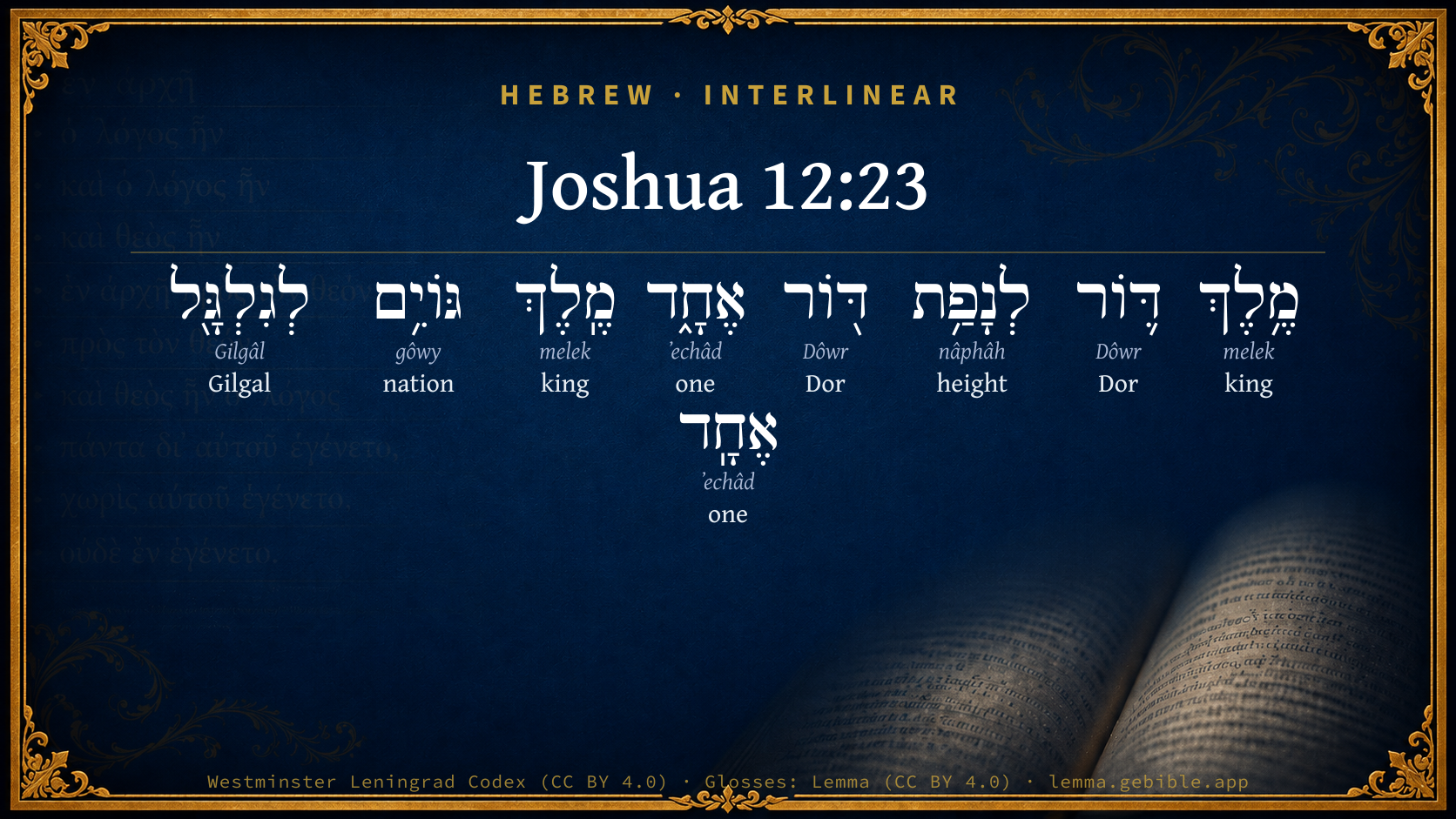
Joshua 12:23

Hebrew (Westminster Leningrad Codex) Joshua 12:23 appears in the Hebrew Old Testament. The text above is from the Westminster Leningrad Codex. Each word links to its Strong’s number, a concise gloss, and parsing drawn from the Open Scriptures Hebrew Bible morphology. Click any word for its full Brown-Driver-Briggs (BDB) entry.
Download image
Cite this verse

Joshua 12:23 (World English Bible). Public Domain. Lemma interlinear Bible study tool, https://lemma.gebible.app/v/joshua/12/23.

Show BibTeX & RIS
BibTeX
RIS
English Translation
the king of Dor in the height of Dor, one; the king of Goiim in Gilgal, one;
World English Bible · Public Domain
Download a study sheet

One document with this verse’s original text, its word-by-word gloss line, the meaning frame, cross-references with their text, attributed commentary, and full source and license credits — printable, and it pastes into notes with its structure intact.

This verse Autodidact and up

Study sheet (.html) Plain text (.txt)

A passage Seminary Student

Up to 50 verses in one chapter. A passage sheet keeps up to 6 commentary sources and 12 cross-references per verse, in the order this page ranks them, and says so on the sheet whenever that leaves anything out. Ask for a single verse and you get the Autodidact verse sheet above.

Everything on this page stays free to read, with no account — the sheet is a download of what is already on screen, not access to it.

Want to remove ads? Support Godless Engineer
Compare translations 3

The same verse in 3 English versions, stacked beneath the original-language interlinear above. Click any original word for its lexicon entry.

Each is an independent rendering of the whole verse — the interlinear is not word-aligned to these translations.

Highlighted words mark where these versions differ — a whole-verse word diff, not a word-by-word alignment.

  • World English Bible Public Domain
    the king of Dor in the height of Dor, one; the king of Goiim in Gilgal, one;
  • King James Version Public Domain
    The king of Dor in the coast of Dor, one; the king of the nations of Gilgal, one;
  • unfoldingWord Literal Text CC BY-SA 4.0
    the king of Dor in Naphoth Dor, one; the king of Goiim in Gilgal, one;

unfoldingWord Literal Text — © unfoldingWord, licensed CC BY-SA 4.0. Word-aligned USFM3 via Door43 (git.door43.org/unfoldingWord/en_ult).

Versions to compare (up to 4)

3 of 4 selected

Show all 18 translations

Every available English version of this verse, each an independent rendering of the whole verse.

  • World English Bible Public Domain
    the king of Dor in the height of Dor, one; the king of Goiim in Gilgal, one;
  • Berean Standard Bible Public Domain
    the king of Dor in Naphath-dor, one; the king of Goiim in Gilgal, one;
  • Majority Standard Bible Public Domain
    the king of Dor in Naphath-dor, one; the king of Goiim in Gilgal, one;
  • King James Version Public Domain
    The king of Dor in the coast of Dor, one; the king of the nations of Gilgal, one;
  • American Standard Version (1901) Public Domain
    the king of Dor in the height of Dor, one; the king of Goiim in Gilgal, one;
  • Revised Version (1885) Public Domain
    the king of Dor in the height of Dor, one; the king of Goiim in Gilgal, one;
  • Geneva Bible (1599) Public Domain
    The King of Dor, in the countrey of Dor, one: the King of the nations of Gilgal, one:
  • Douay-Rheims (1899) Public Domain
    The king of Dor, and of the province of Dor one, the king of the nations of Galgal one,
  • Young's Literal Translation Public Domain
    The king of Dor, at the elevation of Dor, one; The king of the Goyim of Gilgal, one;
  • Literal Standard Version CC BY-SA 4.0
    the king of Dor, at the elevation of Dor, one; the king of the nations of Gilgal, one;
  • Unlocked Literal Bible CC BY-SA 4.0
    the king of Dor in Naphoth Dor, the king of Goyim in Gilgal,
  • unfoldingWord Literal Text CC BY-SA 4.0
    the king of Dor in Naphoth Dor, one; the king of Goiim in Gilgal, one;
  • Darby Bible Public Domain
    the king of Dor in the upland of Dor, one; the king of Goim, at Gilgal, one;
  • World Messianic Bible Public Domain
    the king of Dor in the height of Dor, one; the king of Goiim in Gilgal, one;
  • Webster's Bible Public Domain
    The king of Dor in the border of Dor, one; the king of the nations of Gilgal, one;
  • Free Bible Version CC BY-SA 4.0
    The king of Dor in Naphath-dor. The king of Goiim in Gilgal.
  • Bible in Basic English Public Domain
    The king of Dor on the hill of Dor, one; the king of Goiim in Gilgal, one;
  • JPS Tanakh (1917) Public Domain
    the king of Dor in the region of Dor, one; the king of Goiim in the Gilgal, one;

Literal Standard Version (2020), Covenant Press — licensed CC BY-SA 4.0. Text via the HelloAO Bible API (eBible.org). Unlocked Literal Bible (unfoldingWord) — licensed CC BY-SA 4.0. Text via the HelloAO Bible API (eBible.org). unfoldingWord Literal Text — © unfoldingWord, licensed CC BY-SA 4.0. Word-aligned USFM3 via Door43 (git.door43.org/unfoldingWord/en_ult). Free Bible Version, Dr. Jonathan Gallagher — licensed CC BY-SA 4.0. Text via the HelloAO Bible API (eBible.org).

Word by word

More ways to search: Search by grammar → Find every occurrence → Compare this word →

Practice this passage: Drill this verse → Learn its vocabulary →

About this verse

These counts appear in no published source. They are computed here, from the morphology-tagged text and Lemma’s own curated glosses. What Lemma adds →

9
words
6
distinct lemmas
Historical
section

Notable vocabulary

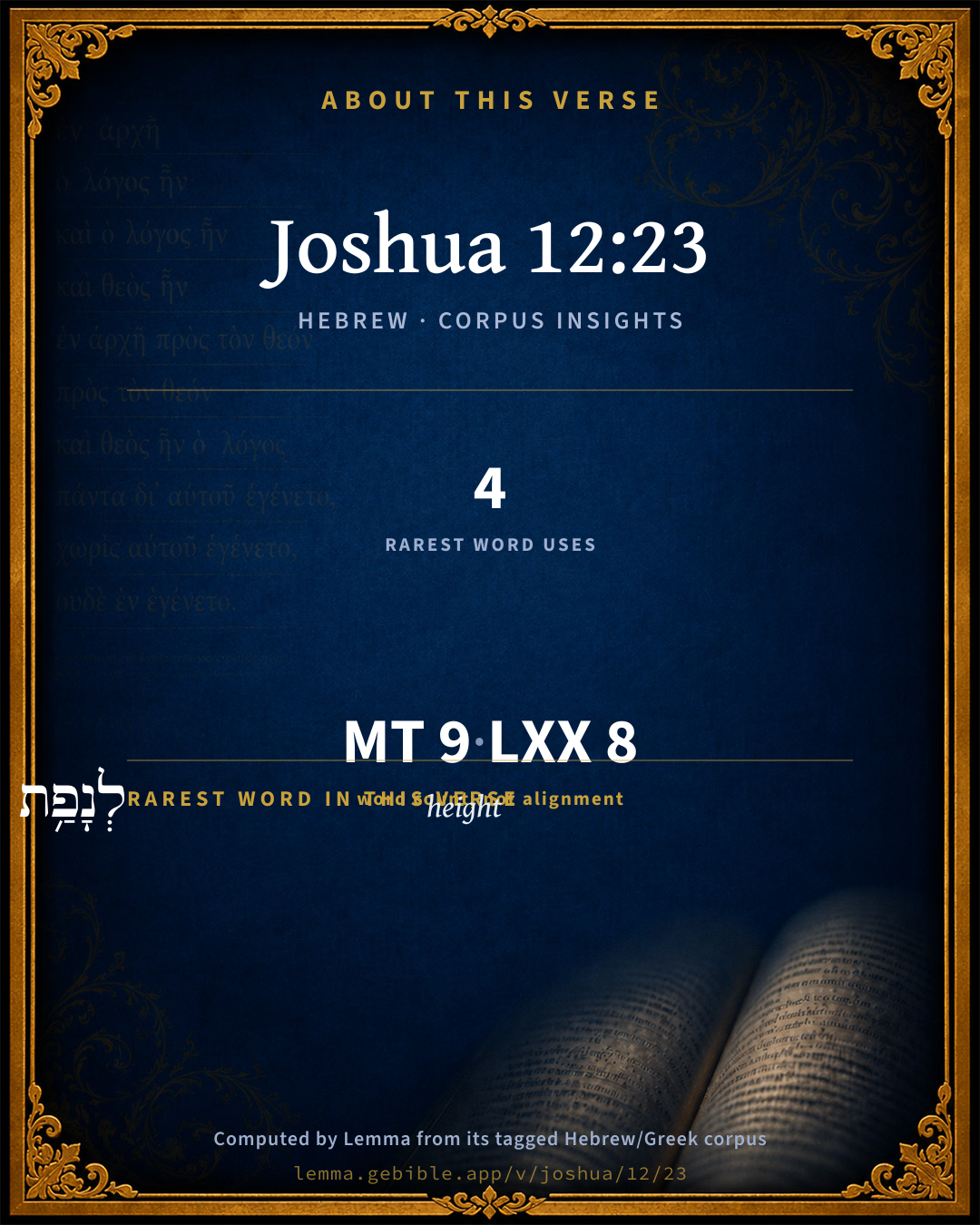
The rarest word here is לְנָפַ֥ת height H5299 — appearing just 4 times in the whole Hebrew Bible.

Shared distinctive vocabulary

לְנָפַ֥ת height H5299 occurs in 4 verses of the Hebrew Bible. Also found in:

Grammatical profile

  • 7 nouns
  • 2 adjectives

Repetition

Words recur within this verse — often emphatic in Hebrew:

  • מֶ֥לֶךְ king H4428 ×2
  • דּ֛וֹר Dor H1756 ×2
  • אֶחָ֑ד one H259 ×2

Hebrew & Septuagint length

In English translation the verse runs 17 words from the Hebrew and 13 from the Septuagint (LXX English) — closely comparable.

A rough comparison of the two English renderings, which tokenize alike — not a word-level alignment.

Word counts can differ between the Hebrew and the Greek without any difference in meaning — e.g. the Hebrew direct-object marker אֵת has no separate Greek word, and Greek often adds the article ὁ.

In the original languages it is 9 Hebrew tokens and 8 Greek tokens — but the two are counted differently (Hebrew bundles its prefixes and suffixes into one token; the Greek is in lemma form), so that isn’t a like-for-like length.

Cross-references

6

Topical passages linked to Joshua 12:23 in the Treasury of Scripture Knowledge — connected by theme and wording, ordered by reader-vote popularity; previews shown in the World English Bible.

  • Joshua 11:2 and to the kings who were on the north, in the hill-country, and in the Arabah south of Chinneroth, and in the lowland, and in the heights of Dor on the west,
  • Genesis 14:1–2 It happened in the days of Amraphel, king of Shinar, Arioch, king of Ellasar, Chedorlaomer, king of Elam, and Tidal, king of Goiim,
  • Joshua 4:19 The people came up out of the Jordan on the tenth day of the first month, and encamped in Gilgal, on the east border of Jericho.
  • Joshua 5:9–10 Yahweh said to Joshua, This day have I rolled away the reproach of Egypt from off you. Therefore the name of that place was called Gilgal, to this day.
  • Joshua 17:11 Manasseh had in Issachar and in Asher Beth-shean and its towns, and Ibleam and its towns, and the inhabitants of Dor and its towns, and the inhabitants of En-dor and its towns, and the inhabitants of Taanach and its towns, and the inhabitants of Megiddo and its towns, even the three heights.
  • Isaiah 9:1 But there shall be no gloom to her who was in anguish. In the former time he brought into contempt the land of Zebulun and the land of Naphtali; but in the latter time has he made it glorious, by the way of the sea, beyond the Jordan, Galilee of the nations.

Cross-references courtesy of OpenBible.info (CC BY 4.0).

Hebrew and Greek witnesses Masoretic Hebrew ↔ Greek Septuagint

The same verse in the two great witnesses to the Old Testament, shown verse-for-verse.

These are two independent witnesses, not word-aligned to each other, and the Septuagint is shown in lemma (dictionary) form.

Hebrew Joshua 12:23 Masoretic · Westminster Leningrad Codex

מֶ֥לֶךְ דּ֛וֹר לְנָפַ֥ת דּ֖וֹר אֶחָ֑ד מֶֽלֶךְ גּוֹיִ֥ם לְגִלְגָּ֖ל אֶחָֽד

the king of Dor in the height of Dor, one; the king of Goiim in Gilgal, one;

World English Bible · Public Domain

Greek LXX Joshua 12:23 Septuagint · lemma form

βασιλεύς δωρ ὁ ναφεδδωρ βασιλεύς γωιμ ὁ γαλιλαία

the king of Odollam belonging to Phennealdor, the king of Gei of Galilee:

LXX2012 (modern English Septuagint) · Public Domain

On this verse, John Gill's Exposition discusses the Septuagint’s reading. Read the note in Commentary ↓

Hebrew: Westminster Leningrad Codex (CC BY 4.0). Greek: Septuagint (public domain); English from LXX2012 (modern English Septuagint) (Public Domain). How the Septuagint differs from the Hebrew →

Targum (Aramaic paraphrase)

1

The Targum is the ancient Jewish Aramaic paraphrase of the Hebrew Scriptures — an interpretive translation, not the Hebrew text itself. Onkelos (literal) and Pseudo-Jonathan (expansive) render the Torah, and Jonathan the Prophets. Coverage is partial: where no permissively-licensed English translation exists for a verse, only the Aramaic is shown. This is verse-level text, not a word-by-word alignment to the Hebrew.

  1. Targum Jonathan Prophets (Joshua–Malachi)
    מַלְכָּא דְדוֹר לְפִלְכֵי דוֹר חָד מַלְכָּא דְעַמְמִין לְגִלְגָלָא חָד:

    (no public-domain English translation for this verse)

    Targum Jonathan — Aramaic: “Mikraot Gedolot” (public domain). English: “Sefaria Community Translation” (CC0 1.0 (public-domain dedication)); “London "Chaldee Paraphrase," 1871” (public domain). Text via Sefaria.

Commentary

Notes on Joshua 12:23 from classic Christian and Jewish commentators (each source and its license shown beneath its notes). The classic Christian expositions comment on the surrounding passage and are grouped to its opening verse, so a note may address several verses; the Jewish commentaries on the Tanakh (Rashi and others) are per-verse, so they appear only where the commentator wrote on this verse.

Lemma curates 59 commentaries, every one of them public domain or Creative Commons licensed, each selected and text-cleaned for this edition rather than reprinted as found. About our sources →

Joseph Benson's Commentary

Jos 12:23. The king of Gilgal — This Gilgal is not the place where Joshua encamped when he came over Jordan; for there was no city there, nor any king of that country, but the king of Jericho. That place had also its name from the circumcision of the Israelites there, chap. Jos 5:9.

Joseph Benson's Commentary on the Old and New Testaments (1811–1818) — public domain. Text from a community e-Sword module.

Adam Clarke's Commentary

Verse 23. The king of Dor] The city of this name fell to the lot of the children of Manasseh, Jos 17:11. Bochart observes that it was one of the oldest royal cities in Phoenicia. The Canaanites held it, Jdg 1:27. Antiochus Sydetes besieged it in aftertimes, but could not make himself master of it. See Bochart, Canaan, lib. i., c. 28, and Dodd.

The king of the nations of Gilgal] This is supposed to mean the higher Galilee, surnamed Galilee of the Gentiles or, nations, as the Hebrew word גוים goyim means. On this ground it should be read king of Galilee of the nations. Others suppose it is the same country with that of which Tidal was king, see Ge 14:1. The place is very uncertain, and commentators have rendered it more so by their conjectures.

Adam Clarke's Commentary on the Bible (1810–1826) — public domain. Text from a community e-Sword/MySword module.

The Cambridge Bible for Schools and Colleges

gen. ed. J. J. S. Perowne

23. Dor] See Jos_11:2.

the nations of Gilgal] “The kyng of the Gentils (folkis) of Galgal,” Wyclif. For the word here rendered “nations” comp. Gen_10:5, “every one after his tongue, after their families, in their nations;” Gen_14:1, “Tidal king of nations.” The Gilgal here mentioned is not the Gilgal on the Jordan, but the modern Jiljilieh, west of Ebal and Gerizim, in the plain along the Mediterranean. See above, ch. Jos_9:6.

The Cambridge Bible for Schools and Colleges (gen. ed. J. J. S. Perowne; Cambridge University Press, 1878–1918) — public domain. Text from a community e-Sword module.

John Gill's Exposition

The king of Dor, in the coast of Dor, one,.... Of which see Jos 11:2; it fell to the lot of Manasseh, but never was possessed by them, as were not Taanach and Megiddo, before mentioned, Jos 17:11 Jdg 1:27,

the king of the nations of Gilgal, one; not the place where Joshua encamped after he had passed Jordan, for that was then no city; the Septuagint version renders it the land of Galilee; and Dr. Lightfoot (s) is of opinion that Galilee is meant, and in the Apocrypha:"Who went forth by the way that leadeth to Galgala, and pitched their tents before Masaloth, which is in Arbela, and after they had won it, they slew much people.'' (1 Maccabees 9:2)Galgala is spoken of as near to Arbel, a city in Galilee: Jerom (t) takes this to be the same with Glagulis, which in his time was a village six miles from Antipatris to the north.

(s) Chorograph. Cent. c. 88. (t) De loc. Heb. fol. 92. B.

John Gill's Exposition of the Whole Bible (1746–1763) — public domain (CC PDM 1.0). Text via the HelloAO Bible API.

Haydock's Catholic Bible Commentary

Galgal, not where the Israelites had encamped, but that part which was afterwards called the Galilee of the Gentiles, in some corner of which the king in question had fixed his residence. For we cannot suppose that he ruled over all that country, extending from Tyre to beyond the Jordan. His people might probably be a mixed multitude of various nations, as Strabo (xvi.) observes, that many parts of Palestine were peopled by men of this description.

George Leo Haydock (1774–1849), Haydock's Catholic Family Bible and Commentary, 1859 edition — public domain. Excludes Psalms (Douay-Rheims chapter numbering differs from Protestant) and Deuterocanonical books (Catholic canon only).

Matthew Poole's English Annotations

Dor, of which Jos 11:2.

Gilgal; not of that Gilgal where Joshua first lodged after his passage over Jordan; where it doth not appear that there was either king or city; but of another city of the same name, (as was frequent in those parts,) probably in Galilee towards the sea whither divers people might possibly resort for trade and merchandise, over whom this was king, as formerly Tidal seems to have been, Gen 14:1.

Matthew Poole's English Annotations on the Holy Bible (1683–1685) — public domain. Text from a community e-Sword/MySword module.

Whedon's Commentary on the Bible

Daniel D. Whedon

23. Dor — See Jos_11:2.

[King of the nations of Gilgal — This intimates that Gilgal was a capital whose sovereign ruled several surrounding tribes. This Gilgal must be distinguished both from that in the Jordan valley and that in the hills of Ephraim. It was probably the Galgulis of Eusebius and Jerome, on the Mediterranean plain, about eighteen miles northeast of Joppa, and near to Antipatris. It is supposed by Robinson and others to be the same as the modern village of Jiljulieh, two miles southeast of the site of Antipatris.]

Daniel D. Whedon (gen. ed.), Commentary on the Old and New Testaments (1874–1909) — public domain. Text from a community e-Sword module.

The Pulpit Commentary

The nations of Gilgal. Or the nations that belong to Gilgal. This is identified by Yandevelde and Conder with Jiljulieh in the plain of Jordan, north of Antipatris, and is therefore, if this identification be correct, a third Gilgal. The word "nations" most probably signifies a diversity of tribes of various races gathered together under the headship of the king of Gilgal, much in the same way that the kingdom of Mercia arose in England from a confused mass of various tribes, gathered together on the marches, or military frontiers, between Britons, Saxons and English, or in the same way that the Austrian and Turkish empires have been formed out of a congeries of various nationalities. So we read of "Tidal king of nations" in Gen_14:1. But others regard the "nations" (Goim) mentioned there as equivalent to the Gutinm of the Babylonian tabletsi.e. , Semitic tribes imperfectly organised, then dwelling in Babylonia, and prefer the LXX reading, Yargal , in Gen_14:1, which Sir Henry Rawlinson considers equivalent to the Accadian Tur Gal, or "great chief." So Sayce, "Babl. Lit.," p. 23; Tomkins, "Studies on the Time of Abraham." See Introduction III

The Pulpit Commentary (1880–1919), ed. H.D.M. Spence-Jones & Joseph S. Exell — public domain. Text from a community e-Sword module.

John Wesley's Explanatory Notes

King of Gilgal - Not of that Gilgal where Joshua first lodged after his passage over Jordan; where it doth not appear, that there was either king or city; but of a city of the same name, probably in Galilee towards the sea, where divers people might possibly resort for trade and merchandise, over whom this was a king, as formerly Tidal seems to have been, Gen. xiv, 1.

John Wesley, Explanatory Notes Upon the Whole Bible (1754–1765) — public domain. Text via the GEBible commentary corpus.

Keil & Delitzsch

C. F. Keil & F. Delitzsch

Dor: see Jos 11:2. Gilgal: the seat of the king of the Goyim (a proper name, as in Gen 14:1), in all probability the same place as the villa nomine Galgulis mentioned in the Onom. (s. v. Gelgel) as being six Roman miles to the north of Antipatris, which still exists in the Moslem village of Jiljule (now almost a ruin; see Rob. Bibl. Res. p. 136), although this village is only two miles E.S.E. of Kefr Sba, the ancient Antipatris (see Ritter, Erdk. xvi. pp. 568-9). Thirza, the capital of the kings of Israel down to the time of Omri (Kg1 14:17; Kg1 15:21, Kg1 15:33; Kg1 16:6.), is probably the present Talluza, an elevated and beautifully situated place, of a considerable size, surrounded by large olive groves, two hours to the north of Shechem (see Rob. Bibl. Res. p. 302, and Van de Velde, ii. p. 294).

Keil & Delitzsch — Biblical Commentary on the Old Testament (1861–1891) — public domain (CC PDM 1.0). Text via the HelloAO Bible API. (Old Testament only.)

Rashi

Rabbi Shlomo Yitzchaki (Rashi)

The Dor region. The provinces of Dor.

Rashi on the Tanakh — English translations: “The Judaica Press complete Tanach with Rashi, translated by A. J. Rosenberg” (CC BY 4.0); “Pentateuch with Rashi's commentary by M. Rosenbaum and A.M. Silbermann, 1929-1934” (public domain); “The Metsudah Tanach series, Lakewood, N.J” (CC BY 4.0); and “The Book of Joshua, Metsudah Publications, 1997” (CC BY 4.0). Text via Sefaria.

Lesson kit

Teaching starters — assembled from the data on this page, not authored interpretation. Every prompt links to the verse data it draws on. Edit before teaching.

Joshua, in the Historical, opens this verse with 9 words (6 distinct Hebrew lemmas). Its most distinctive word is nâphâh (“height”). A historical commentator’s framing appears above. Read the whole chapter for the surrounding context.

Discussion questions

  1. How does “height” (nâphâh) shape what this verse is saying?
  2. Joshua 11:2 shares the word «height» with this verse. How do the two illuminate each other?
  3. “king” occurs 2× in this one verse. What is the effect of the repetition?
  4. These translations render this verse differently; the difference is in the English rendering, not the original. What questions does that raise?
  5. Reading how Joseph Benson's Commentary and Adam Clarke's Commentary read this verse, where do the two commentators agree and where do they part?

Things to notice

Reading settings

Reading text

Shown beneath each verse's original-language words.

Old Testament
Old Testament edition

Read the OT as the Masoretic Hebrew (MT) or the Greek Septuagint (LXX).

English shown for the Greek Septuagint (in the Hebrew ↔ Greek comparison).

Comparing translations? Open the Compare panel on any verse page to stack up to four side by side.