
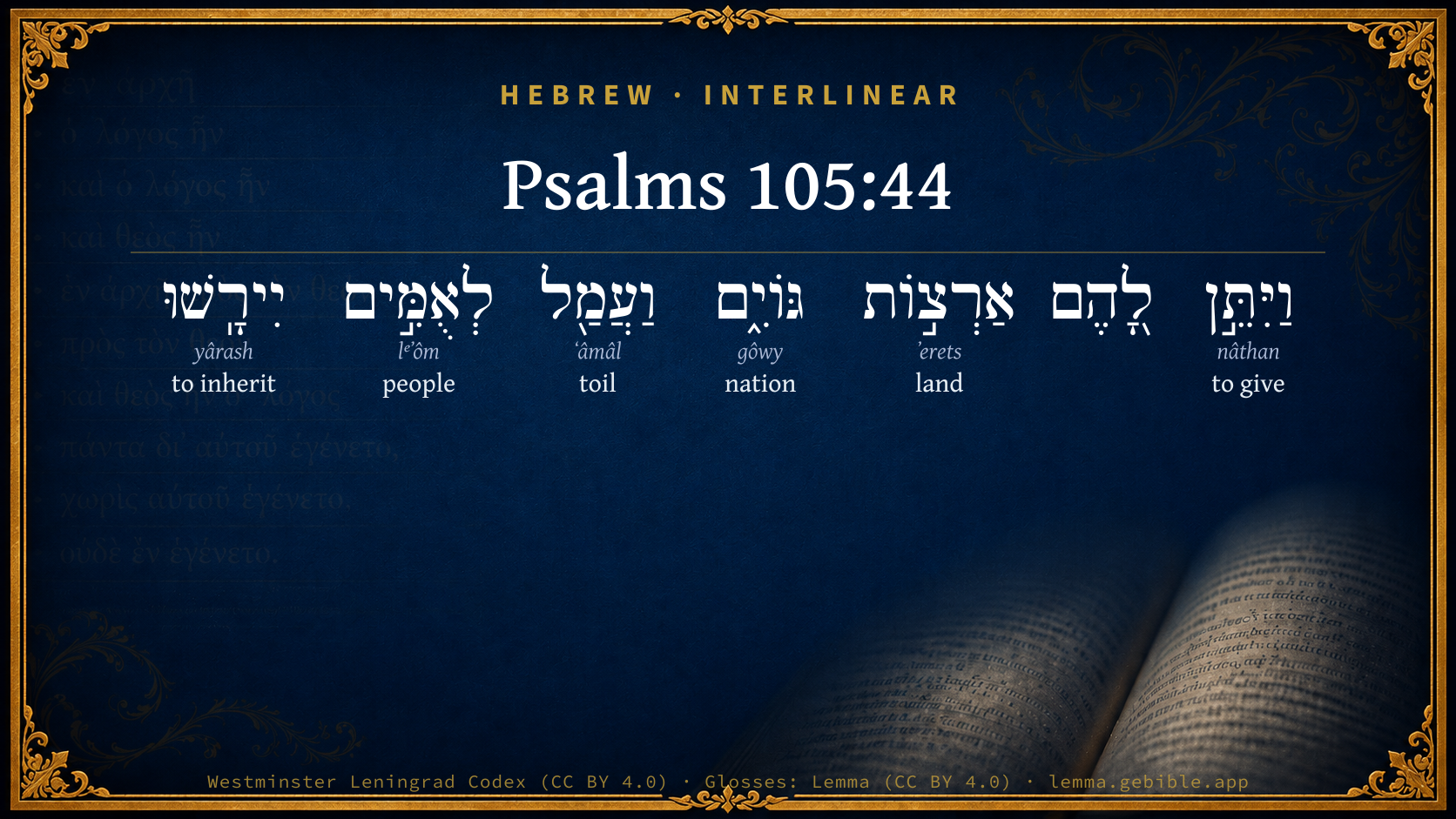
Psalms 105:44

Hebrew (Westminster Leningrad Codex) Psalms 105:44 appears in the Hebrew Old Testament. The text above is from the Westminster Leningrad Codex. Each word links to its Strong’s number, a concise gloss, and parsing drawn from the Open Scriptures Hebrew Bible morphology. Click any word for its full Brown-Driver-Briggs (BDB) entry.
Download image
Cite this verse

Psalms 105:44 (World English Bible). Public Domain. Lemma interlinear Bible study tool, https://lemma.gebible.app/v/psalms/105/44.

Show BibTeX & RIS
BibTeX
RIS
English Translation
He gave them the lands of the nations. They took the labor of the peoples in possession,
World English Bible · Public Domain
Download a study sheet

One document with this verse’s original text, its word-by-word gloss line, the meaning frame, cross-references with their text, attributed commentary, and full source and license credits — printable, and it pastes into notes with its structure intact.

This verse Autodidact and up

Study sheet (.html) Plain text (.txt)

A passage Seminary Student

Up to 50 verses in one chapter. A passage sheet keeps up to 6 commentary sources and 12 cross-references per verse, in the order this page ranks them, and says so on the sheet whenever that leaves anything out. Ask for a single verse and you get the Autodidact verse sheet above.

Everything on this page stays free to read, with no account — the sheet is a download of what is already on screen, not access to it.

Want to remove ads? Support Godless Engineer
Compare translations 3

The same verse in 3 English versions, stacked beneath the original-language interlinear above. Click any original word for its lexicon entry.

Each is an independent rendering of the whole verse — the interlinear is not word-aligned to these translations.

Highlighted words mark where these versions differ — a whole-verse word diff, not a word-by-word alignment.

  • World English Bible Public Domain
    He gave them the lands of the nations. They took the labor of the peoples in possession,
  • King James Version Public Domain
    And gave them the lands of the heathen: and they inherited the labour of the people;
  • unfoldingWord Literal Text CC BY-SA 4.0
    Then he gave to them the lands of the nations, and they took possession of the toil of the peoples

unfoldingWord Literal Text — © unfoldingWord, licensed CC BY-SA 4.0. Word-aligned USFM3 via Door43 (git.door43.org/unfoldingWord/en_ult).

Versions to compare (up to 4)

3 of 4 selected

Show all 18 translations

Every available English version of this verse, each an independent rendering of the whole verse.

  • World English Bible Public Domain
    He gave them the lands of the nations. They took the labor of the peoples in possession,
  • Berean Standard Bible Public Domain
    He gave them the lands of the nations, that they might inherit the fruit of others’ labor,
  • Majority Standard Bible Public Domain
    He gave them the lands of the nations, that they might inherit the fruit of others’ labor,
  • King James Version Public Domain
    And gave them the lands of the heathen: and they inherited the labour of the people;
  • American Standard Version (1901) Public Domain
    And he gave them the lands of the nations; And they took the labor of the peoples in possession:
  • Revised Version (1885) Public Domain
    And he gave them the lands of the nations; and they took the labour of the peoples in possession:
  • Geneva Bible (1599) Public Domain
    And gaue them the lands of the heathen, and they tooke the labours of the people in possession,
  • Douay-Rheims (1899) Public Domain
    And he gave them the lands of the Gentiles: and they possessed the labours of the people:
  • Young's Literal Translation Public Domain
    And He giveth to them the lands of nations, And the labour of peoples they possess,
  • Literal Standard Version CC BY-SA 4.0
    And He gives to them the lands of nations, || And they possess the labor of peoples,
  • Unlocked Literal Bible CC BY-SA 4.0
    He gave them the lands of the nations; they took possession of the wealth of the peoples
  • unfoldingWord Literal Text CC BY-SA 4.0
    Then he gave to them the lands of the nations, and they took possession of the toil of the peoples
  • Darby Bible Public Domain
    And he gave them the lands of the nations, and they took possession of the labour of the peoples:
  • World Messianic Bible Public Domain
    He gave them the lands of the nations. They took the labor of the peoples in possession,
  • Webster's Bible Public Domain
    And gave them the lands of the heathen: and they inherited the labor of the people;
  • Free Bible Version CC BY-SA 4.0
    He gave them the lands of the heathen nations, and they inherited what other people had worked for.
  • Bible in Basic English Public Domain
    And gave them the lands of the nations; and they took the work of the peoples for a heritage;
  • JPS Tanakh (1917) Public Domain
    And He gave them the lands of the nations, and they took the labour of the peoples in possession;

Literal Standard Version (2020), Covenant Press — licensed CC BY-SA 4.0. Text via the HelloAO Bible API (eBible.org). Unlocked Literal Bible (unfoldingWord) — licensed CC BY-SA 4.0. Text via the HelloAO Bible API (eBible.org). unfoldingWord Literal Text — © unfoldingWord, licensed CC BY-SA 4.0. Word-aligned USFM3 via Door43 (git.door43.org/unfoldingWord/en_ult). Free Bible Version, Dr. Jonathan Gallagher — licensed CC BY-SA 4.0. Text via the HelloAO Bible API (eBible.org).

Word by word

More ways to search: Search by grammar → Find every occurrence → Compare this word →

Practice this passage: Drill this verse → Learn its vocabulary →

About this verse

These counts appear in no published source. They are computed here, from the morphology-tagged text and Lemma’s own curated glosses. What Lemma adds →

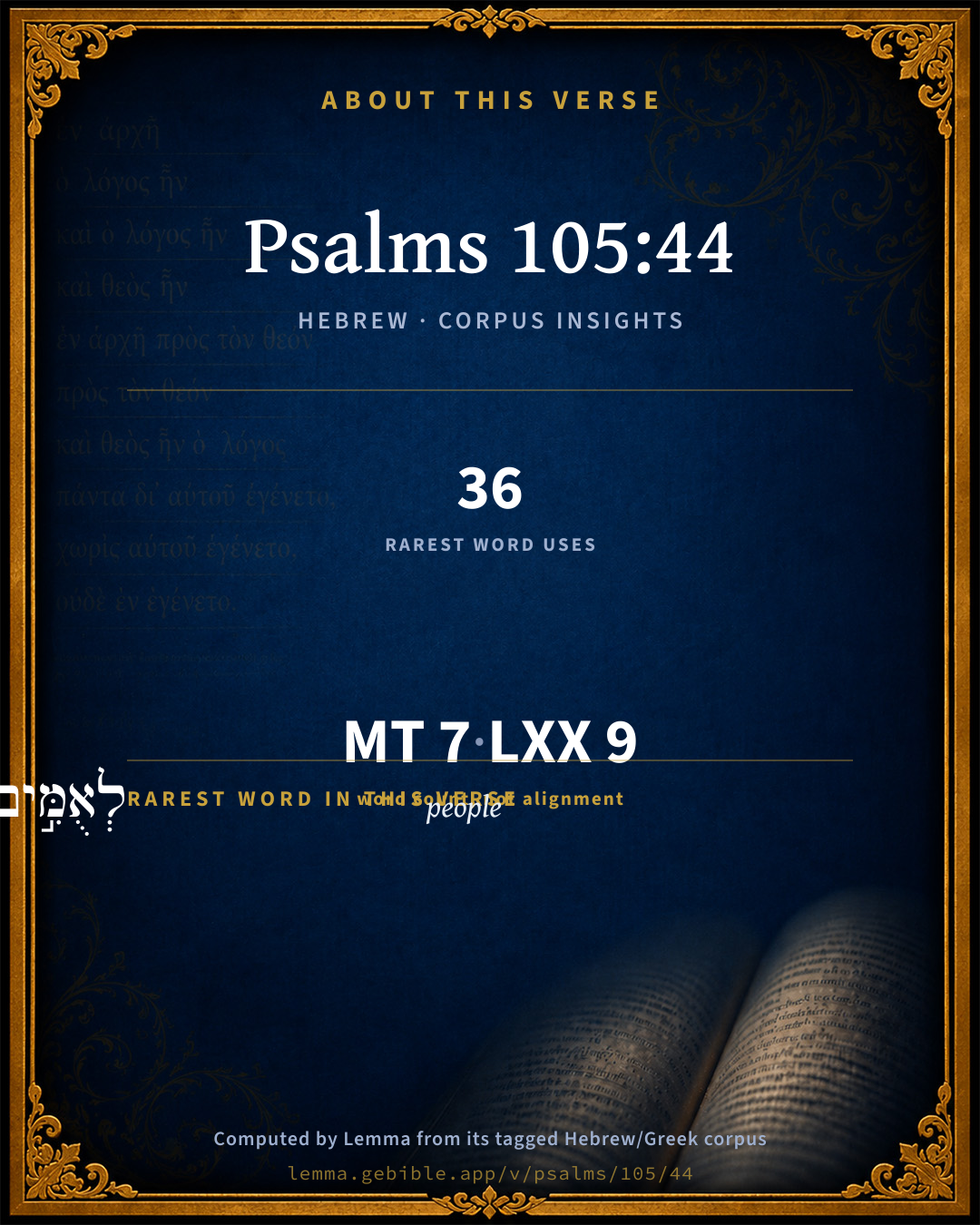
7
words
6
distinct lemmas
Wisdom
section

Shared distinctive vocabulary

לְאֻמִּ֣ים people H3816 occurs in 31 verses of the Hebrew Bible. Also found in:

Grammatical profile

  • 2 verbs
  • 4 nouns
  • 1 preposition

Verb forms

  • וַיִּתֵּ֣ן Qal · Sequential Imperfect
  • יִירָֽשׁוּ Qal · Imperfect

Hebrew & Septuagint length

In English translation the verse runs 17 words from the Hebrew and 16 from the Septuagint (LXX English) — closely comparable.

A rough comparison of the two English renderings, which tokenize alike — not a word-level alignment.

Word counts can differ between the Hebrew and the Greek without any difference in meaning — e.g. the Hebrew direct-object marker אֵת has no separate Greek word, and Greek often adds the article ὁ.

In the original languages it is 7 Hebrew tokens and 9 Greek tokens — but the two are counted differently (Hebrew bundles its prefixes and suffixes into one token; the Greek is in lemma form), so that isn’t a like-for-like length.

Cross-references

14

Topical passages linked to Psalms 105:44 in the Treasury of Scripture Knowledge — connected by theme and wording, ordered by reader-vote popularity; previews shown in the World English Bible.

  • Joshua 24:13 I gave you a land whereon you had not labored, and cities which you didn't build, and you dwell therein; of vineyards and olive groves which you didn't plant do you eat.
  • Psalms 78:55 He also drove out the nations before them, Allotted them for an inheritance by line, And made the tribes of Israel to dwell in their tents.
  • Deuteronomy 6:10–11 It shall be, when Yahweh your God shall bring you into the land which he swore to your fathers, to Abraham, to Isaac, and to Jacob, to give you, great and goodly cities, which you didn't build,
  • Joshua 11:23 So Joshua took the whole land, according to all that Yahweh spoke to Moses; and Joshua gave it for an inheritance to Israel according to their divisions by their tribes. The land had rest from war.
  • Joshua 24:8 I brought you into the land of the Amorites, that lived beyond the Jordan: and they fought with you; and I gave them into your hand, and you possessed their land; and I destroyed them from before you.
  • Psalms 44:2–3 You drove out the nations with your hand, But you planted them. You afflicted the peoples, But you spread them abroad.
  • Joshua 23:4 Behold, I have allotted to you these nations that remain, to be an inheritance for your tribes, from the Jordan, with all the nations that I have cut off, even to the great sea toward the going down of the sun.
  • Nehemiah 9:22–25 Moreover you gave them kingdoms and peoples, which you did allot after their portions: so they possessed the land of Sihon, even the land of the king of Heshbon, and the land of Og king of Bashan.
  • Psalms 80:8 You brought a vine out of Egypt. You drove out the nations, and planted it.
  • Psalms 135:10–12 Who struck many nations, And killed mighty kings,
  • Psalms 136:21–22 And gave their land as an inheritance; For his loving kindness endures forever;
  • Joshua 5:11 They ate of the produce of the land on the next day after the Passover, unleavened cakes and parched grain, in the same day.
  • Joshua 13:7–33 Now therefore divide this land for an inheritance to the nine tribes, and the half-tribe of Manasseh.
  • Joshua 21:43 So Yahweh gave to Israel all the land which he swore to give to their fathers; and they possessed it, and lived therein.

Cross-references courtesy of OpenBible.info (CC BY 4.0).

Hebrew and Greek witnesses Masoretic Hebrew ↔ Greek Septuagint

The same verse in the two great witnesses to the Old Testament, shown verse-for-verse.

You’re reading Greek Psalm 104 (Hebrew Psalm 105). The Septuagint counts the superscription, so verse numbers can differ from the Hebrew — chapter-level alignment, not verse-by-verse. Numbering follows Rahlfs.

These are two independent witnesses, not word-aligned to each other, and the Septuagint is shown in lemma (dictionary) form.

Hebrew Psalms 105:44 Masoretic · Westminster Leningrad Codex

וַיִּתֵּ֣ן לָ֭הֶם אַרְצ֣וֹת גּוֹיִ֑ם וַעֲמַ֖ל לְאֻמִּ֣ים יִירָֽשׁוּ

He gave them the lands of the nations. They took the labor of the peoples in possession,

World English Bible · Public Domain

Greek LXX Greek Psalm 104:44 Septuagint · lemma form

καί δίδωμι αὐτός χώρα ἔθνος καί πόνος λαός κληρονομέω

and gave them the lands of the heathen; and they inherited the labors of the people;

LXX2012 (modern English Septuagint) · Public Domain

Hebrew: Westminster Leningrad Codex (CC BY 4.0). Greek: Septuagint (public domain); English from LXX2012 (modern English Septuagint) (Public Domain). How the Septuagint differs from the Hebrew →

Commentary

Notes on Psalms 105:44 from classic Christian and Jewish commentators (each source and its license shown beneath its notes). The classic Christian expositions comment on the surrounding passage and are grouped to its opening verse, so a note may address several verses; the Jewish commentaries on the Tanakh (Rashi and others) are per-verse, so they appear only where the commentator wrote on this verse.

Lemma curates 59 commentaries, every one of them public domain or Creative Commons licensed, each selected and text-cleaned for this edition rather than reprinted as found. About our sources →

Trapp's Complete Commentary

John Trapp

Psa 105:44 And gave them the lands of the heathen: and they inherited the labour of the people;

Ver. 44. And gave them the lands of the heathen] God doth not his work to the halves, he will perfect that which concerneth us, Psa 138:8, and preserve all his unto his heavenly kingdom, 2Ti 4:18.

And inherited the labour of the people] Their cities, towns, villages, fields, vineyards, all done to the hand of the Israelites. We shall also enter into our Master’s joy, mansions made ready for us, &c.

John Trapp, A Commentary or Exposition upon All the Books of the Old and New Testament (1647–1656) — public domain. Text from a community e-Sword module.

J. A. Alexander on Psalms

Joseph Addison Alexander

44. (Psa 105:44) And gave to them nations' lands, and peoples' labour they inherit. The prominent idea is not that of gentiles or heathen, in the religious sense, but that of other nations, and whole nations, to whose place and possessions they succeeded. Labour is put for its result or product, as a synonymous Hebrew word is in Psa 78:46.

Joseph Addison Alexander, The Psalms Translated and Explained (1850) — public domain. Text from a community e-Sword module.

Tyndale Open Study Notes

Tyndale Open Resources

105:44 Canaan was a land of pagan nations (see 111:6). The psalmist might also be reflecting on God’s promise to Abraham (Gen 24:60) regarding the lands given to Isaac (Gen 26:3).

Tyndale Open Study Notes — © Tyndale Open Resources, licensed CC BY-SA 4.0. Text via the HelloAO Bible API.

John Calvin's Commentaries

44 And he gave them the countries of the nations The Psalmist sets forth the final cause why God in so many ways displayed his wonderful power in redeeming the people, why he did not cease to cherish and defend them in the deserts — why he gave them the possession of the land as he had promised; and this was, that they might dedicate and devote themselves wholly to his service. And, in fact, the end which God proposed in our election was, that he might have on the earth a people by whom he should be called upon and served. The more effectually to stir up the Jews to gratitude, the prophet magnifies the greatness of the divine goodness, by declaring, that they occupied far and wide the countries of the nations, and that all the property which many states had acquired with great labor, they now possessed as it were by right of inheritance. The plural number, both as to the word countries and nations, serves to exhibit in a still more striking light the divine goodness in this matter. The psalm concludes with briefly defining the manner of glorifying God, That they might keep his law It would not be enough to celebrate his grace only with the tongue. To this there must be added practical and experimental piety. And as God rejects all religious services of men’s invention, the only way of rightly serving him which remains, consists in keeping his commandments.

John Calvin's Commentaries (1540-1563) — public domain. Text from the Calvin Translation Society English edition (1840s-50s) via the Christian Classics Ethereal Library (ccel.org). Calvin's coverage is partial (roughly two-thirds of the Bible); uncommented books and verses are honest gaps, never fabricated. The 19th-century editor's footnotes and remarks are omitted so the notes are faithfully Calvin's own voice.

The Cambridge Bible for Schools and Colleges

gen. ed. J. J. S. Perowne

44. And he gave them the lands of the nations,

And they took possession of the labour of the peoples.

See Deu_6:10-11.

The Cambridge Bible for Schools and Colleges (gen. ed. J. J. S. Perowne; Cambridge University Press, 1878–1918) — public domain. Text from a community e-Sword module.

John Gill's Exposition

That they might observe his statutes, and keep his laws,.... All this the Lord did for them, to engage them by his goodness to them to observe the statutes he appointed them, and the laws he gave them; the contrary to which the Canaanites had done, which caused him to cast them out of the land; but on these his people he heaped benefits, thereby to influence them to a cheerful obedience to his will; and this was all he required of them, and the least that they could do, being so highly favoured by him. And this is the end of our spiritual and eternal redemption by Christ, and of our effectual calling by his grace and Spirit, that we be zealous of good works; live unto righteousness, live to him that died for us; glorify him with our bodies and spirits, which are his; and be holy in all manner of conversation.

Praise ye the Lord, all the Israelites ought to have done so, upon the remembrance of the manifold instances of the divine goodness to them, recorded in this psalm; and so the spiritual Israel of God ought to praise him for their redemption by Christ, out of a worse than Egyptian bondage, the bondage of sin, Satan, and the law; and for their calling into liberty, and to marvellous light; for their meetness for heaven, and right unto it; they should praise him now with joyful lips, as they will in the other world to all eternity.

Next: Psalms Chapter 106

John Gill's Exposition of the Whole Bible (1746–1763) — public domain (CC PDM 1.0). Text via the HelloAO Bible API.

Albert Barnes' Notes on the Bible

And gave them the lands of the heathen - Of the “nations” of the land of Palestine, according to his promise. See the notes at Psa 78:55.

And they inherited the labor of the people - The fruit of their labors. See Deu 6:10-11; Jos 13:7.

Albert Barnes' Notes on the Bible (1834–1885) — public domain. Text from a community e-Sword/MySword module.

Matthew Poole's English Annotations

The fruits of their labour, their cities, vineyards, olive, yards, &c.

Matthew Poole's English Annotations on the Holy Bible (1683–1685) — public domain. Text from a community e-Sword/MySword module.

The Treasury of David

Charles H. Spurgeon

Ver. 44. And gave them the lands of the heathen. He drove out the Canaanites and allotted the lands to the tribes. They were called on to fight, but the Lord wrought so wonderfully that the conquest was not effected by their bow or spearthe Lord gave them the land.

And they inherited the labour of the people, they dwelt in houses which they had not built, and gathered fruit front vines and olives which they had not planted. They were not settled in a desert which needed to be reclaimed, but in a land fertile to a proverb, and cultivated carefully by its inhabitants. Like Adam, they were placed in a garden. This entrance into the goodly land was fitly celebrated when the ark was being moved to Zion.

Ver. 44. They inherited the labour of the people. In like manner the heavenly Canaan is enjoyed by the saints without any labour of theirs; this inheritance is not of the law, nor of the works of it; it is the gift of God. Ro 4:14 6:23. John Gill.

Psalms 105:45*

Charles H. Spurgeon's The Treasury of David (1869–1885) — public domain. Psalms only. Text from a community e-Sword/MySword module.

Whedon's Commentary on the Bible

Daniel D. Whedon

44. See on Psa_78:55.

Inherited the labour—Not the fields and vineyards only, but houses, cities, and all public works.

Daniel D. Whedon (gen. ed.), Commentary on the Old and New Testaments (1874–1909) — public domain. Text from a community e-Sword module.

The Pulpit Commentary

And gave them the lands of the heathen (see Joshua 8-12). And they inherited the labour of the people; rather, of the peoples. (comp. Deu_6:10, Deu_6:11)

The Pulpit Commentary (1880–1919), ed. H.D.M. Spence-Jones & Joseph S. Exell — public domain. Text from a community e-Sword module.

John Wesley's Explanatory Notes

labour - The fruits of their labour; their cities, vineyards, olive-yards.

John Wesley, Explanatory Notes Upon the Whole Bible (1754–1765) — public domain. Text via the GEBible commentary corpus.

Lesson kit

Teaching starters — assembled from the data on this page, not authored interpretation. Every prompt links to the verse data it draws on. Edit before teaching.

Psalms, in the Wisdom, opens this verse with 7 words (6 distinct Hebrew lemmas). Its most distinctive word is lᵉʼôm (“people”). A historical commentator’s framing appears above. Read the whole chapter for the surrounding context.

Discussion questions

  1. What does “people” (lᵉʼôm) contribute to the verse as a whole?
  2. Genesis 25:23 shares the word «people» with this verse. How do the two illuminate each other?
  3. The translations on this page render this verse differently — a whole-verse word diff, not a word-by-word alignment. What might account for the different wordings?
  4. The verb «וַיִּתֵּ֣ן» is Qal Sequential Imperfect. How does its form color the action?
  5. Reading how Trapp's Complete Commentary and J. A. Alexander on Psalms read this verse, where do the two commentators agree and where do they part?

Things to notice

Reading settings

Reading text

Shown beneath each verse's original-language words.

Old Testament
Old Testament edition

Read the OT as the Masoretic Hebrew (MT) or the Greek Septuagint (LXX).

English shown for the Greek Septuagint (in the Hebrew ↔ Greek comparison).

Comparing translations? Open the Compare panel on any verse page to stack up to four side by side.