
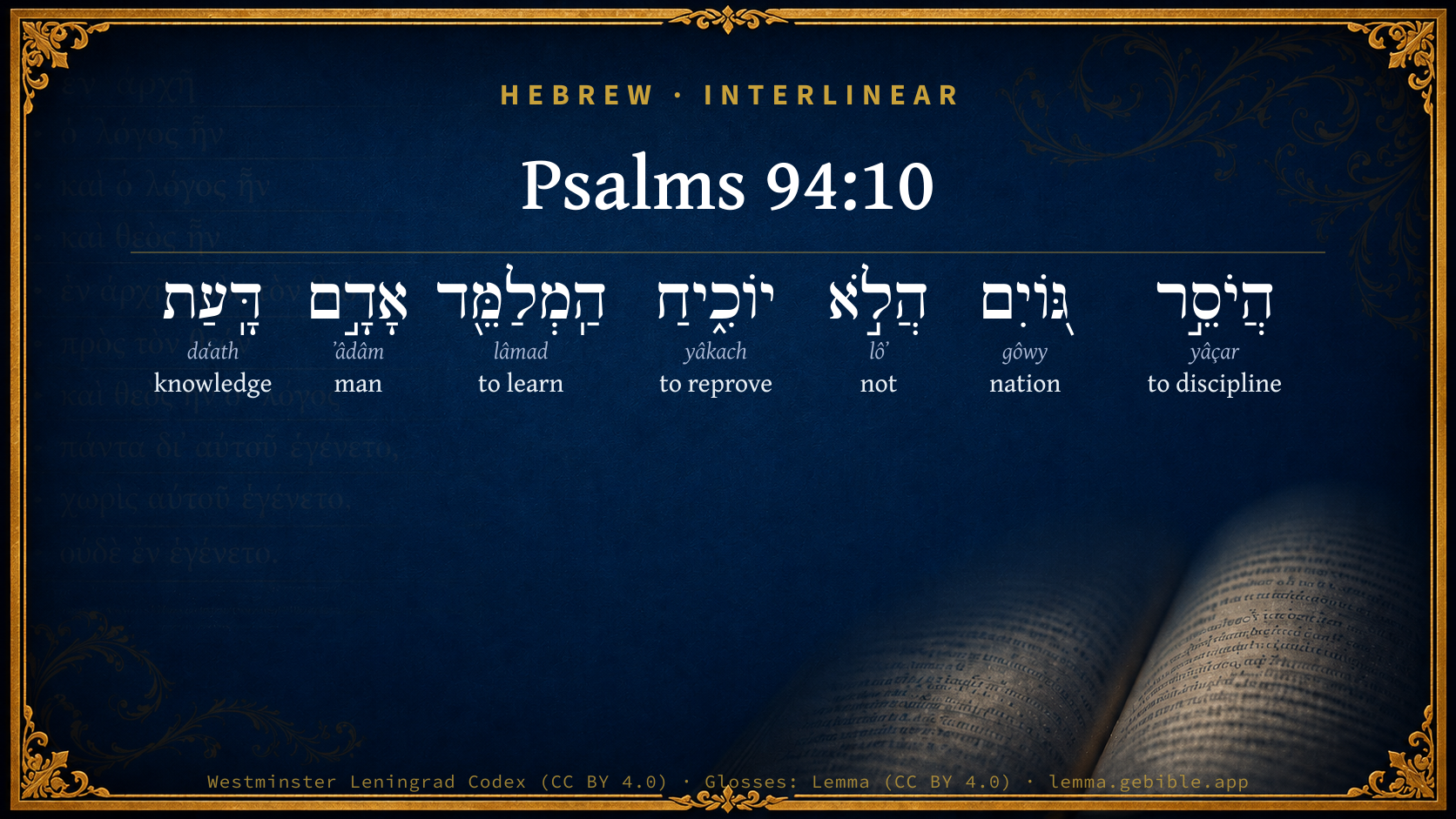
Psalms 94:10

Hebrew (Westminster Leningrad Codex) Psalms 94:10 appears in the Hebrew Old Testament. The text above is from the Westminster Leningrad Codex. Each word links to its Strong’s number, a concise gloss, and parsing drawn from the Open Scriptures Hebrew Bible morphology. Click any word for its full Brown-Driver-Briggs (BDB) entry.
Download image
Cite this verse

Psalms 94:10 (World English Bible). Public Domain. Lemma interlinear Bible study tool, https://lemma.gebible.app/v/psalms/94/10.

Show BibTeX & RIS
BibTeX
RIS
English Translation
He who disciplines the nations, won't he punish? He who teaches man knows.
World English Bible · Public Domain
Download a study sheet

One document with this verse’s original text, its word-by-word gloss line, the meaning frame, cross-references with their text, attributed commentary, and full source and license credits — printable, and it pastes into notes with its structure intact.

This verse Autodidact and up

Study sheet (.html) Plain text (.txt)

A passage Seminary Student

Up to 50 verses in one chapter. A passage sheet keeps up to 6 commentary sources and 12 cross-references per verse, in the order this page ranks them, and says so on the sheet whenever that leaves anything out. Ask for a single verse and you get the Autodidact verse sheet above.

Everything on this page stays free to read, with no account — the sheet is a download of what is already on screen, not access to it.

Want to remove ads? Support Godless Engineer
Compare translations 3

The same verse in 3 English versions, stacked beneath the original-language interlinear above. Click any original word for its lexicon entry.

Each is an independent rendering of the whole verse — the interlinear is not word-aligned to these translations.

Highlighted words mark where these versions differ — a whole-verse word diff, not a word-by-word alignment.

  • World English Bible Public Domain
    He who disciplines the nations, won't he punish? He who teaches man knows.
  • King James Version Public Domain
    He that chastiseth the heathen, shall not he correct? he that teacheth man knowledge, shall not he know?
  • unfoldingWord Literal Text CC BY-SA 4.0
    The one instructing nations, does he not rebuke? Does the one teaching mankind lack knowledge?

unfoldingWord Literal Text — © unfoldingWord, licensed CC BY-SA 4.0. Word-aligned USFM3 via Door43 (git.door43.org/unfoldingWord/en_ult).

Versions to compare (up to 4)

3 of 4 selected

Show all 18 translations

Every available English version of this verse, each an independent rendering of the whole verse.

  • World English Bible Public Domain
    He who disciplines the nations, won't he punish? He who teaches man knows.
  • Berean Standard Bible Public Domain
    He who admonishes the nations, does He not discipline? He who teaches man, does He lack knowledge?
  • Majority Standard Bible Public Domain
    He who admonishes the nations, does He not discipline? He who teaches man, does He lack knowledge?
  • King James Version Public Domain
    He that chastiseth the heathen, shall not he correct? he that teacheth man knowledge, shall not he know?
  • American Standard Version (1901) Public Domain
    He that chastiseth the nations, shall not he correct, `Even' he that teacheth man knowledge?
  • Revised Version (1885) Public Domain
    He that chastiseth the nations, shall not he correct, even he that teacheth man knowledge?
  • Geneva Bible (1599) Public Domain
    Or he that chastiseth the nations, shall he not correct? hee that teacheth man knowledge, shall he not knowe?
  • Douay-Rheims (1899) Public Domain
    He that chastiseth nations, shall he not rebuke: he that teacheth man knowledge?
  • Young's Literal Translation Public Domain
    He who is instructing nations, Doth He not reprove? He who is teaching man knowledge `is' Jehovah.
  • Literal Standard Version CC BY-SA 4.0
    He who is instructing nations, does He not reprove? He who is teaching man knowledge [is] YHWH.
  • Unlocked Literal Bible CC BY-SA 4.0
    He who disciplines the nations, does he not correct? He is the one who gives knowledge to man.
  • unfoldingWord Literal Text CC BY-SA 4.0
    The one instructing nations, does he not rebuke? Does the one teaching mankind lack knowledge?
  • Darby Bible Public Domain
    He that instructeth the nations, shall not he correct -- he that teacheth man knowledge?
  • World Messianic Bible Public Domain
    He who disciplines the nations, won’t he punish? He who teaches man knows.
  • Webster's Bible Public Domain
    He that chastiseth the heathen, shall he not correct? he that teacheth man knowledge, shall he not know?
  • Free Bible Version CC BY-SA 4.0
    Do you think that the one who punishes nations won't punish you too? Do you think that the one who teaches human beings knowledge doesn't know anything?
  • Bible in Basic English Public Domain
    He who is the judge of the nations, will he not give men the reward of their acts, even he who gives knowledge to man?
  • JPS Tanakh (1917) Public Domain
    He that instructeth nations, shall not He correct? even He that teacheth man knowledge?

Literal Standard Version (2020), Covenant Press — licensed CC BY-SA 4.0. Text via the HelloAO Bible API (eBible.org). Unlocked Literal Bible (unfoldingWord) — licensed CC BY-SA 4.0. Text via the HelloAO Bible API (eBible.org). unfoldingWord Literal Text — © unfoldingWord, licensed CC BY-SA 4.0. Word-aligned USFM3 via Door43 (git.door43.org/unfoldingWord/en_ult). Free Bible Version, Dr. Jonathan Gallagher — licensed CC BY-SA 4.0. Text via the HelloAO Bible API (eBible.org).

Word by word

More ways to search: Search by grammar → Find every occurrence → Compare this word →

Practice this passage: Drill this verse → Learn its vocabulary →

הֲיֹסֵ֣ר
yâçar
H3256
“disciplining”
Particle, Interrogative + Verb, Qal, Participle Active, Masculine, Singular, Construct
Part of Speech
Particle + Verb
Stem
Qal
Form
Participle Active
Gender
Masculine
Number
Singular
State
Construct
Full BDB Definition

Origin: a primitive root

TWOT: 877

to chasten, discipline, instruct, admonish - (Qal) - to chasten, admonish - to instruct - to discipline - (Niphal) to let oneself be chastened or corrected or admonished - (Piel) - to discipline, correct - to chasten, chastise - (Hiphil) to chasten - (Nithpael) to teach
  1. גּ֭וֹיִם gôwy H1471 “nations” Noun, Common, Masculine, Plural, Absolute
  2. הֲלֹ֣א lôʼ H3808 “not” Particle, Interrogative + Particle, Negative
  3. יוֹכִ֑יחַ yâkach H3198 “to reprove” Verb, Hiphil, Imperfect, 3rd Person, Masculine, Singular
  4. הַֽמְלַמֵּ֖ד lâmad H3925 “the · learning” Particle, Definite Article + Verb, Piel, Participle Active, Masculine, Singular, Absolute
  5. אָדָ֣ם ʼâdâm H120 “man” Noun, Common, Masculine, Singular, Absolute
  6. דָּֽעַת daʻath H1847 “knowledge” Noun, Common, Feminine, Singular, Absolute

About this verse

These counts appear in no published source. They are computed here, from the morphology-tagged text and Lemma’s own curated glosses. What Lemma adds →

7
words
7
distinct lemmas
Wisdom
section

Shared distinctive vocabulary

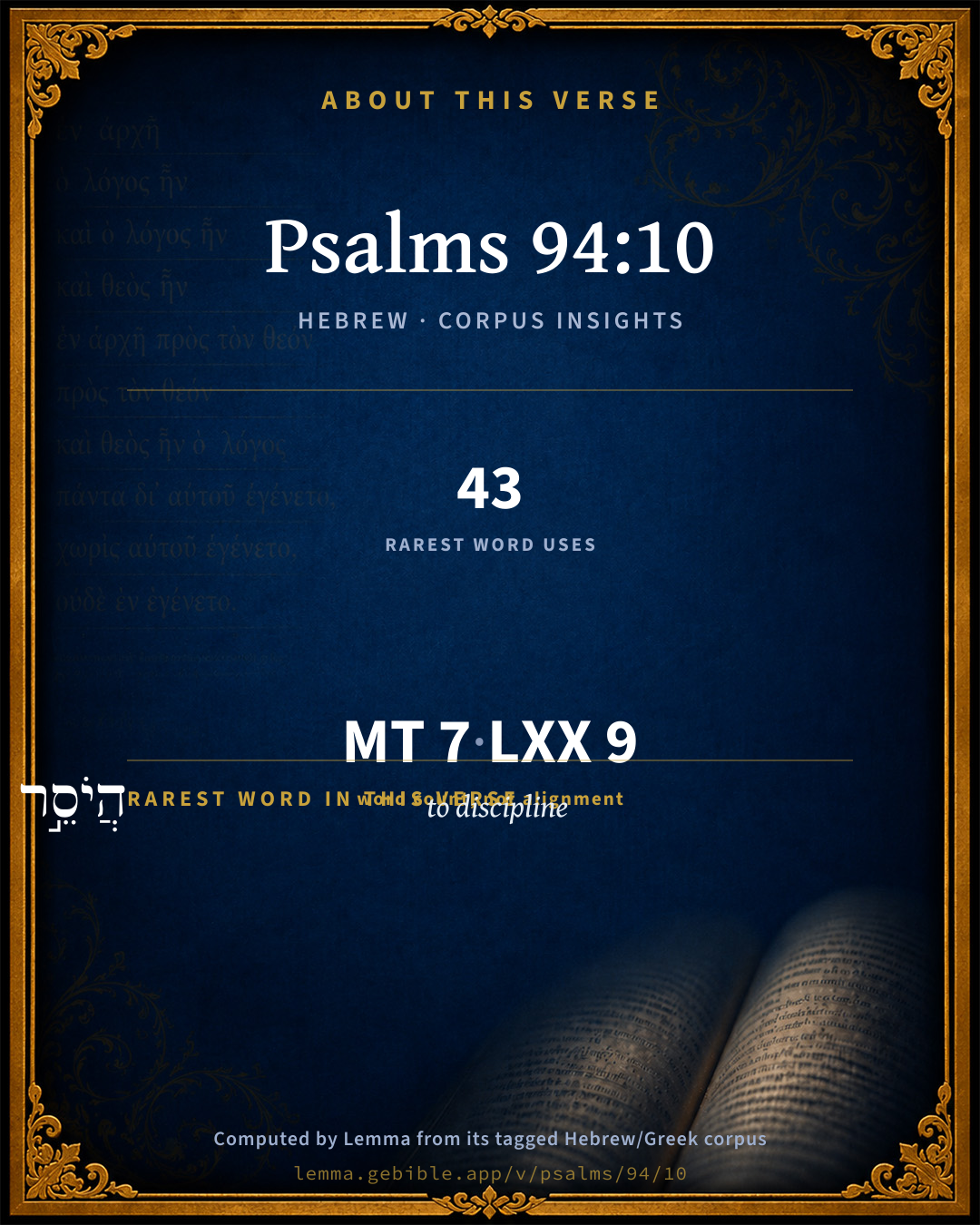
הֲיֹסֵ֣ר to discipline H3256 occurs in 38 verses of the Hebrew Bible. Also found in:

Grammatical profile

  • 3 verbs
  • 3 nouns
  • 1 particle

Verb forms

  • הֲיֹסֵ֣ר Qal · Participle Active
  • יוֹכִ֑יחַ Hiphil · Imperfect
  • הַֽמְלַמֵּ֖ד Piel · Participle Active

Hebrew & Septuagint length

In English translation the verse runs 13 words from the Hebrew and 15 from the Septuagint (LXX English) — closely comparable.

A rough comparison of the two English renderings, which tokenize alike — not a word-level alignment.

Word counts can differ between the Hebrew and the Greek without any difference in meaning — e.g. the Hebrew direct-object marker אֵת has no separate Greek word, and Greek often adds the article ὁ.

In the original languages it is 7 Hebrew tokens and 9 Greek tokens — but the two are counted differently (Hebrew bundles its prefixes and suffixes into one token; the Greek is in lemma form), so that isn’t a like-for-like length.

Cross-references

21

Topical passages linked to Psalms 94:10 in the Treasury of Scripture Knowledge — connected by theme and wording, ordered by reader-vote popularity; previews shown in the World English Bible.

  • Job 35:11 Who teaches us more than the animals of the earth, And makes us wiser than the birds of the sky?'
  • Isaiah 28:26 For his God does instruct him aright, [and] does teach him.
  • Psalms 44:2 You drove out the nations with your hand, But you planted them. You afflicted the peoples, But you spread them abroad.
  • Jeremiah 10:25 Pour out your wrath on the nations that don't know you, and on the families that don't call on your name: for they have devoured Jacob, yes, they have devoured him and consumed him, and have laid waste his habitation.
  • Psalms 9:5 You have rebuked the nations. You have destroyed the wicked. You have blotted out their name forever and ever.
  • Psalms 10:16 Yahweh is King forever and ever! The nations will perish out of his land.
  • Psalms 25:8–9 Good and upright is Yahweh, Therefore he will instruct sinners in the way.
  • Psalms 119:66 Teach me good judgment and knowledge, For I believe in your commandments.
  • Psalms 135:8–12 Who struck the firstborn of Egypt, Both of man and animal;
  • Proverbs 2:6 For Yahweh gives wisdom. Out of his mouth comes knowledge and understanding.
  • Isaiah 2:3 Many peoples shall go and say, "Come, let's go up to the mountain of Yahweh, To the house of the God of Jacob; And he will teach us of his ways, And we will walk in his paths. For out of Zion the law shall go forth, And the word of Yahweh from Jerusalem.
  • Isaiah 10:5–6 Ho Assyrian, the rod of my anger, the staff in whose hand is my indignation!
  • Isaiah 10:12 Therefore it shall happen that, when the Lord has performed his whole work on Mount Zion and on Jerusalem, I will punish the fruit of the stout heart of the king of Assyria, and the glory of his high looks.
  • Isaiah 37:36 The angel of Yahweh went forth, and struck in the camp of the Assyrians one hundred and eighty-five thousand; and when men arose early in the morning, behold, these were all dead bodies.
  • Isaiah 54:13 All your children shall be taught of Yahweh; and great shall be the peace of your children.
  • Ezekiel 39:21 I will set my glory among the nations; and all the nations shall see my judgment that I have executed, and my hand that I have laid on them.
  • Amos 3:2 "You only have I chosen of all the families of the earth. Therefore I will punish you for all of your sins."
  • Habakkuk 1:12 Aren't you from everlasting, Yahweh my God, my Holy One? We will not die. Yahweh, you have appointed him for judgment. You, Rock, have established him to punish.
  • Habakkuk 3:12 You marched through the land in wrath. You threshed the nations in anger.
  • John 6:45 It is written in the prophets, 'They will all be taught by God.' Therefore everyone who hears from the Father, and has learned, comes to me.
  • Psalms 149:7 To execute vengeance on the nations, And punishments on the peoples;

Cross-references courtesy of OpenBible.info (CC BY 4.0).

Hebrew and Greek witnesses Masoretic Hebrew ↔ Greek Septuagint

The same verse in the two great witnesses to the Old Testament, shown verse-for-verse.

You’re reading Greek Psalm 93 (Hebrew Psalm 94). The Septuagint counts the superscription, so verse numbers can differ from the Hebrew — chapter-level alignment, not verse-by-verse. Numbering follows Rahlfs.

These are two independent witnesses, not word-aligned to each other, and the Septuagint is shown in lemma (dictionary) form.

Hebrew Psalms 94:10 Masoretic · Westminster Leningrad Codex

הֲיֹסֵ֣ר גּ֭וֹיִם הֲלֹ֣א יוֹכִ֑יחַ הַֽמְלַמֵּ֖ד אָדָ֣ם דָּֽעַת

He who disciplines the nations, won't he punish? He who teaches man knows.

World English Bible · Public Domain

Greek LXX Greek Psalm 93:10 Septuagint · lemma form

ὁ παιδεύω ἔθνος οὐ ἐλέγχω ὁ διδάσκω ἄνθρωπος γνῶσις

He that chastises the heathen, shall not he punish, even he that teaches man knowledge?

LXX2012 (modern English Septuagint) · Public Domain

On this verse, The Cambridge Bible for Schools and Colleges discusses the Septuagint’s reading. Read the note in Commentary ↓

Hebrew: Westminster Leningrad Codex (CC BY 4.0). Greek: Septuagint (public domain); English from LXX2012 (modern English Septuagint) (Public Domain). How the Septuagint differs from the Hebrew →

Commentary

Notes on Psalms 94:10 from classic Christian and Jewish commentators (each source and its license shown beneath its notes). The classic Christian expositions comment on the surrounding passage and are grouped to its opening verse, so a note may address several verses; the Jewish commentaries on the Tanakh (Rashi and others) are per-verse, so they appear only where the commentator wrote on this verse.

Lemma curates 59 commentaries, every one of them public domain or Creative Commons licensed, each selected and text-cleaned for this edition rather than reprinted as found. About our sources →

Trapp's Complete Commentary

John Trapp

Psa 94:10 He that chastiseth the heathen, shall not he correct? he that teacheth man knowledge, [shall not he know]?

Ver. 10. He that chastiseth the heathen, shall not he correct?] Qui totis gentibus non parcit, vos non redarguet? He that punisheth profane nations that know him not, shall he spare you? Amo 3:2. Shall not tribulation and anguish be upon the Jew first? Rom 2:9. The Chaldee thus paraphraseth, He that gave a law to his people, shall he not punish them when they transgress it?

He that teacheth man knowledge] Shall not he know? is to be supplied to make sense. The psalmist seemeth so displeased at men’s doubting or denying of this, that he could not perfect his sentence, through passion of mind. Some causes, indeed, do give that which themselves have not; as the lifeless heaven enliveneth, the dull whetstone sharpeneth. But here it is far otherwise, and woe be to such as act not accordingly, Isa 29:15.

John Trapp, A Commentary or Exposition upon All the Books of the Old and New Testament (1647–1656) — public domain. Text from a community e-Sword module.

Joseph Benson's Commentary

Psa 94:10. He that chastiseth — Or, He that instructeth, or teacheth, or reproveth (as the word יסר, jasar, often signifies, and is rendered Pro 9:7; Isa 8:11, &c.) the heathen, the Gentiles, or nations of the world: not only the Jews, but all other people, all mankind, as the next clause explains it; shall not he correct? — He who, when he pleases, can and does punish the nations of the world, is he not able to punish you for your wicked speeches and actions? Or, He that reproveth, and therefore discerneth their evil words and works, shall he not discern and reprove yours, who sin against greater light, and more privileges and advantages, and whose sins therefore are more aggravated? He that teacheth man knowledge — That giveth him understanding, and the knowledge of many excellent things by the light of nature; shall not he know — Namely, men’s thoughts, as in the next verse, and of consequence their whole conduct? These words are not in the Hebrew text, but are easily understood out of the foregoing clause. The meaning of the verse, in substance, is, “He that instructeth the nations, and supplieth them with all the knowledge they have, can he want means of discovering what they are contriving and doing, or of finding them out? Will not he be able to trace them out in all their machinations?” Or, as Dr. Horne paraphraseth the words, “It is God who hath instructed the world, by his revelations, in religious knowledge, and, consequently, without all doubt, he cannot be ignorant of the use and abuse which men make of that unspeakable gift.”

Joseph Benson's Commentary on the Old and New Testaments (1811–1818) — public domain. Text from a community e-Sword module.

J. A. Alexander on Psalms

Joseph Addison Alexander

10. (Psa 94:10) Shall the reprover of nations—shall he not chastise—he that teaches mankind knowledge? The antithesis is not between Israel and the Gentiles, but between whole nations or all mankind and individual offenders. Reprover, the one reproving or accustomed to reprove, warn, or admonish. See above, on Psa 2:10; Psa 16:7. The parallel term is nearly synonymous, and means to correct by word or deed. The structure of the first clause is the same as in the verse preceding. In the last clause, by an aposiopesis not uncommon in the Hebrew idiom, the parallelism is left to be completed by the reader. The full sense seems to be, is he who teaches all mankind not competent to teach men individually? He that teaches, literally the (one) teaching.

Joseph Addison Alexander, The Psalms Translated and Explained (1850) — public domain. Text from a community e-Sword module.

Tyndale Open Study Notes

Tyndale Open Resources

94:10 punishes: This word also carries the idea of “warns” (2:10), “disciplines” (6:1; 94:12), or “instructs” (16:7). The Lord disciplines his people to purify their character (Prov 3:11-12; Heb 12:6-11). He punishes his enemies by giving them what they deserve (Ps 1:6; Rom 6:23).

Tyndale Open Study Notes — © Tyndale Open Resources, licensed CC BY-SA 4.0. Text via the HelloAO Bible API.

Geneva Bible (1599)

Geneva Bible translators

If God punish whole nations for their sins, it is mere folly for any one man, or else a few to think that God will spare them.

Geneva Bible (1599) marginal notes — public domain. Text via Bolls.life.

Adam Clarke's Commentary

Verse 10. He that chastiseth the heathen, shall not he correct?] YOU, who are heathens, and heathens of the most abandoned kind.

He that teacheth man knowledge] We here supply shall not he know? But this is not acknowledged by the original, nor by any of the Versions. Indeed it is not necessary; for either the words contain a simple proposition, "It is he who teacheth man knowledge," or this clause should be read in connexion with Ps 94:11: "Jehovah, who teacheth man knowledge, knoweth the devices of man, that they are vanity." As he teaches knowledge to man, must he not know all the reasonings and devices of the human heart?

Adam Clarke's Commentary on the Bible (1810–1826) — public domain. Text from a community e-Sword/MySword module.

John Calvin's Commentaries

10. He that chastiseth the nations, shall not he correct? He would have them argue from the greater to the less, that if God did not spare even whole nations, but visits their iniquity with punishment, they could not imagine that he would suffer a mere handful of individuals to escape with impunity. The comparison intended, however, may possibly be between the Gentiles and the Jews. If God punished the heathen nations, who had not heard his word, with much severity, the Jews might expect that they, who had been familiarised to instruction in his house, would receive still sharper correction, and that he would vindicate his justice most in that nation over which he had chosen to preside. Still the former sense of the passage appears to me preferable, That it is folly in any number of individuals to flatter themselves with impunity, when they see God inflicting public punishment upon collective people. Some think there is an exclusive allusion to the signal and memorable instances of Divine judgment recorded in Scripture, as in the destruction of Sodom with fire from heaven, (Genesis 19.) and of the whole human family by the flood, (Genesis 7.) But the simpler meaning is best, That it were the height of madness in individuals to think that they could escape when nations perish. In adding that God teacheth men knowledge, the Psalmist glances at the overweening confidence of such as despise God, and pride themselves in their acuteness and shrewdness, as we find Isaiah denouncing a woe against those crafty enemies of God who dig deep, that they may hide themselves from his sight, (Isaiah 29:15.) It is a disease prevalent enough in the world still. We know the refuges under covert of which both courtiers and lawyers take occasion to indulge in shameless mockery of God. It is as if the Psalmist had said — You think to elude God through the confidence which you have in your acute understandings, and would pretend to dispute the knowledge of the Almighty, when, in truth, all the knowledge which is in the world is but as a drop from his own inexhaustible fullness.

John Calvin's Commentaries (1540-1563) — public domain. Text from the Calvin Translation Society English edition (1840s-50s) via the Christian Classics Ethereal Library (ccel.org). Calvin's coverage is partial (roughly two-thirds of the Bible); uncommented books and verses are honest gaps, never fabricated. The 19th-century editor's footnotes and remarks are omitted so the notes are faithfully Calvin's own voice.

Ellicott's Commentary for English Readers

(10) He that chastiseth.—Or, He who instructeth. The thought to some extent anticipates St. Paul’s teaching about the divine education of the heathen, in Romans 1.

A Bible Commentary for English Readers, edited by Charles John Ellicott (1878–1897) — public domain. Text from a community e-Sword module.

The Cambridge Bible for Schools and Colleges

gen. ed. J. J. S. Perowne

10. He that instructeth the nations, shall not he rebuke?] The word rendered chastiseth in A.V. includes the ideas of instruction, admonition, discipline, chastisement (LXX ὁ παιδεύων, Vulg. qui corripit, Jer. qui erudit). That rendered correct means to reprove, rebuke, call to account, punish (Psa_50:21). This noteworthy passage stands almost by itself in the O.T. in its explicit assertion that there is a divine education of the nations, analogous to the divine education of Israel (Deu_8:5, &c.), an education which must involve fatherly correction and chastisement (Pro_3:12). It anticipates the teaching of St Paul in Rom_1:20; Rom_2:14-15. Yet long before this, Amos had implicitly taught that a measure of moral knowledge is possessed by the heathen, for the right use of which they are responsible (Amos 1, 2). Cp. also Psa_65:2, and the general purport of the Book of Jonah.

he that teacheth &c.] We expect a question such as A.V. supplies, to complete the sentence, shall not he know? But instead of putting the question the poet breaks off abruptly, and substitutes the comprehensive affirmation of Psa_94:11. It is prosaic to render as R.V., “even he that teacheth &c.”

The Cambridge Bible for Schools and Colleges (gen. ed. J. J. S. Perowne; Cambridge University Press, 1878–1918) — public domain. Text from a community e-Sword module.

John Gill's Exposition

He that chastiseth the Heathen,.... As he did the old world, by bringing a flood upon it, and sweeping away its inhabitants at once; and Sodom and Gomorrah, by raining fire and brimstone upon them, and consuming them from off the earth; and the old inhabitants of Canaan, by ejecting them out of their land for their abominations, with other similar instances:

shall he not correct? such audacious wretches, guilty of such atrocious crimes, such horrid murders, and gross atheism? certainly he will, as he has both a right and power to do it. The Targum is,

"is it possible that he should give the law to his people, and, when they have sinned, should they not be corrected?''

and if these are corrected and chastised, then surely such daring and insolent wretches shall not go unpunished: or, "he that instructeth the Heathen" (d); by the light of nature in things civil and moral, and therefore has a right to punish such who act contrary to it; see Rom 2:12,

he that teacheth man knowledge; that has given him the light of nature; inspired him with reason and understanding; taught him more than the beasts of the field, and made him wiser than the fowls of the heaven; from whom he has the knowledge of all arts and sciences, liberal and mechanic, those of the lower as well as of the higher class; see Joh 1:9. The Targum is,

"has not the Lord taught the first man knowledge?''

that more perfect knowledge of things, which Adam had in innocence, was from the Lord; and therefore,

shall not he know? all persons and things? verily he does; he is a God of knowledge, of all knowledge; his knowledge and understanding is infinite; it reaches to all persons, and to all their thoughts, words, and actions: this clause is not in the Hebrew text; but is understood, and rightly supplied; see Sa2 5:8, compared with Ch1 11:6.

(d) "an erudiens gentes", Cocceius.

John Gill's Exposition of the Whole Bible (1746–1763) — public domain (CC PDM 1.0). Text via the HelloAO Bible API.

Albert Barnes' Notes on the Bible

He that chastiseth the heathen - More literally, “Shall not the Reprover of nations - shall he not chastise - he that teaches man knowledge?” The idea is, that God exercises a government over the nations of the earth; that he has them under his control; that he brings heavy judgments on them; that he thus conveys great lessons to man. And shall not such a Being, in individual cases, reprove and correct for sin? It is assumed here that God, in fact, brings judgments on nations; that he does this by fire, flood, famine, pestilence; that these things are proofs that he presides over the nations of the earth; and the question here is, whether he that does this on the large scale must not be expected to do it in individual cases, so that the offender will not escape.

Shall not he correct? - Shall he not chastise, or bring judgments on offenders?

He that teacheth man knowledge ... - The idea in our translation, that he who imparts knowledge to mankind must himself possess intelligence, is a true one, but it is probably not that which is in the original. The sense is probably merely that God is the great Teacher, and this is the impression which it is intended should be impressed on the mind, leaving the consequences of this to be supplied by the reader: “He that teaches man all the knowledge that he has!” - reflect on the consequences of this, or what must follow from this! Such a Being cannot be ignorant; he must understand all things; he must, therefore, see human conduct everywhere as it is. The consequence - the result - of this is staffed in the next verse, that he must see the thoughts of man, and understand his real character.

Albert Barnes' Notes on the Bible (1834–1885) — public domain. Text from a community e-Sword/MySword module.

Matthew Poole's English Annotations

He that chastiseth the heathen, shall not he correct? He who, when he pleaseth, can and doth punish the Gentiles or nations of the world, is he not able to punish you for your wicked speeches and actions? Or, He that instructeth or teacheth (as this word signifies, Pro 9:7; Isa 8:11, &c.) the nations, (not only the Jews, but all other people, all mankind, as this clause is explained by the next, he that teacheth man knowledge.) shall not he correct or reprove? and therefore must not he discern and know all your hard speeches and wicked actions? Thus the consequent seems to be put for the antecedent, as is frequent in Scripture, and that not without emphasis, to imply that God does not know their sins with a simple or speculative knowledge, but so as to proceed upon that knowledge to judge and punish them.

He that teacheth man knowledge, by giving him understanding, and the knowledge of many excellent things by the light of nature, shall not he know? to wit, men’s thoughts, of which see Psa 94:11; and their words and actions, of which he spoke Psa 94:6,7. These words are not in the Hebrew text, but are easily understood out of the foregoing clause. And the like defects we find elsewhere, as 2Sa 5:8, compared with 1Ch 11:6, especially in vehement commotions of the mind, when a man’s passion stops his speech, as it is here, and Psa 6:3, and in other authors.

Matthew Poole's English Annotations on the Holy Bible (1683–1685) — public domain. Text from a community e-Sword/MySword module.

The Treasury of David

Charles H. Spurgeon

Ver. 10. He that teacheth man knowledge. The question posts midway (for the words in Italics are not Scripture), the point of application being too obvious to need mention. "He that teacheth man all his knowledge." (Fill out the rest yourselves; think, What then?) Henry Cowles.

Ver. 10. He that chastiseth the heathen, shall not he correct? He reproves whole nations, can he not reprove individuals? All history shows that he visits national sin with national judgment, and can he not deal with single persons? The question which follows is equally full of force, and is asked with a degree of warmth which checks the speaker, and causes the inquiry to remain incomplete. It begins,

He that teacheth man knowledge, and then it comes to a pause, which the translators have supplied with the words, shall not he know? but no such words are in the original, where the sentence comes to an abrupt end, as if the inference were too natural to need to be stated, and the writer had lost patience with the brutish men with whom he had argued. The earnest believer often feels as if he could say, "Go to, you are not worth arguing with! If you were reasonable men, these things would be too obvious to need to be stated in your hearing. I forbear." Man's knowledge comes from God. Science in its first principles was taught to our progenitor Adam, and all after advances have been due to divine aid; does not the author and revealer of all knowledge himself know?

Ver. 10. He that teacheth man knowledge. What knowledge have we but that which is derived from himself or from the external world? and what is that world, but his Creation? and what is creation, but the composition, structure, and arrangement of all things according to his previous designs, plans, intentions, will, and mandate? In studying creation in any of its departments, we therefore study his mind: and all that we can learn from it must be his ideas, his purposes, and his performances. No author, in his compositionsno artificer, in his mechanisms, can more truly display their talents and ideas to others, than the unseen Creator manifests his thoughts and intelligence to us in the systems and substances which he has formed, and presents to our continual contemplation. In this sense, Nature is an unceasing revelation of them to us. Sharon Turner.

Psalms 94:11*

Charles H. Spurgeon's The Treasury of David (1869–1885) — public domain. Psalms only. Text from a community e-Sword/MySword module.

Whedon's Commentary on the Bible

Daniel D. Whedon

10. He that chastiseth the heathen—That is, It is admitted by you Hebrews that God chastiseth the nations for their idolatry, and shall he not correct his own people also for the same sin?

Daniel D. Whedon (gen. ed.), Commentary on the Old and New Testaments (1874–1909) — public domain. Text from a community e-Sword module.

The Pulpit Commentary

He that chastiseth the heathen, shall not he correct? i.e. if God does not leave even the heathen without rebukes and chastisements, shall he not much more punish those among his own people who do amiss? He that teacheth man knowledge, shall not he know? Our version supposes an ellipse, which it fills up with great boldness, producing a very excellent sense. But the insertion made does not appear necessary (see the Revised Version).

The Pulpit Commentary (1880–1919), ed. H.D.M. Spence-Jones & Joseph S. Exell — public domain. Text from a community e-Sword module.

John Wesley's Explanatory Notes

Know - Mens thoughts and words and actions.

John Wesley, Explanatory Notes Upon the Whole Bible (1754–1765) — public domain. Text via the GEBible commentary corpus.

unfoldingWord translationNotes

Door43 World Missions Community

General Information:

The writer continues instructing the wicked people.

He who disciplines the nations, does he not correct?

This question can be translated as a statement. It is implied that Yahweh corrects his people. AT: "You know that Yahweh corrects the nations, so you can be sure that he will correct his people!" or "he will punish his people!" (See: Rhetorical Question and Assumed Knowledge and Implicit Information)

does he not correct

This can be stated in positive form. Possible meanings are 1) God corrects. AT: "he corrects" or 2) God punishes. "he punishes" (See: Litotes)

that they are vapor

Here the thoughts of men are compared to vapor or steam that disappears into the air. This metaphor shows how unimportant and useless they are. (See: Metaphor)

vapor

"mist." See how this word is translated in Psalms 39:11

translationWords

discipline

know

Yahweh

unfoldingWord translationNotes — © Distant Shores Media and the Door43 World Missions Community, licensed CC BY-SA 4.0. Source: git.door43.org/Door43/en_tn.

Rashi

Rabbi Shlomo Yitzchaki (Rashi)

will He...not reprove and chastise you for that?

Rashi on the Tanakh — English translations: “The Judaica Press complete Tanach with Rashi, translated by A. J. Rosenberg” (CC BY 4.0); “Pentateuch with Rashi's commentary by M. Rosenbaum and A.M. Silbermann, 1929-1934” (public domain); “The Metsudah Tanach series, Lakewood, N.J” (CC BY 4.0); and “The Book of Joshua, Metsudah Publications, 1997” (CC BY 4.0). Text via Sefaria.

Lesson kit

Teaching starters — assembled from the data on this page, not authored interpretation. Every prompt links to the verse data it draws on. Edit before teaching.

Psalms, in the Wisdom, opens this verse with 7 words (7 distinct Hebrew lemmas). Its most distinctive word is yâçar (“to discipline”). A historical commentator’s framing appears above. Read the whole chapter for the surrounding context.

Discussion questions

  1. How does “to discipline” (yâçar) shape what this verse is saying?
  2. Leviticus 26:18 shares the word «to discipline» with this verse. How do the two illuminate each other?
  3. These translations render this verse differently. What is at stake in choosing one wording over another?
  4. The verb «הֲיֹסֵ֣ר» is Qal Participle Active. How does its form color the action?
  5. Reading how Trapp's Complete Commentary and Joseph Benson's Commentary read this verse, where do the two commentators agree and where do they part?

Things to notice

Reading settings

Reading text

Shown beneath each verse's original-language words.

Old Testament
Old Testament edition

Read the OT as the Masoretic Hebrew (MT) or the Greek Septuagint (LXX).

English shown for the Greek Septuagint (in the Hebrew ↔ Greek comparison).

Comparing translations? Open the Compare panel on any verse page to stack up to four side by side.