
Joshua 23:13

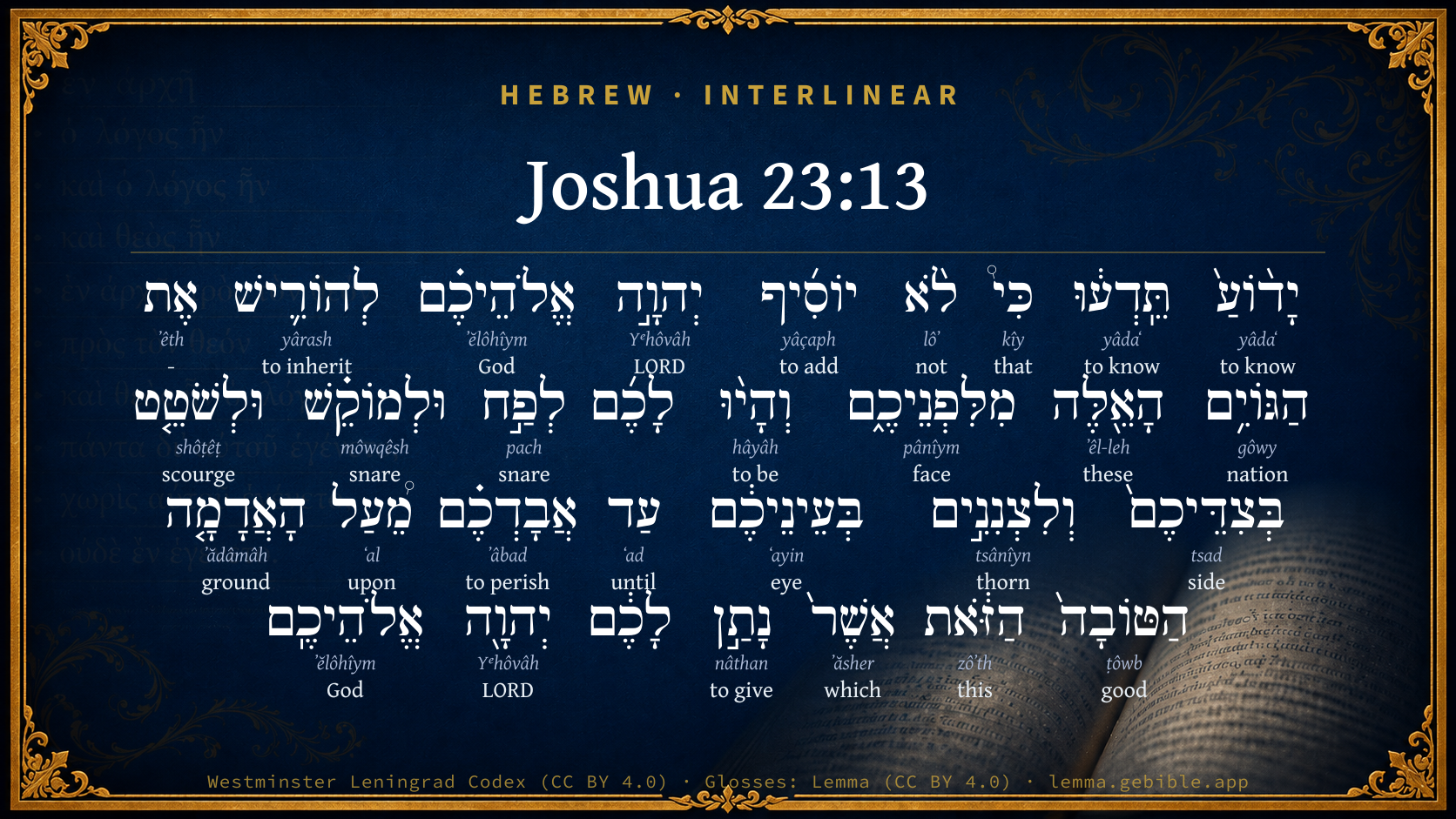
Hebrew (Westminster Leningrad Codex) Joshua 23:13 appears in the Hebrew Old Testament. The text above is from the Westminster Leningrad Codex. Each word links to its Strong’s number, a concise gloss, and parsing drawn from the Open Scriptures Hebrew Bible morphology. Click any word for its full Brown-Driver-Briggs (BDB) entry.
Download image
Cite this verse

Joshua 23:13 (World English Bible). Public Domain. Lemma interlinear Bible study tool, https://lemma.gebible.app/v/joshua/23/13.

Show BibTeX & RIS
BibTeX
RIS
English Translation
know for a certainty that Yahweh your God will no more drive these nations from out of your sight; but they shall be a snare and a trap to you, and a scourge in your sides, and thorns in your eyes, until you perish from off this good land which Yahweh your God has given you.
World English Bible · Public Domain
Highlights
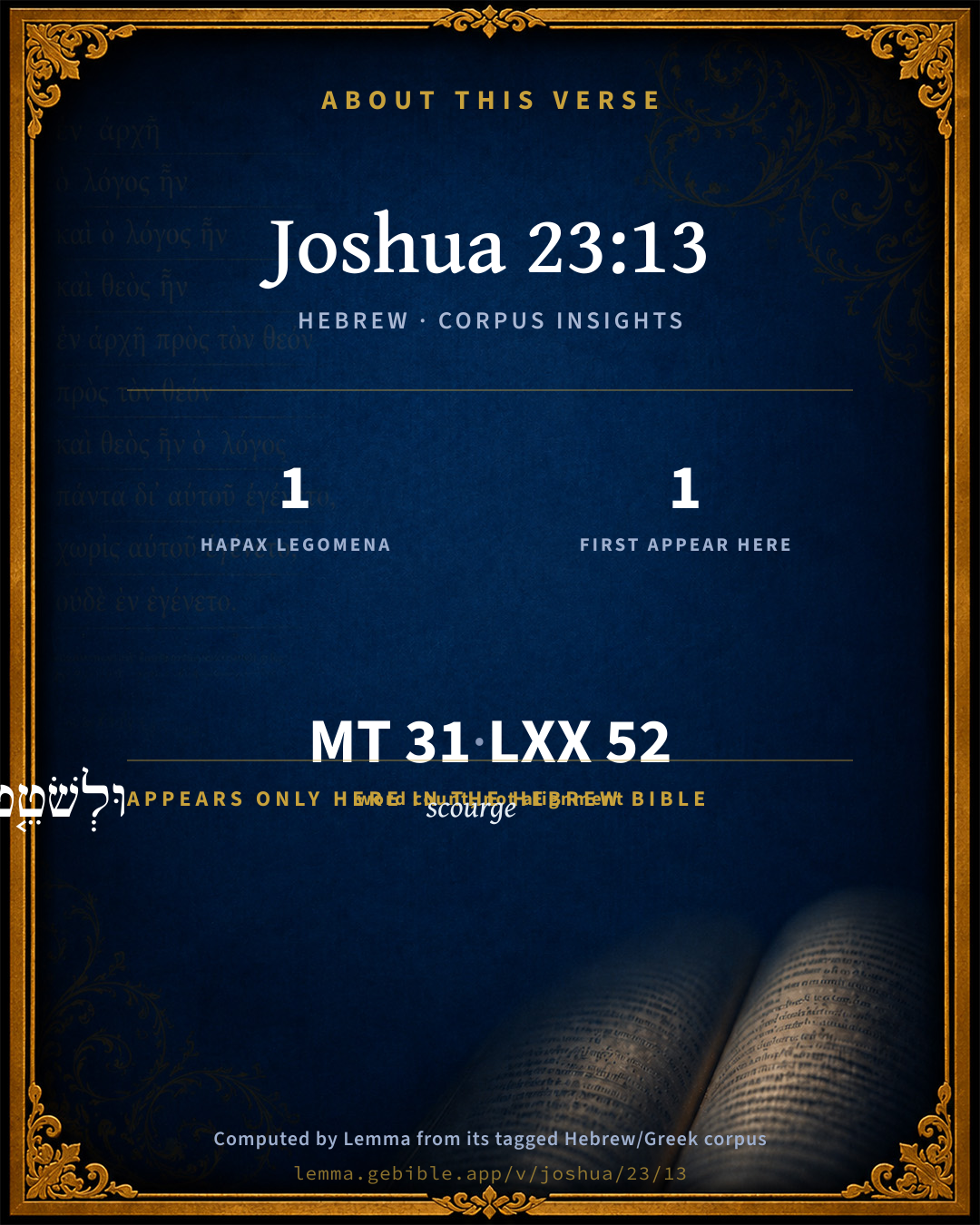
  • 1 hapax legomenon — only here in the Hebrew Bible
  • 1 first appearance in the Hebrew Bible
Full analysis ↓
Download a study sheet

One document with this verse’s original text, its word-by-word gloss line, the meaning frame, cross-references with their text, attributed commentary, and full source and license credits — printable, and it pastes into notes with its structure intact.

This verse Autodidact and up

Study sheet (.html) Plain text (.txt)

A passage Seminary Student

Up to 50 verses in one chapter. A passage sheet keeps up to 6 commentary sources and 12 cross-references per verse, in the order this page ranks them, and says so on the sheet whenever that leaves anything out. Ask for a single verse and you get the Autodidact verse sheet above.

Everything on this page stays free to read, with no account — the sheet is a download of what is already on screen, not access to it.

Want to remove ads? Support Godless Engineer
Compare translations 3

The same verse in 3 English versions, stacked beneath the original-language interlinear above. Click any original word for its lexicon entry.

Each is an independent rendering of the whole verse — the interlinear is not word-aligned to these translations.

Highlighted words mark where these versions differ — a whole-verse word diff, not a word-by-word alignment.

  • World English Bible Public Domain
    know for a certainty that Yahweh your God will no more drive these nations from out of your sight; but they shall be a snare and a trap to you, and a scourge in your sides, and thorns in your eyes, until you perish from off this good land which Yahweh your God has given you.
  • King James Version Public Domain
    Know for a certainty that the LORD your God will no more drive out any of these nations from before you; but they shall be snares and traps unto you, and scourges in your sides, and thorns in your eyes, until ye perish from off this good land which the LORD your God hath given you.
  • unfoldingWord Literal Text CC BY-SA 4.0
    knowing, may you know that Yahweh your God will not continue to dispossess these nations from to your face. And they will be to you for a snare and for a trap and for a whip on your sides and for thorns in your eyes, until you perish from upon this good ground that Yahweh your God has given to you.

unfoldingWord Literal Text — © unfoldingWord, licensed CC BY-SA 4.0. Word-aligned USFM3 via Door43 (git.door43.org/unfoldingWord/en_ult).

Versions to compare (up to 4)

3 of 4 selected

Show all 18 translations

Every available English version of this verse, each an independent rendering of the whole verse.

  • World English Bible Public Domain
    know for a certainty that Yahweh your God will no more drive these nations from out of your sight; but they shall be a snare and a trap to you, and a scourge in your sides, and thorns in your eyes, until you perish from off this good land which Yahweh your God has given you.
  • Berean Standard Bible Public Domain
    know for sure that the LORD your God will no longer drive out these nations before you. Instead, they will become for you a snare and a trap, a scourge in your sides and thorns in your eyes, until you perish from this good land that the LORD your God has given you.
  • Majority Standard Bible Public Domain
    know for sure that the LORD your God will no longer drive out these nations before you. Instead, they will become for you a snare and a trap, a scourge in your sides and thorns in your eyes, until you perish from this good land that the LORD your God has given you.
  • King James Version Public Domain
    Know for a certainty that the LORD your God will no more drive out any of these nations from before you; but they shall be snares and traps unto you, and scourges in your sides, and thorns in your eyes, until ye perish from off this good land which the LORD your God hath given you.
  • American Standard Version (1901) Public Domain
    know for a certainty that Jehovah your God will no more drive these nations from out of your sight; but they shall be a snare and a trap unto you, and a scourge in your sides, and thorns in your eyes, until ye perish from off this good land which Jehovah your God hath given you.
  • Revised Version (1885) Public Domain
    know for a certainty that the LORD your God will no more drive these nations from out of your sight; but they shall be a snare and a trap unto you, and a scourge in your sides, and thorns in your eyes, until ye perish from off this good land which the LORD your God hath given you.
  • Geneva Bible (1599) Public Domain
    Knowe ye for certaine, that the Lord your God will cast out no more of these nations from before you: but they shall be a snare and destruction vnto you, and a whip on your sides, and thornes in your eyes, vntill ye perish out of this good land, which ye Lord your God hath giue you.
  • Douay-Rheims (1899) Public Domain
    Know ye for a certainty that the Lord your God will not destroy them be- fore your face, but they shall be a pit and a snare in your way, and a stumblingblock at your side, and stakes in your eyes, till he take you away and destroy you from off this excellent land, which he hath given you.
  • Young's Literal Translation Public Domain
    know certainly that Jehovah your God is not continuing to dispossess these nations from before you, and they have been to you for a gin, and for a snare, and for a scourge, in your sides, and for thorns in your eyes, till ye perish from off this good ground which Jehovah your God hath given to you.
  • Literal Standard Version CC BY-SA 4.0
    certainly know that your God YHWH is not continuing to dispossess these nations from before you, and they have been to you for a trap, and for a snare, and for a scourge, in your sides, and for thorns in your eyes, until you perish from off this good ground which your God YHWH has given to you.
  • Unlocked Literal Bible CC BY-SA 4.0
    then know for certain that Yahweh your God will no longer drive these nations out from among you. Instead, they will become a snare and a trap for you, whips on your backs and thorns in your eyes, until you perish from this good land that Yahweh your God has given you.
  • unfoldingWord Literal Text CC BY-SA 4.0
    knowing, may you know that Yahweh your God will not continue to dispossess these nations from to your face. And they will be to you for a snare and for a trap and for a whip on your sides and for thorns in your eyes, until you perish from upon this good ground that Yahweh your God has given to you.
  • Darby Bible Public Domain
    know for a certainty that Jehovah your God will no more dispossess these nations from before you, and they shall be snares and traps unto you, and scourges in your sides, and thorns in your eyes, until ye perish from off this good land which Jehovah your God hath given you.
  • World Messianic Bible Public Domain
    know for a certainty that the LORD your God will no longer drive these nations from out of your sight; but they shall be a snare and a trap to you, a scourge in your sides, and thorns in your eyes, until you perish from off this good land which the LORD your God has given you.
  • Webster's Bible Public Domain
    Know for a certainty that the LORD your God will no more drive out any of these nations from before you; but they shall be snares and traps to you, and scourges in your sides, and thorns in your eyes, until ye perish from off this good land which the LORD your God hath given you.
  • Free Bible Version CC BY-SA 4.0
    you can be absolutely sure that the Lord your God will definitely not drive out these nations before you. On the contrary, they will be a trap and a snare to you, a whip on your back and thorns in your eyes until you die out completely from this good land the Lord your God has given you.
  • Bible in Basic English Public Domain
    Then you may be certain that the Lord your God will not go on driving these nations out from before you; but they will become a danger and a cause of sin to you, a whip for your sides and thorns in your eyes, till you are cut off from this good land which the Lord your God has given you.
  • JPS Tanakh (1917) Public Domain
    know for a certainty that the LORD your God will no more drive these nations from out of your sight; but they shall be a snare and a trap unto you, and a scourge in your sides, and pricks in your eyes, until ye perish from off this good land which the LORD your God hath given you.

Literal Standard Version (2020), Covenant Press — licensed CC BY-SA 4.0. Text via the HelloAO Bible API (eBible.org). Unlocked Literal Bible (unfoldingWord) — licensed CC BY-SA 4.0. Text via the HelloAO Bible API (eBible.org). unfoldingWord Literal Text — © unfoldingWord, licensed CC BY-SA 4.0. Word-aligned USFM3 via Door43 (git.door43.org/unfoldingWord/en_ult). Free Bible Version, Dr. Jonathan Gallagher — licensed CC BY-SA 4.0. Text via the HelloAO Bible API (eBible.org).

Word by word

More ways to search: Search by grammar → Find every occurrence → Compare this word →

Practice this passage: Drill this verse → Learn its vocabulary →

וּלְשֹׁטֵ֤ט
shôṭêṭ
H7850
“and · to/for · scourge”
Conjunction + Preposition + Noun, Common, Masculine, Singular, Absolute
Part of Speech
Conjunction + Preposition + Noun
Type
Common
Gender
Masculine
Number
Singular
State
Absolute
Full BDB Definition

Origin: act part of an otherwise unused root meaning (properly, to pierce

TWOT: 2344b

scourge
  1. יָד֨וֹעַ֙ yâdaʻ H3045 “to know” Verb, Qal, Infinitive Absolute
  2. תֵּֽדְע֔וּ yâdaʻ H3045 “to know” Verb, Qal, Imperfect, 2nd Person, Masculine, Plural
  3. כִּי֩ kîy H3588 “that” Conjunction
  4. לֹ֨א lôʼ H3808 “not” Particle, Negative
  5. יוֹסִ֜יף yâçaph H3254 “to add” Verb, Hiphil, Imperfect, 3rd Person, Masculine, Singular
  6. יְהוָ֣ה Yᵉhôvâh H3068 “LORD” Noun, Proper
  7. אֱלֹהֵיכֶ֗ם ʼĕlôhîym H430 “God(s) · your” Noun, Common, Masculine, Plural, Construct + Suffix, Personal, 2nd Person, Masculine, Plural
  8. לְהוֹרִ֛ישׁ yârash H3423 “to inherit” Preposition + Verb, Hiphil, Infinitive Construct
  9. אֶת ʼêth H853 “-” Particle, Direct Object
  10. הַגּוֹיִ֥ם gôwy H1471 “the · nations” Particle, Definite Article + Noun, Common, Masculine, Plural, Absolute
  11. הָאֵ֖לֶּה ʼêl-leh H428 “the · these” Particle, Definite Article + Pronoun, Demonstrative, Common, Plural
  12. מִלִּפְנֵיכֶ֑ם pânîym H6440 “from · to/for · face(s) · your” Preposition + Preposition + Noun, Common, Both, Plural, Construct + Suffix, Personal, 2nd Person, Masculine, Plural
  13. וְהָי֨וּ hâyâh H1961 “and · to be” Conjunction + Verb, Qal, Sequential Perfect, 3rd Person, Common, Plural
  14. לְפַ֣ח pach H6341 “to/for · snare” Preposition + Noun, Common, Masculine, Singular, Absolute
  15. וּלְמוֹקֵ֗שׁ môwqêsh H4170 “and · to/for · snare” Conjunction + Preposition + Noun, Common, Masculine, Singular, Absolute
  16. בְּצִדֵּיכֶם֙ tsad H6654 “in/at · sides · your” Preposition + Noun, Common, Masculine, Plural, Construct + Suffix, Personal, 2nd Person, Masculine, Plural
  17. וְלִצְנִנִ֣ים tsânîyn H6796 “and · to/for · thorns” Conjunction + Preposition + Noun, Common, Masculine, Plural, Absolute
  18. בְּעֵינֵיכֶ֔ם ʻayin H5869 “in/at · eyes · your” Preposition + Noun, Common, Both, Dual, Construct + Suffix, Personal, 2nd Person, Masculine, Plural
  19. עַד ʻad H5704 “until” Preposition
  20. אֲבָדְכֶ֗ם ʼâbad H6 “to perish · you” Verb, Qal, Infinitive Construct + Suffix, Personal, 2nd Person, Masculine, Plural
  21. מֵ֠עַל ʻal H5921 “from · upon” Preposition + Preposition
  22. הָאֲדָמָ֤ה ʼădâmâh H127 “the · ground” Particle, Definite Article + Noun, Common, Feminine, Singular, Absolute
  23. הַטּוֹבָה֙ ṭôwb H2896 “the · good” Particle, Definite Article + Adjective, Adjective, Feminine, Singular, Absolute
  24. הַזֹּ֔את zôʼth H2063 “the · this” Particle, Definite Article + Pronoun, Demonstrative, Feminine, Singular
  25. אֲשֶׁר֙ ʼăsher H834 “which” Particle, Relative
  26. נָתַ֣ן nâthan H5414 “to give” Verb, Qal, Perfect, 3rd Person, Masculine, Singular
  27. יְהוָ֖ה Yᵉhôvâh H3068 “LORD” Noun, Proper
  28. אֱלֹהֵיכֶֽם ʼĕlôhîym H430 “God(s) · your” Noun, Common, Masculine, Plural, Construct + Suffix, Personal, 2nd Person, Masculine, Plural

About this verse

These counts appear in no published source. They are computed here, from the morphology-tagged text and Lemma’s own curated glosses. What Lemma adds →

31
words
26
distinct lemmas
Historical
section

Notable vocabulary

1 hapax legomenon — a word that appears only here in the entire Hebrew Bible:

  • וּלְשֹׁטֵ֤ט scourge H7850

First appearance in Scripture

This word makes its first canonical appearance in the Hebrew Bible here:

  • וּלְשֹׁטֵ֤ט scourge H7850

Shared distinctive vocabulary

וְלִצְנִנִ֣ים thorn H6796 occurs in 2 verses of the Hebrew Bible. Also found in:

Grammatical profile

  • 7 verbs
  • 13 nouns
  • 1 adjective
  • 2 pronouns
  • 4 prepositions
  • 1 conjunction
  • 3 particles

Verb forms

  • יָד֨וֹעַ֙ Qal · Infinitive Absolute
  • תֵּֽדְע֔וּ Qal · Imperfect
  • יוֹסִ֜יף Hiphil · Imperfect
  • לְהוֹרִ֛ישׁ Hiphil · Infinitive Construct
  • וְהָי֨וּ Qal · Sequential Perfect
  • אֲבָדְכֶ֗ם Qal · Infinitive Construct
  • נָתַ֣ן Qal · Perfect

Repetition

Words recur within this verse — often emphatic in Hebrew:

  • יָד֨וֹעַ֙ to know H3045 ×2
  • יְהוָ֣ה LORD H3068 ×2
  • אֱלֹהֵיכֶ֗ם God H430 ×2

Hebrew & Septuagint length

In English translation the verse runs 56 words from the Hebrew and 50 from the Septuagint (LXX English) — closely comparable.

A rough comparison of the two English renderings, which tokenize alike — not a word-level alignment.

Word counts can differ between the Hebrew and the Greek without any difference in meaning — e.g. the Hebrew direct-object marker אֵת has no separate Greek word, and Greek often adds the article ὁ.

In the original languages it is 31 Hebrew tokens and 52 Greek tokens — but the two are counted differently (Hebrew bundles its prefixes and suffixes into one token; the Greek is in lemma form), so that isn’t a like-for-like length.

Cross-references

17

Topical passages linked to Joshua 23:13 in the Treasury of Scripture Knowledge — connected by theme and wording, ordered by reader-vote popularity; previews shown in the World English Bible.

  • Deuteronomy 7:16 You shall consume all the peoples who Yahweh your God shall deliver to you; your eye shall not pity them: neither shall you serve their gods; for that will be a snare to you.
  • Numbers 33:55 But if you will not drive out the inhabitants of the land from before you, then shall those who you let remain of them be as pricks in your eyes, and as thorns in your sides, and they shall vex you in the land in which you dwell.
  • Exodus 23:33 They shall not dwell in your land, lest they make you sin against me, for if you serve their gods, it will surely be a snare to you."
  • Judges 2:2–3 and you shall make no covenant with the inhabitants of this land; you shall break down their altars. But you have not listened to my voice: why have you done this?
  • Deuteronomy 28:63–68 It shall happen that as Yahweh rejoiced over you to do you good, and to multiply you, so Yahweh will rejoice over you to cause you to perish, and to destroy you; and you shall be plucked from off the land where you go in to possess it.
  • 2 Kings 17:22–23 The children of Israel walked in all the sins of Jeroboam which he did; they didn't depart from them;
  • Psalms 69:22 Let their table before them become a snare. May it become a retribution and a trap.
  • Psalms 106:35–39 But mixed themselves with the nations, And learned their works.
  • Luke 21:24 They will fall by the edge of the sword, and will be led captive into all the nations. Jerusalem will be trampled down by the Gentiles, until the times of the Gentiles are fulfilled.
  • Leviticus 26:31–35 I will lay your cities waste, and will bring your sanctuaries to desolation, and I will not take delight in the sweet fragrence of your offerings.
  • Deuteronomy 4:26 I call heaven and earth to witness against you this day, that you shall soon utterly perish from off the land whereunto you go over the Jordan to possess it; you shall not prolong your days on it, but shall utterly be destroyed.
  • Deuteronomy 29:28 and Yahweh rooted them out of their land in anger, and in wrath, and in great indignation, and cast them into another land, as at this day.
  • Deuteronomy 30:18 I denounce to you this day, that you shall surely perish; you shall not prolong your days in the land, where you pass over the Jordan to go in to possess it.
  • 2 Kings 25:26 All the people, both small and great, and the captains of the forces, arose, and came to Egypt; for they were afraid of the Chaldeans.
  • 2 Timothy 2:26 and they may recover themselves out of the devil's snare, having been taken captive by him to his will.
  • 1 Kings 11:4 For it happened, when Solomon was old, that his wives turned away his heart after other gods; and his heart was not perfect with Yahweh his God, as was the heart of David his father.
  • 2 Kings 25:21 The king of Babylon struck them, and put them to death at Riblah in the land of Hamath. So Judah was carried away captive out of his land.

Cross-references courtesy of OpenBible.info (CC BY 4.0).

Hebrew and Greek witnesses Masoretic Hebrew ↔ Greek Septuagint

The same verse in the two great witnesses to the Old Testament, shown verse-for-verse.

These are two independent witnesses, not word-aligned to each other, and the Septuagint is shown in lemma (dictionary) form.

Hebrew Joshua 23:13 Masoretic · Westminster Leningrad Codex

יָד֨וֹעַ֙ תֵּֽדְע֔וּ כִּי֩ לֹ֨א יוֹסִ֜יף יְהוָ֣ה אֱלֹהֵיכֶ֗ם לְהוֹרִ֛ישׁ אֶת הַגּוֹיִ֥ם הָאֵ֖לֶּה מִלִּפְנֵיכֶ֑ם וְהָי֨וּ לָכֶ֜ם לְפַ֣ח וּלְמוֹקֵ֗שׁ וּלְשֹׁטֵ֤ט בְּצִדֵּיכֶם֙ וְלִצְנִנִ֣ים בְּעֵינֵיכֶ֔ם עַד אֲבָדְכֶ֗ם מֵ֠עַל הָאֲדָמָ֤ה הַטּוֹבָה֙ הַזֹּ֔את אֲשֶׁר֙ נָתַ֣ן לָכֶ֔ם יְהוָ֖ה אֱלֹהֵיכֶֽם

know for a certainty that Yahweh your God will no more drive these nations from out of your sight; but they shall be a snare and a trap to you, and a scourge in your sides, and thorns in your eyes, until you perish from off this good land which Yahweh your God has given you.

World English Bible · Public Domain

Greek LXX Joshua 23:13 Septuagint · lemma form

γιγνώσκω ὅτι οὐ μή προςτίθημι κύριος ὁ ἐκὀλεθρεύω ὁ ἔθνος οὗτος ἀπό πρόσωπον σύ καί εἰμί σύ εἰς παγίς καί εἰς σκάνδαλον καί εἰς ἧλος ἐν ὁ πτέρνα σύ καί εἰς βολίς ἐν ὁ ὀφθαλμός σύ ἕως ἄν ἀποὀλλύω ἀπό ὁ γῆ ὁ ἀγαθός οὗτος ὅς δίδωμι σύ κύριος ὁ θεός σύ

know that the Lord will no more destroy these nations from before you; and they will be to you snares and stumbling blocks, and nails in your heels, and darts in your eyes, until you⌃ be destroyed from off this good land, which the Lord your God has given you.

LXX2012 (modern English Septuagint) · Public Domain

On this verse, Haydock's Catholic Bible Commentary discusses the Septuagint’s reading. Read the note in Commentary ↓

Hebrew: Westminster Leningrad Codex (CC BY 4.0). Greek: Septuagint (public domain); English from LXX2012 (modern English Septuagint) (Public Domain). How the Septuagint differs from the Hebrew →

Targum (Aramaic paraphrase)

1

The Targum is the ancient Jewish Aramaic paraphrase of the Hebrew Scriptures — an interpretive translation, not the Hebrew text itself. Onkelos (literal) and Pseudo-Jonathan (expansive) render the Torah, and Jonathan the Prophets. Coverage is partial: where no permissively-licensed English translation exists for a verse, only the Aramaic is shown. This is verse-level text, not a word-by-word alignment to the Hebrew.

  1. Targum Jonathan Prophets (Joshua–Malachi)
    מִדַע תֵּדְעוּן אֲרֵי לָא יוֹסִיף מֵימְרָא דַייָ אֱלָהָכוֹן לְתָרָכָא יַת עַמְמַיָא הָאִלֵין מִן קֳדָמֵיכוֹן וִיהוֹן לְכוֹן לִתְבִיר וּלְתַקְלָא וּלְסִיעַן נַטְלָן זְיָן לְקִבְלֵיכוֹן וּלְמַשִׁרְיָן מַקְפַּנְכוֹן עַד דְתֵבְדוּן מֵעַל אַרְעָא טַבְתָא הָדָא דִי יְהַב לְכוֹן יְיָ אֱלָהָכוֹן:

    (no public-domain English translation for this verse)

    Targum Jonathan — Aramaic: “Mikraot Gedolot” (public domain). English: “Sefaria Community Translation” (CC0 1.0 (public-domain dedication)); “London "Chaldee Paraphrase," 1871” (public domain). Text via Sefaria.

Commentary

Notes on Joshua 23:13 from classic Christian and Jewish commentators (each source and its license shown beneath its notes). The classic Christian expositions comment on the surrounding passage and are grouped to its opening verse, so a note may address several verses; the Jewish commentaries on the Tanakh (Rashi and others) are per-verse, so they appear only where the commentator wrote on this verse.

Lemma curates 59 commentaries, every one of them public domain or Creative Commons licensed, each selected and text-cleaned for this edition rather than reprinted as found. About our sources →

Trapp's Complete Commentary

John Trapp

Jos 23:13 Know for a certainty that the LORD your God will no more drive out [any of] these nations from before you; but they shall be snares and traps unto you, and scourges in your sides, and thorns in your eyes, until ye perish from off this good land which the LORD your God hath given you.

Ver. 13. But they shall be snares and traps unto you.] As the fowler catcheth birds, and the hunter wild beasts in their snares and traps; so shall these Canaanites catch you by their familiarity and commerce, and draw you to participate in their sins and plagues.

And scourges in your sides, and thorns in your eyes.] They shall by their injuries vex and disquiet you, they shall with sharpest weapons prick and gore your tenderest parts, without mercy or measure.

John Trapp, A Commentary or Exposition upon All the Books of the Old and New Testament (1647–1656) — public domain. Text from a community e-Sword module.

Tyndale Open Study Notes

Tyndale Open Resources

23:13 will no longer drive them out: If Israel associated with the Canaanite remnant, God would oblige the Israelites by not driving out that remnant. God ultimately gives people what they seek.

Tyndale Open Study Notes — © Tyndale Open Resources, licensed CC BY-SA 4.0. Text via the HelloAO Bible API.

Geneva Bible (1599)

Geneva Bible translators

Meaning, they shall be a continual grief unto you, and so the cause of your destruction.

Geneva Bible (1599) marginal notes — public domain. Text via Bolls.life.

Adam Clarke's Commentary

Verse 13. They shall be snares] לפח lephach, a net or gin, set by the artful fowler to catch heedless birds.

And traps] מוקש mokesh, any snare, toil, or trap, placed on the ground to catch the unwary traveller or wild beast by the foot.

Scourges in your sides, and thorns in your eyes] Nothing can be conceived more vexatious and distressing than a continual goad in the side, or thorn in the eye. They will drive you into obedience to their false gods, and put out the eyes of your understandings by their idolatries. And God will preserve them merely to distress and punish you.

Adam Clarke's Commentary on the Bible (1810–1826) — public domain. Text from a community e-Sword/MySword module.

The Cambridge Bible for Schools and Colleges

gen. ed. J. J. S. Perowne

13. snares] The word thus rendered denotes (i) a net, trap-net, especially of a fowler; (ii) a snare such as seizes and holds beasts or men by the feet. Comp. Job_18:9, “the gin shall take him by the heel;” Jer_18:22, “they have … hid snares for my feet.” The form of this trap-net appears from the passages Amo_3:5, and Psa_69:22. It was in two parts, which, when set, were spread out upon the ground and slightly fastened with a stick, so that as soon as a bird or beast touched the stick, the parts flew up and enclosed the bird in the net, or caught the foot of the animal.

thorns in your eyes] The warnings of Joshua are severer even than those of Moses (Num_33:55), “nowe thanne wite çe that the Lord çoure God do hem not awey before çoure face, but to çow thei shulen be into a diche, and greene, and hurtynge of çoure side and a staak in çoure eyen, to the tyme that he doo çou a wey,” Wyclif.

The Cambridge Bible for Schools and Colleges (gen. ed. J. J. S. Perowne; Cambridge University Press, 1878–1918) — public domain. Text from a community e-Sword module.

John Gill's Exposition

Know for a certainty that the Lord your God will no more drive out any of these nations from before you,.... Or, "knowing ye shall know" (r); or "know ye"; this may be taken for granted, or the fullest proof, and clearest demonstration, and strongest assurance will be given of it, that in case of such bad conduct, and disobedience to the will of God, no more of the nations of the Canaanites will be driven out of the cities in which they are:

but they shall be snares and traps unto you; who by their bad examples would draw them both to idolatry and superstitious worship, and into all irreligion, profaneness, and immorality, as they did, Psa 106:35,

and scourges in your sides; who either, by ensnaring them, would get an advantage over them, and distress them in their persons, families, and estates; or would be the means of the Lord's correcting and chastising them with the rod and stripes of men, for the iniquities these would draw them into; the allusion is to scourges and lashes laid on the sides of men, or to goads with which beasts are pushed on their sides and driven:

and thorns in your eyes; very troublesome and distressing; for even a mote in the eye is very afflicting: and much more a thorn; See Gill on Num 33:55. Jarchi interprets this word by camps surrounding them, as shields do the bodies of men, and which is approved of by Gussetius (s):

until ye perish from off this good land, which the Lord your God hath given you; by sword, famine, pestilence, or captivity, which has been their case.

(r) "sciendo scietis", Montanus; "sciendo scitote", Pagninus, Vatablus. (s) Comment. Ebr. p. 717.

John Gill's Exposition of the Whole Bible (1746–1763) — public domain (CC PDM 1.0). Text via the HelloAO Bible API.

Haydock's Catholic Bible Commentary

Side. Hebrew, "snares and traps unto you, and scourges in your side." Children and slaves were formerly beaten on this part, Ecclesiasticus xxx. 12., and xlii. 5. Horace (epod. iv.) says, Ibericis peruste funibus latus. The first word St. Jerome seems to have read with th at the end, as peth, means a hole, (Calmet) by which means it was customary to take wild beasts, and to annoy the enemy. (Haydock) --- Septuagint render side, "they shall be nails in your heels."

George Leo Haydock (1774–1849), Haydock's Catholic Family Bible and Commentary, 1859 edition — public domain. Excludes Psalms (Douay-Rheims chapter numbering differs from Protestant) and Deuterocanonical books (Catholic canon only).

Matthew Poole's English Annotations

They shall be snares and traps unto you: by your indulgence to them, and converse with them, you will be enticed and drawn by degrees into their errors, and impieties, and brutish lusts.

Scourges in your sides, and thorns in your eyes: when they have inveigled, and seduced, and thereby weakened you, then they will molest and vex you, no less than a severe scourge doth a man’s sides which are lashed by it, or than a small thorn doth the eye when it is got within it.

Until ye perish from off this good land: they shall so persecute you, and fight against you with such success, that you shall be forced to quit your own land, and wander you know not whither; which must needs be very terrible to them to think of, when they compared this present case, and plenty, and safety, with the pains, and weariness, and hazards, and wants of their former wanderings.

Matthew Poole's English Annotations on the Holy Bible (1683–1685) — public domain. Text from a community e-Sword/MySword module.

Whedon's Commentary on the Bible

Daniel D. Whedon

13. Snares, traps, scourges, thorns — This mixing of metaphors vividly portrays the trouble, sudden disaster, wasting captivity, and destruction which idolatry would bring upon their nation.

Until ye perish from off this good land — The Jews are strangers to that land to-day, so wonderfully has God scattered them, and so marvelously has he preserved their nationality in order that they may be a monument of his truthfulness.

Daniel D. Whedon (gen. ed.), Commentary on the Old and New Testaments (1874–1909) — public domain. Text from a community e-Sword module.

The Pulpit Commentary

Snares and traps. Perhaps, rather, nets and snares. The LXX, where our translation has snare, has pagiv , and for traps has incorrectly skandala . The snare or pach was evidently (Amo_3:5) laid upon the earth; but there is no evidence for Gesenius" idea that the mokesh which follows, there as here, means the stick of the trap, which when displaced involved the bird in the net. As the primary signification of this latter word, which is akin to tvq a bow, seems to mean something curved, it is probably a noose or springe. And the word and its cognates are used of involving, or catching, people by its use. Furst"s Lexicon confirms this view, which has been independently arrived at. Scourges. The Hebrew word is in the singular. It is translated hlouv , nails, in the LXX, and offendiculum in the Vulgate. In your sides. Rather, on your sides. The words here are very similar to those in Num_33:55. Moses, however, does but use two of the similes of which here we have four. He has, moreover, a different word ( for thorns, and the word here translated thorns is there substituted for scourges; "thorns in your sides." Joshua crowds together his similes "to describe the shame, and trouble, and oppression which they would bring upon themselves by joining in the idolatry of the Canaanites" (Keil). The Lord your God. Here, as elsewhere in this and many other passages, we have in the original, Jehovah your God. It is important to remember that the sacred writer is calling the God of Israel by His own proper name, that by which He was distinguished from the gods of the nations round about.

The Pulpit Commentary (1880–1919), ed. H.D.M. Spence-Jones & Joseph S. Exell — public domain. Text from a community e-Sword module.

John Wesley's Explanatory Notes

Traps to you - By your converse with them, you will be drawn by degrees into their errors, and impieties, and brutish lusts. Thorns in your eyes - When they have seduced, and thereby weakened you, then they will molest and vex you, no less than a severe scourge doth a man's sides which are lashed by it, or than a small thorn doth the eye when it is got within it. Till ye perish - They shall so persecute you, and fight against, you with such success, that you shall be forced to quit your own land, and wander you know not whither; which must needs be very terrible to them to think of, when they compared this present ease, and plenty and safety, with the pains, and weariness, and hazards, and wants of their former wanderings.

John Wesley, Explanatory Notes Upon the Whole Bible (1754–1765) — public domain. Text via the GEBible commentary corpus.

Rashi

Rabbi Shlomo Yitzchaki (Rashi)

And a goad in your sides. They will prowl around you to loot and ransack.

And thorns. This is an expression of camps. Similarly: “And they will come upon you with camps,” like a shield (צִנָה) that surrounds a person on three sides, as it is said, “As a shield, you encompass him with favor,” תַּעְטְרֶנוּ meaning תְּסוֹבְבֶנוּ, surrounding, similar to “And Shaul and his men surrounded David and his men.” עוֹטְרִים meaning סוֹבְבִים, surrounding.

Rashi on the Tanakh — English translations: “The Judaica Press complete Tanach with Rashi, translated by A. J. Rosenberg” (CC BY 4.0); “Pentateuch with Rashi's commentary by M. Rosenbaum and A.M. Silbermann, 1929-1934” (public domain); “The Metsudah Tanach series, Lakewood, N.J” (CC BY 4.0); and “The Book of Joshua, Metsudah Publications, 1997” (CC BY 4.0). Text via Sefaria.

Lesson kit

Teaching starters — assembled from the data on this page, not authored interpretation. Every prompt links to the verse data it draws on. Edit before teaching.

Joshua, in the Historical, opens this verse with 31 words (26 distinct Hebrew lemmas). Its most distinctive word is shôṭêṭ (“scourge”). A historical commentator’s framing appears above. Read the whole chapter for the surrounding context.

Discussion questions

  1. The word shôṭêṭ carries the sense “scourge.” How does it shape the verse?
  2. 1 word here appears nowhere else in the Hebrew Bible. Why might the author reach for such rare wording?
  3. This is the first place “scourge” appears in Scripture (first appears here). What does its debut here establish?
  4. How does Numbers 33:55, which shares the word «thorn», read alongside this verse?
  5. What does the repetition of “to know” (2× in this one verse) do in this verse?
  6. These translations render this verse differently; the difference is in the English rendering, not the original. What questions does that raise?
  7. «יָד֨וֹעַ֙» is a Qal Infinitive Absolute verb. How does that grammatical form shape the action described?
  8. Compare how Trapp's Complete Commentary and Tyndale Open Study Notes read this verse. Where do they agree or differ?

Things to notice

  • 1 word in this verse appears nowhere else in the Hebrew Bible.
  • 1 word makes its first canonical appearance in Scripture here.
  • This verse counts 31 Hebrew ↔ 52 Greek words.
  • These translations choose different wording for 28 words in this verse.
  • “to know” occurs 2× in this single verse.

Reading settings

Reading text

Shown beneath each verse's original-language words.

Old Testament
Old Testament edition

Read the OT as the Masoretic Hebrew (MT) or the Greek Septuagint (LXX).

English shown for the Greek Septuagint (in the Hebrew ↔ Greek comparison).

Comparing translations? Open the Compare panel on any verse page to stack up to four side by side.