1 Samuel 8:5

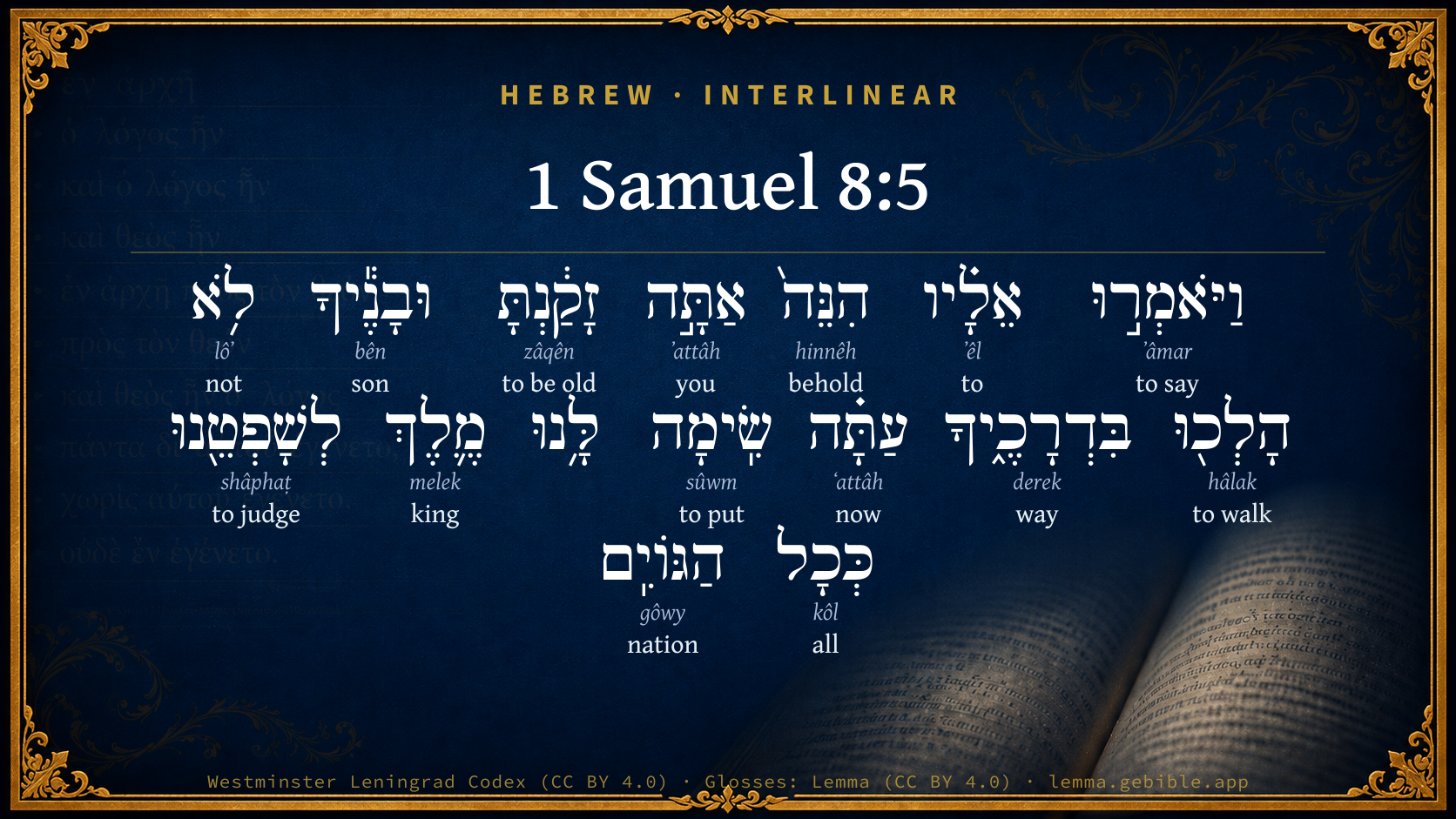
Hebrew (Westminster Leningrad Codex) 1 Samuel 8:5 appears in the Hebrew Old Testament. The text above is from the Westminster Leningrad Codex. Each word links to its Strong’s number, a concise gloss, and parsing drawn from the Open Scriptures Hebrew Bible morphology. Click any word for its full Brown-Driver-Briggs (BDB) entry.
Download image
Cite this verse

1 Samuel 8:5 (World English Bible). Public Domain. Lemma interlinear Bible study tool, https://lemma.gebible.app/v/1-samuel/8/5.

Show BibTeX & RIS
BibTeX
RIS
English Translation
and they said to him, Behold, you are old, and your sons don't walk in your ways: now make us a king to judge us like all the nations.
World English Bible · Public Domain
Download a study sheet

One document with this verse’s original text, its word-by-word gloss line, the meaning frame, cross-references with their text, attributed commentary, and full source and license credits — printable, and it pastes into notes with its structure intact.

This verse Autodidact and up

Study sheet (.html) Plain text (.txt)

A passage Seminary Student

Up to 50 verses in one chapter. A passage sheet keeps up to 6 commentary sources and 12 cross-references per verse, in the order this page ranks them, and says so on the sheet whenever that leaves anything out. Ask for a single verse and you get the Autodidact verse sheet above.

Everything on this page stays free to read, with no account — the sheet is a download of what is already on screen, not access to it.

Want to remove ads? Support Godless Engineer
Compare translations 3

The same verse in 3 English versions, stacked beneath the original-language interlinear above. Click any original word for its lexicon entry.

Each is an independent rendering of the whole verse — the interlinear is not word-aligned to these translations.

Highlighted words mark where these versions differ — a whole-verse word diff, not a word-by-word alignment.

  • World English Bible Public Domain
    and they said to him, Behold, you are old, and your sons don't walk in your ways: now make us a king to judge us like all the nations.
  • King James Version Public Domain
    And said unto him, Behold, thou art old, and thy sons walk not in thy ways: now make us a king to judge us like all the nations.
  • unfoldingWord Literal Text CC BY-SA 4.0
    And they said to him, “Behold, you yourself have aged, and your sons do not walk in your ways. Now appoint for us a king to judge us, like all of the nations.”

unfoldingWord Literal Text — © unfoldingWord, licensed CC BY-SA 4.0. Word-aligned USFM3 via Door43 (git.door43.org/unfoldingWord/en_ult).

Versions to compare (up to 4)

3 of 4 selected

Show all 18 translations

Every available English version of this verse, each an independent rendering of the whole verse.

  • World English Bible Public Domain
    and they said to him, Behold, you are old, and your sons don't walk in your ways: now make us a king to judge us like all the nations.
  • Berean Standard Bible Public Domain
    “Look,” they said, “you are old, and your sons do not walk in your ways. Now appoint a king to judge us like all the other nations.”
  • Majority Standard Bible Public Domain
    “Look,” they said, “you are old, and your sons do not walk in your ways. Now appoint a king to judge us like all the other nations.”
  • King James Version Public Domain
    And said unto him, Behold, thou art old, and thy sons walk not in thy ways: now make us a king to judge us like all the nations.
  • American Standard Version (1901) Public Domain
    and they said unto him, Behold, thou art old, and thy sons walk not in thy ways: now make us a king to judge us like all the nations.
  • Revised Version (1885) Public Domain
    and they said unto him, Behold, thou art old, and thy sons walk not in thy ways: now make us a king to judge us like all the nations.
  • Geneva Bible (1599) Public Domain
    And said vnto him, Beholde, thou art olde, and thy sonnes walke not in thy wayes: make vs nowe a King to iudge vs like all nations.
  • Douay-Rheims (1899) Public Domain
    And they said to him: Behold thou art old, and thy sons walk not in thy ways: make us a king, to judge us, as all nations have.
  • Young's Literal Translation Public Domain
    and say unto him, `Lo, thou hast become aged, and thy sons have not walked in thy ways; now, appoint to us a king, to judge us, like all the nations.'
  • Literal Standard Version CC BY-SA 4.0
    and say to him, “Behold, you have become aged, and your sons have not walked in your ways; now, appoint a king to us, to judge us, like all the nations.”
  • Unlocked Literal Bible CC BY-SA 4.0
    They said to him, “Look, you are old, and your sons do not walk in your ways. Appoint for us a king to judge us like all the nations.”
  • unfoldingWord Literal Text CC BY-SA 4.0
    And they said to him, “Behold, you yourself have aged, and your sons do not walk in your ways. Now appoint for us a king to judge us, like all of the nations.”
  • Darby Bible Public Domain
    and said to him, Behold, thou art become old, and thy sons walk not in thy ways: now appoint us a king to judge us, like all the nations.
  • World Messianic Bible Public Domain
    They said to him, “Behold, you are old, and your sons don’t walk in your ways. Now make us a king to judge us like all the nations.”
  • Webster's Bible Public Domain
    And said to him, Behold, thou art old, and thy sons walk not in thy ways: now make us a king to judge us like all the nations.
  • Free Bible Version CC BY-SA 4.0
    “Look here,” they told him, “you are old, and your sons do not follow your ways. Choose a king to rule over us like all the other nations.”
  • Bible in Basic English Public Domain
    And said to him, See now, you are old, and your sons do not go in your ways: give us a king now to be our judge, so that we may be like the other nations.
  • JPS Tanakh (1917) Public Domain
    And they said unto him: 'Behold, thou art old, and thy sons walk not in thy ways; now make us a king to judge us like all the nations.'

Literal Standard Version (2020), Covenant Press — licensed CC BY-SA 4.0. Text via the HelloAO Bible API (eBible.org). Unlocked Literal Bible (unfoldingWord) — licensed CC BY-SA 4.0. Text via the HelloAO Bible API (eBible.org). unfoldingWord Literal Text — © unfoldingWord, licensed CC BY-SA 4.0. Word-aligned USFM3 via Door43 (git.door43.org/unfoldingWord/en_ult). Free Bible Version, Dr. Jonathan Gallagher — licensed CC BY-SA 4.0. Text via the HelloAO Bible API (eBible.org).

Word by word

More ways to search: Search by grammar → Find every occurrence → Compare this word →

Practice this passage: Drill this verse → Learn its vocabulary →

זָקַ֔נְתָּ
zâqên
H2204
“to be old”
Verb, Qal, Perfect, 2nd Person, Masculine, Singular
Part of Speech
Verb
Stem
Qal
Form
Perfect
Person
2nd Person
Gender
Masculine
Number
Singular
Full BDB Definition

Origin: a primitive root

TWOT: 574

to be old, become old - (Qal) to be old, become old - (Hiphil) to grow old, show age
  1. וַיֹּאמְר֣וּ ʼâmar H559 “and · to say” Conjunction + Verb, Qal, Sequential Imperfect, 3rd Person, Masculine, Plural
  2. אֵלָ֗יו ʼêl H413 “to · him” Preposition + Suffix, Personal, 3rd Person, Masculine, Singular
  3. הִנֵּה֙ hinnêh H2009 “behold” Particle, Demonstrative
  4. אַתָּ֣ה ʼattâh H859 “you” Pronoun, Personal, 2nd Person, Masculine, Singular
  5. וּבָנֶ֕יךָ bên H1121 “and · sons · your” Conjunction + Noun, Common, Masculine, Plural, Construct + Suffix, Personal, 2nd Person, Masculine, Singular
  6. לֹ֥א lôʼ H3808 “not” Particle, Negative
  7. הָלְכ֖וּ hâlak H1980 “to walk” Verb, Qal, Perfect, 3rd Person, Common, Plural
  8. בִּדְרָכֶ֑יךָ derek H1870 “in/at · ways · your” Preposition + Noun, Common, Both, Plural, Construct + Suffix, Personal, 2nd Person, Masculine, Singular
  9. עַתָּ֗ה ʻattâh H6258 “now” Adverb
  10. שִֽׂימָה sûwm H7760 “put” Verb, Qal, Imperative, 2nd Person, Masculine, Singular + Suffix, h
  11. מֶ֛לֶךְ melek H4428 “king” Noun, Common, Masculine, Singular, Absolute
  12. לְשָׁפְטֵ֖נוּ shâphaṭ H8199 “to judge · us” Preposition + Verb, Qal, Infinitive Construct + Suffix, Personal, 1st Person, Common, Plural
  13. כְּכָל kôl H3605 “like/as · all of” Preposition + Noun, Common, Masculine, Singular, Construct
  14. הַגּוֹיִֽם gôwy H1471 “the · nations” Particle, Definite Article + Noun, Common, Masculine, Plural, Absolute

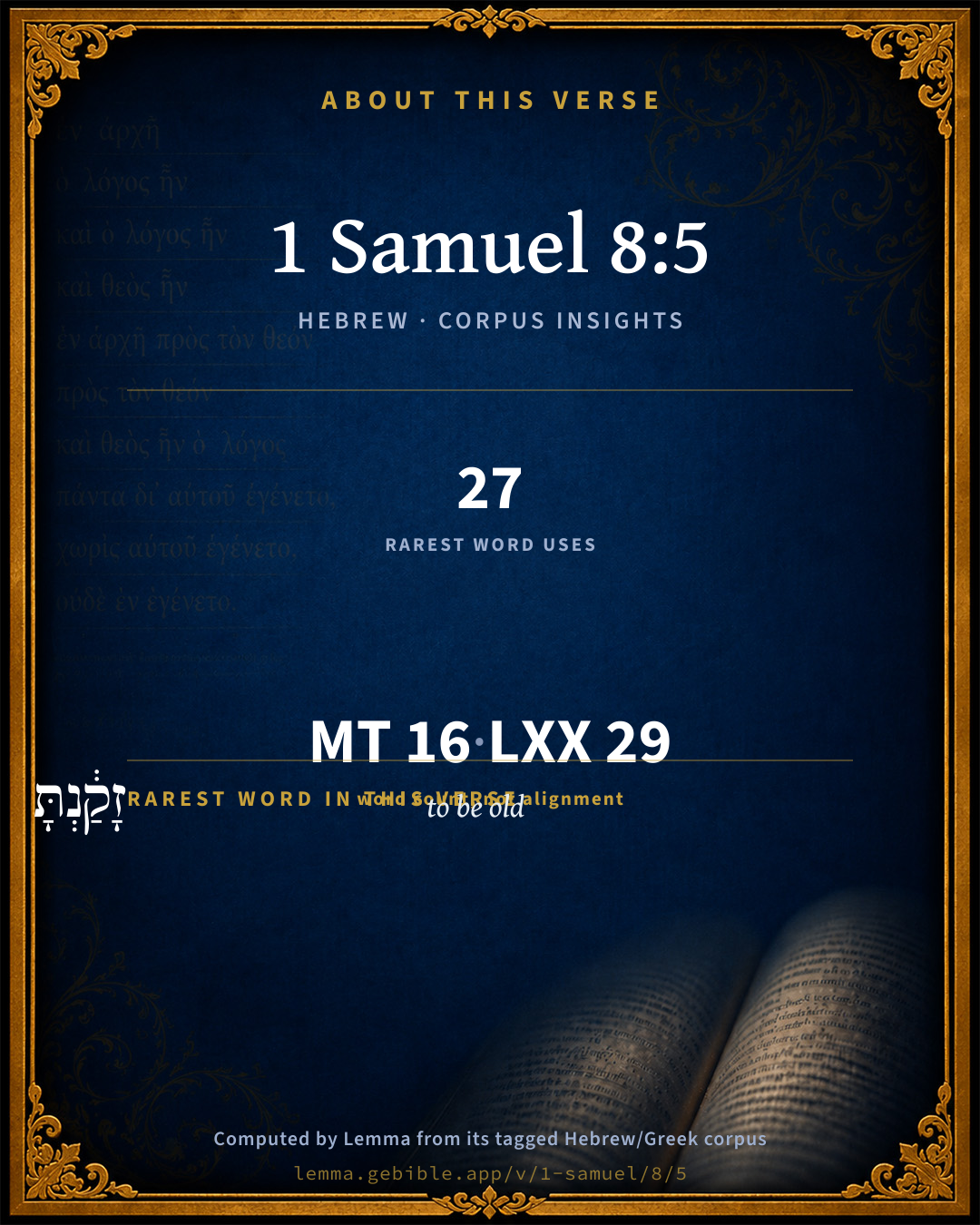
About this verse

These counts appear in no published source. They are computed here, from the morphology-tagged text and Lemma’s own curated glosses. What Lemma adds →

16
words
15
distinct lemmas
Historical
section

Shared distinctive vocabulary

זָקַ֔נְתָּ to be old H2204 occurs in 26 verses of the Hebrew Bible. Also found in:

Grammatical profile

  • 5 verbs
  • 5 nouns
  • 1 pronoun
  • 2 prepositions
  • 1 adverb
  • 2 particles

Verb forms

  • וַיֹּאמְר֣וּ Qal · Sequential Imperfect
  • זָקַ֔נְתָּ Qal · Perfect
  • הָלְכ֖וּ Qal · Perfect
  • שִֽׂימָה Qal · Imperative
  • לְשָׁפְטֵ֖נוּ Qal · Infinitive Construct

Hebrew & Septuagint length

In English translation the verse runs 29 words from the Hebrew and 34 from the Septuagint (LXX English) — closely comparable.

A rough comparison of the two English renderings, which tokenize alike — not a word-level alignment.

Word counts can differ between the Hebrew and the Greek without any difference in meaning — e.g. the Hebrew direct-object marker אֵת has no separate Greek word, and Greek often adds the article ὁ.

In the original languages it is 16 Hebrew tokens and 29 Greek tokens — but the two are counted differently (Hebrew bundles its prefixes and suffixes into one token; the Greek is in lemma form), so that isn’t a like-for-like length.

Cross-references

7

Topical passages linked to 1 Samuel 8:5 in the Treasury of Scripture Knowledge — connected by theme and wording, ordered by reader-vote popularity; previews shown in the World English Bible.

  • Deuteronomy 17:14–15 When you are come to the land which Yahweh your God gives you, and shall possess it, and shall dwell therein, and shall say, I will set a king over me, like all the nations that are round about me;
  • 1 Samuel 8:19–20 But the people refused to listen to the voice of Samuel; and they said, No: but we will have a king over us,
  • 1 Samuel 8:6–8 But the thing displeased Samuel, when they said, Give us a king to judge us. Samuel prayed to Yahweh.
  • Hosea 13:10–11 Where is your king now, that he may save you in all your cities? And your judges, of whom you said, 'Give me a king and princes?'
  • Numbers 23:9 For from the top of the rocks I see him, From the hills I see him: behold, it is a people that dwells alone, And shall not be reckoned among the nations.
  • 1 Samuel 12:17 Isn't it wheat harvest today? I will call to Yahweh, that he may send thunder and rain; and you shall know and see that your wickedness is great, which you have done in the sight of Yahweh, in asking you a king.
  • Acts 13:21 Afterward they asked for a king, and God gave to them Saul the son of Kish, a man of the tribe of Benjamin, for forty years.

Cross-references courtesy of OpenBible.info (CC BY 4.0).

Hebrew and Greek witnesses Masoretic Hebrew ↔ Greek Septuagint

The same verse in the two great witnesses to the Old Testament, shown verse-for-verse.

These are two independent witnesses, not word-aligned to each other, and the Septuagint is shown in lemma (dictionary) form.

Hebrew 1 Samuel 8:5 Masoretic · Westminster Leningrad Codex

וַיֹּאמְר֣וּ אֵלָ֗יו הִנֵּה֙ אַתָּ֣ה זָקַ֔נְתָּ וּבָנֶ֕יךָ לֹ֥א הָלְכ֖וּ בִּדְרָכֶ֑יךָ עַתָּ֗ה שִֽׂימָה לָּ֥נוּ מֶ֛לֶךְ לְשָׁפְטֵ֖נוּ כְּכָל הַגּוֹיִֽם

and they said to him, Behold, you are old, and your sons don't walk in your ways: now make us a king to judge us like all the nations.

World English Bible · Public Domain

Greek LXX 1 Samuel 8:5 Septuagint · lemma form

καί εἶπον αὐτός ἰδού σύ γηράσκω καί ὁ υἱός σύ οὐ πορεύομαι ἐν ὁ ὁδός σύ καί νῦν καταἵστημι ἐπί ἐγώ βασιλεύς δικάζω ἐγώ καθά καί ὁ λοιπός ἔθνος

and they said to him, Behold, you are grown old, and your sons walk not in your way; and now set over us a king to judge us, as also the other nations have.

LXX2012 (modern English Septuagint) · Public Domain

Hebrew: Westminster Leningrad Codex (CC BY 4.0). Greek: Septuagint (public domain); English from LXX2012 (modern English Septuagint) (Public Domain). How the Septuagint differs from the Hebrew →

Targum (Aramaic paraphrase)

1

The Targum is the ancient Jewish Aramaic paraphrase of the Hebrew Scriptures — an interpretive translation, not the Hebrew text itself. Onkelos (literal) and Pseudo-Jonathan (expansive) render the Torah, and Jonathan the Prophets. Coverage is partial: where no permissively-licensed English translation exists for a verse, only the Aramaic is shown. This is verse-level text, not a word-by-word alignment to the Hebrew.

  1. Targum Jonathan Prophets (Joshua–Malachi)
    וַאֲמַרוּ לֵיהּ הָא אַתְּ סִבְתָּא וּבְנָךְ לָא הֲלִיכוּ בְּאָרְחָתָךְ כְּעַן מַנֵי לָנָא מַלְכָּא לְמִדַיְנָנָא כְּכָל עַמְמַיָא:

    (no public-domain English translation for this verse)

    Targum Jonathan — Aramaic: “Mikraot Gedolot” (public domain). English: “Sefaria Community Translation” (CC0 1.0 (public-domain dedication)); “London "Chaldee Paraphrase," 1871” (public domain). Text via Sefaria.

Commentary

Notes on 1 Samuel 8:5 from classic Christian and Jewish commentators (each source and its license shown beneath its notes). The classic Christian expositions comment on the surrounding passage and are grouped to its opening verse, so a note may address several verses; the Jewish commentaries on the Tanakh (Rashi and others) are per-verse, so they appear only where the commentator wrote on this verse.

Lemma curates 59 commentaries, every one of them public domain or Creative Commons licensed, each selected and text-cleaned for this edition rather than reprinted as found. About our sources →

Trapp's Complete Commentary

John Trapp

1Sa 8:5 And said unto him, Behold, thou art old, and thy sons walk not in thy ways: now make us a king to judge us like all the nations.

Ver. 5. Behold, thou art old.] But what of that? was he therefore to be cast off as a Depontanus, a dotard? Or were they weary of receiving so many benefits by one man? But this is Merces mundi. Samuel was not so old but he could do his office, and did for many years after: but they had the itch of innovation, and would needs be of the mode of other nations. And besides all this, there was another pad lay in the straw, and that was the fear of Nahash, king of Ammon, who was now making great preparations against them. See 1Sa 12:12. And hence this headlong and preposterous desire of theirs to change their aristocracy, or rather theocracy, as Josephus calleth it, into a monarchy: a king they would have upon any terms.

And thy sons walk not in thy ways.] But might they not have amended by wholesome admonition? or better judges have been set in their room? Must they needs be exauthorated, and the government altered?

Now make us a king to judge us.] Ut iudicet seu vindicet nos. But were they sure that their king would prove any better than Samuel’s sons had been? And was it so long since they had suffered deeply in Abimelech their king, set up by some of them to their cost? But these men are set upon it, being pricked forward by that unruly evil, ambition, that rideth without reins; they are stiffly resolved contra gentes, to have an absolute, constant, powerful, and pompous king as other nations had, though their condition were far unlike. Planeque non sine exemplo amentiae, praeoptabant libertatem servitio mutare, saith Sulpitius, {a} i.e., so madly bent were they to change their liberty for slavery.

{a} Sacr. Hist., lib. i.

John Trapp, A Commentary or Exposition upon All the Books of the Old and New Testament (1647–1656) — public domain. Text from a community e-Sword module.

Joseph Benson's Commentary

1Sa 8:5. Make us a king — Their desires exceed their reasons, which extended no farther than the removal of Samuel’s sons from their places, and the procuring some other just and prudent assistance to Samuel’s age. Nor was the grant of their desire a remedy for their disease, but rather an aggravation of it. For the sons of their king were likely to be as corrupt as Samuel’s sons; and, if they were, would not be so easily removed. Like other nations — That is, as most of the nations about us have. But there was not the like reason; because God had separated them from all other nations, and cautioned them against the imitation of their examples, and had taken them under his own immediate care and government; which privilege other nations had not.

Joseph Benson's Commentary on the Old and New Testaments (1811–1818) — public domain. Text from a community e-Sword module.

Tyndale Open Study Notes

Tyndale Open Resources

8:5 you are now old, and your sons are not like you: Judges tended to be local leaders; kings, as national leaders, were more capable of uniting a whole nation in times of crisis (8:20). However, a spiritual problem underlay the request for a king (8:7-8). • Other nations, such as Egypt and Sumer, had monarchies for almost 2,000 years before Samuel’s time.

Tyndale Open Study Notes — © Tyndale Open Resources, licensed CC BY-SA 4.0. Text via the HelloAO Bible API.

Geneva Bible (1599)

Geneva Bible translators

Hos. 13:10; Acts 13:21

Geneva Bible (1599) marginal notes — public domain. Text via Bolls.life.

Adam Clarke's Commentary

Verse 5. Make us a king] Hitherto, from the time in which they were a people, the Israelites were under a theocracy, they had no other king but GOD. NOW they desire to have a king like the other nations around them, who may be their general in battle; for this is the point at which they principally aim.

Adam Clarke's Commentary on the Bible (1810–1826) — public domain. Text from a community e-Sword/MySword module.

Ellicott's Commentary for English Readers

(5) And said unto him.—They ground their request—which, however, they framed almost in the very terms used in the prophecy of the Law (Deu_17:14)—upon two circumstances: first, the age of Samuel, and his consequent inability to act as their leader in those perpetual wars and forays with the surrounding hostile nations; secondly, the degeneracy of his sons, who, placed by their father in positions of great trust, naturally looked to succeed him in his high dignity. They felt that the cares and duties of government were too weighty for Samuel, now growing old; and the men who through their kinship to him would naturally succeed him were utterly unfit for his office. The prospect before them was, they felt, a gloomy one. The Philistine power, too, was becoming daily greater in the south.

But what confidence must this assembly of elders have reposed in their aged judge to have used such a plea—his own growing infirmity and the unworthiness of his own sons, whom he had himself appointed to high offices! The elders of the people knew Samuel, the man of God, would do what was right and just—would give them the wisest counsel, utterly regardless of any private interest or feeling. The result justified their perfect confidence.

A Bible Commentary for English Readers, edited by Charles John Ellicott (1878–1897) — public domain. Text from a community e-Sword module.

The Cambridge Bible for Schools and Colleges

gen. ed. J. J. S. Perowne

5. make us a king] Lit. set, i.e. appoint, the same word as in the corresponding passage, Deu_17:14.

like all the nations] i.e. as all the surrounding nations have kings.

The Cambridge Bible for Schools and Colleges (gen. ed. J. J. S. Perowne; Cambridge University Press, 1878–1918) — public domain. Text from a community e-Sword module.

John Gill's Exposition

And said unto him, behold, thou art old,.... See Sa1 8:1, his age was no reproach to him, nor was it becoming them to upbraid him with it; nor was it a reason why he should be removed from his office, for it did not disqualify him for it; but rather, having gained by age experience, was more fit for it, though he might not be able to ride his circuits as formerly:

and thy sons walk not in thy ways; whom he had made judges; this is a better reason than the former for what is after requested; and had they only besought them to remove him from their places, and rested content with that, it would have been well enough; but what they were solicitous for, and always had an inclination to, and now thought a proper opportunity offered of obtaining it, was what follows:

now make us a king to judge us like all the nations; to rule over them as sole monarch; to go before them in battle as their general, as well as to administer justice to them, by hearing and trying causes as their judge; which only they mention to cover their views, and make their motion more acceptable to Samuel; what they were desirous of was to have a king appearing in pomp and splendour, wearing a crown of gold, clothed in royal apparel, with a sceptre in his hand, dwelling in a stately palace, keeping a splendid court, and attended with a grand retinue, as the rest of the nations about them had had for a long time. The first kings we read of were in the times of Abraham, but after it became common for nations to have kings over them, and particularly the neighbours of Israel, as Edom, Moab, Ammon, &c. and Cicero says (x), all the ancient nations had their kings, to whom they were obedient: Israel had God for their King in a peculiar manner other nations had not, and stood in no need of any other; and happy it would have been for them if they had been content therewith, and not sought after another: however, they were so modest, and paid such deference to Samuel, as to desire him to make or appoint one for them.

(x) De Legibus, l. 3.

John Gill's Exposition of the Whole Bible (1746–1763) — public domain (CC PDM 1.0). Text via the HelloAO Bible API.

Haydock's Catholic Bible Commentary

Judge us, in a different manner from what had been hitherto done. (Haydock) --- By a crying ingratitude, they reject the government of a wise old man, who had rendered them the most signal services. Perhaps the power of Naas, king of the Ammonites, might afford them some pretext for acting as they did. (Calmet) --- As all, &c. They seem to prefer the dominion of kings, who ruled over the surrounding barbarous nations as they thought proper, (Haydock) before one who should be tied down to observe the laws, prescribed by God, (Menochius) in case the Israelites should wish to have a king, Deuteronomy xvii. (Haydock) --- In the East, monarchy was the most ancient form of government. (Tacitus, Hist. iv.; Just. i.) "Principio, imperium penes Reges erat."

George Leo Haydock (1774–1849), Haydock's Catholic Family Bible and Commentary, 1859 edition — public domain. Excludes Psalms (Douay-Rheims chapter numbering differs from Protestant) and Deuterocanonical books (Catholic canon only).

Matthew Poole's English Annotations

They feared that Samuel would not live long; and that either he through infirmity and indulgence might leave the government in his sons’ hands, or that they would invade and keep it after their father’s death; and therefore they jointly make their complaints against them, and procure their removal from their places. Thus they are brought low, and crushed by those very wicked ways by which they desired to advance and establish themselves. So true is it, that honesty is the best policy, and unrighteousness the greatest folly.

Make us a king to judge us: their conclusion outruns their premises, and their desires exceed their reasons or arguments, which extended no further than to the removal of Samuel’s sons from their places, and the procuring some other just and prudent assistance to Samuel’s age. Nor was the grant of their desire a remedy for their disease, but rather an aggravation of it; for the sons of their king might and were likely to be as corrupt as Samuel’s sons; and if they were, would not be so easily removed as these were.

Like all the nations, i.e. as most of the nations about us have. But there was not the like reason, because God had separated them from all other nations, and cautioned them against the imitation of their examples, and had taken them into his own immediate care and government; which privilege other nations had not.

Matthew Poole's English Annotations on the Holy Bible (1683–1685) — public domain. Text from a community e-Sword/MySword module.

Whedon's Commentary on the Bible

Daniel D. Whedon

5. Make us a king — What higher tribute of esteem and confidence could a people show their governor than to submit entirely to his hands the reorganization of their government, and the selection and appointment of a king? They probably wished to follow the law of Moses, (Deu_17:15,) “Thou shalt in any wise set him king over thee whom the Lord thy God shall choose,” and they knew no other way of ascertaining the Lord’s choice than by this holy prophet. But this action seems to have been attended with a clamorous and mandatory spirit which was displeasing in the sight of God and of Samuel.

Like all the nations — Perhaps their heathen neighbours had taunted them as being a nation without a king, and therefore they aspired to rival these nations in the appearance of worldly power and grandeur. “The Eastern mind is so essentially and pervadingly regal that to be without a sovereign is scarcely an intelligible state of things to an Oriental, and the Israelites must have had occasion to feel that the absence of a king gave them an appearance of inferiority in the eyes of their neighbours, incapable of understanding or appreciating the special and glorious privileges of their position. Even good men, able to appreciate the advantages of existing institutions, would eventually become weary of a peculiarity which the nations would obtusely persist in regarding as discreditable.” — Kitto.

Daniel D. Whedon (gen. ed.), Commentary on the Old and New Testaments (1874–1909) — public domain. Text from a community e-Sword module.

John Wesley's Explanatory Notes

A king - Their desires exceed their reasons, which extended no farther than to the removal of Samuel's sons from their places, and the procuring some other just: and prudent assistance to Samuel's age. Nor was the grant of their desire a remedy for their disease, but rather an aggravation of it. For the sons of their king were likely to be as corrupt as Samuel's sons and, if they were, would not be so easily removed. Like other nations - That is, as most of the nations about us have. But there was not the like reason; because God had separated them from all other nations, and cautioned them against the imitation of their examples, and had taken them into his own immediate care and government; which privilege other nations had not.

John Wesley, Explanatory Notes Upon the Whole Bible (1754–1765) — public domain. Text via the GEBible commentary corpus.

Lesson kit

Teaching starters — assembled from the data on this page, not authored interpretation. Every prompt links to the verse data it draws on. Edit before teaching.

1 Samuel, in the Historical, opens this verse with 16 words (15 distinct Hebrew lemmas). Its most distinctive word is zâqên (“to be old”). A historical commentator’s framing appears above. Read the whole chapter for the surrounding context.

Discussion questions

  1. What does “to be old” (zâqên) contribute to the verse as a whole?
  2. How does Genesis 18:12, which shares the word «to be old», read alongside this verse?
  3. The translations on this page render this verse differently — a whole-verse word diff, not a word-by-word alignment. What might account for the different wordings?
  4. «וַיֹּאמְר֣וּ» is a Qal Sequential Imperfect verb. How does that grammatical form shape the action described?
  5. Compare how Trapp's Complete Commentary and Joseph Benson's Commentary read this verse. Where do they agree or differ?

Things to notice

Reading settings

Reading text

Shown beneath each verse's original-language words.

Old Testament
Old Testament edition

Read the OT as the Masoretic Hebrew (MT) or the Greek Septuagint (LXX).

English shown for the Greek Septuagint (in the Hebrew ↔ Greek comparison).

Comparing translations? Open the Compare panel on any verse page to stack up to four side by side.