Exodus 32:10

Hebrew (Westminster Leningrad Codex) Exodus 32:10 appears in the Hebrew Old Testament. The text above is from the Westminster Leningrad Codex. Each word links to its Strong’s number, a concise gloss, and parsing drawn from the Open Scriptures Hebrew Bible morphology. Click any word for its full Brown-Driver-Briggs (BDB) entry.
Download image
Cite this verse

Exodus 32:10 (World English Bible). Public Domain. Lemma interlinear Bible study tool, https://lemma.gebible.app/v/exodus/32/10.

Show BibTeX & RIS
BibTeX
RIS
English Translation
Now therefore leave me alone, that my wrath may burn hot against them, and that I may consume them; and I will make of you a great nation."
World English Bible · Public Domain
Download a study sheet

One document with this verse’s original text, its word-by-word gloss line, the meaning frame, cross-references with their text, attributed commentary, and full source and license credits — printable, and it pastes into notes with its structure intact.

This verse Autodidact and up

Study sheet (.html) Plain text (.txt)

A passage Seminary Student

Up to 50 verses in one chapter. A passage sheet keeps up to 6 commentary sources and 12 cross-references per verse, in the order this page ranks them, and says so on the sheet whenever that leaves anything out. Ask for a single verse and you get the Autodidact verse sheet above.

Everything on this page stays free to read, with no account — the sheet is a download of what is already on screen, not access to it.

Want to remove ads? Support Godless Engineer
Compare translations 3

The same verse in 3 English versions, stacked beneath the original-language interlinear above. Click any original word for its lexicon entry.

Each is an independent rendering of the whole verse — the interlinear is not word-aligned to these translations.

Highlighted words mark where these versions differ — a whole-verse word diff, not a word-by-word alignment.

  • World English Bible Public Domain
    Now therefore leave me alone, that my wrath may burn hot against them, and that I may consume them; and I will make of you a great nation."
  • King James Version Public Domain
    Now therefore let me alone, that my wrath may wax hot against them, and that I may consume them: and I will make of thee a great nation.
  • unfoldingWord Literal Text CC BY-SA 4.0
    So now, leave me alone! And let my nose burn against them, and I will destroy them. And I will make you into a great nation.”

unfoldingWord Literal Text — © unfoldingWord, licensed CC BY-SA 4.0. Word-aligned USFM3 via Door43 (git.door43.org/unfoldingWord/en_ult).

Versions to compare (up to 4)

3 of 4 selected

Show all 18 translations

Every available English version of this verse, each an independent rendering of the whole verse.

  • World English Bible Public Domain
    Now therefore leave me alone, that my wrath may burn hot against them, and that I may consume them; and I will make of you a great nation."
  • Berean Standard Bible Public Domain
    Now leave Me alone, so that My anger may burn against them and consume them. Then I will make you into a great nation.”
  • Majority Standard Bible Public Domain
    Now leave Me alone, so that My anger may burn against them and consume them. Then I will make you into a great nation.”
  • King James Version Public Domain
    Now therefore let me alone, that my wrath may wax hot against them, and that I may consume them: and I will make of thee a great nation.
  • American Standard Version (1901) Public Domain
    now therefore let me alone, that my wrath may wax hot against them, and that I may consume them: and I will make of thee a great nation.
  • Revised Version (1885) Public Domain
    now therefore let me alone, that my wrath may wax hot against them, and that I may consume them: and I will make of thee a great nation.
  • Geneva Bible (1599) Public Domain
    Nowe therefore let mee alone, that my wrath may waxe hote against them, for I wil consume the: but I wil make of thee a mighty people.
  • Douay-Rheims (1899) Public Domain
    Let me alone, that my wrath may be kindled against them, and that I may destroy them, and I will make of thee a great nation.
  • Young's Literal Translation Public Domain
    and now, let Me alone, and My anger doth burn against them, and I consume them, and I make thee become a great nation.'
  • Literal Standard Version CC BY-SA 4.0
    and now, leave Me alone, and My anger burns against them, and I consume them, and I make you become a great nation.”
  • Unlocked Literal Bible CC BY-SA 4.0
    Now then, do not try to stop me. My anger will burn hot against them, so I will destroy them. Then I will make a great nation from you.”
  • unfoldingWord Literal Text CC BY-SA 4.0
    So now, leave me alone! And let my nose burn against them, and I will destroy them. And I will make you into a great nation.”
  • Darby Bible Public Domain
    And now let me alone, that my anger may burn against them, and I may consume them; and I will make of thee a great nation.
  • World Messianic Bible Public Domain
    Now therefore leave me alone, that my wrath may burn hot against them, and that I may consume them; and I will make of you a great nation.”
  • Webster's Bible Public Domain
    Now therefore let me alone, that my wrath may wax hot against them, and that I may consume them: and I will make of thee a great nation.
  • Free Bible Version CC BY-SA 4.0
    Now leave me! I am angry with them—let me finish them off! I will make you into a great nation.”
  • Bible in Basic English Public Domain
    Now do not get in my way, for my wrath is burning against them; I will send destruction on them, but of you I will make a great nation.
  • JPS Tanakh (1917) Public Domain
    Now therefore let Me alone, that My wrath may wax hot against them, and that I may consume them; and I will make of thee a great nation.'

Literal Standard Version (2020), Covenant Press — licensed CC BY-SA 4.0. Text via the HelloAO Bible API (eBible.org). Unlocked Literal Bible (unfoldingWord) — licensed CC BY-SA 4.0. Text via the HelloAO Bible API (eBible.org). unfoldingWord Literal Text — © unfoldingWord, licensed CC BY-SA 4.0. Word-aligned USFM3 via Door43 (git.door43.org/unfoldingWord/en_ult). Free Bible Version, Dr. Jonathan Gallagher — licensed CC BY-SA 4.0. Text via the HelloAO Bible API (eBible.org).

Word by word

More ways to search: Search by grammar → Find every occurrence → Compare this word →

Practice this passage: Drill this verse → Learn its vocabulary →

הַנִּ֣יחָה
yânach
H3240
“rest”
Verb, Hiphil, Imperative, 2nd Person, Masculine, Singular + Suffix, h
Part of Speech
Verb
Stem
Hiphil
Form
Imperative
Person
2nd Person
Gender
Masculine
Number
Singular
Full BDB Definition

Origin: a primitive root

TWOT: 1323

to rest - (Qal) - to rest, settle down and remain - to repose, have rest, be quiet - (Hiphil) - to cause to rest, give rest to, make quiet - to cause to rest, cause to alight, set down - to lay or set down, deposit, let lie, place - to let remain, leave - to leave, depart from - to abandon - to permit - (Hophal) - to obtain rest, be granted rest - to be left, be placed - open space (substantive)
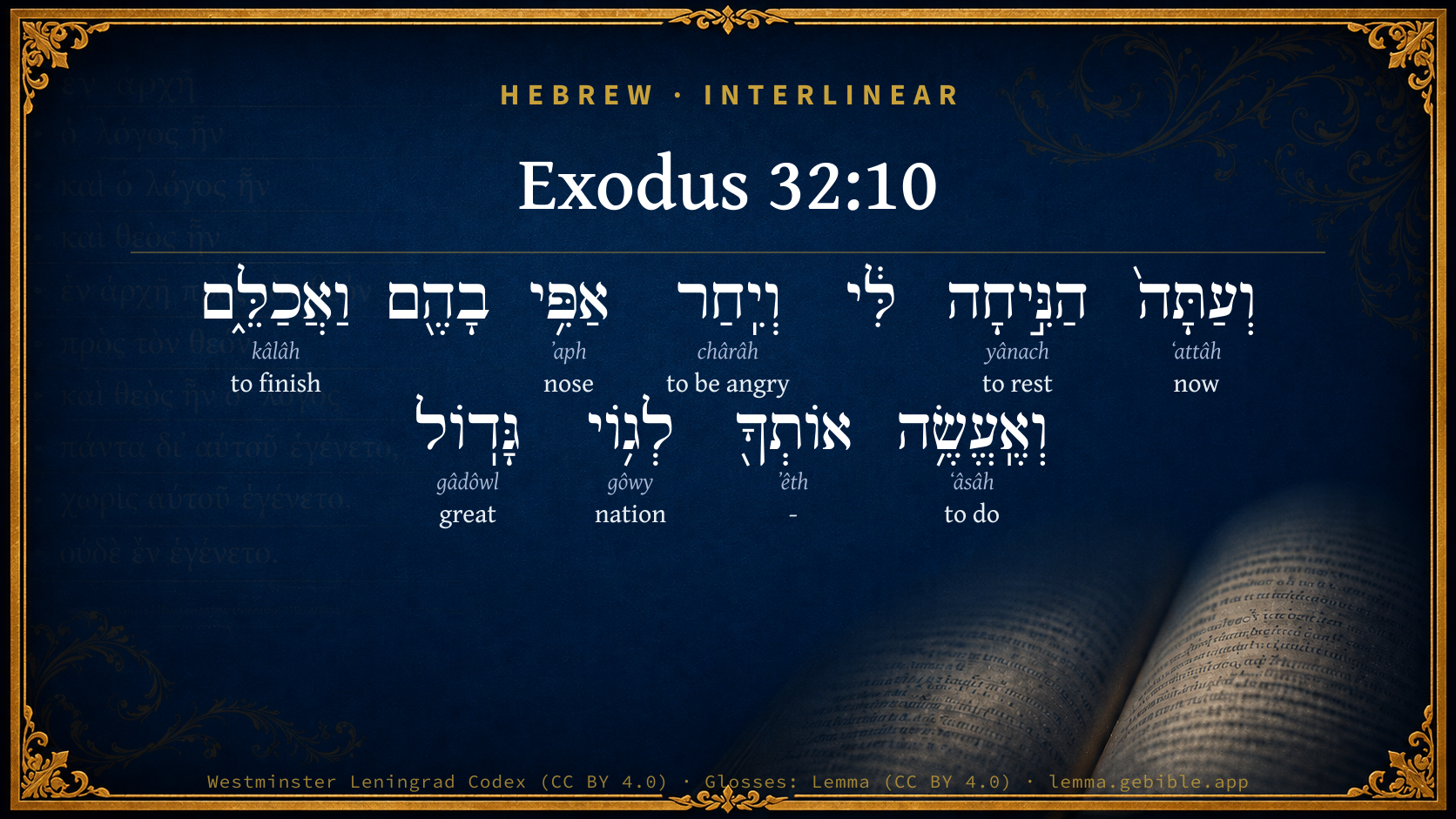
  1. וְעַתָּה֙ ʻattâh H6258 “and · now” Conjunction + Adverb
  2. וְיִֽחַר chârâh H2734 “and · to be angry” Conjunction + Verb, Qal, Jussive, 3rd Person, Masculine, Singular
  3. אַפִּ֥י ʼaph H639 “nose · my” Noun, Common, Masculine, Singular, Construct + Suffix, Personal, 1st Person, Common, Singular
  4. וַאֲכַלֵּ֑ם kâlâh H3615 “and · to finish · them” Conjunction + Verb, Piel, Cohortative, 1st Person, Common, Singular + Suffix, Personal, 3rd Person, Masculine, Plural
  5. וְאֶֽעֱשֶׂ֥ה ʻâsâh H6213 “and · to do” Conjunction + Verb, Qal, Imperfect, 1st Person, Common, Singular
  6. אוֹתְךָ֖ ʼêth H853 “- · you” Particle, Direct Object + Suffix, Personal, 2nd Person, Masculine, Singular
  7. לְג֥וֹי gôwy H1471 “to/for · nation” Preposition + Noun, Common, Masculine, Singular, Absolute
  8. גָּדֽוֹל gâdôwl H1419 “great” Adjective, Adjective, Masculine, Singular, Absolute

About this verse

These counts appear in no published source. They are computed here, from the morphology-tagged text and Lemma’s own curated glosses. What Lemma adds →

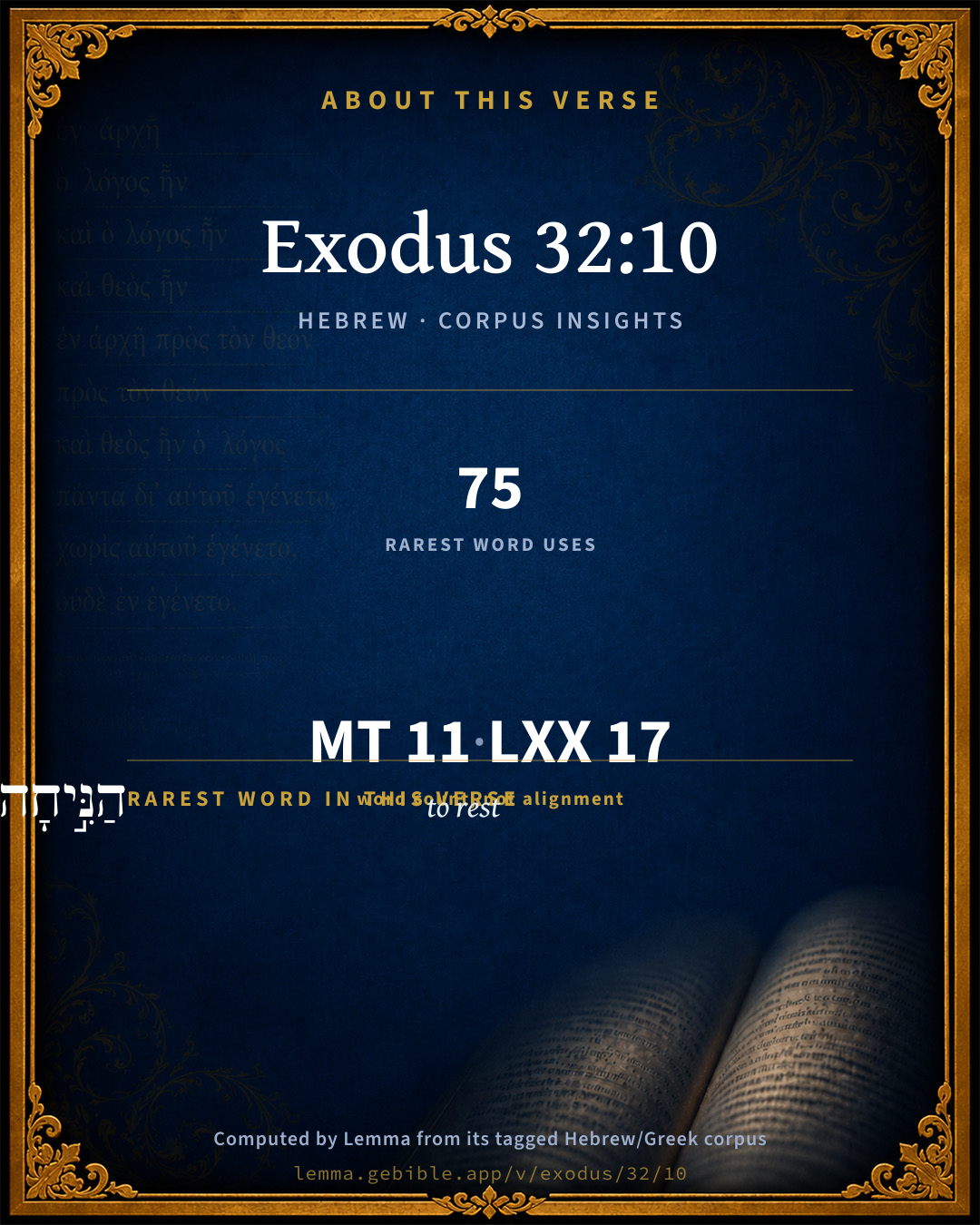
11
words
9
distinct lemmas
Pentateuch
section

Grammatical profile

  • 4 verbs
  • 2 nouns
  • 1 adjective
  • 2 prepositions
  • 1 adverb
  • 1 particle

Verb forms

  • הַנִּ֣יחָה Hiphil · Imperative
  • וְיִֽחַר Qal · Jussive
  • וַאֲכַלֵּ֑ם Piel · Cohortative
  • וְאֶֽעֱשֶׂ֥ה Qal · Imperfect

Hebrew & Septuagint length

In English translation the verse runs 28 words from the Hebrew and 24 from the Septuagint (LXX English) — closely comparable.

A rough comparison of the two English renderings, which tokenize alike — not a word-level alignment.

Word counts can differ between the Hebrew and the Greek without any difference in meaning — e.g. the Hebrew direct-object marker אֵת has no separate Greek word, and Greek often adds the article ὁ.

In the original languages it is 11 Hebrew tokens and 17 Greek tokens — but the two are counted differently (Hebrew bundles its prefixes and suffixes into one token; the Greek is in lemma form), so that isn’t a like-for-like length.

Cross-references

14

Topical passages linked to Exodus 32:10 in the Treasury of Scripture Knowledge — connected by theme and wording, ordered by reader-vote popularity; previews shown in the World English Bible.

  • Deuteronomy 9:14 let me alone, that I may destroy them, and blot out their name from under the sky; and I will make of you a nation mightier and greater than they.
  • Numbers 14:12 I will strike them with the pestilence, and disinherit them, and will make of you a nation greater and mightier than they.
  • Deuteronomy 9:19 For I was afraid of the anger and hot displeasure, with which Yahweh was angry against you to destroy you. But Yahweh listened to me that time also.
  • Exodus 22:24 and my wrath will grow hot, and I will kill you with the sword; and your wives shall be widows, and your children fatherless.
  • Numbers 16:45–48 Get away from among this congregation, that I may consume them in a moment. They fell on their faces.
  • Numbers 14:19–20 Pardon, Please, the iniquity of this people according to the greatness of your loving kindness, and according as you have forgiven this people, from Egypt even until now.
  • Numbers 16:22 They fell on their faces, and said, God, the God of the spirits of all flesh, shall one man sin, and will you be angry with all the congregation?
  • Exodus 32:11 Moses begged Yahweh his God, and said, "Yahweh, why does your wrath burn hot against your people, that you have brought forth out of the land of Egypt with great power and with a mighty hand?
  • Exodus 32:19 It happened, as soon as he came near to the camp, that he saw the calf and the dancing: and Moses' anger grew hot, and he threw the tablets out of his hands, and broke them beneath the mountain.
  • Jeremiah 14:11 Yahweh said to me, Don't pray for this people for [their] good.
  • Jeremiah 15:1 Then said Yahweh to me, Though Moses and Samuel stood before me, yet my mind would not be toward this people: cast them out of my sight, and let them go forth.
  • Genesis 18:32–33 He said, "Oh don't let the Lord be angry, and I will speak yet but this once. What if ten are found there?" He said, "I will not destroy it for the ten's sake."
  • Genesis 32:26–28 The man said, "Let me go, for the day breaks." Jacob said, "I won't let you go, unless you bless me."
  • James 5:16 Confess your offenses to one another, and pray one for another, that you may be healed. The effective, earnest prayer of a righteous man is powerfully effective.

Cross-references courtesy of OpenBible.info (CC BY 4.0).

Hebrew and Greek witnesses Masoretic Hebrew ↔ Greek Septuagint

The same verse in the two great witnesses to the Old Testament, shown verse-for-verse.

These are two independent witnesses, not word-aligned to each other, and the Septuagint is shown in lemma (dictionary) form.

Hebrew Exodus 32:10 Masoretic · Westminster Leningrad Codex

וְעַתָּה֙ הַנִּ֣יחָה לִּ֔י וְיִֽחַר אַפִּ֥י בָהֶ֖ם וַאֲכַלֵּ֑ם וְאֶֽעֱשֶׂ֥ה אוֹתְךָ֖ לְג֥וֹי גָּדֽוֹל

Now therefore leave me alone, that my wrath may burn hot against them, and that I may consume them; and I will make of you a great nation."

World English Bible · Public Domain

Greek LXX Exodus 32:10 Septuagint · lemma form

καί νῦν ἐάω ἐγώ καί θυμόω ὀργή εἰς αὐτός ἐκτρίβω αὐτός καί ποιέω σύ εἰς ἔθνος μέγας

And now let me alone, and I will be very angry with them and consume them, and I will make you a great nation.

LXX2012 (modern English Septuagint) · Public Domain

Hebrew: Westminster Leningrad Codex (CC BY 4.0). Greek: Septuagint (public domain); English from LXX2012 (modern English Septuagint) (Public Domain). How the Septuagint differs from the Hebrew →

Targum (Aramaic paraphrase)

2

The Targum is the ancient Jewish Aramaic paraphrase of the Hebrew Scriptures — an interpretive translation, not the Hebrew text itself. Onkelos (literal) and Pseudo-Jonathan (expansive) render the Torah, and Jonathan the Prophets. Coverage is partial: where no permissively-licensed English translation exists for a verse, only the Aramaic is shown. This is verse-level text, not a word-by-word alignment to the Hebrew.

  1. Targum Onkelos Torah (Genesis–Deuteronomy)
    וּכְעַן הַנַּח בָּעוּתָךְ מִן קֳדָמַי וְיִתְקֵף רוּגְזִי בְהוֹן וְאֵישֵׁיצִנוּן וְאֶעְבֵּד יָתָךְ לְעַם סַגִי:

    (no public-domain English translation for this verse)

    Targum Onkelos — Aramaic: “Onkelos Genesis” (public domain); “Onkelos Exodus” (public domain); “Onkelos Leviticus” (public domain); “Onkelos Numbers” (public domain); “Onkelos Deuteronomy” (public domain). English: “Sefaria Community Translation” (CC0 1.0 (public-domain dedication)); “J.W. Etheridge. The Targums of Onkelos and Jonathan Ben Uzziel on the Pentateuch. London: Longmans, Green, 1862” (public domain). Text via Sefaria.

  2. Targum Pseudo-Jonathan Torah (Genesis–Deuteronomy)
    וּכְדוּן אַנַח בְּעוּתָךְ וְלָא תַפְגִין עֲלֵיהוֹן קֳדָמַי וְאַרְתַח רְגַז אֵשָׁתָא תַקִיפְתָּא בְּהוֹן וְאֵשֵׁיצִינוּן וְאֶעְבַּד יָתָךְ לְעַם סַגִי

    And now, cease from thy prayer, and cry not for them before Me; for I will let My anger burn like strong fire against them, and consume them, and I will make thee a great people.

    Targum Pseudo-Jonathan — Aramaic: “Targum Jonathan on Genesis” (public domain); “Targum Jonathan on Exodus” (public domain); “Targum Jonathan on Leviticus” (public domain); “Targum Jonathan on Numbers” (public domain); “Targum Jonathan on Deuteronomy” (public domain). English: “The Targum of Jonathan ben Uzziel, trans. J. W. Etheridge, London, 1862” (public domain). Text via Sefaria.

Commentary

Notes on Exodus 32:10 from classic Christian and Jewish commentators (each source and its license shown beneath its notes). The classic Christian expositions comment on the surrounding passage and are grouped to its opening verse, so a note may address several verses; the Jewish commentaries on the Tanakh (Rashi and others) are per-verse, so they appear only where the commentator wrote on this verse.

Lemma curates 59 commentaries, every one of them public domain or Creative Commons licensed, each selected and text-cleaned for this edition rather than reprinted as found. About our sources →

Trapp's Complete Commentary

John Trapp

Exo 32:10 Now therefore let me alone, that my wrath may wax hot against them, and that I may consume them: and I will make of thee a great nation.

Ver. 10. Let me alone.] God is fain to bespeak his own freedom: as if Moses’s devotion were stronger than God’s indignation. Great is the power of prayer; able, after a sort, to transfuse a dead palsy into the hand of Omnipotency. For, Let me alone, the Chaldee hath, Leave off thy prayer: but Moses would not. If he get but his head above water, the Lord shall hear of David. {Psa 69:1-3}

John Trapp, A Commentary or Exposition upon All the Books of the Old and New Testament (1647–1656) — public domain. Text from a community e-Sword module.

Joseph Benson's Commentary

Exo 32:10. Let me alone — What did Moses, or what could he do, to hinder God from consuming them? When God resolves to abandon a people, and the decree is gone forth, no intercession can prevent it. But God would thus express the greatness of his displeasure, after the manner of men, who would have none to intercede for those they resolve to be severe with.

Thus also he would put an honour upon prayer, intimating, that nothing but the intercession of Moses could save them from ruin.

Joseph Benson's Commentary on the Old and New Testaments (1811–1818) — public domain. Text from a community e-Sword module.

Tyndale Open Study Notes

Tyndale Open Resources

32:10 Now leave me alone: This apparent command was in fact an invitation to Moses to intercede for his people. Although the people deserved destruction, God was willing not to destroy them if Moses continued to stand before him as an intercessor. • I will make you, Moses, into a great nation: If Moses were willing, God would start over again, abandoning the rest of the children of Abraham and beginning now with the children of Moses. This was apparently a test of Moses’ understanding of God.

Tyndale Open Study Notes — © Tyndale Open Resources, licensed CC BY-SA 4.0. Text via the HelloAO Bible API.

Geneva Bible (1599)

Geneva Bible translators

God showeth that the prayers of the godly stay his punishment.

Geneva Bible (1599) marginal notes — public domain. Text via Bolls.life.

Jamieson, Fausset & Brown

Robert Jamieson, A. R. Fausset & David Brown

make of thee a great nation--Care must be taken not to suppose this language as betokening any change or vacillation in the divine purpose. The covenant made with the patriarchs had been ratified in the most solemn manner; it could not and never was intended that it should be broken. But the manner in which God spoke to Moses served two important purposes--it tended to develop the faith and intercessory patriotism of the Hebrew leader, and to excite the serious alarm of the people, that God would reject them and deprive them of the privileges they had fondly fancied were so secure.

Jamieson, Fausset & Brown — Commentary Critical and Explanatory on the Whole Bible (1871) — public domain (CC PDM 1.0). Text via the HelloAO Bible API.

Adam Clarke's Commentary

Verse 10. Now therefore let me alone] Moses had already begun to plead with God in the behalf of this rebellious and ungrateful people; and so powerful was his intercession that even the Omnipotent represents himself as incapable of doing any thing in the way of judgment, unless his creature desisted from praying for mercy! See an instance of the prevalence of fervent intercession in the case of Abraham, Ge 18:23-33, from the model of which the intercession of Moses seems to have been formed.

Adam Clarke's Commentary on the Bible (1810–1826) — public domain. Text from a community e-Sword/MySword module.

Ellicott's Commentary for English Readers

(10) Let me alone.—This was not a command to abstain from deprecation, but rather an intimation that deprecation might have power to change God’s purpose. Moses was tried by an offer which would have exalted him at the expense of the people. He was allowed to see that he might either sacrifice the people and obtain his own aggrandisement, or deny himself and save them. That he chose the better part redounds to his undying glory.

I will make of thee a great nation—i.e., I will put thee in the place of Abraham, make thee the father of the faithful, destroy all existing Israelites but thee and thine, and proceed de novo to raise up a “great nation” out of thy loins.

A Bible Commentary for English Readers, edited by Charles John Ellicott (1878–1897) — public domain. Text from a community e-Sword module.

The Cambridge Bible for Schools and Colleges

gen. ed. J. J. S. Perowne

10. and I will make, &c.] The promise given to Abraham (Gen_12:2) is now restricted to Moses (cf. Num_14:12).

The Cambridge Bible for Schools and Colleges (gen. ed. J. J. S. Perowne; Cambridge University Press, 1878–1918) — public domain. Text from a community e-Sword module.

John Gill's Exposition

Now, therefore, let me alone,.... And not solicit him with prayers and supplications in favour of these people, but leave him to take his own way with them, without troubling him with any suit on their behalf; and so the Targum of Jonathan,"and now leave off thy prayer, and do not cry for them before me;''as the Prophet Jeremiah was often bid not to pray for this people in his time, which was a token of God's great displeasure with them, as well as shows the prevalence of prayer with him; that he knows not how, as it were, humanly speaking, to deny the requests of his children; and even though made not on their own account, but on the account of a sinful and disobedient people:

that my wrath may wax hot against them, and that I may consume them: which suggests that they were deserving of the wrath of God to the uttermost, and to be destroyed from off the face of the earth, and even to be punished with an everlasting destruction:

and I will make of thee a great nation; increase his family to such a degree, as to make them as great a nation or greater than the people of Israel were, see Deu 9:14 or the meaning is, he would set him over a great nation, make him king over a people as large or larger than they, which is a sense mentioned by Fagius and Vatablus; and, indeed, as Bishop Patrick observes, if this people had been destroyed, there would have been no danger of the promise not being made good, which was made to Abraham, Isaac, and Jacob, concerning the multiplication of their seed, urged by Moses, Exo 32:13 seeing that would have stood firm, if a large nation was made out of the family of Moses, who descended from them: this was a very great temptation to Moses, and had he been a selfish man, and sought the advancement of his own family, and careless of, and indifferent to the people of Israel, he would have accepted of it; it is a noble testimony in his favour, and proves him not to be the designing man he is represented by the deists.

John Gill's Exposition of the Whole Bible (1746–1763) — public domain (CC PDM 1.0). Text via the HelloAO Bible API.

Haydock's Catholic Bible Commentary

Alone. One fully determined on revenge will bear with no expostulation; whence St. Gregory (Mor. ix. 11,) and Theodoret (q. 67,) look upon this as an incitement to pray more earnestly, seeing God’s servants have such influence over Him. The mercy of God struggled with his justice, and stopped its effects. --- Nation, as I promised to Abraham; or I will make thee ruler over a nation greater than this, as Moses explains it, (Deuteronomy ix. 14,) and as the like offer is made, Numbers xiv. 12. The Samaritan subjoins here, "And God was likewise much irritated against Aaron, and would have destroyed him; but Moses prayed for him:" which we are assured was the case, Deuteronomy ix. 20. (Calmet)

George Leo Haydock (1774–1849), Haydock's Catholic Family Bible and Commentary, 1859 edition — public domain. Excludes Psalms (Douay-Rheims chapter numbering differs from Protestant) and Deuterocanonical books (Catholic canon only).

Matthew Poole's English Annotations

Do not hinder me by thy prayers, which I see thou art now about to make on their behalf.

I will make of thee; to come out of thy loins.

Matthew Poole's English Annotations on the Holy Bible (1683–1685) — public domain. Text from a community e-Sword/MySword module.

Whedon's Commentary on the Bible

Daniel D. Whedon

10. Let me alone — Do not interfere, and restrain the punitive outgoing of my wrath by the intercession which I see in thy heart. “Moses had not yet opened his mouth, but God foresaw the holy violence with which his importunity would besiege his throne.” — Bush.

That I may consume them — Exo_32:28 shows that about three thousand of the people perished before the consuming judgment that followed hard upon the sin, but Moses’s plea availed to modify the extent of the fearful stroke. Exo_32:14. The blending of justice and mercy in God’s revelations of himself to Israel is worthy of devout attention. His wrath is a fearful power, and may wax hot against transgressors of his law, and certainly will consume the unrepentant sinner; but he also “keepeth mercy for thousands, forgiving iniquity and transgression and sin,” (Exo_34:7.)

I will make of thee a great nation — He intimates that he might destroy all the rest of the nation, and by means of Moses alone raise up the great nation of which the promise to the fathers had repeatedly spoken.

Daniel D. Whedon (gen. ed.), Commentary on the Old and New Testaments (1874–1909) — public domain. Text from a community e-Sword module.

The Pulpit Commentary

Now, therefore, let me alone. This was not a command, but rather a suggestion; or, at any rate, it was a command not intended to compel obedience like that of the angel to Jacob me go, for the day breaketh". (Gen_32:26) Moses was not intended to take the command as absolute. He did not do so he "wrestled with God," like Jacob, and prevailed. That my wrath may wax hot. Literally, "and my wrath will wax hot." I will make of thee a great nation. (Compare Num_14:12) God could, of course, have multiplied the seed of Moses, as he had that of Abraham; but in that case all that had been as yet done would have gone for nought, and his purposes with respect to his "peculiar people" would have been put back six hundred years and more.

The Pulpit Commentary (1880–1919), ed. H.D.M. Spence-Jones & Joseph S. Exell — public domain. Text from a community e-Sword module.

John Wesley's Explanatory Notes

Let me alone - What did Moses, or what could he do, to hinder God from consuming them? When God resolves to abandon a people, and the decree is gone forth, no intercession can prevent it. But God would thus express the greatness of his displeasure, after the manner of men, who would have none to interceed for those they resolve to be severe with. Thus also he would put an honour upon prayer, intimating, that nothing but the intercession of Moses could save them from ruin, that he might be a type of Christ, by whose mediation alone God would reconcile the world unto himself.

John Wesley, Explanatory Notes Upon the Whole Bible (1754–1765) — public domain. Text via the GEBible commentary corpus.

Scofield Reference Notes

C. I. Scofield

let me alone

This whole scene affords a striking contrast between law and grace. (Cf) Moses’ intercession with Christ’s Joh 17:1-26 Israel was a nation, under probation Exo 19:5; Exo 19:6 believers under grace are a family, awaiting glory; Joh 20:17; Rom 5:1; Rom 5:2. For them there is "an advocate with the Father, whose propitiatory sacrifice never loses efficacy 1Jn 2:1; 1Jn 2:2. Moses pleads a covenant Exo 32:13. Christ points to a sacrifice Joh 17:4.

The Scofield Reference Bible (1917 edition), notes by C. I. Scofield — public domain. Text from a community e-Sword module.

Rashi

Rabbi Shlomo Yitzchaki (Rashi)

הניחה לי LET ME ALONE — So far we have not heard that Moses had prayed on their behalf and yet He says “let Me alone!” which implies a refusal to his entreaty! But by saying this He opened the door to him (offered him a suggestion) intimating to him that if he prayed for them He would not destroy them (Shemot Rabbah 42:9; cf. also Berakhot 32a).

Rashi on the Tanakh — English translations: “The Judaica Press complete Tanach with Rashi, translated by A. J. Rosenberg” (CC BY 4.0); “Pentateuch with Rashi's commentary by M. Rosenbaum and A.M. Silbermann, 1929-1934” (public domain); “The Metsudah Tanach series, Lakewood, N.J” (CC BY 4.0); and “The Book of Joshua, Metsudah Publications, 1997” (CC BY 4.0). Text via Sefaria.

Ramban (Nachmanides)

Rabbi Moshe ben Nachman (Ramban / Nachmanides)

NOW THEREFORE LET ME ALONE, THAT MY WRATH MAY WAX HOT AGAINST THEM. The meaning of this cannot be “let Me alone and I will become angry,” for if His anger had not been aroused yet, why should it wax hot as soon as Moses leaves Him alone? But in line with the plain meaning of Scripture the meaning thereof is: “leave Me, and I will consume them in My burning anger,” similar in thought to the expression, let Me alone, and I will destroy them., Verse 14.By way of the Truth, [the mystic lore of the Cabala], the verse means: “My mercy will subside, and My attribute of justice will wax hot against them and I will consume them with it, for with Me [i.e. when the attribute of mercy is before Me], it has no power over them.” This is the meaning of the expression, And Moses besought the face of the Eternal his G-d, (“face of”) alludes to the attribute of justice (Bachya). being similar in usage to the expression, the face of the Lord Eternal G-d, the G-d of Israel. And so Moses mentioned [in his prayer] in the Book of Deuteronomy, O G-d Eternal — first the name of G-d with Aleph Dalet, which alludes to the attribute of justice. followed by the name of Yod Hei. It is possible that the word vay’chal (and he besought) is of the root t’chilah (beginning). [of the root t’chilah, meaning “beginning” or “first”], because [in the order of the attributes as they are arranged from lowest to highest, the one of justice] is nearest to us” (Ricanti). See also Bachya, in my edition, Vol. II, p. 332. Understand it and you will know.

Ramban (Nachmanides) on the Tanakh — English translation: “Commentary on the Torah by Ramban (Nachmanides). Translated and annotated by Charles B. Chavel. New York, Shilo Pub. House, 1971-1976” (CC BY 4.0). Text via Sefaria.

Lesson kit

Teaching starters — assembled from the data on this page, not authored interpretation. Every prompt links to the verse data it draws on. Edit before teaching.

Exodus, in the Pentateuch, opens this verse with 11 words (9 distinct Hebrew lemmas). Its most distinctive word is yânach (“to rest”). A historical commentator’s framing appears above. Read the whole chapter for the surrounding context.

Discussion questions

  1. What does “to rest” (yânach) contribute to the verse as a whole?
  2. Deuteronomy 9:14 shares this passage’s theme. How do the two illuminate each other?
  3. The translations on this page render this verse differently — a whole-verse word diff, not a word-by-word alignment. What might account for the different wordings?
  4. The verb «הַנִּ֣יחָה» is Hiphil Imperative. How does its form color the action?
  5. Reading how Trapp's Complete Commentary and Joseph Benson's Commentary read this verse, where do the two commentators agree and where do they part?

Things to notice

Reading settings

Reading text

Shown beneath each verse's original-language words.

Old Testament
Old Testament edition

Read the OT as the Masoretic Hebrew (MT) or the Greek Septuagint (LXX).

English shown for the Greek Septuagint (in the Hebrew ↔ Greek comparison).

Comparing translations? Open the Compare panel on any verse page to stack up to four side by side.