
Psalms 98:2

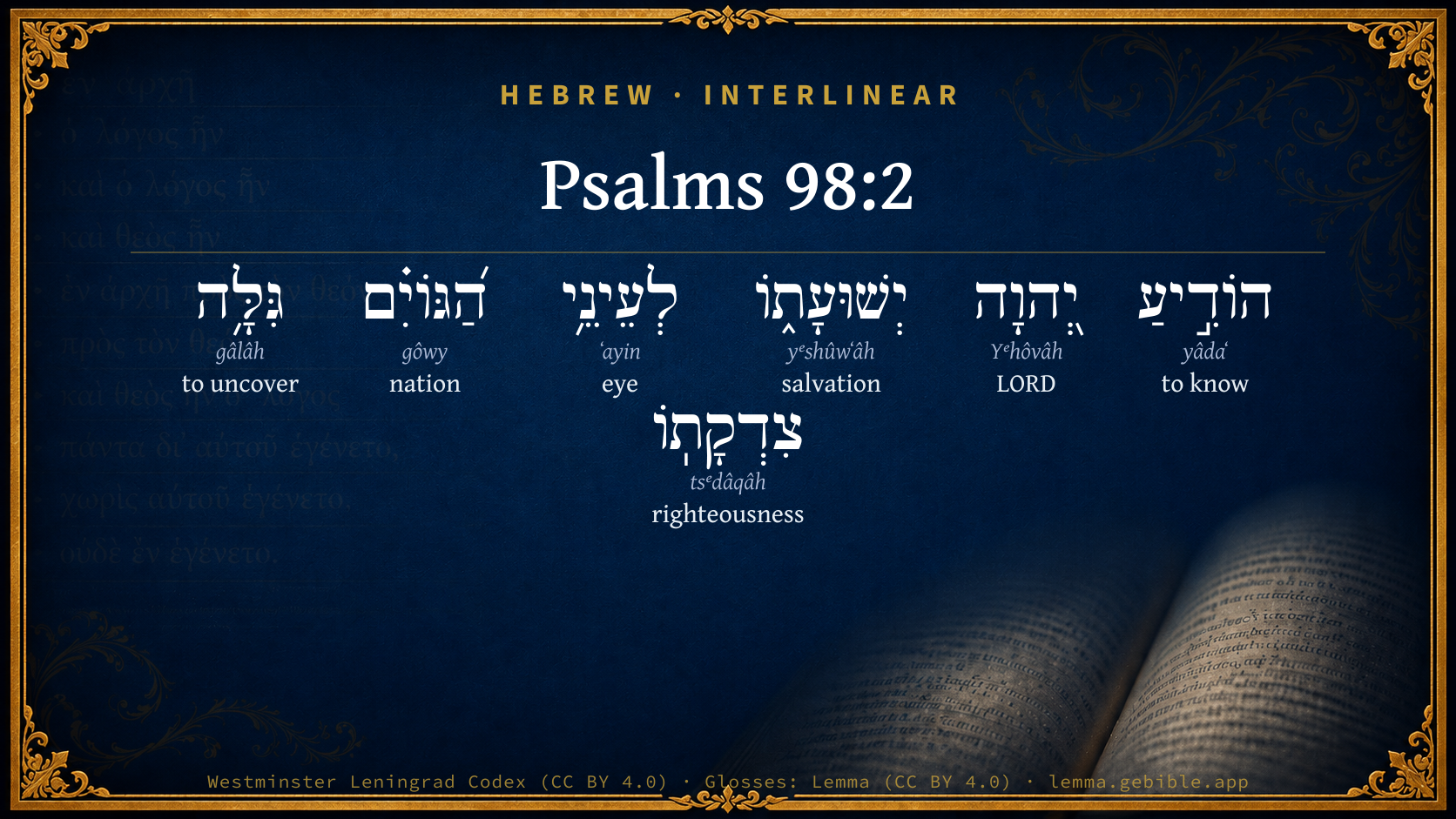
Hebrew (Westminster Leningrad Codex) Psalms 98:2 appears in the Hebrew Old Testament. The text above is from the Westminster Leningrad Codex. Each word links to its Strong’s number, a concise gloss, and parsing drawn from the Open Scriptures Hebrew Bible morphology. Click any word for its full Brown-Driver-Briggs (BDB) entry.
Download image
Cite this verse

Psalms 98:2 (World English Bible). Public Domain. Lemma interlinear Bible study tool, https://lemma.gebible.app/v/psalms/98/2.

Show BibTeX & RIS
BibTeX
RIS
English Translation
Yahweh has made known his salvation. He has openly shown his righteousness in the sight of the nations.
World English Bible · Public Domain
Download a study sheet

One document with this verse’s original text, its word-by-word gloss line, the meaning frame, cross-references with their text, attributed commentary, and full source and license credits — printable, and it pastes into notes with its structure intact.

This verse Autodidact and up

Study sheet (.html) Plain text (.txt)

A passage Seminary Student

Up to 50 verses in one chapter. A passage sheet keeps up to 6 commentary sources and 12 cross-references per verse, in the order this page ranks them, and says so on the sheet whenever that leaves anything out. Ask for a single verse and you get the Autodidact verse sheet above.

Everything on this page stays free to read, with no account — the sheet is a download of what is already on screen, not access to it.

Want to remove ads? Support Godless Engineer
Compare translations 3

The same verse in 3 English versions, stacked beneath the original-language interlinear above. Click any original word for its lexicon entry.

Each is an independent rendering of the whole verse — the interlinear is not word-aligned to these translations.

Highlighted words mark where these versions differ — a whole-verse word diff, not a word-by-word alignment.

  • World English Bible Public Domain
    Yahweh has made known his salvation. He has openly shown his righteousness in the sight of the nations.
  • King James Version Public Domain
    The LORD hath made known his salvation: his righteousness hath he openly shewed in the sight of the heathen.
  • unfoldingWord Literal Text CC BY-SA 4.0
    Yahweh has made known his salvation; to the eyes of the nations he has revealed his righteousness.

unfoldingWord Literal Text — © unfoldingWord, licensed CC BY-SA 4.0. Word-aligned USFM3 via Door43 (git.door43.org/unfoldingWord/en_ult).

Versions to compare (up to 4)

3 of 4 selected

Show all 18 translations

Every available English version of this verse, each an independent rendering of the whole verse.

  • World English Bible Public Domain
    Yahweh has made known his salvation. He has openly shown his righteousness in the sight of the nations.
  • Berean Standard Bible Public Domain
    The LORD has proclaimed His salvation and revealed His righteousness to the nations.
  • Majority Standard Bible Public Domain
    The LORD has proclaimed His salvation and revealed His righteousness to the nations.
  • King James Version Public Domain
    The LORD hath made known his salvation: his righteousness hath he openly shewed in the sight of the heathen.
  • American Standard Version (1901) Public Domain
    Jehovah hath made known his salvation: His righteousness hath he openly showed in the sight of the nations.
  • Revised Version (1885) Public Domain
    The LORD hath made known his salvation: his righteousness hath he openly shewed in the sight of the nations.
  • Geneva Bible (1599) Public Domain
    The Lord declared his saluation: his righteousnes hath he reueiled in the sight of ye nations.
  • Douay-Rheims (1899) Public Domain
    The Lord hath made known his salvation: he hath revealed his justice in the sight of the Gentiles.
  • Young's Literal Translation Public Domain
    Jehovah hath made known His salvation, Before the eyes of the nations, He hath revealed His righteousness,
  • Literal Standard Version CC BY-SA 4.0
    YHWH has made His salvation known, || Before the eyes of the nations, || He has revealed His righteousness,
  • Unlocked Literal Bible CC BY-SA 4.0
    Yahweh has made known his salvation; he has openly showed his justice to all the nations.
  • unfoldingWord Literal Text CC BY-SA 4.0
    Yahweh has made known his salvation; to the eyes of the nations he has revealed his righteousness.
  • Darby Bible Public Domain
    Jehovah hath made known his salvation: his righteousness hath he openly shewed in the sight of the nations.
  • World Messianic Bible Public Domain
    The LORD has made known his salvation. He has openly shown his righteousness in the sight of the nations.
  • Webster's Bible Public Domain
    The LORD hath made known his salvation: his righteousness hath he openly shown in the sight of the heathen.
  • Free Bible Version CC BY-SA 4.0
    The Lord has revealed his salvation to the nations, and shown them his goodness.
  • Bible in Basic English Public Domain
    The Lord has given to all the knowledge of his salvation; he has made clear his righteousness in the eyes of the nations.
  • JPS Tanakh (1917) Public Domain
    The LORD hath made known His salvation; His righteousness hath He revealed in the sight of the nations.

Literal Standard Version (2020), Covenant Press — licensed CC BY-SA 4.0. Text via the HelloAO Bible API (eBible.org). Unlocked Literal Bible (unfoldingWord) — licensed CC BY-SA 4.0. Text via the HelloAO Bible API (eBible.org). unfoldingWord Literal Text — © unfoldingWord, licensed CC BY-SA 4.0. Word-aligned USFM3 via Door43 (git.door43.org/unfoldingWord/en_ult). Free Bible Version, Dr. Jonathan Gallagher — licensed CC BY-SA 4.0. Text via the HelloAO Bible API (eBible.org).

Word by word

More ways to search: Search by grammar → Find every occurrence → Compare this word →

Practice this passage: Drill this verse → Learn its vocabulary →

About this verse

These counts appear in no published source. They are computed here, from the morphology-tagged text and Lemma’s own curated glosses. What Lemma adds →

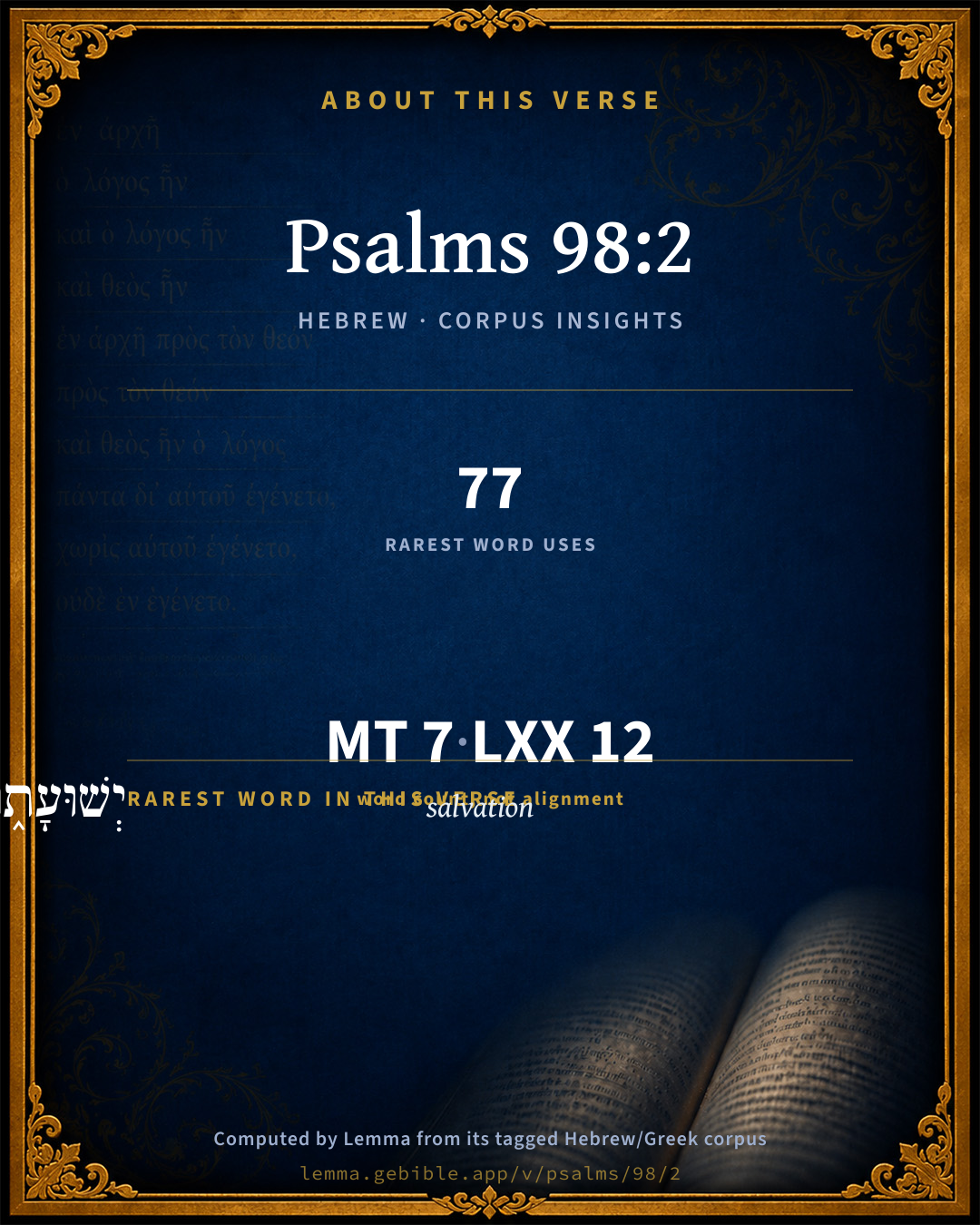
7
words
7
distinct lemmas
Wisdom
section

Grammatical profile

  • 2 verbs
  • 5 nouns

Verb forms

  • הוֹדִ֣יעַ Hiphil · Perfect
  • גִּלָּ֥ה Piel · Perfect

Hebrew & Septuagint length

In English translation the verse runs 18 words from the Hebrew and 18 from the Septuagint (LXX English) — the same length.

A rough comparison of the two English renderings, which tokenize alike — not a word-level alignment.

Word counts can differ between the Hebrew and the Greek without any difference in meaning — e.g. the Hebrew direct-object marker אֵת has no separate Greek word, and Greek often adds the article ὁ.

In the original languages it is 7 Hebrew tokens and 12 Greek tokens — but the two are counted differently (Hebrew bundles its prefixes and suffixes into one token; the Greek is in lemma form), so that isn’t a like-for-like length.

Cross-references

22

Topical passages linked to Psalms 98:2 in the Treasury of Scripture Knowledge — connected by theme and wording, ordered by reader-vote popularity; previews shown in the World English Bible.

  • Isaiah 52:10 Yahweh has made bare his holy arm in the eyes of all the nations; and all the ends of the earth have seen the salvation of our God.
  • Isaiah 62:2 The nations shall see your righteousness, and all kings your glory, and you shall be called by a new name, which the mouth of Yahweh shall name.
  • Psalms 22:31 They shall come and shall declare his righteousness to a people that shall be born, For he has done it.
  • Romans 1:17 For in it is revealed God's righteousness from faith to faith. As it is written, "But the righteous shall live by faith."
  • Romans 3:21–26 But now apart from the law, a righteousness of God has been revealed, being testified by the law and the prophets;
  • Isaiah 49:6 yes, he says, It is too light a thing that you should be my servant to raise up the tribes of Jacob, and to restore the preserved of Israel: I will also give you for a light to the Gentiles, that you may be my salvation to the end of the earth.
  • Isaiah 46:13 I bring near my righteousness, it shall not be far off, and my salvation shall not wait; and I will place salvation in Zion for Israel my glory.
  • Jeremiah 23:6 In his days Judah shall be saved, and Israel shall dwell safely; and this is his name by which he shall be called: Yahweh our righteousness.
  • Romans 10:18 But I say, didn't they hear? Yes, most assuredly, "Their sound went out into all the earth, Their words to the ends of the world."
  • Psalms 24:5 He shall receive a blessing from Yahweh, Righteousness from the God of his salvation.
  • Matthew 28:19 Therefore go, and make disciples of all nations, baptizing them in the name of the Father and of the Son and of the Holy Spirit,
  • Mark 16:15 He said to them, "Go into all the world, and preach the Gospel to the whole creation.
  • Luke 2:30–32 For my eyes have seen your salvation,
  • Luke 3:6 All flesh will see God's salvation.'"
  • John 16:8–10 When he has come, he will convict the world about sin, about righteousness, and about judgment;
  • Romans 9:30 What shall we say then? That the Gentiles, who didn't follow after righteousness, attained to righteousness, even the righteousness which is of faith;
  • Romans 10:3–4 For being ignorant of God's righteousness, and seeking to establish their own righteousness, they didn't subject themselves to the righteousness of God.
  • Philippians 3:9 and be found in him, not having a righteousness of my own, that which is of the law, but that which is through faith in Christ, the righteousness which is from God by faith;
  • 2 Peter 1:1 Simon Peter, a servant and apostle of Jesus Christ, to those who have obtained a like precious faith with us in the righteousness of our God and Savior, Jesus Christ:
  • Isaiah 45:21–25 Declare you, and bring [it] forth; yes, let them take counsel together: who has shown this from ancient time? who has declared it of old? Haven't I, Yahweh? and there is no God else besides me, a just God and a Savior; there is no one besides me.
  • 2 Corinthians 5:21 For him who knew no sin he made to be sin on our behalf; so that in him we might become the righteousness of God.
  • Titus 2:13 looking for the blessed hope and appearing of the glory of our great God and Savior, Jesus Christ;

Cross-references courtesy of OpenBible.info (CC BY 4.0).

Hebrew and Greek witnesses Masoretic Hebrew ↔ Greek Septuagint

The same verse in the two great witnesses to the Old Testament, shown verse-for-verse.

You’re reading Greek Psalm 97 (Hebrew Psalm 98). The Septuagint counts the superscription, so verse numbers can differ from the Hebrew — chapter-level alignment, not verse-by-verse. Numbering follows Rahlfs.

These are two independent witnesses, not word-aligned to each other, and the Septuagint is shown in lemma (dictionary) form.

Hebrew Psalms 98:2 Masoretic · Westminster Leningrad Codex

הוֹדִ֣יעַ יְ֭הוָה יְשׁוּעָת֑וֹ לְעֵינֵ֥י הַ֝גּוֹיִ֗ם גִּלָּ֥ה צִדְקָתֽוֹ

Yahweh has made known his salvation. He has openly shown his righteousness in the sight of the nations.

World English Bible · Public Domain

Greek LXX Greek Psalm 97:2 Septuagint · lemma form

γνωρίζω κύριος ὁ σωτήριον αὐτός ἐναντίον ὁ ἔθνος ἀποκαλύπτω ὁ δικαιοσύνη αὐτός

The Lord has made known his salvation, he has revealed his righteousness in the sight of the nations.

LXX2012 (modern English Septuagint) · Public Domain

Hebrew: Westminster Leningrad Codex (CC BY 4.0). Greek: Septuagint (public domain); English from LXX2012 (modern English Septuagint) (Public Domain). How the Septuagint differs from the Hebrew →

Commentary

Notes on Psalms 98:2 from classic Christian and Jewish commentators (each source and its license shown beneath its notes). The classic Christian expositions comment on the surrounding passage and are grouped to its opening verse, so a note may address several verses; the Jewish commentaries on the Tanakh (Rashi and others) are per-verse, so they appear only where the commentator wrote on this verse.

Lemma curates 59 commentaries, every one of them public domain or Creative Commons licensed, each selected and text-cleaned for this edition rather than reprinted as found. About our sources →

Trapp's Complete Commentary

John Trapp

Psa 98:2 The LORD hath made known his salvation: his righteousness hath he openly shewed in the sight of the heathen.

Ver. 2. The Lord hath made known his salvation] His way of saving his people by his Son, Christ, Mat 1:21 : this mystery, so long kept secret, is now made known to all nations for the obedience of faith, Rom 16:25-26.

His righteousness] Made ours by imputation; this the Jews to this day deride, and the Papists call it putative, in a jeer.

John Trapp, A Commentary or Exposition upon All the Books of the Old and New Testament (1647–1656) — public domain. Text from a community e-Sword module.

The Biblical Illustrator

Joseph S. Exell

Psa_98:2

The Lord hath made known His salvation.

The praise of the vastness of Gods salvation

Mr. Booth, of the Blue Ribbon Army, told me that on his first journey to England, before he started, he said to his wife, I have dreamed a dream. I have dreamt that I shall be wrecked and be the only person that will escape; and what a thrilling story that will be for me to tell. He left home, and there was a collision, both ships were in very great danger, but by the wonderful providence of God both ships got back in harbour, and there was nobody lost whatever. So he said to his wife, Is not this a much more thrilling story to tell? Is it not a much more happy thing to have to say, Saved, and all saved that sailed with me, not one of them lost? Oh, that we might have the privilege of saying, Here am I, and the children that Thou hast given me. (C. H. Spurgeon.)

The Biblical Illustrator, edited by Joseph S. Exell (c. 1880s–1900s) — public domain. Text from a community e-Sword module.

Joseph Benson's Commentary

Psa 98:2-3. The Lord hath made known his salvation — The redemption of the world by the Messiah; which was hitherto reserved as a secret among the Jews, yea, was not thoroughly known by most of the Jews themselves. His righteousness hath he openly showed — Either his faithfulness in accomplishing this great promise of sending the Messiah; or his goodness and mercy, often termed his righteousness, or God’s method of justifying sinners, and making them righteous through faith in Christ, continually called the righteousness of God in the New Testament. He hath remembered his mercy and his truth — He hath now actually given that mercy which he had promised to the Israelites. All the ends of the earth — All its inhabitants, from one end to another; have seen the salvation of our God — It has been published, and plainly discovered to them, not in types and shadows, as under the law, but written as with a sun-beam, and exhibited openly, that he who runs may read it.

Joseph Benson's Commentary on the Old and New Testaments (1811–1818) — public domain. Text from a community e-Sword module.

J. A. Alexander on Psalms

Joseph Addison Alexander

2. (Psa 98:2) Jehovah hath made known his salvation, to the eyes of the nations he hath revealed his righteousness. He hath shewn the world his power and his willingness to save his own people according to his promise, with respect to which his righteousness and his salvation are related to each other as cause and effect. With this verse compare Isa 52:10.

Joseph Addison Alexander, The Psalms Translated and Explained (1850) — public domain. Text from a community e-Sword module.

Tyndale Open Study Notes

Tyndale Open Resources

98:2-3 The Lord makes known his righteousness and faithfulness (see also Isa 52:10).

Tyndale Open Study Notes — © Tyndale Open Resources, licensed CC BY-SA 4.0. Text via the HelloAO Bible API.

Geneva Bible (1599)

Geneva Bible translators

For the deliverance of his Church.

Geneva Bible (1599) marginal notes — public domain. Text via Bolls.life.

Adam Clarke's Commentary

Verse 2. Made known his salvation] He has delivered his people in such a way as to show that it was supernatural, and that their confidence in the unseen God was not in vain.

Adam Clarke's Commentary on the Bible (1810–1826) — public domain. Text from a community e-Sword/MySword module.

The Cambridge Bible for Schools and Colleges

gen. ed. J. J. S. Perowne

2. Jehovah hath made known his salvation:

In the sight of the nations hath he revealed his righteousness.

Cp. Isa_56:1. The juxtaposition of salvation and righteousness is characteristic of Isaiah 40-66. The deliverance of Israel is the outcome and the visible manifestation of Jehovah’s faithfulness to His covenant. Cp. Psa_71:15.

The Cambridge Bible for Schools and Colleges (gen. ed. J. J. S. Perowne; Cambridge University Press, 1878–1918) — public domain. Text from a community e-Sword module.

John Gill's Exposition

The Lord hath made known his salvation,.... Which was appointed him, he undertook, came to perform, and has effected; this, though wrought out, is unknown to men, especially to the Gentile world, who had no prophecy, promise, or revelation of the Messiah, and salvation by him; but now this is made known in the everlasting Gospel, called therefore the Gospel of salvation, and by the ministers of it; and, besides this, the spirit of wisdom and revelation in the knowledge of Christ, and his salvation, is given to some; whereby they come to know their need of it, the suitableness of it to their case, the necessity of going to Christ for it, and their special and particular interest in it; and such have a new song put into their mouths, and are under great obligation to sing it:

his righteousness hath he openly showed in the sight of the Heathen; either the faithfulness of God in fulfilling his promises, particularly in raising up the Saviour Jesus; or the goodness of God to his people, and the strictness of his justice on their surety; goodness towards them, and severity on him, when he spared them and not him, turned his hand of grace and mercy on them, when he awoke the sword of justice against him; or rather his own righteousness, by which he fulfilled the law in the room and stead of his people; and which being brought in is revealed in the gospel, from faith to faith; and that "openly", not in dark shadows, types, and figures; but it is to be seen with open face in the clear glass of the Gospel; and is held up and forth in the ministration of it unto the Gentiles, whom God justifies through faith in it, as well as the believing Jews; see Rom 3:30.

John Gill's Exposition of the Whole Bible (1746–1763) — public domain (CC PDM 1.0). Text via the HelloAO Bible API.

Albert Barnes' Notes on the Bible

The Lord hath made known his salvation - See the notes at Isa 52:10. This does not mean that he had merely “proclaimed” his salvation, or his willingness to save, but that he had shown his salvation - his power to save - by some public act. What the particular act referred to here was, it is impossible now to ascertain. Such acts, however, have been often performed, as when he delivered his people out of Egypt; when he restored the Hebrews from the Babylonian captivity; and whenever he interposed in their behalf in times of danger. He has done it also in the gift of a Saviour; he does it in every revival of true religion; he does it in the salvation of a single sinner.

His righteousness - His righteous character; his faithfulness to his people. Whenever he interposes, it is in behalf of that which is right; and such interposition, therefore, is an illustration of his character as just. It is in this way we learn that his character is that of a just God.

Hath he openly showed - Margin, as in Hebrew, “revealed.” He has disclosed it, or made it manifest.

In the sight of the heathen - The nations; or, so that the nations could see it: that is, the nations outside of Pa estine. His acts were so public - so remarkable - that surrounding nations could learn what was his true character. Thus it was when he delivered his people from Egyptian bondage; and thus also frequently in the history of his people.

Albert Barnes' Notes on the Bible (1834–1885) — public domain. Text from a community e-Sword/MySword module.

Matthew Poole's English Annotations

His salvation; the redemption or salvation of the world by the Messias; which was hitherto reserved as a secret among the Jews, yea, was not thoroughly known and believed by the most of the Jews themselves.

His righteousness; either his faithfulness in accomplishing this great promise of sending the Messias; or his goodness and mercy, oft called by this Hebrew word; or the righteousness of God or of Christ revealed in the gospel.

Matthew Poole's English Annotations on the Holy Bible (1683–1685) — public domain. Text from a community e-Sword/MySword module.

The Treasury of David

Charles H. Spurgeon

Ver. 2. The LORD hath made known his salvation, by the coming of Jesus and by the outpouring of the Holy Ghost, by whose power the gospel was preached among the Gentiles. The Lord is to be praised not only for effecting human salvation, but also for making it known, for man would never have discovered it for himself; nay, not so much as one single soul would ever have found out for himself the way of mercy through a Mediator; in every case it is a divine revelation to the mind and heart. In God's own light his light is seen. He must reveal his Son in us, or we shall be unable to discern him.

His righteousness hath he openly shewed in the sight of the heathen. This word "righteousness" is the favourite word of the apostle of the Gentiles; he loves to dwell on the Lord's method of making man righteous, and vindicating divine justice by the atoning blood. What songs ought we to render who belong to a once heathen race, for that blessed gospel which is the power of God unto salvation, "for therein is the righteousness of God revealed from faith to faith." This is no close secret; it is clearly taught in Scripture, and has been plainly preached among the nations. What was hidden in the types is "openly shewed" in the gospel.

Ver. 2. The LORD hath made known his salvation. By the appearance of his Son in the flesh, and the wonders which he did. His righteousness hath he openly shewed, etc., in the gospel, to all men; that righteousness which is called the "righteousness of God, " and which is enjoyed by faith of Jesus Christ, unto all and upon all them that believe: for there is no difference. Ro 3:22. B. Boothroyd.

Ver. 2. The LORD hath made known, etc. The word uydx denotes not only a publication and promulgation, but also a clear and certain demonstration which produces conviction and causes the matter to be laid up in the mind and memory and preserved: for the proper signification of the root ydy is to lay up what is to be preserved. The word hlg is added, which properly means to uncover, to be uncovered, hence he revealed or uncovered, that it might be both naked and clear, for the purpose of more fully illustrating the character of the manifestation of the Gospel, opposed to what is obscure, involved in shadows and types, and veiled in legal ceremonies. Of which the apostle treats expressly in 2Co 3:7-18. Lastly, when it is added, that in the sight of the nations this uncovering is done, it signifies that this salvation pertains to them also, that it comes to them without distinction, since the Gospel is nakedly and clearly announced. From which it also clearly appears, that the matter reason of the new song are found in such a singular event, since God who formerly permitted the nations to walk in their own ways, now under Messiah calls all without distraction to salvation through faith and newness of life. Venema.

Ver. 2. Made known: He says not, He shewed, but He made known. Adam knew him, and predicted concerning him, "A man shall leave father and mother, and shall cleave to his wife, and they twain shall be one flesh." Abel knew him, who offered the lamb; Seth knew him, and called upon him; Noah knew him, and saved all the race in the ark; Abraham knew him, and offered up his son to him. But because the world had forgotten him and worshipped idols, the Lord made his Jesus known, when he sent the Word in flesh to the Jews, and revealed his righteousness to the nations, when he justified them through faith. Wherefore did he reveal him to the nations? Because of his mercy. Wherefore old he make him known to the Jews? Because of his truth, that is, his promise. Honorius, the Continuator of Gerhohus.

Ver. 2. The Lord hath made known his salvation.

1. The contents of which it is composed.

2. The reasons for which it has been provided.

3. The price at which it has been procured.

4. The terms on which it shall be imparted.

5. The way in which it must be propagated.

6. The manner in which its neglect will be punished. W. J.

Ver. 2. (first clause).

1. What is salvation?

2. Why it is called the Lord's: "Salvation is of the Lord."

3. How he has made it known.

4. For what purpose.

5. With what results. E.G. Gange.

Ver. 2. The great privilege of knowing the gospel.

1. In what it consists. (a) Revelation by the Bible. (b) Declaration by the minister. (c) Illumination by the Spirit. (d) Illustration in daily providence.

2. To what it has led. (a) We have believed it. (b) We have so far understood it as to growingly rejoice in it. (c) We are able to tell it to others. (d) We abhor those who mystify it.

Ver. 2. Salvation's glory.

1. It is divine"his salvation."

2. It is consistent with justice"his righteousness."

3. It is plain and simple"openly showed."

4. It is meant for all sorts of men"heathen."

Psalms 98:3*

Charles H. Spurgeon's The Treasury of David (1869–1885) — public domain. Psalms only. Text from a community e-Sword/MySword module.

Whedon's Commentary on the Bible

Daniel D. Whedon

2. His righteousness—In punishing the wicked and vindicating the just. The word corresponds to his salvation in the previous member of the verse, for the “salvation” of those who trust in him implies judgment against such as reject and persecute the truth.

Openly showed in the sight of the heathen—It was no doubtful display of the divine power and purpose, but open, and defiant of all his enemies. The sentence is a more emphatic form of made known, in the previous member.

Daniel D. Whedon (gen. ed.), Commentary on the Old and New Testaments (1874–1909) — public domain. Text from a community e-Sword module.

The Pulpit Commentary

The Lord hath made known his salvation; i.e. "has manifested his power to save." The psalmist looks back upon the deliverance of ver. 9, as though it were accomplished. His righteousness hath he openly showed in the sight of the heathen. God has vindicated in the eyes of all the nations upon earth the righteousness of his rule over mankind.

The Pulpit Commentary (1880–1919), ed. H.D.M. Spence-Jones & Joseph S. Exell — public domain. Text from a community e-Sword module.

John Wesley's Explanatory Notes

Salvation - The redemption of the world by the Messiah: which was hitherto reserved was a secret among the Jews, yea was not throughly known by the most of the Jews themselves. Righteousness - His faithfulness in accomplishing this great promise.

John Wesley, Explanatory Notes Upon the Whole Bible (1754–1765) — public domain. Text via the GEBible commentary corpus.

Lesson kit

Teaching starters — assembled from the data on this page, not authored interpretation. Every prompt links to the verse data it draws on. Edit before teaching.

Psalms, in the Wisdom, opens this verse with 7 words (7 distinct Hebrew lemmas). Its most distinctive word is yᵉshûwʻâh (“salvation”). A historical commentator’s framing appears above. Read the whole chapter for the surrounding context.

Discussion questions

  1. How does “salvation” (yᵉshûwʻâh) shape what this verse is saying?
  2. How does Isaiah 52:10, which shares this passage’s theme, read alongside this verse?
  3. These translations render this verse differently. What is at stake in choosing one wording over another?
  4. «הוֹדִ֣יעַ» is a Hiphil Perfect verb. How does that grammatical form shape the action described?
  5. Compare how Trapp's Complete Commentary and The Biblical Illustrator read this verse. Where do they agree or differ?

Things to notice

Reading settings

Reading text

Shown beneath each verse's original-language words.

Old Testament
Old Testament edition

Read the OT as the Masoretic Hebrew (MT) or the Greek Septuagint (LXX).

English shown for the Greek Septuagint (in the Hebrew ↔ Greek comparison).

Comparing translations? Open the Compare panel on any verse page to stack up to four side by side.