
Judges 4:13

Hebrew (Westminster Leningrad Codex) Judges 4:13 appears in the Hebrew Old Testament. The text above is from the Westminster Leningrad Codex. Each word links to its Strong’s number, a concise gloss, and parsing drawn from the Open Scriptures Hebrew Bible morphology. Click any word for its full Brown-Driver-Briggs (BDB) entry.
Download image
Cite this verse

Judges 4:13 (World English Bible). Public Domain. Lemma interlinear Bible study tool, https://lemma.gebible.app/v/judges/4/13.

Show BibTeX & RIS
BibTeX
RIS
English Translation
Sisera gathered together all his chariots, even nine hundred chariots of iron, and all the people who were with him, from Harosheth of the Gentiles, to the river Kishon.
World English Bible · Public Domain
Download a study sheet

One document with this verse’s original text, its word-by-word gloss line, the meaning frame, cross-references with their text, attributed commentary, and full source and license credits — printable, and it pastes into notes with its structure intact.

This verse Autodidact and up

Study sheet (.html) Plain text (.txt)

A passage Seminary Student

Up to 50 verses in one chapter. A passage sheet keeps up to 6 commentary sources and 12 cross-references per verse, in the order this page ranks them, and says so on the sheet whenever that leaves anything out. Ask for a single verse and you get the Autodidact verse sheet above.

Everything on this page stays free to read, with no account — the sheet is a download of what is already on screen, not access to it.

Want to remove ads? Support Godless Engineer
Compare translations 3

The same verse in 3 English versions, stacked beneath the original-language interlinear above. Click any original word for its lexicon entry.

Each is an independent rendering of the whole verse — the interlinear is not word-aligned to these translations.

Highlighted words mark where these versions differ — a whole-verse word diff, not a word-by-word alignment.

  • World English Bible Public Domain
    Sisera gathered together all his chariots, even nine hundred chariots of iron, and all the people who were with him, from Harosheth of the Gentiles, to the river Kishon.
  • King James Version Public Domain
    And Sisera gathered together all his chariots, even nine hundred chariots of iron, and all the people that were with him, from Harosheth of the Gentiles unto the river of Kishon.
  • unfoldingWord Literal Text CC BY-SA 4.0
    So Sisera summoned all of his chariotry, 900 chariots of iron, and all of the people who with him, from Harosheth Haggoyim to the wadi of Kishon.

unfoldingWord Literal Text — © unfoldingWord, licensed CC BY-SA 4.0. Word-aligned USFM3 via Door43 (git.door43.org/unfoldingWord/en_ult).

Versions to compare (up to 4)

3 of 4 selected

Show all 18 translations

Every available English version of this verse, each an independent rendering of the whole verse.

  • World English Bible Public Domain
    Sisera gathered together all his chariots, even nine hundred chariots of iron, and all the people who were with him, from Harosheth of the Gentiles, to the river Kishon.
  • Berean Standard Bible Public Domain
    he summoned all nine hundred of his iron chariots and all the men with him, from Harosheth-hagoyim to the River Kishon.
  • Majority Standard Bible Public Domain
    he summoned all nine hundred of his iron chariots and all the men with him, from Harosheth-hagoyim to the River Kishon.
  • King James Version Public Domain
    And Sisera gathered together all his chariots, even nine hundred chariots of iron, and all the people that were with him, from Harosheth of the Gentiles unto the river of Kishon.
  • American Standard Version (1901) Public Domain
    And Sisera gathered together all his chariots, even nine hundred chariots of iron, and all the people that were with him, from Harosheth of the Gentiles, unto the river Kishon.
  • Revised Version (1885) Public Domain
    And Sisera gathered together all his chariots, even nine hundred chariots of iron, and all the people that were with him, from Harosheth of the Gentiles, unto the river Kishon.
  • Geneva Bible (1599) Public Domain
    And Sisera called for all his charets, euen nine hundreth charets of yron, and all the people that were with him from Harosheth of the Gentiles, vnto the riuer Kishon.
  • Douay-Rheims (1899) Public Domain
    And he gathered together his nine hundred chariots armed with scythes, and all his army from Haroseth of the Gentiles to the torrent Cison.
  • Young's Literal Translation Public Domain
    and Sisera calleth all his chariots, nine hundred chariots of iron, and all the people who `are' with him, from Harosheth of the Goyim, unto the brook Kishon.
  • Literal Standard Version CC BY-SA 4.0
    and Sisera calls all his chariots, nine hundred chariots of iron, and all the people who [are] with him, from Harosheth of the nations, to the Brook of Kishon.
  • Unlocked Literal Bible CC BY-SA 4.0
    Sisera called out all his chariots, nine hundred iron chariots, and all the soldiers who were with him, from Harosheth Haggoyim to the Kishon River.
  • unfoldingWord Literal Text CC BY-SA 4.0
    So Sisera summoned all of his chariotry, 900 chariots of iron, and all of the people who with him, from Harosheth Haggoyim to the wadi of Kishon.
  • Darby Bible Public Domain
    Sis'era called out all his chariots, nine hundred chariots of iron, and all the men who were with him, from Haro'sheth-ha-goiim to the river Kishon.
  • World Messianic Bible Public Domain
    Sisera gathered together all his chariots, even nine hundred chariots of iron, and all the people who were with him, from Harosheth of the Gentiles, to the river Kishon.
  • Webster's Bible Public Domain
    And Sisera collected all his chariots, even nine hundred chariots of iron, and all the people that were with him, from Harosheth of the Gentiles to the river of Kishon.
  • Free Bible Version CC BY-SA 4.0
    so he summoned all his nine hundred iron chariots and all his men to come from Harosheth-hagoyim to the Kishon River.
  • Bible in Basic English Public Domain
    So Sisera got together all his war-carriages, nine hundred war-carriages of iron, and all the people who were with him, from Harosheth of the Gentiles as far as the river Kishon.
  • JPS Tanakh (1917) Public Domain
    And Sisera gathered together all his chariots, even nine hundred chariots of iron, and all the people that were with him, from Harosheth-goiim, unto the brook Kishon.

Literal Standard Version (2020), Covenant Press — licensed CC BY-SA 4.0. Text via the HelloAO Bible API (eBible.org). Unlocked Literal Bible (unfoldingWord) — licensed CC BY-SA 4.0. Text via the HelloAO Bible API (eBible.org). unfoldingWord Literal Text — © unfoldingWord, licensed CC BY-SA 4.0. Word-aligned USFM3 via Door43 (git.door43.org/unfoldingWord/en_ult). Free Bible Version, Dr. Jonathan Gallagher — licensed CC BY-SA 4.0. Text via the HelloAO Bible API (eBible.org).

Word by word

More ways to search: Search by grammar → Find every occurrence → Compare this word →

Practice this passage: Drill this verse → Learn its vocabulary →

מֵחֲרֹ֥שֶׁת
Chărôsheth
H2800
“from · Harosheth”
Preposition + Noun, Proper
Part of Speech
Preposition + Noun
Type
Proper
Full BDB Definition

Origin: the same as H2799

TWOT: None

Harosheth = "woodland" - a city in the north of the land of Canaan on the west coast of the lake Merom
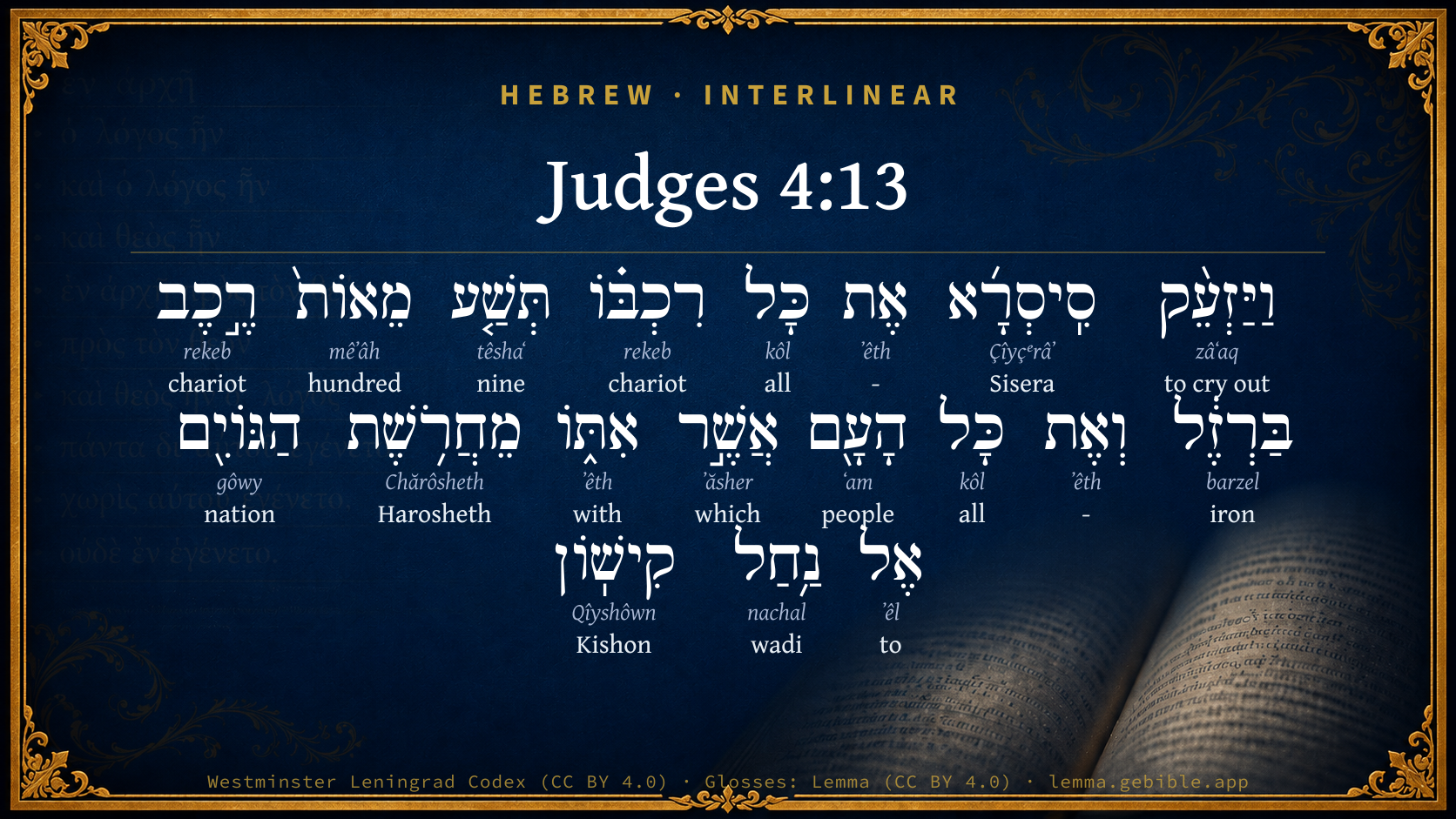
  1. וַיַּזְעֵ֨ק zâʻaq H2199 “and · to cry out” Conjunction + Verb, Hiphil, Sequential Imperfect, 3rd Person, Masculine, Singular
  2. סִֽיסְרָ֜א Çîyçᵉrâʼ H5516 “Sisera” Noun, Proper
  3. אֶת ʼêth H853 “-” Particle, Direct Object
  4. כָּל kôl H3605 “all of” Noun, Common, Masculine, Singular, Construct
  5. רִכְבּ֗וֹ rekeb H7393 “chariot · his” Noun, Common, Masculine, Singular, Construct + Suffix, Personal, 3rd Person, Masculine, Singular
  6. תְּשַׁ֤ע têshaʻ H8672 “nine” Adjective, Cardinal number, Feminine, Singular, Absolute
  7. מֵאוֹת֙ mêʼâh H3967 “hundred” Adjective, Cardinal number, Both, Plural, Absolute
  8. רֶ֣כֶב rekeb H7393 “chariot of” Noun, Common, Masculine, Singular, Construct
  9. בַּרְזֶ֔ל barzel H1270 “iron” Noun, Common, Masculine, Singular, Absolute
  10. וְאֶת ʼêth H853 “and · -” Conjunction + Particle, Direct Object
  11. כָּל kôl H3605 “all of” Noun, Common, Masculine, Singular, Construct
  12. הָעָ֖ם ʻam H5971 “the · people” Particle, Definite Article + Noun, Common, Masculine, Singular, Absolute
  13. אֲשֶׁ֣ר ʼăsher H834 “which” Particle, Relative
  14. אִתּ֑וֹ ʼêth H854 “with · him” Preposition + Suffix, Personal, 3rd Person, Masculine, Singular
  15. הַגּוֹיִ֖ם gôwy H1471 “nation” Noun, Proper
  16. אֶל ʼêl H413 “to” Preposition
  17. נַ֥חַל nachal H5158 “wadi of” Noun, Common, Masculine, Singular, Construct
  18. קִישֽׁוֹן Qîyshôwn H7028 “Kishon” Noun, Proper

About this verse

These counts appear in no published source. They are computed here, from the morphology-tagged text and Lemma’s own curated glosses. What Lemma adds →

19
words
16
distinct lemmas
Historical
section

Notable vocabulary

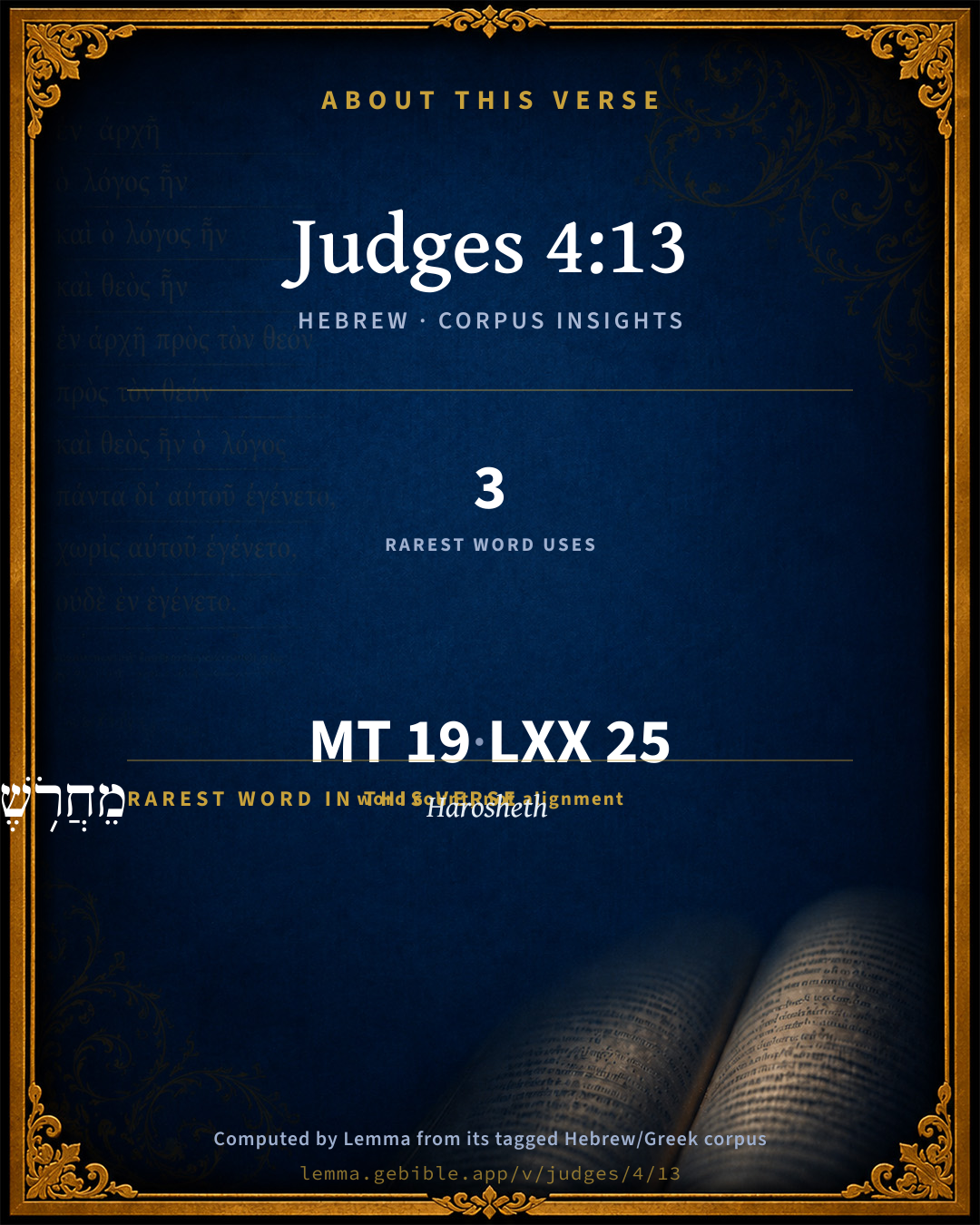
The rarest word here is מֵחֲרֹ֥שֶׁת Harosheth H2800 — appearing just 3 times in the whole Hebrew Bible.

Shared distinctive vocabulary

מֵחֲרֹ֥שֶׁת Harosheth H2800 occurs in 3 verses of the Hebrew Bible. Also found in:

Grammatical profile

  • 1 verb
  • 11 nouns
  • 2 adjectives
  • 2 prepositions
  • 3 particles

Verb forms

  • וַיַּזְעֵ֨ק Hiphil · Sequential Imperfect

Repetition

Words recur within this verse — often emphatic in Hebrew:

  • כָּל all H3605 ×2
  • רִכְבּ֗וֹ chariot H7393 ×2

Hebrew & Septuagint length

In English translation the verse runs 29 words from the Hebrew and 27 from the Septuagint (LXX English) — closely comparable.

A rough comparison of the two English renderings, which tokenize alike — not a word-level alignment.

Word counts can differ between the Hebrew and the Greek without any difference in meaning — e.g. the Hebrew direct-object marker אֵת has no separate Greek word, and Greek often adds the article ὁ.

In the original languages it is 19 Hebrew tokens and 25 Greek tokens — but the two are counted differently (Hebrew bundles its prefixes and suffixes into one token; the Greek is in lemma form), so that isn’t a like-for-like length.

Cross-references

2

Topical passages linked to Judges 4:13 in the Treasury of Scripture Knowledge — connected by theme and wording, ordered by reader-vote popularity; previews shown in the World English Bible.

  • Judges 4:2–3 Yahweh sold them into the hand of Jabin king of Canaan, who reigned in Hazor; the captain of whose host was Sisera, who lived in Harosheth of the Gentiles.
  • Judges 4:7 I will draw to you, to the river Kishon, Sisera, the captain of Jabin's army, with his chariots and his multitude; and I will deliver him into your hand.

Cross-references courtesy of OpenBible.info (CC BY 4.0).

Hebrew and Greek witnesses Masoretic Hebrew ↔ Greek Septuagint

The same verse in the two great witnesses to the Old Testament, shown verse-for-verse.

These are two independent witnesses, not word-aligned to each other, and the Septuagint is shown in lemma (dictionary) form.

Hebrew Judges 4:13 Masoretic · Westminster Leningrad Codex

וַיַּזְעֵ֨ק סִֽיסְרָ֜א אֶת כָּל רִכְבּ֗וֹ תְּשַׁ֤ע מֵאוֹת֙ רֶ֣כֶב בַּרְזֶ֔ל וְאֶת כָּל הָעָ֖ם אֲשֶׁ֣ר אִתּ֑וֹ מֵחֲרֹ֥שֶׁת הַגּוֹיִ֖ם אֶל נַ֥חַל קִישֽׁוֹן

Sisera gathered together all his chariots, even nine hundred chariots of iron, and all the people who were with him, from Harosheth of the Gentiles, to the river Kishon.

World English Bible · Public Domain

Greek LXX Judges 4:13 Septuagint · lemma form

καί καλέω σισαρα πᾶς ὁ ἅρμα αὐτός ἐννακόσιοι ἅρμα σιδηροῦς καί πᾶς ὁ λαός ὁ μετά αὐτός ἀπό αρισωθ ὁ ἔθνος εἰς ὁ χειμάρρους κισων

And Sisara summoned all his chariots, nine hundred chariots of iron and all the people with him, from Arisoth of the Gentiles to the brook of Kison.

LXX2012 (modern English Septuagint) · Public Domain

Hebrew: Westminster Leningrad Codex (CC BY 4.0). Greek: Septuagint (public domain); English from LXX2012 (modern English Septuagint) (Public Domain). How the Septuagint differs from the Hebrew →

Targum (Aramaic paraphrase)

1

The Targum is the ancient Jewish Aramaic paraphrase of the Hebrew Scriptures — an interpretive translation, not the Hebrew text itself. Onkelos (literal) and Pseudo-Jonathan (expansive) render the Torah, and Jonathan the Prophets. Coverage is partial: where no permissively-licensed English translation exists for a verse, only the Aramaic is shown. This is verse-level text, not a word-by-word alignment to the Hebrew.

  1. Targum Jonathan Prophets (Joshua–Malachi)
    וּכְנַשׁ סִיסְרָא יַת כָּל רְתִיכֵיהּ תְּשַׁע מְאָה רְתִיכִין דְבַרְזְלָא וְיַת כָּל עַמָא דְעִמֵיהּ מִתְקוֹף כְּרַכֵּי עַמְמַיָא לְנַחֲלָא דְקִישׁוֹן:

    (no public-domain English translation for this verse)

    Targum Jonathan — Aramaic: “Mikraot Gedolot” (public domain). English: “Sefaria Community Translation” (CC0 1.0 (public-domain dedication)); “London "Chaldee Paraphrase," 1871” (public domain). Text via Sefaria.

Commentary

Notes on Judges 4:13 from classic Christian and Jewish commentators (each source and its license shown beneath its notes). The classic Christian expositions comment on the surrounding passage and are grouped to its opening verse, so a note may address several verses; the Jewish commentaries on the Tanakh (Rashi and others) are per-verse, so they appear only where the commentator wrote on this verse.

Lemma curates 59 commentaries, every one of them public domain or Creative Commons licensed, each selected and text-cleaned for this edition rather than reprinted as found. About our sources →

Trapp's Complete Commentary

John Trapp

Jdg 4:13 And Sisera gathered together all his chariots, [even] nine hundred chariots of iron, and all the people that [were] with him, from Harosheth of the Gentiles unto the river of Kishon.

Ver. 13. Unto the river of Kishon.] "That ancient river," {Jdg 5:21} famous afterwards for the slaughter of the Baalites there. {1Ki 18:40}

John Trapp, A Commentary or Exposition upon All the Books of the Old and New Testament (1647–1656) — public domain. Text from a community e-Sword module.

Jamieson, Fausset & Brown

Robert Jamieson, A. R. Fausset & David Brown

the river of Kishon--The plain on its bank was chosen as the battlefield by Sisera himself, who was unconsciously drawn thither for the ruin of his army.

Jamieson, Fausset & Brown — Commentary Critical and Explanatory on the Whole Bible (1871) — public domain (CC PDM 1.0). Text via the HelloAO Bible API.

Ellicott's Commentary for English Readers

(13) All his chariots.—He saw at once that this very sudden revolt had assumed formidable proportions, and he would need all his forces to dislodge Barak from his strongly entrenched position on Tabor.

Harosheth of the Gentiles.—This is simply the name of the town Harosheth-haggoîm. (See Jdg_4:2.)

A Bible Commentary for English Readers, edited by Charles John Ellicott (1878–1897) — public domain. Text from a community e-Sword module.

The Cambridge Bible for Schools and Colleges

gen. ed. J. J. S. Perowne

13. Harosheth of the Gentiles] See on Jdg_4:2; of the Gentiles (goyim) perhaps on account of the non-Jewish population in the district, cf. Gìlîl hag-goyim, ‘the Circle’ or ‘District of the Gentiles’ in N. Palestine, Isa_9:1.

The Cambridge Bible for Schools and Colleges (gen. ed. J. J. S. Perowne; Cambridge University Press, 1878–1918) — public domain. Text from a community e-Sword module.

John Gill's Exposition

And Sisera gathered together all his chariots,.... Or "therefore" he gathered them together, which might lie some in one place, and some in another, for the better quartering of the men that belonged to them:

even nine hundred chariots of iron; and which, as before observed, are magnified by Josephus, and made to be three thousand:

and all the people that were with him; his soldiers, Jabin's army, of which he was captain, and are called a multitude, Jdg 4:7; and which, the above writer says (h), consisted of three hundred thousand foot, and ten thousand horse, besides the iron chariots: these he collected together, and brought with him:

from Harosheth of the Gentiles; the place where he resided with his army, Jdg 4:2,

unto the river of Kishon; which was near Mount Tabor, the rendezvous of Barak and his men, see Jdg 4:6.

(h) Ut supra. (Antiqu. l. 5. c. 5. sect. 1.)

John Gill's Exposition of the Whole Bible (1746–1763) — public domain (CC PDM 1.0). Text via the HelloAO Bible API.

Haydock's Catholic Bible Commentary

Cison. Part of this torrent falls into the Mediterranean, and part into the sea of Tiberias. It rises from Mount Thabor, (which is about two hour’s walk, south-west of Nazareth) and from Gelboa, &c. (Menochius) --- Here Sisara displayed his immense army, if we may credit Josephus, Jonathan, &c. But the Scripture only specifies 900 chariots of iron. (Calmet) --- Whence, however, we may conclude that his horse and foot would be very formidable. Yet all were presently routed by the small company of Barac, who had God for his leader, ver. 14. (Haydock)

George Leo Haydock (1774–1849), Haydock's Catholic Family Bible and Commentary, 1859 edition — public domain. Excludes Psalms (Douay-Rheims chapter numbering differs from Protestant) and Deuterocanonical books (Catholic canon only).

The Pulpit Commentary

Unto the river (or brook) of Kishon, now the Nahr Mukutta. In the plain of Esdraelon, through which the Kishon flowed into the Mediterranean, there would be room for all his chariots to come into action.

The Pulpit Commentary (1880–1919), ed. H.D.M. Spence-Jones & Joseph S. Exell — public domain. Text from a community e-Sword module.

Scofield Reference Notes

C. I. Scofield

gathered

gathered by cry, or, proclamation.

The Scofield Reference Bible (1917 edition), notes by C. I. Scofield — public domain. Text from a community e-Sword module.

Rashi

Rabbi Shlomo Yitzchaki (Rashi)

From Charoshes Hagoyim to Kishon stream. He mobilized them to proceed to the stream of Kishon from Charoshes Hagoyim where he was stationed.

Rashi on the Tanakh — English translations: “The Judaica Press complete Tanach with Rashi, translated by A. J. Rosenberg” (CC BY 4.0); “Pentateuch with Rashi's commentary by M. Rosenbaum and A.M. Silbermann, 1929-1934” (public domain); “The Metsudah Tanach series, Lakewood, N.J” (CC BY 4.0); and “The Book of Joshua, Metsudah Publications, 1997” (CC BY 4.0). Text via Sefaria.

Radak

Rabbi David Kimhi (Radak)

From Haroshet-hagoyim: We explained this above (Radak on Judges 4:2).

Radak on the Tanakh — English translations: “Sefaria Community Translation” (CC0 1.0 (public-domain dedication)); “Eliyahu Munk, HaChut Hameshulash” (CC BY 4.0); “Rabbi Mike Feuer, Jerusalem Anthology” (CC BY 4.0); and “R. David Kimhi on the first book of Psalms, Translated by R.G. Finch, London, 1919” (public domain). Text via Sefaria.

Lesson kit

Teaching starters — assembled from the data on this page, not authored interpretation. Every prompt links to the verse data it draws on. Edit before teaching.

Judges, in the Historical, opens this verse with 19 words (16 distinct Hebrew lemmas). Its most distinctive word is Chărôsheth (“Harosheth”). A historical commentator’s framing appears above. Read the whole chapter for the surrounding context.

Discussion questions

  1. How does “Harosheth” (Chărôsheth) shape what this verse is saying?
  2. Judges 4:2 shares the word «Harosheth» with this verse. How do the two illuminate each other?
  3. “all” occurs 2× in this one verse. What is the effect of the repetition?
  4. These translations render this verse differently. What is at stake in choosing one wording over another?
  5. The verb «וַיַּזְעֵ֨ק» is Hiphil Sequential Imperfect. How does its form color the action?
  6. Reading how Trapp's Complete Commentary and Jamieson, Fausset & Brown read this verse, where do the two commentators agree and where do they part?

Things to notice

Reading settings

Reading text

Shown beneath each verse's original-language words.

Old Testament
Old Testament edition

Read the OT as the Masoretic Hebrew (MT) or the Greek Septuagint (LXX).

English shown for the Greek Septuagint (in the Hebrew ↔ Greek comparison).

Comparing translations? Open the Compare panel on any verse page to stack up to four side by side.