Psalms 2:8

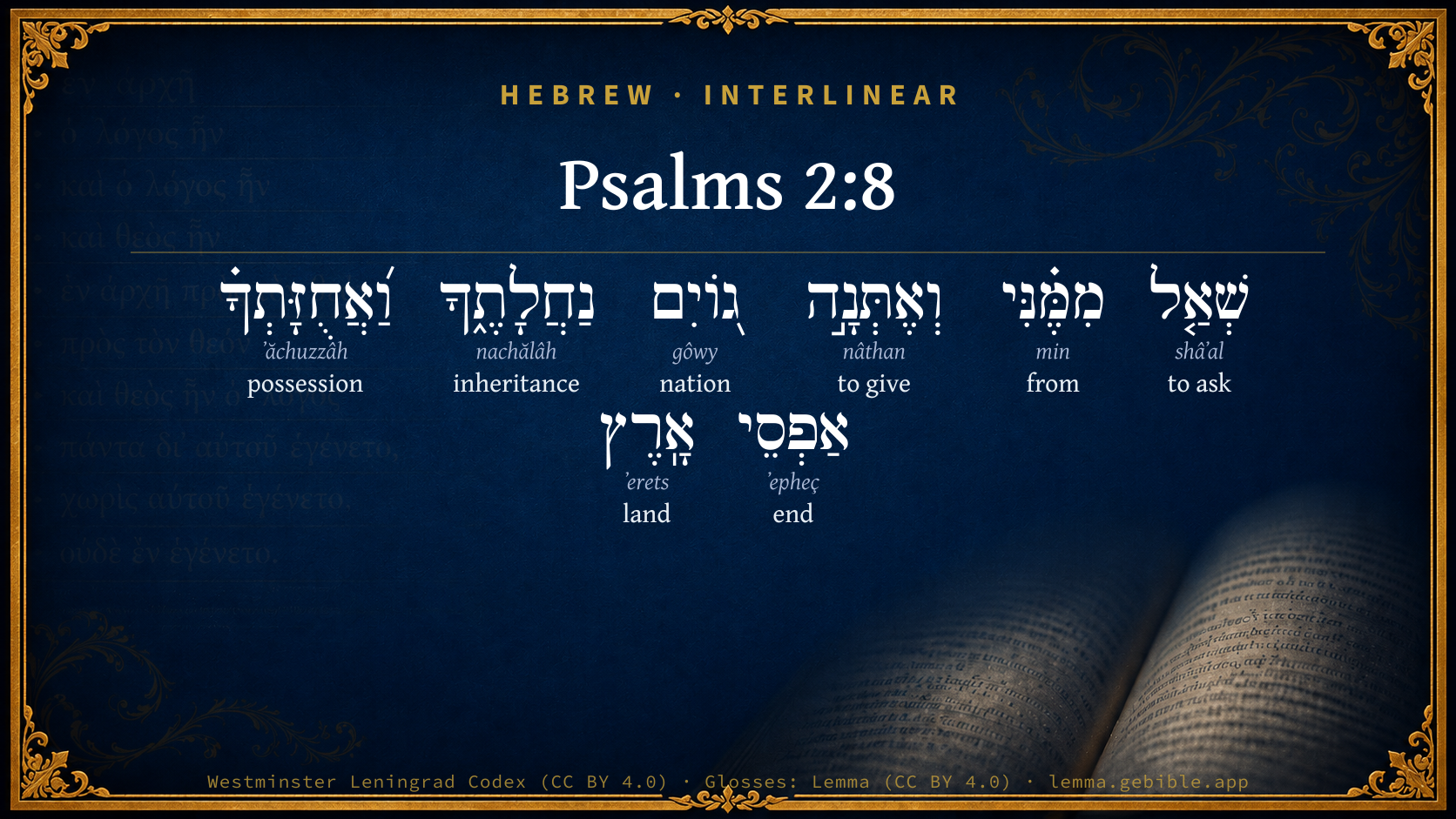
Hebrew (Westminster Leningrad Codex) Psalms 2:8 appears in the Hebrew Old Testament. The text above is from the Westminster Leningrad Codex. Each word links to its Strong’s number, a concise gloss, and parsing drawn from the Open Scriptures Hebrew Bible morphology. Click any word for its full Brown-Driver-Briggs (BDB) entry.
Download image
Cite this verse

Psalms 2:8 (World English Bible). Public Domain. Lemma interlinear Bible study tool, https://lemma.gebible.app/v/psalms/2/8.

Show BibTeX & RIS
BibTeX
RIS
English Translation
Ask of me, and I will give the nations for your inheritance, The uttermost parts of the earth for your possession.
World English Bible · Public Domain
Download a study sheet

One document with this verse’s original text, its word-by-word gloss line, the meaning frame, cross-references with their text, attributed commentary, and full source and license credits — printable, and it pastes into notes with its structure intact.

This verse Autodidact and up

Study sheet (.html) Plain text (.txt)

A passage Seminary Student

Up to 50 verses in one chapter. A passage sheet keeps up to 6 commentary sources and 12 cross-references per verse, in the order this page ranks them, and says so on the sheet whenever that leaves anything out. Ask for a single verse and you get the Autodidact verse sheet above.

Everything on this page stays free to read, with no account — the sheet is a download of what is already on screen, not access to it.

Want to remove ads? Support Godless Engineer
Compare translations 3

The same verse in 3 English versions, stacked beneath the original-language interlinear above. Click any original word for its lexicon entry.

Each is an independent rendering of the whole verse — the interlinear is not word-aligned to these translations.

Highlighted words mark where these versions differ — a whole-verse word diff, not a word-by-word alignment.

  • World English Bible Public Domain
    Ask of me, and I will give the nations for your inheritance, The uttermost parts of the earth for your possession.
  • King James Version Public Domain
    Ask of me, and I shall give thee the heathen for thine inheritance, and the uttermost parts of the earth for thy possession.
  • unfoldingWord Literal Text CC BY-SA 4.0
    Ask from me, and I will give nations your inheritance and the extremities of the earth your possession.

unfoldingWord Literal Text — © unfoldingWord, licensed CC BY-SA 4.0. Word-aligned USFM3 via Door43 (git.door43.org/unfoldingWord/en_ult).

Versions to compare (up to 4)

3 of 4 selected

Show all 18 translations

Every available English version of this verse, each an independent rendering of the whole verse.

  • World English Bible Public Domain
    Ask of me, and I will give the nations for your inheritance, The uttermost parts of the earth for your possession.
  • Berean Standard Bible Public Domain
    Ask Me, and I will make the nations Your inheritance, the ends of the earth Your possession.
  • Majority Standard Bible Public Domain
    Ask Me, and I will make the nations Your inheritance, the ends of the earth Your possession.
  • King James Version Public Domain
    Ask of me, and I shall give thee the heathen for thine inheritance, and the uttermost parts of the earth for thy possession.
  • American Standard Version (1901) Public Domain
    Ask of me, and I will give `thee' the nations for thine inheritance, And the uttermost parts of the earth for thy possession.
  • Revised Version (1885) Public Domain
    Ask of me, and I will give thee the nations for thine inheritance, and the uttermost parts of the earth for thy possession.
  • Geneva Bible (1599) Public Domain
    Aske of me, and I shall giue thee the heathen for thine inheritance, and the endes of the earth for thy possession.
  • Douay-Rheims (1899) Public Domain
    Ask of me, and I will give thee the Gentiles for thy inheritance, and the utmost parts of the earth for thy possession.
  • Young's Literal Translation Public Domain
    Ask of Me and I give nations -- thy inheritance, And thy possession -- the ends of earth.
  • Literal Standard Version CC BY-SA 4.0
    Ask of Me and I give nations [as] Your inheritance, || And the ends of the earth [for] Your possession.
  • Unlocked Literal Bible CC BY-SA 4.0
    Ask me, and I will give you the nations for your inheritance and the farthermost regions of the earth for your possession.
  • unfoldingWord Literal Text CC BY-SA 4.0
    Ask from me, and I will give nations your inheritance and the extremities of the earth your possession.
  • Darby Bible Public Domain
    Ask of me, and I will give thee nations for an inheritance, and for thy possession the ends of the earth:
  • World Messianic Bible Public Domain
    Ask of me, and I will give the nations for your inheritance, the uttermost parts of the earth for your possession.
  • Webster's Bible Public Domain
    Ask of me, and I will give thee the heathen for thy inheritance, and the uttermost parts of the earth for thy possession.
  • Free Bible Version CC BY-SA 4.0
    Ask me, and I will give you the nations as your possessions—the whole earth will belong to you.
  • Bible in Basic English Public Domain
    Make your request to me, and I will give you the nations for your heritage, and the farthest limits of the earth will be under your hand.
  • JPS Tanakh (1917) Public Domain
    Ask of Me, and I will give the nations for thine inheritance, and the ends of the earth for thy possession.

Literal Standard Version (2020), Covenant Press — licensed CC BY-SA 4.0. Text via the HelloAO Bible API (eBible.org). Unlocked Literal Bible (unfoldingWord) — licensed CC BY-SA 4.0. Text via the HelloAO Bible API (eBible.org). unfoldingWord Literal Text — © unfoldingWord, licensed CC BY-SA 4.0. Word-aligned USFM3 via Door43 (git.door43.org/unfoldingWord/en_ult). Free Bible Version, Dr. Jonathan Gallagher — licensed CC BY-SA 4.0. Text via the HelloAO Bible API (eBible.org).

Word by word

More ways to search: Search by grammar → Find every occurrence → Compare this word →

Practice this passage: Drill this verse → Learn its vocabulary →

About this verse

These counts appear in no published source. They are computed here, from the morphology-tagged text and Lemma’s own curated glosses. What Lemma adds →

8
words
8
distinct lemmas
Wisdom
section

Shared distinctive vocabulary

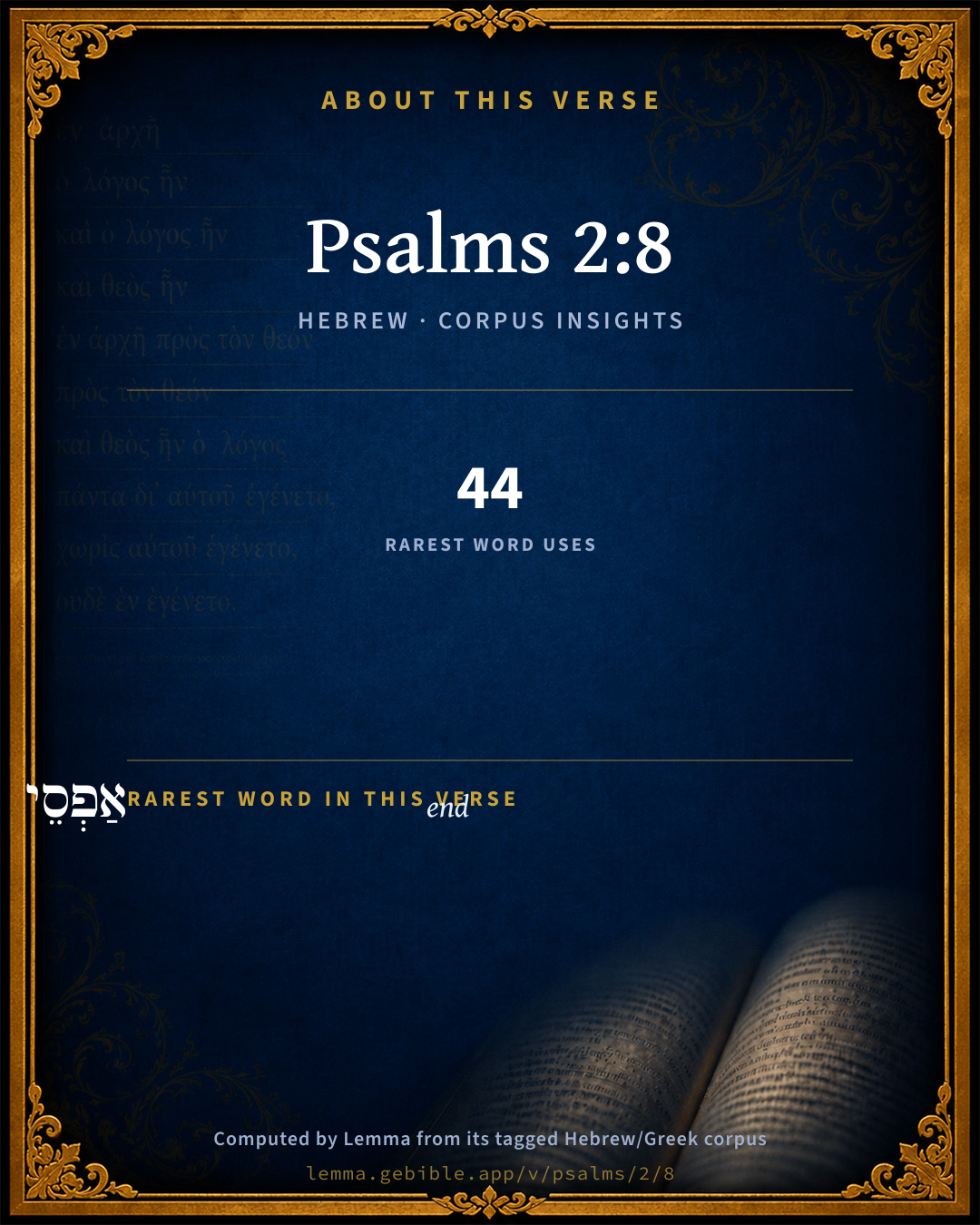
אַפְסֵי end H657 occurs in 43 verses of the Hebrew Bible. Also found in:

Grammatical profile

  • 2 verbs
  • 5 nouns
  • 1 preposition

Verb forms

  • שְׁאַ֤ל Qal · Imperative
  • וְאֶתְּנָ֣ה Qal · Cohortative

Hebrew & Septuagint length

In English translation the verse runs 21 words from the Hebrew and 22 from the Septuagint (LXX English) — closely comparable.

A rough comparison of the two English renderings, which tokenize alike — not a word-level alignment.

Word counts can differ between the Hebrew and the Greek without any difference in meaning — e.g. the Hebrew direct-object marker אֵת has no separate Greek word, and Greek often adds the article ὁ.

Cross-references

5

Topical passages linked to Psalms 2:8 in the Treasury of Scripture Knowledge — connected by theme and wording, ordered by reader-vote popularity; previews shown in the World English Bible.

  • Psalms 22:27 All the ends of the earth shall remember and turn to Yahweh. All the relatives of the nations shall worship before you.
  • Psalms 89:27 I will also appoint him my firstborn, The highest of the kings of the earth.
  • Psalms 72:8 He shall have dominion also from sea to sea, From the River to the ends of the earth.
  • John 17:4–5 I glorified you on the earth. I have accomplished the work which you have given me to do.
  • Daniel 7:13 I saw in the night-visions, and, behold, there came with the clouds of the sky one like a son of man, and he came even to the ancient of days, and they brought him near before him.

Cross-references courtesy of OpenBible.info (CC BY 4.0).

Hebrew and Greek witnesses Masoretic Hebrew ↔ Greek Septuagint

The same verse in the two great witnesses to the Old Testament, shown verse-for-verse.

You’re reading Greek Psalm 2 (Hebrew Psalm 2). The Septuagint counts the superscription, so verse numbers can differ from the Hebrew — chapter-level alignment, not verse-by-verse. Numbering follows Rahlfs.

These are two independent witnesses, not word-aligned to each other, and the Septuagint is shown in lemma (dictionary) form.

Hebrew Psalms 2:8 Masoretic · Westminster Leningrad Codex

שְׁאַ֤ל מִמֶּ֗נִּי וְאֶתְּנָ֣ה ג֭וֹיִם נַחֲלָתֶ֑ךָ וַ֝אֲחֻזָּתְךָ֗ אַפְסֵי אָֽרֶץ

Ask of me, and I will give the nations for your inheritance, The uttermost parts of the earth for your possession.

World English Bible · Public Domain

Greek LXX Greek Psalm 2:8 Septuagint · lemma form

αἰτέω παρά ἐγώ καί δίδωμι σύ ἔθνος ὁ κληρονομία σύ καί ὁ κατάσχεσις σύ ὁ πέρας ὁ γῆ

Ask of me, and I will give you the heathen for your inheritance, and the ends of the earth for your possession.

LXX2012 (modern English Septuagint) · Public Domain

Hebrew: Westminster Leningrad Codex (CC BY 4.0). Greek: Septuagint (public domain); English from LXX2012 (modern English Septuagint) (Public Domain). How the Septuagint differs from the Hebrew →

Commentary

Notes on Psalms 2:8 from classic Christian and Jewish commentators (each source and its license shown beneath its notes). The classic Christian expositions comment on the surrounding passage and are grouped to its opening verse, so a note may address several verses; the Jewish commentaries on the Tanakh (Rashi and others) are per-verse, so they appear only where the commentator wrote on this verse.

Lemma curates 59 commentaries, every one of them public domain or Creative Commons licensed, each selected and text-cleaned for this edition rather than reprinted as found. About our sources →

Trapp's Complete Commentary

John Trapp

Psa 2:8 Ask of me, and I shall give [thee] the heathen [for] thine inheritance, and the uttermost parts of the earth [for] thy possession.

Ver. 8. Ask of me, and I will give thee] All things are conveyed to Christ by asking; shall we think to have anything without asking? Or, are we not worthily miserable that will not make ourselves happy by asking? Now, through Christ’s passion and intercession, it is but ask and have; open thy mouth, and I will fill it. If at any time we ask and miss, it is for the most part because we ask amiss, Jas 4:2-3.

The heathen for thine inheritance] The kingdom of grace (the object whereof are all nations) Christ hath by donation from his Father; for his natural kingdom he hath as God coequal with his Father from all eternity.

John Trapp, A Commentary or Exposition upon All the Books of the Old and New Testament (1647–1656) — public domain. Text from a community e-Sword module.

The Biblical Illustrator

Joseph S. Exell

Psa_2:8

Ask of Me, and I shall give Thee the heathen for Thine inheritance.

The Church aroused to the missionary work

I. The Lords intercession, in reference to missionary enterprise. The great object of missionary enterprise is the subject of our Saviours intercession. The object is the diffusion of the knowledge of Christianity throughout the world; that by means of the knowledge of Christianity, accompanied by the influence of the Divine Spirit, mankind of all nations may be converted to the faith and obedience of Christ, and be made wise, and happy, and good through Him. It is but natural to suppose that what was the leading design of our Lord in becoming incarnate, and suffering, and dying should be a subject of His intercessory prayers. Missionary enterprise, in the grand means by which these objects are to be effected, is one of the principal subjects of our Lords intercessions. Secondary means are varied; the primary means is the Divine influence. In proportion to the degree in which this is communicated, missionary enterprise is prosperous; in proportion to the degree in which it is withheld, it languishes. And the communication of Divine influence was a leading object of our Lords atonement, and must be a leading subject of His intercession.

II. The dignity and importance of missionary enterprise. It is a clear proof of the estimation in which our Lord holds missionary enterprise, that it is the subject of constant intercession with His Father. In endeavouring to promote missionary enterprise we are doing something that is very pleasing to our Lord and Saviour. We may be sure that we shall have all the assistance that is necessary in order to perform our duty in reference to this undertaking. And the fact of our Lords intercession gives us the most abundant assurance that this undertaking will ultimately be completely successful. (John Brown, A. M.)

Prayer glorified by Christs example

It became Jesus to ask. Though He was a Son, yet learned He obedience. Many objections are made to prayer. Some of them are specious, but all are founded on ignorance. The best way to meet them is to take our stand on the Scriptures. God did not dispense with prayer, even in the ease of His Son. Therefore, how much more not with us. But how was He to ask? On earth He prayed like us. In heaven He continues His prayer. And here, through His people, He prays. And His prayers and ours rest on His atonement. Therefore He asks in His own name, and we in His. Let us be encouraged to pray. But let our prayers lead us to active endeavour. We cannot labour in vain. (W. Jay.)

The heathen for Christ

Here is a wonderful donation. The giver is Jehovah, the receiver is the worlds Redeemer, and the gift is the heathen world--mighty populations lying outside of the Judaean realm. What an inheritance is this, and it is given to Christ!

I. This vast inheritance is given Him to cultivate.

1. This inheritance is worth cultivation. It is most prolific, its potential value is immense. It will grow the highest wisdom and the noblest virtues. Sages, poets, orators, apostles lie there by millions.

2. The cultivation of this inheritance has been sadly neglected. The fences are destroyed, the surface is crusted and overrun with thorns and thistles and noxious weeds.

3. Christ alone is able to cultivate it. Others have tried, but failed.

Christ gives to the soul of heathendom that which it wants, and that which none other can give--

1. A Deity in which all hearts can unite in supreme love.

2. A creed in which all intellects can repose with unwavering confidence.

3. A law which all consciences can approve without suspicion.

4. An enterprise in which all souls can work without hesitancy or lack of interest.

II. This vast inheritance is given Him to enjoy. It is a possession of immense value. It will be His as the reward of His mediatorial work. When its vast wildernesses will bloom as Edens, He will see of the travail of His soul and be satisfied. What a joy will be His! Think of the joy of the husbandman surveying in autumn his fields bearing the richest crops of golden grain. Think of me joy of the patriot when he beholds the rebellious provinces bowing again in loyalty to the sovereignty of his country. Think of the joy of the philanthropist in seeing his benevolent efforts crowned with success in the removal of diseases that afflict the body or tyrannies that crush the man. (Homilist.)

Christs inheritance

I. Christ is decreed to be the Son of Jehovah. As such He is both Priest and King. Christ toward us, says Gurnall, acts as a King, but toward His Father as a Priest.

II. As the Son He is promised an inheritance. This inheritance includes all the nations of the earth.

III. But though He is a King and has a promised inheritance, yet His government is to be established by the use of means.

1. These means are the means of grace.

2. These are to be offered to every creature on the earth.

3. We live in that epoch of the worlds history when the Church is actively engaged in having all men reconciled to the Son through the preaching of the gospel.

IV. The time will come when His enemies will be subdued.

1. The Church, therefore, should be diligent in the performances of its present duties.

2. The world should heed the offers of grace ere it be too late.

3. Blessed are all they that put their trust in Him.

4. Let us wait upon God in prayer for the fulfilment of His promise to give the Son the heathen for His inheritance. (L. O. Thompson.)

The uttermost parts of the earth for Thy possession.--

Final triumph of Christianity

This assured--

I. By the promises of the Bible, which are many, explicit, positive, and world-embracing.

II. By the Divine origin and character of Christianity. Christianity is on trial; if it fails to fulfil its promises, then it will be demonstrated that it is not of God.

III. By the measure of success which it has already achieved. There is nothing comparable with it. It saves the chief of sinners. It transforms savages, demons, into saints. Christianity thus stands committed to the achievement of universal dominion. (J. M. Sherwood, D. D.)

Prayer for missions

I believe I am speaking to the right people when I ask you to pray. Unprayed for, I feel very much as if a diver were sent down to the bottom of a river with no air to breathe, or as if a fireman were sent up to a blazing building and held an empty hose; I feel very much as a soldier who is firing blank cartridge at an enemy, and so I ask you earnestly to pray that the gospel may take saving and working effect on the minds of those men to whose notice it has been introduced by us. (James Gilmour.)

Universal dominion of Christ

The boldest thought ever suggested to the human mind is Christs proposition to convert this world to Himself. For originality of conception, simplicity of method, and certainty of result it has no parallel in the world of thought. Bolder than the dream of the Macedonian to conquer all kingdoms by his sword, than the purpose of the Roman to unify all governments into one, than the hope of Leibnitz to create a universal language for this our babbling race, it stands forth sublime in its isolation, to excite our admiration, inflame our zeal, invite our cooperation, and inspire our faith in the future of mankind. (J. P. Newman.)

The Biblical Illustrator, edited by Joseph S. Exell (c. 1880s–1900s) — public domain. Text from a community e-Sword module.

Joseph Benson's Commentary

Psa 2:8. Ask of me — Claim or demand it of me as thy right by my promise, and thy birth and purchase; the heathen for thine inheritance — To be possessed and enjoyed by thee in the manner of an inheritance, namely, surely and perpetually. Thus “Christ was to enter upon the exercise of the intercessorial branch of his priestly office, with a request to the Father that the heathen world, &c., might be given for his inheritance, in return for the labours he had undergone, and the pains he had endured; as also to supply the place of the Jews, who were his original inheritance and possession, but were cast off because of unbelief.” — Horne.

Joseph Benson's Commentary on the Old and New Testaments (1811–1818) — public domain. Text from a community e-Sword module.

Tyndale Open Study Notes

Tyndale Open Resources

2:8 In an example of the suzerain-vassal relationship between the Lord and Israel’s king (see Deuteronomy Book Introduction, “Literary Form”), the Lord invites the king to ask for favors (see Ps 21:2, 4). • All nations will be subject to David’s descendant, the Messiah.

Tyndale Open Study Notes — © Tyndale Open Resources, licensed CC BY-SA 4.0. Text via the HelloAO Bible API.

Geneva Bible (1599)

Geneva Bible translators

Not only the Jews, but the Gentiles also.

Geneva Bible (1599) marginal notes — public domain. Text via Bolls.life.

Jamieson, Fausset & Brown

Robert Jamieson, A. R. Fausset & David Brown

The hopes of the rebels are thus overthrown, and not only so; the kingdom they opposed is destined to be coextensive with the earth.

heathen--or, "nations" (Psa 2:1).

and the uttermost parts of the earth-- (Psa 22:27); denotes universality.

Jamieson, Fausset & Brown — Commentary Critical and Explanatory on the Whole Bible (1871) — public domain (CC PDM 1.0). Text via the HelloAO Bible API.

Adam Clarke's Commentary

Verse 8. Ask of me, and I shall give thee] Here a second branch of Christ's office as Saviour of the world is referred to; viz., his mediatorial office. Having died as an atoning sacrifice, and risen again from the dead, he was now to make intercession for mankind; and in virtue and on account of what he had done and suffered, he was, at his request, to have the nations for his inheritance, and the uttermost parts of the earth for his possession. He was to become supreme Lord in the mediatorial kingdom; in consequence of which he sent his apostles throughout the habitable globe to preach the Gospel to every man.

Adam Clarke's Commentary on the Bible (1810–1826) — public domain. Text from a community e-Sword/MySword module.

John Calvin's Commentaries

8. Ask of me. Christ, it is true, besought his Father (John 17:5) to “glorify him with the glory which he had with him before the world was;” yet the more obvious meaning is, that the Father will deny nothing to his Son which relates to the extension of his kingdom to the uttermost ends of the earth. But, in this wonderful matter, Christ is introduced as presenting himself before the Father with prayers, in order to illustrate the free liberality of God in conferring upon men the honor of constituting his own Son governor over the whole world. As the eternal Word of God, Christ, it is true, has always had in his hands by right sovereign authority and majesty, and as such can receive no accessions thereto; but still he is exalted in human nature, in which he took upon him the form of a servant. This title, therefore, is not applied to him only as God, but is extended to the whole person of the Mediator; for after Christ had emptied himself there was given to him a name which is above every name, that before him every knee should bow, (Philippians 2:9) David, as we know, after having obtained signal victories reigned over a large extent of territory, so that many nations became tributaries to him; but what is here said was not fulfilled in him. If we compare his kingdom with other monarchies it was confined within very narrow boundaries. Unless, therefore, we suppose this prophecy concerning the vast extent of kingdom to have been uttered in vain and falsely, we must apply it to Christ, who alone has subdued the whole world to himself and embraced all lands and nations under his dominion. Accordingly, here, as in many other places, the calling of the Gentiles is foretold, to prevent all from imagining that the Redeemer who was to be sent of God was king of one nation only. And if we now see his kingdom divided, diminished, and broken down, this proceeds from the wickedness of men, which renders them unworthy of being under a reign so happy and so desirable. But although the ingratitude of men hinders the kingdom of Christ from prospering it does not render this prediction of none effect, inasmuch as Christ collects the dispersed remnants of his people from all quarters, and in the midst of this wretched desolation, keeps them joined together by the sacred bond of faiths so that not one corner only, but the whole world is subjected to his authority. Besides, however insolently the ungodly may act, and however they may reject his sovereignty, they cannot, by their rebellion, destroy his authority and power. To this subject also belongs what immediately follows:

John Calvin's Commentaries (1540-1563) — public domain. Text from the Calvin Translation Society English edition (1840s-50s) via the Christian Classics Ethereal Library (ccel.org). Calvin's coverage is partial (roughly two-thirds of the Bible); uncommented books and verses are honest gaps, never fabricated. The 19th-century editor's footnotes and remarks are omitted so the notes are faithfully Calvin's own voice.

The Cambridge Bible for Schools and Colleges

gen. ed. J. J. S. Perowne

8. Ask of me] Inheritance is the natural right of sonship. Yet even the son must plead the promise and claim its fulfilment. Dominion over the nations is not expressly mentioned in 2 Samuel 7; but cp. Psa_89:27.

inheritance … possession] Words frequently applied to the gift of Canaan to Israel (Gen_17:8; Deu_4:21; Deu_32:49). Now the world shall be his with equal right. Jehovah is king of the world, and He offers His representative a world-wide dominion. Cp. Psa_72:8; Zec_9:9-10.

The Cambridge Bible for Schools and Colleges (gen. ed. J. J. S. Perowne; Cambridge University Press, 1878–1918) — public domain. Text from a community e-Sword module.

John Gill's Exposition

Ask of me,.... Jehovah is either here again introduced speaking, or these words are a continuation of the Son's account of what his Father said unto him; which do not suppose any superiority in the one, or inferiority in the other; but are only expressive of the Father's great respect and affection for his Son, as such a way of speaking among men shows, Est 5:3; and of the great interest the Son had in his Father, who could ask nothing but he had it; and shows the perfect harmony, agreement, and unity between them: see Kg1 3:5; Christ, in the council and covenant of grace and peace, asked many things of his Father, which were granted; he asked for the persons of all the elect to be his bride and spouse, and his heart's desire was given him, and the request of his lips was not withheld from him: he asked for all the blessings of grace for them; for spiritual life here, and eternal life hereafter; and all were given him, and put into his hands for them, Psa 20:2; and here it is promised him,

and I shall give thee the Heathen for thine inheritance, and the uttermost parts of the earth for thy possession; by "the Heathen", and "the uttermost parts of the earth", are meant God's elect among the Gentiles, and who live in the distant parts of the world; which are Christ's other sheep, the Father has given to him as his portion, and whom he has made his care and charge: as if it was not enough that he should be King of Zion, or have the government over his chosen ones among the Jews, he commits into his hands the Gentiles also; see Isa 49:6; and these are given him as his inheritance and possession, as his portion, to be enjoyed by him; and who esteems them as such, and reckons them a goodly heritage, and a peculiar treasure, his jewels, and the apple of his eye. These words respect the calling of the Gentiles under the Gospel dispensation; and the amplitude of Christ's kingdom in all the earth, which shall be from sea to sea, and from the rivers to the ends of the earth.

John Gill's Exposition of the Whole Bible (1746–1763) — public domain (CC PDM 1.0). Text via the HelloAO Bible API.

Albert Barnes' Notes on the Bible

Ask of me - That is, of God. This is a part of the “decree” or purpose, as mentioned in Psa 2:7. That decree embraced not only the design to constitute him as his Son, in the sense that he was to be king in Zion, but also the purpose to give him a dominion embracing “the heathen” and “the uttermost parts of the earth.” This wide dominion was to be given him on condition that he would “ask” for it, thus keeping up the idea that Yahweh, as such, is the great source of authority and empire, and that the Messiah, as such occupies a rank subordinate to him. This relation of the Father and Son is everywhere recognized in the New Testament. As we may be sure that the Messiah will ask for this, it follows that the world will yet be brought under his scepter. It may be added that as this wide dominion is promised to the Messiah only on condition that he “asks” for it or prays for it, much more is it true that we can hope for this and for no favor from God, unless we seek it by earnest prayer.

And I shall give thee - I will give thee. That is, he would ultimately give him this possession. No time is specified when it would be done, and the prophecy will be fulfilled if it shall be accomplished in any period of the history of the world.

The heathen - The nations (notes, Psa 2:1); that is, the world. In the time of the writer of the psalm, the world would be spoken of as divided into Hebrews and other nations; the people of God and foreigners. The same division is often referred to in the New Testament under the terms Jew and Gentile, as the Greeks divided all the world into Greeks and barbarians. The word would now embrace all the nations which are not under the influence of the true religion.

For thine inheritance - Thy heritage; thy portion as my Son. There is an allusion here to the fact that he had constituted him as his Son, and hence, it was proper to speak of him as the heir of all things. See the notes at Heb 1:4.

And the uttermost parts of the earth - The farthest regions of the world. This promise would properly embrace all the world as then known, as it is now known, as it shall be hereafter known.

For thy possession - That is, as king. This, on the earth, was be to his possession as the Son of Yahweh, constituted as king. It may be remarked here,

(a) that this can have its fulfillment only in the Lord Jesus Christ. It was not true of David nor of any other Hebrew monarch that he had conceded to him, in fact, any such possession. Their dominions extended, at any time, but little beyond the bounds of Palestine, and embraced a very limited part of the earth - but a small territory, even as compared with many then existing kingdoms. The phrase used here could never have been applied to the limited and narrow country of Palestine.

(b) The promise is to be understood as still in full force. It has never been cancelled or recalled, and though its fulfillment has seemed to be long delayed, yet as no time was specified, its spirit and meaning have not been disregarded. Events have shown that it was not intended that it should be speedily accomplished; and events, when no time is specified, should be allowed to be interpreters of the original meaning of the prophecy.

(c) The promise will yet be fulfilled. It is evidently supposed in the promise that the Messiah would ask for this; and it is solemnly affirmed that if he did, this wide inheritance would be granted to him. The world, then, is to be regarded as given by covenant to the Son of God, and in due time he will set up his dominion over the earth, and rule over mankind. The period is coming when the actual scepter swayed over the nations of the earth will be that of the Son of God, and when his right to give laws and to reign will be acknowledged from the rising to the setting sun. This is the only thing in the future that is certainly known to us, and this is enough to make everything in that future bright.

Albert Barnes' Notes on the Bible (1834–1885) — public domain. Text from a community e-Sword/MySword module.

Matthew Poole's English Annotations

Ask of me; claim or demand it of me, as thy right by my promise, and thy birth and purchase.

For thine inheritance; to be possessed and enjoyed by thee in a manner of an inheritance, to wit, constantly, surely, and perpetually.

The uttermost parts of the earth; either,

1. The whole land of Canaan, from one end of it to the other, as this phrase is used, Psa 61:2; 72:8; which is but a very narrow sense, and that was but a very small kingdom, and no way agreeable to those magnificent expressions here used. Or rather,

2. The whole world, not only the Jewish nation, but the Gentiles also, as this phrase is almost universally used in the Old Testament, as Psa 19:4; 22:28; 46:10; 65:5; Isa 40:28; 45:22, &c. And so these words declare the great amplitude of the kingdom of the Messiah.

Matthew Poole's English Annotations on the Holy Bible (1683–1685) — public domain. Text from a community e-Sword/MySword module.

The Treasury of David

Charles H. Spurgeon

Verse 8. "Ask of me." It was a custom among great kings, to give to favoured ones whatever they might ask. (See Esther 5:6; Matthew 14:7.) So Jesus hath but to ask and have. Here he declares that his very enemies are his inheritance. To their face he declares this decree, and "Lo! here," cries the Anointed One, as he holds aloft in that once pierced hand the sceptre of his power, "He hath given me this, not only the right to be a king, but the power to conquer."

Verse 8. "Ask of me." The priesthood doth not appear to be settled upon Christ by any other expression than this, "Ask of me." The Psalm speaks of his investiture in his kingly office; the apostle refers this to his priesthood, his commission for both took date at the same time; both bestowed, both confirmed by the same authority. The office of asking is grounded upon the same authority as the honour of king. Ruling belonged to his royal office, asking to his priestly. After his resurrection, the Father gives him a power and command of asking.

Stephen Charnock.

Verse 8. As the limner looks on the person whose picture he would take, and draws his lines to answer him with the nearest similitude that he can, so God looks on Christ as the archtype to which he will conform the saint, in suffering, in grace, in glory; yet so that Christ hath the pre-eminence in all. Every saint must suffer, because Christ suffered: Christ must not have a delicate body under a crucified head; yet never any suffered, or could, what he endured. Christ is holy, and therefore so shall every saint be, but in an inferior degree; an image cut in clay cannot be so exact as that engraved on gold. Now, our conformity to Christ appears, that as the promises made to him were performed upon his prayers to his Father, his promises made to his saints are given to them in the same way of prayer: "Ask of me," saith God to his Son, "and I shall give thee." And the apostle tells us, "Ye have not, because ye ask not." God hath promised support to Christ in all his conflicts. Isaiah 42:1. "Behold my servant, whom I uphold;" yet he prayed "with strong cries and tears," when his feet stood within the shadow of death. A seed is promised to him, and victory over his enemies, yet for both these he prays. Christ toward us acts as a king, but toward his Father as a priest. All he speaks to God is by prayer and intercession. So the saints, the promise makes them kings over their lusts, conquerors over their enemies; but it makes them priests toward God, by prayer humbly to sue out these great things given in the promise.

William Gurnall, 1617 - 1679.

Verse 8. It will be observed in our Bible that two words of verse eight are in italics, intimating that they are not translations of the Hebrew, but additions made for the purpose of elucidating the meaning. Now if the "thee" and the "for" are left out, the verse will read thus, "Ask of me, and I shall give the heathen, thine inheritance, and thy possession, the uttermost parts of the earth." And this reading is decidedly preferable to the other. It implies that by some previous arrangement on the part of God, he had already assigned an inheritance of the heathen, and the possession of the earth, to the person of whom he says, "Thou art my Son." And when God says, "I will give," etc., he reveals to his Anointed, not so much in what the inheritance consisted, and what was the extent of possession destined for him, as the promise of his readiness to bestow it. The heathen were already "the inheritance," and the ends of the earth "the possession," which God had purposed to give to his Anointed. Now he says to him, "Ask of me," and he promises to fulfil his purpose. This is the idea involved in the words of the text, and the importance of it will become more apparent, when we consider its application to the spiritual David, to the true Son of God, "whom he hath appointed heir of all things."

Verse 8. Christ's inheritance. William Jay.

Prayer indispensable. Jesus must ask.

Charles H. Spurgeon's The Treasury of David (1869–1885) — public domain. Psalms only. Text from a community e-Sword/MySword module.

Whedon's Commentary on the Bible

Daniel D. Whedon

8. Heathen—Mixed people, Gentiles.

Uttermost parts of the earth—The total boundary of the world. The kingdom of Christ embraces the whole world, all worlds, all things visible and invisible. Col_1:16-17. The Church is only that part of his kingdom on earth which has publicly submitted to his authority, and has obtained pardon and reconciliation through him. The rest are under him dominion, though in a state of revolt. See on Psa_2:9

Daniel D. Whedon (gen. ed.), Commentary on the Old and New Testaments (1874–1909) — public domain. Text from a community e-Sword module.

The Pulpit Commentary

Ask of me, and I shall give thee the heathen for thine inheritance. A very small part of the heathen were the inheritance of David, and therefore the Messiah only can be spoken of in this verse. Before Messiah "all kings" were to "fall down; all nations to do him service". (Psa_72:11; comp. Isa_49:22 Isa_60:3, 4 Mat_28:19, etc.) And the uttermost parts of the earth for thy possession. (comp. Isa_52:10 Jer_16:19 Mic_5:4 Zec_9:10 Act_13:47)

The kingdom and glory of Christ.

"Ask," etc. We have the highest authority for regarding this psalm as a prophecy of the kingdom and glory of Christ. Interpreters labour in vain to fix on some occasion in Israel"s history to account for its composition. No adequate explanation can be imagined of its scope and language but that given in Act_4:25. (comp. Act_13:33 Heb_1:5) Vers. 10-12 would be blasphemous arrogance if spoken by and of a mere earthly king. Here is a declaration and a condition.

I THE DECLARATION.

1. The voice of supreme authority. A grant of absolute dominion over the whole human race. This must be a Divine promise; else it were meaningless, impious. (Psa_22:28) Subordination is implied, as in 1Co_15:27; and in our Saviour"s own declarations. (Joh_6:38 Joh_15:1) But not inferior nature. If it were if Jesus were human only then the gospel would have immeasurably lowered our position towards God; put us further away, instead of bringing us nigh. For under the old covenant, Jehovah himself was King and Shepherd of Israel. On the other hand, the real Manhood of Christ is as indispensable to this Kingship as his Deity. (see Joh_5:27)

2. Or" almighty power. What God promises, he is able to perform. How? How is human freedom reconciled with Divine control of all things, from the counsels of kings (Pro_21:1) to the sparrow"s fall? (Mat_10:29) A problem this that utterly defies human reason. But practically it is solved by faith and prayer. (Php_2:13 Dan_4:35)

3. Of Divine faithfulness. God"s word is pledged and cannot be broken. (Isa_11:9, Isa_11:10) As matter of right, the kingdom is Christ"s. (Mat_28:18) It shall be so in fact (1Co_15:25) one day.

II THE CONDITION. "Ask of me.

1. Our Lord Jesus personally fulfilled this condition, claimed the fulfillment of the promise, when he said, "I have finished," etc.. (Joh_17:4; comp. Php_2:9-11)

2. But Christ is one with "the Church, which is his body." As he by his intercession makes our prayers his own, so we are to make this great request ours. He has taught us to set it foremost in our prayers: "Thy kingdom come". (comp. Psa_72:15; and note the commencing fulfilment, Act_1:14)

CONCLUSION.

1. The scope of Christian hope and effort is as wide as God"s presence it embraces the whole world. (Mat_28:19 Gal_3:8)

2. God"s promises await our prayers. (Joh_16:23)

The Pulpit Commentary (1880–1919), ed. H.D.M. Spence-Jones & Joseph S. Exell — public domain. Text from a community e-Sword module.

John Wesley's Explanatory Notes

Earth - Not only the Jewish nation, but the whole world.

John Wesley, Explanatory Notes Upon the Whole Bible (1754–1765) — public domain. Text via the GEBible commentary corpus.

J. A. Alexander on Psalms

Joseph Addison Alexander

8. The recital of Jehovah's declaration to his Son is still continued. Ask of me, and I will give nations (as) thy heritaqe, i.e. thy portion as my Son, and (as) thy (permanent) possession, from a verb denoting to hold fast, the ends of the earth, a common Old Testament expression for the whole earth, the remotest bounds and all that lies between them. The phrase is never applied to ·a particular country, and cannot therefore be explained of Palestine or David's conquests, without violently changing the sublime to the ridiculous. The only subject, who can be assumed and carried through without absurdity, is the Messiah, who, as the Son and heir of God, had a right to ask this vast inheritance. That he had asked it and received it, is implied in the dominion claimed for him in ver. 2 and 3, where the nations are represented in revolt against him as their rightful sovereign. It was to justify this claim that the divine decree is here recited, the constitution of Messiah's kingdom, in which its limits are defined as co-extensive with the earth.

Joseph Addison Alexander, The Psalms Translated and Explained (1850) — public domain. Text from a community e-Sword module.

unfoldingWord translationNotes

Door43 World Missions Community

Connecting Statement:

Yahweh continues speaking to the new king of Israel.

the nations for your inheritance ... the farthermost regions of the earth for your possession

These phrases express very similar ideas. (See: Parallelism)

the farthermost regions of the earth

"the lands that are very far away"

You will break them with an iron rod; like a jar of a potter, you will smash them to pieces

These phrases express very similar ideas. (See: Parallelism)

You will break them with an iron rod

Defeating the nations is spoken of as breaking them, and his power is spoken of as an iron rod. AT: "You will defeat them completely by your power" (See: Metaphor)

you will smash them to pieces

Destroying nations is spoken of as if they could be smashed like a clay jar. AT: you will completely destroy them like a clay pot" (See: Metaphor and Simile)

a jar of a potter

A potter is a person who makes clay pots and jars. These are fragile and can be broken easily. AT: "a clay jar" or "a clay pot" (See: Translate Unknowns)

translationWords

nation

inherit

possess

rod

unfoldingWord translationNotes — © Distant Shores Media and the Door43 World Missions Community, licensed CC BY-SA 4.0. Source: git.door43.org/Door43/en_tn.

Rashi

Rabbi Shlomo Yitzchaki (Rashi)

Request of Me Pray to Me whenever you come to battle your enemies.

Rashi on the Tanakh — English translations: “The Judaica Press complete Tanach with Rashi, translated by A. J. Rosenberg” (CC BY 4.0); “Pentateuch with Rashi's commentary by M. Rosenbaum and A.M. Silbermann, 1929-1934” (public domain); “The Metsudah Tanach series, Lakewood, N.J” (CC BY 4.0); and “The Book of Joshua, Metsudah Publications, 1997” (CC BY 4.0). Text via Sefaria.

Radak

Rabbi David Kimhi (Radak)

Ask of Me: – And He says to me, Ask of Me.

and I will give thee the nations for thine inheritance: – as He said to him, “And I have cut off all thine enemies from before thee; and I will make thee a great name like unto the name of the great ones that are in the earth” (2 Sam. 7:9); and it says (ibid. 8:14), “And all the Edomites became servants to David”; and it says (ibid. 8:6), “And the Syrians became servants to David”; and it says (1 Chron. 19:17), “and the fame of David went out into all the lands, and the Lord brought the fear of him upon all the nations.” And this is what he means when he says, “I will give thee the nations for thine inheritance.”

And the uttermost parts (אפסי) of the earth for thy possession: – They are the ends (קצות) of the earth, and (the Hebrew words) אפס and קץ are approximate in meaning.

Radak on the Tanakh — English translations: “Sefaria Community Translation” (CC0 1.0 (public-domain dedication)); “Eliyahu Munk, HaChut Hameshulash” (CC BY 4.0); “Rabbi Mike Feuer, Jerusalem Anthology” (CC BY 4.0); and “R. David Kimhi on the first book of Psalms, Translated by R.G. Finch, London, 1919” (public domain). Text via Sefaria.

Ibn Ezra

Rabbi Abraham ibn Ezra

Ask (שְׁאַ֤ל - she'al): It is the custom (minhag) of a father to give an inheritance (le-hanchil) to the son; therefore He said, "and I will make the nations your inheritance (nachalatékha)."

Ends of the earth (אַפְסֵי־אָֽרֶץ - afsei-aretz): From the same root (mi-gizrat) as [in (Genesis 47:15)] "for the money is finished (ki afes kasef)." [It refers to] places cut off (negzarim) from settlement (mi-yishuv).

Ibn Ezra on the Tanakh — English translations: “Sefaria Community Translation” (CC0 1.0 (public-domain dedication)); “Yalkut, Sifsei Chachomim Chumash, Metsudah Publications, 2009” (CC BY 4.0); and “Commentary of Ibn Ezra on Isaiah - trans. by M. Friedlander, 1873” (public domain). Text via Sefaria.

Lesson kit

Teaching starters — assembled from the data on this page, not authored interpretation. Every prompt links to the verse data it draws on. Edit before teaching.

Psalms, in the Wisdom, opens this verse with 8 words (8 distinct Hebrew lemmas). Its most distinctive word is ʼepheç (“end”). A historical commentator’s framing appears above. Read the whole chapter for the surrounding context.

Discussion questions

  1. The word ʼepheç carries the sense “end.” How does it shape the verse?
  2. Numbers 13:28 shares the word «end» with this verse. How do the two illuminate each other?
  3. These translations render this verse differently. What is at stake in choosing one wording over another?
  4. The verb «שְׁאַ֤ל» is Qal Imperative. How does its form color the action?
  5. Reading how Trapp's Complete Commentary and The Biblical Illustrator read this verse, where do the two commentators agree and where do they part?

Things to notice

Reading settings

Reading text

Shown beneath each verse's original-language words.

Old Testament
Old Testament edition

Read the OT as the Masoretic Hebrew (MT) or the Greek Septuagint (LXX).

English shown for the Greek Septuagint (in the Hebrew ↔ Greek comparison).

Comparing translations? Open the Compare panel on any verse page to stack up to four side by side.